The battered relationship between the English and the Irish
The Shamrock, the Irish three-leaf clover, national symbol

The Shamrock, the Irish three-leaf clover, national symbol
The Tudor dynasty is quite well known to many people for various reasons. Of course, most people know the reign of terror of Henry VIII, who left a trail of destruction with his series of marriages, exhausted the English treasury due to the many wars he waged, and the extravagant court and tournaments he maintained. But Henry VIII also founded the Anglican Church, from which the Protestant variant of the English Church would emerge.
Having survived and emerged victorious from the Wars of the Roses between the House of Lancaster and the House of York (1455-1485), the dynasty laid the foundation for the later (expansion) of the British Empire. However, the Tudors are also responsible for the longest-running conflict on the British Isles, that between Protestants and Catholics. The history of this conflict is as complex as it is interesting.
Here, the Reformation was imposed from above and did not, as elsewhere in Europe, arise from a popular movement. The Tudors pursued a colonization policy in Ireland, the island that had been dominated by the English ruler since the 12th century. Henry VIII managed to subjugate the Irish nobility and the Anglican doctrine was elevated to the state religion in Ireland. Catholic masses were later banned, and those who dared to attend them had to pay with land confiscation, which was then transferred to pro-English Protestants. The rebellious Catholic Ireland had to be kept under control due to this policy. The great advantage was that this seemed a relatively cheap solution for the English.
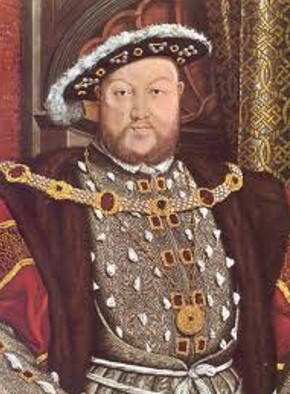
Hendrik VIII Tudor, after a portrait by Hans Holbein ca.1540. Source: Englishistory.net
However, the Irish continued to resist English domination, especially outside the area known as "The Pale"; the area around the current capital Dublin. This area was in the hands of the English king as a feudal lord. Under Elizabeth I of England, Catholics were heavily persecuted, partly because she was at odds with both the Pope and Catholic Spain under Philip II. Here, at the end of the Middle Ages, lies the basis for the conflict between Catholics and Protestants in this area that fell under the influence of the English crown. And Ireland has been predominantly Catholic since the 5th century.
In 1641, the Irish rose en masse, and about 12,000 English colonists were killed. The English revenge was not long in coming when Oliver Cromwell sent a punitive expedition to avenge the killed Protestants and confiscate the land of the Irish victims again. This continued regularly in the following centuries. Furthermore, a number of laws, such as the Test Act, ensured that Catholics could not hold public office, receive education, or own land. The Act of Union in 1800 officially incorporated Ireland into the United Kingdom.
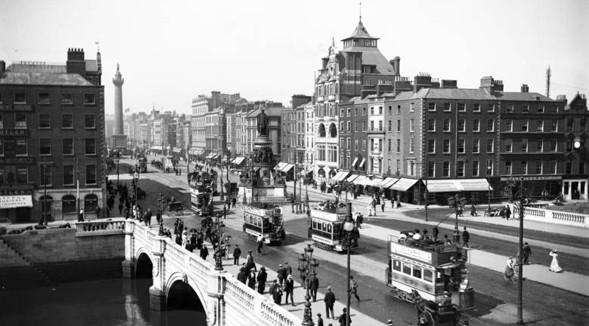
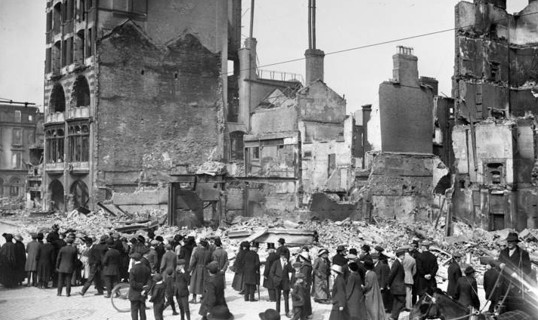
Situation in Dublin before Easter Rising 1916. Source: National Library of Ireland. From same source below: Same place after Easter Rising 1916.
In the 19th century, the poor Irish tenant farmers lived a miserable existence. They hardly knew their landlords, but they could barely support themselves and stay alive thanks to the potatoes they could grow. When the potato harvests failed repeatedly due to a potato disease in 1845 and the following years, it meant certain death for almost a million Irish. As a result, food prices rose enormously, as the harvests elsewhere in Europe also failed. Meanwhile, the landlords continued to take good care of themselves, safely settled in England or in the big city. The Irish were left to their fate. To illustrate; in 1840, the Irish population was about 8 million people, while this number had dropped to about 3.5 million by 1900, directly or indirectly due to these crop failures. Many of them emigrated to America, hoping for a better life there. An estimated 2 million Irish sought their fortune overseas during the 19th century. The crossing was certainly a high risk. You did not board for fun if you could afford it at all. Diseases took a heavy toll once on board. Sharks were said to swim behind the ships full of emigrants because so many died on board and the bodies were thrown overboard. Most Irish found their place on the East Coast of the United States; anyone in Boston on March 17 will notice this.
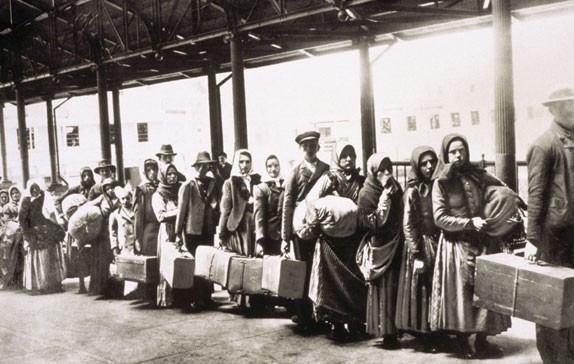
Irish refugees arriving at Ellis Island, New York (source unknown, date unknown)
The mass exodus of Irish to overseas countries had far-reaching political consequences for Ireland. Those who remained would declare independence in 1922; they had not been heard by the English government for too long. The northern part remained under British rule and did not become part of the Republic of Ireland but became Northern Ireland. At the beginning of the 20th century, nationalism grew among the Irish, who did not find the Irish political approach sufficient and felt more heard within the more radical approach of Sinn Fein; which originally advocated a dual monarchy based on the Austro-Hungarian model but was soon taken over by republican nationalists, leading to a clearer course. In 1916, a major uprising broke out during Easter week. The uprising was crushed, but the tone was set for the road to war with the English.
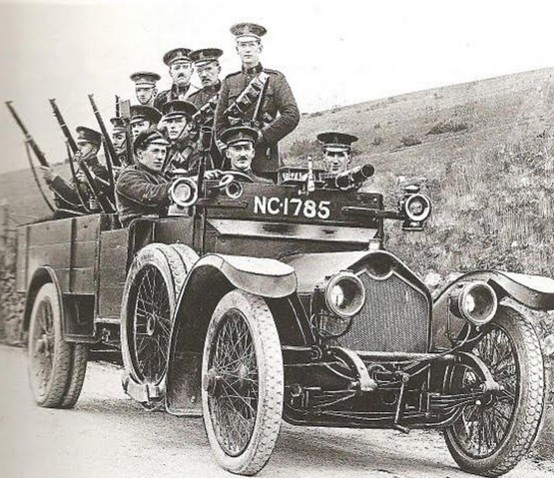
English paramilitary volunteers on patrol 1922
Plantation: colonisation as a cheap instrument of rule
The colonisation policy the Tudors began was less a single decision than a method, repeated whenever a rebellion handed the crown land to redistribute. When the Desmond risings in Munster were broken in the 1580s, the forfeited estates went to English "undertakers" who contracted to settle English tenants on them. Under James I it went further: the departure of the Gaelic lords of Ulster in 1607 left that province open, and from 1609 it was planted with settlers from lowland Scotland as well as England, which is why the religious map of the island still runs differently in the north. The break with Rome that Henry VIII carried through in England reached Ireland as a settlement of property as much as of doctrine, much as the dissolution of the monasteries had done at home.
Confiscation, penal law and the Protestant Ascendancy
Cromwell's expedition was followed by a settlement that made the confiscations permanent. The Act for the Settlement of Ireland of 1652 declared large numbers of Catholic proprietors forfeit and transplanted many of them west of the Shannon into Connacht, so that their estates could pay the soldiers and investors who had financed the war. Williamite victories at the Boyne in 1690 and at Limerick in 1691 closed the last opening for a Catholic recovery: Catholic ownership of Irish land, roughly three-fifths before 1641, was about a seventh by the early eighteenth century. When the United Irishmen rose in 1798, their defeat persuaded London that Ireland could no longer be governed through a separate parliament in Dublin, and the Act of Union followed two years later.
Hunger, relief and the politics of memory
The blight was natural; the scale of the dying was not. Ireland went on exporting grain and livestock while its poorest people starved, because those crops were what the tenant owed as rent, and in 1847 the cost of relief was shifted onto Irish poor-law unions and the landlords who paid the rates, giving many a motive to clear their smallest tenants off the land. Irish-American money later stood behind the Fenian rising of 1867, and the conviction that Westminster had watched a people die became one of the most durable arguments for separation.
Chronology: from the Tudor conquest to partition
| Date | Event |
|---|---|
| 1169–1171 | Anglo-Norman intervention begins English lordship over Ireland. |
| 1541 | Henry VIII is declared King of Ireland; Anglican doctrine becomes the state religion. |
| 1580s | Confiscated Munster estates are planted after the Desmond risings. |
| 1607–1609 | The Gaelic lords leave Ulster; the plantation of the province begins. |
| 1641 | The Irish rise en masse; about 12,000 English colonists are killed. |
| 1649–1653 | Cromwell's punitive campaign and the Cromwellian land settlement. |
| 1690–1691 | Williamite victories at the Boyne and Limerick end Catholic hopes. |
| 1695–1728 | Penal laws bar Catholics from office, education and secure landholding. |
| 1798 | The rising of the United Irishmen is defeated. |
| 1800 | The Act of Union incorporates Ireland into the United Kingdom. |
| 1845–1849 | Repeated potato blight; roughly a million die and mass emigration begins. |
| 1916 | The Easter Rising in Dublin is crushed. |
| 1922 | The Irish Free State is founded; the northern counties stay under British rule. |
Frequently asked questions
Why did the Reformation take hold in England but not in Ireland? The new doctrine was imposed from above rather than growing out of a popular movement, and it arrived attached to a colonisation policy: conformity meant submitting to the same power that was confiscating land and handing it to pro-English Protestants. Religion and property became one quarrel, which is why it outlasted the theology.
What did the penal laws actually do to Catholic Ireland? Measures such as the Test Act shut Catholics out of public office and education and made secure landholding effectively impossible, so that Catholic ownership of Irish land fell from roughly three-fifths before 1641 to about a seventh by the early eighteenth century. The result was a Protestant landlord class ruling a Catholic tenantry whose rent went to men they had never met.
Was the Great Famine simply a natural catastrophe? The potato disease that struck from 1845 was natural, and failed harvests elsewhere in Europe pushed prices up at the worst moment. But the mortality reflected a system in which the poorest depended on one crop, their landlords lived elsewhere, and food left the country as rent while people starved.
Why did a failed rising in 1916 lead to a separate Irish state by 1922? The Easter Rising had little popular backing and was quickly put down, but the executions that followed turned opinion sharply against British rule. Support moved to Sinn Fein, and the argument soon passed from Westminster politics to open conflict. The settlement that ended it left the northern counties under British rule, so partition became the unfinished business of independence.
Bibliography
- Act of Union. 1800.
- Connolly, S. J. Contested Island: Ireland 1460-1630. Oxford University Press, 2007.
- National Archives of Ireland. National Archives of Ireland.
- Statutes of Kilkenny. 1366.
- Wales, Gerald of. Topographia Hibernica.
Recommended reading
Ireland: A Historycarries the whole story from the medieval lordship to partition.
Making Ireland British, 1580-1650the standard study of the plantations and their justifications.
The Great Hunger: Ireland 1845-1849the classic narrative of the famine years and the relief policy.
Emigrants and Exiles: Ireland and the Irish Exodus to North Americafollows the emigrants through their own letters and memoirs.
View on Amazon →: Emigrants and Exiles: Ireland and the Irish Exodus to North America
Easter 1916: The Irish Rebellionthe fullest account of the rising and why its failure changed Irish politics.
As an Amazon Associate I earn from qualifying purchases. Affiliate links in Recommended reading — and in Further reading on older articles — may earn Writesides of History a commission at no extra cost to you.
From the archive
Free for the curious, supported by you
Writesides of History publishes free, in-depth history articles every week. If you enjoy reading, you can support the work: become a member for exclusive deep-dive dossiers and early access, or browse the maps, classroom packs and dossiers in the shop.
Become a Member Donate Visit the Shop