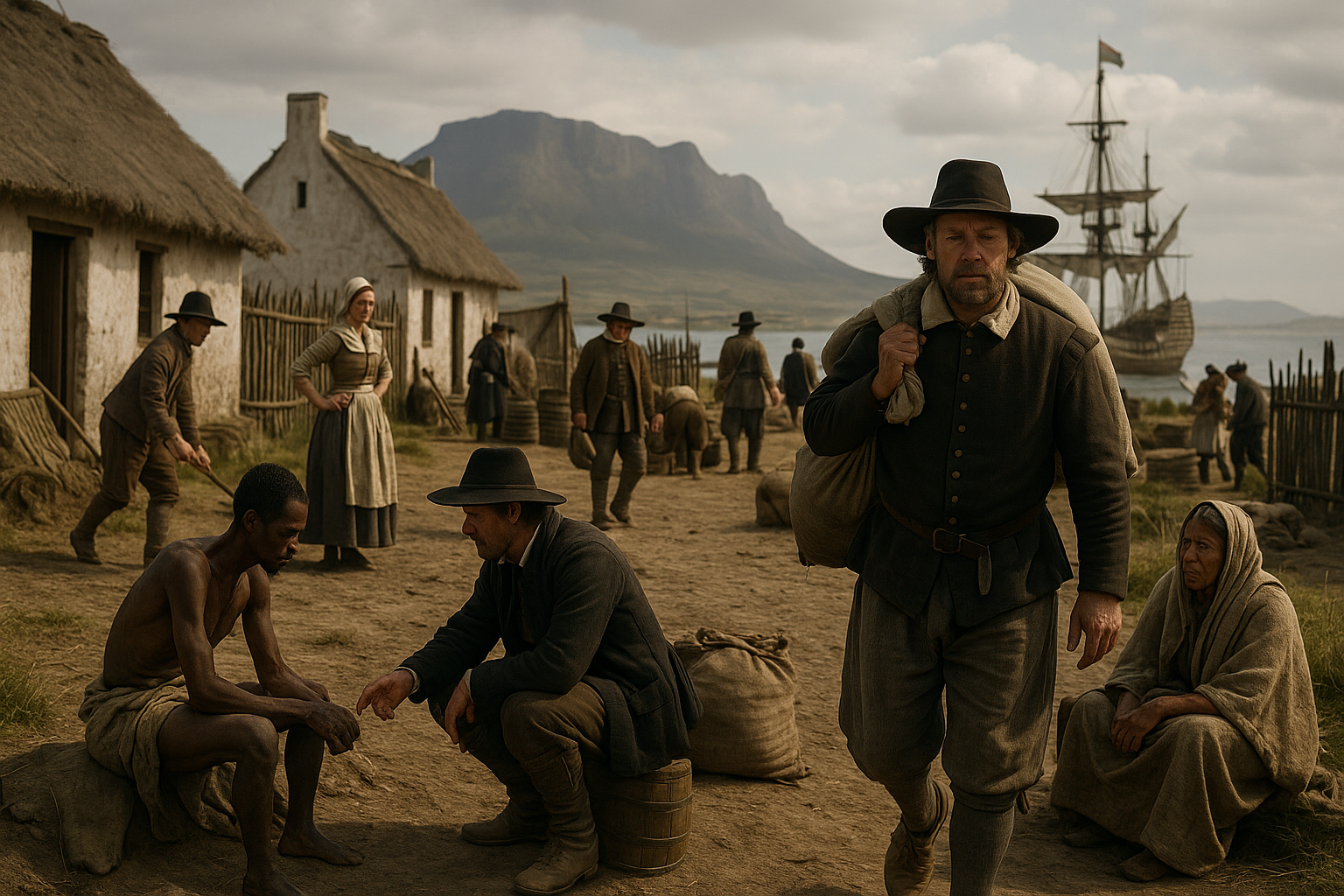
On a windswept April morning in 1652, three battered ships of the Dutch East India Company (VOC) crept cautiously into the sheltered bay beneath Table Mountain. Their commander, Jan van Riebeeck, eyed the coastline with both relief and anxiety. They were at the very edge of the known world, halfway between the VOC’s bustling headquarters in Amsterdam and the fabulous riches—and perils—of Java and Batavia. The mission: to build a lifeline for VOC fleets on their grueling passage to Asia. The cost: years of hunger, confusion, and hard negotiation on Africa’s southern tip. The Cape Colony outpost would become one of the VOC’s most enduring—and controversial—footprints, shaping the destinies of millions for centuries to come.
Pepper and Logistics: Why the Cape?
By the mid-17th century, the Dutch East India Company had become Europe’s undisputed titan of maritime trade. Ships loaded with pepper, porcelain, and silk braved the perilous journey around Africa to reach the bustling spice islands of the East Indies. But along this 15,000-mile odyssey, the hungry, scurvy-ridden crews desperately needed a harbor for fresh water, vegetables, and meat—a safe port where ships could heal, restock, and ready themselves for the next leg. The windswept natural bay beneath Table Mountain offered a nearly perfect answer, but it was also a daunting distance from any European outpost.The explosive growth of Dutch sea trade
Arrival, Struggle, and Survival
Van Riebeeck’s first months at the Cape read more like a tale of endurance than empire-building. The VOC financed the venture minimally; their instructions were cruelly clear—no unnecessary expense, no expansion. The initial fort was nothing grand: log palisades, thatched roofs, earthen walls, all surrounded by a muddy moat. The crew’s first crops fell prey to wind, rain, and theft by baboons, while supplies ran low and almost everyone fell ill. Determination meant improvisation. The settlers scavenged for wild plants, learned to fish with local Khoekhoe and San guides, and fashioned rough tools from the iron carried as ballast in their ships.
Negotiations with the indigenous Khoekhoe were fraught and often tense. The VOC had little interest in outright conquest; they chiefly wanted access to cattle and pasturage, not land. But as Dutch gardens encroached on traditional grazing, and barter gave way to suspicion, the Cape quickly became a contest not just of logistics, but of cultures. The fragile peace depended on van Riebeeck’s ability to mediate, trade, and occasionally retreat.
Seeds of Expansion and the Burden of Success
Despite VOC penny-pinching and tropical fevers, the Cape post slowly transformed. The earliest European crops—barley, wheat, peas—finally began to flourish, helped by water diverted from nearby streams. By 1657, the Company allowed a handful of former employees to settle as “free burghers,” farming plots for profit under strict VOC regulation. Inadvertently, the Company birthed the first permanent European community on southern African soil.
Slaves—imported from Madagascar and Java—soon followed, marking a tragic second beginning for the Cape. The outpost became a crossroads for dispossession and forced migration, as both indigenous people and imported labor were swept into a new, uneasy society. Local officials struggled endlessly with both the unruly “burghers” and tensions with the Khoekhoe, whose resources were increasingly depleted.
For its part, the VOC cared only that ships were stocked and delays avoided. But as gardens spread and trade increased, careful planning gave way to the unpredictable sprawl of colonial ambition, setting patterns—social, legal, and agricultural—that would endure for generations. Other global outposts, like Batavia and Ceylon, reflected similar challenges of logistics, local resistance, and uneasy compromise.Batavia and the VOC’s wider colonial network
Encounters, Friction, and Everyday Cape Life
Life at the Cape outpost was a study in contrasts. In the bake-oven heat of summer or the biting winter damp, Company officials, “burghers,” Khoekhoe herders, slaves, and passing sailors mixed—sometimes warily, sometimes intimately. The garrison drilled, livestock grazed, and market days saw barter and the exchange of news from distant worlds. Crime, insubordination, and mutiny simmered below the surface: jail cells regularly held sailors caught smuggling, or farmers refusing Company regulations.
Among the most memorable incidents was the regular complaints over the rations of “fresh meat.” What began as a logistical concern often flared into near-uprising, as the Company’s strict price-fixing fell afoul of both settler and Khoekhoe expectations. In one tense episode, a delayed Dutch fleet threatened simply to raid local herds by force, straining the uneasy truce.
Yet Cape Town’s kernel of cosmopolitan diversity had a lasting effect. The blending of languages, cuisine, and religious customs soon set it apart from other, more rigidly European colonial stations. Historical records trace the rise of a complex “Cape Dutch” identity, with roots in Europe, Africa, and Asia, all bound by the thin line of VOC control.
The administration at the Cape constantly adapted to the realities of its distant context. Edicts from Amsterdam traveled slowly, if at all. Officials had to haggle, enforce Company monopoly, and sometimes turn a blind eye, all while ships from Java or back from New Amsterdam briefly braced at the Cape’s wind-battered anchorage.the Company’s other Atlantic ventures
Legacy: Pivot Point of Continents
By the end of the 17th century, the Cape Colony was a far cry from its uncertain origins. The outpost developed into a bustling crossroads: sailors bound for Asia, African traders, European settlers, and slaves from as far as Bengal and Angola all left their mark. The hybrid society forged at the Cape—tense, dynamic, often unjust—would become the foundation of modern South African history.
For the VOC, the Cape was never a grand prize, but a logistical keystone in its global empire. Yet the decisions made by van Riebeeck and his successors—where to dig a well, whom to employ or enslave, which peace to risk—had consequences that outlived the Company itself. In the centuries that followed, the Cape would witness British conquest, waves of migration, resistance, and reform. But much of what defined its character—its cosmopolitan spirit, troubled relations with indigenous people, and crucial role in world trade—originated with those first hard years under the VOC flag.