The Bank of England’s Founding: Financing a New Era in 18th-Century Britain
William Paterson’s 1694 wartime loan scheme to fund England’s war with France became the Bank of England — and reshaped British power for centuries.

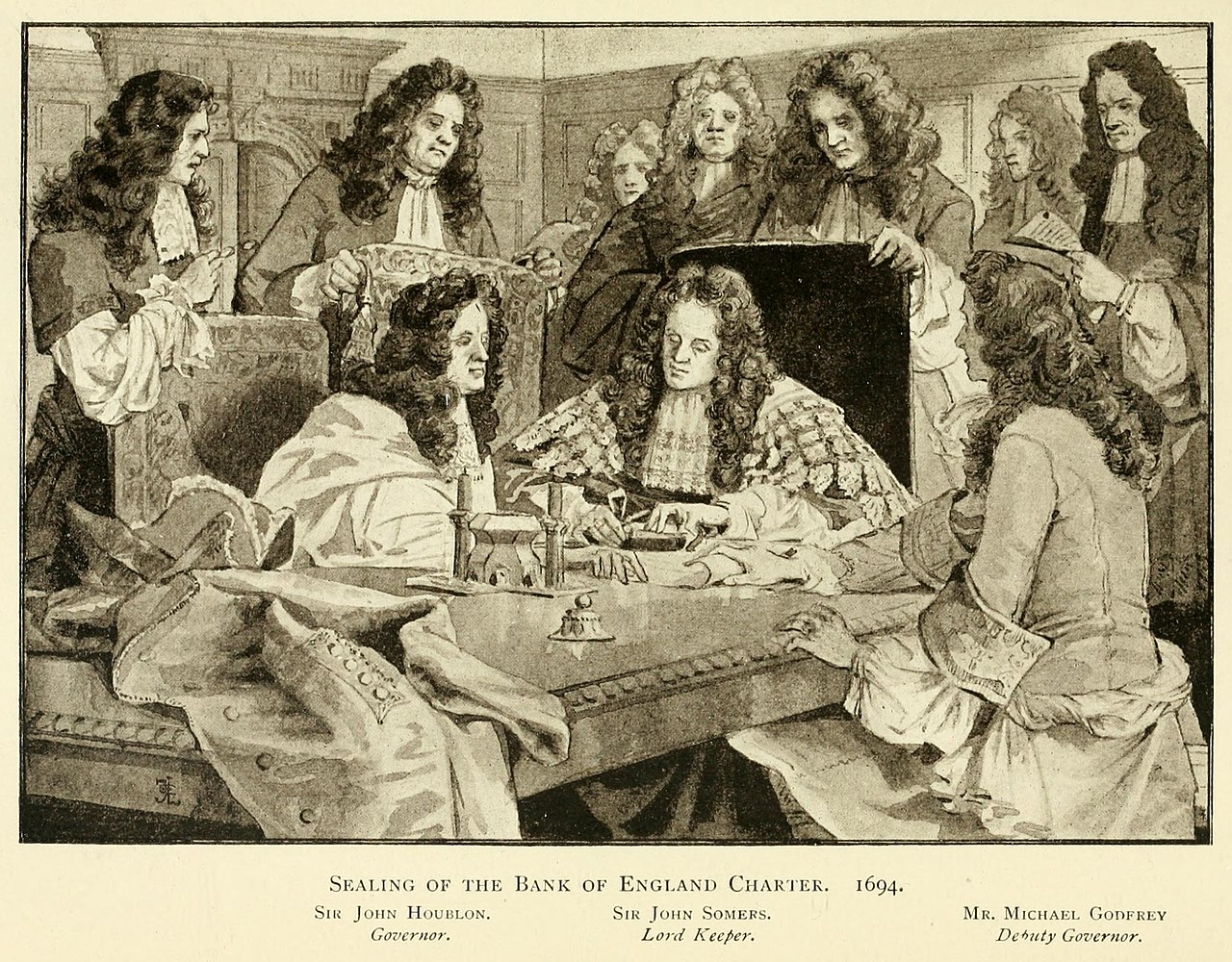
On a rain-soaked July morning in 1694, a group of merchants, financiers, and government officials gathered in the City of London. Their purpose: to launch an institution that would forever alter Britain’s destiny. The Bank of England was born not from calculated peacetime planning but out of the chaos and uncertainty of war. Its founding became a crucible moment, shaping British power, commerce, and global ambition for centuries to come.
Origins: Britain’s Financial Crisis and the Birth of the Bank
The late 17th century saw England embroiled in the Nine Years’ War against France. By 1693, government coffers were nearly empty. Traditional loans from wealthy individuals and syndicates were drying up—trust in the crown’s ability to pay its debts was at an all-time low. The state faced looming military defeat and potential bankruptcy.
That collapse of trust had deep roots. In 1672 Charles II had suspended repayment on the crown’s obligations to the London goldsmith-bankers — the Stop of the Exchequer — ruining several of them and teaching the City that a royal promise was worth only as much as the king’s willingness to keep it. English monarchs were hardly unusual in this; the Spanish crown’s suspension of payments in 1557 hung over every negotiation between a prince and his lenders. What changed was constitutional. The settlement that placed William III and Mary on the throne made Parliament, not the king alone, the body that voted taxes and pledged them, so a loan secured on parliamentary revenue was secured against the very men who were lending it.
Enter William Paterson, the Scottish financier whose bold vision offered a way out. Paterson and his associates proposed creating a joint-stock company that would lend money to the government in exchange for exclusive banking privileges. After difficult parliamentary debates, the Bank of England was chartered in July 1694, with the initial sum of £1.2 million quickly raised from investors. This new model—public debt supported by broad-based private investment—would enable the crown to finance war far beyond the means of previous monarchs.
The terms show how deliberately the risk was spread. The subscribers advanced their £1.2 million at 8 per cent, secured on new duties on shipping and on beer, ale and other liquors voted by Parliament in the Tonnage Act, and were incorporated as the Governor and Company of the Bank of England — a body that could hold property and outlive any of its members. The loan was never really meant to be repaid so much as serviced: the principal became permanent, the interest an annual charge on taxation. That was the decisive break with the older habit of borrowing against one harvest or one campaign.
The Bank’s Early Years: Credibility, Stability, and War Finance
The early days of the Bank saw frequent crisis and skepticism. Rival financiers and goldsmiths protested its monopoly, while critics argued it would ruin the nation. Yet its key innovation, the issuance of banknotes backed by government debt, proved transformative. These notes—effectively promises to pay the bearer—began to circulate as money in London’s bustling markets, gradually gaining trust. For the first time, Britain had an institution capable of converting shaky royal IOUs into widely accepted currency.
Its first serious test came within two years. The Great Recoinage of 1696 called in England’s clipped and worn silver coin and drained ready money from circulation, just as a rival Land Bank, promoted as a landed alternative to a City institution, competed for the government’s business. Bank notes fell to a discount and the Bank was reduced to paying only in part on demand. It survived, and the crisis worked in its favour: the charter renewal of 1697 barred any other corporation from being set up as a bank in England. The monopoly the goldsmiths resented was less a founding gift than the reward for having weathered a panic.
The Bank’s critical role quickly became apparent during subsequent military conflicts. In both the War of the Spanish Succession (1701–1714) and the War of Austrian Succession (1740–1748), Parliament routinely called on the Bank to arrange loans, manage government payments, and underwrite military expenses. Its directors moved confidently between court, City, and Parliament, their influence tangible in the halls of power—much as financiers across Europe observed with envy or alarm.
How the Bank Reshaped British Society and Politics
The Bank’s presence in London’s financial landscape redefined the relationship between state and economy. Its intimate involvement in government finance blurred the lines between private profit and public responsibility. The Bank’s directors—drawn mostly from the London merchant elite—became influential not just in commerce but in the shaping of national policy.
The rise of the Bank also fostered complex reactions outside the capital. Small provincial banks emerged in its shadow, extending credit to new manufacturers and regional merchants. Yet critics, especially “Country” MPs and pamphleteers, decried the Bank as a corrupting influence that tied national prosperity to the interests of London money men.
The Bank’s power was not without peril. During political upheavals—like the “South Sea Bubble” of 1720, when speculative investment fever gripped the nation—the Bank played a stabilizing role, injecting liquidity and maintaining trust in government credit. Yet these episodes also exposed the fragile nature of burgeoning financial capitalism.
International Influence and Competition
The Bank of England quickly became a model for national finance across Europe. The French, Dutch, and later Prussian governments studied its methods, eager to duplicate its success—or undermine it. In turn, the Bank became deeply entwined with Britain’s growing overseas trade networks. The financing of state-sponsored companies such as the East India Company, as well as the infrastructure of colonial commerce, was increasingly processed through the Bank’s ledgers and credit lines.
Its success also solidified London’s reputation as the preeminent financial center of Europe in the 18th century. The city’s courts, coffeehouses, and countinghouses became ever more international in scope, with Dutch, French Huguenot, and German merchants mingling alongside British bankers. The growth of the East India Company owed much to stable state-backed finance, an innovation only possible because of the Bank’s foundation.
Legacy: Enduring Impact on Britain and the Modern World
By the close of the century, the Bank of England had become an indispensable part of British government and society. Its success in managing war finance and stabilizing credit helped keep Britain afloat during the long struggle with Napoleonic France. Even as the Bank faced new challenges—like the crisis of 1797, when it suspended cash payments in the face of invasion threats—its model endured and evolved.
The Bank’s influence stretched far beyond Britain. The global financial order of the modern age—characterized by central banks, public debt, and monetary policy—draws much from the framework created on that July morning in 1694. From its original candle-lit offices near the Royal Exchange, the Bank helped forge the link between private initiative and national power—a union that pushed Britain to economic and imperial dominance.
The story of the Bank of England’s founding is a story of individuals confronting uncertainty with innovation, risk, and vision. Its early decades, shaped by conflict and creativity, would lay the groundwork for the modern financial world—as well as for the rise of the British state itself.
Chronology: from the Stop of the Exchequer to the Restriction of 1797
| Date | Event |
|---|---|
| 1672 | Charles II's Stop of the Exchequer halts repayment to the London goldsmith-bankers, damaging royal credit for a generation. |
| 1688–1689 | The Glorious Revolution confirms Parliament's control over taxation. |
| 1689–1697 | The Nine Years' War against France drives costs far beyond ordinary revenue. |
| July 1694 | Parliament charters the Bank of England; £1.2 million is subscribed and lent to the crown. |
| 1696 | The Great Recoinage and a rival Land Bank squeeze the young Bank; its notes trade at a discount. |
| 1697 | The charter is renewed, barring any other corporation from banking in England. |
| 1701–1714 | Parliament turns routinely to the Bank during the War of the Spanish Succession. |
| 1720 | The South Sea Bubble bursts; the Bank's credit steadies confidence in government paper. |
| 1740–1748 | The War of the Austrian Succession brings further loans and military underwriting. |
| 1797 | Facing invasion fears and a drain on reserves, the Bank suspends cash payments. |
Frequently asked questions
Why did England need a bank in 1694 when wealthy financiers already lent to the crown? By 1693 the private lenders and syndicates funding the Nine Years’ War were withdrawing, because a royal borrower could repudiate its debts and had done so within living memory. Paterson’s scheme replaced a handful of exposed individuals with a chartered joint-stock company drawing capital from many subscribers at once, spreading the risk widely enough to make lending on this scale possible again.
What made the Bank’s loan different from earlier royal borrowing? Earlier loans were personal, short and tied to a particular revenue or campaign, and they lived or died with the monarch’s willingness to honour them. The £1.2 million of 1694 was secured on duties voted by Parliament, held by a corporation that outlived its members, and serviced rather than repaid. Public debt became permanent, and its interest an ordinary annual charge on taxation.
Was the Bank of England a central bank from the beginning? No. It began as a private joint-stock company lending to the government in exchange for privileges, and its shareholders expected dividends. The functions now thought of as central banking — managing the note issue, acting as banker to other banks, standing behind the system in a crisis — accumulated over the following century as its notes and its credit came to be relied upon by everyone else.
Bibliography
- Bank of England Archive. Bank of England.
- Neal, Larry. The Rise of Financial Capitalism: International Capital Markets in the Age of Reason. Cambridge University Press, 1990.
- Paterson, William. A Brief Account of the Intended Bank of England. 1694.
- Tonnage Act. 1694.
Recommended reading
The Financial Revolution in England: A Study in the Development of Public Credit, 1688-1756the foundational study of how parliamentary security turned royal borrowing into permanent public debt.
The Sinews of Power: War, Money and the English State, 1688-1783explains how war finance built the tax bureaucracy and the fiscal-military state that the Bank served.
View on Amazon →: The Sinews of Power: War, Money and the English State, 1688-1783
Till Time's Last Sand: A History of the Bank of England 1694-2013the authorised single-volume history, opening with the founding described here.
View on Amazon →: Till Time's Last Sand: A History of the Bank of England 1694-2013
Virtuous Bankers: A Day in the Life of the Eighteenth-Century Bank of Englandreconstructs the Bank's daily working life from its own inspection records, showing how the institution actually ran.
View on Amazon →: Virtuous Bankers: A Day in the Life of the Eighteenth-Century Bank of England
Casualties of Credit: The English Financial Revolution, 1620-1720traces the arguments about credit and trust that surrounded the Bank's creation, and the costs that came with them.
View on Amazon →: Casualties of Credit: The English Financial Revolution, 1620-1720
Image: A 19th-century steel engraving depicting the Bank of England in London. Rijksmuseum, CC0, via Wikimedia Commons.
As an Amazon Associate I earn from qualifying purchases. Affiliate links in Recommended reading — and in Further reading on older articles — may earn Writesides of History a commission at no extra cost to you.
From the archive
Free for the curious, supported by you
Writesides of History publishes free, in-depth history articles every week. If you enjoy reading, you can support the work: become a member for exclusive deep-dive dossiers and early access, or browse the maps, classroom packs and dossiers in the shop.
Become a Member Donate Visit the Shop