The Hanseatic League: Shaping Northern European Trade in the Medieval Era
How the Hanseatic League united North Sea and Baltic merchant cities, dominated medieval trade, and shaped Northern Europe for four centuries.

In the late Middle Ages, a formidable coalition of merchant cities along the coasts of the North Sea and the Baltic Sea emerged, shaping the very fabric of commerce in Northern Europe. Known as the Hanseatic League, this powerful network forged unprecedented trade links that connected diverse cultures and economies from the 13th to the 17th centuries. Its influence went far beyond mere exchange of goods — the League was a pioneering force in political cooperation, economic regulation, and urban development.
The Origins and Formation of the Hanseatic League
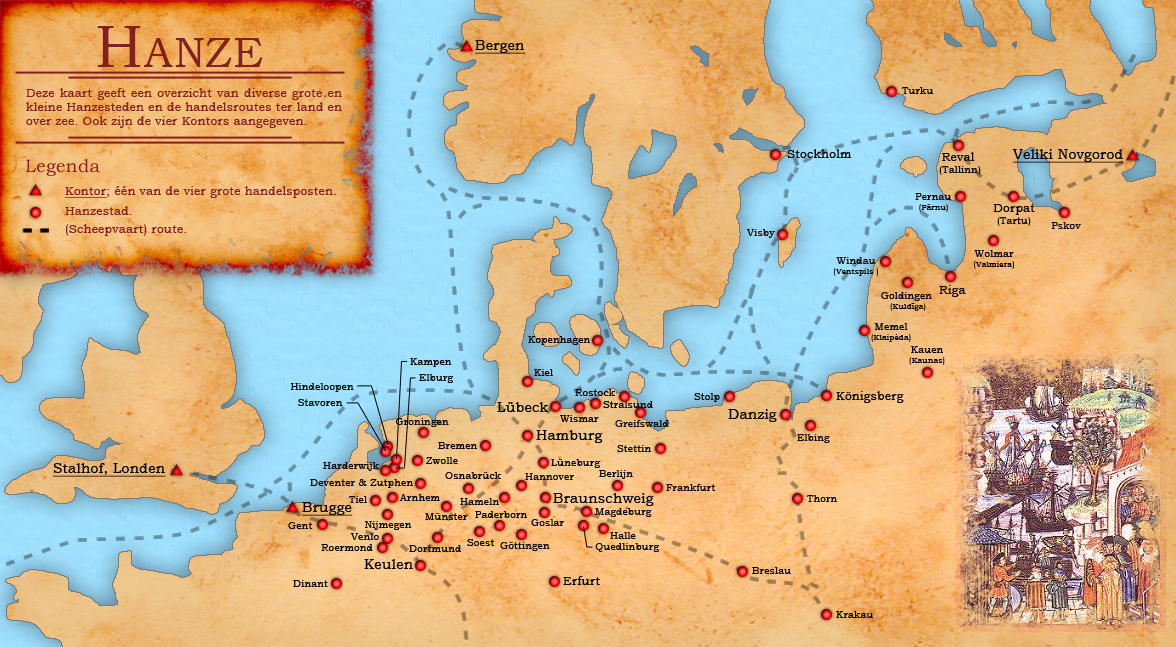
Emerging in the mid-12th century, the Hanseatic League was initially a defensive alliance formed by merchants of Lübeck and Hamburg to protect their commercial interests against piracy and rival powers. Lübeck, situated on the Baltic coast, quickly became the League’s de facto capital, known for its strategic position as a gateway between the Baltic and the rest of Europe. Over the subsequent centuries, the League expanded to include dozens of cities across present-day Germany, Poland, the Baltic states, Scandinavia, and even parts of the British Isles and Russia.
The League was not a state but a unique economic confederation centered on mutual benefit. Its members negotiated common policies, set standard trading practices, and formed collective security arrangements to safeguard their merchant fleets and goods. This unified voice strengthened Northern European trade in an era often fragmented by feudal and territorial conflicts.
Those roots lay in the eastward expansion of German towns along the Baltic shore. Lübeck, founded in 1143 and refounded in 1159 under Henry the Lion, saw its body of urban law granted in turn to daughter towns from Rostock and Wismar to Danzig and Reval. That shared legal template mattered more than any single treaty: a merchant arriving in another Hansa town found familiar courts and familiar rules of contract. What began as an association of individual merchants — the German traders based on Gotland foremost among them — had become an association of towns by 1356, when the members first met in general assembly at Lübeck.
Trade Networks and Economic Impact
The Hanseatic League dominated the trade routes of the North and Baltic Seas. Its merchants specialized in key commodities such as grain, timber, furs, wax, salt, and cloth — vital goods that fueled the growth of medieval Europe’s urban centers. The League’s control over these trade commodities allowed member cities to amass significant wealth and influence.
What distinguished this commerce from the Mediterranean trade of Venice or Genoa was its emphasis on bulk rather than luxury, and it depended on a ship as much as on a treaty. The cog — broad, flat-bottomed and single-masted, with high sides and a stern rudder — carried far more cargo for each man of its crew than earlier northern hulls. Cheap capacity was the point: heavy, low-value goods that could never have borne the freight costs of a lighter vessel became worth moving at all.
One of the League’s greatest achievements was the establishment of the Kontor system — permanent trading posts equipped with warehouses, offices, and even legal courts. Major kontors in places like Bruges, London, Bergen, and Novgorod acted as hubs for negotiations, goods exchange, and financial transactions. This institutional framework fostered reliable long-distance trade, reduced conflict risks, and helped standardize commercial law across borders.
The kontors were not merely warehouses but self-governing communities under their own statutes. At the London Steelyard, Hanseatic merchants were required to remain unmarried and resident within the walled compound — a rule that was commercial rather than pious, since a merchant with local family and local debts could be leaned on by local authorities.
Political Influence and Diplomatic Achievements
Beyond economic matters, the Hanseatic League wielded considerable political clout. It negotiated privileges and trade agreements with kings and princes, leveraging the collective bargaining power of its many cities. The League could muster fleets to protect trade convoys or even engage in armed conflict when necessary, such as its wars against Denmark during the 14th and 15th centuries.
The clearest demonstration of that power came against Denmark. When Valdemar IV seized Gotland and sacked Visby in 1361 and tightened his grip on the Sound, the Hanseatic towns bound themselves together in the Confederation of Cologne in 1367 and went to war. The Treaty of Stralsund that closed the conflict in 1370 confirmed their privileges in Denmark, handed them castles commanding the Sound for fifteen years with a share of the revenues, and gave the towns a voice in approving a Danish king. For a body with no territory and no sovereign, it was an extraordinary settlement.
The League’s ability to operate autonomously while maintaining cordial relations with various monarchies marked an early form of supranational cooperation. Its meetings, held at periodic assemblies known as Hansetags, shaped policies and resolved disputes, ensuring cohesion among diverse urban members.
That strength rested on agreement rather than obligation, and this is where the League least resembles a state. A Hansetag could resolve on a blockade or a levy, but enforcement fell to the towns, whose interests diverged: Cologne’s business faced the Rhine and England, Lübeck’s the Baltic, Danzig’s the Prussian grain trade. Its heaviest sanction was exclusion from Hanseatic privileges — the logic of the guilds within each town, worked at the scale of a continent.
Decline and Lasting Legacy
By the late 16th century, however, the League’s dominance began to wane. The rise of nation-states with centralized monarchies, changing trade routes driven by Atlantic exploration, and internal divisions weakened the coalition’s unity and commercial supremacy. Despite this, the Hanseatic League left an enduring cultural and architectural heritage. Many Hanseatic cities preserve Gothic brick buildings, merchant halls, and port infrastructures commissioned during the League’s heyday.
Several pressures converged. Dutch shippers, sailing cheaper vessels and unencumbered by Hanseatic restrictions on dealing with outsiders, took a growing share of the Baltic grain traffic, and the herring shoals moved from the Scanian coast into the North Sea during the 15th century. More decisively, rulers who had once granted the privileges now found it worth their while to withdraw them: Ivan III closed the Novgorod kontor in 1494, and in 1598 Elizabeth I expelled the Hansards from the Steelyard. What the League could not survive was the strengthening of the very central authority whose weakness had made its privileges possible. The last Hansetag met at Lübeck in 1669.
Moreover, the League set precedents for joint economic regulation, international law in trade, and urban governance that influenced later European commercial associations and modern economic unions. In many ways, the Hanseatic League was a medieval precursor to today’s global trade networks.
Conclusion: The Hanseatic League’s Enduring Historical Impact
The Hanseatic League was more than a medieval trade alliance; it was a remarkable example of cooperation that transcended language, culture, and political division to create a thriving economic and diplomatic entity. Its creation transformed Northern European trade, laying foundations for regional stability and prosperity. By fostering connectedness and mutual interests among diverse urban centers, the League helped shape the trajectory of European economic development well beyond the Middle Ages.
Its legacy can still be explored in the preserved cities and the traditions of commerce it inspired. Understanding the Hanseatic League offers valuable insights into how early economic integration can influence the political and cultural landscape of a region.
Its story belongs to a wider commercial history: to the Italian banking houses of the same centuries, and to the chartered companies of the Atlantic age that eclipsed it and marked the shifting balance of power in Europe.
Chronology: the rise and decline of the Hanseatic League
| Date | Event |
|---|---|
| 1143 | Lübeck founded; refounded 1159 under Henry the Lion |
| 1241 | Lübeck and Hamburg agree to police the route between the two seas |
| 1252–1253 | German merchants win privileges in Flanders, the basis of the Bruges kontor |
| 1282 | German merchants in London merge into the community that became the Steelyard |
| 1356 | The towns meet in general assembly at Lübeck: conventionally the first Hansetag |
| 1361 | Valdemar IV of Denmark seizes Gotland and sacks Visby |
| 1367 | Confederation of Cologne unites the towns for war on Denmark |
| 1370 | Treaty of Stralsund confirms the privileges and the castles on the Sound |
| 1494 | Ivan III closes the Novgorod kontor |
| 1598 | Elizabeth I expels the Hansards from the Steelyard |
| 1669 | The last Hansetag meets at Lübeck |
Frequently asked questions
Was the Hanseatic League a country? No. It had no ruler, no fixed borders, no standing army and no constitution, and even its membership was never settled — towns joined, lapsed and rejoined as their interests dictated. What held it together was shared urban law, common privileges negotiated abroad, and the assemblies known as Hansetags. Its sharpest sanction was exclusion from Hanseatic privileges, which worked because there was nothing stronger to fall back on.
What was a kontor, and why did it matter so much? A kontor was a permanent Hanseatic trading station abroad — Bruges, London, Bergen and Novgorod were the four great ones — with warehouses, offices and its own courts. It let merchants store goods safely, settle disputes under familiar rules, and negotiate as a body rather than as individuals. Its residents answered to the League rather than to local ties and local creditors.
What did Hanseatic merchants actually trade? Bulk goods rather than luxuries: grain, timber, salt, herring, furs, wax and cloth. These were heavy, cheap commodities that only became worth shipping because the cog carried so much cargo for so small a crew. The trade fed the growing towns of Northern Europe and made the League's own cities wealthy in the process.
Why did the Hanseatic League decline? Dutch shippers undercut Hanseatic freight rates in the Baltic grain trade, and the herring shoals shifted into the North Sea in the 15th century. More decisively, the strengthening monarchies that had once granted the privileges began to revoke them — Ivan III closed the Novgorod kontor in 1494, and Elizabeth I expelled the Hansards from London in 1598. A trading corporation with its own courts and compounds was tolerable only where central authority was weak.
Bibliography
- Europaeisches Hansemuseum. Europaeisches Hansemuseum, Luebeck.
- Hammel-Kiesow, Rolf. Die Hanse. C. H. Beck, 2000.
- Hanserecesse. Hanseatic diets.
- Treaty of Stralsund. 1370.
Recommended reading
The German Hansastill the standard single-volume history in English, comprehensive on the League's institutions and its towns.
England and the German Hanse, 1157-1611: A Study of their Trade and Commercial Diplomacythe fullest account of the Steelyard and the long bargaining that sustained it.
A Companion to the Hanseatic Leaguea survey of current scholarship, from the kontors and shipping to Hanseatic law and urban culture.
The Hanse in Medieval and Early Modern Europeessays that reassess how loosely, and how effectively, the League actually governed itself.
View on Amazon →: The Hanse in Medieval and Early Modern Europe
The Baltic: A Historyplaces the League within a thousand years of exchange and conflict around the sea it dominated.
Image: Hans Holbein the Younger, "Portrait of the Merchant Georg Gisze" (1532), a Hanseatic merchant at the London Steelyard. Gemäldegalerie, Berlin, public domain, via Wikimedia Commons.
As an Amazon Associate I earn from qualifying purchases. Affiliate links in Recommended reading — and in Further reading on older articles — may earn Writesides of History a commission at no extra cost to you.
From the archive

Free for the curious, supported by you
Writesides of History publishes free, in-depth history articles every week. If you enjoy reading, you can support the work: become a member for exclusive deep-dive dossiers and early access, or browse the maps, classroom packs and dossiers in the shop.
Become a Member Donate Visit the Shop