Origin of the "Rus"
Frankish annals found the Rhos of 839 to be Swedes; Abbasid silver, the river roads and Rurik's line turned traders into the realm centred on Kiev.

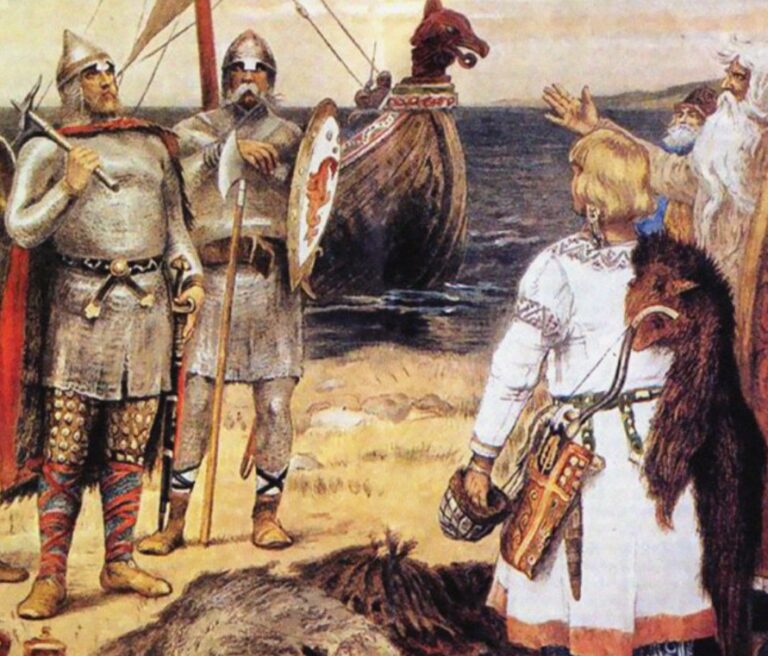
The earliest history of Russia is a topic which often is being neglected. It`s not a matter of a lack of interest on the matter, but rather due to ignorance. The early inhabitants of the great Ukrainian and Southern Russian Steppes were formed by Nomadic people surrounding the Volga, Don and Dnjepr rivers. Among them the folks to become known as the Sarmatians and Scythians, had their origins in the Iranian area. For centuries their dominance in the area was unchallenged, until the Slavic (presumed to have been evolving from the Venedi-tribe as described by Tacitus)people did. After the Huns were adrift between the 4th and 6th Century A.D. the Slavs scattered across Europe in various directions. The Slavs assimilated with the people in the Ukrainian areas and in the following centuries, expanding their presence towards Belarus and Russia. They assimilated also with Baltic tribes. Around the 9th Century the Scandiavian people where expanding their presence over Europe, for a number of reasons. Danes went to the West, harassing the English and French shores, where they would become known as "Vikings". But the Swedes went Eastwards, conquering the rivers leading to the mainland of the Slavic people, setting up trades with them. The Slavs called them "Rus"-people meaning so much as "People who row". Soon the Scandinavians dominated the Slavs and Baltic People, but were then again pushed back after a massive revolt among the Slavs. The Slavic tribes however, soon began fighting eachother again. Stability in the areas was wished for finally, leading the Slavs to invite a "Rus" prince to reign them. The prince was called Rurik. He would lay the foundations for the city of Novgorod. After his Death late 9th Century, his kinsman Oleg took over, expanding his realm by conquest, and finally taking control over Kiev. And here, Kiev Rus would originate. In time, all the Slavic tribes within the realm, would become known as "Rus", living in Russia, the land of the "Rus".
The steppe the Slavs walked into
The lands between the Carpathians and the Volga were never empty ground waiting to be settled; they were a corridor, and for a thousand years before the Rus it belonged to mounted peoples out of the east. The wealth the Scythians and Sarmatians drew from herds and tribute survives in the gold-heavy royal burial mounds of the southern steppe. Their dominance was a matter of terrain rather than character: open grass rewards cavalry, and cavalry taxes whoever must cross it.
The forest belt to the north worked by other rules. There the Volga, the Don, the Dnieper and their tributaries ran roughly north to south, threading swamp and woodland into a usable network in which farming villages could survive as they never could on open steppe. That is one reason the Slavic dispersal following the Hunnic upheavals took root so widely: the peoples Tacitus had grouped under names such as the Venedi were, by the eighth century, spread from the Elbe to the upper Volga, sharing much in speech and custom and almost nothing in the way of central authority. That absence is the precondition for everything after it. When the Khazar khaganate consolidated on the lower Volga and Don, several Slavic tribes of the forest-steppe fell to paying it tribute because they had no structure capable of refusing — the same weakness that soon made them attractive to armed traders arriving from the opposite direction.
Rivers, silver and the road east
The eastward expansion was, at bottom, a hunt for silver. From roughly 800 the mints of the Abbasid caliphate were pouring dirhams into circulation, and the northern forests held what those markets wanted: furs, wax, honey, amber and slaves. Two arteries carried the exchange. The Volga route ran through the Bulgar markets to the Caspian and the caravan roads beyond; the Dnieper route ran south past the rapids to the Black Sea and Constantinople, and later generations knew it as the road from the Varangians to the Greeks. Neither was a voyage in the seagoing sense: both demanded shallow craft, long stretches of rowing against the current, and portages where boats were dragged overland between watersheds.
This is why the eastern venture took a different shape from the western one. The Danes who struck England and Francia arrived under sail, took what was portable and left, and that tradition — running from Lindisfarne to the siege of Paris — eventually produced the conquest and settlement recorded in the Danelaw. The rivers permitted nothing so quick. A crew that wanted silver had to move slowly through inhabited country, return the next season and hold the portages in between, which meant bases, and bases meant dealings with the Slavic and Finnic populations along the way: first as partners, then as tribute-takers. Staraya Ladoga on the Volkhov and the fortified sites later known as Rurikovo Gorodishche and Gnezdovo show the pattern in the ground, mixed settlements where Scandinavian metalwork, Slavic pottery and Islamic coin turn up together.
The name and what it described
The etymology the article gives is the one most philologists accept. The Old Norse vocabulary of rowing passed into Finnic speech as Ruotsi, still the ordinary Finnish word for Sweden, and from Finnic into Slavic as Rus. The word began as a description of what these men did rather than of where they came from, which is exactly why it could later attach to a dynasty, then to a people who were not Scandinavian at all, and finally to a country.
Outsiders noticed them early and independently. Frankish annalists recorded in 839 that envoys of a people calling themselves Rhos had reached the emperor Louis the Pious and, on inquiry, proved to be Swedes. Arabic geographers describe Rus merchants trading and burying their dead along the Volga. A Byzantine handbook of the mid-tenth century lists the names of the Dnieper rapids twice over, once in the language of the Rus and once in Slavonic — the first set recognisably Norse, the second not. Three traditions with no interest in corroborating one another describe the same bilingual world.
Rurik, Oleg and the making of a realm
The invitation reaches us through the Primary Chronicle, compiled in Kiev around 1113, some two and a half centuries after the events it dates to 862. Its sequence is the one the article follows: the northern tribes threw off the overseas tribute-takers, fell to fighting among themselves, and then sent for a prince who could impose order. Historians read this less as the minute of a constitutional meeting than as a foundation story shaped for a ruling house that needed its authority to look invited rather than seized. Archaeology confirms the substance without the tidiness — Scandinavians were unquestionably established and powerful in the north — but no spade has found the moment of agreement.
What followed is better attested. On the chronicle's reckoning Rurik died in 879 and his kinsman Oleg took Kiev in 882, and the choice of Kiev was decisive. The town sat on the high right bank of the Dnieper at the last defensible point before the river ran out into open steppe: far enough south to command the traffic heading for Constantinople, far enough north to be held against the nomads who controlled the grass. Taking it also meant taking over the tribute of Slavic tribes who had been paying the Khazars, converting a trading interest into a territorial one. Within a generation the Rus negotiated as a power rather than a nuisance: the treaty made with Byzantium in 911 set out how Rus merchants were to be housed, fed and policed while they did business at Constantinople.
How the rowers became Slavs
The most striking thing about the Rus is how quickly they stopped being Scandinavian. The names tell it: Helgi becomes Oleg, Ingvar becomes Igor, Helga becomes Olga, and by the middle of the tenth century Igor and Olga's son bears the wholly Slavic name Sviatoslav. The dynasty ruled a population overwhelmingly Slavic, gathered its tribute on the annual circuit the Byzantines transcribed as polyudie, and came to speak and pray as its subjects did; the conversion of Vladimir in 988 completed the reorientation, binding the realm to Byzantine Christianity and Slavonic letters rather than to the north. Assimilation at that speed is what makes the article's closing point exact. The word Rus travelled from a band of rowers to a princely house, from the house to its territory, and from the territory to everyone in it — so that tribes who had once been the object of Rus tribute ended by calling themselves Rus without contradiction.
An argument that outlived the evidence
Few questions in European history have been fought over as hotly, or for as poor a reason. In the eighteenth century scholars at the St Petersburg Academy of Sciences set out the Scandinavian reading of the chronicle; Mikhail Lomonosov attacked it as an insult to Russian origins, and the dispute hardened into the Normanist and anti-Normanist positions argued for the next two hundred years, with particular bitterness in the Soviet period, when a foreign founding looked politically intolerable. The heat came from the assumption underneath — that a state's dignity depends on the ethnicity of whoever first collected its taxes.
The evidence is less dramatic than either camp wanted. Scandinavians formed the armed and commercial elite of the early Rus; the graves, the coin hoards, the Norse names in the Byzantine treaties and the rapids in the Byzantine handbook leave little room to argue otherwise. But they were a thin layer over a Slavic society that supplied the language, the farming and the settlements, and the polity belonged to neither parent alone. Kievan Rus was a fusion, and the realm that grew from it is claimed today as ancestral by Ukraine, Belarus and Russia alike.
Chronology of the Rus
| Date or period | Event |
|---|---|
| 1st century AD | Tacitus describes the Venedi east of the Vistula, later linked to Slavic origins |
| 4th–6th century | Hunnic upheaval unsettles the steppe; Slavic groups disperse widely across Europe |
| 7th–8th century | The Khazar khaganate dominates the lower Volga and Don; some Slavic tribes pay it tribute |
| c. 750 | Staraya Ladoga is settled on the Volkhov, the earliest of the northern river bases |
| c. 800 onward | Abbasid silver dirhams flow north along the Volga in exchange for furs, wax and slaves |
| 839 | Frankish annals record envoys of a people called Rhos, found to be Swedes |
| 860 | A Rus fleet appears before Constantinople |
| 862 (chronicle date) | Northern tribes invite Rurik to rule after expelling tribute-takers and falling into discord |
| 879 (chronicle date) | Rurik dies; his kinsman Oleg succeeds him |
| 882 (chronicle date) | Oleg takes Kiev and makes it the centre of the realm |
| 911 | A Rus treaty with Byzantium regulates the trading of Rus merchants at Constantinople |
| mid-10th century | Sviatoslav, first ruler of the line with a Slavic name, succeeds Igor and Olga |
| 988 | Vladimir's conversion binds Rus to Byzantine Christianity and Slavonic letters |
| c. 1113 | The Primary Chronicle takes shape in Kiev, fixing the story of Rurik's invitation |
Frequently asked questions
Why did the Swedes go east while the Danes went west? Geography set the terms. The Danish and Norwegian coasts opened onto the North Sea and the sailing routes to England and Francia, where a fast raid could take portable wealth and leave; the Swedish coast opened onto the Baltic and the river mouths of the eastern forests. The eastern rivers could not be raided in the same way, because they had to be rowed and portaged slowly through inhabited country, so the venture there took the form of trading bases and tribute rather than coastal plunder.
What does the word "Rus" actually mean? It began as a term for rowing and rowing crews in Old Norse, passed into Finnic speech as Ruotsi — still the Finnish word for Sweden — and entered Slavic as Rus. It described an activity, not a homeland, which is precisely why it could later be applied to a princely dynasty, then to the territory that dynasty ruled, and finally to a Slavic population that had no Scandinavian ancestry at all.
Did the Slavs really invite a prince to rule them? The invitation is reported by the Primary Chronicle, written in Kiev around 1113 about events placed in 862, and it served a ruling house that benefited from appearing to have been asked rather than to have seized power. Archaeology confirms the underlying situation — Scandinavians were established and dominant in the northern river settlements — without confirming the neat moment of agreement. The likeliest reading is that a real pattern of expulsion, disorder and negotiated overlordship was later compressed into a single founding scene.
When did the Rus stop being Scandinavian? Remarkably fast: within about three generations. Helgi, Ingvar and Helga appear in the Slavic record as Oleg, Igor and Olga, and by the middle of the tenth century the ruling prince bears the entirely Slavic name Sviatoslav. Language, tribute-taking and, after Vladimir's conversion in 988, religion all bound the dynasty to its Slavic subjects rather than to the north.
Bibliography
- Fadlan, Ahmad ibn. Risala. 922.
- Porphyrogenitus, Constantine VII. De administrando imperio.
- Povest vremennykh let. Kievan Caves Monastery.
- State Hermitage Museum. State Hermitage Museum.
- Winroth, Anders. The Conversion of Scandinavia. Yale University Press, 2012.
Recommended reading
The Emergence of Rus 750-1200the standard scholarly narrative of how river trade, tribute and dynasty combined into a state.
Viking Rus: Studies on the Presence of Scandinavians in Eastern Europethe archaeological case, settlement by settlement and grave by grave.
View on Amazon →: Viking Rus: Studies on the Presence of Scandinavians in Eastern Europe
Medieval Russia, 980-1584takes up the story where Kievan Rus is already formed and follows it to Muscovy.
Reimagining Europe: Kievan Rus' in the Medieval World, 988-1146argues for Rus as an ordinary member of the medieval European political world rather than an eastern exception.
View on Amazon →: Reimagining Europe: Kievan Rus' in the Medieval World, 988-1146
Children of Ash and Elm: A History of the Vikingsthe best recent account of the Scandinavian world the eastward rowers came from.
View on Amazon →: Children of Ash and Elm: A History of the Vikings
As an Amazon Associate I earn from qualifying purchases. Affiliate links in Recommended reading — and in Further reading on older articles — may earn Writesides of History a commission at no extra cost to you.
From the archive

Free for the curious, supported by you
Writesides of History publishes free, in-depth history articles every week. If you enjoy reading, you can support the work: become a member for exclusive deep-dive dossiers and early access, or browse the maps, classroom packs and dossiers in the shop.
Become a Member Donate Visit the Shop