How the Mongol Empire Reshaped Medieval Eurasia: Conquest, Trade, and Cultural Exchange
How the Mongol Empire reshaped medieval Eurasia: Genghis Khan's conquests, the Pax Mongolica, and the trade and cultural exchange that followed.

In the sweeping vastness of medieval Eurasia, few forces shaped the course of history as dramatically as the Mongol Empire. Rising from the steppes of Central Asia in the early 13th century, the empire forged by Genghis Khan and his successors altered political boundaries, economic networks, and cultural landscapes across an immense geographic canvas. This article delves into how the Mongols’ unrivaled conquests and governance transformed the medieval world, connecting distant civilizations and laying foundations for the modern era.
The Rise of the Mongol Empire and Genghis Khan’s Vision
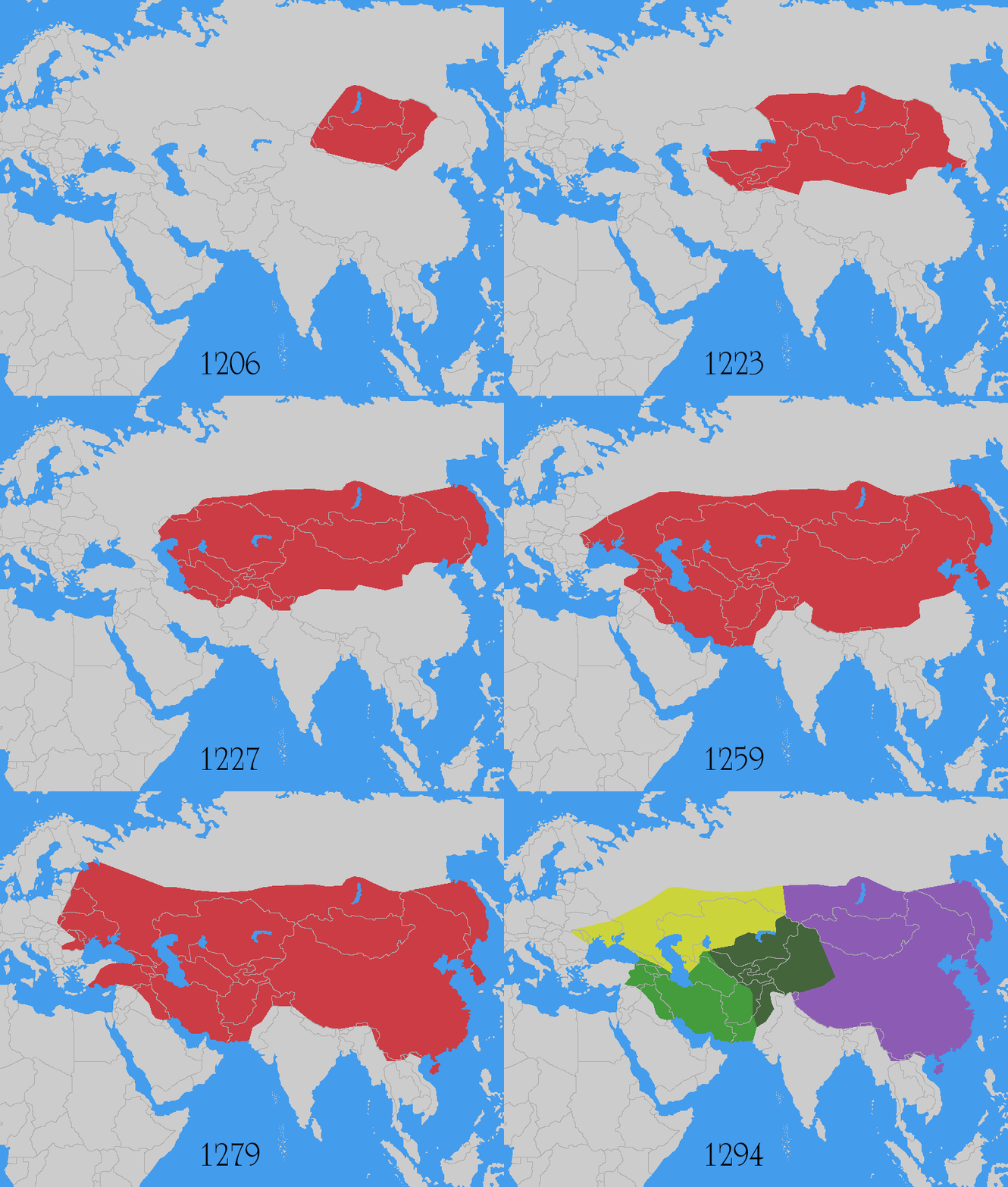
The Mongol Empire’s origins trace to a collection of fractious nomadic tribes inhabiting the Central Asian steppe, united under the leadership of Temujin. Crowned as Genghis Khan in 1206, he revolutionized Mongol society by imposing strict military discipline, meritocratic leadership, and a codified legal system known as the Yassa. His vision extended beyond tribal dominance; he sought a vast empire united under Mongol rule. Between 1206 and his death in 1227, Genghis Khan led unprecedented military campaigns that subdued the Khwarezmian Empire, the Kara-Khitai, and parts of northern China, using innovative tactics, intelligence networks, and psychological warfare to overcome enemies.
Expansive Conquests and Political Transformations
Following Genghis Khan’s death, his successors continued expanding the empire to an unparalleled size, making the Mongol Empire the largest continuous land empire in history. Under Ögedei Khan and later Möngke Khan, Mongol armies conquered Eastern Europe, the Middle East, and more of China with remarkable speed. These conquests did not simply mean territorial acquisition, but also the integration and reconfiguration of political institutions across Eurasia. Many local rulers were retained or replaced by Mongol administrators who maintained order while extracting tribute. The empire’s division into khanates, including the Golden Horde in Russia and the Ilkhanate in Persia, created regional power bases that influenced the medieval political map for centuries.
Administering an Empire Won on Horseback
Conquest was the easier half of the Mongol achievement; holding the territory demanded machinery the steppe had never possessed. The decimal organisation imposed during the unification of the Mongol tribes doubled as an administrative grid, so populations could be counted and taxed through the same chain of command that mustered soldiers. Successive Great Khans ordered censuses in northern China, Iran and the Rus principalities alike, turning irregular plunder into predictable revenue. Resident officials known as darughachi and basqaq supervised subject territories and forwarded tribute to the khan's treasury; dynasties that submitted early were often left in place, while those that resisted were destroyed outright. Because the Mongols were few relative to their subjects, they recruited talent wherever they found it: Uyghur scribes supplied the script, Khitan and Chinese officials the fiscal vocabulary of the sedentary state, Persian and Central Asian Muslims the accounting practice of the Islamic world.
The Mongol Impact on Trade and the Pax Mongolica
One of the most significant legacies of the Mongol Empire was its facilitation of trade and cultural interchange across Eurasia. The Mongols established the Pax Mongolica, a period of relative peace and stability along the Silk Road routes, secured by Mongol military presence. These conditions enabled merchants, missionaries, and travelers — including the famed Venetian explorer Marco Polo — to traverse vast distances with unprecedented safety and efficiency. Cities prospered as commercial hubs, exchanging silk, spices, precious metals, and ideas among Europe, the Middle East, and East Asia. The Mongol postal relay system, or Yam, enhanced communication, further knitting together this sprawling empire and the broader world.
Merchants, Silver, and the Machinery of Exchange
The Pax Mongolica was not simply an absence of war; it rested on institutions that made long-distance movement predictable. Merchants on imperial business carried a paiza, an inscribed tablet of authority entitling the bearer to protection, lodging and fresh mounts at the Yam stations. Mongol princes and princesses invested directly through ortogh partnerships — merchant associations, often Muslim or Uyghur, financed with capital from the ruling family and licensed to trade on its behalf. The effect was an unusual alignment of interests: the men who commanded the armies held a personal stake in the caravans, and their income depended on keeping the roads open rather than plundering them. Silver became the common measure of value across the khanates, while Yuan China issued a paper currency that astonished foreign visitors before foundering on over-issue. Genoese and Venetian colonies on the Black Sea gave Latin European merchants a direct western terminus — a reach the Hanseatic trading world of the north could not match.
Cultural Exchanges and Religious Tolerance
Mongol rule also accelerated cultural and religious interactions that shaped Eurasian intellectual life. Unlike many conquerors, the Mongols practiced remarkable religious tolerance, patronizing Buddhism, Islam, Christianity, and shamanistic traditions simultaneously. This openness encouraged the exchange of ideas, art, and technology — from Chinese papermaking and printing to Persian astronomy and medicine. The Mongol court became a crucible where diverse cultures met and influenced one another. However, the sweeping destruction caused by invasions, especially in cities like Baghdad and Kiev, also left deep scars in Eurasian history, illustrating the complex duality of Mongol impact.
Specialists in Motion
Much of that exchange travelled less through books than through people, often people who had no say in the matter. Craftsmen and engineers were routinely spared during sieges and deported across the empire: Chinese and Khitan siege engineers accompanied Mongol armies into Iran and Syria, while engineers from the Islamic world built the counterweight trebuchets used against Song fortresses in China. Persian astronomers at the observatory founded for Hulagu at Maragha in 1259 worked with Chinese colleagues, and instruments and tables circulated in both directions. Rashid al-Din, the Ilkhanate's vizier and physician, compiled in the Jami' al-Tawarikh a chronicle treating Franks, Chinese, Indians and Turks within a single frame — arguably the first world history written from a Eurasian vantage point. Motifs travelled with techniques: Chinese block printing and the craft of papermaking moved westward through Iran, and cloud-collar patterns and dragon imagery from Chinese textiles reappear in Persian painting and metalwork under Ilkhanid patronage.
Decline of the Empire and Lasting Legacy
By the late 13th and early 14th centuries, internal divisions, succession crises, and resistance from conquered peoples gradually weakened the Mongol Empire. The khanates fragmented, and the rise of new powers like the Timurids and the Ottoman Empire reshaped regional dynamics. Nonetheless, the effects of Mongol rule endured, revitalizing transcontinental trade and setting political precedents for governance over diverse populations. The Mongol Era’s imprint can be seen in the subsequent globalizing impulses of the early modern period, bridging East and West in new and lasting ways.
How Historians Weigh the Mongol Century
Modern scholarship has grown less comfortable with casting the Mongols as either pure destroyers or benign facilitators of exchange. The enormous casualty figures given by contemporary chroniclers are now generally read as rhetorical rather than statistical, though the ruin of irrigation systems in Iran and Iraq and the sack of Baghdad in 1258 were real and lasting. Against that stands the case, pressed hardest in recent work on the Golden Horde, that the khanates were durable political systems rather than parasitic occupations. The connectivity cut both ways: the plague that reached the Black Sea ports in the 1340s before devastating monastic and rural Europe moved along corridors the Mongols had done much to open. Older national traditions — the Russian memory of a "Tatar yoke", the Persian memory of catastrophe — shaped the field for centuries, and separating them from the record remains a central task.
The Mongol Empire’s story is one of sheer scale and unparalleled influence. Its ability to connect vast territories through conquest, trade, and cultural exchange fundamentally altered medieval Eurasian history and paved the way for a more interconnected world.
For those intrigued by related transformations in Eurasian history, consider exploring historic Silk Road commerce to see how trade routes evolved centuries later.
Chronology: the Mongol century in Eurasia
| Date | Event |
|---|---|
| 1206 | Temujin proclaimed Genghis Khan; the Mongol tribes united under one ruler |
| 1211 | Campaigns begin against the Jin dynasty in northern China |
| 1219–1221 | Conquest of the Khwarezmian Empire |
| 1227 | Death of Genghis Khan |
| 1229 | Ögedei elected Great Khan |
| 1237–1241 | Campaigns across the Rus principalities and into Eastern Europe; Kiev sacked in 1240 |
| 1251 | Möngke elected Great Khan |
| 1258 | Sack of Baghdad ends the Abbasid Caliphate |
| 1260–1264 | Civil war between Kublai and Ariq Böke; the empire fragments into khanates |
| 1271–1295 | Marco Polo's journey to the Mongol east and back |
| 1279 | Yuan conquest of Song China completed under Kublai Khan |
| 1368 | The Yuan dynasty is driven out of China |
Frequently asked questions
What was the Pax Mongolica? It was the security along the Eurasian caravan routes created by Mongol military control, when merchants and travellers could cross the continent with unusual safety. It rested on institutions rather than goodwill: the Yam relay system, paiza tablets of safe conduct, and ortogh partnerships through which the ruling family invested directly in trade.
How was the Mongol Empire divided? It broke into regional khanates — best known the Golden Horde in the Rus lands and the Ilkhanate in Persia, alongside the Chagatai domain in Central Asia and the Yuan realm in China. The split followed the succession struggle of the 1260s and hardened as each branch built its own revenue base.
Were the Mongols genuinely religiously tolerant? They patronised Buddhism, Islam, Christianity and shamanistic practice simultaneously and staffed their administrations without regard to creed. That openness was practical as much as principled, buying the cooperation of subject elites, and it did not prevent the destruction of cities such as Baghdad. Several khanates later converted to the dominant religion of their subjects, as the Ilkhanate did to Islam.
Why did the Mongol Empire decline? Succession crises, the growing independence of the khanates and sustained resistance from conquered populations pulled the empire apart from the late thirteenth century onward. New forces — the Timurids, the Ottomans, a resurgent China after 1368 — filled the space left behind, though the trade networks and administrative precedents outlasted Mongol control.
Bibliography
- Battuta, Ibn. Rihla.
- Polo, Marco. Il Milione.
- Rossabi, Morris. Khubilai Khan: His Life and Times. University of California Press, 1988.
- Rubruck, William of. Itinerarium. 1255.
Recommended reading
The Mongol Empirea current scholarly synthesis covering the empire's rise and each successor khanate in turn.
The Horde: How the Mongols Changed the Worldargues the Golden Horde was a sophisticated commercial and political system, not a parasitic occupation.
View on Amazon ->: The Horde: How the Mongols Changed the World
Culture and Conquest in Mongol Eurasiathe standard study of how specialists and techniques moved between Iran and China under Mongol patronage.
The Mongols and the Islamic World: From Conquest to Conversionthe fullest account of Mongol rule over Muslim lands, from Baghdad to the khanates' conversion.
View on Amazon ->: The Mongols and the Islamic World: From Conquest to Conversion
Genghis Khan and the Making of the Modern Worldthe best-known popular case for the empire's role in knitting Eurasia together.
View on Amazon ->: Genghis Khan and the Making of the Modern World
As an Amazon Associate I earn from qualifying purchases. Affiliate links in Recommended reading — and in Further reading on older articles — may earn Writesides of History a commission at no extra cost to you.
From the archive
Free for the curious, supported by you
Writesides of History publishes free, in-depth history articles every week. If you enjoy reading, you can support the work: become a member for exclusive deep-dive dossiers and early access, or browse the maps, classroom packs and dossiers in the shop.
Become a Member Donate Visit the Shop