The Knights Templar: Origins, Power and Destruction
The Knights Templar — formally the Poor Fellow-Soldiers of Christ and of the Temple of Solomon — were a Catholic military order founded around 1119 to protect Christian pilgrims travelling to the Holy Land after the First Crusade. Over two centuries they evolved from nine impoverished knights into medieval Europe's first multinational organization: an elite fighting force, a pioneering banking network, and a landholding power answerable only to the pope — until their dramatic destruction between 1307 and 1312.
Key facts
| Founded | c. 1119, Jerusalem |
| Founder | Hugues de Payens |
| Papal recognition | Council of Troyes, 1129 |
| Headquarters | Temple Mount, Jerusalem; later Acre and Cyprus |
| Distinctive dress | White mantle with red cross |
| Suppressed | 1307 (arrests in France) – 1312 (papal dissolution) |
| Last Grand Master | Jacques de Molay, executed 1314 |
Origins: nine knights and a temple
In the aftermath of the First Crusade (1096–1099), the roads of the newly conquered Kingdom of Jerusalem were dangerous. Around 1119 the French knight Hugues de Payens and eight companions vowed to protect pilgrims, taking monastic vows of poverty, chastity, and obedience. King Baldwin II granted them quarters on the Temple Mount — believed to stand on the ruins of Solomon's Temple — which gave the order its name.
The turning point came in 1129, when the Council of Troyes gave the order a formal rule, shaped by the influential abbot Bernard of Clairvaux. His treatise In Praise of the New Knighthood resolved the tension between monastic life and warfare, casting the Templars as a new kind of knight who fought not for glory but for Christ. Papal bulls — above all Omne datum optimum (1139) — exempted the order from local taxes and placed it directly under papal authority. For more on their military role, see The Knights Templar: Guardians of the Crusades and Medieval Power.
Warriors of the Crusades
The Templars became the professional core of crusader armies. Disciplined, permanently stationed in the East, and bound by a strict rule that forbade retreat unless outnumbered more than three to one, they fought in nearly every major engagement of the crusader era — from the defence of the Kingdom of Jerusalem to the disastrous Battle of Hattin (1187), where 230 captured Templars were executed on Saladin's orders.
Their military infrastructure was equally important. The order built and garrisoned castles across the crusader states and produced its own arms and armour — see The Templars' Ironworks: Metallurgy and Military Infrastructure in Outremer. When Acre, the last crusader stronghold, fell in 1291, the Templar fortress was the final position to hold out — the end of the order's founding mission. Read the full story in The Fall of Acre in 1291.
Europe's first bankers
To fund war in the East, the Templars built something unprecedented: a financial network spanning Europe and the Mediterranean. A pilgrim could deposit funds at the Temple in London or Paris and withdraw them in Acre against a letter of credit — an early form of the traveller's cheque that made carrying vulnerable gold unnecessary. Kings used the Paris Temple as a royal treasury; popes used Templar houses to move crusade taxes.
This system rested on the order's reputation for incorruptibility and on its network of over 800 commanderies — estates that generated income and doubled as local branches. Explore this system in depth in The Templars' Banking Network: Finance, Trust, and Power in Medieval Europe and Knights Templar and Technological Innovation: Banking, Codes, and Castles.
The commanderies were also engines of agricultural progress, spreading improved milling, viticulture, and estate management across the countryside — see Templar Commanderies and Agricultural Innovation in 12th-Century France. Their Mediterranean shipping and trade routes are covered in Commerce and Crusade: The Templar Trade Networks.
Symbols and identity
The white mantle (purity) with the red cross (martyrdom), the black-and-white Beauceant banner, the seal of two knights on one horse (poverty and brotherhood) — Templar symbolism was carefully constructed and remains instantly recognizable today. For the meaning behind these emblems, read Knights Templar Symbolism — The Meaning Behind the Cross.
The fall: 1307–1314
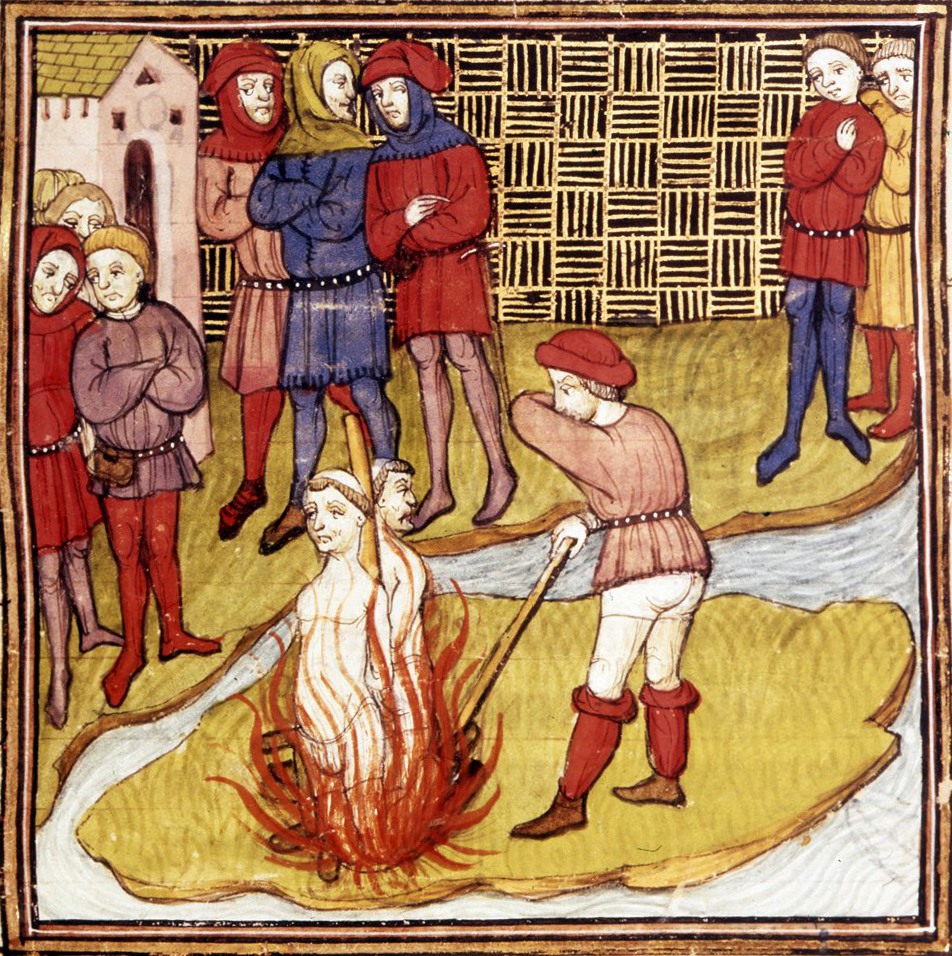
After the loss of the Holy Land, the order was rich, privileged, and without a clear purpose — a dangerous combination. King Philip IV of France, deeply indebted to the Temple, struck on Friday 13 October 1307: mass arrests, charges of heresy and blasphemy, and confessions extracted under torture. Pope Clement V, under French pressure, dissolved the order at the Council of Vienne in 1312. Grand Master Jacques de Molay, recanting his forced confession, was burned at the stake in Paris in 1314, reportedly cursing king and pope — both died within the year.
Most historians regard the charges as fabricated; the Chinon Parchment, rediscovered in 2001, shows that Clement V had privately absolved the order's leadership of heresy in 1308.
Chronology
| Year | Event |
|---|---|
| c. 1119 | Order founded in Jerusalem by Hugues de Payens |
| 1129 | Council of Troyes: official rule granted |
| 1139 | Bull Omne datum optimum: papal privileges |
| 1187 | Battle of Hattin; Jerusalem lost to Saladin |
| 1291 | Fall of Acre; headquarters moves to Cyprus |
| 13 Oct 1307 | Mass arrests in France under Philip IV |
| 1312 | Council of Vienne dissolves the order |
| 1314 | Jacques de Molay executed in Paris |
Frequently asked questions
Were the Knights Templar monks or soldiers? Both. They took monastic vows and followed a religious rule, but their duty was armed protection of pilgrims and the crusader states — a "new knighthood" combining both callings.
Why were the Templars arrested on Friday the 13th? Philip IV of France needed their wealth and feared their independence. The date — 13 October 1307 — is one origin often cited for the Friday-the-13th superstition, though the link is a modern popularization.
Did the Templars have a hidden treasure? No credible evidence supports a lost treasure or secret survival. Their assets were transferred to the Knights Hospitaller in 1312; much of the mythology stems from 18th-century Freemasonry and modern fiction.
Do the Knights Templar still exist? The original order was dissolved in 1312. Modern organizations using the name are revival or fraternal groups with no institutional continuity.
All Templar articles
The articles below dive deeper into every aspect of the order — banking, symbolism, trade, metallurgy, agriculture, and warfare.
Articles on Knights Templar (9)

The Order of Christ: How the Templars Survived in Portugal
When Pope Clement V dissolved the Knights Templar in 1312, King Dinis of Portugal preserved the order under a...

Vox in Excelso: The Papal Bull That Dissolved the Knights Templar
On 22 March 1312 Pope Clement V issued Vox in Excelso, ending the Knights Templar not by conviction but by...

The Templars’ Ironworks: Metallurgy, Innovation, and Military Infrastructure in 12th-Century Outremer
How the Knights Templar’s ironworks in 12th-century Outremer forged the weapons, castles and economy that...

Commerce and Crusade: The Templar Trade Networks in the Eastern Mediterranean, 1150–1300
How the Knights Templar built trade networks linking the Levant to Europe, reshaping commerce, politics and...

Knights Templar Commanderies and the Spread of Agricultural Innovation in 12th-Century France
How Templar commanderies in 12th-century France spread the heavy plough, watermills and crop rotation, and...

The Knights Templar and Technological Innovation: Banking, Codes, and Castles in Medieval Europe
How the Knights Templar reshaped medieval Europe through their innovations in banking, coded correspondence...

The Templars’ Banking Network: Finance, Trust, and Power in Medieval Europe
How the Knights Templar built medieval Europe’s first banking network of deposits, transfers and royal...

Knights Templar Symbolism — The Meaning Behind the Cross
The Templars wore no cross at their founding; it was most likely granted under Eugenius III, sewn to the left...

Knights Templar: The Warrior-Monks Who Ruled the Crusades
Who were the Knights Templar and what was their purpose? Inside the crusader knights who became medieval...
Free for the curious, supported by you
Writesides of History publishes free, in-depth history articles every week. If you enjoy reading, you can support the work: become a member for exclusive deep-dive dossiers and early access, or browse the maps, classroom packs and dossiers in the shop.
Become a Member Donate Visit the Shop