The Raid on Dutch soil
At Gennep on 10 May 1940, Brandenburgers in Dutch uniform seized the bridge intact and ran a troop train straight through the Peel-Raam Position at Mill.

Early 1940, The Netherlands was still building their defense against a possible raid from Hitlers Germany. In the middle section of the Eastern border, they build the so called Maaslinie, supported with the “Peel-raamstelling”, a defensive line containing rather small concrete fortifications called “kazematten” from which fixed machinegunfire could be launched upon the enemy approaching. The Peelraamstelling contained about 2000 of these Kazematten, intersected by approximately 300-400 meters. Next to that a anti-tank channel had been dug, which was supposed to prevent enemy tanks on their advance.
A line built to buy time, not to win
The Peel-Raam Position was never meant to defeat a German invasion on its own. Dutch strategy rested on armed neutrality, and behind that neutrality lay a very old idea: if an invader came anyway, the field army would fall back on the Vesting Holland — Fortress Holland — the western provinces protected by rivers and by deliberately flooded ground, and hold there until the diplomatic situation changed or a great power intervened. It was the same instinct that had saved the Dutch Republic in the disaster year of 1672, when sluices were opened and a belt of shallow water stopped the armies of Louis XIV where fortresses had failed.
That doctrine explains the shape of the eastern defences. The Maas Line was a thin outpost belt along the river, meant to watch the crossings and force an attacker to deploy. The Peel-Raam Position lay roughly nine to twenty-one kilometres behind it, running from Grave past Mill and then south along the Zuid-Willemsvaart canal towards Weert. In the northern sector the anti-tank obstacle was a purpose-dug Defensiekanaal; further south the existing canal did the same work. What the line did not do was join up with the Belgian defences beyond the border, so its southern end hung in the air — a gap neutrality had forbidden the two staffs to close.
The state of the Dutch army in comparison to the German army was an inferior one, and modernisation of the army had not been put through properly. The river “Maas” was considered a natural barrier but the eastern border held several bridges. To prevent the enemy from crossing the bridges, they were mostly prepared for demolition by the teams responsible.
The bridges the Dutch could not afford to lose
Demolition was the hinge on which the whole eastern scheme turned: a river is only a barrier while the crossings over it are gone. On the morning of the invasion most of the Dutch firing parties did their work and the great majority of the Maas bridges went into the water. The plan failed only where it was attacked by something other than an ordinary assault.
The Germans understood the problem exactly as the Dutch did, which is why the crossings went not to the leading infantry but to a new and still experimental formation: Bau-Lehr-Bataillon z.b.V. 800, the unit that would shortly become famous as the Brandenburgers. Its speciality was the coup de main in enemy uniform — seizing a bridge in the minutes before the charges could be fired, rather than fighting across it afterwards. Of all the targets on the Dutch frontier the railway bridge at Gennep was the most valuable, because it carried the line from Goch straight across the Maas and pointed, without a turn, at the Peel-Raam Position beyond.
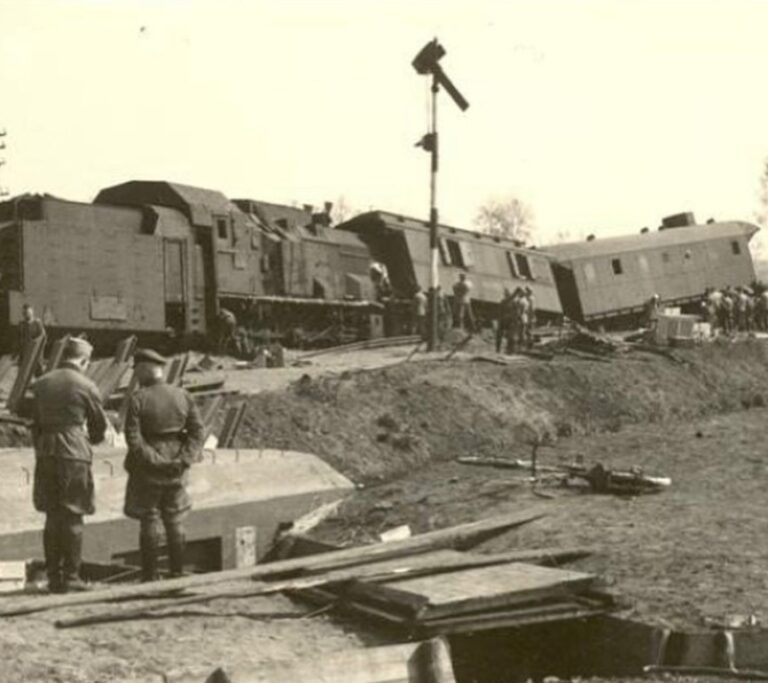
Armoured train near Mill, The Netherlands, May 1940
A handful of men in the wrong uniforms
The party that took the Gennep bridge was small. In the early hours of 10 May 1940 a team led by Oberleutnant Wilhelm Walther, dressed as Dutch military police escorting German prisoners, worked its way onto the eastern approach and struck at around two in the morning. Two guard positions were overrun and three of the attackers were wounded before the group was pinned down; Walther, still in Dutch uniform, walked forward along the bridge, and the hesitation of defenders who could not be certain what they were looking at gave the rest of the team the seconds they needed. The guards were overcome and the detonators disabled. Walther received the Knight's Cross for the action on 4 June 1940.
But in the early morning the Germans were able to neutralize the demolitionloads from the railroad bridge at Gennep and to decept the guards. It made them possible not only to breach the Maaslinie, but also breach the Peelraamstelling using an armoured train containing troops and penetrate Dutch soil up to 15 kilometers until the train was finally put to a hold at the town of Mill. The Germans were then able to attack the Peelraamstelling from behind. Later that same day after delaying the German advance and brave defensive efforts, the Peelraamstelling was cleared as ordered by the High Command of the Dutch army. Next defensive line for the Germans to stumble upon would be the Grebbelinie, an attachment to the North of the Peelraamstelling.
The trains at Mill
What crossed the captured bridge was not a spearhead of tanks but two trains: an armoured train followed by a troop train carrying roughly five hundred infantrymen of the 481st Infantry Regiment, part of Generalleutnant Gerhard Kauffmann's 256th Infantry Division. Because the invasion had not yet been recognised for what it was, they rolled through the Dutch positions almost unopposed, and at about half past four in the morning they halted some three and a half kilometres west of Mill, near Zeeland — behind the line, in the middle of the ground the casemates were built to cover.
The improvisation that followed decided the shape of the day. When the armoured train ran back east some three quarters of an hour later, apparently to fetch reinforcements, Dutch troops had already dragged rail obstacles — the steel "asperges" designed for exactly this purpose — onto the track and laid mines, and the train was derailed. The corridor closed behind the Germans who had already used it. What remained was a conventional battle: the Mill sector was held by roughly two thousand men in two battalions with artillery support, fighting behind the Defensiekanaal, minefields and casemates, and now also fighting the infantry deposited in their rear. Dutch counter-attacks failed to destroy the intruders, but the position was not carried cheaply, and the advance was held up for a full day.
The captured bridge also proved less useful than the Germans had hoped. It was a railway crossing, and to run lorries and guns over it timber had to be laid between and beside the rails; the train carrying that timber was routed to the wrong destination and arrived a day late. For the first crucial hours the great prize at Gennep delivered infantry on rails and very little else.
The order that had already been written
The evacuation of the Peel-Raam Position on the evening of 10 May looks, from the outside, like a collapse forced by the breakthrough at Mill. It was in fact a decision taken six weeks earlier. General Henri Winkelman, who had taken command of the Dutch armed forces in February 1940, did not regard the position as a main line of resistance at all. On 30 March he decided in secret that at the onset of a German attack the bulk of Third Army Corps would be pulled back to the Linge to cover the southern flank of the Grebbe Line, leaving only a covering force behind. The men in the casemates were not told; they were defending a position their commander-in-chief had already decided to give up.
The withdrawal was carried out that night, a rearguard holding the crossings of the Zuid-Willemsvaart until about four in the morning on 11 May while the field units marched west. Historians have argued ever since about whether the plan was realism or defeatism. The case for Winkelman is that a long, thinly held line with an open southern flank, facing an enemy free to concentrate anywhere along it, would have cost the Dutch army its field divisions in a day. The case against is that the troops who died holding it died for a line nobody intended to keep.
What the breakthrough cost
The consequences ran well beyond one Brabant village. The French Seventh Army, advancing north to link up with the Dutch in Brabant and Zeeland, found the Dutch field army gone from the sector it had come to support and its own position untenable within days. Inside the Netherlands the war moved quickly to the water lines: the Grebbe Line, the next obstacle facing the Germans, held for three days and fell on 13 May, Rotterdam was bombed on 14 May, and Winkelman signed the capitulation at Rijsoord on 15 May.
The raid at Gennep is remembered because it shows so cleanly how narrow the margins were. A defensive system built over years, at great cost, was unhinged in a few minutes by a handful of men in borrowed uniforms and a sentry's moment of doubt — and then held up for a day by soldiers improvising with rail obstacles and mines. Neither fact cancels the other. The same summer would show, in the skies over southern England during the Battle of Britain, that a defence surviving its first day could change the course of the war; the Dutch eastern lines were never designed to be given that chance.
Chronology of the raid and the breakthrough, 1939–1940
| Date | Event |
|---|---|
| 1939 | The Peel-Raam Position is fortified, with casemates, minefields and an anti-tank canal from Grave past Mill to the Zuid-Willemsvaart |
| February 1940 | General Henri Winkelman becomes commander-in-chief of the Dutch armed forces |
| 30 March 1940 | Winkelman secretly decides to abandon the Peel-Raam Position at the onset of an attack and withdraw Third Army Corps behind it |
| c. 02:00, 10 May 1940 | Oberleutnant Wilhelm Walther's Brandenburger team, in Dutch uniform, seizes the Gennep railway bridge and disables the demolition charges |
| c. 04:30, 10 May 1940 | An armoured train and a troop train pass through the Peel-Raam Position and halt near Zeeland, west of Mill |
| Morning, 10 May 1940 | The returning armoured train is derailed on rail obstacles and mines; the battle for Mill develops on both sides of the line |
| Evening, 10 May 1940 | The Dutch high command orders the Peel-Raam Position cleared |
| c. 04:00, 11 May 1940 | The rearguard on the Zuid-Willemsvaart breaks off; the field units are away to the west |
| 13 May 1940 | The Grebbe Line falls |
| 14 May 1940 | Rotterdam is bombed |
| 15 May 1940 | Winkelman signs the Dutch capitulation at Rijsoord |
| 4 June 1940 | Walther is awarded the Knight's Cross for the Gennep operation |
Frequently asked questions
Why did the Dutch not simply blow up the bridge at Gennep? They intended to, and the charges were in place with a firing party responsible for them. The bridge was taken by a small German team in Dutch uniforms who reached the detonation point before the order could be carried out, which is precisely why the operation was given to a specialist unit rather than to ordinary assault infantry. Most of the other Maas bridges were destroyed as planned.
How could a train breach a fortified line? The Peel-Raam Position was designed to stop men and tanks approaching across open ground, with an anti-tank canal and interlocking machine-gun fire covering the front. A railway ran straight through it, and once the bridge behind was intact the line offered a corridor that pointed the wrong way for the defenders — troops arrived behind the casemates rather than in front of them. The Dutch answer was improvised: rail obstacles and mines that derailed the armoured train when it tried to return.
Was the Peel-Raam Position abandoned because of the breakthrough at Mill? Not really. Winkelman had already decided on 30 March 1940 to give up the position at the start of any attack and to withdraw the bulk of his field troops to cover the southern flank of the Grebbe Line. The fighting at Mill determined how much time that withdrawal was given, not whether it would happen.
Did the defence achieve anything? It bought a day. The German advance was delayed by roughly twenty-four hours and cost the attackers heavier casualties than the campaign's pace suggests, and that delay covered the retreat of Dutch field units towards Fortress Holland. Set against the five-day collapse of the Netherlands as a whole, it was a small return on an expensive line — but it was not nothing.
Bibliography
- Instrument of capitulation of the Netherlands armed forces. 1940.
- Jong, Loe de. Het Koninkrijk der Nederlanden in de Tweede Wereldoorlog.
- Nationaal Archief. Nationaal Archief, Netherlands.
- Operational orders for Fall Gelb. Oberkommando des Heeres, 1940.
Recommended reading
May 1940: The Battle for the Netherlandsthe standard scholarly account of the five-day campaign, and the best corrective to the idea that it was simply Blitzkrieg.
The Blitzkrieg Legend: The 1940 Campaign in the Westthe official German history of the western campaign, essential for understanding why bridges and speed mattered more than tanks.
View on Amazon →: The Blitzkrieg Legend: The 1940 Campaign in the West
Brandenburger: Wartime Photographs of Wilhelm Walthera photographic record assembled from the album of the officer who led the seizure of the Gennep bridge.
View on Amazon →: Brandenburger: Wartime Photographs of Wilhelm Walther
The Fall of France: The Nazi Invasion of 1940places the Dutch collapse inside the wider Allied defeat that followed within weeks.
View on Amazon →: The Fall of France: The Nazi Invasion of 1940
As an Amazon Associate I earn from qualifying purchases. Affiliate links in Recommended reading — and in Further reading on older articles — may earn Writesides of History a commission at no extra cost to you.
Free for the curious, supported by you
Writesides of History publishes free, in-depth history articles every week. If you enjoy reading, you can support the work: become a member for exclusive deep-dive dossiers and early access, or browse the maps, classroom packs and dossiers in the shop.
Become a Member Donate Visit the Shop