The Magna Carta of 1215: Foundation of Modern Liberty and Rule of Law
Defeat abroad and a barons' revolt forced King John to seal Magna Carta at Runnymede in 1215 — annulled by the pope within ten weeks, reissued regardless.

In 1215, a momentous event unfolded that would profoundly influence the development of constitutional law and civil liberties not only in England but across the world. The signing of the Magna Carta, or "Great Charter," marked a turning point in medieval history, challenging royal authority and laying early foundations for modern legal systems.
Background: England Before the Magna Carta
By the early 13th century, England was ruled by King John, a monarch whose reign was rife with controversy. Ascending the throne in 1199, King John faced numerous military challenges, including losing significant territories in France. His heavy taxation and arbitrary justice caused widespread dissatisfaction among the nobility and other subjects.
The king’s autocratic style and financial demands led to strained relationships with the English barons and heightened tensions across the realm. This turmoil set the stage for a direct confrontation over the rights of the crown versus those of the governed.
Two blows in particular hollowed out John's authority. In 1204 Philip II of France took Normandy, severing the cross-Channel realm the English aristocracy had held since the Norman Conquest; the decade of scutage, punitive inheritance reliefs and sold wardships that followed was meant to win it back, and instead bought defeat at Bouvines in 1214. The barons had paid for a lost war. John also quarrelled with the church: his refusal to accept Stephen Langton as Archbishop of Canterbury brought an interdict on England in 1208 and his own excommunication in 1209, ending only when he submitted in 1213 and held his kingdom as a fief of Pope Innocent III. The bargain gained a protector abroad without restoring trust at home.
The Barons’ Revolt and the Road to Runnymede
By 1215, discontent among England’s powerful barons reached a breaking point. They refused to continue supporting King John's wars and financial levies without limits on his authority. Seeking to check his power, the barons compelled the king to negotiate and agree to a set of demands.
The rebels' demands were not invented for the occasion. Their model was the coronation charter of Henry I, issued in 1100, in which a king had promised to abandon his predecessor's evil customs; copies were circulating among the discontented, and Langton is generally credited with pressing that precedent on them. In May 1215 the barons formally renounced their homage, and London opened its gates to them, costing John his richest city and his best source of credit. Only then did he agree to talk.
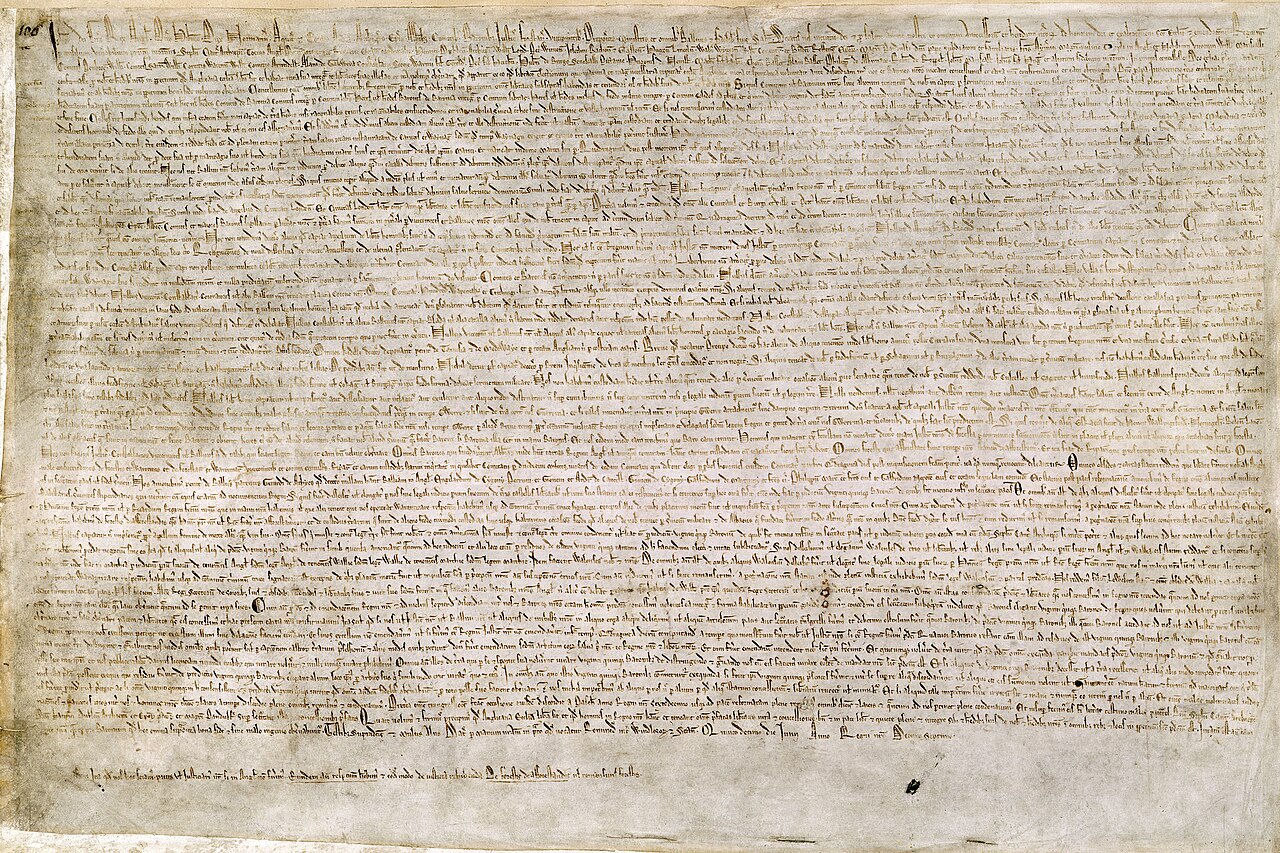
The negotiations culminated at Runnymede, a meadow beside the River Thames, on June 15, 1215. There, the Magna Carta was sealed by King John. It was not merely a list of baronial privileges but a groundbreaking legal charter that addressed grievances concerning governance, justice, taxation, and feudal rights. The meeting place measured the mistrust: Runnymede lay between the royal castle at Windsor and the rebel camp at Staines.
Key Clauses and Their Significance
The Magna Carta contained numerous clauses that curbed royal power and guaranteed feudal and legal protections. Among its most famous provisions were:
- Rule of Law: The king and his government were bound by law, notably the need for lawful judgment before punishment.
- Due Process: Free men could not be imprisoned or stripped of property without lawful judgment—a precursor to modern trial rights.
- Taxation with Consent: The monarch could not levy or collect certain taxes without the agreement of a council of barons.
- Protection of Church Rights: Ensuring the freedom and autonomy of the English church from royal interference.
These principles directly challenged the notion of absolute monarchy and helped establish legal limits on sovereign power.
In the numbering later editors gave it, the charter runs to sixty-three clauses, and most of them are intensely practical: fixed inheritance reliefs, protection for widows, the removal of fish-weirs from the Thames, the expulsion of John's foreign mercenary captains. The famous principles sit inside that thicket of detail. Clause 39 promised that no free man would be seized, imprisoned or dispossessed except by the lawful judgement of his peers or by the law of the land; clause 40 added that to no one would the king sell, deny or delay right or justice. Clause 61 then created a committee of twenty-five barons entitled to seize royal castles and lands if he broke the terms — the provision that made the charter enforceable, and made it intolerable to John.
Immediate Aftermath and Legacy
Although the Magna Carta was initially intended as a peace treaty to resolve baronial rebellion, King John sought to annul it almost immediately, leading to the First Barons' War. However, after John's death in 1216, the charter was reissued with modifications under his successor, Henry III, and gained acceptance as a foundational document.
The annulment ran through Rome. As a papal vassal, John appealed to his overlord, and Innocent III obliged on 24 August 1215 with the bull Etsi carissimus, condemning the settlement as extorted by force and declaring it void. As live law, the 1215 text had lasted roughly ten weeks. The war that followed nearly ended the dynasty: the rebels offered the crown to Prince Louis of France, who landed in 1216 and held London. John's death that October changed the arithmetic, since loyalists could now fight for a nine-year-old rather than a hated king, and the regent William Marshal reissued the charter in Henry III's name at once — without the security clause that had provoked the quarrel. A third issue followed in 1217 alongside a separate Charter of the Forest, and the definitive version was granted by Henry III in 1225 in return for a tax. Edward I confirmed that text in 1297, and it was entered on the statute roll.
Over the centuries, the Magna Carta evolved from a feudal document protecting noble privileges into a symbol of broader liberties and constitutional governance. It inspired legal developments such as the English Petition of Right (1628), Bill of Rights (1689), and even modern democratic constitutions around the world, including the United States Constitution.
The Magna Carta's Enduring Influence
Today, the Magna Carta is remembered as a cornerstone of legal history. It introduced the radical idea that rulers are subject to the law and that citizens possess inherent rights that governments must respect.
Its legacy persists in contemporary concepts of human rights, separation of powers, and the rule of law, making it one of the most important documents in Western legal tradition and political thought.
That second career owed much to seventeenth-century lawyers. Sir Edward Coke read clause 39 as a guarantee of jury trial and of protection against arbitrary imprisonment, and turned it against the Stuart prerogative; the reading fed the parliamentary quarrels of the 1620s and, through them, the constitutional settlement of 1688. The phrase "due process of law" is not in the charter at all: a statute of Edward III restated clause 39 in those words in 1354, and it is that formulation American constitutional law inherited.
Conclusion
The Magna Carta of 1215 was not merely a medieval treaty but a transformative milestone in the history of governance. Born from conflict and concession, it challenged arbitrary royal power and planted the seeds for centuries of legal and constitutional progress. Understanding its origins and impact helps us appreciate the enduring quest for liberty and justice that continues to shape modern societies.
Chronology of the Magna Carta
| Date | Event |
|---|---|
| 1199 | John succeeds Richard I as king of England |
| 1204 | Philip II of France takes Normandy from John |
| 1208 | England is placed under papal interdict; John is excommunicated in 1209 |
| 1213 | John submits to Innocent III and holds England as a papal fief |
| July 1214 | Defeat at Bouvines ends the campaign to recover Normandy |
| May 1215 | The rebel barons renounce their homage; London opens its gates to them |
| 15 June 1215 | Magna Carta is sealed by King John at Runnymede |
| 24 August 1215 | Innocent III annuls the charter by the bull Etsi carissimus |
| 1216 | Prince Louis of France is offered the crown; John dies and Henry III succeeds |
| November 1216 | The charter is reissued in Henry III's name, without the security clause |
| 1217 | A third issue appears alongside the separate Charter of the Forest |
| 1225 | Henry III grants the definitive version in return for a tax |
| 1297 | Edward I confirms the charter and it is entered on the statute roll |
Frequently asked questions
Did King John actually sign the Magna Carta? He sealed it rather than signed it. Authentication in 1215 was done with the great seal in wax, and a royal signature would have carried no legal weight; the sealed charter was then copied and sent out to the shires, binding him exactly as the barons intended.
If the charter was annulled within weeks, why does it matter? Innocent III condemned it in August 1215, so the original text was live law for barely ten weeks. What survived was the reissues: the versions granted in 1216, 1217 and 1225 under Henry III, and the confirmation of 1297 that put the charter on the statute roll. Its authority comes from kings having to grant it again and again.
Who counted as a "free man" under clause 39? Far fewer people than the modern language suggests. The clause covered barons, knights, freeholders and townsmen, while the villeins who made up much of England's rural population were excluded from its guarantee. The wording proved elastic enough for later generations to read universally, but in 1215 it settled matters between a king and his propertied subjects.
How much of the Magna Carta is still law in England? Only a handful of clauses from the 1297 version remain in force; the rest was repealed as the feudal grievances it addressed fell away. The survivors include the liberties of the English church, the ancient liberties of the City of London, and the combined text of clauses 39 and 40 on lawful judgement and the denial of justice.
Bibliography
- British Library. British Library.
- III, Innocent. Etsi carissimus. 1215.
- Magna Carta. 1215.
- Turner, Ralph V. Magna Carta: Through the Ages. Pearson, 2003.
- Wendover, Roger of. Flores Historiarum.
Recommended reading
Magna Cartaa clause-by-clause commentary with the full text, and the best single guide to what the charter actually said.
Magna Cartathe standard scholarly account, revised by George Garnett and John Hudson, on how the charter was made and remade.
Magna Carta: A Very Short Introductiona compact, reliable overview running from Runnymede to the charter's modern reputation.
King John: Treachery and Tyranny in Medieval England: The Road to Magna Cartaa biography of the misrule and lost French wars that drove the barons to Runnymede.
View on Amazon →: King John: Treachery and Tyranny in Medieval England: The Road to Magna Carta
Magna Carta: The Birth of Libertya brisk narrative of the crisis of 1215 and of the charter's afterlife in Anglo-American liberty.
As an Amazon Associate I earn from qualifying purchases. Affiliate links in Recommended reading — and in Further reading on older articles — may earn Writesides of History a commission at no extra cost to you.
From the archive
Free for the curious, supported by you
Writesides of History publishes free, in-depth history articles every week. If you enjoy reading, you can support the work: become a member for exclusive deep-dive dossiers and early access, or browse the maps, classroom packs and dossiers in the shop.
Become a Member Donate Visit the Shop