The Carolingian Renaissance: Charlemagne's Revival of Learning
Advised by Alcuin of York, Charlemagne deliberately rebuilt schooling, manuscript copying, and literacy — reversing centuries of decline.

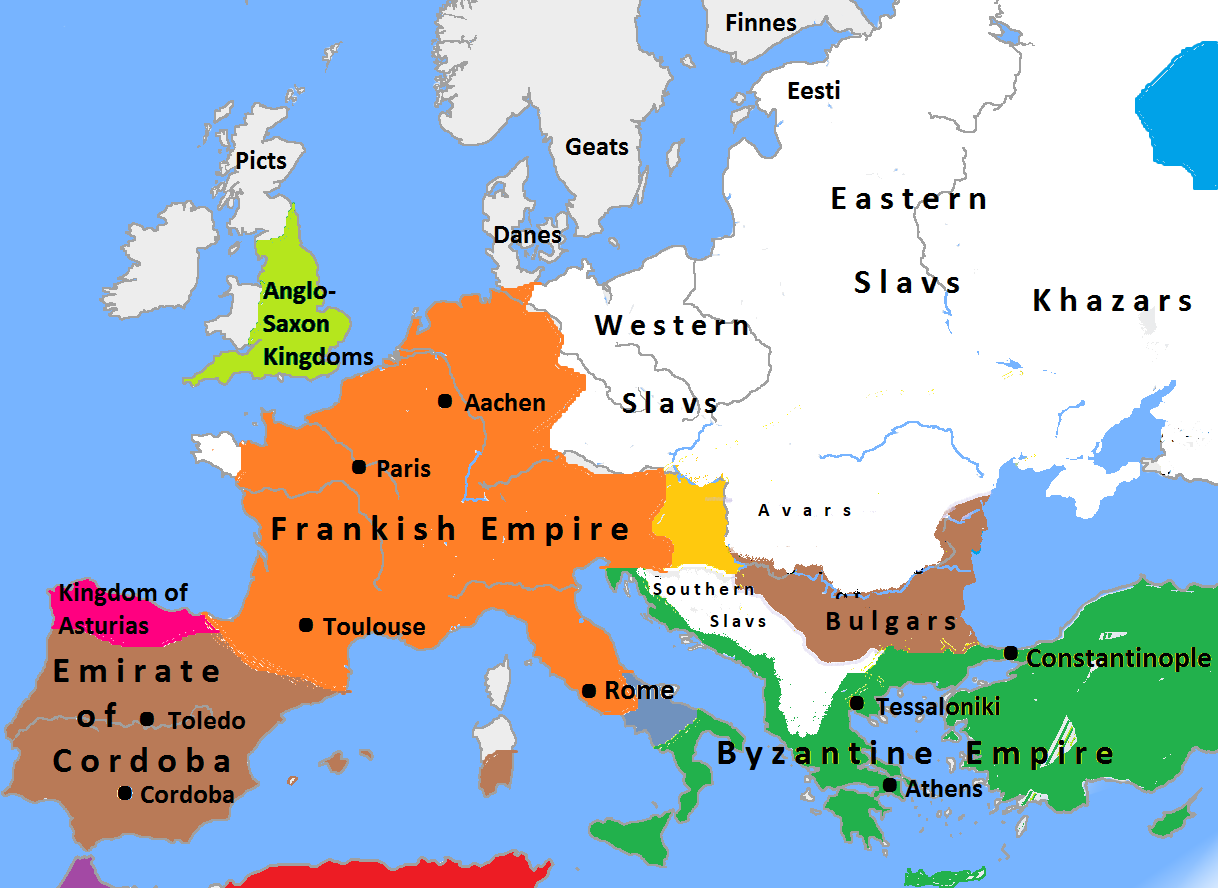
For three centuries after Rome fell, learning in the Frankish West had contracted into a narrow clerical channel, and even the Latin of the Church had grown corrupt with error. Then, in the late eighth century, a king decided to reverse the trend on purpose. Charlemagne — ruler of the Franks from 768 and emperor from 800 — treated education not as a private ornament but as an instrument of good government and right religion, and he built policy around it. He summoned the finest scholars in Europe to his court, ordered monasteries and cathedrals to run schools, commissioned corrected texts, and standardized the very handwriting in which books were copied. The result, later called the Carolingian Renaissance, was the deliberate rebuilding of literate culture in the Latin West. This was the mirror image of the long decline of literacy that had shut reading up inside the Church: where the earlier age had watched learning shrink by neglect, Charlemagne's age expanded it by design.
Why a King Cared About Grammar
Charlemagne's interest in learning was intensely practical. He governed a vast, sprawling empire through written instructions — the capitularies — sent to counts and bishops across his territories, and he wanted those orders read and obeyed accurately. He also believed, sincerely, that a Christian ruler was responsible for the salvation of his people, and that salvation depended on prayers said correctly, scripture copied without error, and clergy who actually understood the Latin they recited. Garbled texts and half-literate priests were, in this view, both an administrative failure and a spiritual danger.
The problem was real. Generations of hand-copying by scribes with shaky Latin had introduced errors into Bibles, prayer books, and legal texts, and standards of clerical education had fallen unevenly across the realm. Charlemagne's response was to make the correction and spread of learning a matter of royal command, backed by the authority of a rising dynasty that had already replaced the last of the fading Merovingian kings and now sought to renew Christian civilization itself.
Alcuin of York and the Court School
To lead this effort Charlemagne recruited the best scholar he could find: Alcuin of York, an Anglo-Saxon deacon trained in the rich cathedral school of York, one of the leading centres of learning in the Latin West. Charlemagne met him in Italy and, around 782, brought him to the Frankish court to direct its palace school and to shape the wider educational program. Alcuin became the intellectual architect of the revival — teaching the royal family and courtiers, training a generation of scholars, standardizing the curriculum around the traditional liberal arts, and advising the king on reform. His central role in the Carolingian school movement made him the indispensable partner of the whole enterprise.
Alcuin was not alone. Charlemagne's court drew talent from across Europe — the Lombard grammarian Paul the Deacon, the Visigothic scholar Theodulf of Orléans, the Irishman Dungal, and others — creating a cosmopolitan brain trust unlike anything the Frankish kingdom had seen. This gathering of scholars around the throne is the human core of the wider story of Charlemagne and the Carolingian revival.
Turning Policy into Schools and Books
What distinguishes the Carolingian Renaissance is that it was enacted through royal directives, not left to chance. Two documents capture the program. In the Admonitio Generalis of 789, a sweeping capitulary of reform, Charlemagne ordered that schools be established to teach boys to read, and that correct copies of essential texts be made available. In a related circular letter known as De litteris colendis ("On the cultivation of letters"), addressed to abbots and bishops, he urged that those in monasteries and cathedrals who had the ability to learn should be encouraged to study, so that they could better understand scripture — insisting that right conduct and right speech went together.
These orders gave the monastic scriptorium a renewed and enlarged purpose. Where copyists had long preserved a curated remnant of texts, now they were mobilized on a larger scale to produce corrected Bibles, service books, patristic works, and school texts, and to recopy classical Latin authors as the tools of grammar and rhetoric. A very large proportion of the surviving works of Roman literature reaches us through Carolingian copies made in this period — the revival did not just teach the present but rescued the past.
Carolingian Minuscule: A Reform You Can Read
One of the most enduring achievements of the revival was a reform of handwriting itself. Frankish scribes developed and spread a clear, rounded, standardized script known as Carolingian minuscule, with well-formed letters, spaces between words, and consistent use of capitals and punctuation. Compared with the cramped and regionally variable scripts that preceded it, minuscule was dramatically easier to read and to copy accurately — precisely the qualities a program built on correct texts required.
The script's influence outlived the empire that produced it. Centuries later, Italian Renaissance humanists, admiring the clarity of what they thought were "ancient" manuscripts (in fact Carolingian copies), modelled their own handwriting on it — and that humanist letterform became the basis of the roman typefaces still used in printed books today. In a real sense, the shape of the letters on this page descends from Charlemagne's reform.
| Element of the revival | What it did |
|---|---|
| Palace school under Alcuin | Trained courtiers and scholars; set the curriculum |
| Admonitio Generalis (789) | Ordered schools and correct texts across the realm |
| De litteris colendis | Urged monasteries and cathedrals to cultivate learning |
| Monastic scriptoria | Copied corrected Bibles, service books, and classical texts |
| Carolingian minuscule | Standardized a clear, legible script for accurate copying |
| Correction of texts | Purged errors from scripture, liturgy, and law |
The Reach and Limits of the Revival
The Carolingian Renaissance was not a mass movement — it did not make peasants literate or transform the whole of society. It was concentrated in the court, the monasteries, and the cathedral schools, and its immediate audience was the clergy and a slice of the aristocracy. Its aims were as much religious and administrative as intellectual. Yet within those limits its impact was immense and lasting. It raised the standard of Latin, multiplied and corrected the stock of books, trained the teachers who would staff the next generation of schools, and preserved a great share of the classical inheritance for the future.
Crucially, it created durable institutions. The monastic and cathedral schools nurtured under Charlemagne and his successors — the program continued under his son Louis the Pious and beyond — became the seedbeds from which later medieval learning, and eventually the universities, would grow. When the political unity of the empire fractered in the ninth century, the schools and libraries endured, carrying the revival's gains forward even as the emperors' power waned.
Conclusion
The Carolingian Renaissance was the moment the Latin West chose, consciously, to climb back out of the long contraction of learning. Where the early medieval centuries had let reading dwindle into a clerical necessity, Charlemagne — guided by Alcuin and a court full of scholars — made its recovery a matter of royal policy: schools by decree, books corrected by command, a legible script imposed for accuracy, and the classical past copied afresh in the scriptoria. The revival did not reach everyone, and it was driven as much by piety and statecraft as by love of letters. But it rebuilt the foundations of European intellectual life and preserved the texts on which all later Western learning would draw — the deliberate answer to an age of decline.
Chronology: the making of the Carolingian revival
| Date | Event |
|---|---|
| 768 | Charlemagne becomes king of the Franks, succeeding the Carolingian dynasty that had displaced the Merovingians. |
| c. 782 | Alcuin of York, trained at the cathedral school of York, arrives at the Frankish court to direct the palace school. |
| c. 785 | The circular letter De litteris colendis urges abbots and bishops to cultivate learning in their houses. |
| 789 | The Admonitio Generalis orders that schools be established and that correct copies of essential texts be made available. |
| 796 | Alcuin leaves the court for the abbey of St Martin at Tours, which becomes a leading centre of copying and teaching. |
| 800 | Charlemagne is crowned emperor in Rome. |
| 804 | Alcuin dies at Tours, having trained the generation of scholars who carried the reform onward. |
| Late 8th–9th centuries | Carolingian minuscule is developed and spread as the standard script of the empire's scriptoria. |
| 814 | Charlemagne dies; the educational programme continues under his son Louis the Pious. |
| 9th century | The political unity of the empire fractures, but the monastic and cathedral schools and their libraries endure. |
| 15th century | Italian humanists model their handwriting on Carolingian manuscripts, and that letterform becomes the basis of roman type. |
Frequently asked questions
What was the Carolingian Renaissance? It was a revival of learning, education, and manuscript production in the Frankish empire during the late eighth and ninth centuries, driven by Charlemagne and his scholars. It rebuilt schooling, corrected religious and classical texts, and standardized Latin and handwriting across the realm.
What role did Alcuin of York play? Alcuin, an Anglo-Saxon scholar from the cathedral school of York, was the intellectual leader of the revival. Recruited by Charlemagne around 782, he directed the palace school, shaped the curriculum, trained scholars, and advised the king on educational and religious reform.
Why did Charlemagne care so much about learning? His motives were practical and religious. He governed through written orders that needed to be understood accurately, and he believed a Christian ruler was responsible for correct worship, which required error-free texts and educated clergy. Reforming learning served both his administration and his sense of religious duty.
What was Carolingian minuscule and why did it matter? Carolingian minuscule was a clear, standardized script with spaces between words and consistent letterforms, far easier to read and copy accurately than earlier scripts. It spread across the empire, and Renaissance humanists later revived it, making it the ancestor of the roman typefaces used in print today.
Bibliography
- Admonitio generalis. 789.
- Bibliotheque nationale de France. Bibliotheque nationale de France.
- Epistola de litteris colendis. Frankish royal court.
- Ganz, David. Corbie in the Carolingian Renaissance. 1990.
- York, Alcuin of. Epistolae.
Recommended reading
The Carolingians and the Written Wordthe definitive study of literacy, texts, and their uses in the Carolingian world.
Charlemagne: The Formation of a European Identityan authoritative modern account of Charlemagne and his reforms.
View on Amazon →: Charlemagne: The Formation of a European Identity
Daily Life in the World of Charlemagnea vivid picture of Carolingian society, court, and schooling.
Two Lives of Charlemagnethe essential early biographies, including Einhard's portrait of the learned emperor.
Carolingian Learning, Masters and Manuscriptscollected studies on the schools and scholars of the revival.
View on Amazon →: Carolingian Learning, Masters and Manuscripts
Image: Charlemagne receiving Alcuin, who presents manuscripts copied by his monks — painting by Jean-Victor Schnetz, 1833 (Louvre). Public domain, via Wikimedia Commons.
As an Amazon Associate I earn from qualifying purchases. Affiliate links in Recommended reading — and in Further reading on older articles — may earn Writesides of History a commission at no extra cost to you.
From the archive
Free for the curious, supported by you
Writesides of History publishes free, in-depth history articles every week. If you enjoy reading, you can support the work: become a member for exclusive deep-dive dossiers and early access, or browse the maps, classroom packs and dossiers in the shop.
Become a Member Donate Visit the Shop