Ötzi the Iceman: Solving a 5,300-Year-Old Murder in the Alps
In 1991 hikers found a 5,300-year-old body frozen in the Alps: Ötzi the Iceman, whose murder and genome rewrote Copper Age Europe.

On 19 September 1991, two German hikers descending the Ötztal Alps on the Austrian-Italian border noticed something brown protruding from a melting glacier: a human body, curled on its side in a rocky hollow, so well preserved that the first people to see it assumed it was a recently lost mountaineer. It took several days, and the arrival of an Innsbruck archaeologist, to realize that the corpse was not decades old but roughly 5,300 years old, a man who had died in the Copper Age and been sealed in ice ever since. Named Ötzi after the valley where he was found, he remains the oldest natural human mummy in Europe, and the single richest source of direct physical evidence anyone has ever had for how a Stone Age person actually lived, ate, dressed, worked, and died. What began as a puzzling find on a hiking trail became one of the most intensively studied bodies in the history of archaeology, and the investigation into his death has taken on the shape of a genuine cold case, one still being reopened by new forensic techniques more than three decades later.
A Body Out of Time
Ötzi was found at 3,210 meters above sea level near the Tisenjoch pass, a route Alpine herders and traders had used for thousands of years to cross between what are now Austria and Italy. A brief thaw had exposed his upper body from the ice that had entombed him since his death. A survey conducted several days after the discovery determined the site lay about 92 meters inside Italian territory, which is why the body and his equipment are now held by Italy rather than Austria, at the South Tyrol Museum of Archaeology in Bolzano, where he is kept in a climate-controlled cell and viewable through a small window.
Radiocarbon dating placed his death between roughly 3350 and 3105 BC, meaning he lived at the boundary archaeologists call the Chalcolithic, or Copper Age, when farming communities across Europe had begun working metal but had not yet entered the Bronze Age proper. That dating alone made Ötzi extraordinary: bodies from this period almost never survive with skin, organs, and clothing intact. The ice that killed him also preserved him, freezing his tissue before decomposition could take hold and then protecting him from the crushing movement of the glacier by keeping him tucked into a sheltered rock gully. Extreme cold has preserved organic remains elsewhere in world archaeology too, most famously in the frozen royal kurgans of the Scythians in the Altai Mountains, where permafrost sealed Iron Age burials in ice for millennia in much the same way the Alpine glacier sealed Ötzi.
Who Was Ötzi?
Forensic examination puts Ötzi at around 45 years old when he died, roughly 160 centimeters tall and slightly built, with signs of a hard physical life: worn joints, arthritis in his neck, back, and hips, hardened arteries, and evidence of whipworm infection and advanced gum disease. He also carried the earliest confirmed evidence of the bacterium associated with Lyme disease found in any human body.
A full reanalysis of his genome published in 2023 substantially revised the popular image of Ötzi built from earlier reconstructions. Rather than the fair-skinned, long-haired figure seen in early museum models, the updated genetic data indicated notably dark skin for a European individual, and a genetic predisposition toward male-pattern baldness, meaning Ötzi likely had thinning or balding hair rather than the shaggy mane he was originally given. The same study found that more than 90 percent of his ancestry traced to early Anatolian farmers who had spread into Europe with the arrival of agriculture, with no detectable genetic input from the Steppe herders who would sweep into Western Europe not long after his lifetime. That suggested Ötzi belonged to a fairly isolated Alpine farming community with limited mixing with other contemporary populations, a detail that has helped geneticists map how ancestries shifted across Copper Age Europe. The revision is a reminder of how quickly laboratory science can overturn settled historical pictures: the same pattern played out when tree-ring dating confirmed the Norse voyages to Vinland centuries before Columbus, a claim once treated mainly as saga rather than history.
Dressed and Equipped for the Mountains
Ötzi did not die empty-handed, and the equipment scattered around him is as informative as the body itself. He wore a coat, belt, and leggings of stitched goat and sheep leather, a woven grass cape for insulation, a bearskin cap, and shoes with bearskin soles, deerhide uppers, and a netting of grass fibers packed inside for warmth, an arrangement so effective that a 2017 reconstruction found it kept feet warmer than some modern hiking boots in similar conditions.
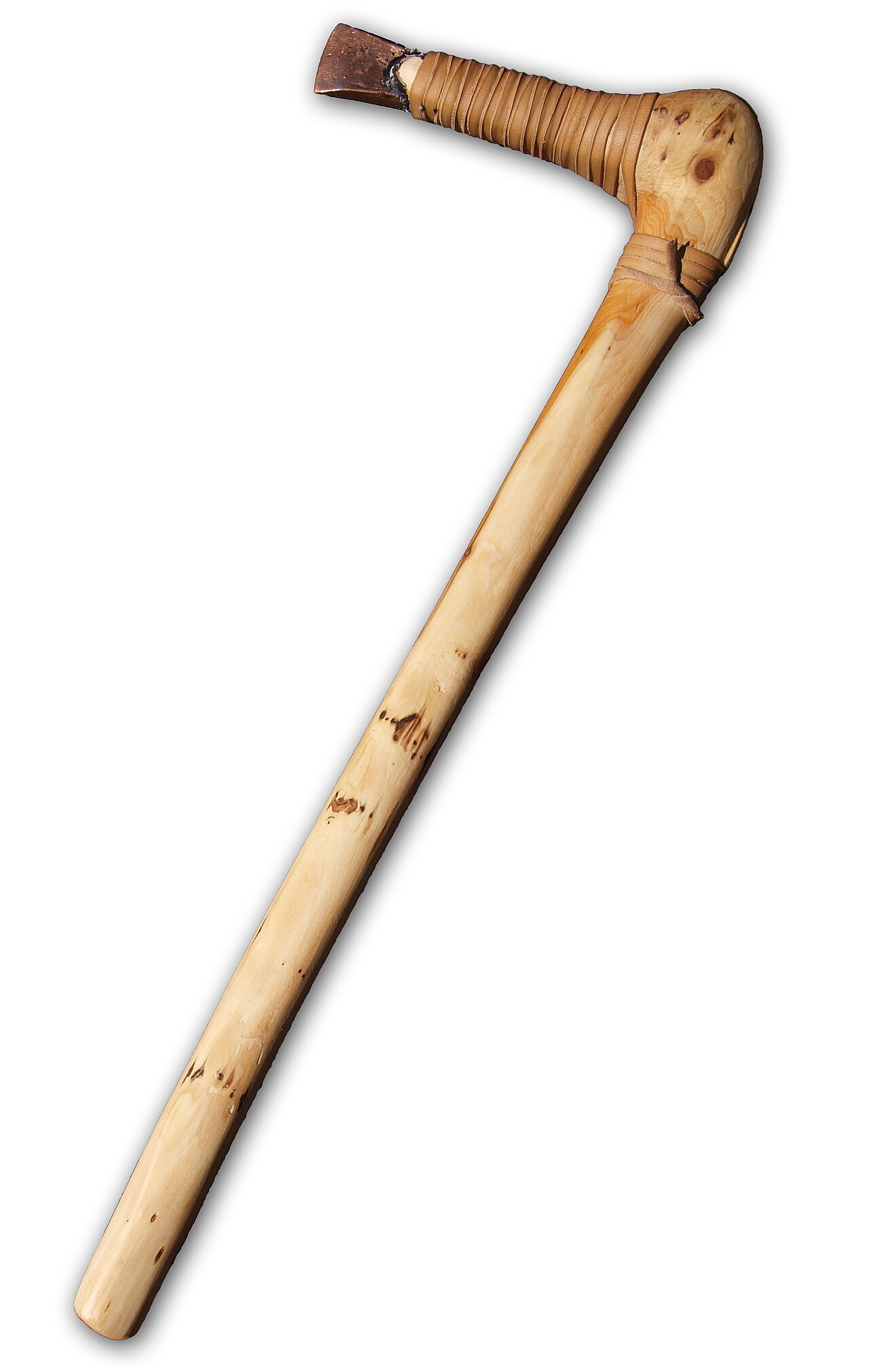
His toolkit included a flint dagger with an ash handle, a birch-bark container that held embers wrapped in maple leaves for restarting fires, and two pieces of birch fungus threaded on a cord, likely carried for their mild antibiotic and styptic properties. Most striking was his copper axe, its blade nearly pure copper and hafted onto a yew handle with birch tar and leather bindings. Analysis of the metal traced its ore to sources in southern Tuscany, hundreds of kilometers from where Ötzi died, physical proof that Copper Age Alpine communities were plugged into long-distance exchange networks for metal centuries before anything resembling organized trade routes appears in the written record; the same kind of resource-driven exchange that, on a much larger scale, would later underpin operations like the Templars' own ironworks in the crusader states.
He was also, unusually, still building a weapon when he died: an unfinished yew longbow, more than 1.8 meters long, that he had not yet strung or fully smoothed, along with a deerhide quiver holding 14 arrow shafts, only two of which were finished with flint points and feather fletching. The choice of yew for a self-bow, prized for combining flexible sapwood with a stiffer heartwood, is the same property that made the same timber the material of choice for the English longbow thousands of years later.
Perhaps the most debated find on his body is not a tool at all but ink: Ötzi carries 61 tattoos, simple lines and crosses made by rubbing charcoal into small cuts rather than piercing with a needle. Their placement over joints affected by his arthritis, rather than in visible decorative spots, has led most researchers to interpret them as a therapeutic practice, an early relative of acupuncture, rather than body art in the modern sense.
A Cold Case Five Millennia Old
For a decade after his discovery, researchers assumed Ötzi had died of exposure, perhaps caught by a sudden storm while crossing the pass. That theory collapsed in 2001, when a CT scan revealed a flint arrowhead lodged just below his left shoulder blade. The arrow had entered from behind and torn close to the subclavian artery, and forensic radiologists concluded this single wound was almost certainly the immediate cause of death.
Later research complicated that already dramatic picture. A cut on his right hand, partially healed, suggested he had been in a violent confrontation days before he died. DNA from as many as four other people was recovered from his knife, a coat, and one of his arrowheads, hinting he may have retrieved a weapon after a fight or even carried or fought alongside others who were wounded or killed. Most recently, physiological modeling published in 2024 and 2025 has pushed back against the idea that Ötzi bled out within minutes, suggesting instead that he may have survived for hours after being hit, and pointing to clotted blood found in his brain tissue as evidence of a blow to the head close to the time of death. The precise sequence, whether he was ambushed while fleeing uphill, caught after a days-long pursuit, or killed in a final struggle at the pass, remains unresolved and is still actively studied.
His last meal, reconstructed from stomach contents recovered years after his intestines were first assumed empty, showed a heavy, fatty meal of wild goat and red deer meat eaten alongside einkorn wheat, all consumed not long before he died, suggesting he was well fed and functioning normally in the hours before the fatal encounter rather than starving or fleeing for an extended period.
Timeline of Key Events
| Date | Event |
|---|---|
| c. 3350–3105 BC | Ötzi's estimated lifetime and death, based on radiocarbon dating |
| 19 September 1991 | Body discovered by hikers Helmut and Erika Simon near the Tisenjoch pass |
| 1992 | Body moved to the University of Innsbruck for initial study |
| 1998 | Remains transferred to the South Tyrol Museum of Archaeology, Bolzano |
| 2001 | CT scan identifies the arrowhead lodged near his shoulder blade |
| 2012 | First full genome sequence published |
| 2023 | Reanalysis of the genome reveals dark skin, balding, and Anatolian ancestry |
| 2024–2025 | New forensic modeling reassesses the timeline and cause of his death |
Rewriting the Copper Age
Beyond the mystery of his death, Ötzi's significance lies in how much ordinary Copper Age life he preserved by accident. Pollen and charcoal recovered with him have helped reconstruct the landscape and even the season of his death, most likely late spring or early summer. His clothing and tools demonstrate a level of textile, leatherworking, and metallurgical skill that written sources from later periods could only describe secondhand. Before Ötzi, most of what was known about Copper Age Alpine communities came from grave goods and settlement remains; after Ötzi, archaeologists had a single, remarkably complete snapshot of one individual's entire material world, from the fungus in his pouch to the copper in his axe, that could be tested, dated, and cross-checked against the broader archaeological record rather than reconstructed from fragments alone.
Conclusion
More than three decades after his discovery, Ötzi has arguably told researchers more about prehistoric Europe than any single archaeological site of comparable size. His body has been read for disease, diet, ancestry, and violence; his gear has been read for trade, craft, and technology; and his death, still not fully settled, continues to be reinterpreted as imaging and forensic methods improve. Few individuals from any period of history, let alone one without writing, have had their final days reconstructed in such granular, evolving detail.
Image: Facial and body reconstruction of Ötzi the Iceman, based on forensic and genetic evidence, on display at the South Tyrol Museum of Archaeology. Photo by Mannivu, CC BY-SA 4.0, via Wikimedia Commons.
Frequently asked questions
How did Ötzi the Iceman die? Ötzi was killed by an arrow that struck him from behind and lodged near his left shoulder blade, tearing tissue close to a major artery; a CT scan discovered the arrowhead in 2001. Newer research from 2024 and 2025 suggests he may have survived for some hours after being hit rather than dying within minutes, and that he also suffered a blow to the head around the time of death.
How old is Ötzi and when did he live? Radiocarbon dating places Ötzi's death between about 3350 and 3105 BC, making him roughly 5,300 years old, and he was approximately 45 years old at the time of his death, elderly by the standards of his community.
Where can you see Ötzi the Iceman today? Ötzi and his equipment are held at the South Tyrol Museum of Archaeology in Bolzano, Italy, where the mummy is kept in a specially built, climate-controlled cold cell and can be viewed by visitors through a small window, since the survey after his discovery placed the find site just inside Italian territory.
Is there really a "curse of the Iceman"? Tabloid reports in the early 2000s linked several deaths of people connected to Ötzi's discovery and study, including one of the hikers who found him, to a supposed curse. Researchers and journalists who examined the claim found no evidence of any pattern beyond coincidence and the ordinary mortality expected among a group of mostly older adults over more than a decade.
Bibliography
- EURAC Research. EURAC Research, Bolzano.
- Radiological and forensic examinations of the Iceman. EURAC Research Institute for Mummy Studies.
- South Tyrol Museum of Archaeology. South Tyrol Museum of Archaeology, Bolzano.
- The Iceman: body, clothing and equipment. South Tyrol Museum of Archaeology.
Recommended reading
The Man in the Icewritten by the lead archaeologist on the original investigation, this is the foundational account of the discovery and early scientific analysis.
Iceman: Uncovering the Life and Times of a Prehistoric Man Found in an Alpine Glaciera journalist's account of the discovery and the political and scientific disputes over the body that followed.
Ötzi, the Iceman: The Full Facts at a Glancea concise, museum-authored summary of confirmed findings, useful for checking details against the latest research.
View on Amazon →: Ötzi, the Iceman: The Full Facts at a Glance
Europe Before Rome: A Site-by-Site Tour of the Stone, Bronze, and Iron Agesplaces Ötzi within the wider context of Copper Age and Bronze Age archaeological sites across Europe.
View on Amazon →: Europe Before Rome: A Site-by-Site Tour of the Stone, Bronze, and Iron Ages
As an Amazon Associate I earn from qualifying purchases. Affiliate links in Recommended reading — and in Further reading on older articles — may earn Writesides of History a commission at no extra cost to you.
From the archive
Free for the curious, supported by you
Writesides of History publishes free, in-depth history articles every week. If you enjoy reading, you can support the work: become a member for exclusive deep-dive dossiers and early access, or browse the maps, classroom packs and dossiers in the shop.
Become a Member Donate Visit the Shop