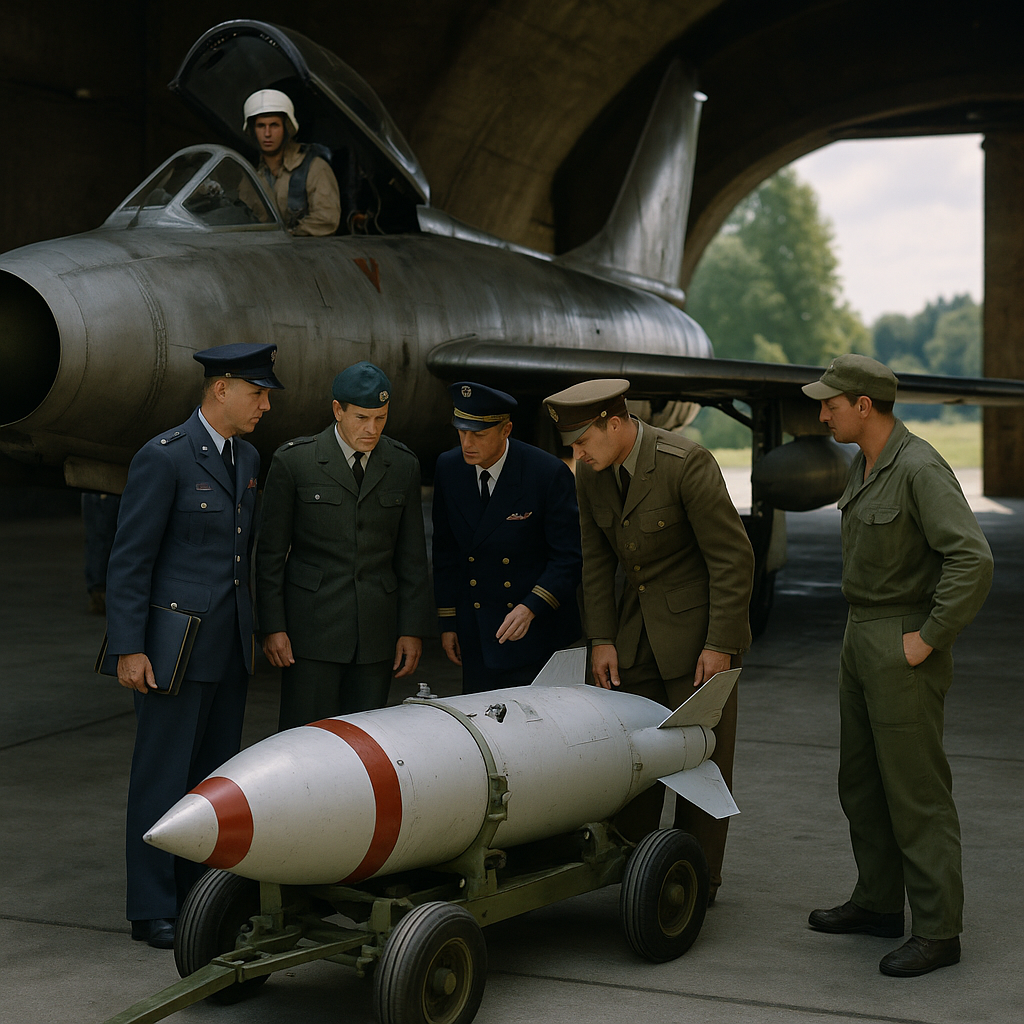
On a cold evening in late autumn 1983, inside a musty meeting room in Brussels, a cluster of NATO diplomats huddled around a table thick with papers and guarded optimism. Outside, crowds protested nuclear armaments; inside, policymakers wrestled with a dilemma decades in the making: was NATO’s nuclear sharing policy a guarantee of collective security, or a ticking time bomb of alliance mistrust? Between 1957 and 1987, the question of who controlled nuclear weapons, how they were deployed, and what that meant for European and transatlantic politics lay at the heart of the most fundamental transformations of the Cold War era. This article explores NATO’s nuclear sharing policy not merely as a military posture, but as a technological experiment, a sociopolitical challenge, and a lightning rod for alliance tensions that shaped the very structure of Euro-Atlantic relations.
Technology on the Front Line: Dual-Key Arrangements and Warhead Evolution
NATO’s nuclear sharing began as a technological improvisation during a period when the United States held a near-monopoly on deployable nuclear forces. The Eisenhower administration recognized that extending nuclear deterrence credibly to Europe—beyond the abstract “nuclear umbrella”—required tangible, visible deployments of weapons on European soil. This translated into a series of technological shifts: starting with the deployment of American atomic artillery and tactical warheads, followed in the late 1950s and early 1960s by systems such as the Thor and Jupiter intermediate-range ballistic missiles, and B-61 gravity bombs designed for use by European aircraft under strict US oversight.
The crux of NATO nuclear sharing’s technology lay in the dual-key system: US weapons were stored at airbases or depots across key Western European nations, ready to be mounted on host country aircraft or delivery systems, but always controlled by an American-issued coded lock. In an emergency, both US and local authorities needed to approve release—an arrangement engineered to make the use of these weapons both a collective defense act and one impossible to undertake unilaterally. For host nations such as West Germany, the Netherlands, Belgium, Italy, and Turkey, this technology was both a symbol of trust and a constant reminder of dependency. As warhead miniaturization and delivery system reliability improved throughout the 1970s and 1980s, questions only intensified about whether the nuclear trigger truly required two hands—or whether a local commander could, in a crisis, act alone. These anxieties shaped technical design, security policy, and the very fabric of NATO’s command relationships.
Tactical Integration or Political Provocation? The Strategic Calculus
From the outset, NATO’s nuclear sharing was designed to serve more than military needs: it aimed to bind together a diverse alliance under the existential logic of deterrence. By distributing nuclear weapons and their delivery systems among NATO members, the United States sought to assure European partners that their fate was inseparable from Washington’s own and deter the Warsaw Pact from contemplating aggression at any level. This sharing policy was at the heart of NATO strategy documents such as MC 14/2 and the 1967 Harmel Report, which justified flexible response and escalation control as alliance-wide—not purely American—projects.
Yet, beneath this strategic logic lurked deep uncertainty. The prospect of using tactical nuclear weapons on NATO’s own territory—particularly in West Germany or Italy—was fraught with humanitarian, political, and practical dilemmas. European citizens and leaders were forced to confront the realities of what ‘defense’ meant: would their own soil become a battlefield in a first nuclear exchange? Protests in the 1970s and especially during the 1980s Euromissile crisis (over the deployment of Pershing II and cruise missiles) revealed how fragile the bargain was. For some countries, such as Germany, the possession (even in potential) of nuclear delivery capability became intertwined with debates over sovereignty, division, and reunification, echoing the broader societal impacts seen in the era’s debates about cultural power and soft diplomacy as explored in soft diplomacy during the Cold War.
Societal Shockwaves: Grassroots Protest, Civil-Military Relations, and Identity
The nuclear sharing policy cast a broad shadow over civil societies in Western Europe. As nuclear weapons became more visible—stationed in local barracks, serviced on local airfields, and a recurring topic in news broadcasts—ordinary Europeans confronted existential questions of security and morality. Major demonstrations, such as the 1983 peace marches in Bonn, London, and Rome, were not marginal events; they drew hundreds of thousands and often united unlikely coalitions across class, religious, and political lines. In these protests, the debate transcended military policy—it was about democracy, transparency, and the right to determine one’s fate in the nuclear age.
For host societies, particularly in West Germany and Italy, the nuclear sharing arrangements wrought profound changes in civil-military relationships. Local governments were increasingly caught between the demands of alliance solidarity and grassroots opposition to the physical presence of foreign troops and nuclear warheads. Meanwhile, military personnel tasked with the protection, maintenance, and possible use of nuclear weapons became symbols of both security and division in their communities. This societal tension was a new phenomenon for many European democracies, and its reverberations reshaped the political landscape, influencing party formation, the rise of Green movements, and public discourse surrounding international collaboration—echoing the transformative effects on urban societies found in episodes like how military or political planning shapes societies.
Alliance Tensions: Sovereignty, Trust, and Secret Negotiations
Technology and strategy may have been the public face of NATO’s nuclear sharing, but its politics thrummed with private tension and constant negotiation. The United States, as the arsenal’s ultimate owner, wielded enormous leverage, yet NATO partners became increasingly assertive about their say in nuclear planning and use. France, under Charles de Gaulle, withdrew from the integrated military command in 1966 in part to regain full sovereignty, refusing the presence of American-controlled nuclear weapons on its soil. Conversely, West Germany—divided, insecure, and surrounded by Warsaw Pact states—sought greater influence, pressing for access to nuclear planning and sometimes, clandestinely, for technical know-how that could support eventual independent capability.
Washington’s balance between reassurance and control was rarely stable. As the nuclear sharing policy developed, the US created the Nuclear Planning Group in 1966 to grant allies channels for consultation, yet ultimate authority remained ambiguous. In times of transatlantic friction—the Vietnam War, détente, or the 1983 Euromissile debate—alarm rose in European capitals over the risk of ‘decoupling’: the fear that the US might hesitate to risk its own cities in defense of Europe. Such fears fueled disputes over modernization, arms control, and the credibility of deterrence. These alliance tensions were both a microcosm of the technological networks and diplomatic calculations that shaped NATO as examined in NATO’s technological and intelligence networks and a persistent source of structural change within the alliance itself.
The Enduring Legacy and Ongoing Relevance
By 1987, when the Intermediate-Range Nuclear Forces (INF) Treaty was signed, the policy landscape was fundamentally changed. The agreement, resulting in the withdrawal of entire classes of nuclear missiles from Europe, signaled a transformation not only in arms control but in alliance relations and public expectations. Yet NATO’s nuclear sharing doctrine did not vanish; it adapted, reflecting a new consensus that deterrence required not just weapons, but alliance dialogue, public accountability, and the careful management of national sensitivities.
The legacy of the 1957–1987 era echoes in today’s debates about extended deterrence, technological proliferation, and the nature of multinational security arrangements. NATO’s nuclear sharing policy created new forms of cooperation and dependency, fundamentally altering societies and political cultures across the Atlantic. It revealed both the power and the peril of tying national security to shared technological threats—an echo of earlier European crises such as the Berlin Airlift, where technology and geopolitics collided to reshape not just strategy but the very structure of the alliance technology and Cold War geopolitics. Amid renewed global uncertainty, the debates sparked by NATO’s Cold War nuclear sharing remain instructive—and unresolved—for the future of collective security.