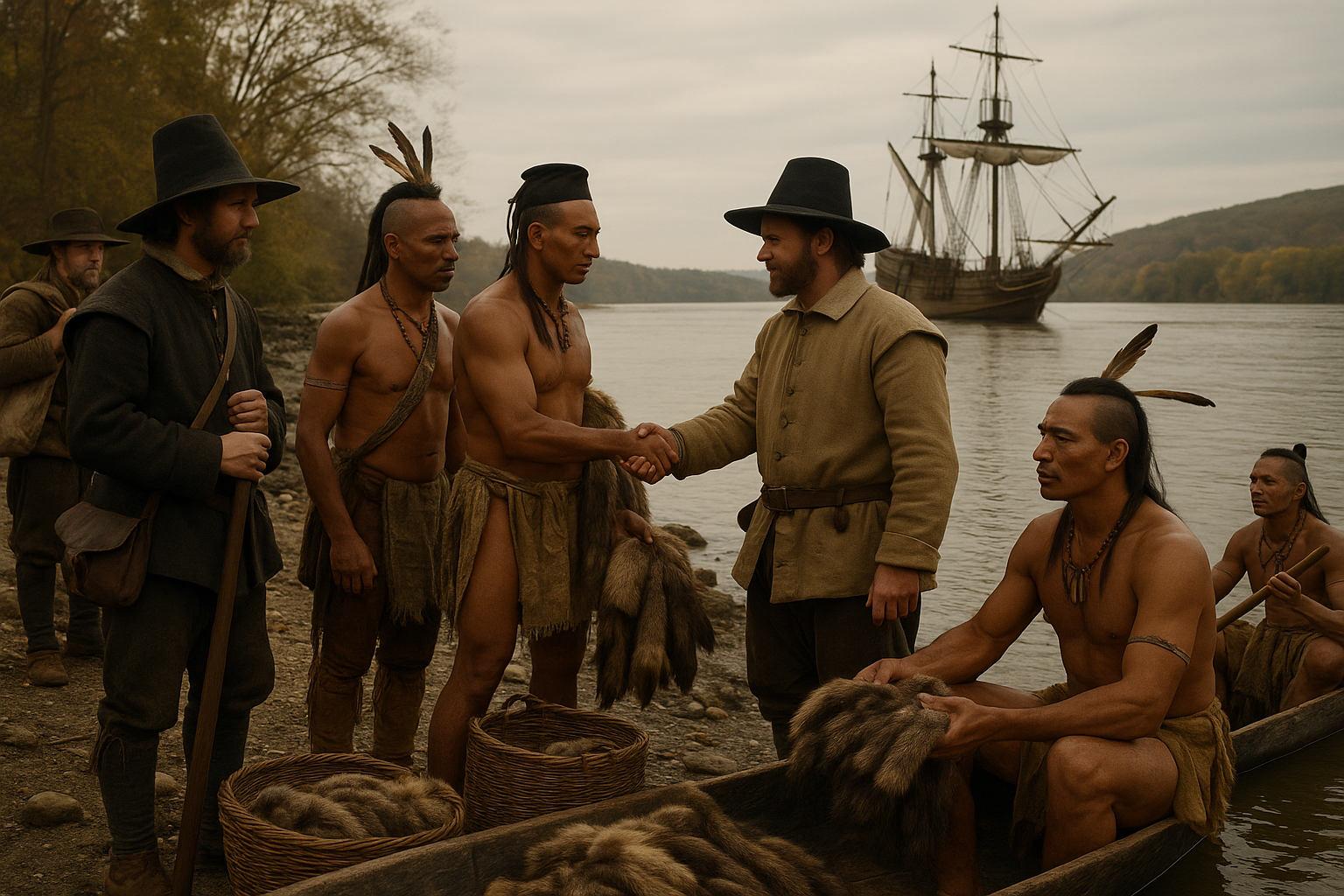
In September 1609, as fog drifted over the Hudson River, Henry Hudson—captain for the Dutch East India Company—steered his ship, the Halve Maen (Half Moon), into the lands of the Lenape and Mahican peoples. This moment is often depicted as the opening of a new world for Europeans, yet for local Indigenous societies, it was an encounter with the latest in a series of outsiders drawn by the river’s bounty. What unfolded over the next half-century along the Hudson was not a story of one-sided European dominance, nor a simple commercial partnership. Instead, it was a period of structural change, negotiation, and conflict, as both Dutch and Indigenous peoples used trade to reshape their societies and the power that governed them. The Dutch-Indigenous trade networks that arose in New Netherland blurred lines between commerce, diplomacy, and survival, leaving marks still visible in the region’s landscape and memory.
Forging Networks: The Early Fur Trade and Its Foundations
Far from a void waiting to be filled, the Hudson River valley was a crossroads of established Indigenous exchange long before European arrival. The arrival of Dutch traders in the early seventeenth century meant entering these dense webs—a dynamic highlighted by the swift comprehension displayed by Mahican and Mohawk communities when trading for European goods. The Dutch, craving beaver pelts for Europe’s insatiable hat market, turned their posts such as Fort Nassau and later Fort Orange (now Albany) into gateways between the Atlantic world and Native societies. These posts were not fortresses alone; they thrived as hubs where wampum, furs, metal tools, and textiles changed hands, forging relationships and rivalries alike.
The very structure of Dutch power in New Netherland depended on the health and maintenance of these trade networks. Company policy aimed to undercut English and French competitors by luring Indigenous trappers and middlemen to their posts, offering better-quality trade goods and flexible terms. Through gifts, negotiations, and the strategic use of wampum as currency, the Dutch institutionalized economic relationships that had deep political overtones. This mirrored the wider global strategies of Netherlands trading companies, as seen in the era’s other colonial outposts—such as in the case of the VOC in southern Africa, discussed in Dutch East India Company outposts.
Indigenous Agency and the Reshaping of Power
Contrary to depictions that cast Indigenous players as passive recipients or victims, the peoples of the Hudson valley actively shaped the new order. The Mohawks, as the easternmost nation of the Iroquois Confederacy (Haudenosaunee), quickly established themselves as dominant middlemen, leveraging Dutch demand to consolidate power over both neighboring tribes and the western flow of goods. Likewise, the Mahicans to the north worked to maintain earlier connections to French traders in Canada, pitting empire against empire for their advantage.
This new economy had immediate social and political repercussions. Access to Dutch metal tools and firearms was jealously guarded, and whole communities were reorganized to maximize fur production and trade revenue. For the Haudenosaunee, trade became intertwined with the so-called “Beaver Wars”—a series of violent struggles to control access to European markets and sources of fur. Rather than merely reacting, Indigenous societies adapted their methods of diplomacy, alliance, and warfare to secure their place in these shifting networks. These developments illustrate the broader patterns of negotiation between European and local powers—in some ways paralleling how hybrid forms of control emerged in other early modern trade encounters, such as those explored in global Dutch trading networks.
Reciprocity, Rivalry, and the Everyday Reality of Exchange
Daily encounters between Dutch settlers and Indigenous traders transcended simple barter or market exchange. Transactions were often embedded in performances of mutual respect, hospitality, and ritual. The process of establishing trade relationships, for example, depended on formal gifting ceremonies and the mutual recognition of status. Wampum beads, painstakingly carved from shells, were vital not only as currency but as signifiers of trust, alliance, and the weighty obligations that connected trading partners. In turn, the exchange of guns, axes, and kettles supplied not only hunting technology but became woven into the fabric of Indigenous life and ritual.
At the same time, these exchanges produced persistent uncertainties and rivalries. Dutch trading posts required a constant flow of pelts—so much so that overhunting began to threaten both animal populations and the trading economy itself. Meanwhile, rival Indigenous groups, and even rival Dutch factions, competed aggressively for favor and profit. As more settlers arrived, the delicate web of reciprocity frayed, and mutually beneficial exchanges increasingly gave way to disputes, deception, and instances of outright violence. These tensions echoed the broader pattern across early modern Atlantic societies, where new technologies and economic relationships could serve as double-edged swords—a theme seen, for example, in the inroads of scientific society and commerce in scientific knowledge and trade.
The Political Economy of Trade and the Transformation of Authority
The explosive growth of the fur trade directly challenged the political geography of both Native and Dutch societies. For the Dutch, authority in New Netherland rested less on sheer numbers—European settlers were never more than a small minority—and more on their ability to act as indispensable brokers in Indigenous trade networks. The Dutch West India Company, nominal lord of the colony, found itself forced to negotiate with rival Native leaders and their shifting confederacies as often as with its own fractious colonists. The company’s pragmatic approach to local autonomy, religious tolerance, and ad hoc alliances reflected the reality that their survival hinged on maintaining influence through commerce as much as government.
For Indigenous communities, participation in the trade transformed leaders into diplomats and power-brokers, reshaping internal social structures and patterns of leadership. Gift-giving, negotiation, and the sometimes violent enforcement of trade agreements all became crucial to maintaining both the flow of goods and communal cohesion. Competition for the Dutch connection sometimes heightened divisions and led to shifting alliances, as different Native groups responded to external pressures and opportunities. This mutual dependency, with its volatility and innovation, created a frontier society that was neither purely Dutch nor purely Indigenous in character, but something distinct—a hybrid defined by exchange, conflict, and adaptation.
Disintegration and Enduring Legacies
By the 1660s, the trade system that had propped up New Netherland was under strain. Beaver populations were seriously depleted, destabilizing the economic foundations of the region. The expansionist ambitions of the English brought new rivalry, culminating in the conquest of New Netherland in 1664. For both Dutch and Indigenous peoples, this marked not a clean break, but an era of deep adjustment. Some Dutch settlers remained under English rule, continuing to trade with Indigenous partners, while Native societies were increasingly driven to the margins of a rapidly Anglicizing world.
Yet the innovations and disruptions of the Dutch-Indigenous trade networks reverberated long after political control shifted. Wampum, for example, would be used as legal tender by colonial authorities across the northeast for generations. The patterns established during Dutch rule—of brokerage, negotiated frontiers, and the entanglement of commerce and authority—endured in the region’s political and economic DNA. The story of the Hudson River trade illuminates how early modern colonialism was not simply an imposition of European order, but a complex process shaped by local agency, resistance, and adaptation. The echoes of these centuries-old encounters can still be traced in the cultural memory and landscape of the Hudson Valley, where rivers, place-names, and family stories bear witness to that first age of encounters on the Hudson.