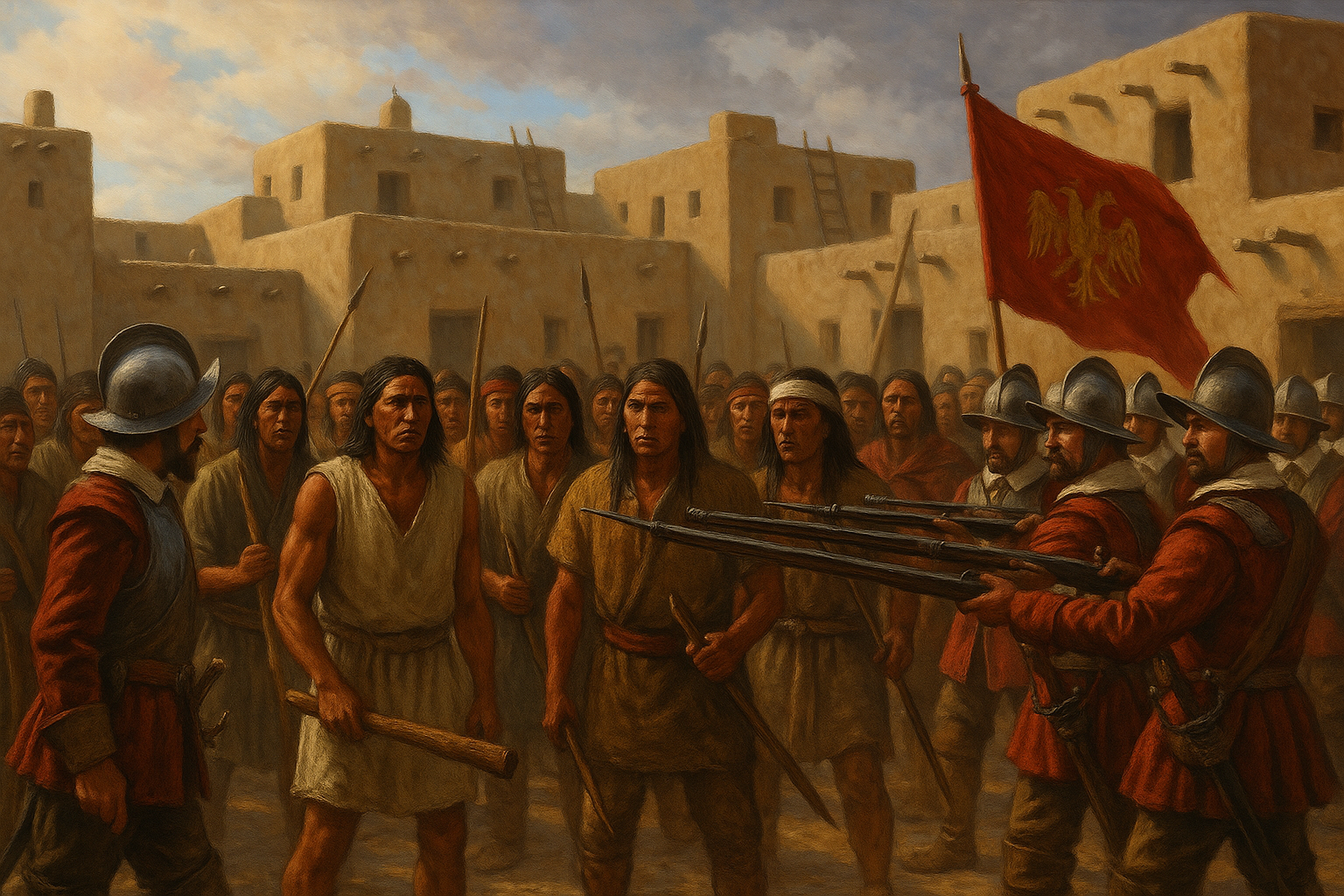
In the parched valleys and river plains of 17th-century New Mexico, a fierce conflict erupted that would shake the foundations of Spanish colonial ambition in North America. The Pueblo Revolt of 1680 was more than an uprising against missionaries and settlers—it was a sudden, explosive challenge to the very system of imperial control that Spain had struggled to construct on the empire’s northern frontier. This revolt dramatically exposed the fragility of colonial governance, testing the limits of Spanish authority and revealing enduring Indigenous capacity for resistance and self-organization within the political theater of early modern imperial expansion.
Crown Ambitions and the Machinery of Colonial Control
The origins of Spanish presence in present-day New Mexico lay in both spiritual and strategic aims. From the late 16th century, royal directives empowered Franciscan missionaries and secular authorities to pacify and convert the region’s Indigenous Pueblos. By 1680, around fifty Franciscan friars operated among roughly twenty-five separate Pueblo towns, supported by a small and often ill-provisioned garrison in Santa Fe, the administrative center. Spanish rule rested on a brittle alliance of military intimidation, religious coercion, and a fragmented civil bureaucracy.
This system—typical of Spain’s more peripheral colonies—struggled to assert authority. Viceroyalty of New Spain delegated enormous responsibilities to distant governors with minimal resources, mandating both defense and tribute extraction from semi-autonomous Indigenous populations. The Spanish attempted to centralize authority by installing royal officials such as alcaldes and encomenderos, but their reach was shallow and often contested. The Franciscan order, de facto rulers in many pueblos, drove efforts to eradicate older traditions, policing religious practice and often presiding as both judges and landlords. The crown’s ambitions depended on fragile compacts, and its capacity to deploy coercive force across the vast landscapes was sharply limited by geography, logistics, and local resistance.
Pueblo Societies: Fragmentation, Cooperation, and Adaptation
At the heart of the region, Pueblo peoples maintained their own internal political systems and communal structures. Each Pueblo town—such as Taos, Acoma, or Hopi—preserved a degree of self-determination through councils, civil offices, and structured ceremonial societies. Spanish colonialism exploited these fissures, often relying on the traditional leadership system to mediate tribute and enforce policies. Yet, the presence of an external overlord and the relentless campaign of forced conversion and labor obligations ultimately underscored the Pueblos’ common grievances.
Over the decades, demographic shocks—introduced disease, crop failures, drought, and the increasing violence of neighboring nomadic groups—destabilized the region. Despite their political fragmentation and differences in language and ritual, Pueblo leaders developed clandestine networks of communication and resistance. The Spanish, for their part, depended on the seeming passivity and fractured unity of these towns. But beneath the surface, a coalition was forming that would eventually defy both mission and civil authorities.
Religious Imposition, Repression, and the Seeds of Revolt
The most persistent antagonism stemmed from the aggressive suppression of Pueblo religious practice by Franciscan friars. The missionaries, empowered by royal prerogative and their own institutional zeal, destroyed kivas, outlawed dances, and punished practitioners of Pueblo religion. Converts—genuine or strategic—faced surveillance and the threat of violence. In the minds of colonial authorities, such measures served both spiritual salvation and imperial stability; in practice, they inflamed resentment and positioned friars as the most visible face of foreign domination.
Several flashpoints in the 1670s—drought, intensified Apache raids, famine, and especially waves of epidemic diseases—deepened Pueblo suspicion and disillusionment. Spanish responses often involved scapegoating “sorcerers” and intensifying prosecutions of Indigenous religious leaders. The arrest and torture of key Pueblo spiritual figures, including a Tewa man known as Popé, radicalized opposition into a pan-Pueblo conspiracy. The logic of collective resistance took root under brutal conditions of colonial rule and material hardship.
The Revolt and Its Immediate Political Consequences
In August 1680, in a remarkable display of coordination, Pueblo warriors struck across the region, targeting missions, administrative posts, and the settlers’ homes. Nineteen of the province’s thirty-three Catholic missionaries were killed, as were Spanish farmers and soldiers. Communication networks—runners bearing knotted cords as countdowns—demonstrated a capacity for inter-village alliance previously unseen by colonial observers. Within days, the Spanish retreat from their settlements was chaotic and total; the survivors made their way south toward El Paso del Norte.
The revolt was not a simple anti-Spanish outburst but a well-organized assertion of sovereignty. Popé and his allies sought to expel the symbols and institutions of colonial control, abolishing Christian baptisms, marriages, and religious symbols, and restoring communal land use and the centrality of the kiva. Importantly, the uprising did not produce a single confederated government, but it did momentarily invert the regional political order, reasserting local Indigenous authority and halting—for over a decade—the machinery of Spanish rule in New Mexico.
The Fractured Edges of Empire: Limits of Spanish Rule Exposed
The Pueblo Revolt dealt an extraordinary blow to the Spanish imperial project in the southwest, highlighting the constraints intrinsic to colonial rule far from the formal centers of power. The empire’s reliance on a small, poorly equipped garrison, the limited economic incentives of northern New Mexico, and the inability to integrate or effectively recruit Indigenous collaboration all contributed to the revolt’s success. Crown officials in Mexico City and Madrid confronted the sobering realization that easier conquests in densely populated and centralized regions—notably, the Aztec and Inca empires—could not be replicated in the diffuse and resistant societies of northern New Spain.
Spanish attempts to reestablish their presence in the 1690s required renegotiated arrangements. The crown gradually adopted policies of accommodation—greater toleration of Indigenous religious practices, less intrusive mission programs, and new diplomatic overtures—in hopes of avoiding a renewed cycle of resistance. Still, the reasserted Spanish control remained patchy, and the era of unchallenged missionary and secular dominance had ended. The revolt marked a rupture in the narrative of European omnipotence and joined a broader current of resistance shaping colonial worlds—echoes of which appear in the fractures and realignments following populist uprisings like mass revolt or even the negotiated settlements after religious conflict, such as the Edict of Nantes.
Conclusion: Legacy and Reverberations in Early Modern Politics
The Pueblo Revolt of 1680 stands as a defining example of the dynamic, contested nature of imperial power in the early modern period. The withdrawal and subsequent accommodations by Spanish authorities signified not simply a military retreat but an unwilling concession to the persistence of Indigenous political forms and agency. In the wake of the revolt, colonial administrations across the Spanish Americas confronted uncomfortable questions over the viability of religiously driven ‘total control’ in frontier societies.
This episode belongs to a wider pattern of crises and re-negotiations that beset Europe’s overseas empires in the 16th and 17th centuries. The lessons of Pueblo resistance—about the tight limits of distant authority, the robustness of localized governance, and the potential for peripheral actors to reshape imperial destinies—resonate alongside other challenges to sovereign power documented in this period, from the internal religious fractures of France to the mercantile experiments of the Dutch in new colonial settlements, as explored in colonial struggles. In New Mexico, 1680 marked not merely a year of upheaval but a pivot point in understanding the dynamic politics at the edges of empire—a lesson in humility for European imperial ambition, and a testament to the continuing complexity of Indigenous political life.