# Writesides of History — the complete archive
> In-depth articles spanning ancient, medieval, early modern, and modern history — empires, economies, and the events that shaped our world.
224 articles, complete. Generated 2026-09-18T17:27:34.164Z; newest article 2026-09-17.
Quote freely, with attribution to Writesides of History and a link to the article url. The articles are written and published by Writesides of History, which is both author and publisher. Images are not covered by the line above. Every media record carries its own creator, licence and source url; most are Wikimedia Commons files under their own terms. Honour the record, not this file.
Manifest: https://writesidesofhistory.com/agents/index.json · Recent changes: https://writesidesofhistory.com/agents/changes.json · Bibliography: https://writesidesofhistory.com/agents/sources.json
---
# Stammheim as a Building: A Courtroom Built for a Trial
url: https://writesidesofhistory.com/stammheim-as-a-building-a-courtroom-built-for-a-trial/
era: modern · published: 2026-09-17 · topics: cold-war
**In 1975, West Germany did not have a courtroom secure enough to try the imprisoned leadership of the Red Army Faction, so the state of Baden-Württemberg built one from nothing, on the grounds of Stuttgart's Stammheim prison, in time for the trial to open that May. The windowless, reinforced building was never meant to be a public monument. It became one anyway, and outlived its own verdict by more than four decades before it was finally demolished.**
## Why the state built a courtroom instead of using one
Stuttgart already had a functioning Higher Regional Court. What it did not have was a way to move four defendants from a high-security prison wing to that courthouse, several times a week, for a trial expected to run for years, without creating a standing opportunity for a rescue attempt. The indictment rested on the RAF's 1972 May offensive against American military and West German police targets; our [record of these operations](https://writesidesofhistory.com/datasets/red-army-faction-attacks/) documents the offensive in full.
The solution was architectural rather than procedural: put the courtroom next to the cells, so that no journey through the city was ever necessary. The federal agency's dossier on the trial states this directly — a new building beside the prison replaced the transport risk with a fixed, defensible perimeter. It was, in effect, an admission that the ordinary machinery of West German justice could not accommodate a trial the state considered existential.
## A windowless building in a matter of months
Construction moved fast by the standards of German public building. A single-storey, windowless hall of reinforced concrete and steel went up on the prison grounds through 1974 and into early 1975, with cabling strung over the roof to obstruct any attempt to approach or land near the building from the air. Reporting at the time put the cost of the building alone at around twelve million Deutschmarks, more than half of an overall trial budget estimated at roughly twenty million — extraordinary sums for what was, functionally, a single room built for a single case.
Inside, the courtroom held space for the panel of judges, prosecutors, a large defense team, journalists and the public, all separated from the four defendants by security glass and armed guards. There were no windows to the outside world — only artificial light and poured concrete, in a building designed to keep the outside out rather than to let anything in.
## Chronology
| Date | Event |
|---|---|
| 1974–early 1975 | Windowless courtroom built beside Stuttgart-Stammheim prison, reported at around 12 million Deutschmarks |
| 21 May 1975 | Trial opens against four defendants from the RAF's founding leadership |
| 1975–1976 | Listening devices are installed in defendants' cells; discovery of the bugging becomes public in 1977 |
| 20 January 1977 | Presiding judge Theodor Prinzing withdraws after a defense bias motion succeeds; Eberhard Foth takes over |
| 28 April 1977 | Verdict delivered after roughly 192 trial days: life sentences for the surviving defendants |
| 2015–2019 | New high-security courthouse built nearby for about €29 million, designed by Müller Reimann Architekten |
| April 2019 | New building opens; the 1975 courtroom stands empty |
| 2020s | Stuttgart's monument-protection authority grants permission to demolish the 1975 building |
| 2025–2026 | The new courthouse hosts an unrelated high-security trial, reviving comparisons to 1975 |
## What the design argued, before anyone said a word
A courtroom is supposed to be neutral ground on which guilt is decided, not assumed. The Stammheim building argued something different before a single witness was called: that the men and woman inside it were already, by the state's own engineering, treated as a threat requiring a fortress. Security glass separated the dock from counsel and the public gallery. Cameras and armed personnel were a fixture rather than an exception. The defense argued repeatedly, across the trial's 192 sessions, that the physical setting itself compromised the presumption of innocence — a complaint the digital edition of the trial protocol preserves in the defense's own recorded objections, not as later commentary but as a running feature of the proceedings.
That tension — a building whose every wall makes a claim about danger, in a system that is supposed to presume none — did not end with this trial. It is close to the argument a legal scholar made in 2026 about the courthouse's successor on the same ground, describing the site as a stage on which the state performs its own confidence as much as it adjudicates a case.
## The room was not as private as it looked
The building's isolation was meant to keep threats out. It also, for a period in 1975 and 1976, kept a secret in: investigators had placed listening devices in defendants' cells to monitor conversations with their lawyers, a fact that only became public in 1977. When it emerged, several of the defendants' own chosen lawyers — including Otto Schily, later a federal minister — walked out of the proceedings and refused to take further part until they had assurances that client conversations were no longer monitored. The affair briefly threatened the legitimacy of a trial the state had already spent enormously to secure, and it remains the clearest evidence that the building's defenses were not only aimed outward. A parallel, quieter version of the same instinct — a Cold War state widening its own surveillance reach under pressure — runs through the contemporaneous expansion of [NSA wiretapping in the United States](https://writesidesofhistory.com/nsa-surveillance-nixon/) and through the intelligence-sharing habits [NATO built up](https://writesidesofhistory.com/nato-intelligence-networks-global-expansion-1949-1991/) across the same decades.
## A verdict, and a building that kept working
The trial ended on 28 April 1977 with life sentences for the surviving defendants, closing a case that had also cost one defendant's life — she died in her cell in May 1976, before the verdict was reached, in a death that remained disputed. The courtroom itself did not close with the case. Baden-Württemberg's judiciary kept using the same high-security hall for other proceedings that required its particular defenses for decades afterward, through the years in which [Germany remained a country divided](https://writesidesofhistory.com/the-fall-of-the-berlin-wall-end-of-an-era-and-the-dawn-of-german-unity/) by the wider Cold War the RAF had positioned itself against, and beyond. A building raised for one case became, by default, the state's standing answer to any case it judged comparably dangerous.
## Replaced, not forgotten
By the 2010s the 1975 building was outdated by the standards it had itself set: modern high-security courtrooms needed different technology, different accessibility, and better conditions for juries, judges and the public than a windowless concrete hall from the height of the Cold War could offer. Baden-Württemberg built a new courthouse immediately next to it, opened in April 2019 at a reported cost of around €29 million and designed by the Berlin firm Müller Reimann Architekten under the state's own property and construction office. The old building stood empty afterward. Stuttgart's monument-protection authority weighed whether the courtroom where a defining trial of the Federal Republic had unfolded deserved formal preservation, and ultimately granted permission for its demolition rather than requiring it be kept as a memorial — a decision that treated the building as infrastructure that had done its job, not as a site owed permanence.
## The same address, a different decade
The new courthouse did not retire the symbolism that came with its location. In 2025 and 2026, the state security chambers sitting on the same ground in Stammheim heard an unrelated high-security case, and press coverage reached instinctively for the comparison to 1975 — the same address, the same architecture of glass separation and restricted access, applied to a different generation of defendants and a different kind of alleged offense. As with the earlier proceedings that once filled our [account of the third generation's unsolved cases](https://writesidesofhistory.com/the-third-generation-twenty-years-of-attacks-and-almost-no-convictions/), the honest position is that some of what happens inside a courtroom like this stays genuinely contested, and a record built to explain the building should say so rather than adjudicate it. What the echo confirms is narrower and more durable: a state that builds a fortress for one trial tends to keep the fortress.
## Conclusion
The Stammheim courtroom was never meant to outlast its case, yet it stood for more than forty years, hosted trials its builders never anticipated, and was replaced only by another high-security courthouse built on the same logic next door. Its real subject was never only the four defendants tried inside it — it was how a democracy builds space for judging people it has already decided are dangerous, a question the [Kommando statement's claims of responsibility](https://writesidesofhistory.com/the-kommando-statement-how-the-raf-wrote-its-own-record/) never had to answer and the state could not avoid.
## Frequently asked questions
**Why did West Germany build an entirely new courtroom instead of using Stuttgart's existing court?** Moving the defendants repeatedly across the city to the Higher Regional Court's normal building was judged too great a security risk, so the state built a windowless courtroom directly beside the prison holding them, eliminating the transport route rather than trying to secure it.
**What was discovered about the defendants' cells during the trial?** In 1977 it emerged that investigators had installed listening devices in defendants' cells during 1975 and 1976 to monitor privileged conversations with their lawyers. Several defense lawyers, including Otto Schily, walked out of the proceedings in protest until they received assurances the surveillance had ended.
**What happened to the 1975 building after the trial ended in 1977?** It remained in continuous use by Baden-Württemberg's judiciary for other high-security cases for decades, was finally replaced by a new courthouse that opened in April 2019, and was subsequently demolished after the city's monument-protection authority granted permission.
**Is the Stammheim site still used for high-security trials today?** Yes. The new courthouse that replaced the 1975 building in 2019 sits on the same ground beside the prison and has continued to host state security cases, including an unrelated trial in 2025–2026 that drew renewed comparisons to the original 1975 proceedings.
## Recommended reading
- Beatrice de Graaf and Alex P. Schmid (eds.), *Terrorists on Trial: A Performative Perspective* (2016) - examines how courtrooms themselves stage and shape terrorism trials, directly relevant to what the Stammheim building's design communicated before any testimony began. [View on Amazon →](https://www.amazon.com/dp/9087282400)
- Karrin Hanshew, *Terror and Democracy in West Germany* (2012) - the fullest account of how the West German state argued with itself over the legal and physical limits of defending democracy against the RAF. [View on Amazon →](https://www.amazon.com/dp/1107017378)
- Jeremy Varon, *Bringing the War Home: The Weather Underground, the Red Army Faction, and Revolutionary Violence* (2004) - situates the Stammheim trial within the broader history of the group's confrontation with the West German state. [View on Amazon →](https://www.amazon.com/dp/0520241193)
---
# The Battle of Arsuf, 1191: The Charge Richard Never Ordered
url: https://writesidesofhistory.com/battle-of-arsuf-1191/
era: medieval · published: 2026-09-16 · topics: crusades
**On 7 September 1191, the rearguard of Richard the Lionheart's army broke formation on the coastal plain north of Jaffa without waiting for an order, and the general charge that followed it became the only pitched battle Richard fought and won outright in the Holy Land.** The Battle of Arsuf is usually told as a duel between two famous names, but the men who actually held the column together that day — a Hospitaller Grand Master, a Flemish nobleman, a Burgundian duke — did as much to decide it as either king did.
## A march built to be attacked
Richard left Acre in the last week of August 1191, six weeks after taking the city, with roughly 20,000 men bound for Jaffa. The route ran down the coast so that the fleet could shadow the column offshore, carrying supplies and giving the army somewhere to retreat if it was broken. That single choice shaped everything about the march: the army moved in a tight rectangular formation, infantry and crossbowmen screening the landward flank, knights and baggage on the seaward side, never allowing Saladin's cavalry a gap to exploit — a stark contrast to [the undisciplined column that was annihilated at Civetot](https://writesidesofhistory.com/civetot-1096-the-end-of-the-peoples-crusade/) almost a century earlier.
Saladin shadowed the column from the hills for more than two weeks, probing constantly and waiting for the discipline to crack. The [Templars](https://writesidesofhistory.com/the-knights-templar-guardians-of-the-crusades-and-medieval-power/) held the vanguard; behind them came the Breton and Angevin contingents, then the Poitevins, then the Anglo-Normans, with the Knights Hospitaller under their Grand Master, Garnier de Nablus, forming the rearguard that bore the worst of the harassment. On 7 September, as the column cleared the forest of Arsuf onto open ground near the ruined town of the same name, Saladin committed his full army to stop it there.
## The men who held the line
Richard is the name attached to Arsuf, but the battle was fought by a column of commanders whose names rarely make it past a footnote. Garnier de Nablus had led the Hospitallers since 1190 and had spent the march absorbing arrow fire and watching his order's horses die under him one at a time. Hugh III, Duke of Burgundy, commanded the French royal contingent left behind when Philip II sailed home after the fall of Acre — a substantial force that answered to no one but Richard by agreement, not by feudal obligation. Robert de Sablé led the Templar knights in the vanguard. And on the exposed inland wing of the rearguard rode James of Avesnes, a nobleman from Hainaut who had brought Flemish and Frisian crusaders east and had already fought through the siege of Acre.
None of these men is a stranger to specialists in the Third Crusade — the same is true of [Isaac Komnenos on Cyprus](https://writesidesofhistory.com/isaac-komnenos-and-the-fall-of-cyprus-1191/), taken by this army only months earlier — but none of them has the name recognition that keeps an article off the "thin stub" list either. Arsuf is really their battle: Richard's contribution was timing, not presence at the point of contact.
## The charge nobody ordered
Richard's plan, as the Latin chroniclers describe it, was to absorb Saladin's attacks without breaking formation until the whole Ayyubid army was committed at close range, then answer with a single coordinated charge. It was a plan that asked an extraordinary amount of the rearguard, which took the heaviest fire for hours while the order to charge did not come.
Garnier de Nablus asked Richard more than once for permission to counter-attack and was refused each time. The Hospitallers held their ground losing horses to Turkish and Bedouin archery at close range until, according to the Itinerarium, the Grand Master and a knight named Baldwin de Carron broke first, spurring out of the line without a signal. The rest of the Hospitaller line went with them rather than watch two of their own ride into the enemy alone.
Richard's response was the decision that made the battle his. A premature, unsupported charge from one wing of a defensive column could have been destroyed in isolation. Instead he ordered every division forward at once, turning what should have been an act of indiscipline into a general assault delivered at exactly the moment Saladin's whole force was in the open. The Ayyubid line broke under the weight of it, and Richard is credited by the chroniclers with the harder discipline of the day: pulling his knights back into formation for a second and third charge rather than letting them scatter in pursuit.
## The death of James of Avesnes
Not every part of the line reformed cleanly. Fighting on the exposed inland wing, James of Avesnes was thrown from his horse and surrounded. Ambroise and the Itinerarium both turn his death into the set-piece of the battle: dismounted and fighting on foot, he is said to have killed several attackers before he fell, and later tradition has him crying out for Richard to avenge him as he went down — a line worth reading as chronicle embellishment rather than a transcript, since no one who heard it is likely to have survived to report it accurately. What is better attested is the aftermath: his body was recovered from the field the next day and buried at Arsuf, and the Latin sources agree that Richard himself was present at the burial, alongside Guy of Lusignan, the displaced king of Jerusalem who had joined the crusade. His death was treated at the time as the single costliest loss of an otherwise one-sided victory.
## What the victory actually won
The Itinerarium claims some 7,000 Ayyubid dead and thirty-two emirs killed against a few hundred crusader losses; Bahā' ad-Dīn, writing from inside Saladin's own camp, does not dispute a heavy defeat but gives no figure that confirms the Latin total, and modern historians treat both sides' numbers as rhetorical rather than a body count anyone actually took. What is not in dispute is the shape of the outcome: Saladin's field army was mauled and its morale damaged, but it was not destroyed, and it withdrew rather than surrendered.
That distinction mattered more than the casualty count. [Our record of these operations](https://writesidesofhistory.com/datasets/richard-i-third-crusade/) lists Arsuf alongside [the treaty Richard eventually signed at Jaffa](https://writesidesofhistory.com/treaty-of-jaffa-1192-what-richard-and-saladin-signed/) for exactly this reason: a battle that breaks an army's nerve without breaking the army itself buys time and ground, not the war — the coastal states it preserved would still be fighting for their existence a century later, at [the fall of Acre in 1291](https://writesidesofhistory.com/the-fall-of-acre-in-1291-the-last-crusader-stronghold-in-the-holy-land/). Richard reached Jaffa on 10 September and spent weeks refortifying it, and Saladin went back to the harassment and avoidance tactics that had worked before Arsuf, rather than risking a second pitched battle. Arsuf opened the coast road; it did not open the road to Jerusalem.
## Chronology
| Date | Event |
|---|---|
| 12 July 1191 | Acre falls to the crusaders |
| Late August 1191 | Richard's army marches south from Acre along the coast |
| Early September 1191 | Saladin's forces shadow and harass the column from the hills |
| 7 September 1191 | Battle of Arsuf; the Hospitaller rearguard breaks and Richard commits a general charge |
| 7 September 1191 | James of Avesnes is killed on the exposed inland wing |
| 8 September 1191 | James of Avesnes's body is recovered and buried at Arsuf |
| 10 September 1191 | The army reaches Jaffa and begins refortifying it |
## Conclusion: a victory measured in time, not territory
Arsuf gave Richard the one thing his reputation is built on: a pitched battle, fought on his own terms, that he unambiguously won — a discipline the crusading movement would not always manage, as [the Fourth Crusade's descent into the sack of Constantinople](https://writesidesofhistory.com/the-fourth-crusade-and-the-sack-of-constantinople-a-turning-point-in-medieval-history/) would later show. It did not give the crusade Jerusalem, and within a year Richard would be negotiating a truce rather than besieging the city. What it did was keep the coastal corridor open long enough for that negotiation to happen from a position of strength rather than collapse — and it did so because a Hospitaller Grand Master's nerve broke at the right moment, and a king who had planned for exactly that possibility was ready to turn it into a victory instead of a disaster.
## Frequently asked questions
**Did Richard order the Hospitaller charge that started the battle?** No. The Latin chronicles agree that Garnier de Nablus and a knight, Baldwin de Carron, broke ranks without waiting for Richard's signal after enduring hours of archery fire. Richard's achievement was reacting fast enough to turn an unauthorised charge into a coordinated general assault before it could be cut off and destroyed.
**How large were the two armies?** Chroniclers give Richard's army as roughly 20,000 men and Saladin's force as larger, sometimes put as high as 25,000–35,000. Medieval battle numbers were rarely counted precisely and modern historians treat these figures as approximate at best.
**Was Saladin's army destroyed at Arsuf?** No. It suffered heavy losses and its morale was damaged, but it withdrew in reasonably good order and continued to harass Richard's operations for another year. Arsuf secured the coast road to Jaffa; it did not end the war.
**Why is James of Avesnes remembered from this battle specifically?** He was the highest-ranking crusader killed at Arsuf, and the two main Latin chronicles both turned his last stand into the emotional centre of their accounts, complete with a dying appeal to Richard that later tradition treats as legend rather than a verified quotation.
## Recommended reading
- John Gillingham, *Richard I* (1999) - the standard modern biography and the fullest case that Arsuf was a defensive battle won by design. [View on Amazon →](https://www.amazon.com/dp/0300094043)
- Helen J. Nicholson (trans.), *Chronicle of the Third Crusade* (1997) - the Latin narrative of the march and the battle in full, with the critical apparatus to read it against its own bias. [View on Amazon →](https://www.amazon.com/dp/0754605817)
- Marianne Ailes and Malcolm Barber (trans.), *The History of the Holy War: Ambroise's Estoire de la Guerre Sainte* (2003) - the eyewitness verse chronicle, including its account of James of Avesnes's death. [View on Amazon →](https://www.amazon.com/dp/0851158919)
- Bahā' ad-Dīn ibn Shaddād, trans. D. S. Richards, *The Rare and Excellent History of Saladin* (2001) - the defeat as recorded from inside Saladin's own camp. [View on Amazon →](https://www.amazon.com/dp/0754640779)
- Christopher Tyerman, *God's War: A New History of the Crusades* (2006) - places Arsuf within the wider military history of the crusades. [View on Amazon →](https://www.amazon.com/dp/0674023870)
---
# The Five Admiralties: Why the Dutch Republic Had No Single Navy
url: https://writesidesofhistory.com/the-five-admiralties-of-the-dutch-republic/
era: early-modern · published: 2026-09-15 · topics: dutch-republic
**The Dutch Republic never built a navy. It built five.** Between 1574 and 1597 five separate admiralty boards, one for Rotterdam, one for Amsterdam, one for Zeeland, one for the Noorderkwartier and one for Friesland, were fixed in law as the permanent, competing institutions that would fight the Republic's wars at sea for the next two centuries. There was no ministry of the navy, no single commander-in-chief who outranked the others by right, and no single treasury. There were five colleges, five sets of accounts, five sets of shipyards, and one States-General that had to negotiate with all of them before a fleet could put to sea.
## A republic with no center to build one
The reason was structural, not accidental. The Union of Utrecht of 1579 had bound seven sovereign provinces into a confederation, not a state, and each province guarded its own purse and its own militia jealously. When the Earl of Leicester tried, during his brief governorship in the 1580s, to fold naval administration into a single college answerable to him, Holland read it as a bid to override provincial control of trade and shipping. The reaction produced the opposite of centralization: Amsterdam formally organized its own admiralty in 1586, the Noorderkwartier followed with a board of its own in 1589, and Friesland completed the pattern in 1596. Rotterdam's board, administering what the Dutch called "de Maze," and Zeeland's, seated at Middelburg, had older roots still. On 13 August 1597 the States-General stopped fighting the fact and legislated it: an Instructie fixed five admiralty colleges as the Republic's permanent naval administration, each drawing delegates from its own province and from the States-General, each with its own admission of ships, its own dockyards and its own officers.
## Five boards, five cities
Each admiralty combined roles that a modern state would split among a navy, a coastguard, a customs service and an admiralty court. It fitted out warships, policed its stretch of coast, collected duties on shipping, and judged prize cases when a captured enemy vessel was brought into port.
| Admiralty | Seat | Formally established | Province represented |
|---|---|---|---|
| Rotterdam (de Maze) | Rotterdam | 1574 | Holland (Maas district) |
| Zeeland | Middelburg | 1584 | Zeeland |
| Amsterdam | Amsterdam | 1586 | Holland (Amsterdam district) |
| Noorderkwartier | Hoorn and Enkhuizen | 1589 | Holland (northern district) |
| Friesland | Dokkum, later Harlingen | 1596 | Friesland |
Amsterdam, the richest of the five by a wide margin, generally carried the largest share of the fleet's cost and could usually outbuild and outman the others when it chose to. Rotterdam and Zeeland followed at a distance, each with its own dockyards and its own captains. Friesland and the Noorderkwartier were consistently the smallest and the least able to meet the shipbuilding quotas the States-General assigned them, a weakness that shows up repeatedly in the correspondence of the war years. None of the five was subordinate to another on paper, which is exactly why coordinating them in wartime took constant negotiation rather than a single order down a chain of command.
## Chronology
| Date | Event |
|---|---|
| 1574 | The Rotterdam admiralty, the oldest of the five, is organized as Spanish naval power is pushed back from Holland's coast |
| 1584 | Zeeland's own admiralty college is seated at Middelburg |
| 1586 | Amsterdam formally organizes its own admiralty, resisting the Earl of Leicester's attempt at a single central board |
| 1589 | The States-General authorizes a separate admiralty for the Noorderkwartier |
| 1596 | Friesland establishes its own board, completing the pattern of five |
| 1597 | The States-General's Instructie of 13 August fixes all five admiralties in law as the Republic's permanent naval administration |
| 1652–1674 | The three Anglo-Dutch Wars test the five-headed system against the single, centrally funded Royal Navy |
| 1795 | The Batavian Revolution abolishes the admiralty system along with the Republic itself |
## Taxing trade to fight for it
The admiralties were funded almost entirely by convooien en licenten, convoy dues and trade licenses levied on shipping passing through Dutch ports, which made them the closest thing the Republic had to a federal tax authority. In principle the revenue was earmarked for building and equipping warships; in practice the sums fell short of what the States-General's shipbuilding quotas demanded almost every year of a major war, and from 1638 the States-General took to leasing out the collection of convooien en licenten to tax farmers to squeeze more reliable revenue out of the same trade. The system tied the navy's budget directly to the health of Dutch overseas commerce, including the fortunes of companies such as the one chronicled in [how the Dutch East India Company transformed global trade networks](https://writesidesofhistory.com/how-the-dutch-east-india-company-transformed-global-trade-networks/): when trade slowed, the fleet's funding slowed with it, at the exact moment an enemy blockade was most likely to be squeezing that trade in the first place.
## Five chains of command
The human cost of the arrangement shows up in officers who rarely appear outside specialist naval histories. Job de Wildt served as secretary of the Amsterdam admiralty for decades in the second half of the seventeenth century, the administrator who actually kept ships, crews and paperwork moving through the college's bureaucracy and who helped organize the fleet that carried William III to England in 1688. Egbert Meeuwszoon Kortenaer rose through the Rotterdam admiralty's service to become Lieutenant-Admiral of de Maze in January 1665 and was killed commanding its squadron five months later at the Battle of Lowestoft, the opening fleet action of the Second Anglo-Dutch War. Neither man commanded the whole Dutch fleet, because under this system almost no one did in the way an English or French admiral could claim to. A joint expedition required each admiralty to agree to contribute ships in roughly its assigned proportion, appoint its own officers to lead them, and accept a single lieutenant-admiral, usually but not automatically drawn from Holland's boards, as commander of the combined fleet for that campaign only. Some historians argue this diffusion of authority slowed Dutch fleet concentration at critical moments in the Anglo-Dutch Wars; others point out that the same structure gave the Republic five independent shipbuilding and revenue bases that an enemy could not knock out with one strike.
The admiralties also had to share the sea with two chartered trading companies that armed and fought their own ships under their own commissions rather than an admiralty's: the VOC in Asia and the WIC in the Atlantic and West Africa. Those company fleets fought battles the States admiralties never saw, from the Strait of Malacca to the coast of Brazil, actions catalogued in [our record of these operations](https://writesidesofhistory.com/datasets/dutch-golden-age-naval-battles/) alongside the North Sea campaigns the admiralty boards ran directly.
## A compromise that outlasted its logic
The five-admiralty system survived because no province would trade its own board, its own dockyards and its own share of convoy revenue for a single national one, even when the inefficiency of divided command was plain to contemporaries. It absorbed the strain of the [Rampjaar of 1672](https://writesidesofhistory.com/the-disaster-year-1672-political-upheaval-and-survival-in-the-dutch-republic/), when the field army collapsed but the fleet, expensively maintained by all five boards through the stadholderless years, held the coast. It outlived the Golden Age prosperity that had funded it so easily through [convoy and license revenue tied to booming trade](https://writesidesofhistory.com/tulip-mania-in-the-dutch-republic-the-first-major-financial-bubble-and-its-sudden-collapse/), and it kept limping on for another century after that prosperity thinned. The system that five jealous provinces had built to avoid handing power to any one of them finally ended not by reform but by revolution: the Batavian Republic swept the five colleges away in 1795 and replaced them with a single national navy, the arrangement the States-General had specifically avoided in 1597.
## Frequently asked questions
**Why did the Dutch Republic have five admiralties instead of one?** The Republic was a confederation of seven sovereign provinces under the Union of Utrecht, not a kingdom with a central government. Each of the maritime provinces insisted on controlling its own shipping revenue, dockyards and officer appointments, and an early attempt to fold naval administration into one college was read as an attack on that control. The compromise the States-General eventually wrote into law in 1597 was five permanent boards rather than one.
**Which admiralty was the most powerful?** Amsterdam, by far the wealthiest of the five, generally funded and fielded the largest share of the fleet and could usually outbuild the others when it chose to. Rotterdam and Zeeland followed at a distance, each with its own dockyards, captains and revenue base. Friesland and the Noorderkwartier were consistently the smallest and struggled hardest to meet the shipbuilding quotas assigned to them.
**Did the VOC and WIC have their own navies too?** Yes, and this is a separate layer from the five admiralties. The Dutch East India Company and the Dutch West India Company armed and commanded their own fleets under their own charters, and fought company wars in Asia and the Atlantic that the States admiralties did not direct or pay for.
**What replaced the admiralty system?** The Batavian Revolution of 1795 abolished the Dutch Republic and its five admiralty colleges together. In their place the new Batavian state built a single centralized national navy, the very arrangement the provinces had specifically avoided when they legislated five boards in 1597.
## Recommended reading
- J. R. Bruijn, *The Dutch Navy of the Seventeenth and Eighteenth Centuries* (1993) - the standard English-language account of how the admiralties actually administered ships, officers and money. [View on Amazon →](https://www.amazon.com/dp/0872498751)
- C. R. Boxer, *The Dutch Seaborne Empire 1600-1800* (1965) - the classic survey of how Dutch trade and Dutch naval power depended on each other. [View on Amazon →](https://www.amazon.com/dp/0091310512)
- Jonathan I. Israel, *The Dutch Republic: Its Rise, Greatness, and Fall 1477-1806* (1995) - the fullest single-volume political history, with the federal structure that produced five admiralties at its center. [View on Amazon →](https://www.amazon.com/dp/0198207344)
- J. R. Jones, *The Anglo-Dutch Wars of the Seventeenth Century* (1996) - sets the divided Dutch command structure directly against England's more centralized one across three wars. [View on Amazon →](https://www.amazon.com/dp/0582056306)
---
# Civetot, 1096: The End of the People's Crusade
url: https://writesidesofhistory.com/civetot-1096-the-end-of-the-peoples-crusade/
era: medieval · published: 2026-09-14 · topics: crusades
**On 21 October 1096, a Seljuk force under Kilij Arslan I ambushed several thousand crusaders three miles from their camp at Civetot, on the Gulf of Nicomedia, and killed most of them, including the lord who had led the expedition's advance contingent across two continents.** Walter Sansavoir, lord of Boissy-sans-Avoir, had set out from France seven months earlier at the head of one of the first armed bands to answer Pope Urban II's call at Clermont. He never saw the main crusading army, and neither did the two other lords the chronicles name among the dead at Civetot that autumn. Their deaths came almost a full year before Godfrey of Bouillon's forces reached the walls of Nicaea.
## An advance guard with no land to lose
Walter Sansavoir's epithet was not a figure of speech. Boissy-sans-Avoir, his lordship west of Paris, was modest even by the standards of minor French nobility, and the name attached to him — "without possessions" — followed him east. When Peter the Hermit's preaching drew thousands of poor pilgrims across northern France and the Rhineland in the winter of 1095–96, Walter organized one of the first bands to actually leave, departing in March 1096, weeks ahead of Peter's own, much larger following.
The logic was practical. A smaller, earlier group could move faster and forage more easily than the tens of thousands who would follow. Walter's contingent crossed Germany and Hungary without serious incident — King Coloman of Hungary, wary of the disorder these bands could cause, let them pass on condition of good behaviour — and it was only in Byzantine territory, near Belgrade, that supply disputes turned violent. A clash over foraging killed some of Walter's men before the Byzantine governor at Niš intervened, provisioned the column, and escorted it on to Constantinople, where it arrived around mid-July 1096.
## Waiting at the emperor's expense
Emperor Alexios I Komnenos had asked the West for soldiers, not a crowd of the poor, and he treated Walter's arrival as a problem to be managed rather than a relief force. He held the group outside the walls, supplied it, and waited for Peter the Hermit's larger host, which reached Constantinople in early August after a march that had turned genuinely bloody at Semlin and Niš. Once the two groups had combined — an uneasy mixture of French, German, Italian and Lombard bands with no agreed command — Alexios ferried the whole assembly across the Bosporus and settled it at a fortified supply base the Latin sources call Civetot, on the Gulf of Nicomedia. His instructions were explicit: wait for the organized baronial armies, and do not provoke Kilij Arslan I, the Seljuk sultan whose capital at Nicaea lay barely fifty miles away.
Not everyone in the camp died in battle. Albert of Aachen's chronicle, in the sixth chapter of his first book, records that Walter of Poissy, lord of Poissy and one of the expedition's own commanders, did not live to see the disaster that followed — he died of illness in the camp, one of an unknown number the sickness took before the Turks did. The chronicle gives no further detail; where a cause is not recorded beyond the fact of the illness, that silence is the whole of what survives.
## The fort at Xerigordos
Camp discipline did not hold. French bands raided toward Nicaea for plunder and food, and in September a mixed force of German and Italian pilgrims — estimated at several thousand — marched some four days from Civetot under Rainald of Broyes, lord of Broyes, and seized a small Turkish fort called Xerigordos, intending to use it as a forward base. Kilij Arslan responded quickly, sending a relief force that cut off the fort's water supply, which lay outside its walls. After eight days without water, the garrison capitulated on 29 September.
Albert of Aachen's sixteenth chapter counts Rainald of Broyes among those killed when the fort fell, and that is the account this record follows; other tellings of the same siege describe Rainald surrendering and accepting conversion to save his life before the garrison was killed or enslaved regardless, and the sources do not resolve which came first. What is not disputed is the outcome for almost everyone else inside the walls: those who refused conversion were killed, and the women and children among them were taken into slavery.
## The ambush and the end of the camp
Turkish agents reportedly slipped into the Civetot camp afterward and spread word that the raiding party had taken Nicaea itself and was dividing its riches — a rumor the surviving crusaders, hungry for the same plunder, chose to believe. Peter the Hermit was in Constantinople at the time, negotiating supplies with Alexios, and Walter Sansavoir is recorded arguing for patience until the sultan's real strength could be judged. He was overruled. On 21 October, some twenty thousand pilgrims, soldiers and camp followers marched out of Civetot toward Nicaea and into a wooded ravine where Kilij Arslan's army was waiting.
The ambush was total. Albert of Aachen's twenty-first chapter describes Walter Sansavoir fighting to the end and dying pierced by seven arrows, his mail hauberk unable to stop them. Most of the column was killed where it stood; a remnant of perhaps three thousand fled back toward the coast and held out in a ruined fortification until a Byzantine relief fleet, alerted by Peter the Hermit, evacuated them across the strait. [Our record of these operations](https://writesidesofhistory.com/datasets/crusader-nobility-deaths/) lists both Walter Sansavoir and Rainald of Broyes among the war's earliest noble deaths — men who never reached the campaigns their epitaphs are usually filed under.
## Chronology
| Date | Event |
|---|---|
| Nov 1095 | Urban II calls for crusade at Clermont |
| March 1096 | Walter Sansavoir's contingent departs France |
| Mid-July 1096 | Walter's group reaches Constantinople |
| Early Aug 1096 | Peter the Hermit's larger host arrives; the combined force is ferried to Civetot |
| c. mid-Sept 1096 | Rainald of Broyes's raiding party captures Xerigordos |
| 21–29 Sept 1096 | Siege of Xerigordos; the garrison surrenders after its water is cut off |
| 21 Oct 1096 | Ambush at Civetot; Walter Sansavoir is killed and the camp is destroyed |
| Spring 1097 | The main crusading armies arrive at Nicaea and pass the site |
## What was left of the People's Crusade
When the main armies reached Nicaea the following spring, chroniclers described a hill of bleached bones near Civetot as the only monument to the men who had gone ahead of them. Peter the Hermit survived — his absence from the camp that October was the accident that spared him — and he rejoined the crusade in a much-reduced role, present at Antioch and Jerusalem but never again leading an independent force. The disaster at Civetot is usually treated as a prelude, a cautionary chapter cleared away before the "real" First Crusade begins with [the massacres its passage triggered in the Rhineland](https://writesidesofhistory.com/rhineland-massacres-1096-first-crusade-jewish-communities/) and, later, the sieges that built the crusader states.
That framing costs these men their own history. Walter Sansavoir, Walter of Poissy and Rainald of Broyes held real lordships in France before they mortgaged them to answer a papal summons, and each died in a way the chronicles recorded precisely because he was a lord, not one of the anonymous thousands beside him. Disease, siege and ambush killed them within seven months of leaving home, before Godfrey of Bouillon or [the Knights Templar](https://writesidesofhistory.com/the-knights-templar-guardians-of-the-crusades-and-medieval-power/) that followed the crusading movement had done anything to be remembered for. The crusader states these men never lived to see would stand for two centuries, through catastrophes as different as [the sack of Constantinople in 1204](https://writesidesofhistory.com/the-fourth-crusade-and-the-sack-of-constantinople-a-turning-point-in-medieval-history/) and [the fall of Acre in 1291](https://writesidesofhistory.com/the-fall-of-acre-in-1291-the-last-crusader-stronghold-in-the-holy-land/), and would depend at every stage on the labour of women who traveled with these same armies and are rarely named at all — a gap [the crusading nobility's own record](https://writesidesofhistory.com/the-unsung-warriors-womens-crucial-role-in-the-crusades/) makes plain in its own way.
## Conclusion
Civetot is remembered, when it is remembered at all, as a disaster that cleared the ground for the crusade proper — an undisciplined mob punished for ignoring an emperor's advice. That verdict is not wrong, but it flattens three men who held real titles and made a real journey into a single cautionary anecdote. Walter Sansavoir organized and led an army across two empires before he died fighting in a ravine near Nicaea. Rainald of Broyes held a captured fort for eight days without water before the sources lose track of exactly how he died. Walter of Poissy never reached a battlefield at all. None of them lived to see Jerusalem, and none of them is a name most accounts of the First Crusade bother to keep.
## Frequently asked questions
**Why did Walter Sansavoir leave France months before the main crusading armies?** His band was one of several that set out in spring 1096, ahead of the baronial forces still mustering supplies and soldiers, on the reasoning that a smaller group could move and forage faster. That same speed left it without the numbers or discipline the later, organized armies had.
**What happened to Peter the Hermit during the battle?** He was in Constantinople negotiating supplies with Emperor Alexios I when the ambush occurred, so he was not present for it. He survived, later rejoined the main crusade when it reached Nicaea in 1097, and traveled with it to Antioch and Jerusalem, though he never again commanded an independent force.
**Did anyone from the Civetot camp survive the ambush?** A remnant of roughly three thousand escaped back toward the coast and held a ruined fortification until a Byzantine fleet, alerted by Peter the Hermit, rescued them and carried them back across the Bosporus. The great majority of the twenty thousand who marched out that morning did not.
**Is Rainald of Broyes's death at Xerigordos disputed?** Albert of Aachen counts him among those killed when the fort fell after an eight-day siege, which is the account this record follows. Other versions of the same episode describe him surrendering and converting to save his life first, and the surviving sources do not settle which is accurate.
## Recommended reading
- Thomas Asbridge, *The First Crusade: A New History* (2004) - the standard modern narrative of the whole expedition, with the People's Crusade set firmly in context. [View on Amazon →](https://www.amazon.com/First-Crusade-New-History/dp/0195178238)
- Peter Frankopan, *The First Crusade: The Call from the East* (2012) - reconstructs the crusade's opening months from the Byzantine side, where Civetot looked very different than it did from the West. [View on Amazon →](https://www.amazon.com/First-Crusade-Call-East/dp/0674059948)
- Steven Runciman, *A History of the Crusades, Volume One: The First Crusade and the Foundation of the Kingdom of Jerusalem* (1951) - the classic narrative account, still the fullest telling of the disaster at Civetot in English. [View on Amazon →](https://www.amazon.com/History-Crusades-Crusade-Foundation-Jerusalem/dp/052106161X)
- Christopher Tyerman, *God's War: A New History of the Crusades* (2006) - situates the People's Crusade within two centuries of crusading, showing how unusual its total failure actually was. [View on Amazon →](https://www.amazon.com/dp/0674023870)
---
# Sickles on the Masts: Decimus Brutus and the Naval Battle Against the Veneti, 56 BC
url: https://writesidesofhistory.com/decimus-brutus-veneti-naval-battle-gulf-of-morbihan-56-bc/
era: ancient · published: 2026-09-13 · topics: roman-empire
**In the summer of 56 BC, a Roman fleet built that same year on the Loire met the war navy of the Veneti in the open water of the Gulf of Morbihan, and won not by ramming or archery but by cutting rope.** Roman crews fitted long poles with sharpened hooks, normally used against siege walls, and used them to sever the halyards holding the Veneti's leather sails to their masts. It was an improvised answer to a real tactical problem: the Veneti had built their ships for the Atlantic, and those ships were, by Caesar's own account, better suited to the fight than anything Rome could put on the water that year (Caesar, *The Conquest of Gaul*, Book III.7-16). The engagement is recorded in the campaign table of our [record of Caesar's operations in Gaul and Britannia](https://writesidesofhistory.com/datasets/caesar-campaigns-gaul-britannia/) as the naval campaign against the Veneti, commanded not by Caesar in person but by his young legate, Decimus Brutus.
## A Revolt Over Grain and Hostages
The trouble began the previous winter. In 57 BC the Veneti and other Armorican tribes of Brittany had submitted to Publius Crassus, [son of the triumvir Marcus Crassus](https://writesidesofhistory.com/crassus-loss-of-legions-battle-of-carrhae/), handing over hostages as a guarantee of loyalty (BG II.34). Over the winter of 57-56 BC, Crassus's legion, quartered among the Andes near the Atlantic coast, ran short of grain, and he sent officers, including two named by Caesar as Quintus Velanius and Titus Silius, to requisition supplies from the coastal tribes (BG III.7-8). The Veneti seized them, and offered to trade the captured officers for the return of their own hostages. Several neighboring tribes — the Osismi, Lexovii, Namnetes, Ambiliati and others — joined the seizure and prepared for war rather than risk being singled out for punishment alone (BG III.9).
Caesar's own explanation is that the Veneti feared losing their hostages permanently and calculated, correctly for a season, that Rome's legions were poorly equipped for their terrain: tidal inlets, marsh and fortified promontories reachable only at low tide, ill-suited to infantry sieges (BG III.9, 12). Some modern historians note that Caesar had also just reconnoitered an expedition to Britain, and wonder whether the Veneti, who controlled the cross-Channel trade routes along this coast, had further reasons to resist a Roman fleet in their waters — a question the text itself does not answer.
## Ships Built for the Ocean, Not the Mediterranean
Caesar's account gives an unusually detailed technical description of Veneti shipbuilding, and it is worth taking at face value even where his political framing should not be: the ships were built entirely of oak, with flat bottoms designed to sit safely on shoals and tidal mudflats, and bows and sterns raised high to survive Atlantic swells and storms that a Mediterranean galley could not have weathered (BG III.13). Their cross-beams were a foot wide and fastened with iron nails as thick as a thumb, their anchor cables were iron chains rather than rope, and their sails were made of raw or tanned hides rather than woven cloth or hemp — a design Caesar attributes either to a scarcity of flax or, more plausibly, to leather's greater resilience against Atlantic gales.
None of this made the Veneti ships fast. What it gave them was strength and height: they rode higher out of the water than the Roman vessels, built hastily on the Loire that same spring and crewed largely with rowers drawn from the Roman province rather than veterans of Mediterranean naval warfare. Roman ships could not easily ram the heavier oak hulls, and missiles thrown upward at much higher decks did little damage. The Veneti fleet — Caesar puts the number in the low 200s of ships, gathered from across the Armorican coast and its allies — mustered at the mouth of the gulf to meet the Romans as they arrived (BG III.14).
## The Battle in the Gulf of Morbihan
Caesar states he watched the engagement from high ground on the shore with the bulk of his land army, unable to intervene directly (BG III.14). The Roman advantage lay only in oars and maneuverability, since a rowed vessel could turn inside a sailing ship becalmed or fighting the wind. Roman crews closed with individual Veneti ships one or two at a time rather than attempting a general melee, and it was here that Brutus's crews used the hooked poles — described in the sources as similar to the iron hooks Roman soldiers used against fortification walls — to grab and tear the ropes securing the yard to the mast (BG III.14). Once a Veneti ship's rigging was cut, its sail collapsed and the ship lost all way, since the Veneti had built no provision for rowing their oceangoing vessels under oar power alone (BG III.13-14).
Two or three Roman ships would then surround each disabled vessel and board it, overwhelming the crew in close combat where Roman legionaries training as marines had the advantage. As more Veneti ships were disabled, others tried to flee under sail toward open water. At that point, Caesar records, the wind dropped to a dead calm, leaving the surviving Veneti ships stranded and unable to maneuver at all (BG III.15). Roman ships rowed down the survivors one by one through the rest of the afternoon; by evening, according to Caesar, only a handful of Veneti ships reached shore out of a fleet that had numbered in the hundreds.
## Chronology
| Date | Event |
|---|---|
| 57 BC | Veneti and other Armorican tribes submit to Publius Crassus; hostages exchanged (BG II.34) |
| Winter 57-56 BC | Crassus's officers, sent to requisition grain, are seized by the Veneti (BG III.7-8) |
| Spring 56 BC | Caesar orders a fleet built on the Loire and recruits rowers from the Roman province |
| Summer 56 BC | The Roman and Veneti fleets meet in the Gulf of Morbihan; Brutus commands the Roman ships (BG III.11, 14) |
| Summer 56 BC | Hooked poles cut the Veneti sail-ropes; a sudden calm traps the surviving ships (BG III.14-15) |
| After the battle | The Veneti senate is executed and the population sold into slavery (BG III.16) |
## Punishment and the End of Armorican Sea Power
The defeat ended Armorican resistance for that campaigning season; with no fleet left and no army in the field, the coastal towns had nothing to defend them (BG III.16). Caesar's response was deliberately severe: he had the Veneti's ruling council put to death and sold the rest of the tribe into slavery, a punishment he explicitly ties to their violation of the customary immunity of envoys — the seized Roman officers — rather than to the military threat itself (BG III.16). It was among the harshest reprisals Caesar records against any Gallic community in the entire war, meant to deter revolt elsewhere — though other tribes further north and east tested Rome's frontier commanders again within a few years, including the legates who later held the line on [the Rhine under Drusus and Germanicus](https://writesidesofhistory.com/drusus-and-germanicus-romes-generals-on-the-rhine/).
The battle is also one of the few securely dated naval engagements fought in open Atlantic water in antiquity, unlike the Mediterranean ship warfare familiar from [Athens's naval buildup before Salamis](https://writesidesofhistory.com/themistocles-sparta-naval-power-salamis/) or the [triremes launched from Athenian shipyards](https://writesidesofhistory.com/athens-naval-shipyards-maritime-power-520-445-bc/). Those fleets fought with rams among light, fast galleys; Brutus's crews faced a wholly different naval architecture and solved it with an improvised weapon rather than a better ship.
## Conclusion
The naval campaign against the Veneti rarely gets the attention paid to the sieges of the later Gallic War, but it is one of the more revealing episodes of the conflict precisely because it was not won by Roman strength. Rome's ships were weaker, its crews less experienced with the ocean, and its commander a legate rather than Caesar himself. What decided the battle was a mechanical countermeasure to a specific enemy advantage, followed by weather the Romans could not have planned for. The brutal settlement that followed says as much about how Rome wanted to be seen by the rest of Gaul as it does about the Veneti themselves.
## Frequently asked questions
**Who commanded the Roman fleet against the Veneti?** Caesar assigned command to a legate he calls Brutus, generally identified as the young Decimus Junius Brutus Albinus, who would later serve under Caesar in the civil war and, in 44 BC, join the conspiracy against him. Caesar himself watched the battle from the shore with the land army rather than commanding at sea (BG III.11, 14).
**Why couldn't Roman ships simply ram or outfight the Veneti navy?** The Veneti ships were built of solid oak with reinforced timbers, making them far sturdier than the lighter Roman vessels built hastily that spring, and their high sides put Roman missile troops at a serious disadvantage. Rome's only real advantage was that oared ships could maneuver better than sailing ships, especially in light or contrary wind (BG III.13-14).
**What was the actual tactic that won the battle?** Roman sailors used long poles fitted with sharpened hooks, adapted from equipment used in siege warfare, to catch and cut the ropes holding each Veneti ship's sail to its mast. Once disabled, a ship could not maneuver, and Roman crews would surround and board it while the crew was unable to escape (BG III.14).
**What happened to the Veneti after their defeat?** Caesar had the entire Veneti governing council executed and sold the rest of the population into slavery, a punishment he attributed specifically to their seizure of Roman officers rather than to ordinary battlefield defeat. It was one of the harshest reprisals recorded anywhere in the Gallic War (BG III.16).
## Recommended reading
- Adrian Goldsworthy, *Caesar: Life of a Colossus* (2008) - places the Veneti campaign within the wider arc of the Gallic War and Caesar's political needs at Rome. [View on Amazon →](https://www.amazon.com/dp/0300126891)
- Lionel Casson, *Ships and Seamanship in the Ancient World* (1995) - the standard reference on ancient naval architecture, useful for grasping how unusual the Veneti's oak-and-leather ships were. [View on Amazon →](https://www.amazon.com/dp/0801851300)
- Barry Cunliffe, *The Ancient Celts* (2018) - a broad, well-illustrated account of Gaulish and Celtic societies, including the Atlantic-facing tribes of Armorica. [View on Amazon →](https://www.amazon.com/dp/019875292X)
---
# Cardinal Richelieu: The Bishop Who Engineered the French State
url: https://writesidesofhistory.com/cardinal-richelieu-architect-of-french-absolutism/
era: early-modern · published: 2026-09-12 · topics: early-modern-france, thirty-years-war
**In August 1624, a forty-year-old bishop with a reputation for ruthless competence took his seat on the royal council of Louis XIII and did not leave real power again until his death eighteen years later.** Armand Jean du Plessis, Cardinal de Richelieu, inherited a France still scarred by the [religious civil wars of the previous century](https://writesidesofhistory.com/catherine-de-medici-architect-of-influence-in-the-french-wars-of-religion/) and threatened on every border by the Habsburg dynasty that ruled both Spain and the Holy Roman Empire. By the time he died in December 1642, French Protestants had lost their fortified towns but kept their faith, the crown's authority ran deeper into the provinces than it ever had, and France had committed itself to the European war that would eventually break Habsburg supremacy. None of that was inevitable. It was the product of one minister's patient, often brutal insistence that the interests of the state overrode every other loyalty — including, when necessary, his own church's confessional solidarity.
## From Poitou Bishopric to the King's Council
Richelieu was born into minor nobility in Paris in 1585 and was pushed toward the church almost by administrative accident: his family held the bishopric of Luçon as a hereditary benefice, and when his elder brother declined to take orders, the position fell to Armand instead. He was consecrated bishop of the small, poor Poitou diocese in 1607 at just twenty-one, using the post less as a devotional calling than as a training ground in provincial administration. His political break came through Marie de' Medici, regent for her young son Louis XIII, who secured his appointment as a secretary of state in 1616. A cardinal's hat followed in 1622, and in 1624, after his predecessor as chief minister was arrested on corruption charges, Richelieu took the position that would define the rest of his life.
His early position was more precarious than the later legend of an all-powerful cardinal suggests. Louis XIII was a suspicious, reluctant patron, and Richelieu owed his survival less to royal affection than to his ability to make himself indispensable — and to eliminate rivals before they eliminated him.
## Breaking the Huguenot State Within a State
The Edict of Nantes, [Henry IV's 1598 settlement](https://writesidesofhistory.com/the-edict-of-nantes-securing-religious-toleration-in-early-modern-france/) with his former Huguenot co-religionists, had granted French Protestants not just freedom of worship but fortified towns and their own armed garrisons — a state within the state that Richelieu regarded as an intolerable threat to royal authority, regardless of his own office as a prince of the Catholic Church. When the Huguenot stronghold of La Rochelle rose in open rebellion with the promise of English naval support, Richelieu personally directed the siege that followed in 1627–1628. Unable to storm a well-fortified Atlantic port, he ordered a massive stone-and-timber sea wall built across the harbor mouth, reportedly inspired by accounts of Alexander the Great's causeway at Tyre, sealing the city off from resupply. The siege dragged on for over a year; when La Rochelle surrendered in October 1628, famine had killed a large share of a population that had numbered around 25,000 before the siege began.
The victory was total but the peace that followed was calculated rather than vindictive. The 1629 Peace of Alais stripped Huguenots of their political and military privileges — their fortresses and private armies were gone for good — while leaving the religious toleration of the Edict of Nantes intact for another half-century, until [Louis XIV revoked it in 1685](https://writesidesofhistory.com/the-edict-of-nantes-securing-religious-toleration-in-early-modern-france/). Richelieu had separated the religious question from the political one, itself a small revolution in how a Catholic minister could treat a Protestant minority.
## The Day of the Dupes
Richelieu's boldest and most dangerous confrontation came not with Protestants but with the Catholic devout party at court, led by his former patron Marie de' Medici herself. By 1630 the queen mother had come to see Richelieu's foreign policy — an emerging willingness to ally with Protestant powers against the Catholic Habsburgs — as a betrayal of the faith, and during a severe illness of Louis XIII in September 1630 she pressed her son to dismiss the cardinal once he recovered. On 10–11 November 1630, in a scene later called the Day of the Dupes, Louis appeared to yield to his mother's demand. Richelieu's enemies at court celebrated prematurely; within a day the king reversed course, confirmed his minister in office, and sent his own mother into permanent exile, where she died in poverty in 1642, having spent her final years plotting fruitlessly against him.
The episode crystallized the doctrine for which Richelieu became infamous across Europe: raison d'état, the idea that the state's security could justify actions — including a cardinal allying with Protestant princes — that a purely confessional politics would forbid. Critics accused him of cynicism; defenders argued he simply recognized, earlier than most contemporaries, that a multi-confessional Europe required a foreign policy based on power rather than creed.
## Entering Europe's Deadliest War
Richelieu had been maneuvering against Habsburg power for years before France formally joined the fighting. As early as January 1631 he arranged the Treaty of Bärwalde, by which France subsidized the Swedish king Gustavus Adolphus's campaigns against the Holy Roman Emperor without French troops needing to fire a shot — a case of [papal and cardinal diplomacy crossing confessional lines](https://writesidesofhistory.com/papal-politics-thirty-years-war/) that scandalized more traditional Catholic opinion. That indirect strategy held until 1634, when a combined Habsburg army crushed the Swedish-led Protestant forces at the Battle of Nördlingen, threatening to knock France's remaining allies out of the war entirely. Richelieu concluded that only direct French intervention could prevent a total Habsburg victory, and on 19 May 1635 France declared war on Spain, followed by war against the Emperor the following year. The fighting outlived Richelieu by years, ending only with the [Peace of Westphalia in 1648](https://writesidesofhistory.com/the-peace-of-westphalia-1648-forging-a-new-era-of-sovereignty/) for the Empire and the Peace of the Pyrenees in 1659 for Spain, but the strategic logic he set in 1635 held throughout: contain the Habsburgs by force rather than negotiation alone.
## State Power, Print, and the Académie Française
Domestically, Richelieu extended royal authority into the provinces through intendants — royal commissioners dispatched from Paris to oversee taxation and justice, bypassing local nobles and officeholders whose loyalty the crown could never fully guarantee. He also grasped, much as the crown's earlier use of [the printing press to project state authority](https://writesidesofhistory.com/paper-empires-printing-state-power-early-modern-france/) had shown, that controlling information mattered as much as controlling territory. In 1631 he lent his patronage to Théophraste Renaudot's Gazette, France's first officially sanctioned newspaper, which served in part as a vehicle for government-approved narratives.
His most enduring cultural creation was the Académie française, founded through letters patent Louis XIII signed on 29 January 1635, with statutes formalized the following month. Its charge — to give French a fixed grammar and vocabulary capable of treating the arts and sciences with precision — reflected Richelieu's conviction that a unified, prestigious French language was itself an instrument of state power, not merely a matter of literary taste. The Académie has continued to operate, with interruptions, ever since, arguably outlasting even the political settlement later expressed in stone at [Versailles](https://writesidesofhistory.com/palace-of-versailles-absolutism-in-stone-and-ritual/).
## Chronology
| Year | Event |
|---|---|
| 1585 | Armand Jean du Plessis born in Paris |
| 1607 | Consecrated bishop of Luçon at age twenty-one |
| 1616 | Appointed secretary of state under Marie de' Medici's regency |
| 1622 | Named a cardinal of the Catholic Church |
| 1624 | Becomes Louis XIII's chief minister |
| 1627–1628 | Directs the siege of La Rochelle against the Huguenots |
| 1629 | Peace of Alais strips Huguenot military privileges |
| 1630 | The Day of the Dupes; Marie de' Medici exiled |
| 1631 | Treaty of Bärwalde subsidizes Sweden against the Habsburgs |
| 1635 | Académie française founded; France declares war on Spain |
| 1642 | Richelieu dies in Paris, still in office |
## Conclusion
Richelieu left France a paradox that later ministers inherited along with the state he had strengthened: a monarchy more centralized and more feared abroad than it had been in generations, purchased through decades of continuous war, heavy taxation, and the deliberate suppression of any institution — noble, Protestant, or parliamentary — that might check royal will. Louis XIV would inherit both the tools Richelieu built and the war debts they generated, and the absolutist court culture that reached its fullest expression at Versailles owed an unmistakable debt to the administrative machinery a cardinal had assembled a generation earlier. Whether Richelieu deserves credit as the architect of the modern French state or blame as the man who normalized reason of state over conscience remains, as it was in his own lifetime, a genuinely contested question.
## Frequently asked questions
**Was Richelieu actually more powerful than King Louis XIII?** Richelieu depended entirely on the king's continued favor and was recalled from the brink of dismissal at least once, most dramatically during the Day of the Dupes in 1630. Real authority still ran through Louis XIII, but Richelieu was uniquely skilled at making his continued ministry seem indispensable to the king's own interests.
**Did a Catholic cardinal really ally with Protestant rulers?** Yes — Richelieu subsidized the Swedish Protestant king Gustavus Adolphus against the Catholic Holy Roman Emperor beginning in 1631, and France later fought directly alongside Protestant powers after 1635. Some contemporaries and later Catholic critics saw this as scandalous; Richelieu justified it as necessary to prevent total Habsburg domination of Europe.
**What happened to the Huguenots under Richelieu?** After the fall of La Rochelle in 1628, the 1629 Peace of Alais removed Huguenot fortified towns and private armies but preserved the religious toleration granted by the Edict of Nantes. Full religious toleration would last until Louis XIV revoked the Edict in 1685, decades after Richelieu's death.
**Did Richelieu write the Testament politique himself?** The work is traditionally attributed to Richelieu and circulated as his political testament, but it was published posthumously and historians continue to debate how much of the text he personally dictated versus secretaries who assembled it from his papers.
## Recommended reading
- Anthony Levi, *Cardinal Richelieu: And the Making of France* (2000) - a readable single-volume account of Richelieu's rise and statecraft. [View on Amazon ->](https://www.amazon.com/dp/078670778X)
- Joseph Bergin, *Cardinal Richelieu: Power and the Pursuit of Wealth* (1985) - the standard scholarly study of how political office and personal fortune intertwined in Richelieu's career. [View on Amazon ->](https://www.amazon.com/dp/0300048602)
- Jean-Vincent Blanchard, *Éminence: Cardinal Richelieu and the Rise of France* (2011) - a vivid narrative biography attentive to Richelieu's use of theater and public image. [View on Amazon ->](https://www.amazon.com/dp/0802717047)
- J.H. Elliott, *Richelieu and Olivares* (1984) - a classic comparative study setting Richelieu alongside his Spanish rival for a sharper view of both. [View on Amazon ->](https://www.amazon.com/dp/0521262054)
---
# The Rhineland Massacres of 1096: When the First Crusade Turned on Europe's Jews
url: https://writesidesofhistory.com/rhineland-massacres-1096-first-crusade-jewish-communities/
era: medieval · published: 2026-09-11 · topics: crusades, medieval-germany
**In the spring and early summer of 1096, months before the armies of the First Crusade reached the Holy Land, bands of armed crusaders and local townspeople turned on the Jewish communities of the Rhineland, killing an estimated several thousand people in Speyer, Worms, Mainz, Cologne, and smaller towns nearby.** The violence had no sanction from Pope Urban II, who had called for the crusade at Clermont in November 1095 to fight Muslim powers in the East, not to attack Jews in Germany. It was instead the work of self-organized bands, most notoriously one led by a minor nobleman named Emicho, who argued that Christians should not march thousands of miles to fight unbelievers while leaving unconverted communities at home untouched. The result was the worst violence against Jewish communities in Christian Europe to that point, and a pattern of crusade-linked persecution that would recur for centuries.
## The Preaching That Lit the Fuse
Urban II's sermon at Clermont set off a wave of popular enthusiasm his own bishops and knights could not fully control. Alongside the feudal armies assembling through the winter of 1095–96, informal bands of pilgrims, minor knights, [women, and other non-combatants](https://writesidesofhistory.com/the-unsung-warriors-womens-crucial-role-in-the-crusades/) gathered under preachers like Peter the Hermit to march east on their own timetable — a movement historians call the People's Crusade. Among the separate bands forming in the Rhineland was one led by Count Emicho of Flonheim, sometimes called Emicho of Leiningen, whose contingent had no connection to Peter's group and no episcopal approval. Emicho and his followers reasoned, according to the Hebrew chronicles that later described them, that a war for Christ should begin by forcing the conversion or destruction of Jewish communities living under Christian princes — an argument with no basis in Urban's own preaching. Several bishops moved quickly to shelter Jewish residents once the danger became clear, with very mixed success.
## Speyer: The First Attack, and the First Refuge
The violence reached Speyer on 3 May 1096, when a mob attacked the city's Jewish quarter and killed around a dozen people who could not reach safety in time. Bishop Rüdiger Huzmann, who had personally invited a Jewish community to settle in Speyer in 1084 and walled off a protected quarter for them, moved immediately to shelter the survivors inside his own fortified residence. He went further than most fellow bishops would: chroniclers record that he had the hands cut off some of the attackers he could identify. Speyer's Jewish community survived 1096 largely intact because its bishop had both the will and the means to protect it — a contrast that events in Worms and Mainz would make painfully clear.
## Worms and Mainz: Sieges the Bishops Could Not Hold
Emicho's band reached Worms on 18 May 1096. Some Jewish residents were killed in the town itself; most fled to the bishop's palace, but after roughly a week the crusaders broke in, and estimates drawn from the Hebrew chronicles put the dead at several hundred to around a thousand.
Mainz suffered the worst single massacre of the campaign. Archbishop Ruthard, who held one of the most powerful sees in the empire, tried to turn Emicho's band away and took Jewish residents into his own palace for safety. It was not enough: sympathizers inside Mainz opened the gates, and on 27 May 1096 the crusaders overran the archbishop's residence. Traditional accounts describe over a thousand deaths in a single day, including parents who, faced with a choice between forced baptism and their children's lives, are said to have killed their own families rather than submit — an act the chroniclers frame within the Jewish concept of *kiddush ha-Shem*, sanctification of God's name through martyrdom. Historians treat the chronicles' more dramatic details, including specific numbers and reported speeches, with some caution, since they were composed to commemorate martyrs rather than to document events neutrally, but the scale of the killing at Mainz is corroborated across independent accounts.
Emperor Henry IV, in Italy at the time and no part of the violence, later accused Ruthard of profiting from the murdered Jews' property — a charge almost certainly sharpened by the fact that Ruthard was Henry's opponent in the ongoing [Investiture Controversy](https://writesidesofhistory.com/the-investiture-controversy-power-struggles-in-medieval-germany/) over who controlled the appointment of bishops. Whether the accusation was accurate or simply convenient is still debated.
## Cologne and the Rhineland's Wider Reach
Cologne's bishop took a different approach when Emicho's band arrived around 30 May: rather than holding a single fortified refuge, he dispersed the city's Jewish residents into smaller nearby towns, including Neuss, Wevelinghoven, Eller, and Xanten, hoping the crusaders would not track them down. Some survived; over the following weeks, though, armed bands located several hiding places and killed the Jews sheltering there, so Cologne's diocese recorded a death toll comparable to Mainz's, even without a single massacre matching the scale of 27 May. Smaller-scale violence also touched Trier and Metz, farther up the Rhine and Moselle.
## Chronology
| Date | Event |
|---|---|
| 27 November 1095 | Urban II preaches the First Crusade at the Council of Clermont |
| Spring 1096 | Independent crusading bands, including Count Emicho's contingent, assemble in the Rhineland |
| 3 May 1096 | Attack on Speyer's Jewish community; Bishop Rüdiger Huzmann shelters survivors |
| 18 May 1096 | Emicho's band besieges Worms; most Jewish residents take refuge in the bishop's palace before it falls |
| 27 May 1096 | Mainz overrun; Archbishop Ruthard's protection fails and the city's Jewish community suffers the campaign's heaviest losses |
| ~30 May 1096 | Cologne's bishop disperses the Jewish community to nearby towns |
| June 1096 | Crusading bands hunt down dispersed Jews around Cologne; smaller-scale violence reaches Trier and Metz |
| 1097 | Henry IV permits Jews who were forcibly baptized to revert to Judaism |
| 1120 | Pope Calixtus II issues *Sicut Judaeis*, reaffirming papal protection for Jewish communities |
## How Many Died, and How We Know
Modern estimates for the total killed across the Rhineland range from roughly two thousand to twelve thousand, a spread reflecting genuine uncertainty rather than careless disagreement. The most detailed accounts come from Hebrew chronicles — the Mainz Anonymous, written closest to the events, and the longer Solomon bar Simson chronicle, compiled four decades later — both composed to memorialize the dead as martyrs, not to produce a dispassionate body count. Some historians read their numbers as roughly indicative, while others treat more consistent figures, such as the reported toll at Mainz, as reliable because they recur across independent traditions. What is not disputed is that the Rhineland massacres were the largest coordinated violence against Jewish communities in Latin Christendom to that date, carried out by crusaders acting entirely outside the chain of command Urban II had set in motion.
## The Emperor's Response
Henry IV was in no position to prevent the massacres, but his response afterward mattered. In 1097 he issued an edict permitting forcibly baptized Jews to return openly to Judaism, overriding church doctrine that baptism, however coerced, could not be undone — a position Pope Clement III's circle protested but could not reverse in the empire's own courts. Henry also opened an investigation into the plundering of Jewish property, a process that touched Ruthard's own conduct. A generation later, in 1120, Pope Calixtus II issued *Sicut Judaeis*, formally reaffirming papal protection for Jewish communities — a bull popes would reissue repeatedly over the following centuries, in part because the pattern set in 1096 kept recurring whenever new crusades were preached.
## Conclusion
The Rhineland massacres are a reminder that the First Crusade's violence did not begin at the walls of Nicaea or Jerusalem, and it did not always follow the instructions of the men who preached it. Bishops in Speyer, Worms, Mainz, and Cologne tried, with very different success, to shelter communities that had lived under their protection for generations; the outcome depended less on doctrine than on how much armed force a bishop could bring against a mob that answered to no one. The episode set a grim precedent: crusade fervor turning against local Jewish communities would recur across the two centuries of holy war fought by orders like the [Knights Templar](https://writesidesofhistory.com/the-knights-templar-guardians-of-the-crusades-and-medieval-power/), through settlements like the [Treaty of Jaffa](https://writesidesofhistory.com/treaty-of-jaffa-1192-what-richard-and-saladin-signed/), and on to the crusader states' collapse at the [fall of Acre in 1291](https://writesidesofhistory.com/the-fall-of-acre-in-1291-the-last-crusader-stronghold-in-the-holy-land/). It also forced emperor and papacy to state, more explicitly than before, that forced conversion had no legitimate place in Christian practice, even as Jewish communities' vulnerability to religious violence stayed unresolved for centuries.
## Frequently asked questions
**Did Pope Urban II order the attacks on Jewish communities?** No. Urban II's preaching at Clermont in 1095 called for an armed expedition against Muslim powers controlling Jerusalem and made no mention of Jewish communities. The massacres were carried out by independent bands, particularly one led by Count Emicho, without papal or episcopal authorization.
**Which cities suffered the worst violence?** Mainz saw the heaviest single death toll, with traditional accounts describing over a thousand killed on 27 May 1096 after Archbishop Ruthard's protection failed. Worms and the towns around Cologne also suffered severe losses; Speyer's community survived largely intact because Bishop Rüdiger Huzmann sheltered them successfully.
**Why do death toll estimates vary so widely?** The main sources are Hebrew chronicles composed to commemorate the dead as martyrs, not to produce precise casualty counts, and written years to decades after the events. Historians treat the overall scale — several thousand dead across multiple cities — as well established, while individual numbers remain harder to verify.
**What happened to Jews who were forcibly baptized during the massacres?** In 1097 Henry IV issued an edict allowing forcibly baptized Jews to return openly to Judaism, breaking with standard church teaching on the permanence of baptism and drawing protest from Pope Clement III's circle. Many who had converted under threat of death used this permission to formally rejoin their communities.
## Recommended reading
- Robert Chazan, *In the Year 1096: The Jews and the First Crusade* (1996) - an accessible narrative account of the events in Speyer, Worms, and Mainz and their aftermath. [View on Amazon →](https://www.amazon.com/dp/0827605757)
- Thomas Asbridge, *The First Crusade: A New History* (2004) - situates the Rhineland violence within the wider, chaotic launch of the crusading movement in 1096. [View on Amazon →](https://www.amazon.com/dp/0743220838)
- Kenneth Stow, *Alienated Minority: The Jews of Medieval Latin Europe* (1992) - places 1096 within the longer legal and social history of Jewish communities under Christian rule. [View on Amazon →](https://www.amazon.com/dp/0674015932)
---
# The Battle of the Teutoburg Forest: Rome's Lost Legions in Germania
url: https://writesidesofhistory.com/battle-of-the-teutoburg-forest/
era: ancient · published: 2026-09-10 · topics: roman-empire
**In the autumn of 9 AD, three Roman legions marching through the forests east of the Rhine walked into an ambush that erased them from the Roman order of battle forever.** Publius Quinctilius Varus, the governor of Germania, led roughly twenty thousand men into a running fight against a Germanic coalition organized by a Roman-trained officer named Arminius, and over three days the column was cut to pieces. The disaster, remembered as the Battle of the Teutoburg Forest, stopped Roman expansion east of the Rhine dead and left a boundary that would hold, with only brief exceptions, for the rest of the empire's existence.
## The Making of a Traitor
Arminius was a young noble of the Cherusci, a tribe whose territory lay near the middle Weser, and by the time of the battle he held Roman citizenship and equestrian rank, honors earned through service as an auxiliary officer in Rome's own army. He had likely fought for Rome in the brutal Pannonian revolt of 6 to 9 AD, gaining direct knowledge of Roman tactics, discipline, and the vulnerabilities of a legionary column on the march. Varus, by contrast, arrived in Germania in 7 AD with a reputation built in Syria, where as governor he had administered a settled, thoroughly Romanized province. Ancient writers agree that Varus treated the still-unconquered tribes east of the Rhine as though they were already a tax-paying province, and that this misjudgment, combined with his trust in Arminius as a loyal ally, opened the door to catastrophe.
Arminius drew Varus's confidence over months, sitting at his council table while secretly building a coalition of Cherusci, Marsi, Chatti, Bructeri, and other tribes. In the late summer of 9 AD, with Varus's army stationed at a summer camp likely near the Weser, Arminius reported a local uprising and urged the governor to march his column through unfamiliar forest terrain to suppress it, a detour that took the legions away from the safer, more open routes they usually followed. Arminius rode ahead, ostensibly to rally allied troops, and instead joined the ambush he had spent the summer preparing.
## A Column Strung Out in the Forest
Varus commanded three legions, the seventeenth, eighteenth, and nineteenth, along with six cohorts of auxiliaries and three cavalry squadrons, encumbered by a long baggage train of wagons, families, and camp followers, since the march was arranged more like a peacetime relocation than a campaign. The terrain chosen for the ambush, likely a narrow corridor between wooded hills and boggy lowland near modern Kalkriese in Lower Saxony, forced the column into a thin, strung-out line that could not form the close ranks and defensive squares that made a legion formidable in open battle. Rain and wind added to the chaos, and earthen ramparts built by the Germanic warriors funneled the Romans into killing zones where javelins could reach them from cover before they ever saw an enemy formation to fight.
The fighting stretched across three days as the column tried repeatedly to break out and reach safer ground, digging in each night behind hastily built fortifications and losing more men with every renewed attempt to move. Some historians argue the Romans came close to escaping the worst terrain on the second day before a final storm and a fresh ambush finished the destruction; the ancient sources disagree on the precise sequence, and no continuous eyewitness account survives. Varus, seeing the battle lost, took his own life rather than face capture, following the example of several of his senior officers, as Cassius Dio's later account of the disaster's final hours records.
## Rome's Reckoning
Estimates of the dead vary, but ancient and modern historians generally put the toll at somewhere between fifteen and twenty thousand men, a substantial share of Rome's entire military presence on the Rhine frontier. As Suetonius records, when word reached Augustus in Rome, the emperor was so shaken that he reportedly went weeks without cutting his hair or beard and would strike his head against a doorpost, crying "Quintili Vare, legiones redde," Quinctilius Varus, give me back my legions. The three destroyed legions, the seventeenth, eighteenth, and nineteenth, were never reconstituted, and their numbers disappeared permanently from the Roman army list, a mark of disgrace unique in the empire's history.
The immediate strategic effect was the collapse of Rome's ambition to hold a province of Germania stretching to the Elbe, a goal [Drusus and his son Germanicus](https://writesidesofhistory.com/drusus-and-germanicus-romes-generals-on-the-rhine/) had spent two decades pursuing. Germanicus later led punitive campaigns across the Rhine, recovering two of the three lost legionary eagles and visiting the battlefield itself to bury the scattered bones of Varus's dead, but Tiberius recalled him before the territory could be permanently reoccupied. The Rhine, not the Elbe, became the empire's fixed boundary for the remainder of Roman rule in the West, a limit that shaped how [Roman roads and frontier infrastructure](https://writesidesofhistory.com/engineering-empire-roman-roads-augustus/) developed for centuries afterward, oriented around defense of an established line rather than continued conquest.
## Digging Up the Varus Disaster
For nearly two thousand years, the exact site of the battle was unknown, and antiquarians proposed dozens of candidate locations across northern Germany, disagreements that still surface in scholarship today. That changed in 1987, when a British army officer and amateur archaeologist named Tony Clunn began finding Roman coins and sling bullets near Kalkriese, north of Osnabruck, using a metal detector during off-duty exploration. Systematic excavation over the following decades uncovered thousands of Roman military artifacts, mass graves of unburied human and animal remains, and the remnants of the earthen rampart the Germanic warriors had built to channel the Roman column into ambush.
The Kalkriese finds are now widely, though not unanimously, accepted as marking the Teutoburg Forest battlefield or at least a major episode within the running fight, since the geography of a three-day retreat likely spanned many kilometers across more than one site. The museum built at Kalkriese today interprets the coins, weapons fittings, and skeletal remains recovered there, evidence that corroborates the broad shape of [Tacitus's later description](https://writesidesofhistory.com/tacitus-image-germanic-tribes/) of Roman bones left scattered where they fell, even where the literary and archaeological records cannot be reconciled in every detail.
## Chronology
| Date | Event |
| --- | --- |
| 7 AD | Varus becomes governor of Germania after serving as governor of Syria |
| 6-9 AD | Arminius likely serves as a Roman auxiliary officer during the Pannonian revolt |
| Late summer, 9 AD | Arminius reports a false uprising and persuades Varus to divert his column |
| c. 8-11 September, 9 AD | Three days of ambush and running battle destroy Varus's army |
| 9 AD | Varus takes his own life; the seventeenth, eighteenth, and nineteenth legions are annihilated |
| 14-16 AD | Germanicus campaigns across the Rhine, recovering two of the three lost eagles |
| 1987 | Tony Clunn's finds at Kalkriese begin the modern rediscovery of the likely battlefield |
## The Frontier That Never Moved
The Teutoburg Forest disaster did not end Rome's power, but it drew a line the empire never again seriously tried to erase. For the next four centuries, the Rhine marked the practical edge of direct Roman rule in the region, a boundary that shaped everything from [the artistic and political image Augustus cultivated](https://writesidesofhistory.com/imperial-ideals-artistic-patronage-age-augustus/) in the years after the defeat to the military reforms his successors pursued along the northern frontier. Set beside [Crassus's earlier catastrophe at Carrhae](https://writesidesofhistory.com/crassus-loss-of-legions-battle-of-carrhae/), Varus's defeat shows how a single miscalculated campaign could redraw an empire's ambitions for generations, and how the long, slow contraction that eventually reshaped [the Western Roman Empire](https://writesidesofhistory.com/80/) had roots in frontiers Rome chose, after Teutoburg, never to cross again.
## Frequently asked questions
**Who was Arminius, and why did he betray Rome?** Arminius was a noble of the Cherusci tribe who held Roman citizenship and equestrian rank after serving as a Roman auxiliary officer, likely during the Pannonian revolt. Ancient sources give no single explanation for his betrayal, but modern historians generally point to a combination of tribal loyalty, resentment of Roman taxation and legal authority, and personal ambition to lead a Germanic coalition rather than serve within it.
**How many Roman soldiers died at Teutoburg?** Ancient and modern estimates vary, but most put the toll at somewhere between fifteen and twenty thousand dead, including the three destroyed legions, six cohorts of auxiliaries, and three cavalry units, along with camp followers traveling with the column. The precise figure cannot be established with certainty, since no ancient source gives a verified count.
**Is Kalkriese definitely the site of the battle?** Kalkriese, near Osnabruck in Lower Saxony, holds the largest body of physical evidence linked to the disaster and is widely accepted as marking at least part of the battlefield. Because the fighting stretched across three days and likely covered a broad area, some historians argue the ambush unfolded across multiple sites rather than at Kalkriese alone, and the question remains open.
**Did Rome ever try to reconquer Germania after the defeat?** Yes, briefly. Germanicus led campaigns across the Rhine between 14 and 16 AD, defeating Arminius's coalition in open battle and recovering two of the three lost legionary eagles, but Tiberius recalled him rather than hold the territory permanently. After that, the Rhine remained Rome's practical frontier for the rest of the empire's history in the West.
## Recommended reading
- Michael McNally, *Teutoburg Forest AD 9: The Destruction of Varus and His Legions* (2011) - a concise campaign history with maps tracing the likely route of the ambush and the three-day retreat. [View on Amazon ->](https://www.amazon.com/dp/1846035813)
- Peter S. Wells, *The Battle That Stopped Rome* (2003) - an archaeologist's account of the disaster and its long-term effect on Rome's German frontier policy. [View on Amazon ->](https://www.amazon.com/dp/0393020282)
- Tony Clunn, *The Quest for the Lost Roman Legions: Discovering the Varus Battlefield* (2009) - the discoverer of the Kalkriese site recounts the search that identified the likely battlefield. [View on Amazon ->](https://www.amazon.com/dp/1932714707)
- Adrian Goldsworthy, *Augustus: First Emperor of Rome* (2014) - situates the disaster within Augustus's wider reign and its effect on his plans for the empire's frontiers. [View on Amazon ->](https://www.amazon.com/dp/0300216661)
---
# The Treaty of Jaffa, 1192: What Richard and Saladin Actually Agreed
url: https://writesidesofhistory.com/treaty-of-jaffa-1192-what-richard-and-saladin-signed/
era: medieval · published: 2026-09-09 · topics: crusades
**On 2 September 1192, a truce was sworn at Jaffa that ended the Third Crusade without a final battle and without Jerusalem changing hands. Richard was too ill to attend and swore by proxy; Saladin, by custom, did not swear at all, and his relatives and emirs gave the oath in his place.** The Third Crusade is remembered as a failure, and the document that closed it is the reason. That reputation rests on a single measure — the city — and the agreement itself is more interesting than the verdict.
## What was left to bargain with
By the summer of 1192 both sides were finished. Richard had twice advanced to Beit Nuba, within about twelve miles of Jerusalem, and turned back both times without giving battle. His reasoning was consistent and is recorded on both sides: the city could probably be taken, and could not be held once the army sailed home, because holding it required a garrison in a fortress cut off from the sea by hostile country. In July his own council of Templars, Hospitallers and Syrian barons told him the same thing.
Saladin's position was no better. His coalition had been in the field for years, his emirs wanted to go home to their own lands, and the loss of the Egyptian caravan in June had shown how exposed his supply lines were. When Richard, already preparing to leave, was drawn back to relieve Jaffa in August and beat a much larger force in front of the town, the message was unmistakable to both: neither could finish the other.
Richard was seriously ill at Jaffa through late August. Negotiations that had run intermittently for a year — including the extraordinary proposal that Saladin's brother al-Adil marry Richard's sister Joanna and rule Jerusalem jointly — came to a conclusion in the first days of September.
## The terms
The agreement was a truce, not a peace, and it ran for three years and eight months from September 1192. Its substance was territorial and practical:
- **The coast from Tyre to Jaffa remained in Latin hands.** This was the real gain of the crusade: a functioning coastal strip with harbours, which is what kept the kingdom of Jerusalem alive for another century.
- **Jerusalem remained under Muslim rule**, and Saladin guaranteed safe passage for unarmed Christian pilgrims to visit the Holy Sepulchre. Ambroise describes the parties that went up; Richard himself did not go.
- **Ascalon was to be demolished.** Richard had spent the winter and spring rebuilding its walls at his own expense, and giving it up was the concession that cost him most. A refortified Ascalon threatened the road between Egypt and Syria, which is exactly why Saladin would not leave it standing.
- **Merchants of both sides could move freely** through the other's territory.
Ascalon is the term to watch. It is the clearest evidence that this was a negotiated settlement between two exhausted powers rather than a favour granted by a victor — Saladin conceded the coast, Richard conceded the fortress that would have made the coast dangerous.
## Why the city stayed out of reach
The usual explanation is that Richard lacked the strength. The better one is that he lacked the *afterwards*. A crusading army was a temporary thing: men had taken a vow, discharged it, and went home. Whoever took Jerusalem would hold it with whatever garrison stayed behind, in a city with no port, surrounded by territory Saladin's successors would continue to control.
[The full record of Richard's operations](https://writesidesofhistory.com/datasets/richard-i-third-crusade/) makes the shape of this plain. He fought and won every engagement he commanded in person, from Limassol to the relief of Jaffa. Two of the eighteen operations are advances on Jerusalem; neither is a siege. That is not a record of a commander who was beaten in front of the objective. It is the record of a commander who declined the objective twice, on the same reasoning, and was proved right by what happened to the kingdom that came after him.
## Chronology
| Date | Event |
|---|---|
| Sept 1191 | Battle of Arsuf; Richard reaches Jaffa |
| Dec 1191 – Jan 1192 | First advance to Beit Nuba; withdrawal without battle |
| Jan – May 1192 | Ascalon rebuilt at Richard's expense |
| June 1192 | Egyptian caravan captured near Tell al-Khuwaylifa |
| Jun – Jul 1192 | Second advance to Beit Nuba; withdrawal without battle |
| 27 July – 5 Aug 1192 | Saladin takes Jaffa; Richard's counter-attack retakes and holds it |
| 2 September 1192 | Truce sworn at Jaffa |
| 9 October 1192 | Richard sails from Acre |
| 4 March 1193 | Saladin dies at Damascus |
## Conclusion: a truce both men could survive
Saladin died six months after the truce was sworn, and his empire divided among his relatives almost immediately. Richard was shipwrecked on the way home, taken by Leopold of Austria, and held for over a year while England raised a ransom that has been estimated at several times the crown's annual revenue. Neither man ever returned to the question.
The truce held. It was renewed and adapted by their successors, and the coastal kingdom it preserved lasted until 1291. Judged against the promise that launched the crusade — the recovery of Jerusalem — the Treaty of Jaffa is a failure. Judged against what either side could still enforce in September 1192, it is close to the best outcome available to both, which is why both could present it at home as a success.
## Frequently asked questions
**Did Richard and Saladin ever meet?** No. All the negotiations went through intermediaries, most often Saladin's brother al-Adil, and the two exchanged gifts and messages without ever being in the same place.
**How long was the truce meant to last?** Three years and eight months from September 1192. It was intended as a breathing space, not a settlement, and both sides expected the war to resume.
**Why did Richard not visit Jerusalem when pilgrims were allowed in?** The chroniclers give no single reason, and the explanations offered since — that he would not enter as a guest a city he had failed to take, or that he was still unwell and anxious to sail — are inferences rather than evidence. What is recorded is that parties of his men went and he did not.
**Was giving up Ascalon a defeat?** It was the price of keeping the coast. Richard had rebuilt it at his own cost and it was militarily valuable, which is why Saladin insisted; that both sides fought hard over this one clause is the best indication that the treaty was a genuine negotiation rather than a dictated peace.
## Recommended reading
- John Gillingham, *Richard I* (1999) - the standard biography and the fullest defence of the decision not to besiege Jerusalem. [View on Amazon →](https://www.amazon.com/dp/0300094043)
- Bahā' ad-Dīn ibn Shaddād, trans. D. S. Richards, *The Rare and Excellent History of Saladin* (2001) - the negotiations from inside Saladin's household. [View on Amazon →](https://www.amazon.com/dp/0754640779)
- Helen J. Nicholson (trans.), *Chronicle of the Third Crusade* (1997) - the Latin narrative of the same months. [View on Amazon →](https://www.amazon.com/dp/0754605817)
- Christopher Tyerman, *God's War: A New History of the Crusades* (2006) - the wider context of truces and coexistence in the Latin East. [View on Amazon →](https://www.amazon.com/dp/0674023870)
- Malcolm Cameron Lyons and D. E. P. Jackson, *Saladin: The Politics of the Holy War* (1982) - the scholarly biography that reads Saladin's diplomacy as statecraft rather than chivalry. [View on Amazon →](https://www.amazon.com/dp/0521317398)
*Image: "Saladin the Victorious" (coloured), after Gustave Doré. Public domain, via Wikimedia Commons.*
---
# The Third Generation: Twenty Years of Attacks and Almost No Convictions
url: https://writesidesofhistory.com/the-third-generation-twenty-years-of-attacks-and-almost-no-convictions/
era: modern · published: 2026-09-08 · topics: cold-war
**Between 1985 and 1991 the Rote Armee Fraktion shot or blew up a company chief executive, a research director, a senior diplomat, a banker and the head of the agency privatising East Germany's economy. Almost nobody was ever convicted for any of it. The German federal agency for civic education puts it plainly: despite an intensive search, most members of the third generation were never identified.**
## A different organisation wearing the same name
The group that carried out these attacks was not the one that had been tried at Stammheim. Its predecessors were dead or in prison; its cadre was small, technically capable, and — this is the point — invisible in a way the first generation never was.
The strategy changed with the personnel. From the early 1980s the RAF pursued what it called an internationalisation of the struggle, aiming at NATO and at the men who ran the West German economy rather than at the domestic security apparatus. The first attempt under that strategy failed: in December 1984 an attack on the NATO school at Oberammergau came to nothing.
What followed did not fail. On 1 February 1985 attackers entered the house of Ernst Zimmermann, chief executive of the engine builder MTU, at Gauting, tied up his wife, took him to the bedroom and shot him in the back of the head. On 8 August a car bomb at the Rhein-Main air base killed an American soldier, Frank Scarton, and a civilian employee, Becky Bristol, and injured twenty-three people; the identity card used to get onto the base had been taken the day before from a serviceman, Edward Pimental, who was shot for it in Wiesbaden.
On 9 July 1986 a charge left at the roadside at Straßlach killed the Siemens manager Karl-Heinz Beckurts and his driver, Eckhard Groppler. On 10 October Gerold von Braunmühl, a department head at the Foreign Office, was shot outside his house in Bonn — with a weapon that, in all probability, had already been used to murder Hanns-Martin Schleyer nine years earlier. On 30 November 1989 a shaped charge at the roadside destroyed the armoured car of Alfred Herrhausen, the chairman of Deutsche Bank, and killed him instantly. On 1 April 1991 Detlev Karsten Rohwedder, president of the Treuhandanstalt, was shot through the window of his house: the last person the RAF murdered.
## Attempts that failed, and one that succeeded spectacularly
Two attacks on officials failed. A bomb intended for Hans Tietmeyer, then state secretary in the finance ministry, missed him in 1988; an attack on Hans Neusel, state secretary in the interior ministry, failed in 1990.
And in March 1993 the group destroyed a newly built prison at Weiterstadt that had not yet received a single inmate. The damage ran to more than a hundred million marks, and it was, as Christopher Daase puts it, the RAF's last spectacular action. Nobody was killed. Five years later the group dissolved itself.
## Why so little was ever proved
Three things separate this period from the 1970s.
**The group had learned.** The first generation was caught because it lived in the open, kept documents and moved in a recognisable milieu of supporters. The third generation operated with far fewer people and far less paper.
**The technique changed.** Remotely triggered roadside charges and long-range shooting leave less behind than a bank robbery or a kidnapping. The attacks were described at the time as having military precision, and the description was accurate in the way that mattered forensically.
**The evidence that did exist was contested.** The Herrhausen and Rohwedder investigations both ran for years and produced no conviction for the killings themselves. Where our dataset records "no perpetrator was identified", it is recording an outcome, not a gap in the research.
## What a register can honestly say
This is where a dataset earns its keep or fails. It would be easy to write "RAF" in an attribution column for all eight of these rows and move on. It would also be wrong: the attacks were claimed in the group's name, and the group's authorship is not seriously doubted, but that is a different claim from saying who did them.
Our [register of RAF attacks](https://writesidesofhistory.com/datasets/red-army-faction-attacks/) therefore keeps three separate columns — what was claimed, whether the act was criminally attributed, and what the legal outcome was — and for this period the third column mostly says that no perpetrator was identified. That is the finding of the federal agency's own account, and it is stated affirmatively rather than as an absence, because it is the single most important fact about the group's last decade.
The register also does not name suspects. A number of individuals have been publicly linked to these attacks over the years without ever being convicted of them, and naming them in a table that exists precisely to separate accusation from proof would be a self-defeating thing to do.
## The historians' disagreement
There is a live argument about whether the third generation was the same organisation at all. One reading treats it as continuous: the same name, the same commando convention, the same targets in a different register. Another reads it as a small successor group that inherited a brand and a set of contacts and had little organisational connection to what came before.
The evidence that would settle it is exactly the evidence that does not exist — the identities of the people who carried out the attacks. That is an unusual position for a subject so recent and so heavily documented, and it is the reason the third generation remains the part of the RAF's history that is argued about most and known least.
## Sources and further reading
The attacks, the victims and the failure of the investigations here follow the RAF dossier of the Bundeszentrale für politische Bildung — the article on the third generation (49299) and the roll of the dead (49319) — together with Christopher Daase's article in *Aus Politik und Zeitgeschichte* (30202) for Weiterstadt and for the argument about why the group failed. The companion piece on [the Kommando statement](https://writesidesofhistory.com/the-kommando-statement-how-the-raf-wrote-its-own-record/) explains how the claims themselves work as evidence. Our [dataset of RAF attacks](https://writesidesofhistory.com/datasets/red-army-faction-attacks/) records all twenty-seven incidents with the article that carries each one.
## Recommended reading
- Jeremy Varon, *Bringing the War Home: The Weather Underground, the Red Army Faction, and Revolutionary Violence* (2004) - the comparative history of revolutionary violence in West Germany and the United States, and the standard English account of the earlier generations. [View on Amazon →](https://www.amazon.com/dp/0520241193)
- Karrin Hanshew, *Terror and Democracy in West Germany* (2012) - the political history of the state's response, and of the argument about what a democracy may do to defend itself. [View on Amazon →](https://www.amazon.com/dp/1107017378)
- Sarah Colvin, *Ulrike Meinhof and West German Terrorism: Language, Violence, and Identity* (2009) - on the group's self-understanding, which is most of what survives of a generation that was never identified. [View on Amazon →](https://www.amazon.com/dp/1571134158)
---
# The Battle of Abrolhos, 1631: A Victory Decided by a Cable
url: https://writesidesofhistory.com/the-battle-of-abrolhos-1631-a-victory-decided-by-a-cable/
era: early-modern · published: 2026-09-07 · topics: dutch-republic
**On 12 September 1631, off the shoals called the Abrolhos on the Brazilian coast, a Dutch squadron of sixteen ships attacked a Spanish and Portuguese fleet twice its number. By nightfall about three thousand men were dead, the Dutch admiral had drowned himself, and both sides had reason to call it a victory.**
## Why a trading company had a battle fleet
The Dutch West India Company was chartered in 1621 as an instrument of war as much as of trade. Its target was the Iberian Atlantic — the sugar of Brazil, the silver route through the Caribbean, the slaving stations of West Africa — and its method was a fleet. By 1630 it had taken Recife and Olinda, and it held the coast of Pernambuco against a Portuguese population that had not surrendered with the towns.
That is the position the Spanish fleet of 1631 was sent to change. Its commander, Antonio de Oquendo, had twenty ships of war, twelve caravels carrying troops for Pernambuco and Paraíba, and twenty-four merchantmen loaded with Bahian sugar sailing under his convoy. His orders were to make Bahia first — instructions Southey calls ill-judged, because they gave the Dutch commander Adriaen Janszoon Pater time to reach Recife, land his own troops and supplies, and put to sea in search of the enemy with sixteen good ships.
## The action
Oquendo had the numbers; Pater had the bigger ships and the heavier guns. Before the fighting began Oquendo was advised to take the soldiers out of the transports and distribute them among his warships and larger merchantmen. He judged himself strong enough already and ordered the transports to fall to leeward — a decision that kept the troops safe and kept them out of the battle.
When the fleets met, Oquendo took the weather gage of Pater's flagship and grappled with it. What followed was the kind of engagement that decides itself by small acts. The Dutch tried to break free; a Spanish captain, Juan Costelho, got aboard the enemy and passed a cable around her foremast to hold the two ships together — a service, in Southey's phrase, that cost him his life. A second Dutch ship bore up to attack Oquendo from the other side; Cosme do Couto Barbosa ran his own small vessel between them and was sunk for it, and was picked up a prisoner. That manoeuvre appears to have saved the Spanish commander.
Then Pater's ship caught fire. The Spaniards kept up so continuous a discharge that the flames could not be fought. Oquendo cut the cable that held him alongside, because the Dutch ship's destruction was now certain and his own was so disabled that he had to be towed clear by Juan de Prado.
Pater could probably have lived. The Spaniards were picking up survivors and many of his men swam to them. Instead he took his colours, wrapped them round his armour, and went over the side.
The Spanish flagship's counterpart, the *almiranta*, engaged another Dutch ship and was sunk. At nightfall the two fleets were still in sight of one another.
## Who won
The answer depends on what was being contested.
By the measure of the day itself, the honours were even and the losses were equal: about three thousand men in all, on both sides together. Southey notes that the Portuguese accounts relate Pater's death to the honour of their enemy and do not accuse the Dutch of misconduct, while De Laet, on the Dutch side, complains that few of the Dutch captains did their duty.
By the measure of the campaign, the Iberians achieved what they came for. Oquendo detached the Conte de Bagnuolo with the relief for Pernambuco and told him to stand in for the coast and make the first port he could. The troops landed. The Dutch had failed to stop the convoy, which was the only thing that could have made the battle worth its cost to them.
By the measure of the war, it changed less than either side hoped. The Company kept Recife, took Paraíba in 1634, and held Dutch Brazil for another two decades before it was lost — not to a relief fleet from Europe, but to a revolt of the Luso-Brazilian planters.
## Reading the outcome column
This is why our [record of Dutch Golden Age sea battles](https://writesidesofhistory.com/datasets/dutch-golden-age-naval-battles/) treats *outcome* as a judgement rather than a fact, and marks the certainty of each row accordingly. Abrolhos is entered as a Spanish and Portuguese victory, because the strategic object — getting the relief through — was achieved, and because the Dutch lost their admiral and his flagship. A Dutch account can be written from exactly the same facts in which sixteen ships fought thirty-two to a standstill.
The record's other convention matters here too: ship and casualty counts are not tabulated. The figure of three thousand dead comes from Southey, who took it from the accounts available to him; other traditions give other numbers, and putting one of them in a column would give the disagreement a precision it does not have.
## A note on the sources
The Dutch side of this battle is in De Laet's *Iaerlijck Verhael*, the West India Company's own annual narrative, printed in 1644. It survives as a black-letter book whose scanned text cannot be read mechanically with enough confidence to cite a page, which is why the [dataset row](https://writesidesofhistory.com/datasets/dutch-golden-age-naval-battles/) points to Southey's *History of Brazil*, where the same material is set out in English with the Dutch and Portuguese versions side by side. Southey is a nineteenth-century writer working from seventeenth-century books, and he is cited here for what those books say, not as a modern authority on the Atlantic war.
## Recommended reading
- Charles R. Boxer, *The Dutch Seaborne Empire, 1600-1800* (1965) - the standard account of the Company world, including the West India Company's Atlantic war of which this battle was part. [View on Amazon →](https://www.amazon.com/dp/0140136185)
- J. R. Bruijn, *The Dutch Navy of the Seventeenth and Eighteenth Centuries* (1993) - the modern history of the Republic's naval organisation, and the reference this record would cite by page if it were openly available. [View on Amazon →](https://www.amazon.com/dp/0872498751)
- Jonathan I. Israel, *The Dutch Republic: Its Rise, Greatness, and Fall 1477-1806* (1995) - the wider setting: why the Republic went to war in the Atlantic at all, and what it expected to get. [View on Amazon →](https://www.amazon.com/dp/0198207344)
---
# Jebel Sahaba: What a Restudy Did to the Oldest Massacre
url: https://writesidesofhistory.com/jebel-sahaba-what-a-restudy-did-to-the-oldest-massacre/
era: prehistoric · published: 2026-09-06 · topics: stone-age
**Jebel Sahaba, on the east bank of the Nile in what is now northern Sudan, has been described for over fifty years as the earliest evidence of warfare anywhere. In 2021 a team went back to the same bones, examined all of them under a microscope, and came away with a different story — not a quieter one, but a longer one.**
## What was found, and when
The cemetery was excavated in the mid-1960s by Fred Wendorf, as part of the salvage archaeology carried out before the Aswan High Dam flooded a stretch of the Nubian Nile. It was published in 1968 as Site 117: a burial ground of the Final Palaeolithic, with stone points found in and among the bodies, and a striking number of individuals showing injuries.
The dating puts the cemetery between roughly 13,400 and 18,600 years ago, which makes it the earliest funerary complex known from the Nile valley. The collection went to the British Museum, and the interpretation went into every survey of prehistoric warfare written since: a massacre, and the oldest one on record.
## What the restudy changed
The 2021 re-examination in *Scientific Reports* did three things.
**It raised the count.** With supernumerary bones and teeth taken into account, the site can now be regarded as holding the remains of at least sixty-four individuals — three of which are now missing from the collection. The older figure of sixty-one was a floor, not a ceiling.
**It found far more injuries.** More than a hundred previously undocumented lesions were identified, on individuals already known to be injured and on others who had not been recognised as such. Several had lithic artefacts still embedded in the bone. Most of the trauma is consistent with projectile weapons, which in this period means arrows and darts.
**It found healing.** This is the finding that matters. A quarter of the skeletons with lesions carry both healed and unhealed trauma — that is, injuries survived long enough for bone to remodel, and injuries that were not survived. A single massacre cannot produce that pattern. People who were shot, recovered, and were later shot again were living through something that lasted.
## One event or a generation?
The distinction is not academic. A massacre is an episode: a raid, a rout, a collapse of relations between two groups on a single day. Repeated raiding is a condition — a way of life in which violence recurs at intervals over years, and in which the same individuals can be wounded more than once.
The Late Pleistocene Nile valley offers a plausible setting for the second reading. The river was a corridor of concentrated resources in an increasingly arid landscape, and groups whose subsistence depended on the same fishing and fowling grounds had reason to contest them repeatedly. Embedded stone and healed fractures have also been documented at the Wadi Halfa cemetery associated with the Qadan industry, which suggests the pattern is not confined to one graveyard.
None of that turns Jebel Sahaba into something gentle. It turns it into something more durable, and rather more disturbing: not the memory of a single terrible day, but the ordinary background of several generations.
## Why the row says both
Our [register of collective violence before 3000 BCE](https://writesidesofhistory.com/datasets/prehistoric-collective-violence/) records Jebel Sahaba with a minimum number of individuals that names both figures — the sixty-one in the collection and the at-least sixty-four of the restudy, with the three now missing stated — and with a certainty of medium rather than high.
Medium is the honest rating. The bones are real, the injuries are real, the count is as firm as anyone can make it. What is contested is the shape of the event, and a register that quietly picked one reading would be doing the work a reader ought to be able to do themselves.
The same problem recurs at the other end of the record. Nataruk in Kenya, published in *Nature* in 2016 as the earliest evidence of inter-group conflict among foragers, was challenged within months by specialists who argued that the cranial damage is consistent with sediment pressure after burial. Our row for Nataruk carries low certainty and says so.
## What a restudy is for
There is a temptation to treat a re-examination as a debunking, and this one was reported that way in places. It is better understood as what the discipline is supposed to do: the material stays, the questions change, and the second look asks things the first look could not.
Wendorf's team worked against a rising reservoir with the methods of the 1960s, and produced a record good enough that a team fifty years later could go back to the same collection and find a hundred injuries they had missed. That is not a failure of the original work. It is the reason the original work still matters.
## Sources and further reading
The findings described here are from Crevecoeur and colleagues, "New insights on interpersonal violence in the Late Pleistocene based on the Nile valley cemetery of Jebel Sahaba", *Scientific Reports* 11 (2021), which is open access. Wendorf's original 1968 report remains the description of the excavation itself. For the comparison with a European site where the same single-event question arises, see the 2023 study of San Juan ante Portam Latinam in the same journal. Our [dataset of prehistoric collective violence](https://writesidesofhistory.com/datasets/prehistoric-collective-violence/) records thirteen sites on the same terms, each with the reference that carries it.
## Recommended reading
- Lawrence H. Keeley, *War Before Civilization* (1996) - the case for endemic prehistoric violence, and the framework in which Jebel Sahaba was first popularised as the oldest known war. [View on Amazon →](https://www.amazon.com/dp/0195091124)
- Steven A. LeBlanc, *Constant Battles: The Myth of the Peaceful, Noble Savage* (2003) - reads hunter-gatherer conflict as a response to resource pressure, which is the reading the Nile corridor evidence tends to support. [View on Amazon →](https://www.amazon.com/dp/0312310900)
- James C. Scott, *Against the Grain: A Deep History of the Earliest States* (2017) - a corrective to any account that treats the move from foraging to farming as a straightforward improvement. [View on Amazon →](https://www.amazon.com/dp/0300182910)
---
# Isaac Komnenos and the Fall of Cyprus, 1191
url: https://writesidesofhistory.com/isaac-komnenos-and-the-fall-of-cyprus-1191/
era: medieval · published: 2026-09-05 · topics: crusades
**In the first week of May 1191, a storm scattered Richard the Lionheart's fleet off the southern coast of Cyprus, and three of his ships went aground near Limassol. Within a month the island had a new ruler, and its old one was in silver chains.** The conquest of Cyprus takes up a few pages in most accounts of the Third Crusade, filed under preliminaries — the detour before the real business at Acre. It deserves better. Of everything the Third Crusade achieved, Cyprus was the only territorial gain that lasted, and it outlived the crusader states on the mainland by nearly three centuries.
## The usurper nobody wanted to defend
Isaac Doukas Komnenos was a great-nephew of the Byzantine emperor Manuel I. He had been captured by the Armenians in Cilicia, ransomed, and had arrived on Cyprus around 1184 with forged imperial documents appointing him governor. Once installed he stopped pretending, declared himself emperor, and held the island independent of Constantinople for seven years. A Byzantine fleet sent to recover it in 1187 was wrecked by a Norman-Sicilian squadron before it could land, and after that no one in Constantinople had the ships to try again.
Seven years of independent rule left almost no defenders. Neophytos the Recluse, a Cypriot hermit writing within five years of the conquest, calls Isaac's rule a calamity and describes confiscations and violence against the island's own population — and Neophytos had no reason to flatter the Latins who replaced him, since he condemns them too. That double condemnation is the most useful thing a historian has here, because both surviving Latin narratives were written to justify Richard, and a Greek source that dislikes everyone is a better check on them than either is on the other.
## Three ships and a shipwreck
Richard had sailed from Messina on 10 April 1191 after wintering in Sicily, where his relations with the local population had already produced two armed confrontations. The fleet ran into heavy weather off Crete. Three ships were driven onto the Cypriot coast near Limassol; one of them carried Joanna, Richard's sister and the widowed queen of Sicily, and Berengaria of Navarre, whom he would marry within the month.
What Isaac did next decided everything. The survivors of the wrecked ships were, by the Latin accounts, stripped and imprisoned, and the ship carrying the two women was refused fresh water in harbour. Whether Isaac was asserting a coastal ruler's customary rights over wreck or committing an outrage depends entirely on which account is being read, and no Cypriot account of the incident survives. What is not in dispute is the effect: when Richard's main fleet arrived on 6 May, he had both a grievance and a pretext, and a hostile ruler sitting astride his supply line to Acre.
## Fifteen days
The campaign that followed was short and one-sided, and the dataset behind this article records it as two operations rather than one: the landing and battle at Limassol, and the conquest of the island that followed.
Richard's men made an opposed landing from ships' boats at Limassol and drove Isaac's force off the beach. Isaac withdrew inland, then agreed terms, then repudiated them within a day and fled — the Latin chroniclers treat this as proof of bad faith, though a ruler with no fleet, no allies and a hostile population had few options that were not humiliating. Richard then split his forces and worked round the island, taking the coastal castles while Guy of Lusignan, the displaced king of Jerusalem who had joined him, led a second column. Isaac surrendered at the end of May at Cape Saint Andreas, on the condition — famously — that he not be put in irons. Richard had him fettered in silver.
That last detail is the kind of thing that survives because it is memorable, and it should be treated with care: it appears in the Latin tradition, which had every reason to enjoy it. Its persistence in every retelling since says more about how Richard's reputation was built than about what happened at Cape Saint Andreas.
## What Richard did with it
He sold it. Within weeks Richard had passed Cyprus to the Knights Templar for 100,000 Saracen bezants, of which the order paid 40,000 down. The Templars garrisoned the island thinly, provoked a revolt in Nicosia at Easter 1192, put it down with a sortie that Neophytos describes as a massacre, and handed the island back as a bad investment. Richard then transferred it to Guy of Lusignan, who had lost the kingdom of Jerusalem to Conrad of Montferrat and needed somewhere to rule. The Lusignan dynasty held Cyprus until 1489.
The financial logic is worth stating plainly, because it is usually skipped. Richard needed money and a base; he got both, and disposed of the administrative problem twice. [Our record of his campaigns](https://writesidesofhistory.com/datasets/richard-i-third-crusade/) counts Sicily and Cyprus alongside Arsuf and Jaffa for exactly this reason: treating them as preliminaries makes the campaign look like a failed march on Jerusalem, when the ledger of what was actually gained and held points somewhere else entirely.
## Chronology
| Date | Event |
|---|---|
| c. 1184 | Isaac Komnenos arrives in Cyprus with forged imperial letters |
| 1185 | Isaac declares himself emperor of Cyprus |
| 1187 | A Byzantine recovery fleet is destroyed before it can land |
| 10 April 1191 | Richard sails from Messina |
| early May 1191 | Storm wrecks three ships near Limassol; survivors detained |
| 6 May 1191 | Richard's fleet reaches Limassol |
| 11–12 May 1191 | Richard marries Berengaria of Navarre at Limassol |
| late May 1191 | Isaac surrenders at Cape Saint Andreas |
| June 1191 | Cyprus sold to the Knights Templar |
| Easter 1192 | Templar garrison suppresses a rising in Nicosia |
| 1192 | Cyprus transferred to Guy of Lusignan |
## Conclusion: the only thing that lasted
Isaac Komnenos died in captivity, probably around 1195, and left almost nothing behind: no coinage tradition, no administration that survived him, no partisans. He is remembered because he was in the way of a better-documented man. That is a thin sort of immortality, and it is also why he is worth writing about — the Third Crusade is usually told through the two figures on its poster, and the island that changed hands in fifteen days did more for the Latin East than either of them managed on the mainland.
Jerusalem was never attacked. Acre was retaken and lost again a century later. Cyprus was still a Latin kingdom when Columbus sailed.
## Frequently asked questions
**Why did Richard attack Cyprus at all?** The immediate cause was Isaac's treatment of shipwrecked crusaders and his refusal of harbour rights to the ship carrying Richard's sister and betrothed. The strategic cause was that Cyprus sat on the sea route to Acre, and a hostile ruler there threatened the supply line of an army that could not feed itself from the Levantine coast.
**Was Isaac Komnenos really a Byzantine emperor?** No. He was a member of the imperial family who seized the island using forged credentials and then claimed the imperial title. Constantinople never recognised him and tried once, unsuccessfully, to remove him by force.
**Why did the Templars give Cyprus back?** They had paid 40,000 bezants of a 100,000-bezant price and garrisoned the island with fewer than a hundred men. When the Greek population rose at Easter 1192 the order concluded it could not hold Cyprus and administer it profitably at the same time, and returned it to Richard rather than commit more resources.
**How long did Latin rule last?** The Lusignan kingdom lasted until 1489, when Cyprus passed to Venice; the Ottomans took it in 1571. Latin rule on the island outlasted the last mainland crusader stronghold, Acre, by almost two centuries.
## Recommended reading
- Peter W. Edbury, *The Kingdom of Cyprus and the Crusades, 1191–1374* (1991) - the standard account of what happened to the island after Richard sold it. [View on Amazon →](https://www.amazon.com/dp/0521458374)
- John Gillingham, *Richard I* (1999) - the fullest modern case that the Cyprus campaign was deliberate strategy rather than an accident of weather. [View on Amazon →](https://www.amazon.com/dp/0300094043)
- Helen J. Nicholson (trans.), *Chronicle of the Third Crusade: A Translation of the Itinerarium Peregrinorum et Gesta Regis Ricardi* (1997) - the Latin narrative in full, with the apparatus needed to read it critically. [View on Amazon →](https://www.amazon.com/dp/0754605817)
- Marianne Ailes and Malcolm Barber (trans.), *The History of the Holy War: Ambroise's Estoire de la Guerre Sainte* (2003) - the eyewitness verse chronicle, text and translation. [View on Amazon →](https://www.amazon.com/dp/0851158919)
- Christopher Tyerman, *God's War: A New History of the Crusades* (2006) - places the Third Crusade in the long argument about what the crusades were for. [View on Amazon →](https://www.amazon.com/dp/0674023870)
*Image: "C. 1140 Asia Minor and Crusader States" by William Robert Shepherd. Public domain, via Wikimedia Commons.*
---
# The Kommando Statement: How the RAF Wrote Its Own Record
url: https://writesidesofhistory.com/the-kommando-statement-how-the-raf-wrote-its-own-record/
era: modern · published: 2026-09-04 · topics: cold-war
**Almost every attack the Rote Armee Fraktion carried out arrived with a text. It named the operation after a dead member of the group, explained the target in the group's own vocabulary, and was sent to a news agency. Those statements are the reason a register of RAF attacks can be compiled at all — and the reason it has to be read with care.**
## A signature made of names
The convention was established early and kept for twenty years. A commando was named for someone the group counted as its own dead: *Kommando Petra Schelm*, after the first RAF member shot by police; *Kommando Thomas Weisbecker*; *Kommando Holger Meins*, after the prisoner who died on hunger strike in 1974; *Kommando Ulrike Meinhof*; *Kommando Siegfried Hausner*, after the man who died of injuries from the Stockholm embassy attack; later *Kommando Mara Cagol* for an Italian, *Kommando Patsy O'Hara* for an Irish hunger striker, *Kommando George Jackson* for an American.
Read as a series, the names are a claim about lineage and about internationalism, and they were meant to be read that way. Each attack was presented as an answer to a specific death, and the deaths chosen from outside Germany asserted that the group belonged to a worldwide movement rather than a West German one.
## What the statements were for
Three things at once.
**They were an attribution device.** A bombing without a claim is an event; a bombing with a claim is a position. The May offensive of 1972 — the United States Army's V Corps headquarters in Frankfurt on 11 May, the police headquarters at Augsburg and the Bavarian criminal police office in Munich on 12 May, a federal judge's car on 15 May, the Springer building in Hamburg on 19 May, and the headquarters of the US forces in Europe at Heidelberg on 24 May — was a sequence, and the statements are what made it legible as one.
**They were an argument.** The texts explained targets in the group's own terms: American military installations as the war in Vietnam brought home, the Springer press as the manufacture of consent, a judge as the machinery of the state. Whether one finds the argument coherent is a separate question from whether it was made, and it was made every time.
**They were a discipline.** A group that names its operations after its dead is telling its own members what the operations are for. The naming survived every change of personnel, which is one of the few threads running unbroken from 1972 to the 1990s.
## Why a dataset needs two columns
The statements create a specific problem for anyone trying to compile a record. A claim of responsibility is evidence that a claim was made. It is not evidence that the claim is true, and it is not a legal finding.
That is why our [register of RAF attacks](https://writesidesofhistory.com/datasets/red-army-faction-attacks/) keeps *claimed by* and *criminally attributed* in separate columns, and why the second column has three values rather than two: yes, partly, and no. Partly is the interesting one. It covers the attacks where a court convicted people of membership or of participation without establishing who did the specific act — which is the ordinary condition of terrorism prosecutions, and which a single "solved / unsolved" column would erase.
The legal column, in turn, records only what an official account states. For the May 1972 offensive that is the Stammheim judgment: life sentences for the three surviving defendants, pronounced in April 1977. For the offensive of 1977 — the killing of the Federal Prosecutor General Siegfried Buback and his companions in April, of the Dresdner Bank chairman Jürgen Ponto in July, and the kidnapping and murder of the employers' president Hanns-Martin Schleyer from September — it is Brigitte Mohnhaupt's conviction as ringleader for nine murders and nine attempted murders, five life sentences and fifteen years.
## Where the convention breaks
Two kinds of row do not fit the pattern, and both are marked in the dataset.
The first is the attack that was never claimed. Some incidents were attributed to the group by investigators or by courts without any Kommando statement, and the claim column says so rather than inventing one.
The second is the reverse, and it belongs to the group's last decade: attacks that were claimed in the group's name and never attributed to anybody. From the mid-1980s the federal agency's own account is blunt about the result — despite an intensive search, most members of the third generation were never identified. A statement arrived; nobody was ever convicted for what it described. That is the subject of the [companion article on the third generation](https://writesidesofhistory.com/the-third-generation-twenty-years-of-attacks-and-almost-no-convictions/).
## Reading a claim without repeating it
There is an editorial line under all of this that is worth stating plainly. Quoting a terrorist group's justification at length gives it the platform it was written for; refusing to describe it at all makes the record incomprehensible. The dataset takes the narrow path: it names the commando, because that name is a fact about the attack and the way the group organised its own memory, and it does not reproduce the texts.
It also names no individual who was never convicted. Victims are named, because their identity is public and is the identity of the event. Suspects are not, because a register that distinguishes claims from findings would be a poor thing if it made an accusation of its own in the process.
## Sources and further reading
The sequence of attacks and the legal outcomes here follow the RAF dossier of the Bundeszentrale für politische Bildung: the articles on the first generation (49256), the Stammheim trial (49264), the second generation (49268) and the clemency debate (49324). Our [dataset of RAF attacks](https://writesidesofhistory.com/datasets/red-army-faction-attacks/) records twenty-seven incidents on these terms, each with the article that carries it.
## Recommended reading
- Jeremy Varon, *Bringing the War Home: The Weather Underground, the Red Army Faction, and Revolutionary Violence* (2004) - the comparative study of the two groups, and the best English account of how their communiques worked as political texts. [View on Amazon →](https://www.amazon.com/dp/0520241193)
- Karrin Hanshew, *Terror and Democracy in West Germany* (2012) - on what the state did in response, and how the Federal Republic argued with itself about the limits of self-defence. [View on Amazon →](https://www.amazon.com/dp/1107017378)
- Sarah Colvin, *Ulrike Meinhof and West German Terrorism: Language, Violence, and Identity* (2009) - reads the group's own writing as writing, which is exactly what a claim of responsibility demands. [View on Amazon →](https://www.amazon.com/dp/1571134158)
---
# Cape Rachado, 1606: The Battle Both Sides Won
url: https://writesidesofhistory.com/cape-rachado-1606-the-battle-both-sides-won/
era: early-modern · published: 2026-09-03 · topics: dutch-republic
**On 17 August 1606 eleven Dutch ships attacked a Portuguese armada in the Strait of Malacca. Eight days later the Dutch sailed away and the Portuguese Viceroy held the field. It is recorded here as a Portuguese victory, and it is also the moment the Portuguese position in the Strait began to fail.**
## The siege that came first
Malacca was the hinge of the eastern trade. Whoever held it controlled the narrow water through which the spice of the Moluccas, the silk of China and the cloth of Coromandel had to pass, and the Portuguese had held it since 1511.
In 1606 the Dutch admiral Cornelis Matelieff de Jonge laid siege to it in alliance with the ruler of Johor. Danvers puts the combined force at a hundred and fifty sail and sixteen thousand men, against a garrison of little more than a hundred Portuguese under André Furtado de Mendonça. The siege ran four months, and the besiegers are said to have thrown more than fifty thousand cannonballs into the city without making much impression on it.
What broke the siege was news rather than force. The Viceroy of the Estado da Índia, Dom Martim Afonso de Castro, had left Goa in May with twelve galleons, four galleys and some seventy other vessels, and he was on his way. Matelieff raised the siege and withdrew to meet him at sea.
## Eight days off Cape Rachado
The Viceroy reached Malacca after a stormy passage in which some of his ships were lost. Shortly after his arrival, on 17 August, eleven Dutch vessels attacked him.
The first day's fighting lasted until dark with about equal loss on both sides. The next morning it resumed, and the balance began to tell: the Dutch ships were the larger and the more heavily armed, and they did considerable damage to the Portuguese. Vessels on both sides burned. The running fight went on, in Danvers's account, for eight days altogether, at the end of which the Portuguese ships were very much disabled.
Then, on 24 August, the Viceroy offered battle again — and the Dutch declined it and sailed away.
By the only test that a seventeenth-century commander would have recognised, that settles it. The side that offers battle and is not met has won the day, and the Viceroy entered Malacca with his fleet, where he found a city badly knocked about by the siege but still Portuguese.
## What happened next, and why the verdict is not simple
The Viceroy then divided his fleet: seven galleons under Dom Álvaro de Meneses were sent towards the Nicobar Islands to meet the ships expected from Portugal, and five more under Nuno Álvares Pereira went to escort provision ships coming from Java through the Singapore Strait.
The Dutch, having refitted, learned that the armada had been split. On 22 October they came back to Malacca and fell on Pereira's five galleons alone.
That is the shape of the whole contest in miniature. The Portuguese could win an engagement and still lose the sea, because their strength was a single fleet that had to be everywhere, and the Company's strength was a permanent presence that could wait, repair and return. Within a generation the Dutch held the approaches; in 1641 Malacca itself fell to them.
## Why the row says "Portuguese tactical victory"
Our [record of Dutch Golden Age sea battles](https://writesidesofhistory.com/datasets/dutch-golden-age-naval-battles/) enters this action as a Portuguese tactical victory with medium certainty, and the certainty rating is doing real work.
The facts are not much disputed: the dates, the eleven Dutch ships, the eight days, the withdrawal. What is disputed is the scoring. The Dutch tradition has always read Cape Rachado as a strategic success — the blockade was resumed within weeks, the Portuguese fleet was damaged beyond quick repair, and the campaign that mattered was the one for the Strait rather than the one for that week. The Portuguese tradition reads it as a relief expedition that did exactly what it set out to do.
Both readings are supportable from the same sequence of events, which is precisely why the dataset carries an outcome column and a certainty column rather than one column pretending to be a fact.
## The Asian half of the record
Cape Rachado is one of four Asian actions in the record, and the reason there are only four is worth stating. The wars of the Republic in Europe were fought between states that kept navies and printed accounts of them; the wars of the Company east of the Cape were fought by a chartered corporation whose records went into its own archives and stayed there.
The other three Asian rows come from Danvers's narrative of the Goa blockades: two engagements before the bar of Goa on 21 January and 11 February 1637, in which a Dutch squadron of ten vessels was met by a Portuguese fleet and the Portuguese claimed the advantage, and the destruction of a Portuguese fleet lying at anchor off Puludindin by seven Dutch ships in the same year.
## Sources and further reading
The narrative here follows Danvers, *The Portuguese in India*, volume II, pages 136 and 137, which gives the siege, the eight-day battle and the division of the fleet in sequence. Matelieff's own journal, in Peter Borschberg's scholarly edition, is the indispensable Dutch account and the place to go for the admiral's reasoning; it is a modern scholarly edition and not openly available, which is why the [dataset row](https://writesidesofhistory.com/datasets/dutch-golden-age-naval-battles/) cites Danvers for the page a reader can check.
## Recommended reading
- Charles R. Boxer, *The Dutch Seaborne Empire, 1600-1800* (1965) - the classic overview of the Company world in which this battle was fought, and still the best single account of how a corporation ran a war. [View on Amazon →](https://www.amazon.com/dp/0140136185)
- J. R. Bruijn, *The Dutch Navy of the Seventeenth and Eighteenth Centuries* (1993) - the standard modern history of the Republic's naval organisation, and the work this record would cite by page if it were openly available. [View on Amazon →](https://www.amazon.com/dp/0872498751)
- Jonathan I. Israel, *The Dutch Republic: Its Rise, Greatness, and Fall 1477-1806* (1995) - the political and economic frame around the maritime story, including why the Republic could sustain fleets in two hemispheres at once. [View on Amazon →](https://www.amazon.com/dp/0198207344)
---
# Bell Beaker Pottery: The Cup That Tracked a Continent-Wide Migration
url: https://writesidesofhistory.com/bell-beaker-pottery/
era: prehistoric · published: 2026-09-02 · topics: early-bronze-age
**Sometime around 2750 BC, potters near the Tagus estuary in what is now Portugal began shaping a distinctive inverted-bell-shaped cup, decorated in horizontal bands of cord and comb impressions, and within a few centuries variants of that same pot were being buried with the dead from Sicily to Scotland.** Archaeologists call it Bell Beaker pottery, and for more than a century it has posed one of prehistory's stubbornest questions: did a drinking vessel simply become fashionable across a continent with no [writing](https://writesidesofhistory.com/writing-and-trade-clay-tokens-to-cuneiform/), no roads, and no political unity to spread it, or did the people who made it actually move? Ancient DNA research over the past decade has supplied a partial answer, and it is more complicated, and more interesting, than either extreme.
## A Shape That Traveled
The classic Bell Beaker is a wheel-less, hand-built ceramic vessel with a flaring rim, a rounded belly, and a narrow base, its surface covered in comb- or cord-impressed zones often filled with white paste to make the pattern stand out against the fired clay. It is usually found as a single, largely intact pot placed in an individual grave rather than the collective tombs and settlement middens of the preceding Neolithic. That shift in burial custom is itself significant: across much of Atlantic and Central Europe, communal megalithic burial, in which the bones of many generations mingled in one chamber, gave way to single burials furnished with a small, standardized kit of personal grave goods, of which the beaker itself was the most consistent element.
The style first appears in Copper Age Iberia in what specialists call the Maritime tradition, and from there it moved fast. By roughly 2500 to 2400 BC, Beaker-style pottery had reached the Atlantic coast of France, southern Germany, and the Rhine basin, and by 2450 to 2300 BC it had crossed to the British Isles, the Low Countries, and southern Scandinavia, a Channel crossing made by boat, since the land bridge of [Doggerland](https://writesidesofhistory.com/doggerland-lost-mesolithic-landscape-north-sea/) had already vanished beneath the North Sea. In under three centuries a specific decorative grammar had become recognizable from the Algarve to the Orkney Islands, a reach unmatched by almost any other Copper or early Bronze Age artifact type.
## The Beaker Package
Bell Beaker pottery rarely traveled alone. Graves across the culture's range share a recurring set of objects archaeologists call the "Beaker package": the beaker itself, a stone wrist-guard (worn to protect the forearm from a bowstring), barbed-and-tanged flint arrowheads, small tanged copper knives, and V-perforated bone or shale buttons for fastening clothing. Where metal was available, Beaker burials are some of the earliest clear evidence of individual metalworking skill in prehistoric Europe, marking the tail end of the Copper Age in many regions.
Beaker Europe was not the only part of the continent changing fast in these centuries; further east, the giant [proto-city settlements of the Trypillia culture](https://writesidesofhistory.com/proto-cities-before-writing-catalhoyuk-jericho-trypillia/) had already been abandoned, a reminder that Copper Age Europe was a patchwork of trajectories. This reach across thousands of kilometers is what made the Beaker phenomenon so puzzling: a shared taste in drinking vessels does not, by itself, prove that anyone moved. For much of the twentieth century, archaeologists split over whether to imagine "Beaker folk" migrating outward from Iberia, or whether the pottery and its status symbols spread the way any prestige fashion spreads today, carried by trade, marriage, and imitation rather than by settlers.
## Chronology
| Date (BC) | Development |
|---|---|
| c. 2750–2700 | Maritime-style Bell Beaker pottery appears in the Tagus estuary region of Portugal |
| c. 2500–2400 | Style spreads along the Atlantic façade into France and the Central European "Eastern Group" |
| c. 2450–2300 | Bell Beaker pottery reaches the British Isles, the Low Countries, and Denmark |
| c. 2400–2300 | Burial of the Amesbury Archer near Stonehenge, southern England |
| c. 2200–1800 | Bell Beaker as a distinct pottery style fades out across Europe, giving way fully to early Bronze Age traditions |
| 2018 | Genome-wide ancient DNA study documents large-scale population change accompanying the Beaker complex in Britain |
## The Archer Near Stonehenge
No single burial illustrates the debate's stakes better than the Amesbury Archer, found in 2002 during housing development work near Stonehenge and excavated by Wessex Archaeology. Dated to roughly 2400 to 2300 BC, the grave held one of the richest sets of Beaker-period grave goods ever found in Europe: five beaker pots, three copper knives, sixteen barbed flint arrowheads, a pair of stone wrist-guards, a shale belt ring, boar tusks, and a kit of flint-knapping and metalworking tools, including cushion stones used as a portable anvil, which led excavators to identify him as an early metalworker. Isotope analysis of his tooth enamel suggested he grew up on the continent, possibly the Alpine region, before spending his adult life in Britain, making him one of the clearest examples of the long-distance movement the Beaker complex has long been suspected of carrying. His grave sits only a few centuries after the main construction phases at Stonehenge, in a landscape whose earlier monument-building traditions echo, in spirit if not method, the collective ambition seen at sites like [Gobekli Tepe](https://writesidesofhistory.com/gobekli-tepe-early-monuments-before-agriculture/) millennia earlier.
## Pots, Not People? A Century of Debate
Early twentieth-century archaeologists, working in a culture-historical tradition that equated a distinct artifact style with a distinct migrating "people," were comfortable speaking of an invading Beaker folk. By the 1970s and 1980s, processual archaeologists such as Colin Renfrew pushed back hard against that model, arguing that a shared drinking vessel and its prestige goods could spread as an ideology among existing populations without any large-scale movement of people. For a generation, "pots, not people" became something close to orthodoxy in Beaker studies, and the older migrationist reading was treated as a relic of an earlier, more credulous archaeology. Ancient DNA has since forced a more nuanced middle position, and the evidence differs sharply by region.
## What Ancient DNA Revealed
A landmark 2018 study in *Nature*, based on genome-wide data from 170 Neolithic, Copper Age, and Bronze Age individuals, found strikingly little genetic connection between Beaker-associated people in Iberia and those in Central Europe, despite their sharing the same pottery style and grave-good package. In Iberia, the population that adopted Beaker pottery around 2750 BC stayed genetically continuous with earlier Copper Age Iberians, much as the isolated Alpine farming community behind [Otzi the Iceman](https://writesidesofhistory.com/otzi-the-iceman-copper-age-murder-mystery-alps/) shows almost no steppe ancestry a few centuries earlier, supporting the idea that the style itself, not migrants, arrived in Iberia first. In Central Europe, by contrast, Beaker individuals already carried substantial "steppe" ancestry inherited from the Corded Ware culture, itself descended from earlier migrations out of the Pontic-Caspian steppe.
The clearest case of migration came from Britain. The same study found that the arrival of the Beaker complex there coincided with the replacement of around 90 percent of the pre-existing British gene pool within a few hundred years, one of the most dramatic population turnovers documented anywhere in ancient European genetics. Migrants carrying steppe-related ancestry, equipped with the Beaker package, did not simply introduce a new pottery fashion to Neolithic Britain; within a handful of generations they became the overwhelming majority of the ancestors of the people living there. Researchers caution that sample sizes remain modest, and the exact mechanism of that replacement is still debated.
That regional contrast is the real lesson of Beaker research: neither "it was all migration" nor "it was all an idea" survives contact with the genetic evidence. The same pot traveled by two different means depending on where it landed, carried by traders and imitators along the Atlantic coast, and carried in the bodies, and eventually the majority ancestry, of migrants who crossed into Britain.
## Conclusion
Bell Beaker pottery endures as one of prehistoric archaeology's best case studies in how much can ride on a single, humble artifact type. A cup that fits in one hand became the thread connecting Copper Age Iberia, Corded Ware Central Europe, and Bronze Age Britain, and following that thread with radiocarbon dates, isotopes, and now whole genomes has repeatedly overturned assumptions about how ideas, objects, and people moved through a Europe with no writing to record any of it. The debate is not closed; regional chronologies are still being refined, and the mechanisms behind Britain's turnover remain contested. But the outline is clearer than at any point since the style was named: sometimes a shared fashion really was just a fashion, and sometimes it was a migration wearing a fashion's clothes.
## Frequently asked questions
**What is Bell Beaker pottery?** It is a distinctive style of hand-built, inverted-bell-shaped drinking vessel, decorated with cord- or comb-impressed bands, that spread across Copper Age and early Bronze Age Europe between roughly 2750 and 1800 BC. It is usually found in individual graves alongside a recurring set of grave goods known as the Beaker package.
**Did the Beaker culture involve migration, or just a shared fashion?** Both, depending on region. Ancient DNA shows Iberia's population stayed largely continuous even as it adopted Beaker pottery, suggesting the style spread there as an idea, while Britain saw roughly 90 percent of its gene pool replaced within a few centuries of the complex's arrival, a clear sign of migration.
**Who was the Amesbury Archer?** A man buried around 2400 to 2300 BC near Stonehenge with one of the richest Bell Beaker grave assemblages ever found, including five pots, copper knives, and metalworking tools. Isotope evidence from his teeth suggests he grew up on the continent before living out his adult life in Britain.
**Why did archaeologists stop believing in a Beaker migration for a while?** In the mid-to-late twentieth century, processual archaeologists reacted against culture-historical models that too readily equated pottery styles with migrating peoples, arguing instead that Beaker pottery spread as a prestige fashion among existing populations. Ancient DNA research since 2015 has shown that migration did play a major, if regionally uneven, role after all.
## Recommended reading
- Barry Cunliffe, *Britain Begins* (2013) - a sweeping account of the peopling of Britain and Ireland that situates the Beaker arrival within the deeper story of prehistoric migration. [View on Amazon →](https://www.amazon.com/dp/0199679452)
- David Reich, *Who We Are and How We Got Here* (2018) - the leading ancient-DNA researcher's account of how genome studies, including the Beaker data, are rewriting prehistoric population history. [View on Amazon →](https://www.amazon.com/dp/1101873469)
- Mike Parker Pearson, *Stonehenge: Exploring the Greatest Stone Age Mystery* (2012) - places the Beaker-era burials found around Stonehenge, including the Amesbury Archer, in the context of the monument's long use. [View on Amazon →](https://www.amazon.com/dp/0857207326)
- Marc Vander Linden, *The Bell Beaker Phenomenon in Europe* (2024) - a concise, up-to-date synthesis of the archaeological and genetic evidence across every major Beaker region. [View on Amazon →](https://www.amazon.com/dp/1009496867)
---
# Talheim, 5000 BC: The Pit That Changed the Neolithic Argument
url: https://writesidesofhistory.com/talheim-5000-bc-the-pit-that-changed-the-neolithic-argument/
era: prehistoric · published: 2026-09-02 · topics: stone-age
**In 1983 a farmer near Talheim in Baden-Württemberg found human bone while digging. What came out of the ground was a pit containing thirty-four people — men, women and children — killed with axes and adzes and thrown in without arrangement.** For a generation of prehistorians the find was decisive, because it arrived in the middle of an argument about whether farming societies in Neolithic Europe fought at all.
## What was in the pit
The bodies were not laid out. In a period whose burials are otherwise careful — a body on its side, knees drawn up, a pot and a few tools at hand — the Talheim dead were dumped. The injuries are concentrated on the head, and they are the injuries a stone adze or an axe makes: rounded or wedge-shaped depressions in the vault of the skull, most of them at the back.
That last detail carries most of the argument. Wounds to the back of the head are not what a face-to-face fight produces. They are what killing produces, when the person struck is not resisting, or is running, or is already down.
The minimum number of individuals is thirty-four. That figure comes from the excavation report, and it is repeated in the comparative literature — the 2023 restudy of San Juan ante Portam Latinam tabulates the three known Linearbandkeramik massacre sites together, and gives Talheim thirty-four, Asparn/Schletz sixty-seven and Schöneck-Kilianstädten twenty-six.
## Why one pit changed an argument
Until the 1980s the standard account of the European Neolithic ran roughly like this: farming arrived, populations grew, land was plentiful, and organised violence belonged to the later world of chiefdoms, metal and fortification. Prehistoric warfare was treated as a late development, and the absence of evidence was read as evidence of absence.
Talheim broke that reading, because it could not be explained away. A single pit with thirty-four bodies, all bearing the same class of injury, deposited at once, is not an accumulation of accidents. And the Linearbandkeramik — the first farming culture of Central Europe, recognisable by its incised pottery — was supposed to be exactly the sort of society in which this did not happen.
Two more sites followed. At Asparn/Schletz in Lower Austria the dead lay unburied in the ditch of an enclosure, with carnivore gnawing and partial disarticulation showing that nobody came back to bury them. At Schöneck-Kilianstädten, excavated much later and published in 2015, twenty-six people were killed by blunt force and arrow injuries and deposited in a commingled mass grave. The excavators of that site noted something that recurs at all three: young women are missing from the dead, which is usually read as their having been taken.
## What the pit cannot tell you
It is worth being precise about the limits, because Talheim is often made to carry more than it can.
**It does not date a war.** A single event leaves a single deposit. Whether the killing at Talheim belongs to a long conflict, a raid, or a one-off collapse of relations between two settlements is not recoverable from the bones.
**It does not establish who did it.** Isotope work on the teeth of the Talheim dead has been used to argue about where the victims grew up, not about the attackers, who left nothing behind but their weapon signatures.
**It does not make massacre the norm.** The Halberstadt grave, published in 2018, contains nine individuals, seven of them male, with cranial injuries clustered so tightly at the back of the head that the excavators read them as executions rather than as a fight — captives killed in a controlled way, not a community wiped out. Two very different events, three hundred kilometres apart, in the same culture.
That is the honest position: the Linearbandkeramik ended in a period that included at least three destroyed communities and at least one set of executions, and the relationship between those events is not settled.
## How the evidence is counted
The word that does the work in all of this is *perimortem* — an injury inflicted around the time of death, distinguished from an older healed injury by the absence of healing, and from later damage by the way fresh bone breaks. It is the hardest judgement in the discipline, and it is where reasonable specialists disagree.
That is why our [register of collective violence before 3000 BCE](https://writesidesofhistory.com/datasets/prehistoric-collective-violence/) carries a certainty column rather than a simple list of massacres. Talheim is rated high: the count, the injuries and the single deposition are all settled in the literature. Herxheim, where the same culture's remains were processed in ways that some read as cannibalism and others as a secondary mortuary rite, is rated low, and the row says why.
## The wider picture
Set beside the rest of the record, Talheim is neither the largest nor the oldest. Jebel Sahaba in Sudan is far older and, on the 2021 restudy, records repeated raiding rather than one event. San Juan ante Portam Latinam in Spain holds the remains of more than three hundred people. Potočani in Croatia has forty-one, killed in a single episode around 4200 BC.
What Talheim has is clarity. Thirty-four people, one pit, one class of injury, one moment. In a discipline that argues about almost everything, that combination is rare enough to have become the reference point against which every other contested site is measured — including the ones this register rates as uncertain.
## Sources and further reading
The Talheim count and the comparison with the other Linearbandkeramik sites are taken from the 2023 study of San Juan ante Portam Latinam in *Scientific Reports*, whose table 3 sets the three sites side by side. The Kilianstädten excavation report in *PNAS* (2015) is the fullest account of a third massacre site and of the missing young women; the Halberstadt paper in *Nature Communications* (2018) is the counter-case. Our own [dataset of prehistoric collective violence](https://writesidesofhistory.com/datasets/prehistoric-collective-violence/) records each site with its minimum number of individuals, the trauma reported and the reference that carries it.
## Recommended reading
- Lawrence H. Keeley, *War Before Civilization* (1996) - the book that made the case that prehistoric societies fought often and lethally, and the reason finds like Talheim were re-read rather than explained away. [View on Amazon →](https://www.amazon.com/dp/0195091124)
- Steven A. LeBlanc, *Constant Battles: The Myth of the Peaceful, Noble Savage* (2003) - argues that resource pressure made warfare a constant across most of prehistory; useful as the strong form of the position this article treats with caution. [View on Amazon →](https://www.amazon.com/dp/0312310900)
- James C. Scott, *Against the Grain: A Deep History of the Earliest States* (2017) - on what early farming actually did to the people who took it up, which is the background against which a destroyed Linearbandkeramik village has to be read. [View on Amazon →](https://www.amazon.com/dp/0300182910)
---
# The Treaty of Rome, 1957: How Six Nations Built the Common Market
url: https://writesidesofhistory.com/treaty-of-rome-1957-founding-common-market/
era: modern · published: 2026-09-01 · topics: european-integration
**On the morning of March 25, 1957, delegations from six European states climbed the steps of the Capitoline Hill in Rome to sign two treaties that neither the assembled photographers nor most of the signatories themselves fully expected to reshape a continent.** In the Sala degli Orazi e Curiazi of the Palazzo dei Conservatori, ministers from Belgium, France, West Germany, Italy, Luxembourg, and the Netherlands signed instruments creating the European Economic Community (EEC) and the European Atomic Energy Community (Euratom). What began as a technical arrangement to remove tariffs and coordinate nuclear research became, within a generation, the legal foundation of the European Union. The Treaty of Rome did not create a superstate, and it did not end national rivalry in Europe. It did something narrower and more durable: it bound six economies together through law, making withdrawal too costly for any of them to attempt.
## From a Failed Army to a Common Market
The road to Rome began with a collapse. In August 1954, the French National Assembly refused to ratify the European Defence Community, a plan for a joint European army that would have folded a rearmed West Germany into a supranational force rather than a national one. The vote effectively killed the idea of political and military union as the next step after the 1951 Treaty of Paris, which had created the [European Coal and Steel Community](https://writesidesofhistory.com/schuman-plan-european-economic-cooperation/). For advocates of integration, the defeat was a serious setback, but not a fatal one. If defence and high politics were too sensitive to pool, economics might not be.
That calculation drove the foreign ministers of the ECSC's six member states to meet at Messina, Sicily, from June 1 to 3, 1955. There they agreed to explore a general common market and a joint organization for atomic energy, and they appointed Belgian Foreign Minister Paul-Henri Spaak to chair an intergovernmental committee that would turn the idea into a workable plan. The shift from a defence community to a customs union was itself telling: governments already accustomed by [Marshall Plan aid](https://writesidesofhistory.com/rebuilding-europe-the-economic-impact-of-the-marshall-plan-after-world-war-ii/) to coordinating economic policy simply changed terrain rather than giving up on unity.
## The Spaak Report and the Road to Val Duchesse
Spaak's committee worked for roughly nine months, and its report, approved by the six governments on April 21, 1956, became the blueprint for what followed. Rather than integrating industries one sector at a time, as the ECSC had done with coal and steel, the report recommended a horizontal approach: a general customs union with a common external tariff, built up gradually so that no single national economy would be shocked into collapse. The Venice conference of foreign ministers endorsed the report in late May 1956 and authorized full treaty negotiations, which opened at the Château de Val Duchesse outside Brussels.
Those negotiations were not a formality. French negotiators, wary of exposing a protected economy to German and Benelux competition, pressed for safeguard clauses, a transitional timetable, and the inclusion of France's overseas territories in an association arrangement preserving colonial-era trade links. France also tied its support for the common market to a parallel Euratom treaty, since planners hoped pooled research would deliver nuclear technology for both civilian power and an eventual independent arsenal. West Germany's Konrad Adenauer treated economic integration as the surest path to full political rehabilitation for a state only a decade removed from total defeat. Britain, invited to the Messina talks, chose not to join, preferring to keep control of its own trade policy and Commonwealth ties — a decision that shaped the Six's early years and foreshadowed the long dispute over British membership that would follow.
## Six Signatures on the Capitoline Hill
By March 1957 the text was settled, and the six governments arranged a signing ceremony designed to carry symbolic weight: Rome, the city that had once ruled the same territories the new Community now spanned. On March 25, in the Palazzo dei Conservatori, Christian Pineau and Maurice Faure signed for France, Konrad Adenauer and Walter Hallstein for West Germany, Antonio Segni and Gaetano Martino for Italy, Paul-Henri Spaak and Jean-Charles Snoy et d'Oppuers for Belgium, Joseph Bech and Lambert Schaus for Luxembourg, and Joseph Luns and Johannes Linthorst Homan for the Netherlands. Two separate treaties were signed that day, one founding the EEC and the other Euratom, though both are conventionally remembered together as the Treaty of Rome. Ratification followed through the winter, and the treaties entered into force on January 1, 1958.
## What the Treaties Actually Built
The EEC treaty committed its six members to a customs union and a common market built around the free movement of goods, services, capital, and labor — the "four freedoms" that remain the legal core of the European Union today. Article 8 set a transitional period of twelve years, divided into three four-year stages, during which internal tariffs would be phased out and a common external tariff phased in. In practice the customs union was completed faster than planned: internal tariffs and quotas were eliminated by July 1, 1968, eighteen months ahead of schedule. The treaty also set out objectives for a future common agricultural policy, though the detailed mechanism — price supports and market intervention — was not agreed until 1962.
The treaty established a Commission to propose and administer policy, a Council of Ministers to decide, a Common Assembly (forerunner of the European Parliament) to provide oversight, and a Court of Justice to settle disputes between members. Walter Hallstein, the West German jurist who had led his country's delegation at Val Duchesse, became the Commission's first president in January 1958 and spent nearly a decade pushing the young institution to act with more independence than some member governments were comfortable granting it. That tension between supranational initiative and national control resurfaced decades later, for instance when [the Commission's first attempts at computerized governance](https://writesidesofhistory.com/computers-contested-sovereignty-european-commission-1970-1990/) ran into resistance from member states guarding their own administrative sovereignty. The Euratom treaty pooled research funding and nuclear materials among the Six, but never delivered the joint reactor program French sponsors wanted, as national programs — especially France's own weapons effort — diverged from its cooperative aims.
## Chronology
| Date | Event |
| --- | --- |
| August 30, 1954 | The French National Assembly declines to ratify the European Defence Community, ending plans for a joint European army. |
| June 1–3, 1955 | Foreign ministers of the ECSC's six members meet at Messina and agree to explore a common market and an atomic energy community. |
| April 21, 1956 | The Spaak Report is approved, setting out the blueprint for a general customs union built up in stages. |
| Late May 1956 | Foreign ministers meeting in Venice endorse the Spaak Report and open formal treaty negotiations at Val Duchesse. |
| March 25, 1957 | The Treaties of Rome establishing the EEC and Euratom are signed at the Palazzo dei Conservatori. |
| January 1, 1958 | The treaties enter into force; Walter Hallstein becomes the first President of the EEC Commission. |
| July 1, 1968 | Internal tariffs and quotas among the Six are eliminated, completing the customs union eighteen months ahead of the treaty's own schedule. |
## Conclusion: A Narrow Bargain With a Long Reach
The Treaty of Rome was not written as a founding constitution, and its authors made no claim to have ended the nation-state in Europe. Some historians, following Alan Milward, read it instead as six governments using shared institutions to strengthen their own states and economies, not as a first step toward a federal Europe dissolving national sovereignty. Whichever reading one prefers, the treaty's practical effect was to lock France, West Germany, Italy, and the Benelux countries into a legal relationship that outlasted every government that signed it. The customs union it created was completed ahead of schedule; the Commission it established grew into a genuine executive; and the "four freedoms" it wrote into treaty law became the template against which every later step in integration, from Britain's 1973 accession to the passport-free travel later built by [the Schengen system](https://writesidesofhistory.com/schengen-information-system-european-governance-impact-1995-2010/), would be measured. Six delegations on the Capitoline Hill could not have promised the European Union that followed, but they wrote the clauses that made it possible.
## Frequently asked questions
**Why is it called the "Treaty of Rome" if two treaties were signed?** On March 25, 1957, the same six governments signed two separate instruments in the same ceremony: one establishing the European Economic Community and one establishing the European Atomic Energy Community, or Euratom. Because they were signed together in Rome, both are conventionally referred to as the Treaty of Rome, though lawyers and historians sometimes distinguish them as the "Rome Treaties" to be precise.
**Why didn't Britain join the EEC from the start?** British policymakers were invited to the Messina talks but declined to join the negotiations that followed, preferring to protect their trade policy independence and their trading relationships within the Commonwealth rather than commit to a customs union and common external tariff. That choice left European integration to the original Six and set up Britain's later, repeatedly frustrated attempts to join, which did not succeed until 1973.
**Did the Treaty of Rome create the euro or the European Parliament?** No. The 1957 treaty established a Common Assembly with advisory and oversight powers, which only gained direct elections in 1979 and the name European Parliament later still; a single currency was not seriously negotiated until the Maastricht Treaty of 1992, decades after Rome.
**Why did France insist on the Euratom treaty alongside the common market?** French negotiators made the customs union conditional on a parallel atomic energy treaty because French planners wanted pooled European resources to support both a civilian nuclear power program and, eventually, an independent French nuclear weapons capability. In practice Euratom's joint research ambitions faded quickly as national nuclear programs, particularly France's own, diverged from the treaty's cooperative framework.
## Recommended reading
- Andrew Moravcsik, *The Choice for Europe: Social Purpose and State Power from Messina to Maastricht* (1998) - a data-driven account of the bargaining among France, Germany, and Britain that produced the Treaty of Rome and later agreements. [View on Amazon →](https://www.amazon.com/dp/0801485096)
- Craig Parsons, *A Certain Idea of Europe* (2003) - traces the French domestic political battle between rival visions of Europe that shaped Paris's negotiating position at Val Duchesse. [View on Amazon →](https://www.amazon.com/dp/0801440866)
- John Gillingham, *European Integration, 1950-2003: Superstate or New Market Economy?* (2003) - a sweeping history that places the Treaty of Rome within the half-century argument over what kind of Europe was being built. [View on Amazon →](https://www.amazon.com/dp/0521012627)
- Desmond Dinan, *Ever Closer Union: An Introduction to European Integration* (2010) - a widely used textbook account of how the 1957 treaties' institutions evolved into the modern European Union. [View on Amazon →](https://www.amazon.com/dp/1588266079)
---
# The Storming of the Bastille: How a Paris Crowd Toppled a Royal Fortress on 14 July 1789
url: https://writesidesofhistory.com/storming-of-the-bastille-french-revolution-1789/
era: early-modern · published: 2026-08-31 · topics: early-modern-france
**On 14 July 1789, several hundred Parisians armed with muskets looted from the Invalides the day before turned on the Bastille, a royal fortress-prison in eastern Paris, and after four hours of fighting that killed roughly a hundred of them, broke inside and freed the seven prisoners they found there.** The fortress held almost nothing of what the crowd expected: no torture chambers, no mass of political victims, just four forgers, two men held at their own families' request, and an elderly would-be assassin of Louis XV. What the Bastille held mattered less than what it stood for. Within a generation, its fall was celebrated as the birth of French liberty, and within a century, 14 July had become the republic's national holiday.
## A Fortress Built for War, Repurposed for Kings
The Bastille was never designed as a prison. Built between 1370 and 1383 to defend Paris's eastern gate during the Hundred Years' War, it was an eight-towered stone fortress with walls nearly a hundred feet high, ringed by a moat and armed with cannon. Only in the seventeenth century, under Cardinal Richelieu and later Louis XIV, did the crown convert it into a state prison for holding people by royal warrant, the notorious *lettres de cachet* that let a minister or an angry father have someone confined without trial. Voltaire spent time there, twice. By the 1780s the Bastille was an anachronism, expensive to garrison and holding only a handful of inmates; some historians argue the crown might have closed it within a few years regardless.
What survived was its reputation. Decades of pamphlets and prison memoirs had turned the Bastille into shorthand for arbitrary royal power, a building whose thick walls supposedly hid the crown's enemies indefinitely. That imagined Bastille, built by the printing press as much as by medieval masons, is what the crowd marched on in July 1789.
## The Road to July: Bread, Bankruptcy, and a Sacked Minister
France entered the summer of 1789 in genuine crisis. A poor 1788 harvest had driven bread prices to their highest levels in decades, royal finances were exhausted by war debt, and the Estates-General, summoned for the first time since 1614, had spent weeks deadlocked over how the three orders should vote. In late June the Third Estate broke away, declared itself the National Assembly, and swore not to disperse until France had a constitution. Troop movements around Paris and Versailles in early July convinced many Parisians the king was preparing to dissolve the Assembly by force.
The spark came on 11 July, when Louis XVI dismissed Jacques Necker, his finance minister and, to much of Paris, the one royal official who seemed to sympathize with reform. News reached the capital the next day and set off open unrest, with crowds clashing with royal troops near the Palais-Royal. On 13 July a mob broke into the Invalides and seized roughly 30,000 muskets, along with cannon, but almost no gunpowder. The obvious place to find powder was the Bastille, which stored several tons for the royal arsenal. By the morning of 14 July, thousands of armed Parisians and mutinous French Guards had gathered outside its walls, demanding the powder and the withdrawal of cannon they believed were aimed at the neighborhood.
## Four Hours at the Bastille
The Bastille's governor, Bernard-René Jourdan de Launay, had a garrison of only around a hundred men, mostly elderly Invalides veterans reinforced by a detachment of Swiss troops, against a crowd that grew through the morning into the thousands. Negotiations over the powder stalled, and around one in the afternoon fighting broke out after a delegation crossed into an outer courtyard and the defenders, fearing an assault, opened fire. The battle lasted roughly four hours. Protected by the walls and a raised drawbridge, the garrison inflicted far heavier losses than it suffered: ninety-eight attackers were killed against a single defender, a disparity that shows how well the old fortress still worked defensively even against a force many times its size.
De Launay briefly considered blowing up the powder magazine rather than surrender, which would have leveled much of the neighborhood, but his own officers talked him out of it. Around five in the afternoon, with no relief coming from Versailles, he lowered the drawbridge. The crowd poured in, freed the seven prisoners, and turned on the garrison and its commander. De Launay was marched toward the Hôtel de Ville, beaten along the way, and killed before he arrived; his head was cut off and paraded through Paris on a pike, as was that of Jacques de Flesselles, the city's provost of merchants, accused of sabotaging the crowd's efforts to arm itself.
## Chronology
| Date (1789) | Event |
| --- | --- |
| 5 May | The Estates-General opens at Versailles for the first time since 1614 |
| 17 June | The Third Estate declares itself the National Assembly |
| 11 July | Louis XVI dismisses finance minister Jacques Necker |
| 12–13 July | Riots spread through Paris; a crowd seizes muskets from the Invalides |
| 14 July, morning | Armed Parisians gather outside the Bastille demanding gunpowder |
| 14 July, afternoon | Fighting breaks out; after roughly four hours, Governor de Launay surrenders |
| 14 July, evening | De Launay and provost Jacques de Flesselles are killed by the crowd |
| 16 July | Louis XVI reinstates Necker and withdraws troops from Paris |
| 17 July | Demolition contractor Pierre-François Palloy begins tearing down the fortress |
| 1880 | The French Republic formally adopts 14 July as its national holiday |
## Myth Versus Reality: Seven Prisoners, One Symbol
The most striking fact about the Bastille's fall is how little it actually liberated. Records list exactly seven prisoners inside on 14 July: four men convicted of forging financial documents, two confined at the request of their own families, and the elderly Comte de Solages, held on a warrant obtained by his relatives. There was no crowd of political dissidents chained in dungeons, no torture apparatus for the mob to discover, though rumor soon supplied one anyway. Some historians argue the Bastille's real significance lay less in what the crowd found than in what the assault proved possible: that armed Parisians could defeat a royal garrison and that the king's authority in his own capital was no longer absolute.
That gap between the modest reality and the enormous symbol did not go unnoticed at the time. Gouverneur Morris, the American merchant then living in Paris, wrote skeptically in his diary about the disorder and violence he witnessed around the fall of the Bastille, a reminder that eyewitnesses did not uniformly read the event as a triumph of liberty. Demolition began within days under the contractor Pierre-François Palloy, who turned stones from the ruins into medallions and miniature Bastilles sold across France, manufacturing the fortress's afterlife as a revolutionary relic even as its walls came down.
## From Riot to Revolution
The fall of the Bastille did not by itself create a new government, but it settled, for the moment, whether the crown could reverse the political changes of the preceding weeks by force. Louis XVI traveled to Paris on 17 July, wore the revolutionary cockade, and effectively recognized the new order in the capital. The National Assembly, no longer facing military dissolution, continued drafting what became the Declaration of the Rights of Man and of the Citizen weeks later. News of the fall also helped trigger the rural panic historians call the Great Fear, which spread through the countryside in late July and fed directly into the Assembly's decision to abolish feudal privileges on the night of 4 August.
Parisian crowd politics of this kind had precedent in earlier confrontations between subjects and unpopular rule, from the largely bloodless deposition behind England's [Glorious Revolution of 1688](https://writesidesofhistory.com/the-glorious-revolution-of-1688-how-englands-bloodless-coup-changed-the-monarchy-forever-2/) to the pamphlet wars that had already been shaping French opinion for years, as detailed in accounts of how the crown had once tried to [control political messaging through the printing press](https://writesidesofhistory.com/paper-empires-printing-state-power-early-modern-france/). Paris would see the same pattern of crowd action against fortified state power recur, on a bloodier scale, in the [Paris Commune of 1871](https://writesidesofhistory.com/the-paris-commune-of-1871-revolution-in-the-heart-of-france/).
## Conclusion
The Bastille that fell on 14 July 1789 was already a fading institution, garrisoned by old soldiers and holding a handful of forgers and family embarrassments rather than the political prisoners of legend. What made the day revolutionary was not what the crowd found inside, but the demonstration that royal authority in Paris could be broken by force and that the king would, for now, accept it. The Bourbon monarchy that had built its [Versailles](https://writesidesofhistory.com/palace-of-versailles-absolutism-in-stone-and-ritual/) around rituals of control and commissioned generations of [court portraiture](https://writesidesofhistory.com/bourbon-france-portrait-art/) to project unshakeable majesty could not hold a fortress with a hundred veterans against several thousand armed Parisians. The stones went to Palloy's workshops, and 14 July became the date the French Republic would eventually choose to mark the beginning of its modern political life.
## Frequently asked questions
**How many prisoners were actually freed from the Bastille?** Seven: four men held for forgery, two confined at their own families' request, and an elderly nobleman detained on a warrant obtained by relatives. None were the political prisoners the crowd's rhetoric had led many to expect.
**Why did the crowd attack the Bastille specifically?** The fortress stored a large supply of gunpowder the crowd urgently needed, having already seized thousands of muskets from the Invalides the previous day. Its reputation as a symbol of arbitrary royal imprisonment made it a natural target.
**What happened to the Bastille's governor after he surrendered?** Bernard-René de Launay was marched toward the Hôtel de Ville, beaten along the way, and killed before he arrived. His head was carried through Paris on a pike, along with that of the city's provost of merchants, Jacques de Flesselles.
**Why did 14 July become France's national holiday?** It offered a single, dramatic day that later republican governments could celebrate without endorsing the Revolution's more divisive later phases. The French Republic formally adopted it as the national holiday in 1880.
## Recommended reading
- Simon Schama, *Citizens: A Chronicle of the French Revolution* (1989) - a sweeping, richly detailed narrative history that places the Bastille's fall within the broader collapse of the old order. [View on Amazon →](https://www.amazon.com/dp/0679726101)
- William Doyle, *The Oxford History of the French Revolution* (2018) - the standard one-volume scholarly account, tracing events from Louis XVI's accession through the Revolution's aftermath. [View on Amazon →](https://www.amazon.com/dp/0198804938)
- Georges Lefebvre, *The Great Fear of 1789: Rural Panic in Revolutionary France* (1973) - the classic study of the countryside panic that followed the Bastille's fall and fed the abolition of feudal privilege. [View on Amazon →](https://www.amazon.com/dp/0394719395)
- Hans-Jürgen Lüsebrink and Rolf Reichardt, *The Bastille: A History of a Symbol of Despotism and Freedom* (1997) - traces how the fortress's image, more than its brick and stone, was constructed by pamphlets and prints before and after 1789. [View on Amazon →](https://www.amazon.com/dp/0822318946)
---
# The Battle of Stamford Bridge: The Forced March That Broke a Viking Invasion
url: https://writesidesofhistory.com/battle-of-stamford-bridge-1066/
era: medieval · published: 2026-08-30 · topics: medieval-england, vikings
**On 25 September 1066, an English army that had covered nearly 200 miles in under a week fell on a Norwegian invasion force outside a small Yorkshire crossing, killed a king, and ended the last serious Scandinavian bid to rule England - only to march south again within days to lose everything at Hastings.** The Battle of Stamford Bridge rarely gets top billing in the story of 1066; it is remembered, if at all, as the warm-up act before William the Conqueror's landing. But on its own terms it was one of the most complete tactical victories of the English Middle Ages, and the exhaustion it left behind may have cost Harold Godwinson his crown three weeks later.
## A kingdom facing two invasions
When Edward the Confessor died childless in January 1066, the English throne passed to Harold Godwinson, the most powerful nobleman in the kingdom. His claim was immediately contested from two directions. Duke William of Normandy asserted that Edward had promised him the succession years earlier, and began assembling an invasion fleet on the Channel coast. Far to the north, King Harald Sigurdsson of Norway - known to history as Harald Hardrada, "the Hard Ruler" - had his own claim, inherited from an earlier agreement between Norwegian and Danish kings, and a formidable reputation as a mercenary commander who had fought from Sicily to Constantinople.
Harold Godwinson spent the summer of 1066 watching the Channel, where William's army sat waiting for a favourable wind. It was the wrong coast to watch. In early September, Harald Hardrada's fleet - later Norse tradition, admittedly written generations afterward, put it at some 200 ships, with other estimates running higher - sailed down the English coast and up the Humber estuary toward York, a city and hinterland still marked by two centuries of earlier [Scandinavian settlement](https://writesidesofhistory.com/the-danelaw-and-viking-settlement-in-england/).
## Tostig's grudge and an improbable alliance
Hardrada did not sail alone. Waiting to join him was Tostig Godwinson, Harold's own younger brother. Tostig had been Earl of Northumbria until a rebellion against his harsh rule drove him out in 1065; when Harold, as king, upheld the Northumbrian rebels' demands rather than restore his brother, Tostig went into exile nursing a grievance that curdled into treason. He tried and failed to raise support from the King of Denmark before finding a willing partner in Hardrada, offering local knowledge and a claim to legitimacy in exchange for help retaking his earldom.
The alliance made for an unusual invasion: a Norwegian king pursuing an old dynastic claim, reinforced by an English earl settling a family score. It also meant the invaders knew exactly where England's northern defenses were weakest.
## Fulford: the Norwegians take York
The local earls, Edwin of Mercia and Morcar of Northumbria, gathered what forces they could and met the invaders at Fulford, just outside York, on 20 September. The battle was a disaster for the English earls; their army was broken and York's citizens, with no relief in sight, agreed to surrender the city and provide hostages and provisions to the Norwegian-led force. It looked, for a few days, as though northern England had simply changed hands.
## The forced march north
News of Fulford reached Harold in the south while he was still watching for William. He responded with a march that historians still treat as a logistical feat: gathering troops as he went, his army is generally reckoned to have covered close to 185 miles from London to Yorkshire in well under a week, an extraordinary pace for an eleventh-century army moving on foot and horseback. It was a very different kind of mobility from the mounted knights [William the Conqueror](https://writesidesofhistory.com/the-norman-conquest-of-1066-how-william-the-conqueror-reshaped-england/) would field weeks later; Harold's strength was speed on the march rather than shock combat, closer in spirit to the traditions of horse-breeding and campaign logistics that shaped [medieval European warfare more broadly](https://writesidesofhistory.com/medieval-horse-breeding-european-warfare-900-1300/).
Harold's speed caught the Norwegians completely off guard. Confident that no relief force could arrive so quickly, and with York already surrendered, Hardrada and Tostig had left a substantial part of their men - and much of their armor - back at the ships moored at Riccall, several miles from the agreed hostage-exchange point at Stamford Bridge, a crossing of the River Derwent about eight miles east of York.
## The battle at the bridge
On the morning of 25 September, Harold's army appeared on the road from York, catching the Norwegian force strung out and lightly armored on both banks of the Derwent. According to later English tradition, a single Norwegian warrior held the narrow bridge alone long enough for his comrades on the eastern bank to form a shield wall, before an English soldier floated a boat or barrel beneath the bridge and speared him from below - a story vivid enough to have become the battle's defining image, though it appears in the English chronicle tradition rather than in Snorri Sturluson's saga of Harald's life.
Once the crossing was forced, the fighting became a grinding, hours-long struggle. Harald Hardrada, fighting in the front rank without the mail he had left at the ships, was killed by an arrow to the throat. Tostig took command of the Norwegian line and, when Harold reportedly offered him peace and his earldom back if he would abandon the fight, refused. The battle resumed and Tostig, too, was killed. A relief force under Eystein Orre, who had force-marched from the ships on hearing the news, arrived late in the day for a last, desperate assault - remembered in Norse tradition as "Orre's Storm" - but it broke against the English line as well.
## Aftermath: nineteen days to Hastings
The scale of the defeat is best measured by the ships. Of the several hundred vessels that had carried Hardrada's army to England, only a small fraction - traditionally put at around two dozen - were needed to carry the survivors home. It was, by any measure, the end of Norway's ambitions to rule England, and it is often described, with the usual caveats that attach to symbolic turning points, as marking the close of the [Viking Age](https://writesidesofhistory.com/viking-raids-from-lindisfarne-to-the-siege-of-paris/) of large-scale Scandinavian conquest in Western Europe.
Harold had no time to enjoy the victory. Word reached him within days that William had landed at Pevensey on the south coast on 28 September, while Harold's army was still in Yorkshire. He marched his exhausted, depleted force back south, covering the distance to London in roughly a week and pressing on to meet William near Hastings on 14 October without waiting for reinforcements from the earls who had lost at Fulford. Whether fatigue from Stamford Bridge decided the outcome at Hastings is a question historians still debate rather than settle; what is not disputed is that the same army fought two major battles against two different invaders inside a single month, an ordeal that would strain any medieval force. The crown that Stamford Bridge had briefly secured for Harold would pass out of English hands entirely within weeks - and the vulnerability of an English throne to invasion by a rival with an old dynastic claim was a lesson the kingdom would relearn more than once, down to the battlefield deaths that ended the [Wars of the Roses at Bosworth Field](https://writesidesofhistory.com/yorkist-marriage-alliances-court-politics-1450-1485/) four centuries later.
## Chronology
| Date (1066) | Event |
|---|---|
| Early September | Harald Hardrada's fleet sails from Norway and joins Tostig Godwinson |
| 20 September | Norwegian-led force defeats Earls Edwin and Morcar at the Battle of Fulford |
| c. 24 September | York surrenders; Harold's army, having marched from the south, reaches Yorkshire |
| 25 September | Harold's army destroys the Norwegian force at Stamford Bridge; Hardrada and Tostig are killed |
| 28 September | William of Normandy lands at Pevensey on the south coast |
| 14 October | Harold's exhausted army is defeated by William at the Battle of Hastings |
## Conclusion
Stamford Bridge deserves to be remembered on its own terms, not just as a prelude. It was a rare instance of an Anglo-Saxon army out-marching and out-fighting a professional Scandinavian force on ground of its own choosing, and it broke, in a single afternoon, an invasion that had already taken York. That it is remembered mainly as the battle before Hastings says more about the scale of what followed than about the battle itself: England's crown changed hands twice within three weeks in the autumn of 1066, and the first of those changes was a genuine English triumph before it became, in hindsight, the opening act of a national catastrophe.
## Frequently asked questions
**Why did Tostig Godwinson fight against his own brother?** Tostig had been driven out as Earl of Northumbria in 1065 after a rebellion against his rule, and King Harold sided with the rebels rather than restore him. Exiled and embittered, Tostig sought allies willing to invade England on his behalf, eventually finding one in Harald Hardrada of Norway.
**How large was Harald Hardrada's invasion fleet?** Later Norse saga tradition put the fleet at around 200 ships, though other estimates run higher; precise figures are disputed because the surviving accounts were written well after the event. Whatever the exact count, it was large enough to defeat a regional English army at Fulford and occupy York before Harold arrived.
**Did the victory at Stamford Bridge cost Harold the crown at Hastings?** It is a long-debated question rather than a settled one. Harold's army marched roughly 185 miles north, fought a major battle, then marched south again to face William within three weeks, and some historians argue that fatigue and losses from Stamford Bridge weakened his force at Hastings, while others stress that Harold's core mistake was attacking before his full strength had assembled.
**Is Stamford Bridge really "the end of the Viking Age"?** It is a common shorthand rather than a precise historical boundary. Scandinavian raiding and dynastic ambitions in the British Isles did not vanish overnight, but Stamford Bridge marked the last time a Norwegian king led a full-scale invasion aimed at conquering England, which is why many historians treat it as symbolically closing that era.
## Recommended reading
- Kelly DeVries, *The Norwegian Invasion of England in 1066* (1999) - the fullest scholarly study of the campaign, weighing the English and Norse sources against each other. [View on Amazon ->](https://www.amazon.com/dp/1843830272)
- Marc Morris, *The Norman Conquest* (2012) - places Stamford Bridge within the full sweep of the year 1066 and its long aftermath. [View on Amazon ->](https://www.amazon.com/dp/0091931452)
- Peter Marren, *1066: The Battles of York, Stamford Bridge and Hastings* (2004) - a battlefield historian's guide to the terrain and tactics of all three engagements fought that autumn. [View on Amazon ->](https://www.amazon.com/dp/0850529530)
---
# How Medieval Guilds Worked: Apprentices, Journeymen and Masters, 1100–1500
url: https://writesidesofhistory.com/how-medieval-guilds-worked-apprentice-journeyman-master/
era: medieval · published: 2026-08-29 · topics: medieval-economy
A medieval craft guild was an association of people who did the same work in the same town, given standing by the town or the crown to set the terms of that work. It decided who could practise the craft, how long they had to train, what counted as an acceptable piece of work, and what happened to a member who fell short. Between roughly 1100 and 1500 that arrangement spread across urban Europe, and the ladder it is remembered for — apprentice, journeyman, master — became the ordinary route into skilled work in hundreds of towns.
What follows is how that ladder worked in practice: what an apprenticeship contract committed both sides to, what a journeyman was paid and how far he could move, what it actually took to become a master, and how quality was checked once someone was one. It also sets out how much of this varied. There was no single European guild system, and the sections below name the towns where the rules ran the other way.
This page covers the medieval centuries. For what became of these institutions between 1550 and 1750 — their entanglement with the state, chartered companies and eventual abolition — see [what the guild system became in the early modern period](https://writesidesofhistory.com/role-early-modern-guilds-european-economic-systems/). Both pages sit in the [Medieval Economy & Guilds](https://writesidesofhistory.com/medieval-economy/) collection.
Why craft guilds appeared
Guilds followed towns. As urban populations grew from the eleventh century onward, crafts that had been practised in a handful of workshops became trades with dozens or hundreds of practitioners competing in the same market, buying from the same suppliers and selling to customers who could not easily judge what they were buying. A buyer can weigh a loaf. A buyer cannot see whether a silver cup is sterling or whether a cloth was fulled properly, and will find out only after paying.
Craft associations answered several problems at once, which is why they are hard to summarise. They gave the town a body that could be held responsible for the quality of a trade's output. They gave masters a way to limit competition among themselves. They gave workers a burial fund, a chapel and someone to appeal to in a dispute. And they gave rulers a unit of the urban population that could be taxed, licensed and, when necessary, blamed.
The earliest surviving craft charter in England is a royal grant to the weavers of London in 1155, under Henry II. That it came from the crown rather than from the weavers is characteristic: guild privileges were typically granted, confirmed and sometimes revoked by an authority above the guild, and they were very often paid for.
The ladder: apprentice, journeyman, master
The craft ladder as statutes described it — and the exits most people took
ApprenticeEntry: a master willing to take you, a premium paid by your family, and in many crafts a place limited by statuteBound by contract for a fixed term of years. Housed, fed and taught by the master. Paid little or nothing; the training is the wage.
JourneymanEntry: a completed term, and a master's word that it was completedA trained worker paid by the day, working for a master rather than for himself. Free to move between workshops and, in much of Europe, between towns.
MasterEntry: capital for a workshop, a fee to the guild, usually town citizenship, and in some crafts an approved masterpieceRuns a workshop, takes apprentices, answers to the guild for the work that leaves the shop, and may hold office in it.
The ladder is not a staircase. Most people who entered it did not reach the top. Apprenticeships were abandoned, masters died mid-term, and the costs of mastership — fees, tools, a shop, citizenship — stopped many journeymen permanently. Journeyman was a destination as often as a stage, and much urban craft work was done by people who stayed there for life.
The three ranks are a convenience of English. Contemporaries used their own words, and the words did not always divide the same way: *Zünfte* and *Ämter* in German-speaking towns, *arti* in Florence, *métiers* in Paris, *gremis* in Barcelona, *Gaffeln* in Cologne, misteries and companies in England. Some crafts had intermediate grades; some had none worth the name.
Apprenticeship: the contract and the terms
Apprenticeship was a contract, and its central feature is that it bound both parties. The master undertook to teach the craft — not merely to use the labour — and to provide food, lodging and usually clothing. The apprentice's family undertook to pay a premium and to leave the child in the master's household, under the master's authority, for the agreed term. Breach was actionable, and town courts heard cases in both directions: masters suing runaways, and families suing masters who had taught nothing.
Terms varied by craft and by town, and the variation was not random. Trades where the skill took long to acquire, or where the master's investment in tools and materials was high, tended to demand longer terms; trades that needed hands more than judgment demanded shorter ones. Around 1268 the Paris register compiled for the provost, Étienne Boileau, set down for each of roughly a hundred trades its own apprenticeship term, its hours and its inspection arrangements — the point being precisely that they differed from one another. Anyone who quotes a single European apprenticeship length is quoting one town, one trade and one century.
Two things the contract did not guarantee. It did not guarantee that the apprentice would ever practise the craft independently: completing a term made you a trained worker, not a master. And it did not guarantee equal access. Places were limited by statute in many crafts, premiums excluded poorer families, and the sons and daughters of existing masters routinely entered on easier terms — sometimes formally, by a statute that halved their fee, and sometimes simply because their father was the master who took them.
Journeymen: day wages and movement
The word records the arrangement. A journeyman was paid by the *journée*, the day's work — not by the piece, not by the year, and not by a share of the shop. He had finished his term, he could be trusted with the work, and he worked in another man's premises with another man's tools for a daily wage.
That made journeymen the mobile part of the workforce. A master's need for hands rose and fell with the season and the order book, so journeymen moved between workshops, and frequently between towns, in a way apprentices could not and masters generally did not. Skill travelled with them, which is one of the routes by which techniques crossed borders — and one reason towns that wished to keep a technique tried to stop the people who carried it from leaving. Lucca bound its silk workers to secrecy under oath and heavy penalty, as the case of [the Lucchese silk guilds](https://writesidesofhistory.com/guild-secrets-artisanal-economy-silk-weaving-13th-century-lucca/) shows; when political upheaval drove those workers out after 1314, the technique went with them to Venice and Florence.
Journeymen also organised. Where their numbers were large and their prospects of mastership poor, they formed their own associations for burial, drink, mutual aid and — visibly by the fourteenth and fifteenth centuries — for bargaining and stoppages. Masters' guilds and town councils regarded these bodies with suspicion and legislated against them repeatedly, which is itself evidence that they existed and had force.
Becoming a master: capital, citizenship and the masterpiece
Mastership was an economic threshold before it was a test of skill. A master needed premises, tools and working capital for materials, and had to pay an entry fee to the guild. In most towns he also needed to be a citizen — a burgher — and citizenship itself was commonly bought. The practical consequence is that the decisive question for a competent journeyman was usually not whether he could do the work but whether he could raise the money, and the ordinary solutions were inheritance, marriage into a master's family, or a widow's workshop.
The masterpiece belongs to this picture, but not at the beginning of it. The requirement to submit an approved specimen of work spread unevenly through the later medieval centuries and hardened afterwards. Where it existed it did real work: it demonstrated competence in a trade where a bad piece could injure a customer or discredit a town's export. But the historiography divides sharply on what it mainly accomplished. Sheilagh Ogilvie reads masterpiece requirements, alongside fees and waiting periods, principally as instruments for restricting entry and protecting the incomes of those already inside. The essays collected by Stephan Epstein and Maarten Prak give more weight to what guild training transmitted, and treat the requirement as part of a system that did in fact produce and preserve skill. The disagreement is genuine and unresolved, and a reader should know that rather than be handed one side of it.
Family and network mattered throughout. Reduced fees for masters' sons, marriage between craft households, and the inheritance of a workshop and its custom all meant that the ladder was climbed most easily by people already standing near it.
The three stages compared
| | Apprentice | Journeyman | Master |
| --- | --- | --- | --- |
| **Entry** | Contract with one master; premium paid by the family; places often capped by statute | Completed term, attested by the master | Entry fee, capital for a workshop, usually town citizenship; in some crafts an approved masterpiece |
| **Work** | Learns the craft while working in the master's shop and household | Skilled work in another master's shop, with the master's tools and materials | Runs a shop; takes apprentices; answerable to the guild for what it produces |
| **Payment** | Board, lodging, clothing and training; little or no wage | A wage by the day | The profit of the shop, less fees, dues and levies |
| **Obligations** | Obedience and residence for the term; secrecy in some crafts | Guild and civic dues; often barred from taking apprentices | Upholds standards, submits to inspection, pays dues, may serve in guild office |
| **Possible next step** | Journeyman — if the term is completed and attested | Master — if capital, citizenship and, where required, a masterpiece can be had | Guild office; civic office in towns where the crafts governed |
| **Important regional variation** | Term length set per craft and per town; the Paris register of c. 1268 gives roughly a hundred different ones | Movement between towns was normal in German-speaking lands, more constrained where a technique was protected, as at Lucca | In Nuremberg after 1349 there was no autonomous guild to admit anyone: the council licensed and policed the crafts itself |
Quality control: wardens, marks, measures and sanctions
Enforcement is where guild regulation stops being a set of rules and becomes visible in surviving objects. The standard machinery had four parts.
**Inspection by sworn officers.** Guilds appointed wardens or searchers with the right to enter workshops, examine work in progress and seize what failed. The English statute of 1300, under Edward I, required that silver reach the sterling standard and gold the touch of Paris, and directed the guardians of the craft to go from shop to shop to assay the work.
**Marks.** The same statute introduced the leopard's head as a compulsory assay mark on silver — an early instance of a public sign that a piece had been tested by someone other than the person selling it. Marking systems spread across trades and towns: cloth seals, town marks and makers' marks all did the same job of attaching a traceable claim to an object after it left the workshop.
**Standard weights and measures.** Guilds and town governments maintained standards for the units their trade sold by, and inspected against them. The offence in most surviving cases is not poor craftsmanship but short measure.
**Sanctions, graded.** Fines were the ordinary penalty. Above them lay confiscation and destruction of the defective goods, public exposure of the offender, suspension from the trade and, at the extreme, expulsion — which in a town where the guild controlled practice meant the end of a livelihood.
These systems protected buyers, and they protected the reputation of a town's exports, which was often the more pressing motive. They also gave existing masters a lawful instrument to use against competitors, and the records show it being used that way.
Economic protection and market restriction
The same rules face two directions, and any honest account has to say so. Limiting the number of apprentices maintained the quality of training and limited the future supply of competitors. Restricting practice to guild members guaranteed that work was done by trained hands and excluded everyone else: women in most crafts and most towns, migrants, Jews, and in many places anyone not born within the walls. Fixing prices or terms of sale stabilised a trade and suppressed competition within it.
Whether the net effect helped or hindered European economic growth is the central dispute in the modern literature, and it remains open. What can be said without taking a side is that guild privileges were legal instruments obtained from an authority, that they were valuable, that they were paid for, and that they were defended in court by the people who held them.
Training, mutual aid and religious life
Reading guilds only as economic institutions misses most of what their members would have said they were for. A craft association typically maintained an altar or a chapel, paid for candles and masses, buried its dead and prayed for them. It supported members who fell ill, and widows and orphans after a death. It held a feast, processed on its saint's day and enforced a standard of conduct on its members that had little to do with workmanship.
At York in 1415 the *Ordo paginarum* recorded which of some fifty crafts was answerable for which pageant in the Corpus Christi cycle. It is a religious document and an administrative one at the same time: to know which guild owed which play is to have a register of the city's trades and their standing. Craft, worship and civic obligation were not separate spheres that guilds happened to straddle. They were the same membership seen from different angles.
Three documented cases
**Paris, c. 1268 — regulation written down.** Étienne Boileau, provost of Paris, had the customs of the city's trades compiled into the register known as the *Livre des métiers*. It records, trade by trade, apprenticeship terms, working hours and inspection arrangements for roughly a hundred crafts. It is the earliest systematic record of its kind for a major European city — and it is a record made by royal authority, so it shows what the crown wished fixed in writing as much as what workshops did.
**Nuremberg, 1348–49 — the crafts without a guild.** After a craftsmen's rising, the patrician council of Nuremberg banned autonomous guild organisation outright. The crafts themselves did not disappear: for the next four centuries they worked under sworn ordinances issued and policed by the council itself. Nuremberg is the standing refutation of the idea that medieval urban crafts were necessarily guild-governed. The regulation was there; the self-governing guild was not.
**Florence, 1293 — the guild as constitution.** The Ordinances of Justice tied eligibility for political office to membership of a guild, making the *arti* the constitutional basis of the city. In Flanders the crafts entered the government of Bruges and Ghent in the settlement of 1302, and at Cologne the *Verbundbrief* of 1396 handed the council to twenty-two *Gaffeln*, craft federations, an arrangement that held for four hundred years. Where guilds governed, guild membership was the route to civic power — and exclusion from a guild was exclusion from politics.
How much varied: towns, regions and crafts
The strongest single claim this page makes is a negative one. There was no uniform European guild system in these centuries, and the apprentice–journeyman–master ladder is a serviceable summary rather than a rule that was everywhere in force.
Terminology varied, as the names above show. Apprenticeship terms were set per craft and per town. Access varied: some crafts admitted women in their own right, most did not; some admitted outsiders, many did not. The masterpiece was required in some crafts and unknown in others. Governance varied most of all — Florence and Cologne were governed through their crafts, while Nuremberg forbade autonomous guilds and Lübeck kept its *Ämter* firmly under a council that never let them govern. Leiden had guilds like any Holland town, but its great export trade, the drapery, was run by the city as a municipal *nering* under sworn officials rather than by a craft guild at all.
And the absence of evidence is not evidence of absence. The towns named here are places where the institution happens to be unusually well documented. There were hundreds of others.
Into the early modern period
Nothing about 1500 ended any of this. What changed over the following centuries was the setting: growing state power that wanted to license and tax crafts directly, chartered companies operating at a scale no town guild could regulate, and new ways of organising production — putting-out into the countryside, and later the factory — that worked outside guild jurisdiction altogether.
Guild rules also became national law in places where they had been local custom. The English Statute of Artificers of 1563 fixed a seven-year apprenticeship for the realm; the apprenticeship clauses were not repealed until 1814. The institutions themselves were dismantled unevenly and late: Tuscany in 1770, France in 1791, the Dutch Republic in 1798, with compulsory membership surviving in the Habsburg lands to 1859. That story — adaptation, entanglement with the state, and abolition — is the subject of [the early modern guild system, 1550–1750](https://writesidesofhistory.com/role-early-modern-guilds-european-economic-systems/).
Chronology of the medieval craft guild, c. 1100–1500
| Date | Event |
| --- | --- |
| 12th century | Craft associations multiply as urban populations grow across western Europe. |
| 1155 | Henry II grants a royal charter to the weavers of London, the earliest surviving craft-guild charter in England. |
| 1271 | Venice sets down the statute of the glassmakers in the *Capitolare dei fioleri*. |
| c. 1268 | The *Livre des métiers* records the customs of roughly a hundred Paris trades for the provost, Étienne Boileau. |
| 1291 | The Republic of Venice orders the glass furnaces moved to Murano, enclosing the craft on an island. |
| 1293 | Florence's Ordinances of Justice tie political office to guild membership. |
| 1300 | The statute of Edward I sets the sterling standard and introduces the leopard's head assay mark, with wardens assaying shop to shop. |
| 1302 | After the Battle of the Golden Spurs, the craft guilds of Bruges and Ghent take a formal share in city government. |
| 1308 | The statute of Lucca's Corte dei Mercanti codifies oversight of a silk industry already exporting across Europe. |
| 1327 | The London Goldsmiths' Company receives its royal charter. |
| 1332 | A guild-based city constitution replaces patrician rule at Strasbourg. |
| 1348–49 | After a craftsmen's rising, Nuremberg's council bans autonomous guild organisation; the crafts continue under council ordinance for four centuries. |
| 1368 | A guild constitution gives the crafts a majority on the Augsburg council. |
| 1382 | The Guild of Saint Luke is chartered at Antwerp, registering the city's painters and printers. |
| 1396 | Cologne's *Verbundbrief* hands the council to twenty-two *Gaffeln*. |
| 1415 | York's *Ordo paginarum* records which craft answers for which pageant of the Corpus Christi cycle. |
| 15th century | Guild statutes are recorded at Kraków under Magdeburg town law; Leiden's drapery is run as a municipal *nering* rather than by a craft guild. |
For teachers and students
For teachers and students
**Learning objectives**
1. Explain why craft guilds emerged in medieval towns, distinguishing the interests of buyers, masters, workers and rulers.
2. Describe the apprentice–journeyman–master progression and identify the economic conditions, not merely the skill requirements, that governed movement between the stages.
3. Evaluate the claim that guilds guaranteed quality, using the evidence of inspection and marking alongside the argument that the same rules restricted entry.
**Key terms**
- **Apprentice** — a trainee bound by contract to one master for a fixed term, kept and taught rather than paid.
- **Journeyman** — a trained worker paid by the day in another master's workshop; from the French *journée*.
- **Masterpiece** — a specimen of work submitted for approval before admission as a master; required in some crafts and periods, not in others.
- **Warden (searcher)** — a sworn officer of the guild with the right to inspect workshops and seize substandard work.
- **Burgher status (citizenship)** — formal membership of the town, usually a precondition for mastership and commonly purchased.
**Discussion questions**
1. The same guild rule can be described as a guarantee of quality or as a barrier to entry. Take one rule from this page and argue both readings from the evidence given.
2. Nuremberg banned autonomous guilds in 1349 but kept regulating its crafts for four centuries. What does that case tell you about which was doing the essential work — the guild, or the regulation?
3. Most people who began an apprenticeship never became masters. How should that change the way we describe the ladder to someone meeting it for the first time?
Frequently asked questions
**How long was a medieval apprenticeship?** There is no single answer, and that is the historically accurate reply. Terms were set craft by craft and town by town: the Paris register of about 1268 records roughly a hundred trades each with its own arrangements. Longer terms went with crafts where skill took longer to acquire or the master's investment was greater. The familiar figure of seven years comes from later English law — the Statute of Artificers of 1563 — and applying it to the medieval centuries across Europe is an anachronism.
**Did every journeyman become a master?** No, and most did not. Mastership required capital for premises and tools, an entry fee, and in most towns citizenship, which was itself usually bought. A competent journeyman could be blocked indefinitely by cost alone. Many remained journeymen for life, and journeyman work accounted for a large share of urban craft production.
**Was a masterpiece always required?** No. The requirement spread unevenly through the later Middle Ages and became more general afterwards; plenty of crafts never used one. Where it did exist, historians disagree about its main function — a genuine test of competence, or a device for limiting entry alongside fees and waiting periods. Both readings are argued in the literature cited below.
**Could women join medieval guilds?** In most crafts and most towns, not on the same terms as men. There were real exceptions, particularly in textile trades and in the position of masters' widows, who could sometimes continue a workshop and its rights after a husband's death. But exclusion was the norm, and it was one of several — migrants and religious minorities were commonly barred as well.
**Were all medieval towns governed by guilds?** No. Nuremberg banned autonomous guild organisation after the rising of 1348–49 and had its council regulate the crafts directly for the next four hundred years. Lübeck kept its craft offices under a council that never allowed them to govern, and Leiden ran its main export trade as a municipal administration rather than as a craft guild. Guild-governed towns such as Florence and Cologne were one pattern among several.
How to cite this page
Writesides of History, "How Medieval Guilds Worked: Apprentices, Journeymen and Masters, 1100–1500", 2026. https://writesidesofhistory.com/how-medieval-guilds-worked-apprentice-journeyman-master/
## Recommended reading
- Sheilagh Ogilvie, *The European Guilds: An Economic Analysis* (2019) - the fullest sceptical assessment of what guilds cost and what they delivered. [View on Amazon →](https://www.amazon.com/dp/0691137544)
- S. R. Epstein and Maarten Prak (eds.), *Guilds, Innovation and the European Economy, 1400-1800* (2008) - essays arguing that guilds transmitted and sometimes generated technical innovation. [View on Amazon →](https://www.amazon.com/dp/0521887178)
- James R. Farr, *Artisans in Europe, 1300-1914* (2000) - a survey of artisan work, culture and guild life across six centuries. [View on Amazon →](https://www.amazon.com/dp/0521418887)
- Maarten Prak, *Citizens without Nations: Urban Citizenship in Europe and the World, c.1000-1789* (2018) - places craft guilds within the wider civic institutions of the town. [View on Amazon →](https://www.amazon.com/dp/1107504155)
- Sheilagh Ogilvie, *Institutions and European Trade: Merchant Guilds, 1000-1800* (2011) - on the merchant guilds whose privileges shaped long-distance commerce. [View on Amazon →](https://www.amazon.com/dp/0521747929)
---
# Crassus and the Loss of His Legions: Rome's Catastrophe at Carrhae
url: https://writesidesofhistory.com/crassus-loss-of-legions-battle-of-carrhae/
era: ancient · published: 2026-08-28 · topics: roman-empire
**In the summer of 53 BC, the Roman proconsul Marcus Licinius Crassus led some seven legions across the Euphrates into Parthian territory, and within weeks most of that army was dead, captured, or scattered across the Mesopotamian desert.** The defeat at Carrhae cost Rome an estimated 20,000 dead and 10,000 prisoners, along with Crassus's own life and the legionary eagles of his shattered legions. It remains one of the heaviest single defeats in Roman military history, and it fell not on a frontier garrison but on one of the three men who, alongside Julius Caesar and Pompey the Great, effectively ran the Roman state.
## From Triumvir to Would-Be Conqueror
Crassus owed his standing to wealth and political management rather than to any real military reputation, though he had helped crush the Spartacus revolt in 71 BC. In 60 BC he joined Caesar and Pompey in the informal power-sharing arrangement historians call the First Triumvirate, renewed at the conference of Lucca in 56 BC. That renewal secured Crassus a second consulship in 55 BC alongside Pompey, and through the tribune Gaius Trebonius's law it gave him a five-year proconsular command of Syria. Caesar was carving out a reputation in Gaul; Pompey already had the glory of his eastern campaigns against Mithridates. Crassus, the financier of the group, wanted a conquest of his own, and Parthia — the powerful state that had inherited much of the old Persian world beyond the Euphrates — offered the kind of prize that could match his partners' achievements, the same elite competition for status traced in [Cicero's account of the late Republic's patronage networks](https://writesidesofhistory.com/ciceros-rise-oratory-patronage-power-late-roman-republic/).
Rome had no formal grievance against Parthia. The war was one of choice, launched for prestige and plunder rather than defense, and several senators, including Cicero, are recorded as uneasy about its legality and odds. Crassus nonetheless arrived in Syria in 54 BC and spent the winter probing Mesopotamia and gathering supplies, aiming to strike deep into Parthian territory the following season.
## Into the Desert
In the spring of 53 BC, Crassus crossed the Euphrates with roughly 35,000–40,000 infantry organized in seven legions, several thousand auxiliaries, and about 4,000 cavalry, including a contingent of Gallic horsemen his son Publius Crassus had brought from serving under Caesar, where he had commanded two of the operations listed in our [record of Caesar's campaigns in Gaul and Britannia](https://writesidesofhistory.com/datasets/caesar-campaigns-gaul-britannia/). The cautious route followed the river, keeping the army supplied by water and shielding its flank. Instead, on the advice of Ariamnes, an Arab chieftain from the client kingdom of Osroene who had previously supplied Rome and now acted as guide, Crassus struck out across the open desert toward Parthian-held Mesopotamia. Ancient writers treat Ariamnes as either bribed or coerced into Parthian service, and modern historians remain divided on how much genuine treachery, as opposed to bad judgment, shaped the decision — the same caution about single, late-written sources that applies to [Drusus and Germanicus's campaigns on the Rhine](https://writesidesofhistory.com/drusus-and-germanicus-romes-generals-on-the-rhine/).
The desert crossing left the Roman army without reliable water, without local support, and without the terrain cover that had protected Roman infantry in prior eastern campaigns. It also delivered them onto ground that could not have suited the enemy better: a flat, open plain near the town of Carrhae, ideal for cavalry and useless for the close-order infantry tactics on which Roman success depended.
## The Battle of Carrhae
The Parthian commander, a nobleman known by the title Surena, met Crassus with a force built almost entirely around horses: roughly 9,000 mounted archers and about 1,000 heavily armored cataphracts, with no infantry at all. Roman commanders expected cavalry to run short of arrows in a sustained fight, but Surena had brought a baggage train of camels loaded with replacement ammunition, letting his horse archers maintain a punishing rate of fire for hours.
Crassus formed his legions into a hollow square, the standard defensive response to encirclement, but the formation simply turned the battle into a slow bombardment. Roman shields could not fully stop the heavier Parthian arrows at close range, and the legionaries had no effective way to close with an enemy that simply rode away from any advance. Publius Crassus led a mixed force of cavalry, infantry and archers in a sortie meant to drive the horse archers off; the Parthians feigned retreat, drew the smaller Roman column away from the main body, then encircled and destroyed it with cataphract lancers. Publius was killed, and Surena's men reportedly paraded his head on a spear before the main Roman line to break its morale.
As night fell, the surviving Romans abandoned their wounded and retreated toward the town of Carrhae. Crassus's second-in-command, Gaius Cassius Longinus — later one of Julius Caesar's assassins — managed to extract a substantial detachment and reach Roman Syria safely, a rare episode of competent leadership in an otherwise catastrophic campaign.
## The Death of Crassus and Rome's Reckoning
Trapped and starving at Carrhae, Crassus agreed to negotiate with Surena. Both Plutarch and Cassius Dio, writing generations later, describe him being killed during the parley, reportedly while being helped or forced onto a horse in a scene the Roman side read as an ambush. Cassius Dio adds that the Parthians afterward poured molten gold into Crassus's mouth or severed head as a mocking comment on his legendary wealth; this detail is a moralizing story rather than a verified event, and it should be treated as the kind of legend that grows up around a famous death rather than as fact.
Roman losses were catastrophic: ancient figures put the dead at around 20,000 and the captured at around 10,000, against a Parthian force a fraction of the Roman army's size. Among the captured matériel were the legionary eagles, the sacred standards whose loss was a mark of institutional disgrace rather than mere battlefield defeat. They were not recovered by force; Augustus negotiated their return diplomatically in 20 BC and celebrated the settlement as a triumph, commemorating it with an arch in the Roman Forum — the same instinct for image management behind [Rome's road-building propaganda under Augustus](https://writesidesofhistory.com/engineering-empire-roman-roads-augustus/).
## Chronology: From Triumvirate to Carrhae and Beyond
| Date | Event |
|---|---|
| 60 BC | Crassus, Pompey and Caesar form the First Triumvirate |
| 56 BC | The conference at Lucca renews the alliance and sets its members' next commands |
| 55 BC | Crassus's second consulship; the Lex Trebonia grants him Syria for five years |
| 54 BC | Crassus arrives in Syria and begins probing operations in Mesopotamia |
| Spring 53 BC | Crassus crosses the Euphrates and is guided into the open desert by Ariamnes |
| 53 BC | Battle of Carrhae: Publius Crassus's cavalry sortie is destroyed; the Roman square is worn down by Parthian horse archers |
| 53 BC | Crassus is killed during a parley with Surena after the retreat to Carrhae |
| 40 BC | Parthians overrun Roman Syria; further Roman standards are lost under Decidius Saxa |
| 36 BC | Mark Antony's own invasion of Parthia fails, adding further Roman losses to the account |
| 20 BC | Augustus negotiates the diplomatic return of the standards lost at Carrhae |
## Why Carrhae Mattered
The military disaster had political consequences that outlasted the battlefield. The First Triumvirate had already been an uneasy balance between three ambitious men; Crassus's death removed the figure who had, however imperfectly, buffered the rivalry between Caesar and Pompey. Within a few years that rivalry hardened into civil war, a collapse that political historians of the late Republic — including those who study the Senate politics of [Cicero's oratory](https://writesidesofhistory.com/cicero-rhetoric-power-roman-senate/) — treat as one of the pivots toward the end of republican government.
Carrhae also set the terms of Rome's long, inconclusive relationship with Parthia. No later Roman emperor managed a lasting conquest east of the Euphrates, and the diplomatic recovery of the standards became a byword for how much prestige, rather than strategic gain, was really at stake on the eastern frontier — a theme echoed in the fiscal strain behind [Diocletian's later economic reforms](https://writesidesofhistory.com/diocletians-price-edict-late-roman-economic-reform/) and in a Republican elite that, like Crassus, measured status partly in visible wealth, as seen in [Rome's sumptuary laws](https://writesidesofhistory.com/sumptuary-laws-republican-rome-luxury-status/).
## Conclusion
Carrhae was not a frontier skirmish that went wrong; it was the destruction of an army led by one of the three most powerful men in Rome, undertaken for reasons of personal ambition rather than necessity. Crassus's poor route, his underestimation of a purely cavalry army, and the desert terrain combined to produce a defeat whose scale shocked contemporaries and whose consequences — the unraveling of the Triumvirate, decades of unfinished business with Parthia, and a stain on Roman military prestige that persisted until Augustus's diplomacy — outlived the man himself by generations.
## Frequently asked questions
**Why did Crassus invade Parthia when Rome had no formal war with it?** Crassus wanted a military triumph to match Caesar's conquests in Gaul and Pompey's earlier campaigns in the east, and Parthia was the nearest rich target within reach of his proconsular command in Syria. Ancient writers describe the war as a matter of personal ambition rather than strategic necessity, and some Roman senators reportedly questioned its legality before it began.
**How could a smaller Parthian force defeat seven Roman legions?** The Parthian army fought entirely on horseback, combining fast-moving mounted archers with heavily armored cataphract lancers, and it operated on open, flat terrain that neutralized Roman infantry tactics. A resupply train of camels let the horse archers keep firing far longer than the Romans expected, wearing down a Roman square that had no effective way to force close combat.
**What happened to the legionary standards captured at Carrhae?** The Parthians kept the eagles as trophies for over three decades. Augustus negotiated their return through diplomacy in 20 BC rather than through renewed conquest, and he presented the peaceful recovery as a major triumph, commemorating it with a new arch in the Roman Forum.
**Did Crassus really die from having molten gold poured down his throat?** That detail comes from Cassius Dio, writing about two and a half centuries after the event, and it reads as a moralizing legend built around Crassus's reputation for greed rather than a verified fact. Plutarch's earlier account instead describes Crassus's head and hand being sent to the Parthian king after his death during a parley with Surena.
## Recommended reading
- Gareth C. Sampson, *The Defeat of Rome: Crassus, Carrhae and the Invasion of the East* (2008) - a full military and political reassessment of the campaign and Crassus's much-maligned generalship. [View on Amazon →](https://www.amazon.com/dp/1844156761)
- Nic Fields, *Carrhae 53 BC: Rome's Disaster in the Desert* (2022) - a concise campaign study of the battle's terrain, tactics and immediate aftermath. [View on Amazon →](https://www.amazon.com/dp/1472849043)
- B. A. Marshall, *Crassus: A Political Biography* (1976) - the standard scholarly biography tracing Crassus's career from the Sullan proscriptions to his death in Parthia. [View on Amazon →](https://www.amazon.com/dp/902560692X)
- Rose Mary Sheldon, *Rome's Wars in Parthia: Blood in the Sand* (2010) - places Carrhae within the longer arc of Rome's inconclusive wars against Parthia. [View on Amazon →](https://www.amazon.com/dp/0853039313)
---
# Writing and Trade: How Bronze Age Bookkeeping Invented the Written Word
url: https://writesidesofhistory.com/writing-and-trade-clay-tokens-to-cuneiform/
era: prehistoric · published: 2026-08-27 · topics: early-bronze-age
**Writing did not begin as poetry, prophecy, or law: it began as a receipt.** The earliest texts anywhere in the world, scratched onto small clay tablets in the city of Uruk in southern Mesopotamia around 3200 BC, are not stories or hymns but tallies of grain, sheep, textiles, and labor moving through temple storerooms. Before that, for thousands of years, the same information had been tracked with small clay counters — tokens — pressed into wet clay or sealed inside hollow clay balls. The invention of writing, one of the handful of transformations historians agree changed the trajectory of civilization, grew directly out of the unglamorous problem of keeping accounts in an economy built on trade, tribute, and surplus.
## Counting Before Writing: The Token System
Long before any script existed, small geometric objects of fired or sun-dried clay — cones, spheres, disks, cylinders — were already in use across the Near East to represent quantities of goods. Archaeologist Denise Schmandt-Besserat, who catalogued thousands of these objects from sites across Iran, Iraq, the Levant, and Turkey, argued that a cone might stand for a measure of grain and a sphere for a larger measure, with other shapes tracking sheep, oil, or textiles. The simplest tokens appear as early as roughly 8000 BC, coinciding with the spread of farming and herding economies that made tracking surplus necessary in the first place. For millennia these tokens did the work later handed to writing: they let someone absent from a transaction still know what had been counted, promised, or delivered.
By around 3500 BC, as settlements like Uruk grew into some of the first true cities, a more elaborate set of tokens appeared alongside the old plain shapes — perforated, incised, and more finely made, apparently tracking finished and traded goods such as textiles and metal rather than raw agricultural staples. Some historians read this shift as evidence that long-distance trade and specialized craft production, not farming alone, pushed accounting technology toward greater complexity.
## From Envelope to Tablet
The decisive step happened when tokens representing a transaction began to be sealed together inside a hollow clay envelope, known to archaeologists as a bulla, stamped on the outside with the cylinder seal of the official responsible. Excavations at Susa, in what is now Iran, uncovered bullae still containing their original tokens, confirming how the system worked. A bulla solved one problem — it made a record tamper-evident — but created another: once sealed, nobody could see what was inside without breaking it. The solution, as Schmandt-Besserat's influential theory has it, was to press each token into the envelope's soft outer surface before enclosing it, leaving a two-dimensional impression that recorded the contents without opening the seal. Not every specialist accepts every step of this account; some argue the shift from sealed administrative practice to script was less linear than a single token-to-sign chain implies. But the broad outline — an economy needing portable, checkable records of trade, arriving at a way to mark that in clay — is well established.
Once the impressed symbols on an envelope's surface did the job the tokens inside had done, the hollow envelope became unnecessary. Sometime before 3200 BC, scribes in and around Uruk began flattening the clay into solid tablets, marked with impressed pictographs and numerals rather than tokens at all. That flattened tablet, not any single dramatic breakthrough, is usually treated as the birth of writing.
## Uruk's Temple Economy and the First Tablets
The earliest true written tablets, from a phase of Uruk's history archaeologists call Uruk IV, date to roughly 3350 to 3200 BC, with a slightly earlier layer of purely numerical tablets, lacking pictographic signs, going back to around 3500 BC (the Uruk V phase). German excavations at the site, underway since the 1920s, have recovered several thousand of these tablets, overwhelmingly administrative in content. They record barley rations, the movement of livestock, deliveries of beer and textiles, and labor obligations owed to temple institutions — the kind of information a large economy relying on both local production and distant trade for timber, stone, and metal could not keep in memory alone.
This period's script, known as proto-cuneiform, combined pictographic signs for objects and professions with an unusually complicated set of numerical systems: rather than one universal way of counting, scribes used different systems for different goods, so the symbol for "ten" measuring grain was not the symbol for "ten" measuring people or land. Decoding that layered numerical logic, opaque for decades, was the achievement of a computer-assisted study published in 1993 by Hans Nissen, Peter Damerow, and Robert Englund, who showed the earliest scribes of Uruk were not fumbling toward literature but running a purpose-built accounting system.
## What the Earliest Tablets Actually Say
It is worth being precise about what these first texts were not. They carried no verbs, no grammar, and almost no continuous sentences; a typical tablet lists commodity signs next to numerals, occasionally with the name of an official or institution, in the format of an inventory rather than a narrative. Full sentence structure, and with it connected prose, developed only gradually over the following centuries, through the Uruk III phase and into the Early Dynastic period. One especially early example, a small limestone tablet excavated at the Sumerian city of Kish and dated broadly to the Late Uruk period, is sometimes described as the world's oldest known written document; that claim is disputed, since the dating range is wide and comparably early tablets survive from Uruk itself, but the object is a genuine record of writing's pictographic, pre-grammatical infancy. Proto-cities like [Çatalhöyük and Jericho](https://writesidesofhistory.com/proto-cities-before-writing-catalhoyuk-jericho-trypillia/) had already shown large, organized settlements could function for millennia without any of this machinery; what changed at Uruk was a scale of exchange that finally made memory alone insufficient.
## Beyond Mesopotamia: Parallel Inventions
Mesopotamia was not the only place commercial and administrative pressure produced a script. Egyptian hieroglyphs appear in the archaeological record at roughly the same time, around 3200 to 3100 BC, though historians remain divided on whether Egypt developed the idea independently or borrowed the general concept of writing from contact with Mesopotamia. Much later and apparently without external contact, the Indus Valley civilization produced its own still-undeciphered script by around 2600 BC, and Chinese writing emerged independently on oracle bones by the late second millennium BC. Trade and administration recur as pressures behind nearly every one of these separate inventions, even where the resulting signs share no common ancestry.
## Chronology
| Date | Development |
|---|---|
| c. 8000 BC | Simple clay tokens in use across the Near East to track agricultural goods |
| c. 3500 BC | Complex tokens appear, tracking manufactured and traded goods; sealed clay bullae in use at sites like Susa |
| c. 3500 BC | Earliest purely numerical clay tablets appear at Uruk (Uruk V phase) |
| c. 3350-3200 BC | Proto-cuneiform pictographic tablets appear at Uruk (Uruk IV phase), overwhelmingly administrative |
| c. 3200-3100 BC | Egyptian hieroglyphic writing appears, independently or through contact |
| c. 3200-3000 BC | Uruk III phase: proto-cuneiform sign inventory expands and standardizes |
| 1928-1936 | German excavators recover and publish the first archaic Uruk tablets |
| 1993 | Nissen, Damerow, and Englund decode the early numerical notation systems |
## Trade, Temple, or Both? A Live Debate
Historians disagree how much weight to put on trade, as opposed to temple and palace redistribution, in explaining why writing appeared when it did. The tablets themselves are institutional records — grain rationed by a temple, labor assigned by an authority — rather than contracts between independent merchants, which has led some scholars to argue centralized administration, not market exchange, was the immediate driver. Others note that the goods tracked, including metal, timber, and fine textiles, were themselves often obtained through long-distance trade the resource-poor Mesopotamian alluvium could not otherwise supply, making trade and temple bookkeeping two sides of one system rather than rival explanations. Either way, the underlying pressure was the same: an economy too large to run on memory and reputation alone.
## Conclusion
The written word did not arrive as an inspired leap; it accumulated, layer by layer, out of the mundane demands of an economy that had outgrown what any one person could remember. Clay tokens, sealed envelopes, impressed symbols, and finally flattened tablets each solved a narrow, practical problem of accounting for trade and temple goods, and only the cumulative result of those small fixes turned out to be one of the most consequential technologies human beings have built. Long after Uruk's scribes stopped tallying barley and sheep, the same instinct to make exchange legible would resurface in institutions as different as [the Library of Alexandria](https://writesidesofhistory.com/the-library-of-alexandria-the-heart-of-ancient-scholarship-and-knowledge/) and the building projects of [the pyramid builders of Giza](https://writesidesofhistory.com/the-great-pyramid-of-giza-engineering-marvel-and-eternal-legacy-of-ancient-egypt/), both resting on record-keeping traditions rooted in this Bronze Age bookkeeping. It is a reminder that civilization's larger turning points, like the monument-raising of hunter-gatherers at [Göbekli Tepe](https://writesidesofhistory.com/gobekli-tepe-early-monuments-before-agriculture/), often began not with an idea about the future but a practical problem in the present.
## Frequently asked questions
**Did writing really begin as an accounting tool?** Yes. The earliest tablets from Uruk, dating to roughly 3350-3200 BC, record allocations of grain, livestock, textiles, and labor rather than stories, laws, or religious texts. Continuous narrative writing developed only centuries later.
**Is the clay token theory of writing's origin universally accepted?** No. Denise Schmandt-Besserat's token-to-tablet theory is influential and well evidenced by finds of tokens and sealed bullae, but some scholars argue the shift from sealing practices to a true script was less direct than a single continuous chain.
**Did other civilizations invent writing independently of Mesopotamia?** Most historians think so, at least in some cases. Egyptian hieroglyphs appear at nearly the same time, though scholars disagree on whether Egypt developed the idea independently or absorbed it through contact. Indus Valley script and Chinese writing appear to have emerged independently, without Mesopotamian contact, at later dates.
**What did the earliest Mesopotamian tablets actually contain?** They were administrative lists: commodity signs paired with numerals, sometimes with the name of an official or institution attached, in the format of an inventory. They lacked grammar, verbs, and full sentences, which only developed gradually over the following centuries.
## Recommended reading
- Andrew Robinson, *The Story of Writing: Alphabets, Hieroglyphs and Pictograms* (2007) - a broad, accessible survey of how the major world scripts emerged and evolved. [View on Amazon ->](https://www.amazon.com/dp/0500286604)
- Amalia E. Gnanadesikan, *The Writing Revolution: Cuneiform to the Internet* (2008) - traces the transition from accounting tokens to full writing systems and beyond. [View on Amazon ->](https://www.amazon.com/dp/1405154063)
- Irving Finkel and Jonathan Taylor, *Cuneiform: Ancient Scripts* (2015) - a concise, richly illustrated introduction to how cuneiform script actually worked. [View on Amazon ->](https://www.amazon.com/dp/1606064479)
- Gwendolyn Leick, *Mesopotamia: The Invention of the City* (2002) - situates the bureaucratic and trade economy of Uruk within the broader story of the first cities. [View on Amazon ->](https://www.amazon.com/dp/0140265740)
---
# Australia's Elite Soldiers in Vietnam: The SAS Regiment and the Training Team
url: https://writesidesofhistory.com/australian-elite-troops-vietnam-sas-training-team/
era: modern · published: 2026-08-26 · topics: cold-war
**On 3 August 1962, thirty Australian officers and warrant officers stepped off a flight in Saigon, forming the Australian Army Training Team Vietnam — the first Australian unit committed to the war and, a decade later, the last to leave.** Over the following ten years the Team grew into the most highly decorated Australian unit of the conflict, its advisers embedded alongside South Vietnamese and American forces at remote border camps. Four years after the Team's arrival, a second elite formation joined it: the Special Air Service Regiment, whose small reconnaissance patrols out of Nui Dat became, by most measures, the most effective Australian fighting force in Vietnam. Together the two units — one built for teaching and advising, the other for stealth and small-unit combat — gave Australia's Vietnam commitment a reputation for elite soldiering that outlasted the war itself and still shapes how the conflict is remembered at home.
## A Ten-Year Commitment Begins
The Training Team, universally known within the Army as "the Team," was raised specifically for advisory duty and placed under the command of Colonel Francis Philip "Ted" Serong, a soldier with extensive experience of jungle warfare and counter-insurgency in Malaya and Burma. Its members did not fight as a conventional unit; they were posted singly or in pairs to South Vietnamese Army battalions and to the American-run Civilian Irregular Defense Group camps that dotted the country's remote highlands and border regions, training and leading local forces against Viet Cong infiltration. This dispersed, advisory role meant Team members frequently found themselves the only Australians — sometimes the only non-Vietnamese officers at all — for miles in any direction, a position that demanded unusual initiative and exposed them to combat as often as, or more often than, soldiers in conventional battalions.
The Team's strength grew steadily through the decade, reaching a peak of 227 personnel in November 1970, and almost 1,000 Australians served with it in total. Its isolation from the wider Australian contingent — which arrived only from 1965, when a battalion was committed and later grew into the 1st Australian Task Force — meant the Team operated alone for its first three years, an advisory experiment that predated Australia's larger commitment entirely.
## The SAS Comes to Nui Dat
The Special Air Service Regiment's involvement began in 1966, when 1 Squadron deployed to Nui Dat as part of the newly formed 1st Australian Task Force in Phuoc Tuy province. Over the following five years, the Regiment's three sabre squadrons rotated through two tours each, acting, in the words later used by military historians, as the Task Force's "eyes and ears." Rather than fighting as a large formation, SAS patrols worked in small teams — typically five men — inserted by helicopter deep into contested territory to locate Viet Cong base areas, monitor troop movements, and report enemy strength back to Nui Dat, occasionally setting ambushes along known infiltration routes.
This was reconnaissance-led warfare, closer in spirit to the intelligence-gathering that Cold War alliances relied on elsewhere — from the networks described in [NATO's intelligence and technology expansion](https://writesidesofhistory.com/nato-intelligence-networks-global-expansion-1949-1991/) to the older logic of watching an adversary before engaging one. Roughly 580 SAS soldiers served in Vietnam, conducting close to 1,200 patrols. Regiment tradition holds that Viet Cong forces in Phuoc Tuy came to call the patrols "Ma Rung," or phantoms of the jungle, though the phrase survives mainly through unit lore rather than a documented Viet Cong source.
## Small Patrols, an Outsized Record
What made the SAS deployment distinctive was the disparity between its own losses and the casualties it reported inflicting. Official unit figures record roughly seven SAS deaths across the five-year deployment — one killed by enemy fire, one who died of wounds, three killed in accidents, one missing and one who died of illness — against 28 wounded. Over the same period, patrol reports credited the Regiment with 492 enemy killed and a further 106 "possibly killed." Historians generally treat the SAS record as genuinely exceptional, the product of superior training and the tactical advantage of choosing when to engage — but body counts from the Vietnam War as a whole are notoriously unreliable evidence, compiled under pressure to show progress, so the SAS figures are best read as the Regiment's own patrol reporting rather than an independently verified tally.
## Four Victoria Crosses
If the SAS record rested on avoiding decisive contact, the Training Team's reputation rested on the opposite: advisers thrown into combat alongside the South Vietnamese units they served, with none of a conventional battalion's depth of support around them. All four Victoria Crosses awarded to Australians in the war went to Team members. Warrant Officer Kevin Wheatley was posthumously awarded the VC in 1965 after refusing to abandon a wounded comrade during a Viet Cong ambush. Major Peter Badcoe received his, also posthumously, in 1967 for a string of actions rescuing wounded advisers and rallying South Vietnamese troops under fire. Warrant Officers Ray Simpson and Keith Payne were each decorated within three weeks of one another in 1969: Simpson for leading a company out of an ambush and returning for wounded men, and Payne for spending roughly three hours, wounded himself, gathering some forty scattered and wounded soldiers under mortar fire at the border outpost of Ben Het and leading them to safety. Across its decade of service the Team received more than one hundred decorations in total, a record that, alongside the SAS, made it the most consistently celebrated element of Australia's Vietnam commitment — a status not unlike the outsized reputations small specialised forces earned elsewhere in Cold War alliances such as [NATO's nuclear-sharing arrangements](https://writesidesofhistory.com/nato-nuclear-sharing-policy-1957-1987/).
## Chronology
| Date | Event |
| --- | --- |
| 3 August 1962 | Thirty officers and NCOs of the newly formed Australian Army Training Team Vietnam arrive in Saigon under Colonel F. P. Serong. |
| 1965 | Warrant Officer Kevin Wheatley is killed defending a wounded comrade; he is posthumously awarded the Victoria Cross. |
| 1966 | 1st Australian Task Force is established at Nui Dat, Phuoc Tuy province; 1 Squadron, SAS Regiment, deploys as part of it. |
| 1967 | Major Peter Badcoe is killed leading South Vietnamese troops in a series of actions; he is posthumously awarded the Victoria Cross. |
| November 1970 | The Training Team reaches its peak strength of 227 personnel. |
| 1971 | 1st Australian Task Force withdraws from Phuoc Tuy, ending the SAS Regiment's combat deployment. |
| 1969 | Warrant Officers Ray Simpson and Keith Payne are each awarded the Victoria Cross within three weeks of one another. |
| December 1972 | The Training Team departs Vietnam, the last Australian unit to leave after a decade of service. |
## Withdrawal and a Lasting Reputation
Australia's broader military presence wound down through 1971 and 1972 as the Task Force withdrew and Vietnamization shifted fighting back to South Vietnamese forces, a drawdown that unfolded against the backdrop of an American administration consumed by surveillance controversies of its own, as explored in [the expansion of NSA surveillance under Nixon](https://writesidesofhistory.com/nsa-surveillance-nixon/). The Training Team, true to its advisory role since 1962, stayed on after the combat units left, finally departing in December 1972 as the last Australian formation in the country — a bookend to the commitment it had opened a decade earlier, in an era when Cold War diplomacy still played out on television as vividly as on battlefields, as it had at the [1961 Vienna summit between Kennedy and Khrushchev](https://writesidesofhistory.com/television-diplomacy-kennedy-khrushchev-vienna-summit-broadcasts/).
In the years since, both units have occupied a particular place in Australian memory of the war: not the conscript battalions whose service defined the domestic controversy over Vietnam, but small, selected forces whose casualties were comparatively light and whose acts of valour were unusually well documented. That reputation formed amid the same Cold War currents that reshaped alliances elsewhere in the period, from Western Europe's long argument over shared nuclear responsibility to the diplomatic thaw that followed, of the kind later visible in projects like [Apollo-Soyuz](https://writesidesofhistory.com/apollo-soyuz-test-project-detente-diplomacy-technology/). What set the SAS and the Training Team apart in Australia's Vietnam story was neither scale nor strategic decisiveness — a few hundred advisers and a few hundred SAS soldiers never determined the war's outcome — but how their conduct became, for a divided home front, a rare and largely uncontested source of national pride.
## Frequently asked questions
**Were the SAS Regiment and the Training Team the same unit?** No. The Training Team was raised in 1962 to advise South Vietnamese and allied irregular forces, with members typically posted singly to local units rather than fighting together. The SAS Regiment deployed from 1966 as part of the 1st Australian Task Force and ran reconnaissance and ambush patrols from its own base at Nui Dat. The two overlapped for years but had distinct roles, chains of command and reputations.
**Why did the Training Team win all four Australian Victoria Crosses of the war?** Team advisers were typically the only Australians present with the South Vietnamese units they served, without the depth of support a conventional battalion could call on, which repeatedly put individual advisers in positions where they had to act alone under fire to rescue wounded comrades or rally collapsing local forces. All four VC actions — involving Kevin Wheatley, Peter Badcoe, Ray Simpson and Keith Payne — arose from exactly this exposed advisory role.
**How reliable are the reported SAS "kill ratio" figures from Vietnam?** The Regiment's own patrol reports credited it with hundreds of enemy killed for a small number of its own dead, and most historians accept SAS patrols were genuinely effective. But body counts across the Vietnam War are widely considered unreliable, since units on all sides had incentives to report favourable figures, so the ratio is best read as internal patrol reporting rather than an audited statistic.
**When did Australia's Vietnam commitment finally end?** Australian combat units, including the Task Force and the SAS Regiment, withdrew from Phuoc Tuy province in 1971 as part of the broader Vietnamization of the war. The Training Team, true to its founding role as an advisory rather than combat formation, remained afterward and did not leave until December 1972, making it both the first and the last Australian unit in Vietnam.
## Recommended reading
- David Horner, *SAS: Phantoms of War: A History of the Australian Special Air Service* (2002) - the standard scholarly history of the Regiment, covering its Vietnam deployment in full detail. [View on Amazon ->](https://www.amazon.com/SAS-Phantoms-History-Australian-Special/dp/1865086479)
- Peter Edwards, *Australia and the Vietnam War* (2014) - a concise synthesis of Australia's decade-long commitment, drawing on the official history series. [View on Amazon ->](https://www.amazon.com/Australia-Vietnam-War-Peter-Edwards/dp/1742232744)
- Terry O'Farrell, *Behind Enemy Lines: An Australian SAS Soldier in Vietnam* (2002) - a first-hand account of two tours and forty patrols from an SAS forward scout and patrol commander. [View on Amazon ->](https://www.amazon.com/Behind-Enemy-Lines-Australian-Solider/dp/1865085901)
- Mike Colman, *Payne VC: The Story of Australia's Most Decorated Soldier from the Vietnam War* (2009) - a biography of Keith Payne built around the action at Ben Het and his Training Team service. [View on Amazon ->](https://www.amazon.com/Payne-VC-Australias-Decorated-Soldier/dp/0733324886)
---
# The Palace of Versailles: Engineering Absolute Monarchy in Stone and Ritual
url: https://writesidesofhistory.com/palace-of-versailles-absolutism-in-stone-and-ritual/
era: early-modern · published: 2026-08-25 · topics: early-modern-france
**In 1682, Louis XIV moved the government of France to a former hunting lodge twelve miles outside Paris, and for the next century every French king ruled from a palace built, quite deliberately, to make the nobility easier to watch.** Versailles began under Louis XIII as a modest brick-and-stone retreat for hunting. His son turned it into something without precedent in Europe: a single vast building where thousands of nobles lived and competed for the king's attention under rules he himself set. Its fountains, mirrors, and processions were not decoration bolted onto a political project; they were the project.
## From Hunting Lodge to Seat of Government
Louis XIII commissioned the original pavilion at Versailles between 1631 and 1633, a modest U-shaped structure of brick and stone built for hunting parties, not statecraft. His son had reasons of his own to want distance from Paris: the Fronde, the aristocratic revolt of his childhood years, had driven the young king from his own capital more than once, and the memory never quite left him. Beginning in 1662, Louis XIV commissioned the first of several building campaigns at Versailles, and from that date until his death in 1715 the site underwent one of the largest construction programs in European history. Louis Le Vau added a new forecourt and then, between 1668 and 1670, wrapped the old hunting lodge in a stone "envelope" that expanded the building without demolishing his father's original core. After Le Vau's death, Jules Hardouin-Mansart took over, working alongside the decorator Charles Le Brun and the garden designer André Le Nôtre to expand Versailles into the complex whose footprint survives today.
The government of France moved to Versailles formally in 1682, and the palace became what one modern historian has called a miniature city, housing the king, his family, thousands of courtiers, and the machinery of ministries under one roof. This was neither hasty nor accidental. Louis XIV had watched his own minority unravel into civil war when great nobles operated from fortified estates, largely outside royal supervision. A single palace built around the king's own apartments solved that problem by architecture rather than force.
## Water, Stone, and the Politics of Engineering
The site itself was a poor choice for a palace by any ordinary standard: Versailles sat on marshy, waterless high ground with none of the natural springs or rivers that typically determined where European rulers built. Supplying the fountains meant importing water on an industrial scale, and the solution, the Machine de Marly, was among the most ambitious hydraulic engineering projects of the seventeenth century, a system of enormous waterwheels on the Seine that pumped river water uphill through miles of pipe to reservoirs feeding the gardens. Exact figures for the project's cost and workforce are disputed among historians, since the crown's own accounting obscured how expenditure on Versailles was spread across royal budgets, but the scale of labor was never in question: tens of thousands of soldiers and laborers worked the site, and disease and accidents killed workers in numbers the court did not advertise.
That willingness to bend a difficult landscape to royal will was itself a political statement: a palace that could conjure fountains and canals on ground that offered none naturally demonstrated that the king's authority could overcome nature as readily as it overcame the nobility. The gardens, laid out by Le Nôtre in strict geometric perspective radiating from the king's own bedroom window, made the same argument in landscape form: every avenue in the park led the eye back to the monarch.
## The Hall of Mirrors and the Theatre of Diplomacy
The Hall of Mirrors, completed in 1684 under Hardouin-Mansart's direction, became the palace's most famous space and a working instrument of statecraft. Seventeen mirrored arches faced seventeen windows overlooking the gardens, an extravagant use of a material France had previously imported from Venice at high cost; the crown established its own royal mirror manufactory partly to escape that dependency, turning a luxury good into a demonstration of French self-sufficiency. Ambassadors were received in the gallery and processed its length toward the throne, the room's scale designed to intimidate before a word of diplomacy was exchanged. The link between art and political messaging ran through the whole palace, much as it did in the [portrait culture of the Bourbon court](https://writesidesofhistory.com/bourbon-france-portrait-art/), where painted images of the king served on canvas nearly the same purpose the architecture served in stone.
## The Court Domesticated: Ritual as Rule
Versailles's deepest political innovation was not architectural but behavioral. Louis XIV structured the nobility's daily life around his own body: the lever, the ceremony of the king's rising each morning, and the coucher, its evening counterpart, became coveted rituals in which the right to hand the king his shirt or hold a candle marked a courtier's standing more precisely than any title. According to the duc de Saint-Simon, whose memoirs remain the fullest surviving eyewitness account of these rituals, the king used the granting and withholding of such minor privileges as continuous, low-stakes tests of loyalty. Saint-Simon wrote as an embittered participant who felt his own ducal rank diminished by a king who elevated legitimized bastards and commoner ministers over hereditary peers, so his account carries a grievance of its own, but the pattern he describes — a nobility kept too busy competing for favor to plot against the crown — matches what historians have independently reconstructed from household records.
This was, in effect, a policy for neutralizing the aristocracy that the [Wars of Religion](https://writesidesofhistory.com/catherine-de-medici-architect-of-influence-in-the-french-wars-of-religion/) and the Fronde had shown could otherwise tear the kingdom apart. A noble family that spent a fortune maintaining an apartment at Versailles, competing for court offices and pensions, had far less capacity to fund a private army on its own estates. The same logic of concentrating power through presence shaped how the crown [used the printing press to control political messaging](https://writesidesofhistory.com/paper-empires-printing-state-power-early-modern-france/) in these same decades, and it found an echo in how [Prussia's Hohenzollern rulers built their own court rituals](https://writesidesofhistory.com/hohenzollern-court-ritual-ceremony-prussian-monarchy/) partly by copying Versailles. Louis XIV never actually said "L'État, c'est moi" — the line is a legend later writers attached to him, and most historians doubt he spoke those words — but the palace he built made a more durable version of the same claim.
## Chronology
| Date | Event |
| --- | --- |
| 1631–1633 | Louis XIII builds a modest hunting pavilion at Versailles |
| 1661 | Nicolas Fouquet's finance ministry collapses partly over the extravagance of his own château at Vaux-le-Vicomte, a cautionary tale Louis XIV absorbed before building his own palace |
| 1662 | Louis XIV commissions the first major building campaign at Versailles |
| 1668–1670 | Louis Le Vau encases the original lodge in a new stone "envelope" |
| 1682 | The royal court and government formally relocate to Versailles |
| 1684 | The Hall of Mirrors is completed under Jules Hardouin-Mansart |
| 1685 | Louis XIV revokes the [Edict of Nantes](https://writesidesofhistory.com/the-edict-of-nantes-securing-religious-toleration-in-early-modern-france/) from Versailles, ending legal toleration for French Protestants |
| 1715 | Louis XIV dies at Versailles after 72 years on the throne |
| 1789 | Parisian market women march on Versailles and force Louis XVI's family back to Paris |
## Versailles After the Sun King
Louis XIV's successors inherited a palace that was as much a liability as an asset. Louis XV and Louis XVI kept the court there largely because moving it risked signaling weakness, even as the cost of maintaining thousands of courtiers strained finances already buckling under war debt. The isolation from Paris that had once protected the crown from urban unrest became a vulnerability once that unrest grew organized: in October 1789, a crowd of Parisian women marched to Versailles and compelled the royal family back to the capital, ending the palace's 107-year run as the seat of government. Versailles never again served as a working royal residence, though it hosted two later moments of state theater in the room built for Louis XIV's diplomacy: the German Empire was proclaimed in the Hall of Mirrors in 1871, and the treaty ending the First World War was signed there in 1919.
## Conclusion
Versailles worked because Louis XIV understood something his predecessors had not: that a palace could function as a system of government rather than merely a backdrop for one. Its water engineering, mirrored galleries, and rigid daily ceremonies were not separate achievements but three faces of a single project — converting royal birth into a near-automatic machinery of obedience. That machinery outlived Louis XIV by more than seven decades, and its failure in 1789 arrived not because the architecture stopped working but because the political conditions that had made it work no longer held.
## Frequently asked questions
**Why did Louis XIV move the French court to Versailles?** Louis XIV had lived through the Fronde, an aristocratic revolt during his childhood that forced the royal family to flee Paris, and he wanted a capital he controlled entirely. Versailles let him gather the nobility under one roof, where daily competition for royal favor replaced the independent power bases nobles had held on their own estates.
**How long did it take to build the Palace of Versailles?** Construction unfolded across several campaigns from 1662 until Louis XIV's death in 1715, with major phases led first by Louis Le Vau and then by Jules Hardouin-Mansart. Work and expansion continued under later kings, though never again at the same scale.
**What was the Hall of Mirrors used for?** Completed in 1684, the Hall of Mirrors served as a reception space for ambassadors and state ceremonies, its mirrored arches and garden views designed to overwhelm visitors before any negotiation began. It later hosted the proclamation of the German Empire in 1871 and the signing of the treaty ending the First World War in 1919.
**Did courtiers really compete over rituals like the king's morning dressing?** Yes; according to the memoirist duc de Saint-Simon, minor privileges such as handing the king his shirt during the lever carried real political weight, since access to the king's person was one of the few currencies of status Versailles offered nobles who had lost their independent regional power.
## Recommended reading
- Nancy Mitford, *The Sun King* (1966) - a vivid, witty portrait of Louis XIV and daily life among his courtiers at Versailles. [View on Amazon →](https://www.amazon.com/dp/1590174917)
- Philip Mansel, *King of the World: The Life of Louis XIV* (2019) - a recent, internationally researched biography that places Versailles within Louis XIV's global ambitions. [View on Amazon →](https://www.amazon.com/dp/022669089X)
- Ian Thompson, *The Sun King's Garden* (2006) - the fullest account of how André Le Nôtre and Louis XIV together engineered the palace's gardens and waterworks. [View on Amazon →](https://www.amazon.com/dp/1582346313)
---
# The Order of Christ: How the Templars Survived in Portugal
url: https://writesidesofhistory.com/order-of-christ-templars-survived-portugal/
era: medieval · published: 2026-08-24 · topics: knights-templar, medieval-church
**When Pope Clement V dissolved the Knights Templar in 1312, the order did not vanish everywhere at once.** In most of Christian Europe, [the bull *Vox in Excelso*](https://writesidesofhistory.com/vox-in-excelso-papal-bull-dissolved-knights-templar-1312/) and the companion decree that followed it delivered Templar estates into the hands of the rival Knights Hospitaller. But in the kingdom of Portugal, King Dinis I refused to let the order's assets, its castles, and many of its former brothers simply disappear into another institution's coffers. Within seven years of the suppression, he had engineered something almost unique in the aftermath of the Templar trials: a new military order, built on the old one's foundations, that answered to the Portuguese crown rather than to Rome or to the Hospitallers. It was called the Militia of Our Lord Jesus Christ — the Order of Christ — and it would go on to outlive the Templars by more than two centuries, eventually bankrolling the voyages that opened the Atlantic to Europe.
## A Kingdom That Did Not Burn Its Templars
Portugal's experience of the Templar affair looked nothing like France's. King Philip IV had launched the persecution in October 1307 with coordinated dawn arrests, and the confessions that followed, extracted under torture, gave the French crown the material it needed to press for the order's destruction across Christendom. Dinis I took a very different path. Rather than hunting Portuguese Templars as heretics, he moved in the years before the order's formal suppression to bring its properties and personnel in his kingdom under direct royal oversight, treating them as an asset to be preserved rather than a scandal to be purged. The [Templar order that had built castles and financial networks across Europe](https://writesidesofhistory.com/the-knights-templar-guardians-of-the-crusades-and-medieval-power/) had never been accused in Portugal of the crimes that damned it in France, and Dinis had no obvious motive to destroy men who had spent generations defending his kingdom's frontier with Muslim al-Andalus.
## The Iberian Exception
Clement V's dissolution bull did not, by itself, decide where Templar wealth would go. That question was settled six weeks later, on 2 May 1312, by a second bull, *Ad Providam*, which assigned former Templar property across most of Europe to the Hospitallers. It carved out a conspicuous exception, however, for the kingdoms of Castile, Aragon, Portugal, and Majorca, where the pope left the final disposition of Templar assets to further negotiation rather than handing them automatically to a rival order already resented by local rulers for its own wealth and privileges. Aragon's King James II used that opening to found an entirely new order, the Order of Montesa, formally established in 1317 with papal approval to absorb Templar and some Hospitaller property in his territories. Dinis pursued the same strategy for Portugal, and with less friction than James had faced, since the Portuguese Templars carried no taint of confession or trial.
## Ad Ea Ex Quibus: A New Order, an Old Inheritance
In 1318, Dinis petitioned Pope John XXII to sanction a new military order built from what remained of the Portuguese Temple. The pope, resident at Avignon like his predecessor, agreed on terms that suited a crown eager to keep its frontier defenders intact: on 14 March 1319, John XXII issued the bull *Ad ea ex quibus*, formally establishing the Order of Christ and transferring to it the people, castles, and revenues of the former Portuguese Templars. Unlike the Hospitaller transfer elsewhere, this was not a rival order absorbing a defeated one; in practice, it allowed many of the same men, the same fortresses, and much the same administrative structure to continue under a new banner and a new master answerable to the Portuguese king. The order's first headquarters was modest by comparison with what it would become: the church of Santa Maria do Castelo at Castro Marim, a frontier town in the Algarve, under its first Grand Master, Dom Gil Martins, a knight who had previously served the Portuguese Order of Aviz.
## Chronology
| Date | Event |
|---|---|
| 13 October 1307 | Philip IV orders the mass arrest of Templars in France |
| 22 March 1312 | *Vox in Excelso* dissolves the Knights Templar |
| 2 May 1312 | *Ad Providam* grants Templar property to the Hospitallers, excepting Castile, Aragon, Portugal, and Majorca |
| 1317 | Aragon founds the Order of Montesa on former Templar lands |
| 1318 | King Dinis I petitions Pope John XXII to charter a new Portuguese order |
| 14 March 1319 | *Ad ea ex quibus* establishes the Order of Christ, based at Castro Marim |
| Mid-14th century | The order's headquarters moves to the former Templar castle at Tomar |
| 1420–1460 | Henry the Navigator serves as Grand Master, funding Atlantic exploration |
## From Castro Marim to Tomar
The order did not stay in the Algarve for long. Later in the fourteenth century — chroniclers and historians differ on the precise year — the Order of Christ transferred its seat north to Tomar, the fortress-town that had served as the principal stronghold of the Templars in Portugal since Grand Master Gualdim Pais founded its castle around 1160. The move put the Order of Christ in physical possession of the most important surviving monument of the old Templar presence in the kingdom: a hilltop castle built around a round church, the Charola, modeled loosely on the rotunda of the Church of the Holy Sepulchre in Jerusalem. What had been built as the Temple's Portuguese headquarters became, and remains, the Convent of Christ, a complex that UNESCO now protects as a World Heritage Site for the layered building campaigns — Romanesque, Gothic, Manueline, Renaissance — that successive masters of the order added to it over the following centuries.
## Henry the Navigator and the Cross on the Sails
The Order of Christ might have remained a minor regional curiosity had it not acquired, in the fifteenth century, a Grand Master whose ambitions reached far beyond Portugal's borders. Prince Henry, later remembered as Henry the Navigator, held the position from 1420 until his death in 1460, and he used the order's revenues and its exemption from certain crown obligations to underwrite the maritime expeditions that pushed steadily down the West African coast during his lifetime. The order's distinctive emblem, a red cross pattée with a white field at its center, descended visually from the Templar cross that had marked the order's founders two centuries earlier, and it was painted onto the sails of the caravels that carried Portuguese crews into increasingly unfamiliar waters. That visual inheritance tied the voyages of the fifteenth century back to an order whose institutional memory, if not its formal mission, still stretched to the Crusader states that had given the original Templars their purpose before [the fall of Acre in 1291](https://writesidesofhistory.com/the-fall-of-acre-in-1291-the-last-crusader-stronghold-in-the-holy-land/) ended the Latin presence in the Holy Land.
## A Symbol That Outlasted the Order
The Order of Christ's cross did not stay confined to a religious-military brotherhood. After Manuel, who had served as the order's governor before becoming King Manuel I of Portugal in 1495, the emblem was increasingly treated as a symbol of the crown and the kingdom's overseas ventures rather than of the order alone, paired in Portuguese iconography with the armillary sphere that also became a mark of the Age of Discoveries. Centuries later, long after Portugal's fortunes had been reshaped by episodes like [the union of the Spanish and Portuguese crowns between 1580 and 1640](https://writesidesofhistory.com/the-iberian-union-political-intrigue-and-cultural-transformations-in-early-modern-spain-and-portugal/), the cross of the Order of Christ remained visible on Portuguese military insignia, a fragment of Templar visual identity that had migrated, through the accident of Dinis's fourteenth-century diplomacy, into the symbolic vocabulary of a modern nation-state. It is a strikingly different afterlife from the one imagined by [the medieval cross the Templars themselves wore](https://writesidesofhistory.com/knights-templar-symbolism-the-meaning-behind-the-cross/) as marks of penitential warfare in the Holy Land.
## Conclusion
What happened in Portugal after 1312 was not really a survival story in the sense of secret continuity or hidden brotherhoods; it was a straightforward act of royal statecraft. Dinis I recognized that the Templars' Portuguese estates, fortresses, and experienced fighting men were too valuable to hand to a rival order or scatter through confiscation, and Pope John XXII, negotiating from Avignon with a monarch who controlled the property in question, had little practical reason to refuse. The result was an order that carried forward the Temple's castles, its cross, and much of its personnel under a new charter — one that, a century later, would help finance Portugal's opening of the Atlantic world.
## Frequently asked questions
**Was the Order of Christ secretly the same organization as the Knights Templar?** Not secretly, but substantially in practice. King Dinis I arranged for many of the same fortresses, revenues, and former Templar brothers in Portugal to pass into the new order chartered by Pope John XXII in 1319, so the institutional and personal continuity was real, even though the Order of Christ was a legally distinct body created by papal bull rather than a Templar order operating under an assumed name.
**Why did Portugal keep its Templar properties instead of handing them to the Hospitallers?** The bull *Ad Providam* of May 1312, which assigned most former Templar assets to the Knights Hospitaller, explicitly excepted Castile, Aragon, Portugal, and Majorca, leaving their disposition open to further negotiation. King Dinis used that opening to petition for a new Portuguese order rather than let the property pass to a rival institution.
**What was Henry the Navigator's connection to the Order of Christ?** Henry served as the order's Grand Master from 1420 until his death in 1460, and he drew on its wealth and privileges to help finance the Portuguese voyages down the African coast associated with the early Age of Discoveries, which is why the order's cross appeared on the sails of Portuguese ships during this period.
**Where was the Order of Christ headquartered?** It was founded at the church of Santa Maria do Castelo in Castro Marim in the Algarve in 1319, then later moved its seat to the fortress-town of Tomar, the former principal stronghold of the Knights Templar in Portugal, where the Convent of Christ still stands today.
## Recommended reading
- Dan Jones, *The Templars: The Rise and Spectacular Fall of God's Holy Warriors* (2017) - a sweeping narrative history that traces the order from its founding through its suppression and afterlife across Europe. [View on Amazon →](https://www.amazon.com/dp/0525428305)
- Peter Russell, *Prince Henry "the Navigator": A Life* (2000) - the standard scholarly biography of the Order of Christ's most consequential Grand Master. [View on Amazon →](https://www.amazon.com/dp/0300082339)
- Roger Crowley, *Conquerors: How Portugal Forged the First Global Empire* (2015) - a vivid account of the Portuguese maritime expansion that the Order of Christ helped finance. [View on Amazon →](https://www.amazon.com/dp/0812994000)
---
# Drusus and Germanicus: Rome's Generals on the Rhine Frontier
url: https://writesidesofhistory.com/drusus-and-germanicus-romes-generals-on-the-rhine/
era: ancient · published: 2026-08-23 · topics: roman-empire
**In 9 BC, a Roman general died after a fall from his horse deep in territory no Roman army had ever permanently held, and the Senate voted his family a name they would carry for three generations: Germanicus, "conqueror of Germania."** Nero Claudius Drusus, stepson of the emperor Augustus, had spent four seasons pushing Roman power across the Rhine toward the Elbe, farther into Germanic territory than any Roman commander before him. His son, born Nero Claudius Germanicus in honor of that unfinished conquest, would spend his own short career avenging Rome's worst military disaster and trying to finish what his father began, only to die in Syria a decade later under circumstances Romans argued over for the rest of Tiberius's reign. Between them, father and son trace the arc of Rome's ambitions on the German frontier: how far the empire reached, and what happened to the men who reached too far.
## The First Conqueror of Germania
Drusus, born in 38 BC to Livia and her first husband, grew up in the household of Augustus after his mother's remarriage to the future emperor. He married Antonia Minor, daughter of Mark Antony and Octavia, and by his early thirties commanded Rome's forces on the Rhine and in Gaul — a frontier Julius Caesar had crossed twice and abandoned twice, as our [record of his campaigns in Gaul and Britannia](https://writesidesofhistory.com/datasets/caesar-campaigns-gaul-britannia/) sets out season by season. Between 12 and 9 BC he led four campaigning seasons against the Germanic tribes east of the river, subduing the Sicambri and Frisii, defeating the Chauci near the North Sea coast, and pushing to the Weser and then the Elbe. He also had a canal dug linking the Rhine to the Zuiderzee, the *fossa Drusiana*, to move his fleet against the coastal tribes, in the same tradition of infrastructure that [Rome's road builders under Augustus](https://writesidesofhistory.com/engineering-empire-roman-roads-augustus/) used to bind new territory to the empire. In 9 BC he became the first Roman commander to reach the Elbe, a river Rome would never again hold as a frontier.
## A Death on the Rhine and a Name Passed Down
That same year, Drusus fell from his horse while returning from the Elbe and broke his leg; the injury turned fatal within about a month. Tiberius, his older brother, reportedly rode from northern Italy to Germania in a single journey to reach him before he died. Augustus had the body carried to Rome and delivered the funeral eulogy himself, the same kind of stagecraft that shaped [Augustan public image](https://writesidesofhistory.com/imperial-ideals-artistic-patronage-age-augustus/) more broadly, and Drusus was buried in the imperial family's mausoleum. The Senate then voted Drusus and his descendants the honorific title "Germanicus," commemorating a conquest never finished. His son, not yet four, inherited the name and would spend his career trying to live up to it.
## A Prince Raised for the Purple
Germanicus, born in 15 BC, grew up amid the same imperial household that had shaped his father. He married Agrippina the Elder, a granddaughter of Augustus, around 5 AD, and in 4 AD Augustus arranged a two-step succession plan: he adopted Tiberius as his heir and required Tiberius, in turn, to adopt Germanicus, even though Tiberius already had a son, Drusus the Younger, securing the succession two generations ahead. Germanicus, still in his twenties, served under Tiberius during the Pannonian and Dalmatian revolts of 6 to 9 AD, gaining his first military experience shortly before Rome's frontier strategy collapsed altogether.
That collapse came in 9 AD, when Publius Quintilius Varus led three legions into an ambush organized by the Germanic chieftain Arminius, remembered as the Battle of the Teutoburg Forest. Roughly twenty thousand men were killed, and Augustus, according to Suetonius, was left banging his head against a door and crying "Quintili Vare, legiones redde," give me back my legions. The disaster ended any near-term prospect of a Roman province of Germania and left the Rhine, rather than the Elbe, as the empire's boundary. The site at Kalkriese, widely accepted as the battlefield, has yielded coins, weapons, and mass graves consistent with [Tacitus's later account](https://writesidesofhistory.com/tacitus-image-germanic-tribes/) of the slaughter.
## Vengeance and the Eagles of the Teutoburg Forest
When Augustus died in August 14 AD, the Rhine and Danube legions mutinied, demanding shorter service and better pay. Germanicus faced down the mutiny in person and sent his pregnant wife and infant son from the camp for safety, a gesture the soldiers found shaming enough to help restore order, then redirected their energy into a punitive raid across the Rhine before the year was out.
Over the next two campaigning seasons, Germanicus pushed deep into Germanic territory in a campaign of retribution. In 15 AD his officer Lucius Stertinius recovered one of the three lost eagle standards, and Germanicus led his army to the battlefield itself, where his soldiers buried the bleached bones of Varus's dead; a second eagle was recovered the following year. In 16 AD he forced Arminius into open battle at Idistaviso on the Weser, inflicting heavy losses. But a fleet battered by storms and the difficulty of holding ground beyond the Rhine convinced Tiberius further campaigning offered little return, and he recalled Germanicus to Rome, where the following year he celebrated a triumph displaying German captives, including Arminius's wife Thusnelda, though Arminius was never captured.
## The East, Piso, and a Death Rome Never Stopped Arguing Over
In 17 AD Tiberius sent Germanicus east with authority overriding the region's other governors, to settle a succession crisis in client-kingdom Armenia and manage relations with Parthia. Tiberius also appointed Gnaeus Calpurnius Piso as governor of Syria, widely believed at the time to have been sent to check Germanicus's popularity, though what Tiberius actually intended remains disputed. The two men clashed openly, and in October 19 AD, after a lingering illness, Germanicus died at Antioch at thirty-three, reportedly accusing Piso of poisoning him with his last words. Whether he was truly poisoned, or died of illness amplified by suspicion, has never been established.
Agrippina the Elder carried her husband's ashes back to Rome amid extraordinary public mourning. Piso tried to retake Syria by force before being recalled and tried before the Senate in 20 AD on charges from treason to murder. He died, officially by his own hand, before the case concluded, though some suspected he was killed to spare Tiberius embarrassment. The bronze *Senatus Consultum de Cn. Pisone Patre*, rediscovered in fragments in Spain in the 1980s, records the Senate's staged verdict clearing the imperial household, revealing how the affair was meant to be remembered rather than what happened at Antioch.
## Chronology
| Date | Event |
|---|---|
| 12-9 BC | Drusus campaigns across the Rhine, reaching the Elbe in 9 BC |
| 9 BC | Drusus dies of a riding injury; the Senate grants his family the name "Germanicus" |
| c. 5 AD | Germanicus marries Agrippina the Elder |
| 4 AD | Augustus has Tiberius adopt Germanicus as part of the succession settlement |
| 9 AD | Varus loses three legions at the Teutoburg Forest |
| 14 AD | Rhine legions mutiny after Augustus's death; Germanicus suppresses it and raids across the Rhine |
| 15-16 AD | Germanicus campaigns in Germania, recovers two of the three lost eagles, fights at Idistaviso |
| 16 AD | Tiberius recalls Germanicus from the Rhine frontier |
| 17 AD | Germanicus celebrates his triumph in Rome, then departs for the eastern provinces |
| 19 AD | Germanicus dies at Antioch, accusing Piso of poisoning him |
| 20 AD | Piso is tried before the Senate and dies before the verdict |
## Two Generals, One Unfinished Frontier
Drusus and Germanicus never achieved what their name commemorated. The Elbe frontier Drusus reached was abandoned within a generation, and Germanicus's campaigns avenged Teutoburg without reversing it; Rome's border settled permanently on the Rhine. What the two men left behind was less a conquered province than a case study in how the early Principate handled its most popular generals, the same tension visible later in [Messalina's court under Claudius](https://writesidesofhistory.com/messalina-court-power-intrigue-claudian-palace/), Germanicus's own brother. Their descendants inherited the name and its danger: Germanicus's son [Caligula](https://writesidesofhistory.com/caligulas-games-public-spectacle-social-order-imperial-rome/), nicknamed by the Rhine legions who mutinied under his father, grew up to become one of Rome's most notorious emperors. The unfinished conquest stayed bound to the trajectory that carried [the Western Roman Empire](https://writesidesofhistory.com/80/) toward decline, a reminder that the frontier Rome could not hold shaped the imperial court as much as any battle in the city itself.
## Frequently asked questions
**Who were Drusus and Germanicus?** Drusus was a stepson of Augustus who campaigned across the Rhine into Germania between 12 and 9 BC, reaching the Elbe before dying of a riding accident. His son Germanicus, adopted by Tiberius as part of Augustus's succession plan, later commanded the Rhine legions and led campaigns of retribution after Teutoburg.
**Did Rome ever conquer Germania?** No. Drusus's advance to the Elbe was never held permanently, and after the Teutoburg Forest disaster of 9 AD wiped out three legions, Rome abandoned plans for a province there. Germanicus's campaigns recovered lost standards and defeated Arminius's coalition, but Tiberius recalled him rather than occupy the territory, and the Rhine remained Rome's frontier for centuries.
**How did Germanicus die, and was he poisoned?** Germanicus died at Antioch in 19 AD after a lingering illness, and ancient sources say he accused the Syrian governor Gnaeus Calpurnius Piso of poisoning him with his final words. Whether this was genuine poisoning or illness read through contemporary suspicion has never been resolved, and historians treat it as an open question.
**What happened to Piso?** Piso was recalled to Rome and tried before the Senate in 20 AD on charges including treason and complicity in Germanicus's death. He died before the trial concluded, officially by suicide, though some suspected he was killed to protect the emperor from scandal. The Senate's decree on the case, rediscovered on a bronze inscription in Spain in the 1980s, records how the affair was officially resolved.
## Recommended reading
- Lindsay Powell, *Eager for Glory: The Untold Story of Drusus the Elder, Conqueror of Germania* (2011) - the first full-length modern biography of Drusus and his Rhine campaigns. [View on Amazon ->](https://www.amazon.com/dp/184884333X)
- Lindsay Powell, *Germanicus: The Magnificent Life and Mysterious Death of Rome's Most Popular General* (2013) - a detailed modern account of Germanicus's career and his unresolved death. [View on Amazon ->](https://www.amazon.com/dp/1781591202)
- Adrian Murdoch, *Rome's Greatest Defeat: Massacre in the Teutoburg Forest* (2006) - a narrative of the 9 AD disaster that set the stage for Germanicus's revenge campaigns. [View on Amazon ->](https://www.amazon.com/dp/0750940158)
- Peter S. Wells, *The Battle That Stopped Rome* (2003) - an archaeologist's account of Teutoburg and its long-term effect on Rome's German frontier. [View on Amazon ->](https://www.amazon.com/dp/0393020282)
- Barbara Levick, *Tiberius the Politician* (1999) - a political biography situating Germanicus's career and recall within Tiberius's regime. [View on Amazon ->](https://www.amazon.com/dp/0415217539)
---
# Göbekli Tepe: The Monuments Hunter-Gatherers Raised Before Farming
url: https://writesidesofhistory.com/gobekli-tepe-early-monuments-before-agriculture/
era: prehistoric · published: 2026-08-22 · topics: stone-age
**On a bare limestone hill in southeastern Turkey, more than six thousand years before the first stone of Stonehenge was raised, people with no metal tools, no pottery, and no farms quarried, carved, and erected rings of pillars weighing up to several tons apiece.** The site is called Göbekli Tepe, Turkish for "potbelly hill," and since systematic excavation began in 1995 it has forced archaeologists to rethink a story that once seemed settled: that monumental architecture was a product of agriculture and the surplus, hierarchy, and organized labor that farming made possible. At Göbekli Tepe, the sequence runs the other way. The monuments came first.
## A Hill Nobody Looked At Twice
A 1963 joint survey by the University of Chicago and Istanbul University noted the mound and its scatter of broken limestone slabs, but the surveyors assumed the visible stone tips were grave markers from a medieval cemetery and moved on. The site sat largely unexamined for three decades. In 1994, the German archaeologist Klaus Schmidt, who had previously worked at the nearby Neolithic site of Nevalı Çori, went looking for other early sites in the region and was directed to the hill by local farmers who had turned up unusual stone fragments while plowing. He began formal excavations the following year under the German Archaeological Institute and the Şanlıurfa Museum, and quickly realized the buried stone tips were not grave markers at all, but the tops of monumental carved pillars standing in deliberately built stone enclosures. Schmidt directed the dig until his death in 2014; excavation has continued since under his successors at the DAI and Turkish universities.
## Monuments Before the Plow
Radiocarbon dating places the main monumental phase of Göbekli Tepe, known to archaeologists as Layer III, in the Pre-Pottery Neolithic A period, roughly 9600 to 8200 BC, making the oldest enclosures over eleven thousand years old. That places them thousands of years before pottery, writing, or the wheel existed anywhere, and well before domesticated cereals or livestock appear in the region's archaeological record. It is a reminder that the mobile foragers of this period were capable of far more than survival: elsewhere in the same broad era, the hunter-gatherer communities of [Doggerland](https://writesidesofhistory.com/doggerland-lost-mesolithic-landscape-north-sea/) were building rich, if less monumental, lives across a now-drowned landscape at the opposite end of Europe. The people who built and used the earliest enclosures were hunter-gatherers, not settled farmers, subsisting on wild gazelle, aurochs, and wild cereals rather than cultivated crops. That sequence is what makes the site so disruptive to older models of prehistory, which generally assumed that only settled agricultural societies, with stored food surpluses and centralized authority, could muster the labor and coordination monumental construction requires. Göbekli Tepe suggests instead that large-scale communal building, and the social organization it demanded, may have helped drive people toward the settled life that agriculture eventually made permanent, rather than simply following from it.
## Reading the Stones
The enclosures Schmidt and his teams uncovered are roughly circular or oval rings of T-shaped limestone pillars, some standing more than five meters tall and weighing several tons, arranged around two larger central pillars of the same T-shaped form. More than twenty such enclosures have now been identified using geophysical survey, though only a handful, most famously Enclosure D, have been fully excavated. Many pillars carry relief carvings of foxes, boars, snakes, scorpions, cranes, and vultures, along with abstract symbols whose meaning is still debated, a tradition of symbolic animal imagery with roots stretching back tens of thousands of years earlier to the painted caves of [Lascaux and Altamira](https://writesidesofhistory.com/cave-art-lascaux-altamira-paleolithic-painters/). A handful of the largest pillars have stylized arms, hands, belts, and loincloths carved along their sides, strongly suggesting the T-shape represents an abstracted human figure rather than a purely architectural form. One relief in particular, Pillar 43 in Enclosure D, has drawn outside attention: a small group of researchers has proposed it encodes a record of a comet impact around 10,950 BC. Most specialists regard that reading as speculative and unsupported by the evidence, and it remains a minority position.
## A Temple Before a City? A Debate Still Open
Schmidt's own interpretation, laid out in his 2012 excavation monograph, was that Göbekli Tepe functioned as a sanctuary used periodically by dispersed hunter-gatherer groups for ritual and feasting rather than as a permanent settlement. He and his colleagues found large quantities of animal bone alongside grinding stones and vessels that may have been used for brewing, evidence read as the debris of large communal feasts. Schmidt's phrase for this model, "temple before city," proposed that shared religious practice, not economic necessity, first pulled scattered foraging bands into sustained cooperation. More recent excavation by his successors, reported by the DAI, has complicated that picture. Later seasons have turned up domestic features and other traces of longer-term habitation at Göbekli Tepe and related sites, suggesting the mound was not purely ceremonial and may have supported some resident population alongside its ritual function. The debate over how to weigh sanctuary against settlement, and over whether backfilling of the great enclosures around 8000 BC was a single deliberate ritual act or the accumulated result of everyday activity and erosion, remains active among the excavators themselves rather than settled either way. Deliberately covering a finished monument in earth is not unique to Göbekli Tepe; millennia later, the [Scythian royal kurgans](https://writesidesofhistory.com/scythian-royal-kurgans-gold-burial-mounds/) of the Eurasian steppe were built the opposite way around, mounded up rather than filled in, but with the same instinct to seal a sacred structure beneath the ground once its purpose was served.
## Chronology
| Date | Event |
|---|---|
| 1963 | A University of Chicago–Istanbul University survey notes the mound, mistaking pillar tips for grave markers |
| 1994 | Klaus Schmidt identifies the site as Neolithic while surveying the region |
| 1995 | Formal excavation begins under the German Archaeological Institute and Şanlıurfa Museum |
| c. 9600–8200 BC | Main monumental phase (Layer III enclosures) constructed and used |
| c. 8000 BC | The largest enclosures are filled in, deliberately or through long accumulation |
| 2014 | Klaus Schmidt dies; excavation continues under new DAI and Turkish leadership |
| 2018 | Göbekli Tepe is inscribed as a UNESCO World Heritage Site |
| 2021–present | The Taş Tepeler project expands excavation to a dozen related sites across the region |
## A Landscape, Not a Single Hill
Göbekli Tepe is no longer studied in isolation. Since 2021 a Turkish-led initiative called Taş Tepeler, or "Stone Hills," coordinated by Istanbul University with the DAI, has extended systematic excavation to a cluster of related mounds across the same region, including Nevalı Çori, where Schmidt first encountered T-shaped pillars, and Karahan Tepe, some 35 kilometers away. Karahan Tepe has produced its own striking finds, including a monumental carved figure discovered in 2023, one of the most complete naturalistic human sculptures known from this period anywhere in the world. Together these sites indicate that Göbekli Tepe was not an isolated anomaly but part of a wider Pre-Pottery Neolithic culture spread across the upper Euphrates and Tigris basins, one that repeatedly invested enormous communal labor in carved stone monuments before any of these communities had committed to full-time farming. That broader pattern echoes, on a much older timescale, how large early settlements such as [Çatalhöyük and Jericho](https://writesidesofhistory.com/proto-cities-before-writing-catalhoyuk-jericho-trypillia/) also organized dense communal life without writing to record it.
## Conclusion
Göbekli Tepe did not just push the date of monumental architecture back by thousands of years; it undermined the assumption that farming had to come first. Hunter-gatherers with stone tools, working without draft animals, wheels, or metal, quarried and raised pillars taller than a person and heavier than a car, then filled and reburied their own creation within a few thousand years, a feat of organized labor that would not look out of place among the achievements of far later, fully agricultural societies like the builders of [the Great Pyramid of Giza](https://writesidesofhistory.com/the-great-pyramid-of-giza-engineering-marvel-and-eternal-legacy-of-ancient-egypt/). What drove that effort, whether shared belief, seasonal gathering, competitive display, or some combination the surviving stones cannot fully explain, is still argued over by the archaeologists who know the site best. What is no longer in question is that Göbekli Tepe, together with its sister sites across the Taş Tepeler landscape, has permanently rewritten how early human communities are understood to have organized themselves, long before anyone had planted a field.
## Frequently asked questions
**How old is Göbekli Tepe?** The main monumental enclosures date to roughly 9600 to 8200 BC, making the oldest structures over eleven thousand years old and more than six thousand years older than Stonehenge. The site was built and used by hunter-gatherer communities before agriculture was established in the region.
**Who discovered Göbekli Tepe?** A 1963 University of Chicago and Istanbul University survey first noted the mound but mistook the visible stone tips for medieval grave markers. German archaeologist Klaus Schmidt correctly identified it as a major Neolithic site in 1994 and began formal excavation in 1995, directing the dig until his death in 2014.
**Was Göbekli Tepe a temple?** Klaus Schmidt argued it functioned primarily as a ceremonial gathering place, a "temple before city," based on evidence of large-scale feasting and the absence of obvious dwellings in the areas he excavated. More recent excavation has uncovered domestic features at Göbekli Tepe and related sites, so archaeologists now debate whether it was purely ceremonial or also supported some resident population.
**How does Göbekli Tepe relate to Karahan Tepe and other nearby sites?** Since 2021, the Taş Tepeler project has shown that Göbekli Tepe belongs to a wider network of related Pre-Pottery Neolithic sites across southeastern Turkey, including Karahan Tepe and Nevalı Çori. Several of these sites share the same T-shaped pillar tradition, and Karahan Tepe has produced its own major discovery, a large carved human figure found in 2023.
## Recommended reading
- Klaus Schmidt, *Göbekli Tepe: A Stone Age Sanctuary in South-Eastern Anatolia* (2012) - the excavator's own account of the dig and the case for his "temple before city" thesis. [View on Amazon ->](https://www.amazon.com/dp/3944178009)
- Steven Mithen, *After the Ice: A Global Human History, 20,000-5000 BC* (2004) - places Göbekli Tepe within the wider transition from foraging to farming across the ancient Near East. [View on Amazon ->](https://www.amazon.com/dp/0674015703)
- David Graeber and David Wengrow, *The Dawn of Everything: A New History of Humanity* (2021) - challenges linear narratives of social evolution, drawing directly on sites like Göbekli Tepe to question whether monument-building required agriculture or hierarchy. [View on Amazon ->](https://www.amazon.com/dp/0374157359)
- James C. Scott, *Against the Grain: A Deep History of the Earliest States* (2017) - examines why humans delayed committing to full-time farming even after they were capable of it, useful context for Göbekli Tepe's hunter-gatherer builders. [View on Amazon ->](https://www.amazon.com/dp/0300182910)
---
# The Battle of Verdun: Germany's Gamble on the Logic of Attrition
url: https://writesidesofhistory.com/battle-of-verdun-logic-of-attrition-1916/
era: modern · published: 2026-08-20 · topics: world-wars
**On the morning of 21 February 1916, German artillery opened a bombardment on a nine-mile stretch of the French line north of Verdun so intense that some French defenders later said the ground itself seemed to catch fire.** What followed was not a battle designed to break through and end the war in a single stroke, but something colder: an attempt to draw the French army into a killing ground and destroy it there, position by position, for as long as it took. By the time the fighting guttered out in December 1916, Verdun had become the longest continuous battle of the First World War, a 302-day contest fought over a few square miles of hills and forts that neither side could really afford to lose.
## A Fortress Chosen for Its Meaning
Verdun was not an obvious military target in 1916. The old fortress city on the Meuse had lost much of its garrison and heavy guns the year before, redistributed to more active fronts, and it did not sit astride any strategic prize worth the name. That, to the German Chief of the General Staff, Erich von Falkenhayn, was precisely the point. Verdun bulged into the German line and had defended France's eastern frontier since the days of Vauban; French national pride was fused to it in a way that made retreat politically unthinkable, whatever the military logic might say. Falkenhayn's plan, as he later described it, was not to capture Verdun outright but to threaten it just enough that the French high command would feed division after division into its defense, absorbing losses the French army could not sustain and the German army, firing from prepared positions with a huge concentration of heavy artillery, supposedly could.
## The Christmas Memorandum and a Contested Strategy
The clearest statement of that intent survives in a single document: a memorandum Falkenhayn said he sent to Kaiser Wilhelm II in December 1915, arguing that a limited offensive at Verdun would force France to defend the salient "to the last man" and that "the forces of France will bleed to death" in the attempt. No copy of that memorandum has ever surfaced in the German archives, and the only account of it comes from Falkenhayn's own memoir, published in 1919 after his dismissal from command. Some historians accept it as a genuine, if unusually cynical, statement of strategy; others argue Falkenhayn invented or embellished it after the fact to make a costly failure look like a plan working as intended. What is not in dispute is how the battle actually unfolded: an offensive that began as a narrow attack on the east bank of the Meuse and, within weeks, swallowed both banks and drew in reserves neither side had originally intended to commit.
## Fire and Steel: February to July 1916
The opening bombardment fired roughly a million shells in under ten hours, and German infantry advanced behind it against French positions that had been thinned out and, in places, only partially fortified. On 25 February, a small German raiding party walked into Fort Douaumont, the most powerful of the ring of forts around Verdun, and took it almost without a fight after its skeleton garrison had already been withdrawn. The fall of Douaumont, four days into the offensive, was a shock the French high command could not absorb quietly, and command of the Second Army defending Verdun passed that same day to General Philippe Pétain, who imposed a rigid system of rotating divisions through the sector so that no unit spent too long under the guns before being relieved.
Pétain's other contribution was logistical rather than tactical. With the main railway into Verdun cut by German fire, the French army turned a narrow departmental road running north from Bar-le-Duc into a single-purpose supply artery, later named the Voie Sacrée, the Sacred Way. Thousands of trucks moved in a continuous rotation along it, day and night, carrying men, shells, and food into the salient and the wounded and exhausted back out. It was an improvised solution to a problem the German plan had not anticipated: that a fortress city could be resupplied fast enough, by road alone, to keep absorbing an offensive meant to starve it of the will to fight.
## Chronology
| Date | Event |
|---|---|
| 21 February 1916 | German bombardment opens the offensive on the east bank of the Meuse |
| 25 February 1916 | Fort Douaumont falls; Pétain takes command of the French Second Army |
| Spring 1916 | The Voie Sacrée sustains Verdun by continuous truck convoy |
| 1 May 1916 | Pétain moves up to command Army Group Centre; General Robert Nivelle takes over the Second Army |
| 23 June 1916 | German phosgene gas attack marks the deepest German advance, near Fort Souville |
| 24 October 1916 | French counter-offensive recaptures Fort Douaumont |
| 2 November 1916 | French forces retake Fort Vaux |
| 15–18 December 1916 | Final French offensive pushes the German line back; major fighting ends |
## Petain, Nivelle, and the Slow Reversal
By the early summer of 1916, the German advance had stalled a few miles short of Verdun itself, at the shattered village of Fleury and the approaches to Fort Souville, where a gas attack on 23 June marked the furthest German penetration of the entire battle. Pétain's careful rotation policy, whatever it cost in administrative strain, kept French morale from collapsing outright, and by autumn the initiative had shifted. Under Nivelle and his subordinate General Charles Mangin, the French mounted a series of set-piece counter-offensives built around massed artillery, retaking Fort Douaumont on 24 October and Fort Vaux a little over a week later. A final French push in mid-December drove German forces back roughly to the lines they had held in February, closing a battle that had gained almost no ground for either side in ten months of fighting. It was not the swift, decisive engagement that would settle a war in an afternoon, in the way [the Battle of Midway](https://writesidesofhistory.com/the-battle-of-midway-turning-point-pacific-war-1942/) would decide the naval balance in the Pacific a generation later; Verdun was won, to the extent it was won at all, by simply outlasting the other side.
## The Reckoning
Verdun's casualty toll is one of the most-cited and least-settled figures of the First World War. Imperial War Museums estimates the killed and wounded on both sides at roughly 555,000 French and 434,000 German, figures the museum itself describes as necessarily approximate given the chaos of the fighting and the incompleteness of wartime records. Other tallies, factoring in the missing and men who later died of wounds, put the combined toll closer to a million. Whatever the precise number, the scale of suffering fell on medical and evacuation systems that were never designed for it; the same overwhelmed conditions that drove the wartime expansion of organizations like [the Red Cross on the Western Front](https://writesidesofhistory.com/the-humanitarian-front-the-role-of-the-red-cross-in-world-war-i/) were nowhere more visible than along the roads out of Verdun. France's war effort would grind on for two more years, financed partly by wartime debts whose reckoning came only after the armistice, in the reparations and reconstruction politics that later produced arrangements like [the Dawes Plan](https://writesidesofhistory.com/the-dawes-plan-of-1924-reviving-weimar-germanys-economy/). Verdun itself entered French national memory almost immediately as the battle the army had not lost, a status cemented well before the United States entered the war in 1917 following [the interception of the Zimmermann Telegram](https://writesidesofhistory.com/the-zimmermann-telegram-the-coded-message-that-pulled-america-into-world-war-i/).
## Conclusion
Verdun rarely gets remembered as a battle of maneuver, because it was not one; it was a test of which army's industrial base, medical services, and political will would crack first under sustained, grinding pressure. Falkenhayn's strategy, real or reconstructed after the fact in his own memoir, described a kind of warfare that had little to do with the breakthrough battles either side still hoped for elsewhere on the Western Front, closer in spirit to the attritional air war [the Royal Air Force fought over southern England in 1940](https://writesidesofhistory.com/battle-of-britain-raf-fighter-command-1940/) than to any single decisive clash. What Verdun actually proved was narrower and grimmer: that a fortress could be resupplied by road alone against a besieging army with more guns, and that neither side's soldiers, having endured ten months of it, had anything left to call a victory.
## Frequently asked questions
**Why did Germany choose to attack Verdun in 1916?** Verdun was a historic French fortress city whose loss would have been a severe blow to French national pride, which German Chief of the General Staff Erich von Falkenhayn calculated would force France to defend it regardless of the military cost. The salient also sat close enough to German rail lines to let the German army mass an unusually large concentration of heavy artillery for the opening bombardment.
**What was the "bleed France white" strategy, and is it real?** The phrase comes from a memorandum Falkenhayn said he sent the Kaiser in December 1915, arguing that a limited offensive at Verdun would force the French army to commit reserves faster than it could replace losses. No copy of the memorandum survives outside Falkenhayn's own 1919 memoir, and historians remain divided over whether it reflects his genuine prewar intent or a justification written after the offensive had already failed to achieve a breakthrough.
**How many soldiers were killed or wounded at Verdun?** Estimates vary because wartime records were incomplete, but Imperial War Museums puts combined French and German casualties, killed and wounded, at roughly 989,000 over the battle's 302 days. Some broader counts that include the missing and men who died later of wounds run higher still.
**Did France or Germany win the Battle of Verdun?** By December 1916, French counter-offensives under Nivelle and Mangin had pushed German forces back close to their February starting positions, and Verdun itself was never captured, so the battle is generally counted as a costly French defensive success. Neither side gained any strategic advantage proportional to the losses involved, which is why historians usually treat Verdun as a demonstration of attrition's costs rather than a conventional military victory.
## Recommended reading
- Alistair Horne, *The Price of Glory: Verdun 1916* (1962) - the classic narrative account that established Verdun's reputation in English-language historiography. [View on Amazon →](https://www.amazon.com/dp/0140157689)
- Ian Ousby, *The Road to Verdun* (2002) - situates the battle within French nationalism and the country's long memory of 1870. [View on Amazon →](https://www.amazon.com/dp/0712664300)
- John Mosier, *Verdun: The Lost History of the Most Important Battle of World War I, 1914-1918* (2013) - a revisionist account drawing on untranslated French sources that challenges some standard readings of the campaign. [View on Amazon →](https://www.amazon.com/dp/0451414624)
---
# The Hessian Auxiliaries: Why German Troops Fought for the British Crown
url: https://writesidesofhistory.com/hessian-auxiliaries-german-troops-british-crown/
era: early-modern · published: 2026-08-19 · topics: american-revolution
**Between 1776 and 1783, six German princes leased close to 30,000 of their soldiers to the British Crown for use against its rebellious American colonies, and Americans came to call every one of them "Hessians," whether they hailed from Hesse-Kassel, Brunswick, or four smaller states entirely.** The arrangement was not slavery or kidnapping, as Patriot propaganda often implied, but a long-established European institution: a ruler's standing army was also a source of income, and a subsidy treaty could turn idle regiments into ready cash. For the German princes it was a calculated gamble on royal solvency. For the roughly 30,000 men who marched, sailed, and in thousands of cases never returned, it was eight years fighting someone else's war on someone else's continent.
## Six Princes, One British Contract
Facing a colonial rebellion that had already produced open fighting at [Lexington and Concord](https://writesidesofhistory.com/who-fired-the-shot-heard-round-the-world-lexington-green/) and would eventually require more soldiers than Parliament could recruit or the public would tolerate conscripting, King George III's ministers turned to a well-worn continental practice: hiring troops from smaller German states through formal subsidy treaties. Britain signed agreements with Hesse-Kassel, Hesse-Hanau, Brunswick (Braunschweig-Wolfenbüttel), Anhalt-Zerbst, Ansbach-Bayreuth, and Waldeck, each contract specifying how many regiments a prince would supply, how they would be paid, and what compensation the ruler would receive. Hesse-Kassel supplied by far the largest contingent, an initial 12,000 men that grew to nearly 19,000 over the course of the war, which is why American colonists lumped every contingent, Brunswickers and Waldeckers included, under the single label "Hessian."
The treaties were negotiated as state business, not private contracts. Britain agreed to pay each prince at British army rates, well above what the soldiers earned at home, plus a fixed annual subsidy for the duration of hostilities. Landgrave Friedrich II of Hesse-Kassel received roughly 450,000 crowns a year for his 12,000 men, while Anhalt-Zerbst's much smaller commitment of 600 troops earned its prince only about 22,500 crowns. Critics in Britain, Edmund Burke prominent among them, attacked the arrangement in Parliament as an unworthy way to fight fellow subjects; the Continental Congress, in the Declaration of Independence, denounced George III for "transporting large Armies of foreign Mercenaries to compleat the works of death, desolation, and tyranny."
## Money, Not Just Manpower
For the princes, the soldier trade was less about personal enrichment than about financing the modern state. Friedrich II of Hesse-Kassel used the British subsidies to fund a standing army, expand his bureaucracy, and pay down debt without raising taxes on his own subjects, a use of "mercenary" income that historians have since treated as a case study in cameralist state-building rather than simple profiteering. That same logic of squeezing revenue from a well-organized administrative state runs through the broader story of eighteenth-century German statecraft, visible too in the [Prussian legal and economic reforms of Frederick the Great](https://writesidesofhistory.com/frederick-prussian-legal-reforms-enlightened-monarchy/) and in the [cameralist administrators who tried to systematize Prussia's finances](https://writesidesofhistory.com/cameralists-prussian-economic-administration-1650-1750/) in the same decades. Small German courts like Hesse-Kassel's also staged their own rituals of dynastic prestige, not unlike the ceremonial culture of the neighboring [Hohenzollern court in Prussia](https://writesidesofhistory.com/hohenzollern-court-ritual-ceremony-prussian-monarchy/), even as their treasuries depended on renting out soldiers abroad.
The soldiers themselves had little say in the arrangement. Hesse-Kassel and the other states relied on conscription, drawn heavily from the peasantry and from men without the money or connections to buy an exemption. Regiments were filled out with a mix of long-serving professionals, conscripts, and — increasingly as the war dragged on — recruits pressed into service with little enthusiasm for a war fought thousands of miles from home.
## Crossing the Atlantic
The initial German contingents landed on Staten Island in the summer of 1776, joining the British buildup for the campaign against New York, more than a year after [Paul Revere's alarm riders](https://writesidesofhistory.com/paul-reveres-ride-real-story-one-if-by-land-two-if-by-sea/) had already turned a colonial dispute into open war. They fought at the Battle of Long Island that August and again at White Plains that autumn, and by winter several Hessian regiments held forward outposts along the Delaware River in New Jersey, including the garrison town of Trenton under Colonel Johann Rall.
That posting proved disastrous. On the icy morning of December 26, 1776, George Washington's army, having crossed the Delaware the night before, struck Rall's brigade before it had finished mustering. Rall was mortally wounded rallying his men and died the next day; the attack killed or wounded roughly a hundred Hessians and took close to 900 prisoner. The defeat at Trenton, followed days later by another British setback at Princeton, reversed a string of American losses that autumn and gave Washington's army, and the Revolution itself, a reprieve it badly needed going into 1777.
## Chronology
| Date | Event |
|---|---|
| January–February 1776 | Britain signs subsidy treaties with Hesse-Kassel and the other five German states |
| Summer 1776 | First German regiments land on Staten Island, New York |
| August 27, 1776 | Hessian units fight at the Battle of Long Island |
| December 26, 1776 | Washington's dawn attack overwhelms Rall's brigade at Trenton |
| October 1777 | Brunswick troops under Baron Riedesel surrender with Burgoyne's army at Saratoga |
| 1778–1781 | German auxiliaries garrison New York, fight in the southern campaigns, and guard captured territory |
| 1783 | The Peace of Paris ends the war; surviving auxiliaries are shipped home or given leave to remain |
## Captivity, Daily Life, and the Convention Army
Trenton was not the war's only mass capture of German troops. When General John Burgoyne's invasion from Canada collapsed at Saratoga in October 1777, the Brunswick contingent commanded by Baron Friedrich Adolf von Riedesel surrendered along with the rest of Burgoyne's army under the terms of the so-called Saratoga Convention. Riedesel's wife, Friederike Charlotte, had traveled with the army through the campaign and its aftermath, and her letters and journal, later published in translation, remain one of the fullest firsthand accounts of what the march into captivity and the long confinement that followed actually looked like for the families attached to these regiments. According to several surviving soldiers' letters, captured Hessians in Pennsylvania were often billeted among the colony's substantial German-speaking population, working on local farms while awaiting exchange or the war's end, an arrangement that blurred the line between prisoner and neighbor in ways that unsettled American and German officers alike.
Britain's use of manpower beyond regular redcoats was not limited to German regiments; Virginia's royal governor had already tried a different kind of leverage in late 1775 with [Lord Dunmore's Proclamation](https://writesidesofhistory.com/lord-dunmores-proclamation-freedom-slavery-loyalty-virginia/), offering freedom to enslaved Patriots who joined the Crown. For the German rank and file, contact with Pennsylvania's German-speaking farmers did something quieter: it planted the idea, for a good number of them, that staying might beat marching home to conscript service and debt.
## Why So Many Stayed
Peace in 1783 did not send every German soldier home. Some historians estimate that around 6,000 of the roughly 30,000 who served chose to remain in North America rather than return, settling across Pennsylvania, New York, Virginia, and the Carolinas, with a smaller number moving north into British Canada. Desertion accounted for some of that number over the course of the war, but formal discharge and simple decisions to stay after 1783 accounted for more. For princes who had leased out soldiers as a source of state revenue, this quiet postwar attrition was an unplanned cost of the arrangement, a leakage of exactly the manpower the original treaties had been designed to preserve.
The word "Hessian" outlived the war by far longer than the treaties that created it, hardening into an all-purpose American term for any German soldier who had fought for the Crown and, eventually, into folklore: Washington Irving's Headless Horseman in "The Legend of Sleepy Hollow" was, by local legend, a Hessian artillery trooper decapitated by a cannonball during the war, his ghost still searching for what he had lost fighting a war that was never his own.
## Conclusion
The Hessian auxiliaries occupy an uncomfortable place in the Revolution's memory: neither the noble redcoats of British tradition nor the citizen-soldiers of the American founding myth, but conscripted subjects of small German states, leased out by their rulers to fight a war of someone else's making. Their princes profited, their labor built roads, palaces, and bureaucracies back home, and their presence in America, meant to intimidate the rebellion into submission, instead helped harden colonial opinion against reconciliation. That thousands of them chose, in the end, to stay in the country they had been sent to conquer says as much about the limits of eighteenth-century statecraft as any battle report could.
## Frequently asked questions
**How many German soldiers fought for Britain in the American Revolution?** Roughly 30,000 German soldiers served with British forces between 1776 and 1783, drawn from six separate principalities under formal subsidy treaties. Some broader counts run higher once wartime replacements and reinforcements are included, since regiments were regularly refilled after losses to combat, disease, and desertion.
**Why were soldiers from six different German states all called "Hessians"?** Hesse-Kassel supplied by far the largest single contingent, and American colonists, unfamiliar with the patchwork of small German territories, applied its name loosely to every German soldier fighting for the Crown, including Brunswickers, Waldeckers, and men from Anhalt-Zerbst. The label stuck in American usage long after the war ended.
**What happened to the Hessians captured at Trenton and Saratoga?** Prisoners taken at Trenton in December 1776 and with Burgoyne's army at Saratoga in October 1777 were marched into the American interior, many held or paroled in Pennsylvania and Virginia, where a substantial German-speaking population already lived. Some were eventually exchanged, while others worked local farms and, for a portion of them, never returned to formal military service.
**Did any Hessian soldiers stay in America after the war?** Yes. Some historians estimate that thousands of the German soldiers who served chose to remain in North America once the war ended in 1783 rather than return home, settling mainly in Pennsylvania, New York, and the southern colonies, with a smaller number relocating to British Canada.
## Recommended reading
- Friederike Baer, *Hessians: German Soldiers in the American Revolutionary War* (2022) - the fullest recent synthesis, covering all six principalities rather than Hesse-Kassel alone. [View on Amazon →](https://www.amazon.com/dp/0190249633)
- Daniel Krebs, *A Generous and Merciful Enemy: Life for German Prisoners of War during the American Revolution* (2013) - traces what captivity in Pennsylvania and Virginia actually looked like for the soldiers taken at Trenton and Saratoga. [View on Amazon →](https://www.amazon.com/dp/0806143568)
- David Hackett Fischer, *Washington's Crossing* (2004) - a Pulitzer Prize-winning account of the Delaware crossing and the attack on Rall's brigade at Trenton. [View on Amazon →](https://www.amazon.com/dp/0195170342)
---
# The Battle of Crécy and the Longbow Revolution
url: https://writesidesofhistory.com/the-battle-of-crecy-and-the-longbow-revolution/
era: medieval · published: 2026-08-18 · topics: medieval-warfare, medieval-england, medieval-france
**On the afternoon of 26 August 1346, an English army perhaps 12,000 strong stood on a low ridge near the Picardy village of Crécy-en-Ponthieu and destroyed a French force nearly twice its size. By nightfall, a third of Philip VI's army lay dead on the field, including a king, a duke, and some 1,500 knights and esquires, while English losses were counted in the low hundreds. The instrument of that slaughter was not a new weapon — the longbow had existed for generations — but a new way of organizing infantry to make cavalry irrelevant. Crécy did not just win a battle. It began to unmake the assumption, unquestioned for centuries, that mounted knights ruled the medieval battlefield.**
## Edward III's Gamble in Normandy
Crécy was the climax of a campaign that began as plunder, not conquest. On 12 July 1346, Edward III landed a force of English, Welsh, and allied troops at Saint-Vaast-la-Hougue in Normandy, opening what historians call the Crécy chevauchée: a mounted raid designed to burn, loot, and humiliate rather than hold ground. Edward's claim to the French crown, asserted through his mother Isabella and pressed on and off since 1337, gave the invasion its legal pretext, but the immediate goal was destruction. English and allied companies stripped the Norman countryside for miles inland, and on 26 July they stormed Caen, the wealthiest city in the region, killing much of the garrison and population over several days of sack.
That kind of warfare produced plunder and terror, not decisive victory, and King Philip VI mobilized to trap the raiders before they reached safety. Edward turned east and north, shadowed by a growing French army, and found the crossing of the Somme blocked at every ford until a local guide revealed a tidal crossing at Blanchetaque. The English got across just ahead of the pursuit. With the sea and the port of Calais now his only realistic refuge, Edward chose to stop running. Near the village of Crécy, on ground he had reportedly scouted days earlier, he turned to fight.
## The Ground and the Formation
The position Edward chose did most of the work before a single arrow flew. His army stood on a gentle slope, flanks anchored by the villages of Wadicourt and Crécy itself, with the small River Maye and patches of woodland further constraining French movement. Edward dismounted his men-at-arms — a deliberate break from continental practice, which prized the mounted charge as the mark of a knight — and placed them in three battles, or divisions, with the young Edward, Prince of Wales, known to history as the Black Prince, given nominal command of the vanguard at only sixteen.
Flanking each division, English and Welsh longbowmen were drawn up in a "herse" formation, angled wedges that let archers rake an advancing enemy from the front and both sides at once. Chroniclers describe shallow pits dug in front of the line to break up a cavalry charge, and Edward is credited with deploying a handful of primitive cannon — among the earliest use of gunpowder artillery on a European battlefield — though their effect was almost certainly more psychological than lethal. It had rained heavily that morning, and the field had turned to mud that would matter enormously for what followed.
## The Genoese Charge and a Storm's Bad Timing
Philip's army, gathered in haste from across the French nobility and its allies, was led into action by some 6,000 Genoese crossbowmen, mercenaries with a formidable reputation. That reputation depended on equipment they did not have with them: their large shields, or pavises, had been left behind in the baggage train, and the rain had slackened their crossbow strings in a way it had not affected the English longbows, which their owners had kept unstrung and dry until the moment of battle. Advancing into low, blinding afternoon sun, the Genoese loosed a volley that fell short. The English answer did not.
Ten thousand longbowmen, each capable of loosing ten to twelve arrows a minute against a crossbow's two or three, tore into the crossbowmen before they could reload. The Genoese broke and fled back toward their own lines — and Philip's mounted knights, contemptuous of hired infantry and impatient for glory, rode them down rather than let them pass. What followed was less a battle than a repeated collision between disciplined defense and disintegrating attack.
## Fifteen Charges, One Result
French chroniclers and later historians count as many as fifteen separate cavalry charges against the English line before nightfall ended the slaughter. Each followed roughly the same pattern: knights spurred forward across ground already torn by mud, fallen horses, and the bodies of the Genoese, into arrow fire that killed mounts as readily as riders, and finally into a static line of dismounted men-at-arms who had not moved from the ground they had chosen at dawn. Whatever cohesion the French army possessed dissolved with each failed assault, and command and control that depended on individual noblemen's honor rather than a unified chain proved unable to call a halt.
Among the dead was John of Bohemia, blind for years yet resolved to strike at least one blow, who reportedly had his horse tied to those of his knights so they could lead him into the fray; all of them died together. Philip VI himself had two horses killed under him and was wounded by an arrow before being persuaded to leave the field after dark, a French king in flight from his own defeated army.
## Why Crécy Mattered
Crécy's death toll was lopsided, but its significance lay less in the casualties than in what it demonstrated. A force built around trained infantry, favorable ground, and disciplined missile fire had annihilated the mounted feudal host that had dominated European warfare since the eleventh century, and it had done so decisively rather than by lucky accident. The lesson was not lost on Edward's contemporaries, though it was absorbed unevenly: France would relearn it at Poitiers a decade later and again at Agincourt in 1415, while the [system of statutes, compulsory practice, and imported yew that produced English archers](https://writesidesofhistory.com/english-longbow-supply-chain-training-medieval-england/) kept supplying the men who made the tactic repeatable. Crécy also opened the road to Calais, which fell to a yearlong siege in the campaign's aftermath and remained an English possession for two centuries, giving England a permanent foothold on the continent.
The battle's deeper cause reached back into the tangled inheritance disputes that had bound the English and French crowns together for generations. The [dynastic marriages that knotted the Plantagenets to the French royal house](https://writesidesofhistory.com/plantagenet-matrimonial-web-dynastic-marriages-anglo-french-politics/) gave Edward a claim worth fighting for, however weak in strict law, and the war it triggered would not end for over a century. French military culture, meanwhile, remained wedded to the mounted charge and the great fortified castle for generations after Crécy exposed their limits in the open field, a conservatism visible even in the fortress-building traditions of [thirteenth-century French castle architecture](https://writesidesofhistory.com/iron-innovation-castle-architecture-13th-century-france/) that predated the battle's lessons about static defense against missile fire. The [warhorses bred for shock combat](https://writesidesofhistory.com/medieval-horse-breeding-european-warfare-900-1300/) that carried Philip's knights forward at Crécy were, in a sense, casualties of the battle too: the animal that had defined a class and a way of war proved unable to close the gap that arrows had opened.
## Chronology
| Date | Event |
|---|---|
| 12 July 1346 | Edward III lands his army at Saint-Vaast-la-Hougue in Normandy |
| 26 July 1346 | English forces storm and sack Caen |
| Mid-August 1346 | The army is pursued toward the Somme, finding every ford blocked |
| c. 24 August 1346 | Edward's army crosses the Somme at the tidal ford of Blanchetaque |
| 26 August 1346 | The Battle of Crécy is fought; Philip VI's army is routed |
| 4 September 1346 | The Siege of Calais begins |
| 3 August 1347 | Calais surrenders to Edward III |
## Conclusion
Crécy is remembered as a longbow story, and rightly so, but the weapon alone did not win the battle. What won it was the discipline to dismount proud knights and hold ground, the judgment to choose a slope that funneled the enemy into arrow range, and an army built by law and practice to deliver massed missile fire faster than an opponent could absorb it. France would take decades to relearn how to fight the English on these terms, and by then the Hundred Years' War had already been reshaped by a single August afternoon in Picardy.
## Frequently asked questions
**Why did the French lose despite outnumbering the English?** Philip VI's army combined feudal levies, allied contingents, and mercenaries with no unified command, and its knights charged repeatedly and piecemeal rather than in a coordinated assault, riding down their own Genoese crossbowmen in the process and into a fixed defensive position they never dislodged.
**Did gunpowder weapons decide the battle?** No. Edward III likely deployed a handful of primitive cannon at Crécy, among the earliest recorded use of gunpowder artillery in a European field battle, but their technology was too crude to inflict serious casualties; the outcome was decided overwhelmingly by longbow fire and terrain.
**What happened to Calais after the battle?** Edward marched directly from Crécy to besiege Calais, which held out for nearly a year before surrendering on 3 August 1347. The town became an English possession and remained one for over two hundred years, giving England a permanent continental bridgehead.
**How does Crécy compare to Agincourt?** Both battles pitted English longbowmen against much larger French forces on ground that restricted cavalry, and both ended in lopsided French defeats. Crécy came nearly seventy years earlier and set the pattern that Poitiers in 1356 and Agincourt in 1415 would repeat, though French commanders were slow to adapt despite the recurring lesson.
## Recommended reading
- Andrew Ayton and Philip Preston, *The Battle of Crécy, 1346* (2005) - the fullest scholarly reassessment of the armies, sources, and battlefield. [View on Amazon ->](https://www.amazon.com/dp/1843833069)
- Michael Livingston, *Crécy: Battle of Five Kings* (2022) - a reconstruction of the campaign and battle using satellite mapping and a wide range of contemporary sources. [View on Amazon ->](https://www.amazon.com/dp/1472847067)
- David Nicolle, *Crécy 1346: Triumph of the Longbow* (2000) - a concise, well-illustrated campaign account of the battle and its immediate context. [View on Amazon ->](https://www.amazon.com/dp/1855329662)
- Jonathan Sumption, *The Hundred Years War, Volume 1: Trial by Battle* (1990) - places Crécy inside the war's opening decade and the dynastic dispute that caused it. [View on Amazon ->](https://www.amazon.com/dp/0571138950)
---
# Cults and Rites: How Rome Managed the Gods of an Empire
url: https://writesidesofhistory.com/cults-and-rites-religion-power-roman-empire/
era: ancient · published: 2026-08-17 · topics: roman-empire
**In 186 BC the Roman Senate did something it rarely did to a religion: it crushed one.** Alarmed by reports of nocturnal, mixed-sex gatherings devoted to the wine-god Bacchus, the senators passed the *Senatus Consultum de Bacchanalibus*, a decree preserved on a bronze tablet that survives to this day. It restricted Bacchic worship across Italy, limited any future gathering to a handful of participants, and required prior senatorial permission for anyone who still wanted to hold one. According to the historian Livy, thousands were investigated and many were executed. The episode captures something essential about Roman religion: it was rarely a private matter of conscience. Cults and rites were public business, woven into politics, war, and the legitimacy of the state itself, and Rome treated the gods the way it treated conquered peoples, sometimes with tolerance, sometimes with naked control.
## A Marketplace of the Sacred
Official Roman religion was less a system of belief than a system of maintenance. The *pax deorum*, the "peace of the gods," depended on getting the ritual calendar right: the correct sacrifice, on the correct day, performed by the correct priest, in the correct words. Colleges of priests, the pontifices, augurs, and flamines, existed not to preach doctrine but to guard procedure. The [Vestal Virgins](https://writesidesofhistory.com/vestal-virgins-power-privilege-peril-ancient-rome/) tended Rome's sacred hearth fire on exactly these terms, their chastity and precision treated as a load-bearing part of the city's safety.
Because Roman religion asked for correct practice rather than correct belief, Rome could absorb new gods with relative ease, as long as those gods did not threaten the state's monopoly on organizing public ritual. Conquered communities kept their own gods; Rome frequently adopted them too, through a ritual called *evocatio*, in which a besieging general formally invited an enemy city's patron deity to change sides and take up residence in Rome. Religion, in other words, was a tool of empire before it was a matter of the soul.
## Importing the Gods: Cybele and Isis
That openness had limits, and the limits moved constantly. In 204 BC, with Hannibal still menacing Italy during the Second Punic War, the Senate consulted the Sibylline Books and concluded that Rome needed the black meteoric stone of Cybele, the Magna Mater, from the Anatolian city of Pessinus. The goddess was ferried to Rome and installed on the Palatine Hill, at the very center of the city, an extraordinary act of religious importation undertaken in wartime desperation. Her cult came with practices ordinary Romans found alarming: self-castrated priests called Galli, ecstatic processions, and later the *taurobolium*, in which initiates stood beneath a platform while a bull was slaughtered above them. Rome kept the goddess but fenced off her wilder rites, at first barring citizens from serving as her priests at all.
The cult of Isis had a rougher path. Egyptian merchants, sailors, and slaves brought her worship to Rome informally by the second century BC, without state sanction, and the Senate reacted with repeated crackdowns. Altars to Isis were torn down in Rome in 58, 53, and 48 BC, and in 28 BC Augustus banned her cult within the sacred boundary of the city entirely, associating it with his defeated rival Cleopatra. Isis worship persisted anyway in the suburbs, and within a generation the ban had failed: Caligula built her a grand temple, the Iseum Campense, in the Campus Martius around AD 38, formally admitting into the capital a goddess two emperors had tried to keep out.
## The Bacchanalian Crackdown
The Bacchic suppression of 186 BC stands apart because Rome moved against a cult already present among its own citizens, not merely a foreign import. Livy's account, itself written two centuries later and probably shaped by later moral anxieties, describes secret rites, alleged crimes committed under cover of ritual frenzy, and a Senate that acted less out of theological concern than fear of an unsupervised network binding together thousands of participants outside its control. The surviving bronze tablet is blunt about the remedy: no shrine, no gathering of more than a small, single-sex group, and no priest, without the Senate's explicit approval. The lesson Roman authorities drew was durable. A rite was tolerable; an organization was a threat.
## Mithras and the Soldiers of the Frontier
Where Cybele and Isis processed openly through Roman streets, the mystery cult of Mithras did the opposite. Emerging in the first century AD and flourishing especially among soldiers along the Rhine and Danube frontiers, Mithraism was initiatory and deliberately secret, practiced in small underground chambers called mithraea built to resemble caves. Initiates passed through graded ranks, from Raven to Father, and the cult's central image, the tauroctony, showed Mithras slaying a bull while a dog, a snake, and a scorpion attended the killing. Because Mithraic communities left almost no surviving scripture, modern historians reconstruct the cult mostly from its art and archaeology rather than from texts, one reason it remains among the most contested subjects in Roman religious history. Its appeal to army officers and imperial bureaucrats made it, in practice, a rite of the empire's administrative and military class, spreading wherever Roman garrisons went, from Hadrian's Wall to the Danube.
## The Emperor as God
The most consequential Roman rite was not imported from anywhere; Rome built it from its own political needs. Julius Caesar was formally declared a god, Divus Julius, by the Senate in 42 BC, two years after his assassination. Augustus, careful not to repeat the appearance of monarchy that had helped get Caesar killed, avoided demanding worship as a living god within Rome itself. In the provinces, especially the Greek-speaking east, it was another matter. In 29 BC he authorized temples at Pergamon and Nicomedia, one dedicated to Roma and Divus Julius for Roman citizens, another to Roma and Augustus for provincials, formally launching what modern historians call the imperial cult. Later emperors pushed the boundary further, and the joke attributed to the dying Vespasian, "Alas, I think I am becoming a god," captures the peculiar Roman compromise: apotheosis was a political honor voted by the Senate after death, even as living emperors in the provinces were already receiving sacrifices in their own names. The showmanship of imperial power that surfaces in [Caligula's public spectacles](https://writesidesofhistory.com/caligulas-games-public-spectacle-social-order-imperial-rome/) and the propaganda embedded in [Augustan art and patronage](https://writesidesofhistory.com/imperial-ideals-artistic-patronage-age-augustus/) drew directly on this fusion of religion and rule, just as [Rome's road network](https://writesidesofhistory.com/engineering-empire-roman-roads-augustus/) carried the emperor's name and image into every province the cult reached.
## Chronology: Cults and Rites in the Roman World
| Date | Event |
|---|---|
| 204 BC | The Senate imports the black stone of Cybele from Pessinus to Rome during the war with Hannibal |
| 186 BC | The *Senatus Consultum de Bacchanalibus* suppresses the Bacchic cult across Italy |
| 58–48 BC | Altars to Isis are repeatedly destroyed in Rome by senatorial order |
| 42 BC | The Senate deifies the murdered Julius Caesar as Divus Julius |
| 29 BC | Augustus authorizes provincial temples to Roma and Augustus at Pergamon and Nicomedia |
| 28 BC | Augustus bans the cult of Isis within Rome's sacred boundary |
| c. AD 38 | Caligula builds the Iseum Campense, formally admitting Isis worship into the city |
| 1st–4th century AD | Mithraism spreads through the Roman army along the Rhine and Danube frontiers |
## Conclusion
Roman religion was never one thing. It was a state calendar of sacrifices maintained by hereditary priesthoods, a marketplace where foreign gods could be imported, banned, and readmitted according to political need, and eventually a mechanism for turning dead emperors, and sometimes living ones, into objects of cult themselves. What united the Bacchanalian crackdown, the guarded admission of Cybele and Isis, the soldier's secret devotion to Mithras, and the temples raised to Roma and Augustus was a single Roman instinct: ritual was too powerful a tool of loyalty and control to leave unsupervised. When [Constantine later refounded the empire's capital and its religious order around Christianity](https://writesidesofhistory.com/constantine-the-great-conversion-power-and-the-founding-of-constantinople/), he was not abandoning that instinct so much as redirecting it toward a single, exclusive faith, a change every bit as political as it was spiritual.
## Frequently asked questions
**Was Roman religion the same as Roman morality?** Not directly. Roman religion centered on correct ritual performance rather than personal ethical belief, so a citizen could fulfill every religious obligation to the state cult while mystery religions like the cult of Isis addressed more personal questions of morality, the afterlife, and salvation.
**Why did Rome ban some cults but adopt others?** The deciding factor was usually organizational independence rather than the god's origin. Cybele and Isis were eventually absorbed because their worship could be supervised or confined, while the Bacchic networks of 186 BC were suppressed because they created unsupervised gatherings that operated outside senatorial and family authority.
**Did ordinary Romans really believe the emperor was a god?** Practice varied sharply by region. Provincial subjects, especially in the Greek-speaking east, offered sacrifices to living emperors as part of established civic religion, while in Rome itself formal deification was reserved for emperors after death and voted by the Senate, reflecting Augustus's caution about appearing to claim divine kingship while alive.
**What made Mithraism different from Rome's other imported cults?** Unlike the public processions associated with Cybele and Isis, Mithraism was a secretive initiatory cult practiced in small underground shrines, restricted largely to men and especially popular among soldiers and imperial officials. It left rich archaeological remains, from mithraea to tauroctony carvings, but almost no surviving scripture, which is why so much of its theology remains reconstructed rather than read.
## Recommended reading
- Mary Beard, John North, and Simon Price, *Religions of Rome: Volume 1, A History* (1998) - the standard scholarly survey of how Roman public religion actually functioned as an institution. [View on Amazon ->](https://www.amazon.com/dp/0521316820)
- Robert Turcan, *The Cults of the Roman Empire* (1996) - a detailed account of the Great Mother, Isis, Mithras, and the other eastern cults Rome absorbed. [View on Amazon ->](https://www.amazon.com/dp/0631200479)
- Hugh Bowden, *Mystery Cults of the Ancient World* (2010) - an accessible guide to the initiatory religions, including Mithraism, that ran alongside Rome's public cults. [View on Amazon ->](https://www.amazon.com/dp/0691146381)
- S. R. F. Price, *Rituals and Power: The Roman Imperial Cult in Asia Minor* (1984) - the foundational study of how provincial communities built the imperial cult around Rome's emperors. [View on Amazon ->](https://www.amazon.com/dp/0521259037)
---
# Lascaux and Altamira: How Two Caves Rewrote the Story of the First Artists
url: https://writesidesofhistory.com/cave-art-lascaux-altamira-paleolithic-painters/
era: prehistoric · published: 2026-08-16 · topics: stone-age
**Beneath a hillside in southwestern France and inside a collapsed cave in northern Spain, Ice Age hunter-gatherers left behind two of the most complete surviving records of Paleolithic imagination: the painted galleries of Lascaux and Altamira, discovered sixty-one years apart and, for decades, received in almost opposite ways.** Altamira's ceiling of polychrome bison, found in 1879, was first dismissed as an impossible fraud, too accomplished for "primitive" hunters. Lascaux's sprawling procession of horses, aurochs, and stags, found in 1940, was accepted almost overnight as a masterpiece, largely because Altamira had already forced scholars to change their minds decades earlier. Together, the two caves did more than any other discovery to establish that people living tens of thousands of years before writing, cities, or farming were already capable of deliberate, lasting art.
## Altamira: A Skeptic's Scandal
The cave of Altamira, near Santillana del Mar in Cantabria, had been known locally since a hunter named Modesto Cubillas noticed its entrance around 1868. The landowner and amateur archaeologist Marcelino Sanz de Sautuola explored it in 1875 without recognizing anything remarkable. He returned in 1879 with his young daughter María, who looked up at the low ceiling of a side chamber and spotted what he had missed: a herd of bison, painted in red ochre and black manganese, shaded and shaped to follow the natural bulges of the rock itself.
Sautuola published his findings in 1880, arguing the paintings dated to the Paleolithic. The scientific establishment, led by the French prehistorian Émile Cartailhac, rejected the claim outright: cave art this accomplished, critics argued, could not belong to the same "primitive" hunter-gatherers known from crude stone tools. Some accused Sautuola of hiring a contemporary artist to fake them, and he died in 1888, his reputation still under a cloud.
Vindication came slowly, as further painted caves turned up across France in the 1890s and early 1900s, buried under sediment layers that could be dated stratigraphically. In 1902, Cartailhac published a remarkable public retraction, "Mea culpa d'un sceptique" ("A skeptic's mea culpa"), accepting Altamira's authenticity and his own error, a cautionary tale in which the discovery had been correct and the experts wrong, because their assumptions about the intelligence of Ice Age people had been too small.
## Lascaux: Four Boys, a Dog, and a Buried Masterpiece
Lascaux's discovery, in the Vézère valley near Montignac, had none of Altamira's decades-long controversy. On 12 September 1940, four teenagers, Marcel Ravidat, Jacques Marsal, Georges Agnel, and Simon Coencas, were exploring the hillside above the village, reportedly following Ravidat's dog into a hole left by an uprooted tree. Squeezing through the opening, they found a network of limestone chambers covered with painted and engraved animals on a scale nobody had previously encountered: an estimated 600 painted figures and nearly 1,500 engravings, including galloping horses, huge aurochs bulls, red deer, and a scattering of enigmatic geometric signs.
News of the find reached the prehistorian Abbé Henri Breuil, already the leading authority on Paleolithic art from decades documenting Altamira and other French caves, who confirmed its authenticity within days. Because the scholarly groundwork had already been laid, Lascaux needed no Cartailhac-style reckoning; it was recognized immediately as one of the greatest galleries of Ice Age art ever found, later nicknamed the "Sistine Chapel of prehistory," much as Altamira had already earned a version of the same nickname.
## Reading Two Different Time Capsules
Radiocarbon and uranium-series dating show that Lascaux and Altamira, despite surface similarities, preserve very different slices of deep time. Lascaux's paintings date to roughly 21,000 to 17,000 years ago, concentrated within the Solutrean and early Magdalenian cultures, created within a relatively short window that gives the cave something close to a single coherent artistic program: horses, aurochs, and deer arranged with apparent compositional intent across the Hall of the Bulls and the Axial Gallery.
Altamira, by contrast, is a palimpsest. A 2012 uranium-series study led by geochronologist Alistair Pike found that a club-shaped ("claviform") symbol in Altamira's Polychrome Chamber was at least 35,600 years old, pushing the cave's earliest markings into the Aurignacian period, more than 20,000 years before its famous bison ceiling was painted in the later Magdalenian, roughly 14,000 to 16,000 years ago. Altamira was decorated repeatedly, across a span longer than all of recorded human history since the invention of writing.
## Chronology
| Date | Event |
|---|---|
| c. 1868 | Modesto Cubillas notices the entrance to Altamira |
| 1879 | Sautuola and his daughter María identify the painted ceiling at Altamira |
| 1880 | Sautuola publishes his findings; widely rejected as Paleolithic |
| 1902 | Cartailhac's "Mea culpa d'un sceptique" accepts Altamira's authenticity |
| 12 Sept. 1940 | Four teenagers and a dog find the entrance to Lascaux |
| 1948 | Lascaux opens to the public |
| 1963 | Lascaux closes after algae and calcite damage from visitors |
| 1979 | Lascaux inscribed on the UNESCO World Heritage list |
| 1983 | Lascaux II, a partial replica, opens |
| 1985 | Altamira inscribed on the UNESCO World Heritage list |
| 2008 | Altamira listing extended to 17 further caves in northern Spain |
| 2012 | Uranium-series dating pushes Altamira's earliest art to 35,600 years |
| 2016 | Lascaux IV, a fuller replica, opens |
## How the Painters Worked
Both caves show artists working with a shared, if regionally varied, toolkit. Pigments came from mineral sources close at hand: red and yellow ochres, and black from manganese dioxide or charcoal, mixed with animal fat, blood, or water into a workable paste. Painters used the natural relief of the rock, bulges, cracks, and curves, to give their animals volume and movement. Some figures were drawn with fingers or fur pads, others outlined with flint tools, and some, especially at Lascaux, appear to have been sprayed on using hollow bone tubes or by blowing pigment from the mouth, an early precursor of the stencil technique also seen at Altamira.
Neither cave shows signs of having been a living space. Both sit deep inside dark, damp chambers, far from any domestic hearths, in total blackness that painters could only have worked in by the light of fat-burning stone lamps. That separation has long fueled arguments that the images served a ritual or mnemonic purpose tied to hunting or cosmology, though no single interpretation commands the consensus once assumed by early scholars like Breuil, much as meaning varied for later Neolithic monument-builders such as those at [Çatalhöyük and Jericho](https://writesidesofhistory.com/proto-cities-before-writing-catalhoyuk-jericho-trypillia/).
## Preservation Versus Popularity
Both caves nearly destroyed themselves through their own fame. At Lascaux, roughly 1,200 visitors a day passed through the narrow galleries during the 1950s, and carbon dioxide and moisture from human breath fed algae, the "green sickness," and later a white calcite haze, the "white sickness." French authorities closed the original cave in 1963, restricting access to a handful of scientists a few days each month, and opened a partial replica, Lascaux II, in 1983; a fuller replica, Lascaux IV, followed in 2016. Altamira followed a similar arc, closing and reopening amid concern over microbial growth before Spain built its own full-scale replica, the Neocueva, beside the original in 2001, much as other irreplaceable monuments, from Egypt's [Great Pyramid of Giza](https://writesidesofhistory.com/the-great-pyramid-of-giza-engineering-marvel-and-eternal-legacy-of-ancient-egypt/) to Gothic cathedrals like [Chartres Cathedral](https://writesidesofhistory.com/stone-and-symbol-chartres-cathedral/), now have to be managed as fragile survivors, not simple attractions.
## Why These Caves Still Matter
Lascaux and Altamira reset the baseline for what scholars believed Ice Age humans were capable of. Before Altamira's vindication in 1902, prehistoric humans were widely imagined as barely articulate scavengers; after it, and after Lascaux confirmed the pattern four decades later, it became impossible to deny that people living 15,000 to 35,000 years ago could plan compositions and sustain artistic traditions across generations. That recalibration reshaped how archaeologists approached other traces of deep human history, from the drowned landscapes of [Mesolithic Doggerland](https://writesidesofhistory.com/doggerland-lost-mesolithic-landscape-north-sea/) to the Copper Age toolkit carried by [Ötzi the Iceman](https://writesidesofhistory.com/otzi-the-iceman-copper-age-murder-mystery-alps/) and the frozen grave goods of the [Scythian royal kurgans](https://writesidesofhistory.com/scythian-royal-kurgans-gold-burial-mounds/): evidence once read as primitive is now approached expecting skill and intention.
## Conclusion
Separated by a border, a century of discovery, and thousands of years of painting history, Lascaux and Altamira remain the twin pillars of how the modern world understands Ice Age art. Altamira paid the price of being first, dismissed for decades before an embarrassed establishment admitted its error; Lascaux reaped the benefit, recognized within days. Both caves now survive largely as replicas, their fragile originals sealed away and monitored, a final irony for artists who painted in absolute darkness, never imagining their work would need protection from the light of human curiosity itself.
## Frequently asked questions
**Which cave is older, Lascaux or Altamira?** Altamira has the older art. Its earliest markings, dated by uranium-series analysis in 2012, are at least 35,600 years old, while its famous bison ceiling was painted roughly 14,000 to 16,000 years ago. Lascaux's paintings are more tightly clustered, dating to about 21,000 to 17,000 years ago.
**Can visitors still see the real caves today?** No. Both original caves are closed to the public to prevent damage from humidity, carbon dioxide, and light. Visitors instead see full-scale replicas: Lascaux IV, opened in 2016, and the Neocueva at Altamira, opened in 2001, both built beside the sealed originals.
**Why was Altamira's art rejected as fake for so long?** Scholars assumed Paleolithic hunter-gatherers lacked the skill and abstract thought needed for such refined, naturalistic images. Sautuola's 1880 publication was widely dismissed until further painted caves, found in stratified, dateable contexts across France, made the Ice Age origin of such art undeniable by the early 1900s.
**What pigments and tools did the cave painters use?** Painters relied on iron-oxide ochres for red and yellow, and manganese dioxide or charcoal for black, mixed with fat, blood, or water and applied with fingers, fur pads, or blown through hollow bone tubes. They worked by the light of fat-burning stone lamps, using the cave wall's natural contours to give their animals volume.
## Recommended reading
- Norbert Aujoulat, *Lascaux: Movement, Space, and Time* (2005) - a ten-year study by the prehistorian who led modern research on the cave, with detailed photography of its painted chambers. [View on Amazon →](https://www.amazon.com/dp/0810959003)
- Antonio Beltrán (ed.), *The Cave of Altamira* (1999) - a chamber-by-chamber survey with essays on the cave's discovery, dating, and conservation. [View on Amazon →](https://www.amazon.com/dp/0810919893)
- Jean Clottes, *Cave Art* (2008) - a broad survey by a leading specialist, situating Lascaux and Altamira within the wider tradition of European painted caves. [View on Amazon →](https://www.amazon.com/dp/0714845922)
- Gregory Curtis, *The Cave Painters: Probing the Mysteries of the World's First Artists* (2006) - a narrative account of both discoveries and the shifting theories about who painted them and why. [View on Amazon →](https://www.amazon.com/dp/1400043484)
---
# The Battle of Midway: How Codebreakers and Dive Bombers Turned the Pacific War
url: https://writesidesofhistory.com/the-battle-of-midway-turning-point-pacific-war-1942/
era: modern · published: 2026-08-15 · topics: world-wars
**Over four days in June 1942, a numerically inferior United States Navy task force ambushed the Imperial Japanese Navy's Combined Fleet near a tiny mid-Pacific atoll and sank four of the six aircraft carriers that had attacked Pearl Harbor seven months earlier.** The Battle of Midway, fought from 4 to 7 June 1942, was not the largest naval engagement of the Second World War, nor the bloodiest, but it destroyed Japan's carrier-based striking power and the irreplaceable, highly trained aircrews that operated it. Historians still debate how decisive any single battle can be in a war spanning a continent-sized ocean, but Midway halted Japan's run of unbroken victories since Pearl Harbor and forced Tokyo onto the strategic defensive for the remainder of the Pacific War.
## A Fleet Rebuilding After Pearl Harbor
By the spring of 1942, Admiral Isoroku Yamamoto, commander of Japan's Combined Fleet, believed time was working against him. American shipyards were outbuilding Japan's, and the surprise raid on Doolittle's Tokyo bombers in April 1942 — launched from a carrier the Imperial Navy had failed to locate — embarrassed the naval high command and hardened Yamamoto's resolve to force a decisive fleet battle before American industrial power caught up. His plan combined a diversionary strike on the Aleutian Islands with the main effort: an invasion of Midway Atoll, a speck of land 1,300 miles northwest of Pearl Harbor, that Yamamoto expected would draw the US Pacific Fleet's remaining carriers into a trap where his superior force could destroy them.
The US Navy, under Admiral Chester Nimitz, had just fought the Battle of the Coral Sea in early May 1942 — the first naval battle in history in which opposing ships never sighted each other, fought entirely by carrier aircraft. Coral Sea cost the United States the carrier USS Lexington but so damaged two Japanese carriers, Shokaku and Zuikaku, that neither could join the Midway operation, quietly reducing Yamamoto's carrier advantage before the battle even began.
## Breaking the Code
Midway is remembered as much for a feat of signals intelligence as for the fighting itself. Cryptanalysts at Station HYPO in Pearl Harbor, led by Commander Joseph Rochefort, had partially broken the Japanese navy's JN-25 operational code and detected references to an imminent operation against a target designated "AF." Rather than accept an ambiguous designation, Rochefort's team had Midway's garrison transmit an uncoded message claiming its freshwater distillation plant had broken down. When Japanese radio traffic soon reported that "AF" was short of water, American commanders had their confirmation. The episode was a striking parallel to the campaign of coded communication that had pulled the United States into an earlier world war, told in the story of [the Zimmermann Telegram](https://writesidesofhistory.com/the-zimmermann-telegram-the-coded-message-that-pulled-america-into-world-war-i/), and it gave Nimitz something few commanders ever receive: near-total foreknowledge of an enemy's timing, strength, and objective.
Armed with that intelligence, Nimitz positioned two carrier task forces northeast of Midway, out of Japanese scouting range: Task Force 16, with USS Enterprise and USS Hornet under Rear Admiral Raymond Spruance, and Task Force 17, built around USS Yorktown under Rear Admiral Frank Jack Fletcher. Yorktown had taken bomb damage at Coral Sea that Japanese planners assumed would keep it in dockyard repair for months; Pearl Harbor's yard workers patched it seaworthy in barely 72 hours, restoring a carrier Yamamoto's staff did not know was coming.
## Chronology of the Battle
| Date (1942) | Event |
|---|---|
| 3 June | Japanese diversionary force strikes Dutch Harbor, Alaska; US patrol planes spot the Midway invasion convoy |
| 4 June, dawn | Vice Admiral Chuichi Nagumo launches a strike from four carriers — Akagi, Kaga, Soryu, and Hiryu — against Midway's airfield |
| 4 June, morning | Nagumo orders a second strike rearmed for ships after a scout plane belatedly reports American carriers; US torpedo squadrons attack and are nearly annihilated |
| 4 June, 10:20–10:26 | American dive bombers from Enterprise and Yorktown strike almost simultaneously, catching Akagi, Kaga, and Soryu with fueled aircraft on deck; all three are mortally damaged within minutes |
| 4 June, afternoon | Hiryu's aircraft locate and cripple USS Yorktown; a second Japanese strike hits Yorktown again that afternoon |
| 4 June, evening | American dive bombers locate and fatally damage Hiryu, the last Japanese fleet carrier still fighting |
| 5–6 June | Yamamoto cancels the Midway invasion and withdraws; US aircraft sink the cruiser Mikuma during the retreat |
| 7 June | Yorktown, still under tow, is sunk by the Japanese submarine I-168 along with the destroyer USS Hammann |
## The Five Fateful Minutes
The battle's outcome turned on a narrow window of time. Nagumo's carriers spent the mid-morning of 4 June rearming their reserve aircraft, first for a second strike on Midway, then switching to torpedoes and armor-piercing bombs once American ships were sighted — a slow, hazardous process that left hangar decks littered with armed ordnance. Successive waves of American torpedo bombers, flying low and unescorted, were shot down almost to a man; Torpedo Squadron 8 from Hornet lost all 15 aircraft, with only Ensign George Gay surviving in the water. But those doomed attacks dragged the Japanese combat air patrol down to sea level, out of position when Lieutenant Commander Wade McClusky's dive bombers from Enterprise and Lieutenant Commander Max Leslie's squadron from Yorktown arrived overhead almost unopposed. In the space of roughly six minutes, three Japanese fleet carriers were transformed into infernos of burning fuel and detonating bombs.
The wartime radar-and-command networks that let a smaller air force absorb and outlast a stronger one were not unique to the Pacific; Britain's Fighter Command had used a similar advantage of warning and coordination two years earlier, a story told in [the Battle of Britain and RAF Fighter Command](https://writesidesofhistory.com/battle-of-britain-raf-fighter-command-1940/). At Midway, the advantage was intelligence and timing rather than radar, but the principle — that foreknowledge could offset an enemy's numerical edge — was the same. American codebreaking at Midway also echoed the wartime cryptanalytic triumphs later achieved against Germany, chronicled in [the Enigma codebreakers at Bletchley Park](https://writesidesofhistory.com/wartime-codes-enigma-turing-bletchley-park/).
## What the Loss Cost Japan
Japan's four sunk carriers represented roughly two-thirds of its first-line fleet carrier strength, but the deeper wound was human. Midway killed around 3,057 Japanese sailors and airmen, including many of the veteran pilots and, critically, the specialized flight-deck and maintenance crews who could not be quickly replaced. The Imperial Japanese Navy's carrier air groups never fully recovered their prewar skill level; by 1944, in battles such as the Philippine Sea, Japan was sending far less experienced pilots against a US Navy that had multiplied its carrier fleet many times over. American losses — one carrier, one destroyer, 307 dead, and 145 aircraft — were serious but sustainable for an economy shifting into full wartime production.
Japan's naval strength in 1942 rested on a modernization program that stretched back to the nineteenth century, when the Meiji government replaced feudal military structures with a Western-style navy almost from scratch, a transformation detailed in [the Meiji Restoration and the fall of Japan's samurai class](https://writesidesofhistory.com/the-meiji-restoration-revolution-and-the-fall-of-japans-samurai-class/). That modern navy grew out of a country that had spent over two centuries deliberately isolated from the outside world under the policy examined in [Japan's sakoku closed-country policy](https://writesidesofhistory.com/sakoku-japans-closed-country-policy-four-gates-1633-1853/) and administered by the shogunate described in [how the Tokugawa shogunate crafted Japan's Edo-period stability](https://writesidesofhistory.com/how-the-tokugawa-shogunate-crafted-japans-edo-period-stability/). The carrier force wrecked at Midway was, in that sense, the product of eight decades of deliberate, rapid state-driven naval development — destroyed in a single morning.
## Conclusion
Midway did not end the Pacific War; nearly three more years of brutal fighting followed, from Guadalcanal to Iwo Jima and Okinawa. But it stripped Japan of the offensive naval airpower that had carried it across the Pacific in the six months after Pearl Harbor, and it never again launched an operation with the same margin of carrier superiority. For the United States, arriving at the battle with inferior numbers but superior intelligence, Midway proved that a war many assumed Japan could win outright on early momentum alone had become, instead, a contest of industrial endurance — one American shipyards were positioned to win.
## Frequently asked questions
**Why is Midway called the turning point of the Pacific War?** Midway destroyed four of Japan's six fleet carriers and their veteran air crews in a single battle, ending Japan's ability to conduct large-scale offensive carrier operations. While the war continued for nearly three more years, Japan never again held the initiative it had enjoyed between Pearl Harbor and June 1942.
**How much did American codebreaking matter to the outcome?** It mattered enormously. Station HYPO's partial break of the JN-25 code let Admiral Nimitz identify Midway as the target, learn the Japanese attack date, and position his outnumbered carriers in ambush rather than reacting blind, turning what could have been a defeat into a decisive American victory.
**What happened to the four Japanese carriers that were sunk?** Akagi, Kaga, and Soryu were struck by American dive bombers on the morning of 4 June 1942 while their decks were loaded with fueled and armed aircraft, and all three sank or were scuttled within hours. Hiryu survived long enough to launch strikes that crippled USS Yorktown before American bombers found and fatally damaged it that same evening.
**Did the United States lose any ships at Midway?** Yes. USS Yorktown, already damaged in the Battle of the Coral Sea a month earlier, was hit by Japanese carrier aircraft on 4 June and then sunk by the submarine I-168 on 7 June while under tow, along with the destroyer USS Hammann, which was struck by the same torpedo salvo.
## Recommended reading
- Jonathan Parshall and Anthony Tully, *Shattered Sword: The Untold Story of the Battle of Midway* (2005) - a reassessment of the battle built extensively from Japanese primary sources. [View on Amazon ->](https://www.amazon.com/dp/1574889249)
- Craig L. Symonds, *The Battle of Midway* (2011) - a compact, well-sourced single-volume account in Oxford's Pivotal Moments in American History series. [View on Amazon ->](https://www.amazon.com/dp/0199315981)
- Gordon W. Prange, *Miracle at Midway* (1982) - a classic narrative history drawing on interviews with survivors from both fleets. [View on Amazon ->](https://www.amazon.com/dp/0140068147)
- Walter Lord, *Incredible Victory: The Battle of Midway* (1967) - an early, vivid oral-history-driven account still valued for its human detail. [View on Amazon ->](https://www.amazon.com/dp/1580800599)
- John B. Lundstrom, *The First Team: Pacific Naval Air Combat from Pearl Harbor to Midway* (1984) - a detailed operational history of the carrier aviators on both sides in the war's opening months. [View on Amazon ->](https://www.amazon.com/dp/159114471X)
---
# Who Fired the Shot Heard Round the World? The Unsolved Mystery at Lexington Green
url: https://writesidesofhistory.com/who-fired-the-shot-heard-round-the-world-lexington-green/
era: early-modern · published: 2026-08-14 · topics: american-revolution
**On the morning of April 19, 1775, seventy-seven Massachusetts militiamen stood in loose ranks on a village common, watched roughly seven hundred British regulars march toward them, and then, in the space of a few seconds and a single unattributed gunshot, helped ignite a war neither side had formally declared.** Eight of those militiamen were dead or dying within minutes. Not one eyewitness — American or British, then or in the two and a half centuries since — has ever been able to say with certainty whose musket fired first. The identity of the person who fired what history remembers as the "shot heard round the world" remains one of the most examined and least resolved mysteries of the American Revolution, not for lack of witnesses but because of how many contradictory witnesses there were.
## A Green Built for Confrontation
By dawn on April 19, Lexington had already had a long night. Riders including [Paul Revere and William Dawes](https://writesidesofhistory.com/paul-reveres-ride-real-story-one-if-by-land-two-if-by-sea/) had reached the town after midnight, warning that a British column under Lieutenant Colonel Francis Smith was marching from Boston toward Concord to seize a colonial arms cache. Captain John Parker, a farmer and French and Indian War veteran, mustered the town's militia company on Lexington Green in the small hours, dismissed the men when no British troops appeared, and reassembled roughly 77 of them when a scout, Thaddeus Bowman, finally spotted the approaching column near dawn.
Parker had no intention of fighting a force nearly ten times his own size. Later testimony consistently records him ordering his men not to fire unless fired upon, and to disperse rather than engage. Many of those men saw themselves as defending rights traced to English common law and the Magna Carta — rights they believed Parliament had spent a decade violating — but Parker wanted a visible, orderly show of readiness that morning, not a battle.
Leading the British vanguard was Major John Pitcairn, a Royal Marine officer who, by most accounts, tried to prevent bloodshed rather than provoke it. When Pitcairn's advance companies reached the green, he ordered the militiamen to lay down their arms and disperse. Parker, seeing his men badly outnumbered, gave the order to withdraw — but not, it seems, an unambiguous order to lower their weapons, and confusion over that distinction may have been part of what followed.
## Sixty Seconds Nobody Agreed On
What happened next took less time to occur than it takes to describe. As the militia began moving off the green, still carrying their muskets, a single shot rang out from an unknown source. Within moments, British soldiers — apparently without a direct order from Pitcairn, who insisted afterward that he never commanded his men to fire — discharged a ragged volley into the retreating militia. By the time officers restored order, eight Lexington men lay dead and ten more were wounded. A single British soldier suffered a minor wound.
Every element of that sixty seconds was contested almost immediately and has stayed contested since. American depositions, gathered within days by the Massachusetts Provincial Congress and rushed to London and Philadelphia to shape opinion before British accounts could arrive, insisted the regulars had fired first and without provocation. British officers, in their own reports to Gage, insisted just as firmly that armed colonists — some from behind a stone wall, others near Buckman Tavern facing the green — had fired first, and that the volley was a defensive reaction.
## Chronology of the Morning
| Time (approx.), April 19, 1775 | Event |
|---|---|
| 12:30–2:00 a.m. | Riders reach Lexington; militia mustered, then dismissed when no troops appear |
| c. 4:30 a.m. | Scout Thaddeus Bowman reports the British column approaching |
| c. 5:00 a.m. | Parker re-forms roughly 77 militiamen on Lexington Green |
| c. 5:00 a.m. | British vanguard under Major Pitcairn arrives; orders the militia to disperse |
| c. 5:00–5:01 a.m. | Parker orders his men to withdraw; an unattributed shot is fired |
| Immediately after | British regulars fire a volley without a direct order |
| Within minutes | Eight militiamen dead or dying, ten wounded, one British soldier hurt |
| Later that morning | Fighting resumes at Concord's North Bridge and along the British retreat |
News of the fighting spread through the colonies within days, reaching as far as Virginia, where Royal Governor [Lord Dunmore was already locked in his own escalating standoff with colonists](https://writesidesofhistory.com/lord-dunmores-proclamation-freedom-slavery-loyalty-virginia/) that spring — an early sign that royal authority was unraveling across more than one colony at once, not only in Massachusetts.
## Named Suspects, None Confirmed
Historians and antiquarians have spent nearly 250 years chasing candidates for the first shot, and none has held up to full scrutiny. One persistent local tradition names Solomon Brown, a young militiaman said to have fired from behind Buckman Tavern at a British officer he recognized from an earlier encounter that night. A separate account, recorded by the Lexington minister Jonas Clarke and echoed in a deposition from militiaman Thomas Fessenden, describes a British officer riding behind Pitcairn who fired a pistol toward the retreating militia — which, if accurate, would place responsibility with a British officer rather than an American, regardless of who fired the volley that followed. British sources counter that an unidentified colonial bystander, possibly one of the men who had spent the night at the tavern, fired from cover and provoked the return fire.
None of these accounts can be independently verified, and all share a structural problem: everyone testifying had a reason to shift blame. American depositions were explicitly collected as political material for the Continental Congress and sympathizers abroad, much as a single intercepted document would later help pull a reluctant United States into a European war through the [Zimmermann Telegram](https://writesidesofhistory.com/the-zimmermann-telegram-the-coded-message-that-pulled-america-into-world-war-i/). British officers, for their part, faced courts-martial if found to have provoked an unauthorized firefight on civilians. Neither side had any incentive to admit responsibility, and black-powder smoke, panic, and the sheer number of armed men on a small green meant that even sympathetic witnesses genuinely could not trace a single shot to a single musket.
## Why the Question May Never Close
Modern historians, including David Hackett Fischer in his authoritative study of the day's events, generally treat the identity of the first shooter as fundamentally unrecoverable rather than merely undiscovered. The available evidence — dueling depositions taken for political effect, decades-later reminiscences colored by the war's outcome, and no physical evidence capable of distinguishing one musket ball from another — does not support a confident attribution. That uncertainty was built into the event itself, much as the [ride that warned Lexington the night before](https://writesidesofhistory.com/paul-reveres-ride-real-story-one-if-by-land-two-if-by-sea/) was, in reality, a messy, improvised relay among several riders long before legend simplified it into one clean story.
The mystery also reflects a pattern that recurs whenever armed men face off under stress: contested first-shot questions resurface throughout American history, including the notorious thirty seconds of the [O.K. Corral gunfight in Tombstone](https://writesidesofhistory.com/earp-brothers-gunfight-ok-corral-tombstone-1881/) more than a century later, where participants on both sides likewise gave irreconcilable accounts of who fired first.
## A Phrase Borrowed From a Different Battle
One further complication rarely makes it into popular retellings: the phrase "the shot heard round the world" was not coined about Lexington at all. Ralph Waldo Emerson wrote it in 1837 for his "Concord Hymn," composed for the dedication of a monument at Concord's North Bridge, where American militia fired on British troops later that same morning in a separate, better-documented engagement. Emerson's lines — "Here once the embattled farmers stood, / And fired the shot heard round the world" — describe the fighting at Concord, not the pre-dawn chaos on Lexington Green. Popular memory has since folded the two together, but strictly speaking the famous line belongs to Concord's bridge, while the actual mystery of the war's opening shot belongs to Lexington's green nearly three hours earlier.
## Conclusion
The Battle of Lexington lasted perhaps ninety seconds and killed eight men — a minor engagement by any military measure of the eight-year war that followed. Yet its opening shot has outlasted every other question about April 19, 1775, precisely because no combination of depositions, courts-martial testimony, or modern historical reasoning can resolve it. What is certain is what came after: a British volley, eight dead militiamen, and a colony-wide mobilization that turned a single contested gunshot into the opening act of American independence. The men on Lexington Green that morning could not have known they were making history — only that each would insist, for the rest of his life, that he had not been the one to start it.
## Frequently asked questions
**Did Major Pitcairn order his troops to fire on the militia?** No surviving evidence supports that claim, and Pitcairn himself denied giving any such order in his report to General Gage. Most accounts, American and British alike, describe the volley as a spontaneous reaction among the regulars once a shot was heard, not a command Pitcairn issued.
**How many people died at the Battle of Lexington?** Eight Massachusetts militiamen were killed or mortally wounded and about ten more were wounded in the brief engagement on Lexington Green. Only one British soldier suffered a minor wound in the same exchange.
**Is the "shot heard round the world" the same shot fired at Lexington?** Not technically. Ralph Waldo Emerson's 1837 phrase comes from his "Concord Hymn," written about the fighting at Concord's North Bridge later that same morning, not the earlier, unattributed shot on Lexington Green. The two events have since become conflated in popular memory.
**Why did both sides rush to collect eyewitness depositions after the battle?** The Massachusetts Provincial Congress gathered American testimony within days specifically to send to London and to the Continental Congress, hoping to shape public opinion before British accounts arrived first. That political urgency is one reason historians treat the surviving depositions with caution rather than as neutral evidence.
## Recommended reading
- David Hackett Fischer, *Paul Revere's Ride* (1994) - the definitive account of the alarm network and the confused opening minutes on Lexington Green. [View on Amazon →](https://www.amazon.com/dp/0195098315)
- Rick Atkinson, *The British Are Coming: The War for America, Lexington to Princeton, 1775-1777* (2019) - a richly sourced narrative that opens with the march on Lexington and the chaos that followed. [View on Amazon →](https://www.amazon.com/dp/1250231329)
- Derek W. Beck, *Igniting the American Revolution: 1773-1775* (2015) - traces the political fuse from Boston's unrest through the first shots fired in Massachusetts. [View on Amazon →](https://www.amazon.com/dp/1492631329)
- J. L. Bell, *The Road to Concord: How Four Stolen Cannon Ignited the Revolutionary War* (2016) - reconstructs the intelligence chase that sent British troops toward Lexington and Concord. [View on Amazon →](https://www.amazon.com/dp/1594162492)
---
# The Treaty of Verdun and the Frankish Partition of 843
url: https://writesidesofhistory.com/treaty-of-verdun-frankish-partition-843/
era: medieval · published: 2026-08-13 · topics: dark-ages-francia
**In August 843, at a meeting whose original text has not survived, three grandsons of Charlemagne carved his empire into three kingdoms. The Treaty of Verdun ended three years of civil war among the sons of Louis the Pious and split the Carolingian world into West Francia, a Middle Kingdom, and East Francia — territories that would, over the following century, harden into the recognizable outlines of France and Germany.** It was not the end of the Carolingian dynasty, which would rule fragments of the old empire for another century and more, but it was the moment the single empire Charlemagne had built stopped being single.
## The Empire Charlemagne Left Behind
When Charlemagne died in 814, he left an empire stretching from the Pyrenees to the Elbe and from the North Sea to central Italy — a political achievement without precedent in the post-Roman West. That empire rested on personal loyalty to the ruler and on the Frankish custom of partible inheritance, by which a king's lands were traditionally divided among his surviving sons rather than passed whole to a single heir. Charlemagne's own succession plans had assumed division, but the deaths of his elder sons left only one, Louis the Pious, to inherit everything in 814. For a generation the empire held together as one realm under one emperor, sustained by the cultural and administrative program historians call the [Carolingian Renaissance](https://writesidesofhistory.com/charlemagne-and-the-carolingian-renaissance-forging-medieval-europes-intellectual-revival/), which trained the clerks and advisers — men like [Alcuin of York](https://writesidesofhistory.com/alcuin-of-york-carolingian-school-movement-charlemagne-medieval-education/) a generation earlier — who kept government running.
## Louis the Pious and the Seeds of Civil War
Louis the Pious tried repeatedly to settle the succession while he lived, and repeatedly failed to make any settlement stick. His 817 plan, the *Ordinatio Imperii*, favored his eldest son Lothair with the imperial title and ultimate authority over his younger brothers Pippin and Louis the German, who received subordinate kingdoms. The birth of a fourth son, Charles — later called Charles the Bald — to Louis's second wife Judith upset this arrangement, and Louis's attempts to carve out a share for Charles provoked repeated rebellions by his elder sons, including a period in 833 when Louis was actually deposed and briefly forced into public penance by his own sons and the bishops who backed them. He was restored, but the empire he handed on at his death in 840 was already a battleground of competing claims. This pattern of a strong king failing to control his own succession echoed an older Frankish problem: the [Merovingian kings before them](https://writesidesofhistory.com/clovis-and-the-rise-of-the-merovingian-franks/) had faced the same fracturing pressure of partible inheritance, and the eventual [hollowing-out of Merovingian royal power](https://writesidesofhistory.com/dagobert-i-and-the-twilight-of-merovingian-power/) by ambitious deputies was itself part of how the Carolingians had risen to the throne in the first place.
## The Battle of Fontenoy and the Oaths of Strasbourg
Louis the Pious's death in June 840 removed the one figure able and willing to hold the empire together, and the brothers went to war almost immediately. Lothair I, who held the imperial title, tried to assert overlordship over his half-brothers Louis the German and Charles the Bald. The decisive clash came on 25 June 841 at the Battle of Fontenoy, near Auxerre, one of the bloodiest battles fought among Franks in living memory; contemporary poets described the slaughter with real horror, since the dead on both sides were kinsmen and former comrades. Lothair lost the field but not the war outright, and that winter Louis the German and Charles the Bald cemented their alliance. On 14 February 842 the two brothers and their assembled armies swore mutual oaths at Strasbourg — each swearing in the other's language, Louis in Old French and Charles in Old High German, so ordinary soldiers on both sides could witness the pledge. The Oaths of Strasbourg, preserved in the chronicle of Louis's nephew Nithard, are the oldest surviving written texts of both early French and early German. Isolated and outmaneuvered, Lothair finally agreed to negotiate a genuine division of the empire.
## Negotiating at Verdun
Commissioners spent months in 842 and early 843 surveying the empire's resources — its estates, dioceses, abbeys, and revenues — to construct three shares of comparable wealth rather than simply equal territory. The brothers and their advisers met at Verdun in August 843 to finalize the settlement. No copy of the treaty text itself survives; everything historians know about its terms comes from later chroniclers, above all the *Annals of Fulda* and the *Annals of St-Bertin*, which describe the resulting borders rather than quote a formal charter. What emerged was not a division along language or ethnicity, which barely functioned as a political concept at the time, but a division designed to give each brother workable, coherent territory.
## The Three Kingdoms
Charles the Bald received the western portion, roughly the lands west of the Rhône, Saône, Meuse, and Scheldt rivers — the core of what became West Francia and, much later, the Kingdom of France. Louis the German took the lands beyond the Rhine, plus a few bishoprics on its west bank at Mainz, Worms, and Speyer, forming East Francia, the nucleus of the later German kingdom. Lothair I, as eldest and nominal emperor, kept a long, narrow Middle Kingdom running from the North Sea coast of Frisia through Lotharingia, Burgundy, and Provence into the Kingdom of Italy, along with both of the empire's symbolic capitals: Aachen and Rome. This corridor kingdom looked prestigious on a map but was strategically almost impossible to defend, and its fate over the following decades would prove that geography, not titles, decided the future.
## Chronology
| Date | Event |
|---|---|
| 814 | Death of Charlemagne; Louis the Pious becomes sole emperor |
| 817 | *Ordinatio Imperii* names Lothair senior heir, sparks resentment |
| 830–834 | Repeated rebellions by Louis's sons; brief deposition in 833 |
| 840 | Death of Louis the Pious; civil war begins among his sons |
| 25 June 841 | Battle of Fontenoy; Lothair defeated by his brothers |
| 14 February 842 | Oaths of Strasbourg bind Louis the German and Charles the Bald |
| August 843 | Treaty of Verdun divides the empire into three kingdoms |
| 855 | Death of Lothair I; Middle Kingdom further subdivided among his sons |
| 870 | Treaty of Meerssen partitions Lotharingia between East and West Francia |
## Legacy: France, Germany, and the Land Between
The Treaty of Verdun did not create France and Germany overnight, and no one at Verdun in 843 thought of the settlement as founding two future nations. Charles the Bald's West Francia and Louis the German's East Francia nonetheless developed increasingly separate administrations, languages, and aristocracies over the following generations, a divergence the Strasbourg oaths had already hinted at. Lothair's Middle Kingdom fared far worse: on his death in 855 it split again among his three sons, and when the youngest, Lothair II, died without a legitimate heir in 869, West and East Francia carved up his share of Lotharingia at the Treaty of Meerssen in 870, leaving Italy on its own. The long, disputed borderland between France and Germany — fought over from Lotharingia's dissolution through Alsace-Lorraine in the nineteenth and twentieth centuries — traces directly to the impossible geography of Lothair's 843 inheritance. The fragmented kingdoms were also poorly placed to resist outside pressure: within a generation, [Viking raiding fleets](https://writesidesofhistory.com/viking-raids-from-lindisfarne-to-the-siege-of-paris/) were exploiting the divided Frankish successor states, and by 911 a West Frankish king had granted the Viking leader Rollo land around the lower Seine that became Normandy — the duchy from which William the Conqueror would launch the [Norman Conquest of England](https://writesidesofhistory.com/the-norman-conquest-of-1066-how-william-the-conqueror-reshaped-england/) a century and a half later.
## Conclusion
The Treaty of Verdun was a family settlement, not a blueprint for modern Europe, and its framers thought in terms of dynastic inheritance rather than nations. Yet by splitting Charlemagne's empire into a western, an eastern, and an unstable middle kingdom, the brothers at Verdun set boundaries — however imperfect and repeatedly redrawn — that outlasted the Carolingian dynasty itself. West Francia and East Francia went on to become the medieval kingdoms of France and Germany; the contested middle strip became the fault line along which those two powers would compete for the next thousand years. Few treaties whose original text is lost have left so durable a mark on the map of Europe.
## Frequently asked questions
**Why doesn't the original text of the Treaty of Verdun survive?** No official charter or full text has come down to us; everything known about the treaty's precise terms is reconstructed from later ninth-century chronicles, particularly the *Annals of Fulda* and the *Annals of St-Bertin*, which describe the resulting territorial division rather than quote a formal document.
**Who were the three brothers who divided the empire?** They were the surviving sons of Louis the Pious and grandsons of Charlemagne: Lothair I, who kept the imperial title and the Middle Kingdom; Louis the German, who received East Francia; and Charles the Bald, who received West Francia.
**What made the Middle Kingdom so unstable?** Lothair's territory was a long, narrow corridor stretching from the North Sea to central Italy, with no natural unity of geography, language, or administration. It fractured further among his own sons after his death in 855 and was largely absorbed by its eastern and western neighbors within a few decades.
**Did the Treaty of Verdun create modern France and Germany?** Not directly — the ninth-century kingdoms bore little resemblance to modern nation-states, and centuries of further wars, mergers, and dynastic change followed. But the west-east division of Verdun set the earliest durable boundary between what became French-speaking and German-speaking Europe.
## Recommended reading
- Janet L. Nelson, *Charles the Bald* (1992) — the standard biography of the West Frankish king who negotiated at Verdun and outlived both his brothers. [View on Amazon →](https://www.amazon.com/dp/1138157503)
- Rosamond McKitterick, *The Frankish Kingdoms Under the Carolingians, 751–987* (1983) — a foundational survey of the political structures that Verdun split apart. [View on Amazon →](https://www.amazon.com/dp/0582490057)
- Pierre Riché, *The Carolingians: A Family Who Forged Europe* (1993) — a sweeping family history that places the 843 partition inside the longer arc of Carolingian rule. [View on Amazon →](https://www.amazon.com/dp/0812213424)
- Simon MacLean, *Kingship and Politics in the Late Ninth Century: Charles the Fat and the End of the Carolingian Empire* (2003) — essential for understanding how the post-Verdun kingdoms kept splintering after 843. [View on Amazon →](https://www.amazon.com/dp/0521044456)
- Janet L. Nelson, *King and Emperor: A New Life of Charlemagne* (2019) — the major recent biography of the grandfather whose empire the Treaty of Verdun ultimately broke apart. [View on Amazon →](https://www.amazon.com/dp/0520314204)
---
# Constantine the Great: Conversion, Power, and the Founding of Constantinople
url: https://writesidesofhistory.com/constantine-the-great-conversion-power-and-the-founding-of-constantinople/
era: ancient · published: 2026-08-12 · topics: roman-empire
**In October 312 AD, a Roman general marched on Rome with a sign painted on his soldiers' shields, and within a generation the empire's official religion had changed forever.** Constantine I, who would later be called Constantine the Great, spent the first years of his reign as one ruler among several in a fractured tetrarchic system. By the time he died in 337, he had reunified the empire under a single emperor, ended centuries of intermittent persecution against Christians, presided over the first ecumenical church council in history, and founded a new capital on the Bosphorus that would outlast Rome itself by a thousand years. Few reigns in antiquity changed as much, as fast, or with consequences that ran as deep.
## From Provincial Officer to Rival Emperor
Constantine was born around 272 AD in Naissus, in the Roman province of Moesia, son of a rising military officer named Constantius Chlorus and a woman named Helena, later venerated as a saint for her role in Christian pilgrimage to the Holy Land. Constantius became one of the four rulers of the tetrarchy, the power-sharing system Emperor [Diocletian](https://writesidesofhistory.com/diocletians-price-edict-late-roman-economic-reform/) had devised in 293 to stabilize an empire battered by decades of civil war and frontier pressure. When Diocletian and his co-senior-emperor Maximian abdicated together in 305, Constantius was elevated to senior emperor in the west. He died the following year at Eboracum, in Roman Britain, and his soldiers immediately proclaimed Constantine his successor, brushing aside the tetrarchy's careful succession plan. The system, designed to prevent exactly this kind of dynastic seizure, began unraveling almost as soon as its founder left the stage, and the empire slid back into the cycle of rival emperors that had defined the broader story of [Rome's long decline](https://writesidesofhistory.com/80/).
## The Vision at the Milvian Bridge and the Edict of Milan
Constantine spent six years consolidating Gaul and Britain while Italy fell under the control of a rival claimant, Maxentius, son of the retired Maximian. In 312 he invaded Italy and marched on Rome. According to later Christian sources, principally the bishop Eusebius of Caesarea and the writer Lactantius, Constantine experienced a vision before the decisive battle: a sign in the sky, interpreted as the Chi-Rho monogram of Christ, accompanied by the words "by this sign, conquer." Whatever actually happened, Constantine had his soldiers mark their shields with the Christian symbol before the Battle of the Milvian Bridge on 28 October 312. Maxentius's army was routed against the Tiber, and Maxentius drowned attempting to retreat across a collapsing pontoon bridge. Constantine entered Rome as master of the western empire.
The following year, in 313, Constantine met his eastern counterpart Licinius at Milan, and together the two emperors issued what later became known as the Edict of Milan. The edict granted legal toleration to Christianity throughout the empire and restored property that had been confiscated from Christian communities during the persecutions under Diocletian and his colleague Galerius. It did not make Christianity the state religion, and Constantine continued to hold the traditional pagan title of Pontifex Maximus for the rest of his reign. But it ended, permanently, the empire's periodic campaigns to stamp Christianity out, and it set Constantine on a path of increasingly open patronage of the church, funding basilicas, exempting clergy from certain civic duties, and involving himself directly in church affairs.
## One Empire, Two Emperors, and the Road to Sole Rule
Toleration did not mean partnership. Constantine and Licinius shared an uneasy peace for a decade, broken by two rounds of civil war. In 316 the two came to blows over territory in the Balkans, reaching an inconclusive settlement. The final rupture came in 324, when Constantine defeated Licinius decisively at the Battle of Adrianople and again at Chrysopolis, ending tetrarchic power-sharing altogether. Licinius surrendered and was initially spared, but was executed the following year on charges of plotting a comeback. For the first time since Diocletian's reforms four decades earlier, one man ruled the entire Roman world.
## The Council of Nicaea and the Shape of Christian Doctrine
Sole rule brought Constantine directly into a theological dispute splitting the church he now patronized. An Alexandrian priest named Arius had argued that Christ the Son was created by God the Father and was therefore not co-eternal with him, a position many bishops saw as a threat to Christian unity. In 325, Constantine summoned bishops from across the Roman world to Nicaea in Asia Minor, paying their travel from the imperial treasury and presiding personally over the First Council of Nicaea, the first assembly of its kind in Christian history. The council produced the Nicene Creed, condemned Arius's teaching, and set an enduring precedent: doctrinal disputes were now, at least potentially, matters for imperial intervention. Constantine's motives were as political as theological — a divided church threatened civil unrest in an empire he had just spent years reunifying by force.
## Chronology
| Date | Event |
|---|---|
| c. 272 AD | Constantine born in Naissus, Moesia |
| 293 | Diocletian establishes the Tetrarchy |
| 305 | Diocletian and Maximian abdicate; Constantius Chlorus becomes senior western emperor |
| 306 | Constantius dies at Eboracum; troops proclaim Constantine emperor |
| 312 | Constantine defeats Maxentius at the Battle of the Milvian Bridge |
| 313 | Edict of Milan grants toleration to Christianity |
| 316–317 | First round of civil war between Constantine and Licinius |
| 324 | Constantine defeats Licinius at Adrianople and Chrysopolis; sole ruler of the empire |
| 325 | Council of Nicaea produces the Nicene Creed |
| 330 | Constantinople dedicated as the new imperial capital |
| 337 | Constantine dies near Nicomedia, reportedly baptized shortly before death |
## New Rome on the Bosphorus
Even before defeating Licinius, Constantine had begun looking eastward for a capital better placed than Rome to defend the empire's wealthiest provinces and richest frontiers. He chose the old Greek city of Byzantium, on the strait separating Europe from Asia, and began an ambitious building program in 324, dedicating the finished city on 11 May 330 as Constantinopolis, "the city of Constantine." The site commanded the maritime route between the Black Sea and the Mediterranean, sat close to the Danube and eastern frontiers, and was defensible on three sides by water. Constantine populated it with senators drawn from Rome, built a hippodrome modeled on Rome's Circus Maximus, and raised churches rather than temples as its principal monuments, a departure from the building traditions that had defined [imperial Rome's public architecture](https://writesidesofhistory.com/vespasian-public-works-rome-transformation/) for centuries. Constantinople served as capital of the Eastern Roman Empire for over a thousand years after the west collapsed, surviving until [Ottoman forces took the city in 1453](https://writesidesofhistory.com/the-fall-of-constantinople-1453-the-end-of-byzantium-and-dawn-of-a-new-era/), and later convulsed by crises such as [the Nika Riots of 532](https://writesidesofhistory.com/nika-riots-532-constantinople-destruction-renewal/) under Justinian, who ruled from the very city Constantine had built.
## Legacy and Historical Debate
Historians remain divided over how to read Constantine's relationship with Christianity. Some, following Eusebius's admiring near-contemporary account, treat his conversion as sincere and central to his reign. Others emphasize the political utility of a unified church as an instrument for holding a vast empire together, noting that Constantine delayed his own baptism until he lay dying in 337, a common practice meant to wash away a lifetime of sins at the last possible moment. Both readings likely contain some truth; personal faith and imperial statecraft were rarely separable concerns for a fourth-century emperor. His reign also reordered Rome's older religious landscape, gradually eroding institutions such as [the Vestal Virgins](https://writesidesofhistory.com/vestal-virgins-power-privilege-peril-ancient-rome/), whose public role had anchored traditional Roman religion for centuries and now competed with an increasingly favored church. Constantine's coinage reform, including the gold *solidus*, gave the late empire its most stable currency in generations, building on work Diocletian's earlier tax and monetary reforms had begun.
## Conclusion
Constantine inherited a fractured, war-weary tetrarchy and left behind a reunified empire with a new religious settlement and a new capital that would carry Roman government forward for another millennium after Rome itself fell. He was neither a straightforward saint nor a purely cynical operator; he was a Roman emperor who recognized, correctly, that a persecuted minority faith could be turned into a unifying institution, and who backed that judgment with the full machinery of the Roman state. Few individual decisions in ancient history did more to determine the shape of the centuries that followed.
## Frequently asked questions
**Did Constantine actually convert to Christianity, or was it political calculation?** Ancient sources disagree, and modern historians remain split. Constantine promoted Christianity publicly from 312 onward and involved himself deeply in church affairs, including presiding at Nicaea, but he retained pagan religious titles and delayed baptism until his deathbed in 337, so most scholars now see genuine belief and political strategy as intertwined rather than separable.
**What did the Edict of Milan actually do?** Issued jointly by Constantine and Licinius in 313, it legalized Christianity across the empire and ordered the return of confiscated Christian property. It granted toleration rather than establishing Christianity as the state religion, which did not happen until later in the fourth century under Theodosius I.
**Why did Constantine build a new capital instead of ruling from Rome?** Constantinople, dedicated in 330, sat closer to the empire's wealthiest eastern provinces and most active frontiers along the Danube and in the east, while commanding a defensible strait between the Black Sea and the Mediterranean. Rome, by contrast, was increasingly peripheral to the military and economic centers of gravity in the fourth-century empire.
**What was decided at the Council of Nicaea in 325?** Bishops summoned by Constantine condemned the teaching of Arius, who held that Christ was created by and subordinate to God the Father. They produced the Nicene Creed as a unified statement of Christian doctrine, establishing a precedent for imperial involvement in resolving church disputes.
## Recommended reading
- Timothy D. Barnes, *Constantine: Dynasty, Religion and Power in the Later Roman Empire* (2011), draws on newly reinterpreted inscriptions to reconstruct Constantine's family politics and the case for a sincere, early conversion. [View on Amazon →](https://www.amazon.com/Constantine-Dynasty-Religion-Power-Empire/dp/1405117273)
- H. A. Drake, *Constantine and the Bishops: The Politics of Intolerance* (2000), offers the fullest account of how Constantine balanced imperial governance against the demands of an increasingly organized church, including the run-up to Nicaea. [View on Amazon →](https://www.amazon.com/Constantine-Bishops-Politics-Intolerance-Ancient/dp/0801862183)
- Michael Grant, *Constantine the Great: The Man and His Times* (1994), is a readable narrative biography that draws heavily on Constantine's own coinage to trace the propaganda behind his rise to sole power. [View on Amazon →](https://www.amazon.com/Constantine-Great-Man-His-Times/dp/0684195208)
- Charles Odahl, *Constantine and the Christian Empire* (2004), gives the most detailed account of the Milvian Bridge campaign and Constantine's church-building program in Rome, Jerusalem, and Constantinople. [View on Amazon →](https://www.amazon.com/Constantine-Christian-Empire-Imperial-Biographies/dp/0415174856)
---
# Doggerland: Europe's Lost Mesolithic Homeland Beneath the North Sea
url: https://writesidesofhistory.com/doggerland-lost-mesolithic-landscape-north-sea/
era: prehistoric · published: 2026-08-11 · topics: stone-age
**Beneath the shipping-lane waters of the southern North Sea lies a country no map maker ever drew: Doggerland, a low, river-veined plain that once joined Britain seamlessly to continental Europe and supported human communities for thousands of years before the sea closed over it.** For most of the twentieth century, this drowned landscape survived only as a puzzle in the nets of North Sea trawlermen, who periodically hauled up mammoth bones, antler tools, and lumps of ancient peat from fishing grounds far from any modern coastline. Archaeologists later borrowed oil-industry seismic data to prove these scattered finds belonged to a single vanished world: a Mesolithic homeland sometimes called "the real Atlantis," minus the myth.
## Naming a Vanished Country
The name Doggerland did not exist until 1998, when the British archaeologist Bryony Coles published a paper titled "Doggerland: A Speculative Survey" in the *Proceedings of the Prehistoric Society*. Coles borrowed the name from the Dogger Bank, a shallow sandbank named after the "doggers," a type of Dutch fishing boat that worked the area for centuries. Her paper reframed the submerged North Sea not as empty seabed but as a former landscape deserving study on its own terms, with its own rivers, hills, and inhabitants, rather than a footnote to the prehistory of Britain or the Netherlands.
Coles worked largely from bathymetric charts and educated inference, since systematic mapping did not yet exist. That changed once archaeologists gained access to seismic reflection data that energy companies had collected while prospecting for oil and gas beneath the North Sea floor. Repurposed for archaeology, this industrial data let researchers trace ancient rivers, lake basins, and low hills across thousands of square kilometers of seabed, turning Coles's speculative survey into a detailed map of a real, lost country.
## From Ice Sheet to Hunting Ground
At the height of the last Ice Age, so much of the planet's water was locked up in glaciers that global sea levels stood dramatically lower than today, and much of the North Sea basin was exposed as dry land or covered by ice. As the great ice sheets retreated at the end of the Pleistocene, roughly 12,000 years ago, they left behind a low-lying plain connecting what are now the British Isles to the European mainland. Far from a bleak land bridge crossed only in passing, this plain became one of the richest environments in Mesolithic Europe.
By around 10,000 years ago, Doggerland was a mosaic of wooded hills, wide river valleys, lagoons, and salt marshes, teeming with red deer, aurochs, wild boar, and waterfowl, threaded by rivers that offered fresh water and easy movement for the hunter-gatherer groups who lived there. Environmental DNA extracted from seabed sediment cores has confirmed the presence of oak and hazel forest, freshwater wetlands, and the animal populations that fed the people living among them, giving researchers ecological detail usually reserved for landscapes that were never lost at all. It was a landscape not unlike the settled river valleys that, further south and slightly later, allowed communities such as [Çatalhöyük and Jericho](https://writesidesofhistory.com/proto-cities-before-writing-catalhoyuk-jericho-trypillia/) to grow into some of the world's first large, dense settlements, though Doggerland's inhabitants remained mobile hunter-fisher-gatherers rather than farmers.
## Finding a Country Underwater
Direct evidence for how people lived on Doggerland is fragmentary, since almost all of it now lies under tens of meters of water and marine sediment, but what has surfaced is remarkable. In 1931, the crew of the fishing trawler *Colinda*, working the Leman and Ower Banks around 40 kilometers off the English coast, dredged up a lump of peat that split open to reveal a barbed antler point, a Mesolithic fishing tool dated to roughly 10,000 years ago. It was the first hard proof that people, not just animals, had once lived on ground now beneath the waves, and it launched decades of intermittent finds by fishing crews working the same banks.
Later fieldwork, most prominently the "Europe's Lost Frontiers" project led by archaeologist Vincent Gaffney, combined seismic mapping with sediment coring from research vessels to identify former river channels, lake beds, and likely settlement areas across thousands of square kilometers of seabed. The project's findings, published in a series of monographs beginning in 2023, represent the most detailed reconstruction yet attempted of any submerged prehistoric landscape. Much like the ancient DNA analysis that transformed scientific understanding of [Ötzi the Iceman](https://writesidesofhistory.com/otzi-the-iceman-copper-age-murder-mystery-alps/) decades after his discovery, laboratory techniques unavailable to Coles in 1998 have let today's researchers read Doggerland's buried sediments almost as if they were an excavation on dry land.
## Rising Seas and the Long Drowning
Doggerland's disappearance was not a single event but a slow, then sudden, catastrophe stretched across several thousand years. As the world warmed after the Ice Age, melting ice sheets fed a long-term rise in global sea levels that steadily narrowed the plain, turning wide lowlands into marsh, then estuary, then open water, generation by generation. Communities likely retreated inland as familiar hunting grounds flooded, a slow-motion displacement closer in spirit to the gradual coastal retreats faced by low-lying communities today than to any single dramatic event.
The final chapter, however, was far from gradual. Around 8,150 years ago, roughly 6200 BC, a massive underwater landslide off the coast of Norway, known as the Storegga Slide, triggered one of the largest tsunamis of the entire Holocene epoch. Geological deposits from the wave have been traced from Greenland to the Faroe Islands, Scotland, and Scandinavia, with run-up heights estimated at up to 20 meters in the Shetland Islands. Archaeologists once assumed the Storegga tsunami was the single event that drowned the last of Doggerland outright. Research published more recently in the journal *Antiquity* suggests instead that some higher ground, including part of the Dogger Bank, may have survived the wave as a diminished island for a time before the sea finally claimed it. By around 7,500 years ago, roughly 5500 BC, the Dogger Bank was fully submerged and the North Sea had taken on essentially its modern shape, separating Britain from the continent by open water for good.
## Chronology of a Drowned World
| Date | Event |
|---|---|
| c. 18,000 years ago | Height of the last Ice Age; much of the North Sea basin is exposed land or ice |
| c. 12,000 years ago | Retreating ice sheets leave a low, habitable plain linking Britain to continental Europe |
| c. 10,000 years ago | Doggerland flourishes as forested, river-veined Mesolithic hunting and fishing ground |
| 1931 AD | Trawler *Colinda* dredges up a barbed antler point, first direct evidence of settlement |
| c. 8,150 years ago (c. 6200 BC) | The Storegga Slide tsunami devastates the remaining Doggerland coastline |
| c. 7,500 years ago (c. 5500 BC) | Dogger Bank fully submerges; the North Sea reaches its modern extent |
| 1998 AD | Bryony Coles publishes "Doggerland: A Speculative Survey," coining the name |
| 2015–2021 AD | The "Europe's Lost Frontiers" project systematically maps the submerged landscape |
## Why Doggerland Matters
Doggerland reframes a familiar story. Britain has been imagined, in myth and modern politics alike, as an island set apart by nature's design, yet for most of the time humans have lived there, no such separation existed. The strait that later carried Roman legions and [Viking longships](https://writesidesofhistory.com/viking-raids-from-lindisfarne-to-the-siege-of-paris/) into Britain did not even exist for the earliest inhabitants, who simply walked in across dry, populated ground. Doggerland also shows that entire inhabited landscapes, not just isolated sites, can vanish from the record and later be recovered through patient work, much as [changing sea ice repeatedly opened and sealed the Arctic sea lanes](https://writesidesofhistory.com/northwest-passage-european-exploration-arctic-trade-1550-1700/) that later explorers spent centuries trying to chart.
The research methods pioneered on Doggerland, repurposing industrial survey data and extracting environmental DNA from marine sediment, have become a template for locating other submerged prehistoric landscapes worldwide, from Southeast Asia's Sunda Shelf to the Gulf of Mexico.
## Conclusion
Doggerland was never a myth; it was a real, densely inhabited landscape that supported human communities for millennia before rising seas and a catastrophic tsunami erased it from the map. Its rediscovery, built from a trawlerman's lucky net-haul, an archaeologist's speculative 1998 survey, and decades of borrowed industrial data, has turned an empty stretch of seabed into one of the best-documented lost landscapes on Earth. What remains beneath the waves is not just evidence of where people once lived, but a record of how an entire world can disappear, and, with enough patience, be found again.
## Frequently asked questions
**What was Doggerland?** Doggerland was a low-lying landmass connecting Britain to continental Europe across today's southern North Sea. It supported Mesolithic hunter-gatherer communities amid forests, rivers, and wetlands from roughly 12,000 years ago until rising seas and the Storegga tsunami overwhelmed it around 6200 BC.
**Who named Doggerland, and why?** Archaeologist Bryony Coles coined the name in a 1998 paper, taking it from the Dogger Bank, itself named after the "doggers," a traditional type of Dutch fishing vessel. She argued the submerged region deserved study as a former landscape in its own right, not an obscure gap between Britain and the continent.
**How do archaeologists study a landscape that is entirely underwater?** Researchers reuse seismic survey data collected by oil and gas companies to trace buried rivers, lake basins, and hills, combined with sediment cores from which scientists extract environmental DNA and pollen to reconstruct past vegetation and animal life.
**Did a single tsunami destroy Doggerland?** Not entirely. The Storegga Slide tsunami around 6200 BC devastated the coastline and was long assumed to be the final blow, but recent research suggests some higher ground, including part of the Dogger Bank, survived as an island before finally submerging around 5500 BC.
## Recommended reading
- Vincent Gaffney, Simon Fitch, and David Smith, *Europe's Lost World: The Rediscovery of Doggerland* (2009), explains how oil-industry seismic data was first turned into an archaeological map. [View on Amazon →](https://www.amazon.com/Europes-Lost-World-Rediscovery-Doggerland/dp/190277177X)
- Luc Amkreutz and Sasja van der Vaart-Verschoof, editors, *Doggerland: Lost World under the North Sea* (2022), gathers current specialist research into a single accessible, up-to-date overview. [View on Amazon →](https://www.amazon.com/Doggerland-Lost-World-under-North/dp/9464261137)
- Vincent Gaffney and Simon Fitch, *Europe's Lost Frontiers: Context and Methodology* (2023), is the first monograph from the major ERC-funded mapping project and details the seismic and coring methods described above. [View on Amazon →](https://www.amazon.com/Europes-Lost-Frontiers-Context-Methodology/dp/1803272686)
- Chris Stringer, *Homo Britannicus: The Incredible Story of Human Life in Britain* (2006), places Doggerland within the longer sweep of human occupation in Britain, from the earliest arrivals through the ice ages. [View on Amazon →](https://www.amazon.com/Homo-Britannicus-Incredible-Britain-Penguin/dp/0141018135)
- Barry Cunliffe, *Britain Begins* (2012), traces the archaeological and genetic story of the British Isles from the end of the last Ice Age onward, framing Doggerland's loss as the opening chapter. [View on Amazon →](https://www.amazon.com/dp/0199679452)
---
# The Battle of Britain: How RAF Fighter Command Held the Skies in 1940
url: https://writesidesofhistory.com/battle-of-britain-raf-fighter-command-1940/
era: modern · published: 2026-08-09 · topics: world-wars
**Between 10 July and 31 October 1940, RAF Fighter Command fought the Luftwaffe for control of British airspace in a contest that Winston Churchill would call the country's "finest hour."** It was the first major military campaign fought almost entirely in the air, and the first significant defeat suffered by Nazi Germany. Roughly 3,000 Allied airmen — a fifth of them from Poland, Czechoslovakia, and other occupied or Commonwealth nations — flew against a numerically superior enemy air force, relying on radar, a centralized command network, and sheer endurance to deny Germany the air superiority it needed for a cross-Channel invasion. The battle did not end the war, but it kept Britain in it, and its outcome reshaped the strategic calculations of every combatant power for the next five years.
## Why Hitler Needed the Skies First
After France's collapse in June 1940, Germany stood unopposed across the Channel from an isolated Britain. Hitler's directive for Operation Sea Lion, the planned invasion, made air superiority the precondition for any landing: the Kriegsmarine could not guarantee safe passage for troop barges while the RAF remained intact, and the Wehrmacht could not risk an amphibious crossing under hostile skies. Reichsmarschall Hermann Göring assured Hitler the Luftwaffe could destroy Fighter Command within weeks. That assumption shaped the German campaign — and its failure shaped the outcome.
Britain's position looked precarious on paper. The Luftwaffe fielded roughly 2,600 combat aircraft in France, the Low Countries, and Norway, against around 700 serviceable RAF fighters, chiefly Hawker Hurricanes and the newer, faster Supermarine Spitfire. But raw numbers understated Britain's advantages: it fought over home territory, where damaged aircraft and surviving pilots were recoverable, while German losses were final. Fighter Command also held a technological and organizational edge the Luftwaffe never fully appreciated until too late.
## The Dowding System: Radar, Control Rooms, and a Chain of Command
Air Chief Marshal Sir Hugh Dowding, head of Fighter Command since 1936, had spent the preceding four years building an integrated air defense network that came to be known as the Dowding System. A chain of coastal radar stations — Chain Home — detected incoming German formations while they were still over France, feeding range, bearing, and altitude data to a central Filter Room at Fighter Command headquarters at Bentley Priory. Observer Corps volunteers tracked aircraft once they crossed the coast, and the combined picture was relayed to sector control rooms, which scrambled precisely the squadrons needed to intercept.
This system let Dowding husband his limited fighter force rather than fly costly standing patrols, a fact German intelligence consistently underestimated. Air Vice-Marshal Keith Park, commanding No. 11 Group over southeast England and London, bore the brunt of the fighting, feeding fighters into battle in controlled numbers rather than the massed "big wing" formations favored by rival commander Trafford Leigh-Mallory of No. 12 Group — a doctrinal dispute that outlasted the battle and cost Dowding and Park their commands within months of victory.
## From the Channel to the Airfields: The Battle Escalates
Historians generally divide the battle into four overlapping phases, moving from probing attacks on Channel shipping to a direct assault on the fighter bases that, had it continued, might have broken Fighter Command's ability to operate at all.
| Phase | Dates | Focus |
|---|---|---|
| Kanalkampf | 10 July – 11 August 1940 | Attacks on Channel convoys and coastal targets, testing RAF defenses |
| Adlerangriff opens | 12–23 August 1940 | Adlertag ("Eagle Day," 13 August) launches a broader assault on coastal airfields and radar stations |
| The critical phase | 24 August – 6 September 1940 | Sustained Luftwaffe attacks on No. 11 Group's sector airfields, straining pilot reserves |
| The shift to cities | 7 September – 31 October 1940 | Bombing shifts to London and other cities, easing pressure on Fighter Command's airfields |
The critical phase in late August was the campaign's most dangerous stretch. Repeated raids on sector stations such as Biggin Hill and Kenley damaged runways, communications, and operations rooms faster than they could be repaired, while Fighter Command's pool of experienced pilots shrank under near-continuous combat. Had the Luftwaffe sustained this pressure, some historians argue Fighter Command's cohesion — not its aircraft numbers — might eventually have broken.
## The Blitz and Battle of Britain Day
On 7 September 1940, in a decision partly provoked by an accidental RAF raid on Berlin, Göring redirected the main weight of the Luftwaffe's daylight attacks from Fighter Command's airfields to London itself, beginning what became known as the Blitz. The switch was a strategic error: it gave the battered sector stations time to recover just as the campaign reached its climax. On 15 September 1940 — now commemorated annually as Battle of Britain Day — the Luftwaffe launched two massed daylight raids on London, expecting to find Fighter Command exhausted. Instead RAF squadrons, including reinforcements from No. 12 Group, met the raids in strength; German losses that day convinced the high command that air superiority was not imminent. Two days later Hitler indefinitely postponed Operation Sea Lion, and by the end of October the Luftwaffe had abandoned large-scale daylight raids in favor of night bombing, effectively ending the battle.
## The Few: A Multinational Fight for Britain
Addressing the House of Commons on 20 August 1940, at the height of the fighting, Churchill delivered the line that gave the campaign's aircrew their enduring name: "Never in the field of human conflict was so much owed by so many to so few." Fighter Command's roughly 3,000 pilots were never an exclusively British force. Polish and Czechoslovak airmen who had already fought and lost in their own countries brought hard-won combat experience; No. 303 (Polish) Squadron, flying Hurricanes, became the highest-scoring Allied squadron of the entire battle, credited with roughly 126 German aircraft destroyed in barely six weeks of frontline service. Pilots from Canada, New Zealand, Australia, South Africa, and neutral Ireland and the United States flew alongside them, alongside women of the Air Transport Auxiliary who ferried new aircraft to frontline squadrons and the radar operators and plotters of the Women's Auxiliary Air Force who kept the Dowding System running around the clock.
The human cost was heavy on both sides. Fighter Command lost roughly 544 pilots killed between July and October 1940; the Luftwaffe lost more than 1,700 aircraft and thousands of aircrew, many experienced bomber crews Germany could not easily replace. That asymmetry — Britain losing fighters it could rebuild, Germany losing crews it could not — proved as decisive as any day's fighting.
## Why the RAF Prevailed
No single factor explains the outcome. Radar and the Dowding System gave Britain warning time the Luftwaffe never disrupted for long, despite early attacks on Chain Home stations. British aircraft production under Lord Beaverbrook's Ministry of Aircraft Production consistently outpaced German fighter output through the summer, replacing losses faster than Göring's planners expected. German intelligence badly misjudged Fighter Command's reserves, repeatedly declaring the RAF on the verge of collapse. And the switch to bombing London, whatever its later horror for civilians, relieved the pressure on airfields that had come closest to breaking the system in late August — a contrast to how efficiently Germany's own state apparatus could mobilize administrative machinery, seen in the story of [IBM's punch-card technology under Nazi administration](https://writesidesofhistory.com/ibm-punch-card-nazi-bureaucracy-control/).
The battle's legacy extended well beyond 1940. The signals intelligence habits it forged fed directly into the codebreaking triumphs later chronicled in the story of [Alan Turing's work at Bletchley Park](https://writesidesofhistory.com/wartime-codes-enigma-turing-bletchley-park/), and RAF Fighter Command's wartime infrastructure became the backbone of Britain's postwar air defenses, later folded into NATO's integrated air-defense and nuclear-sharing arrangements described in [NATO's nuclear-sharing policy](https://writesidesofhistory.com/nato-nuclear-sharing-policy-1957-1987/). The airfields and squadrons that survived 1940 also underpinned Britain's contribution to the [Berlin Airlift](https://writesidesofhistory.com/the-berlin-airlift-a-defining-moment-at-the-dawn-of-the-cold-war/) less than a decade later, and the aviation-industrial culture the battle validated fed into Britain's later, more ambivalent record in supersonic flight, told in the story of [Concorde and aviation governance](https://writesidesofhistory.com/concorde-to-deregulation-supersonic-flight-governance-1969-1985/).
By denying Germany the air superiority Sea Lion required, Fighter Command did not win the Second World War in a single summer — but it ensured there would be a war left to win. Britain remained an unsinkable base for the eventual liberation of Western Europe, and the battle gave the Allied cause its first proof, after a year of German victories, that the Luftwaffe could be fought to a standstill.
## Chronology of the Battle of Britain
| Date | Event |
|---|---|
| 1936 | Air Chief Marshal Sir Hugh Dowding takes charge of RAF Fighter Command and begins building the integrated air defence network later known as the Dowding System |
| June 1940 | France collapses, leaving Germany unopposed across the Channel and Britain isolated |
| 10 July – 11 August 1940 | Kanalkampf: Luftwaffe attacks on Channel convoys and coastal targets probe RAF defences |
| 12–23 August 1940 | Adlerangriff opens; Adlertag ("Eagle Day") on 13 August widens the assault to coastal airfields and radar stations |
| 20 August 1940 | Churchill tells the House of Commons that "never in the field of human conflict was so much owed by so many to so few" |
| 24 August – 6 September 1940 | The critical phase: sustained attacks on No. 11 Group's sector stations, including Biggin Hill and Kenley, strain Fighter Command's pilot reserves |
| 7 September 1940 | Göring shifts the main weight of daylight attacks from the airfields to London, beginning the Blitz |
| 15 September 1940 | Two massed daylight raids on London are met in strength and beaten back — the day now commemorated as Battle of Britain Day |
| 17 September 1940 | Hitler postpones Operation Sea Lion indefinitely |
| 31 October 1940 | With large-scale daylight raids abandoned in favour of night bombing, the battle is conventionally reckoned to end |
## Frequently asked questions
**When did the Battle of Britain take place?** Historians generally date the battle from 10 July to 31 October 1940, though the most intense fighting fell between August and mid-September, and RAF Fighter Command Day is traditionally marked as beginning on 10 July.
**Why is 15 September called Battle of Britain Day?** On 15 September 1940 the Luftwaffe launched its largest daylight raids on London since the campaign began, expecting to find Fighter Command critically weakened. Instead RAF squadrons intercepted in strength, inflicting losses that convinced the German high command air superiority was not achievable, and Hitler postponed Operation Sea Lion two days later.
**How important were Polish pilots to the Battle of Britain?** Polish airmen, many of them combat veterans of the 1939 invasion of Poland, made up roughly one in twenty of Fighter Command's pilots. No. 303 (Polish) Squadron alone was credited with the highest number of German aircraft destroyed of any Allied squadron in the battle, despite joining the fighting only partway through.
**Did the Battle of Britain actually stop a German invasion?** The battle did not defeat Germany, but by denying the Luftwaffe the air superiority Hitler's own directives made a precondition for Operation Sea Lion, it removed the immediate threat of invasion. Hitler postponed Sea Lion indefinitely on 17 September 1940 and never revived it, turning German strategic attention toward the Soviet Union instead.
## Recommended reading
- Stephen Bungay, *The Most Dangerous Enemy: A History of the Battle of Britain* (2000) - a tightly argued, myth-busting account of the strategic and organizational reasons Fighter Command prevailed. [View on Amazon →](https://www.amazon.com/dp/1854107216)
- James Holland, *The Battle of Britain: Five Months That Changed History, May–October 1940* (2010) - a detailed narrative history covering the full campaign from the fall of France through the shift to night bombing. [View on Amazon →](https://www.amazon.com/dp/0312675003)
- Derek Wood and Derek Dempster, *The Narrow Margin: The Battle of Britain and the Rise of Air Power, 1930–1940* (1961) - the classic postwar study of the Dowding System and the years of preparation behind the summer of 1940. [View on Amazon →](https://www.amazon.com/dp/0090021606)
- Michael Korda, *With Wings Like Eagles: A History of the Battle of Britain* (2009) - an accessible account that weaves the strategic picture together with the experiences of individual pilots on both sides. [View on Amazon →](https://www.amazon.com/dp/0061125350)
---
# Fortress and Gallery: The Construction and Decoration of the Sistine Chapel
url: https://writesidesofhistory.com/sistine-chapel-construction-and-decoration-renaissance-rome/
era: early-modern · published: 2026-08-08 · topics: renaissance
**The Sistine Chapel was built to survive an attack before anyone thought to fill it with masterpieces.** Commissioned by Pope Sixtus IV in the 1470s, its plain brick exterior and thick, crenellated walls were sized to double as a fortress for the pope's household guard in the event of an uprising or a foreign siege of Rome. Only after the walls were standing did successive popes turn the building into the most intensively decorated room in Western art: a Quattrocento fresco cycle finished in eleven frantic months, a ceiling repainted almost single-handedly by a sculptor who insisted he was not a painter, and an altar wall unveiled decades later as a meditation on judgment and mortality. The chapel's decoration took place across roughly sixty years and four papacies, and its layered history — architectural, artistic, political, and eventually censorious — is as revealing as the images themselves.
## A Fortress with a Ceiling
Sixtus IV, born Francesco della Rovere, became pope in 1471 and quickly set about remaking the physical fabric of the Vatican. The old Cappella Magna, the chapel used for the papal household's liturgical functions and for gatherings of the entire papal court, was in poor repair, and Sixtus commissioned a replacement on the same footprint: a rectangular hall roughly 40.5 meters long, 13.4 meters wide, and 20.7 meters high — dimensions that, tradition holds, deliberately echoed the measurements given for the Temple of Solomon in the Old Testament. The architect of record was the Florentine Baccio Pontelli, while the Roman builder Giovannino de' Dolci supervised construction on site between roughly 1477 and 1481. The heavy walls and small, high windows were not decorative choices; they reflected genuine anxiety about Rome's security after the Pazzi Conspiracy of 1478 briefly threatened to unseat the Medici in Florence and destabilize the wider Italian peninsula that the papacy depended on for stability.
The first Mass was celebrated in the finished chapel on the Feast of the Assumption, August 15, 1483, with the building formally consecrated and dedicated to the Virgin Mary. At that point the ceiling was a plain blue vault scattered with gold stars, a modest decorative scheme that would remain in place for another twenty-five years before Michelangelo replaced it entirely.
## The First Painters: A Renaissance All-Star Team
Sixtus IV did not wait for the building to be finished before commissioning its decoration. In 1480 he summoned a roster of the most sought-after painters working in central Italy — Pietro Perugino, Sandro Botticelli, Domenico Ghirlandaio, and Cosimo Rosselli — along with their workshops and assistants, among them Luca Signorelli, Biagio d'Antonio, and Bartolomeo della Gatta. Perugino appears to have served as something close to a project coordinator, and each master was required to submit a sample fresco for the pope's evaluators to judge before the wider commission proceeded, an arrangement that turned the chapel's lower walls into an unusually direct professional competition.
The scheme they executed between July 1481 and May 1482 — barely eleven months of work — paired two parallel picture cycles running the length of the room: scenes from the life of Moses on the south wall and scenes from the life of Christ on the north wall, framed by painted portraits of early popes in the register above and false tapestries below. The pairing was theological rather than merely decorative, designed to argue visually that the New Testament fulfilled and superseded the Old, and that Christ's authority passed directly to Peter and, through Peter, to the reigning pope. Botticelli's contributions included the *Temptations of Christ* and *Punishment of the Rebels*, later regarded as some of the most sophisticated compositions of his career, executed in the same years he was also working on panel paintings in Florence for the [Medici family](https://writesidesofhistory.com/the-medici-family-architects-of-the-renaissances-cultural-revival/), whose banking fortune and political patronage had done as much as any single force to make the wider Renaissance possible, including through the reach of [the Medici Bank](https://writesidesofhistory.com/banking-power-and-florentine-glory-the-rise-of-the-medici-bank/) into papal finances.
## Chronology
| Period | Development |
|---|---|
| 1471 | Francesco della Rovere elected Pope Sixtus IV |
| 1477–1481 | Chapel constructed under Baccio Pontelli and Giovannino de' Dolci |
| August 15, 1483 | First Mass; chapel consecrated to the Virgin Mary |
| 1481–1482 | Wall frescoes painted by Perugino, Botticelli, Ghirlandaio, and Rosselli |
| May 1508 | Michelangelo contracted by Pope Julius II to paint the ceiling |
| October 31, 1512 | Ceiling unveiled, four and a half years after work began |
| 1535–1541 | Michelangelo paints *The Last Judgment* for Popes Clement VII and Paul III |
| 1564–1565 | Daniele da Volterra repaints nudes at the order of Pope Pius IV |
| 1980–1994 | Modern conservation campaign cleans centuries of soot and varnish |
## Michelangelo and the Reluctant Ceiling
By 1508, the plain starry vault Sixtus IV had left behind was showing structural cracks, and Pope Julius II — della Rovere's nephew and a builder-pope in his own right — decided to replace it. Julius's first choice for the job was, by Michelangelo's own account, not entirely his own; the artist was at the time absorbed in carving Julius's own marble tomb and reportedly suspected that rivals, including the architect Donato Bramante, had steered the fresco commission toward him hoping he would fail at a medium he had rarely practiced on this scale. The contract signed on May 8, 1508, called for a relatively modest scheme of the twelve apostles in the ceiling's triangular spandrels. Michelangelo, given unusual latitude by Julius and likely guided by court theologians, expanded the plan into one of the most ambitious pictorial programs ever attempted: nine central panels narrating Genesis from the Separation of Light from Darkness to the Drunkenness of Noah, framed by prophets, sibyls, and dozens of subsidiary figures, most famously the outstretched hands of *The Creation of Adam*.
Michelangelo worked largely without the customary large team of assistants, standing on a scaffold of his own design that he anchored into holes in the wall rather than the floor, freeing the chapel below for continued use during services. Payment records show a gap in 1510–1511 when work apparently stalled, likely over funding disputes with the notoriously impatient Julius, before Michelangelo completed the entire vault by October 31, 1512 — a little over four years after the contract was signed, an extraordinary pace for a single artist covering roughly 460 square meters of curved plaster.
## The Last Judgment and a Changed Church
Nearly a quarter century later, Michelangelo returned to the chapel he had once tried to avoid decorating. Pope Clement VII, a Medici himself and a distant relative of the family whose patronage had shaped Botticelli's generation, commissioned a new fresco for the altar wall shortly before his death in 1534; his successor, Paul III, pressed the aging Michelangelo to carry the project through. Painted between 1535 and 1541, *The Last Judgment* covers the entire altar wall with more than 300 figures swirling around a muscular, beardless Christ presiding over the resurrection of the dead and the damnation of the wicked. It is a darker, more turbulent work than the ceiling above it, shaped by the sack of Rome in 1527, the spiritual crisis of the Protestant Reformation, and Michelangelo's own advancing age and religious anxiety.
The fresco's nudity provoked controversy almost immediately, and the debate became formally institutional after the [Council of Trent](https://writesidesofhistory.com/council-of-trent-negotiations/) issued its 1563 decree against "lasciviousness" in religious art — part of the same broader Counter-Reformation push toward doctrinal and artistic discipline that shaped Catholic Europe's response to Protestant critique. In 1564, months after Michelangelo's death, Pope Pius IV ordered the painter Daniele da Volterra to add loincloths and draperies over the most exposed figures, a task that earned Volterra the enduring, half-mocking nickname "Il Braghettone," the breeches-maker. Further covering was added by later restorers, and only the twentieth-century cleaning campaign of 1980–1994 removed some, though not all, of these additions along with centuries of candle soot and old varnish, revealing colors far brighter than generations of visitors had ever seen.
## Patronage, Politics, and the Chapel's Later Life
The Sistine Chapel's decoration was never purely an artistic exercise; every phase of the work doubled as an assertion of papal authority, delivered through the same visual language of magnificence that royal courts elsewhere in Europe were beginning to master, as seen a century and a half later in the way [Bourbon France's monarchy](https://writesidesofhistory.com/bourbon-france-portrait-art/) deployed portraiture to project political legitimacy. The chapel's function as the site of papal conclaves, formalized well before Michelangelo ever climbed his scaffold, meant that cardinals sequestered to elect a new pope did so beneath frescoes designed explicitly to remind them of the continuity between biblical authority and the man they were about to choose. The building's dual identity — fortified hall and pictorial argument for papal supremacy — reflects the same fusion of art and statecraft visible in other Italian families of the period, including the [Medici's own cardinals and popes](https://writesidesofhistory.com/catherine-de-medici-architect-of-influence-in-the-french-wars-of-religion/), whose branch of the family eventually married into the French crown.
## Conclusion
The Sistine Chapel's decoration is not the work of one artist but a record of shifting papal priorities across six decades: Sixtus IV's need to legitimize a contested papacy through Old and New Testament parallels, Julius II's appetite for monumental self-presentation, and the anxious, chastened Church of Paul III and Pius IV grappling with Reformation-era doubts about religious imagery itself. Michelangelo's ceiling and altar wall have long overshadowed the Quattrocento frescoes beneath them, yet the earlier cycle by Perugino, Botticelli, Ghirlandaio, and Rosselli remains one of the most concentrated gatherings of Renaissance talent ever assembled under one roof, and it set the visual and theological program that Michelangelo's later work would answer rather than replace.
## Frequently asked questions
**Who actually built the Sistine Chapel?** The architect was the Florentine Baccio Pontelli, working from a design commissioned by Pope Sixtus IV, while the builder Giovannino de' Dolci supervised construction on the Vatican site between roughly 1477 and 1481; the finished hall was consecrated in August 1483.
**Did Michelangelo paint the whole chapel?** No. Michelangelo painted the ceiling (1508–1512) and later the altar wall's *Last Judgment* (1535–1541), but the side walls were painted decades earlier, in 1481–1482, by a team led by Perugino, Botticelli, Ghirlandaio, and Rosselli, whose work remains in place today.
**Why did Michelangelo not want to paint the ceiling?** He considered himself primarily a sculptor and was already at work on Julius II's marble tomb when the commission arrived; he later suspected that architectural rivals had recommended him for the fresco hoping he would fail at an unfamiliar medium.
**Why are some figures in the Last Judgment wearing draped clothing that looks painted on afterward?** Following the Council of Trent's 1563 condemnation of nudity in religious art, Pope Pius IV ordered painter Daniele da Volterra to cover the most exposed figures in 1564–1565, earning him the nickname "Il Braghettone." Some of these additions were removed during the chapel's 1980–1994 restoration, though not all.
## Recommended reading
- Ross King, *Michelangelo and the Pope's Ceiling* (2003) - a detailed narrative of the ceiling's four-year execution, Michelangelo's working methods, and his fraught relationship with Julius II. [View on Amazon →](https://www.amazon.com/dp/0142003697)
- Andrew Graham-Dixon, *Michelangelo and the Sistine Chapel* (2009) - situates the ceiling and Last Judgment within Michelangelo's full career and the Rome of successive popes. [View on Amazon →](https://www.amazon.com/dp/1602393680)
- Loren Partridge, *Michelangelo — The Sistine Chapel Ceiling: Rome* (1996) - a scholarly, image-rich study of the ceiling's iconography and its theological program. [View on Amazon →](https://www.amazon.com/dp/0807613150)
- Michael Hirst, Carlo Pietrangeli, and Gianluigi Colalucci, *The Sistine Chapel: A Glorious Restoration* (1994) - an account by the Vatican's own restoration team of the 1980–1994 cleaning campaign and what it revealed beneath centuries of soot and varnish. [View on Amazon →](https://www.amazon.com/dp/0810938405)
---
# Vox in Excelso: The Papal Bull That Dissolved the Knights Templar
url: https://writesidesofhistory.com/vox-in-excelso-papal-bull-dissolved-knights-templar-1312/
era: medieval · published: 2026-08-07 · topics: knights-templar, medieval-church
**On 22 March 1312, in a closed session of the Council of Vienne, Pope Clement V read out a document that ended the Knights Templar—not through a verdict of guilt, but through the sheer administrative authority of the papacy.** The bull, known by its opening words *Vox in excelso* ("A voice from on high"), suppressed the nearly two-century-old military order without ever formally convicting it of the heresy charges that had been used to destroy it. Five years of arrests, torture, and trials had failed to produce a legal case the Church could stand behind, so Clement chose a different weapon entirely: papal decree. Understanding how that decree worked—and why a pope resorted to it—reveals as much about the machinery of medieval power as it does about the Templars' famous downfall.
## The Road to Vienne
The suppression did not begin at Vienne. It began before dawn on 13 October 1307, when agents of King Philip IV of France arrested every Templar they could find across the kingdom in a single coordinated sweep. Philip, [deeply indebted to the order](https://writesidesofhistory.com/templar-banking-network-medieval-europe/) and eager to seize its considerable wealth, accused the Templars of heresy, idolatry, and obscene initiation rites. Confessions followed almost immediately—extracted through torture administered by royal officials and the Inquisition. Grand Master [Jacques de Molay](https://writesidesofhistory.com/the-knights-templar-guardians-of-the-crusades-and-medieval-power/) himself confessed under duress in the first days of captivity, a confession he would later retract, then confess to again, in a pattern repeated by hundreds of brothers across France. The white mantle and [red cross](https://writesidesofhistory.com/knights-templar-symbolism-the-meaning-behind-the-cross/) that had marked Templar brothers for nearly two centuries offered no protection against the king's agents.
Clement V, elected in 1305 and never resident in Rome, was trapped between his formal authority over the Templars—a papal order answerable only to the pope—and a French king who controlled the territory the papal court now occupied. Clement initially protested Philip's unilateral arrests as a violation of ecclesiastical jurisdiction, but by November 1307 he had issued the bull *Pastoralis praeeminentiae*, instructing other European monarchs to arrest their own Templars and seize their property. The order's fate was effectively sealed before any trial had run its course.
## The Council of Vienne and Philip's Ultimatum
Clement convened the Council of Vienne in October 1311, intending it to weigh the evidence properly. The assembled prelates proved reluctant. Many bishops felt the confessions were tainted by torture and that the order deserved a genuine legal defense rather than a foregone conclusion. According to conciliar records, the council's majority favored allowing the Templars to mount a defense, and discussion turned toward launching a new crusade rather than condemning the order outright.
Philip IV was not willing to wait. He assembled a general gathering of his kingdom at nearby Lyon and applied direct pressure on the pope, then traveled to Vienne itself with a large retinue in February 1312 to demand suppression. Between 17 and 29 February 1312, secret negotiations took place between Clement and Philip's envoys—without the council fathers present. Unable to secure a formal conviction, Clement capitulated to a face-saving compromise: he would dissolve the order not through judicial condemnation (*per modum condemnationis*) but through papal administrative provision (*per modum provisionis*), citing the order's damaged reputation and the impossibility of it continuing to serve any useful purpose—without declaring it formally heretical.
## What Vox in Excelso Actually Said
The bull itself is a careful piece of legal engineering. Clement explicitly stated that he was not issuing a definitive judicial sentence, since the evidence did not "suffice for the formal and definite condemnation of the Order by way of definitive sentence." Instead, he suppressed the Templars "by way of provision or apostolic ordinance," citing the order's public infamy, the widespread scandal it had caused, and the near-impossibility of it ever again serving its founding purpose of protecting pilgrims and the Holy Land—a mission that had already been left without a base after the [fall of Acre in 1291](https://writesidesofhistory.com/the-fall-of-acre-in-1291-the-last-crusader-stronghold-in-the-holy-land/) ended the crusader presence in the Levant. The distinction mattered enormously: a legal conviction would have branded every Templar and every act of the order as heretical from its founding; an administrative suppression left the door open for individual innocence and avoided a full doctrinal reckoning that could have implicated the papacy's own earlier endorsements of the order.
The bull was formally promulgated at the second public session of the council on 3 April 1312, with Philip IV and his three sons present in the cathedral at Vienne. Templar property, the bull ordered, was to pass to the Church for reassignment—a matter Clement addressed in follow-up bulls within weeks.
## Chronology: From Arrest to Dissolution
| Date | Event |
|---|---|
| 13 October 1307 | Philip IV orders mass arrest of Templars across France |
| November 1307 | Clement V issues *Pastoralis praeeminentiae*, extending arrests across Christendom |
| October 1311 | Council of Vienne convenes to judge the Templars |
| 17–29 February 1312 | Secret bargaining between Clement V and Philip IV's envoys |
| 22 March 1312 | *Vox in Excelso* read in closed session, suppressing the order |
| 3 April 1312 | Bull formally promulgated in public session, Philip IV present |
| 2 May 1312 | *Ad providam* transfers Templar property to the Hospitallers |
| 16 May 1312 | *Nuper in concilio* extends the property settlement |
| 18 March 1314 | Jacques de Molay burned at the stake in Paris |
## Where the Templars' Wealth Went
Suppressing the order raised an immediate practical problem: what to do with its vast [network of commanderies](https://writesidesofhistory.com/templar-commanderies-agricultural-innovation-france/), farms, and [financial holdings](https://writesidesofhistory.com/knights-templar-innovation-banking-codes-castles/) across Europe. Clement answered this on 2 May 1312 with the bull *Ad providam*, which granted the bulk of former Templar property to the rival military order, the Knights Hospitaller, so that the original purpose of the donations—support for the defense of the Holy Land—could continue. Iberian holdings in Aragon, Castile, Portugal, and Majorca were explicitly excepted, since local monarchs there had their own plans for the assets; in Portugal that property would eventually be reorganized into a new institution, the Order of Christ. Implementation elsewhere was slow. In England, resistance from the crown, the baronage, and the heirs of original donors meant the Hospitallers held only nominal control of former Templar estates for decades.
Clement's decree also carved out provision for individual Templars who had not been convicted of heresy: many were absolved and permitted to enter other religious orders or received small pensions from the redistributed property, a far cry from the mass execution sometimes imagined in popular memory. Only a small number of leaders, including de Molay, were tried separately and executed.
## The Grand Master's Final Act
Vox in Excelso settled the order's institutional fate, but the fate of its last Grand Master remained unresolved for two more years. Jacques de Molay and three other senior officers were handed over to a papal commission for individual sentencing. In March 1314, that commission condemned them to life imprisonment—a relatively lenient outcome given the charges. According to chroniclers, de Molay then publicly retracted his earlier confession, declaring the order innocent and the charges fabricated. Furious at this reversal, Philip IV had de Molay and fellow officer Geoffroi de Charney burned at the stake that same day, 18 March 1314, on an island in the Seine in Paris, bypassing the ecclesiastical process entirely. Legend holds that de Molay cursed both king and pope from the flames, predicting they would join him within the year; both Clement V and Philip IV did in fact die within the following twelve months, fueling centuries of speculation despite the lack of any verifiable causal link.
## Conclusion
*Vox in Excelso* is a reminder that the medieval papacy's most consequential acts were not always verdicts of guilt but exercises of administrative power dressed in careful legal language. Clement V never proved the Templars guilty of heresy; he simply decided, under relentless royal pressure, that the order could no longer usefully exist and dissolved it by decree. That distinction—between conviction and suppression—shaped everything that followed: the redistribution of Templar wealth to the Hospitallers, the survival of individual Templars within new institutions, and the enduring historical debate over whether the order was ever actually guilty of anything beyond inconvenient wealth and a king's debts.
## Frequently asked questions
**Did the pope declare the Knights Templar heretical?** No. *Vox in Excelso* explicitly avoided a formal judicial condemnation, stating the evidence was insufficient for a "definitive sentence." Clement V suppressed the order administratively, by "apostolic provision," rather than convicting it of heresy—a careful legal distinction that spared individual Templars from being automatically branded heretics.
**What happened to Templar property after the dissolution?** Most of it was granted to the Knights Hospitaller through the bull *Ad providam*, issued 2 May 1312, so the wealth would continue funding the defense of the Holy Land. Property in Iberian kingdoms including Portugal was handled separately and later underpinned new local institutions.
**Was Jacques de Molay executed because of Vox in Excelso?** Not directly. The bull dissolved the order in 1312, but de Molay's personal fate was decided separately by a papal commission in 1314. After he retracted his confession, King Philip IV had him burned at the stake without further ecclesiastical proceedings.
**Why didn't the Council of Vienne simply vote to condemn the Templars?** Many bishops at the council doubted confessions extracted under torture and wanted the order given a genuine legal defense. Unable to secure that conviction from a reluctant council, Clement V bypassed it through direct, secret negotiation with Philip IV and issued the suppression by his own authority instead.
## Recommended reading
- Malcolm Barber, *The Trial of the Templars* (2006) - the definitive scholarly study of the arrests, confessions, and legal maneuvering that led directly to *Vox in Excelso*. [View on Amazon →](https://www.amazon.com/dp/0521856396)
- Alain Demurger, *The Last Templar: The Tragedy of Jacques de Molay, Last Grand Master of the Temple* (2004) - a close account of the Grand Master's imprisonment, confession, retraction, and execution in the aftermath of the bull. [View on Amazon →](https://www.amazon.com/dp/1861975295)
- Dan Jones, *The Templars: The Rise and Spectacular Fall of God's Holy Warriors* (2017) - an accessible narrative history covering the order's full arc from founding through the Council of Vienne and dissolution. [View on Amazon →](https://www.amazon.com/dp/0525428305)
- Helen Nicholson, *The Knights Templar: A New History* (2001) - situates the suppression within the order's broader institutional history and its relationship with the papacy. [View on Amazon →](https://www.amazon.com/dp/0750925175)
- Malcolm Barber, *The New Knighthood: A History of the Order of the Temple* (1994) - essential background on the order's founding purpose and institutional structure, which *Vox in Excelso* formally dismantled. [View on Amazon →](https://www.amazon.com/dp/0521420415)
---
# Diocletian's Price Edict and the Struggle to Reform the Late Roman Economy
url: https://writesidesofhistory.com/diocletians-price-edict-late-roman-economic-reform/
era: ancient · published: 2026-08-06 · topics: roman-empire
**In 301 AD, the Roman emperor Diocletian did something no emperor had attempted at this scale: he tried to fix prices across the entire empire by decree, backed by the threat of death.** The Edict on Maximum Prices set legal ceilings on roughly 1,400 goods and services, from wheat and wine to the wages of a farm laborer or a lawyer's fee. It was the most ambitious piece of economic legislation to survive from the ancient world, and within a few years it had collapsed into unenforceable dead letter. Yet the edict was only the most visible piece of a much larger project. Diocletian, who ruled from 284 to 305, also reformed Rome's coinage and rebuilt its tax system from the ground up, in a sustained attempt to save an empire whose finances had nearly come apart during the preceding half-century of crisis.
## An Empire Whose Money Had Stopped Working
Diocletian inherited an economic emergency. Between 235 and 284, the period historians call the Crisis of the Third Century, the empire cycled through dozens of short-lived emperors, endured near-constant civil war, and faced invasions on multiple frontiers at once. To pay soldiers and buy loyalty, successive regimes debased the main silver coin, the antoninianus, again and again. What had been a coin of roughly 40 to 50 percent silver under the Severan dynasty fell to under 5 percent silver by the reign of Gallienus in the 260s. Merchants and soldiers alike learned to distrust the coinage, prices for everyday goods climbed sharply, and the state's own ability to collect and spend meaningful revenue eroded along with the metal content of its money. The broader collapse of central authority during these decades is the backdrop against which [the fall of the Roman Empire](https://writesidesofhistory.com/80/) is usually told, but the third-century crisis was as much a monetary and fiscal breakdown as a political one, and it is the story that explains why Diocletian felt compelled to act so drastically once he took power.
## Rebuilding the Coinage and the Tax Base
Diocletian's first response was not the price edict but a currency reform, introduced around 294. He struck a new gold *aureus*, a high-purity silver coin called the *argenteus*, and a larger silvered bronze coin known to modern numismatists as the *nummus* or *follis*, so that ordinary transactions could again involve a coin whose face value bore some relationship to its metal content. Alongside this, beginning in the later 280s and continuing through the 290s, his administration overhauled how the empire assessed taxes, replacing a patchwork of local arrangements with the *capitatio-iugatio* system: a head tax on individuals (*capitatio*) combined with a land tax calculated by the size, fertility, and productivity of agricultural holdings (*iugatio*). Together the two taxes gave the treasury a far more predictable, empire-wide basis for revenue than anything the third century had managed. This fiscal reconstruction sat alongside the Tetrarchy, Diocletian's division of imperial power among four rulers so that defense and taxation no longer depended on Rome alone — much as Vespasian had earlier used [large state-directed public works](https://writesidesofhistory.com/vespasian-public-works-rome-transformation/) to signal that the imperial center could still command resources on a grand scale.
## The Edict on Maximum Prices, 301 AD
The currency and tax reforms were structural and slow-acting. Inflation, however, was an immediate political problem, and in 301 Diocletian addressed it head-on with the Edict on Maximum Prices (*Edictum de Pretiis Rerum Venalium*). The edict's preamble, preserved in fragments found across the eastern empire, blamed the crisis on the greed of merchants and speculators rather than on decades of coin debasement, and it fixed ceilings for an enormous range of items: grain, meat, and wine; textiles and leather goods; transport costs by land and sea; and wages for occupations from farm laborers to teachers and advocates. Enforcement was brutal by design. Anyone who sold above the listed price, and anyone who paid it, faced execution, and a seller who withheld goods from the market entirely rather than sell at the mandated price could be punished just as severely. Copies of the edict, inscribed in Latin and Greek on stone, were set up in cities across the empire; substantial fragments survive from sites including Aphrodisias in Asia Minor, where a large public inscription of the text has helped historians reconstruct much of its content.
Rome's rulers had experimented with regulating commerce long before Diocletian — [sumptuary laws in the Republic](https://writesidesofhistory.com/sumptuary-laws-republican-rome-luxury-status/) had tried to curb spending on luxury rather than cap prices outright, and [Caligula's public games](https://writesidesofhistory.com/caligulas-games-public-spectacle-social-order-imperial-rome/) showed how earlier emperors used state largesse and spectacle to manage the same restless urban population Diocletian was now trying to placate with cheaper bread. The price edict extended that tradition of intervention into something far more comprehensive and far more punitive than anything attempted before.
## Chronology
| Date | Event |
|---|---|
| 235–284 | Crisis of the Third Century; silver content of the antoninianus collapses to under 5 percent |
| 284 | Diocletian proclaimed emperor |
| 286 | Empire administratively divided into western and eastern halves |
| 293 | Tetrarchy formalized with the appointment of two junior Caesars |
| c. 287–297 | *Capitatio-iugatio* tax reform standardizes land and head taxes across the empire |
| c. 294 | Currency reform introduces the *argenteus* and the *nummus* (follis) |
| 301 | Edict on Maximum Prices issued, capping roughly 1,400 goods, services, and wages |
| 305 | Diocletian abdicates; the price edict is already widely ignored |
| 4th century onward | *Capitatio-iugatio* outlives the price edict and underpins late Roman and early Byzantine taxation |
## Why the Price Controls Failed
Within a few years of its promulgation, the Edict on Maximum Prices had effectively collapsed. The empire was too vast and its markets too regionally varied for a single set of prices, set in the currency of Nicomedia or Antioch, to make sense from a Gallic market town to an Egyptian village. Local officials lacked the manpower to police thousands of daily transactions in every marketplace, and the death penalty proved too severe and too visible a threat to apply consistently — juries and magistrates balked at enforcing it against ordinary traders. The predictable result was that goods vanished from open sale rather than being sold at a loss, black markets flourished beyond the reach of the law, and merchants who could not legally profit simply stopped bringing goods to market at all. Ancient writers who mention the edict, including the Christian polemicist Lactantius, describe exactly this pattern: shortages, hoarding, and eventually a quiet abandonment of enforcement. By the time Diocletian abdicated in 305, the edict survived mostly as an unenforced curiosity, and no successor tried to revive price controls on anything like the same scale.
## What Actually Endured
The price edict's failure has tended to overshadow the reforms that worked. The *capitatio-iugatio* tax system proved durable because it did not fight the market directly; it simply gave the state a stable method for extracting revenue from land and labor, and it remained the fiscal backbone of the empire for generations, surviving in modified form into the Byzantine era under emperors such as [Justinian, who rebuilt Constantinople](https://writesidesofhistory.com/nika-riots-532-constantinople-destruction-renewal/) on tax revenues collected through descendants of Diocletian's system. The currency reform likewise laid groundwork later refined by Constantine, whose gold *solidus* finally gave the empire a stable high-value coin. The tetrarchic government also invested heavily in fortifications and infrastructure to secure the frontiers this revenue was meant to fund, echoing how [Rome had rebuilt itself as a more fire-resistant city](https://writesidesofhistory.com/fireproof-city-roman-urban-planning-64-ad/) after 64 AD, or how [Augustus-era engineers extended Roman roads](https://writesidesofhistory.com/engineering-empire-roman-roads-augustus/) to knit the territory together. Diocletian's economic program was less a single failed experiment than a mixed record: a punitive intervention that failed almost immediately, wrapped around fiscal and monetary reforms that outlasted him by centuries.
## Conclusion
Diocletian's Edict on Maximum Prices is often remembered as ancient history's clearest case study in the futility of price controls, and the verdict is largely fair: goods disappeared, black markets grew, and the law was abandoned within years of being carved into stone. But judging Diocletian's economic reforms solely by the edict misses the larger picture. His currency reset and his overhaul of imperial taxation addressed the deeper causes of the third-century crisis in ways that proved genuinely durable, shaping how the late Roman and Byzantine states raised money long after the price tables themselves had been forgotten. The edict was Diocletian's most dramatic economic act, but it was his quieter fiscal reforms that actually held the empire together.
## Frequently asked questions
**What was Diocletian's Edict on Maximum Prices?** It was an imperial decree issued in 301 AD that set legal price ceilings on roughly 1,400 goods, services, and wages across the Roman Empire, backed by the threat of execution for sellers and buyers who exceeded the listed prices.
**Why did the Roman economy need reform under Diocletian?** Decades of civil war and weak central authority during the Crisis of the Third Century had led emperors to debase the empire's silver coinage repeatedly, driving the antoninianus's silver content below 5 percent by the 260s and fueling severe inflation that Diocletian inherited when he took power in 284.
**Did the price edict actually work?** No. It proved unenforceable across such a large and economically diverse empire; goods vanished from legal markets, black markets emerged, and by the time Diocletian abdicated in 305 the edict was already being widely ignored, with no later emperor attempting a similarly comprehensive price control scheme.
**What parts of Diocletian's reforms survived him?** The *capitatio-iugatio* tax system, which combined a head tax and a land tax into a uniform empire-wide framework, remained the basis of Roman and early Byzantine fiscal administration for generations, and his currency reforms paved the way for Constantine's more successful gold *solidus*.
## Recommended reading
- Stephen Williams, *Diocletian and the Roman Recovery* (1997) - a detailed narrative account of Diocletian's reign, including the political and economic logic behind his reforms. [View on Amazon →](https://www.amazon.com/dp/0415918278)
- David S. Potter, *The Roman Empire at Bay, AD 180–395* (2004) - a comprehensive survey of the third-century crisis that gives essential context for why Diocletian's economic measures were necessary. [View on Amazon →](https://www.amazon.com/dp/0415100585)
- Simon Corcoran, *The Empire of the Tetrarchs: Imperial Pronouncements and Government, AD 284–324* (1996) - the standard scholarly study of Diocletian's edicts and tetrarchic administration, including the Price Edict itself. [View on Amazon →](https://www.amazon.com/dp/0198149840)
- Kenneth W. Harl, *Coinage in the Roman Economy, 300 B.C. to A.D. 700* (1996) - a thorough account of Diocletian's and Constantine's monetary reforms within the longer arc of Roman currency history. [View on Amazon →](https://www.amazon.com/dp/0801852919)
---
# Proto-Cities before Writing: Jericho, Çatalhöyük, and the Trypillia Mega-Sites
url: https://writesidesofhistory.com/proto-cities-before-writing-catalhoyuk-jericho-trypillia/
era: prehistoric · published: 2026-08-05 · topics: early-bronze-age
**Thousands of years before anyone pressed a reed stylus into wet clay, human beings were already living in walled towns, densely packed honeycomb settlements, and sprawling agricultural mega-sites larger than many medieval cities.** Jericho's stone tower rose around 8000 BC. Çatalhöyük in central Anatolia housed thousands of people under one continuous roofline by 7000 BC. And on the fertile plains of what is now Ukraine, the Trypillia culture built settlements that, at their peak between 4100 and 3600 BC, sprawled across more than 300 hectares — larger than the earliest cities of Mesopotamia that would later invent writing. None of these places left a single inscription, because none of them needed to. Understanding how they functioned without a script forces a harder question than "when did cities begin": what, exactly, makes a settlement a city in the first place?
## A City Is Not Defined by Its Alphabet
In 1950, archaeologist V. Gordon Childe published an influential list of ten traits he associated with the "urban revolution," the shift from village to city. His list included larger, denser populations; full-time specialists freed from farming; a surplus economy; monumental public architecture; a ruling class; long-distance trade; sophisticated art; and, as only one item among ten, writing. Childe built his model chiefly around early Mesopotamian cities like Uruk, where writing and urbanism arrived together around 3400 to 3200 BC. But archaeology since Childe's day has repeatedly found settlements that check several of his other boxes centuries or millennia earlier, without a script anywhere in sight. Scholars now generally call these places "proto-cities" or "mega-sites": large, dense, and socially complex, but without the administrative writing systems that traditionally defined "civilization."
That absence means everything historians know about these places comes from the ground itself, not from any voice the inhabitants left describing their own laws, kings, gods, or disputes. What survives is architecture, refuse, burials, tools, and, occasionally, wall art. Three sites illustrate the range of proto-urban life without writing: a fortified oasis town in the Jordan Valley, a sprawling agglomeration of mudbrick houses in Anatolia, and colossal ring-planned settlements on the Ukrainian steppe.
## Jericho's Tower: Fortification without a Kingdom
At Tell es-Sultan, beside the freshwater spring of Ein es-Sultan in the Jordan Valley, a community of the Pre-Pottery Neolithic A period built a massive stone wall and an attached stone tower around 8000 BC, among the earliest large-scale stone construction known anywhere. The wall stood at least several meters high, and the tower rose roughly 8.5 meters, with an internal staircase leading to its summit. For decades this was described as the world's oldest city wall, built to defend Jericho's people and its precious spring from raiders. More recent scholarship has complicated that picture: some archaeologists argue the wall may have served partly to hold back seasonal flooding or mudslides from the hills above, rather than functioning purely as a military fortification. Either explanation points to the same underlying fact, that a community of a few hundred to perhaps a couple of thousand people organized enough collective labor to move and shape tons of stone for a shared structure, without any ruling bureaucracy known to have directed the work through written orders.
Jericho at this stage had no writing, no coinage, and, as far as excavation shows, no distinct palace or temple separating an elite from everyone else. What it had was permanence: a settlement occupying the same mound for millennia, rebuilt on top of itself so often that Tell es-Sultan today rises as an artificial hill layered with the debris of its own history. Fortification as a shared civic project would recur across later history, up to the elaborate concentric stonework of [13th-century French castles like Carcassonne](https://writesidesofhistory.com/iron-innovation-castle-architecture-13th-century-france/), but Jericho's tower predates any of the centralized feudal or royal authority behind those later projects by many thousands of years.
## Çatalhöyük: A Town with No Streets
Roughly a thousand kilometers northwest of Jericho, on the Konya Plain of central Turkey, Çatalhöyük grew from a small farming village around 7100 BC into one of the largest known Neolithic communities, with population estimates for its peak centuries ranging from a few thousand up to around eight to ten thousand people. What makes Çatalhöyük remarkable is not just its size but its layout: houses were built wall to wall in dense clusters with no streets or alleys between them. Residents entered through holes in the roof, climbing down ladders, and moved across the settlement by walking over the rooftops themselves.
Inside, houses were plastered and re-plastered, decorated with paintings of hunting scenes, geometric patterns, and the horns of aurochs mounted directly into walls and platforms. The dead were buried beneath the floors of the houses where the living continued to eat and sleep. Excavators led by Ian Hodder found almost no evidence of separate elite housing, temples, or granaries controlled by a distinct ruling group, which has led many archaeologists to describe Çatalhöyük's society as strikingly egalitarian, organized more around household and kin groups than around any central authority. Its rooftop-only layout also stands in sharp contrast to the deliberately gridded streets and fire-resistant building codes that [Rome imposed on itself after the fire of 64 AD](https://writesidesofhistory.com/fireproof-city-roman-urban-planning-64-ad/). Long-distance connections did exist even so: obsidian tools recovered at the site were traced to volcanic sources in Cappadocia, evidence that raw materials moved across meaningful distances through exchange networks centuries before anyone at Çatalhöyük wrote down a single trade agreement, much as the copper in [Ötzi the Iceman's axe](https://writesidesofhistory.com/otzi-the-iceman-copper-age-murder-mystery-alps/) was later traced hundreds of kilometers from where he died, physical proof of exchange no contemporary document records.
## The Trypillia Mega-Sites: Europe's Forgotten Giants
The most startling proto-cities of all were, until relatively recently, barely known outside specialist circles. Between roughly 4100 and 3600 BC, communities of the Cucuteni-Trypillia culture, spread across what is now Moldova, Romania, and Ukraine, built settlements that dwarfed anything else in prehistoric Europe. Sites such as Talianki, Maidanetske, and Nebelivka reached sizes of up to 320 hectares, with researchers estimating as many as 2,800 houses standing simultaneously and populations plausibly in the range of ten to fifteen thousand people or more. Aerial photography and geophysical survey, rather than excavation alone, first revealed the true scale of these places, since so little rose visibly above the modern ground surface.
Trypillia mega-sites were laid out in concentric rings of houses circling large open central areas, a plan that looks deliberate rather than accidental, though archaeologists still debate what organized it, given the absence of any monumental palace, temple, or fortification wall comparable to Jericho's. Houses appear similar in size to one another, which many researchers read as evidence against a sharply stratified elite, and some settlements show signs that houses were periodically and ritually burned, a practice whose purpose remains debated. Despite rivaling or exceeding early Mesopotamian cities in scale, the Trypillia mega-sites collapsed and were abandoned by around 3600 BC, centuries before writing appears anywhere in the record, without ever developing one of their own. The same Pontic-Caspian steppe country would later be home to the Scythians, another culture that left no script of its own; almost everything known about [Scythian royal burial practice comes from Herodotus and archaeology rather than any indigenous Scythian text](https://writesidesofhistory.com/scythian-royal-kurgans-gold-burial-mounds/), much as everything known about the Trypillia mega-sites depends entirely on what survives in the ground.
## Chronology
| Date (approx.) | Development |
|---|---|
| c. 9000 BC | First settlement begins at the spring of Tell es-Sultan (Jericho) |
| c. 8000 BC | Jericho's stone wall and tower built, Pre-Pottery Neolithic A |
| c. 7100 BC | Çatalhöyük founded on the Konya Plain in Anatolia |
| c. 6700–6500 BC | Çatalhöyük reaches its peak population and density |
| c. 5700 BC | Çatalhöyük's East Mound is abandoned |
| c. 4100 BC | Trypillia mega-site construction begins in the Bug-Dnieper region |
| c. 3800–3600 BC | Trypillia mega-sites reach their maximum size, up to 320 hectares |
| c. 3600 BC | The largest Trypillia mega-sites are abandoned |
| c. 3400–3200 BC | Cuneiform writing emerges at Uruk in southern Mesopotamia |
## Living Without a Script
None of these communities were illiterate in the sense of having lost a writing system; they existed before writing was invented anywhere on Earth, so the concept simply did not apply. That has not stopped historians from asking how societies of thousands of people coordinated construction projects, distributed resources, and resolved disputes without any administrative record. The likeliest answer, pieced together from architecture and material culture, is that small-scale, face-to-face, kin-based, and ritual mechanisms did the work that written bureaucracy would later take over, rather than the tax rolls and law codes that define literate states like Mesopotamia or Egypt. Writing itself, when it did finally emerge at Uruk, grew directly out of accounting: clay tokens and sealed bullae used to track grain and livestock gradually flattened into the pictographic marks that became cuneiform, the same underlying problem of recording quantities that, thousands of years later, [would still be driving the adoption of a whole new numeral system in medieval European trade](https://writesidesofhistory.com/spread-arabic-numerals-medieval-europe/).
That informal coordination had real limits. None of the three sites discussed here grew into the kind of centralized, multi-generational state that later literate civilizations built, and all eventually declined or were abandoned. Writing, once it appeared, proved an extraordinarily effective technology for holding larger and more hierarchical societies together, which is one reason the Bronze Age cities that followed, equipped with king lists, tax records, and law codes, were able to grow larger and endure longer than any Neolithic mega-site had. Even so, the reach of writing was never as complete as surviving monumental inscriptions can suggest; centuries after Rome fell, [literacy across Western Europe contracted sharply back into monasteries and cathedral schools](https://writesidesofhistory.com/decline-of-literacy-outside-the-church-dark-ages-monastic-scriptoria/), a reminder that a script in a society's toolkit never guaranteed it reached most people within that society.
## Conclusion
Jericho's tower, Çatalhöyük's honeycomb rooftops, and the vast rings of the Trypillia mega-sites all complicate the tidy story that cities and writing arrived together. Each site met some of the classic markers archaeologists associate with urban life, dense population, communal architecture, and long-distance exchange, while lacking others, most conspicuously a script. What they demonstrate is that large-scale human cooperation is older and more varied than the invention of writing, and that literacy, when it eventually appeared, was one tool among several that societies used to manage complexity, not the single threshold separating prehistory from civilization. The mega-sites and proto-cities that came before it remain, in the most literal sense, prehistoric: places whose story can only be read in stone, ash, and soil.
## Frequently asked questions
**What is a "proto-city"?** A proto-city, or mega-site, is a large, dense prehistoric settlement that shows some features associated with urban life, such as substantial population size, communal architecture, or long-distance trade connections, but predates the writing systems traditionally used to define the beginning of "civilization" in places like Mesopotamia.
**Was Çatalhöyük really a city if it had no streets or writing?** Archaeologists debate the label, which is why many prefer "proto-city." Çatalhöyük had thousands of densely packed residents and shared architectural conventions, but its lack of streets, monumental public buildings, and any clear ruling elite sets it apart from later cities like Uruk, which combined comparable size with writing, temples, and centralized administration.
**How much bigger were the Trypillia mega-sites than early Mesopotamian cities?** At their peak between roughly 3800 and 3600 BC, the largest Trypillia mega-sites in Ukraine reached up to 320 hectares, a scale that matched or exceeded early Uruk-period Mesopotamian cities, even though Uruk would go on to develop writing while the Trypillia mega-sites were abandoned without ever adopting or inventing one.
**Why did Jericho build a wall and tower so early, if not for writing or a king to organize it?** Researchers still debate the primary purpose of Jericho's Pre-Pottery Neolithic A wall and tower, with defense against raiders and protection from seasonal flooding both proposed. Either way, its construction shows that a community could mobilize substantial collective labor for a shared structure through custom and cooperation, without needing writing or a centralized bureaucratic state to direct the work.
## Recommended reading
- Kathleen M. Kenyon, *Digging Up Jericho* (1957) - the excavator's own account of the 1952–1956 digs at Tell es-Sultan that first revealed the Pre-Pottery Neolithic wall and tower. [View on Amazon →](https://www.amazon.com/dp/B0007DPQFO)
- Ian Hodder, *The Leopard's Tale: Revealing the Mysteries of Çatalhöyük* (2006) - the site's longtime excavation director on daily life, art, and burial practice at Çatalhöyük. [View on Amazon →](https://www.amazon.com/dp/0500051410)
- Johannes Müller, Knut Rassmann, and Mykhailo Videiko (ed.), *Trypillia Mega-Sites and European Prehistory 4100–3400 BCE* (2016) - the core academic survey of the Ukrainian mega-sites, drawing on aerial and geophysical survey data. [View on Amazon →](https://www.amazon.com/dp/1910526029)
- Monica L. Smith, *Cities: The First 6,000 Years* (2019) - a broad, accessible tour of early urbanism worldwide that situates sites like these within the larger question of what makes a city. [View on Amazon →](https://www.amazon.com/dp/073522367X)
- V. Gordon Childe, *Man Makes Himself* (1936) - the foundational, still widely cited text that framed the Neolithic and urban "revolutions" and the ten-trait model this article measures Jericho, Çatalhöyük, and the Trypillia mega-sites against. [View on Amazon →](https://www.amazon.com/dp/0851246494)
---
# The Earp Brothers and the Gunfight at the O.K. Corral
url: https://writesidesofhistory.com/earp-brothers-gunfight-ok-corral-tombstone-1881/
era: modern · published: 2026-08-04 · topics: nineteenth-century
**On the afternoon of October 26, 1881, three brothers and a dying gambler walked half a block down Fremont Street in Tombstone, Arizona Territory, into thirty seconds that would outlive every one of them.** Wyatt, Virgil, and Morgan Earp, joined by John "Doc" Holliday, confronted five members of a loose alliance of ranchers, rustlers, and gamblers known as the Cochise County Cowboys. When the smoke cleared, three men were dead or dying, three more were wounded, and a two-year-old mining boomtown had produced the most famous shootout in American history — one that took place, contrary to its name, not inside the O.K. Corral itself but in a narrow vacant lot beside it.
## A Silver Boomtown Built on Borrowed Time
Tombstone existed because of a single find. In 1877 the prospector Ed Schieffelin staked a silver claim in the hills of southeastern Arizona Territory and named it, with dark humor, "Tombstone" — soldiers at a nearby army post had warned him that all he would find in Apache country was his own grave marker. The strike proved enormous. A settlement of a few hundred residents in 1878 swelled to several thousand by 1881, drawing miners, merchants, saloon-keepers, and gamblers from across the West. Silver money built substantial buildings and a busy business district, but Tombstone's law enforcement lagged behind its growth, and its politics split sharply between town-based Republicans aligned with the Earps and county Democrats aligned with Sheriff John Behan.
Into this fast-growing, loosely policed town came Wyatt Earp, a sometime lawman and full-time gambler, along with his brothers Virgil and Morgan, and Wyatt's friend Doc Holliday, a tubercular dentist turned card player with a reputation for violence. Virgil Earp held federal authority as a Deputy U.S. Marshal and, by 1881, also served as Tombstone's town marshal — a dual role that put him at the center of the town's uneasy order.
## The Cowboys and a Deepening Feud
The Cochise County Cowboys were not a single organized gang but a shifting network of ranchers and rustlers, among them Ike and Billy Clanton and brothers Tom and Frank McLaury, who ran cattle — much of it stolen across the border in Mexico — through the grasslands east of Tombstone. Sheriff Behan, an elected county official, depended on friendly relations with the Cowboys and their allies for political support, while the Earps, tied to federal law enforcement and Tombstone's business interests, increasingly treated the Cowboys as a threat to the town's stability and their own standing.
Tensions built for months over stolen livestock, unpaid debts, and public threats before coming to a head in late October 1881. On the night of October 25, a drunk and armed Ike Clanton quarreled with Doc Holliday and made threats against the Earps that were repeated to Virgil the next morning. Rather than defuse the situation, the following afternoon brought Ike Clanton, Billy Clanton, and the McLaury brothers into town armed, gathering near the O.K. Corral's rear entrance on Fremont Street. Virgil, backed by Wyatt, Morgan, and Holliday, resolved to disarm them under a city ordinance banning firearms within town limits.
## Thirty Seconds on Fremont Street
Shortly after 3 p.m., the four lawmen walked down Fremont Street toward a narrow lot beside C.S. Fly's boarding house and photography studio, next to the corral's rear entrance, where the Cowboys had gathered. Accounts differ on exactly who fired first and what words were exchanged, but within seconds the confrontation became a gunfight at a range of only a few feet. Roughly thirty shots were fired in about thirty seconds. When it ended, Billy Clanton and both McLaury brothers lay dead or dying; Virgil, Morgan, and Holliday were all wounded; Wyatt Earp was untouched. Ike Clanton and Billy Claiborne, who by the Earp party's account never drew a weapon, had fled the scene unharmed.
## Chronology
| Date | Event |
|---|---|
| 1877 | Ed Schieffelin stakes the silver claim that becomes Tombstone |
| 1879 | Tombstone is formally founded amid a rapid population boom |
| Oct. 25, 1881 | Ike Clanton threatens the Earps after a night of drinking and gambling |
| Oct. 26, 1881, ~3:00 p.m. | Gunfight breaks out in the lot beside the O.K. Corral on Fremont Street |
| Oct. 31–Nov. 29, 1881 | Judge Wells Spicer holds a preliminary hearing into the killings |
| Nov. 29, 1881 | Spicer rules the Earps and Holliday acted within the law; no trial follows |
| Dec. 28, 1881 | Virgil Earp is ambushed and maimed by shotgun fire |
| Mar. 18, 1882 | Morgan Earp is assassinated while playing billiards |
| Mar. 20–Apr. 15, 1882 | Wyatt Earp leads a federal posse on the "Earp Vendetta Ride" |
## A Courtroom Verdict, Not a Closing Chapter
Sheriff Behan, who had watched the gunfight, filed murder charges against the Earps and Holliday within hours. The case went not to a jury trial but to a month-long preliminary hearing before Justice of the Peace Wells Spicer, who heard weeks of conflicting testimony about who drew first and whether the Cowboys had actually surrendered their weapons. On November 29, 1881, Spicer ruled that the evidence did not support a murder charge, concluding that the Earps and Holliday had acted within their duty as officers facing armed resistance. The ruling closed the legal case but did nothing to end the feud that had produced it.
Two months later, on December 28, 1881, unknown gunmen ambushed Virgil Earp on a Tombstone street, shattering his left arm and ending his career as a lawman. Then, on March 18, 1882, an assassin shot Morgan Earp through a window of a Tombstone billiard hall, killing him within the hour. Convinced the courts would never deliver justice, Wyatt Earp — now carrying a federal posse commission — led riders, including Holliday, across Cochise County between March 20 and April 15, 1882, killing several men he held responsible, among them Frank Stilwell and "Curly Bill" Brocius. The Vendetta Ride ended Wyatt's law-enforcement career in Arizona; he left the territory before year's end and spent his long remaining life drifting between mining camps, saloons, and eventually early Hollywood, before his death in 1929.
## From Local Feud to National Myth
The gunfight's transformation into legend took decades. Contemporary newspapers covered it as a violent but local dispute between rival factions, not a defining national event. It was the biographies, pulp fiction, and films of the twentieth century that recast the half-minute shootout as the defining showdown of the American West, often stripping away the tangled context of mining wealth, factional politics, and a still-forming rule of law that had produced it. Modern historians, drawing on court transcripts, newspaper archives, and the Spicer hearing record, have worked to restore that context — showing a fight born less of pure heroism or villainy than of a boomtown's fragile order and a federal officer's contested authority. That tension between formal law and frontier improvisation echoes beyond Tombstone, visible too in the way [Paul Revere's ride](https://writesidesofhistory.com/paul-reveres-ride-real-story-one-if-by-land-two-if-by-sea/) depended on informal networks rather than official authority, or how [Lord Dunmore's Proclamation](https://writesidesofhistory.com/lord-dunmores-proclamation-freedom-slavery-loyalty-virginia/) tested the limits of a royal governor's power a century earlier.
The gunfight's aftermath, in which a governing faction tried and failed to fully control men who considered themselves above town law, has parallels in how European authorities struggled to police new industrial classes, as with [the machine-breaking Luddites](https://writesidesofhistory.com/the-luddites-machine-breakers-of-englands-industrial-dawn/) of early nineteenth-century England, and in the diplomatic order that [the Congress of Vienna](https://writesidesofhistory.com/the-congress-of-vienna-negotations-that-shaped-post-napoleonic-europe/) tried to impose on a similarly volatile continent. The Spicer hearing's insistence on due process even amid frontier violence also traces back to principles first codified in [Magna Carta](https://writesidesofhistory.com/the-magna-carta-of-1215-foundation-of-modern-liberty-and-rule-of-law/).
## Conclusion
The Gunfight at the O.K. Corral lasted less time than it takes to read this paragraph, yet it marked the violent edge of a decades-long argument over who held legitimate authority on the American frontier — federal marshals, county sheriffs, or the ranchers and rustlers who answered to neither. Tombstone's silver, like the boom economies that reshaped so much of the nineteenth-century world, from [Potosí's mountain of silver](https://writesidesofhistory.com/potosi-silver-spanish-imperial-finance/) to Europe's own industrializing towns, drew people faster than institutions could govern them. The Earps and Holliday walked away from Fremont Street convinced they had enforced the law; much of Tombstone, and the Cowboys' allies, were never persuaded. That unresolved argument, more than the gunfire itself, is what has kept the story alive for a century and a half.
## Frequently asked questions
**Did the gunfight actually happen inside the O.K. Corral?** No. The shooting took place in a narrow vacant lot on Fremont Street, next to C.S. Fly's boarding house and photography studio, beside the corral's rear entrance. The corral itself fronted Allen Street and was never the scene of the shooting, but its name stuck to the event anyway.
**How long did the gunfight last, and who died?** The shooting lasted roughly thirty seconds, during which around thirty shots were fired at close range. Billy Clanton and brothers Tom and Frank McLaury were killed. Virgil Earp, Morgan Earp, and Doc Holliday were wounded, Wyatt Earp was unhurt, and Ike Clanton and Billy Claiborne fled the scene unharmed.
**Were the Earps and Holliday punished for the killings?** No. Sheriff John Behan charged them with murder, but a month-long preliminary hearing before Judge Wells Spicer ended on November 29, 1881, with a ruling that they had acted lawfully in the line of duty. No trial followed, though the ruling did not end the surrounding feud.
**What happened after the hearing cleared the Earps?** The violence continued. Virgil Earp was ambushed and crippled in December 1881, and Morgan Earp was assassinated in March 1882. Wyatt Earp then led the "Earp Vendetta Ride," a weeks-long pursuit of the Cowboys he blamed for the attacks, before leaving Arizona Territory for good.
## Recommended reading
- Casey Tefertiller, *Wyatt Earp: The Life Behind the Legend* (1997) — long regarded as the essential, most thoroughly researched biography of Wyatt Earp and the Tombstone years. [View on Amazon →](https://www.amazon.com/dp/0471283622)
- Jeff Guinn, *The Last Gunfight: The Real Story of the Shootout at the O.K. Corral and How It Changed the American West* (2011) — a myth-debunking account that reconstructs the feud and the gunfight from period sources. [View on Amazon →](https://www.amazon.com/dp/1439154244)
- Steven Lubet, *Murder in Tombstone: The Forgotten Trial of Wyatt Earp* (2004) — a legal scholar's close reading of the Spicer hearing testimony and its implications for the case. [View on Amazon →](https://www.amazon.com/dp/030011527X)
- Tom Clavin, *Tombstone: The Earp Brothers, Doc Holliday, and the Vendetta Ride from Hell* (2020) — a wide-angle narrative covering the silver boom, the feud, and the vendetta that followed the gunfight. [View on Amazon →](https://www.amazon.com/dp/1250214580)
---
# Lord Dunmore's Proclamation: Freedom, Slavery, and Loyalty in Revolutionary Virginia
url: https://writesidesofhistory.com/lord-dunmores-proclamation-freedom-slavery-loyalty-virginia/
era: early-modern · published: 2026-08-03 · topics: american-revolution
**On November 7, 1775, aboard a British warship off the Virginia coast, the colony's last royal governor signed a single-page document that would outlast every battle he fought.** John Murray, the fourth Earl of Dunmore, declared all indentured servants and enslaved people belonging to rebellious colonists free, provided they were "able and willing to bear arms" for the king. Published a week later, the proclamation did not save Dunmore's crumbling royal government — within two months he had lost his last land base and retreated permanently to the sea — but it forced a question the Revolution's founders had spent years avoiding: if liberty was the cause, who exactly was it for?
## A Governor Losing His Colony
Dunmore had governed Virginia since 1771, and by the spring of 1775 his authority was collapsing. In the early hours of April 20, 1775 — the day after shots were fired at [Lexington and Concord](https://writesidesofhistory.com/paul-reveres-ride-real-story-one-if-by-land-two-if-by-sea/), though news of that clash had not yet reached Virginia — Dunmore ordered royal marines to remove gunpowder from the public magazine in Williamsburg. Virginians read the raid as proof the Crown meant to leave the colony defenseless, and militia companies began marching on the capital; Patrick Henry led one such column before a cash settlement defused the crisis. Dunmore was not appeased. By early June he had abandoned the Governor's Palace and taken his family aboard HMS Fowey in the York River, governing what remained of royal Virginia from shipboard for the rest of his tenure.
Cut off from the House of Burgesses and unable to raise enough loyal white militia, Dunmore looked for other leverage. Virginia's enslaved population, then close to 40 percent of the colony's people, had already been testing the chaos, with enslaved men approaching British ships that spring to offer service in exchange for freedom. Dunmore had floated the idea of arming enslaved people in private correspondence with London as early as 1772, and by autumn 1775 he judged the moment had come to make the offer formal and public.
## The Text and Its Limits
The proclamation itself was narrower than either its supporters or its critics later remembered it. It did not abolish slavery in Virginia, nor did it free the enslaved people of Loyalist masters, nor even all those held by Patriots — only ones "able and willing to bear Arms" who reached British lines. Women, children, and older enslaved people were explicitly excluded, though many still fled toward Dunmore's ships in family groups, hoping proximity to the British would protect them regardless of the wording. The document also declared Virginia under martial law and threatened Patriot leaders directly, but it was the promise of freedom that seized colonists' attention and fear.
News of the proclamation spread through Virginia within days, carried partly by word of mouth among enslaved communities and partly by outraged Patriot newspapers determined to rally white opposition. Within weeks, several hundred enslaved men had made their way to Dunmore's floating base, and he organized the ablest of them into a fighting unit that became known as the Ethiopian Regiment. Its members reportedly wore sashes or breast pieces stitched with the words "Liberty to Slaves," a slogan that turned the language of the American cause directly back against it.
## The Ethiopian Regiment and the Battle of Great Bridge
By late November 1775, Dunmore commanded a patchwork force: roughly 150 to 175 British regulars, several hundred men of the Ethiopian Regiment, and a Loyalist unit he styled the Queen's Own Loyal Virginia Regiment. He used this force to hold a strategic causeway at Great Bridge, south of Norfolk, blocking the route Patriot militia needed to relieve the town.
The attack, launched on December 9, 1775, went badly from the start. A mix-up left the Ethiopian Regiment out of position for its planned diversionary role, and the British commander, Captain Samuel Leslie, pressed ahead with a frontal assault across the narrow causeway anyway. Patriot riflemen entrenched on the far bank inflicted heavy casualties and drove the attackers back within minutes. The defeat broke what remained of Dunmore's position on Virginia soil. He evacuated to the naval squadron in the harbor, and on January 1, 1776, Norfolk — Virginia's largest town — burned during a chaotic bombardment that contemporaries, and later most historians, blamed primarily on Dunmore's ships, though Patriot forces contributed too.
## Chronology
| Date | Event |
|---|---|
| April 20, 1775 | Dunmore's marines seize gunpowder from the Williamsburg magazine |
| Early June 1775 | Dunmore abandons the Governor's Palace and moves onto British warships |
| November 7, 1775 | Dunmore signs the proclamation aboard ship |
| November 14, 1775 | The proclamation is published in Virginia |
| December 9, 1775 | Patriot militia defeat Dunmore's forces at the Battle of Great Bridge |
| January 1, 1776 | Norfolk is destroyed by fire during British bombardment |
| May 1776 | Smallpox forces the fleet to relocate for quarantine and inoculation |
| July 9, 1776 | Patriots storm Dunmore's camp at Gwynn's Island |
| August 1776 | Dunmore sails north to New York, ending royal government in Virginia |
## Disease, Retreat, and Dissolution
Crowded aboard ships with poor sanitation, the Ethiopian Regiment and the refugees who had joined it were devastated by smallpox and typhus through the winter and spring of 1776. In May, Dunmore relocated his fleet roughly fifty miles north to Gwynn's Island, hoping isolation would help control the outbreak; instead, disease kept killing faster than volunteers could replace losses. By late June, Dunmore reported the epidemic had killed an "incredible number" of his people, "especially the Blacks," and his effective force had shrunk to barely 150 men fit for duty. On July 9, 1776, Patriot artillery and militia stormed the island, forcing a hurried evacuation that left many sick behind. Historians estimate several hundred members of the Ethiopian Regiment died from disease during the campaign, a toll that likely dwarfed the unit's combat losses. In August 1776, Dunmore sailed what remained of his squadron north to New York, formally ending royal government in Virginia.
## Reshaping Loyalties Across the Colony
The proclamation's most immediate effect was political, not military. Many white Virginians who had hesitated over independence — including slaveholding planters normally cautious about provoking London — read Dunmore's offer as confirmation that the Crown would arm their human property against them. Committees of safety used it as recruiting propaganda, and Patriot leaders such as Patrick Henry cited it as proof that reconciliation with Britain was no longer possible. Even colonists who had shown little enthusiasm for independence a year earlier moved toward the Patriot camp once the specter of an armed, British-backed emancipation was raised. Dunmore's gamble to shore up royal authority thus helped accelerate the very rebellion it was meant to suppress.
For the enslaved people who answered the proclamation, outcomes were varied and often bleak. Some who reached British lines gained lasting freedom, evacuating with Crown forces later in the war; others were recaptured and returned to slavery, sometimes sold further south as punishment; many more died of disease before the war's larger battles were even fought. Dunmore's offer was not the war's only one of its kind — Sir Henry Clinton's 1779 Philipsburg Proclamation extended a similar promise on a much larger scale — but it was the first, and it set the template later British commanders would follow.
## Conclusion
Lord Dunmore's Proclamation lasted barely two months as an effective instrument of royal power in Virginia, undone by disease, defeat at Great Bridge, and the destruction of Norfolk. Yet its consequences outran its brief operational life. It forced white Virginians to confront, far earlier than they wished, the contradiction between a rebellion fought in the name of liberty and a society built on slavery, and it gave hundreds of enslaved Virginians a narrow, dangerous, but real chance to claim freedom on their own initiative. The document remains one of the clearest points in the Revolutionary War where the war's professed ideals and its social order collided in the open.
The proclamation belongs to a wider pattern of rulers using decrees to redraw the boundaries of freedom and loyalty in a crisis, visible a century earlier in France's [Edict of Nantes](https://writesidesofhistory.com/the-edict-of-nantes-securing-religious-toleration-in-early-modern-france/) and in the settlement that followed England's [Glorious Revolution of 1688](https://writesidesofhistory.com/the-glorious-revolution-of-1688-how-englands-bloodless-coup-changed-the-monarchy-forever-2/). Dunmore's willingness to fracture colonial society along the fault line of bondage also echoed the divided allegiances of the [English Civil War](https://writesidesofhistory.com/the-english-civil-war-causes-conflict-and-the-execution-of-king-charles-i/), when subjects were forced to choose between crown and countrymen. The proclamation's tangled legacy for those who sought freedom through it has a colonial parallel in the Dutch Cape settlement described in [Fortune and Famine](https://writesidesofhistory.com/fortune-and-famine-the-dutch-east-india-companys-first-years-at-the-cape-colony-outpost/), where bondage and freedom shaped an outpost's fate from its earliest years.
## Frequently asked questions
**Did Lord Dunmore's Proclamation free all enslaved people in Virginia?** No. It applied only to enslaved people and indentured servants owned by Patriot supporters, and only to those who were able-bodied and willing to bear arms for the Crown. Enslaved people held by Loyalist masters, along with women, children, and older men, were not covered by its terms.
**What happened to the Ethiopian Regiment?** Several hundred enslaved men joined Dunmore's forces and were organized into the Ethiopian Regiment, but disease — chiefly smallpox and typhus — killed far more of them than combat did. After the defeat at Great Bridge and a devastating epidemic at Gwynn's Island in 1776, the survivors evacuated with Dunmore to New York.
**Why did the proclamation push some Virginians toward independence?** Many slaveholding Virginians who had been reluctant to break with Britain saw the proclamation as evidence that the Crown would arm enslaved people against them. That fear, more than abstract political principle, hardened opposition to royal government across the colony.
**Was Dunmore's Proclamation the only such offer the British made?** No. In 1779, Sir Henry Clinton issued the Philipsburg Proclamation, extending a similar offer to enslaved people of rebels across all thirteen colonies, on a far larger scale than Dunmore's 1775 offer.
## Recommended reading
- Douglas R. Egerton, *Death or Liberty: African Americans in Revolutionary America* (2009) - traces how enslaved and free Black Americans, including those who answered Dunmore's call, navigated the Revolution's competing promises of freedom. [View on Amazon →](https://www.amazon.com/dp/0195306694)
- James Corbett David, *Dunmore's New World: The Extraordinary Life of a Royal Governor in Revolutionary America* (2013) - the fullest biography of Dunmore, covering his career from Virginia through the proclamation and beyond. [View on Amazon →](https://www.amazon.com/dp/0813934249)
- Alan Taylor, *The Internal Enemy: Slavery and War in Virginia, 1772–1832* (2013) - a Pulitzer Prize–winning study that opens with Dunmore's Proclamation and follows its long shadow over Virginia slavery and warfare. [View on Amazon →](https://www.amazon.com/dp/039334973X)
---
# The Execution of Conradin: How Europe's Last Hohenstaufen King Died at Sixteen
url: https://writesidesofhistory.com/the-execution-of-conradin-last-hohenstaufen-king-died-at-sixteen/
era: medieval · published: 2026-08-01 · topics: medieval-germany, famous-popes
**On 29 October 1268, a sixteen-year-old boy knelt in the marketplace of Naples and was beheaded before a crowd. His name was Conradin, and by blood he was Duke of Swabia and titular King of Jerusalem and Sicily, the last direct male heir of the House of Hohenstaufen — for a century the most powerful royal dynasty in Europe. His executioner, Charles of Anjou, had captured him ten weeks earlier after crushing his invasion army at the Battle of Tagliacozzo. The killing of a legitimate, crowned claimant by judicial sentence, rather than by imprisonment or ransom, was so far outside the customs of medieval warfare that it shocked contemporaries across the continent.** Conradin's death did not just end one young man's life; it extinguished, almost at a stroke, the dynasty that had ruled Germany and much of Italy since the twelfth century, and it marked a definitive victory for the papacy in its two-hundred-year contest with the empire.
## A Child's Inheritance
Conradin was born in March 1252 at Wolfstein Castle in Bavaria, the only son of the German king Conrad IV and Elisabeth of Bavaria. He was not yet two years old when his father died in 1254, leaving him titular ruler of an empire he had never seen. Real power in the Hohenstaufen lands passed to regents and, in the Kingdom of Sicily, to his father's illegitimate half-brother Manfred, who governed as regent before crowning himself king outright in 1258 on the strength of a false rumor that the boy had died.
The Hohenstaufens had spent generations locked in conflict with the papacy over the old question of whether emperors or popes held ultimate authority in Christendom — a struggle whose roots reached back to the [Investiture Controversy of the eleventh century](https://writesidesofhistory.com/the-investiture-controversy-power-struggles-in-medieval-germany/). Conradin's grandfather, the formidable Emperor Frederick II, had been excommunicated repeatedly and denounced by one pope as the Antichrist. By the 1260s the papacy had resolved to finish the Hohenstaufens for good. Pope Urban IV, and then his successor Clement IV, offered the crown of Sicily to Charles of Anjou, the ambitious younger brother of King Louis IX of France, in exchange for military conquest of the kingdom. Charles arrived in Italy in 1265 and marched south into the kingdom; in February 1266 he defeated and killed Manfred at the Battle of Benevento, taking the throne Manfred had claimed.
## A Fifteen-Year-Old Claims His Crown
Manfred's death did not settle the matter. Ghibelline factions across Italy — the party that traditionally backed the empire against the papacy — appealed to the teenage Conradin, still in Bavaria, to come south and reclaim his hereditary kingdom. In 1267, at just fifteen, he crossed the Alps with an army drawn from German, Spanish, and Italian supporters, issuing a manifesto at Verona that laid out his claim to Sicily. Pope Clement IV excommunicated him that November, but Conradin's cause seemed, for a time, to be prospering: Sicily rose in revolt against Angevin rule, his fleet defeated Charles's ships, and in July 1268 he entered Rome to an enthusiastic popular welcome, backed by his ally Henry of Castile, the city's senator.
The decisive test came on 23 August 1268 at Tagliacozzo, in the hills of central Italy. Conradin's forces, including a contingent of Spanish knights, broke Charles's front line and seemed to have won the field — until a reserve division of veteran French knights, hidden behind a hill on the advice of the crusading veteran Erard of Valery, counterattacked once Conradin's men had scattered to plunder the field, turning apparent victory into a rout. Conradin fled the field, reached Rome, and then made for the coastal fortress of Astura, hoping to escape by sea to Sicily. Instead, the lord of Astura, calculating where his interests lay, seized him and handed him over to Charles's men.
## Trial and Execution
Charles imprisoned Conradin in the Castel dell'Ovo in Naples, together with his close companion Frederick I, Margrave of Baden, and other captured supporters. What followed was, by the standards of thirteenth-century warfare, extraordinary: rather than simply holding his royal prisoner for ransom or lifelong confinement, as was customary even for defeated claimants, Charles had Conradin formally tried for treason. According to near-contemporary accounts, the panel of judges was reluctant to condemn a legitimate king to death, and only one — a Provençal jurist loyal to Charles — voted for execution. On the strength of that single vote, the court's protonotary, Robert of Bari, pronounced the sentence.
On 29 October 1268, Conradin and Frederick of Baden were beheaded in the public square of Naples. A later, much-repeated tradition holds that Pope Clement IV had counseled Charles that "Conradin's life means Charles's death, and Conradin's death means Charles's life" — but this chilling epigram appears only in sources written well after the event, and modern historians regard it as a later invention rather than something the pope actually said or wrote. What is certain is that Clement had excommunicated Conradin and never intervened to save him, whatever private reservations he may have held.
The execution appalled many who heard of it. Even chroniclers with no love for the Hohenstaufens described the killing of a boy-king as a stain on Charles's reputation, and later medieval and Romantic writers turned Conradin into a tragic figure, the subject of poems, paintings, and, in the nineteenth century, a marble memorial erected in Naples by the Bavarian crown prince Maximilian.
## Chronology
| Date | Event |
|---|---|
| March 1252 | Conradin born at Wolfstein Castle, Bavaria |
| May 1254 | Death of Conrad IV; Conradin becomes titular King of Sicily and Jerusalem |
| 1258 | Manfred crowns himself King of Sicily as regent for the (rumored dead) Conradin |
| February 1266 | Charles of Anjou defeats and kills Manfred at Benevento |
| 1267 | Conradin crosses the Alps to reclaim his kingdom |
| November 1267 | Pope Clement IV excommunicates Conradin |
| 23 August 1268 | Charles of Anjou defeats Conradin at the Battle of Tagliacozzo |
| 29 October 1268 | Conradin and Frederick of Baden beheaded in Naples |
| 1273 | Rudolf of Habsburg elected king, ending the Great Interregnum in Germany |
| 1282 | Sicilian Vespers uprising ends direct Angevin rule over the island of Sicily |
## Why the Execution Mattered
Conradin's death ended the direct male line of the Hohenstaufen dynasty that had produced emperors, kings, and some of the era's most sophisticated courts, most notably that of his grandfather Frederick II in Sicily. In the German lands, the vacancy at the top of Hohenstaufen power contributed to what historians call the Great Interregnum, a period without an effective, universally recognized king of Germany that lasted until the election of Rudolf of Habsburg in 1273 — the founder of a dynasty that would eventually eclipse anything the Hohenstaufens had achieved. It was a pattern familiar elsewhere in the medieval world: dynasties that seemed unshakeable could unravel with startling speed once a single contested succession broke their line, as the near-contemporary implosion of the Mongol [Golden Horde's ruling house](https://writesidesofhistory.com/golden-horde-succession-crisis-fragmentation/) would also demonstrate a century later.
In Italy, Charles of Anjou now held the Kingdom of Sicily uncontested, at least for a time. But the resentment his French administration provoked among Sicilians erupted in 1282 in the uprising known as the Sicilian Vespers, which drove Angevin officials from the island and opened the door to the kingdom of Aragon, whose king Peter III had married Manfred's daughter Constance and pressed her hereditary claim. The Mediterranean politics of dynastic marriage and inherited claim that shaped Aragon's court culture in the decades that followed, explored in the story of [courtly rivalry in fourteenth-century Aragon](https://writesidesofhistory.com/chivalric-rivalry-courtly-virtue-aragon/), trace their roots directly back to Conradin's failed campaign and Charles's harsh justice.
The execution also set an uncomfortable precedent. Kingdom of Sicily itself had seen its share of succession crises in the preceding century — the [instability that gripped the island under the young King William II in 1177](https://writesidesofhistory.com/the-1177-crisis-in-the-kingdom-of-sicily-william-iis-struggle-to-secure-authority/) shows how fragile royal authority there could be even under a native Norman dynasty — but none of those crises had ended with a crowned claimant's public beheading. Two centuries later, England's Wars of the Roses would produce its own share of dynastic bloodletting, including the near-total destruction of the House of York's senior line chronicled in the [marriage politics of the Yorkist court](https://writesidesofhistory.com/yorkist-marriage-alliances-court-politics-1450-1485/); Conradin's execution stands as one of the starkest early examples of medieval rulers treating a rival's royal blood as no protection at all once political necessity demanded otherwise. It was, in that sense, closer in spirit to the era's politically driven judicial proceedings, such as the [heresy trials that purged Cathar resistance in southern France](https://writesidesofhistory.com/the-albigensian-heresy-trials-turning-point-in-medieval-religious-justice-in-southern-france/), than to the conventions of chivalric warfare that supposedly governed how nobles treated captured enemies.
## Conclusion
Conradin's brief, doomed campaign to reclaim his grandfather's kingdom lasted barely a year from his crossing of the Alps to his death in the Naples marketplace. Yet few single events in the thirteenth century carried such lasting consequences. His execution closed the book on one of medieval Europe's great royal houses, cemented papal alliance with the Angevins as the dominant force in southern Italy, and left a vacancy in Germany that reshaped imperial politics for a generation. That a sixteen-year-old boy, guilty of nothing more than pressing an inherited claim, paid for these outcomes with his head remained, for centuries afterward, one of the most vivid symbols of how ruthlessly medieval power politics could override the era's own supposed codes of noble conduct.
## Frequently asked questions
**Who was Conradin?** Conradin (1252–1268) was the last direct male heir of the House of Hohenstaufen, titular Duke of Swabia and King of Jerusalem and Sicily. He was the grandson of Emperor Frederick II and son of Conrad IV of Germany, and he spent his short life trying to claim the Sicilian throne his family had lost to Charles of Anjou.
**Why was Conradin executed instead of ransomed or imprisoned?** Captured royal claimants in medieval Europe were usually held for ransom or life imprisonment rather than killed, since royal blood was normally seen as its own protection. Charles of Anjou instead had Conradin tried for treason and beheaded, a decision contemporaries found shocking precisely because it broke with that convention and eliminated any future Hohenstaufen threat to his rule.
**Did the pope order Conradin's execution?** There is no reliable evidence that Pope Clement IV ordered or explicitly approved the killing. The famous line attributing the decision to his counsel is a later literary invention, though Clement had excommunicated Conradin and made no effort to intervene on his behalf.
**What happened to the Hohenstaufen dynasty after Conradin's death?** With Conradin's execution, the direct male line of the Hohenstaufens ended. Some family claims persisted through female relatives and Manfred's illegitimate descendants, but none regained power, and Germany entered a period of contested, weak central kingship — the Great Interregnum — until Rudolf of Habsburg's election in 1273.
## Recommended reading
- Steven Runciman, *The Sicilian Vespers: A History of the Mediterranean World in the Later Thirteenth Century* (1958) - the classic account that places Conradin's execution within the wider Mediterranean struggle between the papacy, the Angevins, and the Hohenstaufens. [View on Amazon →](https://www.amazon.com/dp/0521437741)
- Jean Dunbabin, *Charles I of Anjou: Power, Kingship and State-Making in Thirteenth-Century Europe* (1998) - the standard modern biography of Charles of Anjou, covering his conquest of Sicily and his role in Conradin's trial and execution. [View on Amazon →](https://www.amazon.com/dp/0582253713)
- Norman Housley, *The Italian Crusades: The Papal-Angevin Alliance and the Crusades against Christian Lay Powers, 1254–1343* (1982) - explains how the papacy formally sanctioned Charles's war against Manfred and Conradin as a crusade, essential context for why Rome backed the Hohenstaufens' destruction. [View on Amazon →](https://www.amazon.com/dp/B008SLZZ2Q)
- David Abulafia, *Frederick II: A Medieval Emperor* (1988) - a major biography of Conradin's grandfather that establishes the Hohenstaufen inheritance and the imperial-papal conflict Conradin's campaign was fighting to reclaim. [View on Amazon →](https://www.amazon.com/dp/0195080408)
---
# The Fenian Rising of 1867: The Rebellion That Failed but Changed Ireland
url: https://writesidesofhistory.com/fenian-rising-1867-irish-republican-brotherhood/
era: modern · published: 2026-07-29 · topics: irish-rebellions
**On the night of 5–6 March 1867, several thousand members of a secret oath-bound society called the Irish Republican Brotherhood marched out into one of the worst blizzards in living memory, converging on hilltops and police barracks across Ireland to launch a rebellion that had been years in the planning.** By the following afternoon it was effectively over. The Fenian Rising, as it became known, never came close to matching the scale of bloodshed or ambition of the [1798 Rebellion](https://writesidesofhistory.com/1798-rebellion-united-irishmen-ireland/) seven decades earlier. Yet the movement behind it, the Irish Republican Brotherhood (IRB) and its American sister organization, the Fenian Brotherhood, left a deeper mark on Irish and British politics than its brief, disorganized skirmishes might suggest. Its failure in the field and its unexpected success in the court of public opinion set the template that Irish republicanism would follow for the next half-century, down to the [Easter Rising of 1916](https://writesidesofhistory.com/the-battered-relationship-between-the-english-and-the-irish/).
## A Secret Army Built on Cells
The Irish Republican Brotherhood was founded in Dublin on 17 March 1858 by James Stephens, a veteran of the failed 1848 Young Ireland rising who had spent years in exile in Paris absorbing the conspiratorial methods of continental secret societies. Stephens, who took the title "Head Centre," organized the IRB into a pyramid of oath-bound cells, or "circles": a colonel commanded nine captains, each captain commanded nine sergeants, and each sergeant commanded nine privates. In theory, no member below the top rank knew the identity of anyone outside his own small cell, which was meant to make the organization informer-proof. In practice, the Brotherhood would be undone again and again by paid spies who infiltrated it at every level.
Money and manpower came heavily from the Irish diaspora in the United States. In 1859, John O'Mahony, another veteran of 1848, founded the Fenian Brotherhood in New York as the American counterpart to Stephens's organization, taking its name from the Fianna, the legendary warrior-band of Irish mythology. The two organizations together became known simply as "the Fenians." Their cause received an unplanned boost from the American Civil War: when the war ended in 1865, the Fenian Brotherhood suddenly had access to thousands of Irish-born, combat-experienced veterans looking for a new fight, some of whom took part in botched Fenian raids across the Canadian border in 1866. In Ireland itself, the government moved first: in September 1865 it suppressed the Fenian newspaper *The Irish People* and arrested much of the IRB's leadership, and in February 1866 it suspended habeas corpus, allowing indefinite detention without trial. A rising planned for that year had to be postponed, and Stephens, increasingly seen by impatient subordinates as a man who talked of revolution but never delivered one, was deposed as Head Centre in December 1866.
## Chester Castle: A Plan Betrayed
The new leadership settled on a bold opening move: seizing the arsenal at Chester Castle in England, which held some 10,000 rifles, then rushing the weapons to Holyhead and across the Irish Sea to arm the rising in Wexford. Organized by Captain John McCafferty, an Irish-American Civil War veteran, the plan drew well over a thousand Fenians, mostly Irish laborers from northern England's industrial towns, to converge on Chester on 11 February 1867. It never had a chance: an informer inside the movement, John Joseph Corydon, had already told the police everything, and reinforcements reached the castle before the Fenians could act. McCafferty sent word through the night for his men to disperse and make their way home as best they could; many were arrested trying to do so.
News of the postponement never reached the Fenians of south Kerry. On 12 February, a local rising went ahead anyway around Cahersiveen, led by Colonel John Joseph O'Connor, another Civil War veteran, who had returned home with a limp from a war wound. His small force attacked a coastguard station, shot and wounded a policeman, and set out toward Killarney before realizing no other county was rising alongside them. Within days the Kerry men had scattered.
## The Night of the Snowstorm
The main rising finally came on the night of 5–6 March 1867, coinciding with a ferocious blizzard that buried roads and hillsides in snow and left poorly clothed rebels to stand watch through freezing rain and gales. What followed were gatherings and skirmishes rather than pitched battles, breaking out in County Dublin, Cork, Limerick, Clare, and Tipperary. The largest engagement came at Tallaght, outside Dublin, where several hundred Fenians marching toward a muster point ran into constabulary near the local barracks and were driven off, two of their number killed. At Kilmallock in County Limerick, roughly 500 Fenians under a self-styled "General Dunne" attacked the police barracks before dawn on 6 March; a mere fifteen constables, aided by their wives reloading rifles, held the building until the attackers gave up and fled. Estimates of the total turnout that night range up to several thousand, but the rebels were armed mostly with pikes and a scattering of rifles, with no coordinated command and no hope of resupply. By the next day, most had gone home; casualties on both sides were modest, and most rebel deaths came from gunfire or exposure to the cold rather than from any real battle.
## Erin's Hope Arrives Too Late
Even the rising's promised reinforcements failed to arrive on time. On 23 May 1867, the ship *Erin's Hope*, carrying around forty armed Fenian officers, most of them American Civil War veterans, along with rifles and artillery pieces, sailed into Sligo Bay hoping to link up with local rebels. By then the rising had already been crushed for weeks, and no one came to meet them. The ship moved south along the coast to Waterford, where a small landing party went ashore and was quickly arrested; the rest sailed back to the United States, their weapons undelivered.
## The Manchester Martyrs and the Clerkenwell Bomb
Militarily, the Fenian movement was finished by the spring of 1867. Politically, its most consequential moments were still to come, and they played out not in Ireland but in England. In September 1867, police in Manchester arrested two senior Fenians, Thomas J. Kelly and Timothy Deasy. A week later, Fenians ambushed the van transporting the prisoners to jail, breaking open the lock to free them; in the struggle, a police sergeant, Charles Brett, was shot and killed. Kelly and Deasy escaped for good, but five men were later tried for Brett's murder. Three of them, William Philip Allen, Michael Larkin, and Michael O'Brien, were hanged outside Salford Gaol on 23 November 1867 despite a public clemency campaign; a fourth, the American citizen Edward O'Meagher Condon, had his sentence commuted after his cry of "God save Ireland!" from the dock became an enduring slogan of Irish nationalism, later set to music as an unofficial anthem. The executed men entered nationalist memory as the "Manchester Martyrs."
Then, on 13 December 1867, Fenians attempted to blast open the wall of Clerkenwell Prison in London to free another leader, using a barrel of gunpowder. The explosion brought down not just the prison wall but nearby tenement housing, killing twelve civilians and injuring well over a hundred. It horrified British public opinion, triggered a wave of anti-Irish sentiment in English cities, and briefly made Fenianism a byword for terrorism in the London press. Paradoxically, it also convinced serious politicians that Irish grievances could no longer simply be ignored or suppressed by force.
## Chronology of the 1867 Rising
| Date | Event |
|---|---|
| 17 March 1858 | James Stephens founds the Irish Republican Brotherhood in Dublin |
| 1859 | John O'Mahony founds the Fenian Brotherhood in New York |
| September 1865 | *The Irish People* suppressed; IRB leadership arrested |
| February 1866 | Habeas corpus suspended in Ireland |
| 11 February 1867 | Chester Castle arms raid betrayed and abandoned |
| 12 February 1867 | Premature rising in south Kerry around Cahersiveen |
| 5–6 March 1867 | Main nationwide rising, fought in a severe blizzard |
| 23 May 1867 | The ship *Erin's Hope* lands too late in Sligo Bay |
| September 1867 | Manchester rescue of Kelly and Deasy; Sergeant Brett killed |
| 23 November 1867 | Execution of the "Manchester Martyrs" |
| 13 December 1867 | Clerkenwell explosion in London kills twelve civilians |
## Why the Rising Failed
Contemporaries and historians alike have pointed to the same handful of causes. The IRB's cellular structure, designed to defeat informers, never actually did: government agents such as Corydon reported on the movement's plans almost from the top down. Leadership was divided and indecisive, with Stephens removed for over-caution just months before the rising he had spent years postponing finally went ahead without him. Weapons were chronically short, and the arms that Chester and *Erin's Hope* were meant to supply never reached Irish hands. And the British state, forewarned repeatedly, had troops and constabulary positioned well ahead of time, so that what might have been a coordinated national insurrection became a series of isolated, quickly suppressed local skirmishes.
## A Failure That Changed British Policy
The rising's true significance lay in what followed rather than what it achieved on the ground. William Gladstone, who became prime minister in 1868, later said his mission was to "pacify Ireland," and the shockwaves of 1867 helped push him toward genuine reform: disestablishment of the Church of Ireland in 1869 and the first Irish Land Act in 1870, which for the first time gave tenant farmers some legal protection against arbitrary eviction. An Amnesty Association campaigned successfully for the release of Fenian prisoners through the early 1870s. Former Fenians did not disappear from public life; Michael Davitt, who had served time for Fenian gun-running, went on to found the Irish National Land League in 1879 alongside Charles Stewart Parnell, fusing physical-force republicanism with parliamentary agitation in what became known as the "New Departure." The IRB itself survived underground for another half-century, its organizational core eventually providing much of the leadership behind the Easter Rising of 1916.
## Conclusion
The Fenian Rising of 1867 was, by any conventional military measure, a failure: badly coordinated, thinly armed, and crushed within days by a government that had known about it well in advance. But its aftermath, playing out in courtrooms and on gallows in Manchester and amid the rubble of a London prison wall, did what the fighting itself could not, forcing Irish grievances back onto the British political agenda and supplying Irish nationalism with martyrs, a rallying cry, and an organizational network that would outlast the Victorian age.
The Fenians were far from the only nineteenth-century movement willing to meet economic and political grievance with direct action: in England, the [Luddites](https://writesidesofhistory.com/the-luddites-machine-breakers-of-englands-industrial-dawn/) had already shown how quickly industrial-age unrest could turn to organized violence, while across the Channel the short-lived [Paris Commune of 1871](https://writesidesofhistory.com/the-paris-commune-of-1871-revolution-in-the-heart-of-france/) demonstrated how far a revolutionary government could go once it seized a capital, however briefly. Ireland's own tradition of armed rebellion against British rule stretched back at least as far as the [1798 Rising of the United Irishmen](https://writesidesofhistory.com/1798-rebellion-united-irishmen-ireland/), and it would not end with the Fenians of 1867.
## Frequently asked questions
**What was the Fenian Rising of 1867?** It was an armed rebellion against British rule in Ireland, organized by the secret Irish Republican Brotherhood and its American counterpart, the Fenian Brotherhood. The main rising took place on the night of 5–6 March 1867 in counties including Dublin, Cork, Limerick, Clare, and Tipperary, but poor coordination, informers, and a severe snowstorm meant it amounted to little more than scattered skirmishes that were suppressed within days.
**Who were the Manchester Martyrs?** William Philip Allen, Michael Larkin, and Michael O'Brien were three Fenians hanged in Manchester on 23 November 1867 for their part in a police sergeant's death during the rescue of two Fenian leaders from a prison van. Their executions, seen by nationalists as unjust, made them lasting symbols of the movement and inspired the rebel song "God Save Ireland."
**Why did the Fenian Rising fail?** The rising failed because British informers, most notably John Joseph Corydon, betrayed key plans in advance, including the attempt to seize arms at Chester Castle. Leadership was divided, weapons were scarce, and a severe blizzard on the night of the main rising further scattered poorly organized rebel bands who faced a British government and police force that had already been reinforced and forewarned.
**What was the lasting impact of the Fenian Rising?** Although militarily unsuccessful, the rising and its violent aftermath in England pushed Prime Minister William Gladstone toward Irish reform, including disestablishing the Church of Ireland in 1869 and passing the Irish Land Act of 1870. Former Fenians such as Michael Davitt later helped found the Land League, and the Irish Republican Brotherhood's underground network endured to help organize the Easter Rising of 1916.
## Recommended reading
- Michael T. Foy, *The Fenian Rising: James Stephens and the Irish Republican Brotherhood, 1858-1867* (2024) — a recent, detailed narrative of the IRB's founding under Stephens through the 1867 rising itself. [View on Amazon →](https://www.amazon.com/dp/180399262X)
- R.V. Comerford, *The Fenians in Context: Irish Politics and Society, 1848-82* (1985) — the standard scholarly study placing the 1867 rising within the wider social and political history of post-Famine Ireland. [View on Amazon →](https://www.amazon.com/dp/0391033123)
- Joseph O'Neill, *The Manchester Martyrs* (2012) — a focused account of the 1867 rescue attempt, the killing of Sergeant Brett, and the trial and execution of Allen, Larkin, and O'Brien. [View on Amazon →](https://www.amazon.com/dp/1856359514)
- R.F. Foster, *Modern Ireland 1600-1972* (1988) — a sweeping general history that sets the Fenian movement within the longer arc of Anglo-Irish relations. [View on Amazon →](https://www.amazon.com/dp/0140132503)
*Image: "The Fenian Rising in Ireland — Night Attack on the Police at Tallaght, March 5, 1867," a contemporary illustrated-press engraving. Public domain, via Wikimedia Commons.*
---
# How Genghis Khan Unified the Mongol Tribes by 1206
url: https://writesidesofhistory.com/how-genghis-khan-unified-mongol-tribes-1206/
era: medieval · published: 2026-07-28 · topics: mongol-empire
**In the spring of 1206, at a gathering beside the Onon River in the Mongolian heartland, an assembly of chieftains proclaimed a former outcast named Temüjin the supreme ruler of all the Mongol peoples, granting him the title Genghis Khan.** The moment is often treated as a footnote to the conquests that followed—the invasions of northern China, Central Asia, and Eastern Europe that made the Mongol Empire the largest contiguous land empire in history. But the unification that preceded those conquests was, by most measures, the harder achievement. For centuries the Mongolian steppe had been home to rival clans bound by blood feuds, shifting alliances, and a political culture that punished ambition as readily as it rewarded it. Turning that fractured world into a single obedient nation took Temüjin roughly two decades of exile, betrayal, and war, and it depended less on battlefield genius than on a set of deliberate institutional breaks with steppe tradition. This is the story of how one man dismantled the old clan order and built a new one in its place.
## A Fractured Steppe Before Temüjin
Mongolia in the twelfth century was not a nation but a patchwork of nomadic confederations—Merkit, Tatar, Kereit, Naiman, Tayichiud, and Temüjin's own Borjigin clan among them—that herded livestock across the same grasslands while raiding, marrying into, and periodically slaughtering one another. Political power flowed through kinship and personal loyalty rather than fixed institutions; a khan commanded only as long as he could reward followers with plunder and protect them from rivals. Alliances were sealed through marriage or through the Mongol custom of anda, a formal bond of blood-brotherhood between men who swore lifelong loyalty to each other. It was a system built for constant, low-grade war, and it produced no shortage of capable leaders. What it lacked was any mechanism for turning temporary coalitions into lasting unity—a gap Temüjin would eventually fill by breaking the system itself.
## An Outcast's Childhood
Temüjin was born into this world sometime around 1162 (sources disagree, with estimates ranging from 1155 to 1167) near the Onon River, the son of a minor Borjigin chieftain named Yesugei. When Temüjin was about nine, Yesugei arranged his betrothal to Börte, a girl from the Onggirat tribe, and was poisoned by Tatars on the journey home. Without their protector, Temüjin's family was abandoned by their own clan and left to survive on the margins of the steppe; the boy reportedly killed his older half-brother Behter in a dispute that, according to the *Secret History of the Mongols*—the semi-legendary chronicle that is the chief source for these early years—stemmed from conflict over food and status within the fractured household. Captured at one point by the rival Tayichiud clan, Temüjin escaped and eventually married Börte around age sixteen, only for the Merkits to abduct her in retaliation for an old grievance: decades earlier, Yesugei himself had taken Temüjin's mother, Hoelun, from a Merkit husband.
To recover Börte, Temüjin turned to two men who would define the next twenty years of his life: Toghrul, khan of the Kereit and his late father's anda, and Jamukha, a Jadaran chieftain who was Temüjin's own childhood anda. Both supplied warriors, the Merkits were routed, and Börte was recovered—though her freedom came late enough that the parentage of her first son, Jochi, was quietly disputed within the family for the rest of his life.
## Alliances, Defeat, and the Baljuna Covenant
Temüjin and Jamukha ruled jointly as allies for roughly a year and a half before their partnership collapsed, reportedly over Jamukha's preference for hierarchy based on birth and Temüjin's growing habit of promoting talented followers regardless of lineage. Around 1187, the two former blood-brothers met in battle at Dalan Baljut, where Jamukha's forces defeated Temüjin's—a setback serious enough that the historical record on Temüjin goes nearly silent for several years afterward.
He reemerged allied once more with Toghrul, and together they campaigned successfully against the Tatars in 1196, a service for which the Jin dynasty in northern China granted Toghrul the title "Ong Khan." But success bred rivalry. In 1201 a coalition of tribes threatened by Temüjin's rise elected Jamukha as Gür Khan, "universal ruler," and moved against him; Temüjin defeated the coalition, and Jamukha's alliance began to fray. Relations with Toghrul deteriorated in turn, culminating in 1203 at the Battle of Khalakhaljid Sands, where the combined forces of Toghrul and Jamukha routed Temüjin's army. He fled with a small band of followers to the muddy waters of Lake Baljuna, where, according to tradition, his surviving companions—drawn from multiple tribes and religions—swore an oath of loyalty regardless of their origin, an episode later remembered as the Baljuna Covenant and treated by admirers as proof that Temüjin's authority rested on merit and personal fidelity rather than blood.
## Turning the Tide
The retreat to Baljuna marked the low point of Temüjin's career, not its end. Later in 1203 he launched a surprise attack that shattered Toghrul's Kereit confederation; Toghrul fled and was killed by Naiman forces who failed to recognize the fallen khan. In 1204, Temüjin defeated the Naimans themselves at the Battle of Chakirmaut, eliminating the last major power capable of contesting the eastern steppe. Jamukha, his coalitions exhausted, was betrayed and handed over by his own remaining followers in 1205. Temüjin executed the men who had betrayed their lord as a warning about loyalty, then, according to the *Secret History*, offered his old anda reconciliation. Jamukha refused and asked instead for a death without spilled blood, in keeping with steppe custom for men of noble rank; Temüjin granted it. By the end of 1205, no rival remained who could challenge him for control of Mongolia.
## Breaking the Clans: A New Kind of Army
Military victory alone would not have produced lasting unity—every steppe leader before Temüjin had won battles only to see coalitions dissolve once the fighting stopped. What made 1206 different was a set of institutional reforms that dismantled the clan structure itself. Temüjin reorganized the entire Mongol population into a decimal military and administrative system: units of ten (arban), a hundred (jaghun), a thousand (minghan), and ten thousand (tümen), each commanded by men chosen for skill and demonstrated loyalty rather than noble birth. Soldiers from different clans and tribes were deliberately mixed within these units, breaking the old bonds of kinship that had made rebellion so easy to organize. He also formed the keshig, an elite personal guard drawn from the sons of commanders across the new units—part hostage, part honor guard, part training ground for the empire's future officers—which bound the loyalty of the aristocracy directly to the ruler's household.
## The Kurultai of 1206
In the spring of 1206, a kurultai—a formal assembly of Mongol nobility—gathered at the source of the Onon River and proclaimed Temüjin ruler of all the Mongols under the title Genghis Khan. Linguists still debate the exact meaning of the title, which has been translated variously as "fierce ruler," "resolute ruler," and "oceanic" or "universal ruler"; whatever its precise sense, its political meaning was unmistakable. Genghis Khan moved quickly to formalize the new order: he appointed his adopted brother Shigi Qutuqu as chief judge to record legal rulings and begin codifying what would become the Yassa, the body of law and custom that governed Mongol conduct, and he adopted a writing system based on the Uyghur script, reportedly after capturing a Naiman scribe named Tatatunga, giving the Mongols their first means of keeping written records and law.
## Why the Unification Mattered
The 1206 kurultai is the conventional founding date of the Mongol Empire, but Mongolia's unification was the empire's true foundation stone. The decimal army, the keshig, and the practice of promoting loyal commoners over disloyal nobles gave Genghis Khan a fighting force with no competing centers of allegiance—a structural advantage his successors would carry into the campaigns against the Jin dynasty, the Khwarezmian Empire, and beyond, [transforming medieval Eurasia](https://writesidesofhistory.com/how-the-mongol-empire-reshaped-medieval-eurasia-conquest-trade-and-cultural-exchange/) through conquest and the trade networks that followed in its wake. Genghis Khan's own descendants would later rule the [Golden Horde](https://writesidesofhistory.com/golden-horde-succession-crisis-fragmentation/) and other khanates carved from the empire he founded, eventually bringing Mongol authority into direct contact with the early principalities of [the Rus](https://writesidesofhistory.com/origin-of-the-rus/). The steppe cavalry culture that made this possible had deep roots: centuries earlier, other nomadic confederations such as the [Scythians](https://writesidesofhistory.com/scythian-royal-kurgans-gold-burial-mounds/) had built their own power on horsemanship and mobility, though none achieved anything approaching the scale of political unification Genghis Khan imposed on Mongolia. Even sedentary Europe, wrestling with its own dependence on mounted warfare through practices like [medieval horse breeding](https://writesidesofhistory.com/medieval-horse-breeding-european-warfare-900-1300/), never produced cavalry integrated into so total a political and military system. And where other medieval empires, such as the [Abbasid Caliphate in its frontier provinces](https://writesidesofhistory.com/abbasid-jazira-military-collapse-local-revolt/), struggled to keep tribal loyalty subordinate to central authority, Genghis Khan had solved that exact problem before he ever looked beyond Mongolia's borders.
## Conclusion
Genghis Khan's conquests would go on to reshape China, Persia, Russia, and Eastern Europe, but the unification of the Mongol tribes was the precondition for all of it. It was achieved not by a single decisive battle but through two decades of exile, betrayal, alliance, and reorganization that replaced the steppe's old clan loyalties with a new hierarchy built on merit and personal fidelity to one ruler. By the time the assembled nobles proclaimed him Genghis Khan on the banks of the Onon River in 1206, Temüjin had already done the hardest part of building an empire: he had made Mongolia, for the first time in its history, one nation instead of many.
## Chronology: from outcast to Genghis Khan
| Year | Event |
|---|---|
| c. 1162 | Temüjin born near the Onon River, son of the chieftain Yesugei |
| c. 1171 | Yesugei poisoned by Tatars; Temüjin's family abandoned by their clan |
| c. 1178 | Temüjin marries Börte; Merkits abduct her soon after |
| c. 1187 | Jamukha defeats Temüjin at the Battle of Dalan Baljut |
| 1196 | Temüjin and Toghrul campaign successfully against the Tatars |
| 1201 | Jamukha proclaimed Gür Khan by a rival tribal coalition |
| 1203 | Defeat at Khalakhaljid Sands; retreat to Lake Baljuna; destruction of the Kereit |
| 1204 | Naimans defeated at the Battle of Chakirmaut |
| 1205 | Jamukha captured and executed |
| 1206 | Kurultai on the Onon River proclaims Temüjin "Genghis Khan" |
## Frequently asked questions
**How did Genghis Khan unify the Mongol tribes?** He combined military victories over rival confederations—the Merkits, Tayichiud, Kereit, Naimans, and the coalition led by his former ally Jamukha—with structural reforms that broke the old clan system, reorganizing the population into mixed military units commanded by loyal, merit-chosen officers rather than hereditary chieftains.
**When was Genghis Khan proclaimed ruler of the Mongols?** A kurultai, or assembly of Mongol nobles, proclaimed Temüjin as Genghis Khan in the spring of 1206 at a gathering near the source of the Onon River in what is now northeastern Mongolia, formally founding the Mongol Empire.
**What does the title "Genghis Khan" mean?** The exact etymology is debated among linguists, with proposed translations including "fierce ruler," "resolute ruler," and "oceanic" or "universal ruler." Regardless of its precise linguistic origin, the title was understood at the time to mean supreme ruler over all Mongol peoples.
**What happened to Jamukha, Genghis Khan's rival?** Jamukha, Temüjin's childhood blood-brother turned principal rival, was betrayed by his own remaining followers in 1205. Temüjin executed the men who betrayed their lord, then, according to the *Secret History of the Mongols*, offered Jamukha reconciliation; Jamukha declined and asked for a bloodless death befitting his rank, which was granted.
## Recommended reading
- Jack Weatherford, *Genghis Khan and the Making of the Modern World* (2004) - traces how the meritocratic institutions Genghis Khan built during unification carried through into imperial governance. [View on Amazon ->](https://www.amazon.com/dp/0609809644)
- John Man, *Genghis Khan: Life, Death, and Resurrection* (2004) - a narrative biography with close attention to the early rivalries with Jamukha and Toghrul. [View on Amazon ->](https://www.amazon.com/dp/0312366248)
- Frank McLynn, *Genghis Khan: His Conquests, His Empire, His Legacy* (2015) - a thematic biography with dedicated analysis of Mongol military and administrative organization. [View on Amazon ->](https://www.amazon.com/dp/0306823950)
- Paul Ratchnevsky, *Genghis Khan: His Life and Legacy* (1991) - the standard scholarly biography, drawing directly on the *Secret History of the Mongols* and other primary sources. [View on Amazon ->](https://www.amazon.com/dp/0631189491)
*Image: Portrait of Genghis Khan (Temüjin), from a Yuan-dynasty album, ink and colour on silk, National Palace Museum, Taipei. Public domain, via Wikimedia Commons.*
---
# Piranesi's Carceri d'Invenzione: The Imaginary Prisons That Haunted the Romantics
url: https://writesidesofhistory.com/piranesis-carceri-dinvenzione-imaginary-prisons/
era: early-modern · published: 2026-07-28 · topics: piranesi-grand-tour
**Sometime around 1745, a young Venetian etcher living in Rome began work on a set of prints unlike anything else being sold to the tourists and antiquarians who filled the city's print shops.** Giovanni Battista Piranesi called the series Invenzioni Capric di Carceri — "capricious inventions of prisons" — and where his other work meticulously documented the ruins and monuments of ancient Rome for a market of wealthy foreign visitors, these fourteen etchings showed something that did not exist: cavernous, half-ruined vaults stacked with staircases that led nowhere, chains and wheels of unclear purpose, and tiny human figures dwarfed by architecture with no visible end. Piranesi never explained what the Carceri d'invenzione, or "Imaginary Prisons," were supposed to represent, and he barely acknowledged authorship of the first edition at all. Yet within a century these images had lodged themselves in the imagination of Romantic poets, inspired one of literature's most famous secondhand descriptions of an artwork, and prefigured the impossible architecture of 20th-century artists who had never read a word Piranesi wrote about his own intentions.
## From Stonemason's Son to Roman Draftsman
Piranesi was born on October 4, 1720, in Mestre, on the mainland across the lagoon from Venice, the son of a stonemason and building contractor. His uncle, an engineer for the Venetian waterworks, gave him early grounding in hydraulics and structural engineering, while a brother in a Carthusian monastery fed him an enthusiasm for the achievements of ancient Rome. His early training also gave him a thorough grounding in perspective construction and stage design, the theatrical scenography then epitomized by families of court designers such as the Bibiena and by architects like Filippo Juvarra — whose fantastical stage sets, with their plunging, exaggerated perspectives, would echo throughout his later work.
In 1740, at twenty, Piranesi traveled to Rome as a draftsman attached to the retinue of the new Venetian ambassador. There he studied etching technique under Giuseppe Vasi, who reportedly told his talented but restless pupil that he was "too much a painter, my friend, to be an etcher" — advice Piranesi ignored to spectacular effect. He settled permanently in Rome in 1745 and, within a few years, began the project that would occupy him until his death: the Vedute di Roma, hundreds of large, dramatically lit views of the city's ancient and modern monuments, including its ruined engineering marvels such as the roads and aqueducts that had once bound the empire together — the same infrastructure celebrated in [Rome's road network under Augustus](https://writesidesofhistory.com/engineering-empire-roman-roads-augustus/). These views became essential souvenirs for the young aristocrats of the Grand Tour, who carried them home to London, Paris, and Berlin as proof they had seen Rome's grandeur firsthand.
## The First Carceri: A Sketchbook of Nightmares
The Carceri were something else entirely. Piranesi began etching them around 1745, and the first edition — fourteen plates, untitled, unnumbered, and issued without his name attached to most of them — appeared in 1750, bundled with an archaeological publication on Roman antiquities. Rendered in a loose, sketch-like manner with pale, atmospheric tonal washes, these early states show vast subterranean vaults filled with drawbridges, catwalks, hoists, and staircases that climb toward openings too high or too oddly placed to serve any real building. Art historians classify them as an extreme version of the capriccio, the Italian genre of architectural fantasy that mixed real and invented ruins into imaginative compositions — but even against that flexible tradition, the Carceri were unusually disorienting. Piranesi drew on his training as a stage designer, since theatrical prison scenes were a stock feature of Baroque opera sets, and several plates share close similarities with surviving designs by court architects such as Filippo Juvarra.
Unlike the ordered, sunlit cityscapes of contemporaries such as the vedutisti Canaletto and Bernardo Bellotto, Piranesi's imagined interiors offered no comforting sense of scale or completion. Structures recede into darkness without resolving; stairways terminate in mid-air; the eye is never given a stable vantage point from which the whole space can be understood. Piranesi seems to have been uneasy about how the images would be received — the first edition's title page does not credit him as artist, an unusual reticence for a printmaker who otherwise signed and marketed his work aggressively.
## A Darker Second Edition
Piranesi set the plates aside for roughly a decade before returning to them. For a second edition, published around 1761, he reworked all fourteen original etchings and added two entirely new ones, bringing the series to sixteen numbered plates (I through XVI). The transformation was dramatic. Where the first states had a pale, almost sketch-like luminosity, the reworked plates were bitten far more deeply, replacing delicate Rococo shading with dense fields of cross-hatching and heavy tonal contrast better suited to the scenes' oppressive mood. Piranesi also added new machinery — chains, pulleys, gallows, and instruments whose torturous function is left deliberately unclear — along with additional shadowy figures scattered through the vaults. The new Plate II introduced an explicit scene of torture near the bottom of the composition, and several plates gained deliberately impossible geometry: staircases and vaulting that could not exist as coherent three-dimensional structures, prefiguring the "impossible object" illusions later formalized by 20th-century artists and mathematicians.
The revisions were not purely aesthetic. The new inscriptions on Plates II and XVI reflect Piranesi's contemporary architectural polemics: Plate II names victims "punished unjustly" under the emperor Nero, drawn from Tacitus, while Plate XVI paraphrases the historian Livy on the justice of early Roman law. Piranesi was, at the same time, waging a very public argument about the origins of Roman civilization, publishing his treatise Della Magnificenza ed Architettura de' Romani in the same year, 1761, to argue that Rome's architectural genius descended from the Etruscans rather than the Greeks — a direct challenge to the Hellenizing view then being promoted by the German scholar Johann Joachim Winckelmann. That debate over Greek versus Roman priority ran through much of educated Europe's engagement with antiquity, shaping how contemporaries assessed monuments like the [Parthenon in Athens](https://writesidesofhistory.com/the-parthenon-architectural-masterpiece-and-cultural-symbol-of-ancient-athens/) against the ruins of Rome. Winckelmann's pro-Greek argument would go on to dominate the standard history of Western architecture, leaving Piranesi's Etruscan thesis a minority position — but the conviction behind it clearly seeped into the Carceri's brooding vision of Roman power in decline.
## Architecture the Grand Tour Never Sold
It is worth being precise about what the Carceri were not. They were not part of the commercial engine that made Piranesi's fortune — that was the Vedute di Roma, sold in vast numbers to English, French, and German visitors on the Grand Tour who wanted a faithful record of the ruins they had walked among. Educated travelers of this period often belonged to antiquarian and scientific circles back home, institutions such as Britain's [Royal Society](https://writesidesofhistory.com/royal-society-british-knowledge-1660-1720/), whose members prized precisely the kind of careful documentary engraving Piranesi supplied. The Carceri, by contrast, sold more modestly and circulated chiefly among artists, connoisseurs, and the curious; Piranesi's diffidence about naming himself as their creator suggests he understood them as a more private, exploratory project than his archaeological views. That private, almost confessional quality — imagined space used as "a source of self-analysis and of creative release," in the words of Piranesi scholar John Wilton-Ely — is part of what later made the series so compelling to readers looking for psychological, rather than architectural, meaning in the plates.
The patronage system that had earlier made Florence the center of Renaissance art, embodied by families such as the [Medici](https://writesidesofhistory.com/the-medici-family-architects-of-the-renaissances-cultural-revival/), had by Piranesi's century given way to a more commercial market of independent publishers, subscribers, and tourist buyers — yet artists still relied on wealthy foreign patrons and cardinals for major commissions, and Piranesi navigated that world skillfully even as the Carceri remained a comparatively personal side project.
## From Coleridge's Fever Dream to Escher's Staircases
The Carceri's afterlife among the Romantics rests substantially on one secondhand account. In his 1821 Confessions of an English Opium-Eater, Thomas De Quincey recalled that Samuel Taylor Coleridge had once described to him a set of Piranesi's plates depicting "the scenery of his own visions during the delirium of a fever": vast Gothic halls filled with wheels, cables, and levers, and, climbing a staircase that abruptly terminated in mid-air with no balustrade, the figure of Piranesi himself, endlessly ascending. De Quincey was working from Coleridge's verbal description rather than a firsthand viewing of the Carceri, and Piranesi himself never used the word "dream" to describe any of his fantastical images — but the passage fixed the Carceri in the English literary imagination as a vision of hallucinatory, endless imprisonment. Byron, Goethe, Victor Hugo, and Edgar Allan Poe, whose story "The Pit and the Pendulum" echoes the Carceri's machinery of torment, all drew on the same unsettling mood. Twentieth-century readers found their own analogue in M.C. Escher, who hung Piranesi prints in his studio in the 1930s and whose impossible staircases — most famously in the 1960 lithograph Ascending and Descending — extend the Carceri's spatial paradoxes into pure geometric puzzle.
## Chronology: Piranesi and the Carceri
| Year | Event |
|---|---|
| 1720 | Piranesi born in Mestre, near Venice, the son of a stonemason |
| 1740 | Travels to Rome as a draftsman with the Venetian ambassador's retinue; studies etching under Giuseppe Vasi |
| 1745 | Settles permanently in Rome; begins work on the Carceri plates |
| 1747–48 | Begins the Vedute di Roma, continued until his death |
| 1750 | First edition of the Carceri published: 14 untitled, unnumbered plates, issued with an archaeological publication |
| 1761 | Second edition: all plates reworked and more deeply bitten, two new plates added, 16 total; Della Magnificenza published |
| 1778 | Piranesi dies in Rome, having produced roughly 2,000 plates in his lifetime |
| 1821 | Thomas De Quincey publishes Confessions of an English Opium-Eater, relaying Coleridge's description of the plates |
| 1930s | M.C. Escher hangs Piranesi prints in his studio |
| 1960 | Escher's lithograph Ascending and Descending extends the Carceri's spatial paradoxes into pure geometry |
## Conclusion
The Carceri d'invenzione occupy an unusual place in Piranesi's career: a private, initially unsigned experiment that outlasted the commercial views that made him famous in his own lifetime. What began as loosely sketched capricci in 1745 became, by the darker and more deliberately unsettling second edition of 1761, one of the most influential images of confinement and irrational space in European art — not because Piranesi explained what they meant, but because generations of writers and artists after him kept finding their own meanings in the vaults, machines, and stairways that lead nowhere.
## Frequently asked questions
**What is Piranesi's Carceri d'Invenzione?** It is a series of etchings by the Italian artist Giovanni Battista Piranesi depicting vast, imaginary prison interiors filled with staircases, vaults, and machinery. Fourteen plates were first published in 1750; a reworked and expanded edition of sixteen numbered plates followed in 1761.
**Why did Piranesi rework the Carceri in 1761?** Piranesi returned to the plates roughly a decade after the first edition and deepened the etching to create heavier tonal contrast, added new machinery and figures, and introduced two new plates with explicit torture imagery, giving the series a darker visual and thematic tone consistent with his contemporary architectural polemics about ancient Rome.
**Are the Carceri based on real prisons?** No. The compositions derive from theatrical stage design conventions for prison scenes, particularly the exaggerated perspectival sets used in Baroque opera, combined with Piranesi's studies of genuine Roman ruins. The spaces contain deliberately impossible geometry and are not depictions of any actual building.
**How did the Carceri influence later art and literature?** Samuel Taylor Coleridge's description of the plates, relayed secondhand by Thomas De Quincey in Confessions of an English Opium-Eater (1821), fixed the Carceri in the Romantic imagination as visions of feverish, endless imprisonment. The series later influenced writers including Edgar Allan Poe and Victor Hugo, and its impossible staircases anticipated the paradoxical architecture of the 20th-century artist M.C. Escher.
## Recommended reading
- John Wilton-Ely, *The Mind and Art of Giovanni Battista Piranesi* (1978) — the standard scholarly study of Piranesi's career and the intellectual context behind the Carceri's two editions. [View on Amazon →](https://www.amazon.com/dp/0500091226)
- Philip Hofer, *The Prisons (Le Carceri): The Complete First and Second States* (1973) — reproduces both editions of the Carceri plates side by side for direct comparison. [View on Amazon →](https://www.amazon.com/dp/0486215407)
- Marguerite Yourcenar, *The Dark Brain of Piranesi and Other Essays* (1984) — an influential literary essay analyzing the psychological and imaginative logic of the Carceri series. [View on Amazon →](https://www.amazon.com/dp/0374177090)
- John Wilton-Ely, *Piranesi as Architect and Designer* (1993) — examines how Piranesi's architectural training and Roman antiquarianism shaped his imaginative work, including the Carceri. [View on Amazon →](https://www.amazon.com/dp/0300053827)
*Image: "Arco di Settimio Severo," an etching by Giovanni Battista Piranesi from the Vedute di Roma. Public domain, via Wikimedia Commons.*
---
# Ötzi the Iceman: Solving a 5,300-Year-Old Murder in the Alps
url: https://writesidesofhistory.com/otzi-the-iceman-copper-age-murder-mystery-alps/
era: prehistoric · published: 2026-07-27 · topics: stone-age
**On 19 September 1991, two German hikers descending the Ötztal Alps on the Austrian-Italian border noticed something brown protruding from a melting glacier: a human body, curled on its side in a rocky hollow, so well preserved that the first people to see it assumed it was a recently lost mountaineer.** It took several days, and the arrival of an Innsbruck archaeologist, to realize that the corpse was not decades old but roughly 5,300 years old, a man who had died in the Copper Age and been sealed in ice ever since. Named Ötzi after the valley where he was found, he remains the oldest natural human mummy in Europe, and the single richest source of direct physical evidence anyone has ever had for how a Stone Age person actually lived, ate, dressed, worked, and died. What began as a puzzling find on a hiking trail became one of the most intensively studied bodies in the history of archaeology, and the investigation into his death has taken on the shape of a genuine cold case, one still being reopened by new forensic techniques more than three decades later.
## A Body Out of Time
Ötzi was found at 3,210 meters above sea level near the Tisenjoch pass, a route Alpine herders and traders had used for thousands of years to cross between what are now Austria and Italy. A brief thaw had exposed his upper body from the ice that had entombed him since his death. A survey conducted several days after the discovery determined the site lay about 92 meters inside Italian territory, which is why the body and his equipment are now held by Italy rather than Austria, at the South Tyrol Museum of Archaeology in Bolzano, where he is kept in a climate-controlled cell and viewable through a small window.
Radiocarbon dating placed his death between roughly 3350 and 3105 BC, meaning he lived at the boundary archaeologists call the Chalcolithic, or Copper Age, when farming communities across Europe had begun working metal but had not yet entered the Bronze Age proper. That dating alone made Ötzi extraordinary: bodies from this period almost never survive with skin, organs, and clothing intact. The ice that killed him also preserved him, freezing his tissue before decomposition could take hold and then protecting him from the crushing movement of the glacier by keeping him tucked into a sheltered rock gully. Extreme cold has preserved organic remains elsewhere in world archaeology too, most famously in the frozen [royal kurgans of the Scythians](https://writesidesofhistory.com/scythian-royal-kurgans-gold-burial-mounds/) in the Altai Mountains, where permafrost sealed Iron Age burials in ice for millennia in much the same way the Alpine glacier sealed Ötzi.
## Who Was Ötzi?
Forensic examination puts Ötzi at around 45 years old when he died, roughly 160 centimeters tall and slightly built, with signs of a hard physical life: worn joints, arthritis in his neck, back, and hips, hardened arteries, and evidence of whipworm infection and advanced gum disease. He also carried the earliest confirmed evidence of the bacterium associated with Lyme disease found in any human body.
A full reanalysis of his genome published in 2023 substantially revised the popular image of Ötzi built from earlier reconstructions. Rather than the fair-skinned, long-haired figure seen in early museum models, the updated genetic data indicated notably dark skin for a European individual, and a genetic predisposition toward male-pattern baldness, meaning Ötzi likely had thinning or balding hair rather than the shaggy mane he was originally given. The same study found that more than 90 percent of his ancestry traced to early Anatolian farmers who had spread into Europe with the arrival of agriculture, with no detectable genetic input from the Steppe herders who would sweep into Western Europe not long after his lifetime. That suggested Ötzi belonged to a fairly isolated Alpine farming community with limited mixing with other contemporary populations, a detail that has helped geneticists map how ancestries shifted across Copper Age Europe. The revision is a reminder of how quickly laboratory science can overturn settled historical pictures: the same pattern played out when tree-ring dating confirmed the [Norse voyages to Vinland](https://writesidesofhistory.com/vinland-norse-north-atlantic-exploration/) centuries before Columbus, a claim once treated mainly as saga rather than history.
## Dressed and Equipped for the Mountains
Ötzi did not die empty-handed, and the equipment scattered around him is as informative as the body itself. He wore a coat, belt, and leggings of stitched goat and sheep leather, a woven grass cape for insulation, a bearskin cap, and shoes with bearskin soles, deerhide uppers, and a netting of grass fibers packed inside for warmth, an arrangement so effective that a 2017 reconstruction found it kept feet warmer than some modern hiking boots in similar conditions.
His toolkit included a flint dagger with an ash handle, a birch-bark container that held embers wrapped in maple leaves for restarting fires, and two pieces of birch fungus threaded on a cord, likely carried for their mild antibiotic and styptic properties. Most striking was his copper axe, its blade nearly pure copper and hafted onto a yew handle with birch tar and leather bindings. Analysis of the metal traced its ore to sources in southern Tuscany, hundreds of kilometers from where Ötzi died, physical proof that Copper Age Alpine communities were plugged into long-distance exchange networks for metal centuries before anything resembling organized trade routes appears in the written record; the same kind of resource-driven exchange that, on a much larger scale, would later underpin operations like the [Templars' own ironworks in the crusader states](https://writesidesofhistory.com/templars-ironworks-outremer-metallurgy/).
He was also, unusually, still building a weapon when he died: an unfinished yew longbow, more than 1.8 meters long, that he had not yet strung or fully smoothed, along with a deerhide quiver holding 14 arrow shafts, only two of which were finished with flint points and feather fletching. The choice of yew for a self-bow, prized for combining flexible sapwood with a stiffer heartwood, is the same property that made the same timber the material of choice for the [English longbow](https://writesidesofhistory.com/english-longbow-supply-chain-training-medieval-england/) thousands of years later.
Perhaps the most debated find on his body is not a tool at all but ink: Ötzi carries 61 tattoos, simple lines and crosses made by rubbing charcoal into small cuts rather than piercing with a needle. Their placement over joints affected by his arthritis, rather than in visible decorative spots, has led most researchers to interpret them as a therapeutic practice, an early relative of acupuncture, rather than body art in the modern sense.
## A Cold Case Five Millennia Old
For a decade after his discovery, researchers assumed Ötzi had died of exposure, perhaps caught by a sudden storm while crossing the pass. That theory collapsed in 2001, when a CT scan revealed a flint arrowhead lodged just below his left shoulder blade. The arrow had entered from behind and torn close to the subclavian artery, and forensic radiologists concluded this single wound was almost certainly the immediate cause of death.
Later research complicated that already dramatic picture. A cut on his right hand, partially healed, suggested he had been in a violent confrontation days before he died. DNA from as many as four other people was recovered from his knife, a coat, and one of his arrowheads, hinting he may have retrieved a weapon after a fight or even carried or fought alongside others who were wounded or killed. Most recently, physiological modeling published in 2024 and 2025 has pushed back against the idea that Ötzi bled out within minutes, suggesting instead that he may have survived for hours after being hit, and pointing to clotted blood found in his brain tissue as evidence of a blow to the head close to the time of death. The precise sequence, whether he was ambushed while fleeing uphill, caught after a days-long pursuit, or killed in a final struggle at the pass, remains unresolved and is still actively studied.
His last meal, reconstructed from stomach contents recovered years after his intestines were first assumed empty, showed a heavy, fatty meal of wild goat and red deer meat eaten alongside einkorn wheat, all consumed not long before he died, suggesting he was well fed and functioning normally in the hours before the fatal encounter rather than starving or fleeing for an extended period.
## Timeline of Key Events
| Date | Event |
|---|---|
| c. 3350–3105 BC | Ötzi's estimated lifetime and death, based on radiocarbon dating |
| 19 September 1991 | Body discovered by hikers Helmut and Erika Simon near the Tisenjoch pass |
| 1992 | Body moved to the University of Innsbruck for initial study |
| 1998 | Remains transferred to the South Tyrol Museum of Archaeology, Bolzano |
| 2001 | CT scan identifies the arrowhead lodged near his shoulder blade |
| 2012 | First full genome sequence published |
| 2023 | Reanalysis of the genome reveals dark skin, balding, and Anatolian ancestry |
| 2024–2025 | New forensic modeling reassesses the timeline and cause of his death |
## Rewriting the Copper Age
Beyond the mystery of his death, Ötzi's significance lies in how much ordinary Copper Age life he preserved by accident. Pollen and charcoal recovered with him have helped reconstruct the landscape and even the season of his death, most likely late spring or early summer. His clothing and tools demonstrate a level of textile, leatherworking, and metallurgical skill that written sources from later periods could only describe secondhand. Before Ötzi, most of what was known about Copper Age Alpine communities came from grave goods and settlement remains; after Ötzi, archaeologists had a single, remarkably complete snapshot of one individual's entire material world, from the fungus in his pouch to the copper in his axe, that could be tested, dated, and cross-checked against the broader archaeological record rather than reconstructed from fragments alone.
## Conclusion
More than three decades after his discovery, Ötzi has arguably told researchers more about prehistoric Europe than any single archaeological site of comparable size. His body has been read for disease, diet, ancestry, and violence; his gear has been read for trade, craft, and technology; and his death, still not fully settled, continues to be reinterpreted as imaging and forensic methods improve. Few individuals from any period of history, let alone one without writing, have had their final days reconstructed in such granular, evolving detail.
*Image: Facial and body reconstruction of Ötzi the Iceman, based on forensic and genetic evidence, on display at the South Tyrol Museum of Archaeology. Photo by Mannivu, [CC BY-SA 4.0](https://creativecommons.org/licenses/by-sa/4.0/), via Wikimedia Commons.*
## Frequently asked questions
**How did Ötzi the Iceman die?** Ötzi was killed by an arrow that struck him from behind and lodged near his left shoulder blade, tearing tissue close to a major artery; a CT scan discovered the arrowhead in 2001. Newer research from 2024 and 2025 suggests he may have survived for some hours after being hit rather than dying within minutes, and that he also suffered a blow to the head around the time of death.
**How old is Ötzi and when did he live?** Radiocarbon dating places Ötzi's death between about 3350 and 3105 BC, making him roughly 5,300 years old, and he was approximately 45 years old at the time of his death, elderly by the standards of his community.
**Where can you see Ötzi the Iceman today?** Ötzi and his equipment are held at the South Tyrol Museum of Archaeology in Bolzano, Italy, where the mummy is kept in a specially built, climate-controlled cold cell and can be viewed by visitors through a small window, since the survey after his discovery placed the find site just inside Italian territory.
**Is there really a "curse of the Iceman"?** Tabloid reports in the early 2000s linked several deaths of people connected to Ötzi's discovery and study, including one of the hikers who found him, to a supposed curse. Researchers and journalists who examined the claim found no evidence of any pattern beyond coincidence and the ordinary mortality expected among a group of mostly older adults over more than a decade.
## Recommended reading
- Konrad Spindler, *The Man in the Ice* (1994) - written by the lead archaeologist on the original investigation, this is the foundational account of the discovery and early scientific analysis. [View on Amazon →](https://www.amazon.com/dp/0517799693)
- Brenda Fowler, *Iceman: Uncovering the Life and Times of a Prehistoric Man Found in an Alpine Glacier* (2000) - a journalist's account of the discovery and the political and scientific disputes over the body that followed. [View on Amazon →](https://www.amazon.com/dp/0679431675)
- Angelika Fleckinger, *Ötzi, the Iceman: The Full Facts at a Glance* (2011) - a concise, museum-authored summary of confirmed findings, useful for checking details against the latest research. [View on Amazon →](https://www.amazon.com/dp/385256574X)
- T. Douglas Price, *Europe Before Rome: A Site-by-Site Tour of the Stone, Bronze, and Iron Ages* (2013) - places Ötzi within the wider context of Copper Age and Bronze Age archaeological sites across Europe. [View on Amazon →](https://www.amazon.com/dp/0199914702)
---
# The 1798 Rebellion: How the United Irishmen Rose Against British Rule
url: https://writesidesofhistory.com/1798-rebellion-united-irishmen-ireland/
era: modern · published: 2026-07-25 · topics: irish-rebellions
**In the early hours of 24 May 1798, mail coaches failed to arrive at their scheduled stops across Leinster — the prearranged signal for a rebellion years in the planning to begin.** Within days, tens of thousands of Irish men, armed mostly with pikes and pitchforks, had risen against the British Crown in the largest and bloodiest rebellion in Irish history. The rising was the work of the Society of United Irishmen, a movement that had set out seven years earlier with a strikingly modern ambition: to unite Catholic, Protestant, and Presbyterian Irishmen in a single political nation, "the common name of Irishman," and break the country free of British control. By late summer it was over, crushed county by county, its leaders dead, exiled, or awaiting the gallows. Yet its consequences reshaped Ireland's constitutional relationship with Britain for more than a century.
## From Debating Society to Underground Republic
The United Irishmen began in Belfast in October 1791, founded chiefly by Theobald Wolfe Tone, a Dublin-born Protestant barrister, together with Presbyterian merchants and professionals frustrated by their exclusion from full political power under the Anglican-dominated "Protestant Ascendancy." Inspired by the American and French Revolutions, the society campaigned openly at first for parliamentary reform and Catholic emancipation, arguing that Ireland's sectarian divisions were a tool used by the ruling elite to keep the country's Catholic majority and Presbyterian dissenters permanently apart and powerless. This was a radical proposition in a kingdom still governed under the penal framework of the [Protestant constitutional settlement](https://writesidesofhistory.com/the-glorious-revolution-of-1688-how-englands-bloodless-coup-changed-the-monarchy-forever-2/) that had followed the seventeenth century's wars of religion.
The government's tolerance did not last. As war broke out between Britain and revolutionary France in 1793, the authorities grew alarmed at a movement openly sympathetic to French republicanism, and outlawed the Society in 1794. Rather than dissolving, the United Irishmen reorganized underground as an oath-bound revolutionary body, its structure of cells and county "directories" modeled loosely on French Jacobin clubs. Its goals hardened from reform to full separation: an independent Irish republic, achieved if necessary with French military help. Wolfe Tone traveled to Paris to lobby the French Directory directly, and in December 1796 a French invasion fleet of roughly 14,000 troops under General Lazare Hoche did reach Bantry Bay in County Cork — only to be scattered by violent winter storms before a single soldier landed. The near-miss convinced Dublin Castle that the United Irish threat was real and imminent.
## The Government Strikes First
Through 1797 and early 1798, the authorities pursued a deliberate policy of pre-emptive terror, particularly in Ulster, where martial law, free quartering of troops on suspect households, and punishments including flogging and "pitch-capping" (forcing burning pitch onto a victim's scalp) were used to extract confessions and disarm the countryside before a rising could begin. The campaign, later remembered as the "Dragooning of Ulster," succeeded in crippling the movement's best-organized province. In March 1798, government informers — the United Irishmen were riddled with paid spies almost from their founding — enabled the mass arrest of the Leinster Directory at a house in Dublin, decapitating the rebellion's central leadership weeks before it was due to begin. Lord Edward Fitzgerald, the aristocratic radical who had emerged as the rising's military commander, evaded capture until 19 May, when he was fatally wounded resisting arrest; he died in Newgate Prison on 4 June, before the worst of the fighting was even over.
Stripped of coordinated leadership and betrayed from within, local United Irish commanders in Leinster decided they had no choice but to rise anyway, rather than wait to be arrested one by one.
## Wexford's Republic
The rebellion that broke out on 23–24 May was fiercest and most successful, however briefly, in County Wexford, a county with little prior reputation for United Irish organizing. Provoked by brutal army searches for arms, Wexford's rebels — led in the field by the parish priest Father John Murphy, a former loyalist radicalized by the burning of his own chapel — won a startling victory at the Battle of Oulart Hill on 27 May, destroying a detachment of the North Cork Militia. Enniscorthy and the county town of Wexford fell within days, and the rebels briefly governed the county through an elected committee, sometimes called the "Wexford Republic," that tried, with mixed success, to prevent reprisals against Protestant loyalists and property.
That restraint did not hold everywhere. On 5 June, a rebel assault on the garrison town of New Ross was repulsed with heavy losses after fierce street fighting. The same day, at Scullabogue, a barn holding loyalist prisoners — men, women, and children, Protestant and Catholic alike — was set alight, killing more than 100 people in one of the rebellion's darkest atrocities, a stark contrast to the United Irishmen's founding ideal of non-sectarian brotherhood. The rising's momentum broke at the Battle of Vinegar Hill on 21 June, when General Gerard Lake led a large government force in overrunning the rebel camp outside Enniscorthy. Vinegar Hill effectively ended the Wexford rebellion as an organized force, though guerrilla resistance under leaders such as Michael Dwyer continued in the Wicklow Mountains for years afterward.
## Ulster's Presbyterian Rising
Despite the earlier crackdown, County Antrim and County Down also rose in early June, led by Presbyterian radicals rather than the Catholic tenant farmers who dominated the Wexford rising — a reminder that the United Irishmen's cross-sectarian founding vision was not mere rhetoric. Linen merchant Henry Joy McCracken led an attack on the town of Antrim on 7 June that was ultimately repelled; Henry Munro's rebels seized Ballynahinch in County Down but were defeated there on 9 June. Both risings collapsed within days. McCracken was captured and hanged in Belfast on 17 July, reportedly refusing an offer of clemency in exchange for informing on his comrades.
## Too Little, Too Late: The French Landing
French help finally arrived on 22 August 1798, more than two months after the main Irish risings had already been crushed. General Jean Humbert landed at Killala Bay in County Mayo with roughly 1,000 French troops and enough arms to equip thousands of local recruits. His small force won a startling early victory at the Battle of Castlebar on 27 August — remembered derisively by the British as the "Races of Castlebar" for the speed of the government militia's retreat — and briefly presided over a "Republic of Connacht." But without further French reinforcement and facing an overwhelming government army under Lord Cornwallis, Humbert's combined force was defeated at the Battle of Ballinamuck on 8 September. Wolfe Tone himself was captured at sea in October, aboard a small French squadron intercepted off Lough Swilly. Court-martialed in Dublin and sentenced to hang, Tone died on 19 November 1798 from a self-inflicted throat wound, reportedly to deny the government the satisfaction of a public execution.
## Chronology of the 1798 Rebellion
| Date | Event |
|---|---|
| October 1791 | Society of United Irishmen founded in Belfast |
| 1793–1794 | War with France begins; United Irishmen outlawed and forced underground |
| December 1796 | French invasion fleet scattered by storms at Bantry Bay |
| March 1798 | Leinster Directory arrested; leadership decapitated |
| 23–24 May 1798 | Rebellion begins in Leinster |
| 27 May 1798 | Rebel victory at the Battle of Oulart Hill, County Wexford |
| 5 June 1798 | Failed assault on New Ross; Scullabogue Barn massacre |
| 7–9 June 1798 | Ulster risings at Antrim and Ballynahinch, both defeated |
| 21 June 1798 | Government victory at the Battle of Vinegar Hill breaks the main rising |
| 22 August 1798 | French force under General Humbert lands at Killala Bay |
| 27 August 1798 | Rebel-French victory at Castlebar; Republic of Connacht proclaimed |
| 8 September 1798 | French-Irish force defeated at the Battle of Ballinamuck |
| November 1798 | Wolfe Tone dies in custody after capture at Lough Swilly |
| 1800–1801 | Act of Union abolishes the Irish Parliament |
## Aftermath: The Act of Union
Estimates of the rebellion's death toll vary, but most historians place the figure between 10,000 and 30,000 killed in less than four months of fighting, the overwhelming majority of them rebels and civilians rather than government soldiers. For Prime Minister William Pitt the Younger, the rising — and the demonstrated willingness of France to use Ireland as a back door into Britain — proved that a separate Irish Parliament in Dublin was a standing security risk. Pitt pushed through the Act of Union, which came into force on 1 January 1801, abolishing the Irish Parliament and folding Ireland directly into a new United Kingdom of Great Britain and Ireland governed from Westminster. The promised companion measure, Catholic emancipation, was blocked by King George III and delayed for another generation, a broken promise that fed directly into the next century of Irish nationalist grievance and further rebellions, from the [complicated, centuries-long Anglo-Irish relationship](https://writesidesofhistory.com/the-battered-relationship-between-the-english-and-the-irish/) that followed to the revolutionary wars reshaping the wider continent in the [Napoleonic era](https://writesidesofhistory.com/the-congress-of-vienna-negotations-that-shaped-post-napoleonic-europe/) into which 1798 fed.
## Conclusion
The 1798 Rebellion failed in every immediate military sense: no French army arrived in time, no Irish republic was declared and sustained, and its leadership was killed, exiled, or driven underground within months. Yet its ambition — a non-sectarian Irish nation uniting Catholic, Protestant, and Presbyterian citizens against British rule — outlived the defeat and became a founding reference point for Irish republicanism for the next two centuries, invoked by movements from the Young Irelanders of 1848 to the leaders of the 1916 Easter Rising. Its failure also produced the opposite of what the United Irishmen intended: not Irish self-government, but the Act of Union that erased what independence Ireland's Parliament still had.
## Frequently asked questions
**What caused the 1798 Irish Rebellion?** The rebellion grew out of the United Irishmen's frustration with Ireland's exclusion of Catholics and Presbyterian dissenters from full political power, radicalized by the French Revolution and by brutal government repression — including mass arrests, floggings, and "pitch-capping" — carried out in the months before the rising to pre-emptively crush the movement.
**Who were the United Irishmen?** Founded in Belfast in 1791 by Theobald Wolfe Tone and Presbyterian reformers, the Society of United Irishmen was a movement that sought to unite Catholics, Anglicans, and Presbyterian dissenters as "the common name of Irishman" against British rule, evolving from a legal reform society into an underground revolutionary republican organization after being outlawed in 1794.
**Did the French help the Irish rebels in 1798?** France attempted to intervene twice. A large invasion fleet was scattered by storms at Bantry Bay in December 1796 before landing, and a much smaller force of roughly 1,000 troops under General Humbert landed at Killala Bay in August 1798, winning an early victory at Castlebar before being defeated at Ballinamuck — arriving too late to support the main risings already crushed in June.
**What happened to Wolfe Tone after the rebellion?** Wolfe Tone was captured at sea off Lough Swilly in October 1798 while trying to reach Ireland with a French naval squadron. Convicted by court-martial in Dublin and sentenced to be hanged, he died in custody on 19 November 1798 from a self-inflicted wound to the throat, days before his scheduled execution.
## Recommended reading
- Thomas Pakenham, *The Year of Liberty: The Story of the Great Irish Rebellion of 1798* (1969) — the classic narrative history of the rising, still widely regarded as the standard popular account. [View on Amazon →](https://www.amazon.com/dp/0812930886)
- Marianne Elliott, *Wolfe Tone: Prophet of Irish Independence* (1989) — the definitive scholarly biography of the United Irishmen's chief strategist and diplomat. [View on Amazon →](https://www.amazon.com/dp/0300051956)
- Daniel Gahan, *The People's Rising: Wexford, 1798* (1995) — a detailed study of the rebellion's bloodiest and most successful theatre. [View on Amazon →](https://www.amazon.com/dp/0717123235)
- Kevin Whelan, *The Tree of Liberty: Radicalism, Catholicism and the Construction of Irish Identity 1760–1830* (1996) — situates the rebellion within the broader transformation of Irish political identity. [View on Amazon →](https://www.amazon.com/dp/0268018944)
*Image: "Defeat at Vinegar Hill," an 1845 engraving by George Cruikshank depicting the decisive battle of 21 June 1798 outside Enniscorthy. Public domain, via Wikimedia Commons.*
---
# Clovis and the Rise of the Merovingian Franks
url: https://writesidesofhistory.com/clovis-and-the-rise-of-the-merovingian-franks/
era: medieval · published: 2026-07-25 · topics: dark-ages-francia
**In the ruins of Roman Gaul, one warlord out-fought, out-married, and out-manoeuvred his rivals to build a kingdom that would outlast every other Germanic successor state in the West. His name was Clovis, and by the time he died around 511 he had welded the scattered Frankish war-bands into a single realm stretching across much of modern France and the Rhineland. His most consequential decision, though, was not made on a battlefield. When Clovis accepted baptism as a Catholic Christian — rather than the Arian Christianity embraced by the Visigoths, Ostrogoths, and Vandals — he aligned his dynasty with the Gallo-Roman population and the Catholic bishops who led it, giving the Merovingian Franks a religious and political advantage their rivals never enjoyed.** That choice, and the kingdom Clovis assembled around it, laid the foundation of Frankish power for the next two and a half centuries.
## The Franks Before Clovis
The Franks were a confederation of Germanic peoples living along the lower and middle Rhine, described by Roman writers from the third century onward. Unlike some barbarian groups who arrived as long-distance migrants, the Franks expanded gradually from their homeland into northern Gaul, often serving in or alongside the Roman army as allied troops before Roman authority faded. By the mid-fifth century they were split among several petty kings ruling different groups — the Salian Franks of the north among them — with no single ruler over the whole people. The Roman ethnographic tradition that shaped how such peoples were seen reached back to writers like Tacitus, whose [portrait of the Germanic tribes](https://writesidesofhistory.com/tacitus-image-germanic-tribes/) coloured Roman perceptions for centuries.
Clovis, born around 466, inherited the kingship of the Salian Franks based at Tournai in 481 or 482, succeeding his father Childeric I. He was a young ruler of a modest kingdom in a landscape crowded with competitors: other Frankish kinglets, the Gallo-Roman general Syagrius ruling a Roman remnant around Soissons, the Visigoths dominant in the southwest, the Burgundians in the southeast, and the Alemanni pressing from the east. Within thirty years, Clovis would eliminate or subordinate nearly all of them.
## Building a Kingdom by Conquest
Clovis's expansion began in 486 with his defeat of Syagrius at the Battle of Soissons, which extinguished the last independent Roman-ruled territory in northern Gaul and gave the young king its cities and revenues. Over the following decades he campaigned relentlessly. He fought the Alemanni, most famously at the Battle of Tolbiac (traditionally dated around 496), a hard clash that later tradition linked directly to his conversion. He absorbed other Frankish kingdoms, sometimes by war and sometimes by the ruthless elimination of rival kings, consolidating the whole Frankish people under his sole rule.
His greatest military triumph came in 507 at the Battle of Vouillé, near Poitiers, where he defeated and killed Alaric II, king of the Visigoths. The victory drove the Visigoths largely out of Gaul and into Spain, and it handed Clovis the rich lands of Aquitaine. By the end of his reign the Merovingian kingdom dominated Gaul from the Rhine to the Pyrenees — an achievement no other barbarian ruler of the age matched in durability.
## The Baptism of Clovis and the Choice of Catholicism
The religious dimension of Clovis's success is what most distinguished the Merovingians from their neighbours. Most of the Germanic peoples who settled in the former empire had converted to Arian Christianity, a form of the faith condemned as heretical by the Catholic Church because it denied the full equality of Christ with God the Father. Arianism set the Visigothic, Ostrogothic, Vandal, and Burgundian ruling classes apart from their overwhelmingly Catholic Gallo-Roman and Italo-Roman subjects, creating a persistent religious fault line between rulers and ruled.
Clovis, according to the sixth-century bishop and historian Gregory of Tours, was a pagan who married a Catholic Burgundian princess, Clotilde, and eventually accepted baptism at the hands of Bishop Remigius of Reims. Gregory frames the conversion around a battlefield vow: hard-pressed against the Alemanni, Clovis promised to follow Clotilde's God if granted victory, won the battle, and was baptized along with thousands of his warriors. The traditional date is Christmas Day 496, though many modern historians argue for a later year, around 508. The precise date is debated, but the significance is not: by choosing Catholicism directly, Clovis avoided the Arian detour that isolated other Germanic kings, and won the active support of the Catholic bishops who formed the surviving backbone of Gallo-Roman civic leadership.
This alliance with the Church paid dividends the Arian kingdoms could not obtain. Catholic bishops lent Clovis legitimacy, administrative skill, and influence over the Gallo-Roman population; his wars against Arian rivals such as the Visigoths could even be cast as campaigns on behalf of orthodox Christianity. In a society where [reading and record-keeping had retreated into the Church](https://writesidesofhistory.com/decline-of-literacy-outside-the-church-dark-ages-monastic-scriptoria/), the goodwill of literate, well-connected bishops was a strategic asset of the first order.
## The Merovingian Foundation
The dynasty Clovis founded took its name from a semi-legendary ancestor, Merovech, said to be his grandfather. The Merovingians cultivated a distinctive royal mystique, most visibly in the long, uncut hair that marked the "long-haired kings" as set apart from ordinary men. Clovis also gave his realm institutional shape: he issued the *Lex Salica* (Salic Law), a written code of Frankish custom in Latin, and he made Paris a centre of his kingdom, choosing it as a residence and burial place.
That legislative turn ran alongside his dealings with the Church. In 511, the last year of his life, Clovis summoned thirty-two bishops to a council at Orléans — the first such gathering convened by a Frankish king — whose canons regulated church property, the right of sanctuary, and the terms on which men might enter the clergy. The council made explicit what his baptism had implied: the Catholic hierarchy of Gaul now looked to a Frankish king rather than to a Roman emperor or an Arian court, and the king in turn drew on the bishops as the one body capable of administering an enlarged realm.
One Merovingian custom, however, carried the seeds of future trouble: the kingdom was treated as personal property to be divided among a king's sons. On Clovis's death around 511, his realm was partitioned among his four sons, beginning a long pattern of division, reunification, and fratricidal conflict that would define Merovingian politics. The dynasty produced further strong rulers — the last great one being [Dagobert I in the seventh century](https://writesidesofhistory.com/dagobert-i-and-the-twilight-of-merovingian-power/) — before real power slipped from the kings to their powerful household officials.
## Conclusion
Clovis stands at the hinge between the Roman and medieval worlds. He took a fragmented people on the Roman frontier and forged from them the most successful of the barbarian kingdoms, one whose heartland became the nucleus of France. His conquests mattered, but his conversion mattered more: by embracing Catholic Christianity when his rivals clung to Arianism, he bound his throne to the Church and to the Gallo-Roman majority, an alliance that gave the Merovingian dynasty a stability its competitors lacked. The kingdom he left behind would fracture and reassemble many times, but the Frankish realm he created endured — and with it, the political foundation on which the later Carolingian empire and medieval Europe would be built.
## Chronology: Clovis and the founding of Merovingian Gaul
| Approx. date | Event |
|---|---|
| c. 466 | Clovis born, son of Childeric I |
| 481/482 | Clovis becomes king of the Salian Franks |
| 486 | Defeats Syagrius at Soissons |
| c. 496 | Battle of Tolbiac against the Alemanni |
| 496 or c. 508 | Baptism of Clovis as a Catholic |
| 507 | Defeats the Visigoths at Vouillé |
| c. 508–511 | Issues the Salic Law; makes Paris a royal centre |
| 511 | Council of Orléans, the first church council summoned by a Frankish king |
| c. 511 | Death of Clovis; kingdom divided among his sons |
## Frequently asked questions
**Who was Clovis I?** Clovis I (c. 466 – c. 511) was king of the Salian Franks who united the various Frankish groups under his rule, conquered most of Roman Gaul, and founded the Merovingian dynasty. He is often regarded as the founder of the Frankish kingdom that eventually became France.
**Why was Clovis's conversion to Catholicism so important?** Most Germanic kings of the era were Arian Christians, a faith rejected as heretical by the Catholic Church, which divided them from their Catholic subjects. By converting directly to Catholicism, Clovis won the support of the Gallo-Roman population and its powerful bishops, giving his dynasty a unity and legitimacy the Arian kingdoms could not match.
**When was Clovis baptized?** Tradition dates his baptism by Bishop Remigius of Reims to Christmas Day 496, following his victory over the Alemanni. Many modern historians, however, favour a later date around 508, and the exact year remains genuinely uncertain.
**What happened to Clovis's kingdom after he died?** Following Frankish custom, the kingdom was divided among his four sons around 511, treating the realm as inheritable property. This set a lasting pattern of partition and reunification, along with frequent conflict among royal heirs, that shaped Merovingian history for the next two centuries.
## Recommended reading
- Gregory of Tours, *The History of the Franks* (1974) - the essential near-contemporary narrative source for Clovis and the early Merovingians. [View on Amazon →](https://www.amazon.com/dp/0140442952)
- Ian Wood, *The Merovingian Kingdoms 450–751* (1994) - the standard modern scholarly survey of the dynasty from Clovis onward. [View on Amazon →](https://www.amazon.com/dp/0582493722)
- Patrick J. Geary, *Before France and Germany: The Creation and Transformation of the Merovingian World* (1988) - a lucid interpretation of how the Frankish world emerged from late antiquity. [View on Amazon →](https://www.amazon.com/dp/0195044584)
- Guy Halsall, *Barbarian Migrations and the Roman West, 376–568* (2007) - indispensable context on the collapse of Roman Gaul and the rise of the successor kingdoms. [View on Amazon →](https://www.amazon.com/dp/0521435439)
- Edward James, *The Franks* (1988) - an accessible archaeological and historical introduction to the Frankish people. [View on Amazon →](https://www.amazon.com/dp/0631148728)
*Image: The Baptism of Clovis (upper register) and Dagobert hunting, from a 13th-century manuscript of the Vie de saint Denis (BnF). Public domain, via Wikimedia Commons.*
---
# Dagobert I and the Twilight of Merovingian Power
url: https://writesidesofhistory.com/dagobert-i-and-the-twilight-of-merovingian-power/
era: medieval · published: 2026-07-25 · topics: dark-ages-francia
**For a brief span in the early seventh century, the Frankish kingdom was ruled by a single energetic king who commanded his nobles, patronized the Church, and made his court a centre of real power. His name was Dagobert I, and when he died in 639 he was the last Merovingian monarch of whom that could truly be said. After him came a century of shadow-kings — the *rois fainéants*, or "do-nothing kings" — while the actual work of ruling passed into the hands of a court official called the mayor of the palace. It was from among these mayors that a new dynasty, the Carolingians, would eventually rise to replace the Merovingians altogether.** Dagobert's reign thus marks a turning point: the last high summer of Merovingian kingship before its long decline.
## Dagobert's Rise
Dagobert was the son of Chlothar II, who in 613 had reunited the long-divided Frankish realm under a single ruler after decades of civil war between its constituent kingdoms of Neustria, Austrasia, and Burgundy. In 623 Chlothar installed the young Dagobert as king of Austrasia, the eastern Frankish kingdom, partly to satisfy its powerful nobles who wanted a king of their own. When Chlothar died around 629, Dagobert took control of the whole kingdom, sidelining his half-brother Charibert (who was given a subordinate realm in Aquitaine) and ruling as king of all the Franks.
Together, the reigns of Chlothar II and Dagobert I are often described as the peak of Merovingian power. Dagobert governed an unusually unified kingdom, campaigned on its frontiers — against the Slavs to the east and in other border regions — and asserted royal authority over the aristocracy with a vigour that his successors would not manage. He moved the centre of gravity of the kingdom back toward Neustria and made Paris once again a true seat of royal government.
## A King and His Court
Dagobert's reign is remembered for the brilliance of its court and its close partnership with the Church. His most famous adviser was Eligius (Saint Eloi), a goldsmith who became a trusted counsellor and later a bishop, and whose craftsmanship and administrative service became legendary. Dagobert was a notable patron of the Church, and above all of the abbey of Saint-Denis near Paris, which he richly endowed and which became closely tied to the monarchy; he was buried there, beginning the tradition of Saint-Denis as the necropolis of French kings.
This royal patronage of monasteries mattered in an age when [literacy and administration were concentrated in the Church](https://writesidesofhistory.com/decline-of-literacy-outside-the-church-dark-ages-monastic-scriptoria/). By binding great abbeys to the crown, Dagobert drew on the one institution capable of supplying educated servants, keeping records, and lending sacred legitimacy to his rule — much as [Clovis had done by allying with the Catholic bishops](https://writesidesofhistory.com/clovis-and-the-rise-of-the-merovingian-franks/) more than a century earlier. Later medieval legend, blending memory and invention, made Dagobert into an almost archetypal figure of Frankish kingship, celebrated (and gently mocked) in the popular French song "Le bon roi Dagobert."
## The Concessions That Undid the Kings
Yet the very way Chlothar II and Dagobert secured their power carried a hidden cost. To win and hold the loyalty of the regional aristocracies, they had made significant concessions — confirming the standing of the great nobles and, crucially, strengthening the office of the mayor of the palace (*maior domus*) in each of the kingdoms. Originally the mayor was simply the head of the royal household, a chief steward. But as the kings leaned on these officials to manage relations with the nobility and to run the machinery of the court, the mayoralty grew into the most powerful office in the realm after the kingship itself.
The mayor led the army, controlled access to the king, distributed patronage, and increasingly spoke for the aristocracy as a whole. Once the office became entrenched — and in Austrasia, effectively hereditary within a single powerful family — the balance of power tilted permanently. Even when a Merovingian king reached adulthood, it was often the mayor who genuinely governed. The king remained the sacred, legitimate figurehead whose bloodline conferred authority; the mayor exercised that authority in practice.
## The Rois Fainéants
Dagobert died in 639, and with him the tradition of the strong Merovingian king effectively ended. His successors were frequently children when they came to the throne, and they tended to die young, reign briefly, or lack the standing to master their nobles. Later writers, above all the Carolingian propagandists who justified the change of dynasty, painted these kings as *rois fainéants* — idle, powerless "do-nothing kings" who did little but sit on the throne, grow their symbolic long hair, and ride to the annual assembly in an ox-cart while the mayors ran the kingdom.
The portrait is exaggerated — some of these kings were more active than the hostile sources admit, and the image served the interests of the dynasty that supplanted them — but the underlying reality was real enough. Power had migrated from the crowned king to the uncrowned mayor.
## From Mayors to a New Dynasty
The family that mastered the Austrasian mayoralty would become the Carolingians. Pippin of Herstal secured dominance over the whole Frankish realm by winning the Battle of Tertry in 687. His son, Charles Martel, ruled the Franks in all but name and famously checked an invading Arab-Berber army near Tours in 732. Charles's son, Pippin the Short, finally took the last step: in 751, with the sanction of the pope, he deposed the last Merovingian king, Childeric III, and had himself crowned king of the Franks. The long-haired dynasty of Clovis and Dagobert was over.
The new Carolingian line would go far beyond anything the later Merovingians achieved, culminating in Pippin's son Charlemagne and a deliberate revival of learning and government — the [Carolingian renaissance](https://writesidesofhistory.com/the-carolingian-renaissance-charlemagnes-revival-of-learning/) that reshaped early medieval Europe. But that ascent began in the slow hollowing-out of royal power that followed Dagobert's death, when the office of the mayor of the palace quietly outgrew the throne it was meant to serve.
## Conclusion
Dagobert I was the last Merovingian king to rule as well as reign. His court, his frontier campaigns, and his partnership with abbeys like Saint-Denis represented the dynasty at its height. But the concessions he and his father made to the aristocracy — and above all the empowerment of the mayors of the palace — set in motion a shift that his weaker successors could not reverse. The century of "do-nothing kings" that followed was not simply a story of feeble monarchs but of a structural transfer of power from crown to court official. In that slow twilight, the Carolingian mayors rose from stewards to rulers, until in 751 they claimed the crown itself and closed the long chapter that Clovis had opened.
## Chronology: from Dagobert to the Carolingians
| Approx. date | Development |
|---|---|
| 613 | Chlothar II reunites the Frankish kingdom after decades of civil war |
| 623 | Chlothar installs the young Dagobert as king of Austrasia |
| c. 629 | Chlothar II dies; Dagobert becomes king of all the Franks |
| c. 629 | Dagobert's half-brother Charibert is given a subordinate realm in Aquitaine |
| 630s | Dagobert campaigns on the frontiers and endows the abbey of Saint-Denis |
| 639 | Death of Dagobert I; he is buried at Saint-Denis and royal power begins to decline |
| later 7th c. | Mayors of the palace dominate the "do-nothing kings" |
| 687 | Pippin of Herstal wins the Battle of Tertry |
| 732 | Charles Martel halts an Arab-Berber army near Tours |
| 751 | Pippin the Short deposes Childeric III and takes the crown |
## Frequently asked questions
**Why is Dagobert I called the last strong Merovingian king?** Dagobert ruled a reunited and relatively well-governed Frankish kingdom, campaigned effectively on its frontiers, and kept the aristocracy in check to a degree his successors could not. After his death in 639, royal power declined sharply, and no later Merovingian exercised comparable authority.
**Who were the rois fainéants?** The *rois fainéants*, or "do-nothing kings," were the later Merovingian monarchs who reigned as legitimate but largely powerless figureheads while the mayors of the palace held real power. The label comes largely from later Carolingian sources, which exaggerated their idleness to justify the change of dynasty.
**What was the mayor of the palace?** The mayor of the palace (*maior domus*) began as the head of the royal household but grew into the most powerful office in the kingdom, leading the army, controlling patronage, and effectively governing in the king's name. In Austrasia the office became dominated by one family, which eventually became the Carolingian dynasty.
**How did the Merovingian dynasty finally end?** The mayors of the palace steadily eclipsed the kings after Dagobert. In 751 Pippin the Short, with papal approval, deposed the last Merovingian king, Childeric III, and had himself crowned king of the Franks, establishing the Carolingian dynasty in place of the descendants of Clovis.
## Recommended reading
- Ian Wood, *The Merovingian Kingdoms 450–751* (1994) - the standard survey of the whole dynasty, including Dagobert and the age of the mayors. [View on Amazon →](https://www.amazon.com/dp/0582218780)
- Paul Fouracre, *The Age of Charles Martel* (2000) - the key study of how the mayors of the palace rose to dominate the later Merovingian kings. [View on Amazon →](https://www.amazon.com/dp/0582064767)
- Paul Fouracre and Richard A. Gerberding, *Late Merovingian France: History and Hagiography, 640–720* (1996) - sources and analysis for exactly the period after Dagobert. [View on Amazon →](https://www.amazon.com/dp/0719047919)
- J. M. Wallace-Hadrill, *The Long-Haired Kings* (1962) - a classic set of studies on Merovingian kingship and its mystique. [View on Amazon →](https://www.amazon.com/dp/0802065007)
- Patrick J. Geary, *Before France and Germany: The Creation and Transformation of the Merovingian World* (1988) - essential background on the Frankish world Dagobert ruled. [View on Amazon →](https://www.amazon.com/dp/0195044584)
*Image: King Dagobert I, engraving by Nicolas de Larmessin, 17th century (Rijksmuseum). CC0, via Wikimedia Commons.*
---
# Decline of Literacy Outside the Church in the Dark Ages
url: https://writesidesofhistory.com/decline-of-literacy-outside-the-church-dark-ages-monastic-scriptoria/
era: medieval · published: 2026-07-25 · topics: dark-ages-francia
**When the Western Roman Empire dissolved during the fifth century, one of its quietest casualties was the everyday act of reading. Rome had run on paperwork — tax registers, land deeds, court records, private letters, and a book trade that circulated the classics from Britain to Syria — and it had produced a broad class of literate laymen to keep that machinery turning. Within a few generations of the empire's collapse in the West, that world had shrunk almost beyond recognition. Literacy did not vanish, but it contracted sharply into a single institution: the Christian Church. For the next several centuries, to be able to read Latin was, in most of the former Roman West, very nearly the same thing as being a churchman.** This retreat of the written word into monasteries and cathedral schools shaped how the early medieval world governed itself, made law, and remembered the civilization it had inherited.
## The Roman World of Readers
Late Roman society was not universally literate — most people, then as in every pre-modern society, could not read — but literacy was widespread among the propertied and administrative classes and was woven into the fabric of public life. Governing the empire meant generating documents: census returns, tax assessments, military rosters, imperial rescripts, and the vast correspondence that bound provincial officials to the centre. A network of schools taught grammar and rhetoric to the sons of the elite, and a commercial trade in books kept Virgil, Cicero, and the Church Fathers in circulation. Reading and writing were tools of career, commerce, and status, not the monopoly of any priesthood.
The unravelling of the Western imperial state pulled the props out from under this system. As the tax apparatus decayed, the cities that had hosted schools shrank, and secular careers that had rewarded a literary education disappeared, the practical incentives to educate lay children in letters faded with them. The Germanic kingdoms that replaced Roman authority — Franks, Visigoths, Ostrogoths, Burgundians — inherited some Roman administrators at first, but over the sixth and seventh centuries the pool of literate laypeople steadily thinned outside the clergy.
## Why the Church Held On
The Church survived this contraction as a reading institution because, for Christianity, the written word was not optional. Its authority rested on scripture that had to be read aloud, copied accurately, and interpreted; its liturgy required service books; its bishops corresponded across vast distances; and its law and doctrine were bound up in texts. Where secular society could function on memory, custom, and the spoken word, the Church could not do without the book. Monasteries in particular institutionalized reading: the influential Rule of Saint Benedict, composed in the sixth century, prescribed daily periods of sacred reading (*lectio divina*) and required that books be handed out to the brethren, making literacy a structural feature of monastic life rather than an individual accomplishment.
The result was that, across much of the post-Roman West, the ability to read Latin became concentrated among monks, priests, and bishops. Kings who needed a document drafted, a letter written, or a law recorded increasingly turned to clergy to do it. This clerical near-monopoly on literacy is one of the defining features of the period once loosely called the "Dark Ages" — an age not necessarily of ignorance, but of a dramatically narrowed base of readers.
## Government, Law, and the Spoken Word
The consequences for governance were profound. The [Frankish kingdom that Clovis and his Merovingian heirs built](https://writesidesofhistory.com/clovis-and-the-rise-of-the-merovingian-franks/) still issued written law — the *Lex Salica*, or Salic Law, was set down in Latin — and Merovingian kings maintained a royal writing office that produced charters and diplomas. But the everyday texture of power grew far more oral than it had been under Rome. Disputes were often settled by sworn testimony, oath-helpers, and the memory of community elders rather than by consulting an archive. Land might change hands with a written charter, but the ceremony, witnesses, and public ritual that accompanied the transfer frequently mattered more than the parchment itself.
Written law codes in this world served partly as symbols of royal legitimacy — a Germanic king issuing law in Latin was consciously stepping into Roman shoes — and partly as reference points, rather than as instruments consulted in daily administration by a literate bureaucracy. The thinning of lay literacy meant that the deep Roman habit of running society through continuous documentation could not be sustained, and government leaned instead on personal loyalty, face-to-face obligation, and the spoken oath.
## The Scriptorium and the Memory of Antiquity
If the narrowing of literacy was a loss, the monastic response to it was one of the era's great achievements. In the *scriptorium* — the writing room of a monastery — monks copied manuscripts by hand, one page at a time, in a slow, painstaking labour that could take months for a single book. Their primary purpose was religious: to produce Bibles, psalters, liturgical books, and the works of the Church Fathers. But because a good monastic library was expected to hold the tools of learning, scriptoria also copied classical Latin texts — grammar and rhetoric manuals, works of history, and some of the poetry and prose of pagan antiquity.
This is the crucial point for the survival of the classical world. A very large share of the Latin literature that reaches us today does so because early medieval monks chose to recopy fragile, decaying ancient books onto fresh parchment before the originals crumbled. Works by Cicero, Virgil, and countless others passed through the bottleneck of the monastic scriptorium; texts that no monastery happened to copy were, in many cases, lost forever. The monasteries thus became, almost accidentally, the memory banks of a vanished civilization — preserving not only Christian scripture but a curated slice of the pagan literary inheritance. The broader story of these institutions as [centres of faith, learning, and power](https://writesidesofhistory.com/the-role-of-monasteries-in-medieval-europe-centers-of-faith-learning-and-power/) runs directly through the work of the copyist's desk.
## A Contraction, Not an Extinction
| Feature | Roman Empire (4th c.) | Post-Roman West (6th–7th c.) |
|---|---|---|
| Who could read | Broad propertied and official class | Mainly clergy and monks |
| Purpose of writing | Administration, commerce, law, letters | Liturgy, scripture, charters, chronicles |
| Schools | Urban grammar and rhetoric schools | Monastic and episcopal schools |
| Book production | Commercial book trade | Monastic scriptoria |
| Basis of governance | Continuous documentation | Oath, custom, memory, some charters |
It is important not to overstate the collapse. Literacy never disappeared; some lay aristocrats, royal notaries, and merchants could still read, and regions such as Visigothic Spain and Ostrogothic Italy retained more of the Roman literary tradition than northern Gaul. What changed was the base and purpose of literacy: from a wide, secular, administrative skill to a narrow, sacred, and institutional one. The written word became the special preserve of those whose vocation required it.
That concentration set the stage for what came next. Because the Church had kept literacy alive, a later Frankish ruler who wanted to revive learning had something to revive — trained scribes, surviving manuscripts, and monastic schools to build upon. When Charlemagne launched his deliberate program to restore education and correct the texts of the Church, he was drawing on the very institutions that had preserved reading through its long contraction, a project that became the [Carolingian revival of learning](https://writesidesofhistory.com/the-carolingian-renaissance-charlemagnes-revival-of-learning/).
## Conclusion
The decline of literacy outside the Church was not a sudden fall into darkness but a slow narrowing of who read, why, and for what. As the Roman administrative world dissolved, the practical reasons for lay people to master letters fell away, and reading retreated into the one institution that could not function without it. The cost was real: a society that governed increasingly by memory and oath rather than by the written record, and a classical inheritance that survived only where a monk chose to copy it. But the same monasteries that marked the limit of early medieval literacy also became its lifeline, guarding both scripture and the remnants of antiquity in their scriptoria until a broader world was ready to read again.
## Chronology of a narrowing literacy
| Date or period | Event |
|---|---|
| 4th century | The late Roman West runs on continuous documentation — census returns, tax assessments, rescripts and private correspondence — supported by urban grammar and rhetoric schools and a commercial book trade. |
| 5th century | The Western imperial state dissolves; the tax apparatus decays, cities shrink, and the secular careers that had rewarded a literary education disappear. |
| 476 | The last emperor in the West is deposed, and the Germanic successor kingdoms — Franks, Visigoths, Ostrogoths, Burgundians — inherit Roman administrators but not the Roman school system. |
| c. 507–511 | Clovis has the *Lex Salica* set down in Latin, a written law code that serves as a mark of royal legitimacy as much as an instrument of daily administration. |
| c. 530s | The Rule of Saint Benedict prescribes daily *lectio divina* and the distribution of books to the brethren, making literacy a structural feature of monastic life. |
| 6th–7th centuries | The pool of literate laypeople thins outside the clergy; kings turn to churchmen to draft documents, and monastic scriptoria replace the commercial book trade as the main site of copying. |
| 6th–8th centuries | Monks recopy decaying ancient manuscripts onto fresh parchment, carrying a curated share of classical Latin literature — Cicero, Virgil, grammar and rhetoric manuals — through the bottleneck of the scriptorium. |
| Late 8th century | Charlemagne launches a deliberate programme to restore education and correct the texts of the Church, drawing on the trained scribes, surviving manuscripts and monastic schools that had preserved reading through its contraction. |
## Frequently asked questions
**Did literacy completely disappear after the fall of Rome?** No. Literacy contracted sharply but never vanished. It became concentrated among clergy and monks, with some lay aristocrats, royal notaries, and merchants still able to read. Regions such as Visigothic Spain and Ostrogothic Italy retained more of the Roman literary tradition than northern Gaul.
**Why did the Church preserve literacy when secular society did not?** Christianity depended on written scripture that had to be copied, read aloud, and interpreted, along with liturgical books and episcopal correspondence. Secular life, by contrast, could increasingly function on custom, memory, and the spoken oath, so the incentives to educate lay children in letters faded as the Roman administrative state decayed.
**What was a scriptorium?** A scriptorium was the writing room of a monastery, where monks copied manuscripts by hand. They produced Bibles and liturgical books above all, but also recopied classical Latin texts, which is why a great deal of ancient literature survives today only because early medieval monks transcribed decaying originals onto fresh parchment.
**How did reduced literacy affect early medieval government?** Government leaned far more on oral procedure than Rome had. Kings still issued written law codes such as the Salic Law and maintained writing offices for charters, but disputes were often settled by sworn testimony and communal memory rather than by consulting archives, and power rested heavily on personal loyalty and public ritual.
## Recommended reading
- Pierre Riché, *Education and Culture in the Barbarian West, Sixth through Eighth Century* (1976) - the classic study of how learning survived and changed after Rome's fall. [View on Amazon →](https://www.amazon.com/dp/087249330X)
- Rosamond McKitterick, *The Carolingians and the Written Word* (1989) - a landmark analysis of literacy, documents, and their uses in the Frankish world. [View on Amazon →](https://www.amazon.com/dp/0521315654)
- M. T. Clanchy, *From Memory to Written Record: England 1066–1307* (1993) - a brilliant account of how societies shifted from oral to documentary habits, illuminating the wider medieval pattern. [View on Amazon →](https://www.amazon.com/dp/0631168575)
- Bernhard Bischoff, *Latin Palaeography: Antiquity and the Middle Ages* (1990) - the standard introduction to how medieval scribes actually copied and preserved texts. [View on Amazon →](https://www.amazon.com/dp/0521367263)
- Leila Avrin, *Scribes, Script and Books: The Book Arts from Antiquity to the Renaissance* (1991) - an accessible survey of the making of books through the age of the scriptorium. [View on Amazon →](https://www.amazon.com/dp/0838905226)
*Image: The scribe Jean Miélot at work in his writing room, illumination by Jean Le Tavernier, c. 1450–1460. Public domain, via Wikimedia Commons.*
---
# The Carolingian Renaissance: Charlemagne's Revival of Learning
url: https://writesidesofhistory.com/the-carolingian-renaissance-charlemagnes-revival-of-learning/
era: medieval · published: 2026-07-25 · topics: dark-ages-francia
**For three centuries after Rome fell, learning in the Frankish West had contracted into a narrow clerical channel, and even the Latin of the Church had grown corrupt with error. Then, in the late eighth century, a king decided to reverse the trend on purpose. Charlemagne — ruler of the Franks from 768 and emperor from 800 — treated education not as a private ornament but as an instrument of good government and right religion, and he built policy around it. He summoned the finest scholars in Europe to his court, ordered monasteries and cathedrals to run schools, commissioned corrected texts, and standardized the very handwriting in which books were copied. The result, later called the Carolingian Renaissance, was the deliberate rebuilding of literate culture in the Latin West.** This was the mirror image of the long [decline of literacy that had shut reading up inside the Church](https://writesidesofhistory.com/decline-of-literacy-outside-the-church-dark-ages-monastic-scriptoria/): where the earlier age had watched learning shrink by neglect, Charlemagne's age expanded it by design.
## Why a King Cared About Grammar
Charlemagne's interest in learning was intensely practical. He governed a vast, sprawling empire through written instructions — the *capitularies* — sent to counts and bishops across his territories, and he wanted those orders read and obeyed accurately. He also believed, sincerely, that a Christian ruler was responsible for the salvation of his people, and that salvation depended on prayers said correctly, scripture copied without error, and clergy who actually understood the Latin they recited. Garbled texts and half-literate priests were, in this view, both an administrative failure and a spiritual danger.
The problem was real. Generations of hand-copying by scribes with shaky Latin had introduced errors into Bibles, prayer books, and legal texts, and standards of clerical education had fallen unevenly across the realm. Charlemagne's response was to make the correction and spread of learning a matter of royal command, backed by the authority of a rising dynasty that had already replaced the [last of the fading Merovingian kings](https://writesidesofhistory.com/dagobert-i-and-the-twilight-of-merovingian-power/) and now sought to renew Christian civilization itself.
## Alcuin of York and the Court School
To lead this effort Charlemagne recruited the best scholar he could find: Alcuin of York, an Anglo-Saxon deacon trained in the rich cathedral school of York, one of the leading centres of learning in the Latin West. Charlemagne met him in Italy and, around 782, brought him to the Frankish court to direct its palace school and to shape the wider educational program. Alcuin became the intellectual architect of the revival — teaching the royal family and courtiers, training a generation of scholars, standardizing the curriculum around the traditional liberal arts, and advising the king on reform. His central role in the [Carolingian school movement](https://writesidesofhistory.com/alcuin-of-york-carolingian-school-movement-charlemagne-medieval-education/) made him the indispensable partner of the whole enterprise.
Alcuin was not alone. Charlemagne's court drew talent from across Europe — the Lombard grammarian Paul the Deacon, the Visigothic scholar Theodulf of Orléans, the Irishman Dungal, and others — creating a cosmopolitan brain trust unlike anything the Frankish kingdom had seen. This gathering of scholars around the throne is the human core of the wider story of [Charlemagne and the Carolingian revival](https://writesidesofhistory.com/charlemagne-and-the-carolingian-renaissance-forging-medieval-europes-intellectual-revival/).
## Turning Policy into Schools and Books
What distinguishes the Carolingian Renaissance is that it was enacted through royal directives, not left to chance. Two documents capture the program. In the *Admonitio Generalis* of 789, a sweeping capitulary of reform, Charlemagne ordered that schools be established to teach boys to read, and that correct copies of essential texts be made available. In a related circular letter known as *De litteris colendis* ("On the cultivation of letters"), addressed to abbots and bishops, he urged that those in monasteries and cathedrals who had the ability to learn should be encouraged to study, so that they could better understand scripture — insisting that right conduct and right speech went together.
These orders gave the monastic scriptorium a renewed and enlarged purpose. Where copyists had long preserved a curated remnant of texts, now they were mobilized on a larger scale to produce corrected Bibles, service books, patristic works, and school texts, and to recopy classical Latin authors as the tools of grammar and rhetoric. A very large proportion of the surviving works of Roman literature reaches us through Carolingian copies made in this period — the revival did not just teach the present but rescued the past.
## Carolingian Minuscule: A Reform You Can Read
One of the most enduring achievements of the revival was a reform of handwriting itself. Frankish scribes developed and spread a clear, rounded, standardized script known as Carolingian minuscule, with well-formed letters, spaces between words, and consistent use of capitals and punctuation. Compared with the cramped and regionally variable scripts that preceded it, minuscule was dramatically easier to read and to copy accurately — precisely the qualities a program built on correct texts required.
The script's influence outlived the empire that produced it. Centuries later, Italian Renaissance humanists, admiring the clarity of what they thought were "ancient" manuscripts (in fact Carolingian copies), modelled their own handwriting on it — and that humanist letterform became the basis of the roman typefaces still used in printed books today. In a real sense, the shape of the letters on this page descends from Charlemagne's reform.
| Element of the revival | What it did |
|---|---|
| Palace school under Alcuin | Trained courtiers and scholars; set the curriculum |
| *Admonitio Generalis* (789) | Ordered schools and correct texts across the realm |
| *De litteris colendis* | Urged monasteries and cathedrals to cultivate learning |
| Monastic scriptoria | Copied corrected Bibles, service books, and classical texts |
| Carolingian minuscule | Standardized a clear, legible script for accurate copying |
| Correction of texts | Purged errors from scripture, liturgy, and law |
## The Reach and Limits of the Revival
The Carolingian Renaissance was not a mass movement — it did not make peasants literate or transform the whole of society. It was concentrated in the court, the monasteries, and the cathedral schools, and its immediate audience was the clergy and a slice of the aristocracy. Its aims were as much religious and administrative as intellectual. Yet within those limits its impact was immense and lasting. It raised the standard of Latin, multiplied and corrected the stock of books, trained the teachers who would staff the next generation of schools, and preserved a great share of the classical inheritance for the future.
Crucially, it created durable institutions. The monastic and cathedral schools nurtured under Charlemagne and his successors — the program continued under his son Louis the Pious and beyond — became the seedbeds from which later medieval learning, and eventually the universities, would grow. When the political unity of the empire fractered in the ninth century, the schools and libraries endured, carrying the revival's gains forward even as the emperors' power waned.
## Conclusion
The Carolingian Renaissance was the moment the Latin West chose, consciously, to climb back out of the long contraction of learning. Where the early medieval centuries had let reading dwindle into a clerical necessity, Charlemagne — guided by Alcuin and a court full of scholars — made its recovery a matter of royal policy: schools by decree, books corrected by command, a legible script imposed for accuracy, and the classical past copied afresh in the scriptoria. The revival did not reach everyone, and it was driven as much by piety and statecraft as by love of letters. But it rebuilt the foundations of European intellectual life and preserved the texts on which all later Western learning would draw — the deliberate answer to an age of decline.
## Chronology: the making of the Carolingian revival
| Date | Event |
| --- | --- |
| 768 | Charlemagne becomes king of the Franks, succeeding the Carolingian dynasty that had displaced the Merovingians. |
| c. 782 | Alcuin of York, trained at the cathedral school of York, arrives at the Frankish court to direct the palace school. |
| c. 785 | The circular letter *De litteris colendis* urges abbots and bishops to cultivate learning in their houses. |
| 789 | The *Admonitio Generalis* orders that schools be established and that correct copies of essential texts be made available. |
| 796 | Alcuin leaves the court for the abbey of St Martin at Tours, which becomes a leading centre of copying and teaching. |
| 800 | Charlemagne is crowned emperor in Rome. |
| 804 | Alcuin dies at Tours, having trained the generation of scholars who carried the reform onward. |
| Late 8th–9th centuries | Carolingian minuscule is developed and spread as the standard script of the empire's scriptoria. |
| 814 | Charlemagne dies; the educational programme continues under his son Louis the Pious. |
| 9th century | The political unity of the empire fractures, but the monastic and cathedral schools and their libraries endure. |
| 15th century | Italian humanists model their handwriting on Carolingian manuscripts, and that letterform becomes the basis of roman type. |
## Frequently asked questions
**What was the Carolingian Renaissance?** It was a revival of learning, education, and manuscript production in the Frankish empire during the late eighth and ninth centuries, driven by Charlemagne and his scholars. It rebuilt schooling, corrected religious and classical texts, and standardized Latin and handwriting across the realm.
**What role did Alcuin of York play?** Alcuin, an Anglo-Saxon scholar from the cathedral school of York, was the intellectual leader of the revival. Recruited by Charlemagne around 782, he directed the palace school, shaped the curriculum, trained scholars, and advised the king on educational and religious reform.
**Why did Charlemagne care so much about learning?** His motives were practical and religious. He governed through written orders that needed to be understood accurately, and he believed a Christian ruler was responsible for correct worship, which required error-free texts and educated clergy. Reforming learning served both his administration and his sense of religious duty.
**What was Carolingian minuscule and why did it matter?** Carolingian minuscule was a clear, standardized script with spaces between words and consistent letterforms, far easier to read and copy accurately than earlier scripts. It spread across the empire, and Renaissance humanists later revived it, making it the ancestor of the roman typefaces used in print today.
## Recommended reading
- Rosamond McKitterick, *The Carolingians and the Written Word* (1989) - the definitive study of literacy, texts, and their uses in the Carolingian world. [View on Amazon →](https://www.amazon.com/dp/0521315654)
- Rosamond McKitterick, *Charlemagne: The Formation of a European Identity* (2008) - an authoritative modern account of Charlemagne and his reforms. [View on Amazon →](https://www.amazon.com/dp/0521716454)
- Pierre Riché, *Daily Life in the World of Charlemagne* (1978) - a vivid picture of Carolingian society, court, and schooling. [View on Amazon →](https://www.amazon.com/dp/0812210964)
- Einhard and Notker the Stammerer, *Two Lives of Charlemagne* (1969) - the essential early biographies, including Einhard's portrait of the learned emperor. [View on Amazon →](https://www.amazon.com/dp/0140442138)
- John J. Contreni, *Carolingian Learning, Masters and Manuscripts* (1992) - collected studies on the schools and scholars of the revival. [View on Amazon →](https://www.amazon.com/dp/0860783170)
*Image: Charlemagne receiving Alcuin, who presents manuscripts copied by his monks — painting by Jean-Victor Schnetz, 1833 (Louvre). Public domain, via Wikimedia Commons.*
---
# The Danelaw and Viking Settlement in England
url: https://writesidesofhistory.com/the-danelaw-and-viking-settlement-in-england/
era: medieval · published: 2026-07-25 · topics: vikings
**In 865 the pattern of Viking activity in England changed forever. Instead of the familiar summer raids by fleets that came and went, a great coalition of Scandinavian warriors — the Great Heathen Army — landed in East Anglia and stayed. Over the next decade it toppled three of the four Anglo-Saxon kingdoms, and only the desperate resistance of one man, King Alfred of Wessex, kept the last of them alive. The settlement that emerged from this struggle divided England in two: a Saxon south and west under Alfred, and a Scandinavian-ruled north and east that came to be called the Danelaw. There, Norse settlers put down roots so deep that their laws, their customs, and above all their words are woven into English life to this day.** The Danelaw is the point at which the Viking Age in England turned from plunder to permanence.
## From Raiding to Conquest
The raids that had struck English monasteries since the 790s escalated sharply in the mid-ninth century, as Viking fleets began to overwinter rather than sail home. The decisive break came in 865 with the arrival of the Great Heathen Army (the *micel here* of the Anglo-Saxon Chronicle), a force far larger and more ambitious than earlier raiding parties, led by chieftains later remembered in saga as the sons of the legendary Ragnar Lodbrok — Ivar the Boneless and Halfdan among them.
This army came not to loot but to conquer. In 866 it took York, capital of Northumbria. By 869 it had overrun East Anglia and killed its king, Edmund, later venerated as a martyr. In 874 it drove the king of Mercia into exile and installed a puppet. Within roughly a decade, three of the four great Anglo-Saxon kingdoms — Northumbria, East Anglia, and Mercia — had fallen or been broken. Only Wessex, in the south, still stood.
## Alfred and the Survival of Wessex
The Great Heathen Army turned on Wessex in the 870s, and for a time it seemed the last kingdom would fall with the rest. In January 878 the Viking leader Guthrum launched a surprise midwinter attack on the royal estate at Chippenham, scattering the West Saxon forces and forcing Alfred — who had become king in 871 — to flee into the marshes of Athelney in Somerset. From this refuge he waged a guerrilla resistance, then rallied the men of the shires.
In May 878 Alfred met Guthrum's army at the Battle of Edington and won a decisive victory. The terms he imposed were as shrewd as the triumph was hard-won. By the agreement associated with Wedmore, Guthrum accepted Christian baptism — with Alfred himself standing as his godfather — and undertook to withdraw from Wessex. A later treaty between Alfred and Guthrum fixed a boundary between English and Viking-controlled territory, running roughly along the old Roman road of Watling Street from London toward Chester. This line effectively partitioned England, confirming the survival of an independent Wessex while acknowledging Scandinavian rule over the north and east — the region that became the Danelaw. Alfred spent his later years fortifying his kingdom with a network of garrisoned towns (*burhs*), reforming the army, building ships, and — echoing Charlemagne's example — promoting learning and the translation of key texts into English.
## What the Danelaw Was
"Danelaw" (from the Old English *Dena lagu*, "the law of the Danes") originally referred to the area where Danish law and custom prevailed rather than English law, and it came to describe the broad swathe of northern and eastern England under Scandinavian control or heavy settlement. It was never a single unified state but a patchwork of Viking-ruled territories: the Kingdom of York (Jórvík) in the north, the lands of the East Anglian Danes, and, in the east Midlands, the confederation known as the Five Boroughs — Leicester, Lincoln, Nottingham, Derby, and Stamford.
Within this zone, Scandinavian settlers arrived in significant numbers, taking land, farming, and trading. York grew into a bustling Viking commercial hub linked to the wider Norse world of silver and exchange. Local society ran on Danish legal customs, distinctive units of assessment and landholding, and a class of free peasant farmers (*sokemen*) more numerous here than elsewhere in England. The Danelaw was thus not merely a military occupation but a genuine transplantation of Scandinavian people and ways of life onto English soil — part of the same wave of expansion that carried the Norse [across the North Atlantic to Iceland and beyond](https://writesidesofhistory.com/vinland-norse-north-atlantic-exploration/) and along the rivers of the east toward [the lands of the Rus](https://writesidesofhistory.com/origin-of-the-rus/).
## Reconquest and Absorption
The division did not last as a permanent frontier. Alfred's successors — his son Edward the Elder, his daughter Æthelflæd, "Lady of the Mercians," and his grandson Æthelstan — spent the first half of the tenth century steadily conquering the Danelaw, taking the Five Boroughs and finally, in 927, the Kingdom of York, so that Æthelstan could claim to rule a single kingdom of England for the first time. Viking rulers reasserted themselves in York on and off until 954, when the expulsion of the last Norse king, Eric Bloodaxe, ended independent Scandinavian rule.
But conquest did not erase the settlers. The Scandinavian population of the north and east remained, now as subjects of the English crown, and their culture had already blended with that of their Anglo-Saxon neighbours. A fresh wave of Danish attacks around the year 1000 even placed a Danish king, Cnut, on the English throne from 1016 — proof that the Scandinavian connection remained alive. And the deepest legacy of the Danelaw was not political at all but linguistic and cultural.
## The Lasting Mark on Language and Place
Nowhere is the Viking settlement more visible today than on the map and in the dictionary. Across the old Danelaw, hundreds of place-names carry Old Norse elements: towns ending in *-by* (Derby, Whitby, Grimsby, meaning a farmstead or village), *-thorpe* (a secondary settlement, as in Scunthorpe), *-thwaite* (a clearing), and *-toft* (a homestead) mark where Scandinavian settlers lived and farmed.
The Norse imprint on the English language itself runs even deeper, because Old Norse and Old English were related tongues whose speakers could partly understand one another. Everyday English words borrowed from the Norse include *sky*, *skin*, *egg*, *knife*, *window*, *husband*, *law*, *anger*, *leg*, *ill*, and the verbs *take*, *get*, and *give*. Most strikingly, English adopted the Norse pronouns *they*, *them*, and *their* — a rare and telling sign of how intimately the two peoples mixed. When William of Normandy — himself descended from Vikings settled in Francia — [conquered England in 1066](https://writesidesofhistory.com/the-norman-conquest-of-1066-how-william-the-conqueror-reshaped-england/), he took over a land whose northern and eastern halves had already been reshaped by an earlier Scandinavian settlement that no reconquest could undo.
## Conclusion
The Danelaw marks the moment the Viking Age in England stopped being about raids and became about roots. The Great Heathen Army destroyed three kingdoms and nearly a fourth, and it was only Alfred's resistance at Athelney and Edington that preserved an English realm at all. The settlement that followed split the country between Saxon and Dane, and even after Alfred's heirs reconquered the north and east, the Scandinavian people who had settled there stayed on and blended into the population. Their laws faded and their kings were expelled, but their villages kept their Norse names and their words entered the mouths of everyone who has spoken English since. Few episodes of conquest have left so durable and so ordinary a legacy.
## Chronology: from raid to settlement and reconquest
| Approx. date | Event |
| --- | --- |
| From the 790s | Viking raids strike English monasteries; fleets come and go with the season. |
| Mid-9th century | Raiding escalates as Viking fleets begin to overwinter in England rather than sail home. |
| 865 | The Great Heathen Army lands in England |
| 866 | Vikings capture York |
| 869 | East Anglia falls; King Edmund killed |
| 871 | Alfred becomes king of Wessex |
| 874 | The king of Mercia is driven into exile and a puppet ruler installed. |
| 878 | Guthrum's surprise attack; Alfred wins at Edington; Wedmore agreement |
| c. 886 | Treaty of Alfred and Guthrum sets the boundary |
| 917–918 | Edward the Elder and Æthelflæd retake much of the Danelaw |
| 927 | Æthelstan takes York; claims kingship of all England |
| 954 | Expulsion of Eric Bloodaxe ends Norse rule in York |
| 1016 | Cnut, a Danish king, takes the English throne after a renewed wave of attacks. |
## Frequently asked questions
**What was the Danelaw?** The Danelaw was the region of northern and eastern England where Danish law, custom, and settlement prevailed after the Viking conquests of the ninth century. It included the Kingdom of York, the East Anglian Danish lands, and the Five Boroughs of the east Midlands, and was never a single unified state but a patchwork of Scandinavian-ruled territories.
**How did Alfred the Great stop the Vikings?** After being driven into hiding at Athelney in early 878, Alfred rallied the men of Wessex and defeated Guthrum's army at the Battle of Edington. He then secured a settlement in which Guthrum accepted Christian baptism and withdrew, and he fortified Wessex with garrisoned towns, a reformed army, and ships, ensuring his kingdom's survival.
**Did the English ever take back the Danelaw?** Yes. Alfred's successors — Edward the Elder, Æthelflæd of Mercia, and Æthelstan — reconquered the Danelaw over the first half of the tenth century, with Æthelstan taking York in 927 and claiming to rule all England. Independent Norse rule in York ended in 954 with the expulsion of Eric Bloodaxe, though the Scandinavian population remained.
**What traces of Viking settlement survive today?** The clearest are in language and place-names. Hundreds of towns in the old Danelaw end in Norse elements such as *-by* and *-thorpe*, and everyday English words like *sky*, *egg*, *knife*, *law*, and *window* — even the pronouns *they*, *them*, and *their* — come from Old Norse, reflecting how closely the settlers mixed with the English.
## Recommended reading
- Richard Abels, *Alfred the Great: War, Kingship and Culture in Anglo-Saxon England* (1998) - the leading scholarly biography of Alfred and his wars against the Vikings. [View on Amazon →](https://www.amazon.com/dp/0582040477)
- Dawn M. Hadley, *The Vikings in England: Settlement, Society and Culture* (2006) - a focused study of Scandinavian settlement and the Danelaw. [View on Amazon →](https://www.amazon.com/dp/0719059828)
- Katherine Holman, *The Northern Conquest: Vikings in Britain and Ireland* (2007) - an accessible account of the Viking impact across the British Isles. [View on Amazon →](https://www.amazon.com/dp/1909930555)
- Cat Jarman, *River Kings: A New History of the Vikings from Scandinavia to the Silk Roads* (2021) - a lively archaeological perspective on the Viking world, including England. [View on Amazon →](https://www.amazon.com/dp/1643138693)
- Justin Pollard, *Alfred the Great: The Man Who Made England* (2005) - an engaging narrative history of Alfred and his age. [View on Amazon →](https://www.amazon.com/dp/0719566665)
*Image: Statue of King Alfred the Great, Winchester — photograph by Hassocks5489, 2019. CC0, via Wikimedia Commons.*
---
# Viking Raids: From Lindisfarne to the Siege of Paris
url: https://writesidesofhistory.com/viking-raids-from-lindisfarne-to-the-siege-of-paris/
era: medieval · published: 2026-07-25 · topics: vikings
**On 8 June 793, seaborne raiders fell on the island monastery of Lindisfarne off the coast of Northumbria, plundering its treasures, killing and enslaving monks, and desecrating one of the holiest sites in the English Church. To contemporaries the attack was almost incomprehensible — the scholar Alcuin, then at Charlemagne's court, wrote in horror that never before had such terror appeared in Britain. Lindisfarne announced the arrival of the Vikings, and over the next century their raids swelled from hit-and-run strikes by a few ships into vast, organized campaigns that could besiege a great city. The trajectory from that first shocking raid to the Viking army encamped before Paris in 885 is the story of how Scandinavian raiding matured into a strategic threat that shook the kingdoms of the West.**
## What Drove the Vikings
The word "Viking" describes an activity as much as a people — the seafaring Norse of Scandinavia who went raiding, trading, and later settling across Europe from the late eighth century. Historians debate what launched this outburst, and the causes were almost certainly plural. Population pressure and a shortage of good farmland in parts of Scandinavia pushed ambitious young men to seek fortune abroad. Political consolidation at home, as chieftains and kings competed for power, gave both losers and rising warlords reasons to look overseas for plunder and prestige. A hunger for portable wealth — silver above all, along with slaves who could be sold in eastern markets — offered rich rewards.
Above all, the Vikings possessed the technology to act on these motives: the longship. Clinker-built, shallow-drafted, and driven by both sail and oar, the longship could cross open sea, hug a coastline, and then row far up rivers into the heart of a kingdom, landing warriors almost anywhere and withdrawing before a defence could gather. Monasteries and trading towns, often undefended and stocked with silver and provisions, made ideal early targets. This maritime mobility was the Vikings' decisive advantage, and it shaped everything about how they fought.
## The Age of Raids Begins
After Lindisfarne, attacks came thick and fast around the coasts and islands of Britain and Ireland. The monastery of Jarrow was struck, Iona in the Hebrides was raided repeatedly, and Irish coastal sites suffered grievously. In these first decades the pattern was opportunistic: small fleets appeared in summer, seized what they could, and sailed home. The raiders' targets were wealth and captives, not territory, and their speed made them maddeningly hard to counter.
By the middle of the ninth century the character of the raids changed. Fleets grew larger, and instead of returning home each autumn, Viking armies began to overwinter in the lands they attacked, using fortified island or riverside bases from which to raid year-round. This shift toward sustained, semi-permanent campaigning marked the transition from raiding to something closer to invasion — a change that would culminate in the great armies that overran much of England and pressed deep into Francia. The same restless expansion carried Norse raiders and settlers far beyond the West, east along the rivers of Russia to help form [the earliest Rus principalities](https://writesidesofhistory.com/origin-of-the-rus/) and across the North Atlantic toward [Iceland, Greenland, and Vinland](https://writesidesofhistory.com/vinland-norse-north-atlantic-exploration/).
## Up the Rivers of Francia
The Frankish empire, so recently unified under Charlemagne, proved dangerously vulnerable once it fragmented among his quarrelling heirs. The Vikings exploited its great rivers — the Seine, the Loire, the Rhine — as highways into the interior. Rouen was sacked; Nantes was stormed in 843 with great slaughter; Paris itself was attacked and ransomed more than once in the 840s and 850s. Frankish kings frequently resorted to paying the raiders enormous sums of silver, the *Danegeld*, to buy them off — a tactic that brought temporary relief but advertised the profits of raiding and invited return.
By the 880s the Frankish response had begun to stiffen. Fortified bridges were built across rivers to block the passage of longships, and towns invested in walls. It was against this backdrop of a hardening defence and a still-formidable Viking host that the greatest siege of the age unfolded.
## The Siege of Paris, 885–886
In November 885 a large Viking fleet — the sources give wildly inflated numbers of hundreds of ships and tens of thousands of men — sailed up the Seine and demanded passage past Paris to raid the rich lands of Burgundy beyond. The city, built on an island in the river and commanding two fortified bridges, blocked the way. Its defence was led by Odo (Eudes), Count of Paris, and Bishop Gozlin, with a garrison that contemporaries numbered at only a few hundred fighting men.
The Vikings, led by a chieftain named Sigfred, assaulted the towers guarding the bridges with siege engines, battering rams, and fire. The defenders held, repelling attack after attack — at one point pouring a scalding mixture of hot wax and pitch on the attackers. The siege dragged on for months through the winter. When a flood swept away one of the bridges, an isolated tower with a tiny garrison was overwhelmed. Still the city did not fall. Much of what we know comes from the monk Abbo of Saint-Germain-des-Prés, an eyewitness who turned the siege into a Latin epic poem.
Relief finally came in 886 when the Emperor Charles the Fat arrived with an army — but rather than crush the besiegers, he negotiated. He paid the Vikings a large sum of silver and, to the disgust of the Parisians, permitted them to sail on up the Seine to plunder Burgundy. The city had held, but the empire's leadership had not.
## Chronology: from Lindisfarne to the Siege of Paris
| Approx. date | Event |
|---|---|
| 793 | Raid on Lindisfarne shocks Christendom |
| 794–795 | Attacks on Jarrow and Iona |
| 840s | Viking fleets overwinter; raids intensify in Francia |
| 843 | Sack of Nantes |
| 845 | Vikings attack Paris and are paid to leave |
| 885–886 | The great Siege of Paris; the city holds |
| 887–888 | Charles the Fat deposed; Odo elected king of West Francia |
## Aftermath and Meaning
The Siege of Paris had consequences out of all proportion to its military result. Charles the Fat's feeble response discredited him, and within two years he was deposed; Odo, the hero of the defence, was elected king of the West Franks, a sign of how far real authority now flowed to those who could actually fight the Vikings. And the raiders on the Seine did not simply melt away. Within a generation, the Frankish crown would take the same course that England had taken with the Danelaw: in 911 it granted the Viking leader Rollo lands around the lower Seine in exchange for defence and conversion, creating the duchy of Normandy. The descendants of those settled raiders would, in 1066, launch the [Norman Conquest of England](https://writesidesofhistory.com/the-norman-conquest-of-1066-how-william-the-conqueror-reshaped-england/) — a distant echo of the ships that had once terrorized the same coasts.
The arc from Lindisfarne to Paris shows how a phenomenon that began as sudden coastal terror evolved into a sustained strategic contest. The Vikings' unmatched mobility let them strike where defenders were weak; the wealth and disunity of the Christian kingdoms rewarded them; and only when those kingdoms learned to fortify, resist, and eventually absorb the newcomers did the age of raids give way to an age of settlement.
## Conclusion
Between 793 and 886 the Vikings transformed themselves in the eyes of Western Europe from a mysterious seaborne menace into a durable strategic problem. Lindisfarne was a single, shocking blow; the Siege of Paris was a months-long campaign against a fortified capital by an army that expected to be paid a kingdom's ransom. Driven by land hunger, political ambition, and the pursuit of silver and slaves, and carried by the incomparable longship, Norse raiders exposed every weakness of a fragmenting Carolingian world. Their raids did not merely destroy; they reshaped the politics of the lands they struck, toppling emperors, elevating defenders like Odo, and setting in motion the settlements — from Normandy to the Danelaw — that would carry the Viking Age into its next phase.
## Frequently asked questions
**Why is the raid on Lindisfarne in 793 so famous?** Lindisfarne was one of the most sacred monasteries in the English Church, and its sudden, brutal sack by seaborne raiders stunned contemporaries. It is traditionally taken as the symbolic beginning of the Viking Age in the West, and the scholar Alcuin recorded the shock it caused across Christendom.
**What made Viking raids so hard to stop?** Their longships were fast, seaworthy, and shallow enough to row far up rivers, letting the Vikings strike almost anywhere along a coast or waterway and withdraw before defenders could assemble. Undefended monasteries and towns full of silver made easy targets, and the fragmented kingdoms of the West struggled to mount a coordinated defence.
**Did the Vikings capture Paris in 885–886?** No. Despite a months-long siege by a large Viking force, Paris held out under Count Odo and Bishop Gozlin. The Emperor Charles the Fat eventually arrived but paid the Vikings to leave and let them raid Burgundy instead, a humiliating outcome that helped lead to his deposition.
**How did the Viking raids on Francia end?** They gave way to settlement. In 911 the Frankish king granted the Viking leader Rollo territory around the lower Seine, creating what became the duchy of Normandy, in exchange for defending the region and accepting Christianity. The descendants of these settlers later conquered England in 1066.
## Recommended reading
- Neil Price, *Children of Ash and Elm: A History of the Vikings* (2020) - a sweeping, up-to-date account of the Viking world and its raids. [View on Amazon →](https://www.amazon.com/dp/0465096980)
- Anders Winroth, *The Age of the Vikings* (2014) - a clear, thematic survey covering raiding, ships, trade, and society. [View on Amazon →](https://www.amazon.com/dp/0691149852)
- Gwyn Jones, *A History of the Vikings* (1984) - a classic narrative history of the Scandinavian expansion. [View on Amazon →](https://www.amazon.com/dp/0192801341)
- Peter Sawyer (ed.), *The Oxford Illustrated History of the Vikings* (1997) - authoritative essays on every aspect of the Viking Age. [View on Amazon →](https://www.amazon.com/dp/0198205260)
- Simon Coupland, *Carolingian Coinage and the Vikings* (2007) - specialist studies on the Vikings in Francia, including the sieges and the Danegeld. [View on Amazon →](https://www.amazon.com/dp/0860789918)
*Image: "Ein Wikingerüberfall" (A Viking Raid), painting by Ferdinand Leeke, 1901. Public domain, via Wikimedia Commons.*
---
# Paul Revere's Ride: The Real Story Behind 'One If by Land, Two If by Sea'
url: https://writesidesofhistory.com/paul-reveres-ride-real-story-one-if-by-land-two-if-by-sea/
era: early-modern · published: 2026-07-24 · topics: american-revolution
**On the night of April 18, 1775, a Boston silversmith climbed into a rowboat, muffled his oars with a woman's petticoat, and slipped past a British warship anchored in the Charles River.** He was not alone in his mission, he did not shout the words most Americans associate with him, and the signal that set the whole operation in motion was never meant for his own eyes. Paul Revere's ride into American memory owes as much to a poem written 86 years later as it does to the events of that night. The real story — pieced together from Revere's own 1798 deposition, British records, and the accounts of the men who rode alongside him — is less a solitary dash through the darkness and more a case study in how an underground network of couriers, sextons, and farmers turned a single piece of intelligence into a colony-wide mobilization within hours.
## Boston on the Edge
By the spring of 1775, Massachusetts was a colony effectively governed by two rival authorities. British General Thomas Gage commanded the royal garrison occupying Boston, while the Massachusetts Provincial Congress, meeting outside the city, ran a shadow government backed by companies of armed militia. Tensions had been building since the Powder Alarm of September 1774, when a false rumor that British troops had seized colonial gunpowder sent thousands of militiamen marching before anyone realized the report was wrong. The episode embarrassed the Patriots but taught them a valuable lesson: they needed a faster, more reliable way to sound the alarm. The Boston Committee of Safety spent the following months organizing exactly that — a standing network of "alarm riders" ready to gallop into the countryside the moment real intelligence arrived.
That intelligence came on April 18, when Dr. Joseph Warren, the Patriots' chief organizer in Boston, learned that Gage was sending roughly 700 regulars out that night. Their objective was twofold: seize a cache of militia weapons and gunpowder stored in Concord, and possibly arrest the rebel leaders John Hancock and Samuel Adams, then lodging in Lexington. Warren needed to get word out fast, and he needed a backup plan in case the first messenger was stopped.
## Two Lanterns for a Backup Signal
Before he even left Boston, Revere had arranged a contingency with the Sons of Liberty across the water in Charlestown, in case he himself was captured or unable to leave the city. If the British marched out over the Boston Neck by land, one lantern would be hung in the steeple of Christ Church (known today as the Old North Church); if they rowed across the Charles River instead, two lanterns would signal a departure "by sea." On the evening of the 18th, church sexton Robert Newman and vestryman John Pulling slipped past British sentries, climbed into the steeple, and held up two lit lanterns for about a minute — just long enough for watchers in Charlestown to see them before Newman and Pulling extinguished the lights and escaped through a window to avoid a waiting British patrol.
The signal was a backup, not the alarm itself. Revere had already arranged to row across the river that same night to deliver the message to Charlestown's Patriots in person; the lanterns existed only in case he failed to make the crossing. Longfellow's poem later reversed this logic entirely, portraying the lanterns as the signal that sent Revere galloping into the night — a vivid image, but not what happened.
## Not One Rider, But Three
Warren dispatched two riders that evening, not one. William Dawes left Boston first, around 9 p.m., riding the long way out over the Neck past British checkpoints. Revere left roughly half an hour later, rowing across the Charles, borrowing a horse named Brown Beauty from Deacon John Larkin in Charlestown, and taking a more direct northern route toward Lexington. Revere reached the Hancock-Clarke House, where Hancock and Adams were staying, around midnight — about half an hour ahead of Dawes, who arrived by the longer road.
After warning Hancock and Adams, the two riders set out together toward Concord to alert the militia guarding the weapons stores there. Along the way they met a third man, Dr. Samuel Prescott, a young Patriot returning from a late visit to his fiancée in Lexington, who knew the local roads well and joined the mission. Around 1 a.m., the three ran into a British patrol screening the road ahead of the main column. Prescott vaulted his horse over a stone wall and escaped to raise the alarm in Concord. Dawes talked his way free with a ruse — riding to a nearby farmhouse and shouting that he had "caught" two British officers, which startled his captors into fleeing — before his exhausted horse threw him and bolted, leaving him to walk back to Lexington on foot. Revere had the worst luck of the three: British officers held him at gunpoint, questioned him, confiscated Brown Beauty, and released him to walk back into Lexington without a horse. Of the three original riders, it was Prescott — the man history remembers least — who actually completed the ride to Concord.
## Chronology of the night
| Time (approx.) | Event |
|---|---|
| evening, Apr. 18 | Joseph Warren learns that Gage is sending roughly 700 regulars toward Concord |
| c. 9:00 p.m., Apr. 18 | William Dawes leaves Boston via the Neck |
| c. 10:00 p.m. | Revere rows across the Charles River to Charlestown |
| c. 10:00 p.m. | Robert Newman and John Pulling hang two lanterns in Christ Church steeple |
| c. 11:00 p.m. | Revere borrows the horse Brown Beauty and rides north toward Lexington |
| midnight | Revere reaches Lexington and warns Hancock and Adams |
| c. 12:30 a.m., Apr. 19 | Dawes arrives in Lexington by the longer road |
| c. 1:00 a.m. | Revere, Dawes, and Samuel Prescott ride together toward Concord |
| c. 1:00–1:30 a.m. | British patrol stops the three riders; Revere captured, Dawes thrown from his horse, Prescott escapes to Concord |
| dawn, Apr. 19 | Militia and British regulars clash at Lexington, then Concord |
## What the Alarm Actually Achieved
The three riders were never the whole story. Once word reached Lexington and Concord, a wider web of Committee of Safety riders, church bells, signal guns, and shouted warnings from farmhouse to farmhouse carried the news outward in every direction. By the end of April 19, the alarm had reached as far as New Hampshire, Maine, and Rhode Island, and an estimated 14,000 militiamen from roughly 47 towns had mobilized within marching distance of Concord — a mobilization speed that stunned British commanders and helped turn a punitive raid into the opening battle of the Revolutionary War. Revere himself was an experienced part of this system: he had served as a courier for the Boston Committee of Correspondence for months before that night, carrying messages as far as Philadelphia and New York.
## The Poem That Rewrote the Night
Paul Revere's ride would likely be a footnote in specialist histories today if Henry Wadsworth Longfellow had not turned it into verse. Longfellow wrote "Paul Revere's Ride" in 1860 and published it in January 1861, on the eve of the Civil War, deliberately crafting a patriotic legend to rally Northern sentiment rather than writing sober history. His poem gives Revere the entire ride alone, has the lanterns serve as the signal to Revere rather than from him, and puts the words "the British are coming" in his mouth — a phrase Revere almost certainly never shouted, since the mission depended on secrecy and most colonists still considered themselves British subjects. The poem made Revere a household name for generations of American schoolchildren while erasing Dawes and Prescott from the story almost entirely, a fictional imbalance historians have spent the past half-century working to correct, most thoroughly in David Hackett Fischer's 1994 study of the ride and its context.
The episode is, in its way, a reminder of how a single piece of intercepted or transmitted information can pivot the course of a conflict, whether carried by lantern signal and courier in 1775 or, more than a century later, by a decoded cable that helped draw the United States into the [First World War](https://writesidesofhistory.com/the-zimmermann-telegram-the-coded-message-that-pulled-america-into-world-war-i/). Revere's ride also anticipated, in its improvised relay of signals and messengers, the kind of organized battlefield communication that would not become a formal military discipline until the codebreakers and signal units of [twentieth-century warfare](https://writesidesofhistory.com/wartime-codes-enigma-turing-bletchley-park/). And when Massachusetts militiamen later justified their resistance, they frequently reached back to the same well of English constitutional tradition, including the guarantees traced to [Magna Carta](https://writesidesofhistory.com/the-magna-carta-of-1215-foundation-of-modern-liberty-and-rule-of-law/), that colonists across the Atlantic invoked as the "rights of Englishmen" being violated by Parliament.
## Conclusion
The true story of April 18–19, 1775, is more interesting than the legend, not less. It shows a revolutionary movement that had already built the infrastructure of resistance — courier networks, signal systems, and a militia mobilization plan — months before a shot was fired, and it restores William Dawes and Samuel Prescott to a story that had quietly written them out. Paul Revere's own contribution was real and important: he was a trusted, experienced courier who reached Lexington first and helped set the alarm in motion. But the ride succeeded because it was never really his alone.
## Frequently asked questions
**Did Paul Revere really shout "The British are coming"?** No. His mission depended on secrecy, since British patrols were watching the roads, and most colonists at the time still considered themselves British subjects. Revere's own 1798 account describes quietly alerting individual households, not shouting a public warning. The phrase comes from Longfellow's 1861 poem, not from any contemporary record.
**Who rode with Paul Revere on the night of April 18, 1775?** Revere was one of at least three riders. William Dawes left Boston separately by a longer land route as a backup in case Revere was captured, and Dr. Samuel Prescott joined the two men on the road to Concord. Of the three, only Prescott actually completed the ride into Concord after the group was stopped by a British patrol.
**What happened to Paul Revere after he was captured?** British officers stopped Revere, Dawes, and Prescott around 1 a.m. on the road to Concord. Revere was held at gunpoint, questioned about the militia's plans, and had his horse confiscated before being released to walk back to Lexington on foot. He arrived just in time to help move John Hancock's papers to safety before the fighting began at dawn.
**What did the "one if by land, two if by sea" lanterns actually signal?** The two lanterns hung in Boston's Christ Church (Old North Church) steeple on April 18, 1775, told Patriots waiting in Charlestown that British troops were crossing the Charles River by boat rather than marching out over the Boston Neck. The signal was a backup relay, arranged in case Revere himself could not get across the river to deliver the news in person — not, as later legend has it, a signal sent to Revere.
## Recommended reading
- David Hackett Fischer, *Paul Revere's Ride* (1994) - the definitive scholarly account, reconstructing the alarm-rider network and separating documented fact from the Longfellow legend. [View on Amazon →](https://www.amazon.com/dp/0195098315)
- Jayne E. Triber, *A True Republican: The Life of Paul Revere* (1998) - a full biography situating the famous ride within Revere's decades of work as a Patriot courier and artisan. [View on Amazon →](https://www.amazon.com/dp/1558491392)
- Rick Atkinson, *The British Are Coming: The War for America, Lexington to Princeton, 1775–1777* (2019) - an award-winning narrative history opening with the events of April 1775 in vivid, well-sourced detail. [View on Amazon →](https://www.amazon.com/dp/1627790438)
- Henry Wadsworth Longfellow, *Tales of a Wayside Inn* (1863) - the original volume containing "Paul Revere's Ride," useful for reading the legend itself against the documented history above. [View on Amazon →](https://www.amazon.com/dp/1410200582)
---
# Vinland: The Norse Voyages to North America, 1,000 Years Before Columbus
url: https://writesidesofhistory.com/vinland-norse-north-atlantic-exploration/
era: medieval · published: 2026-07-24 · topics: vikings
**In 2021, scientists studying a felled tree trunk at a windswept site on the northern tip of Newfoundland announced something no archaeologist had ever managed before: an exact year for a European presence in the Americas, half a millennium before Columbus.** Buried in the wood's growth rings was the signature of a massive solar radiation storm known to have struck Earth in 993 AD. By counting outward from that ring to the bark, researchers fixed the felling date to 1021 AD precisely. The site was L'Anse aux Meadows, and the people who cut that tree were Norse settlers who had sailed west from Greenland in search of timber, pasture, and the wine-country they called Vinland. Their voyages, recorded centuries later in Icelandic sagas that blended history with legend, describe a short, difficult, and ultimately abandoned attempt to plant a foothold in a land already occupied by people the Norse called Skrælings. It remains the best-documented pre-Columbian contact between Europe and North America — and one of the strangest dead ends in medieval history.
## From Iceland to Greenland: The Westward Chain
The Norse reached Vinland by a chain of westward expansion that had been building for over a century. Norwegian settlers colonized Iceland from around 870 AD, and from Iceland, the restless and often exiled sailed further still — the same westward energy that, traveling south instead, saw Norse raiders settle in northern France and found the duchy whose descendants later launched the [Norman Conquest of England](https://writesidesofhistory.com/the-norman-conquest-of-1066-how-william-the-conqueror-reshaped-england/). Around 985–986 AD, a Norwegian-born adventurer named Erik the Red, banished from Iceland after a killing, led a fleet of settlers to a large island he named — with considerable marketing flair — Greenland, hoping the appealing name would attract colonists to its fjords. Two settlements took root on Greenland's southwestern coast, the Eastern and Western Settlements, which at their height supported several thousand Norse farmers raising sheep, goats, and cattle on land wedged between the ice cap and the sea.
Greenland was the launching point for everything that followed. It sat at the edge of the known world, and its settlers were the ones who first glimpsed land further west. This was only one branch of Norse expansion: while Danes and Norwegians pushed west across the Atlantic, Swedish Vikings were pushing east along the rivers of what is now Russia and Ukraine, a very different frontier that produced [the earliest Rus principalities](https://writesidesofhistory.com/origin-of-the-rus/) rather than a short-lived American outpost.
## Bjarni's Sighting and Leif's Landfall
According to the *Saga of the Greenlanders*, the first European to see North America was not an explorer but a merchant blown off course. Around 985 or 986, Bjarni Herjólfsson set sail for Greenland to join his father among Erik the Red's settlers, but storms and fog pushed his ship far off its route. He sighted low, forested land unlike anything described of Greenland, but Bjarni had no interest in exploring — he wanted to find his father — and sailed on without landing, becoming, in the sagas' telling, an object of mild scorn for his lack of curiosity.
That curiosity fell instead to Leif Eriksson, Erik the Red's son, who around the year 1000 bought Bjarni's ship, retraced his route in reverse, and became the first Norseman recorded to set foot on North American soil. The sagas describe him working southward along the coast, naming what he found as he went: a barren, glacier-scoured land he called Helluland ("land of flat stones," likely Baffin Island), a flat, forested coast he called Markland ("land of forests," likely Labrador), and finally a milder region with self-sown wheat, salmon-rich rivers, and — most enticingly for Norse traders — wild grapes, which he named Vinland, the "land of wine." Leif's party built a base of turf-walled longhouses, later called Leifsbúðir, and wintered there before returning to Greenland with a cargo of timber and grapes that made the venture look, on paper, extremely promising.
## The Vinland Sagas: Two Tellings, One Story
Almost everything known about these voyages comes from two Icelandic sagas composed roughly two centuries later, in the early 1200s: the *Saga of Erik the Red* and the *Saga of the Greenlanders* (Grænlendinga saga). The two accounts disagree on details — the *Greenlanders' Saga* describes four separate expeditions to Vinland after Bjarni's sighting, while *Erik the Red's Saga* compresses the story into a single major voyage and gives its central role not to Leif but to Thorfinn Karlsefni and his wife Gudrid Thorbjarnardóttir. Historians read the sagas cautiously, as oral tradition shaped by generations of retelling before being written down, but the broad outline — Greenlanders sailing west, finding a temperate wooded coast, and clashing with its existing inhabitants — has held up well against archaeology.
Karlsefni's expedition, around 1010, was the most ambitious attempt at real settlement. He sailed with several ships, roughly 140 to 160 people, and livestock, intending to found a permanent colony rather than a timber camp. Gudrid gave birth to a son, Snorri Thorfinnsson, during the venture — the first child of known European descent born in North America. The settlement nonetheless failed within a few years, undone largely by conflict with the people the Norse called Skrælings, almost certainly ancestors of the Indigenous Beothuk, Innu, or related northeastern peoples whose accounts of these encounters no written record preserves. Trade in the sagas turns quickly to violence — a bull that terrifies visiting traders, a skirmish, and eventually pitched fighting that convinces the Norse the land, however rich, was not worth holding against its residents.
## L'Anse aux Meadows: The Site the Sagas Point To
For centuries, Vinland existed only in saga and speculation. That changed in 1960, when Norwegian explorers Helge and Anne Stine Ingstad, working from clues in the sagas and local Newfoundland testimony, identified the remains of Norse buildings at L'Anse aux Meadows on the island's northern tip. Excavation confirmed turf-walled halls, a smithy with iron slag and a stone anvil, boat-repair debris, and artifacts including a bronze cloak pin, a bone knitting needle, and a spindle whorl — evidence of women present, not just a raiding party. Radiocarbon dating placed the site broadly around 1000 AD, and the 2021 tree-ring study using the 993 AD solar storm signature refined that to the precise felling year of 1021.
L'Anse aux Meadows itself was almost certainly a way station and repair base rather than Vinland proper — its landscape of bog and scrubland doesn't match the sagas' description of grapes and self-sown wheat, which points further south, plausibly toward the Gulf of St. Lawrence or even New Brunswick. No second Norse settlement site has been confirmed anywhere else in North America, despite decades of searching, which means L'Anse aux Meadows remains the only archaeologically verified Norse presence on the continent.
## Timeline of the Vinland Voyages
| Approx. date | Event |
|---|---|
| c. 870 AD | Norse settlement of Iceland begins |
| 985–986 AD | Erik the Red leads settlers to Greenland |
| 985–986 AD | Bjarni Herjólfsson sights land west of Greenland but does not land |
| c. 1000 AD | Leif Eriksson retraces Bjarni's route, lands in Helluland, Markland, and Vinland |
| c. 1004–1013 AD | Thorvald, Thorstein, and Thorfinn Karlsefni lead further expeditions; conflict with Skrælings |
| c. 1013–1015 AD | Norse abandon attempts at permanent Vinland settlement |
| 1021 AD | Tree-ring dated Norse activity confirmed at L'Anse aux Meadows |
| c. 1450s AD | Norse Greenland settlements are abandoned |
## Why the Norse Left — and Never Came Back
The sagas name conflict with the Skrælings as the immediate cause of Vinland's abandonment, and the numbers alone explain why: a few dozen or a few hundred settlers, however well-armed, had no chance of holding territory against determined resistance from established Indigenous populations across an ocean from reinforcement. But the deeper reason was arithmetic rather than combat. Greenland's Norse population never exceeded a few thousand at its height, and Vinland lay a further, dangerous open-boat voyage beyond that already marginal colony. Timber and grapes were valuable, but not valuable enough to sustain settlers an ocean and a sea away from Norway's markets when Greenland itself struggled to remain self-sufficient.
Greenland's own colony did not last either. It persisted for roughly 450 years, trading walrus ivory, furs, and polar bear skins to Norway and, later, through the [Hanseatic League's](https://writesidesofhistory.com/the-hanseatic-league-shaping-northern-european-trade-in-the-medieval-era/) trading networks that came to dominate northern European commerce, but by the 15th century it had vanished. The causes are still debated: worsening climate during the onset of the Little Ice Age, prolonged drought shown in recent isotopic studies, soil exhaustion from overgrazing, the collapse of the ivory trade as African elephant ivory reached Europe more cheaply, and growing pressure from the Thule Inuit culture that expanded into the same coastal zones the Norse depended on. By the mid-15th century, the last written reference to the Greenland settlements — a 1408 marriage record — had gone silent, and when later expeditions returned to the fjords, they found only ruins.
## Conclusion
The Vinland voyages were not a single triumphant discovery but a slow-motion frontier that opened and closed within about a generation, remembered afterward mostly as saga material until archaeology gave it solid ground. Their significance lies less in what the Norse achieved in North America — a handful of winters, some timber, a short-lived outpost — and more in what the episode reveals about the outer limits of medieval seafaring and settlement. Norse sailors, using ships built for North Atlantic swells and navigation by landmark, sun, and bird flight, crossed from Norway to Iceland to Greenland to Newfoundland in stages spanning less than a century and a half, then walked away from the far end of that chain when the economics and the resistance of its inhabitants made staying impossible. Columbus's voyages half a millennium later would connect two hemispheres permanently; the Norse had already shown, briefly and almost accidentally, that it could be done at all. It would be centuries before Europeans returned to these northern waters with the same intent, when Tudor and Stuart-era navigators resumed the search for a passage through the Arctic in their own [quest for the Northwest Passage](https://writesidesofhistory.com/northwest-passage-european-exploration-arctic-trade-1550-1700/).
## Frequently asked questions
**Did the Vikings really reach America before Columbus?** Yes. Archaeological excavation at L'Anse aux Meadows in Newfoundland, combined with a 2021 tree-ring study using a known 993 AD solar radiation spike, confirmed Norse activity there in the exact year 1021 AD — nearly 500 years before Christopher Columbus's 1492 voyage to the Caribbean.
**Where exactly was Vinland?** Vinland's precise location is debated. L'Anse aux Meadows on Newfoundland's northern tip is the only confirmed Norse site, but its bog-and-scrubland landscape doesn't match the sagas' description of grapes and self-sown wheat, so many historians think it served as a way station while the "true" Vinland described in the sagas lay further south, possibly around the Gulf of St. Lawrence.
**Why did the Norse abandon Vinland?** The Vinland Sagas attribute the withdrawal to escalating violent conflict with Indigenous peoples the Norse called Skrælings, likely ancestors of the Beothuk or related northeastern groups. With only a few hundred settlers at most and no realistic path to reinforcement across the Atlantic, the Norse concluded the outpost could not be defended and gave up permanent settlement within roughly a decade.
**What happened to the Norse Greenland colony that supported the Vinland voyages?** The Greenland settlements lasted about 450 years before being abandoned by the mid-15th century. Researchers point to a combination of causes: Little Ice Age cooling and drought, soil exhaustion from overgrazing, the collapse of the walrus-ivory trade, and pressure from the expanding Thule Inuit culture.
## Recommended reading
- Anne Stine Ingstad and Helge Ingstad, *The Viking Discovery of America: The Excavation of a Norse Settlement in L'Anse aux Meadows, Newfoundland* (2001) - a firsthand account from the archaeologists who identified and excavated the only confirmed Norse site in North America. [View on Amazon →](https://www.amazon.com/dp/0816047162)
- Keneva Kunz (trans.), *The Vinland Sagas: The Icelandic Sagas about the First Documented Voyages Across the North Atlantic* (2008) - an accessible modern translation of the *Saga of Erik the Red* and the *Saga of the Greenlanders*. [View on Amazon →](https://www.amazon.com/dp/0140447768)
- William W. Fitzhugh and Elisabeth I. Ward (eds.), *Vikings: The North Atlantic Saga* (2000) - a Smithsonian Institution exhibition volume covering Norse Atlantic expansion, Greenland archaeology, and the Vinland evidence in wide context. [View on Amazon →](https://www.amazon.com/dp/1560989955)
---
# Gold of the Dead: Inside the Royal Kurgans of the Scythians
url: https://writesidesofhistory.com/scythian-royal-kurgans-gold-burial-mounds/
era: ancient · published: 2026-07-23 · topics: scythians
**On 21 June 1971, an archaeologist named Borys Mozolevsky lifted a slab of earth in a burial mound near the Ukrainian village of Ordzhonikidze and found himself staring at a coiled gold pectoral weighing over a kilogram, its three tiers crowded with herdsmen, animals, and mythical beasts locked in combat.** It was the greatest single find in more than 260 years of digging into the burial mounds of the Scythians, a confederation of horse-riding nomads who dominated the Pontic-Caspian steppe from roughly the 7th to the 3rd century BC. The Scythians left no writing of their own. Everything known about their kings, their gods, and their wars comes from two sources that rarely agree in the details: the grim, detailed account of the Greek historian Herodotus, and the earth itself, in the form of the great mounded tombs called kurgans that still rise from the grasslands of Ukraine, southern Russia, and the Siberian Altai.
## Nomads of the Pontic Steppe
The Scythians were an Iranian-speaking people first recorded by Assyrian scribes in the seventh century BC, when Scythian raiders fought alongside and against the great powers of the Near East. By the sixth century they had settled into a loose but formidable confederation across the steppe grasslands north of the Black Sea, a landscape earlier and later dominated by other mobile peoples — the Cimmerians they displaced, and much later the Slavic and Scandinavian groups who would forge the [earliest Rus principalities](https://writesidesofhistory.com/origin-of-the-rus/) along the same river corridors. Scythian power rested on horsemanship, composite bows fired from the saddle, and a loose hierarchy of tribes under royal clans who claimed descent, in their own origin myth recorded by Herodotus, from a union between Heracles and a snake-legged goddess.
Contact with the Greek world shaped Scythian material culture profoundly. Greek colonies dotted the northern Black Sea coast — Olbia, Panticapaeum, Chersonesus — trading grain, timber, and slaves from the steppe interior for wine, oil, and finely worked luxury goods. Athens itself depended on Black Sea grain shipped through these very ports, a trade route that ran in parallel to the naval infrastructure the [Athenian fleet](https://writesidesofhistory.com/athens-naval-shipyards-maritime-power-520-445-bc/) was built to protect. Out of this exchange grew a hybrid art form: Greek goldsmiths, often working to order in the Black Sea colonies, produced objects saturated with distinctly Scythian imagery for Scythian patrons. It is this fusion — Greek technique applied to steppe iconography — that fills the museum cases of Kyiv and St. Petersburg today.
## The Kurgan: A Steppe Architecture for Kings
A kurgan is, in essence, an artificial hill raised over a grave. For a wealthy Scythian, that hill could be immense. The Chertomlyk kurgan on the lower Dnieper and the Solokha kurgan nearby each reached roughly 19–20 meters in height with a base some 100 meters across — heaped by hand, basket by basket, over a burial chamber sunk deep into the steppe soil. Construction typically began with a shaft driven down from the surface, from which side chambers or catacombs opened at the bottom, sometimes in a cross or cloverleaf pattern to hold the king, his attendants, and his grave goods separately. Timber props, reed matting, and felt hangings lined the chambers before the entrance was sealed and the earth mounded above.
Grave robbery began almost as soon as the mound builders left. Herodotus himself notes that the Scythians took extraordinary precautions against it, and ancient plunderers still found their way into most of the largest tombs within a few generations, tunneling down through the loose fill to strip the central chamber of anything portable. This is why the most spectacular finds have come not from central tombs but from side chambers and subsidiary burials the looters missed. At Solokha, excavators in 1912–13 found the main tomb already ransacked in antiquity, but a secondary tomb nearby was untouched, yielding a gold torc, an ornate akinakes short sword, and the celebrated gold comb depicting three Scythian warriors locked in battle. At Tolstaya Mogila, the tomb that yielded Mozolevsky's pectoral was likewise a side burial that grave robbers had overlooked while emptying the central chamber.
## Herodotus and the Rites of a Scythian King
Herodotus devotes a lengthy passage of Book 4 of his *Histories* to the funeral of a Scythian king, and archaeology has confirmed enough of it to make the rest difficult to dismiss. According to his account, the king's body was first embalmed — the abdomen opened, cleaned, and packed with aromatic plants — then carried on a wagon in a mourning procession through each subject tribe in turn, its members required to join the cortege, shave their hair, gash their arms, and pierce their left hand with an arrow in ritual grief. The procession ended in the territory of the Gerrhi, deep in Scythian lands, where the king was laid in a large square pit on a bed of leaves, spears planted around him, and the chamber roofed over with timber and matting.
The burial that followed was, by Herodotus's account, mass killing on a considerable scale. One of the king's concubines, his cupbearer, cook, groom, personal attendant, and messenger were strangled and buried with him, along with horses and gold vessels — the king's silver and bronze, Herodotus notes pointedly, were left behind, since gold alone was thought fit for a king's grave. A year later, mourners returned to kill fifty of the best young retainers and fifty of the finest horses, stuffed their bodies, mounted the horsemen on the horses using wooden frames driven through the carcasses, and arranged this grim honor guard in a circle around the mound. Excavators at Pazyryk in the Altai and at other frozen or well-preserved kurgans have indeed found multiple sacrificed horses — sometimes a dozen or more — interred with a single ruler, lending real archaeological weight to a passage that reads, on its own, like traveler's exaggeration.
## Major Scythian Royal Kurgans
| Kurgan | Location | Date | Excavated | Notable find |
|---|---|---|---|---|
| Arzhan-1 | Tuva, southern Siberia | c. 9th century BC | 1971–74 | Earliest known royal kurgan; proto-Scythian gold and horse burials |
| Chertomlyk | Lower Dnieper, Ukraine | 4th century BC | 1862–63 | Gold-appliquéd garments, silver amphora, royal horse burials |
| Solokha | Lower Dnieper, Ukraine | Early 4th century BC | 1912–13 | Gold comb with battle scene, gold torc, akinakes sword |
| Tolstaya Mogila (Tovsta Mohyla) | Dnipropetrovsk region, Ukraine | 4th century BC | 1971 | Gold pectoral, over 1 kg, made by Greek goldsmiths |
| Pazyryk | Altai Mountains, Russia | 4th–3rd century BC | 1929–49 | Permafrost-preserved textiles, felt carpets, tattooed remains |
## The Golden Language of Animal Style
The gold recovered from Scythian kurgans overwhelmingly depicts animals, and it does so in a distinctive visual vocabulary art historians call the "animal style": stags with antlers swept back along their spines, coiled panthers, griffins tearing at horses, and boars rendered in compact, torqued poses that emphasize power and motion over naturalism. These images decorated everything a Scythian elite wore or carried into the afterlife — belt plaques, quiver covers, horse trappings, torcs, and weapon sheaths — and scholars generally read them as more than decoration, encoding status, clan identity, and probably cosmological beliefs shared across the mobile pastoral societies of the wider Eurasian steppe.
What makes objects like the Tolstaya Mogila pectoral and the Solokha comb so remarkable is the collision of traditions visible in their manufacture. Stylistic and technical analysis points to Greek workshops, quite possibly located in the Bosporan cities on the Black Sea coast, producing these pieces to Scythian taste and, in some cases, to Scythian commission. The pectoral's lower register shows griffins savaging horses in pure steppe idiom; its upper register shows Scythian herdsmen milking sheep in a naturalistic Greek style. Few objects anywhere in the ancient world capture cultural fusion so literally in a single piece of metalwork.
## Frozen Tombs of the Altai
While the Ukrainian kurgans preserve gold brilliantly, they preserve almost nothing organic — wood, textile, and flesh rot away in the open steppe soil. The Pazyryk kurgans in the Altai Mountains are the exception. Meltwater that seeped into the tombs after burial and then refroze locked the burial chambers in permafrost, preserving felt wall hangings, elaborately knotted carpets, wooden furniture, and even tattooed human skin in extraordinary detail. The famous "Pazyryk carpet," the oldest pile carpet known to survive anywhere, and the tattooed "Ice Maiden" and chieftains recovered from these tombs give a view of Scythian daily life — clothing, art, even skin decoration — that the gold-rich but organically empty tombs further west simply cannot.
## Confirming Herodotus, Rewriting the Steppe
For much of the twentieth century, Herodotus's account of the Scythians was read with suspicion, as the kind of ethnographic exoticism a Greek writer might invent about a distant, alien people. Decades of Soviet, Ukrainian, and Russian excavation have reversed that judgment on many specific points: the wagon burials, the horse sacrifices, the gold-over-silver hierarchy in the graves, and details of dress and weaponry all find close matches in the archaeological record. Recent fieldwork has also pushed the origins of Scythian material culture earlier than once thought — excavations at Arzhan and the nearby site of Tunnug 1 in Tuva have produced animal-style gold and elaborate horse burials dating as early as the ninth century BC, centuries before the classic Pontic kurgans, suggesting the artistic and funerary traditions later seen at Chertomlyk and Solokha originated deep in the Siberian steppe and spread west with Scythian expansion.
The Scythians themselves did not last as a dominant steppe power. From the third century BC onward, a related but rival Iranian-speaking people, the Sarmatians, pushed in from the east and gradually displaced Scythian rule over the Pontic grasslands, absorbing or scattering the remaining tribes. But the kurgans stayed where they were raised, and the gold stayed buried with them — until Mozolevsky, and the archaeologists before and after him, began to dig.
## Conclusion
The royal kurgans of the Scythians are one of the rare cases in ancient history where a written source and the physical record illuminate each other almost point for point. Herodotus gave later readers a funeral rite that sounded, for centuries, like folklore; the excavators of Chertomlyk, Solokha, Tolstaya Mogila, and Pazyryk gave that folklore horses, gold, and human bone. What survives is not only a portrait of how Scythian elites buried their dead, but a rare window — through Greco-Scythian gold and Altai permafrost alike — into how a people with no writing of their own chose to be remembered.
## Chronology: Scythian kurgans and their excavation
| Date | Event |
|---|---|
| c. 9th century BC | Arzhan-1 raised in Tuva, southern Siberia — the earliest known royal kurgan, with proto-Scythian animal-style gold and horse burials |
| 7th century BC | Assyrian scribes record Scythian raiders fighting alongside and against the great powers of the Near East |
| 6th century BC | Scythians settle into a loose confederation across the steppe north of the Black Sea; trade with the Greek colonies of Olbia, Panticapaeum and Chersonesus |
| c. 430 BC | Herodotus describes the Scythian royal funeral rite in Book 4 of his *Histories* |
| Early 4th century BC | Solokha kurgan raised on the lower Dnieper |
| 4th century BC | Chertomlyk and Tolstaya Mogila raised; Greco-Scythian goldwork at its height |
| 4th–3rd century BC | Pazyryk burials made in the Altai Mountains, later sealed in permafrost |
| From the 3rd century BC | The Sarmatians push in from the east and gradually displace Scythian rule over the Pontic steppe |
| 1862–63 | Chertomlyk excavated, yielding gold-appliquéd garments, a silver amphora and royal horse burials |
| 1912–13 | Solokha excavated; the main tomb is found looted, but an untouched side tomb yields the gold comb, a torc and an akinakes |
| 1929–49 | Pazyryk kurgans excavated, recovering permafrost-preserved textiles, felt carpets and tattooed human remains |
| 21 June 1971 | Borys Mozolevsky lifts the gold pectoral, over 1 kg, from a side burial at Tolstaya Mogila |
| 1971–74 | Arzhan-1 excavated, pushing the origins of Scythian material culture back into the Siberian steppe |
## Frequently asked questions
**What is a kurgan?** A kurgan is an earthen burial mound, typically raised over a timber or stone-lined chamber sunk into the ground beneath it. The Scythians and other Eurasian steppe peoples built kurgans ranging from small family mounds to royal tombs nearly 20 meters high, and the term is now used generally for steppe burial mounds from the Bronze Age through the medieval period.
**Why were Scythian royal tombs filled with so much gold?** Herodotus records that gold alone was considered fitting for a Scythian king's grave, while silver and bronze vessels were left out of the burial. Gold also served as a portable, highly visible marker of status among a nomadic elite with no fixed capitals or monuments, and much of it was commissioned from Greek goldsmiths working in Black Sea trading colonies.
**Were most Scythian kurgans robbed of their treasure?** Yes — ancient grave robbers tunneled into the central chambers of most large kurgans within a generation or two of burial, which is why famous finds like the Tolstaya Mogila pectoral and the Solokha comb came from smaller side tombs and subsidiary burials that looters overlooked rather than from the main royal chamber.
**What happened to the Scythians?** From around the third century BC, the related Sarmatians expanded from the east and gradually displaced Scythian control of the Pontic steppe, absorbing or pushing out the remaining Scythian tribes over the following centuries. Scattered Scythian populations persisted in Crimea and the northern Black Sea region into the early centuries AD.
## Recommended reading
- Barry Cunliffe, *The Scythians: Nomad Warriors of the Steppe* (2019) - a sweeping, richly illustrated synthesis of Scythian archaeology and history by a leading European archaeologist. [View on Amazon →](https://www.amazon.com/dp/0198820127)
- Renate Rolle, *The World of the Scythians* (1989) - a foundational account drawing on Soviet-era excavations of the Pontic kurgans, still widely cited for its detail on burial practice. [View on Amazon →](https://www.amazon.com/dp/0520068645)
- St John Simpson and Svetlana Pankova (eds.), *Scythians: Warriors of Ancient Siberia* (2017) - the catalogue of the British Museum's landmark exhibition, with essays on the Pazyryk frozen tombs and Scythian gold. [View on Amazon →](https://www.amazon.com/dp/0500021287)
- Herodotus, *The Histories* (1998) - the primary ancient source for Scythian customs and the royal funeral described in Book 4. [View on Amazon →](https://www.amazon.com/dp/0192824252)
---
# Boycotting Apartheid: The Global Sanctions Campaign That Isolated South Africa, 1960–1990
url: https://writesidesofhistory.com/boycotting-apartheid-global-sanctions-campaign-1960-1990/
era: modern · published: 2026-07-22 · topics: apartheid
**In June 1959, a small group of exiled South Africans and British sympathizers met in a London flat and agreed to ask ordinary shoppers to stop buying South African goods.** It was a modest beginning for what would grow, over the following three decades, into the largest and longest-running international solidarity campaign of the twentieth century — one that reached into supermarkets, stock exchanges, Olympic stadiums, and the halls of the United States Congress. Long before Nelson Mandela and F.W. de Klerk sat down to negotiate apartheid's end, as described in [Mandela and de Klerk: Negotiating the End of Apartheid, 1990–1994](https://writesidesofhistory.com/mandela-de-klerk-end-of-apartheid/), a global movement of consumers, athletes, shareholders, and lawmakers had spent thirty years working to make the apartheid system too costly for South Africa's white minority government to sustain. This is the story of that campaign: how it built momentum, where it succeeded, where it stalled, and how it ultimately helped tip the balance toward negotiation.
## From Shopping Boycott to Global Movement
The 1959 London meeting grew directly out of an appeal by Chief Albert Lutuli, president of South Africa's African National Congress, for international consumers to boycott South African produce. The resulting Boycott Movement asked British shoppers to avoid South African fruit, wine, and tobacco — a modest, moralistic gesture aimed at connecting ordinary Western consumers to a system of racial domination on the other side of the world.
Then, on March 21, 1960, South African police opened fire on unarmed demonstrators protesting the [pass laws](https://writesidesofhistory.com/building-apartheid-urban-planning-segregation-johannesburg/) in the township of Sharpeville, killing 69 people. The massacre transformed the boycott campaign overnight. Within months the London group renamed itself the Anti-Apartheid Movement, and similar organizations sprang up across Western Europe, North America, and the Commonwealth. What had been a scattered appeal to conscience became an organized transnational network with a single, escalating demand: isolate South Africa economically, diplomatically, and culturally until apartheid ended.
## The United Nations Takes Up the Cause
International institutions moved quickly to formalize the pressure. In November 1962, the UN General Assembly passed Resolution 1761, establishing the Special Committee against Apartheid and calling on member states to impose economic and diplomatic sanctions on Pretoria. The resolution had teeth in name only — the major Western powers, including the United States, Britain, and France, refused to join the committee or enforce binding sanctions, wary of losing access to South African minerals and strategic [shipping lanes around the Cape](https://writesidesofhistory.com/fortune-and-famine-the-dutch-east-india-companys-first-years-at-the-cape-colony-outpost/). Still, the resolution gave the anti-apartheid campaign an institutional home and a permanent international platform, and the Special Committee became a clearinghouse for boycott campaigns, sanctions research, and diplomatic pressure for the next three decades.
## Emptying the Stadiums: The Sports Boycott
Few tactics embarrassed the apartheid government more than the sporting boycott, because South Africa's white population took immense national pride in rugby, cricket, and Olympic competition. FIFA suspended South Africa's football association in 1961 over segregated play, and South Africa was barred from the 1964 Tokyo Olympics before being formally expelled from the International Olympic Committee in 1970. A 1968 United Nations General Assembly call for a comprehensive sports boycott accelerated the exclusion: by the mid-1970s South Africa had been frozen out of cricket, rugby, tennis, golf, and even, from 1974, international chess.
The boycott reached a diplomatic flashpoint in 1976, when New Zealand's rugby team, the All Blacks, toured South Africa despite the informal boycott. In protest, 28 African nations withdrew from the Montreal Summer Olympics that same year. The resulting Commonwealth crisis produced the 1977 Gleneagles Agreement, in which Commonwealth heads of government — meeting at a hotel in Perthshire, Scotland — pledged to discourage sporting contact with apartheid South Africa. The agreement had no legal force, but it gave Commonwealth governments political cover to pressure their own sporting federations, and it made every unauthorized rugby or cricket tour to South Africa an act of diplomatic controversy for the rest of the apartheid era.
## Codes, Consciences, and Corporations
Not every campaign demanded full withdrawal. In 1977, the Reverend Leon Sullivan — an African-American minister and the first Black member of General Motors' board of directors, at a time when GM was South Africa's largest single employer of Black workers — drafted a code of conduct for American firms still operating there. The Sullivan Principles required signatory companies to desegregate workplaces, pay equal wages for equal work, and invest in training Black employees for supervisory roles. By 1983, some 146 American companies had signed on, spending a combined $78 million pursuing the principles' goals.
Critics on the activist left dismissed the Sullivan Principles as a way for companies to justify staying in South Africa rather than leaving it, and by the mid-1980s the argument for corporate withdrawal, not reform, had won out. Sullivan himself eventually agreed, calling in 1987 for total American disinvestment. His principles nonetheless mattered as a transitional step: they normalized the idea that doing business in South Africa carried an ethical price tag, paving the way for the divestment wave that followed.
## The Divestment Decade
The 1980s were the campaign's high-water mark. University students occupied administration buildings from Berkeley to Columbia demanding that endowments sell their South African-linked stock. City councils, county governments, and state pension funds across the United States passed measures barring investment in companies doing business in South Africa, eventually covering well over a hundred municipal and state jurisdictions. In Britain, the Anti-Apartheid Movement's decades-long campaign against Barclays Bank — begun in 1970 specifically to challenge the bank's South African operations — finally succeeded in 1986, when Barclays sold its South African subsidiary after years of eroding student accounts and public boycotts.
Popular culture amplified the pressure. The 1985 charity single "Sun City," recorded by Artists United Against Apartheid and featuring dozens of musicians who pledged never to perform at the Sun City resort in the nominally independent Bophuthatswana homeland, turned a labor-boycott principle into a Top 40 protest anthem. Three years later, the "Nelson Mandela 70th Birthday Tribute" concert at Wembley Stadium — broadcast by satellite to an audience estimated in the hundreds of millions, in the same tradition of instant global broadcasting pioneered by the early communications satellites described in [From Sputnik to Telstar: How Early Satellites Transformed Mass Media and Global Communication](https://writesidesofhistory.com/sputnik-telstar-satellites-mass-media-global-communication/) — turned Mandela's imprisonment into a subject of everyday conversation for people who had never previously followed South African politics.
## Congress Overrules a President
The campaign's most consequential legislative victory came in Washington. Even as the Reagan administration pursued a policy of "constructive engagement" — quiet diplomatic pressure rather than public sanctions — the Congressional Black Caucus, the lobbying group TransAfrica, and the grassroots Free South Africa Movement built enough bipartisan support in Congress to pass the Comprehensive Anti-Apartheid Act in 1986. The bill banned new US loans and investment in South Africa, prohibited the country's government from holding American bank accounts, withdrew landing rights for South African Airways, and banned imports of South African steel, iron, uranium, coal, textiles, and agricultural products.
President Reagan vetoed the bill on September 26, 1986, arguing that punitive sanctions would harm the very Black South African workers they intended to help, and that he preferred to pursue his own more limited restrictions by executive order. Congress disagreed emphatically: the House voted 315–84 to override the veto on September 29, and the Senate followed with a 78–21 vote on October 2, 1986. It marked the first time in the twentieth century that Congress had overridden a president's veto on a foreign policy matter, and it placed the United States government formally and legally on the side of the sanctions campaign it had resisted for a quarter-century.
## Timeline: The Global Campaign Against Apartheid
| Year | Milestone |
|---|---|
| 1959 | Boycott Movement founded in London after Albert Lutuli's appeal |
| 1960 | Sharpeville massacre; movement becomes the Anti-Apartheid Movement |
| 1962 | UN General Assembly Resolution 1761 creates Special Committee against Apartheid |
| 1968 | UN calls for a comprehensive sports boycott of South Africa |
| 1970 | South Africa expelled from the International Olympic Committee; Barclays boycott campaign begins |
| 1976 | African nations boycott Montreal Olympics over New Zealand's rugby tour of South Africa |
| 1977 | Gleneagles Agreement on sporting contacts; Sullivan Principles launched |
| 1985 | "Sun City" charity single released by Artists United Against Apartheid |
| 1986 | US Comprehensive Anti-Apartheid Act passed over Reagan's veto; Barclays exits South Africa |
| 1988 | Nelson Mandela 70th Birthday Tribute concert broadcast globally from Wembley Stadium |
| 1990 | Mandela released; negotiations begin |
| 1993 | International boycott formally lifted as South Africa's transition to democracy proceeds |
## Conclusion
No single boycott, sanction, or sporting ban ended apartheid on its own; the system was ultimately dismantled through negotiations conducted inside South Africa, in the crucible described in the story of Mandela and de Klerk's fraught 1990s talks. But three decades of coordinated international pressure narrowed Pretoria's options and raised the cost of intransigence at every level — economic, cultural, and reputational. By the time F.W. de Klerk stood up in February 1990 to announce Mandela's release, South Africa's government faced a country whose banks would not lend to it, whose airline could not land in the United States, whose athletes could not compete internationally, and whose products sat unsold on boycotted shelves from Amsterdam to Oakland. The global anti-apartheid campaign did not win the fight alone, but it made sure South Africa's leaders could not simply wait the crisis out.
## Frequently asked questions
**What was the international anti-apartheid movement?** It was a decades-long, transnational campaign — beginning with a 1959 London boycott appeal and growing into a global network — that used consumer boycotts, sports bans, corporate codes of conduct, university and municipal divestment, and government sanctions to pressure South Africa's apartheid regime. It coordinated activity across Western Europe, North America, and the Commonwealth, with the United Nations Special Committee against Apartheid serving as an institutional hub from 1962 onward.
**Did international sanctions actually help end apartheid?** Most historians credit the sanctions and boycott campaigns with significantly raising the economic and political cost of apartheid, particularly after the 1986 US Comprehensive Anti-Apartheid Act and the mid-1980s divestment wave, though they stop short of calling sanctions the sole cause. The pressure combined with internal unrest, economic stagnation, and the end [of the Cold War](https://writesidesofhistory.com/the-berlin-airlift-a-defining-moment-at-the-dawn-of-the-cold-war/) to convince South Africa's National Party government that negotiation, not repression, was the only sustainable path forward.
**Why was South Africa banned from the Olympics?** The International Olympic Committee suspended South Africa in the 1960s and formally expelled it in 1970 because its Olympic teams were selected on a racially segregated basis, violating the Olympic Charter's principle of non-discrimination. The ban, reinforced by a 1968 UN General Assembly call for a full sports boycott, lasted until 1992, when a newly non-racial South African team competed at the Barcelona Games.
**What was the Sullivan Principles code, and why did it end?** Drafted in 1977 by the Reverend Leon Sullivan, an African-American General Motors board member, the Sullivan Principles were a voluntary code requiring US companies operating in South Africa to desegregate workplaces and promote Black employees into supervisory roles. By the mid-1980s, activists argued the code let companies avoid the harder question of full withdrawal, and in 1987 Sullivan himself abandoned the principles in favor of calling for total American disinvestment from South Africa.
## Recommended reading
- Håkan Thörn, *Anti-Apartheid and the Emergence of a Global Civil Society* (2006) - a sociological history situating the movement within the rise of transnational activist networks. [View on Amazon ->](https://www.amazon.com/dp/1403939373)
- Rob Skinner, *The Foundations of Anti-Apartheid: Liberal Humanitarians and Transnational Activists in Britain and the United States, c.1919-64* (2010) - traces the British and American networks that produced the 1959 boycott appeal at the heart of this story. [View on Amazon ->](https://www.amazon.com/dp/0230203663)
- Francis Njubi Nesbitt, *Race for Sanctions: African Americans against Apartheid, 1946-1994* (2004) - traces how TransAfrica, the Free South Africa Movement, and the Congressional Black Caucus moved sanctions from the political margins to the center of US foreign policy. [View on Amazon ->](https://www.amazon.com/dp/0253342325)
- Ryan M. Irwin, *Gordian Knot: Apartheid and the Unmaking of the Liberal World Order* (2012) - places the international campaign within the broader collapse of postwar assumptions about race and sovereignty. [View on Amazon ->](https://www.amazon.com/dp/0199855617)
---
# Sakoku: Inside Japan's Closed-Country Policy and Its Four Gates to the World, 1633–1853
url: https://writesidesofhistory.com/sakoku-japans-closed-country-policy-four-gates-1633-1853/
era: early-modern · published: 2026-07-21 · topics: tokugawa-japan
**In 1639, a Portuguese ship arriving at Nagasaki was turned away under threat of death, the final act in a sequence of edicts that sealed Japan off from most of the world for more than two centuries.** The policy came to be known as sakoku, or "closed country," and it is often remembered as a simple story of a nation pulling up its drawbridge. The reality was more calculated: rather than cutting all contact, the Tokugawa shogunate built a small number of tightly supervised gateways through which trade, information, and diplomacy continued to flow on the shogunate's own terms. Understanding those gateways — and the crisis that produced them — reveals sakoku not as isolation for its own sake, but as an instrument of political control. For the broader story of how the Tokugawa built the stability sakoku protected, see [How the Tokugawa Shogunate Crafted Japan's Edo Period Stability](https://writesidesofhistory.com/how-the-tokugawa-shogunate-crafted-japans-edo-period-stability/).
## From Open Port to Locked Door
When Tokugawa Ieyasu unified Japan after 1600, the archipelago was already a hub of international commerce. Portuguese and Spanish traders had been calling at Japanese ports since the 1540s, Jesuit missionaries had converted several hundred thousand Japanese to Catholicism, and Japanese "red seal ships" sailed as far as Siam and the Philippines under officially licensed trade charters. Ieyasu tolerated this activity, mindful of the profits it generated, but his successors grew wary of the political risk that came with it: converted daimyo, foreign firearms, and a religion that answered to Rome rather than Edo.
Tokugawa Iemitsu, shogun from 1623 to 1651, moved decisively. Beginning in 1633, he issued a series of edicts restricting travel and trade. The 1633 edict banned unlicensed voyages abroad and required official permission for any ship leaving Japan. The 1635 edict went further, prohibiting Japanese subjects from traveling overseas at all and barring those already abroad from returning, on pain of death. Christianity, already targeted by earlier persecutions, was pushed further underground.
## The Shimabara Rebellion and the Final Edicts
The turning point came with the Shimabara Rebellion of 1637–1638, an uprising of roughly 30,000 peasants and ronin, many of them Christian, in the Amakusa and Shimabara region of Kyushu. The shogunate needed months and tens of thousands of troops — with Dutch naval bombardment assistance — to crush it, and the rebellion convinced Edo that Christian converts and foreign missionaries represented a standing security threat. In 1639, the shogunate issued its final sakoku edict, expelling the Portuguese from Japan entirely and forbidding their ships from returning. Any Portuguese vessel that appeared afterward was to be destroyed and its crew executed; a Portuguese delegation that arrived in 1640 to plead for renewed trade was beheaded almost to a man.
With the Portuguese gone and the Spanish already excluded since 1624, only two European partners remained candidates for continued contact: the Dutch, who had no interest in missionary work and had proven their military usefulness during Shimabara, and no one else. The [Dutch East India Company's](https://writesidesofhistory.com/fortune-and-famine-the-dutch-east-india-companys-first-years-at-the-cape-colony-outpost/) merchants — the same company that was simultaneously [transforming global trade networks](https://writesidesofhistory.com/how-the-dutch-east-india-company-transformed-global-trade-networks/) from its base in the Dutch Republic — were moved from the port city itself to Dejima, a small artificial fan-shaped island built originally to contain the Portuguese, where they lived under close Japanese supervision for the next two centuries.
## The Myth of Total Isolation
Sakoku is frequently described as a total ban on foreign contact, but Japan under the Tokugawa was never sealed as tightly as the popular image suggests. Contact continued through four carefully managed gateways, each assigned to a different domain and a different set of partners:
| Gateway | Controlling domain | Foreign partner |
|---|---|---|
| Nagasaki | Direct shogunate control | Dutch (Dejima) and Chinese merchants |
| Tsushima | Sō clan | Kingdom of Korea |
| Satsuma | Shimazu clan | Ryukyu Kingdom (and indirectly China) |
| Matsumae | Matsumae clan | Ainu of Ezo (Hokkaido) |
At Nagasaki, one or two Dutch ships arrived each year carrying Chinese silk, sugar, and, increasingly, European scientific instruments and books; Chinese junks arrived in far greater numbers and generated the bulk of Nagasaki's foreign trade revenue. Through Tsushima, the Sō family managed a formal diplomatic and trade relationship with Joseon Korea, including periodic Korean embassies to Edo. Satsuma's conquest of the Ryukyu Kingdom in 1609 gave the shogunate an indirect back channel into Chinese trade, since Ryukyu maintained its own tribute relationship with the Qing court. In the north, the Matsumae domain controlled the fur, fish, and kelp trade with the Ainu people of Ezo, a relationship that was less an equal exchange than a slow encroachment on Ainu territory and autonomy.
## Dejima and the Window of Dutch Learning
Dejima deserves particular attention because of its outsized intellectual legacy. Confined to an island roughly the size of two football pitches, connected to Nagasaki by a single guarded bridge, the small Dutch community was nonetheless permitted to bring in books, instruments, and specimens that formed Japan's only direct channel to European science for over two hundred years. Japanese scholars developed a discipline known as *rangaku*, or "Dutch learning," studying Western anatomy, astronomy, cartography, and medicine through Dutch-language texts and translators — a domestic counterpart to the [scientific societies flourishing in the Dutch Golden Age](https://writesidesofhistory.com/scientific-societies-knowledge-networks-dutch-golden-age/) itself.
The 1774 publication of *Kaitai Shinsho*, a translation of a Dutch anatomical atlas, is often cited as the moment rangaku became a serious intellectual movement rather than a curiosity. By the early nineteenth century, rangaku scholars were quietly absorbing enough Western science that, when Japan was forced open in the 1850s, the country had a small but capable cadre of technically literate elites ready to accelerate modernization during the Meiji era.
## Why the Shogunate Kept the Door Ajar
Sakoku is best understood as risk management rather than xenophobia. Complete severance from world trade would have deprived the shogunate of tax revenue, luxury goods, and strategic intelligence about events abroad — including, notably, regular reports the Dutch were required to file on world affairs, known as the *fūsetsugaki*. By restricting contact to a handful of partners who posed no missionary threat and depended on shogunate goodwill for their trading privileges, Edo could monitor the outside world, extract its economic benefits, and deny rival daimyo any independent foreign alliance that might threaten central authority. The system also gave the shogunate a monopoly on the political prestige of foreign relations: only Edo received Dutch and Korean delegations, reinforcing the shogun's status as Japan's sole legitimate ruler.
## The End of Sakoku
The system held for roughly two centuries until Commodore Matthew Perry's American squadron arrived in Edo Bay in 1853 demanding open ports, backed by a fleet the shogunate could not match. The Convention of Kanagawa in 1854 and subsequent treaties dismantled sakoku's trade restrictions within little more than a decade, exposing how far Japan's isolation had left it behind the industrial and naval capabilities of Western powers — a gap the Meiji reformers spent the following decades racing to close, much as [the Meiji Restoration overturned Japan's samurai class](https://writesidesofhistory.com/the-meiji-restoration-revolution-and-the-fall-of-japans-samurai-class/) in the years that followed.
## Chronology: Japan's closed country, 1540s–1868
| Date | Event |
|---|---|
| 1540s | Portuguese and Spanish traders begin calling at Japanese ports; Jesuit missionary work follows |
| 1600 | Tokugawa Ieyasu unifies Japan; licensed "red seal ship" trade continues to Siam and the Philippines |
| 1609 | Satsuma's Shimazu clan conquers the Ryukyu Kingdom, opening an indirect channel to Chinese trade |
| 1624 | The Spanish are excluded from Japan |
| 1633 | Iemitsu's first sakoku edict bans unlicensed voyages abroad |
| 1635 | Japanese subjects are forbidden to travel overseas; those already abroad may not return, on pain of death |
| 1637–1638 | The Shimabara Rebellion; roughly 30,000 peasants and ronin rise in Kyushu and are crushed with Dutch naval assistance |
| 1639 | The final sakoku edict expels the Portuguese and bars their ships from returning |
| 1640 | A Portuguese delegation seeking renewed trade is beheaded almost to a man |
| 1641 | The Dutch factory is moved to Dejima, the artificial island in Nagasaki harbour |
| 1774 | Publication of *Kaitai Shinsho*, the translated Dutch anatomical atlas that establishes rangaku as a serious discipline |
| 1853 | Commodore Matthew Perry's American squadron arrives in Edo Bay demanding open ports |
| 1854 | The Convention of Kanagawa opens Japanese ports to American ships |
| 1868 | The Meiji Restoration begins Japan's drive to close the gap with Western powers |
## Frequently asked questions
**What does sakoku mean?** Sakoku (鎖国) translates roughly as "chained" or "locked country." The term was coined retrospectively in the early nineteenth century by a Japanese translator working from a Dutch source, and it later became the standard label for the Tokugawa shogunate's foreign policy from the 1630s to the 1850s.
**Did sakoku mean Japan had no contact with the outside world at all?** No. Trade and diplomacy continued through four controlled gateways at Nagasaki (Dutch and Chinese), Tsushima (Korea), Satsuma (Ryukyu), and Matsumae (Ainu). What sakoku restricted was unlicensed travel, unsupervised trade, and Christian missionary activity, not all foreign contact.
**Why did the Tokugawa shogunate expel the Portuguese but not the Dutch?** The Portuguese were closely tied to Catholic missionary work, which the shogunate blamed for stoking the Shimabara Rebellion of 1637–1638. The Protestant Dutch had no missionary agenda and had even assisted the shogunate militarily during that rebellion, making them a lower political risk as a trading partner.
**How did sakoku end?** American Commodore Matthew Perry's naval squadron arrived in 1853 and returned in 1854 to force the signing of the Convention of Kanagawa, which opened Japanese ports to American ships. Further unequal treaties with other Western powers followed, ending sakoku's trade restrictions and setting the stage for the Meiji Restoration of 1868.
## Recommended reading
- Ronald P. Toby, *State and Diplomacy in Early Modern Japan* (1984) — the foundational study arguing that sakoku was a system of controlled foreign relations rather than true isolation. [View on Amazon →](https://www.amazon.com/dp/0804719527)
- Reinier H. Hesselink, *The Dream of Christian Nagasaki: World Trade and the Clash of Cultures, 1560–1640* (2015) — a detailed account of the collapse of the Portuguese trade and the road to the 1639 expulsion. [View on Amazon →](https://www.amazon.com/dp/0786499613)
- Grant K. Goodman, *Japan and the Dutch, 1600–1853* (2000) — a survey of the Dejima relationship and the rise of rangaku scholarship. [View on Amazon →](https://www.amazon.com/dp/0700712208)
- Marius B. Jansen, *The Making of Modern Japan* (2000) — places sakoku's end within the broader arc from Tokugawa rule to the Meiji Restoration. [View on Amazon →](https://www.amazon.com/dp/0674009916)
---
# Arming the Archers: Yew, Statutes, and the Supply Chain Behind the English Longbow
url: https://writesidesofhistory.com/english-longbow-supply-chain-training-medieval-england/
era: medieval · published: 2026-07-20 · topics: medieval-warfare, medieval-england, medieval-economy
**The English longbow is remembered for a handful of dramatic afternoons—Crécy, Poitiers, Agincourt—when clouds of arrows broke the charges of armored knights. But the weapon itself was the least remarkable part of the story. A stave of yew, a hemp string, and a yard of ash could be made almost anywhere in Europe. What could not be copied was the system behind it: a century-spanning apparatus of royal statutes, compulsory village practice, guild workshops, international timber imports, and feather levies counted in the millions. England did not simply field archers; it manufactured them, by law, from childhood onward. The longbow was less a weapon than the visible tip of one of medieval Europe's most ambitious exercises in state organization.**
## A Weapon Anyone Could Make, and Almost No One Could Use
The longbow's paradox begins with its simplicity. A self bow cut from a single stave, roughly the height of its user, it contained no mechanical parts and could be produced by a skilled bowyer in a matter of hours. Its power came from the properties of yew: the pale sapwood on the back of the bow resists stretching while the darker heartwood on the belly resists compression, making a single stave behave like a laminated composite. Bows recovered from the wreck of the *Mary Rose*, Henry VIII's warship lost in 1545, suggest draw weights commonly exceeding 100 pounds, with some estimated far higher—forces that modern recreational archers would find unmanageable.
That is precisely the point. A crossbow could be handed to a town militiaman with a week of instruction; a war bow of this power demanded a body reshaped by years of use. Skeletons of medieval archers show twisted spines, enlarged left arms, and characteristic bone changes in the shoulder—the physical signature of a lifetime of heavy shooting. The English crown understood, earlier and more thoroughly than its rivals, that such men could not be recruited. They had to be grown.
The raw material for this insight came from the Welsh Marches. Gerald of Wales, writing in the late twelfth century, marveled at the rough elm bows of Gwent, which he claimed could drive an arrow through an oak door a palm's breadth thick. Edward I incorporated Welsh and border archers into his armies against Scotland, and the lesson of massed archery matured through the Scottish wars—at Falkirk in 1298 and decisively at Halidon Hill in 1333—before it ever crossed the Channel.
## Legislating a Nation of Archers
What turned regional skill into national capacity was law. The Assize of Arms tradition, renewed under Henry III in 1252, already required modest freeholders to keep bows among their arms. But the decisive intervention came from Edward III in the middle of the Hundred Years' War. In 1363, alarmed that archery was falling into neglect, he ordered able-bodied men to practice at the butts on Sundays and feast days, and banned—on pain of imprisonment—the "idle games" that competed for their leisure: football, handball, cockfighting, dice, and the throwing of stones, wood, and iron.
The measure is often retold as a historical curiosity, the medieval king who outlawed football. It was in fact a piece of defense procurement. Practice at the butts, repeated every week across thousands of parishes, was the training pipeline that produced men capable of drawing a war bow. Later kings kept the machinery in place: Richard II renewed the game bans and required practice from laborers and servants, and successive statutes into the Tudor period obliged fathers to provide bows for their sons and villages to maintain their shooting grounds. Archery in England was not a pastime that happened to be useful in war; it was an obligation dressed as recreation.
The crown paid well for the results. By the mid-fourteenth century a mounted archer earned sixpence a day on campaign—half the wage of a man-at-arms, but roughly triple what a farm laborer could expect at home. For yeoman families, the village butts were a path to cash wages, plunder, and occasionally remarkable social mobility. The indenture system, by which captains contracted with the crown to deliver companies of a fixed size and composition, turned this pool of trained men into a recruitable, inspectable resource. Armies that stunned France, like the one Henry V led to [Agincourt in 1415](https://writesidesofhistory.com/the-battle-of-agincourt-1415-triumph-against-the-odds-in-the-hundred-years-war/), were assembled from parish archers whose skills the state had been cultivating by statute for two generations.
## The Yew Problem: A Medieval Import Crisis
The system had one strategic vulnerability: England could not grow enough good yew. English churchyard yew was often knotty and coarse-grained; the finest bowstaves came from slow-grown mountain yew in Spain, the Alps, and the forests of southern Germany and the Carpathians. From the fourteenth century onward, England's most iconic "national" weapon depended on a continental supply chain running through Venice, [the Hanseatic ports](https://writesidesofhistory.com/the-hanseatic-league-shaping-northern-european-trade-in-the-medieval-era/), and the merchants of the Baltic and the Low Countries.
The crown managed this dependency the way modern states manage strategic materials. Edward IV's Statute of Westminster of 1472 required every ship unloading cargo at an English port to deliver four bowstaves per tun of goods—a tax paid in timber rather than coin. Richard III raised the stakes in 1483, demanding ten bowstaves with every butt of malmsey wine imported from the Mediterranean. Prices tell the story of growing scarcity: bowstaves that sold for two pounds per hundred in the early 1480s reached eight pounds within a few years, and Venetian merchants were commanding double that by the early sixteenth century. On the continent, the trade grew so intensive that Bavarian and Austrian yew stands were stripped over the course of the sixteenth century, an early example of a military-driven resource depletion crisis.
This dependence gave the longbow a hidden fragility. The weapon celebrated as the embodiment of English self-reliance was, in its material substance, an import—and every escalation of demand pushed the price higher and the forests thinner.
## Arrows by the Million: The Logistics of a Storm
If bows were a long-term investment, arrows were ammunition, consumed on a scale that forced the crown to organize production like a war industry. Arrows were counted in sheaves of twenty-four; an archer might loose a sheaf in two minutes of intense shooting. A field army of 5,000 archers could therefore discharge well over 100,000 arrows in the opening minutes of a battle. Supplying that appetite meant mobilizing entire counties.
Royal records preserve the astonishing arithmetic. In 1417, Henry V ordered six wing feathers taken from every goose in twenty southern counties and delivered to the Tower of London for fletching. In December 1418, the demand grew: sheriffs across England were instructed to collect 1,190,000 goose feathers by the following Michaelmas. Behind the feathers stood a chain of specialized crafts—bowyers, fletchers, stringers, and arrowsmiths, each organized into London guilds (the Bowyers and Fletchers formally separated in 1371)—working to royal contracts alongside provincial suppliers. The Tower functioned as a central arsenal, receiving, storing, and issuing bows and sheaves for each campaign.
The chronology of the system's construction is worth setting out:
| Year | Measure | Purpose |
|------|---------|---------|
| 1252 | Assize of Arms renewed | Freeholders required to keep bows and arrows |
| 1298–1333 | Falkirk and Halidon Hill | Massed archery tactics proven against Scotland |
| 1363 | Edward III's archery ordinance | Compulsory Sunday practice; rival games banned |
| 1371 | London Bowyers and Fletchers split | Specialized craft guilds for bow and arrow production |
| 1417–1418 | Henry V's feather levies | Up to 1.19 million goose feathers collected for fletching |
| 1472 | Statute of Westminster | Four bowstaves owed per tun of imported cargo |
| 1483 | Richard III's import act | Ten bowstaves per butt of malmsey wine |
Nothing comparable existed for the French crossbow corps or for the mercenary archers of other kingdoms. France periodically attempted to establish its own archery training—Charles V encouraged practice, and the francs-archers of the fifteenth century were a conscious imitation—but no continental monarchy sustained the combination of compulsory training, guild production, and import regulation across a century and a half.
## Why the System, Not the Weapon, Won Battles
Seen from this angle, the famous victories look different. At Crécy in 1346 and Poitiers ten years later, English arrows disrupted charges by the finest heavy cavalry in Europe—a warhorse-based military elite whose own supporting system of studs and breeding programs is explored in [the transformation of European cavalry warfare](https://writesidesofhistory.com/medieval-horse-breeding-european-warfare-900-1300/). The arrows did not simply outperform the knights; one mature state system collided with another, and on those fields the cheaper one prevailed. An archer cost the crown sixpence a day and a childhood of Sunday practice. A knight represented decades of investment in horses, armor, and land tenure. The longbow system allowed England, the smaller and poorer kingdom, to convert its yeomanry into battlefield capital that France could not match quickly, because the missing ingredient—a generation of trained bodies—could not be purchased at any price.
The same logic explains the weapon's long, reluctant retirement. Gunpowder weapons reversed the equation: an arquebusier could be trained in weeks, and powder and shot could be manufactured without importing scarce Alpine timber. Even so, the longbow persisted in English armies deep into the sixteenth century—the *Mary Rose* carried well over a hundred war bows in 1545—partly from conservatism, but partly because the training system still existed and guns were still unreliable. Only in 1595 did the Privy Council finally order the trained bands to replace bows with firearms. The statutes had outlived their usefulness by decades precisely because they were embedded in parish life, guild privilege, and law rather than in any single armory.
## Conclusion: The State Behind the String
The English longbow owes its legend to battles, but its substance to administration. Between the thirteenth and sixteenth centuries, the English crown built and maintained something rare in medieval Europe: a standing human and material infrastructure for a single weapon system, sustained through law, taxation, trade policy, and compulsory training. It reached into village recreation, London guild halls, Venetian shipping manifests, and the wing of every goose in southern England. When historians speak of the medieval origins of the modern state, they usually point to taxation and justice. The longbow suggests another thread: the capacity to organize an entire society, over generations, around a military technology. The bow itself was wood and string. The weapon was England.
## Chronology of the English Longbow System
| Date | Event |
|---|---|
| Late 12th century | Gerald of Wales describes the formidable bows of Gwent, the regional skill England would later nationalize |
| 1252 | Henry III renews the Assize of Arms, requiring modest freeholders to keep bows and arrows |
| 1298 | Falkirk: massed archery is used against the Scots in Edward I's northern wars |
| 1333 | Halidon Hill: the archer-centred battle formation is decisively proven |
| 1346 | Crécy: English arrows disrupt charges by the heavy cavalry of France |
| 1356 | Poitiers: a second great archer victory confirms the tactic in France |
| 1363 | Edward III orders practice at the butts on Sundays and feast days and bans the rival "idle games" |
| 1371 | The London Bowyers and Fletchers formally separate into distinct craft guilds |
| 1415 | Agincourt: Henry V fields an army built from two generations of parish archers |
| 1417 | Six wing feathers are ordered from every goose in twenty southern counties, for delivery to the Tower |
| 1418 | Sheriffs across England are instructed to collect 1,190,000 goose feathers by the following Michaelmas |
| 1472 | Edward IV's Statute of Westminster requires four bowstaves per tun of cargo unloaded at an English port |
| 1483 | Richard III demands ten bowstaves with every butt of malmsey wine imported from the Mediterranean |
| 1545 | The *Mary Rose* sinks carrying well over a hundred war bows, later recovered from the wreck |
| 1595 | The Privy Council orders the trained bands to replace their bows with firearms |
## Frequently asked questions
**Why was the English longbow so effective?**
Not because of the bow alone — a simple yew stave — but because England built a system around it: compulsory lifelong training, mass arrow production, and organized supply that could deliver an arrow storm no other kingdom could match.
**Why did England have to import yew for its longbows?**
English yew was knotty and fast-grown. The dense, slow-grown yew of Alpine and Iberian mountains made far better bow staves, so the Crown compelled wine and other merchants to deliver staves as an import duty.
**Was longbow practice really compulsory in medieval England?**
Yes. Royal statutes — most famously the 1363 order of Edward III — required able-bodied men to practise archery on Sundays and holidays, while banning games like football that competed for their time.
**Why did the longbow eventually disappear from English armies?**
It took a decade to train a strong archer but weeks to train a musketeer. As firearms improved in the 16th century, the training pipeline that sustained the longbow collapsed faster than the weapon's actual battlefield value.
## Recommended reading
- Matthew Strickland and Robert Hardy, *The Great Warbow: From Hastings to the Mary Rose* (2005) — the fullest scholarly account of the war bow, its power and the evidence recovered from the wreck. [View on Amazon →](https://www.amazon.com/dp/0750931671)
- Hugh D. H. Soar, *The Crooked Stick: A History of the Longbow* (2004) — follows the weapon itself, from stave and string to arrowhead, across its long English life. [View on Amazon →](https://www.amazon.com/dp/1594160023)
- Michael Prestwich, *Armies and Warfare in the Middle Ages: The English Experience* (1996) — the standard study of how English armies were recruited, paid and supplied. [View on Amazon →](https://www.amazon.com/dp/0300076630)
- Anne Curry, *Agincourt: A New History* (2005) — rebuilds the 1415 campaign from muster rolls and indentures, showing how archer companies were actually raised. [View on Amazon →](https://www.amazon.com/dp/0752428284)
- Robert Hardy, *Longbow: A Social and Military History* (2012) — a readable account of the archers themselves, their equipment, training and terms of service. [View on Amazon →](https://www.amazon.com/dp/0857332481)
---
# Silver of the Barcids: How Iberian Mines Bankrolled Carthage's Road to the Second Punic War
url: https://writesidesofhistory.com/barcid-silver-mines-iberia-carthage-war-finance/
era: ancient · published: 2026-07-19 · topics: carthage
**When Carthage surrendered to Rome in 241 BC, it was not merely defeated — it was financially ruined. The Treaty of Lutatius demanded an indemnity of 3,200 talents of silver, a staggering sum for a state whose navy lay at the bottom of the sea and whose unpaid mercenaries were about to turn on their employer. Yet within two decades, Carthage had rebuilt its fortunes so completely that it could pay Rome on schedule, field one of the finest armies in the Mediterranean, and strike silver coins of remarkable purity. The engine of this recovery lay not in Africa but across the sea, in the mineral-rich sierras of southern Iberia. There, three generations of the Barcid family — Hamilcar, Hasdrubal, and Hannibal — built a mining and minting complex that transformed Carthaginian power and set the stage for the greatest war of antiquity.**
## Bankruptcy and the Mercenary Crisis
The First Punic War (264–241 BC) drained Carthage in a way few ancient conflicts had drained any state. Twenty-three years of naval construction, mercenary wages, and lost fleets exhausted the treasury. The peace terms compounded the damage: 1,000 talents payable immediately and 2,200 more over ten years. When Carthage tried to negotiate down the back pay owed to its returning mercenary army, the result was the Mercenary War (241–237 BC), a savage conflict fought in Carthage's own hinterland that the historian Polybius called the "Truceless War." Rome exploited the chaos to seize Sardinia and extort an additional 1,200 talents — an act Polybius considered a principal cause of the hatred that later fueled Hannibal's war.
By 237 BC, Carthage faced a brutal arithmetic. Its Sicilian and Sardinian revenues were gone, its African tribute base had been ravaged by the mercenary revolt, and the Roman indemnity clock was ticking. The general who had crushed the mercenaries, Hamilcar Barca, proposed a solution as old as Phoenician seafaring itself: Iberia. The peninsula's southern coast had been tied to the Phoenician world for centuries through the old colony of Gadir (modern Cádiz), and behind that coast lay some of the richest silver deposits in the ancient world. Carthage's ancestors had come to Iberia for exactly this metal, a trade that stretched back to the city's [legendary foundation and early rise](https://writesidesofhistory.com/from-didos-dream-the-foundation-and-early-rise-of-carthage/) as a Tyrian outpost.
## Hamilcar's Conquest of the Silver Country
Hamilcar crossed to Gadir in 237 BC with his son-in-law Hasdrubal and, according to the famous story told by Polybius and Livy, his nine-year-old son Hannibal, who swore at his father's altar never to be a friend to Rome. Hamilcar's campaigns over the next eight years followed the geology as much as the politics of the peninsula. He subdued the Turdetani of the Baetis (Guadalquivir) valley and pushed toward the mining zones of the Sierra Morena, the mountain belt whose argentiferous lead ores had made the semi-legendary kingdom of Tartessos wealthy centuries earlier.
Ancient writers understood precisely what Hamilcar was doing. Diodorus Siculus records that he "advanced the interests of his country by the acquisition of silver mines," using the revenue both to pay his largely mercenary army and to send remittances home that quieted his political opponents. Silver did double duty: it serviced the Roman indemnity and it bought Hamilcar an independence of action that no Carthaginian general had enjoyed before. The Barcid position in Iberia became something between a provincial command and a family principality — loyal to Carthage, but funded and manned on its own account.
Hamilcar founded a stronghold at Akra Leuke (probably near modern Alicante) and was killed in battle around 229/228 BC, drowning in a river while covering the retreat of his sons, according to one tradition. Command passed, with the army's acclamation and Carthage's assent, to Hasdrubal.
## Hasdrubal and the Founding of New Carthage
Hasdrubal, nicknamed "the Fair," consolidated by diplomacy what Hamilcar had won by the sword, marrying an Iberian princess and binding local chieftains to the Barcid cause. His most consequential act came around 228–227 BC, when he founded Qart Hadasht — "New City," the same name as Carthage itself, known to the Romans as Carthago Nova and to us as Cartagena. The site was chosen with a prospector's eye as much as an admiral's: a superb natural harbor sat directly beside the silver-lead lodes of the surrounding sierra, one of the densest mining districts in the Mediterranean world.
New Carthage became the administrative heart of Barcid Iberia: treasury, arsenal, mint, and shipyard in one. The scale of extraction it commanded is best glimpsed through a later source. The geographer Strabo, drawing on Polybius, reports that in the generation after the Romans took over these same workings, some 40,000 laborers toiled in the mines of New Carthage, yielding the Roman state 25,000 drachmae a day. Even allowing for the usual exaggerations of ancient statistics, the order of magnitude is telling — and the Romans had inherited, not invented, this operation.
Rome noticed the recovery. In 226 BC it extracted from Hasdrubal the Ebro Treaty, by which Carthaginian forces would not cross the river Ebro in arms. The agreement implicitly conceded most of the peninsula south of that line to Barcid control — a measure of how formidable the silver-funded province had become in barely a decade. Hasdrubal was assassinated by a Celtic slave in 221 BC, and the army raised on its shields the twenty-six-year-old Hannibal.
## Mines, Miners, and Money
What did Barcid mining actually look like? The richest evidence comes from Pliny the Elder, who describes a mine he calls Baebelo — its exact location is debated, but it lay in the Spanish interior — that furnished Hannibal with 300 pounds of silver a day. By Pliny's time the workings had been driven some 1,500 paces into the mountain, with water-bearers laboring day and night by torchlight to bale out the floods, "making a river of the water." The passage captures both the productivity and the human cost of ancient deep mining: this was labor performed largely by slaves, prisoners of war, and subjected local populations, in shafts where flooding, collapse, and foul air were constant killers.
The ore itself was argentiferous galena — lead sulfide carrying silver. Miners followed the veins with iron tools and fire-setting, crushed and washed the ore, then smelted it and refined the silver by cupellation, a process that separated precious metal from lead at the cost of enormous quantities of fuel and toxic smoke. Slag heaps and Punic-era lamps found in the mining sierras around Cartagena and in the Sierra Morena testify to the intensity of the work.
The silver's most visible product was coinage. The Barcids struck a splendid series of high-purity silver shekels and multiples at Gadir and New Carthage, coins that served to pay soldiers and proclaim power at once. Many bear the head of Melqart, the Tyrian Herakles — some scholars have seen in these idealized features portraits of Hamilcar or Hannibal, though the identification remains contested — while reverses carry the war elephant that became the dynasty's signature. Coinage on this scale marked a transformation: Carthage had traditionally been a late and reluctant coiner, but Barcid Iberia ran on minted silver, a military economy in the most literal sense. Rome itself would learn the same lesson of silver as statecraft; centuries later, another empire's finances would hang on [American silver from Potosí](https://writesidesofhistory.com/potosi-silver-spanish-imperial-finance/) in strikingly similar fashion.
## Chronology of Barcid Iberia
| Year (BC) | Event |
|---|---|
| 241 | Treaty of Lutatius ends First Punic War; indemnity of 3,200 talents |
| 241–237 | Mercenary ("Truceless") War; Rome seizes Sardinia, adds 1,200 talents |
| 237 | Hamilcar Barca lands at Gadir; conquest of southern Iberia begins |
| c. 229/228 | Hamilcar killed; Hasdrubal the Fair takes command |
| c. 228–227 | Foundation of Qart Hadasht (New Carthage) |
| 226 | Ebro Treaty between Hasdrubal and Rome |
| 221 | Hasdrubal assassinated; Hannibal acclaimed general |
| 219 | Hannibal besieges and takes Saguntum |
| 218 | Second Punic War begins; Hannibal marches on Italy |
| 209 | Scipio storms New Carthage; mines pass to Rome |
## Paying for Hannibal's War
When Hannibal besieged Saguntum in 219 BC and marched for the Alps the following year, he moved at the head of an army that Iberian silver had recruited, equipped, and paid. The war chest he carried, the mercenaries he hired from Iberian and Celtic tribes, the fleet and garrisons left behind under his brother Hasdrubal — all rested on the output of the mines. Livy's account of Hannibal's preparations at New Carthage makes plain that the city functioned as the war's financial headquarters.
That is precisely why the war in Spain mattered as much as the war in Italy. While Hannibal won his dazzling victories at Trebia, Trasimene, and Cannae, Roman armies under the elder Scipio brothers fought doggedly to cut the peninsula — and its silver — off from the Italian front. The decisive stroke came in 209 BC, when the young Publius Cornelius Scipio, the future Africanus, stormed New Carthage in a single day's assault. Along with the city he captured its treasury, its mint, its hostages from the Iberian tribes, and its mines. Modern science has added a striking footnote: geochemical analysis of Roman coins shows that after 209 BC their silver increasingly carries the isotopic signature of Iberian ore. Rome was now literally minting its war effort from Hannibal's silver, an influx of wealth that would soon reshape Roman society itself and provoke anxieties about luxury that echo through the Republic's later [sumptuary laws](https://writesidesofhistory.com/sumptuary-laws-republican-rome-luxury-status/).
Deprived of its financial base, the Carthaginian position in Iberia collapsed within three years. Hannibal, unbeaten in the field, was starved of reinforcement and recalled to Africa, where Zama ended the war in 202 BC.
## Conclusion: The Empire That Silver Built and Lost
The Barcid venture in Iberia is one of antiquity's clearest demonstrations that great-power war is waged with treasuries as much as with armies. In twenty-eight years, a bankrupt city rebuilt itself into Rome's most dangerous rival on the strength of mines worked in darkness by tens of thousands of the unfree. The same silver that made Hannibal's march possible made Iberia the war's true prize, and its loss decided the conflict as surely as any battle. Rome absorbed the lesson completely: the mines of Spain became a pillar of Republican finance for two centuries, and the road from New Carthage's silver to Roman world power ran straight and unbroken. Few families in history have so thoroughly forged — and armed — their city's destiny from ore in the ground as the Barcids did between 237 and 209 BC.
## Frequently asked questions
**Why did Carthage expand into Spain after the First Punic War?**
Carthage had lost Sicily and Sardinia and owed Rome a crushing indemnity of 3,200 talents. Iberia's silver mines, fertile land, and manpower offered a way to rebuild wealth and military strength outside Rome's reach.
**How much silver did the Iberian mines produce?**
Ancient authors describe enormous yields — Pliny later reported that Roman-era workings around New Carthage employed tens of thousands of miners. Under the Barcids the mines funded indemnity payments, a professional army, and a new silver coinage within a single generation.
**Who were the Barcids?**
The family of Hamilcar Barca: his sons-in-law and sons, including Hasdrubal the Fair, who founded New Carthage, and Hannibal, who led the Second Punic War against Rome. They governed Punic Iberia almost as a family dominion from 237 to 209 BC.
**Did Iberian silver pay for Hannibal's war against Rome?**
Largely, yes. Silver paid his mercenary army and allies — which is why Scipio's capture of New Carthage and the mines in 209 BC crippled the Carthaginian war effort more than any battlefield defeat.
## Recommended reading
- Dexter Hoyos, *Hannibal's Dynasty: Power and Politics in the Western Mediterranean, 247-183 BC* (2003) - the standard study of how Hamilcar, Hasdrubal, and Hannibal built and governed their Iberian command as a family enterprise. [View on Amazon →](https://www.amazon.com/dp/041529911X)
- Adrian Goldsworthy, *The Fall of Carthage: The Punic Wars 265-146 BC* (2003) - sets the Barcid silver economy within the full military and financial arc of Rome's three wars against Carthage. [View on Amazon →](https://www.amazon.com/dp/0304366420)
- Richard Miles, *Carthage Must Be Destroyed: The Rise and Fall of an Ancient Civilization* (2011) - traces Carthage's recovery after the 241 BC indemnity and the Iberian expansion that financed it, drawing on archaeology alongside Polybius and Livy. [View on Amazon →](https://www.amazon.com/dp/0141018097)
- Serge Lancel, *Hannibal* (1999) - a biography following Hannibal from the childhood oath at Gadir through his command at New Carthage to the war his family's silver made possible. [View on Amazon →](https://www.amazon.com/dp/0631218483)
---
# Between Cross and Crescent: Papal Politics and Catholic-Protestant Diplomacy During the Thirty Years' War
url: https://writesidesofhistory.com/papal-politics-thirty-years-war/
era: early-modern · published: 2026-07-18 · topics: thirty-years-war, famous-popes
The Thirty Years’ War (1618–1648) saw papal politics become entangled in the complex web of Catholic-Protestant diplomacy, as the Vatican sought to defend Catholic orthodoxy while balancing the existential threat posed by the Ottoman Empire to Christendom. Papal administrations waged a diplomatic campaign involving secret envoys, financial subsidies, and attempts at religious mediation to shape the conflict’s course in Central Europe, with consequences that would forever alter the Catholic Church’s role in global politics.
The collision of the Cross and Crescent was both literal and symbolic at this turning point in early modern history. As armies clashed across devastated German lands, and dynastic ambitions drew Catholic and Protestant rulers into shifting coalitions, the Papacy’s fraught efforts to broker unity—and the fear of Islam’s advance into Europe—set the stage for a diplomacy filled with compromise, betrayal, and the profound suffering of ordinary believers.
## The Papacy’s Geopolitical Dilemma in the Early Seventeenth Century
Papal politics in the early seventeenth century were defined by the dual challenge of confronting Protestantism within Europe and checking the Ottoman advance in the east. In Rome, Pope Paul V (1605–1621) and his successors faced mounting pressure to maintain Catholic unity in the face of the Protestant Reformation’s growing power and territorial spread, particularly in the Holy Roman Empire and the kingdoms of northern Europe. Simultaneously, the threat of the Ottoman Empire’s seemingly relentless expansion cast a shadow over Christendom, especially after the disastrous Battle of Mohács (1526) and the continuing presence of Ottoman armies on the Danube frontier.
This context forced the Papacy to grapple with divergent priorities. The pressure to restore Catholic hegemony, rekindled at the [Council of Trent](https://writesidesofhistory.com/council-of-trent-negotiations/), drove Rome’s support for Catholic princes—including the Habsburg Emperors—while the existential fear of a new Ottoman offensive demanded collaboration across sectarian lines. Papal and European leaders thus engaged in a precarious balancing act, sometimes allying with Protestants or turning a blind eye to heterodox resistance in the name of defending Europe against the Crescent.
## Diplomatic Channels: Nuncios, Envoys, and the Catholic League
The Papacy’s main diplomatic instruments during the Thirty Years’ War were its network of nuncios—permanent ambassadors stationed in Catholic and sometimes Protestant courts—and the orchestration of Catholic alliances such as the Catholic League. By the outbreak of the war in 1618, papal nuncios operated in Vienna, Madrid, Paris, and other capitals, reporting back to Rome on shifting allegiances, court intrigues, and the prospects for reconciliation—or escalation—among Europe’s Christian rulers.
Pope Gregory XV (1621–1623), alarmed by the spread of Protestant rebellion in Bohemia and the disintegration of imperial authority, orchestrated a flow of papal subsidies to the Catholic League, supporting military leaders like Count Tilly and Maximilian of Bavaria. Yet these alliances were fraught with tension. The League’s political interests often diverged from papal priorities, with member states using Rome’s funds to further their own ambitions. Papal diplomats, sometimes dismissed as meddling outsiders, moved in a world of intrigue, courtly favor, and bitter denominational strife.
Envoys faced very real dangers, from armed Protestant mobs to interception by rival powers. The Vatican’s diplomatic archives are filled with desperate letters—papal secretaries imploring for money, negotiators promising just one more chance at peace, and warnings of Turkish raids beyond Vienna calling for Christian solidarity. Human stakes were high: for many, the arrival of a nuncio could mean a lifeline in the form of financial aid for embattled co-religionists—or suspicions of foreign interference that led to open hostility.
## Catholic-Protestant Diplomacy and the Crescent Threat
Between 1618 and 1648, Catholic-Protestant diplomacy became inseparable from the ongoing fear of the Ottoman Empire, which loomed as a common enemy to both confessions. Papal representatives in Vienna repeatedly urged Habsburg emperors not only to suppress rebellion but to prepare for renewed Ottoman campaigns. Rome lobbied for a pan-European military coalition, hatching plans for “Holy Leagues” that might transcend divisive confessional lines in the face of the “infidel” threat.
Yet Christian unity remained elusive. The Vatican’s appeals for a truce in Germany to concentrate on the Turkish peril were met with skepticism by Protestant leaders, while Catholic rulers like France’s Cardinal Richelieu cynically used Turkish pressure as diplomatic leverage. Richelieu, for instance, offered covert aid to German Protestants in order to weaken Habsburg power, even as French diplomats corresponded with Istanbul to keep the Ottomans busy on the east. These under-the-table understandings highlight the grim realities of early modern realpolitik: papal dreams of a united Christendom yielded to secret deals with the Porte or with Protestant princes, often prioritizing national security over religious solidarity.
Ordinary Europeans, meanwhile, bore the brunt of these machinations. In 1629, rumors of a Turkish invasion triggered mass panic in Habsburg Hungary and southern Germany. Refugees, mercenaries, and Jesuit missionaries alike struggled with confused loyalties—some seeing the Papacy as a protector, others blaming Rome for perpetuating the war rather than forging peace. Human suffering, rather than religious triumph, became the most enduring legacy of these failed attempts at unity.
## Papal Mediation, Religious Toleration, and the Limits of Influence
Pope Urban VIII (1623–1644) pursued an increasingly cautious diplomacy as the war’s devastation deepened and the prospects for Catholic victory dimmed. By the mid-1630s, the Papacy recognized that a total Catholic restoration in the Holy Roman Empire was unlikely. Urban’s envoys lobbied for moderation, calling for amnesties and religious toleration to stem the conflict’s toll. Diplomatic efforts with France, Spain, and the Habsburgs turned to limited arms control and hostage exchanges, rather than grand coalitions against the Ottomans or Protestants.
Nonetheless, the Papacy’s ability to shape events was circumscribed by the self-interest of Catholic monarchs. The rise of bureaucratized statecraft—a phenomenon explored in [papal diplomacy at Westphalia](https://writesidesofhistory.com/papal-diplomacy-westphalia-1648/)—left little room for the Vatican’s appeals to conscience or faith-based unity. Rome’s growing reliance on diplomacy and financial subsidies, rather than open military alliances, revealed the limits of spiritual and temporal power in this new age.
Efforts at mediation were frequently stymied by distrust on all sides. Letters from papal diplomats describe frustrated attempts to broker ceasefires in German cities, persuading Catholic armies to respect Protestant enclaves for fear of Ottoman advance—only to be disregarded in the heat of battle. These failures contributed to the traumatic collective memory of the period, deepening confessional animosities that would last far beyond 1648.
## Consequences: Recasting the Papal Role in European and Ottoman Diplomacy
The immediate consequence of papal involvement in the Thirty Years’ War was the erosion of the Vatican’s ability to dictate European political or religious affairs. The institutionalization of state interests and the principle of cuius regio, eius religio formalized at the Peace of Westphalia relegated the Papacy to the margins of secular diplomacy. Catholic-Protestant negotiation, once believed by popes to be a question of eternal salvation, became another calculus in the ruthless arithmetic of statecraft.
Paradoxically, the Papacy’s efforts to defend Europe against the Ottoman Crescent indirectly encouraged confessional moderation. As endless warfare risked opening Europe’s doors to Turkish incursion, Christian rulers embraced pragmatic alliances, ultimately leading to limited forms of religious coexistence—prefigured by the earlier [Edict of Nantes](https://writesidesofhistory.com/the-edict-of-nantes-securing-religious-toleration-in-early-modern-france/). The legacy of these years reshaped not only international diplomacy, but also the lived faith and daily survival of millions: survivors forged new local solidarities in devastated towns, while the credulous whispered that only a miracle had kept the Crescent at bay.
## Conclusion: Legacy of Papal Diplomacy and Shifting Allegiances
The legacy of papal politics during the Thirty Years’ War lies in the pragmatic, often desperate, diplomacy that failed to unify Christendom but set in motion new norms of international relations. Papal emissaries, moving between Protestant and Catholic courts, embodied the contradiction of an era in which religious zeal met geopolitical necessity—and found itself outmaneuvered by the secularizing forces of state and market.
The trauma of the war and the failed dream of a “unified” Christian Europe ultimately paved the way for the modern secular state system, while leaving the Papacy with a diminished but still symbolic role in global affairs. The memory of those decades, and the men and women caught between the Cross and Crescent, offered a sobering lesson in the limits of spiritual authority faced with the ambitions of kings and the suffering of ordinary people. As seen in later developments at [the Peace of Westphalia](https://writesidesofhistory.com/the-peace-of-westphalia-1648-forging-a-new-era-of-sovereignty/), papal prestige would never fully recover—yet the aspirations and tragedies of this period continue to shape Europe’s religious and diplomatic landscape even centuries later.
## Chronology: the papacy, the war and the Ottoman frontier
| Date | Event |
|---|---|
| 1526 | The Battle of Mohács destroys the Hungarian kingdom and brings Ottoman armies onto the Danube frontier, where they remain a standing threat throughout the following century |
| 1545–1563 | The Council of Trent fixes the programme of Catholic restoration that Rome would press on the Catholic princes during the war |
| 1605–1621 | Pontificate of Paul V, who faces Protestant expansion in the Holy Roman Empire and northern Europe alongside the Ottoman pressure in the east |
| 1618 | Revolt in Bohemia opens the Thirty Years’ War; papal nuncios are already stationed at Vienna, Madrid, Paris and other capitals |
| 1621–1623 | Gregory XV directs papal subsidies to the Catholic League, funding the campaigns of Maximilian of Bavaria and Count Tilly |
| 1623–1644 | Pontificate of Urban VIII, whose diplomacy grows steadily more cautious as the war’s devastation deepens |
| 1624–1642 | Richelieu governs France, offering covert aid to German Protestants against the Habsburgs while French diplomats keep up correspondence with Istanbul |
| 1629 | Rumours of a Turkish invasion set off mass panic in Habsburg Hungary and southern Germany |
| mid-1630s | Rome concludes that a total Catholic restoration in the Empire is no longer attainable; papal envoys begin lobbying for amnesties and toleration |
| 1648 | The Peace of Westphalia formalises *cuius regio, eius religio* and leaves the Papacy at the margins of secular diplomacy |
## Frequently Asked Questions
### What role did the Papacy play in the Thirty Years’ War?
The Papacy acted as a major diplomatic force during the Thirty Years’ War, supporting Catholic powers with funds and envoys, but struggled to influence the increasingly secular politics of European states.
### How did the Ottoman Empire affect European diplomacy during the war?
The Ottoman Empire’s presence on Europe’s eastern borders pressured Catholic and Protestant leaders to consider pan-Christian unity, but often only resulted in pragmatic, shifting alliances rather than real cooperation.
### Why did the Papacy’s influence decline after the Thirty Years’ War?
Papal authority waned due to the rise of sovereign state interests, the precedent of religious toleration, and the sidelines position the Vatican took in Westphalian diplomacy, which formalized state sovereignty over confessional concerns.
### Did any diplomatic efforts succeed in creating Catholic-Protestant unity?
No lasting Catholic-Protestant unity emerged, as political ambition and mistrust outweighed religious solidarity; the Papacy’s mediation attempts usually fell victim to the interests of secular rulers and ongoing confessional violence.
## Recommended reading
- Peter H. Wilson, *The Thirty Years War: Europe's Tragedy* (2009) - the standard modern history of the conflict, and the fullest account of how dynastic interest outran confessional loyalty. [View on Amazon →](https://www.amazon.com/dp/0674036344)
- Robert Bireley, *The Jesuits and the Thirty Years War: Kings, Courts, and Confessors* (2003) - follows Rome's men at the courts of Vienna, Munich, Paris and Madrid, the world in which papal envoys actually worked. [View on Amazon →](https://www.amazon.com/dp/0521820170)
- Eamon Duffy, *Saints and Sinners: A History of the Popes* (2015) - places Paul V, Gregory XV and Urban VIII within the long decline of papal temporal authority. [View on Amazon →](https://www.amazon.com/dp/0300206127)
- Noel Malcolm, *Useful Enemies: Islam and The Ottoman Empire in Western Political Thought, 1450-1750* (2019) - shows how the Ottoman threat was invoked, and exploited, in the political argument of exactly these decades. [View on Amazon →](https://www.amazon.com/dp/0198830130)
- Caroline Finkel, *Osman's Dream: The History of the Ottoman Empire* (2006) - the Crescent side of the story, and what the Porte was in fact doing while Rome feared it. [View on Amazon →](https://www.amazon.com/dp/0465023967)
---
# Chivalric Rivalry and the Cultivation of Courtly Virtue in 14th-Century Aragon
url: https://writesidesofhistory.com/chivalric-rivalry-courtly-virtue-aragon/
era: medieval · published: 2026-07-17 · topics: medieval-courts, medieval-spain
Chivalric rivalry and the cultivation of courtly virtue in 14th-century Aragon describe a period when competitive displays of knightly honor, martial prowess, and refined manners defined noble identity. These intense rivalries shaped political alliances, social hierarchies, and even the legal landscape in the Crown of Aragon. During the 1300s, the Aragonese court became a vibrant stage for ambitious nobles pursuing prestige through jousts, tournaments, and displays of gallantry, all while aspiring to the ideals of loyalty, justice, and generosity that defined the era’s concept of virtue.
Against the backdrop of dynastic tension, regional conflicts, and a changing European order, Aragon’s nobles invested deeply in performances of chivalry. Their contests—both martial and social—were more than mere pageantry: they carried significant risks, rewards, and implications for families and kingdoms. To unravel the realities of chivalric rivalry in 14th-century Aragon is to step inside a world marked by personal ambition, courtly intrigue, and the high human stakes of an age when virtue and power were unavoidably entwined.
## The Foundations of Chivalric Culture in Aragon
Chivalric culture in 14th-century Aragon evolved from earlier Iberian and French traditions, drawing heavily on codified behaviors celebrated in courtly literature such as the "Llibre del ordre de cavalleria" (ca. 1275) by Ramon Llull and the celebrated romances translated at the royal court. The coronation of James II in 1291 and the consolidation of Aragonese power through the early 14th century coincided with a deliberate cultivation of chivalric ideals among the aristocracy. By the reigns of Alfonso IV (1327–1336) and Peter IV (1336–1387), both lay and ecclesiastical authorities in Aragon championed knightly virtue as a civilizing and unifying force during periods of internal strife and external threat.
Prominent chronicles of the era—such as those by Ramon Muntaner and Bernat Desclot—document feuding among the Aragonese nobility, highlighting how contests of valor were not merely sport, but catalysts for reputation and social standing. Tournaments at courts in Zaragoza, Barcelona, and Valencia attracted knights from as far as France and Italy, intensifying rivalries as competitors sought the favor of monarchs and noblewomen alike. Courtly settings became spheres where martial prowess and refined deportment were equally essential for advancement, especially in a society still shaped by the memory of crusading and the Reconquista.
## Rivalry, Tournaments, and the Reality of Noble Competition
Tournaments and chivalric rivalries in 14th-century Aragon played a significant role in structuring noble hierarchies and determining access to royal favor. Organized jousts—such as those held during Peter IV’s reign in the 1350s and 1360s—brought together leading families, including the Folc de Cardona, Montcada, and Urrea lineages. Public victories in tournaments provided instantly recognizable proof of both valor and martial skill, while defeat could lead to public embarrassment or long-lasting enmity between individuals and families.
The competition extended beyond the lists: rival knights sought to outdo one another in acts of largesse, loyalty, and even piety, constructing elaborate reputations that the court and chroniclers would remember. Such competitions could escalate into feuds or contribute to larger political intrigues, as was seen during the War of the Two Peters (1356–1375), when personal rivalries among nobles on each side influenced the course of the conflict. The stakes could be deadly: failure in a tournament, a rash word at court, or a perceived slight might result in legal challenges, duels, or exclusion from royal service—consequences deeply felt by families who depended on noble honor for their standing and fortunes.
## The Cultivation of Courtly Virtue: Ideals and Realities
Courtly virtue in Aragon centered on a complex fusion of martial strength, religious devotion, and personal honor codified in courtesy literature and knightly orders. The "Llibre dels Fets," attributed to King James I and widely circulated among the nobility, celebrated courage and forbearance as core virtues, while the creation of orders such as the Order of the Holy Spirit (founded by Peter IV) provided institutional support for ideals of chivalric conduct. Courts imposed high standards for generosity, mercy, and defense of the vulnerable, expecting knights to embody both martial and moral excellence.
Yet the reality of living up to these ideals was fraught with difficulty. Financial pressures from equipping for tournaments, redeeming ransoms, and presenting lavish gifts strained the resources of even well-established families; lesser nobles could be ruined by their efforts to compete on the same stage. Furthermore, codes of courtly love and service to noblewomen added layers of complexity and potential for both celebration and scandal, aligning personal ambition with broader social expectations. Tension between self-advancement and public virtue often shaped the stories chronicled about the era, as knights and ladies navigated the dangers of gossip, rivalry, and favor at the shifting royal court.
## The Role of Women and the Power of Reputation
Women of the Aragonese aristocracy played a vital role in shaping chivalric culture and the contests of male rivals. Noble ladies—such as Eleanor of Sicily, queen to Peter IV, and Violant of Bar—not only hosted courtly gatherings but also functioned as arbiters of taste and virtue, bestowing symbolic rewards like scarves or favors to distinguish courageous knights. Through marriage alliances and friendship networks, women influenced the trajectories of ambitious men, tipping the scales in family rivalries or even in high political affairs—a dynamic mirrored elsewhere in Europe, as in the careers of Eleanor of Aquitaine and her courts [Eleanor of Aquitaine and her courts](https://writesidesofhistory.com/eleanor-of-aquitaine-noblewomen-patronage/).
Reputation in Aragon was a delicate currency. Courtly poets and chroniclers—some employed by powerful women—helped shape, defend, or destroy the honor of noblemen and ladies alike. A knight’s standing could rise or fall on the outcome of a single tournament, a ballad, or a disputed affair. For women, reputation affected their marriages, property rights, and families’ fortunes, making the cultivation of virtue as much a defense as an aspiration. The interplay between those who granted honor and those who earned it gave Aragonese courtly culture both its dynamism and its perilous edge.
## Chivalric Rivalry, Law, and Political Consequence
Chivalric rivalry in 14th-century Aragon did not remain confined to the stage of social spectacle—it intersected forcefully with politics and the law. The period witnessed the codification of knightly privileges, known as "fueros," and the rise of regional parliaments (Corts), where noble factions competed to shape legislation and royal policy. The breakdown of trust among nobles during episodes such as the Union of Aragon rebellion (1347–1348) revealed how chivalric contest could flare into open conflict, directly threatening the power of the crown.
Peter IV’s efforts to centralize authority, and his manipulation of noble rivalries, show how perceptions of virtue and honor could be weaponized in statecraft. The ability to win a tournament or gain the favor of powerful women at court could mean access to lucrative offices and lands, or conversely, the loss of all status and property in the event of disgrace or defeat. This environment of rivalry, status, and risk produced a unique blend of legal precedent and personal ambition that influenced both the trajectory of the kingdom and its legacy. On the European stage, Aragon’s chivalric culture intersected with broader currents seen in neighboring courts and the turbulent [Genoese-Venetian rivalries](https://writesidesofhistory.com/battle-for-bosporus-genoese-venetian-byzantine-crisis/), linking Iberian developments to the fate of the wider Mediterranean world.
## Conclusion: The Enduring Impact of Chivalric Rivalry in Aragon
Chivalric rivalry and the ideals of courtly virtue in 14th-century Aragon forged a distinctive aristocratic culture whose effects reached far beyond jousts and feasts. The personal ambitions and calculated displays of virtue by knights and noblewomen shaped politics, law, and even the fate of the royal house. Later generations looked back on this era as both a high point of martial pageantry and a cautionary tale of how personal rivalries could destabilize kingdoms.
The legacy of this culture continued to influence Iberian codes of honor for centuries, echoing in the legal reforms and social mores of later Castilian and Spanish society, and providing the background for the literature of Cervantes and the myth of Don Quixote. To study these Aragonese contests is to witness the real human stakes beneath the armor—a world where courtly ambition, virtue, and risk shaped lives as dramatically as any battle. For further insights into how similar values shaped other medieval courts, see the role of intermarriage and competition in [the Plantagenet-era politics](https://writesidesofhistory.com/plantagenet-matrimonial-web-dynastic-marriages-anglo-french-politics/) or the changing contours of noble identity in [late medieval England](https://writesidesofhistory.com/yorkist-marriage-alliances-court-politics-1450-1485/).
## Chronology of chivalric rivalry in 14th-century Aragon
| Date | Event |
|---|---|
| ca. 1275 | Ramon Llull composes the "Llibre del ordre de cavalleria", the treatise that codified knightly conduct for later Aragonese courts |
| 1280s | Bernat Desclot writes his chronicle of Catalan-Aragonese affairs, an early record of noble deeds and feuds |
| 1291 | James II is crowned king of Aragon, beginning the consolidation of royal power that ran alongside the deliberate cultivation of chivalric ideals |
| 1325–1328 | Ramon Muntaner composes his chronicle, preserving accounts of aristocratic rivalry and martial display |
| 1327–1336 | Reign of Alfonso IV, when lay and ecclesiastical authorities alike promoted knightly virtue as a civilizing and unifying force |
| 1336 | Peter IV succeeds to the throne, opening a fifty-year reign marked by tournaments, centralization, and the calculated use of noble rivalries |
| 1347–1348 | The Union of Aragon rebellion breaks the trust between crown and nobility, showing how chivalric contest could flare into open conflict |
| 1349 | Eleanor of Sicily marries Peter IV; as queen she becomes a leading patron and arbiter of courtly virtue |
| 1350s–1360s | Organized jousts at Zaragoza, Barcelona, and Valencia draw the Folc de Cardona, Montcada, and Urrea lineages alongside knights from France and Italy |
| 1356–1375 | The War of the Two Peters, in which personal rivalries among nobles on each side influence the course of the conflict |
| 1387 | Peter IV dies, closing the reign in which Aragonese chivalric culture reached its fullest institutional expression |
## Frequently Asked Questions
### What was the main purpose of chivalric tournaments in 14th-century Aragon?
Chivalric tournaments in 14th-century Aragon served as contests for noble reputation, royal favor, and demonstration of knightly virtues such as valor and courtesy. They helped structure aristocratic hierarchies and were critical stages for both personal advancement and alliance-building.
### How did noblewomen influence chivalric culture in Aragon?
Noblewomen in Aragon shaped chivalric culture by bestowing symbolic rewards, participating in courtly judgments, and influencing alliances through marriage and patronage. Their roles as arbiters of virtue and taste affected the social and political destinies of noble families.
### What risks did participation in chivalric rivalry entail?
Participating in chivalric rivalry involved real risks, including physical injury or death in tournaments, financial ruin from the cost of competition, and the potential for public disgrace or legal reprisals. The stakes could lead to family feuds or loss of royal favor.
### Did Aragonese chivalric culture differ from that in other European regions?
Aragonese chivalric culture blended Iberian, French, and local traditions, with a particular emphasis on loyalty to the crown and the fusion of martial and religious values. While it shared similarities with neighboring regions, the unique political structure and social tensions of Aragon shaped its distinct character.
## Recommended reading
- Ramon Llull, *The Book of the Order of Chivalry* (2013) - a modern translation of the 13th-century Catalan treatise this article cites as the founding text of Aragonese knightly conduct, and the standard against which court behavior was measured. [View on Amazon →](https://www.amazon.com/dp/1843838494)
- Maurice Keen, *Chivalry* (1984) - the classic survey of how martial prowess, courtesy, and religious devotion fused into a single code across medieval Europe, framing the virtues Aragonese nobles competed to embody. [View on Amazon →](https://www.amazon.com/dp/0300031505)
- Richard W. Kaeuper, *Chivalry and Violence in Medieval Europe* (1999) - explores the tension between chivalry's civilizing claims and the real bloodshed of tournament and feud, clarifying why Aragonese rivalries could turn deadly. [View on Amazon →](https://www.amazon.com/dp/0198207301)
- Thomas N. Bisson, *The Medieval Crown of Aragon: A Short History* (1986) - the essential political history of the kingdom under Alfonso IV and Peter IV, covering the Corts, the Union of Aragon rebellion, and the War of the Two Peters discussed in this article. [View on Amazon →](https://www.amazon.com/dp/0198219873)
---
# Diplomacy and Rivalry: Athenian-Spartan Relations in the Decade Before the Peloponnesian War
url: https://writesidesofhistory.com/athenian-spartan-diplomacy-before-peloponnesian-war/
era: ancient · published: 2026-07-16 · topics: ancient-greece
Athenian-Spartan relations in the decade before the Peloponnesian War (c. 440–431 BC) were defined by sustained diplomatic maneuvering, escalating political rivalry, and repeated crises in interstate alliances. From 441 to 431 BC, both city-states tested the limits of peace through intrigues, proxy wars, and fragile treaties, ultimately making open conflict nearly inevitable. The period’s dramas played out in council halls, ambassadorial exchanges, and the heavy silences of military musters, directly shaping the world-changing struggle that would soon erupt.
If history often turns on moments of miscalculation and pride, nowhere is this clearer than in the slow-motion collision between Athens and Sparta before war’s outbreak. Two city-states—[one a democracy of seaborne empire, the other a militarized oligarchy](https://writesidesofhistory.com/sparta-athens-rivalry-before-peloponnesian-war/)—were bound together by the uneasy ties of the so-called “Thirty Years’ Peace” but separated by incompatible ambitions, deep-rooted suspicions, and the hundreds of smaller poleis whose fates orbited their gravitational pull. At stake were not only grain trade or questions of honor, but the lived experiences of ordinary citizens: the fear of siege, the fate of hostages, the future of Greek autonomy. Their diplomatic jockeying, over nearly a decade, offers a lens onto both the machinery of interstate relations and the human realities beneath every decision.
## The Aftermath of the Thirty Years’ Peace: Foundations and Friction
The Thirty Years’ Peace, signed in 446/445 BC between Athens and Sparta, temporarily stabilized relations and ended a cycle of open conflict, but left both powers wary of each other's intentions and dissatisfied with the agreement’s ambiguities. In practical terms, Athens retained its naval empire and Sparta acknowledged this reluctantly, while both accepted the principle that allies would remain loyal and not defect. The treaty’s underlying tension—Athens’ continued expansion versus Sparta’s perceived hegemony on the mainland—set the stage for persistent friction throughout the 430s BC.
In the years immediately after the peace, Athens asserted dominance over its own alliance, transforming the Delian League into an empire and intervening forcefully in member states that wavered. Sparta, meanwhile, struggled with unrest among its allies in the Peloponnesian League, many of whom resented Athenian interference yet feared Spartan retaliation. The memories of battles at Tanagra and Oenophyta were still fresh, and both superpowers saw peace as unfinished business rather than lasting security. Diplomacy in this context was never about mutual trust but careful monitoring of rival moves, and the Greek world remained highly volatile despite the treaty’s wording.
## Flashpoints and Proxy Wars: Samos, Potidaea, and the Shadows of Empire
During the decade before the Peloponnesian War, Athens and Sparta became embroiled in a series of flashpoints and proxy conflicts, with the Samian Revolt (440–439 BC) and the Potidaean affair (432 BC) standing as key examples. When Samos, a prominent Athenian ally, rebelled against imperial control, Pericles led a massive siege to subdue the island. Sparta debated intervention but hesitated—its allies’ pleading ultimately countered by the judgment that existing peace terms offered no justification for war. The diplomatic stand-off allowed Athens to restore authority with brutal efficiency, heightening Spartan fears of Athens’ ability to coerce and punish dissent among allies.
The clash over Potidaea, a Corinthian colony and Athenian tributary, further destabilized the balance. Athens demanded Potidaea tear down its walls and expel potential Spartan influence, prompting a siege that lasted over two years and drained Athenian coffers as well as morale. Corinth, Sparta’s loyal ally, protested vigorously and provided aid through unofficial channels, putting increased pressure on the Spartan king Archidamus II to reconsider direct action. For citizens of these cities, the consequences were immediate: conscriptions, food shortages, displacement, and vulnerability to pillage or reprisal. These smaller-scale crises made the Greek world seem perpetually on the brink and exposed the limits of diplomatic assurances in the face of day-to-day hardship.
## The Megarian Decree and Commercial Warfare
The Athenian Megarian Decree of 432 BC, championed by Pericles and ratified by the Athenian assembly, imposed harsh economic sanctions against Megara for alleged trespass on [sacred land](https://writesidesofhistory.com/sacred-boundaries-religious-cults-political-control-archaic-athens/). This act barred Megarian merchants from access to all Athenian-controlled ports and markets, severely damaging the city’s commerce and turning a local dispute into a major point of interstate contention. Sparta’s council, pressured by Megarian embassies, took growing umbrage at Athens’ disregard for “Greek norms” and interpreted the decree as an abuse of imperial power contrary to the spirit of the Thirty Years’ Peace.
Athens, already entrenched in its sense of maritime strength, used the decree as both bargaining chip and warning, signaling its dominance over trade and its willingness to use economic tools as political weapons. The effect rippled through the Aegean: merchants faced ruin, Megarian families struggled to feed themselves, and surrounding states watched the limits of negotiation shrink with each passing season. The refusal of Athens to lift the decree despite Spartan ultimatums hardened attitudes in both cities, transforming a dispute over contested territory into a symbol of broader, irreconcilable ambitions.
## Diplomatic Overtures, Deliberations, and Failures
Between 432 and 431 BC, both Athens and Sparta dispatched repeated embassies in desperate attempts to avert war, with formal delegations debating in council halls and forging temporary pacts. In 432 BC, the Spartans demanded that Athens “free the Greeks”—effectively, dismantle its empire—a proposition Pericles and the Athenian assembly categorically rejected. Sparta’s envoys, including king Archidamus II, stressed the need for arbitration and compromise, while prominent Athenians like Pericles instead emphasized preparedness and the costs of submission.
Each round of negotiation exposed deeper distrust. Thucydides, an Athenian general and historian, recounts bitter dialectics as envoys sparred over legalistic language and responsibility for escalating crises. The debates reflected not only policy but the fragile psychology of rivalry—Spartans unconvinced of Athenian restraint; Athenians certain that concessions would mean subjugation. Individual voices, from war hawks to moderates, vied for influence. The human element is stark: citizens listening anxiously in the agora; envoys carrying not just words but reputations and the fate of their city on their shoulders. The last embassies in 431 BC found neither side willing to yield on principles that now seemed existential.
## Alliances Unraveling: Corinth, Thebes, and the Precarious Greek World
Corinth, Thebes, and other secondary powers played critical roles in unraveling the peace—agitating for confrontation while also fearing its consequences. Corinth felt betrayed by Athenian intransigence over Potidaea and Megarian sanctions, lobbying feverishly in Sparta’s councils for war; Theban ambitions in Plataea and Boeotia created new fronts for diplomatic and military escalation. The intertwined web of alliances meant any spark—whether a border skirmish or a festival insult—could engulf multiple city-states in rapid succession.
For the citizens and leaders of these satellites, Athens and Sparta appeared both as protectors and as threats. Corinthian traders and generals weighed the risks of open defiance against potential ruin; Theban elders calculated the odds of Athenian retaliation for involvement in local disputes. The blurring of diplomacy and proxy warfare made the Greek world profoundly unstable, as even moderate voices were drowned out by calls for honor, vengeance, and security. In the final weeks before war, the social and emotional toll was pronounced—envoys pleading for aid, small cities conscripting youths against their will, and the everyday uncertainty of waiting for news of peace or invasion. The era’s drama, as much as its politics, lay in the negotiation of these shared, sometimes desperate risks.
## Conclusion: The Human Stakes and Lasting Legacy
Athenian-Spartan diplomacy in the shadow years of the Peloponnesian War illustrates the limits of interstate negotiation amid glaring rivalry and clashing ambitions. Despite elaborate embassies and grand speeches, real trust was never achieved, and each crisis further eroded the norms that might have preserved peace. For ordinary Greeks—laborers, farmers, traders, those far from council chambers—these events meant the threat of famine, the draft, or exile. For leaders, every act risked not just city honor but the unraveling of the entire Greek order.
The legacy is twofold: a cautionary tale about the fragility of peace in a divided world, and a template for the interplay of diplomacy, pride, and strategic misjudgment that echoes through history. Modern observers may draw parallels with other periods where alliances, economics, and mistrust coalesced into open conflict. The decade before 431 BC shows not only the machinery of statecraft, but the lived anxieties and calculations that forever altered the Greek world. For further insights into the economic power behind Athens’ position in this era, explore [the development of Athens’ naval shipyards](https://writesidesofhistory.com/athens-naval-shipyards-maritime-power-520-445-bc/) and for the preceding roots of the naval competition, see [the aftermath of Salamis](https://writesidesofhistory.com/themistocles-sparta-naval-power-salamis/). The fracture and volatility of the Greek scene before war erupted were as much about individual fears, ambitions, and risks as about great powers and their politics.
## Chronology: from the Thirty Years’ Peace to the outbreak of war
| Date | Event |
| --- | --- |
| c. 457 BC | Athenian and Spartan armies clash at Tanagra, and Athens defeats the Boeotians at Oenophyta — the fighting whose memory still shadowed relations a generation later. |
| 446/445 BC | The Thirty Years’ Peace is agreed. Athens keeps its naval empire, Sparta its primacy on the mainland, and both sides accept that neither will receive the other’s defecting allies. |
| 440–439 BC | Samos revolts against Athenian control. Pericles besieges the island and restores Athenian authority by force, while Sparta debates intervention and concludes that the treaty gives no grounds for war. |
| 433–432 BC | Athens orders Potidaea, a Corinthian colony inside its own tribute empire, to pull down its walls and expel Corinthian magistrates. The city revolts, and the Athenian siege that follows lasts more than two years. |
| 432 BC | The Athenian assembly, at Pericles’ urging, passes the Megarian Decree, barring Megarian traders from every port and market under Athenian control. |
| 432 BC | Corinthian and Megarian envoys press their case before the Spartan assembly, which votes that Athens has broken the peace; king Archidamus II counsels delay and arbitration but is overruled. |
| 432–431 BC | Successive Spartan embassies demand redress, and finally that Athens “free the Greeks.” Pericles persuades the assembly to concede nothing, including the withdrawal of the Megarian Decree. |
| 431 BC | The last embassies fail. A Theban attack on Plataea opens hostilities, and the Peloponnesian War begins. |
## Frequently Asked Questions
### What was the Thirty Years’ Peace between Athens and Sparta?
The Thirty Years’ Peace was a treaty signed in 446/445 BC that aimed to end years of open warfare between Athens and Sparta. It established mechanisms for arbitration and helped stabilize the Greek world temporarily, but failed to resolve underlying tensions between the two powers.
### What triggered the breakdown in Athenian-Spartan relations before the Peloponnesian War?
Key triggers included events like the Samian Revolt, the Potidaean crisis, and the Megarian Decree. These incidents exposed fundamental differences and rival ambitions, and escalated tensions through both diplomacy and proxy conflicts.
### How did the Megarian Decree contribute to rising tensions?
The Megarian Decree was an Athenian embargo that severely damaged Megara’s economy, effectively excluding it from all Athenian-controlled markets. This act was perceived by Sparta as provocative and abusive, undermining any remaining trust between the two alliances.
### Did Athens and Sparta attempt to negotiate peace before the war?
Yes, both city-states sent multiple embassies and engaged in formal negotiations in the lead-up to war, particularly in 432–431 BC. However, persistent distrust and irreconcilable demands meant that these attempts ultimately failed to prevent the outbreak of conflict.
## Recommended reading
- Donald Kagan, *The Outbreak of the Peloponnesian War* (1969) — the foundational scholarly study of precisely the decade this article covers, weighing whether the drift from the Thirty Years' Peace to open war was the product of deliberate choice or structural inevitability. [View on Amazon →](https://www.amazon.com/Outbreak-Peloponnesian-War-Donald-Kagan/dp/0801405017)
- G.E.M. de Ste. Croix, *The Origins of the Peloponnesian War* (1972) — a rigorous counter-reading that shifts responsibility toward Sparta and its allies, essential for weighing the competing claims made in the embassies and the Megarian Decree debate recounted here. [View on Amazon →](https://www.amazon.com/Origins-Peloponnesian-War-Ste-Croix/dp/0715617281)
- Donald Kagan, *The Peloponnesian War* (2003) — a one-volume narrative synthesis that carries the story forward from the diplomatic breakdown this article traces into the war itself, useful for readers wanting the fuller arc. [View on Amazon →](https://www.amazon.com/Peloponnesian-War-Donald-Kagan/dp/0670032115)
- Robert B. Strassler (ed.), *The Landmark Thucydides* (1996) — an annotated edition of the primary source behind the embassy speeches and Periclean debates described in this article, with maps and notes that situate each crisis geographically. [View on Amazon →](https://www.amazon.com/Landmark-Thucydides-Comprehensive-Guide-Peloponnesian/dp/0684828154)
- Victor Davis Hanson, *A War Like No Other* (2005) — a thematic account of how the war that followed this failed diplomacy was actually fought, giving context for what was ultimately at stake in the negotiations of 432–431 BC. [View on Amazon →](https://www.amazon.com/War-Like-Other-Athenians-Peloponnesian/dp/1400060958)
---
# Wartime Codes and Enigma: Alan Turing’s Cryptographic Breakthrough at Bletchley Park
url: https://writesidesofhistory.com/wartime-codes-enigma-turing-bletchley-park/
era: modern · published: 2026-07-15 · topics: world-wars
Wartime codes and Enigma refer to the secret communication methods used by Nazi Germany during World War II, most notably the Enigma machine, and the successful codebreaking efforts at Bletchley Park led by Alan Turing. Turing’s cryptographic breakthrough in 1940–1941 allowed British intelligence to regularly read encrypted German military messages, profoundly influencing the Allied war effort. The impact of Turing’s work is measured not just in technological achievement, but in countless lives affected and the accelerated end of a brutal global conflict.
Few wartime stories convey the collision of genius, urgency, and peril more powerfully than the race to crack the Enigma code. In the shadowed hush of Bletchley Park’s “Huts,” mathematicians and linguists faced maddening secrecy and moral burdens, torn between the victory of breaking secrets and the agony of acting on only some of them. The battle for Enigma was not a textbook puzzle, but a story of minds under siege and the very real, daily gamble of life and death on the world stage. In reconstructing the episode, we enter a world where intellectual audacity, isolation, and ethical torment were the true terrain of war.
## The Enigma Machine: German Innovation, Allied Disaster
The Enigma machine, invented by German engineer Arthur Scherbius in the 1920s and militarized by Nazi Germany from the 1930s, was an electro-mechanical rotor cipher device that encoded military and diplomatic traffic. By 1939, Enigma had been refined with daily key changes and plugboard settings, creating some 150,000,000,000,000,000,000 possible combinations—rendering decryption by hand practically impossible for the Allies. This cryptographic barrier contributed directly to a string of German successes during the early years of World War II, notably in the Battle of the Atlantic, where U-boats hunted Allied convoys with apparent impunity.
Allied command realized quickly that traditional intelligence-gathering methods—spies, radio intercepts, prisoner interrogations—were now secondary to what became known as “[signals intelligence](https://writesidesofhistory.com/the-zimmermann-telegram-the-coded-message-that-pulled-america-into-world-war-i/).” If Enigma could not be read, Britain’s lifeline to America faced strangulation by submarine, with the threat of mass starvation and invasion daily realities. The psychological impact of Enigma’s supposed invulnerability—reinforced by German operators’ confidence—fostered a perilous sense of security inside Nazi command, but a spirit of emergency and innovation behind British lines.
## Bletchley Park: Recruitment, Tension, and the Makings of a Secret Army
Bletchley Park, a country estate in Buckinghamshire, England, was selected in 1938 as the site for the Government Code and Cypher School’s wartime expansion. By late 1940, it housed a secret workforce of several hundred, growing to over 9,000—among them mathematicians, “bloody good linguists,” chess champions, and debutantes. Among its most significant early recruits was Alan Turing, Cambridge-trained mathematician, who joined the park in September 1939 and soon took control of work targeting Army and Luftwaffe Enigma.
Life at Bletchley Park was marked by intense secrecy and constant pressure. Workers in the “Huts” knew only the fragments necessary for their task. The interdisciplinary nature of the staff—Oxbridge dons alongside women from all backgrounds—created social friction as well as unique strengths. Personal lives were sacrificed to the codebreaking grind: marriages buckled, friendships frayed, and nervous exhaustion was endemic. Yet out of this volatile environment, extraordinary ingenuity would emerge.
## Alan Turing and Cryptographic Genius: From Mathematics to Machines
Alan Turing’s breakthrough against Enigma was achieved between late 1939 and 1941, when he designed the “bombe” electromechanical device to automate the search for day's key settings. Assisted by mathematician Gordon Welchman and leveraging earlier Polish research, Turing’s machine could check thousands of possible Enigma settings per hour, a task previously impossible for human codebreakers. In May 1940, the first operational bombe, code-named “Victory,” came online; by autumn, frequent—though not constant—decrypts of [German Air Force signals](https://writesidesofhistory.com/battle-of-britain-raf-fighter-command-1940/) began arriving in Allied hands.
Contrary to legend, Turing’s work unfolded as a series of partial victories marked by setbacks and improvisations; each time the Germans adjusted their procedures or introduced additional rotors and security features, Bletchley Park had to scramble to adapt. The breakthroughs achieved were often as much administrative and organizational as technical: networks of Wrens (Women’s Royal Naval Service) staffed bombes around the clock; cryptanalysts devised elaborate routines to exploit operator carelessness (“cribs”); and feedback loops with Allied intelligence prioritized targets for maximum strategic gain. Turing, notoriously awkward in social settings, proved relentless in pursuit, often working for days with little rest, driven by a clarity of purpose that overrode his personal struggles.
## Human Stakes: Secrecy, Sacrifice, and the Ethics of Codebreaking
The consequences of Bletchley’s successes were visible in “Ultra” intelligence. From 1941—at times, on a daily basis—the British Admiralty and Allied commanders received updates on German plans, fleet movements, and convoy attacks. This advantage saved shipping, rerouted men and supplies, and contributed directly to victories such as the destruction of U-boats in the Atlantic and the thwarting of the Afrika Korps’ supply lines. But the price was high: Allied leaders could not always act on decrypted information without alerting the enemy to the codebreaking triumph, forcing them to allow some attacks and deaths to maintain the secret. The torpedoing of certain convoys and untold individual tragedies were the terrible arithmetic of “Ultra security.”
Inside Bletchley, workers lived in a pressure cooker. Absolute silence outside their group was required—the Official Secrets Act was signed on day one. Many had no idea their colleagues’ function; few could speak openly about their burdens. For women in particular, whose labor was undervalued and whose postwar contributions remained unsung for decades, the war at Bletchley was a story of pride braided to invisibility. The human cost of Turing’s cryptographic victory is measured equally in the stress disorders, broken families, and moral crises of its architects as in the strategic gains made from Berlin to El Alamein. The aftermath also saw many, including Turing himself, facing a return to civilian life where their achievements remained unrecognized for decades, with Turing’s subsequent persecution and ultimate suicide in 1954 illustrating the stark divide between wartime value and postwar treatment.
## Impact on War and After: Technology, Intelligence, and Legacy
Turing’s Enigma breakthrough shortened World War II by at least two years, according to postwar analyses by Allied command, and potentially saved millions of lives by enabling the Normandy landings and the containment of the U-boat threat. The intelligence codenamed “Ultra” became one of Britain’s greatest assets, informing everything from D-Day to resistance operations. Postwar, the techniques and technology refined at Bletchley Park seeded the birth of modern computing—Turing’s logical theories underpinning the invention of the first programmable electronic machines, such as Colossus, used later to break the more advanced Lorenz cipher.
Bletchley’s triumph influenced intelligence networks well into the Cold War, setting precedents for the fusion of human ingenuity and machinery that would characterize 20th-century espionage and statecraft. The moral dilemmas confronted—the balance of secrecy with action, the treatment of outsiders and “misfits” in national service—still resonate. Turing, once persecuted and largely erased from public memory, now stands as a symbol of both the price and the necessity of unconventional minds in moments of crisis. For historians considering the transformative impact of cryptography, Turing’s work at Bletchley Park is inseparable from the broader narratives of technological and social change in the modern era, paralleling developments in projects like [IBM punch card technology in Nazi administration](https://writesidesofhistory.com/ibm-punch-card-nazi-bureaucracy-control/) and the expansion of signals intelligence highlighted in [the evolution of NATO intelligence](https://writesidesofhistory.com/nato-intelligence-sharing-1980-2000/).
## Conclusion: A Legacy Etched in Secrecy and Sacrifice
The breaking of Enigma at Bletchley Park by Alan Turing and his colleagues was both a technical revolution and a profoundly human episode in modern history. Their victory was measured not in parades or public acclaim, but in quietly averted disasters, battles won before they began, and lives weighed against silence. Turing’s legacy reaches far beyond the victory in 1945, shaping the digital world and giving voice to those whose quiet labor changed the course of the 20th century. The memory of Bletchley Park endures—a reminder that in the crucible of total war, the smallest group of people in the tightest secrecy can alter the fate of millions.
## Chronology: from Scherbius to Ultra
| Period | Event |
|---|---|
| 1920s | Arthur Scherbius develops the Enigma rotor cipher machine in Germany. |
| 1938 | Bletchley Park is chosen for the Government Code and Cypher School’s expansion. |
| September 1939 | Alan Turing arrives and takes charge of Army and Luftwaffe Enigma. |
| 1939–1940 | Turing and Gordon Welchman design the bombe, building on earlier Polish research. |
| May 1940 | The first operational bombe, code-named “Victory”, comes online. |
| Autumn 1940 | Decrypts of German Air Force signals begin reaching Allied hands. |
| From 1941 | “Ultra” intelligence reaches the Admiralty and Allied commanders, at times daily. |
| 1941–1943 | Ultra shapes the Atlantic convoy war and the attack on Afrika Korps supply lines. |
| 1943–1944 | Colossus is built against the Lorenz cipher; Ultra informs the Normandy landings. |
| 1954 | Turing dies, his wartime achievement still officially secret. |
## Frequently Asked Questions
### What was the Enigma machine used for during World War II?
The Enigma machine was a German cipher device used to encrypt military and diplomatic communications. Its complexity allowed the Nazi regime to communicate securely across all fronts until British codebreakers at Bletchley Park, led by Alan Turing, were able to break its codes.
### How did Alan Turing contribute to breaking Enigma?
Alan Turing developed the “bombe,” a mechanical device that rapidly tested possible Enigma settings, dramatically speeding up the codebreaking process. His mathematical insights and organizational leadership at Bletchley Park were instrumental in rendering German communications vulnerable to Allied interception.
### Why couldn't the Allies act on every deciphered message?
If the Allies responded to every decrypted message, it would reveal to the Germans that their codes had been broken. Therefore, British intelligence often had to let some attacks happen, balancing strategic secrecy with operational gains—a painful ethical dilemma for those at Bletchley Park.
### What is the legacy of Turing’s work at Bletchley Park?
Turing’s codebreaking helped shorten World War II and save millions of lives, but also laid the foundation for modern computer science. His story highlights the human costs and moral challenges of intelligence warfare, resonating in fields ranging from national security to digital technology.
## Recommended reading
- Andrew Hodges, *Alan Turing: The Enigma* (1983) - the standard biography, exact on both the mathematics and the man Bletchley could use but never accommodate. [View on Amazon →](https://www.amazon.com/dp/069115564X)
- Gordon Welchman, *The Hut Six Story: Breaking the Enigma Codes* (1982) - the insider’s account of how Turing’s collaborator turned decryption into a round-the-clock routine. [View on Amazon →](https://www.amazon.com/dp/0070691800)
- F. H. Hinsley and Alan Stripp (eds.), *Codebreakers: The Inside Story of Bletchley Park* (2001) - twenty-seven first-hand accounts from inside the Huts, the fullest collective memoir of the place. [View on Amazon →](https://www.amazon.com/dp/0192801325)
- Sinclair McKay, *The Secret Life of Bletchley Park* (2011) - a social history of life under the Official Secrets Act, attentive to the women whose work went unsung for decades. [View on Amazon →](https://www.amazon.com/dp/1845136330)
---
# Diplomatic Manoeuvres and Religious Tensions: Papal-Imperial Negotiations at the Council of Trent (1545–1563)
url: https://writesidesofhistory.com/council-of-trent-negotiations/
era: early-modern · published: 2026-07-14 · topics: thirty-years-war, famous-popes
The Council of Trent (1545–1563) was a major ecumenical council of the Catholic Church, convened to address doctrinal and structural challenges raised by the Protestant Reformation. It was marked by complex diplomatic manoeuvres and religious tensions between the papacy and the Holy Roman Empire, as both vied to shape Church policy and European power. These negotiations not only redefined Catholic doctrine but also influenced the balance of power in early modern Europe and altered the daily lives of clergy and laity alike.
The story of the Council of Trent is one of faith, power, and compromise at a time when the fate of Europe’s religious order hung in the balance. From its opening session under uneasy truce in 1545 to its final decrees in 1563, the Council became a battleground not just of ideas, but of ambitions—Papal, Imperial, and local. What unfolded in Trento would echo in the confessional divisions of Europe, the liturgies of daily worshippers, and the careers of ambitious bishops and nervous kings. In this drama of theological debate and political negotiation, human passions shaped doctrine as much as doctrine tried to tame passion.
## The Council Takes Shape: Papal Goals and Imperial Expectations
The Council of Trent convened for the first time in December 1545 in the small city of Trento, under the auspices of Pope Paul III and with the reluctant endorsement of Charles V, Holy Roman Emperor. The Pope aimed to reaffirm papal supremacy and check the spread of Protestant reform, while Charles V hoped the council would bridge divisions in his multi-confessional empire. Both parties recognized the Council’s potential: for the papacy, a chance to reassert control; for the Emperor, a means to prevent further fragmentation of imperial authority.
This tension was evident in the very act of convening the Council. Charles V had for years pressured the papacy for a general council to address the religious chaos unleashed by Luther’s Reformation, but successive popes had stalled, wary of ceding doctrinal deliberations to an assembly dominated by secular rulers. Only with Protestant successes mounting—and Catholic princes growing restless—did Paul III relent, but not without first ensuring that ecclesiastical control, not imperial dictate, would guide proceedings. The choice of location, Trento, was a compromise: technically under imperial rule, yet close to Italian territory and papal influence. In this setting, every gesture—seating arrangements, ceremonial protocol, the languages spoken—became freighted with political meaning.
## Debate and Delay: The Struggle for Control, 1545–1552
From 1545 to 1552, the Council of Trent’s sessions were dominated by bureaucratic delays, power struggles, and mutual suspicion, as papal legates and imperial ambassadors fought for procedural and doctrinal influence. The Pope’s representatives—most notably Cardinals Del Monte, Cervini, and Pole—insisted on the Council’s exclusive authority to define doctrine, while Emperor Charles V’s envoys demanded reforms on issues like episcopal residence and clerical discipline to appease German princes. Both sides invoked the interests of Christendom, but in reality, the negotiations were inseparable from the dynastic and confessional politicking of the day.
Beneath the formality, diplomatic gamesmanship ruled. Imperial representatives urged the Council to proceed in a manner accessible to Protestant observers, including using the vernacular and inviting Lutheran theologians. The papacy, however, resisted, fearing that open debate might dilute Catholic dogma and reduce papal control. When Charles V’s military fortunes wavered—most dramatically during the Schmalkaldic War (1546–47) and the resulting Augsburg Interim—his leverage over the Council ebbed. The Council itself temporarily relocated to Bologna (1547–49), a move orchestrated by the papacy on the pretext of plague, yet transparently designed to sidestep imperial control. No fewer than three popes—Paul III, Julius III, and Marcellus II—would preside over the Council in this period, and each faced the same conundrum: how to achieve Church unity without sacrificing Rome’s prerogatives. Interruptions, papal deaths, and war repeatedly stalled progress, proving that the Council was as much about political negotiation as doctrinal clarity.
## Cardinals, Bishops, and Agents: Human Stakes Behind the Councils
Cardinals, bishops, and secular agents played pivotal roles in shaping the Council’s direction, often acting at cross-purposes to their official mandates. Cardinals such as Giovanni Morone and Reginald Pole, tasked with facilitating compromise, secretly maintained correspondence with reform-minded bishops or relayed imperial frustrations to Rome. The threat of heresy or imperial displeasure loomed over many delegates, and every policy debate was imbued with personal risk and political calculation.
Bishops from across Catholic Europe forced to leave their dioceses risked absenteeism in their local communities and political backlash from rulers who suspected them of serving foreign (that is, papal or imperial) interests. For imperial envoys, failure to secure meaningful reform carried the threat of Protestant rebellion within their home territories, while papal legates navigated the treacherous waters of curial politics and possible charges of overstepping ecclesiastical bounds. Some figures, like Cardinal Morone, would be imprisoned by the papacy itself on suspicion of heretical leanings. This human element—fear, ambition, and the weight of conscience—colored every session, as fraught as any diplomatic exchange in Europe’s tumultuous courts, not unlike the intrigue documented in [Burgundian court negotiations](https://writesidesofhistory.com/burgundy-court-entertainers-medieval-performance/).
## The Doctrinal Battlegrounds: Compromise, Anathema, and the Search for Unity
The Council of Trent issued far-reaching doctrinal decrees between 1546 and 1563, including on original sin, justification, the nature of the sacraments, and clerical discipline—each the outcome of intricate negotiation and, at times, deadlock. The papal delegation pressed for an uncompromising stance against Protestant innovations, whereas the Imperial side stressed the need for moderate formulations that could draw back ‘lost’ German princes. The famous Decree on Justification (1547), for instance, rejected Luther’s views on salvation by faith alone, but its precise language bore traces of compromise: key terms were discussed, debated, and revised to be as inclusive as possible without betraying Catholic orthodoxy.
Other issues—like the reforms of episcopal residence and the education of priests—engendered equally fierce debates. The Emperor and several reform-minded bishops wanted to crack down on absentee bishops and corruption, hoping for real improvements in local church life. The papacy, wary that too much power would devolve to local hierarchies at the expense of Rome, yielded only slowly and with much hesitation. Over time, the insistence of delegates from Spain, France, and German territories forced the eventual adoption of stricter clerical regulations. The result was a mixture: uncompromising excommunications (‘anathemas’) on certain doctrines, qualified reforms on governance and pastoral care. In the process, distinctive confessional boundaries were etched into European life, as seen again during later attempts at religious coexistence such as [the Edict of Nantes](https://writesidesofhistory.com/the-edict-of-nantes-securing-religious-toleration-in-early-modern-france/).
## The Habsburg-Papal Rift and the Path to Closure
From 1552, the Council of Trent was suspended for nearly a decade, due to renewed wars and deteriorating papal-imperial relations—only reconvening in 1562 under Pope Pius IV and with a new cast of imperial and Spanish envoys. The final sessions (1562–1563), coming after Charles V’s death in 1558, revealed the full depth of the rift: his successor Ferdinand I sought more sweeping reforms and religious concessions, while the papacy, encouraged by a strengthened Catholic identity, refused to compromise on major doctrinal points.
French, Spanish, and Italian factions within the Council now vied for influence, with some bishops—in private as well as public—threatening to withdraw, while others, such as the Spanish, demanded even stricter rules for discipline and doctrine. The Papal-Imperial negotiations were so tense that in 1563, open arguments erupted on the Council floor concerning the wording of the decrees and the Pope’s right to confirm their decisions. Ultimately, as exhaustion set in, both sides accepted a peace of attrition: the Pope retained the last word on interpretation and promulgation, but enough reform was enacted to satisfy imperial, Spanish, and French wishes for action. The final papal bull “Benedictus Deus,” issued in 1564, enshrined the Council’s decrees and signaled a new era of Catholic unity, albeit one rooted in the realities of divided authority and enduring religious tensions.
## Conclusion: Legacy of a Fraught Triumph
The Council of Trent’s decrees shaped the Catholic Church for centuries, enshrining core teachings and reforming institutional life. Its true legacy, however, lies in how diplomatic manoeuvres and religious tensions between Rome and the Holy Roman Empire created a pattern for Church-state negotiation that would recur whenever faith and power collided—again visible in subsequent peace treaties and religious settlements, such as those detailed in [the Peace of Westphalia](https://writesidesofhistory.com/papal-diplomacy-westphalia-1648/).
For clergy and laity, the Council’s outcomes meant new standards of spiritual discipline and education, while for rulers, it set parameters for confessional coexistence and control. The wounds and anxieties of Trent were not easily healed: they were felt in the cautious sermons of parish priests, the fervor of Counter-Reformation Catholics, and the defensive edicts of Protestant princes. The human stakes—compromise, suspicion, hope—remained at the core of Europe’s confessional age and the ongoing negotiation between faith and power.
## Chronology of the Council of Trent, 1545–1564
| Date | Event |
| --- | --- |
| December 1545 | The Council opens at Trento under Pope Paul III, with the reluctant endorsement of Emperor Charles V. |
| 1546–1547 | The Schmalkaldic War pits Charles V against the Protestant princes of the Empire, and his fortunes on the battlefield shape his leverage over the Council. |
| 1547 | The Decree on Justification rejects Luther's doctrine of salvation by faith alone, its wording revised to be as inclusive as Catholic orthodoxy would allow. |
| 1547–1549 | The Council is transferred to Bologna on the pretext of plague, a move designed to move proceedings beyond imperial reach. |
| 1548 | Charles V imposes the Augsburg Interim as a provisional religious settlement in the Empire. |
| 1549–1555 | Paul III dies; Julius III and then, briefly, Marcellus II succeed him during the Council's stalled years. |
| 1552 | The Council is suspended amid renewed war and deteriorating papal-imperial relations. |
| 1558 | Charles V dies; his successor Ferdinand I presses for more sweeping reform and religious concessions. |
| 1562 | The Council reconvenes under Pope Pius IV with a new cast of imperial and Spanish envoys. |
| 1563 | Open arguments erupt on the Council floor over the wording of the decrees and the Pope's right to confirm them; the Council concludes its final sessions. |
| 1564 | The papal bull *Benedictus Deus* confirms and promulgates the Council's decrees. |
## Frequently Asked Questions
### What were the main points of conflict between the papacy and the Holy Roman Empire at the Council of Trent?
The main points of conflict included control over Council procedures, the extent of anti-Protestant doctrine, and the depth of internal Church reform. Both sides sought to shape the Council’s decisions to their advantage, resulting in frequent delays and political maneuvering.
### How did the choice of Trent as the Council’s location reflect Papal-Imperial negotiations?
Trent was chosen because it belonged to the Empire but was close to Italian territory and accessible to Rome. This compromise helped balance papal fears of imperial domination and imperial demands for genuine participation.
### How did the Council of Trent impact ordinary Catholics and local church life?
The Council’s reforms forced higher standards of clerical education and discipline, curbed abuses, and standardized worship. These changes reached parish churches throughout Europe, shaping everyday religious practice for generations.
### Did the Council succeed in reconciling Protestants with the Catholic Church?
No, the Council’s doctrinal definitions—especially on justification and the sacraments—made reconciliation impossible. Instead, it solidified confessional boundaries, separating Catholics and Protestants more definitively.
## Recommended reading
- John W. O'Malley, *Trent: What Happened at the Council* (2013) - the fullest modern narrative of the Council's sessions and the papal-imperial maneuvering behind them. [View on Amazon →](https://www.amazon.com/dp/0674066979)
- Geoffrey Parker, *Emperor: A New Life of Charles V* (2019) - traces how Charles V's wars, including the Schmalkaldic War, shaped his shifting leverage over the Council. [View on Amazon →](https://www.amazon.com/dp/0300196520)
- R. Po-chia Hsia, *The World of Catholic Renewal, 1540-1770* (2005) - situates Trent's decrees on clerical discipline and episcopal residence within the broader Catholic reform movement they launched. [View on Amazon →](https://www.amazon.com/dp/0521602416)
- Michael A. Mullett, *The Catholic Reformation* (1999) - examines the doctrinal disputes over justification and the sacraments that divided papal and imperial delegates at Trent. [View on Amazon →](https://www.amazon.com/dp/0415189144)
*Image: "Speculum Romanae Magnificentiae: Council of Trent", a contemporary Italian engraving (1565) depicting a session of the Council. Metropolitan Museum of Art, public domain (CC0), via Wikimedia Commons.*
---
# Marriage Alliances and Court Politics in the House of York, 1450–1485
url: https://writesidesofhistory.com/yorkist-marriage-alliances-court-politics-1450-1485/
era: medieval · published: 2026-07-13 · topics: medieval-courts, medieval-england
The marriage alliances of the House of York between 1450 and 1485 were calculated political tools that shaped court intrigue, secured and destabilized royal authority, and determined the balance of power in late-medieval England. These unions entwined the fates of rival noble houses, enhanced legitimacy, and often brought unforeseen consequences that stretched far beyond private family arrangements. The House of York’s matrimonial strategies played a central role in the Wars of the Roses, weaving a web of loyalties and vendettas that shaped the English monarchy’s fate.
The struggle for the crown in the fifteenth century was never just a matter of bloody battlefields or royal births; it was negotiated in the halls of court, over nuptial contracts, and across candlelit strategy meetings. Behind every alliance forged and every marriage brokered, there was a personal calculation alongside the broader ambitions of dynastic survival. The Yorkist court, in particular, became a chessboard where queens, duchesses, and courtiers maneuvered for influence, and where the hopes and futures of entire families rested on the fragile promises of marriage.
## The Dawn of Yorkist Ambition: Marriage as a Means to the Throne
From 1450, members of the House of York pursued marriage alliances as deliberate tools to build political support and challenge the legitimacy of the Lancastrian regime. Richard, Duke of York (1411–1460), married Cecily Neville—herself the daughter of the powerful Earl of Westmorland and closely related to the Neville family—around 1429, strengthening the network upon which Yorkist claims would later depend. This marriage gave Richard nine legitimate children, including future kings Edward IV and Richard III, intertwining Yorkist ambitions with the fortunes of the Nevilles, whose shifting allegiances proved pivotal in the struggle for the throne.
By the mid-1450s, as the mental illness of Henry VI destabilized English politics, the Yorkist claim—enhanced by Cecily’s noble connections—acquired force beyond genealogy alone. The Nevilles, through Cecily, became staunch Yorkist allies, most notably in the person of Richard Neville, Earl of Warwick (“the Kingmaker”), who married into the family himself by wedding Anne Beauchamp, and whose daughters later became key pawns in the dynastic drama. These alliances did not merely add names to the Yorkist ledger; they translated into knights on the battlefield and counselors at the center of power. The personal stake of each spouse—gains, risks, and disappointments—could shift the fate of England’s monarchy overnight.
## Edward IV and Elizabeth Woodville: A Royal Marriage with Revolutionary Consequences
Edward IV’s secret 1464 marriage to Elizabeth Woodville radically altered Yorkist court politics and exposed the dangers and potential of royal marriages. Edward, young king and victor at Towton (1461), contravened the expectations of his council—and, crucially, the ambitions of his chief power broker, Warwick—by marrying a Lancastrian widow of only moderate nobility. Elizabeth, daughter of Sir Richard Woodville and Jacquetta of Luxembourg, was beautiful and ambitious, but her family had little standing compared to the foreign princesses or great English heiresses Warwick had in mind.
This union—revealed only when Elizabeth was already queen—infuriated Warwick and the old nobility. She reoriented patronage networks overnight, catapulting her large family into positions of power, provoking jealousies and resentment among established peers. Edward’s marriage helped to trigger Warwick’s rebellion and subsequent alliance with the exiled Lancastrians. The resulting instability revealed the sharp human cost of royal matches made for love or personal advantage: at least three great peerage families were set against the Woodvilles and Yorkist rule, and civil war returned. These consequences echoed the dangers of matrimonial diplomacy also seen in the fraught cross-Channel maneuvers of Edward’s Plantagenet ancestors—see [the Plantagenet tradition of marriage alliances](https://writesidesofhistory.com/plantagenet-matrimonial-web-dynastic-marriages-anglo-french-politics/).
## Marriage, Faction, and Female Agency at the Yorkist Court
Women in the Yorkist circle—especially Elizabeth Woodville, Cecily Neville, and Warwick’s daughters—is central to understanding the period’s court politics. These women were not passive prizes, but political actors whose marriages and relationships shaped factional alignments. Elizabeth Woodville, as queen, leveraged her extensive family network: her sisters and brothers married into the royal circle, binding ambitious courtiers closer and creating implacable rivalries with houses such as the Nevilles and the de Veres.
Meanwhile, Cecily Neville—surviving matriarch and “Queen by right”—retained status at court and maneuvered between her sons’ rival factions after Edward IV’s death. The Kingmaker’s daughters, Isabel and Anne Neville, were married respectively to George, Duke of Clarence (Edward IV’s brother), and first to Edward, Prince of Wales (Lancastrian heir), then to Richard, Duke of Gloucester (future Richard III). These marriages, forged amid betrayal and political necessity, tied the fates of the Yorkist and Lancastrian bloodlines together, making the distinctions between them ever more ambiguous. The agency and ambitions of these women—bridging or dividing families through marriage—became levers of court power, reminiscent of the influence wielded by earlier figures such as Eleanor of Aquitaine [Eleanor of Aquitaine's courts](https://writesidesofhistory.com/eleanor-of-aquitaine-noblewomen-patronage/).
## The Clarence-Gloucester Rivalry: Matrimony, Murder, and the Perils of Ambition
The marriages of George, Duke of Clarence, and Richard, Duke of Gloucester, to Warwick’s daughters Isabel and Anne Neville, illustrate the perilous intersection of kinship and ambition in the York court. In 1469, George married Isabel, seeking to cement his claim as potential heir to the crown, aided by Warwick’s resources. Richard’s 1472 marriage to Anne, recently widowed after the death of Edward of Lancaster, further consolidated the Neville inheritance and brought him vast northern estates.
The fallout was brutal. George, ambitious but erratic, conspired against his brother Edward IV, saw his wife die (possibly of poisoning), and was ultimately executed for treason (1478)—drowned, legend holds, in a butt of Malmsey wine. Anne’s marriage to Richard, meanwhile, brought Richard unprecedented local influence and later a pathway to the throne. The rivalry—and the fates of these marriages—exposed the risk when family ties were turned to political ends. Familial bonds became weapons, and each triumph bore a cost in betrayal and bereavement. The intricate, often self-defeating consequences of such marriages reflected the danger of turning kinship into a battleground, echoing the patterns of dynastic vulnerability and civil conflict familiar from earlier English and continental courts [similar struggles in medieval Navarre](https://writesidesofhistory.com/power-and-politics-in-15th-century-navarre-the-kingdoms-struggles-for-survival-in-a-turbulent-medieval-europe/).
## The Princes in the Tower: The Ultimate Price of Unstable Alliances
The events of 1483—Edward IV’s sudden death, Richard III’s usurpation, and the disappearance of the princes in the Tower—were shaped at every turn by the legacy of Yorkist marriage politics. Edward IV’s sons, Edward V and Richard of Shrewsbury, represented the union of the York and Woodville lines. The brief rule of young Edward V in 1483 fell victim to the intensely personal and factionalized court left by decades of matrimonial politicking. Richard of Gloucester, now Richard III, took the crown. His justification—rumored illegitimacy of Edward IV’s marriage and children—stemmed directly from earlier marriage arrangements, casting doubt on the entire Yorkist succession.
The disappearance (and probable murder) of the two princes became one of the most infamous events in English history. The context was not just ruthless ambition, but rather the poisoned legacy of decades of fractured loyalties and factional enmity. Elizabeth Woodville, the princes’ mother, took sanctuary with her daughters, highlighting the ongoing danger to women caught at the heart of dynastic conflict. The violent aftermath—including the rise of Henry Tudor, whose claim rested partly on yet another calculated marriage (to Elizabeth of York)—demonstrated the high personal cost of courtly alliance-building and the inextricable connection between matrimonial strategy and civil strife in the late medieval English state.
## Conclusion: Lasting Impact and the Legacy of Yorkist Marriage Politics
The marriage alliances of the House of York between 1450 and 1485 forged, fractured, and refashioned the political landscape of late-medieval England. These unions not only shaped the shifting allegiances—and enmities—of noble houses, but also embedded the personal tragedies and triumphs of individual men and women within the fate of the monarchy itself. The court politics that grew from them were volatile, often violent, and rarely predictable, driving a cycle of ambition and betrayal that made and unmade kings.
By 1485, with the defeat of Richard III at Bosworth Field and the rise of the Tudor dynasty, the lessons of Yorkist marriage politics were clear: dynastic strategy could bind kingdoms together or tear them apart. The marriages that once promised stability became, instead, catalysts of bloodshed and loss. Yet they also transformed the nature of the royal court, elevating the roles of women, legitimizing new claimants, and setting precedents for political marriage that echoed for generations. The Yorkist era stands as a testament to the power of intimate choices at the heart of history, their ripples spreading from private chambers to the very crown of England.
## Chronology: Yorkist marriages and the contest for the crown
| Date | Event |
|---|---|
| c. 1429 | Richard, Duke of York marries Cecily Neville, binding Yorkist fortunes to the Neville affinity |
| 1453 | Henry VI's mental collapse destabilises Lancastrian government and gives the Yorkist claim political force |
| 1461 | Edward IV wins at Towton and takes the throne |
| 1464 | Edward IV secretly marries Elizabeth Woodville, bypassing his council and Warwick's diplomacy |
| 1469 | George, Duke of Clarence marries Isabel Neville; Warwick moves into open rebellion |
| 1470 | Warwick allies with the exiled Lancastrians; Anne Neville is married to Edward of Lancaster, Prince of Wales |
| 1471 | Edward of Lancaster is killed at Tewkesbury and Edward IV is restored |
| 1472 | Richard, Duke of Gloucester marries the widowed Anne Neville, consolidating the Neville inheritance in the north |
| 1476 | Isabel Neville dies, her death later attended by rumours of poisoning |
| 1478 | Clarence is executed for treason |
| 1483 | Edward IV dies; Edward V is set aside on grounds of his parents' marriage; Richard III is crowned; the princes disappear from the Tower |
| 1485 | Richard III is defeated at Bosworth Field and Henry Tudor takes the crown |
| 1486 | Henry VII marries Elizabeth of York, joining the Lancastrian and Yorkist claims |
## Frequently Asked Questions
### How did marriage alliances influence the Wars of the Roses?
Marriage alliances allowed the House of York to secure powerful allies, but also fueled rivalries and betrayals that intensified the Wars of the Roses. Prominent unions, such as Edward IV's marriage to Elizabeth Woodville and the Neville marriages, shaped factional lines and determined the fortunes of the Yorkist cause.
### Why was Edward IV's marriage to Elizabeth Woodville controversial?
Edward IV married Elizabeth Woodville in secret in 1464, bypassing council and noble expectations in favor of personal preference. Her elevation destabilized court politics, estranged key supporters like Warwick, and contributed to ongoing conflict within the Yorkist camp.
### What role did noblewomen play in Yorkist court politics?
Noblewomen like Cecily Neville, Elizabeth Woodville, and the Neville sisters were active political agents. Through their marriages or roles as royal matriarchs, they shaped the fortunes of their families and influenced alliances, inheritance, and the succession crisis that followed Edward IV's death.
### How did Yorkist marriage strategy affect the transition to Tudor rule?
The unstable alliances and factional feuds created by Yorkist marriages set the stage for the rise of Henry Tudor in 1485. By marrying Elizabeth of York, Henry VII united Lancaster and York, ending decades of civil conflict and establishing the Tudor dynasty.
## Recommended reading
- Charles Ross, *Edward IV* (1997) - the standard scholarly life of the king whose secret marriage reshaped Yorkist court politics. [View on Amazon ->](https://www.amazon.com/dp/0300073720)
- Michael Hicks, *Warwick the Kingmaker* (1998) - the fullest study of the magnate whose matrimonial ambitions for his daughters turned him from Edward IV's maker into his enemy. [View on Amazon ->](https://www.amazon.com/dp/0631162593)
- David Baldwin, *Elizabeth Woodville: Mother of the Princes in the Tower* (2002) - a biography of the queen whose marriage and family network redrew the patronage map of the Yorkist court. [View on Amazon ->](https://www.amazon.com/dp/0750927747)
- Rosemary Horrox, *Richard III: A Study of Service* (1991) - traces how Richard's northern estates and affinity, built on the Neville inheritance, carried him to the throne. [View on Amazon ->](https://www.amazon.com/dp/0521407265)
- J. L. Laynesmith, *The Last Medieval Queens: English Queenship 1445-1503* (2004) - a thematic account of Margaret of Anjou, Elizabeth Woodville, Anne Neville and Elizabeth of York as political actors rather than consorts. [View on Amazon ->](https://www.amazon.com/dp/0199247374)
---
# Tacitus and the Image of Germanic Tribes: Ethnography, Stereotypes, and Roman Identity
url: https://writesidesofhistory.com/tacitus-image-germanic-tribes/
era: ancient · published: 2026-07-12 · topics: roman-empire
Tacitus was a Roman senator and historian who, around 98 AD, wrote the *Germania*, a detailed ethnographic study of the Germanic tribes beyond Rome's frontiers. The work simultaneously provided real ethnographic information and constructed stereotypes, reflecting Roman anxieties and ideals, and serving as a mirror to Roman identity. Tacitus’ depiction of the Germanic peoples influenced Roman self-perception and had lasting echoes throughout European history.
On a winter night in imperial Rome, Tacitus put stylus to wax, scrutinizing a world that was not his own. The “barbarian” tribes of Gaul and Germania haunted Roman politics and consciousness—at once military threats and foreign counterpoints to a civilization confident in its virtues, yet anxious about its decline. In *Germania*, Tacitus set out to catalogue, interpret, and even mythologize these peoples, constructing images as much about the Romans as about the Germans themselves. This endeavor, straddling ethnography, political commentary, and literary artistry, has left an indelible mark on the Western intellectual tradition, raising questions still debated by historians, ethnographers, and those fascinated by the shifting boundaries of identity and culture.
## Tacitus and His *Germania*: Context and Intent
The *Germania* was completed in 98 AD by Publius Cornelius Tacitus, a Roman senator and intellectual active during the reigns of Domitian, Nerva, and Trajan. The treatise catalogues roughly two dozen tribes inhabiting the lands east of the Rhine and north of the Danube, regions the Romans characterized collectively as “Germania.” Tacitus, leaning upon soldierly reports and perhaps earlier works such as those by Pliny the Elder, assembled his account at a time when Rome's expansion into these territories seemed perilous, and memories of disasters like the Teutoburg Forest (9 AD) remained raw in the Roman psyche.
Yet Tacitus was hardly crafting a neutral survey. His ethnography was both a literary achievement and a subtle form of social critique. Tacitus structured his account to both inform and admonish, describing Germanic society in ways that commented on Roman decadence and decline. His work blends fact and fiction, ethnographic interest and political anxiety, revealing more about Roman values than about a supposedly “pure” Germanic reality. His audience—elite Roman senators, readers well-versed in imperial politics—could not fail to notice these double meanings and the charged emotional stakes involved.
## Ethnography or Rhetoric? Tacitus’ Method and Literary Strategies
Tacitus’ *Germania* presents itself as an empirical ethnography, but its accuracy is filtered through Roman categories, biases, and political motives. Gathering information from previous written sources (particularly Pliny the Elder), soldierly testimony, and trade gossip, Tacitus’s descriptions of geography, tribal divisions, warfare, and customs mix direct observation with hearsay and extrapolation. His opening chapters establish the lands as harsh, the climate as grim, and the inhabitants as shaped by both.
The structure of the text alternates between cataloguing tribal locations and dissecting Germanic society—marriage, justice, warfare, leadership, and sacrificial rites. Frequently, Tacitus employs rhetorical devices: deliberate antithesis, hyperbole, and idealization. He portrays the Germans as martial, chaste, truthful, and loyal in sharp contrast to Rome’s own reputed corruption, sexual license, and legal manipulation. This idealized “noble savage” trope was already embedded in Greco-Roman tradition but reached new force in Tacitus’s hands, serving as veiled criticism of imperial Rome. The results straddle the line between ethnography, moralistic satire, and the politics of comparison, framing the “other” as a polemical tool to hold up a mirror to Rome herself.
## Stereotypes and Reality: Germanic Peoples in Roman Imagination
Tacitus crafted a distinct image of the Germanic tribes between fact and stereotype, depicting them as fierce warriors, pure-blooded, deeply communal, and immune to decadence. In his account, the Chatti are austere and constant, the Suebi are notable for elaborate hair customs, and the Semnones and Hermunduri exhibit ancient religious rites. Yet these descriptions regularize and exaggerate difference; Tacitus insists that all Germans share “blue eyes, reddish hair, and large bodies,” simplifying diverse ethnic realities to create a consistent, exotic “other.”
These stereotypes were powerful—and functional. For the Roman elite, the Germanic tribes embodied both the danger and the virtue lost. Their martial vigor contrasted with perceived Roman softness; their monogamy with Roman infidelity. Tacitus’s exaggerations fed military fears but also political nostalgia for a less corrupt past. His Germans offered simplicity, courage, honor, and discipline—qualities Romans claimed for themselves but now doubted existed at home. This use of stereotype was not accidental but formed part of Tacitus’s larger rhetorical strategy, emblematic of a broader tradition that has shaped perceptions of “barbarism” in Western thought.
## Constructing Roman Identity Through the “Barbarian” Mirror
Tacitus’ characterization of the Germanic tribes was ultimately an exercise in defining and defending Roman identity. Completed in the wake of Domitian’s political purges, at a period of imperial anxiety, the *Germania* aimed less to document precise Germanic realities than to propose an alternative, a corrective, by which Rome could recalibrate itself. By imagining the tribes as uncorrupted, virtuous, and governed by simple laws and loyalties, Tacitus invoked a lost Roman past—one built on ancestral discipline and pietas—against which the soft luxuries of imperial society stood condemned. (Roman unease about display and excess long predated the empire; see [the sumptuary laws of the Republic](https://writesidesofhistory.com/sumptuary-laws-republican-rome-luxury-status/).)
In Rome, the treatise landed among a social class disturbed by rumors of senatorial weakness, popular apathy, and rampant corruption. By contrasting Roman and Germanic customs—at times overtly, at times with subtle irony—Tacitus made the tribes beyond the Rhine into a mirror for Roman self-examination. The Germans functioned as an object lesson: to neglect those hard-won virtues was to face decline and, perhaps, subjugation. Tacitus’s ethnography therefore contributed not just to the empire’s knowledge of its neighbors, but to its sense of who it was—and who it might become if its citizens failed their heritage. This technique of national self-reflection through the “barbarian” proved enduring throughout Roman literary and political discourse, paralleling the ways that Athens defined itself through comparison with Sparta or Persia. (See the contrast explored in [the rivalry between Athens and Sparta](https://writesidesofhistory.com/sparta-athens-rivalry-before-peloponnesian-war/).)
## Legacy and Consequences: Tacitus’ Germania Across the Ages
Tacitus’s *Germania* outlived not only the Flavian dynasty but the Roman Empire itself. In the immediate Roman context, the treatise influenced both political rhetoric and policy concerning the frontier. Periods of renewed conflict—such as the Marcomannic Wars (166–180 AD) or the empire’s late third-century “Crisis”—showed how Roman stereotypes about tribal enemies shaped both military campaigns and peace overtures.
More significantly, the *Germania* became a touchstone for later centuries. During the Renaissance, Humanist scholars rediscovered the work, reading into it a proto-nationalist vision of “Germanic liberty” that would later be mobilized by Enlightenment and Romantic thinkers. In modern times, nationalists across Germany and Scandinavia sought to root their own identities in Tacitus’s sometimes-mythical accounts, reanimating his stereotypes for their own purposes—often dangerously distorting the ancient text. Such endurance reveals the human stakes of Tacitus’s ethnography: one historian’s attempt to diagnose the ills of his own society became a weapon and mirror for others, centuries beyond his imagining.
Tacitus' approach—using the perceptions of outsiders to sharpen questions of internal virtue and decline—finds echo in many historical moments. His moralizing ethnography helped crystallize the idea of “barbarian” as the inverse of civilization, a trope that shaped not only Roman policy but European attitudes toward cultural difference for millennia. For historians today, the challenge is to disentangle Tacitus’s twin projects: to read *Germania* both as a window onto early Germanic life (however blurred) and as a crafted artifact of Roman political crisis and identity construction. In this, Tacitus stands as both witness and architect of the shifting boundaries of “us” and “them”—boundaries sometimes more fluid, sometimes more dangerous, than the Roman mind could grasp.
## Chronology: from Roman treatise to national myth
| Date | Event |
| --- | --- |
| 9 AD | Three Roman legions under Varus are destroyed in the Teutoburg Forest, a disaster still raw in Roman memory when Tacitus writes. |
| c. 47–79 AD | Pliny the Elder, who had served on the German frontier, produces the writings on Germany that later authors, Tacitus among them, draw upon. |
| 81–96 AD | The reign of Domitian, whose purges of the senatorial class shape the political mood in which Tacitus works. |
| 96–98 AD | Nerva rules and is succeeded by Trajan, opening the freer atmosphere in which Tacitus begins to publish. |
| 98 AD | Tacitus completes the *Germania*, cataloguing roughly two dozen tribes east of the Rhine and north of the Danube. |
| 166–180 AD | The Marcomannic Wars bring sustained fighting on the Danube frontier, tested against Roman assumptions about tribal enemies. |
| c. 235–284 AD | The third-century crisis exposes the frontier repeatedly, and inherited stereotypes shape both campaigns and peace overtures. |
| 1455 | A manuscript of the *Germania* traced to Hersfeld Abbey reaches Italy, restoring the text to Western scholarship. |
| 1500 | The humanist Conrad Celtis publishes the *Germania* in Vienna, where German readers take it as evidence of an ancient national character. |
| 19th–20th centuries | Romantic and then nationalist writers in Germany and Scandinavia rework Tacitus’s account into a founding myth of racial and cultural purity. |
## Frequently asked questions
**Where did Tacitus get his information about the Germanic tribes?** Not, for the most part, from first-hand observation. His account rests on earlier written sources — Pliny the Elder above all — together with the testimony of soldiers who had served on the frontier and the gossip of traders who crossed it. That chain of transmission matters, because each link filtered Germanic life through Roman categories before it ever reached Tacitus’s desk.
**How accurate is Tacitus’s depiction of the Germanic tribes?** Some of it reflects real customs, and the tribal geography of the Chatti, Suebi, Semnones and Hermunduri is not invented. But the picture is regularized and exaggerated: the claim that all Germans share blue eyes, reddish hair and large bodies flattens genuine ethnic diversity into a single exotic type. Historians therefore read the *Germania* as both a source for early Germanic life and a constructed literary artefact, and try to keep the two projects apart.
**Why would a Roman senator praise Rome’s enemies?** Because the praise was aimed at Rome. By making the Germans martial, chaste, truthful and loyal, Tacitus held up qualities Romans still claimed for themselves but suspected they had lost, and the contrast condemned imperial luxury, sexual license and legal manipulation without naming a single Roman. The “noble savage” already existed in Greco-Roman tradition; Tacitus turned it into a precision instrument of political criticism.
**How did the *Germania* become useful to modern nationalism?** Renaissance humanists who rediscovered the text read into it a vision of ancient “Germanic liberty,” which Enlightenment and Romantic thinkers then elaborated. Nationalists in Germany and Scandinavia later took Tacitus’s idealized and partly mythical Germans as literal ancestors, evidence of an unmixed and virtuous origin. The result distorted the ancient text badly, turning a Roman’s diagnosis of Roman decline into a charter for someone else’s identity.
## Recommended reading
- J. B. Rives (ed.), *Tacitus: Germania* (1999) - the standard English translation with a full historical commentary weighing the text against the archaeological evidence. [View on Amazon →](https://www.amazon.com/dp/0198150504)
- Christopher B. Krebs, *A Most Dangerous Book: Tacitus's Germania from the Roman Empire to the Third Reich* (2011) - traces the treatise's afterlife from humanist rediscovery to its capture by nationalist and racial ideology. [View on Amazon →](https://www.amazon.com/dp/0393062651)
- Greg Woolf, *Tales of the Barbarians: Ethnography and Empire in the Roman West* (2011) - shows how Roman writing about barbarians worked as a genre, and what it was really for. [View on Amazon →](https://www.amazon.com/dp/140516073X)
- Peter S. Wells, *The Barbarians Speak: How the Conquered Peoples Shaped Roman Europe* (1999) - reconstructs the peoples beyond the Rhine from what they left behind rather than from what Romans said about them. [View on Amazon →](https://www.amazon.com/dp/0691058717)
- Malcolm Todd, *The Early Germans* (2004) - a survey of Germanic society, settlement and religion that sets Tacitus's claims beside the material record. [View on Amazon →](https://www.amazon.com/dp/1405117141)
---
# Mandela and de Klerk: Negotiating the End of Apartheid, 1990–1994
url: https://writesidesofhistory.com/mandela-de-klerk-end-of-apartheid/
era: modern · published: 2026-07-11 · topics: apartheid
Mandela and de Klerk: Negotiating the End of Apartheid, 1990–1994 refers to the crucial political process in which Nelson Mandela and F.W. de Klerk, respective leaders of the African National Congress (ANC) and the National Party, engaged in talks and compromise to dismantle South Africa’s system of racial apartheid and pave the way for the country’s first democratic elections. These negotiations involved repeated crises, moments of fragile trust, and the balancing of immense social, economic, and political pressures—ultimately leading to the formal end of apartheid in 1994.
South Africa in the early 1990s stood at the edge of violent implosion and radical transformation. For nearly 50 years, [apartheid law](https://writesidesofhistory.com/building-apartheid-urban-planning-segregation-johannesburg/) had divided and dehumanized the nation. By 1990, two men—Nelson Mandela, recently freed after 27 years in prison, and President F.W. de Klerk, the last white head of state—found themselves navigating a fraught passage toward peace. Their negotiations would not only rewrite the country’s legal foundation, but also test the limits of leadership, compromise, and the very idea of reconciliation.
## The Road to Negotiation: Mandela’s Release and de Klerk’s Calculated Gamble
On February 2, 1990, State President F.W. de Klerk announced the release of Nelson Mandela and lifted the ban on anti-apartheid political parties, fundamentally changing South Africa’s political landscape. Mandela was freed from Victor Verster Prison on February 11, 1990, after 27 years of incarceration, signaling both hope and anxiety for all South Africans. These decisions were not only acts of political courage but also responses to intensifying crises: [international sanctions](https://writesidesofhistory.com/boycotting-apartheid-global-sanctions-campaign-1960-1990/), internal revolt, and economic collapse had made minority rule unsustainable.
De Klerk’s reforms shocked even members of his own National Party. He calculated that controlled negotiations with credible black leaders were his best option for ensuring a transition without catastrophe for the white minority. Mandela, for his part, emerged from prison with extraordinary stature—both a symbol of suffering and, crucially, a pragmatic leader prepared to negotiate rather than demand outright victory. The stakes were enormous: the possibility of civil war loomed, and expectations among black South Africans for immediate change were running perilously high.
The months after Mandela’s release exposed deep distrust between the old guard and the newly empowered ANC leadership. Initial overtures were tentative; the memory of decades of violence, brutality, and betrayal could not be erased by a handshake. Yet, both Mandela and de Klerk understood that talks were the only way forward, even as their respective movements bristled with radicals who saw negotiation as compromise with evil.
## Breakdowns and Breakthroughs: CODESA and the Human Cost
The Convention for a Democratic South Africa (CODESA) officially began in December 1991, bringing together 19 political organizations, but quickly became dominated by the ANC and National Party. Despite a veneer of progress, the period from 1991 to 1993 was marked by violence—thousands died in township clashes, and trust between negotiating parties collapsed during several high-profile massacres such as Boipatong in June 1992. Mandela and de Klerk, both under threat from elements within their own camps, were forced to confront the fact that impasse meant bloodshed.
Mandela, grieving over victims of state and vigilante violence, suspended negotiations in July 1992, demanding a genuine commitment to ending political repression. De Klerk responded with rhetorical and legal concessions, removing certain apartheid-era security powers and promising more rigorous prosecution of police abuses. Despite these steps, assassination attempts, right-wing sabotage, and mass protests made each return to the table an act of personal and political risk for both men.
The CODESA talks repeatedly stalled over core issues: a new constitution, the balance of majority versus minority rights, and the fate of security forces. Human lives remained the cost of delay. Yet, Mandela and de Klerk’s willingness to meet privately, sometimes away from their own advisers, nudged the process forward at moments when public negotiations threatened to disintegrate. In this crucible of crisis, Mandela’s calculated empathy and de Klerk’s recognition of shifting historical tides began to eclipse rigid ideological lines.
## Compromise, Concessions, and Key Turning Points
The breakthrough moment came in September 1992, when Mandela and de Klerk agreed to the Record of Understanding, which moved negotiations ahead by addressing points such as the inclusion of all parties in democratic talks and a general amnesty for political crimes. This agreement, brokered in the shadow of ongoing violence, revealed the tension between justice and peace: concessions threatened both men's popular support but proved essential for forward movement. The Record of Understanding set the stage for a multi-party negotiating forum and signaled the mutual recognition that neither side could impose a unilateral solution.
Over the next year, negotiations intensified around the technical and symbolic structure of post-apartheid governance. Arguments raged over federalism, minority safeguards, and the sequencing of elections and constitution writing. Mandela and de Klerk both experienced fierce internal opposition: for Mandela, the challenge was retaining the trust of communities brutalized for generations, while de Klerk faced anger from a white right wing that staged paramilitary marches and terror attacks to force a showdown.
One of the most tense moments came with the massacre at Bisho in 1992 and the assassination of Chris Hani in April 1993. The latter, in particular, nearly derailed the process; yet it was Mandela’s televised appeal for calm that prevented mass civil unrest. The capacity of both leaders to restrain their own supporters—sometimes at personal risk—was a decisive element in keeping negotiation alive.
## The Final Steps: The Interim Constitution and the 1994 Election
On November 18, 1993, South Africa adopted the Interim Constitution, the product of relentless negotiation and compromise between Mandela, de Klerk, and scores of party leaders. This document enshrined principles such as universal suffrage and the protection of minority rights, balancing competing historic fears. F.W. de Klerk’s National Party secured a share of transitional government power, while the ANC accepted phased reforms rather than immediate, total transformation.
The run-up to the election, set for April 1994, was fraught with violence and anxiety. Right-wing groups launched attacks on polling sites; elements of the security services remained suspect; and certain regions—most notably KwaZulu-Natal—teetered on the edge of ethnic civil war. In this maelstrom, Mandela and de Klerk projected a careful choreography: joint public appearances, calls for peace, and behind-the-scenes pressure on their own activists to accept the risks of compromise over the certainty of war.
The election of April 27, 1994, saw over 19 million South Africans of all races cast their ballots. The ANC and Mandela emerged victorious—Mandela became South Africa’s first black president, and de Klerk joined the national unity government as deputy president. The transition did not erase decades of trauma or inequality, but it marked an extraordinary instance of political conflict giving way, through negotiation, to a new constitutional order.
## Legacy and Human Cost: Reconciliation and Unresolved Tensions
The negotiations between Mandela and de Klerk during 1990–1994 not only ended apartheid but set a rare international example of personal and political reconciliation. Their partnership earned them the Nobel Peace Prize in 1993. Yet the process left unresolved wounds: many victims of apartheid violence felt justice was sacrificed for expedience; amnesties and compromises became sources of bitterness and debate throughout the Truth and Reconciliation Commission that followed.
Their achievement was not perfect peace, but the prevention of civil war and the establishment of democratic institutions where none had previously existed for the majority. The legacy remains visible: a stable constitution, regular elections, but also daunting economic and social inequalities. The choices made by Mandela and de Klerk—sometimes against the will of their supporters—shaped not merely a transition of government, but the future of millions navigating the realities of freedom, forgiveness, and lingering unrest.
The Mandela-de Klerk negotiations, like other high-stakes diplomatic turning points—such as [the Congress of Vienna](https://writesidesofhistory.com/the-congress-of-vienna-negotations-that-shaped-post-napoleonic-europe/) or [the Peace of Westphalia](https://writesidesofhistory.com/the-peace-of-westphalia-1648-forging-a-new-era-of-sovereignty/)—show the delicate art required when former enemies seek shared survival over mutual destruction. Their example, fraught with compromise, remains both inspiration and caution to conflict-riven societies worldwide.
*Image: Frederik de Klerk and Nelson Mandela shake hands at the World Economic Forum Annual Meeting in Davos, January 1992. World Economic Forum, [CC BY-SA 2.0](https://creativecommons.org/licenses/by-sa/2.0/), via Wikimedia Commons.*
## Chronology of the Negotiated Transition, 1990–1994
| Date | Event |
| --- | --- |
| 2 February 1990 | De Klerk announces the release of Nelson Mandela and lifts the ban on anti-apartheid political parties. |
| 11 February 1990 | Mandela walks free from Victor Verster Prison after 27 years of imprisonment. |
| 1990–1991 | Tentative early contacts between the government and the ANC proceed amid deep mutual distrust. |
| December 1991 | The Convention for a Democratic South Africa (CODESA) opens, bringing together 19 political organizations. |
| June 1992 | The Boipatong massacre collapses what trust the negotiating parties had built. |
| July 1992 | Mandela suspends negotiations, demanding a genuine commitment to ending political repression. |
| September 1992 | Ciskei soldiers fire on an ANC protest march at Bisho, deepening the crisis in the homelands. |
| September 1992 | Mandela and de Klerk agree to the Record of Understanding, reopening the path to multi-party talks. |
| April 1993 | The assassination of Chris Hani nearly derails the process; Mandela's televised appeal for calm averts mass unrest. |
| 18 November 1993 | South Africa adopts the Interim Constitution, enshrining universal suffrage and protections for minority rights. |
| December 1993 | Mandela and de Klerk receive the Nobel Peace Prize. |
| 27 April 1994 | Over 19 million South Africans of all races vote in the country's first democratic election. |
| May 1994 | Mandela becomes South Africa's first black president; de Klerk joins the government of national unity as deputy president. |
## Frequently Asked Questions
### What was the primary goal of the negotiations between Mandela and de Klerk?
The primary goal of negotiations between Mandela and de Klerk from 1990–1994 was to dismantle the apartheid system and establish a democratic, non-racial government in South Africa. The process aimed at ending white minority rule and ensuring political participation for all South Africans.
### How did violence affect the negotiations?
Violence, including political assassinations, massacres, and township clashes, repeatedly threatened to derail the talks. Despite these crises, the persistence of both leaders in returning to the negotiating table was vital to the process’s ultimate success.
### What role did the Interim Constitution play?
Adopted in November 1993, the Interim Constitution provided the legal foundation for elections and the transition to democracy. It included guarantees for minority rights and mechanisms for continued negotiation post-election.
### Did all South Africans support Mandela and de Klerk’s compromises?
No, many on both sides—white hardliners and black radicals—opposed the process, feeling it conceded too much. The leaders faced internal resistance but persisted in seeking a peaceful outcome over absolute victory.
## Recommended reading
- Allister Sparks, *Tomorrow Is Another Country: The Inside Story of South Africa's Road to Change* (1996) - a reporter's reconstruction of the secret contacts that preceded the public talks and made CODESA possible. [View on Amazon →](https://www.amazon.com/dp/0226768554)
- Patti Waldmeir, *Anatomy of a Miracle: The End of Apartheid and the Birth of the New South Africa* (1998) - a correspondent's account of the transition, tracing how violence and compromise pulled against each other between 1990 and 1994. [View on Amazon →](https://www.amazon.com/dp/0813525829)
- Nelson Mandela, *Long Walk to Freedom: The Autobiography of Nelson Mandela* (1995) - Mandela's own narrative of prison, release, and the negotiations that carried him to the presidency. [View on Amazon →](https://www.amazon.com/dp/0316548189)
- Anthony Sampson, *Mandela: The Authorized Biography* (1999) - built on access to Mandela's papers and on interviews with de Klerk and others who sat at the negotiating table. [View on Amazon →](https://www.amazon.com/dp/0679781781)
- David Welsh, *The Rise and Fall of Apartheid* (2010) - sets the negotiated settlement within the long history of the system it dismantled, from racial domination to majority rule. [View on Amazon →](https://www.amazon.com/dp/0813930561)
---
# Peace, Parity, and Papacy: Papal Diplomacy at the Peace of Westphalia, 1648
url: https://writesidesofhistory.com/papal-diplomacy-westphalia-1648/
era: early-modern · published: 2026-07-10 · topics: thirty-years-war, famous-popes
The Peace of Westphalia (1648) marked the end of [the Thirty Years' War](https://writesidesofhistory.com/papal-politics-thirty-years-war/) and fundamentally reshaped the European balance of power, yet it signified a profound defeat for papal diplomacy. Papal envoys—especially Fabio Chigi—fought to preserve Catholic primacy and deny legal legitimacy to Protestantism, but their efforts were ultimately sidelined by the secular ambitions of Europe's rulers. This episode exposed the waning influence of the papacy within the new international system that prioritized parity among sovereign states over religious unity.
The Westphalian settlements are often portrayed as triumphs of religious tolerance or realism, but for papal officials the result was cause for grief and consternation. Behind the formal treaties lay a complex web of secret instructions, human rivalries, and fraught negotiations spanning eight years. The outcome threatened to unravel the spiritual and political fabric that Rome had guarded for a millennium, as the popes faced the sobering limits of spiritual authority in an increasingly state-centered Europe.
## Papal Objectives and Preparations for Westphalia
Papal diplomacy at Westphalia was orchestrated from Rome by Innocent X (papacy 1644–1655), who appointed Fabio Chigi as nuncio extraordinary to the negotiations beginning in 1644 at Münster and Osnabrück. The core instructions given to Chigi, dated May 1644, were explicit: under no circumstances was he to recognize Protestant states as legal equals to Catholic princes, nor to consent to any lasting compromise that would admit permanent heresy. These instructions mirrored the papacy’s longstanding tradition of seeking religious uniformity and its assumption of spiritual suzerainty over Christendom.
Yet the papal strategy was deeply reactive and defensive. By 1644, Europe had been at war for nearly three decades. Papal resources were depleted, and its principal Catholic allies—Spain, Austria, and France—were not unified. Internal church reforms initiated by Trent were still fragile, and the wider Catholic population was exhausted by war and plague. Despite the urgency, the papacy faced a diplomatic paradox: it sought to act as a broker of peace while refusing to legitimize religious pluralism, all at a time when the Protestant powers (Sweden and various German princes) demanded parity.
Chigi’s mission was thus defined by contradiction—he was instructed to actively shape negotiations but maintain a doctrinal inflexibility that undermined Rome’s credibility as an arbiter. This tension was well understood by contemporaries. Spanish and Austrian diplomats warned Chigi that open intransigence risked losing any influence over proceedings; French and Swedish envoys, on the other side, intended to seize on Rome’s rigidity to drive wedges among Catholic parties. Papal cables to and from Rome became riddled with anxiety, as every shift at the negotiating table in Westphalia threatened a step further from Catholic unity.
## The Human Faces of Papal Diplomacy: Chigi, Innocent X, and Their Enemies
Fabio Chigi, who would become Pope Alexander VII in 1655, personified the dilemma and heartbreak of papal diplomacy at Westphalia. Stationed at Münster from 1644 to 1648, Chigi carried the emotional burden of Rome’s expectations and the personal hostility of Protestant negotiators. The papal nuncio, often described as grave and learned, conducted himself with dignified discipline, refusing direct negotiations with Protestant envoys and striving to rally Catholic allies—especially the Spanish and imperial delegations—around uncompromising positions on religion.
Pope Innocent X, by all accounts a man of cautious intellect, provided Chigi with steady encouragement but also insisted on inflexible orders, even as Chigi’s reports warned of growing isolation. Other powerful players—Cardinal Mazarin of France, Count Oxenstierna of Sweden, and Johann Ludwig von Nassau-Hadamar for the empire—watched the papal position with wary interest. For the Protestants, Chigi’s absence from joint ceremonies and his refusal to recognize their legitimacy was interpreted as both insult and confirmation that Rome would not accept a peace at the price of religious pluralism. Meanwhile, Catholic diplomats increasingly found the papal line a liability in their pursuit of a realistic, durable peace.
Chigi’s diplomatic ordeal was intensely personal. He worked long hours drafting protests, reprimanding less-devout Catholic princes for their wavering, and sending coded dispatches to Rome. He also faced bitter attacks from some Catholic rulers, especially the French, who resented Rome’s attempts to direct French foreign and domestic policy. Chigi’s position grew more precarious as the talks dragged on and the momentum toward a secular solution became unstoppable. As papal agents clung to the language of “heresy,” the human dimension—a nuncio agonizing over the fate of Europe’s faithful—underscored the tragedy of ideals overtaken by political necessity.
## Negotiations and the Breakdown of Papal Influence
Between 1644 and 1648, papal efforts at Münster and Osnabrück faltered as the Catholic powers prioritized state sovereignty over the doctrinal demands of Rome. French and Austrian representatives, including Cardinal Mazarin and Emperor Ferdinand III’s envoys, grew openly impatient with Chigi’s intransigence, while Protestant rulers refused even symbolic concessions to the papacy. The climate at the congress—exhausted, suspicious, but hungry for peace—left little room for the ideals of universal Christendom that Chigi was obliged to protect.
The signature moment came in 1648, as the treaties of Münster and Osnabrück took their final shape. Chigi—and through him, Innocent X—refused to sign, endorse, or even witness the peace treaties. The papal position was, simply, that no compromise could sanction heresy: to do so would betray the souls under the Church’s care and violate [the Council of Trent](https://writesidesofhistory.com/council-of-trent-negotiations/). But the secular powers pressed ahead. Even the Spanish, whose loyalty to Rome was prized, set aside Chigi’s warnings in order to secure vital political interests. The papal nuncio watched in despair as the religious clauses were finalized: Protestants received guaranteed security, equality in the empire, and the de facto right to maintain their faiths.
Chigi drafted a lengthy “protestatio”—a formal protest—vowing that the Pope did not condone the peace, and dispatched it to the congress on 26 October 1648, just two days after the treaties were signed. This document, later circulated throughout Catholic Europe, had no practical effect on the signatory powers and was generally ignored by both Catholic and Protestant rulers. The human and institutional defeat was matched by practical irrelevance: neither Rome’s threats nor its appeals could alter the shape of the new European order.
## The Catholic World Reacts: Shock, Accommodation, and Unintended Consequences
Papal reactions to Westphalia varied from rage in Rome to quiet resignation among Catholic leaders in Paris, Madrid, and Vienna. In the aftermath, Pope Innocent X issued the bull “Zelo Domus Dei” in November 1648, publicly condemning the peace as “null, void, invalid, unjust, damnable, reprobate, inane, empty of meaning and effect for all time.” Yet the Catholic princes chose not to comply with the papal denunciation: they upheld the treaties, valuing civil peace and the practical benefits of cessation over papal principle.
The episode revealed a historic shift. The Catholic world, even its most devoted monarchies, could no longer be compelled to subordinate raison d’état to Rome’s spiritual mandates—an echo, though on a different scale, of the tensions analyzed in [the aftermath of the Edict of Nantes in France](https://writesidesofhistory.com/the-edict-of-nantes-securing-religious-toleration-in-early-modern-france/). The defeat at Westphalia exposed the limits of papal coercion and signified the irreversible pluralization of European Christianity. In practice, papal nuncios found themselves increasingly confined to spiritual affairs or to the courtly diplomacy of more pliant states rather than the grand design of unity that had dominated Church strategy for generations.
Pious communities and individuals responded with emotion and confusion. Many devout Catholics read papal condemnations in church, uncertain of how to reconcile these with the visible peace. Some feared excommunication or spiritual condemnation, while others accepted the new order with pragmatic resignation. The experience was deeply personal for people who had seen relatives die for religion and now watched as religious divisions were made permanent by the peace. The reaction, from village priest to royal court, oscillated between sorrow, disbelief, and a reluctant acceptance.
## Legacy and the New Limits of Papal Power
The Peace of Westphalia left the papacy in a significantly weakened diplomatic position, initiating a pattern seen throughout the later seventeenth and eighteenth centuries. Papal bulls lost much of their secular authority outside Rome’s immediate orbit. No single Christian monarch henceforth perceived Rome as the undisputed center of international legitimacy. Instead, the model of state sovereignty—enshrined at Westphalia—spread and deepened across Europe, rendering papal protestations largely symbolic.
The episode also set precedents for future international relations, both in confirming the principle of legal parity among confessions and in limiting the conditions under which religious criteria could dictate political or territorial settlements. The Catholic Church, despite notable later revivals in spiritual influence and scholarly production—such as those documented in [the rise of France’s ideological state power](https://writesidesofhistory.com/paper-empires-printing-state-power-early-modern-france/) and [the growth of scientific societies](https://writesidesofhistory.com/royal-society-british-knowledge-1660-1720/)—would seldom again wield the kind of direct political authority it had sought to exercise at Westphalia.
For the papacy, the emotional and institutional aftermath of Westphalia was sobering. By the time Chigi ascended the papal throne as Alexander VII in 1655, the Church’s strategy focused less on international arbitration and more on reforming internal life and doctrine. The era of religious wars forged a secular age in which the Church would need to find new methods of relevance—pastoral, intellectual, and occasionally, in the centuries to come, through moral diplomacy. But in 1648, papal ambitions were decisively checked, as the world moved into a new era of political and religious pluralism.
## Chronology: papal diplomacy and the Westphalian settlement
| Date | Event |
|---|---|
| 1545–1563 | The Council of Trent fixes the doctrinal standard of religious uniformity that papal envoys would later invoke at Westphalia |
| 1618–1648 | The Thirty Years' War exhausts the empire and depletes the resources of Catholic and Protestant powers alike |
| 1644 | Innocent X, elected pope, appoints Fabio Chigi nuncio extraordinary to the peace negotiations |
| May 1644 | Chigi's instructions forbid him to recognise Protestant states as legal equals or to accept any lasting compromise admitting permanent heresy |
| 1644–1648 | Negotiations proceed at Münster and Osnabrück; Chigi is stationed at Münster and refuses direct dealings with Protestant envoys |
| 24 October 1648 | The treaties of Münster and Osnabrück are signed; Chigi will neither sign, endorse nor witness them |
| 26 October 1648 | Chigi dispatches his formal *protestatio* to the congress; the signatory powers ignore it |
| November 1648 | Innocent X issues the bull *Zelo Domus Dei*, condemning the peace as null and void; the Catholic princes uphold the treaties regardless |
| 1655 | Chigi is elected pope as Alexander VII; papal strategy turns from international arbitration towards internal reform |
## Frequently Asked Questions
### What role did the papacy play at the Peace of Westphalia in 1648?
The papacy, represented by Fabio Chigi under Pope Innocent X, tried to defend Catholic primacy and deny legal legitimacy to Protestantism, but its influence was marginalized by secular states prioritizing peace and state sovereignty.
### Why did the papal nuncio Fabio Chigi refuse to sign the Westphalia treaties?
Fabio Chigi refused to sign because the treaties granted legal security and parity to Protestant states, which directly contradicted papal orders to preserve Catholic orthodoxy and deny legitimacy to heresy.
### How did Catholic rulers respond to the papal condemnation of Westphalia?
Catholic rulers ignored the papal bull condemning Westphalia, upholding the treaties and valuing civil stability and political interests over papal demands for religious unity.
### What was the impact of Westphalia on papal authority in Europe?
The Peace of Westphalia dramatically reduced papal influence in international affairs, confirming the secular principle of state sovereignty and legal parity among religious confessions.
**Read also:** [The Peace of Westphalia 1648: forging a new era of sovereignty](https://writesidesofhistory.com/the-peace-of-westphalia-1648-forging-a-new-era-of-sovereignty/)
## Recommended reading
- Derek Croxton, *Westphalia: The Last Christian Peace* (2013) - the fullest English-language account of the congress, and of what Rome lost there. [View on Amazon →](https://www.amazon.com/dp/1137333324)
- Peter H. Wilson, *The Thirty Years War: Europe's Tragedy* (2009) - the standard modern history of the war whose settlement Chigi could not prevent. [View on Amazon →](https://www.amazon.com/dp/0674036344)
- Derek Croxton and Anuschka Tischer, *The Peace of Westphalia: A Historical Dictionary* (2001) - a reference volume covering the envoys, treaties and terms named here. [View on Amazon →](https://www.amazon.com/dp/0313310041)
- Eamon Duffy, *Saints and Sinners: A History of the Popes* (2015) - places Innocent X and Alexander VII within the long arc of papal authority and its limits. [View on Amazon →](https://www.amazon.com/dp/0300206127)
- Robert Bireley, *The Refashioning of Catholicism, 1450-1700: A Reassessment of the Counter-Reformation* (1999) - explains the Tridentine programme that made Chigi's inflexibility a matter of principle. [View on Amazon →](https://www.amazon.com/dp/081320951X)
---
# Innovation and Rivalry: Athens’ Naval Shipyards and the Birth of Maritime Power, 520–445 BC
url: https://writesidesofhistory.com/athens-naval-shipyards-maritime-power-520-445-bc/
era: ancient · published: 2026-07-09 · topics: ancient-greece
Athens’ naval shipyards, notably at Piraeus, were a series of unprecedented military-industrial complexes built and expanded between 520 and 445 BC, which enabled Athens to construct and maintain a dominant trireme fleet. These innovations transformed the city-state’s economy, society, and political structures, fueling its rise as the ancient Mediterranean’s preeminent maritime power. The shipyards' evolution intertwined local ingenuity with escalating rivalries—especially with Sparta—fundamentally altering Athenian life and reshaping regional dynamics.
In just under a century, the Athenian approach to shipbuilding evolved from scattered, small-scale beach landings to an intricate, state-managed enterprise with hundreds of warships at its command. As tension simmered between Greek city-states and the threat from Persia loomed, an arms race at sea began to unfold. The Athenians, responding to existential pressures and fierce competition, harnessed unprecedented collaborative effort—mobilizing resources, technology, and manpower for the construction of their fleet. At Piraeus, the hum of saws, clatter of tools, and calls of foremen became daily hallmarks of urban life, echoed by the debates and reforms unfolding in the Assembly. This was a time when naval infrastructure was not just a matter of defense or ambition but a driver of lasting structural change, the reverberations of which would profoundly shape Greek—and Western—history.
## The Birth of the Athenian Naval Complex: Origins and Early Innovations
Athens began its transformation into a maritime power around 520 BC, when it established its first organized naval facilities at Phaleron before relocating to Piraeus in the 480s BC. Early innovations included dedicated sheds (neosoikoi) for trireme storage and systematic division of shipbuilding labor, directly managed and financed by the polis. This model replaced more ad hoc approaches seen elsewhere in Greece, marking a structural shift towards state-coordinated naval logistics.
Prior to 520 BC, Athens relied on a small fleet housed on beaches, typical of older Greek practices. But shifting political winds—especially the rise of ambitious leaders like Themistocles—brought about a vision of Athens as a sea power able to project influence beyond the Attic peninsula. Following the reforms of Cleisthenes, political will and expended resources allowed for the conversion of Piraeus into a fortified port. Themistocles, recognizing the natural harbors and strategic potential of Piraeus, led the effort to move fleet operations there. By the late 480s, Athens had constructed over 150 neosoikoi, providing secure, organized infrastructure for rapid naval deployment. This physical innovation represented more than technological change—it signified a revolution in state investment and long-term security planning, setting Athens on a very different trajectory from land-focused rivals.
## Naval Innovation as Social Transformation: Labor, Citizenship, and the Athenian Demos
The expansion of the shipyards and Athenian fleet from 482 BC onwards profoundly changed Athenian society by creating new forms of labor, extending citizenship participation, and democratizing political power through naval service. This structural change directly connected maritime innovation to broader social transformation, as thousands of citizens and metics found new roles and status within the polis.
The most revolutionary aspect was the labor force behind the ships. Trireme rowing required not only skilled craftsmen—like shipwrights, sailmakers, and carpenters—but also vast numbers of rowers, mostly drawn from the city’s lowest tax class, the thetes. At the peak of the Classical era’s naval expansion, over 40,000 men could be directly involved in the operation and maintenance of Athens' fleet and harbors. This necessity elevated previously marginalized citizens, giving the thetes a newfound political importance in the Assembly. Naval pay, combined with opportunities for civic pride and prizes, restructured the expectations of citizenship. Unlike the rural hoplite class of wealthy landowners, naval service was accessible to urban and poorer Athenians, fueling deeper engagement with democratic processes and changing the city’s power balance.
Moreover, the economic activity around the shipyards catalyzed urban growth. Craftsmen clustered in neighborhoods near Piraeus, merchants dealt in imported timber, metal, and sailcloth, while slaves and metics found employment in the shipyards’ supply chain. The bustle of shipbuilding, repairs, and provisioning turned Piraeus into a cosmopolitan extension of Athens, entwining the fates of the city and port and broadening what it meant to be part of the Athenian demos. This integration of production, service, and civic participation set Athens apart from rivals—and at the same time, made the city ever more reliant on maritime control.
## Rivalry and Armament: Political Dynamics and Inter-State Competition
Between 520 and 445 BC, fierce rivalry—especially with Persian and Spartan forces—spurred Athens to continual naval innovation, fundamentally shaping political decisions and public investment. Athenian leaders like Themistocles and later Pericles prioritized funding for fleet expansion, leveraging both state silver resources (notably from the Laurion mines) and persuasive rhetoric to rally support for naval construction.
The Persian threat, culminating in the battles of Marathon (490 BC) and later Salamis (480 BC), was perhaps the most immediate spur to innovation. Themistocles’ sway in the Assembly, as well as a surge in silver revenues around 483 BC, allowed him to convince citizens to fund a major shipbuilding program—resulting in the construction of an additional 200 triremes in the years before Salamis. This immense undertaking turned Athens into a fortress at sea, and the victory at Salamis cemented its naval pre-eminence. After Persia’s defeat, Athens did not disband its fleet, but instead directed its power at Greek rivals. The emergence of the Delian League and the tension with Sparta—the latter more invested in infantry—made the shipyards symbols and instruments of Athenian intent. The political debates of the period often revolved around naval budgets, outreach to allies, and the balancing act of autonomy versus hegemony, as analyzed in depth in [the aftermath of Salamis](https://writesidesofhistory.com/themistocles-sparta-naval-power-salamis/).
This relentless investment in military infrastructure had far-reaching consequences. Athens’ political identity became entwined with its navy; decision-making favored strategies suited to maritime powers. In the process, growing disparities emerged between the interests of Athens and those of more traditional, land-focused regions—resulting in deepening political rifts and, ultimately, the conditions leading to the Peloponnesian War. Naval innovation thus not only secured external security but catalyzed intense competition and internal debate over Athens’ ambitions and resources.
## The Mechanics of Naval Power: Institutional and Technological Developments in the Shipyards
The Athenian shipyards between 482 and 445 BC embodied technological and organizational advancements, such as mass-produced triremes, strict naval inventories, and state-controlled logistics, which were enforced by newly established magistracies including the dockyard commissioners (epistatai). This administrative structure enabled Athens to construct, maintain, and deploy one of the world’s earliest standing navies.
Technical advances in trireme construction were considerable. Triremes required highly specialized hull designs, mortise-and-tenon jointing, and the mass procurement of ship timber—a supply chain Athens secured through both commerce and diplomatic outreach. The division of labor enabled rapid assembly and maintenance; magistrates supervised the allocation of materials, inspection of ships, and management of reserve parts. These activities were meticulously recorded, and triremes themselves became standardized, facilitating swift naval mobilization. Beyond the docks, naval boards oversaw strategy, pay, and manning, integrating military policy with day-to-day civilian administration. The efficient management of resources and people bore structural similarities to later state organizations involved in large-scale public works, such as those described in [Vespasian's Rome](https://writesidesofhistory.com/vespasian-public-works-rome-transformation/).
The impact of these institutions rippled outwards. State oversight ensured that innovations such as copper sheathing, new rigging designs, and improved steering were quickly adopted. Constant drilling in the harbors kept the fleet battle-ready, while engineers innovated with drydocks and slipways. By 445 BC, the shipyards’ logistical precision allowed Athens to maintain over 300 triremes—a standing force unequalled in the Greek world—making naval innovation inseparable from institutional organization and political will.
## Societal Consequences: Wealth, Dependency, and Urban Identity
The remarkable expansion of Athenian shipyards created a society increasingly dependent on naval commerce, militarization, and the fortunes of empire. By 450 BC, the port of Piraeus and its surrounding urban districts had become vital economic engines, deeply entwined with the city’s political and social identity. The concentration of wealth, skills, and labor around the shipyards produced both prosperity and new vulnerabilities for Athens.
The influx of trade, tribute, and war spoils from the Delian League filled Athenian coffers, enabling massive state spending—not just on shipyards but also on temples, theaters, and civil works. The lives of tens of thousands became linked to maritime activity: stevedores, suppliers, shipwrights, and rowers fueled an ecosystem dependent on Athenian naval profits. However, as Athens’ identity and security became ever more dependent on sea power, this created a society whose stability was tied to the maintenance and dominance of its fleet. The physical and psychological investment in the shipyards became a double-edged sword: they allowed Athens to shape Mediterranean affairs but also lured the city into expensive wars, such as those that would erupt in the later Peloponnesian conflict. As demonstrated in [the unfolding rivalry between Sparta and Athens](https://writesidesofhistory.com/sparta-athens-rivalry-before-peloponnesian-war/), Athens’ structural dependency on naval supremacy defined its trajectory for generations to come. The grandeur of its shipyards, like the monuments later erected on the Acropolis, stood as a testament to both Athenian achievement and the inherent risks of innovation-driven society.
## Conclusion: Legacy of Innovation, Rivalry, and the Transformation of Athens
Between 520 and 445 BC, Athens’ naval shipyards profoundly changed not just the course of Greek military history but the very structure and identity of the city-state itself. The systematic investment in maritime technology, labor, and institutions secured Athens an empire at sea, empowered the lower classes, and entrenched the city’s reliance on innovation and competition. The legacy of Athens’ shipbuilding era was complex: it brought opportunity and cohesion but also generated internal tensions and dependencies which would define the city’s fate during the later struggles with Sparta and the broader Greek world.
The Athenian shipyards at Piraeus became a model for state-led industrial organization, foreshadowing future military and economic transformations in Western history. They serve today as a reminder of the enduring power—and perils—of technological innovation in shaping not just the fortunes of states, but the lives, ambitions, and social structures of their people. The memory of this transformative period persists both in the ruins at Piraeus and in the lessons of hubris, creativity, and rivalry that resonate through history—just as they do in the marble columns and naval reliefs of the [Parthenon](https://writesidesofhistory.com/the-parthenon-architectural-masterpiece-and-cultural-symbol-of-ancient-athens/).
## Chronology: Athens’ Naval Shipyards, 520–445 BC
| Date | Event |
| --- | --- |
| c. 520 BC | Athens establishes its first organized naval facilities at Phaleron, replacing reliance on a small beach-housed fleet. |
| 508/507 BC | The reforms of Cleisthenes reshape Athenian political life, creating the civic will and machinery for large-scale public investment. |
| 490 BC | The Persian landing is defeated at Marathon, sharpening Athenian debate over how to meet a seaborne threat. |
| 483 BC | A surge in silver revenues from the Laurion mines gives Themistocles the fiscal argument for a major shipbuilding programme. |
| 482 BC onwards | Fleet and shipyard expansion begins in earnest; some 200 additional triremes are built in the years before Salamis. |
| 480s BC | Fleet operations are relocated from Phaleron to the fortified harbours of Piraeus. |
| Late 480s BC | Over 150 ship sheds (neosoikoi) stand at Piraeus, giving Athens secure, organized infrastructure for rapid deployment. |
| 480 BC | Victory at Salamis vindicates the shipbuilding programme and cements Athenian naval pre-eminence. |
| 478/477 BC | The Delian League is formed; rather than disbanding the fleet, Athens turns its naval power toward Greek affairs. |
| c. 450 BC | Piraeus and its surrounding districts function as vital economic engines, with tribute and trade funding wide state expenditure. |
| 445 BC | Shipyard administration under magistrates such as the dockyard commissioners (epistatai) sustains a standing force of over 300 triremes. |
## Frequently Asked Questions
### What were Athens’ main naval innovations between 520–445 BC?
Athens introduced organized shipyards at Piraeus, mass production of triremes, and central state control over naval logistics and labor. These innovations allowed rapid fleet expansion and standardized construction, setting Athens apart from its Greek rivals.
### How did the shipyards at Piraeus impact Athenian society?
The shipyards created thousands of jobs for citizens and metics, elevated the lower class (thetes) through naval service, and intertwined civic participation with maritime power. They also transformed Piraeus into Athens’ economic and social hub.
### What role did rivalry play in Athens’ naval development?
Constant threats from Persia and competition with Sparta pushed Athens to continually innovate and expand its fleet. Political leaders successfully argued for public funding and collective effort in the face of these external pressures.
### Why did Athens become so dependent on its navy?
The economy, political structures, and territorial ambitions of Athens from 520 to 445 BC became deeply linked to naval dominance. This dependency fueled both the city’s wealth and its risks, especially during periods of prolonged conflict.
## Recommended reading
- J. S. Morrison, J. F. Coates, and N. B. Rankov, *The Athenian Trireme: The History and Reconstruction of an Ancient Greek Warship* (2000) — draws on the full-scale reconstructed trireme *Olympias* to explain the hull design, mortise-and-tenon jointing, and mass-production methods that made Athens' shipyards technically viable. [View on Amazon →](https://www.amazon.com/Athenian-Trireme-History-Reconstruction-Ancient/dp/0521564565)
- Vincent Gabrielsen, *Financing the Athenian Fleet: Public Taxation and Social Relations* (1994) — the standard study of the trierarchy and state finance, directly relevant to how Athens paid for its shipyards and mobilized its wealthiest citizens alongside Laurion silver revenues. [View on Amazon →](https://www.amazon.com/Financing-Athenian-Fleet-Taxation-Relations/dp/0801898153)
- Barry Strauss, *The Battle of Salamis: The Naval Encounter That Saved Greece — and Western Civilization* (2004) — a narrative account of the 480 BC battle that vindicated Themistocles' shipbuilding program and secured Athens' naval preeminence. [View on Amazon →](https://www.amazon.com/Battle-Salamis-Encounter-Western-Civilization/dp/0743244508)
- Borimir Jordan, *The Athenian Navy in the Classical Period: A Study of Athenian Naval Administration and Military Organization in the Fifth and Fourth Centuries B.C.* (1975) — a detailed study of the magistracies, inventories, and logistical administration behind the shipyards, including the dockyard oversight discussed in this article. [View on Amazon →](https://www.amazon.com/Athenian-navy-classical-period-administration/dp/0520094824)
---
# Plaques and Perils: The Black Death’s Impact on Monastic Life in Late Medieval England
url: https://writesidesofhistory.com/black-death-monastic-england/
era: medieval · published: 2026-07-09 · topics: medieval-church, medieval-england
The Black Death was a devastating pandemic that swept through England in the mid-14th century, killing nearly half the population and severely disrupting monastic institutions. In late medieval England, the catastrophe reshaped monastic life by dramatically reducing numbers, altering structures of authority, and challenging old certainties about the role of religious orders. The plague’s impact on monasteries not only threatened their existence but also reshaped their relationship with society and the state.
In the summer of 1348, the first hot winds of plague crossed the Channel from continental Europe and entered the Kentish ports, slipping quietly into the world of priories, abbeys, and friaries that had long anchored English spiritual life. For centuries, monasteries had been islands of stability in a turbulent landscape — places of prayer, learning, and agricultural innovation. But as the Black Death cut swathes through towns and countryside alike, the very foundations of monastic England were shaken. Graveyards filled. Cloisters fell silent. What happened within those walls, and what legacy did this cataclysm leave for faith, authority, and English society?
## The Black Death’s Arrival in English Monasteries
For England’s many monastic houses — from grand Benedictine abbeys to the more modest Cistercian or Augustinian priories — the plague arrived not just as a physical threat, but as a profound spiritual and organizational crisis. The communal life that defined every monastery made them uniquely vulnerable: monks and nuns lived, prayed, worked, and slept in close quarters, sharing everything from bread to prayer-books to viruses. With no immunity, mortality rates inside monastic precincts sometimes soared even higher than in the lay populations outside their walls.
Chronicles like that of Henry Knighton record whole communities overwhelmed. At some houses, like Westminster Abbey or Glastonbury, death entered faster than replacements could be found. The Carthusian monastery of London lost all but one of its brothers. Moreover, the relentless rhythm of monastic services broke down as choir-stalls emptied. These disruptions posed unprecedented questions: when nearly an entire convent or abbey perished, who would carry on the spiritual work? The crisis destabilized the continuity that had long been monasticism’s claim to authority.
## Institutional Collapse and the Struggle for Succession
The structural integrity of England’s monastic world depended on orderly succession and clearly defined authority. The Black Death shattered this. Abbots, priors, and senior officials died suddenly, leaving communities leaderless or in the hands of inexperienced juniors hastily promoted in dire circumstances. Papal dispensations, previously rare privileges, became commonplace as church authorities scrambled to fill vacancies with underaged or insufficiently trained monks and priests.
In desperation, some houses bent or broke their own rules — recruiting externally rather than from within, lowering standards, and suspending traditional periods of probation. This influx of new, and often less committed, members fundamentally altered the internal culture of monastic life. Accounts from institutions such as St. Albans lament the decline in discipline and morale that followed. Uncertainty bred factionalism, with some houses riven by disputes over rightful authority and claims to property. Such instability did not go unnoticed by secular lords and the Crown, who increasingly intervened in appointments or appropriated lands amid monastic confusion.
The Cistercian order suffered a particularly severe blow to a category of member unique to it: the lay brothers, or conversi, who worked the granges and sustained the abbeys' agricultural economy. Mortality among the conversi was heavy enough that the office was never restored to its earlier scale, and by the Dissolution most Cistercian houses retained only a handful of lay brothers where dozens had once labored.
## Economic Strain and Social Reorientation
The Black Death’s most immediate effect was demographic collapse, but its economic aftermath rippled out for decades. Monasteries, like many great landholders, lost swathes of their labor force to death or flight. Fields went unploughed; rents went unpaid. Where once monks could rely on armies of lay brothers and tenant farmers, now they contended with deserted villages and fallow acres. The resulting financial crisis undermined their ability to fulfill both religious and charitable obligations.
Adaptation took many forms. Some monasteries consolidated holdings or leased demesne lands — a shift from direct management to rentier income. Others reduced alms or curtailed hospitality, altering their social role as local providers of charity and stability. The economic turmoil also opened spaces for lay entrepreneurs, as monastery lands were increasingly leased to profit-minded farmers in the new market economy. This shift presaged a loss of monastic influence, subtly undermining the institutional and spiritual leadership that had underpinned English society. Monasteries, once central to rural organization, found their local and national significance eroding as society gradually recalibrated its expectations—and its allegiances.
Recovery was repeatedly interrupted. Further outbreaks in 1361, 1369, and 1375 struck a population that had not yet replenished itself, denying monastic houses the generational renewal that a single epidemic might otherwise have allowed. Each recurrence reopened wounds in monastic finances just as rents and labor markets began to stabilize, compounding the same pressures on income and recruitment across a full generation.
## Spiritual Crisis and Cultural Responses
The sheer scale of death forced profound theological and psychological reckoning within religious houses. Some communities met catastrophe with renewed piety and penitential fervor, redoubling prayers for the dead and seeking to interpret the plague as divine judgment or a call to spiritual reform. Others, hollowed and traumatized, saw spiritual life degenerate into rote ritual or, as critics noted, outright laxity. The traditional monastic certainty of separation from the world was called into question: if even the most devout suffered, what did that say of divine favor and the purpose of cloistered life?
Yet the trauma of the Black Death also fostered creativity and adaptation. New devotional practices emerged — memorial plaques, chantries, and masses for the dead proliferated, partly in response to mass mortality within monastic ranks. Relationships between monks and their lay patrons deepened, as survivors endowed monasteries to ensure intercessory prayers for their souls. These new memorial cultures were not simply private responses, but public, architectural, and economic changes that left physical marks, from commemorative floor tiles to altered layout of cloisters. Artistic innovation and new forms of remembrance echoed larger changes in European spiritual life, as seen in the shifting iconography documented in [Stone and Symbol: The Construction and [Iconography of Chartres Cathedral](https://writesidesofhistory.com/stone-and-symbol-chartres-cathedral/), 1194–1220].
## Political Dynamics and Changing Monastic-State Relations
Prior to the Black Death, monasteries were powerful quasi-independent institutions, often acting as major landlords, regional administrators, and even political brokers. The post-plague period strained their relations with both Crown and local authorities. With so many monastic seats vacant, kings and local lords took a more active interest in appointments and monastic property. The monarchy, chronically short of revenue due to its own losses, eyed weakened monastic estates as potential resources. In some cases, royal licenses were required to fill vacant abbacies, further eroding the autonomy of religious houses.
The breakdown of internal monastic discipline and the administrative confusion opened the door to increased secular oversight. This set a precedent for later interventions, including the more aggressive assertions of royal power that culminated in reforms and, eventually, [the Dissolution](https://writesidesofhistory.com/the-dissolution-of-the-monasteries-henry-viiis-transformation-of-englands-sacred-landscape/) in the 16th century—an event rehearsed in crisis during the plague. The Black Death marked the beginning of a slow, steady shrinkage of monastic independence in England, paving the way for profound religious and political transformations to come. The connection between religious, political, and social power, visible in communities like those studied in [The Role of [Monasteries in Medieval Europe](https://writesidesofhistory.com/the-role-of-monasteries-in-medieval-europe-centers-of-faith-learning-and-power/): Centers of Faith, Learning, and Power], was permanently destabilized.
Historians disagree about how much weight to place on the epidemic itself. David Knowles treated the Black Death as an accelerant rather than a sole cause, arguing that recruitment and discipline had already been softening before 1348. Other scholars emphasize the sheer scale of mortality as a genuine rupture that no single generation could have absorbed. Both readings agree that no house emerged from the epidemic unchanged.
## Conclusion: The Enduring Legacy of Catastrophe
In the generations after the Black Death, English monasteries never fully regained their pre-pandemic vitality. Numbers remained lower, recruitment standards never wholly recovered, and monastic discipline faced continuing criticism from reformers and ecclesiastical authorities. The social, spiritual, and administrative trauma of the mid-14th century lingered in memory and structure alike.
Yet, the crisis also catalyzed important changes. The church’s cultural responses to mass death echoed for centuries in England’s religious art, charity, and practice — direct links are visible between the innovations of the plague era and later late-medieval devotional life. The political transformations set the stage for seismic shifts in church-state relations, shown in institutional developments like those described in [Monastic Medicine: Healing, Innovation, and [Knowledge in Medieval Monasteries](https://writesidesofhistory.com/monastic-medicine-healing-innovation-medieval-monasteries/)]. Ultimately, the Black Death exposed monasticism’s strengths and limits, becoming both a warning and a catalyst: a marker of vulnerability, but also of the capacity for reinvention in the heart of England’s medieval world.
## Chronology: the Black Death and English monastic life
| Date | Event |
| --- | --- |
| Summer 1348 | Plague crosses the Channel from continental Europe and enters English ports, reaching the priories, abbeys and friaries of the south |
| 1348–1349 | Mortality peaks inside monastic precincts, where shared dormitories, refectories and choirs spread infection faster than in many lay communities; the daily round of services breaks down as choir stalls empty |
| 1349 | Abbots, priors and senior obedientiaries die in numbers, leaving houses leaderless or in the hands of hastily promoted juniors |
| 1349–1350s | Papal dispensations to ordain under-age or insufficiently trained men become commonplace; houses recruit externally and suspend traditional periods of probation |
| 1350s | Chroniclers at houses such as St Albans record falling discipline and morale, and disputes over rightful authority and property divide some communities |
| 1350s–1360s | With tenants and lay brothers dead or gone, monastic landlords lease out demesne land rather than farm it directly, shifting from direct management to rentier income |
| 1361 | A second national outbreak strikes a population that has not yet replenished itself |
| 1369 | A third outbreak interrupts monastic recovery just as rents and labour markets begin to stabilise |
| 1375 | A fourth outbreak completes a generation of repeated epidemic loss |
| Later 14th century | Chantries, memorial masses and commemorative monuments multiply as lay patrons endow religious houses for prayers for the dead |
| Later 14th–15th century | Crown and local lords take a closer interest in vacant abbacies and monastic estates, eroding the quasi-independence of religious houses |
| 1530s | The Dissolution ends English monastic life; most Cistercian houses hold only a handful of lay brothers where dozens once worked the granges |
## Frequently Asked Questions
### How did the Black Death change monastic recruitment?
The Black Death forced monasteries to lower age and training requirements for new members, often admitting underage or less prepared novices. This shift weakened traditional discipline and long-term communal cohesion.
### Did monasteries play a role in public health during the plague?
Yes, some monasteries provided care for the sick and burial for plague victims, but these efforts often overwhelmed their resources and led to heavy mortality within their own ranks due to close living conditions.
### How did the plague affect monastic wealth and landholdings?
Many monasteries faced significant economic losses from decreased rents and labor shortages. As a result, they often leased lands to lay tenants and lost some economic and local influence.
### What is the connection between the Black Death and later monastic reforms?
The administrative chaos and decline in standards following the Black Death paved the way for future church reforms and the erosion of monastic autonomy, setting the stage for changes like the Dissolution of the Monasteries.
## Recommended reading
- John Hatcher, *The Black Death: A Personal History* (2008) - reconstructs the plague's arrival and toll through a single English community, capturing the demographic shock that also emptied monastic choirs. [View on Amazon ->](https://www.amazon.com/dp/0306815710)
- Barbara Harvey, *Living and Dying in England, 1100-1540: The Monastic Experience* (1993) - draws on Westminster Abbey's exceptional archives to show how mortality, recruitment, and diet reshaped Benedictine daily life across the plague era. [View on Amazon ->](https://www.amazon.com/dp/0198204310)
- David Knowles, *The Religious Orders in England, Volume 2* (1955) - the standard scholarly account of how the Black Death strained administration and discipline across England's religious houses. [View on Amazon ->](https://www.amazon.com/dp/052129567X)
- James France, *Separate but Equal: Cistercian Lay Brothers 1120-1350* (2012) - traces the collapse of the Cistercian lay-brother system, one of the starkest institutional casualties of the plague within English monasticism. [View on Amazon ->](https://www.amazon.com/dp/0879072466)
---
# Canvases and Kingdoms: Court Patronage and the Flourishing of Portrait Art in Bourbon France, 1660–1720
url: https://writesidesofhistory.com/bourbon-france-portrait-art/
era: early-modern · published: 2026-07-09 · topics: early-modern-france
Canvases and Kingdoms: Court Patronage and the Flourishing of Portrait Art in Bourbon France, 1660–1720 examines the powerful influence of royal and aristocratic patronage on the development of portraiture in France during the reigns of Louis XIV and Louis XV. Court patronage in this era transformed portrait painting into a vital tool for royal image-making, political control, and the articulation of social hierarchy. The emergence and dominance of portrait art in Bourbon France were inseparable from the shifting dynamics of power, society, and state-building during the late seventeenth and early eighteenth centuries.
The glittering courts of Versailles and Paris during the Bourbon era were not merely backdrops to sumptuous display—they were engines of cultural and political innovation. Nowhere was this more evident than in the rise of portrait art under the watchful gaze of kings and their courtiers. In an age obsessed with order, lineage, and spectacle, the portrait became a battleground for status and legitimacy, tightly woven into the fabric of society. The spread of this art form mirrored profound structural shifts: the centralization of royal authority, the professionalization of the arts, and the rise of a system in which patronage was not simply personal favoritism, but a carefully orchestrated tool of governance.
## The Political Economy of Portraiture
In Bourbon France, the production, commissioning, and display of portrait art were rooted in the machinery of statecraft. Following the turbulent [Wars of Religion](https://writesidesofhistory.com/catherine-de-medici-architect-of-influence-in-the-french-wars-of-religion/) and the consolidation of royal power under Louis XIV, court portraiture took on new urgency. Portraits ceased to be merely family records or devotional objects; they became vital instruments of political theater and social negotiation. For the monarchy, portraiture functioned as visual propaganda, projecting ideals of immutable authority and divine right, especially in an era where obedience to the sovereign was being rigorously enforced, both ideologically and administratively.
This transformation was underpinned by the structure of court patronage. The elaborate system of pensions, appointments, and honorary positions at court drew artists into the royal orbit. Portraitists such as Hyacinthe Rigaud and Nicolas de Largillière thrived, producing carefully orchestrated images that reinforced not just the king’s image, but also the status claims of lesser nobles seeking proximity to the throne. The institutional context—such as the founding of the Académie Royale de Peinture et de Sculpture in 1648 and its heightening influence in subsequent decades—provided frameworks for both reward and regulation. Artistic commissions increasingly depended on an artist’s courtly associations, blurring the lines between professional ambition and political loyalty.
## The Social Dynamics of Patronage
At the heart of this flourishing of portraiture was the complex choreography of patronage. Portraits were a social currency, deployed by the nobility, financiers, and even ambitious members of the bourgeoisie to signal allegiance, secure favor, and assert rank. The court of Versailles, and the intricate etiquette it demanded, became a stage for endless competition—each painted likeness a calculated intervention in the pageant of court life. The strategic commissioning of portraits thus played into the culture of visibility and recognition, both consolidating old hierarchies and enabling new social mobility within the rigidly stratified system of the Bourbon regime.
Yet, patronage was not a static system. The rise of the administrative monarchy coincided with shifts in the old order. As royal officials and new men of letters gained prominence, the world of portraiture expanded beyond the traditional nobility. The adaptability of portraiture—as an art form able to meet both personal aspiration and the institutional needs of the state—meant that images of bureaucrats, clergymen, and merchant elites began to appear alongside those of dukes and princesses. In this way, portrait art became a site where tensions between tradition and transformation played out visually and socially, as seen in parallel with transformations in state administration discussed in works such as [administrative reforms in seventeenth-century Scandinavia](https://writesidesofhistory.com/gustavus-adolphus-administrative-reforms-scandinavia/).
## The Iconography of Power: Art, Ritual, and Image-Making
The Bourbon portrait was never simply a matter of likeness. Each work was embedded in a web of ritual, symbolism, and coded gestures that communicated clear messages to an informed audience. Court protocol exerted enormous influence over how sitters were to be presented: Louis XIV’s Sun King iconography, for example, was standardized across canvas, medal, and tapestry—a project designed to assert the king’s supremacy and the cosmic inevitability of his rule. Artists were required to carefully observe the conventions of courtly display: the arrangement of regalia, the depiction of clothing, the subtle position of gaze, and the inclusion of allegorical motifs all operated within an intricate lexicon of power.
This iconographic program extended far beyond the king. The portrayal of royal women, heirs, ministers, and courtiers drew upon layers of meaning—from ancient myth to contemporary politics—crafted in close dialogue with the evolving rituals of state. Even seemingly simple choices—a hand on a sword, a glance at the viewer, the presence of a religious book—spoke to political claims and social anxieties. The visual discipline of portraiture thus undergirded a broader campaign of order, hierarchy, and projection. In many ways, the structuring of dress and gesture in the portraits paralleled the sumptuary laws and ceremonial protocols being codified elsewhere in Europe, as explored in [studies of sumptuary law and status](https://writesidesofhistory.com/sumptuary-laws-republican-rome-luxury-status/), providing a sense of stability and predictability in a world of political uncertainty.
## Court Artists, Institutions, and the Changing Status of the Painter
If artists in Bourbon France were shaped by the imperatives of court patronage, they also helped reshape the system from within. The period witnessed a dramatic professionalization of the artist’s role, driven by institutions like the Académie and by the court’s appetite for spectacle. Royal sponsorship brought with it not only wealth and notoriety but dependence: ties to a single powerful patron could make (or break) a career, yet also restrict artistic innovation. The negotiation of creative autonomy and hierarchy echoed broader struggles for status and security within the changing French elite.
Nonetheless, leading portraitists exercised considerable agency. They forged networks, cultivated multiple patrons, and often used their work to shape debates on taste, dignity, and national identity. The best known, Hyacinthe Rigaud, became a model of artistic entrepreneurship, combining courtly service with the cultivation of a broader clientele. In this respect, the situation in France both paralleled and diverged from that in other European courts—echoing, for instance, the mixture of control and creative latitude seen in the Medici circles of Florence, as detailed in [the courtly sphere of the Medici](https://writesidesofhistory.com/the-medici-family-architects-of-the-renaissances-cultural-revival/). Yet, in Bourbon France, the central role of state institutions meant that the distinction between public and private patronage grew increasingly ambiguous.
## Society Reflected and Transformed: Consequences of the Portrait Boom
The flood of portraits spilling from artists’ studios into galleries, salons, and even remote châteaux was more than a mirror—these images actively shaped conceptions of self, authority, and social possibility. Through portraiture, the individual was inserted into a web of relationships and hierarchies defined by the court. For the monarchy, the strategic dispersal of royal portraits—not just to subjects but to foreign powers—became an early form of ‘soft power’, reinforcing diplomatic ties and shaping the international image of France. For the broader elite, painted likenesses forged a sense of unity, participation, and ambition, offering a visual ‘proof’ of their place within the Bourbon polity.
This visual regime, however, was not without its tensions. The very success of portraiture exposed cracks in the system: anxieties over social mobility, the erosion of traditional noble distinction, and the ambiguous place of women and ‘new men’ in this carefully curated hierarchy. At times, even the technical mastery of the court artist—so evident in the painted sheen of velvet or the sharp gleam of armor—became an object of satire or suspicion. The portrait boom ultimately offered a barometer of the competing pressures—display and discipline, fame and surveillance—that marked Bourbon society in the age of Versailles. The intersection of artistic ambition and state-building here echoes broader European developments, such as the increasing coordination of scientific inquiry and crown authority detailed in [the crown-science alliance in Restoration England](https://writesidesofhistory.com/royal-society-british-knowledge-1660-1720/).
## Conclusion: Legacy and Influence
The portrait art boom in Bourbon France left a profound and lasting legacy. The combination of courtly patronage, institutional oversight, and artistic ingenuity created a visual culture that was as durable as it was dazzling. Portraiture did not vanish with the end of the ancien régime; rather, the practices, conventions, and anxieties forged at Versailles would persist, influencing the artistic and social landscape of Enlightenment and Revolutionary France. The structural changes in patronage, the role of images in political messaging, and the professionalization of artists established models that survived the collapse of monarchy—and reverberated across Europe, shaping the emergence of the modern cult of personality and the political uses of art.
In Bourbon France, therefore, the flourishing of portrait art was not simply a story of individual genius or royal whim. It was a product of deeper shifts—in administration, social hierarchy, and the machinery of power—the imprint of Bourbon statecraft and the aspirations, both collective and individual, that the canvas could project for generations to come.
## Chronology: Court Patronage and French Portraiture
| Date | Event |
| --- | --- |
| 1648 | The Académie Royale de Peinture et de Sculpture is founded in Paris, giving painters an institution outside the old guild structure. |
| 1661 | On Mazarin's death Louis XIV assumes personal rule, beginning the centralisation of authority that court portraiture would be enlisted to project. |
| 1663 | Colbert becomes vice-protector of the Académie and issues new statutes, with Charles Le Brun as its dominant figure; the crown gains direct control over training, standards and commissions. |
| 1682 | The court and government are formally installed at Versailles, concentrating the etiquette, competition and visibility that made portraits a form of social currency. |
| 1686 | Nicolas de Largillière is received into the Académie with his portrait of Le Brun, a mark of portraiture's rising standing among academic genres. |
| 1700 | Hyacinthe Rigaud is received into the Académie, by then the leading portraitist of the court and a model of artistic entrepreneurship. |
| 1701 | Rigaud paints Louis XIV in his coronation robes; the canvas becomes the official image of the king and the template for French state portraiture. |
| 1715 | Louis XIV dies and the Regency begins, loosening the Versailles-centred patronage system while its conventions of display and image-making persist. |
## Frequently Asked Questions
### How did court patronage shape portrait art in Bourbon France?
Royal and aristocratic patronage directly supported artists and determined the visual conventions of portraiture, making portraits tools of political communication and social advancement in Bourbon France.
### Why did portrait painting flourish particularly between 1660 and 1720?
The centralization of royal power, expansion of the court, and the creation of powerful institutions like the Académie Royale drove a demand for portraits that reflected and reinforced new social hierarchies.
### Which artists were most influential in this period?
Artists such as Hyacinthe Rigaud and Nicolas de Largillière rose to prominence, exemplifying the close relationship between artists and the Bourbon court and shaping the era’s distinctive visual language.
### What role did the Académie Royale de Peinture et de Sculpture play?
The Académie provided formal training, regulated artistic standards, and helped organize prestigious commissions, ensuring that portrait art aligned with courtly values and political objectives.
## Recommended reading
- Peter Burke, *The Fabrication of Louis XIV* (1992) - the classic study of how Louis XIV's image was deliberately built and circulated through paintings, medals, and prints. [View on Amazon ->](https://www.amazon.com/Fabrication-Louis-XIV-Peter-Burke/dp/0300059434)
- Louis Marin, *Portrait of the King* (1988) - a foundational analysis of how the royal portrait itself functioned as an instrument of absolutist power. [View on Amazon ->](https://www.amazon.com/Portrait-King-Theory-History-Literature/dp/0816616043)
- Christian Michel, *The Académie Royale de Peinture et de Sculpture: The Birth of the French School, 1648-1793* (2018) - the definitive history of the institution that trained and regulated France's court painters. [View on Amazon ->](https://www.amazon.com/Acad%C3%A9mie-Royale-Peinture-Sculpture-1648-1793/dp/1606065351)
- Hannah Williams, *Académie Royale: A History in Portraits* (2015) - traces the Académie's artists through their own portraits, illuminating their status, rivalries, and professional identity. [View on Amazon ->](https://www.amazon.com/Acad%C3%A9mie-Royale-Portraits-Hannah-Williams/dp/1409457427)
---
# Rhetoric, Law, and Power: Cicero’s Consular Year and the Triumph of Oratory in the Late Roman Republic
url: https://writesidesofhistory.com/cicero-consular-year-oratory-power/
era: ancient · published: 2026-07-09 · topics: roman-empire
Cicero’s consular year (63 BC) was a pivotal period in Roman history when the magistrate’s powers of law and speech were mobilized to resolve the Catilinarian Conspiracy and navigate a Republic on the brink of collapse. It was a moment when the command of oratory determined political outcomes, legal reforms, and the fragile equilibrium of power among Rome’s elite. Cicero’s actions that year shaped not only the institutional balance within the Republic but also the societal expectations about leadership and the persuasive power of rhetoric itself.
In an age where political violence, elite competition, and civic unrest threatened to dissolve centuries-old structures, Cicero’s consulate marked both the triumph and the exposure of oratory as a principal lever of authority. The events of 63 BC—centered on the exposure and suppression of Lucius Sergius Catilina’s revolutionary plot—illuminated larger trends reshaping the Republic. Understanding Cicero’s consular year requires looking beyond the drama of the Catilinarian speeches to the deeper tensions between tradition, reform, and the performative nature of Roman politics.
## The Political Landscape: Erosion and Opportunity
The Late Roman Republic was an era of structural instability marked by relentless competition among Rome’s elites, the rise of popular politics, and growing disillusionment among the citizenry. By the time Cicero ascended to the consulship, the balance between the Senate’s traditional authority and the ambitions of powerful individuals—often with military backing—had dangerously frayed. Sulla’s earlier proscriptions and constitutional reforms had restored senatorial privileges but left Rome’s wider political fabric coarser and more brittle, with violence never far beneath the surface.
This tense background presented opportunity for outsiders—men like Cicero, a novi homo (new man), who possessed neither noble lineage nor inherited status. Cicero’s ascent was built not on ancestry but on legal acumen and a peerless command of public speaking, marking a shift in the nature of Roman political legitimacy. In contrast to traditional aristocratic power, Cicero’s pathway signaled that mastery of persuasive speech and the legal craft could forge new openings amid systemic uncertainty. His rise—explored in depth in *Cicero’s Rise: Oratory, Patronage, and [Power in the Late](https://writesidesofhistory.com/ciceros-rise-oratory-patronage-power-late-roman-republic/) Roman Republic*—was itself a sign of republican institutions’ search for stabilizing forces.
## The Triumph of Oratory: Words as Weapons and Shields
Cicero’s reputation as the greatest Roman orator was not merely personal. In Republican Rome, public speech was a principal mode of power. The Forum, the Senate, and the courts were arenas where influence was measured not just by advocacy but by the capacity to bend opinion, frame law, and inspire action. During his consulship, Cicero’s speeches—especially the four Catilinarian Orations—became performative acts aimed at rallying the Senate, the equestrian order, and the people against perceived internal threats.
The Catilinarian Conspiracy presented the ultimate test. When rumors spread that Catiline and his followers sought to overthrow the government, Cicero employed rhetoric both as a defensive shield and as a weapon. His first oration, delivered to a stunned Senate with the conspirators present, elevated oratory from a political skill to a tool of institutional defense. Through staged drama and linguistic artistry, Cicero fashioned himself as Rome’s savior, positioning the use of emergency powers and the suspension of due process as necessary acts of statecraft. This episode demonstrated, perhaps more than any other single event, the degree to which persuasion—not force alone—could redirect the trajectory of the Republic’s crisis.
## Law, Extraordinary Powers, and Structural Strain
Cicero’s resort to legal exceptionalism in 63 BC exposed the fragility of Rome’s constitutional order. Upon receiving evidence of the conspiracy, Cicero invoked the *senatus consultum ultimum* (“final decree of the Senate”), an emergency provision directing magistrates to see to it that the state took no harm. This legal instrument, while not new, had increasingly become a mechanism for suspending normal safeguards and enabling coercion. Cicero’s framing of the decree as a lawful necessity drew on rhetorical precedent and the Senate’s established authority, but it also pushed the boundaries of legality to the limit.
The fateful decision to execute Catiline’s associates without formal trial exposed the tension between republican ideals and emergency pragmatism. Cicero’s persuasive invocation of ‘salus populi suprema lex’ (“the welfare of the people is the supreme law”) mobilized public anxiety into acceptance of extrajudicial measures. Yet, the precedent set—later used against Cicero himself—underscored how oratory could both sustain and destabilize legal norms. The crisis acted as a crucible, testing the limits of Rome’s constitutional resilience and establishing a model for future “emergency” powers that would haunt the Republic.
That decision was not made lightly, and the Senate session of 5 December 63 BC, in which the conspirators’ fate was debated, became one of the most closely studied set-pieces in Roman political oratory. Julius Caesar, then praetor-elect, spoke against execution, warning that killing citizens without trial would set a precedent that could later be turned against any Roman, and urged permanent imprisonment instead. Cato the Younger answered him with a demand for immediate death, casting clemency as an invitation to further sedition rather than an act of mercy. Cicero, presiding as consul, ultimately sided with Cato, and the Senate voted for execution that same night. The episode, preserved in Sallust’s near-contemporary account, shows that the *senatus consultum ultimum* did not settle the question of legality so much as transfer it into the arena of persuasion, where the outcome depended on which speaker could better command the room.
## Society, Leadership, and the Spectacle of Political Performance
If Cicero’s year as consul was an assertion of speech and law, it was equally a performance staged before the Roman people. Public rhetoric in Rome was never a private affair but a spectacle where high-stakes drama unfolded. Cicero’s brilliant positioning as pater patriae (father of the fatherland) fused legal authority with personal charisma, forging a powerful new image of political leadership. His appearances in the Forum, carefully curated speeches, and interaction with the assemblies all contributed to a shift in popular expectations about what a statesman should be.
The engagement between elites and the masses was thus mediated through spectacle. While popular assemblies retained formal power, real influence hinged on who could narrate crisis, construct legitimacy, and marshal emotional energy. Cicero’s blend of legal process, rhetorical mastery, and self-fashioning reflected, and ultimately accelerated, the transformation of Roman politics into a theater where perception often outweighed process. The consular year also revealed the dangers of such performance, drawing hostility from hardliners and the resentments of future demagogues and autocrats—including Julius Caesar—who learned from Cicero the immense potential and peril of oratorical popularity.
## Aftermath and the Repercussions for Republican Order
Cicero’s consular year did not solve the deeper problems of the Roman Republic, but it crystallized the intersection of rhetoric, law, and power in a society under enormous strain. The Senate’s willingness to allow extralegal action set precedents that eroded civil safeguards and contributed to the normalization of violence and summary justice. Moreover, Cicero’s own fate—exile a few years later, nominally for his role in executing citizens without trial—demonstrated the volatility unleashed when eloquence, legality, and self-promotion collided.
Yet the legacy of Cicero’s consulate proved paradoxical. While it elevated the model of the orator-statesman and reaffirmed the Senate’s central role for a brief moment, it also highlighted the shifting ground beneath the late Republic. The very skills that secured Cicero’s triumph became tools for more ambitious actors, signposting the coming transition to imperial rule and the use of spectacle in governing public opinion. For students of Roman history, an exploration of Cicero’s later correspondence—such as in *Cicero’s Private Correspondence: Letters as [Instruments of Political Strategy](https://writesidesofhistory.com/cicero-private-correspondence-roman-political-strategy/) in the Late Roman Republic*—shows a man reckoning with the unintended consequences of his earlier triumph.
## Conclusion: Rhetoric as Agent of Change and Instability
Cicero’s consular year stands at the intersection of tradition and transformation. By wielding rhetoric and law as instruments of public order, he both stabilized and accelerated the Republic’s structural changes. His ability to catalyze Senate action and shape civic emotion epitomized the creative, yet perilous, power of words in a system already veering toward autocracy. The episode remains a testament to the enduring tension between constitutional form, political performance, and the persuasive potential of oratory—a tension mirrored in other transformative moments, such as the urban renewal initiatives analyzed in *[The Fireproof City: Innovations in Roman Urban Planning After the Great Fire of 64 AD](https://writesidesofhistory.com/fireproof-city-roman-urban-planning-64-ad/)* or the use of spectacle for order in *Caligula’s Games: [Public Spectacle and Social](https://writesidesofhistory.com/caligulas-games-public-spectacle-social-order-imperial-rome/) Order in Early Imperial Rome*.
Ultimately, Cicero’s consular legacy reminds us that structural change is often driven not only by new laws or external shocks, but by individuals who understand, and dare to exploit, the performative heart of politics. The triumph of oratory in 63 BC echoed in the centuries that followed, shaping Roman societal ideals of republican virtue, legal sovereignty, and the volatile relationship between voice and power.
## Chronology of Cicero’s Consular Year
| Date | Event |
| --- | --- |
| 82–81 BC | Sulla’s dictatorship: proscriptions and constitutional reforms restore senatorial privilege while leaving political violence close to the surface of Roman public life. |
| 64 BC | Cicero, a *novus homo* without noble ancestry, is elected consul for the following year; Lucius Sergius Catilina is among the defeated candidates. |
| January 63 BC | Cicero enters office as consul, his authority resting on legal reputation and oratory rather than inherited status. |
| Summer 63 BC | Catiline fails again at the consular elections, and reports of a conspiracy against the government begin to circulate in Rome. |
| 21 October 63 BC | The Senate passes the *senatus consultum ultimum*, directing the magistrates to see to it that the state takes no harm. |
| 8 November 63 BC | Cicero delivers the First Catilinarian Oration to the Senate with Catiline present; Catiline leaves Rome shortly afterwards. |
| 3 December 63 BC | Documentary evidence implicating the conspirators is secured, and Cicero presents the case to the Roman people in the Forum. |
| 5 December 63 BC | The Senate debates the conspirators’ fate: Caesar, praetor-elect, argues against execution and for permanent imprisonment; Cato the Younger demands death. Cicero sides with Cato and the Senate votes for execution, carried out that night. |
| December 63 BC | Cicero is acclaimed *pater patriae*, fusing legal authority with personal charisma at the height of his standing. |
| January 62 BC | Catiline is defeated and killed in battle near Pistoria, ending the armed phase of the conspiracy. |
| 58 BC | Cicero goes into exile, nominally for having put Roman citizens to death without trial — the precedent of 63 BC turned against its author. |
## Frequently Asked Questions
### What was Cicero’s role in the Catilinarian Conspiracy?
Cicero, as consul in 63 BC, exposed and suppressed the Catilinarian Conspiracy, using his oratory to rally the Senate and authorize the execution of conspirators without trial. His actions marked both a victory for the state and a precedent for extralegal measures.
### How did Cicero’s oratory influence Roman political culture?
Cicero’s speeches not only resolved immediate political crises but also established the orator as a central figure in Roman leadership. His ability to persuade shaped both senatorial authority and popular expectations for statesmen, demonstrating how words could become the main currency of power.
### What legal powers did Cicero rely on during his consular year?
Cicero invoked the *senatus consultum ultimum*, an emergency decree empowering consuls to protect the Republic. This allowed him to act outside normal legal boundaries, exposing lasting tensions between law and expediency in Roman governance.
### Did Cicero’s actions have long-term consequences for the Republic?
Yes, Cicero’s precedent of using emergency powers and extrajudicial punishment weakened Republican legal norms, paving the way for later abuses and contributing to Rome’s shift toward autocratic rule.
## Recommended reading
- Anthony Everitt, *Cicero: The Life and Times of Rome’s Greatest Politician* (2001) - a narrative biography that traces how Cicero’s oratorical and legal skill carried a novus homo to the consulship. [View on Amazon ->](https://www.amazon.com/Cicero-Times-Romes-Greatest-Politician/dp/037575895X)
- Kathryn Tempest, *Cicero: Politics and Persuasion in Ancient Rome* (2011) - a study centered on how Cicero used persuasive speech as a political instrument, directly bearing on the Catilinarian Orations. [View on Amazon ->](https://www.amazon.com/Cicero-Politics-Persuasion-Ancient-Rome/dp/184725246X)
- Sallust, *Catiline’s War, The Jugurthine War, Histories* (2007) - the near-contemporary Roman account of the conspiracy and the Senate debate over the conspirators’ fate, translated by A. J. Woodman. [View on Amazon ->](https://www.amazon.com/Catilines-Jurgurthine-Histories-Penguin-Classics/dp/0140449485)
- Catherine Steel, *Roman Oratory* (2006) - a concise survey of how public speech functioned as a mechanism of political power in the Republic. [View on Amazon ->](https://www.amazon.com/Roman-Oratory-Catherine-Steel/dp/0521687225)
---
# Converging on the Chip: European Integration and the Semiconductor Race, 1977–1992
url: https://writesidesofhistory.com/european-integration-semiconductor-race/
era: modern · published: 2026-07-09 · topics: european-integration, technology-history
Converging on the Chip: European Integration and the Semiconductor Race, 1977–1992 was a period during which Western European countries responded to global competition in semiconductor technology by pursuing coordinated industrial policies, fostering supranational collaboration, and restructuring national industries. This era marked a structural shift in how Europe organized innovation, industrial capacity, and strategic autonomy in response to mounting pressure from U.S. and Japanese technology leadership.
The late twentieth-century race for semiconductor dominance was more than an economic contest; it was a crucible that fused technology, politics, and the very project of European integration itself. As microchips became the essential building blocks of emerging information societies, the dependency on foreign—chiefly American and Japanese—suppliers sharpened anxieties among European policymakers and captains of industry. Their solution would dramatically reshape the European economic and political landscape, and in so doing, illuminate the immense power—and peril—of converging on the chip.
## Strategic Wake-Up: A Fragmented Starting Line
As the 1970s drew to a close, Western Europe found itself alarmingly dependent on foreign suppliers for advanced semiconductors. The United States, home to industry giants like Intel and Texas Instruments, was the epicenter of innovation and manufacturing. Meanwhile, Japanese firms such as NEC and Toshiba began to outpace even the Americans in memory-chip production. European firms were hobbled by fragmentation, scale limitations, and divergent national industrial policies—a situation reminiscent of other sectors before initiatives like the ECSC, as examined in [the Schuman Plan’s approach to industrial cooperation](https://writesidesofhistory.com/schuman-plan-european-economic-cooperation/).
For critical industries ranging from telecommunications to defense, this technological subordinate position posed major risks. The popularization of the term "chip gap" in European political discourse was both a symptom and catalyst of panic. Each country’s champion—Siemens in Germany, Thomson-CSF in France, Ferranti in the UK—lacked the size or cross-border clout to set global standards. Yet all recognized that falling behind in microelectronics meant forfeiting economic power and ceding technological sovereignty in a world increasingly defined by computers, satellites, and smart systems.
## Politics of Autonomy: Supranational Visions and National Hesitations
Policymakers and technocrats debated the path forward intensely between 1977 and the early 1980s. The Commission of the European Communities (precursor to the European Union) led the charge, championing collective industrial strategies. But forging consensus among member states proved arduous, given differing industrial strengths, economic philosophies, and priorities. France pursued state-directed technology policy, while the UK favored market orientation, and Germany sought a blend of both; these tensions would define the compromises and progress of the period.
European integration in microelectronics became a battleground for larger questions of sovereignty and pooled resources. Supranational initiatives like the ESPRIT (European Strategic Programme for Research and Development in Information Technology) and JESSI (Joint European Submicron Silicon Initiative) were landmark efforts. Through these, billions were funneled into collaborative research, cross-border industrial consortia, and standards-setting bodies. Yet ESPRIT and JESSI also became theaters for power struggles—over who would lead, where jobs and facilities would land, and how far to entrust the EC-level bureaucracy with control over national champions. The Commission had been rehearsing these arguments for more than a decade, as [the earlier contest over computers and European sovereignty](https://writesidesofhistory.com/computers-contested-sovereignty-european-commission-1970-1990/) shows.
## Structural Change: Corporate Realignment and New Alliances
At the firm level, Europe witnessed a wave of consolidation and new forms of industrial networking. While in earlier decades each nation sought to sustain its own champion, the chip race catalyzed mergers, equity swaps, and research partnerships that transcended borders. Thomson-CSF partnered with Siemens, Philips, and other regional actors to coordinate research, development, and pilot manufacturing. The rise of Franco-German and Benelux consortia marked the practical erosion of strictly national systems in favor of a pan-European corporate order—aligning with broader EC objectives championed in the Single European Act of 1986.
These transformations exposed European societies to a different industrial rhythm. Engineers and skilled workers found mobility across borders became more common, while future-focused educational programs reflected pan-European standards. Critically, the increased dependence on joint-venture structures and supranational funding left local regions vulnerable to shifts in EC priorities. When debates emerged over which plants would survive in the face of Japanese and American onslaught, the social cost of plant closures—often in longstanding industrial heartlands—brought home the complex relationship between global competitiveness and regional inequality.
## Societal Impact: Technology, Labor, and European Identity
The stakes of semiconductor integration were not confined to boardrooms and ministries. At the societal level, the semiconductor race shaped workforce retraining, education reform, and the popular imagination of Europe’s future. Technological upskilling initiatives, promoted by both national governments and EC programs, sought to transition tens of thousands of workers from declining heavy industries to the new world of microelectronics. Polytechnic institutions and universities built cross-border programs, facilitating the circulation of expertise—mirroring technological knowledge-sharing in earlier eras, such as [how Japan leveraged technology for social transformation](https://writesidesofhistory.com/japans-bullet-train-shinkansen-innovation-national-identity/).
These organizational changes reverberated culturally. Europe’s relative backwardness in chips was frequently invoked as both a cautionary tale and a rallying cry by politicians seeking to reinvigorate the European project. The pursuit of “technological sovereignty” infused the broader movement toward a single market and identity, aligning with parallel discussions on European governance, digital networks, and information policy. Failure and success in chip production came to symbolize the broader destiny of Europe as a global actor amidst American and Asian powerhouses.
## The External Arena: Global Competition and Political Tensions
The semiconductor race drew Europe into the global spotlight, forcing it to navigate between the regulatory power of the United States and the manufacturing dynamism of Japan. U.S. firms, backed by aggressive federal R&D and defense procurement, saw the EC’s initiatives as both a threat and an opportunity. Washington lobbied hard to maintain access to European markets, demanded intellectual property concessions, and scrutinized state subsidies for potential trade violations.
Japan’s relentless focus on scaling, process optimization, and market penetration exerted a different pressure. European technocrats studied Japanese keiretsu business models and government-industry symbiosis, incorporating selected lessons in both policy and industrial practice while attempting to avoid over-dependence. These external pressures often reinforced the logic of integration, pushing hesitant member states closer together as they realized the risks of going it alone. The resulting structure of European chip policy was thus both defensive and creative—fortifying homegrown capabilities but often borrowing from global best practices, much as NATO intelligence-sharing was transformed by international technological networks, as seen in [the transformation of NATO intelligence sharing](https://writesidesofhistory.com/nato-intelligence-sharing-1980-2000/).
## Conclusion: From Microchips to Macro-Unity
By 1992, Europe had not closed the technology gap with the U.S. and Japan, but it had profoundly changed the mechanisms by which it approached innovation, industrial strategy, and supranational integration. The collaborative research frameworks, cross-border joint ventures, and robust EC-level policy coordination born from the semiconductor race became blueprints for future high-tech sectors, from biotechnology to telecommunications. Many of the organizational tools, policy instincts, and even social anxieties that shaped this era are visible in the ongoing debates about digital sovereignty and technological competitiveness today.
Just as the chip itself straddles the invisible boundary between hardware and logic, Europe’s semiconductor race embodied the dual challenges of material production and political vision. In seeking technological autonomy, European actors helped weave a new social and economic fabric—one marked by collaboration but also by the difficulties of accommodating diversity and mediating new forms of regional risk. The legacy of 1977–1992 is not merely one of missed opportunities or hard-fought gains, but of structural transformation: a convergence that defined an era, and set the stage for the digital Europe of the twenty-first century.
## Chronology: Europe and the semiconductor race, 1977–1992
| Date | Event |
|---|---|
| 1976–1980 | Japan's MITI-backed VLSI research programme accelerates Japanese memory-chip production, sharpening European talk of a "chip gap" |
| 1978 | Britain's National Enterprise Board funds INMOS, a state-backed attempt to create a British semiconductor champion |
| 1982–1983 | The European Commission secures agreement for the ESPRIT pilot phase, its first large collaborative information-technology programme |
| 1984 | ESPRIT I opens (1984–1988), funding cross-border research consortia among Siemens, Philips, Thomson and their partners |
| 1984 | Siemens and Philips begin their joint Megaproject to develop submicron memory technology |
| 1985 | EUREKA is launched in Paris as an industry-led, intergovernmental complement to Community research programmes |
| 1986 | The Single European Act is signed, giving research and technological development a treaty basis alongside the single-market programme |
| 1986 | The US–Japan Semiconductor Trade Arrangement reorders world chip trade and sharpens scrutiny of state subsidies |
| 1987 | Italy's SGS and Thomson Semiconducteurs merge into SGS-Thomson, the period's most complete cross-border consolidation |
| 1987–1992 | ESPRIT II continues collaborative research on a larger budget |
| 1989 | JESSI is launched to push European firms toward submicron silicon manufacturing |
| 1990 | Philips's Operation Centurion restructuring pulls the company back from mass-market memory chips, exposing the limits of the joint effort |
| 1992 | The Maastricht Treaty is signed, embedding research and technology policy in the framework of the new European Union |
## Frequently Asked Questions
### What was the “chip gap” in Europe during this period?
The “chip gap” referred to Europe’s significant lag behind the United States and Japan in advanced semiconductor production and technology, sparking concerns about industrial dependency and strategic vulnerability.
### How did ESPRIT and JESSI influence European high-tech industries?
These large-scale programs fostered pan-European collaboration in semiconductor R&D and manufacturing, encouraging joint projects, corporate alliances, and standard-setting that transcended national borders.
### Why was semiconductor self-sufficiency important to European policymakers?
Semiconducor self-sufficiency was seen as vital for economic security, technological sovereignty, and maintaining competitiveness in emerging information economies amid powerful global rivals.
### What lasting effects did the semiconductor race have on European integration?
The race accelerated structural changes, embedding supranational frameworks and industrial cooperation into Europe’s approach to innovation and cementing the logic of integration in high-tech policymaking.
## Recommended reading
- Wayne Sandholtz, *High-Tech Europe: The Politics of International Cooperation* (1992) — the closest scholarly study to this article's subject, explaining why ESPRIT, RACE and EUREKA emerged once national programmes stalled. [View on Amazon →](https://www.amazon.com/dp/0520302109)
- Franco Malerba, *The Semiconductor Business: The Economics of Rapid Growth and Decline* (1985) — an economist's account, written as the race was under way, of why European chip firms lost ground to American and Japanese rivals. [View on Amazon →](https://www.amazon.com/dp/0299104605)
- Kenneth Flamm, *Creating the Computer: Government, Industry, and High Technology* (1988) — traces how state funding shaped computing on both sides of the Atlantic, the backdrop against which Europe's chip-gap anxiety took hold. [View on Amazon →](https://www.amazon.com/dp/0815728492)
- Laura D'Andrea Tyson, *Who's Bashing Whom? Trade Conflict in High Technology Industries* (1992) — case studies of the American, Japanese and European trade disputes that generated the external pressures described here. [View on Amazon →](https://www.amazon.com/dp/0881321060)
- Chris Miller, *Chip War: The Fight for the World's Most Critical Technology* (2022) — sets Europe's 1980s efforts within the long global contest over semiconductors that continues today. [View on Amazon →](https://www.amazon.com/dp/1982172002)
*Image: A silicon wafer, the base material of the integrated circuits at the center of the chip race. Public domain, via Wikimedia Commons.*
---
# Satellites, Databases, and Borders: The Transformation of NATO Intelligence Sharing, 1980–2000
url: https://writesidesofhistory.com/nato-intelligence-sharing-1980-2000/
era: modern · published: 2026-07-09 · topics: cold-war
Satellites, Databases, and Borders: The Transformation of NATO Intelligence Sharing, 1980–2000, was the period during which NATO fundamentally restructured how its member-states collected, analyzed, and exchanged intelligence. By integrating satellite reconnaissance, shared digital databases, and sophisticated negotiation over the limits of sovereign control, NATO radically expanded the speed, scale, and sociopolitical complexity of its intelligence apparatus. This transformation shaped the politics of alliance solidarity, redefined transatlantic security, and created lasting ripples in [European integration and](https://writesidesofhistory.com/european-integration-semiconductor-race/) state sovereignty.
In the waning years [of the Cold War](https://writesidesofhistory.com/the-berlin-airlift-a-defining-moment-at-the-dawn-of-the-cold-war/), NATO faced the mounting challenge of reconciling formidable technological innovation with the fiercely guarded sovereignty of its member states. As new threats emerged from both state and non-state actors, traditional intelligence structures—rooted in sealed paper dispatches, compartmentalized offices, and the discipline of silence—rapidly grew obsolete. The passage from the 1980s to the turn of the millennium became, for NATO, not just a bureaucratic shift but a crucible of adaptation, negotiation, and recurring contestation of national interests. The introduction of shared intelligence satellites, electronic databases, and cross-border data protocols represented not merely technical upgrades but also seismic shifts in the alliance’s structure, identity, and the lived experience of its societies.
## The Satellite Revolution and the Shifting Gaze
The dawn of satellite reconnaissance was a tectonic event in the architecture of NATO intelligence. The launch of satellites with photographic and signals intelligence (SIGINT) capacities, most notably through collaborative NATO and US-led programs, made it possible for the alliance to continuously monitor adversaries and emerging crises, regardless of cloud cover or border restrictions. The near-real-time collection and dissemination of images from space offered what no border station or physical outpost could: continuous surveillance and the potential for rapid, collective response.
Yet this leap came with new tensions. While satellite-derived images could, in theory, be pooled among NATO allies, the reality of sharing was fraught with suspicion and hierarchy. The United States, as the alliance’s technological engine, often wielded disproportionate control over access—determining, in practice, which images or intercepts would be shared, when, and in what detail. This imbalance sparked recurring debates within NATO councils, as smaller member states sought equal footing and feared being left in the dark. The resulting negotiations redefined both the boundaries of trust within the alliance and the nature of intelligence as a shared public good.
## Databases and Digital Transformation
If satellites changed how information was gathered, the emergence of electronic databases during the late 1980s and 1990s revolutionized how it was stored, processed, and exchanged. Early on, NATO intelligence was distributed via locked filing cabinets, courier pouches, and trusted hands. By the mid-1990s, secure digital networks connected intelligence services, military commands, and national ministries. Central to this digital revolution was the creation of the Allied Command Europe Intelligence File (ACE INTELFILE), a structured, access-controlled database containing a mosaic of human, signals, and imagery intelligence.
This development was not simply technical but structural. It necessitated new protocols for classification, authentication, and audit trails—each requiring intense negotiation among member states over access rights, user verification, and oversight. Intelligence professionals now had to cultivate unfamiliar skills: navigating encryption layers, negotiating standardized coding languages, and reconciling national privacy laws with alliance-wide needs. These changes foreshadowed the wider digitization of European governance seen later in innovations like the Schengen Information System, as explored in [broader European context](https://writesidesofhistory.com/schengen-information-system-european-governance-impact-1995-2010/).
## The Sovereignty Dilemma: Borders Reimagined
For much of the Cold War, sovereignty acted as a hard legal and psychological border against free-flowing intelligence. States guarded sources and methods—fearing compromise or political embarrassment—and maintained ‘need to know’ as a sacred doctrine. The age of electronic databases and real-time satellite feeds put this paradigm under pressure. The question was no longer just what intelligence to share, but how much control a nation was willing to surrender to alliance structures, and under what legal, ethical, and political safeguards.
This shift sparked political contestation, particularly as new NATO members joined after 1989 and the alliance’s eastern frontier moved closer to the fragmented former Soviet bloc. Countries like Germany, France, and the United Kingdom renegotiated memoranda governing intelligence flows—sometimes resisting US pressure to standardize access or to loosen national regulations over data protection. The diplomatic wrangling over borderless intelligence anticipated later debates over European integration and digital law, echoing historical tensions seen in [earlier European digitalization](https://writesidesofhistory.com/computers-contested-sovereignty-european-commission-1970-1990/).
## Societal Impact and Everyday Security
The transformation of NATO’s intelligence networks was not contained to conference rooms or military bases—it filtered, often subtly, into European societies. First, the enhanced intelligence sharing enabled earlier warning of potential crises, reducing the risk of surprise attack or escalation. This security dividend, however, came with deeper consequences: the emergence of an information society in which the boundary between government surveillance and civilian privacy became contested ground.
The collective memory of surveillance abuses during the Cold War, as documented in cases like [the NSA’s expanding surveillance under Nixon](https://writesidesofhistory.com/nsa-surveillance-nixon/), made the public wary of the growing technical reach of alliance intelligence. Debates raged over data protection, democratic control, and the very meaning of national sovereignty in a borderless digital era. Whistleblower scandals, parliamentary inquiries, and the rise of privacy advocacy groups became regular features of the political landscape—each a testament to how the evolution of NATO intelligence was experienced, contested, and reimagined from below.
## Political Dynamics and Alliance Cohesion
The upgrade of NATO’s intelligence apparatus unmasked—not always comfortably—the actual workings of the alliance’s political core. While shared databases and satellite feeds theoretically fostered transparency, they also revealed the enduring hierarchies within NATO. The United States’ technological dominance, the delicate balance between national and collective priorities, and occasional incidents of espionage within the alliance all tested cohesion.
Nevertheless, these very struggles gave rise to new institutional cultures and habits of consultation. Routine joint intelligence assessments, standardized reporting formats, and the cross-border assignment of analysts fostered a professional intelligentsia with a ‘NATO-first’ rather than solely national orientation. This evolution contributed, in its own right, to the reimagining of alliance identity and purpose in a rapidly globalizing post-Cold War world—a dynamic also chronicled in [moments of alliance adaptation](https://writesidesofhistory.com/natos-ss20-missile-crisis-response/) and [the longer history of NATO's information systems](https://writesidesofhistory.com/nato-intelligence-networks-global-expansion-1949-1991/).
## Conclusion: The Lasting Legacy of a Digital Alliance
The era between 1980 and 2000 witnessed more than the modernization of tools: it marked the struggle, adaptation, and compromise through which a multinational alliance redefined the nature of security and its relationship with both technology and society. In bridging satellites, databases, and borders, NATO forged new structures that have endured and evolved—setting precedents for intelligence cooperation in the twenty-first century's battles with cyber threats, terrorism, and hybrid warfare.
As with all revolutions, gains brought new insecurities—over privacy, sovereignty, and the risks of dependency on shared (or contested) information infrastructure. Yet the very act of grappling with these dilemmas shaped a more resilient, interconnected NATO, whose legacy as an intelligence-sharing community continues to inform debates on security, democracy, and digital rights across the Atlantic world to this day.
## Chronology: NATO intelligence sharing, 1980–2000
| Date or period | Event |
| --- | --- |
| Early 1980s | NATO intelligence still moves by courier pouch, sealed paper dispatch and compartmentalised national office, governed by a strict ‘need to know’ doctrine. |
| 1980s | Satellite photographic and signals reconnaissance, driven largely by US-led programmes, gives the alliance continuous surveillance regardless of cloud cover or border restrictions. |
| Late 1980s–1990s | Electronic databases begin to replace filing cabinets, and secure digital networks link intelligence services, military commands and national ministries. |
| 1989 | The fall of the Berlin Wall begins the collapse of the Cold War order around which NATO’s intelligence structures had been built. |
| 1991 | The dissolution of the Warsaw Pact and of the Soviet Union leaves a fragmented former Soviet bloc on the alliance’s eastern approaches. |
| Mid-1990s | The Allied Command Europe Intelligence File (ACE INTELFILE) gathers human, signals and imagery intelligence into a single access-controlled database, forcing new rules on classification, authentication and audit. |
| 1995 | The Schengen Information System becomes operational, extending the logic of shared cross-border databases from military intelligence into European civil governance. |
| 1999 | Poland, Hungary and the Czech Republic join NATO, moving the alliance’s eastern frontier and widening the circle of states inside its intelligence arrangements. |
| By 2000 | Joint assessments, standardised reporting formats and cross-border analyst postings are routine — as are unresolved arguments over data protection, privacy and democratic oversight. |
## Frequently Asked Questions
### What role did satellite technology play in NATO intelligence sharing?
Satellite technology enabled NATO to collect and rapidly disseminate imagery and signals intelligence across borders, greatly enhancing the alliance’s ability to monitor threats and coordinate responses in near real time.
### How did digital databases transform intelligence sharing within NATO?
Digital databases centralized intelligence storage and access, allowing analysts from different member states to consult, contribute to, and cross-reference highly classified information, while requiring new protocols for security and oversight.
### Why was the sharing of intelligence between NATO countries sometimes contentious?
Disagreements often arose over issues of national sovereignty, trust, and concerns about compromising sources or sensitive capabilities, especially as technology made deeper integration both possible and necessary.
### What were the societal impacts of these changes in NATO intelligence sharing?
The growth of intelligence networks raised questions about surveillance, privacy, and democratic oversight, shaping political debates and civil society movements around data protection and government transparency.
## Recommended reading
- Timothy Andrews Sayle, *Enduring Alliance: A History of NATO and the Postwar Global Order* (2019) - the best archival account of how NATO's political core actually negotiated the hierarchies described here. [View on Amazon →](https://www.amazon.com/dp/1501735500)
- Richard J. Aldrich, *GCHQ: The Uncensored Story of Britain's Most Secret Intelligence Agency* (2010) - traces how a national signals agency handled the pressures of alliance sharing and public scrutiny. [View on Amazon →](https://www.amazon.com/dp/0007278470)
- Dwayne A. Day (ed.), *Eye in the Sky: The Story of the Corona Spy Satellites* (1998) - the standard collection on the reconnaissance satellites that made continuous overhead surveillance possible. [View on Amazon →](https://www.amazon.com/dp/1560988304)
- Jeffrey T. Richelson, *The Wizards of Langley: Inside the CIA's Directorate of Science and Technology* (2001) - explains the technical machinery behind imagery and signals collection and who controlled its output. [View on Amazon →](https://www.amazon.com/dp/0813366992)
- Stephen Budiansky, *Code Warriors: NSA's Codebreakers and the Secret Intelligence War Against the Soviet Union* (2016) - a readable history of Cold War signals intelligence and the secrecy culture that shaped what allies were told. [View on Amazon →](https://www.amazon.com/dp/0385352662)
---
# The Plantagenet Matrimonial Web: Dynastic Marriages and Anglo-French Politics, 1152–1234
url: https://writesidesofhistory.com/plantagenet-matrimonial-web-dynastic-marriages-anglo-french-politics/
era: medieval · published: 2026-07-09 · topics: medieval-courts, medieval-england, medieval-france
The Plantagenet matrimonial web refers to the series of strategically calculated dynastic marriages orchestrated by the Plantagenet dynasty between 1152 and 1234. These unions profoundly shaped Anglo-French political relations, cementing cross-Channel alliances, igniting wars, and determining the destinies of entire kingdoms. The resulting web of kinship tied England and France together in bonds of both affection and hostility, turning private marital arrangements into matters of continental consequence.
Few European families cast a longer or more tangled shadow over the medieval world than the Plantagenets. Their dynasty's fortunes—and those of the lands they ruled—were inextricably linked to whom they married, whose heirs they produced, and which alliances could be forged, broken, or exploited by matrimonial means. This was not merely a matter of custom or tradition, but of hard political necessity. Marriages were the principal tools of statecraft, wielded with calculation and cunning by Plantagenet kings, queens, and their ambitious advisors. Behind courtly wedding ceremonies lay personal sacrifices, shattered dreams, and generations of children born as instruments of policy. Nowhere were the stakes higher than along the shifting Anglo-French frontier, where loyalties and boundaries might be redrawn with each union or divorce.
## The Foundational Union: Eleanor of Aquitaine and Henry II (1152)
The marriage of Eleanor of Aquitaine to Henry, Duke of Normandy and future Henry II of England, in 1152 was a turning point that dramatically altered the map and power structure of Western Europe. At the time of their union, Eleanor had just divorced King Louis VII of France, and her immense inheritance included Aquitaine and Poitou—nearly a third of modern France. Their marriage abruptly shifted these rich lands from Capetian to Plantagenet control, making Henry the most powerful noble in France and, upon his accession in 1154, king of England.
This match created a Plantagenet empire stretching from Scotland to the Pyrenees, profoundly changing the Anglo-French balance and sowing the seeds for future conflict. The French king, outraged and outmaneuvered, spent decades seeking to claw back what had been lost, while the Plantagenets found themselves entangled in perpetual conflict to maintain their claims. The marriage also had intensely personal and cultural consequences: Eleanor, famed for her political acumen and patronage of the arts, brought a new courtly culture to England and became a formidable political actor in her own right. Her courts at Poitiers and Westminster set standards for chivalry, poetry, and learning matched in few places in Europe. The children born to Henry and Eleanor—most notably Richard the Lionheart and John—would inherit both the immense burden and opportunity that sprang from their parents' alliance, with devastating results for the Anglo-French world.
## The Next Generation: Inheritance, Sibling Rivalry, and Franco-Plantagenet Marriages
The marriages and rivalries among Henry II and Eleanor’s children exemplified the deep political and human consequences of dynastic matches. Richard (later the Lionheart), Geoffrey, and John all sought advantageous marriages, while their sister Matilda wed Henry the Lion, Duke of Saxony, aiming to secure Plantagenet alliances with German princes. However, it was the ill-fated union of Geoffrey to Constance of Brittany in 1181 that drew the Plantagenets into the centuries-old Breton independence struggle, eventually placing Geoffrey’s son Arthur in direct competition with John for the English crown in 1199.
These family entanglements had continental repercussions. Richard’s own lack of legitimate heirs led to the infamous succession crisis after his death in 1199. John’s desperate attempts to secure the crown and keep his continental lands drove him to seek allies through marriage, notably to Isabella of Angoulême in 1200—infuriating her previous fiancé, Hugh de Lusignan, and triggering local rebellion. At the same time, Plantagenet princesses were woven into the Capetian orbit, such as Eleanor, daughter of Henry II, who wedded Alfonso VIII of Castile, drawing the family into Spanish politics. These personal unions became the spark for wars that would devastate the Plantagenet position in France and transform both English and French royal policies. The drama of loyalty, betrayal, and ambition played out in the bedrooms of castles as often as on battlefields.
## The Matrimonial Chessboard: Cross-Channel Alliances and Their Political Cost
Cross-Channel marriages forged by the Plantagenet dynasty—such as the 1200 marriage of King John to Isabella of Angoulême and the attempts of their offspring to claim French lands—directly fueled conflict between the English and French crowns. Each union was a chess move in a larger game. John’s marriage to Isabella, a rich heiress from the heart of Poitou, was intended to strengthen his grip on the southwest of France. Instead, it alienated local lords and angered King Philip II of France, giving him a pretext to challenge Plantagenet authority. Philip summoned John to Paris in 1202 for judgment over his marital misconduct, and when John failed to appear, Philip declared his continental domains forfeit—triggering a devastating French invasion that saw the loss of Normandy, Maine, Anjou, and Touraine by 1204.
The human consequences were brutal: hundreds of noble families found their loyalties divided, lands devastated, and children caught between allegiances. The complex web of marriage alliances extended to other royal courts as well. One famous example is the marital negotiations for Blanche of Castile, granddaughter of Eleanor and Henry II. Initially betrothed to a son of the English royal house, she was ultimately married in 1200 to Louis, Philip II’s heir—securing the Capetian succession and bringing Plantagenet blood directly into the heart of the French monarchy. This decision, orchestrated by Eleanor herself, had a lasting legacy. Blanche would become regent of France and a renowned political actor in her own right.
## Women at the Heart of Dynastic Networks
Plantagenet women—especially Eleanor of Aquitaine and Blanche of Castile—played central roles in the dynamics of Anglo-French politics through their marriages, courts, and regencies. Eleanor’s second marriage, her influence over her sons, and her decades-long political activity shaped the priorities and diplomatic strategies of the English crown. Beyond mere pawns, these royal women wielded agency, using their positions to protect family interests, sponsor learning, and even negotiate peace or war.
Blanche of Castile, Eleanor’s granddaughter, exemplifies the enduring impact of these matrimonial strategies. Raised in the shadow of cross-Channel rivalry, Blanche married Louis VIII of France in 1200 as a teenage bride and soon became regent for her son, Louis IX. Her regency (1226–1234) was marked by shrewd diplomacy and tenacious defense against baronial revolts, leveraging her Plantagenet connections to stabilize French rule. Blanche’s career demonstrated how, in the fragile and contested world of medieval monarchy, marriage could be both a trap and a perch from which a queen shaped the course of empires. Royal women, by birth and by marriage, became the living sinews binding France and England in each generation, often negotiating for the safety and influence of their children despite being surrounded by suspicion and intrigue. Recent historical scholarship, such as [research on Eleanor of Aquitaine’s courts](https://writesidesofhistory.com/eleanor-of-aquitaine-noblewomen-patronage/), sheds fresh light on their cultural and diplomatic influence.
## From Matrimony to Magna Carta: Political Fallout and Shifting Dynasties
Dynastic marriages orchestrated by the Plantagenets between 1152 and 1234 not only determined borders, but also contributed to unrest, constitutional change, and the decline of Plantagenet fortunes in France. The loss of Normandy and other French lands after John’s disastrous reign can be traced to the failures and frictions born of earlier matrimonial strategies. The personal grievances of magnates displaced by shifting borders, the grievances of lords left landless by conflicting feudal allegiances, and the shattered fortunes of noble houses all fueled political unrest.
This unrest reached its climax in England with the baronial rebellion against King John. The grievances stemming from lost lands in France and coercively arranged marriages among the lesser nobility helped galvanize the movement that led to the sealing of [Magna Carta in 1215](https://writesidesofhistory.com/the-magna-carta-of-1215-foundation-of-modern-liberty-and-rule-of-law/). Magna Carta’s clauses sought to restrict royal interference in matters of marriage, inheritance, and wardship—the very levers Plantagenet kings had so ruthlessly manipulated. The treaty at the close of this era, the Treaty of Paris in 1259 (which grew directly out of the tangled claims established in the 12th century), confirmed the loss of most Plantagenet lands in France but set enduring precedents for how marriage could make and unmake kingdoms.
## Conclusion: Legacy of the Plantagenet Matrimonial Web
The Plantagenet matrimonial web of 1152–1234 left a legacy that reached far beyond the personal intrigues of kings and queens. The marriages during these years bound together—and sometimes ripped apart—the destinies of England and France. They set in motion centuries of conflict, shaped the destinies of saints and villains, and changed the face of European monarchy.
At a human level, these marriages meant exile, heartbreak, or ambition realized for dozens of royal offspring and those tied to them. Dynastic unions provided the framework upon which states rose and fell, and the shadow of these alliances would loom for centuries. [The Hundred Years](https://writesidesofhistory.com/the-battle-of-agincourt-1415-triumph-against-the-odds-in-the-hundred-years-war/)’ War, the development of parliamentary restrictions on the crown, and the enduring cultural connections (and animosities) between England and France all find their roots in this critical era of marital statecraft. The Plantagenet era offers a vivid reminder: in the medieval world, love and power were rarely strangers, and marriage was a weapon as potent as any sword. For a sense of how these transformations were mirrored in court life and culture, see [feasts in Plantagenet England](https://writesidesofhistory.com/medieval-royal-dining-power-feasts-england/) and [construction of French cathedrals](https://writesidesofhistory.com/stone-and-symbol-chartres-cathedral/).
## Chronology of the Plantagenet matrimonial web
| Date | Event |
| --- | --- |
| March 1152 | Eleanor of Aquitaine's marriage to Louis VII of France is annulled, returning Aquitaine and Poitou to her control. |
| May 1152 | Eleanor marries Henry, Duke of Normandy, transferring nearly a third of modern France from the Capetian to the Plantagenet orbit. |
| 1154 | Henry accedes as Henry II of England, joining the English crown to an inheritance stretching from Scotland to the Pyrenees. |
| 1168 | Matilda, daughter of Henry II and Eleanor, marries Henry the Lion, Duke of Saxony, extending Plantagenet alliances into Germany. |
| 1170 | Eleanor, daughter of Henry II, marries Alfonso VIII of Castile, drawing the dynasty into Iberian politics. |
| 1181 | Geoffrey marries Constance of Brittany, entangling the Plantagenets in the Breton independence struggle. |
| April 1199 | Richard the Lionheart dies without legitimate heirs; John and Geoffrey's son Arthur contest the succession. |
| May 1200 | Blanche of Castile, Eleanor's granddaughter, marries Louis, heir to Philip II of France. |
| August 1200 | John marries Isabella of Angoulême, alienating Hugh de Lusignan and the lords of Poitou. |
| 1202 | Philip II summons John to Paris to answer for the marriage; John refuses to appear and his continental fiefs are declared forfeit. |
| 1204 | French invasion completes the loss of Normandy, Maine, Anjou and Touraine. |
| 1215 | Baronial rebellion forces John to seal Magna Carta, whose clauses limit royal control of marriage, inheritance and wardship. |
| 1226–1234 | Blanche of Castile governs France as regent for the young Louis IX, defending the crown against baronial revolt. |
| 1259 | The Treaty of Paris settles the claims born of these unions, confirming the loss of most Plantagenet lands in France. |
## Frequently Asked Questions
### Why did Eleanor of Aquitaine’s marriage to Henry II matter so much for Anglo-French relations?
Eleanor’s marriage to Henry II in 1152 brought vast French territories under English control, dramatically altering the balance of power between France and England and creating persistent rivalry over these lands.
### How did Plantagenet marital policies help cause the loss of Normandy?
King John’s controversial marriage to Isabella of Angoulême in 1200 alienated French vassals, giving King Philip II an excuse to confiscate Plantagenet holdings, leading to the conquest of Normandy by 1204.
### Who was Blanche of Castile, and why was she significant in this period?
Blanche of Castile was the granddaughter of Eleanor of Aquitaine and Henry II. As queen of France and later regent, she played a vital role in securing the Capetian succession and defending the French crown during minority and crisis.
### What is the legacy of the Plantagenet matrimonial web?
The intricate marriage network created enduring political, cultural, and legal ties—and hostilities—between England and France, setting the stage for later conflicts like the Hundred Years’ War and influencing European dynastic politics for centuries.
## Recommended reading
- Ralph V. Turner, *Eleanor of Aquitaine: Queen of France, Queen of England* (2009) - the standard scholarly life of the queen whose 1152 remarriage set the whole matrimonial web in motion. [View on Amazon ->](https://www.amazon.com/dp/0300119119)
- John Gillingham, *The Angevin Empire* (2001) - a concise analysis of how the cross-Channel dominion created by marriage was actually held together and governed. [View on Amazon ->](https://www.amazon.com/dp/0340741155)
- W. L. Warren, *King John* (1997) - the classic account of the reign in which the Angoulême marriage and the forfeiture of 1202 cost the dynasty Normandy. [View on Amazon ->](https://www.amazon.com/dp/0300073747)
- Lindy Grant, *Blanche of Castile, Queen of France* (2016) - the first modern scholarly biography of the Plantagenet granddaughter who became regent of France. [View on Amazon ->](https://www.amazon.com/dp/0300219261)
- Dan Jones, *The Plantagenets: The Warrior Kings and Queens Who Made England* (2013) - a fast-moving narrative of the dynasty across the generations covered here. [View on Amazon ->](https://www.amazon.com/dp/0143124927)
---
# The Templars’ Ironworks: Metallurgy, Innovation, and Military Infrastructure in 12th-Century Outremer
url: https://writesidesofhistory.com/templars-ironworks-outremer-metallurgy/
era: medieval · published: 2026-07-09 · topics: knights-templar, crusades
The Templars’ ironworks in 12th-century Outremer were specialized sites of metallurgical production and innovation, operated by the Knights Templar to supply iron weapons, tools, and defensive materials. These workshops fundamentally transformed military infrastructure and contributed to the Crusader states’ strategic and social resilience. Through advanced methods and practical organization, the ironworks served as the backbone of Templar military and logistical strength in the Holy Land.
Amid the tumultuous backdrop of the Crusades, the Knights Templar were not simply warriors and financiers—they were builders and technological innovators. Their presence in Outremer (the Crusader-held lands of the eastern Mediterranean) is often examined through the prisms of spirituality, battle, or banking, but less frequently through the metallurgical lens. Yet, it was in the roaring forges nestled behind fortress walls or on the edges of commanderies that Templar ingenuity shaped the realities of medieval warfare and society. By investing in iron production and engineering, the Templars catalyzed a structural transformation, undergirding not only their castle construction and armament but also the evolving life of Outremer.
## Forging the Crusader Edge: Why Iron Mattered in Outremer
Outremer in the 12th century faced distinct geographical and logistical challenges. Local timber was scarce, and surface iron deposits were largely untapped or poorly utilized by earlier occupiers. For Crusader fortresses beset by hostile neighbors and long supply lines from Europe, local production of iron became a non-negotiable necessity. The Templars recognized that reliable access to high-quality iron could mean the difference between holding a stronghold and capitulating before the siege engines of their foes.
This focus on indigenous metallurgy marked a departure from dependence on imported arms or European smiths. Instead, the Templars established workshops in strategic locations—often near water sources, woodlands, and known ore deposits. These were not rudimentary blacksmith huts but complex operations, sometimes associated with fortress precincts, featuring forges, bellows, water-powered hammers, and storage facilities. The Templar ironworks emerged as rare nodes of intensive production and technical knowledge, staffed by both Western artisans and local craftsmen, and producing not only swords and arrowheads but also iron fittings, nails, agricultural implements, and the iron-clad doors that turned castles into citadels.
## Metallurgical Innovation and Technical Exchange
The Templar ironworks were engines of technical adaptation and innovation. Drawing on artisanal traditions brought from France and the Latin West, but also learning from Eastern techniques encountered in Byzantium and the Islamic world, their forges became melting pots of cross-cultural metallurgy. Templar crusaders did not simply replicate what they knew; they borrowed and refined local methods, improving smelting, forging, and carburizing processes to suit the climate and material constraints of the Levant.
One significant area of innovation was the management of raw materials and fuels. The scarcity of European-style forests put a premium on charcoal and wood, prompting experimentation with alternative fuels or more efficient furnaces. The Templars’ exposure to water-wheel technology, known in Islamic Spain and Byzantium, led to its adaptation for powering large hammers and bellows—greatly increasing productivity. Templar records and archaeological findings suggest a pragmatic culture that documented useful advances and standardized production where possible. Through such practices, the ironworks facilitated not only continuity in arms production but a subtle, ongoing process of technological transfer and improvement. Many of these themes parallel advances explored in [The Ingenious Waterwheel: Technological Innovation and Social Change in Medieval Islamic Spain](https://writesidesofhistory.com/ingenious-waterwheel-medieval-islamic-spain/) and [Iron and Innovation: The Technological Transformation of Castle Architecture in 13th-Century France](https://writesidesofhistory.com/iron-innovation-castle-architecture-13th-century-france/).
## Military Infrastructure: From Castles to Supply Lines
At the heart of Templar innovation was the drive to build—and to hold—fortresses against overwhelming odds. The order’s castles in Outremer, such as Safed, Tortosa, and the mighty ruins at Chastel Blanc, were not just defensive refuges: they were workshops of military architecture, reshaped by the possibilities of local iron production. Iron-reinforced gates, drop-down portcullises, drawbridges and hinges all relied upon a ready and robust metal supply. The efficiency of Templar ironworks thus became entwined with the rise of near-impregnable fortifications—stone and iron fused in monumental complexes that would confound besiegers for generations.
Yet the impact of the ironworks was felt far beyond fortress walls. Efficient production supplied not only on-site needs but equipped garrisons scattered over vast distances, ensured the repair and reinforcement of siege engines, and helped to maintain wagon chains, agricultural tools, and building materials—all crucial for the sustenance of Crusader military and civilian life. The integration of armament and provisioning exemplified a long-view strategy: control of iron meant control over logistics, sustaining not just battles, but the very possibility of long-term governance over a fractured land. This interconnected approach resembles how agricultural and logistical reform anchored Templar authority in France, as analyzed in [Knights Templar Commanderies and the Spread of Agricultural Innovation in 12th-Century France](https://writesidesofhistory.com/templar-commanderies-agricultural-innovation-france/).
## Social and Economic Impact: Artisans, Labor, and Local Societies
The Templar ironworks catalyzed shifts not only in military power, but in local economic and social organization. To support continuous operation, the order drew upon a patchwork of Western and Eastern smiths, apprentices, miners, and laborers, weaving these communities into its vast network of dependencies. This integration often required negotiation with local rulers or the employment of skilled Muslim and Christian craftsmen, who brought with them indigenous knowledge and techniques. In a region fractured by conflict, the ironworks could serve as rare islands of cooperation, or at least pragmatic coexistence.
The output of these workshops—tools, nails, cookware, and agricultural implements—often spilled into surrounding markets, enriching civilian life and forging ties to local economies. In some instances, Templar commanderies became hubs of artisanal production, allowing the order to exert additional social influence through trade, employment, and technology transfer. This pattern of technological and economic integration recalls the broader impact of craft industries and knowledge-sharing in medieval society, paralleled by [Guild Secrets and the Artisanal Economy: Silk Weaving in 13th-Century Lucca](https://writesidesofhistory.com/guild-secrets-artisanal-economy-silk-weaving-13th-century-lucca/). By positioning themselves not only as warriors but as technological patrons, the Templars helped reconfigure the economic landscape of Outremer, even as they fortified its military future.
## Political Dynamics: Iron, Authority, and Negotiation of Power
The rise of the ironworks reinforced the Templar image as indispensable defenders of the Latin East, deepening their political leverage with monarchs and the Church. Their technical command—and the infrastructure that resulted—not only augmented battlefield prowess but enabled the Templars to shape regional policy. Kings and princes, reliant on Templar fortifications and arms, often met the order’s demands with acquiescence, granting lands, privileges, and exemptions in recognition of military and logistical indispensability.
However, this very concentration of technological and economic control could breed suspicion and rivalry. Efforts to regulate, tax, or appropriate the profits of the ironworks became flashpoints in Templar-government relations. Moreover, the Templars’ ability to employ and integrate local labor, and sometimes to supply both Crusaders and Muslim polities in times of shifting alliances or truces, made their workshops potent symbols of pragmatic adaptation—sometimes at the expense of ideological purity. Thus, the Templar ironworks were not mere sites of production, but battlegrounds in the negotiation of identity, loyalty, and power in an uncertain political climate—dynamics not unlike those explored in [Commerce and Crusade: The Templar Trade Networks in the Eastern Mediterranean, 1150–1300](https://writesidesofhistory.com/templar-trade-networks-eastern-mediterranean/) and [The Knights Templar and Technological Innovation: Banking, Codes, and Castles in Medieval Europe](https://writesidesofhistory.com/knights-templar-innovation-banking-codes-castles/).
## Conclusion: Legacy of Iron, Memory of Power
In the forge’s glare, the Knights Templar sculpted more than swords—they shaped the foundations of Crusader endurance and left a lasting imprint on the medieval East. Their ironworks exemplified structural change: making warfare more sustainable, fortifications more formidable, and local societies more interconnected and technologically sophisticated. Even as Outremer faded, the order’s example—melding technological skill with military ambition—echoed through later medieval Europe, inspiring new approaches to resource management and statecraft.
Far from being a footnote in the story of the Crusades, the Templars’ metallurgical legacy offers a window into the interweaving of innovation, authority, and society. It serves as a reminder that medieval power was as much hammered out on the anvil of industry as decided on the field of battle. The crucible of Outremer did not merely test faith and arms—it fired the engines of change still discernible in the stones and iron fastenings of forgotten castles today.
## Chronology of Templar iron and fortification in Outremer
| Date | Event |
|---|---|
| 1119 | The Order of the Temple is founded in Jerusalem to protect pilgrims on the roads of the Latin East |
| 1129 | The Council of Troyes gives the order its rule and Western recognition, opening the flow of donations that funded its estates |
| 1139 | *Omne datum optimum* exempts the order from tithes and local episcopal authority, leaving its workshops and revenues under its own control |
| 1152 | Tortosa and its district pass to the Templars after Nur al-Din’s raid; the order refortifies the town and its inland keeps, including Chastel Blanc |
| 1168 | King Amalric entrusts Safed to the Templars, adding a major northern stronghold to the order’s building programme |
| 1187 | Defeat at Hattin and the fall of Jerusalem cost the order many inland castles and the production sites attached to them |
| 1191 | Acre is retaken and becomes the Templar headquarters and the principal port for iron, arms and supplies |
| 1240s | Safed is rebuilt on a monumental scale, an undertaking that consumed vast quantities of iron fittings, tools and skilled labour |
| 1266 | Baybars takes Safed from the Templars |
| 1291 | Acre falls; the order loses its Levantine bases and withdraws to Cyprus |
## Frequently Asked Questions
### What types of iron goods did the Templars produce in Outremer?
The Templar ironworks produced weapons, armor, tools, nails, structural fittings for castles, and everyday implements. Their output ranged from swords and arrowheads to agricultural equipment and iron-reinforced gates.
### How did the Templar ironworks affect local societies in Outremer?
By employing both local and Western craftsmen, the ironworks fostered technical exchange and sometimes pragmatic cooperation across religious lines. Their production supported economies around Templar commanderies and promoted social integration.
### Were the Templar forges more advanced than local workshops?
Templar ironworks often blended European and Eastern metallurgical techniques, sometimes surpassing local output in scale, standardization, and technical innovation, especially when supported by water-powered machinery and documented best practices.
### How did the control of iron production impact Templar political power?
By ensuring military readiness and logistical sustainability, control over ironworks gave the Templars leverage with rulers and the Church, but also provoked suspicion, leading to negotiations over privileges and control of resources.
## Recommended reading
- Malcolm Barber, *The New Knighthood: A History of the Order of the Temple* (1994) - the standard scholarly history, and the best account of how the order financed and administered its estates and workshops. [View on Amazon →](https://www.amazon.com/dp/0521420415)
- Adrian J. Boas, *Crusader Archaeology: The Material Culture of the Latin East* (1999) - the fullest survey of what excavation actually reveals about industry, building techniques and craft production in Outremer. [View on Amazon →](https://www.amazon.com/dp/0415173612)
- Hugh Kennedy, *Crusader Castles* (1994) - the essential study of the fortifications whose gates, hinges and siege defences depended on a steady supply of iron. [View on Amazon →](https://www.amazon.com/dp/0521799139)
- Alan Williams, *The Knight and the Blast Furnace: A History of the Metallurgy of Armour in the Middle Ages and the Early Modern Period* (2003) - the definitive technical account of medieval smelting, forging and carburizing. [View on Amazon →](https://www.amazon.com/dp/9004124985)
- Frances Gies and Joseph Gies, *Cathedral, Forge and Waterwheel: Technology and Invention in the Middle Ages* (1994) - a readable synthesis of medieval technology, including the water-powered hammers and bellows that transformed iron production. [View on Amazon →](https://www.amazon.com/dp/0060925817)
---
# Divided Allies: Themistocles, Sparta, and the Naval Power Struggle After Salamis
url: https://writesidesofhistory.com/themistocles-sparta-naval-power-salamis/
era: ancient · published: 2026-07-09 · topics: ancient-greece
The naval power struggle after the Battle of Salamis was a decisive turning point in Greek history. Themistocles sought to entrench Athenian maritime dominance, but Sparta resisted, prioritizing traditional land power and Peloponnesian interests. This contest drove major changes in Greek political structures, social dynamics, and inter-polis alliances.
Beneath the triumph at Salamis in 480 BCE, a much deeper conflict boiled: who would define the future of Greek defense and dominance? Themistocles, the visionary Athenian statesman who had engineered the fleet’s victory, pressed for a radical reorientation toward naval power. But Sparta and its supporters, wedded to the old order of hoplite infantry and oligarchic unity, recoiled from this transformation. In the tense months that followed, the Allies’ common cause frayed, institutions shifted to accommodate new realities, and both Athens and Sparta began down a path that would soon reshape the whole Greek world.
## The Aftermath of Salamis: A Fractured Alliance
Salamis confirmed the critical importance of sea power in the Greco-Persian Wars. For the first time, the direction of Greek security was determined as much on water as on land—yet this did not produce unified purpose among the victorious allies. Instead, deep-seated differences surfaced. Sparta, respected as the leader of the Hellenic League, had employed its prestige and hoplite discipline to galvanize resistance, but its society remained deeply suspicious of naval expansion. Naval campaigning threatened to upend the land-based hierarchy and values that structured Spartan life and authority.
Themistocles, meanwhile, envisioned a future in which Athens led Greece by virtue of its dynamic, citizen-staffed fleet. The Athenian victory at Salamis owed much to the city’s naval buildup, funded by newfound silver from Laurion and championed by Themistocles in political battles at home. The fleet was not just a war machine but a vehicle for social mobilization: empowering the thetes (the poorest class of Athenian citizens) who rowed its galleys and shifting the axis of power away from the old aristocratic landowners. Themistocles' advocacy for rebuilding and expanding Athens’ walls—achieved through subterfuge against Spartan objections—exemplified the growing distrust and divergence between the epicenters of Greek resistance.
## Themistocles and the Naval Revolution
Themistocles shaped the Athenian state into a maritime power with consequences far beyond military affairs. His push for a permanent, powerful fleet changed how Athens recruited, mobilized, and rewarded its population. Previously, only landowners counted for most decision-making; now, the thetes—men who owned little but their labor—became indispensable. This democratically-inclined shift was not merely accidental but a calculated political strategy on Themistocles’ part, helping him build a new Athenian constituency invested in sea power and radical civic inclusion.
Institutionally, Athens had to adapt: shipbuilding required resources, organization, and long-term security planning. The expansion of the naval arsenal at [the Piraeus](https://writesidesofhistory.com/athens-naval-shipyards-maritime-power-520-445-bc/), the growth of state-supported shipyards, and the establishment of regular naval training laid the foundation for what would become the Delian League and Athens’ future thalassocracy. Every aspect of Athenian administration, from finance to foreign diplomacy, was thus marked by a new orientation toward the sea, giving Athens an energetic, sometimes restless, edge over its more static rivals. This stood in sharp contrast to the social conservatism of Sparta and provided fertile ground for future rivalry, as seen later in direct confrontations like those discussed in [the rivalry between Athens and Sparta](https://writesidesofhistory.com/sparta-athens-rivalry-before-peloponnesian-war/).
## Spartan Conservatism and the Limits of Hegemony
For Sparta, the rise of Athenian navalism was a political and existential threat. The Spartans viewed maritime affairs with suspicion, seeing them as inherently destabilizing and antithetical to their values of discipline, hierarchic order, and isolation from foreign customs. While the victory over Persia depended on Athenian seamanship, the leadership in Sparta’s Gerousia (council of elders) and among the kings recoiled from the consequences: a more cosmopolitan, mobile, and democratic Greece, which threatened the integrity of Spartan oligarchy.
After Salamis, Sparta attempted to refocus the alliance on fortifying the Isthmus of Corinth. This approach, rooted in traditional military thinking, exposed a strategic disconnect with Athens. Where Themistocles envisioned aggressive naval campaigns into the Aegean and later the Hellespont, Sparta tended to withdraw support after the immediate Persian threat receded. Indeed, Spartan attempts to maintain hegemony through conservative and insular policies only served to alienate rising powers like Athens. These pressures would ultimately lay the groundwork for the schism embodied by the formation of the Delian League, where many Greek states, eager for continued naval action and economic opportunity, broke ranks with Spartan-led conservatism. For further context on the formation of power blocs in the ancient world, see [imperial coalitions and their impacts](https://writesidesofhistory.com/imperial-ideals-artistic-patronage-age-augustus/).
## Societal Shifts and the Democratic Tide
The ascendancy of Athenian naval power did more than shift the geopolitical chessboard—it altered the social fabric of Athens itself. The empowerment of the lower social classes through service as rowers brought about a new kind of democracy, one that extended beyond the assembly to the very logic of the state. Naval policy required incentives, pay, and recognition for broader swathes of the citizenry, integrating the concept of collective participation in defense and expansion of influence.
This democratizing effect, however, was highly contentious. Many traditionalists, both in Athens and among allied states, viewed these developments with alarm. The very identity of Athens began to change as maritime trade, conflict, and alliance became normal. These tensions spread outward: Greek poleis were now forced to choose which model—naval democracy or land-based oligarchy—best suited their ambitions and identities. The seeds of Athenian imperialism, as embodied in the tribute system of the Delian League, found fertile ground in the same naval innovations pioneered by Themistocles, while Sparta’s reluctance to adapt left it looking increasingly archaic.
## Diplomatic Fallout: The Walls and the Rift
Perhaps no episode better illustrates the structural and diplomatic consequences than the Athenian rebuilding of their city walls in the immediate aftermath of Salamis. The Athenians, led by Themistocles, understood that without fortifications, their independence and naval base would be at the mercy of hostile powers. The Spartans, invoking the ‘common good’ of the Hellenic League, objected—ostensibly to prevent Persia from having walled bases in Greece, but in truth to curb Athenian independence.
The diplomatic gamesmanship that ensued—Themistocles stalling negotiations at Sparta while the Athenians hastily built—exposed the lack of trust and the shifting power dynamic. Once the walls stood, Athens was no longer militarily or politically subordinate; it could dictate terms from a position of security, further solidifying the rift. The episode dramatized the effects of a changing alliance, where old ties of leadership gave way to wary maneuvering, and where institutional changes at home translated directly into foreign policy stances. This pattern of rivalry and subterfuge connects to the wider patterns of political manipulation found in [other ancient political crises](https://writesidesofhistory.com/ciceros-rise-oratory-patronage-power-late-roman-republic/).
## Conclusion: Legacy of the Naval Power Struggle
The post-Salamis rivalry between Themistocles’ Athens and Sparta marked the dawn of a new political order in the Greek world. Maritime strategy reshaped not only the mechanics of warfare but also the distribution of political power and social status across the Aegean. The expansion of democratic participation in Athens, driven by the needs of a naval empire, reverberated through centuries of Greek and Western political development.
The naval power struggle forged new institutions, alliances, and enmities that would ultimately crystallize in the Peloponnesian War, after decades of [wary diplomacy between the two cities](https://writesidesofhistory.com/athenian-spartan-diplomacy-before-peloponnesian-war/). In this sense, the fallout after Salamis was not just a tale of strategic disagreement but a story of structural transformation—a moment when the future of the Greek world was ripped from the grip of old powers, and given over to new ideas about citizenship, statehood, and military innovation. This ancient episode continues to offer insight into how technological change and social mobility can fracture alliances and reshape the destiny of entire civilizations.
## Chronology of the post-Salamis power struggle
| Date | Event |
|---|---|
| 483/482 BCE | On Themistocles' proposal, Athens votes to spend the new silver strike at Laurion on a war fleet rather than distribute it to citizens |
| 481 BCE | Greek states form the Hellenic League against Persia, with Sparta holding the command |
| Summer 480 BCE | Peloponnesian forces fortify the Isthmus of Corinth, the land line Sparta preferred to defend |
| September 480 BCE | The allied fleet destroys the Persian navy at Salamis, won largely by Athenian ships and Athenian rowers |
| 479 BCE | The Persian defeats at Plataea and Mycale end the invasion; the allies carry the war to the Hellespont |
| 479/478 BCE | Athens rebuilds its city walls while Themistocles stalls negotiations at Sparta |
| 478 BCE | Themistocles presses on with fortifying the Piraeus as Athens' permanent naval base |
| 478/477 BCE | The Delian League is founded under Athenian leadership; states wanting continued naval war break with Sparta |
| 431 BCE | The Peloponnesian War begins between the sea power and the land power that Salamis had set apart |
## Frequently Asked Questions
### What caused tensions between Themistocles and Sparta after Salamis?
Athens, under Themistocles, pushed for naval expansion and fortification of their city, challenging Spartan authority and priorities. Sparta preferred traditional land-based defense, leading to strategic and political friction that fragmented the Greek alliance.
### How did the rise of Athenian naval power affect society?
The growth of the Athenian navy empowered lower-class citizens who served as rowers, resulting in broader participation in democratic processes and shifting the social balance away from traditional elites. This democratization was central to Athens’ emerging identity.
### Why did Sparta fear Athenian fortifications?
Sparta feared that city walls would make Athens too independent and harder to control within the alliance, undermining Spartan security policies and allowing Athens to dominate the region militarily and politically.
### What wider impact did the naval power struggle have on Ancient Greece?
The conflict set the stage for future wars and rivalries, notably the Peloponnesian War, while accelerating democratic developments in Athens and reconfiguring inter-polis relations across Greece.
## Recommended reading
- Barry Strauss, *The Battle of Salamis: The Naval Encounter That Saved Greece — and Western Civilization* (2004) - the fullest narrative of the battle itself and of the fleet Themistocles built to fight it. [View on Amazon →](https://www.amazon.com/dp/0743244516)
- Robert Garland, *Athens Burning: The Persian Invasion of Greece and the Evacuation of Attica* (2017) - reconstructs the evacuation that made the Athenian city walls so urgent afterwards. [View on Amazon →](https://www.amazon.com/dp/1421421968)
- Tom Holland, *Persian Fire: The First World Empire and the Battle for the West* (2007) - a readable account of the whole Persian war, including the Hellenic League and its strains. [View on Amazon →](https://www.amazon.com/dp/0307279480)
- Paul Cartledge, *The Spartans: The World of the Warrior-Heroes of Ancient Greece* (2004) - explains the land-based social order that made Spartan suspicion of naval power more than mere conservatism. [View on Amazon →](https://www.amazon.com/dp/1400078857)
- Russell Meiggs, *The Athenian Empire* (1979) - the standard study of what the Delian League became once Athens turned sea power into rule. [View on Amazon →](https://www.amazon.com/dp/0198148437)
---
# Wiretapping the World: The Expansion of NSA Surveillance During the Nixon Presidency (1969–1974)
url: https://writesidesofhistory.com/nsa-surveillance-nixon/
era: modern · published: 2026-07-08 · topics: cold-war
The expansion of NSA surveillance during the Nixon presidency (1969–1974) transformed the scale and reach of American intelligence-gathering, introducing new technological and bureaucratic structures that enabled unprecedented monitoring of global and domestic communications. This escalation both reflected and intensified concerns over national security, pushing American society and politics into new debates over the boundaries of state power and individual privacy.
The years of Richard Nixon’s presidency remain a watershed in the evolution of the American national security state. The reach of the National Security Agency (NSA) proliferated behind the scenes, even as political scandal and Cold War tension dominated headlines. The Nixon era was as much about the methods and mechanisms of state surveillance as it was about personalities and policies, marking a transition from traditional wiretapping toward technologically sophisticated, sometimes legally ambiguous, electronic eavesdropping. This is the story of how Nixon’s years in power crafted new pathways for intelligence gathering—and the structural, societal, and political legacies that followed.
## The Architecture of NSA Expansion
The National Security Agency, created in 1952, was always designed for signals intelligence: intercepting foreign communications. But during the Nixon years, the agency grew to new heights of capability and ambition. Driven by the twin pressures of the Vietnam War and escalating Cold War rivalries, U.S. intelligence leaders and policymakers endorsed an unprecedented expansion in global eavesdropping—underpinned by evolving technologies and secret administrative authorizations.
Organizationally, the NSA shifted from selective, case-by-case intercepts to the establishment of long-term, systematic data-gathering programs. Operations like SHAMROCK and MINARET exemplified this shift. SHAMROCK, which had roots in earlier decades, now took on new significance by collecting the entirety of certain international cable communications. MINARET, meanwhile, was an “enemy list” operation: a real-time surveillance initiative that flagged the electronic communications of antiwar activists, civil rights leaders, journalists, and even U.S. senators for monitoring.
## Technological Innovation and the Changing Nature of Surveillance
The technological landscape of the late 1960s and early 1970s facilitated this expansion. Satellite interception, more powerful computers, and automated signal analysis allowed the NSA to process vastly larger volumes of data. The agency’s remit grew from targeted wiretaps—sometimes involving clandestine physical access to phone lines—to the mass interception of transatlantic cable traffic and microwave communications.
This shift was not merely quantitative but qualitative. Where wiretapping had once relied on line-by-line authorization and direct human monitoring, Nixon-era surveillance became characterized by bulk data collection, creating stores of information to be mined as new threats or targets emerged. This technological empowerment paralleled a broader trend, evident in areas such as commercial aviation and early satellite communication, where systemic technological advances enabled new forms of governmental and corporate control—connecting to broader shifts seen in [From Concorde to Deregulation: How Supersonic Flight Challenged the [Governance of Commercial Aviation](https://writesidesofhistory.com/concorde-to-deregulation-supersonic-flight-governance-1969-1985/), 1969–1985] and [From Sputnik to Telstar: How [Early Satellites Transformed Mass](https://writesidesofhistory.com/sputnik-telstar-satellites-mass-media-global-communication/) Media and Global Communication, 1957–1965].
## Political Dynamics and Bureaucratic Maneuvering
The Nixon White House’s relationship with the American intelligence apparatus was famously fraught—marked by both deep suspicion and heavy reliance. Nixon and his advisors, ever wary of leaks and political opposition, pressed for ever greater intelligence about perceived subversives “within” as well as threats “without.” The White House often sought to circumvent normal channels, seeking loyalty in intelligence services and demanding actionable intelligence on political enemies, contributing to what Nixon himself called the “plumbers” operations.
Yet, the most consequential changes often happened at the bureaucratic level. The NSA, for the most part, operated below the radar: empowered by secretive executive orders, classified memoranda, and a culture of urgency. The expansion of its mandate reflected a mutual understanding among intelligence chiefs and administration officials: that “total information” was a prerequisite for security in a turbulent age. The chain of authorization frequently bypassed congressional oversight, and even some top military officials were left out of the loop, effectively creating a shadow architecture of surveillance that would haunt American politics for decades.
## Societal Impact: Public Trust and Civil Liberties at Risk
While most Americans during the Nixon years remained unaware of the true scope of NSA surveillance, its expansion had powerful indirect effects on the political climate. Widespread secrecy and a growing sense of bureaucratic impunity undermined trust in government—a theme that would erupt spectacularly with the Watergate scandal and revelations of executive overreach.
The surveillance net cast by the NSA, particularly through programs like MINARET, also rattled the boundaries between foreign and domestic intelligence. Civil rights leaders like Martin Luther King Jr., prominent journalists, and antiwar activists found themselves under government scrutiny, often without their knowledge. This blurring of “enemy” categories posed deep questions about the constitutional limits of surveillance and whether national security justified incursions into First and Fourth Amendment rights. The dilemmas confronted in this era would echo in debates about state power and privacy, not unlike those provoked centuries earlier in struggles between executive authority and legal restraint—as glimpsed in [The Congress of Vienna: Negotations That Shaped Post-Napoleonic Europe](https://writesidesofhistory.com/the-congress-of-vienna-negotations-that-shaped-post-napoleonic-europe/) and [Blueprints of Control: How IBM’s Punch Card Technology Enabled Nazi Bureaucracy](https://writesidesofhistory.com/ibm-punch-card-nazi-bureaucracy-control/).
## Oversight, Scandal, and Enduring Consequences
The mounting of congressional and journalistic scrutiny in the mid-1970s revealed the transformative—and in many eyes, dangerous—trajectory of American surveillance. Investigations like the Church Committee’s hearings (1975–1976) exposed not only the scale but the lack of legal basis and oversight in NSA activities during Nixon’s time. Public outrage centered not just on what was done, but on how secretive and structurally entrenched such practices had become.
The eventual outcome was structural: the establishment of new oversight mechanisms, explicit restrictions on domestic surveillance, and the passage of the Foreign Intelligence Surveillance Act (FISA) in 1978. Even these reforms, however, would do little to shrink the underlying capacity the NSA had developed for monitoring global communications. What changed was less the architecture than the legal and political environment through which surveillance was justified or constrained—a legacy still at the core of present-day debates over privacy and government power.
## Conclusion: The Legacy of Nixon-Era NSA Surveillance
The expansion of NSA surveillance during the Nixon presidency was neither a temporary anomaly nor a merely technical development. It was a watershed that embedded a new logic of state information-gathering—one that privileged total knowledge, often at the expense of individual rights and open oversight. The structural changes to intelligence bureaucracies—the integration of technological systems, the normalization of executive secrecy, and the bypassing of judicial checks—would prove difficult to reverse.
Perhaps most importantly, the Nixon-era expansion of NSA capabilities established patterns that would shape American political life for the next half-century. It seeded mistrust that eroded confidence in government, crystallized flashpoints around privacy that continue to haunt national debates, and revealed the ambiguous place of law in the face of “national emergencies.” The trajectory of the NSA as an institution proved how, in the modern era, technology and politics could collaborate to remodel the very boundaries of democratic society—much as technological and administrative revolutions had done in earlier chapters of modern history, such as [Transatlantic Wires: Undersea Cables and the Making of Global Communication, 1858–1914](https://writesidesofhistory.com/transatlantic-wires-undersea-cables-global-communication/) and [Computers, Contested Sovereignty, and the Birth of Automated Governance: The European Commission’[s First Digital Transformation](https://writesidesofhistory.com/computers-contested-sovereignty-european-commission-1970-1990/), 1970–1990].
## Chronology of NSA Expansion in the Nixon Years
| Date | Event |
|---|---|
| 1945 | Operation SHAMROCK begins collecting international cable traffic handled by American commercial carriers |
| 1952 | The National Security Agency is created as the centralised American signals-intelligence service |
| 1967 | Operation MINARET begins flagging the communications of named American citizens for monitoring |
| 20 January 1969 | Richard Nixon takes office amid the Vietnam War and intensifying Cold War rivalry |
| 1969–1974 | Satellite interception, faster computers and automated signal analysis shift the NSA from case-by-case wiretaps to bulk collection |
| 17 June 1972 | The Watergate break-in exposes the White House "plumbers" and its appetite for intelligence on political opponents |
| 9 August 1974 | Nixon resigns; the scale of executive secrecy becomes a central public question |
| 1975–1976 | The Church Committee hearings reveal SHAMROCK, MINARET and the absence of legal authority or oversight |
| 1978 | Congress passes the Foreign Intelligence Surveillance Act, setting statutory limits and review for intelligence gathering touching U.S. citizens |
## Frequently Asked Questions
### What were Operation SHAMROCK and Operation MINARET?
Operation SHAMROCK collected massive amounts of international cable traffic, while Operation MINARET targeted specific U.S. citizens, including civil rights activists and journalists, for surveillance. Both operated with minimal oversight and were later deemed controversial.
### How did technological advances affect NSA surveillance during Nixon’s presidency?
New satellite interception, computer processing, and automated analysis tools allowed the NSA to shift from limited wiretapping to mass interception of global communications, fundamentally changing the scale and effectiveness of intelligence operations.
### How did these surveillance programs impact civil liberties?
By targeting Americans, especially activists and journalists, NSA surveillance programs during the Nixon era blurred the line between foreign intelligence and domestic monitoring, raising serious concerns about constitutional rights and government overreach.
### What reforms followed the revelations of NSA activities in the 1970s?
Public and congressional outrage prompted the creation of oversight committees and the passage of the Foreign Intelligence Surveillance Act (FISA) in 1978, which established legal bounds and review mechanisms for intelligence gathering involving U.S. citizens.
## Recommended reading
- James Bamford, *The Puzzle Palace: Inside the National Security Agency, America's Most Secret Intelligence Organization* (1982) - the book that first pulled the agency's Cold War structure and its Nixon-era programmes into public view. [View on Amazon →](https://www.amazon.com/dp/0140067485)
- Matthew M. Aid, *The Secret Sentry: The Untold History of the National Security Agency* (2009) - a documentary history built on declassified archives, strongest on how technology reshaped collection. [View on Amazon →](https://www.amazon.com/dp/1596915153)
- Athan G. Theoharis, *Spying on Americans: Political Surveillance from Hoover to the Huston Plan* (1978) - traces the domestic-surveillance machinery that MINARET inherited and extended. [View on Amazon →](https://www.amazon.com/dp/0877221413)
- Kathryn S. Olmsted, *Challenging the Secret Government: The Post-Watergate Investigations of the CIA and FBI* (1996) - the fullest account of how Congress and the press confronted the intelligence agencies after Nixon. [View on Amazon →](https://www.amazon.com/dp/0807845620)
- James Bamford, *Body of Secrets: Anatomy of the Ultra-Secret National Security Agency* (2002) - follows the capability built in the Nixon years forward into the satellite age. [View on Amazon →](https://www.amazon.com/dp/0385499086)
---
# Silver, Sovereignty, and the Global Economy: The Role of Potosí in Shaping Spanish Imperial Finance, 1550–1700
url: https://writesidesofhistory.com/potosi-silver-spanish-imperial-finance/
era: early-modern · published: 2026-07-06 · topics: spanish-empire
**Introduction**
In the mid-sixteenth century, a lonely Andean mountaintop burst onto the world stage. The Cerro Rico of Potosí, towering above the Bolivian Altiplano, concealed beneath its slopes the greatest unmined wealth the world had ever seen. When Spanish prospectors struck silver in 1545, they unveiled not just a geological marvel but the epicenter of a new global order. As the mine’s glittering veins snaked outward, they entwined the fates of Spanish sovereigns, Andean societies, European financiers, and Asian merchants alike. Potosí was never merely a remote mining camp—it became the engine of imperial Spain’s fiscal might, the crucible of social transformation in the Americas, and a pivotal node in the evolving early modern global economy. The silver of Potosí reframed power: it underwrote crowns, toppled states, and redrew the contours of sovereignty itself.
This article delves into the transformative influence of Potosí silver on Spain’s imperial structures and global interconnectedness from 1550 to 1700. By examining how this mountain’s riches funneled into royal treasuries, remade colonial society, and shaped a worldwide circulation of goods and power, we witness more than an economic phenomenon—we glimpse an era of profound structural change and far-reaching consequences for the idea of sovereignty itself.
## The Mining Revolution at Potosí: Technology, Labor, and Colonial Authority
Mining at Potosí was as much a technological and organizational feat as it was an economic one. The Spanish colonial authorities quickly realized that extracting the silver ore embedded in the Cerro Rico required more than simple surface panning or shallow digs. They introduced and adapted techniques like the patio process, which used mercury to amalgamate silver from lower-grade ores, revolutionizing extraction and multiplying yields dramatically. Ingenious water-powered mills, adapted from European models, drove the pulverization of ore at an unprecedented scale—a telling sign of Europe’s technological encounter with the mineral riches of the New World.
Beneath these technical advancements lay the brutal realities of the mita, a coerced labor draft imposed on the Andean population. Drawn into a cycle of relentless conscription, indigenous men were compelled to toil in the depths of the mines, often at the cost of their lives and their communities’ cohesion. The Spanish relied on pre-existing Inca corvée traditions while profoundly intensifying their scope and cruelty. Silver thus welded together empire and extraction, colonial bureaucracy and local constraint. The highly regimented administration at Potosí—complete with royal officials, tax farmers, and church representatives—represented an early model for Spain’s broader efforts at [From Craft to Capital: The Role of Early Modern Guilds in Shaping European Economic Systems, 1550–1750](https://writesidesofhistory.com/role-early-modern-guilds-european-economic-systems/) and resource management across its empire.
## Silver and Imperial Finance: Funding Armies, Debts, and Dreams of Power
Spain’s sixteenth- and seventeenth-century monarchs depended on the lifeblood of silver to wage wars and maintain their status as Europe’s preeminent power. From the reign of Charles V to that of Philip II and beyond, the bullion that streamed from Potosí to Seville’s royal mint became the financial foundation of the Spanish monarchy. Silver shipments, known as the flota, were meticulously taxed at the source and at each stage of their dangerous Atlantic journey. Up to a fifth of all extracted silver, the “royal fifth,” was legally claimed by the crown, providing an essential revenue stream that dwarfed all other sources.
This wealth, however, seldom remained in Spain for long. Much of the silver instantly began a trans-European journey, diverted to pay imperial debts to Genoese, German, and Dutch bankers contracted by the crown. The fiscal machinery constructed around this silver—complex webs of bills of exchange, forward contracts, and credit instruments—transformed the way states raised funds and serviced their obligations. As the Spanish treasury’s appetite for funds increased, so did its reliance on the continuous, and ultimately precarious, flow from Potosí. The notorious royal bankruptcies of Philip II, including the watershed crisis of 1557 ([Philip II’s Bankruptcy of 1557: Spain’s Financial Crisis and Its Wide Repercussions](https://writesidesofhistory.com/philip-iis-bankruptcy-of-1557-spains-financial-crisis-and-its-wide-repercussions/)), illustrated the structural vulnerabilities of a fiscal system built on mineral windfalls, not sustainable economic growth or taxation.
Yet, by enabling Spain to finance massive military campaigns—from its interventions in the Low Countries to the [catastrophic Armada](https://writesidesofhistory.com/the-spanish-armada-of-1588-a-turning-point-in-european-naval-power/)—the Potosí windfall also exposed the paradox of silver as both a source of power and a structural trap. The reliance on colonial silver complicated questions of sovereignty: who truly benefited from the wealth, and who bore the risks, as debts fell due far from the silver mountains themselves?
## The Social Fabric of Potosí: Wealth, Migration, and Inequality
The impact of Potosí radiated outward—transforming not only European coffers, but also the complex colonial society that grew up around the mine. By 1600, Potosí had become one of the world’s largest urban centers, its population swollen with migrants from throughout the viceroyalty of Peru and beyond. Merchants, miners, artisans, muleteers, royal officials, and fortune-seekers flocked to the mountain in search of opportunity. The town’s exuberant prosperity spawned opulent churches and mansions, while also giving rise to abject poverty and sharp social stratification, visible in the crowded barrios of indigenous laborers and enslaved Africans.
Silver created a social world marked by both ad hoc cosmopolitanism and profound inequality. Indigenous communities shouldered the weight of the mita, living under the constant shadow of forced conscription and disruption of ancestral ways of life. The toll was disastrous—depopulation, trauma, and loss of customary social organization. Yet, Potosí was also a site of adaptation and resistance: some indigenous families leveraged positions as overseers or administrators, while others maintained networks of mutual aid far from the mine. Gender roles shifted as women, left behind in native villages, assumed new economic and social responsibilities. The fabric of daily life in Potosí thus mirrored the fractious, diverse, and often contradictory currents that silver unleashed across colonial Latin America.
## Silver’s Reach: Global Circulation, Exchange, and Asian Connections
Potosí’s influence stretched far beyond Spanish dominions. By the late sixteenth century, its silver, once minted into coins in Lima and Seville, traversed global trade networks, fueling a new era of commercial and material exchange. In Europe, the flood of New World silver contributed to inflation—the so-called “price revolution”—which upended the value of money, wages, and rents, and permanently altered the economic landscape. The silver pillar propping up the Spanish monarchy also destabilized social contracts by eroding the purchasing power of the very subjects it sought to rule.
Perhaps most dramatically, Potosí silver connected the Atlantic and Pacific worlds. It enabled the famed Manila Galleons, which ferried silver across the Pacific to Asia in exchange for silks, porcelains, and spices. This river of money met insatiable demand in Ming and Qing China, where silver served as the backbone of the tax system and monetary exchange. Thus, Spanish silver, dug from Andean earth by conscripted labor, found itself at the heart of a global nexus, underwriting import, consumption, and capital formation from Seville to Canton. Scholars have rightly compared this circulation to the globalizing effects of printing presses in European statecraft, as documented in [Paper Empires: The Spread of Printing Technology and State Power in Early Modern France, 1500–1700](https://writesidesofhistory.com/paper-empires-printing-state-power-early-modern-france/).
Potosí’s silver also wove together the destinies of other imperial rivals and merchant powers, foreshadowing later developments analyzed in [How the Dutch East India Company Transformed Global Trade Networks](https://writesidesofhistory.com/how-the-dutch-east-india-company-transformed-global-trade-networks/). In this sense, the role of Potosí in shaping commodity flows, price formation, and international accounts marks one of history’s first truly global monetary systems, with implications still present in today’s interconnected economies.
## Reshaping Sovereignty: Limits, Corruption, and the Contest for Control
The vast flow of silver from Potosí did not guarantee unchallengeable Spanish sovereignty. Instead, it transformed the very nature of authority—at home and abroad. The sheer wealth at stake tempted corruption and embezzlement; colonial administrators, miners, merchants, and even the clergy, found ways to siphon profits and evade royal taxation. The elaborate bureaucracy designed to regulate extraction and shipment grew ever more complex, and ever less effective at stemming illicit trade or the rise of a powerful Creole and merchant elite who could sometimes rival royal priorities.
At the same time, the strategic reliance on silver revenues made the Spanish monarchy vulnerable to technological, political, and even natural disruptions. As ore yields inevitably declined and the costs of mining increased, the fiscal system found itself squeezed between the demands of creditors and imperial ambitions. The contests between Spanish authorities, local powerbrokers, and international bankers mirrored, in their own way, the broader European struggles to define the limits and claims of sovereignty. In the wake of fiscal decline, and under the strain of competition from rising powers, Spain was forced to confront the reality that its silver might had bought glory, but could not secure indefinite supremacy or stability.
## Conclusion: The Legacy of Potosí’s Silver Age
Potosí stands as a symbol of both possibility and peril—a source of fabulous wealth that fundamentally reshaped early modern statecraft, society, and the world economy. Its silver fueled imperial projects, underpinned dreams of Hispanic universal monarchy, but also brought about cycles of debt, inflation, hardship, and colonial exploitation unlike anything previously seen. The mining complex’s legacy was structural: it forced new administrative practices, transformed social hierarchies, and forged global links across continents and oceans. Ultimately, the story of Potosí is also a cautionary one, echoing in later financial and imperial failures—the fleeting nature of mineral riches and the limits of sovereignty built on extractive power.
As modern historians follow silver’s trail across the world, from the Andean heights to the bustling ports of Asia, they uncover the roots of today’s globalized financial order and are reminded of early modern Spain’s gamble: that the mountain’s bounty could sustain a vast empire, and that power grounded in extraction could be bent to sovereign will. Potosí’s legacy, shimmering atop the Andes, endures as a testament to the inextricable entanglement of resources, power, and global exchange in the making—and unmaking—of empire.
## Chronology: Potosí and Spanish imperial finance, 1545–1700
| Date | Event |
| --- | --- |
| 1545 | Spanish prospectors strike silver at the Cerro Rico above the Bolivian Altiplano, opening the richest mining complex of the early modern world. |
| 1554 | Bartolomé de Medina demonstrates mercury amalgamation — the patio process — in New Spain, the technique that will later make Potosí's lower-grade ores profitable. |
| 1557 | Philip II suspends payment to his bankers in the first of the Spanish crown's royal bankruptcies, exposing the gap between silver receipts and imperial obligations. |
| 1565 | The first return crossing of the Manila Galleon links Acapulco to the Philippines, opening the Pacific route by which American silver reaches Asia. |
| 1569–1581 | Viceroy Francisco de Toledo reorganises Upper Peru, systematising the mita labour draft and putting amalgamation and water-powered milling on an industrial footing at Potosí. |
| 1570s–1600s | Potosí's output reaches its peak, and the "royal fifth" levied on it becomes the largest single revenue stream of the Spanish monarchy. |
| c. 1600 | Potosí ranks among the largest urban centres on earth, its migrant population drawn from across the viceroyalty of Peru and beyond. |
| Late 16th century | The influx of New World bullion feeds the European "price revolution", eroding the purchasing power of wages and fixed rents. |
| 1588 | The Armada sails against England, the most expensive of the campaigns financed against expected silver receipts. |
| 17th century | Ore yields decline and extraction costs rise, squeezing the crown between its creditors and its imperial commitments. |
| 1700 | The Habsburg line in Spain ends, closing the era in which Andean silver had underwritten Hispanic claims to universal monarchy. |
## Frequently asked questions
**What was the mita, and how did it differ from the Inca labour system it drew on?** The mita was a rotational labour draft that compelled Andean communities to send men to work the mines at Potosí. The Spanish built it on the pre-existing Inca corvée tradition, but vastly enlarged its scale and severity, tying whole provinces to a permanent cycle of conscription. The result was depopulation, broken household economies, and the erosion of customary social organisation in the villages that supplied the labour.
**What was the "royal fifth," and why did so little of the silver stay in Spain?** The royal fifth, or quinto, was the crown's legal claim to up to one fifth of all silver extracted, collected at the source and supplemented by taxes at each stage of the Atlantic convoy. It dwarfed every other source of royal revenue. Yet most of the bullion left Spain almost immediately to service debts owed to Genoese, German and Dutch bankers, so the treasury functioned less as a store of wealth than as a channel between the Andes and Europe's financial centres.
**How did silver from the Andes end up in China?** Once minted in Lima and Seville, Potosí silver entered global trade networks, and the Manila Galleons carried it across the Pacific in exchange for silk, porcelain and spices. Demand was enormous because silver underpinned the tax system and monetary exchange of Ming and later Qing China. A mountain worked by conscripted Andean labour therefore sat at the centre of a monetary system running from Seville to Canton.
**If Potosí was so rich, why did it not secure lasting Spanish power?** The silver funded armies, the Low Countries campaigns and the Armada, but it was a windfall rather than a productive tax base, and the monarchy borrowed against it faster than it arrived. Philip II's repeated bankruptcies, beginning with the crisis of 1557, exposed how fragile a fiscal system built on mineral revenue could be. As ore yields fell and mining costs rose, Spain was left with the debts, the inflation and the obligations, but no longer the flow that had justified them.
## Recommended reading
- Kris Lane, *Potosí: The Silver City That Changed the World* (2019), is the fullest single-volume account of the city's rise and decline, and sets the Cerro Rico's output against its environmental and human cost. [View on Amazon →](https://www.amazon.com/Potosi-Changed-California-History-Library/dp/0520280849)
- Peter J. Bakewell, *Miners of the Red Mountain: Indian Labor in Potosí, 1545–1650* (1984), remains the standard study of the mita, and reconstructs how the draft actually worked in the century this article covers. [View on Amazon →](https://www.amazon.com/Miners-Red-Mountain-Indian-1545-1650/dp/0826307698)
- Jane E. Mangan, *Trading Roles: Gender, Ethnicity, and the Urban Economy in Colonial Potosí* (2005), looks past the mine shafts to the markets and taverns, and shows how women and indigenous traders shaped the city's everyday economy. [View on Amazon →](https://www.amazon.com/Trading-Roles-Ethnicity-Colonial-Otherwise/dp/0822334704)
- Richard von Glahn, *Fountain of Fortune: Money and Monetary Policy in China, 1000–1700* (1996), explains why Chinese demand for silver was so deep, and is the best account of what happened to Spanish bullion once it crossed the Pacific. [View on Amazon →](https://www.amazon.com/Fountain-Fortune-Monetary-Policy-1000-1700/dp/0520204085)
---
# Stone and Symbol: The Construction and Iconography of Chartres Cathedral, 1194–1220
url: https://writesidesofhistory.com/stone-and-symbol-chartres-cathedral/
era: medieval · published: 2026-07-05 · topics: medieval-architecture, medieval-france
Few structures encapsulate the vibrant interplay between spiritual aspiration, social transformation, and political negotiation in the High Middle Ages as compellingly as Chartres Cathedral. When the ancient cathedral burned in 1194, the citizens of Chartres, from noble to commoner, embarked on an ambitious vision: to raise a new, grander church above the ashes. The result—a soaring synthesis of stone and meaning—would not only reshape the landscape of Chartres, but also serve as a model and manifestation of profound change within medieval European society itself.
The story of Chartres Cathedral from 1194 to 1220 is not merely an architectural triumph. It is the chronicle of power redistributing itself, of artisans and civic authorities challenging old boundaries, and of religious ideology carving itself into every arch, window, and sculpture. Across two pivotal decades, Chartres became a living testament to both the creativity and contradictions of its time, standing at the crossroads of economic rivalry, shifting authority, and a society wrestling with the visible and the sacred.
## The Aftermath of Fire: Opportunity Amidst Crisis
In 1194, a devastating fire swept through Chartres, destroying much of the cathedral that had stood as a center of worship and pilgrimage since at least the ninth century. The event, while catastrophic, paradoxically became a catalyst for renewal. The urgency to reconstruct was not simply devotional; it was fiercely political and social. Chartres was caught between the growing ambitions of the Capetian monarchy in Paris and the powers of the local counts and bishops, who saw in the cathedral a means to reaffirm their standing on the regional and even international stage.
The rebuilding effort mobilized every segment of society. Eyewitness accounts describe processions, fundraisers, and donations both large and small—the city’s nobles, burgeoning bourgeoisie, tradesmen, and even peasants contributed, often in highly visible fashion. The cathedral’s reconstruction thus transformed from an ecclesiastical project into a kind of urban performance—a display of collective identity and resilience following devastation. This phenomenon reflected broader shifts in medieval urban life, where civic pride and competition, seen as well in the rise of cities like Lucca and their guild economies ([Guild Secrets and the Artisanal Economy: Silk Weaving in 13th-Century Lucca](https://writesidesofhistory.com/guild-secrets-artisanal-economy-silk-weaving-13th-century-lucca/)), became new engines of cultural and political energy.
## Engineering Innovation and the Gothic Revolution
Chartres Cathedral stands as a pinnacle of the so-called "Gothic revolution," yet its innovations were not simply matters of style—they were loaded with economic, social, and technological implications. Pushing beyond the possibilities of earlier Romanesque structures, Chartres employed flying buttresses, pointed arches, and ribbed vaults at an unprecedented scale, enabling higher naves and vast voids filled with colored light. The cathedral’s architects, often anonymous yet increasingly influential, marshaled mathematical precision and masterful planning on a scale that rivaled contemporary castle architecture ([Iron and Innovation: The Technological Transformation of Castle Architecture in 13th-Century France](https://writesidesofhistory.com/iron-innovation-castle-architecture-13th-century-france/)).
These structural innovations required a reorganization of labor. The town’s stonemasons, glassmakers, and builders, now organized into powerful guilds, asserted greater autonomy, setting new standards for wages and working conditions. Their collaboration with clerics and royal administrators foreshadowed an era in which labor and expertise—rather than solely aristocratic privilege—could give rise to enduring monuments. In this sense, the Gothic cathedral was both a house of God and a public work, tying technical mastery to the ambitions of urban communities and their leaders. The success of this synthesis at Chartres provided a benchmark and inspiration for future projects from Paris to Lübeck, affecting the trajectory of medieval architecture and city life across Europe.
## Iconography as Social and Political Order
The iconography of Chartres was neither ornamental nor incidental; it formed the ideological heart of the project. The famed stained glass windows—over 170 in total—spoke not only to biblical narrative but also encoded the political and social hierarchies of the era. Donor portraits, trade symbols, and civic emblems punctuated the glass, literally shining light on the roles claimed by local guilds, wealthy merchants, and royal patrons in the fabric of the church. Each window became a medium for negotiation and visibility, giving artisans and lay citizens a voice in the spiritual theater of the cathedral. Inscriptions immortalized the mutual obligations and fragile alliances that made construction possible—an implicit contract written in colored light.
Beyond the glass, Chartres’s sculptural program orchestrated a narrative of religious power and social order. The West facade’s "Royal Portal," lined with statues of biblical kings and queens, resonated with the aspirations of France’s Capetian dynasty, which sought both legitimacy and sacral endorsement. This was not lost on contemporary observers: the parallel display of sacred and royal images subtly reinforced—and sometimes contested—the relationship between church and crown. In the labyrinthine organization of sculpture and relief, theologians and artisans encoded contemporary debates over authority, virtue, and the nature of community, underscoring the cathedral’s place not only as a house of prayer but as a visual manifesto for the ordering of medieval society.
## Clerical Authority, Pilgrimage, and Societal Change
The cathedral’s design did more than honor tradition—it channeled spiritual energy through symbols and spaces that shaped behavior and belief. Chartres’s labyrinth, for example, marked more than a decorative floor. Pilgrims traversing its winding path enacted a sacred journey to Jerusalem within the cathedral’s safe bounds, mirroring the physical and theological guidance offered by churchmen and reinforcing the Church's role as both shepherd and gatekeeper. The cult of the Virgin Mary, to whom Chartres was dedicated, intensified during this era; the cathedral’s prominence as a Marian shrine attracted pilgrims from across Europe, solidifying its spiritual—and economic—centrality.
This surge in pilgrimage had material and political consequences. The influx of visitors stimulated local economies, fueling a complex trade in relics, textiles, and hospitality. But it also heightened rivalries with other pilgrimage centers, prompting further investment in Chartres’s ornamentation and ritual calendar, and accentuating tensions between episcopal, civic, and royal interests. In this competition, the city of Chartres often sought to distinguish itself, much as other power centers—whether religious, commercial, or martial—struggled for dominance in the medieval landscape ([The Knights Templar and Technological Innovation: Banking, Codes, and Castles in Medieval Europe and Commerce and Crusade: The Templar Trade Networks in the Eastern Mediterranean, 1150–1300](https://writesidesofhistory.com/knights-templar-innovation-banking-codes-castles/)).
## Collective Identity, Memory, and the Social Fabric
The completion of Chartres Cathedral in 1220 marked not simply the culmination of a building campaign, but the crystallization of a new form of collective memory and local identity. The very process of rebuilding—the communal labor, the financial contributions, the festivals and dramas enacted on its thresholds—wove the citizens of Chartres into a narrative that transcended its physical stones. The structure’s ongoing maintenance, and the prestige conferred by its beauty and fame, ensured that social hierarchies and local histories remained in dialogue with the sacred text embodied by the cathedral’s form.
This process had unexpected democratizing effects. Although the cathedral was ultimately under ecclesiastical authority, the involvement of guilds and broader lay participation gave rise to new forms of self-governance, mutual obligation, and negotiation. As Chartres’s influence spread, its cathedral became a template for other towns seeking to balance local tradition with emerging forms of civic and economic power—a trend visible in the proliferation of guild-based enterprise and religious art across Europe. The fabric of Chartres thus stitched together city, church, and populace in enduring ways, allowing its example to reverberate long after the last chisel left its tracery. For more on communal identity and local transformation in the high Middle Ages, see [Paper and Power: The Introduction of Papermaking to Medieval Europe and Its Social Impact, 1100–1400](https://writesidesofhistory.com/paper-and-power-papermaking-in-medieval-europe/).
## Conclusion: Chartres, Legacy, and the Medieval Imagination
Chartres Cathedral’s reconstruction between 1194 and 1220 encapsulates a moment when the guiding symbols of faith were inextricably linked to the pragmatic realities of power, wealth, and social organization. Its vaults, buttresses, and luminous glass do more than defy gravity; they reveal a society negotiating its roots and horizons. The building’s stones reflect both the ambitions of its age and the shared hopes—and deep divisions—of those who raised it.
The impact of Chartres rippled through centuries. As a beacon of innovation, a stage for political drama, and a spiritual touchstone, it reshaped the physical and symbolic landscapes of medieval Europe. Its story invites us to see the Gothic cathedral not merely as an artistic feat, but as a living record of society’s perpetual striving to give form and meaning to the invisible. In stone and symbol, Chartres still whispers the anxieties, aspirations, and achievements of the medieval world.
## Chronology: the rebuilding of Chartres, 1194–1220
| Date | Event |
| --- | --- |
| From the 9th century | A cathedral at Chartres serves as a centre of worship and of pilgrimage. |
| c. 1145–1155 | The Royal Portal and its column statues of biblical kings and queens are carved for the earlier west front. |
| 1194 | Fire sweeps through Chartres and destroys much of the cathedral. |
| 1194 onwards | Processions, fundraising appeals and donations from every rank of the town finance the rebuilding. |
| c. 1194–1220 | Nave, choir and transepts are raised with pointed arches, ribbed vaults and flying buttresses at unprecedented scale. |
| c. 1200 | The labyrinth is set into the nave floor. |
| c. 1200–1235 | The bulk of the cathedral’s more than 170 windows are glazed, many carrying donor portraits and trade emblems. |
| 1220 | The main structure of the new cathedral is complete. |
## Frequently asked questions
**Why did the 1194 fire produce an entirely new cathedral rather than a repair?** The fire destroyed too much of the standing fabric for patching to satisfy the interests involved. Chartres lay between the rising ambitions of the Capetian monarchy at Paris and the standing of the local counts and bishops, each of whom saw in a grander church a way to advertise itself. Rebuilding on a new scale was a political calculation as much as a devotional one.
**Who actually paid for the reconstruction?** Contributions came from every segment of the town — nobles, the growing bourgeoisie, tradesmen and peasants — and were often made in deliberately visible ways. Processions, fundraisers and public donations turned the campaign into a form of urban performance. That breadth of funding is why so many groups later expected their part in the work to be legible in the finished building.
**What do the stained glass windows reveal about power in Chartres?** Alongside biblical narrative, the windows carry donor portraits, trade symbols and civic emblems identifying the guilds, merchants and royal patrons who paid for them. Each window worked as a medium of negotiation, converting money into permanent visibility inside the city’s most important building. The inscriptions recorded the mutual obligations that made construction possible.
**Why does the labyrinth matter for understanding the cathedral?** The labyrinth in the nave floor was an instrument rather than an ornament: pilgrims walking its winding path enacted a journey to Jerusalem within the safe bounds of the church. That substitution left churchmen in control of the journey’s meaning, confirming the Church as both shepherd and gatekeeper. With the intensifying cult of the Virgin, it drew pilgrims — and their spending — from across Europe.
## Recommended reading
- Philip Ball, *Universe of Stone: A Biography of Chartres Cathedral* (2008) - a readable single-volume account of the rebuilding and of the ideas behind it. [View on Amazon →](https://www.amazon.com/dp/0061154296)
- Margot E. Fassler, *The Virgin of Chartres: Making History through Liturgy and the Arts* (2010) - traces how the Marian cult at Chartres was constructed through liturgy, music and images. [View on Amazon →](https://www.amazon.com/dp/030011088X)
- Otto von Simson, *The Gothic Cathedral* (1988) - the classic argument that Gothic form expressed a theological conception of order. [View on Amazon →](https://www.amazon.com/dp/0691018677)
- Jean Bony, *French Gothic Architecture of the 12th and 13th Centuries* (1983) - the standard technical survey of how the French Gothic system was invented and refined. [View on Amazon →](https://www.amazon.com/dp/0520055861)
- Nicola Coldstream, *Masons and Sculptors* (1991) - a concise introduction to the craftsmen who organised and executed the work. [View on Amazon →](https://www.amazon.com/dp/0802069169)
---
# Caligula’s Games: Public Spectacle and Social Order in Early Imperial Rome
url: https://writesidesofhistory.com/caligulas-games-public-spectacle-social-order-imperial-rome/
era: ancient · published: 2026-07-04 · topics: roman-empire
In the turbulent years following the Roman Republic, few emperors have sparked as much fascination and controversy as Gaius Julius Caesar Augustus Germanicus—better known as Caligula. His short but notorious reign (AD 37–41) is often remembered for stories of cruelty and excess, yet to stop at scandal is to miss the sophisticated machinery of social control embedded in his rule. Nowhere was this more visible than in his public games—spectacles that transformed the fabric of urban life in early imperial Rome, shaping the delicate balance between authority, collective identity, and public expectation. Caligula’s games were not mere distractions; they were the stage on which the politics of power, plebeian aspiration, and imperial legitimacy played out under the watchful eyes of a city enthralled—and, at times, appalled.
## Games as Instruments of Social Engineering
The public games (ludi) held in Rome were never simple entertainment. Under the Republic, they were carefully staged by magistrates as instruments of patronage and civic unity, but in the hands of the emperors, their political function deepened. Caligula inherited this tradition after the transformative reign of Augustus—whose reinvention of Rome’s physical and ceremonial landscape had already set a precedent for using mass spectacle to bind society to the new regime. What made Caligula’s games unique was not their scale, but their intensity and the way they redefined participation and hierarchy in public life.
Caligula vastly expanded the calendar of games, added innovative forms of spectacle, and lavished unprecedented resources on public festivities. Gladiatorial contests, chariot races, and animal hunts were staged not just in the Colosseum’s forerunners but across hastily constructed arenas and temporary venues throughout the city. He introduced nighttime games illuminated by torchlight—transforming the urban rhythm and breaking the boundaries of established social order. By drawing together rich and poor in their hundreds of thousands—and, crucially, by performing rituals of “bread and circuses” on an unprecedented scale—Caligula’s spectacles began to blur the lines between civic order and tumult, sovereign generosity and deliberate provocation.
## The Emperor’s Presence: Proximity and Performance
Central to Caligula’s spectacles was the emperor’s physical and symbolic presence. It was not enough to provide shows; Caligula attended in person, often sitting conspicuously before the crowds and inserting himself into the rituals of the games. Sometimes he appeared in the garb of deities, sometimes he participated as a charioteer, and at times he ordered the games to pause so that he might be acclaimed in person. In this way, the games became a carefully orchestrated drama of imperial charisma and dominance—a way to make the sovereign’s power tangible and undeniable.
This performative proximity, however, had complex effects on the social fabric. For the urban plebs, the emperor’s largesse was both a lifeline and a spectacle of power—subtly reinforcing their dependency while allowing moments of communal joy and shared identity. But for the elite, who had previously sponsored public games themselves as a route to prestige, Caligula’s direct involvement symbolized a usurpation of traditional hierarchies. The emperor’s interventions both thrilled and unsettled, as collective festivity became a forum for both adulation and, in moments of chaos, seditious sentiment.
## Controlling Disorder: Violence, Ritual, and the Price of Entertainment
At their core, the games were carefully calibrated rituals of violence and order. Gladiatorial combats and executions staged for tens of thousands dramatized Rome’s values of courage, discipline, and the subordination of the individual to the collective will. Caligula’s innovation was to make these rituals more unpredictable and, at times, more brutal—blurring the line between justice, spectacle, and cruelty. He presided over executions “intermission-style,” and even commanded games continue regardless of weather or fatigue, creating an atmosphere electric with both anticipation and fear.
This unpredictability, while heightening the emotional temperature of the games, was not simply a reflection of Caligula’s reputed instability. Rather, it represented a deliberate recalibration of the mechanisms of control in the imperial state, making the masses keenly aware of both their dependence and the ever-present threat of imperial displeasure. In this sense, the spectacles were a testing ground for negotiating the limits of obedience, dissent, and the acceptable boundaries of power—a dynamic not unlike the policing of moral excess described in [*The Sumptuary Laws of Republican Rome: Regulating Luxury and Status in a Changing Society*](https://writesidesofhistory.com/sumptuary-laws-republican-rome-luxury-status/).
## Spectacle, Economy, and Urban Society
The economic implications of Caligula’s games were profound. By pouring imperial funds into food distributions, prizes, and theatrical construction, Caligula stimulated the urban economy and bound artisanal trades, entertainers, and contractors to the fortunes of the ruling house. Yet this stimulus was unstable; the enormous expense risked destabilizing imperial finances and creating expectations that later emperors would struggle to meet. The games offered temporary respite from economic pressures, but they also became a focal point for urban complaints and patronage, making the emperor vulnerable to the fickle moods of the Roman crowd.
This dynamic reveals how Caligula’s spectacles contributed to longer-term changes in the relationship between ruler and city. The emperor’s interventions foreshadowed later innovations in public works and social policy—topics more broadly explored in [*State Control and Public Works: Vespasian and the Transformation of Rome’s Urban Landscape*](https://writesidesofhistory.com/vespasian-public-works-rome-transformation/). By reinforcing imperial generosity as the lifeblood of urban order, Caligula raised the bar for what the Roman people demanded from their sovereign, intensifying the stakes of both support and opposition.
## Public Games as Political Theater
Beneath the surface of sport and entertainment, Caligula’s games worked as instruments of imperial propaganda and theater. From their placement on the calendar to the sequence of events and public acclamations, every element dramatized the centrality of the emperor and the unity of the empire. The spectacles created rituals of mutual recognition: the people performing their loyalty, and the emperor performing his magnanimity (or, in moments of caprice, his wrath). In doing so, Caligula followed and stretched the model pioneered by Augustus, blending the personal mythmaking recorded in [*Imperial Ideals and Artistic Patronage in the Age of Augustus*](https://writesidesofhistory.com/imperial-ideals-artistic-patronage-age-augustus/) with the raw energy of mass participation.
Yet this theater was double-edged. The same mass spectacles that could unite the city in fervent adoration might erupt into disorder if the imperial contract broke down. Caligula’s frequent improvisations—such as giving prizes to the most raucous sections of the crowd or ordering the games extended on a whim—courted both popularity and volatility. The destabilizing potential of collective entertainment was a lesson not lost on his successors, who would both refine and regulate public spectacles in an effort to channel, control, and at times subvert urban energies. The memory of Caligula’s games thus haunted Rome's future approaches to public order and ceremonial life.
## Conclusion: Legacy of Caligula’s Public Spectacle
Caligula’s games were more than displays of imperial excess; they were engines of structural innovation, vehicles of political risk, and mirrors of the shifting relationship between sovereign, society, and spectacle. By radically expanding the scale, drama, and unpredictability of public entertainments, Caligula exposed both the power and the fragility of the early principate's social contract. His spectacles foreshadowed the increasing theatricality—and potential explosiveness—of imperial authority, and inaugurated new expectations for civic largesse that would ripple through Roman society for generations.
Even as the memory of Caligula’s madness lingered, the dynamics he intensified became enduring features of Roman imperial rule. The city learned to read the games as political performances—interpreting largesse, absence, innovation, or neglect as signals of broader fortunes. In this, Caligula’s legacy was ambivalent: he used spectacle to both bind and unsettle the populace, forging a society that was ever more focused on the public eye, the performance of power, and the unpredictable rhythms of imperial favor. In the evolution of Roman social order, Caligula’s games stand not as aberrations, but as turning points—moments when the structures of spectacle and society were dramatically, and sometimes dangerously, remodeled before the eyes of Rome.
## Chronology: Caligula’s games and the politics of spectacle
| Date | Event |
| --- | --- |
| 27 BC – AD 14 | Augustus turns the sponsorship of public games into an imperial prerogative, establishing the precedent of binding the city to the ruling house through mass spectacle. |
| AD 14–37 | Tiberius, withdrawn to Capri for the later part of his reign, gives few games and rarely attends them, leaving the urban plebs starved of the entertainments Augustus had accustomed them to. |
| 16 March AD 37 | Tiberius dies and Gaius — nicknamed Caligula in his father’s army camps — is acclaimed emperor amid widespread public enthusiasm. |
| AD 37 | The new reign opens with lavish gladiatorial contests, chariot races and beast hunts, accompanied by a large cash donative to the people and to the praetorian guard. |
| Late AD 37 | Caligula falls seriously ill; ancient writers date the sharpening of his caprice — and the growing volatility of his spectacles — from his recovery. |
| AD 38 | The festival calendar expands: extra days are attached to established games, and shows are staged in temporary venues across the city rather than at a handful of traditional sites. |
| AD 38–40 | Torchlit night-time games break the customary rhythm of the Roman day, while the emperor inserts himself into the proceedings as charioteer, presiding judge and, in costume, as a god. |
| AD 39 | Caligula spans the bay at Baiae with a bridge of boats and rides across it in triumphal dress — spectacle staged outside the arena, but on the same theatrical logic. |
| AD 39–40 | Extraordinary expenditure exhausts the reserve inherited from Tiberius; new taxes, confiscations and public auctions follow, and imperial generosity becomes a focus of complaint as well as gratitude. |
| 24 January AD 41 | Caligula is assassinated by praetorian officers under Cassius Chaerea during the Palatine Games — killed, in the end, at a festival of his own court. |
| AD 41 | Claudius is acclaimed emperor by the praetorians and resumes generous public games, inheriting both the popular appetite Caligula had cultivated and the caution his volatility had taught. |
| AD 80 | Titus inaugurates the Flavian Amphitheatre with a hundred days of games, giving permanent architectural form to the mass spectacle Caligula had mounted in improvised and temporary arenas. |
## Frequently asked questions
**What set Caligula’s games apart from earlier Roman public spectacles?** Where Republican magistrates and even Augustus had used the ludi mainly as scheduled civic rituals, Caligula multiplied the calendar of festivals, introduced torchlit nighttime shows, and staged combats and hunts in temporary venues across the city rather than confining them to a handful of established sites. This constant, unpredictable rhythm of entertainment kept the emperor’s generosity visibly in front of the crowd far more often than tradition required, and it blurred the line between civic order and tumult that earlier games had carefully preserved.
**Why did Caligula insert himself so directly into the action rather than simply sponsoring the games?** By appearing in the guise of deities, competing as a charioteer, or halting proceedings so the crowd could acclaim him in person, Caligula turned the arena into a stage for his own charisma rather than a backdrop the emperor merely funded. This proximity made imperial power feel immediate and theatrical, but it also unsettled elites who had once used sponsorship of games as their own route to public prestige.
**Did the games actually strengthen Caligula’s hold on power?** In the short term, largely yes: the plebs received food, prizes, and communal spectacle that reinforced their dependence on imperial favor, while the emperor’s presence dramatized his authority before hundreds of thousands of spectators. But the same unpredictability that thrilled crowds also risked disorder or resentment when games were extended on a whim or punctuated by sudden violence, so the strategy carried real political risk alongside its benefits.
**What lasting effect did Caligula’s approach have on later Roman emperors?** His successors inherited both the appetite he had cultivated in the urban population and the caution his volatility had taught them, working afterward to regulate and channel public spectacle rather than repeat its more improvisational elements. The scale of expectation Caligula set also made imperial generosity an ongoing political obligation rather than an occasional gesture, raising the bar for what the Roman people demanded from every sovereign who followed him.
## Recommended reading
- Anthony A. Barrett, *Caligula: The Corruption of Power* (1990) - a meticulously sourced reassessment of Caligula's reign that separates verifiable behavior from the hostile caricature left by later senatorial sources. [View on Amazon ->](https://www.amazon.com/dp/0300046537)
- Aloys Winterling, *Caligula: A Biography* (2011) - argues that Caligula's provocations, including his handling of public spectacle, were calculated responses to an unworkable relationship between emperor and Senate. [View on Amazon ->](https://www.amazon.com/dp/0520248953)
- Alison Futrell, *Blood in the Arena: The Spectacle of Roman Power* (1997) - traces how gladiatorial spectacle functioned as an instrument of Roman political authority, the same dynamic Caligula pushed to its limits. [View on Amazon ->](https://www.amazon.com/dp/0292725043)
- Garrett G. Fagan, *The Lure of the Arena: Social Psychology and the Crowd at the Roman Games* (2011) - examines the crowd psychology that made mass spectacle such an effective, and volatile, tool of imperial control. [View on Amazon ->](https://www.amazon.com/dp/0521185963)
---
# From Concorde to Deregulation: How Supersonic Flight Challenged the Governance of Commercial Aviation, 1969–1985
url: https://writesidesofhistory.com/concorde-to-deregulation-supersonic-flight-governance-1969-1985/
era: modern · published: 2026-07-03 · topics: technology-history
The thunderous arrival of the Concorde in 1969 marked not merely a leap in aviation technology, but the opening shot in a battle for the soul of commercial air governance. For the first time, humanity’s ability to travel far faster than sound collided headlong with the postwar apparatus of state control, environmental concern, and entrenched airline monopolies. The Concorde’s slender silhouette above New York or Paris did not simply shuttle passengers across the Atlantic; it forced a profound reckoning over who governed the skies, whose interests were protected, and how far technological ambition could push the limits of policy. Between the first Concorde flights and the dawn of airline deregulation in the United States, supersonic flight became a catalyst that scrambled old regulatory certainties, pitted states against publics, and foreshadowed crises of global governance that remain urgent today.
## Supersonic Dreams and the Structure of Aviation Governance
By the late 1960s, commercial aviation was defined by robust state involvement and transatlantic cooperation, as states tightly regulated air routes, fares, and airline competition. The Concorde emerged from Franco-British collaboration as the flagship of European technological prestige, consciously designed to rival American aerospace dominance and to cement aviation as a locus of national pride. In the process, it was also meant to challenge the near-monopolistic governance of air travel orchestrated through agencies like the US Civil Aeronautics Board (CAB) and international treaties that regulated the very arteries of global movement.
This environment of dense, state-centric governance neatly suited the subsonic jet age, but supersonic flight proved fundamentally destabilizing. Suddenly, regulators confronted operational dilemmas—how to license, route, and monitor aircraft that outpaced existing radar and noise standards, crossed borders faster than treaties envisioned, and attracted both intense public scrutiny and powerful industry lobbying. Where the United States had dictated the terms of international aviation since World War II, the Concorde’s entry aggravated fault lines over who got to say what flew where—and why.
## Environmental and Societal Challenges: The Sonic Boom as Political Event
Public reaction to supersonic passenger flight revealed how technology could mobilize social movements and force governments to evolve new regulatory frameworks. By the early 1970s, grassroots campaigns against the Concorde’s sonic boom—particularly in the US and the UK—demonstrated a powerful new force in aviation policy: the organized voice of the citizen and the community. Protesters and municipal authorities demanded restrictions, citing noise pollution and fears of environmental devastation. Their activism prompted landmark legal and regulatory reversals, most famously the US government’s ban on Concorde flights into many major American cities, including a years-long blockade at New York’s John F. Kennedy Airport.
This standoff forced governments to reconsider the balance between economic interests, technological progress, and environmental responsibility. Environmental impact hearings became arenas for contested expertise, with scientists, airline representatives, and activists vigorously debating the risks of high-altitude emissions and community disruption. For many, the Concorde became both a symbol of elitism—the preserve of wealthy travelers—and a lightning rod for anxieties about unchecked technological progress. These dynamics echo in today’s debates over climate change and infrastructure, where scientific uncertainty and local interests force constant negotiation within regulatory systems.
## Political Clashes and the Limits of National Sovereignty
Beneath the surface of sonic boom controversies lay deeper struggles over political authority and international cooperation. The battle over Concorde landings at American airports, for example, exposed the limits of US federal power versus local governance—mayors, city councils, and state governments all jockeyed for a say, often invoking environmental or economic prerogatives. At an international level, the Concorde challenged postwar airline agreements built on reciprocity and long-term negotiation. When the US delayed and restricted Concorde’s access, the British and French governments accused Washington of hypocrisy and protectionism, straining NATO relationships and highlighting the fragility of Cold War alliances.
Similar tensions played out within Europe, as air transport became an arena for expressions of European autonomy and integration. The Concorde was a flagship project for Franco-British cooperation, loaded with hopes that European states could collaborate to match American technological and economic power—an aspiration with notable parallels to the ambitions described in [**Blueprints for Unity: The Schuman Plan and the Birth of European Economic Cooperation, 1950–1952**.](https://writesidesofhistory.com/schuman-plan-european-economic-cooperation/) Yet intra-European struggles over cost-sharing, landing rights, and public opinion revealed the persistent difficulties of technological policy across borders. In this contested context, the governance of commercial aviation increasingly involved managing diplomatic friction as much as engineering marvels.
## The Regulatory Reckoning: From Control to Liberalization
As Concorde’s sonic booms reverberated across both the Atlantic and the regulatory landscape, structural strains began to show. The economic logic of state control—which had long prioritized national airlines, fixed routes, and administered fares—wilted under the combined pressures of public opposition, oil shocks, and the vastly increased costs of maintaining international aviation prestige. The Concorde never fulfilled its promise of a mass aviation revolution; its extraordinary operating expenses and political baggage helped sour financial enthusiasm for further supersonic passenger projects. Nevertheless, it shattered the postwar status quo, demonstrating the limits of centralized control and exposing commercial aviation’s vulnerability to rapid technological—and societal—change.
By the late 1970s, the managerial consensus that had governed world aviation since 1945 was in crisis. In the United States, persistent debates over the Concorde—and, more broadly, over the inefficiencies of government regulation—set the stage for a sweeping transformation. The Airline Deregulation Act of 1978 marked a decisive shift to a market-driven model, abolishing the CAB, unleashing fare competition, and radically altering airline corporate structures. Deregulation did not occur in a vacuum; it was shaped by years of friction and adaptation during the Concorde era, when the struggle to govern supersonic innovation made visible the limitations of old frameworks and cleared ground for new, more flexible approaches. This mirrored global transitions in governance and technology, as explored in [**Computers, Contested Sovereignty, and the Birth of Automated Governance: The European Commission’s First Digital Transformation, 1970–1990**.](https://writesidesofhistory.com/computers-contested-sovereignty-european-commission-1970-1990/)
## Societal Implications and Global Resonance
The brief, dazzling window of commercial supersonic flight left enduring marks on public discourse and expectations. The arguments that flared around the Concorde—about environmental stewardship, the legitimate role of government, and the proper boundaries of corporate power—became templates for later debates not only in aviation, but in virtually every high-technology field. Local citizens discovered new tools for shaping infrastructure policy and asserting their interests, a transformation echoed in the rise of grassroots movements seen across the late 20th century.
Moreover, the Concorde narrative illustrated how international technical achievements could rapidly become sources of friction, undermining assumed alliances and forcing diplomatic recalibration. The resulting global negotiations on noise, airspace rights, and technological standards helped create a more institutionalized, if often slow, system for resolving transnational disputes—anticipating, in its way, the governance challenges of today’s interconnected world. This dynamic interweaving of technology, policy, and diplomacy bears comparison with contemporaneous stories of communication and global order, including those detailed in [**From Sputnik to Telstar: How Early Satellites Transformed Mass Media and Global Communication, 1957–1965**](https://writesidesofhistory.com/sputnik-telstar-satellites-mass-media-global-communication/) and [**Transistor Diplomacy: How Early Semiconductor Technology Shaped US-Japan Relations, 1955–1975**.](https://writesidesofhistory.com/transistor-diplomacy-semiconductors-us-japan-1955-1975/)
## Conclusion: The Legacy of Supersonic Disruption and Regulatory Change
Between 1969 and 1985, the Concorde era forced governments, businesses, and citizens to reimagine the limits and responsibilities of those who set the rules of the air. Supersonic flight—by virtue of its dramatic environmental impacts, economic impracticability, and international significance—became a crucible in which outdated modes of control were tested and, ultimately, altered or discarded. While the Concorde itself faded into a symbol of lost ambition, the controversies it' ignited lingered, shaping the regulatory logic of aviation long after the last supersonic commercial flight touched down.
In the end, supersonic flight's greatest legacy may not be found in the annals of technology or luxury travel, but in its prompting of a collective reckoning about modern governance. The shift toward market-driven regulation, greater public engagement, and international negotiation mapped out by the Concorde’s troubled journey prefigured, and in some ways precipitated, the new era of aviation—and global governance—that followed. Supersonic flight, for a brief but decisive period, made the contest over who controlled the skies a mirror of the much larger contest over how to govern a rapidly changing world.
## Chronology: Concorde, sonic booms and the deregulation of the skies
| Date | Event |
|---|---|
| 29 November 1962 | Britain and France sign the Concorde agreement, binding the two states to a jointly financed supersonic airliner conceived as a rival to American aerospace dominance |
| 2 March 1969 | Concorde 001 makes its maiden flight from Toulouse; the British-assembled Concorde 002 follows from Filton on 9 April |
| March 1971 | The US Congress withdraws funding from the American supersonic transport programme after sustained environmental and grassroots opposition |
| October 1973 | The oil shock sends fuel prices sharply higher, undermining the economics of a fuel-hungry supersonic fleet and straining the state-sponsored airline model generally |
| 1973 | The Federal Aviation Administration prohibits civil supersonic flight over the United States, closing American airspace to overland Concorde operations |
| 21 January 1976 | British Airways and Air France open the first scheduled Concorde services, to Bahrain from London and to Rio de Janeiro via Dakar from Paris |
| 4 February 1976 | US Transportation Secretary William T. Coleman Jr. authorises a sixteen-month trial of Concorde services at Washington Dulles and New York |
| 11 March 1976 | The Port Authority of New York and New Jersey bars Concorde from John F. Kennedy Airport on noise grounds, defying the federal decision and opening a protracted fight over who governs access to the skies |
| 24 May 1976 | Concorde begins scheduled service to Washington Dulles, a federally operated airport beyond the Port Authority’s reach |
| August–October 1977 | Federal courts strike down the Port Authority’s ban as discriminatory, and the Supreme Court declines to reinstate it |
| 22 November 1977 | Scheduled Concorde flights finally begin at JFK, ending the blockade after nearly two years |
| 24 October 1978 | President Carter signs the Airline Deregulation Act, dismantling the Civil Aeronautics Board’s control over fares, routes and market entry |
| 1 January 1985 | The Civil Aeronautics Board ceases to exist under the Sunset Act of 1984, its residual functions passing to the Department of Transportation |
## Frequently asked questions
**Why did the United States restrict Concorde landings at airports like New York's JFK?** American opposition centered on the sonic boom and engine noise generated by supersonic flight, which local officials and grassroots campaigners argued posed environmental and quality-of-life harms to residents near major airports. The resulting years-long blockade at JFK forced federal, state, and municipal authorities to fight over who actually held the power to regulate an aircraft that crossed jurisdictions faster than existing law anticipated. The dispute was eventually resolved through legal and diplomatic negotiation rather than a clear regulatory framework, exposing how unprepared postwar aviation governance was for supersonic technology.
**How was the Concorde connected to the Airline Deregulation Act of 1978?** The Concorde did not cause deregulation directly, but the controversies it generated—over cost, noise, and the limits of centralized control—helped expose the strain on the managerial, state-centric aviation system built after World War II. That system, administered in the US through the Civil Aeronautics Board, was already under pressure from oil shocks and rising public skepticism of regulation, and the Concorde-era friction added to the case for the market-driven model the 1978 Act ultimately established.
**Why was the Concorde a Franco-British project rather than a purely national one?** Concorde was conceived as a flagship of joint Franco-British aerospace ambition, intended to demonstrate that European states could rival American technological and economic dominance through cooperation rather than going it alone. That ambition mirrored the broader postwar push toward European economic integration, though disputes over cost-sharing and landing rights showed how difficult coordinated technological policy remained even between close allies.
**Did the Concorde ever become commercially successful?** No—its extraordinary operating costs and the political battles surrounding its sonic boom and access rights meant it never achieved the mass-market aviation revolution its designers envisioned, and no comparable second-generation supersonic airliner followed it into commercial service. Even so, the regulatory and diplomatic fights it provoked outlasted its narrow commercial footprint, reshaping how governments approached the governance of high-technology transport.
## Recommended reading
- Jonathan Glancey, *Concorde: The Rise and Fall of the Supersonic Airliner* (2015) - the fullest single-volume account of Concorde's political battles, including the sonic-boom fights and the JFK landing dispute. [View on Amazon ->](https://www.amazon.com/dp/178239107X)
- Mel Horwitch, *Clipped Wings: The American SST Conflict* (1982) - traces the grassroots opposition to supersonic transport that shaped the environmental politics surrounding Concorde's American landing rights. [View on Amazon ->](https://www.amazon.com/dp/0262081156)
- Elizabeth E. Bailey, David R. Graham, and Daniel P. Kaplan, *Deregulating the Airlines* (1985) - written by economists involved in the process, it explains the collapse of the Civil Aeronautics Board and the logic behind the 1978 Airline Deregulation Act. [View on Amazon ->](https://www.amazon.com/dp/0262022133)
- Thomas K. McCraw, *Prophets of Regulation* (1984) - a Pulitzer Prize-winning study of American regulators, including CAB chairman Alfred Kahn, that situates airline deregulation within a longer history of regulatory reform. [View on Amazon ->](https://www.amazon.com/dp/0674716078)
*Image: Concorde G-BBDG in flight (1975). U.S. National Archives and Records Administration, public domain, via Wikimedia Commons.*
---
# Paper Empires: The Spread of Printing Technology and State Power in Early Modern France, 1500–1700
url: https://writesidesofhistory.com/paper-empires-printing-state-power-early-modern-france/
era: early-modern · published: 2026-07-02 · topics: early-modern-france
Imagine a Parisian street at first light. The sound of printing presses fills the air, and the aroma of ink lingers over busy workshops. In the early decades of the sixteenth century, France stood at a crossroads: literacy rates were rising, universities bustling with new ideas, and royal ambitions swelling. The printing press, introduced to France in the late fifteenth century, became more than a tool for copying books; it was a potent force for shaping power, transforming society, and forging a distinctly French sense of statehood between 1500 and 1700.
Yet the evolution of printing technology in France was never a smooth or neutral affair. From its earliest moments, control over printing became a central political issue: who would decide what could be printed? Who could benefit from the new speed and scale of information? And most crucially for kings and ministers, how could this new technology serve the project of creating a strong, unified state out of a patchwork of provinces, languages, and faiths?
## Printers, Patents, and Royal Ambition
Unlike the relatively decentralized world of German and Dutch printing, sixteenth-century France saw rapid royal intervention into the mechanics of print. By 1515, under Francis I, the first explicit attempts at state regulation appeared. The French monarchy recognized both the promise and threat of the press—its startling ability to spread ideas, both loyal and heretical, beyond the reach of church or city council. This potential was not lost on those seeking to shape France in an age of Reformation and repeated [wars of religion](https://writesidesofhistory.com/catherine-de-medici-architect-of-influence-in-the-french-wars-of-religion/). As new texts flooded the market, so too did anxieties about heresy, sedition, and the unruly spread of unlicensed opinion.
The crown established a system of privileges, patents, and royal censorship, targeting presses in Paris, Lyon, and other urban centers. By controlling who could operate a press and what texts they could publish, the monarchy molded the landscape of information itself. These privileges were doled out strategically, cementing alliances between the state and favored booksellers and printers. The architecture of power thus became entwined with the economic fortunes of print, fostering a system where personal advancement depended on proximity to the court's favor.
This system reflected broader European patterns of guild regulation and state control. As explored in [*From Craft to Capital: The Role of Early Modern Guilds in Shaping European Economic Systems, 1550–1750*](https://writesidesofhistory.com/role-early-modern-guilds-european-economic-systems/), guild systems often worked hand in hand with royal prerogative, consolidating both authority and market access. In France, the connection between print and privilege extended deeply into the mechanisms of state-building, as paperwork and printed edicts became tools for both control and visibility.
## The Reformation, Religious Wars, and Information Warfare
The sixteenth century was, above all, an age of profound religious upheaval. Martin Luther's Reformation reverberated across Europe, and in France, the Huguenot (Calvinist) movement met with fierce suppression. Here, the printing press acted as both catalyst and battleground. As pamphlets, broadsides, and polemical treatises flew from hidden presses, the monarchy responded with brute force and bureaucratic innovation alike.
Royal authorities and the Sorbonne (the theological faculty of the University of Paris) coordinated increasingly elaborate systems of censorship, including lists of banned books and the licensing of printers. Policemen and informers rooted out clandestine presses, particularly in Protestant strongholds like La Rochelle and Nîmes. The monarchy's efforts went beyond simple repression; they were an attempt to structure the very flow of information, to build a regime in which printed words could buttress rather than undermine royal legitimacy and Catholic orthodoxy. The Edict of Nantes in 1598—explored further in [*The Edict of Nantes: Securing Religious Toleration in Early Modern France*](https://writesidesofhistory.com/the-edict-of-nantes-securing-religious-toleration-in-early-modern-france/)—provided temporary respite, but the connection between print, authority, and dissent had become unbreakable.
This dynamic was not unique to France, but in the French case, it helped shape the contours of absolutism. The ability of the royal government to license, censor, and harness the press became integral to the self-presentation and everyday functioning of the monarchy. This created what some historians call an early form of 'paper government'—the use of documentary circulation and public printed decrees as instruments of policy, persuasion, and surveillance.
## From Royal Decrees to the Public Sphere: Paperwork, Publicity, and State Power
Alongside religious polemics and classical texts, the most significant output of the French presses was bureaucratic: edicts, ordinances, tax rolls, passports, and regulatory statutes. These seemingly mundane texts formed the backbone of early modern governance. Agencies at every level—royal councils, provincial governors, and city magistrates—relied on the rapid reproduction of official documents to establish the monarchy's reach within (and against) older structures of local autonomy.
The proliferation of paperwork had structural consequences. Ordinary subjects encountered royal authority in the form of printed or written paper: a tax proclamation posted in the village square, a court summon, or an edict on market regulation. In this respect, print was not simply a medium for elite communication but a tangible presence in public life. The state’s power to regulate and disseminate this paperwork—sometimes violently, sometimes through patronage and negotiation—was critical to its consolidation. This transformation echoed parallel developments elsewhere in Europe—see, for example, [*Mapping Control: The Role of Cadastral Surveys in Prussian State Formation, 1750–1800*,](https://writesidesofhistory.com/prussian-cadastral-surveys-state-formation-1750-1800/) which reveals the unifying and surveillance potential of printed documentation.
Moreover, the burgeoning printing trade in cities like Paris and Lyon fueled the rise of what would later become the public sphere. News pamphlets, satirical gazettes, and political tracts began to circulate, often outside official channels. These pamphlets and journals, though sometimes illicit, provided a counterpoint to royal narratives, fostering a culture [of public debate](https://writesidesofhistory.com/inside-the-coffee-houses-of-17th-century-london-cradles-of-public-debate/) and critical engagement that would only amplify as France moved toward Enlightenment.
## Power, Patronage, and the Parisian Press
Central to the monarchy's hold over print was its carefully managed relationship with the Parisian presses and bookseller guilds. By the early seventeenth century, the French crown intensified its grip, in part by co-opting influential printers as officers of state. The Stationers' Guild of Paris, for example, worked closely with the Chancery and police, acting as both a commercial lobby and an enforcement arm of royal policy. This dual role functioned to maintain ideological conformity, but also tied the economic fortunes of the book trade to the unpredictable tides of court politics.
Some of the era’s greatest printers were cultural intermediaries, skilled at navigating the dangerous waters of privilege, censorship, and unofficial patronage. Figures such as Robert Estienne and Sébastien Cramoisy balanced the demands of court and cathedral, often evading royal bans by shifting their imprints or seeking protection from powerful friends. These networks of trust and influence—echoing the relationships explored in *I[ron and Innovation: The Technological Transformation of Castle Architecture in 13th-Century France](https://writesidesofhistory.com/iron-innovation-castle-architecture-13th-century-france/)*, where technological change advanced through alliance and permission—allowed print to act alternately as a lever of power and an instrument of resistance.
The state’s control was never absolute. Even as royal scripts flowed from the presses and bureaucracy expanded, clandestine print flourished, especially during moments of crisis—the Fronde (1648–1653), a series of civil wars, saw a deluge of seditious pamphlets and popular songs broadcast to a restive citizenry. The struggle for control over paper, ink, and narrative was a daily contest played out on the streets, in the salons, and above all, in the hidden corners of the city’s privately run presses.
## Social Change and Widening Horizons: The Transformative Power of Print
The state’s paper empire did more than serve royal ambitions; it fundamentally altered the structure of French society. As printed almanacs, catechisms, and schoolbooks became more affordable, literacy rates—albeit still low by modern standards—began to climb, especially in towns and among the middling sort. The diffusion of knowledge was uneven, but it stoked the fires of curiosity and contestation at every level. Artisans, merchants, and even women—as seen in their roles as letter writers, readers, and sometimes even publishers—gained new tools for navigating social and political life.
Print fostered new worlds of association, critique, and aspiration. The salons of Paris and the satirical gazettes of Lyon grew out of a culture shaped, above all, by the expanded circulation of material texts. Royal edicts, church decrees, and pamphlets became the stuff of daily discussion, helping to construct a common language of political life. This democratization of information—partial and at times illusory—meant that subjects across the kingdom could situate themselves within a broader French project, even as they questioned it. Connections to other European print cultures deepened as well; printing technology created transnational networks not unlike those seen in [*Scientific Societies and Knowledge Networks in the Dutch Golden Age*](https://writesidesofhistory.com/scientific-societies-knowledge-networks-dutch-golden-age/).
The paper empire thus had a double edge. By making itself visible through print, the state rationalized and regularized its presence. Yet in doing so, it inadvertently seeded the ground for social critique, collective organizing, and—eventually—revolutionary imagination. The control of print was always fragile, never sealed; the genie of information, once uncorked, could never be put back in the bottle.
## Conclusion: The Legacy of Paper and Power
By 1700, the French monarchy had constructed a regime where print was essential to the everyday operations of state, no less than to the aspirations of writers, rebels, and ordinary citizens. The ability to regulate and shape the flow of information became a pillar of absolutist rule, but also a prelude to its unraveling. The centuries-long dance of privilege and censorship forged a paper empire whose legacies would echo throughout the Enlightenment and beyond.
In the end, the spread of printing technology in early modern France was not a mere transfer of technique, but a revolution in the infrastructure of power itself. Paperwork, print, and the politics of the page wove themselves into French society’s deepest structures—transforming what it meant to govern, to communicate, and to imagine collective life. That story of structural change, social transformation, and the tension between control and freedom, remains at the heart of our understanding of France’s place in the early modern world.
## Chronology: print and the French crown, 1470–1700
| Date or period | Event |
|---|---|
| 1470 | The first printing press in France is set up at the Sorbonne in Paris |
| 1473 | Printing begins at Lyon, which becomes the kingdom's second great book city |
| 1515 | Francis I accedes; the crown starts to intervene directly in who may print and what may be printed |
| 1521 | The Paris Parlement, acting with the theological faculty, requires approval before religious books are printed |
| 1534 | The Affair of the Placards: printed attacks on the Mass are posted in Paris and provoke a wave of repression |
| 1539 | The Ordinance of Villers-Cotterêts requires French in legal and administrative acts, standardising the paperwork of government |
| 1539–1544 | Robert Estienne is named royal printer, first for Latin and Hebrew, then for Greek |
| 1544 | The Paris faculty of theology issues its list of prohibited books |
| 1551 | The Edict of Châteaubriant tightens licensing, obliges booksellers to declare their stock and bans imports from Geneva |
| 1562–1598 | The wars of religion; clandestine presses in Protestant centres such as La Rochelle and Nîmes are hunted by royal officers |
| 1598 | The Edict of Nantes grants the Huguenots a limited toleration |
| 1631 | Théophraste Renaudot founds the *Gazette* under royal privilege, giving the crown an official newspaper |
| 1640 | Richelieu establishes the Imprimerie Royale at the Louvre, with Sébastien Cramoisy as its first director |
| 1648–1653 | The Fronde; thousands of seditious pamphlets, the mazarinades, flood Paris |
| 1667 | A lieutenant general of police is created for Paris, with the surveillance of printers among his duties |
| 1685 | The revocation of the Edict of Nantes drives Huguenot printers abroad, where they print for the French market |
| 1686 | Royal regulation caps the number of printing houses in Paris at thirty-six |
## Frequently asked questions
**Why did the French crown regulate printing so much more tightly than the German or Dutch states?** France was a large kingdom with a single royal government that had every reason to treat the press as a matter of state, whereas German and Dutch printing was scattered across many small jurisdictions that could not coordinate control even had they wished to. From 1515 the French monarchy could act through a single chancery, a single Parlement of Paris and a theological faculty willing to define orthodoxy. The result was a licensing regime in which the right to print was a favour granted from the centre rather than a trade right claimed from below.
**What was a printing privilege, and who benefited from it?** A privilege was a royal grant of the exclusive right to print a particular text, or to operate a press at all, and it carried both commercial value and political meaning. Because privileges were distributed strategically, favoured printers and booksellers in Paris and Lyon prospered while unlicensed rivals were pushed into illegality, so the book trade's fortunes became tied to proximity to the court. The system suited the crown precisely because it made the trade's leading men dependent on royal goodwill and therefore willing to police their own.
**Did royal censorship actually stop the spread of forbidden books?** No. Clandestine presses operated throughout the period, imports crossed the frontiers from Geneva and later from the Dutch Republic, and printers evaded bans by changing imprints or leaning on protectors at court. Repression raised the cost and the risk of forbidden printing without ever closing it off, and moments of political crisis, above all the Fronde of 1648 to 1653, showed how quickly the unofficial press could overwhelm the official one.
**If the monarchy controlled the press, how did print help create a public sphere?** By making itself visible through printed edicts, proclamations and official gazettes, the state accustomed its subjects to encountering government as paper and to reading and discussing what it said. The same trade that produced those edicts also produced pamphlets, satires and news-sheets, and the same readers acquired the habit of judging them. Control and criticism grew out of one another, which is why the paper empire that consolidated absolutism also prepared the ground for the arguments that would later be turned against it.
## Recommended reading
- Henri-Jean Martin, *Print, Power, and People in 17th-Century France* (1993) - the fullest account of how privilege, censorship and the Paris book trade were bound together with the crown. [View on Amazon →](https://www.amazon.com/dp/0810824779)
- Roger Chartier, *The Cultural Uses of Print in Early Modern France* (1987) - essays on how printed matter actually reached readers of every rank, and what they did with it. [View on Amazon →](https://www.amazon.com/dp/0691054991)
- Jeffrey K. Sawyer, *Printed Poison: Pamphlet Propaganda, Faction Politics, and the Public Sphere in Early Seventeenth-Century France* (1990) - a close study of the pamphlet wars of the 1610s and their effect on the growing state. [View on Amazon →](https://www.amazon.com/dp/0520068831)
- Andrew Pettegree, *The Book in the Renaissance* (2011) - the best survey of the European trade the French presses belonged to, from Gutenberg to 1600. [View on Amazon →](https://www.amazon.com/dp/0300178212)
- Elizabeth L. Eisenstein, *The Printing Revolution in Early Modern Europe* (2005) - the classic argument for print as an agent of structural change, abridged by its author. [View on Amazon →](https://www.amazon.com/dp/0521607744)
---
# Commerce and Crusade: The Templar Trade Networks in the Eastern Mediterranean, 1150–1300
url: https://writesidesofhistory.com/templar-trade-networks-eastern-mediterranean/
era: medieval · published: 2026-07-01 · topics: knights-templar, crusades
At first glance, the image of [the Knights Templar](https://writesidesofhistory.com/knights-templar-innovation-banking-codes-castles/) evokes armored warriors bearing red crosses, guarding holy relics or charging into battle during the Crusades. Yet, behind their martial legend lies another story—one of economic ingenuity, strategic adaptation, and cross-cultural trade. Between 1150 and 1300, the Templars cultivated an expansive commercial web across the Eastern Mediterranean. Their trade networks not only supplied crusader armies and fortified their order’s wealth, but also reshaped the region’s social fabric, reoriented local economies, and left a distinctive mark on political life during an era of both faith and fierce competition.
## The Commercial Foundations of a Military Order
Unlike other monastic orders, the Templars were shaped by both religious devotion and pragmatic necessity. Their commanderies—permanent houses scattered from Jerusalem to Acre, Cyprus to southern France—acted as economic engines for the order. The Eastern commanderies were not isolated fortresses but dynamic centers of production, storage, and exchange. Wine, wheat, olive oil, textiles, and even luxury goods flowed in and out of these hubs. The order’s administrative structure, unusually centralized for its time, knit these outposts together and fostered a robust internal communications network that prefigured later commercial empires.
Two advantages set these houses apart from ordinary estates. The first was legal: the bull *Omne datum optimum* of 1139 exempted the order from tithes and from local episcopal authority, so a commandery could accumulate a surplus, keep it, and move it across frontiers as no ordinary monastery could. The second was organizational: since a share of each Western house’s revenue was owed annually to the East, produce raised in France or Aragon could be assigned to feed a Syrian garrison — down to the iron worked by [Templar smiths in Outremer](https://writesidesofhistory.com/templars-ironworks-outremer-metallurgy/). What looked from outside like supply was one balance sheet stretched across the Mediterranean.
The Mediterranean context was crucial. Coastal strongholds like Acre and Tortosa were ideally situated for both defense and maritime trade. The order’s well-maintained warehouses protected wares from spoilage and theft, while their fleets operated along key routes between the Levant and Western Europe. These operations soon intertwined with local economies: Templar demand for horses, armor, and grain stimulated artisanal and agricultural sectors in both Christian and Muslim territories, reshaping regional production. The integration of the Templar network with broader trade systems—such as those of Italian merchants—demonstrated the porous boundaries between crusading enterprise and Mediterranean commerce, as explored in analyses of economic innovations such as [Paper and Power: The Introduction of Papermaking to Medieval Europe and Its Social Impact, 1100–1400](https://writesidesofhistory.com/paper-and-power-papermaking-in-medieval-europe/).
## Strategic Trade: Linking East and West
Between the twelfth and thirteenth centuries, the Templar trade network became a linchpin in moving goods, people, and information between disparate cultures. Their network funneled supplies to the crusader states, but was also remarkably adaptive, responding to shifting needs, fluctuating markets, and geopolitical storms. The flow of spices, sugar, and textiles from Syria and Egypt into Western Europe not only enriched Templar coffers, but helped fuel Europe’s taste for luxury and innovation.
Goods were only half of what traveled these routes. The houses that stored grain and cloth also moved money and credit, a side of the enterprise developed most fully in the order’s [European banking network](https://writesidesofhistory.com/templar-banking-network-medieval-europe/), and the two reinforced one another: a convoy backed by the order’s own resources was a convoy worth joining.
Templar trade was rooted in strategic partnerships and practical compromise. The order navigated a landscape crowded with rivals—local lords, Italian merchant republics, Hospitallers, and even Muslim traders. Documents record joint shipping ventures with Genoese and Venetian merchants, as well as pragmatic ceasefires with Muslim rulers to ensure the safe passage of caravans. The Templars’ ability to broker truce and trust, sometimes across religious divides, speaks to the fusion of religious and commercial calculation at the heart of their enterprise. Their dual identity—not only knights, but trusted logisticians—enabled them to command respect and protection for their convoys, reminiscent of how commercial interests shaped security policy centuries later, as paralleled in [How the Dutch East India Company Transformed Global Trade Networks](https://writesidesofhistory.com/how-the-dutch-east-india-company-transformed-global-trade-networks/).
## Societal Impact: Transforming Communities and Cultures
The Templar presence in eastern port cities and hinterlands introduced structural changes that rippled far beyond the order’s own enclaves. Their economic activities catalyzed the development of new markets and urban quarters, often drawing artisans and traders from Italy, France, and the Levant. In towns like Acre and Tyre, Templar trade hubs were at the heart of bustling neighborhoods where Latin, Arabic, and Greek were spoken side by side—and where social mobility, for some, became freshly possible.
Their networks reconfigured local labor and land use. Demand for surplus agricultural products and military supplies encouraged rural specialization and led to the consolidation of estates under Templar (or affiliated) management. In turn, these changes sometimes marginalized traditional elites, especially where the Templars purchased lands for profit and converted the labor of tenant farmers to serve their logistical needs. The result was a new kind of commercial class, including not only Western settlers but Levantine middlemen, interpreters, and craftspeople. Simultaneously, the order’s projects—road building, port maintenance, irrigation—mirrored the larger phenomenon of technological adaptation exhibited by other medieval institutions, such as [Knights Templar Commanderies and the Spread of Agricultural Innovation in 12th-Century France](https://writesidesofhistory.com/templar-commanderies-agricultural-innovation-france/).
## Political Dynamics: Commerce as Power and Diplomacy
Commerce, for the Templars, was never simply about profit. Their networks gave them political leverage in a region fraught with instability. With the ability to underwrite armies, feed populations, and fund fortification projects, the Templars became indispensable to crusader kings and local barons alike. In the divided kingdom of Jerusalem and later in Cyprus, Templar logistical supremacy often swayed the outcome of sieges and negotiations—as when their control of vital shipments enabled or undermined defensive strategies during pivotal campaigns.
The order’s commercial diplomacy, whether conducted with rival knights, local emirs, or the papacy, allowed them to mediate disputes and maintain a degree of autonomy otherwise unattainable for a monastic enterprise. But it also made them targets of envy and suspicion. As they centralized assets, acquired lands, and took an active role in shaping urban and rural life, local authorities and rival merchants frequently accused them of overreach and exploitation. This tension between economic imperatives and political legitimacy foreshadowed the order’s later downfall, and paralleled tensions seen in other powerful transregional organizations.
## Decline and Enduring Legacy
The late thirteenth century saw a tightening of the noose around Templar interests. The fall of Acre in 1291 and the subsequent loss of the Holy Land not only compromised their military mission, but fractured their trade network. Forced to retreat to Cyprus and mainland Europe, the Templars’ economic infrastructure could not be sustained without their Levantine commanderies. Yet, many of the structures, networks, and strategies they developed would outlast them, absorbed by other powers and merchant classes.
Cyprus proved a poor substitute: it offered ports and estates but not the hinterland markets or caravan termini that had made Acre profitable, and a network built to hold two shores could not be refounded on one. The loss also ran deeper than revenue: losing [the last crusader stronghold in the Holy Land](https://writesidesofhistory.com/the-fall-of-acre-in-1291-the-last-crusader-stronghold-in-the-holy-land/) removed the military purpose that had justified the order’s privileges, leaving a wealthy, exempt and heavily landed corporation with no visible mission to defend it. Within two decades the papacy dissolved the order and passed much of its property to the Hospitallers.
The Templar contribution to the transformation of the Eastern Mediterranean was thus neither ephemeral nor confined to the ecclesiastical-military sphere. Their integrated networks anticipated the rise of later multinational commercial powers, and their commandery-based administration offered a prototype for future organizational systems inside and [outside the Church](https://writesidesofhistory.com/decline-of-literacy-outside-the-church-dark-ages-monastic-scriptoria/). The resulting blend of commerce, crusade, and cosmopolitan exchange–though forged in violence and faith–left a structural legacy that resonated in the emergence of new markets, the circulation of technologies, and even the architecture of later capitalist endeavors. The story of the Templar trade networks thus stands as a testament to the profound capacity of structural innovation to reshape societies at the crossroads of cultures and empires.
## Chronology of the Templar commercial network
| Date | Event |
|---|---|
| 1139 | *Omne datum optimum* exempts the order from tithes and episcopal authority |
| 1150s–1180s | Commanderies from Jerusalem to Acre and Tortosa become centers of storage and exchange |
| 1187 | Jerusalem falls to Saladin; eastern operations shift toward the coastal ports |
| 1191 | Acre is retaken and becomes the crusader kingdom’s principal capital and port |
| 12th–13th centuries | Joint shipping ventures with Genoese and Venetian merchants tie the Levant to Europe |
| 13th century | Truces with Muslim rulers secure safe passage for caravans |
| 1291 | Acre falls; the Levantine commanderies are lost and the order withdraws to Cyprus |
| 1312 | The papacy dissolves the order; much of its property passes to the Hospitallers |
## Frequently asked questions
**Did the Templars trade for profit, or only to supply the crusades?** Both, and the two were never cleanly separable. Their commerce began as logistics — moving grain, horses and armor to garrisons that could not equip themselves — but the same warehouses and ships soon carried spices, sugar and textiles westward on terms that enriched the order well beyond its military needs. The accusations of overreach that followed the Templars were rooted in exactly that ambiguity.
**What goods actually moved through the Templar network?** Eastward went what a crusading army consumed: grain, wine, olive oil, horses, armor and iron. Westward came the high-value goods of Syria and Egypt — spices, sugar and fine textiles — for a growing European market. Money, credit and information moved alongside the cargo, and proved as valuable as anything carried in a hold.
**How could a crusading order trade with Muslim rulers?** Because commerce required it, and the Templars were pragmatic enough to separate the battlefield from the caravan route. They negotiated truces and safe-conducts with local rulers to keep goods moving, and a reputation for honoring such agreements made them useful intermediaries to both sides. It also fed the suspicion at home that their loyalties were commercial before they were confessional.
**Why did the network collapse after 1291?** The system depended on holding both ends of the route. Once the Levantine commanderies were lost, the eastern ports, warehouses and estates that generated the cargo and the profit were gone, and Cyprus could not replicate them.
## Recommended reading
- Malcolm Barber, *The New Knighthood: A History of the Order of the Temple* (1994) - the standard scholarly history, and the fullest account of how the order’s estates and commanderies were run. [View on Amazon →](https://www.amazon.com/New-Knighthood-History-Order-Temple/dp/0521420415)
- Helen Nicholson, *The Knights Templar: A New History* (2001) - a readable survey that weighs the order’s economic and logistical work equally with its military role. [View on Amazon →](https://www.amazon.com/Knights-Templar-New-History/dp/0750925175)
- Alan Forey, *The Military Orders: From the Twelfth to the Early Fourteenth Centuries* (1992) - the best comparative study of how the military orders acquired and moved resources. [View on Amazon →](https://www.amazon.com/Military-Orders-Twelfth-Fourteenth-Centuries/dp/0802028055)
- Nicholas Morton, *The Medieval Military Orders: 1120-1314* (2012) - a concise introduction with primary sources, setting Templar commerce beside the Hospitallers and Teutonic Knights. [View on Amazon →](https://www.amazon.com/Medieval-Military-Orders-1120-1314-Seminar/dp/1408249588)
- David Abulafia, *The Great Sea: A Human History of the Mediterranean* (2011) - the wider maritime world in which Templar shipping operated, from the Italian republics to the Levantine ports. [View on Amazon →](https://www.amazon.com/Great-Sea-Human-History-Mediterranean/dp/0195323343)
---
# Engineering Empire: Technological Innovation in Rome’s Road Networks under Augustus
url: https://writesidesofhistory.com/engineering-empire-roman-roads-augustus/
era: ancient · published: 2026-06-30 · topics: roman-empire
In the shadow of the newly established Principate, amid triumphant arches and the slow transformation of Rome’s cityscape, a subtler revolution was underway—one destined to bind together the disparate provinces of the empire. For all the marvels of Augustus’s reign, none matched the profound impact or invisible ubiquity of the Roman road. More than simple infrastructure projects, these roads were arteries of state power and technological mastery. Their innovation precipitated structural transformation, shifting the rhythms of commerce, administration, and even imagination in ways that undergirded Rome’s imperial order—an engineering feat unprecedented in the ancient world.
The reign of Augustus (27 BC – AD 14) has been rightly celebrated for the Pax Romana and the flourishing of Roman arts and culture, yet the Augustan road programme stands out as a foundational engine for these achievements. Roads were not merely logistical solutions: they were strategic tools for governance, expressions of centralized authority, and dynamic agents of integration. The impact of their construction, standardization, and sustained maintenance under Augustus fundamentally altered the structural, social, and political landscape of the empire.
## Augustan Ambition and the Political Function of the Road
Augustus inherited a territory both fractured and fragile. Decades of civil war had left the Italian peninsula scarred, with transportation networks patchy, deeply regionalized, and ill-suited for the ambitions of a monarch forging a new order. Harnessing lessons from the late Republic—a period acutely aware of communication’s strategic value, as explored in [*Cicero’s Private Correspondence: Letters as Instruments of Political Strategy in the Late Roman Republic*](https://writesidesofhistory.com/cicero-private-correspondence-roman-political-strategy/)—Augustus recognized that political unification was inextricable from physical connectivity.
The creation of a systematic, all-weather road network was a project of imperial stabilization as much as infrastructure. While earlier consular roads, such as the Via Appia, had announced Rome’s reach, it was under Augustus that expansion became rationalized and coordinated. The emperor cast himself as *pontifex viarum*—“builder of the roads”—a role echoed in imperial propaganda and public monuments. Inscribed milestones, marked with his name, functioned less as travel guides than as immovable statements of centralized authority. In this, the Augustan road network echoed the age’s art and ideology, which sought to materialize imperial ideals with stone and marble (see [*Imperial Ideals and Artistic Patronage in the Age of Augustus*](https://writesidesofhistory.com/imperial-ideals-artistic-patronage-age-augustus/)).
## Engineering Innovation: Technical Mastery as Statecraft
The Augustan era was marked by remarkable advances in road-building technology and systematization. Roman engineers, wedded to both Greek theory and native practicality, refined construction methodologies, standardizing layered roadbeds, cambered surfaces, and meticulous drainage systems. Roads combined deep foundations of gravel and stone, covered with smoothly-fitted paving slabs—engineered for durability through centuries of traffic. The innovation lay not only in materials or techniques, but also in standardized measurements, with Roman *miliaria* (milestones) denoting precise distances from the gilded heart of the empire at the Milliarium Aureum in the Roman Forum.
A system of regional *curatores viarum*, overseen by imperial appointees, was formalized to manage large-scale construction and ongoing maintenance, removing this critical task from the unreliable hands of local magistrates. This administrative centralization paralleled Augustus’s broader reforms, ensuring that every mile of road, from the Alps to the heel of Brundisium, reflected the ordered rationality of the new regime. Logistics, too, were revolutionized: vast quarries and labor gangs—often composed of soldiers, slaves, or conscripted locals—executed plans that traversed mountains, rivers, and marshes, utilizing bridges, embankments, and tunnels in technical feats that would not be bested for centuries. In this, the Augustan project echoes later periods of ambitious state-driven public works, as detailed in [*State Control and Public Works: Vespasian and the Transformation of Rome’s Urban Landscape*.](https://writesidesofhistory.com/vespasian-public-works-rome-transformation/)
## Societal Transformations: Mobility and Social Change
The expansion and rationalization of road networks under Augustus triggered structural changes far beyond mere movement. The “Roman road” swiftly became a catalyst for social transformation, dissolving regional isolation and fostering new forms of interconnectedness. For merchants, the roads opened corridors to far-flung markets, reducing transport times and slashing risks—giving rise to new commercial ventures and a more robust, integrated imperial economy. Soldiers could march at speeds and with organization unprecedented in the ancient world, allowing Augustus to project force and maintain peace over dizzying distances.
More subtly, these roads fostered cultural circulation. Letters, news, religious innovations, and rumors travelled down the same stone paths as legions and tax-collectors. Provincial communities, once insular, found themselves drawn into the gravitational pull of Romanitas—exposed to fashions, laws, and aspirations from Italy and beyond. Roadside settlements flourished, serving travelers and merchants, but also becoming points of cross-cultural blending. This dynamism paralleled other revolutionary networks in history, such as the information webs described in [*Rhetoric and Power: Cicero’s Influence on the Roman Senate*](https://writesidesofhistory.com/cicero-rhetoric-power-roman-senate/) and, in later centuries, the public discourse fostered by *Coffeehouse Networks and the Rise of Public Discourse in Eighteenth-Century London*.
## Administrative Integration and State Control
The Augustan road system was not merely physical—it was fundamentally administrative, reshaping the empire as a single, governable entity. The census, tax collection, imperial edicts, and regional judicial circuits now ran with enhanced efficiency. Stationary posts (*mutationes* for changing horses, and *mansiones* for overnight stays) institutionalized travel, supporting the now-regular flow of imperial couriers and boosting the capacity for surveillance and information-gathering. The vastly improved mobility was a bulwark against rebellion and local insurrection, reducing the latency between a crisis and the arrival of Roman authority.
In the hands of Augustus, the road became the metaphorical—and literal—mechanism of governance. Provincial governors no longer operated as petty monarchs cut off by distance, but as extensions of a central authority now capable of near-instant communication by ancient standards. The spatial collapse bred by the new roads allowed Augustus to assert a transformative imperial unity, anticipating later techniques of bureaucratic control and territorial management.
## Material and Ideological Endurance: The Long Shadow of Rome’s Roads
The social and administrative innovations engineered into the road networks outlived Augustus, setting a standard that subsequent emperors would strive to maintain and emulate. Even as the memory of builders faded, their roads endured, many surviving floods, raids, and centuries of abandonment. They formed the skeleton of Western Europe’s infrastructure: medieval merchants, armies, and pilgrims continued to follow the old Roman lines, repurposing them for new businesses and beliefs. The Augustan road project helped forge the very concept of the “imperial realm”—a zone of shared laws, ideas, and commercial opportunity, held together as much by stone as by decree.
If the triumphal art and public buildings of Augustus made Rome a city of marble, the roads made the empire an integrated whole, teaching generations to think in terms of connectedness and direction. The Augustan roads, in their technical exactitude and ideological function, transmuted the reality of a diverse Mediterranean world into a coherent imperial structure—the kind of structural change that, reshaped both urban and rural life for centuries to come.
## Chronology of Rome’s Roads under Augustus
| Date | Event |
|---|---|
| 312 BC | The censor Appius Claudius Caecus begins the Via Appia, first of Rome’s great consular roads |
| 49–30 BC | Decades of civil war leave Italy’s road network patchy, regionalized and unevenly maintained |
| 27 BC | Augustus receives his name and settles the Principate; he rebuilds the Via Flaminia to Ariminum at his own expense |
| c. 20 BC | Augustus assumes the *cura viarum* and erects the Milliarium Aureum in the Roman Forum, the point from which distances are measured |
| From 20 BC | Regional *curatores viarum*, appointed by the emperor, take road maintenance away from local magistrates |
| 15 BC | After the Alpine campaigns, Drusus opens the trans-Alpine route later completed as the Via Claudia Augusta |
| 8–2 BC | Milestones carrying Augustus’s name record the reorganised Via Augusta running the length of Hispania |
| AD 14 | Augustus dies; the *Res Gestae* lists his roadbuilding among the reign’s public works |
## Conclusion: The Empire’s Tarmac Legacy
Augustus’s investment in roads was as much about the art of power as the science of engineering. These stone tracks, born of technical innovation and political calculation, fostered a new kind of imperial society—one defined by physical openness, social dynamism, and administrative integration. As roads crossed rivers and mountains, so too did they bridge divides of identity, language, and loyalty.
The legacy of the Augustan road system echoes through the centuries, its influence traceable in the patterns of European trade, urbanization, and administration. More than utilitarian infrastructure, Rome’s roads embodied an ideology of order, integration, and imperial reach. In paving the empire, Augustus and his engineers changed the very structure of the Roman world—leaving a model of technological and political ambition whose memory persists even beneath the asphalt of today.
## Frequently asked questions
**What made the Augustan roads different from earlier Roman roads?** Republican roads such as the Via Appia were built piecemeal, each announcing the magistrate who financed it. Under Augustus the work became rationalized and coordinated: layered roadbeds, cambered surfaces and drainage were standardized, distances were measured from a single fixed point in the Roman Forum, and a permanent administration replaced ad hoc consular initiative. The change lay less in the engineering than in the system governing it.
**Who built and maintained the roads, and who paid for them?** Augustus created regional *curatores viarum* under imperial appointees, removing upkeep from the unreliable hands of local magistrates. The physical work fell to quarry gangs of soldiers, slaves and conscripted locals, whose bridges, embankments and tunnels carried routes over mountains, rivers and marshes. The emperor also paid from his own purse for prestige projects, most famously the rebuilding of the Via Flaminia.
**Why were milestones politically important?** The *miliaria* recorded exact distances from the Milliarium Aureum, the gilded marker at the heart of the empire, but their inscriptions carried the emperor's name. Planted along every route, they were less travel guides than immovable statements of centralized authority — the message the age's marble monuments delivered in the capital, repeated for anyone walking a provincial road.
**How did the roads change life in the provinces?** They dissolved regional isolation: merchants reached distant markets at lower cost and risk, roadside settlements grew around the *mutationes* and *mansiones*, and letters, news and religious ideas moved along the same stone as the legions. Communities that had been insular were drawn into the fashions, laws and aspirations of Romanitas — and, at the same speed, into the reach of tax collectors, edicts and troops.
## Recommended reading
- Ray Laurence, *The Roads of Roman Italy: Mobility and Cultural Change* (1999) — connects the road network to social and cultural transformation. [View on Amazon →](https://www.amazon.com/dp/0415166160)
- Raymond Chevallier, *Roman Roads* (1976) — the classic survey of Roman road engineering and administration. [View on Amazon →](https://www.amazon.com/dp/0520028341)
- Romolo A. Staccioli, *The Roads of the Romans* (2003) — an accessible, illustrated overview of the empire's highways. [View on Amazon →](https://www.amazon.com/dp/0892367326)
- Werner Eck, *The Age of Augustus* (2003) — a concise account of the reign that reorganised the state and its infrastructure. [View on Amazon →](https://www.amazon.com/dp/0631229582)
---
# Strategic Uncertainty: NATO’s Response to the Soviet SS-20 Missile Deployment, 1977–1983
url: https://writesidesofhistory.com/natos-ss20-missile-crisis-response/
era: modern · published: 2026-06-29 · topics: cold-war
In the shadowed divide of the late 1970s, Europe trembled under the weight of a new threat. The deployment of the Soviet SS-20 intermediate-range ballistic missile, with its multiple warheads and formidable range, shattered the post-détente illusions of security that had settled across the continent. It was not simply an arms race, but a trigger for existential uncertainty. For the North Atlantic Treaty Organization (NATO), the sudden appearance of these mobile, accurate, and powerful weapons created a crucible moment—one that would test the alliance’s capacity for adaptation, provoke deep societal unease, and ignite fierce debate over the meaning of security itself.
This episode, played out between 1977 and 1983, was not an isolated military maneuver. It forced NATO to reckon with the structural fragility of its own deterrence posture, challenged domestic consent for its policies, and exposed fissures among its member states. The ensuing debate was about more than missiles: it was about the future of transatlantic cooperation, the legitimacy of defense policy within democracies, and the contours of Cold War power. The response was as much about politics and society as it was about warheads and launchers.
## The SS-20 and the Reshaping of Strategic Balance
Sometime in 1977, the first SS-20 missiles began rolling westward inside Soviet territory. With a range of around 5,000 kilometers and the accuracy to strike targets across Western Europe, these mobile missile systems fundamentally altered the region’s security calculus. Unlike the older, less reliable SS-4 and SS-5 missiles, the SS-20 was a technological leap—quieter, easier to conceal, and able to carry multiple independently targetable reentry vehicles (MIRVs) on each missile. The scalability and mobility of the SS-20 unnerved Western military planners; its mere presence eroded not only the perception of deterrence but also the mechanisms through which NATO had anchored European defense for decades.
The missiles’ deployment was particularly destabilizing because it seemed to decouple European security from the American nuclear umbrella. Previously, NATO’s doctrine of “flexible response” depended on the credible threat of US intervention in the event of Soviet aggression. However, as the SS-20 threatened Western Europe with direct and targeted strikes, the prospect grew that the United States might be unwilling to escalate to full-scale nuclear war if only Europe were attacked. As a result, NATO’s leaders faced the urgent task of articulating a new response—one that would reassure European publics, re-anchor alliance solidarity, and counter an adversary that appeared to be rewriting the rules of strategic engagement.
## From Hesitation to the Dual-Track Decision
The years immediately following the SS-20 deployment laid bare the intrinsic limitations of consensus-based security policy. Within NATO, anxiety festered alongside disunity. While European leaders demanded a robust affirmation of American commitment, US policymakers were mindful of widening anti-nuclear sentiment and wary of being drawn into increasingly unpopular arms entanglements. French President Valéry Giscard d’Estaing and German Chancellor Helmut Schmidt voiced European concerns with exceptional clarity, warning that NATO’s deterrence would collapse if the imbalance were allowed to persist. Yet, domestic opposition—particularly in the Federal Republic of Germany, already anxious about serving as the likely epicenter of a future nuclear exchange—placed constraints on government initiative.
The product of these tensions was the December 1979 “dual-track decision.” This landmark policy sought simultaneously to negotiate arms control with the Soviet Union and to modernize NATO’s own theater nuclear capabilities by deploying 572 new US Pershing II and ground-launched cruise missiles in Western Europe if negotiations failed. The dual-track strategy reflected a profound structural change: it institutionalized parallelism between diplomatic engagement and military modernization, hoping that the mere threat of deployments would entice Soviet compromise. Yet for many in Europe, the prospect of new American nuclear weapons—no matter the rationale—was a bitter pill, one that threatened both domestic tranquility and the very legitimacy of the alliance.
## Societal Backlash and the Crisis of Consent
The SS-20 crisis was not simply played out in the halls of power or the secretive confines of military planning rooms. The real shockwaves rippled through Europe’s streets, households, and cultural fabric. As governments debated missile deployments, civil society organized. Peace movements in West Germany, the Netherlands, the United Kingdom, and beyond mobilized millions in protest. From the Frauen für den Frieden (Women for Peace) in Germany to massive rallies in London’s Hyde Park, the scale of anti-nuclear activism eclipsed anything seen since the peak of the early Cold War.
Within these protests lay deep questions about the nature of security and democracy in NATO societies. Citizens challenged the perceived lack of public input into existential policy decisions, and opposition parties—from Social Democrats to Greens—leveraged anti-nuclear sentiment to reshape electoral politics. The movement exposed the fragility of alliance cohesion not just among states, but between governments and their own peoples. It forced NATO policymakers to acknowledge that democratic legitimacy and strategic credibility were now interlinked. There was no longer space for technocratic defense decisions sealed off from public scrutiny—a structural shift in how security policy was conceived, debated, and enacted. The surge of protest contributed to larger trends of domestic contestation and anti-establishment sentiment, themes visible in other postwar Western European transformations, such as those described in [From Kitchen to Kitchenette: The Transformation of Domestic Space and Everyday Life in Postwar Western Europe, 1945–1975](https://writesidesofhistory.com/kitchen-to-kitchenette-postwar-europe/).
## The Politics of Alliance: Negotiation, Dissent, and Realignment
Against the backdrop of mass protest, NATO navigated a minefield of political discord. Unprecedented fissures developed within the alliance. Some member states, such as Belgium and the Netherlands, hesitated or even refused to host new missiles, reflecting parliamentary skepticism and public resistance. This great divergence in national willingness posed the gravest threat to alliance unity since Suez. West German Chancellor Helmut Schmidt’s Social Democratic government nearly collapsed under the pressure—an outcome that later contributed to the Green Party’s rise and the electoral shift to Helmut Kohl’s more Atlanticist policy by 1982.
Diplomatically, the dual-track decision forced the Soviets to the negotiating table. But talks were fractious, prolonged, and, for a long time, fruitless. The “zero option”—in which NATO would forego deployments if the Soviet Union dismantled its SS-20s—hung in a state of limbo until the intermediate-range arms control breakthrough of the mid-1980s. Throughout these years, the perennial question persisted: could Western solidarity outlast domestic dissent? The politics of theater nuclear weapons thus became emblematic of broader alliance challenges, including those seen later in struggles over technology, shared intelligence, and sovereignty, as explored in [Technological Networks and the Global Expansion of NATO’s Intelligence Infrastructure, 1949–1991](https://writesidesofhistory.com/nato-intelligence-networks-global-expansion-1949-1991/).
## Strategic Uncertainty and the Recasting of NATO Doctrine
The years between 1977 and 1983 set the stage for a fundamental reassessment of what NATO’s purpose would be in a rapidly evolving world. The SS-20 crisis forced theorists and military leaders to pin down new concepts of deterrence. Could nuclear threat be credibly extended under conditions of technological and political asymmetry? How might arms control, public opinion, and alliance cohesion all intersect in a system designed for existential crisis management?
In response, NATO leadership devised a far more flexible, layered concept of nuclear sharing, deterrence, and transatlantic partnership. The process would ultimately feed into later reforms and debates, such as those surrounding NATO’s tactical nuclear deployments in the 1980s and the subsequent INF Treaty. Indeed, the intellectual and bureaucratic precedents forged in these years underpinned not just weapon deployments, but the architecture of consultation, transparency, and intra-alliance negotiation which still shapes NATO’s identity. The political consequences were equally significant. The crisis encouraged European governments to invest more heavily in defense consultation fora, paved the way for greater German assertiveness in NATO affairs, and instilled a learned skepticism toward the automatic legitimacy of any security doctrine imposed from above. In these respects, the SS-20 crisis foreshadowed later episodes of transatlantic friction and the need for new institutional innovations, much like the structural responses developed in the face of emerging challenges covered by [NATO’s Nuclear Sharing Policy: Technology, Strategy, and Alliance Tensions, 1957–1987](https://writesidesofhistory.com/nato-nuclear-sharing-policy-1957-1987/).
## Conclusion: Legacy of Uncertainty and Adaptation
The tumult sparked by the deployment of the SS-20 missile rippled far beyond the immediate military aftermath. By 1983, after years of internal struggle, NATO did proceed with its Pershing II and cruise missile deployments—despite tremendous public contention and at significant political cost. The episode left in its wake a transformed alliance, one for which democratic consent had become a prerequisite of credible deterrence, and in which the boundaries between strategic planning, public legitimacy, and alliance negotiation were irreversibly blurred.
The legacy of these years is not simply the hardware of surviving missile bases or the faded banners of peace rallies. Rather, it is the structural lesson that security in modern Europe must always be negotiated—between states, within societies, and in the constant churn of political innovation. The SS-20 crisis thus stands as a defining episode in the ongoing saga of collective security, proving that the future of alliances depends not only on their weapons, but on their ability to channel uncertainty into adaptation and democratic resilience.
## Chronology of the SS-20 crisis, 1977–1987
| Date | Event |
| --- | --- |
| 1977 | The first Soviet SS-20 intermediate-range missiles enter service, replacing the older and less reliable SS-4 and SS-5 systems with a mobile, accurate, MIRV-capable weapon. |
| 1977–1979 | European leaders, among them Helmut Schmidt and Valéry Giscard d’Estaing, warn that the new imbalance threatens the credibility of NATO’s deterrent and risks decoupling European security from the American nuclear guarantee. |
| December 1979 | NATO takes the dual-track decision: pursue arms-control negotiations with Moscow while preparing to deploy 572 American Pershing II and ground-launched cruise missiles in Western Europe if talks fail. |
| 1980–1983 | Peace movements in West Germany, the Netherlands, the United Kingdom and beyond mobilise millions, from Frauen für den Frieden to mass rallies in London’s Hyde Park. |
| 1981 | The “zero option” is tabled: NATO would forego its deployments if the Soviet Union dismantled its SS-20s. Negotiations on it stall for years. |
| 1981–1983 | Belgium and the Netherlands hesitate over hosting the new missiles, exposing the deepest divergence in national willingness the alliance had faced since Suez. |
| October 1982 | Helmut Schmidt’s Social Democratic government falls; Helmut Kohl takes office and steers West Germany onto a more Atlanticist course. |
| 1983 | NATO proceeds with the Pershing II and cruise missile deployments despite sustained public contention and heavy political cost. |
| December 1987 | The Intermediate-Range Nuclear Forces Treaty removes the entire class of missiles at the centre of the crisis from Europe. |
## Frequently asked questions
**Why did the SS-20 alarm NATO more than the Soviet missiles it replaced?** The SS-20 was a generational leap over the SS-4 and SS-5: mobile, easier to conceal, considerably more accurate, and able to carry multiple independently targetable reentry vehicles on a single missile. With a range of roughly 5,000 kilometres it could strike targets across Western Europe from within Soviet territory. That combination of mobility and scalability eroded not only NATO’s military position but the perception of deterrence on which European defence had rested for decades.
**What was NATO’s dual-track decision, and why was it taken?** Adopted in December 1979, the dual-track decision committed NATO simultaneously to negotiating arms control with the Soviet Union and to modernising its own theatre nuclear forces with 572 Pershing II and ground-launched cruise missiles should those talks fail. It was an attempt to answer European fears of decoupling without abandoning détente, and it institutionalised a parallelism between diplomacy and military modernisation. The hope was that the credible prospect of deployment would itself draw Moscow into compromise.
**Why did the deployments provoke such large protests across Western Europe?** The Federal Republic of Germany expected to be the epicentre of any nuclear exchange, and publics elsewhere shared the sense that existential decisions were being taken without them. Protesters challenged not only the weapons but the closed, technocratic manner in which defence policy was made. Opposition parties from the Social Democrats to the emerging Greens took up that sentiment, and anti-nuclear activism on this scale reshaped electoral politics in several member states.
**What did the crisis change about NATO in the longer term?** It established that democratic consent had become a prerequisite of credible deterrence, not an optional supplement to it. The alliance emerged with a more layered concept of nuclear sharing and with a heavier institutional investment in consultation, transparency and intra-alliance negotiation. It also encouraged greater German assertiveness in NATO affairs and left a durable scepticism toward any security doctrine presented as self-evidently legitimate.
## Recommended reading
- Susan Colbourn, *Euromissiles: The Nuclear Weapons That Nearly Destroyed NATO* (2022) - the fullest single-volume account of how the deployments almost tore the alliance apart. [View on Amazon →](https://www.amazon.com/dp/1501766023)
- Jeffrey Herf, *War by Other Means: Soviet Power, West German Resistance, and the Battle of the Euromissiles* (1991) - the classic study of the West German domestic battle at the heart of the crisis. [View on Amazon →](https://www.amazon.com/dp/0029150302)
- Leopoldo Nuti (ed.), *The Euromissile Crisis and the End of the Cold War* (2015) - multinational scholarship drawing on declassified records from both sides of the divide. [View on Amazon →](https://www.amazon.com/dp/0804792860)
- Kristina Spohr, *The Global Chancellor: Helmut Schmidt and the Reshaping of the International Order* (2016) - reconstructs Schmidt's role in raising the alarm that led to the dual-track decision. [View on Amazon →](https://www.amazon.com/dp/0198747799)
- Lawrence Freedman and Jeffrey Michaels, *The Evolution of Nuclear Strategy* (2019) - places flexible response and the Euromissile debate within the wider history of deterrence thinking. [View on Amazon →](https://www.amazon.com/dp/113757349X)
*Image: A Soviet RSD-10 Pioneer (NATO reporting name SS-20 Saber) intermediate-range ballistic missile, Ukrainian Air Force Museum, Vinnytsia. Photo by George Chernilevsky, public domain, via Wikimedia Commons.*
---
# How Castle Architecture Evolved: Iron and Innovation in 13th-Century France
url: https://writesidesofhistory.com/iron-innovation-castle-architecture-13th-century-france/
era: medieval · published: 2026-06-27 · topics: medieval-architecture, medieval-france
On a mist-covered morning in early 13th-century France, the clang of iron against stone echoed across the rolling hills—a blacksmith’s hammer shaping hinges, grilles, and bolts that would soon fortify the imposing skeleton of a new keep. For centuries, castles had signified power and refuge in the feudal world, but it was in this century, amid political strife and shifting techniques of war, that these fortresses underwent a silent revolution. At its core was the marriage of ironworking ingenuity with architectural imagination—a fusion that redrew the lines of siege, rule, and community in medieval France.
This transformation was not merely a matter of military fashion. Rather, it reflected profound changes in technology, economic organization, and the very psychology of conflict. From the deep cellars of Champagne to the battered ramparts of Carcassonne, iron’s emergence in castle construction shifted the balance of power and protection. This article delves into how innovative uses of iron fundamentally restructured the French castle in the 1200s—and how those changes reverberated far beyond the walls themselves.
## The Iron Revolution in Stone
For much of the early medieval period, castles were built of earth, timber, and, where resources permitted, heavy masonry. The 13th century, however, witnessed a seismic shift catalyzed by improved smelting techniques, an expanded ironworking guild network, and a growing class of craftsmen who specialized in lock-making and metalwork for military architecture. The result was a new breed of fortification that fused what had been disparate crafts—masonry, carpentry, and ironworking—into a seamless defensive system.
Iron’s integral role is most visible in the proliferation of elaborately engineered gates, doors, and drawbridges. Where once heavy wooden doors could be burned or battered down, now they were reinforced with bands of iron and embedded with massive rivets. The portcullis—an iron or iron-capped grid that dropped to block a gateway—became a defining symbol of unyielding defense. Artisans crafted intricate locking mechanisms and quick-release systems, allowing defenders to operate these features under siege. Innovations such as turning bridges, metal hinges capable of supporting enormous weight, and complicated closing mechanisms reflected not only advances in metallurgy but also a growing understanding of mechanical leverage and stress. All of these elements combined to create fortresses bristling with technical ingenuity and newly feared by assailants.
## Shifting Power: Castles as Instruments of Control
The 13th-century surge in iron-castle design coincided with a period of intense political realignment within France. Kings and local nobility jockeyed for authority, while outbursts like the Albigensian Crusade and the ongoing Capetian expansion pressured regional magnates to protect—and project—their holdings. Castles, now equipped with iron-bound gates and multi-layered defenses, became hubs of governance, intimidation, and resource management.
No longer confined to mere residence or symbolic stronghold, castles employed technological innovation to transform themselves into active instruments of strategic authority. Iron portcullises and secure gatehouses allowed fewer defenders to hold off larger forces, changing the calculus of rebellion and compliance. Lords could maintain tighter control over their fiefs, extracting taxes and overseeing justice from within impregnable walls. In regions like Languedoc and the Île-de-France, the ability to quickly reinforce or retrofit older castles with cutting-edge ironwork often spelled the difference between capitulation and resistance. In this way, the spread of metallurgical knowledge (aided by itinerant artisans and guilds) also served to knit together networks of loyalty and dependence between local rulers and the burgeoning royal bureaucracy.
## The Siege Economy: Society and Technology Intertwined
Behind every iron-reinforced castle stood a hidden web of labor, industry, and supply. The rising demand for iron spurred new mining operations in regions like the Ardennes and the Massif Central, where entire communities were bound to the fortunes of the smelter’s fire. Blacksmiths, locksmiths, smelters, and carpenters formed interdependent guilds, many of which fiercely protected their technical secrets. This drive toward specialization mirrors developments seen in other medieval industries, such as the silk workshops described in Guild Secrets and the Artisanal Economy: [Silk Weaving in 13th](https://writesidesofhistory.com/guild-secrets-artisanal-economy-silk-weaving-13th-century-lucca/)-Century Lucca. The labor required to produce and transport hundreds of kilos of finished iron for a single castle project represented a significant societal investment—one that entangled peasants, craftsmen, and lords in networks of trade and obligation.
In turn, the castle served as an economic engine, providing shelter, employment, and patronage. The very logistics of castle construction and maintenance—securing charcoal, transporting ore, organizing seasonal workforces—wove rural areas tightly into the fabric of regional economies. Some castles even housed their own workshops, with smiths and carpenters employed year-round. The resulting social hierarchy reflected the castle’s new technological complexity: whereas the early motte-and-bailey lords relied mostly on peasant muscle and a handful of military retainers, the iron-clad fortresses of the 13th century demanded a permanent corps of specialized artisans and administrators. In their work and allegiance, we glimpse early forms of bureaucratic management later analyzed in [From Map to Market: The Spread of Arabic Numerals in Medieval Europe and Its Economic Consequences].
## Iron and the Psychology of Defense
The castle’s new iron sinews reshaped not only battles, but also the experience and imagination of those who lived inside and outside the walls. For defenders, the visible presence of iron—the shine of grilles, the weighty slam of a portcullis—was a source of reassurance in otherwise uncertain times. For would-be attackers, the prospect of facing these obstacles added a fresh psychological layer to the ordeal of siege warfare. Iron did not make castles truly invulnerable, but it introduced delays and frustrations that could sap enemy morale and force attackers to reconsider costly frontal assaults.
These advances fomented shifts in military tactics. Siege engineers endeavored to counter these new defenses with improved siege engines, sapping techniques, and, when possible, bribery or betrayal. The arms race played out not simply at the battering ram, but in the minds and fears of all involved. Tales of “unbreakable gates” entered the chronicles of the period and shaped popular perceptions of royal or seigneurial authority. Even traveling merchants and pilgrims, passing beneath iron portcullises, internalized the boundaries—both physical and symbolic—that these innovations enforced. Similar transformations of everyday experience and status through technological change can be traced in [Paper and Power: [The Introduction of Papermaking](https://writesidesofhistory.com/paper-and-power-papermaking-in-medieval-europe/) to Medieval Europe and Its Social Impact, 1100–1400].
## From Fortress to Network: Royal Ambition and Architectural Innovation
The 13th century was an age of consolidation for the French monarchy. Rulers like Philip II Augustus and later Louis IX recognized the value of technological superiority in stamping royal presence across the realm. Sponsored by the Crown, a number of “model castles” emerged—at the Louvre in Paris, at Château de Coucy, at the mighty concentric ramparts of Carcassonne. Many featured modular plans, allowing for continuous improvement as ironworking techniques evolved. Royal building programs also encouraged the standardization and regulation of guilds, the cross-pollination of craftsmanship, and the movement of expertise, echoing the court culture and exchange documented in [The Court [Entertainers of Medieval Burgundy](https://writesidesofhistory.com/burgundy-court-entertainers-medieval-performance/): Culture, Power, and Performance under the Valois Dukes].
This dynamic fostered a kind of “innovation cascade.” As royal engineers and architects introduced new solutions to technical problems—such as the segmented, multi-layered gates or integrated arrow slits with metal fixtures—local lords competed to match these advances, fueling economic investment and reshaping the architectural landscape across much of France. Over time, the cumulative effect was a dense network of fortresses not only defending the kingdom’s fractured borders, but also serving as nodes of communication, taxation, and judicial order. Technology thus amplified the reach of royal and noble authority, even as it spawned new forms of rivalry and local ambition.
## Conclusion: Legacy of Iron and Innovation
The technological transformation of castle architecture in 13th-century France was far more than an arms race of steel and stone. Iron innovation—rooted in craft, industry, and the aspirations of rulers—reordered the structures of everyday life, social hierarchy, and state formation. The fortified castles of this era were not monolithic relics but rather living testaments to a society adapting to the new realities of conflict, governance, and collective security. Their gates and grilles protected lives, stored wealth, and projected authority, while their very construction wove together distant villages, artisan guilds, and political centers in a web of unprecedented complexity.
This legacy would persist into the late Middle Ages and beyond. The lessons learned in the workshops and fortresses of 13th-century France set precedents for later innovations in urban defense, fortress design, and even the eventual rise of professional standing armies—all of which would transform the map and memory of Europe for centuries to follow.
## Chronology: castles, crown and ironwork in 13th-century France
| Date | Event |
| --- | --- |
| 1180–1223 | Reign of Philip II Augustus, whose building programme sets the pattern for royal fortification across the expanding Capetian domain. |
| c. 1190 | Philip Augustus begins the great circular keep and enclosure of the Louvre in Paris before departing on crusade. |
| 1209 | The Albigensian Crusade opens in Languedoc; Carcassonne surrenders to the crusading army after a short siege. |
| 1226 | Carcassonne and much of Languedoc pass into the royal domain under Louis VIII. |
| 1226–1270 | Reign of Louis IX, under whom royal engineers extend and standardise fortification in the newly annexed south. |
| c. 1225–1242 | Enguerrand III de Coucy raises the château de Coucy, with a keep and gatehouse among the largest built in medieval France. |
| 1229 | The Treaty of Paris ends the Albigensian Crusade and binds the county of Toulouse to the Crown. |
| 1240 | Raymond Trencavel's attempt to retake Carcassonne fails; the Crown answers by strengthening the site. |
| 1240s–1280s | The outer curtain wall of the Cité de Carcassonne is built, producing the concentric double ring still visible today. |
## Frequently asked questions
**What did iron actually change about a 13th-century castle?** Iron did not replace stone; it transformed the points where stone was weakest. Gates and doors were banded and riveted so they could no longer simply be burned or battered through, portcullises of iron or iron-capped timber dropped to seal a gateway, and hinges, bolts and locking mechanisms allowed enormous leaves and turning bridges to be worked quickly by a handful of defenders under fire. The castle's openings, once its liabilities, became its most heavily engineered features.
**Did iron make castles impossible to capture?** No. Iron reinforcement bought delay rather than invulnerability, and delay was the point: a siege that dragged on drained an attacker's supplies, money and morale. Besiegers responded by improving siege engines, by sapping and mining beneath the walls, and—often more effectively—by bribery and betrayal. The result was an arms race fought as much in reputations and fears as at the battering ram.
**Why did iron-reinforced castles matter politically?** Because they altered the arithmetic of rebellion. Secure gatehouses meant fewer defenders could hold off a larger force, so a lord could tax, judge and govern his fief from behind walls that were expensive and slow to reduce. During the Albigensian Crusade and the Capetian expansion that followed, the speed with which an older castle could be retrofitted with modern ironwork often decided whether its holder resisted or capitulated.
**Who supplied all this iron, and what did it cost society?** Demand pulled new mining and smelting into regions such as the Ardennes and the Massif Central, where whole communities depended on the smelter's fire. Producing and hauling hundreds of kilos of finished iron for a single castle required charcoal burners, carters, smiths, locksmiths and carpenters, many organised in guilds that guarded their techniques closely. A castle was therefore an economic institution as much as a military one, tying villages, artisans and lords into durable networks of trade and obligation.
## Recommended reading
- Charles Coulson, *Castles in Medieval Society: Fortresses in England, France, and Ireland in the Central Middle Ages* (2003) - the standard revisionist account of what castles were actually for, with France firmly in the frame. [View on Amazon →](https://www.amazon.com/dp/0198208243)
- Malcolm Hislop, *Castle Builders: Approaches to Castle Design and Construction in the Middle Ages* (2021) - takes the castle apart as a construction project, from gatehouse mechanics to the organisation of the site. [View on Amazon →](https://www.amazon.com/dp/1526796619)
- Jim Bradbury, *The Medieval Siege* (1992) - the best single survey of how attackers answered improved defences, including the great sieges that tested them. [View on Amazon →](https://www.amazon.com/dp/0851153577)
- Frances Gies and Joseph Gies, *Cathedral, Forge, and Waterwheel: Technology and Invention in the Middle Ages* (1994) - a readable synthesis of medieval metallurgy, mechanics and building craft for the general reader. [View on Amazon →](https://www.amazon.com/dp/0060165901)
- Jean Gimpel, *The Medieval Machine: The Industrial Revolution of the Middle Ages* (1976) - the classic argument that the medieval centuries were an age of industrial and mechanical invention. [View on Amazon →](https://www.amazon.com/dp/0030146364)
---
# Cicero’s Private Correspondence: Letters as Instruments of Political Strategy in the Late Roman Republic
url: https://writesidesofhistory.com/cicero-private-correspondence-roman-political-strategy/
era: ancient · published: 2026-06-26 · topics: roman-empire
On a quiet evening in 49 BC, Marcus Tullius Cicero took up his pen and began a letter destined for his friend, the seasoned politician Atticus. Far from being a mere exercise in friendship, this act—repeated hundreds of times over years—became one of Cicero’s most potent political tools. As Rome staggered through crisis, civil war, and the unraveling of its Republican traditions, Cicero’s letters pulsed with anxiety, calculation, and the desperate navigation of shifting alliances. Beyond their literary brilliance, these missives provide unparalleled insight into the ways private correspondence became an engine of political strategy—and structural transformation—in the Late Roman Republic.
In an era marked by brutal electoral contests, crumbling senatorial authority, and the rise of charismatic generals, letter writing allowed statesmen like Cicero to shape events far from the Senate steps. His letters, preserved largely through the efforts of his friend Atticus, form a living archive of intelligence, persuasion, and improvisation. Through their candid voices, historians trace not only the inner workings of Republican politics, but the very mechanisms by which individuals responded to—and at times shaped—vast societal change. Because few personal archives from the Republican elite survive in comparable depth, Cicero's correspondence gives historians a rare view into private calculations behind public events, untraced for most of his contemporaries.
## Epistolary Networks and Roman Political Life
The world in which Cicero wrote was obsessed with networks: familial ties, patron-client relationships, and the informal bonds among Rome’s elite drove every decision. The letter, paradoxically private yet always at risk of being read by unintended eyes, became a crucial node in these networks—a bridge between the personal and the political. Cicero’s correspondence brings alive a society where decisions of state frequently unfolded in whispered notes sent ahead of messengers, not thundered from the Senate’s steps.
Letters circumvented both the slowness and the volatility of formal political venues. For those forced abroad—whether through exile or in service to distant provinces—the letter was a lifeline, maintaining influence and gathering intelligence. Cicero’s exchanges with figures like Julius Caesar, Pompey, and Brutus reveal how letters could nudge, probe, and reposition allies. The meticulous construction of these communications, with their blend of candor and calculated ambiguity, illustrate a society in which the written word was as dangerous as the sword. This was a markedly different register from the set-piece persuasion Cicero deployed in [his speeches before the Senate](https://writesidesofhistory.com/cicero-rhetoric-power-roman-senate/), aimed at an assembled body rather than at one reader's private trust: the letter succeeded on intimacy, the oration on spectacle.
## Cicero’s Letters as Instruments of Negotiation and Alliance
For Cicero, writing was less a matter of record than a means of political survival. Each letter was crafted with the recipient's sensibilities, anxieties, and ambitions in mind. To Atticus, he poured out anxieties and options in real time, shaping possible courses of action. To fellow senators, he posed as the stalwart defender of the res publica. In dispatches to powerful generals, he combined cautious deference with subtle reminders of shared interests or moral values.
One illustrative example came as Julius Caesar’s power grew unchecked. Cicero’s correspondence with Caesar, and later with Brutus and Cassius, was never neutral: it was part persuasion, part plea, and part veiled warning. Through letters, Cicero lobbied for clemency, floated trial balloons about alliances, and even staged careful leaks of his own opinions. In moments when public stances could be fatal, private correspondence was often safer ground for backchannel negotiation. The resulting flexibility allowed Cicero—and others—to adapt to Rome’s new realities. At the same time, the reliance on private communication speaks volumes about the breakdown of collective senatorial deliberation and the rise of individualized, secretive power politics.
## Intelligence, Surveillance, and the Circulation of Information
Cicero’s letters reveal a world obsessed with information, rumor, and the calibration of risk. Recipients were not just confidants: they served as spies, informers, and relays in vast unofficial networks. Cicero’s pleas for news from Atticus—frantic, detailed, and sometimes repetitive—show how difficult it was to know what was happening amidst civil war and intrigue. The ebb and flow of gossip, often disguised as friendly writing, shaped elite responses to events from Caesar’s crossing of the Rubicon to the aftermath of his assassination.
Importantly, Cicero was acutely aware of the dangers of interception. His concerns about which letters could be safely trusted—and his occasional use of coded language—demonstrate the sophisticated countermeasures taken in a political world where written words could become powerful weapons. The careful management and sometimes destruction of correspondence was a form of self-preservation. At the same time, the letters served as tools to construct a certain version of events: what Cicero wrote and whom he informed shaped the options perceived by his correspondents—and, by extension, the actual unfolding of politics in Rome and its provinces. In this sense, Cicero’s use of letters closely parallels the later evolution of covert intelligence and bureaucratic communication, as seen in [Paper and Power: The Introduction of Papermaking to Medieval Europe](https://writesidesofhistory.com/paper-and-power-papermaking-in-medieval-europe/).
## Social Consequences: Letters and the Transformation of Elite Identity
The growing importance of epistolary strategy did not merely reflect the collapse of old structures; it was itself an agent of change. For Rome’s senatorial class, the shift toward private communication altered the very nature of political contestation. Campaigns and policy debates, once aired before the people or the Senate, became increasingly private negotiations. The trust required for this new form of communication privileged older, more deeply rooted relationships: lifelong friendships, shared education, and family alliances gained new weight as the pathways of effective power. These were the same patron-client bonds that had already carried [Cicero's own career from provincial outsider to consul](https://writesidesofhistory.com/ciceros-rise-oratory-patronage-power-late-roman-republic/), now repurposed as the infrastructure of a politics conducted increasingly by letter.
Cicero’s rhetorical flexibility in private correspondence—his shifting registers, tones, and rationales for different readers—allowed for tailored appeals that soothed egos, tested loyalties, or set subtle traps. The result was a political culture at once more personal and more fragmented, fractured by suspicion. The intimacy of letters created new possibilities for alliance, but also for betrayal and misinterpretation.
## The Limits and Dangers of Epistolary Politics
Yet as Rome lurched toward civil war, the limits of private correspondence became painfully clear. As factionalism increased, trust in written words waned; letters were more often copied, quoted, or revealed during trials and proscription lists. The very versatility of the instrument Cicero had honed proved a liability in a system with faltering norms. When political violence became routine, the dangers of the written word—intended or not—demanded ever greater caution, and ultimately could not forestall crisis. What had functioned as a tool of flexibility for a statesman hedging between factions could, once seized by an opponent, become a ready-made record of disloyalty.
Cicero’s own fate illustrates the ultimate ambiguity of personal communication as a tool of statecraft. As he worked feverishly to build opposition to Mark Antony, Cicero found himself relying more than ever on letters to rally allies and spread warnings. But in the final reckoning, letters alone could not substitute for collective action or restore broken institutions. Cicero’s death—his hands, the instruments of his writing, nailed to the Rostra—became the most dramatic sign that the old order could not be revived simply by the arts of persuasion, private or public.
## Conclusion: Legacy and Lasting Impact
Cicero’s private correspondence did not merely reflect the complex, convulsive politics of the Late Roman Republic; it actively shaped them. His letters were not the whole story—but they were catalysts in the drama of institutional change, social realignment, and the personalization of power. In their strategic blending of candor, manipulation, and self-preservation, they furnish a unique window into both the microfoundations of elite politics and the mechanisms by which structural change unfolds in real societies.
In the centuries to come, the careful study of Cicero’s letters would inspire both the humanists of the Renaissance and the tacticians of modern states. Their blend of vulnerability and calculation, intimacy and surveillance, speaks uncannily to later eras in which information—and the control of its flow—becomes central to political survival. Above all, Cicero’s correspondence is a reminder that the most enduring transformations of societies often take place not only in public, but within the private negotiations, anxieties, and ambitions captured by a pen and parchment.
For further context on how elite strategies, information networks, and political communication intersected with the rise and fall of ancient and medieval polities, see [The Secret Lives of Vestal Virgins: Power, Privilege, and Peril in Ancient Rome](https://writesidesofhistory.com/vestal-virgins-power-privilege-peril-ancient-rome/).
## Chronology of Cicero’s Correspondence and the Republic’s Collapse
| Date | Event |
| --- | --- |
| 68 BC | The earliest surviving letters to Titus Pomponius Atticus begin, opening the correspondence that Atticus would preserve and that forms the core of the archive discussed here. |
| 58–57 BC | Cicero is driven into exile and returns; separated from Rome, he depends on letters to hold together the alliances and information channels that sustained his standing. |
| 51–50 BC | Cicero governs the province of Cilicia, conducting his Roman political business at long distance through dispatches and reports from correspondents in the capital. |
| January 49 BC | Caesar crosses the Rubicon and civil war begins; Cicero writes urgently to Atticus, weighing whether to side with Caesar or Pompey. |
| 49–48 BC | With public deliberation paralysed by war, Cicero's letters become the main venue for hedging, backchannel negotiation and the gathering of news from both camps. |
| 15 March 44 BC | Caesar is assassinated by Brutus, Cassius and their associates; Cicero's subsequent letters to the conspirators probe, encourage and warn as the political settlement is contested. |
| 44–43 BC | Cicero mounts his campaign against Mark Antony, using correspondence to rally allies, coordinate with commanders and spread warnings across Italy and the provinces. |
| November 43 BC | Antony, Octavian and Lepidus form the Second Triumvirate and publish proscription lists; written words become documentary evidence of disloyalty. |
| 7 December 43 BC | Cicero is killed at Formiae; his head and hands are displayed on the Rostra, the instruments of his writing put on show. |
| 1345 | Petrarch discovers a manuscript of the letters to Atticus at Verona, beginning the Renaissance humanist study of Cicero's correspondence. |
## Frequently asked questions
**Why did Cicero's letters matter politically, rather than serving only as personal correspondence?** Because Rome's elite politics ran on informal networks of family, patronage, and friendship, letters gave Cicero a way to negotiate, gather intelligence, and reposition alliances outside the slower, more exposed venues of the Senate and the assemblies. Written appeals to figures like Caesar, Pompey, Brutus, and Cassius let him combine candor with calculated ambiguity in ways a public speech could not risk.
**Who was Atticus, and why does so much of Cicero's correspondence survive?** Atticus was Cicero's lifelong friend and confidant, to whom Cicero wrote with unusual candor about his fears, options, and calculations during Rome's crises. Atticus's care in preserving these letters is a major reason this correspondence survives in such depth, giving historians a private view into Republican politics that few of Cicero's contemporaries left behind.
**How did Cicero protect sensitive information in his letters from interception?** Cicero was acutely conscious that letters could be read by unintended eyes, so he varied what he disclosed by recipient, sometimes used coded or veiled language, and carefully managed—or destroyed—correspondence he judged too dangerous to keep. These precautions reflect a political world in which a badly timed letter could be as damaging as an open betrayal.
**Did Cicero's letters ultimately protect him during the civil wars?** No. Even as he used letters to rally opposition to Mark Antony in his final years, the correspondence that had once given him room to maneuver could not substitute for collective institutional action. Cicero was killed in the proscriptions that followed the formation of the Second Triumvirate, a stark reminder that persuasion by letter had limits that raw political violence did not respect.
## Recommended reading
- D. R. Shackleton Bailey, *Cicero's Letters to Atticus* (1965) - the definitive scholarly edition and translation of the correspondence at the heart of this article. [View on Amazon ->](https://www.amazon.com/dp/0521046432)
- Peter White, *Cicero in Letters: Epistolary Relations of the Late Republic* (2010) - examines how the letters worked as instruments of politics and self-presentation. [View on Amazon ->](https://www.amazon.com/dp/0199914346)
- Jon Hall, *Politeness and Politics in Cicero's Letters* (2009) - a close study of how social etiquette shaped Cicero's epistolary strategy. [View on Amazon ->](https://www.amazon.com/dp/0195329066)
- Kathryn Tempest, *Cicero: Politics and Persuasion in Ancient Rome* (2011) - a lucid biography grounded in the letters and speeches. [View on Amazon ->](https://www.amazon.com/dp/184725246X)
---
# Blueprints for Unity: The Schuman Plan and the Birth of European Economic Cooperation, 1950–1952
url: https://writesidesofhistory.com/schuman-plan-european-economic-cooperation/
era: modern · published: 2026-06-25 · topics: european-integration
**Introduction**
On a quiet morning in Paris, May 9, 1950, French Foreign Minister Robert Schuman faced a cluster of reporters. The words he read would echo far beyond his modest surroundings: Schuman proposed that France and Germany, mortal enemies for generations, pool their coal and steel production under a single supranational authority. Out of the immediate postwar landscape of ruins and rationing, Schuman’s vision offered a practical, radical blueprint—a structural leap from traditional diplomacy to shared economic sovereignty. Thus began the Schuman Plan, a seminal yet often underestimated drama in the architecture of modern Europe.
This article immerses into the Schuman Plan’s formative years, 1950 to 1952—a period spanning from the headline-grabbing proposal through the tense negotiations to the dramatic signature of the Treaty of Paris. More than a story of treaties and institutions, the Schuman Plan was a crucible of transformative structural change: it shaped societies, redefined sovereignty, and upended entrenched patterns of international rivalry. Examining the actors, societal debates, and economic recalibrations, we trace how this blueprint for unity set the foundations for European economic cooperation—and ultimately, European identity itself.
## From Destruction to Design: The Context of Postwar Europe
The Europe of 1950 was an unfinished reconstruction site—literal and psychological. Cities like Essen and Saint-Étienne, once industrial powerhouses, were gutted. The looming specter of another German resurgence made neighboring capitals anxious, while the scars of the Second World War’s violence refused to fade. At the same time, the world had changed: the United States, through [the Marshall Plan](https://writesidesofhistory.com/rebuilding-europe-the-economic-impact-of-the-marshall-plan-after-world-war-ii/), had prodded Western Europe toward recovery, but also insisted on cooperation and rationalization. Economic rivalries could no longer be contained within national fences if devastation was to be avoided.
This structural dilemma—a continent too small for autarky, too fractured for unity—was violently urgent in coal and steel. These industries were the engines of peace as much as war: whomever controlled Ruhr’s coking plants or Lorraine’s rolling mills could tilt the strategic balance in Western Europe. Harmony in these sectors was more than economics; it was a matter of survival. The Schuman Plan thus emerged not in the abstract, but as a pragmatic answer to the toxic cycle of rivalry, suspicion, and competition, a follow-up to the broader reconstruction already underway as seen in postwar transformation topics like [**From Kitchen to Kitchenette: The Transformation of Domestic Space and Everyday Life in Postwar Western Europe, 1945–1975**](https://writesidesofhistory.com/kitchen-to-kitchenette-postwar-europe/).
## The Schuman Declaration: Architects, Ambitions, and Opposition
Though the declaration bore Schuman's name, it was the work of a tightly knit circle of French planners and visionaries—notably Jean Monnet, economic modernizer, whose fingerprints lay heavily on its supranational design. Monnet’s insight was to shift away from the centuries-old pattern of secret treaties and balance-of-power calculations. Instead, he sought an institutional mechanism that would make war between France and Germany "not merely unthinkable, but materially impossible." The plan envisioned a new kind of authority: not just intergovernmental consultation, but an entity with real power over national economic levers.
The Schuman Plan was not greeted with universal acclaim. France’s steel magnates bristled at the loss of sovereign direction and the specter of equal German competition. Many British policymakers, wary of binding commitments, opted out, clinging to the national control of strategic industries. German Chancellor Konrad Adenauer, meanwhile, saw the offer as a dignified path back into the European family, but his support was colored by the apprehensions of a population not long removed from occupation and ration cards. Across participating states—France, West Germany, Italy, Belgium, the Netherlands, and Luxembourg—the proposal sparked fierce parliamentary debates and trade union anxieties over jobs and wages. The vision for supranationalism clashed head-on with the old order of the nation-state. The magnitude of the proposed shift recalls earlier historical tensions between centralization and sovereignty, such as those chronicled in [**Mapping Control: The Role of Cadastral Surveys in Prussian State Formation, 1750–1800**.](https://writesidesofhistory.com/prussian-cadastral-surveys-state-formation-1750-1800/)
## Overcoming Division: Negotiation, Sovereignty, and Structural Change
The process of turning the plan from vision into binding promise unfolded over tense months of negotiation. Deep structural anxieties surfaced: What would it mean for a French worker to accept a quota set in Luxembourg? Could German steel be trusted not to fuel militarism? Delegations hammered out the details in Paris conference rooms, shifting between technical haggling and existential questions of identity. The most radical innovation was the proposed High Authority: a supranational executive whose decisions would be binding over national objections. This idea introduced, for the first time in modern European history, the principle of shared sovereignty. Some aspects of this administrative daring foreshadow developments in pan-European governance, as explored later in [**Digital Bureaucracies and the Expansion of European Governance: The Schengen Information System’s Impact, 1995–2010**.](https://writesidesofhistory.com/schengen-information-system-european-governance-impact-1995-2010/)
Resistance persisted. French industrialists, German Catholic trade unions, and Italian communists each found something menacing in the idea of an unelected High Authority. To win support, negotiators offered a compromise: a Common Assembly (precursor to the European Parliament) and a Council of Ministers to counterbalance technocratic control, and a Court of Justice to resolve conflicts. Notably, these institutional checks and balances anticipated the governance structure that would later define the European Union. The final treaty, signed in April 1951, launched the European Coal and Steel Community (ECSC). The ECSC bound together the markets, capital, and planning of six nations—not by dissolving difference, but by institutionalizing interdependence. It was a structural transformation of the European state system—one veiled in economic language but thunderous in political consequence.
## Societal Impact: Labor, Identity, and Daily Lives
The creation of the ECSC reached far beyond ministries and corporation boardrooms. Steelworkers in the Ruhr and coal miners in Wallonia woke to new realities: cross-border wage competition, technological modernization, and job mobility became daily concerns. Unions now found themselves negotiating not just with national employers, but within a complex web of multinational regulation. For workers and their families, the abstract question of European cooperation became a tangible negotiation over livelihoods and local futures.
On the flip side, the ECSC brought about new forms of solidarity. Shared worker conferences and cross-border labor federations sprouted, enhancing pan-European consciousness from the ground up. Local politicians grappled with appeals to both national interest and the promised prosperity of a unified market. Slowly, a European economic identity took root alongside national ones—especially among the younger generation, who found their prospects reshaped by continental opportunity rather than national constraint. These societal changes connect with broader trends in technological and administrative shifts explored in studies such as [**Transistor Diplomacy: How Early Semiconductor Technology Shaped US-Japan Relations, 1955–1975**](https://writesidesofhistory.com/transistor-diplomacy-semiconductors-us-japan-1955-1975/), where new frameworks for cooperation drive social transformations from the inside out.
## Political Dynamics: Integration, Resistance, and Adaptation
The ECSC’s launch triggered a wave of copycat debates across other policy sectors. The success of supranational authority over coal and steel emboldened calls for integration in atomic energy, agriculture, and eventually monetary policy. But the plan also sparked fierce resistance from traditionalists and communists, who continued to warn against the dilution of sovereignty and the risks of capitalist collusion. Parliamentary crises erupted—especially in France and Italy—over perceived loss of self-determination, and public referenda came perilously close to halting the momentum of integration on more than one occasion.
The ECSC’s institutional design, meanwhile, demanded constant adaptation from national governments: ministries learned the language of shared regulation, diplomats accrued new skills in coalition-building, and policymakers faced the daily challenge of aligning domestic constituencies with continental priorities. The High Authority’s early technical decisions—on pricing, production quotas, and investment policy—became flashpoints for political contestation, but also laboratories for the new art of compromise. The need for permanent negotiation, and the resulting web of multilevel governance, marked a genuine shift in European political culture—a slow but steady move from distrust toward shared purpose. This evolution of European governance directly prefigured the later complexities of the European Commission, as seen in [**Computers, Contested Sovereignty, and the Birth of Automated Governance: The European Commission’s First Digital Transformation, 1970–1990**.](https://writesidesofhistory.com/computers-contested-sovereignty-european-commission-1970-1990/)
## Conclusion: Legacy and the Road to Union
The Schuman Plan’s true legacy was not in coal and steel statistics, but in its architectural daring. By successfully embedding supranational institutions into the heart of European recovery, it achieved structural transformation: the old order of competitive sovereignty gave way, however haltingly, to a system of cooperation by design, not just necessity. Through the ECSC, Europeans learned to relinquish some parts of their sovereignty and to experiment, cautiously, with the shared exercise of political and economic power. This process not only stabilized postwar societies but also inspired subsequent leaps, such as the establishment of the European Economic Community in 1957, the launchpad for today’s European Union.
The journey was far from easy or smooth; resistance flared, compromises abounded, and integration was neither inevitable nor uncontested. Yet the Schuman Plan set in motion the structures and habits of mind that enabled European states to work—not just side by side, but together. In doing so, it helped summon into being a new European polity, one whose identity was built as much from shared institutions as from the persistent memory of division. The blueprint for unity, drawn in the dawn of the 1950s, remains the corner stone of European economic, social, and political life—its bold experiment still resonant, and still unfinished.
## Chronology of the Schuman Plan and the ECSC
| Date | Event |
| --- | --- |
| 1947–1951 | Marshall Plan aid pushes Western Europe toward recovery while pressing its governments to coordinate rather than compete. |
| May 9, 1950 | Robert Schuman reads the declaration in Paris, proposing that French and German coal and steel be pooled under a common High Authority. |
| June 1950 | Negotiations open in Paris among France, West Germany, Italy, Belgium, the Netherlands, and Luxembourg; Britain declines to take part. |
| 1950–1951 | Delegations bargain over the High Authority's powers, adding a Common Assembly, a Council of Ministers, and a Court of Justice as counterweights. |
| April 18, 1951 | The Treaty of Paris is signed, establishing the European Coal and Steel Community for a term of fifty years. |
| 1951–1952 | Parliamentary ratification debates in the six member states, with fierce opposition from French industrialists, Italian communists, and sovereignty traditionalists. |
| July 23, 1952 | The Treaty of Paris enters into force and the ECSC formally comes into being. |
| August 1952 | The High Authority takes up its duties under Jean Monnet, its first president, and begins setting prices, quotas, and investment policy. |
| 1957 | The Treaty of Rome establishes the European Economic Community, extending the ECSC model far beyond coal and steel. |
## Frequently asked questions
**Why did the Schuman Plan single out coal and steel rather than the economy as a whole?** Coal and steel were the material base of both reconstruction and rearmament: whoever controlled the Ruhr's coking plants or Lorraine's rolling mills could tilt the strategic balance in Western Europe. Pooling exactly those industries removed the sinews of war from purely national hands, which is why Monnet argued the arrangement would make conflict between France and Germany "not merely unthinkable, but materially impossible." It was also a limited enough sector to make a radical institutional experiment politically negotiable.
**What made the High Authority such a contentious innovation?** The High Authority was a supranational executive whose decisions bound member states even over their objections—the first time in modern European history that the principle of shared sovereignty was written into a working institution. Because its members were not elected, French industrialists, German Catholic trade unions, and Italian communists all saw in it a technocratic body making decisions about jobs, prices, and production beyond democratic reach. Negotiators answered by attaching a Common Assembly, a Council of Ministers, and a Court of Justice as counterweights.
**Why did Britain stay out of the European Coal and Steel Community?** British policymakers were wary of binding commitments that would transfer authority over strategic industries to an authority they did not control, and preferred to keep coal and steel under national direction. That choice left the Community to the six—France, West Germany, Italy, Belgium, the Netherlands, and Luxembourg—and set the pattern by which the institutional core of European integration developed without British participation in its formative years.
**How did the ECSC change ordinary working lives?** Steelworkers in the Ruhr and coal miners in Wallonia faced cross-border wage competition, technological modernization, and new patterns of job mobility, while their unions had to bargain inside a web of multinational regulation rather than only with national employers. At the same time, shared worker conferences and cross-border labor federations gave rise to new forms of solidarity, so that a European economic identity began to grow alongside national ones—most visibly among younger workers whose prospects were shaped by continental rather than national horizons.
## Recommended reading
- John Gillingham, *Coal, Steel, and the Rebirth of Europe, 1945-1955* (1991) - the definitive archival study of the Franco-German industrial bargain that produced the ECSC. [View on Amazon →](https://www.amazon.com/dp/052152430X)
- Jean Monnet, *Memoirs* (1978) - the architect's own account of how the declaration was drafted and why he insisted on a supranational authority. [View on Amazon →](https://www.amazon.com/dp/0385125054)
- Sherrill Brown Wells, *Jean Monnet: Unconventional Statesman* (2011) - a measured biography of the planner who never held elective office yet shaped the Community's design. [View on Amazon →](https://www.amazon.com/dp/1588267873)
- Desmond Dinan, *Europe Recast: A History of European Union* (2014) - traces the line from the Treaty of Paris through the EEC to the modern European Union. [View on Amazon →](https://www.amazon.com/dp/1137436441)
- Tony Judt, *Postwar: A History of Europe Since 1945* (2005) - places the Schuman Plan within the wider social and political reconstruction of the continent. [View on Amazon →](https://www.amazon.com/dp/0143037757)
---
# Mapping Control: The Role of Cadastral Surveys in Prussian State Formation, 1750–1800
url: https://writesidesofhistory.com/prussian-cadastral-surveys-state-formation-1750-1800/
era: early-modern · published: 2026-06-24 · topics: prussia
The landscape of Prussia in the mid-eighteenth century was as much an administrative as a physical terrain. Between 1750 and 1800, the Prussian monarchy harnessed the transformative power of cadastral surveys—a revolutionary marriage of measurement, mapping, and bureaucracy—to redraw not only the countryside but also the very structure of state authority. These sprawling efforts of land registration and mapping were not merely technical enterprises. They reached into the fabric of property, taxation, and rural life, embedding the logic of state control deep within the everyday existence of landowners and peasants alike. The technical labor of the surveyor’s chain and compass in the fields became an unheralded but decisive force in the rise of one of Europe’s most formidable states.
Understanding why cadastral surveys mattered to Prussia requires seeing them as more than acts of cartography. They were instruments of social transformation, deployed by ambitious rulers and reform-minded ministers to extract fiscal order from chaos, empower bureaucratic governance, and ultimately, to reshape society in the service of the state. The consequences rippled out into the political, economic, and social spheres, laying the groundwork for both modern land tenure systems and the centralized administrative apparatus that would come to define the Prussian—and later, German—model of statehood.
## Origins: The State’s Quest for Clarity and Control
By the mid-1700s, Prussia faced the perennial challenge of early modern states: governing a fractured patchwork of provinces, manors, and free towns, each with their own traditions and landholding arrangements. The legacy of feudal rights, noble privileges, and communal lands made it difficult to assess taxes, enforce conscriptions, or plan reforms. Amid growing fiscal needs, especially during and after the reign of [Frederick the Great](https://writesidesofhistory.com/frederick-prussian-legal-reforms-enlightened-monarchy/), a new administrative logic took root—one informed by the cameralist doctrines that prioritized rational order and the maximization of state resources. This intellectual current also resonated in Sweden, Austria, and across the patchwork of German states, but it was Prussia that would push technical innovation to its zenith.
The solution was as pragmatic as it was radical: create a comprehensive “cadastre”—a survey of all landed property, measuring boundaries, determining ownership, and estimating value. This enterprise extended the ambitions of earlier cameralist reforms, as explored in [earlier experiments in economic administration](https://writesidesofhistory.com/cameralists-prussian-economic-administration-1650-1750/). The cadastral survey would become not merely a technical document but a mechanism of visibility, enabling the central state to see, and thus rule, more completely. No longer would village, noble, or estate boundaries rely on the memory of communities or the arbitrary claims of landholders. Instead, a new era of state knowledge—precise, standardized, and anchored in the authority of science—was at hand.
## The Machinery of Mapping: Surveyors, Instruments, and Bureaucratic Power
The mechanics of the Prussian cadastral survey fused Enlightenment science with hard-edged political purpose. Surveyors—trained in mathematics and cartography—stood at the intersection of traditional rural life and the ambitions of the state. Outfitted with theodolites, chains, compasses, and ever-improving mapping techniques, they trudged fields and forests in teams, sometimes accompanied by landowners wary of state intrusion. The process was slow and contentious; stones were moved, field lines debated, and not infrequently, fists and words flew when ancient claims collided with new measurements.
Yet, the act of mapping was itself transformative. By measuring every field and defining every plot, surveyors rendered the irregularities of nature—and of centuries-old landholding traditions—subject to the administrative eye. State offices in Berlin and the provincial capitals became repositories of these vast storehouses of data, which now underpinned taxation, conscription, and agrarian policy. The bureaucrats who gathered, collated, and cross-referenced this information acquired unprecedented power, both over local communities and within the Prussian administrative hierarchy itself. The new maps and registers represented, in the words of one observer, "a mirror of the land that serves the sovereign, not the peasant."
## Societal Upheaval and Rural Transformation
The impact of the cadastral surveys rippled far beyond officialdom. For landed nobles (Junkers) and peasant proprietors, cadastral mapping was a moment of reckoning. For nobles, whose privileges often rested on fuzzy boundaries and informal claims, the cadastre could be double-edged: it solidified rights but also exposed ambiguities that might invite state regulation or taxation. For peasants, especially those holding land through long-standing customary rights, the survey could threaten dispossession—or, conversely, offer new forms of legal recognition and protection under written law.
Villages whose communal systems of fields, woods, and pastures had survived since the Middle Ages now confronted unprecedented pressures toward privatization and enclosure. The act of measuring individual holdings cut through customs and collective arrangements, reconfiguring property relations in favor of individualized tenure. Such changes would ripple outward, influencing patterns of agricultural production, mobility, and even rural protest. In some cases, cadastral surveys empowered local elites and improved state-tenant relations by clarifying responsibilities; in others, they sharpened divisions by exposing inequalities and fueling resentment. This process mirrored, in its structural intent, the shifts in other European states felt during paradigmatic episodes such as the [economic transformations wrought by early modern guilds](https://writesidesofhistory.com/role-early-modern-guilds-european-economic-systems/).
## Fiscal Rationalization and the Logic of the Modern State
At the core of the cadastral project, however, was state revenue. Accurate surveys allowed the monarchy to standardize taxation in a way previously impossible, undermining the capacity of both nobles and peasant communities to shield themselves behind local traditions or underassessment. Tax officials could check reported yields and acreage against the state’s own data, reducing the opportunities for evasion and extracting greater revenues for both peacetime reforms and wartime needs. This surge in state capacity underpinned Prussia’s meteoric rise as a military and administrative power, bringing to life cameralist theories of rational economic management discussed in earlier administrative reforms.
But fiscal rationalization was also a lever for broader reforms. With land and people subject to the same calculating gaze, the Prussian rulers and their ministers—especially during and after the Seven Years’ War—could plan conscription, infrastructure, and resource allocation with new efficiency. The resulting administrative dynamism helped cement Prussia’s reputation as Europe’s archetypal "well-ordered police state," admired and feared in equal measure. This systemic knowledge production presaged later European shifts, evident in the bureaucratic transformations that would sweep through the continent following the Napoleonic Wars and the Congress of Vienna.
## Political Dynamics and the Shaping of State Power
The political dimensions of the cadastral surveys went beyond simple revenue collection. By making the local landscape legible, the monarchy undermined the mediating power of the traditional elites, especially nobles whose autonomy—fiscal, judicial, and administrative—had formed an enduring constraint on central power. Land, after all, was authority: whoever could define, measure, and tax it wielded real control.
Many nobles, recognizing the threat, arduously resisted aspects of cadastral reform, while others sought to co-opt the process for their own agendas. Meanwhile, the central state sought to claim the role of impartial arbiter, ultimately leveraging these disputes to its own advantage by aligning the interests of ambitious commoners and minor landholders with royal authority. The political logic of the cadastre thus advanced a larger project of "mapping control"—reining in independent actors and laying the legal and administrative foundations for a more uniform state. These dynamics echo, in social and political terms, the ways in which changing knowledge networks affected European power structures elsewhere, as in [eighteenth-century England](https://writesidesofhistory.com/londons-coffee-houses-and-the-birth-of-modern-political-culture-in-the-18th-century/).
The new knowledge regime was not universally welcomed. Local unrest and sporadic resistance sometimes flared, fueled by fears that surveys signaled new burdens or masked expropriation. Yet, the cumulative logic of the cadastre proved difficult to resist. Once mapped and measured, land became both an object of state policy and a terrain of negotiation—a tension that would recur in nineteenth-century Germany and beyond.
## Conclusion: Mapping Legacies—The Lasting Impact of the Prussian Cadastre
By 1800, cadastral surveys had helped transform the Prussian monarchy from a polyglot patchwork into an engine of bureaucratic and fiscal modernity. The technical act of mapping proved inseparable from the dynamics of state formation, giving the central authorities a powerful new toolkit with which to penetrate rural society, reconfigure power relationships, and enforce uniformity across provinces. These changes set the stage for later reforms, from urban planning to legal codification, that would further consolidate [state power in](https://writesidesofhistory.com/paper-empires-printing-state-power-early-modern-france/) the nineteenth century.
The Prussian experience illuminates how the tools of measurement, so often seen as intellectually neutral, became deeply political instruments in the Age of Reason—aligning technical precision with the urge for order and control. The legacy of these reforms stretched far beyond their immediate context, influencing both German unification and the global spread of cadastral techniques in the following centuries. Like the introduction of new economic tools described in [earlier European transformations](https://writesidesofhistory.com/spread-arabic-numerals-medieval-europe/) and the global scientific expeditions of [the late eighteenth century](https://writesidesofhistory.com/german-scientific-expeditions-south-america-1780-1800/), Prussia’s mapping of control reveals the enduring interplay between knowledge, power, and the making of modern states.
## Chronology of Prussian cadastral survey and state formation
| Date | Event |
| --- | --- |
| 1740–1786 | Reign of Frederick the Great, under whom cameralist administration and the demand for reliable land data become central to Prussian government. |
| 1750s | The monarchy confronts a patchwork of provinces, manors and free towns whose feudal rights and communal lands defy uniform assessment. |
| 1756–1763 | The Seven Years’ War imposes extraordinary fiscal and manpower demands, sharpening the state’s need to know exactly what land it holds and who owes what upon it. |
| After 1763 | Postwar reconstruction and reform intensify the drive for comprehensive land registration as a basis for taxation and conscription. |
| 1760s–1780s | Trained surveyors with theodolites, chains and compasses work through fields and forests, converting local custom into standardised measurement. |
| 1770s–1790s | Provincial and Berlin offices accumulate maps and registers, giving bureaucrats unprecedented leverage over both local communities and rival officials. |
| 1794 | The Allgemeines Landrecht codifies Prussian law, consolidating in written form the property relations that mapping had made legible. |
| By 1800 | Cadastral knowledge underpins taxation, conscription and agrarian policy, marking Prussia’s transformation into a bureaucratic and fiscal power. |
| 1815 | The Congress of Vienna closes the Napoleonic era, after which administrative techniques of this kind spread widely across the continent. |
## Frequently asked questions
**What exactly was a cadastral survey, and why did the Prussian state want one?** A cadastre was a comprehensive survey of landed property that measured boundaries, determined ownership and estimated value, recorded in maps and registers held by the state. Prussia wanted one because its provinces were a patchwork of manors, free towns and communal lands whose overlapping feudal rights made it nearly impossible to assess taxes or plan conscription. The cadastre was, above all, a mechanism of visibility: it allowed the central government to see the countryside directly rather than through the memory of villages or the claims of landholders.
**How did cadastral mapping change life for Junkers and peasants?** For nobles the effect was double-edged, since precise boundaries hardened privileges that had rested on informal claims while also exposing ambiguities that invited state regulation and taxation. For peasants holding land by customary right, measurement could mean dispossession, but it could equally bring recognition and protection under written law. Villages with medieval systems of common fields, woods and pastures faced the sharpest pressure, as individual plotting cut through collective arrangements and pushed tenure toward privatisation.
**Did the surveys actually increase the state’s revenue?** Accurate registers let tax officials check reported acreage and yields against the state’s own data, which narrowed the room for underassessment and evasion that both nobles and peasant communities had long exploited. The resulting rise in extractable revenue helped finance the reforms of peacetime and the demands of war, and contributed directly to Prussia’s rise as a military and administrative power. Fiscal gain was never the whole point, however, since the same data also made conscription, infrastructure and resource planning far more precise.
**Why do historians treat mapping as political rather than purely technical?** Because legibility redistributed power: whoever could define, measure and tax land held real authority over it, and the cadastre transferred that capacity from local elites to the centre. Nobles understood this well enough to resist parts of the reform or to try to co-opt it, while the monarchy presented itself as an impartial arbiter and used the resulting disputes to its advantage. The Prussian case therefore shows measurement functioning as an instrument of rule, not a neutral record of what was already there.
## Recommended reading
- Roger J. P. Kain and Elizabeth Baigent, *The Cadastral Map in the Service of the State: A History of Property Mapping* (1992) - the standard survey of European property mapping, with sustained attention to the German lands. [View on Amazon →](https://www.amazon.com/dp/0226422615)
- James C. Scott, *Seeing like a State: How Certain Schemes to Improve the Human Condition Have Failed* (1998) - the classic argument for legibility as an instrument of rule, and the frame through which cadastral projects are now read. [View on Amazon →](https://www.amazon.com/dp/0300078153)
- Andre Wakefield, *The Disordered Police State: German Cameralism as Science and Practice* (2009) - a sceptical account of the cameralist doctrines that gave Prussian administrators their language of rational order. [View on Amazon →](https://www.amazon.com/dp/0226870200)
- William W. Hagen, *Ordinary Prussians: Brandenburg Junkers and Villagers, 1500-1840* (2002) - the fullest study of what the relationship between Junkers and villagers actually looked like on the ground, drawn from first-person testimony. [View on Amazon →](https://www.amazon.com/dp/0521815584)
- Christopher Clark, *Iron Kingdom: The Rise and Downfall of Prussia, 1600-1947* (2006) - the best single-volume history of the state whose administrative machinery this article describes. [View on Amazon →](https://www.amazon.com/dp/0674031962)
---
# The Court Entertainers of Medieval Burgundy: Culture, Power, and Performance under the Valois Dukes
url: https://writesidesofhistory.com/burgundy-court-entertainers-medieval-performance/
era: medieval · published: 2026-06-23 · topics: medieval-courts, medieval-france
The glittering courts of the Valois Dukes of Burgundy were famed for their wealth and magnificence, eclipsing even those of France and England in the late Middle Ages. But beneath the surface of jeweled banquets and diplomatic intrigue was a vibrant, highly structured world of performance and spectacle. Court entertainers—musicians, poets, actors, fools, and dancers—were more than sources of diversion. They became tools for the projection of power, agents of cultural transformation, and even political actors in their own right. Their roles reveal a unique intersection where art, authority, and social mobility collided, reshaping the very fabric of Burgundian society.
From the late 14th to the late 15th century, under patrons such as Philip the Bold, John the Fearless, Philip the Good, and Charles the Bold, Burgundy emerged as a European superpower. Its court was both a theater and a laboratory for the new ambitions of princely rule. Entertainers at the Burgundian court did not merely amuse; they played vital parts in legitimizing ducal authority, facilitating diplomacy, and reinforcing the cultural identity of this complex, multiethnic realm. Examining their stories offers unrivaled insight into the mechanisms through which medieval power was performed and reshaped.
## The Rise of the Burgundian Spectacle
The court of Burgundy was renowned for its love of display. Under Philip the Good (r. 1419–1467), the Burgundian state invested lavishly in public ceremonies, religious festivities, and elaborate court pageants. These spectacles served multiple purposes: dazzling visiting dignitaries, reinforcing the status of the duke, and uniting a population spread across present-day France, Belgium, and the Netherlands. At their heart were professional entertainers: not only minstrels, but troupes of jugglers, dancers, and the enigmatic court fools, each carefully recruited for their talent and loyalty.
Musicians occupied a privileged place in this cultural hierarchy. The Burgundian court chapel became a beacon for Europe's finest composers and performers, such as Guillaume Dufay, whose innovations would lay the groundwork for the Renaissance style. But entertainment in Burgundy extended well beyond music. Tableaux vivants, morality plays, and masques animated both religious and secular celebrations. In these performances, noble and common audiences experienced a symbolic order where virtue was rewarded, disorder was mocked, and the duke’s persona—wise, just, pious, or even fearsome—was staged for all to see.
## Entertainers and the Machinery of Power
Entertainers at the Burgundian court were far more than background noise. Their proximity to power imbued them with a capacity to shape political atmospheres and intercede in moments of tension. Court fools—licensed for their mockery—could speak truths or criticize courtiers with relative impunity, making them paradoxically influential in social and political affairs. Musicians and poets, meanwhile, produced works that commemorated ducal victories, mourned defeats, or subtly advanced the causes of patrons and factions. Performers thus occupied a liminal space, weaving between service and subversion.
Patronage, too, was a tool for the Valois Dukes to assert dominance. By attracting celebrated artists and performers from across Europe, including Italy, England, and Flanders, the dukes visually demonstrated their reach and cosmopolitan status. Appointments to the ducal household could offer entertainers upward mobility—a rare path out of obscurity for talented commoners. Their rewards included not just regular pay but gifts of clothing, fine instruments, and even land or small pensions, a testament to their perceived value in the machinery of ducal government.
## Court Entertainment as Diplomacy and Cultural Engineering
Entertainment at the Burgundian court was often orchestrated with precision to serve diplomatic ends. Banquets, masques, and tournaments, staged for visiting envoys or rival monarchs, offered much more than amusement. They became venues where alliances were forged or challenged, and where the boundaries of courtesy, rivalry, and power could be explored safely through symbolic play. Successful performances—especially pageants dramatizing biblical or historical themes—were crafted to project Burgundian virtue or martial prowess, enhancing the duchy’s international standing.
At the same time, these courtly entertainments had profound effects on the social imagination of Burgundy’s diverse population. The integration of motifs and performers from various cultures—French, Flemish, German—into lavish spectacles helped to create a shared identity in a fragmented polity. Through the court, new forms of music, costume, and story were disseminated across cities and towns, echoing developments traced to institutions like the papermakers of Southern Europe in Paper and Power: [The Introduction of Papermaking](https://writesidesofhistory.com/paper-and-power-papermaking-in-medieval-europe/) to Medieval Europe and Its Social Impact, 1100–1400. The Burgundian court was not simply a consumer of European culture—it was an engine for its production and adaptation.
## Structural Change: Professionalization and the Rise of the Performer
A notable development in Burgundian society was the growing professionalization of entertainers. The court’s complex household accounts reveal a system of ranks, wages, and contractual appointments. Choirboys and instrumentalists recruited from Flanders or beyond could rise to high status through service and achievement. Playwrights and choreographers received commissions for specific works tied to liturgical calendars or diplomatic visits, reflecting an increasing formalization of artistic labor. Over time, this led to the establishment of networks of itinerant entertainers who found opportunities not just at court, but in the urban environments of the Low Countries.
This professionalization marked a structural shift in how society valued creativity and skill. The boundaries between artist and artisan began to blur—paralleling trends examined in Guild Secrets and the Artisanal Economy: [Silk Weaving in 13th](https://writesidesofhistory.com/guild-secrets-artisanal-economy-silk-weaving-13th-century-lucca/)-Century Lucca, where craft and innovation were increasingly prized. In Burgundy, the entertainer became a new kind of agent: able to move across borders, gain financial independence, and—occasionally—exercise influence in shaping public taste and policy. The court’s appetite for novelty drew talent from afar, and its standards drove regional artistic development for generations.
## Societal Impact: Hierarchy, Mobility, and Tension
While the Burgundian court offered unprecedented opportunities for entertainers, it also laid bare deeper social tensions. Artists and performers often hailed from humble backgrounds, yet some achieved fame to rival that of knights or clerics. This created both moments of envy and possibilities for social mobility rarely available in the broader feudal order. A successful singer or playwright might earn the duke’s favor and find a place among the gentry of Burgundy, blurring boundaries of birth and status and subtly undermining the rigid stereotypes of medieval social hierarchy.
Yet this mobility was tightly controlled. Just as sumptuary laws in cities like Republican Rome regulated clothing and luxury, so too did Burgundian authorities monitor who could wear costly fabrics or occupy certain positions within palace ceremonies—a topic explored in [The Sumptuary Laws of Republican Rome: Regulating Luxury and Status in a Changing Society](https://writesidesofhistory.com/sumptuary-laws-republican-rome-luxury-status/). Entertainers lived in a precarious world. Their fortunes were tied to the whims of powerful patrons, and a fall from favor could mean ruin or exile. Despite these perils, their presence and popularity introduced new ideas about merit, reward, and the value of individual talent that would influence later European courts.
## Legacy: Performance, Patronage, and the Dawn of Cultural Modernity
The court entertainers of medieval Burgundy left a legacy far greater than laughter or applause. Their innovations in music, theater, and performance contributed to the cultural ferment that helped usher in the early Renaissance in the Low Countries and beyond. The court’s demand for novelty and spectacle drove systemic changes in the training, recruitment, and social status of artists, providing a template for other princely households.
But perhaps most profoundly, the era of the Valois Dukes demonstrated how spectacle and artistry could serve as pillars of statecraft. Through calculated performances, inventive pageantry, and the subtle maneuvering of their servants of joy, the Burgundian Dukes managed to wield soft power in an age often remembered for its brutal wars and iron-fisted politics—a thread that can also be seen in cases like Courtly [Banquets and Culinary Diplomacy](https://writesidesofhistory.com/culinary-diplomacy-capetian-france-1100-1250/): The Role of Food in Capetian France, 1100–1250. Their legacy lives on not just in the echoes of music and laughter, but in the enduring notion that culture itself can be as potent a weapon in the struggle for power and identity as any sword or treaty.
## Chronology: the Burgundian court and its performers
| Date | Event |
| --- | --- |
| 1363 | John II of France grants the Duchy of Burgundy to his son Philip the Bold, founding the Valois line whose courts would become famous for their display. |
| 1369 | Philip the Bold marries Margaret of Flanders, the union that would draw Flemish wealth, cities and musicians into the Burgundian orbit. |
| 1384 | On the death of his father-in-law Louis de Mâle, Philip inherits Flanders, Artois and the Franche-Comté, creating the scattered, multiethnic realm that court spectacle was later enlisted to bind together. |
| 1404 | Philip the Bold dies and John the Fearless succeeds, maintaining the household of minstrels and chapel singers as an instrument of princely prestige. |
| 1419 | John the Fearless is assassinated at Montereau; Philip the Good succeeds and begins the reign in which Burgundian pageantry reaches its height. |
| 1430 | Philip the Good founds the Order of the Golden Fleece at Bruges during his marriage to Isabella of Portugal, giving the court a ceremonial framework for its feasts, processions and chapter meetings. |
| 1435 | The Treaty of Arras reconciles Burgundy with Charles VII of France, and ducal ceremony increasingly presents the duke as a sovereign prince rather than a French vassal. |
| 1454 | The Feast of the Pheasant at Lille stages tableaux vivants, elaborate entremets and a public crusading vow before the assembled nobility — the most celebrated single display of Burgundian court performance. |
| 1467 | Philip the Good dies and Charles the Bold succeeds, inheriting a household of musicians, poets, dancers and fools organised by rank, wage and formal appointment. |
| 1468 | Charles the Bold marries Margaret of York at Bruges; the accompanying tournament and pageants draw performers and craftsmen from across Europe. |
| 1477 | Charles the Bold dies at Nancy and the Burgundian inheritance passes largely to the Habsburgs, carrying the court's models of patronage and spectacle into the courts of Renaissance Europe. |
## Frequently asked questions
**Who were the Valois Dukes of Burgundy who employed these entertainers?** The Valois Dukes were Philip the Bold, John the Fearless, Philip the Good, and Charles the Bold, who ruled Burgundy from the late 14th century to 1477. Under their successive reigns the duchy grew into one of the wealthiest and most culturally ambitious states in Europe, and its court became a stage for demonstrating dynastic power through spectacle.
**What kinds of performers worked at the Burgundian court?** The court employed musicians and composers such as Guillaume Dufay in its chapel, alongside jugglers, dancers, poets, playwrights, and licensed court fools. Musicians produced works tied to religious feast days and diplomatic occasions, while tableaux vivants and morality plays staged during banquets and pageants combined moral instruction with entertainment.
**Why were court fools allowed to mock the duke and his courtiers?** Fools held a licensed position that permitted them to voice criticism or satire that would have been dangerous for anyone else to speak at court. This role gave them an unusual degree of social and political influence, letting tensions or unwelcome truths surface within a controlled, ritualized setting rather than through open confrontation.
**How did the Burgundian court's culture of performance influence later Europe?** The professionalization of musicians, playwrights, and choreographers under the Valois Dukes created models of artistic patronage, wages, and training that other princely households across Europe later adopted. Historians trace part of the cultural ferment behind the early Renaissance in the Low Countries to the standards and demand for novelty that the Burgundian court cultivated.
## Recommended reading
- Richard Vaughan, *Philip the Good: The Apogee of Burgundy* (2004) - the standard scholarly biography of the duke whose court perfected Burgundian spectacle and patronage. [View on Amazon →](https://www.amazon.com/Philip-Good-Apogee-Burgundy-History/dp/0851159176)
- Wim Blockmans and Walter Prevenier, *The Promised Lands: The Low Countries under Burgundian Rule, 1369-1530* (1999) - situates the ducal court and its entertainers within the wider political and social fabric of the multiethnic Burgundian state. [View on Amazon →](https://www.amazon.com/Promised-Lands-Countries-Burgundian-1369-1530/dp/0812213823)
- David Fallows, *Dufay* (1982) - a biography of the composer whose innovations within the Burgundian court chapel helped shape the emerging Renaissance style. [View on Amazon →](https://www.amazon.com/Dufay-Master-Musicians-David-Fallows/dp/0460031805)
- Andrew Brown and Graeme Small (eds.), *Court and Civic Society in the Burgundian Low Countries c.1420-1530* (2007) - a sourcebook of contemporary accounts of the banquets, jousts, and ceremonies that made the court famous. [View on Amazon →](https://www.amazon.com/Burgundian-Countries-c-1420-1520-Manchester-Medieval/dp/0719056209)
---
# Imperial Ideals and Artistic Patronage in the Age of Augustus
url: https://writesidesofhistory.com/imperial-ideals-artistic-patronage-age-augustus/
era: ancient · published: 2026-06-22 · topics: roman-empire
In the twilight years of the Roman Republic, Rome simmered with anxiety and hope in equal measure. Into this volatile cauldron stepped Augustus, heir of Caesar and master of political reinvention, who grasped that to rule was not only to command armies and issue edicts—but to shape the imagination of a city and its empire. The age of Augustus (27 BCE–14 CE) stands as one of history’s most compelling examples of how art and architecture, marshaled deliberately by the state, became instruments of cultural, social, and political transformation. Far from mere ornamentation, artistic patronage under Augustus served as the scaffolding on which a new vision of Roman imperial identity was constructed for citizens from the Forum to the farthest provinces.
The Augustus who surveyed Rome did so with an eye not simply for legacy, but for structural change. Aware of the city’s battered morale after decades of factional conflict, he wielded art as an agent of stability and legitimacy. His vast patronage program was not an afterthought to politics or administration, but an integral tool for social integration and authority-building. In the process, Augustus radically reconfigured the very role of the artist and the patron, and in doing so, he rebuilt the Roman world in marble, myth, and memory.
## The Architecture of Authority: Transforming Rome’s Urban Landscape
Central to Augustus’s project was the capital itself. Recognizing that Rome’s skyline was the greatest stage for imperial ideals, he spearheaded an unprecedented architectural revival. The emperor famously claimed to have found a city of brick and left it of marble—a boast substantiated by a transformative wave of construction. New temples, basilicas, porticoes, and forums arose, not merely to beautify the city but as statements of a rejuvenated Roman order, each structure meticulously embedded with ideological messages.
The Forum of Augustus, inaugurated in 2 BCE, epitomized this approach. Its colonnades, lined with statues of Rome’s great men, traced a direct lineage from the city’s mythic founders and heroes to Augustus himself. The Temple of Mars Ultor, rising at the forum’s heart, tied Augustus’s authority to the avenging of Julius Caesar and the restitution of traditional Roman values. His program extended beyond public edifices to urban infrastructure, with aqueducts, roads, and bridges reinforcing the image of imperial benevolence and functional governance. This architectural transformation under Augustus bears comparison with later episodes in Rome's history, such as Vespasian’s deliberate use of construction to project power and stability, as examined in [*State Control and Public Works: Vespasian and the Transformation of Rome’s Urban Landscape*](https://writesidesofhistory.com/vespasian-public-works-rome-transformation/).
Notably, the Augustan building program was not only about power-grabs or propaganda. It altered the rhythm of civic life and redistributed economic and social opportunity. Building projects generated employment, stimulated artisanal trades, and drew notable families and freedmen into the machinery of state-sponsored creativity, opening new avenues for social mobility and reshuffling the longstanding dynamics of patronage that had defined the late Republic.
## Patronage Networks and the Politics of Art
The late Republican system of patronage—where powerful families vied with each other to sponsor artists, poets, and architects—found a new center in Augustus. By asserting himself as “princeps” or first among equals, he simultaneously co-opted and reoriented this tradition. Augustus provided patronage personally as well as through the offices of key associates like Gaius Maecenas, who became legendary as a tastemaker and supporter of poets such as Virgil and Horace.
This shift was not merely organizational; it was ideological. Under Augustus, the arts increasingly served the aims of the state. Virgil’s *Aeneid*, product of both genuine inspiration and official encouragement, gave Rome its founding epic, framing Augustus as the heir not just of Caesar but of Aeneas and Troy. Literary circles flourished not only in opulent villas but within the direct orbit of power, reshaping the social status of artists and intellectuals, and intertwining the creative and political realms more closely than ever before—as seen in the elevation of figures like Horace or in their close relationship with the imperial center.
At the same time, the Augustan regime’s strategy of centralized patronage disempowered the independent bases of influence that had so vexed the Republic. Where once the Senate or private individuals had funded temples and games, now monuments and spectacles owed their grandeur directly to Augustus. The dynamic is reminiscent, in its social implications, to the way the Medici family in Florence centuries later would harness artistic patronage for political ends (see [*The Medici Family: Architects of the Renaissance’s Cultural Revival*](https://writesidesofhistory.com/the-medici-family-architects-of-the-renaissances-cultural-revival/)).
## Art, Myth, and Messaging: Shaping the Imperial Narrative
Under Augustus, the city became a canvas for Rome’s mythic self-image. Statues and public reliefs everywhere invoked the gods, the genius of the Roman people, and the legitimacy of the new regime. Notably, the Ara Pacis Augustae (Altar of Augustan Peace), completed in 9 BCE, rendered in intricate marble relief the bounty and harmony fostered under Augustus’s rule, with imagery that fused divine favor, fertility, and dynastic continuity.
This ideological art was not static, nor was it simply top-down propaganda. It activated a dynamic interplay between traditional Roman values—pietas, virtus, gravitas—and the needs of a new political order. Augustan art recast familiar stories from civic and family life as embodiments of imperial ideals, blending state authority with a rhetoric of restoration and inclusiveness. Just as Cicero’s oratory had previously shaped the Republic’s political identity (see *Rhetoric and Power: Cicero’s [Influence on the Roman](https://writesidesofhistory.com/cicero-rhetoric-power-roman-senate/) Senate* and *Cicero’s Rise: Oratory, Patronage, and [Power in the Late](https://writesidesofhistory.com/ciceros-rise-oratory-patronage-power-late-roman-republic/) Roman Republic*), now sculptors and architects gave the Augustan project material form, readable to all levels of society.
This deliberate fusion of public art and social meaning had lasting effects: citizens encountered visual reminders of the regime’s beneficence and stability in their daily routines, while the provinces, through the spread of Augustan imagery and building styles, were drawn more closely into the imperial identity. The soft power of the Augustan artistic vision became as integral to empire-building as military conquest or legal reform.
## Societal Transformation Through Artistic Patronage
The Augustan patronage system did not merely reflect elite priorities; it reconfigured capacities and aspirations across Roman society. By commissioning large-scale building projects and grand works of art, Augustus generated new demand for artisans, architects, engineers, and laborers—drawing on traditional Roman skills and embracing foreign expertise, particularly from Greece, stimulating both innovation and standardization.
This state-centered model of artistic labor had wide-reaching consequences for social structure. Freedmen and foreigners, who had often remained outside the highest echelons of Roman society, now found paths to upward mobility through patronage connections. The close alignment of professional achievement and imperial favor enabled exceptional artists to transcend traditional class boundaries, while at the same time reinforcing Augustus’s own role as the nexus of opportunity [and social order](https://writesidesofhistory.com/caligulas-games-public-spectacle-social-order-imperial-rome/). The evolving function of urban space and monumentality in Roman society is echoed in later episodes of Roman rebuilding, such as the aftermath of the Neronian fire explored in [*The Fireproof City: Innovations in Roman Urban Planning After the Great Fire of 64 AD*](https://writesidesofhistory.com/fireproof-city-roman-urban-planning-64-ad/).
Yet these structural adjustments also introduced new tensions. The concentration of cultural authority in the imperial household could limit the space for dissent or diverse artistic expression. As the art and literature of the period exuded harmony and legitimacy, the lived reality for many Romans remained marked by the memory of civil war, social upheaval, and ongoing negotiation between local customs and imperial norms. The Augustan system stabilized, but also stiffened, creative and social hierarchies, the consequences of which would reverberate long after his death.
## Legacy: From Personal Power to Enduring Paradigm
By the time Augustus’s reign ended, the face of Rome—physical and ideological—had been permanently altered. His program of artistic patronage had fused aesthetics, civic engagement, and political authority into a lasting structure of imperial culture. Monuments like the Ara Pacis or the Forum of Augustus became templates for subsequent generations, affirming Augustus’s claim to have rebuilt the city and, more profoundly, to have recast the very concept of power in the ancient world.
Moreover, the Augustan model would shape the practices of emperors and monarchs far beyond Rome, from the Byzantine world to Renaissance Europe and beyond, as successive rulers sought to bind authority and artistry for their own purposes. Augustus’s subtle but comprehensive transformation of patronage, art, and ideology remains a study in how power can permeate—and be sustained by—the very stone and story of a civilization.
## Chronology: art, patronage and marble in the Augustan age
| Date | Event |
|---|---|
| 44 BCE | Julius Caesar assassinated; his great-nephew Octavian is named as his heir |
| 31 BCE | Victory at Actium ends the decades of factional conflict that had exhausted the Republic |
| 27 BCE | Octavian takes the name Augustus and governs as *princeps*, first among equals |
| c. 29–19 BCE | Virgil composes the *Aeneid* within the patronage circle of Gaius Maecenas |
| 19 BCE | Virgil dies; the *Aeneid* gives Rome a founding epic that ties Augustus to Aeneas and Troy |
| 13–9 BCE | The Ara Pacis Augustae is voted, built and completed, its reliefs fusing peace, fertility and dynastic continuity |
| 8 BCE | Death of Maecenas, the tastemaker through whom much literary patronage had flowed |
| 2 BCE | The Forum of Augustus and its Temple of Mars Ultor are inaugurated |
| 14 CE | Augustus dies, leaving a physically and ideologically remade Rome to his successors |
## Frequently asked questions
**How did Augustus use building projects to secure political authority?** He treated Rome’s skyline as the stage on which imperial ideals were played out, filling it with temples, basilicas, porticoes and forums that carried ideological messages as deliberately as any edict. The Forum of Augustus, inaugurated in 2 BCE, lined its colonnades with statues of Rome’s great men so that a visitor read a direct lineage from the city’s mythic founders to Augustus himself. Aqueducts, roads and bridges added a second argument: that imperial rule was benevolent and competent as well as legitimate.
**Who was Maecenas and what was his role in Augustan patronage?** Gaius Maecenas was one of the key associates through whom Augustus exercised patronage without appearing to command it, and he became legendary as a tastemaker and supporter of poets including Virgil and Horace. His circle shows how the late Republican tradition of competing aristocratic patrons was not abolished but reoriented, with the imperial household at its centre. The result raised the social standing of artists and intellectuals while binding the creative and political realms more tightly together than ever before.
**What does the Ara Pacis Augustae represent?** Completed in 9 BCE, the Altar of Augustan Peace rendered in intricate marble relief the bounty and harmony claimed for Augustus’s rule. Its imagery deliberately fused divine favour, fertility and dynastic continuity, so that the peace being celebrated appeared both god-given and inherited. It became one of the templates later generations reused when they wanted to make imperial legitimacy visible in stone.
**Was Augustan art simply propaganda?** Not simply, and reading it that way misses how it worked. Augustan art drew on traditional Roman values—*pietas*, *virtus*, *gravitas*—and recast familiar stories from civic and family life as embodiments of imperial ideals, which made it legible and persuasive at every level of society rather than merely imposed from above. Its effects were also material: building programmes generated employment and opened routes to advancement for freedmen and foreigners, even as the concentration of cultural authority in the imperial household narrowed the space for dissent and diverse artistic expression.
## Recommended reading
- Paul Zanker, *The Power of Images in the Age of Augustus* (1988) - the classic study of Augustan visual language as an instrument of political transformation. [View on Amazon ->](https://www.amazon.com/dp/0472081241)
- Karl Galinsky, *Augustan Culture: An Interpretive Introduction* (1996) - draws art, literature, religion and politics into a single interpretation of the age. [View on Amazon ->](https://www.amazon.com/dp/0691058903)
- Diane Favro, *The Urban Image of Augustan Rome* (1996) - reconstructs how the rebuilt city was actually experienced by those who walked through it. [View on Amazon ->](https://www.amazon.com/dp/0521646650)
- Karl Galinsky (ed.), *The Cambridge Companion to the Age of Augustus* (2005) - sixteen specialist essays covering the regime's art, architecture, literature and religion. [View on Amazon ->](https://www.amazon.com/dp/0521003938)
- Adrian Goldsworthy, *Augustus: First Emperor of Rome* (2014) - the political biography that supplies the narrative frame behind the patronage programme. [View on Amazon ->](https://www.amazon.com/dp/0300178727)
---
# Television, Mass Politics, and the Shaping of American Identity: Campaign Innovations in the 1960 Presidential Election
url: https://writesidesofhistory.com/television-mass-politics-1960-election-innovation/
era: modern · published: 2026-06-21 · topics: technology-history
On a humid September night in 1960, nearly seventy million Americans crowded around their television sets, eyes fixed on two men who would shape the future of their country—and the nature of democracy itself. The first-ever televised presidential debate between John F. Kennedy and Richard Nixon did more than merely pit two personalities against each other. It anticipated and unleashed a profound structural transformation in American political life: one in which the medium became pivotal, the message became meticulously crafted, [and national identity](https://writesidesofhistory.com/japans-bullet-train-shinkansen-innovation-national-identity/) itself was renegotiated, live and in living color. The innovations of the 1960 presidential campaign did not just mark an inflection point in political communication—they reflected and accelerated a wider shift toward a mass-mediated, image-driven era that remains foundational to American politics today.
## Television's Ascent: The New Town Square
By 1960, television had displaced radio and newspapers as the dominant medium of American mass communication. This transition was not simply technological; it was deeply social. Nearly 90 percent of American homes owned a television set, transforming the household living room into a new kind of communal space—a space in which citizens encountered not only popular culture but the very performance of democracy. The pace and reach of television’s diffusion far outstripped earlier technologies; in just a decade, broadcast news and campaign advertising became central to the daily habits of voters from Brooklyn to Boise.
The consequences were soon felt in the political sphere. Television compressed space and time in ways that redefined campaigning, enabling candidates to speak to millions simultaneously, bypassing traditional intermediaries such as party bosses and newspaper editors. No longer confined to whistle-stop tours or printed pamphlets, candidates could now shape their image directly in the homes of voters. The scale and intimacy of the television audience created a mass public sphere, not unlike the transformation chronicled in [the rise of coffeehouse public spheres](https://writesidesofhistory.com/londons-coffee-houses-and-the-birth-of-modern-political-culture-in-the-18th-century/)—but with exponentially greater immediacy and power.
## Image, Performance, and the Politics of Presence
The new medium demanded a new kind of candidate. Style, poise, voice, and even sweat glands became decisive variables—a fact dramatized in the Kennedy-Nixon debates. Whereas Nixon appeared haggard, unshaven, and uncomfortable under the hot studio lights, Kennedy presented a radiant, composed image, tailored to the expectations of the visual age. Polls showed that those who watched the debate on television overwhelmingly favored Kennedy, while radio listeners believed Nixon had won. The difference lay not in policy substance, but in performance—television privileged appearance, affect, and the capacity to create a compelling presence.
The Kennedy campaign, acutely aware of this dynamic, pioneered a new focus on media training, appearance, and production values. Behind the scenes, campaign managers rehearsed everything from camera angles to soundbites. Kennedy’s team embraced techniques drawn from advertising and Hollywood, producing carefully curated commercials and newsreels. Nixon, by contrast, underestimated the centrality of visual narrative, relying on his earlier mastery of radio and face-to-face politics. The message was clear: in the television age, charisma and image were not mere embellishments but essential instruments of political persuasion.
## The Rise of Mass Politics and the Decline of the Old Party System
Television’s penetration into everyday life coincided with a profound reconfiguration of political organization and strategy. The campaign of 1960 marked the dawn of the postwar “mass politics” era: parties and candidates shifted their emphasis from backroom deals and local machines to the cultivation of a national identity shaped by broadcast appeals. The grassroots ground game was not abandoned, but it was complemented—and often overshadowed—by the effort to engineer mass opinion and tell a story to a unified national audience.
This shift weakened the traditional gatekeepers of American politics. Local party bosses, newspaper editors, and even labor federations all saw their influence erode in the face of direct communication between candidates and voters. Kennedy’s campaign spent over $7.5 million—the majority on television slots—targeting not just swing states, but demographic slices carefully identified by polling and marketing data. Nixon’s campaign would follow suit, institutionalizing an approach to politics that prioritized national spectacle and emotional resonance over local, face-to-face persuasion. In doing so, both campaigns reflected and reinforced the broad transformations underway in American society—the emergence of a consumerist, suburban, and increasingly homogenized mass culture.
## Crafting American Identity Through Screen and Story
The use of television in the 1960 campaign was not only strategic; it was deeply symbolic. This was a moment when questions of national identity came to the fore. The Kennedy campaign in particular recognized that television permitted not just the broadcasting of policy platforms, but the construction of national myths—of youth, vigor, inclusivity, and modernity. Kennedy’s portrayal of the so-called “New Frontier” married the promise of technological progress to a celebration of traditional American dynamism, offering viewers an aspirational but familiar image of themselves. Televised campaign spots, biographical documentaries, and staged town hall meetings foregrounded the Kennedy family, evoking a sense of both change and continuity.
Such storytelling operated in tandem with broader cultural trends. As seen in [the transformational impact of satellites on mass media](https://writesidesofhistory.com/sputnik-telstar-satellites-mass-media-global-communication/), the period was characterized by a fascination with technological prowess and national purpose. Television, then, was not just a medium for relaying political content: it was a powerful site for the negotiation of what it meant to be American in a Cold War world. Contrasts between Kennedy’s youth and Nixon’s experience, Catholicism and Protestantism, cosmopolitanism and Middle American values—all were sharpened, blurred, or transcended through the alchemy of television. In the process, viewers themselves became participants in a new kind of democratic ritual, enacted through the daily rhythms of tuning in, reacting, and, ultimately, voting.
## Technological Innovation and the Professionalization of Campaigns
The 1960 election catalyzed a wave of institutional innovation in American political life. The role of the campaign manager evolved from logistical overseer to media strategist, while pollsters, marketing consultants, and television producers assumed growing importance in campaign hierarchies. Candidates began to devote extensive resources to shaping every visual detail, from stage décor to lighting. Crucially, the post-1960 era witnessed the rise of the political consultant, an expert in the craft of mass persuasion—mirroring the kind of technocratic expertise documented in [the use of technology-driven strategies in advancing bureaucratic goals](https://writesidesofhistory.com/ibm-punch-card-nazi-bureaucracy-control/).
Structural change extended to the business of information itself. The rise of network news transformed journalism from a fragmented, regionally focused enterprise into a largely nationalized industry. News anchors—once remote gatekeepers—became household names and active participants in the democratic drama. With coverage shaped increasingly by considerations of narrative, visual drama, and audience engagement, debates, interviews, and campaign stops acquired the pacing and texture of television drama. Even the style of political oratory, which had previously favored the weight and rhythm of the printed word or the radio voice, began to adapt—brevity, clarity, and emotional connection became the new watchwords, as famously illustrated in Kennedy’s succinct, memorable soundbites.
## Consequences, Legacies, and the Recasting of Democracy
The innovations of 1960 set the template for every subsequent campaign—and not only in the United States. The symbiosis of television and mass politics soon became global, accelerating the rise of image-based, media-savvy leaders, and ushering in a new era of political spectacle. The election not only transformed how candidates communicated, but redefined the contours of citizenship and participation: Americans were no longer just readers or listeners, but viewers—participants, critics, and audience for the vivid staging of democracy. The creation of a common national narrative, beamed into living rooms from coast to coast, at once strengthened a sense of national identity while narrowing the spectrum of possible political expression, privileging telegenic figures and easily digestible soundbites over complex, detailed debate.
This legacy remains fraught. The capacity of television to unite a diverse nation also risked flattening regional identities and trivializing policy. Critics lamented the move toward style over substance, questioning the effects of media-driven campaigning on deliberative democracy. Yet, as the decades since 1960 have shown—most recently referenced in articles on [how broadcast technology shapes world politics](https://writesidesofhistory.com/television-diplomacy-kennedy-khrushchev-vienna-summit-broadcasts/)—television’s entwining with political life is durable and highly adaptive. It is no longer possible to separate American identity from the mediated rituals forged in the fires of the 1960 presidential campaign.
## Chronology: television and the 1960 campaign
| Date | Event |
|---|---|
| 1950s | Television spreads through American households, displacing radio and newspapers as the dominant mass medium |
| By 1960 | Nearly 90 percent of American homes own a television set, making the living room the setting for national political life |
| 2 January 1960 | John F. Kennedy announces his candidacy for the Democratic nomination |
| 13 July 1960 | Kennedy is nominated at the Democratic National Convention in Los Angeles |
| 15 July 1960 | Kennedy's acceptance speech sets out the "New Frontier", marrying technological promise to familiar American dynamism |
| 25–28 July 1960 | The Republican National Convention in Chicago nominates Richard Nixon |
| 26 September 1960 | The first televised presidential debate, in Chicago, draws an audience of roughly seventy million; viewers favour Kennedy, radio listeners Nixon |
| 7 October 1960 | The second Kennedy–Nixon debate is broadcast from Washington |
| 13 October 1960 | The third debate is staged with the candidates in different cities, joined by split screen |
| 21 October 1960 | The fourth and final debate, in New York, closes the series |
| 8 November 1960 | Kennedy defeats Nixon by one of the narrowest popular margins in American history |
| 20 January 1961 | Kennedy's inauguration is carried live to a national television audience |
## Conclusion: The Medium Remade the Message
The 1960 presidential election remains a watershed—the moment when campaign innovation, technological change, and societal aspiration collided to recast American politics from the ground up. Television was not a backdrop but an agent of change: shaping voters’ expectations, propelling new actors to the fore, and crafting the narratives through which Americans understood themselves. The blending of performance, image, and mass engagement has generated new opportunities and new challenges for democracy, raising enduring questions about authenticity, access, and the power of technology in the public sphere.
Ultimately, the story of 1960 is a story about more than novelty or spectacle. It is about the emergence of a new era in which the everyman and everywoman became not merely spectators but also, through the flickering light of the television screen, co-authors of American identity itself. The legacy of this election endures in every campaign ad, televised town hall, and carefully crafted soundbite—a living testament to the epochal power of television to reshape both politics and the imagination of a nation.
## Frequently asked questions
**Why did television viewers and radio listeners reach different verdicts on the first Kennedy–Nixon debate?** The two audiences received two different events. Radio carried only argument and voice, where Nixon's command of policy and his experience in face-to-face politics told in his favour; television added appearance, poise, and the unforgiving glare of the studio lights, under which Nixon looked haggard and unshaven while Kennedy looked composed. The split in the polling is the clearest single illustration of the article's central point—that the new medium rewarded presence rather than substance.
**What did the Kennedy campaign do on television that Nixon's did not?** Kennedy's managers treated the camera as a variable to be controlled rather than a channel to be filled. They invested in media training, rehearsed camera angles and soundbites, and borrowed production techniques from advertising and Hollywood for commercials and biographical newsreels. Nixon, confident in his earlier mastery of radio and personal campaigning, underestimated how much visual narrative had come to matter—an asymmetry of preparation more than of talent.
**How did television weaken the traditional American party system?** By letting candidates address millions of voters directly, television bypassed the intermediaries who had previously controlled access to the public: local party bosses, newspaper editors, and labour federations. Kennedy's campaign spent over $7.5 million, most of it on television, targeting demographic slices identified by polling and marketing data rather than delivered by machines. The ground game survived, but it was increasingly subordinated to a national appeal engineered from the centre.
**Did television make American democracy more or less deliberative?** Both, and that is why the legacy remains contested. Broadcasting created a genuinely common national conversation and drew citizens into a shared democratic ritual, while also privileging telegenic figures and digestible soundbites over detailed argument, and flattening the regional identities that print and local organisation had sustained. Critics from 1960 onward have called this a move from substance to style; what is not in dispute is that the change proved durable.
## Recommended reading
- Theodore H. White, *The Making of the President 1960* (1961) — the contemporary classic that first treated a campaign as a story with characters and stagecraft, and set the pattern for how elections are reported. [View on Amazon →](https://www.amazon.com/dp/0061900605)
- W. J. Rorabaugh, *The Real Making of the President: Kennedy, Nixon, and the 1960 Election* (2009) — a scholarly corrective to White, weighing organisation, money and media against the mythology that grew around the campaign. [View on Amazon →](https://www.amazon.com/dp/070061639X)
- Gary A. Donaldson, *The First Modern Campaign: Kennedy, Nixon, and the Election of 1960* (2007) — argues directly the case this article makes, that 1960 was the moment national television reorganised presidential politics. [View on Amazon →](https://www.amazon.com/dp/0742548007)
- Kathleen Hall Jamieson, *Packaging the Presidency: A History and Criticism of Presidential Campaign Advertising* (1996) — the standard history of campaign advertising, essential for seeing how far the techniques of 1960 reached into later practice. [View on Amazon →](https://www.amazon.com/dp/0195089421)
- Alan Schroeder, *Presidential Debates: Fifty Years of High-Risk TV* (2008) — a production-side account of the televised debate as a genre, beginning with the Chicago studio of September 1960. [View on Amazon →](https://www.amazon.com/dp/023114105X)
---
# From Map to Market: The Spread of Arabic Numerals in Medieval Europe and Its Economic Consequences
url: https://writesidesofhistory.com/spread-arabic-numerals-medieval-europe/
era: medieval · published: 2026-06-19 · topics: medieval-economy
On a rain-soaked morning in medieval Florence, a merchant unrolled a parchment ledgersheet, carefully marking sums owed with tidy numerals—numbers that would have seemed alien to his ancestors just two centuries prior. These digits—1 through 9 and their flexible zero—were the Arabic numerals, tools that quietly and irrevocably shaped how Europeans navigated their worlds. Their journey from the treatises of Muslim scholars to the hands of moneychangers and mapmakers is one of contest, adaptation, and ultimately, amplification of economic life.
The spread of Arabic numerals was not an inevitable, seamless story of progress. It was a tale of structural change that rippled through the roots of society: altering how merchants calculated risk, how states amassed and organized wealth, and how power itself was projected. The story of these numerals is not only about calculation—it is about the transformation of a civilization’s most basic habits of thought and governance.
## Numbers Across Borders: The Arrival of Arabic Numerals in Medieval Europe
Arabic numerals, derived from Hindu mathematical innovation and transmitted through the vibrant intellectual networks of the Islamic world, arrived in Europe through a complex matrix of trade, conquest, and scholarly curiosity. In the bustling port cities of the Mediterranean, especially those that formed the central nodes of commerce and learning, cultural contact between Latin Christendom and the Muslim world was intense. The Norman conquest of Sicily, the Crusader states, and the reconquest of the Iberian Peninsula created both antagonism and the conditions for knowledge transfer.
Merchants and scholars moving through Al-Andalus and the ports of Amalfi and Genoa encountered not only silks and spices but also the sophisticated mathematical traditions of Islamic civilization. At the heart of this tradition stood the works of al-Khwarizmi, whose texts on arithmetic—transmitted via Arabic commentaries—were translated in the cosmopolitan translation centers of Toledo and Palermo in the 12th century. As they seeped into Latin, the system of place value, the notation of zero, and methods of performing calculations on paper began to challenge Europe’s centuries-long reliance on unwieldy Roman numerals and the abacus.
## The Resistance of Habit: Political and Social Barriers to Adoption
Yet the translation of treatises into Latin did not immediately lead to numerical revolution. For generations, Europe's commercial and administrative institutions had been shaped by Roman numerals and the merchant’s counting board. Resistance came from all fronts: guilds that defended older skills, clerks suspicious of foreign methods, and city councils wary of fraud concealed within unfamiliar symbols. In parts of 13th-century Italy and France, the use of Arabic numerals was periodically banned in official accounting and contracts, for fear that their alien simplicity might be used for deceit.
Adoption was further complicated by deep-seated political and religious suspicion. Arabic numerals, though now recognised for their Indian origin, were indelibly associated with the Muslim world, at a time when Europe’s encounters with Islam were often hostile or fraught with rivalry. Efforts to control the spread of “infidel figures” reflected broader anxieties about intellectual contamination and cultural hegemony. Nevertheless, the push of practical necessity—fueled by the rise of commerce and the growth of urban economies—eventually began to wear away centuries of conservatism.
## Merchants, Guilds, and the Arithmetic Revolution
The earliest and most ardent adopters of Arabic numerals were the very agents of economic transformation: the merchants. As medieval trade networks expanded from Bruges to Venice, and transactions grew more complex, the limitations of Roman numerals became painfully apparent. Arabic numerals, with their decimal logic and use of zero, allowed for easier calculation of prices, interest, and conversion rates—tasks at the heart of commercial life. For the new generation of [merchant-bankers in places like Lucca or Florence](https://writesidesofhistory.com/banking-power-and-florentine-glory-the-rise-of-the-medici-bank/), this new arithmetic was not just an efficiency—it was a competitive advantage. In fact, merchant families often kept their sons’ education in calculation secret, fearing that the spread of this knowledge would undermine their own positions in a fiercely competitive marketplace.
By the 13th century, the *abacus schools* of northern Italian cities became centers not just of learning, but vectors in a broader process of economic modernization. Here, young men learned not only calculation but the very mental habits required for more intricate financial instruments, like bills of exchange and double-entry bookkeeping. This wave of numeracy, which can be compared to the spread of other artisan and intellectual skills as in *Guild Secrets and the Artisanal Economy: [Silk Weaving in 13th](https://writesidesofhistory.com/guild-secrets-artisanal-economy-silk-weaving-13th-century-lucca/)-Century Lucca*, was as vitally transformative for European commerce as any technological innovation. A revolution in numbers was under way—fulfilled not in the treatises of scholars, but in the ledger books of traders.
## From Accountants to Kingdoms: The Political Consequences of the Numbering Shift
The arrival of Arabic numerals did not merely streamline business. It progressively reshaped the very architecture of medieval authority and governance. Rulers found themselves presiding over increasingly literate and numerate bureaucracies, capable of marshaling detailed records of taxes, rents, and military expenditures. The rise of the fiscal state—where sovereigns aspired to track every penny—demanded a more rational system of finance, and Arabic numerals fit this need perfectly. Their adoption led to increasingly standardized accounting systems, smoother collection of tolls and levies, and greater confidence in long-range fiscal planning.
This numerical transformation paralleled other foundational changes in medieval administration, much as the growth of organized healthcare shaped monastic life as discussed in *[Monastic Medicine: Healing, Innovation, and Knowledge in Medieval Monasteries](https://writesidesofhistory.com/monastic-medicine-healing-innovation-medieval-monasteries/)*. Monarchs such as those in England, France, and the Italian city-states found that, equipped with fluid arithmetic, they could better manage their domains and cement the authority of new administrative elites. The alliance between number, paper, and power—a dynamic similarly explored in *Paper and Power: [The Introduction of Papermaking](https://writesidesofhistory.com/paper-and-power-papermaking-in-medieval-europe/) to Medieval Europe and Its Social Impact, 1100–1400*—was born not in the opulent courts, but in the mundane work of tally rooms and counting houses.
## Markets Reimagined: Long-Term Economic Consequences
The sustained adoption of Arabic numerals in commercial and administrative life resulted in far-reaching structural changes. Markets became more sophisticated as merchants could more easily adjust prices, measure profits, and calculate interest rates. International trade flourished, enabled by a common language of numbers that transcended the parochialism of European states. The resulting explosion of financial instruments—including promissory notes, diverse currencies, and even primitive forms of insurance—spurred the emergence of complex banking houses, a phenomenon echoed in *[The Knights Templar and Technological Innovation: Banking, Codes, and Castles in Medieval Europe](https://writesidesofhistory.com/knights-templar-innovation-banking-codes-castles/)*. These innovations laid the groundwork for the vast commercial networks that linked European cities and foreign empires.
Such developments also had consequences for social structure and wealth distribution. Merchants armed with the new arithmetic amassed fortunes rivaling those of the older nobility, carving out novel forms of political influence and social mobility. City governments, increasingly reliant on precise accountancy, could better marshal resources for public works and defend their autonomy from both feudal lords and royal power—a dynamic visible in the struggles and ambitions chronicled in *The Hanseatic League: [Shaping Northern European Trade](https://writesidesofhistory.com/the-hanseatic-league-shaping-northern-european-trade-in-the-medieval-era/) in the Medieval Era*. The flow of information itself changed: contracts, bequests, and legal instruments proliferated as literacy in both words and numbers became markers of status and opportunity in a rapidly urbanizing society.
## Conclusion: The Legacy of a Numeric Revolution
By the late 15th century, Arabic numerals had gone from novel import to the default script of commerce and government across much of Europe. Their widespread adoption became inseparable from the contours of the emerging capitalist order, the fiscal-military state, and, eventually, the early modern drive for expansion and bureaucracy. What began on the counting tables of medieval merchants ultimately underwrote the fiscal strategies of kings and the dreams of city-states, redrawing the boundaries between power, knowledge, and wealth.
The spread of Arabic numerals reveals how a seemingly technical change can unlock fundamental structural transformation. It was not only a revolution in counting—but a shift that made possible the very maps, ledgers, and markets that would shape Europe’s fate for centuries to come.
## Chronology: Arabic numerals on the road to Europe
| Date | Event |
| --- | --- |
| c. 825 | Al-Khwarizmi writes his treatise on calculation with Hindu numerals, the principal channel by which place value later reaches Latin readers. |
| 1085 | Toledo passes into Christian hands, opening the Andalusi libraries that made the city a translation centre. |
| 1091 | The Norman conquest of Sicily is completed, making Palermo a second meeting point of Latin, Greek and Arabic learning. |
| 12th century | Latin translations of Arabic arithmetic circulate from Toledo and Palermo, carrying place value and the notation of zero into Christian Europe. |
| 1202 | Leonardo of Pisa, raised on the North African trade, completes the *Liber Abaci* and presents the new arithmetic as a commercial tool. |
| 1299 | The moneychangers' guild of Florence restricts the new figures in its members' ledgers, one of the periodic bans on the numerals in official accounting. |
| 13th–14th centuries | Abacus schools multiply in the northern Italian cities, training merchants' sons in calculation, exchange and bookkeeping. |
| 1340 | The earliest surviving accounts kept in full double entry are drawn up by the stewards of Genoa. |
| 1478 | The *Treviso Arithmetic*, the first printed commercial arithmetic, appears in the Venetian hinterland. |
| Late 15th century | Arabic numerals are the ordinary script of commerce and government across most of Europe. |
## Frequently asked questions
**Why did medieval Europeans resist Arabic numerals for so long?** Resistance was practical as much as prejudicial: guilds defended the older skills of the counting board, clerks distrusted foreign methods, and city councils feared that unfamiliar symbols could conceal fraud in contracts and official accounts. In parts of 13th-century Italy and France the numerals were periodically banned from official accounting for exactly that reason. Suspicion was sharpened by their association with the Muslim world at a time when Europe's encounters with Islam were hostile, so what looked like a technical choice carried political weight.
**What could merchants do with Arabic numerals that Roman numerals did not allow?** Decimal place value and the zero made it possible to calculate on paper rather than on a board, and to keep the working itself as a record. That mattered most for the everyday tasks of long-distance trade—converting currencies, apportioning shares, computing interest and adjusting prices—which grew steadily harder as networks stretched from Bruges to Venice. Merchant families treated the skill as proprietary, sometimes keeping their sons' training in calculation quiet so as not to hand rivals the same advantage.
**How did a change in notation affect kings and city governments?** Rulers who could count accurately could tax accurately. Numerate bureaucracies kept detailed records of rents, tolls and military expenditure, which made standardised accounting and long-range fiscal planning possible for the first time, and the fiscal state grew out of that capacity. The gain flowed to the administrative elites who mastered the new arithmetic as much as to the sovereigns they served.
**When did Arabic numerals finally become standard in Europe?** By the late 15th century they had moved from novel import to the default script of commerce and government across much of the continent, roughly three centuries after the first Latin translations. The turning point was commercial rather than scholarly: the numerals won in the ledger books of traders and the abacus schools long before they were universal in charters and chronicles.
## Recommended reading
- Keith Devlin, *The Man of Numbers: Fibonacci's Arithmetic Revolution* (2011) - traces how one Pisan merchant's son carried the Hindu-Arabic system from North African trading posts into European commercial practice. [View on Amazon ->](https://www.amazon.com/dp/0802779085)
- Alfred W. Crosby, *The Measure of Reality: Quantification and Western Society, 1250-1600* (1997) - the classic argument that new habits of counting and measuring underpinned Europe's commercial and administrative transformation. [View on Amazon ->](https://www.amazon.com/dp/0521639905)
- Peter Spufford, *Power and Profit: The Merchant in Medieval Europe* (2002) - a richly illustrated account of the merchant world whose bills of exchange and ledgers made the new arithmetic indispensable. [View on Amazon ->](https://www.amazon.com/dp/0500251185)
- Frank J. Swetz, *Capitalism and Arithmetic: The New Math of the 15th Century* (1987) - anatomises the printed commercial arithmetic of 1478 and the abacus-school teaching that stood behind it. [View on Amazon ->](https://www.amazon.com/dp/0875484387)
- Robert Kaplan, *The Nothing That Is: A Natural History of Zero* (1999) - a readable history of the symbol whose adoption made place-value calculation possible in the first place. [View on Amazon ->](https://www.amazon.com/dp/0195142373)
---
# Rhetoric and Power: Cicero’s Influence on the Roman Senate
url: https://writesidesofhistory.com/cicero-rhetoric-power-roman-senate/
era: ancient · published: 2026-06-18 · topics: roman-empire
In the waning decades of the Roman Republic, a single voice could shape destinies and dismantle alliances. Nowhere was this more apparent than in the Senate, where the clash of words often presaged the clash of swords. Of all the statesmen and orators to command this hallowed chamber, none wielded rhetoric with more precision—or consequence—than Marcus Tullius Cicero. Far from simply entertaining with flourishes of speech, Cicero infused the art of oratory with new political energy, transforming the Senate from a domain of aristocratic consensus into a crucible of contesting visions. His influence reached beyond eloquence: Cicero redefined what it meant to persuade and to govern, and in so doing, he altered the very structure of Roman political life.
Cicero’s ascent coincided with a Republic under strain—between the ambitions of generals, the resurgence of populist tribunes, and the persistent fractures between optimates and populares. His rhetorical innovations were not performed in a vacuum; they echoed through marble halls filled with senators vying for control in a world teetering on the edge of revolution. To understand how Cicero altered the Senate’s role and sense of power is to understand how words became weapons—and how, for a fleeting moment, Rome’s fate hung on persuasion rather than force.
## The Senate Before Cicero: Tradition and Power Brokers
Before Cicero’s rise, the Roman Senate embodied centuries-old traditions of deliberation and hierarchy. Its authority was anchored in consensus and the unwritten mos maiorum—the customs of the ancestors. Debates, though often heated, tended to reinforce an elite order wherein persuasive speech counted, but personal lineage and established networks mattered far more. The great orators of earlier times, like Cato the Elder or Scipio Aemilianus, worked within a relatively insular world—one where rhetoric supported existing structures rather than challenging them.
Yet the late Republic was a period of extraordinary pressures. The influx of wealth, slaves, and new citizens from Roman expansion strained the old ways. Political conflict increasingly pitted ambitious outsiders against noble families, leading to episodes of open violence, such as the Social War and Sulla’s proscriptions. Within the Senate, speech still mattered, but it took its place alongside bribes, secret meetings, and intimidation. In this milieu, rhetoric risked becoming an ornament to power rather than its foundation.
## Cicero’s Entrance: From Outsider to Master Orator
Cicero was a new man—a ‘novus homo’—from Arpinum, without ancestral claim to the Senatorial class. His only path upward was through the mastery of speech. Drawing from Greek rhetorical theory and the practical demands of Roman law courts, Cicero honed an approach to oratory that relied on wit, structured argument, emotional appeals, and ethical credibility. He quickly distinguished himself in high-stakes trials, earning reputation and political capital.
His method was neither wholly improvised nor purely native talent. As a young man Cicero studied under Greek teachers, refining his technique with the rhetorician Apollonius Molon during a period of study on Rhodes, and he set down his early theory of argument in the treatise *De Inventione*. His first major public triumph came in 80 BC with his defense of Sextus Roscius of Ameria, a case that implicated a freedman close to the dictator Sulla; success in that trial marked Cicero as an advocate willing to challenge entrenched power through the law rather than through force.
When Cicero entered the Senate, he brought with him not only dazzling rhetoric, but a vision of the Senate as a deliberative body capable of shaping policy through words. In dramatic moments—such as his prosecution of corrupt officials like Verres, or his defense of the Republic against the Catiline conspiracy—Cicero fused spectacle with civic duty. This approach upended assumptions about the passive Senator, showing that rhetorical force could serve as a counterweight to violence and money. For a deeper analysis of his political rise and oratorical strategies, see [Cicero’s political rise](https://writesidesofhistory.com/ciceros-rise-oratory-patronage-power-late-roman-republic/).
## Rhetoric as Weapon: Debates, Alliances, and Institutional Change
The transformative impact of Cicero’s rhetoric on the Senate was vividly displayed during the Catilinarian debates of 63 BC. Against the conspirator Catiline, Cicero did more than argue: he painted the crisis in moral and existential terms, forcing the Senate to see itself as the bulwark of the state. His famous ‘First Catilinarian’ speech fused urgent warning with classical structure, compelling wavering senators to act by voting for emergency powers and capital punishment for the conspirators.
Through such performances, Cicero demonstrated that persuasion could move a collective body—sometimes more effectively than intimidation or patronage. His rhetoric, however, had dual effects. On one hand, Cicero empowered the Senate’s deliberative function, setting new standards for public debate, logical argument, and civic responsibility. On the other, his style could reinforce divisions: the Senate became an arena for factional maneuvering by oratorical stars, weakening the tradition of collective consensus. Rhetoric became a battleground, and not every senator possessed Cicero’s skill in the contest.
His ability to use speech for institutional innovation is also evident in moments of urban and political crisis. For example, during times when Rome’s very infrastructure became a flashpoint, as explored in [innovations in urban planning](https://writesidesofhistory.com/fireproof-city-roman-urban-planning-64-ad/), Cicero’s model of debate and persuasion left a template for addressing public works and state intervention from the Senate floor.
## Society, Status, and the Performance of Authority
Cicero’s influence did not end at the Senate door. His rhetorical prowess rippled through Roman society, shaping norms of status, education, and civic engagement. Aristocratic families began training their sons in declamation and forensic argument, aspiring to Cicero’s level of fluency. The Senate’s transformation, from a shadowy council of senior statesmen into a forum where performance, persuasion, and public image all mattered, emboldened new classes of leaders—at least those with the talent to rival Cicero.
The societal impact extended to public perceptions of power. Cicero reimagined the senator not merely as a decision-maker, but as a public intellectual, a moral example, and a custodian of the Republic’s values. This changing ideal fed into contemporary anxieties about luxury, status, and civic virtue, topics that reverberated through ongoing debates about social reform and legislation. For instance, restrictions on luxury that once reinforced hierarchy, such as those described in [sumptuary laws](https://writesidesofhistory.com/sumptuary-laws-republican-rome-luxury-status/), became the subject of rhetorical contests rather than silent acquiescence.
At the same time, Cicero’s approach heightened the risks of rhetoric. To speak well was to acquire power—but also enemies. The very visibility and reach of Cicero’s method made him a lightning rod. Political rivals plotted his exile, and the orator eventually fell victim to the violent convulsions he once tried to steer with words.
That fall came in stages. In 58 BC the tribune Publius Clodius Pulcher, an old personal enemy, engineered Cicero’s exile over his handling of the Catilinarian executions, forcing him from Rome for over a year before allies secured his recall in 57 BC. The final reckoning came after Caesar’s assassination, when Cicero used the Philippics to attack Mark Antony and rally the Senate against him; when Antony instead joined Octavian in the Second Triumvirate, Cicero’s name appeared on their proscription lists, and he was killed in December 43 BC, his hands and head displayed on the Rostra where he had once spoken.
## The Senate’s Evolution: From Consensus to Contestation
In the aftermath of Cicero’s career, the Senate cannot be seen in the same light. The primordial, secretive body of tradition and privilege became permanently altered. After Cicero, the Senate was less a chorus of equals than a stage for powerful individual actors—sometimes destabilizing, sometimes invigorating. Oratorical battles replaced subtle negotiation, with the best speakers often setting policy or even endangering their own safety by speaking truth to power.
Structural change was both subtle and dramatic. On one hand, Cicero’s era inaugurated a shift towards open contestation and public justification of policies—sometimes at the expense of unity. On the other, the Senate increasingly became a site where different social groups (the equestrian order, the provincials, rising families) could exert influence through rhetorical skill. The result was a chamber that oscillated between deliberation and division, haunted always by memories of the eloquent orator who tried, through language, to rescue Rome from destruction. The broader context of the Senate’s evolving role also touches on its later involvement in urban reforms and ceremonial duties, issues revisited in [state control under Vespasian](https://writesidesofhistory.com/vespasian-public-works-rome-transformation/) and the changing lives of other elite figures, as in [power and privilege in Ancient Rome](https://writesidesofhistory.com/vestal-virgins-power-privilege-peril-ancient-rome/).
## Conclusion: Cicero’s Lasting Legacy
Cicero’s influence on the Roman Senate remains singular in its combination of intellectual dynamism and practical consequence. He demonstrated not only that rhetoric could serve as a means of navigating, and occasionally transcending, political polarization, but also that language itself could be recast as a tool of civic transformation. The Senate after Cicero was both empowered and unstable—a warning, perhaps, about the double-edged nature of eloquence in a fragile system.
Even as the Republic gave way to Empire, the standards Cicero set for oratory, argument, and public duty echoed in the education of future generations—from imperial advisors to Christian apologists, and beyond. Though he could not save the Republic, Cicero showed that the shape of power could be altered by the artistry of speech alone. In Rome’s greatest deliberative body, the echo of his voice endures: not only as a testament to individual brilliance, but as a permanent reminder that the structure of society—and the destiny of nations—may be constructed, and sometimes deconstructed, by the force of words.
## Chronology of Cicero’s Oratory and the Senate
| Date | Event |
| --- | --- |
| 91–88 BC | The Social War convulses Italy, one of the extraordinary pressures that strained the Senate's old ways of consensus and hierarchy. |
| 82–81 BC | Sulla's dictatorship and proscriptions demonstrate how far violence and intimidation had displaced deliberation inside the Roman political order. |
| 80 BC | Cicero defends Sextus Roscius of Ameria in a case implicating a freedman close to Sulla, his first major public triumph and a signal that he would challenge entrenched power through law rather than force. |
| 79–77 BC | Cicero studies in Greece and on Rhodes, refining his technique with the rhetorician Apollonius Molon. |
| 70 BC | The prosecution of Verres for provincial extortion establishes Cicero as Rome's leading advocate and fuses courtroom spectacle with civic duty. |
| 63 BC | As consul, Cicero confronts the Catilinarian conspiracy; the First Catilinarian frames the crisis in moral and existential terms, and the Senate votes emergency powers and capital punishment for the conspirators. |
| 58 BC | The tribune Publius Clodius Pulcher engineers Cicero's exile over his handling of the Catilinarian executions, forcing him from Rome. |
| 57 BC | Cicero's allies secure his recall after more than a year in exile. |
| 44 BC | Caesar's assassination reopens the contest for the Republic, and the Senate again becomes a stage for competing orators. |
| 44–43 BC | Cicero delivers the Philippics against Mark Antony, seeking to rally the Senate against him. |
| 43 BC | Antony joins Octavian in the Second Triumvirate; Cicero's name appears on their proscription lists. |
| December 43 BC | Cicero is killed, his hands and head displayed on the Rostra where he had once spoken. |
## Frequently asked questions
**What made Cicero’s rhetoric different from earlier Roman orators like Cato the Elder?** Earlier orators worked inside a Senate where lineage counted more than argument. Cicero, a novus homo with no ancestral claim to the Senatorial class, had no path upward except through mastery of speech, so he treated persuasion as a means of acquiring power rather than an ornament to power already held.
**How did Cicero’s speeches against Catiline in 63 BC change how the Senate behaved?** The First Catilinarian framed the conspiracy in moral and existential terms, pressing wavering senators to see themselves as the state’s last defense. That performance moved the Senate to vote emergency powers and capital punishment for the conspirators, a swifter result than patronage or backroom negotiation typically achieved.
**Did Cicero’s style of oratory unify the Senate or divide it?** Both. It strengthened the Senate’s deliberative function by raising the standard for public argument, but it also turned the chamber into an arena where oratorical stars competed for influence, weakening the older tradition of collective consensus among senators of unequal skill.
**What ultimately happened to Cicero because of his prominence as an orator?** The visibility that made him powerful also made him a target: Clodius Pulcher engineered his exile in 58 BC, and his Philippics against Mark Antony later helped place him on the Second Triumvirate’s proscription lists. He was killed in December 43 BC.
## Recommended reading
- Catherine Steel, *Cicero, Rhetoric, and Empire* (2001) - analyses how Cicero's oratory served political and imperial ends. [View on Amazon ->](https://www.amazon.com/dp/0199248478)
- Robert Morstein-Marx, *Mass Oratory and Political Power in the Late Roman Republic* (2004) - the standard study of public speech and power in the late Republic. [View on Amazon ->](https://www.amazon.com/dp/0521823277)
- Elaine Fantham, *The Roman World of Cicero's De Oratore* (2004) - reconstructs the intellectual and social world behind Cicero's theory of oratory. [View on Amazon ->](https://www.amazon.com/dp/0199263159)
- Andrew Lintott, *Cicero as Evidence: A Historian's Companion* (2008) - a critical guide to using Cicero's works as historical sources. [View on Amazon ->](https://www.amazon.com/dp/0199216444)
---
# Japan’s Bullet Train: Technological Innovation and National Identity in the Shinkansen Era, 1964–1980
url: https://writesidesofhistory.com/japans-bullet-train-shinkansen-innovation-national-identity/
era: modern · published: 2026-06-17 · topics: technology-history
On a brisk October morning in 1964, the first sleek, blue-and-white Shinkansen train—soon dubbed the “Bullet Train”—slipped from Tokyo Station, accelerating across freshly laid tracks towards Osaka at previously unthinkable speeds. For the world, it was a technological marvel; for Japan, it was an unmistakable line drawn under the devastation of war, and a promise of modernity. The Shinkansen’s development and expansion between 1964 and 1980 brought about more than innovative transport—it catalyzed profound structural, societal, and political transformations, intertwining the story of a train with that of an emerging national identity and a society on the move.
## Engineering Modernity: The Technological Vision and Structural Breakthroughs
The Shinkansen was not born of whimsy, nor was it a mere copy of global railway advances. Japan’s state-run Japanese National Railways (JNR) poured vast resources into designing a train network from scratch, one that defied the technical and geographic conventions of the time. Japan’s mountainous terrain, dense urban clusters, and vulnerability to earthquakes demanded radical engineering creativity: wide-gauge tracks, continual welded rails, advanced signal control, and aerodynamic train designs were all prioritized to ensure speed, safety, and efficiency. By launching with a top speed of 210 km/h, the Tokaido Shinkansen was instantly the world’s fastest train, and its success heralded a harbinger for future global transport projects.
What truly set the Shinkansen apart was the interdependence between infrastructure and political authority. Every aspect—from financing and legislative approval to land acquisition—required new institutional frameworks and administrative agility. JNR, once a traditional government bureaucracy, was recast as the engine of innovation and efficiency. The demand for rapid completion, particularly with the looming 1964 Tokyo Olympics as a national showcase, compelled the breaking of old routines: cross-ministerial cooperation, streamlined planning procedures, and new construction methods. This spirit of state-led engineering ambition hearkened back to earlier moments in Japanese history, echoing episodes such as the Meiji Restoration’s drive for modernization (see [Japan's modernization under the Meiji Restoration](https://writesidesofhistory.com/the-meiji-restoration-revolution-and-the-fall-of-japans-samurai-class/)).
## Rewiring the Nation: Societal Transformation and Urban Connectivity
The launch of the Shinkansen was not simply an improvement in travel times. Its construction catalyzed Japan’s postwar economic miracle, shrinking the temporal and psychological distance between the nation’s major economic and cultural centers. Tokyo and Osaka—two metropolises separated by centuries of rivalry and hundreds of kilometers—suddenly became linked by a three-hour journey, spurring a new era of commuting and business travel. The economic landscape shifted dramatically as regions along the Shinkansen corridor enjoyed unprecedented access to labor, markets, and cultural exchange. Rural and peripheral towns near Shinkansen stops saw their populations swell and economies invigorated by visitors and urban spillover.
This reconfiguration of space also demanded a rethinking of Japanese daily life. The Shinkansen helped give rise to a “compressed geography,” where business meetings, cultural events, and family visits could all take place in the span of a single day. It also recalibrated traditional rhythms, challenging assumptions about rural-urban divides and the fixedness of local identities. This phenomenon bore strong thematic resonance with broader European trends in communication and infrastructure that were reconstructing the West after the war, such as the spread of [undersea cables and](https://writesidesofhistory.com/transatlantic-wires-undersea-cables-global-communication/) satellite technology ([The global impact of telecommunications advances](https://writesidesofhistory.com/sputnik-telstar-satellites-mass-media-global-communication/)).
## Political Dynamics and National Symbolism
The Shinkansen era’s political landscape was as much a feat of narrative construction as of concrete and steel. The Bullet Train was not merely a government project: it was consciously woven into the fabric of postwar Japanese self-understanding. As images of the train flashed across newspapers and televisions worldwide, Japanese politicians seized the opportunity to present the Shinkansen as a symbol of peaceful progress, technical ingenuity, and collective purpose. In the charged context of Cold War Asia—where Japan’s sovereignty and alignment were constant international themes—the train’s success provided a counter-narrative to defeat and occupation, reinforcing a sense of renewed national purpose and soft power.
Domestically, the Shinkansen also became a political crucible. Debates over funding, route selection, and JNR’s mounting debts provoked sharp tensions among national ministries, local governments, and business interests. Urban mayors and prefectural governors jockeyed to position their cities along planned extensions, recognizing the economic boon and prestige the Shinkansen brought. A strong example of state-orchestrated developmentalism, the project highlighted both the promise and peril of such centralized initiatives—underscoring questions of local autonomy, regional disparities, and the role of government in economic life. In this way, Japan’s experience intersected with broader global trends of the era, where state power, technological networks, and economic modernization converged to shape national destiny ([State control and infrastructure transformation](https://writesidesofhistory.com/vespasian-public-works-rome-transformation/)).
## The Social Experience: Everyday Encounters and Cultural Representations
Far from being a distant feat of engineering, the Shinkansen rapidly became part of everyday Japanese experience. The daily spectacle of the Bullet Train’s punctuality—its clockwork arrivals and departures—set new social expectations for reliability, efficiency, and service. Passengers marveled not only at the speed, but at the ritualized choreography of train staff, the cleanliness of the carriages, and the near-silence that replaced the cacophony of crowded, smoke-filled platforms before modernization.
Culturally, the Bullet Train began to appear in film, literature, and advertising as a new national motif. The Shinkansen signified modern elegance, forward orientation, and, above all, hope—a sharp break with both the austerity of the immediate postwar period and the militarism of previous decades. This new social contract, based on trust in technology and institutions, shaped expectations for government and private enterprise alike. Japanese society, once highly regional and fragmented, began to imagine itself as linked by high-speed arteries running across the archipelago, shrinking local divides and redefining the boundaries of collective identity. The train’s aesthetic—streamlined, futuristic, and serene—became part of Japan’s soft power projection abroad, reinforcing its image as an innovator in global consciousness ([Cultural soft power in global contexts](https://writesidesofhistory.com/art-as-soft-power-cia-abstract-expressionism-cold-war/)).
## Economic Reverberations and Contested Legacies
By the late 1970s, the Shinkansen network had expanded, with new lines under construction and operations extending to the Sanyo region. The transformative economic effects were undeniable. Productivity between Tokyo and Osaka soared. Tourist flows increased, as did demand for supporting industries—from hospitality to engineering. The Shinkansen model, with its mix of government input, private industry participation, and technological innovation, became a template, studied by developing and industrialized nations alike.
Yet the very success of the Shinkansen contained seeds of difficulty. The financial strain on JNR—exacerbated by the oil crises of the 1970s and the rising costs of expansion—raised uncomfortable questions: who should pay for continued infrastructure growth, and how would the burdens be shared between rural and urban areas? By directing so much investment and vibrancy along certain corridors, the project risked deepening regional inequalities. These economic and administrative dilemmas anticipated the eventual breakup and privatization of JNR in the 1980s, an event that ushered in a new era of debate about the role of government in shaping infrastructure and society ([Japanese technological leadership in the postwar era](https://writesidesofhistory.com/transistor-diplomacy-semiconductors-us-japan-1955-1975/)).
## Conclusion: The Shinkansen’s Enduring Legacy
Japan’s Bullet Train era was much more than a technological achievement—it was the embodiment of a society negotiating its place in the modern world. The Tokaido Shinkansen project fused engineering brilliance with political will, and in doing so, it rewired not just the infrastructure of a nation but also the social and cultural imagination of its people. Between 1964 and 1980, as the network expanded and the trains grew faster, the Shinkansen indelibly shaped the rhythms of daily life and the aspirations of a postwar generation.
Today, the symbolism of the Bullet Train endures: its blue nose slicing through the landscape is synonymous with the possibility of renewal, the promise of connectivity, and the pursuit of excellence. It also serves as a case study in the risks and rewards of state-driven modernization, reminding us that technological innovation can both unite and divide, invigorate and burden. As other nations and eras have grappled with similar challenges—whether in the canals of imperial Rome or in the data-driven transformations of late twentieth-century Europe—the lessons of the Shinkansen era remain ever relevant in debates about how technology, identity, and governance intertwine to shape the future.
## Chronology: the Shinkansen and the postwar Japanese state
| Date | Event |
|---|---|
| 1959 | Construction begins on the Tokaido line, the purpose-built high-speed route linking Tokyo and Osaka |
| 1 October 1964 | The Tokaido Shinkansen opens with a top speed of 210 km/h, making it the fastest train in the world |
| October 1964 | The Tokyo Olympics open days later, giving the new train a global audience and confirming its role as a national showcase |
| 1970 | The Nationwide Shinkansen Railway Development Law creates the legislative framework for extending the network across the archipelago |
| 1972 | The Sanyo Shinkansen opens westward from Shin-Osaka to Okayama, carrying the corridor beyond the original Tokaido axis |
| 1973–1974 | The first oil crisis compounds JNR's mounting debts as construction and operating costs rise |
| 1975 | The Sanyo line is completed through to Hakata in northern Kyushu |
| 1987 | JNR is broken up and privatized into the regional JR companies, resolving the debt question the expansion years had raised |
## Frequently asked questions
**Why was the Shinkansen built so quickly?** The 1964 Tokyo Olympics functioned as an immovable national deadline, and the prospect of the world watching gave planners the political leverage to break old bureaucratic routines. Cross-ministerial cooperation, streamlined planning procedures and new construction methods were adopted precisely because the ordinary pace of approval and land acquisition would not have met the date. That urgency recast JNR itself, turning a traditional government bureaucracy into the engine of a national innovation project.
**What engineering problems did Japan's geography force the Shinkansen to solve?** Mountainous terrain, dense urban clusters and constant seismic risk meant the line could not simply copy existing railway practice from abroad. JNR built from scratch instead: wide-gauge track, continuously welded rail, advanced signal control and aerodynamic train design, each chosen to hold speed and safety together on a difficult archipelago. The result was not an incremental improvement on an existing railway but a separate system, and that is why it could run at 210 km/h from its opening day.
**How did the Shinkansen change everyday life in Japan?** By reducing Tokyo to Osaka to a three-hour journey, it created what amounted to a compressed geography, in which a business meeting, a cultural event and a family visit could all fit into a single day. Towns along the corridor saw populations swell and local economies invigorated by visitors and urban spillover, while assumptions about the fixedness of rural and urban identities loosened. The train's punctuality, cleanliness and ritualized service also set new public expectations for reliability that reached well beyond the railway.
**If the Shinkansen was such a success, why did JNR end up broken apart?** The financial strain of continuous expansion, sharpened by the oil crises of the 1970s, left JNR carrying debts that its operational triumphs could not offset. Behind the accounts lay a harder political question about who should pay for infrastructure growth and how the burden should be shared between the favoured corridors and the regions left off them. Those unresolved dilemmas anticipated the breakup and privatization of JNR in the 1980s, which reopened the whole argument about the state's role in shaping infrastructure.
## Recommended reading
- Christopher P. Hood, *Shinkansen: From Bullet Train to Symbol of Modern Japan* (2006) - the standard scholarly account of how a railway became a national symbol. [View on Amazon ->](https://www.amazon.com/dp/0415320526)
- Jessamyn R. Abel, *Dream Super-Express: A Cultural History of the World's First Bullet Train* (2022) - reads the train as a cultural project, tracing the meanings Japan attached to it at home and abroad. [View on Amazon ->](https://www.amazon.com/dp/1503629945)
- Paul H. Noguchi, *Delayed Departures, Overdue Arrivals: Industrial Familialism and the Japanese National Railways* (1990) - an ethnography of JNR from the inside, explaining the working culture behind the timetable. [View on Amazon ->](https://www.amazon.com/dp/0824812883)
- Chalmers Johnson, *MITI and the Japanese Miracle: The Growth of Industrial Policy, 1925-1975* (1982) - the classic analysis of the state-led developmentalism that made projects on this scale possible. [View on Amazon ->](https://www.amazon.com/dp/0804712069)
- Nick Kapur, *Japan at the Crossroads: Conflict and Compromise after Anpo* (2018) - situates the 1964 moment within the political conflict and compromise that immediately preceded it. [View on Amazon ->](https://www.amazon.com/dp/0674984420)
---
# Gustavus Adolphus: How He Built Modern Sweden (1611–1632)
url: https://writesidesofhistory.com/gustavus-adolphus-administrative-reforms-scandinavia/
era: early-modern · published: 2026-06-16 · topics: thirty-years-war
**Introduction**
In the heart of the Nordic world, the early seventeenth century was a crucible for statecraft and innovation. Few monarchs embodied the vigor of structural transformation quite like Gustavus Adolphus of Sweden (r. 1611–1632). His reign occurred against a backdrop of war, shifting religious alliances, and the relentless push toward centralized authority that would come to define the emerging modern state. Yet what made Gustavus Adolphus historically distinctive was not simply his battlefield prowess, but his profound administrative reforms, which restructured the machinery of governance and altered the relationship between the sovereign and his subjects. Sweden, once a peripheral northern kingdom, would soon stand as a model of early modern state-building, its bureaucratic innovations influencing rulers and theorists across Europe.
To understand the Scandinavian transformation under Gustavus, it is necessary to look beyond the drama of war and dynastic intrigue. The king’s approach to administration—his relentless pursuit of order, efficiency, and institutional permanency—shaped not only Sweden’s ability to wage the Thirty Years’ War but also the very fabric of Scandinavian society. The reforms Gustavus Adolphus pioneered reached deep into the lives of nobles and commoners, soldiers and tax collectors, landowners and peasants, forging a state that was both more centralized and paradoxically, more participatory than its feudal predecessors. This article explores the structural changes, societal impacts, and political dynamics generated by Gustavus Adolphus’s reforms between 1611 and 1632—a period that saw the birth of Swedish bureaucratic modernity.
## The Foundations of Swedish Administration: Inheriting Crisis and Opportunity
When Gustavus Adolphus ascended the throne in 1611 at the age of seventeen, Sweden was in a precarious position. The kingdom faced external threats from Denmark, Poland, and Russia, while internally it struggled with a fragmented nobility and an inefficient, decentralized administration. Revenue collection was inconsistent, the Crown’s authority over distant provinces tenuous, and the mechanisms for communication and command inadequate for a state aspiring to play a continental military role.
Yet with crisis came opportunity. Gustavus recognized that a state’s strength was determined as much by the precision of its administration as by the valor of its armies. He and his circle of advisers, most prominently Axel Oxenstierna, saw Sweden’s future in a modernized bureaucratic model—not unlike the cameralist developments that would later shape Central Europe, as discussed in [cameralist administration](https://writesidesofhistory.com/cameralists-prussian-economic-administration-1650-1750/). For Scandinavia, this meant restructuring the traditional roles of the nobility, clergy, and commoners, and building robust institutional frameworks capable of supporting sustained conflict, economic growth, and internal peace.
## Centralization and the Council of the Realm: Reshaping Political Dynamics
One of the most critical changes under Gustavus Adolphus was the formalization and empowerment of the Council of the Realm (Riksrådet), which became the engine of Sweden’s administrative reforms. Previously a gathering of powerful magnates, the council under Gustavus’s reign was transformed into a specialized organ of governance. Its role shifted from an advisory, occasionally rebellious council, to a central instrument for drafting, executing, and supervising state policy. This adjustment altered the balance of power among the elite, anchoring legitimacy not simply in lineage or might, but in service and merit. The king’s careful management of noble privileges—rewarding cooperation with lands or titles, but tying these closely to administrative function—created a self-reinforcing administrative class loyal to the Crown.
This new political dynamic extended to the provinces, where the king’s reforms replaced many hereditary officials with Crown-appointed governors (landshövdingar). These governors were endowed with far-reaching powers: they supervised local administration, implemented royal directives, and ensured tax collection and military levies. While the nobility’s traditional independence was curtailed, the increased responsibilities and privileges available within the new bureaucratic order created alternative pathways to influence and personal advancement. This rebalancing process, akin to developments seen elsewhere in early modern Europe—such as in the transformation of guild leadership described in [the rise of guild statecraft](https://writesidesofhistory.com/role-early-modern-guilds-european-economic-systems/)—would prove crucial to Sweden’s administrative resilience.
## Military Reorganization and Societal Mobilization: Linking Administration to War
No dimension of Gustavus Adolphus’s reforms more clearly demonstrated the fusion of state and society than his military innovations. Instead of relying upon loosely organized regional levies and foreign mercenaries, Gustavus established a system of conscription underpinned by a highly structured administrative apparatus. The Indelningsverket, or “Allotment System,” assigned farms and estates the responsibility of provisioning and supporting soldiers. Civilian and military administration became intertwined; even the smallest parish was now integrated into the machinery of state power, bridging gaps between local and central authority.
This reform profoundly affected Scandinavian society. Farming communities found themselves enlisted into the state’s priorities, linking economic productivity and military service inextricably. The regular census-taking, taxation, and resource allocation required to sustain this system demanded an unprecedented collection of data and flow of information, laying the groundwork for the modern surveillance and information state. As with other administrative evolutions in Europe—such as the gathering of economic intelligence by the Dutch discussed in [knowledge networks](https://writesidesofhistory.com/scientific-societies-knowledge-networks-dutch-golden-age/)—Sweden’s military reforms created a culture of reporting, accountability, and data-driven governance. The mobilization of society in the service of the state both bound the population more closely to the monarchy and fostered an emerging sense of national identity.
## The Administrative Revolution: Bureaucracy, Taxation, and Record-Keeping
At the heart of Gustavus Adolphus’s reforms was a deep commitment to information and order. During his reign, the nascent Swedish bureaucracy expanded rapidly. New central offices—the Kammarkollegium (Chamber College), Krigskollegium (War Office), Kommerskollegium (Board of Trade), and others—were established, each specializing in essential state functions. These bodies deployed educated officials, often drawn from a rising class of university-trained clerks whose social mobility depended on merit rather than birth. Structured hierarchies, clear lines of responsibility, and standardized procedures replaced informal and personalistic management.
Perhaps no reform reshaped the fabric of Sweden more than the rationalization of taxation. The state moved aggressively to catalog and value taxable lands, bringing consistency and predictability to royal revenue streams. Peasants, townsmen, and even the lower nobility found themselves increasingly subject to state oversight, but also gained a voice—albeit limited—in the Diet (Riksdag), which had the right to consent to new taxes and financial measures. The regularity and transparency of this new system reduced opportunities for corruption and arbitrary extortion, although it did not eliminate social tension. This transformation mirrored, in Nordic fashion, the broader evolution of state economic structures witnessed in Venice and Prussia during the period, as explored in [the economic foundations of Venice](https://writesidesofhistory.com/venice-glass-guilds-economic-power/) and [Prussian legal reforms](https://writesidesofhistory.com/frederick-prussian-legal-reforms-enlightened-monarchy/).
## Civic Engagement and the Shaping of Public Sphere
The administrative reforms of Gustavus Adolphus, while strengthening royal authority, paradoxically laid groundwork for broader social participation. The practice of calling regular meetings of the Riksdag not only anchored legislative consent but also fostered habits of political negotiation and dialogue among Sweden’s estates. Even as the monarchy centralized power, it did so by engaging landed nobility, clergy, burghers, and (to a limited degree) freeholding peasants in matters of taxation, defense, and local jurisdiction. This nascent civil society—rooted in administrative necessity—formed an embryonic public sphere capable of voicing, if not dictating, its interests.
The participatory dynamic that emerged would be tested in subsequent decades, but its roots can be traced to the very reforms Gustavus championed. The regular transmission of petitions, reports, and grievances from provincial officers up to the Council mirrored proto-bureaucratic systems elsewhere in Europe, yet Sweden’s blend of administrative coherence and communal involvement was unique for its time. In this way, Gustavus Adolphus’s reign embodied the paradox of early modern state-building: the creation of a strong central state that, out of pragmatism or design, depended upon and cultivated limited but structured civic engagement.
**Conclusion: Legacy of Reform and the Scandinavian Model**
Gustavus Adolphus’s administrative reforms were neither isolated nor ephemeral. By the time of his death on the battlefield at Lützen in 1632, the institutional scaffolding he and his advisers erected remained robust enough to sustain Sweden’s continued rise as both military power and bureaucratic state. The model of governance developed in his reign not only facilitated Sweden’s prominent role in the Thirty Years’ War and its claims in the Baltic, but endured as a template for northern European statecraft. Many of the offices, procedures, and legal traditions established under his watch lasted well beyond the demise of Sweden’s great power era.
Perhaps most significantly, the legacy of Gustavus Adolphus’s reforms was social as well as structural. His reign transformed the relationship between ruler and ruled by binding subject and state together in unprecedented ways. The fusion of central authority, regularized taxation, record-keeping, and military organization created a polity in which loyalty and identity were shaped not just by dynasty, but by shared participation in a durable administrative order. In the broader panorama of early modern history, Sweden under Gustavus Adolphus stands as a pivotal case of how the structures of government, forged in the crucible of war and necessity, could reshape society and chart the path from medieval fragmentation toward modern unity.
## Chronology: Swedish administrative reform, 1611–1632
| Date | Event |
|---|---|
| 1611 | Gustavus Adolphus succeeds his father at the age of seventeen, inheriting war with Denmark and a fragmented, decentralized administration |
| 1612 | Axel Oxenstierna is appointed Chancellor, beginning two decades as the principal architect of Swedish administrative reform |
| 1613 | The Peace of Knäred ends the Kalmar War with Denmark, freeing the Crown to turn to internal reorganization |
| 1614 | The Svea Hovrätt, Sweden's high court of appeal, is established, giving the kingdom a permanent apex judicial institution |
| 1617 | The Riksdag Ordinance (Riksdagsordning) regulates procedure among the four estates, formalizing the Diet's role in consenting to taxation |
| 1617 | The Peace of Stolbova with Russia secures Sweden's eastern frontier and its position on the Gulf of Finland |
| 1618 | A new Chamber Ordinance reorganizes royal finances, placing revenue collection and audit on a standing bureaucratic footing |
| 1620s | Conscription (utskrivning) is regularized parish by parish, and allotment arrangements tie farms and estates to the upkeep of soldiers |
| 1626 | The House of Nobility Ordinance (Riddarhusordningen) organizes the nobility into ranked classes with defined places in the Diet |
| 1630 | Sweden enters the Thirty Years' War with a landing in Pomerania, testing the fiscal and administrative machinery built over two decades |
| 1631 | Victory at Breitenfeld establishes Sweden as a leading power in the German war |
| 6 November 1632 | Gustavus Adolphus is killed at Lützen; the administrative structures he and Oxenstierna built continue to function without him |
| 1634 | The Instrument of Government, drafted by Oxenstierna, codifies the college system and the provincial governorships in written constitutional form |
## Frequently asked questions
**What did Gustavus Adolphus actually change about how Sweden was governed?** He replaced a personalistic, largely improvised administration with permanent institutions staffed by salaried, often university-trained officials. Specialized central offices took over defined functions — finance, war, trade — while Crown-appointed governors (landshövdingar) displaced hereditary officeholders in the provinces. The Council of the Realm was recast from an assembly of magnates into a working organ of government charged with drafting, executing and supervising policy.
**Why did the Swedish nobility accept the loss of its traditional independence?** Gustavus did not simply strip the nobility of privilege; he redirected it. Cooperation was rewarded with lands and titles, but those rewards were tied closely to administrative service, so influence flowed increasingly from office rather than lineage alone. The new bureaucratic order opened alternative routes to power and advancement, which made accommodation with the Crown more attractive than resistance to it.
**How did the allotment system connect ordinary farms to the state?** The Indelningsverket assigned farms and estates the standing responsibility of provisioning and supporting soldiers, replacing reliance on loose regional levies and foreign mercenaries. This drew even the smallest parish into the machinery of state power and fused civilian with military administration. Sustaining it required regular census-taking, taxation and resource allocation, generating a flow of information that made Sweden unusually data-rich for its size.
**Did centralization make Sweden less participatory?** Paradoxically, no. Because the Crown needed consent for new taxes and depended on local cooperation to raise men and revenue, it called the Riksdag regularly and engaged nobility, clergy, burghers and freeholding peasants in questions of taxation, defense and jurisdiction. The result was a strong central state that nonetheless cultivated habits of negotiation, petition and structured civic engagement — limited by later standards, but distinctive in seventeenth-century Europe.
## Recommended reading
- Michael Roberts, *Gustavus Adolphus* (1992) - the standard concise study by the historian who did most to define the modern interpretation of the reign. [View on Amazon →](https://www.amazon.com/dp/0582090008)
- Michael Roberts, *The Swedish Imperial Experience 1560-1718* (1979) - places the reforms of 1611-1632 within the longer arc of Sweden's rise and fall as a great power. [View on Amazon →](https://www.amazon.com/dp/0521278899)
- Jan Glete, *War and the State in Early Modern Europe: Spain, the Dutch Republic and Sweden as Fiscal-Military States* (2002) - the key comparative account of how war-making built permanent administrative capacity, with Sweden as a central case. [View on Amazon →](https://www.amazon.com/dp/0415226457)
- Robert I. Frost, *The Northern Wars: War, State and Society in Northeastern Europe, 1558-1721* (2000) - sets Swedish state-building against its Danish, Polish-Lithuanian and Russian rivals in the contest for the Baltic. [View on Amazon →](https://www.amazon.com/dp/0582064295)
- Peter H. Wilson, *The Thirty Years War: Europe's Tragedy* (2009) - the fullest single-volume history of the conflict that Sweden's reformed administration was built to sustain. [View on Amazon →](https://www.amazon.com/dp/0674036344)
---
# Guild Secrets: Silk Weaving in 13th-Century Lucca
url: https://writesidesofhistory.com/guild-secrets-artisanal-economy-silk-weaving-13th-century-lucca/
era: medieval · published: 2026-06-15 · topics: medieval-economy
In the heart of 13th-century Tuscany, the city of Lucca pulsed with a quiet industriousness and a potent sense of mystery. Its streets echoed with the hum of looms rather than the clang of forges, as the city’s fortune turned on threads of astonishing fineness and dazzling color. Lucca had emerged as one of medieval Europe’s preeminent centers for silk weaving, a feat not simply of commerce, but of the fierce organization, political cunning, and social transformation wrought by the guilds that guarded their secrets as zealously as gold. At stake was not just wealth, but the power to shape lives, dictate social order, and secure the city’s place amid the shifting fortunes of medieval Italy.
The story of Lucca’s rise as a silk capital is more than a tale of luxury goods. It is the story of how an artisanal economy—rooted in exile, reinforced by political pragmatism, and transformed by careful regulation—drove profound [change in medieval](https://writesidesofhistory.com/ingenious-waterwheel-medieval-islamic-spain/) society. Behind the shimmering facade of finished textiles lay a world of hidden methods, professional hierarchies, and political intrigue that would redefine both the internal structure of Lucca and its external relations with neighboring powers. Understanding the dynamics of the silk craft guilds reveals the structural importance of secrecy, the social mobility (and obstacles) enabled by artisanal work, and how technical knowledge became both a commodity and a weapon in the contest for economic preeminence.
## The Foundations: Exile, Migration, and the Birth of Lucca’s Silk Industry
The seeds of Lucca’s silk industry were sown by turbulence. In the 12th and 13th centuries, waves of refugees—especially from Byzantine territories—fled west with both their looms and their know-how. Silk, a commodity long monopolized by [the Eastern Mediterranean](https://writesidesofhistory.com/templar-trade-networks-eastern-mediterranean/), became the chosen path for displaced artisans seeking new lives in an era marked by crusader campaigns and rapidly shifting allegiances. Lucca, situated on the Via Francigena and buffered from coastal raids, proved a natural haven for these émigrés.
Unlike in many medieval cities, where craft activities were scattered or fragmented among many artisanal families, Lucca’s newcomers found fertile ground to form tightly organized networks. The presence of highly skilled, foreign-born weavers created both opportunity and tension with Lucca’s native clothmakers. The integration of these migrants into the city’s economic and social fabric depended on delicate political negotiations, as civic leaders recognized the transformative potential of the silk trade to lift Lucca's fortunes above neighboring townships. The city’s authorities often facilitated the settlement of silk artisans, granting them protection and even special privileges in exchange for expertise—but also with the intent of ultimately bringing their secrets under civic control.
## Secrecy as Strategy: The Guild’s Arsenal
A crucial element in the rise of Lucca’s silk economy was its emphasis on the protection and transmission of proprietary knowledge—what might today be called “industrial secrets.” The major guild, the Arte della Seta, enforced secrecy not merely as a quirk of tradition, but as a deliberate economic and political instrument. Apprentices were bound with severe oaths, sometimes under pain of excommunication, never to divulge trade secrets. Penalties for breach could include heavy fines, professional ruin, and even physical punishment.
Such secrecy served dual purposes: it preserved technical superiority and discouraged rivals both within and beyond Lucca’s walls. The distinction between insiders—sworn guild members—and outsiders, including migrants from rival cities or would-be industrial spies, had far-reaching implications. Knowledge of dye formulas, loom mechanisms, and weaving techniques was carefully compartmentalized. For example, the skills to produce certain patterned fabrics or vibrant colors might be reserved for a self-selecting group within the guild hierarchy, ensuring that advancement (and the higher earnings that came with it) depended above all on reliability and loyalty as judged by senior brethren.
This practice had similarities elsewhere in Italy and Europe. Venice’s glassmakers, for example, relied on similar systems of managed secrecy, as examined in [Venice’s glassmakers](https://writesidesofhistory.com/secrets-of-the-furnace-daily-life-inside-the-murano-glassmakers-guild-1600/). In both cases, civic governments realized that the prosperity of their cities depended as much on what remained hidden as what was sold abroad.
## Economic Transformation and Social Impact
By formalizing access to the most valuable knowledge, the guilds reshaped the foundations of Lucca’s society. Entry into the silk weaving elite was theoretically open to all free citizens who completed [the necessary apprenticeship](https://writesidesofhistory.com/how-medieval-guilds-worked-apprentice-journeyman-master/) and proved their discretion—but in practice, kinship and patronage networks played a powerful role. The wealth generated by the silk guilds elevated entire families into new urban elites, allowing them to marry into ancient patrician lineages or even buy influence in city administration. The rise of these “new men” upset established social hierarchies, provoking both jealousy and a defensive consolidation among landowning aristocrats who saw their dominance threatened by the dazzling profits of silk.
The protection, and eventual monopolization, of knowledge allowed for the creation of a proto-corporate structure, with strict entry requirements and a program of internal surveillance. When silk traded as far afield as Paris or Flanders, it was not just a luxury but a marker of Lucca’s cultural prestige. The growth of these economic networks mirrored structural shifts seen elsewhere in Europe’s medieval world, as found in [Venice’s economic foundations](https://writesidesofhistory.com/venice-glass-guilds-economic-power/) and [the later development of early modern guilds](https://writesidesofhistory.com/role-early-modern-guilds-european-economic-systems/).
Beneath the prosperity, however, class tensions simmered. Not all silk workers benefitted equally. Unskilled laborers and women, who comprised much of the unheralded workforce in the spinning and winding of raw silk, rarely saw the upward mobility of master weavers. Still, the guild structure provided some stability in times of crisis, such as famine or war, and even the city’s poorest saw periodic benefit from communal investment in hospitals or festivals partially funded by guild largesse.
## Guilds, Civic Authority, and Political Power
The prosperity of the silk economy could not have been sustained without a parallel transformation in Lucca’s political order. The communal government was acutely aware that silk’s profitability depended on maintaining both internal order and external reputation. Municipal statutes reinforced the autonomy of the silk guilds, giving them broad judicial and regulatory powers—effectively creating a city within a city. The guilds could adjudicate disputes, supervise weights and measures, and even police their own membership.
This intertwining of economic and political might wasn’t always harmonious. Competitive pressure from Italian rivals—particularly Florence and Genoa—meant that the city’s control of its “industrial diplomacy” became a crucial consideration. Silkworkers who were suspected of leaking secrets to outsiders could be forcibly expelled, imprisoned, or worse. At the same time, the guild’s ability to finance public works—from towers and walls to religious festivals—gave them an outsize influence on the shape and image of Lucca itself. In periods of tension, such as during external sieges or civic strife, the guilds could mobilize resources for defense, blur the line between private artisanal wealth and public civic duty, and sometimes even dictate the terms of peace or alliance.
In a broader sense, the political role of the silk guilds in Lucca presaged patterns seen elsewhere in medieval and early modern Europe, where artisanal elites were integral to fiscal and administrative innovations. The ability of such guilds to balance internal secrecy and external negotiation became a model—albeit a contested one—across the continent.
## Legacy: Knowledge Networks and Competitive Decline
Even at its apogee, Lucca’s dominance in silk was precarious. For all their efforts at secrecy, the lure of high wages and trade privileges sometimes led restless weavers and dyers to decamp for rival cities. When, in the late 13th and early 14th centuries, Florentine and Venetian silk industries began to recruit away Lucchese artisans—sometimes under cover of night, sometimes with open bribes—the tight veil of secrecy unraveled. The techniques once exclusive to Lucca began to spread by human migration, and the city’s grip slipped.
The regional “arms race” of technical skill did, however, leave a clear mark. The very process by which silk knowledge was guarded, transmitted, or lost generated new models for how specialist industries could shape and be shaped by the societies that hosted them. The Lucchese story etched the dangers—and the inevitability—of structural change in economies built on artisanal knowledge. The city’s silk guilds helped shape new models of regulation, professionalization, and social mobility, offering invaluable insight into the evolving medieval world of cities, commerce, and competitive innovation. The echoes can be found in the development of papermaking in Europe, as explored in [the rise of European papermaking](https://writesidesofhistory.com/paper-and-power-papermaking-in-medieval-europe/).
## Conclusion: Silk, Secrets, and the Shaping of Medieval Societies
The tale of Lucca’s 13th-century silk industry is a testament to the transformative potential of knowledge—and to the high stakes of keeping it hidden. In the microcosm of a city riven by rivalry and ambition, guild secrets became the scaffolding for new economic models, powerful social mobility, and even novel approaches to civic administration. While Lucca’s heyday as the unrivaled master of silk was eventually eclipsed, its legacy remains clear: the marriage of artisanal excellence and organizational ingenuity laid foundations for the urban modernity that would characterize much of Italy, and indeed Europe, in centuries to come.
In an age where knowledge could be more valuable than the goods produced, Lucca’s silk weavers taught their rivals—and posterity—that the line between economic power and political authority could be woven as tightly as any shimmering fabric. Their journey from guarded mystery to profound societal change still offers rich lessons for today’s understanding of innovation, secrecy, and the structures underpinning creative economies.
## Chronology: Lucca's silk industry, from refuge to diaspora
| Date | Event |
| --- | --- |
| 1147 | Roger II of Sicily carries silk workers away from Thebes and Corinth to Palermo, an early instance of Byzantine weaving skill being moved west by force. |
| 12th century | Silk weaving takes hold in Lucca, a city set on the Via Francigena and buffered from coastal raids, as displaced artisans settle there with their looms and their methods. |
| 1204 | The Fourth Crusade sacks Constantinople, loosening the eastern Mediterranean's long grip on fine silk and pushing both skills and trade further west. |
| 1214 | Lucca's Corte dei Mercanti, the merchant court that supervised the city's commerce and adjudicated its trade disputes, is attested. |
| 13th century | Lucca stands as the leading Italian producer of silk cloth for export, alongside Genoa, Venice and Bologna, supplying both clerical and secular elites. |
| Mid-13th century | Lucchese merchants carry the city's silks to the fairs of Champagne and on to Paris, Flanders and England, where the cloth doubles as a marker of civic prestige. |
| 1272–1294 | The Ricciardi of Lucca serve as bankers to Edward I of England while marketing Lucchese silk there; the company collapses in 1294. |
| Late 13th century | Guild oaths and municipal statutes bind apprentices, weavers and dyers to secrecy, with expulsion, imprisonment or worse for those suspected of leaking techniques. |
| 1314 | Uguccione della Faggiuola, lord of Pisa, seizes Lucca amid factional strife; merchants and artisans begin leaving the city. |
| c. 1317 | Some thirty Lucchese merchant families and around three hundred artisans—spinners, weavers, dyers—settle in Venice as political exiles. |
| 14th century | Florentine, Venetian, Bolognese and Milanese silk industries absorb Lucchese skill, and the techniques Lucca had guarded spread across the peninsula. |
## Frequently asked questions
**Why did silk weaving take root in Lucca rather than in a coastal city?** Lucca sat on the Via Francigena, the main land route between Italy and France, which gave its merchants direct access to the northern markets where finished silk sold best. It was also set back from the sea and so buffered from the raids that troubled coastal towns, making it a plausible refuge for artisans arriving from the eastern Mediterranean with looms and knowledge but no security. Civic authorities compounded that advantage by offering settlers protection and privileges, partly out of ambition and partly in the hope of eventually bringing their methods under communal control.
**What exactly did the silk guilds keep secret, and how did they enforce it?** The guarded knowledge was technical and specific: dye formulas, loom mechanisms and the weaving methods behind particular patterned fabrics and vibrant colours. The Arte della Seta bound apprentices with severe oaths, sometimes reinforced by the threat of excommunication, and backed them with heavy fines, professional ruin and physical punishment. Crucially, the knowledge was compartmentalised rather than shared wholesale, so that the most valuable techniques stayed with a small circle whose advancement depended on being judged loyal by senior members.
**Did the silk boom benefit everyone in Lucca?** No. Master weavers and the merchant families around them rose into new urban elites, marrying into patrician lineages and buying influence in city administration, which provoked resentment from landowning aristocrats who saw their dominance eroded. The unskilled labourers and the women who did much of the spinning and winding of raw silk rarely saw that mobility, though guild spending on hospitals and festivals returned something to the wider city in hard years.
**Why did Lucca eventually lose its dominance in silk?** Secrecy protected techniques but could not hold people. Florentine and Venetian workshops offered high wages and trade privileges to lure Lucchese weavers and dyers away, and once artisans left, the knowledge left with them—there was no way to separate the method from the person who knew it. Political upheaval in the city accelerated the drain, and by the 14th century the techniques Lucca had guarded so closely were being practised by its rivals.
## Recommended reading
- Luca Molà, *The Silk Industry of Renaissance Venice* (2000) - the fullest study of an Italian silk industry built in part on migrant Lucchese skill. [View on Amazon →](https://www.amazon.com/dp/0801861896)
- Sheilagh Ogilvie, *The European Guilds: An Economic Analysis* (2019) - a sceptical, evidence-heavy account of what guild monopolies and entry rules actually did to European economies. [View on Amazon →](https://www.amazon.com/dp/0691137544)
- Lisa Monnas, *Merchants, Princes and Painters: Silk Fabrics in Italian and Northern Paintings, 1300-1550* (2008) - reads the surviving paintings as evidence for the weaves and patterns Italian workshops actually produced. [View on Amazon →](https://www.amazon.com/dp/0300111177)
- Chris Wickham, *Sleepwalking into a New World: The Emergence of Italian City Communes in the Twelfth Century* (2015) - explains the communal politics that made a city like Lucca able to bargain with its own artisans. [View on Amazon →](https://www.amazon.com/dp/0691148287)
---
# State Control and Public Works: Vespasian and the Transformation of Rome’s Urban Landscape
url: https://writesidesofhistory.com/vespasian-public-works-rome-transformation/
era: ancient · published: 2026-06-14 · topics: roman-empire
**Introduction**
In the shadow of the smoldering ruins left by Nero’s reign, ancient Rome faced a crisis of confidence and chaos. Civil wars had battered its streets; rampant fire and neglect had frayed its once-grand urban fabric. It was into this setting of disorder that Vespasian, a seasoned general with little pedigree for politics, strode in AD 69. Yet, rather than choose opulence or further destruction, Vespasian deployed the full authority of the state to orchestrate a spectacular urban recovery. For the emperor, rebuilding Rome was not just a palliative gesture—it was a calculated assertion of control, a vision of social renewal, and a mechanism of dynastic legitimacy. The transformation of Rome’s landscape under Vespasian was thus not only a matter of stone and mortar, but one [of political strategy](https://writesidesofhistory.com/cicero-private-correspondence-roman-political-strategy/) and social engineering—a watershed in the history of the imperial city.
Vespasian’s ambitious agenda of state-sponsored public works offers a revealing prism through which to understand the changing relationship between imperial power and the people of Rome. By examining the mechanisms, meanings, and legacies of his building programs, we can glimpse how structures both physical and social were realigned. His efforts would not only reshape the city’s silhouette but recalibrate social status, nurture new forms of civic identity, and redefine the rhythms of daily life. In the story of Vespasian’s Rome, the interplay of state control and public works became a blueprint for urban transformation and the enduring projection of imperial authority.
## The Context: Crisis, Rebuilding, and Opportunity for State Power
The Rome inherited by Vespasian was the product of decades of turbulence. Nero’s architectural excesses—typified by his Golden House (Domus Aurea)—had exhausted the treasury and alienated both the Senate and populace. The Great Fire of 64 AD had devastated vast swathes of the city, setting in motion feeble and elitist reconstruction efforts that failed to address the needs of ordinary Romans. The chaos following Nero’s death culminated in civil war, with four emperors in a single year, and left municipal infrastructure damaged and administrative authority discredited.
Vespasian recognized that he could capitalize on the physical and psychological vacuum left by this chaos. Public works offered more than cosmetic improvement: they promised to restore essential services, create employment, and serve as visible assertions of state benevolence—and, by extension, control. The shift from private extravagance (as embodied by the Domus Aurea) to collective utility (such as public forums and amphitheaters) signaled not only a change in priorities, but a reassertion of the emperor’s position as a servant of the people, not their master. Thus, state-led rebuilding was not merely pragmatic but deeply political, helping to heal the social fabric and legitimize a new dynasty in a city desperate for stability.
## The Mechanics of State Control: Financing and Administration
Vespasian’s success in transforming Rome’s urban landscape was underpinned by a robust apparatus of state control. Unlike his predecessors, he placed the imperial administration at the center of the rebuilding process. The emperor reclaimed properties seized or squandered by Nero, channeling these assets back into the public sphere. With an eye for fiscal discipline, Vespasian strengthened control over imperial revenues—especially those flowing from newly subdued provinces in Judaea and the East—and imposed new taxes, famously including the urine tax (vectigal urinae), reputed to have prompted his wry joke “pecunia non olet” (“money does not stink”).
To ensure efficient execution, Vespasian relied on a cadre of trusted officials: freedmen such as Tiberius Claudius Etruscus and imperial engineers with technical expertise. Major projects, such as the construction of the Flavian Amphitheater (later known as the Colosseum), were administered directly by the state, circumventing the irregularities and favoritism that had so often plagued Republican and early imperial works. This bureaucratic innovation anticipated the increasing centralization of Roman governance, foreshadowing the administrative sophistication chronicled centuries later in works like *The Fireproof City: Innovations in Roman Urban Planning After the Great Fire of 64 AD*. Under Vespasian, accountability, planning, and state oversight took precedence, setting the template for subsequent imperial infrastructure development.
## Social and Political Impacts: Inclusion, Labor, and Public Life
The transformation of Rome under Vespasian was not merely architectural—it was social. By shifting the focus of construction from elite private palaces to public amenities, the emperor invited wide segments of the population into the benefits of the new urban order. The Flavian Amphitheater is emblematic: built upon the drained artificial lake of Nero’s Golden House, it was funded through the spoils of imperial conquest and constructed by a workforce that included skilled artisans, engineers, and thousands of enslaved prisoners of war from Judaea. This process not only provided much-needed employment in a crisis-stricken city but also communicated a powerful message—that imperial triumph and the fruits of victory would be shared, at least symbolically, with the Roman people.
Such inclusivity was political as well as practical. Grand spectacles and games held in the new amphitheater reinforced the idea of emperor as provider and unifier, drawing together disparate classes in shared civic rituals. The very stones of the city were recast as instruments of consensus and control, supplanting the earlier “bread and circuses” approach with infrastructural largesse. Much as explored in *The Sumptuary Laws of Republican Rome: Regulating Luxury and Status in a Changing Society*, the reordering of public spaces under Vespasian redefined the boundaries between the elite and the masses, using stone and spectacle as subtle tools of regulation rather than proclamation. The spatial redistribution of pleasure and prestige was thus inseparable from the ongoing negotiation of [social order in](https://writesidesofhistory.com/caligulas-games-public-spectacle-social-order-imperial-rome/) the imperial city.
## Shaping the City: Architectural Priorities and Urban Planning
Vespasian’s reign heralded a new era in the politics of construction. Where previous generations had favored temples or private monuments, his building programs prioritized facilities for public benefit: forums, bathhouses, temples, and above all, [the Colosseum](https://writesidesofhistory.com/the-roman-colosseum-architectural-marvel-and-symbol-of-ancient-romes-power/). These endeavors were not about unbridled innovation, but about restoration and reclamation—the careful repopulation of Rome with structures that reinvigorated civic life and projected images of order, piety, and prosperity. By finishing the Temple of Peace (Templum Pacis), he signaled the end of civil strife; by erecting the Colosseum, he transformed a loathed symbol of tyranny into a national stage for Roman society.
The emperor’s urban policies also introduced new building standards following the lessons of recent urban disaster. Drawing from the reforms and innovations discussed in *The Fireproof City: Innovations in Roman Urban Planning After the Great Fire of 64 AD*, state construction now emphasized fireproof materials, improved infrastructure (such as aqueduct extensions), and the rationalization of street plans. In this way, Vespasian’s works established new expectations for public safety and accessibility, integrating the interests of the plebeian majority with the requirements of a sprawling metropolis. The resulting transformation was not only physical but functional: the city was rendered both more beautiful and more survivable, a testament to the practical consequences of centralized oversight.
## Legitimacy, Memory, and the Flavian Legacy
At the heart of Vespasian’s building strategy was the pursuit of durable legitimacy. Lacking direct ties to the Julio-Claudians, the new emperor needed to root his authority in some visible, lasting achievement. His public works, particularly the monumental amphitheater, became emblems of the new Flavian dynasty’s character—pragmatic, inclusive, and deeply concerned with public fortune. This strategy recalls earlier efforts at self-promotion and dynastic consolidation in Roman politics, such as those chronicled in *Cicero’s Rise: Oratory, Patronage, and [Power in the Late](https://writesidesofhistory.com/ciceros-rise-oratory-patronage-power-late-roman-republic/) Roman Republic*, but Vespasian’s approach was rooted not just in rhetoric, but in stone, labor, and spectacle.
The resonance of these works long outlasted his reign. Structures such as the Colosseum became physical touchstones of imperial memory—symbols of both the benevolence and reach of central authority. The integration of public works into narratives of legitimacy set precedents emulated by later emperors, while the practical legacies of safer, more functional infrastructure sustained the city through new challenges. As time passed and dynasties shifted, the monumental legacy of Vespasian’s Rome remained visible—a living reminder of the complex calculus joining architecture, administration, and authority.
## Conclusion: Lasting Change in Rome’s Urban and Political Fabric
Vespasian’s transformation of Rome’s urban landscape stands as a pivotal chapter in ancient history—a moment when state control fused with civic obligation, and when material recovery was inseparable from political renewal. In his hands, public works programs were not passive responses to disaster but intentional instruments of order, inclusion, and dynastic survival. The orchestrated rebuilding not only rejuvenated the city materially but offered new frameworks for social engagement, political messaging, and the enduring negotiation between ruler and ruled.
The Flavian blueprint for urban recovery left traces not just in the stones of the Colosseum or the quiet shade of re-planted forums, but in the very expectations Romans would have of their emperors for generations. The convergence of architectural vision, central administration, and popular engagement in Vespasian’s Rome reminds us that the form and function of cities are never simply products of chance or decay. They are forged—in moments of crisis and ambition—by the deliberate deployment of state power and the calculated investment in public good. The echoes of Vespasian’s transformation of Rome would resound through centuries, shaping ideas of city, society, and imperial authority ever after, much as foundational shifts did for the reigns and reforms seen in *The Parthenon: Architectural Masterpiece and Cultural Symbol of Ancient Athens*.
## Chronology: Vespasian and the rebuilding of Rome
| Date or period | Event |
|---|---|
| AD 64 | The Great Fire destroys vast swathes of Rome, and reconstruction under Nero is criticised as slow and partial |
| AD 64–68 | Nero raises the Domus Aurea, his Golden House, across the burnt centre of the city, complete with an artificial lake |
| AD 68 | Nero’s death opens a vacuum of authority and leaves the treasury exhausted |
| AD 69 | The Year of the Four Emperors; Vespasian, a career general without political pedigree, ends the civil war as emperor |
| AD 70 | Titus takes Jerusalem; spoils and thousands of Judaean prisoners of war are brought to Rome |
| c. AD 72 | Work begins on the Flavian Amphitheatre, built on the drained lake of Nero’s Golden House |
| AD 75 | The Temple of Peace (Templum Pacis) is dedicated, marking the formal end of civil strife |
| AD 79 | Vespasian dies and is succeeded by his son Titus, the amphitheatre still unfinished |
| AD 80 | Titus dedicates the Flavian Amphitheatre, later known as the Colosseum |
## Frequently asked questions
**Why did Vespasian build his amphitheatre on the site of Nero’s Golden House?** The choice was deliberately symbolic. Nero’s palace complex had come to stand for private extravagance funded at public expense, and by draining its artificial lake and raising a public amphitheatre on the spot, Vespasian converted a loathed emblem of tyranny into a stage for Roman society at large. The gesture announced the shift from imperial self-indulgence to collective utility that defined his whole building programme.
**How did Vespasian pay for such an enormous programme of works?** Through a combination of reclamation, conquest and taxation. He recovered properties seized or squandered under Nero and returned them to the public sphere, tightened control over imperial revenues — especially from the newly subdued provinces of Judaea and the East — and imposed new levies, including the notorious urine tax that prompted his remark *pecunia non olet*, “money does not stink.”
**Who actually built Vespasian’s Rome?** The workforce was mixed. Skilled artisans and imperial engineers supplied the technical expertise, while thousands of enslaved prisoners of war brought back from Judaea provided much of the labour, and the projects themselves generated badly needed employment in a crisis-stricken city. Administration ran directly through the state and a cadre of trusted officials and freedmen, bypassing the favouritism that had dogged earlier building projects.
**Why did public works matter so much to a man with no Julio-Claudian ancestry?** Because Vespasian had no inherited claim to rule and had to manufacture one. Monuments, forums and above all the amphitheatre gave the new Flavian dynasty a visible, durable character — pragmatic, inclusive, attentive to public fortune — that no genealogy could supply. Legitimacy was pursued in stone, labour and spectacle rather than in rhetoric alone.
## Recommended reading
- Barbara Levick, *Vespasian* (2005) - the standard modern biography, strong on how an unglamorous emperor restored confidence and finances. [View on Amazon →](https://www.amazon.com/dp/0415338662)
- Keith Hopkins and Mary Beard, *The Colosseum* (2005) - a brisk, myth-dispelling account of the amphitheatre from Flavian building site to modern ruin. [View on Amazon →](https://www.amazon.com/dp/0674018958)
- A. J. Boyle and W. J. Dominik (eds.), *Flavian Rome: Culture, Image, Text* (2003) - twenty-five scholarly studies covering Flavian politics, architecture, coinage and imperial self-presentation. [View on Amazon →](https://www.amazon.com/dp/9004111883)
- Filippo Coarelli, *Rome and Environs: An Archaeological Guide* (2014) - the indispensable site-by-site guide for anyone tracing what survives of Vespasian’s city on the ground. [View on Amazon →](https://www.amazon.com/dp/0520282094)
- Rabun Taylor, Katherine Wentworth Rinne and Spiro Kostof, *Rome: An Urban History from Antiquity to the Present* (2016) - places the Flavian rebuilding within the long arc of Rome as an urban organism. [View on Amazon →](https://www.amazon.com/dp/1107013992)
---
# Blueprints of Control: How IBM's Punch Card Technology Enabled Nazi Bureaucracy
url: https://writesidesofhistory.com/ibm-punch-card-nazi-bureaucracy-control/
era: modern · published: 2026-06-13 · topics: world-wars, technology-history
In the annals of modern history, few technologies so chillingly illustrate the intersection of innovation and atrocity as IBM's punch card system in Nazi Germany. Often associated with mundane data processing, punch cards were reimagined by the Third Reich as blueprints of social control—turning tabulation into a weapon that enabled the Nazi state’s ambitions of oppression and annihilation. The story of IBM's involvement is not one of simple machines but of how a seemingly neutral technology amplified the regime’s bureaucratic might, making mass surveillance, persecution, and genocide possible on an industrial scale.
As the Nazis expanded their reach in the 1930s and 1940s, administrative complexity ballooned. The demand for order, precision, and speed in handling millions of lives—catalogued by ethnicity, profession, and allegiance—outstripped the capabilities of handwritten ledgers. Into this breach stepped the punch card—marketed by IBM’s German subsidiary, Dehomag—offering not only efficiency, but a language of statistics, classification, and cold rationality. The true legacy of this technology lies not merely in its mechanics, but in the structural changes it unleashed and the darkly transformative influence it exerted on statecraft and society.
## The Rise of Data-Driven Bureaucracy
Prior to the Nazi era, Germany was already a nation enamored with methodical statecraft. Prussian administrative traditions emphasized detailed record-keeping and population management, a legacy examined in articles such as [Prussian economic administration](https://writesidesofhistory.com/cameralists-prussian-economic-administration-1650-1750/). Under the Weimar Republic and then the National Socialists, the scale shifted: from tracking citizens to managing populations—and soon, to identifying and segregating those targeted by racist and ideological codes.
Punch card tabulation arrived in Germany as more than a productivity booster. For the Nazi regime, which prized categorization and absolute order, it promised unprecedented control over society’s most intimate details. Each card, perforated with accessibly coded information, could stand for a person, a property deed, a criminal record, or—by the 1940s—a camp inmate. The transformation was profound: the sheer act of recording became intertwined with mechanisms of state power, regulation, and, ultimately, annihilation.
## IBM, Dehomag, and the Architecture of Persecution
Central to this story is the subsidiary established by IBM: Deutsche Hollerith Maschinen Gesellschaft (Dehomag). From the 1933 population census onwards, Dehomag worked closely with German government ministries and, later, the SS. What began as a national project to track employment, addresses, and ancestry quickly evolved into a vast infrastructure for social sorting. IBM executives in New York were not blind to their subsidiary’s activities. They managed lease arrangements, supplied punch cards (which could not be used without IBM-licensed material), and oversaw technical support, ensuring constant flows of machines and expertise to the Nazi state.
The punch cards themselves were marvels of encoded information. Columns of holes aligned by standardized templates allowed for the rapid cross-referencing of population groups—Aryans, Jews, Roma, political prisoners, and more. The technology enabled an efficient, scalable, and automated approach to Reich-wide classification. It was not just about data storage; with help from Dehomag engineers, Nazi administrators could draw up lists, compare attributes, and plan systematic deportations or forced labor assignments, all in a fraction of the time required by manual methods.
## The Systematic Machinery of Genocide
Beneath the surface of Nazi genocidal operations lay the sinews of an information system powered by punch cards. Registration offices meticulously gathered data on ancestry, property, employment, nationality, and residence. The 1939 census, for example, demanded declarations of racial background, with information entered into coded fields. Soon after, these records served as the backbone for the identification and targeting of Jews, Poles, Roma, and other groups marked for persecution.
Within the camps themselves, the fidelity of punch card tracking became another layer of totalitarian order. Prisoners arriving at camps such as Auschwitz and Dachau were assigned numbers, characteristics, and symbols—all captured in physical punch cards fed into tabulating machines. Camp administrators could instantly access figures on prisoner labor assignments, mortality rates, and transfers. For the SS economic administrators, this system was central to the operation of forced labor networks and, heartbreakingly, to the logistics of extermination—measuring not just human outputs, but the very process of human destruction.
## Technology Transforming the Political Dynamic
Punch card technology did not in itself dictate Nazi policy, but it offered a toolkit that subtly—and sometimes not so subtly—reshaped the conduct of state violence. Bureaucratic authority, once limited by the pace of human computation, became unmoored from such constraints. Decisions could be made and executed not on the basis of incomplete or anecdotal reports, but on something approximating real-time statistics, lists, and projections.
This changed the relationship between party, bureaucracy, and the machinery of the state. The ability to produce precisely tailored lists of individuals for arrest, deportation, or extermination gave Nazi administrators a new sense of power. It fostered a culture where abstracted data stood in for lived humanity—where the logistics of repression became problems to solve with greater technological finesse. In this sense, the Nazi implementation of IBM’s punch card system prefigured later uses of information technology in governance, a theme explored in [digital bureaucracies](https://writesidesofhistory.com/schengen-information-system-european-governance-impact-1995-2010/).
## Societal Consequences: Mass Surveillance and Dispossession
Technological transformation upended how ordinary people interacted with the state. For those in targeted groups, a new form of vulnerability emerged: personal identity became a matter of numbers, codes, and tabulations. The act of registration—once bureaucratic tedium—became fraught with existential peril. Lists compiled by punch card methods put an end to the anonymity that once protected the marginalized. In a system bent on surveillance, individuals now lived and died at the intersection of paper, perforation, and policy.
Beyond the violence inflicted on primary victims, the normalization of population categorization altered German society more broadly. Trust in privacy eroded. Compliance with state norms often meant participating in, or turning a blind eye to, the systematic exclusion and destruction of others. A dynamic emerged where the efficiency of administration justified ever-more rigid application of racist laws and property seizures—transforming not only victims’ fates, but the fabric of everyday German social and economic life. The structural consequences extended far beyond the war, influencing both concepts of bureaucracy and public debates over the ethics of technology in postwar Europe and beyond.
## How Much Did the Machines Decide?
Part of the answer lies in how the technology was sold. Machines were leased rather than bought and the cards were consumables supplied under IBM licence, so every census return and camp roster generated a recurring order, and every installation came with engineers who advised on turning an administrative question into coded columns. Ministries and SS offices could thus enlarge their data operations without building technical capacity of their own.
But the machines supplied no motive. Historians differ over how much weight the technology can bear — much identifying work was still done with pen, parish register and denunciation — and the defensible reading is that punch cards furnished reach, speed and an appearance of objectivity, making a list look like a fact rather than a choice made by officials. That moral distance is what later arguments over state data systems keep returning to, from the controversies traced in [Cold War domestic surveillance](https://writesidesofhistory.com/nsa-surveillance-nixon/) to the European disputes examined in [contested computing sovereignty](https://writesidesofhistory.com/computers-contested-sovereignty-european-commission-1970-1990/).
## Conclusion: Legacy of Mechanized Control
The role of IBM’s punch card technology in Nazi bureaucracy is not merely a cautionary tale of complicity. It stands as a watershed in modern history—a moment when administrative ambition and technological innovation combined to enable, legitimize, and accelerate systematic atrocity. The profound societal and political shifts wrought by punch card tabulation—its transformation of the state’s reach, its power to render entire populations into rows of data, its chilling effect on civic trust—continue to echo in ongoing debates around surveillance technology and automated governance in the digital age.
Above all, the story reminds us that the architecture of control is often built not with overt weapons, but with the unseen gears of paperwork, codes, and machines. To comprehend fully the horrors of the Nazi system is to understand the technologies that made them possible, and to recognize the shadow such inventions cast across the possibilities—and dangers—of the bureaucratic state. The threads connecting these developments to current concerns over data-driven administration and social surveillance urge caution, vigilance, and an abiding awareness of the moral responsibilities entwined with technological power.
## Chronology of punch card administration
| Date | Event |
|---|---|
| 1890 | Hollerith tabulators process the United States census |
| 1910 | Dehomag is founded to work the Hollerith patents in Germany |
| 1922 | IBM's predecessor takes a controlling interest in Dehomag |
| 1933 | Nazi census returns are tabulated on Dehomag equipment |
| 1935 | The Nuremberg Laws make ancestry a legal category |
| 1938 | A decree requires Jews to register their property |
| 1939 | The census adds a supplementary card recording respondents' ancestry |
| 1939–1945 | Registration records underpin identification, dispossession and deportation |
| 1940–1945 | Auschwitz and Dachau track prisoner numbers and labour by card |
| 1945 | Germany's defeat ends the system; the records survive |
## Frequently asked questions
**What was Dehomag, and how was it connected to IBM?** Dehomag—Deutsche Hollerith Maschinen Gesellschaft—was IBM's German subsidiary and the channel through which punch card tabulation reached the German state. From the 1933 census onwards it worked with government ministries and later the SS, while executives in New York managed the leases and supplied the IBM-licensed cards.
**How did punch cards actually contribute to Nazi persecution?** They turned scattered registration data into something that could be sorted, cross-referenced and printed as a list. Ancestry, property, employment and residence were encoded into standardised columns and queried to produce names for arrest, deportation or forced labour.
**Did the technology cause the Holocaust?** No — the impulse was ideological and political, and much identifying work was done by conventional means. What the machines supplied was reach, speed and an appearance of objectivity, lowering the administrative cost of acting on genocidal intentions.
**Why does this episode still matter for debates about data and government?** Because the danger lies less in any single machine than in how easily a state can turn people into sortable records. The Nazi use of punch cards prefigured later questions about who holds population data and how far automated processing outruns legal accountability.
## Recommended reading
- Edwin Black, *IBM and the Holocaust* (2001) - the investigation that placed IBM's relationship with the Nazi state at the centre of the debate. [View on Amazon →](https://www.amazon.com/dp/0609607995)
- Götz Aly and Karl Heinz Roth, *The Nazi Census: Identification and Control in the Third Reich* (2004) - traces German registration practice from Hollerith machines to Nazi population sorting. [View on Amazon →](https://www.amazon.com/dp/1592132596)
- J. Adam Tooze, *Statistics and the German State, 1900-1945* (2001) - explains how German statistical capacity was built and used. [View on Amazon →](https://www.amazon.com/dp/0521803187)
- Raul Hilberg, *The Destruction of the European Jews* (2003) - the landmark study of destruction as a bureaucratic process. [View on Amazon →](https://www.amazon.com/dp/0300095570)
- Michael Thad Allen, *The Business of Genocide: The SS, Slave Labor, and the Concentration Camps* (2002) - shows SS administrators running camp labour as an industry. [View on Amazon →](https://www.amazon.com/dp/0807856150)
---
# Charting the New World: German Scientific Expeditions to South America, 1780–1800
url: https://writesidesofhistory.com/german-scientific-expeditions-south-america-1780-1800/
era: early-modern · published: 2026-06-12 · topics: age-of-exploration, scientific-revolution
On a brisk April morning in 1799, Alexander von Humboldt—the visionary Prussian naturalist—stepped onto Venezuelan soil, his senses alight with the possibilities of a continent still largely a mystery to European science. This watershed moment was the culmination of decades of German scientific ambition, as a constellation of scholars, collectors, and explorers thrust themselves into the wild heart of South America. Their expeditions, often inspired by Enlightenment ideals and propelled by ambitions both personal and national, did far more than catalog exotic plants or measure mountain heights. They instigated profound structural transformations in knowledge production, embedded European science within colonial enterprises, and altered social and political relations not only in South America but in the German states as well.
The story of German scientific expeditions to South America from 1780 to 1800 is not merely one of intrepid adventurers crossing the Atlantic. It is a narrative of how scientific inquiry became entangled with new forms of state support, economic interest, and the politics of legitimacy in the final decades of Europe’s ancien régime. In probing the motivations, societal reverberations, and long-term impacts of these journeys, we unravel threads that lead back to the rapidly changing intellectual and political climate of late eighteenth-century Germany and onward to the fraught processes of imperial expansion and resistance in Latin America.
## Enlightenment Science and the German Quest for Knowledge
The latter half of the eighteenth century was a period of restless energy across the fragmented landscape of the Holy Roman Empire. Nowhere was this more apparent than in the “Republic of Letters,” where German universities and learned societies contended for recognition and relevance against their French and British rivals. For German scholars, the lure of South America—a land of almost mythic biodiversity and unfamiliar peoples—offered not only scientific treasures but the promise of elevating the status of German science at home and abroad.
Unlike the better-funded imperial expeditions of Madrid or London, German ventures were often cobbled together through intricate networks of patronage, universities, and princely courts. Figures such as Johann Christian Daniel von Schreber, the director of the Munich botanical gardens, and Christoph Meiners, co-founder of the Göttingen Society for the Sciences, orchestrated ambitious research agendas that extended far beyond Europe. This period saw the consolidation of scientific societies and the proliferation of correspondence networks—phenomena that paralleled transformations seen in the Dutch context, as explored in [Dutch knowledge networks](https://writesidesofhistory.com/scientific-societies-knowledge-networks-dutch-golden-age/).
It was in this milieu that Alexander von Humboldt and others acquired their formative training. Their intellectual foundations were imbued with cameralist pragmatism—the drive to make science serve state utility—as well as new ideals of cosmopolitanism and objectivity. Expeditions, then, were conceived not only as voyages of discovery but as tools for the reform and rationalization of European states, a logic that echoed the administrative transformations documented in [Cameralism’s effect in Prussia](https://writesidesofhistory.com/cameralists-prussian-economic-administration-1650-1750/).
## Travel, Encounter, and the Challenge to Old World Hierarchies
Once set in motion, German South American expeditions quickly became sites of cultural and intellectual encounter. The sheer diversity of the landscapes—endless rainforests, soaring Andes, labyrinthine river systems—required adaptation and improvisation. Local guides and Indigenous knowledge proved essential, challenging prevailing notions of European superiority and quietly unsettling old hierarchies of expertise.
German explorers were not passive recipients of these encounters. Their meticulous inventories, ethnographic notes, and preserved specimens often depended on local labor and Indigenous mediation. Von Humboldt himself, despite his subsequent celebrity in the salons of Berlin and Paris, credited much of his success to the expertise of guides, informants, and enslaved workers. Such encounters destabilized Old World certainties, compelling many German scientists to rethink central Enlightenment categories—race, environment, and civilization—within a New World context.
Yet these relationships were also marked by asymmetry and extraction. The invaluable specimens shipped back to Göttingen and Berlin became the foundation for new scientific disciplines in Europe, while often contributing to the colonial commodification of South American flora and culture. These same dynamics can be compared to the role of craft and capital in shaping European economic transformation, as seen in [guild-driven economic change](https://writesidesofhistory.com/role-early-modern-guilds-european-economic-systems/), spotlighting how knowledge and resources from the periphery fueled the restructuring of European institutions at home.
## Shaping Societal and Scientific Structures
The cascade of new knowledge that poured from these German expeditions had powerful consequences for European society and science. Specimens, artifacts, and detailed records transformed the collections and exhibit culture of universities and princely courts. Botanical gardens and natural history museums—newly prominent features of German urban life—became not only sites of intellectual prestige but touchstones for civic identity and competitiveness among principalities. These developments mirrored, in their own way, the contestations of urban identity and economic prowess that shaped cities like Venice, discussed in [Venice’s early modern economy](https://writesidesofhistory.com/venice-glass-guilds-economic-power/).
Moreover, the methodical classification, quantification, and mapping of South American realities helped institutionalize the so-called “sciences of order” in Germany. The genre of the scientific travel report grew in prestige, with Humboldt’s sprawling “Personal Narrative of Travels to the Equinoctial Regions” becoming a foundational text. These textual practices provided a model for transdisciplinary collaboration—bridging botany, geography, ethnology, and meteorology—and thus helped reform university curricula and research cultures. The strengthening of scholarly societies, libraries, and scientific journals during this era fostered a new kind of internationalism that allowed German science to compete with France and Britain for epistemic leadership.
## Political Dynamics: Knowledge and German State Formation
The interplay between scientific exploration and political ambition was far from incidental. Within the patchwork of German states, rulers saw scientific achievement as a means to gain legitimacy, modernize administration, and raise their standing in the diplomatic hierarchy of Europe. Collections from South American expeditions were showcased at court and integrated into state-led projects for economic reform and colonial emulation. Even small principalities vied to attract explorers and boast cutting-edge research, mimicking the competitive dynamics seen in the earlier rivalry between princely courts as outlined in [the Hohenzollern court](https://writesidesofhistory.com/hohenzollern-court-ritual-ceremony-prussian-monarchy/).
More subtly, the traffic of knowledge, people, and resources between Germany and South America contributed to a reimagining of sovereignty and statecraft. By appropriating and re-assembling knowledge from the Americas, German states projected power beyond their borders and anticipated patterns of transnational governance that would later mark modern European empires. In this way, South American expeditions formed part of a broader structural change in which the authority to name, map, and classify the non-European world underwrote new claims to legitimacy and influence in the era before the Congress of Vienna would redraw the European order.
## The Impact on South American Societies
While much of the historiography skews toward the European side of these endeavors, German scientific activity in South America had significant, if ambivalent, effects on the societies of the region. Expeditions often arrived at moments of political tension—amid creole unrest, crown reforms, or the fragile peace between rival colonial powers. In their quest to study and collect, German naturalists engaged with local elites, mission administrators, and sometimes Indigenous leaders, introducing new circuits of trade and new regime of value for flora, minerals, and ethnographic artifacts. The knowledge produced was frequently channeled into projects that facilitated economic exploitation and deeper forms of external control.
However, the presence of foreign scientists also created opportunities for negotiation, resistance, and exchange on the part of local actors. Creole elites aligned themselves with expeditions to bolster claims to local autonomy or modernity, while Indigenous experts selectively relayed knowledge in ways that could subvert or reshape European expectations. The expansion of scientific networks in the region thus contributed—albeit indirectly—to the formation of new social identities and aspirations, setting the stage for the coming waves of independence and state formation that would mark the nineteenth century.
## Conclusion: Legacies of Connection and Transformation
The German scientific expeditions to South America between 1780 and 1800 stand as a crucial intersection of intellectual curiosity, state ambition, and social transformation. Far from being isolated feats of exploration, they catalyzed structural changes in the ways knowledge was produced, bodies politic were reimagined, and societies on both sides of the Atlantic engaged with an ever-expanding world. The reverberations endured—from the halls of Göttingen to the newly-forged states of Latin America—inspiring imitators, reformers, and resisters across generations.
In their wake, these expeditions left not only dry specimens and towering treatises but also a model for scientific collaboration and a reflection of the tensions at the heart of Enlightenment modernity. The dialogue they initiated between center and periphery, between ordered study and lived experience, continues to inform how we chart the shifting boundaries of knowledge and power in early modern history and beyond.
## Chronology: German science and South America, 1769–1815
| Date | Event |
| --- | --- |
| 1769 | Alexander von Humboldt is born in Berlin into the Prussian service nobility. |
| 1780s | German universities, princely courts and learned societies expand their botanical gardens, cabinets and correspondence networks. |
| 1791–1792 | Humboldt studies at the Freiberg Mining Academy under Abraham Gottlob Werner. |
| 1792–1796 | Humboldt serves as a Prussian mining official, putting science to work in the cameralist service of the state. |
| 1796 | An inheritance following his mother's death frees Humboldt to plan an overseas expedition of his own. |
| June 1799 | Humboldt and the French botanist Aimé Bonpland sail from A Coruña aboard the *Pizarro*, carrying Spanish royal permission to travel in the American colonies. |
| 1799 | The two naturalists reach the Venezuelan coast and begin their journey through the northern part of the continent. |
| 1800 | The Orinoco expedition confirms the Casiquiare's natural link between the Orinoco and Amazon river systems. |
| 1804 | Humboldt returns to Europe with specimens, measurements and notebooks that will occupy him for decades. |
| 1814–1825 | The *Relation historique*, known in English as the "Personal Narrative of Travels to the Equinoctial Regions", appears in instalments. |
| 1814–1815 | The Congress of Vienna redraws the European order within which German scientific ambition would be pursued. |
## Frequently asked questions
**Why did German expeditions depend on patronage rather than state funding?** The German lands of the late eighteenth century had no unified crown, no overseas colonies and no equivalent of the Spanish or British admiralties to underwrite long voyages. Expeditions were therefore assembled from intricate networks of princely courts, universities and learned societies, each contributing money, credentials or introductions. That improvised financing shaped the ventures themselves, making German naturalists unusually dependent on the goodwill of foreign authorities and on their own reputations within the Republic of Letters.
**What did local and Indigenous knowledge actually contribute to these expeditions?** Guides, informants and enslaved workers supplied the routes, the identifications and the practical survival knowledge without which the inventories and specimen collections would not have existed. Humboldt himself credited much of his success to such expertise, even as the resulting fame accrued to him in Berlin and Paris. The encounters also had an intellectual effect, forcing German scientists to reconsider Enlightenment categories of race, environment and civilisation that had been formulated without New World evidence.
**How did the expeditions change scientific institutions inside Germany?** The returning specimens and records transformed university collections and princely cabinets into botanical gardens and natural history museums that became fixtures of German urban life and markers of civic prestige. The scientific travel report grew into a genre of its own, bridging botany, geography, ethnology and meteorology and providing a working model for transdisciplinary collaboration. Scholarly societies, libraries and journals expanded alongside them, giving German science the institutional weight it needed to compete with France and Britain.
**What did German scientific activity mean for South American societies?** Its effects were genuinely ambivalent. The knowledge produced was frequently channelled into projects of economic exploitation and external control, and it attached new regimes of value to flora, minerals and ethnographic artifacts. At the same time, creole elites used their association with visiting scientists to bolster claims to local autonomy and modernity, while Indigenous experts relayed knowledge selectively, in ways that could reshape European expectations rather than simply satisfy them.
## Recommended reading
- Andrea Wulf, *The Invention of Nature: Alexander von Humboldt's New World* (2015) - the most readable modern account of the naturalist whose 1799 landfall opens this story. [View on Amazon →](https://www.amazon.com/dp/038535066X)
- Laura Dassow Walls, *The Passage to Cosmos: Alexander von Humboldt and the Shaping of America* (2009) - traces how the American journey produced Humboldt's cosmopolitan vision of a connected web of knowledge. [View on Amazon →](https://www.amazon.com/dp/0226871827)
- Neil Safier, *Measuring the New World: Enlightenment Science and South America* (2008) - shows how European measurement and mapping in the Andes depended on local labour and local knowledge. [View on Amazon →](https://www.amazon.com/dp/0226733629)
- Daniela Bleichmar, *Visible Empire: Botanical Expeditions and Visual Culture in the Hispanic Enlightenment* (2012) - the standard study of how botanical expeditions turned New World nature into European images and collections. [View on Amazon →](https://www.amazon.com/dp/0226058530)
- Londa Schiebinger, *Plants and Empire: Colonial Bioprospecting in the Atlantic World* (2004) - examines the commodification of American plants and the knowledge that travelled, or failed to travel, with them. [View on Amazon →](https://www.amazon.com/dp/0674025687)
---
# Paper and Power: The Introduction of Papermaking to Medieval Europe and Its Social Impact, 1100–1400
url: https://writesidesofhistory.com/paper-and-power-papermaking-in-medieval-europe/
era: medieval · published: 2026-06-11 · topics: medieval-economy
On a narrow street [in late medieval](https://writesidesofhistory.com/black-death-monastic-england/) Barcelona, a merchant and a scribe lean over a sheet of the newest marvel—paper. Its texture is unlike costly parchment, and its promise is greater: words can be multiplied, contracts standardized, and information transmitted with newfound speed. The rise of papermaking was not merely a technical revolution, but a fundamental force for structural change that unshackled administrative capacity and democratized knowledge. Between 1100 and 1400, the introduction and spread of papermaking in Europe altered how societies worked, who wielded power, and how authority was legitimized.
## The Arrival: Transmission of Papermaking from East to West
The journey of papermaking to Europe began far from the continent’s borders. Invented in China during the Han dynasty, papermaking’s passage westward owed much to geopolitical flux: Arab conquest of Central Asia in the 8th century brought skilled Chinese prisoners, who shared their knowledge in places like Samarkand. By the 10th century, paper had become entrenched in the Islamic world, serving as an engine for the transmission of science, bureaucracy, and culture. Yet Europe remained bound to parchment and vellum, relying on labor-intensive animal skins to create writing surfaces—a constraint for all but the wealthiest ecclesiastical or secular institutions.
Papermaking entered Europe not as a sudden deluge, but as a trickle that became a torrent. In the 12th century, papermills appeared in Islamic-ruled Spain, especially in Xàtiva, near Valencia—a region open to both Christian and Muslim innovation. The technology spread slowly at first, moving northwards with trade, conquest, and cultural contact. By the late 13th century, papermills dotted Italy and southern France. The process was adapted to local resources: European mills innovated with waterwheels and developed new methods of pulp preparation, building upon earlier techniques pioneered in the Islamic world. The stage was set for profound social and administrative change. For context on parallel technological shifts, see [technological innovation in Islamic Spain](https://writesidesofhistory.com/ingenious-waterwheel-medieval-islamic-spain/).
## Structural Change: Bureaucracy, Banking, and the Written Word
The impact of cheap, abundant paper was felt most immediately in the machinery of power. Monarchies, cities, and burgeoning commercial houses all faced the challenge of record-keeping, contract management, and legal standardization. Parchment, expensive and scarce, had been a limiting factor—paper broke that barrier. The notarial revolution was swiftest in Italian city-states, where commercial contracts, letters of credit, and account books flourished. The thirteenth century saw the Genoese and Florentine banking houses multiply transactions and extend sophisticated credit networks far beyond the Mediterranean. This administrative expansion, built upon the practicalities of paper, set the stage for Europe’s first large-scale, cross-border bureaucracies—foreshadowing later developments such as those explored in [Templar banking networks](https://writesidesofhistory.com/templar-banking-network-medieval-europe/).
Cities and principalities, craving efficiency and legitimacy, expanded their chanceries and municipal archives. Notaries, clerks, and municipal officials became both gatekeepers and catalysts: new professional classes emerged centered around paper-based literacy and record-keeping. Royal chancelleries—like those in England, France, and Aragon—found themselves able to issue more writs, keep more duplicate records, and expand their administrative memory. Legal standardization blossomed; it became plausible to store, reference, and contest contracts that had been multiply copied and distributed, broadening access to justice and reshaping power dynamics between rulers and ruled. To see how the expansion of written forms changed elite consumption and court life, consider [courtly feasts in medieval England](https://writesidesofhistory.com/medieval-royal-dining-power-feasts-england/).
## Society Transformed: Literacy, Education, and the Spread of Knowledge
Papermaking did more than entrench bureaucracy—it made literacy and learning accessible as never before. Universities, only recently founded in Bologna, Paris, and Oxford, were hungry for affordable writing materials. Students, clerics, and itinerant scholars prized paper for its relatively low cost, and manuscript culture began to flourish. The proliferation of textbooks, glosses, and scientific treatises on paper allowed knowledge to circulate across national and linguistic lines at unprecedented speed. This massification in the late-medieval intellectual world would eventually undergird the Scholastic synthesis and propel Europe into the early modern period.
As paper entered the bloodstream of towns and rising cities, its impact infiltrated further into social hierarchy. Whereas parchment books remained luxuries for monasteries and cathedrals, paper allowed the rise of the lay reader and the civic archive. Urban guilds, merchant’s fraternities, and even artisans began to maintain written records, ordinances, and account books. Paper democratized not only knowledge but also social aspiration, subtly destabilizing long-standing hierarchies that were predicated on exclusive access to written culture. For the role of intellectual communities and educational reformers in shaping medieval knowledge, compare [Carolingian educational reforms](https://writesidesofhistory.com/alcuin-of-york-carolingian-school-movement-charlemagne-medieval-education/).
## Political Dynamics: Control, Surveillance, and the Written State
Paper’s abundance did not mean its production or use was free of politics. Control over the papermaking industry quickly became a matter of local power and royal prerogative. In many Italian and Spanish towns, papermills were tightly regulated, their guilds subject to civic statutes, their products often taxed or subject to export controls. Cities with thriving mills, like Fabriano in Italy, guarded the secrets of sizing (the process that made paper suitable for writing) and the quality of their raw materials. The municipal authorities understood the strategic value of paper: whoever controlled its production could shape the output of legal, financial, and administrative documents.
As monarchs and urban councils became reliant on paper, they also sharpened their control over written information and its custodians. Administrative proliferation was double-edged: on one hand, the state gained unprecedented oversight and surveillance capacity through routine record-keeping and audit trails; on the other, subjects and subjects' representatives (merchants, notaries, guildsmen) exploited the same technology to petition, contest, and sometimes undermine authority. The balance between transparency, record-keeping, and political control was never stable, and paper fueled new forms of both cooperation and confrontation between institutions and the wider populace. This tension recurs in many aspects of medieval political life, as seen in [Investiture Controversy power struggles](https://writesidesofhistory.com/the-investiture-controversy-power-struggles-in-medieval-germany/).
## Cultural and Economic Ripple Effects
The cultural consequences of paper’s ascendance were profound. Creation of civic chronicles, family records, and guild ordinances fed new forms of collective memory and identity. Urban elites commissioned family trees and chronicles, merchants preserved letters from distant lands, and towns established archives that would anchor claims to land, privilege, or tradition. Over time, these practices fostered urban patriotism, legal continuity, and the first glimmerings of civic historical consciousness. In commercial terms, paper enabled the complex documentation systems required by the fast-developing capitalist economy of late medieval Europe. Bills of exchange, contracts, and receipts found a new permanence, setting the groundwork for modern financial instruments and bureaucratic routines.
Paper also opened new spaces for dissent, satire, and controversy. The possibility of copying and circulating polemical texts, petitions, or critiques took on potent political meaning. Ecclesiastical authorities alternately embraced and policed the production of paper manuscripts, recognizing their capacity both to consolidate orthodoxy and to empower heterodoxy. The textual communities that sprang up around new genres of writing—vernacular poetry, chivalric romance, religious treatises—often owed their very existence to the accessibility of paper. In this way, the social fabric of Europe became textured by a multitude of new written voices, both sanctioned and subversive.
## Conclusion: The Quiet Revolution and Its Legacy
Between 1100 and 1400, the introduction and spread of papermaking fundamentally reordered the architecture of European society. What began as a technological curiosity from afar grew into the sinews of bureaucracy, the veins of commerce, and the very voice of the city and subject. Paper’s utility—its cheapness, its adaptability, its promise of multiplicity—became indispensable for states, towns, and families alike. Its arrival precipitated a quiet yet radical administrative and social revolution, rebalancing the relationship between rulers and ruled, and sowing the seeds for the exponential knowledge growth that would define the Early Modern era.
The legacy of medieval papermaking endures not only in the archives but in the continuing struggles over who generates, controls, and preserves written information. Structural change, always silent in its unfolding, remade medieval Europe in the lines and fibers of a new material. In the story of paper’s rise, we witness the broader truth of technology’s power to reshape society and, ultimately, to negotiate the boundaries of power itself.
## Chronology: paper’s journey from China to Christian Europe
| Date | Event |
|---|---|
| c. 105 CE | Papermaking is developed in Han-dynasty China, where the craft remains largely confined to East Asia for centuries |
| 8th century | Arab expansion into Central Asia carries the technique westward; skilled Chinese captives help establish papermaking at Samarkand |
| 10th century | Paper is entrenched across the Islamic world, serving its bureaucracy, science and book culture while Europe still writes on parchment and vellum |
| Late 11th–12th centuries | Universities take shape at Bologna, Paris and Oxford, creating a student and clerical readership hungry for affordable writing material |
| 12th century | Papermills operate in Islamic-ruled Spain, above all at Xàtiva near Valencia — the technology’s first foothold in Europe |
| 13th century | Genoese and Florentine banking houses multiply contracts, letters of credit and account books, extending credit networks far beyond the Mediterranean |
| Late 13th century | Papermills spread through Italy and southern France; Fabriano becomes a centre whose sizing methods and raw materials are guarded as civic secrets |
| 13th–14th centuries | Royal chancelleries in England, France and Aragon issue more writs and keep more duplicate records; cities enlarge their chanceries and municipal archives |
| 14th century | Guilds, merchants’ fraternities and artisans keep their own paper ordinances, letters and account books, widening the reach of written culture |
| by 1400 | Paper is established across Latin Christendom as the working material of administration, commerce and learning |
## Frequently asked questions
**How did papermaking actually reach medieval Europe?** It travelled westward in stages rather than arriving all at once. Invented in China during the Han dynasty, the craft passed into the Islamic world after the Arab conquest of Central Asia in the 8th century, when skilled Chinese prisoners shared their knowledge in centres such as Samarkand. From there it reached Europe through Islamic-ruled Spain, where mills were working at Xàtiva near Valencia by the 12th century, before spreading north into Italy and southern France over the following two centuries.
**Why did paper matter so much when parchment already existed?** Parchment and vellum were made from animal skins, a slow and expensive process that limited who could afford to write at length. Paper broke that constraint, and the effects showed first in the machinery of power: notarial contracts, letters of credit, account books, duplicate chancery records and municipal archives all multiplied once the writing surface stopped being scarce. Cheapness, in other words, translated directly into administrative capacity.
**Was paper simply a European copy of an Eastern technique?** No — European mills adapted what they received. They applied waterwheels to the work and developed their own methods of pulp preparation on top of the techniques pioneered in the Islamic world, fitting the process to local resources. Towns such as Fabriano treated their refinements, particularly sizing, as commercial assets worth protecting.
**Did paper strengthen rulers or their subjects?** Both, which is precisely why its politics were unstable. Routine record-keeping and audit trails gave monarchs and city councils an oversight they had never possessed, and control of the mills themselves became a matter of guild statute, taxation and export restriction. Yet merchants, notaries and guildsmen used the same cheap material to petition, to litigate and to circulate criticism, so paper fuelled confrontation as readily as it fuelled control.
## Recommended reading
- Jonathan M. Bloom, *Paper Before Print: The History and Impact of Paper in the Islamic World* (2001) - the essential account of the stage this article begins with, tracing paper from Samarkand to the mills of Spain and Sicily. [View on Amazon →](https://www.amazon.com/dp/0300089554)
- Orietta Da Rold, *Paper in Medieval England: From Pulp to Fictions* (2020) - follows paper into the hands of kings, clerks, bishops and poets, showing how the material was actually used rather than merely acquired. [View on Amazon →](https://www.amazon.com/dp/1108840574)
- Michael T. Clanchy, *From Memory to Written Record: England 1066–1307* (2012) - the classic study of how a governing culture shifted from oral memory to the archive, the transformation paper made affordable. [View on Amazon →](https://www.amazon.com/dp/1405157917)
- Mark Kurlansky, *Paper: Paging Through History* (2016) - a readable long view that keeps the Asian and Middle Eastern contributions at the centre of the story rather than the margins. [View on Amazon →](https://www.amazon.com/dp/0393239616)
- Nicholas A. Basbanes, *On Paper: The Everything of Its Two-Thousand-Year History* (2013) - ranges from the Islamic scholars to twelfth-century Spain and thirteenth-century Italy, tracking paper's social afterlife as much as its manufacture. [View on Amazon →](https://www.amazon.com/dp/0307266427)
---
# Cicero’s Rise: Oratory, Patronage, and Power in the Late Roman Republic
url: https://writesidesofhistory.com/ciceros-rise-oratory-patronage-power-late-roman-republic/
era: ancient · published: 2026-06-10 · topics: roman-empire
In the waning days of the Roman Republic, as old social orders frayed and the political ground shifted beneath the feet of Rome’s elite, Marcus Tullius Cicero emerged as one of the most dynamic—and controversial—figures of his age. Unlike Rome’s typical statesmen, Cicero was a novus homo, a self-made man without the noble ancestry that had long served as the gateway to power. Yet through a rare combination of rhetorical brilliance, savvy manipulation of patronage networks, and bold political maneuvering, Cicero not only rose to the highest office of consul but also sought to shape the Republic’s political culture at its most tumultuous hour. His life and career illuminate profound structural transformations—both in how power was gained and in how it was wielded—on the eve of Rome’s imperial future.
## The Power of Words: Oratory as a Political Weapon
The most visible engine of Cicero’s ascent was his unmatched skill as an orator. In a Roman society where public speech was the chief tool of civic engagement and political competition, Cicero held a distinct advantage. From his earliest days as a young advocate in the law courts, he quickly gained notoriety for his eloquence and incisive argumentation. The famous prosecution of Gaius Verres, a corrupt governor, in 70 BC, not only showcased Cicero’s forensic mastery but also signaled his readiness to challenge the entrenched aristocracy with rhetoric as his weapon.
Oratory for Cicero was more than mere performance. Speeches before the Senate, the people’s assemblies, and in the courtroom were stages on which political battles unfolded and reputations were made or destroyed. Cicero’s speeches were meticulously crafted for maximum effect—rich with appeals to Roman tradition (mos maiorum), but also with a keen sense of timing and audience sentiment. This performative dimension was central in a Republic increasingly dependent on mass politics and public opinion, especially as the balance of power shifted from closed aristocratic councils to broader electoral contests. Cicero’s success marked a new era wherein oratorical prowess could rival or even outpace birthright as a ticket to high office. The changing roles of status and merit, reflected by tactics such as sumptuary laws and contestation of traditional privileges, redefined the political game, opening new opportunities for ambitious men like Cicero (see [The Sumptuary Laws of Republican Rome](https://writesidesofhistory.com/sumptuary-laws-republican-rome-luxury-status/)).
## Patronage, Networks, and Navigating Rome’s Social Structures
While oratory offered public glory, the engine of Roman politics ran on relationships. Cicero, keenly aware of his outsider status, became a master of building web-like networks—aligning himself with established patrons, cultivating clients among the rising equestrian class, and forging ties with powerful figures regardless of their political affiliations. His correspondence, carefully maintained and widely preserved, reveals a man adept at balancing principle with pragmatic concessions, using letters as a parallel arena for influence. Patronage, in the late Republic, functioned less as an expression of static hierarchy and more as a dynamic and shifting system for accessing resources, mobilizing support, and wielding indirect power.
Cicero’s patronage network reflected the social fluidity of his times—a period when legal reforms and economic change unsettled old certainties, and ambitious outsiders pressed upward from below. By cultivating young men of talent as clients and interceding for allies in court, Cicero both extended his reach and shored up his legitimacy among the political and social elite. At the same time, he navigated the expectations of his own supporters and the resentments of Rome’s established aristocracy with a delicate touch, constantly working to balance loyalty with adaptability. Far from a simple client of the great, Cicero remade the role of patronage itself, transforming it into a tool not just of personal advancement, but of political coalition-building.
## Crisis, Reform, and the New Politics of the Late Republic
Cicero’s career unfolded during an era marked by seismic political disruption and outright violence. Sulla’s dictatorship had left the Senate dominant but deeply fractured; social mobility was rising among the equites (wealthy non-nobles) as the old aristocracy became increasingly embattled by urban unrest and competition from new men. In this context, the Republic’s traditional institutions strained at the seams. Cicero’s consulship in 63 BC—recognized for its central role in defeating the Catilinarian conspiracy—catapulted him to the peak of prestige, yet set him on a collision course with those who charged him with curtailing popular rights in the name of security.
Yet, what makes Cicero’s rise especially revealing is not only his rhetorical and networking brilliance but also how he navigated Rome’s structural changes. The late Republic was becoming a stage of competing populist and oligarchic visions, with politicians like Caesar and Pompey sidestepping old procedures or building personal military and political followings. Cicero attempted to be a “defender of the Republic” and the rule of law, even as the tools and strategies required for political survival demanded flexible, sometimes contradictory, behaviors. In effect, the very skills that enabled Cicero—a political outsider—to rise, reflected and reinforced the Republic’s transformation from a rigid hierarchy to a more competitive (and chaotic) political landscape. This dynamic, oscillating between tradition and innovation, finds echoes in other periods where shifting powers and governance models intersect, such as the aftermath of disasters like the Great Fire and the resulting urban and legal reforms (see [The Fireproof City: How Nero Rebuilt Rome After the Great Fire of 64 AD](https://writesidesofhistory.com/fireproof-city-roman-urban-planning-64-ad/)).
## Societal Impact: A Republic in Transition
Cicero’s rise was not a story of social mobility alone; it symbolized a larger change in the Roman political order. His combination of non-noble background, rhetorical prowess, and reliance on networks meant that the very structure of opportunity in Rome was evolving. Birth and ancestry still mattered, but personal achievement, adaptability, and command of public sentiment were ascending. Cicero’s emphasis on virtue (virtus), civic responsibility, and “the common good” became both part of his appeal and a means to justify his place at the heart of Roman politics.
However, the societal impact went beyond new pathways to power. Cicero’s career charted out the increasing volatility of Roman politics, where sudden reversals, exile, and violence became standard hazards for those at the top. The Republic as a system was constrained by contradictions: it upheld ancient ideals, but its mechanisms increasingly rewarded demagogues, orators, and military strongmen. Cicero, for all his ideals, sometimes found himself employing the very populist tactics he decried. This tension—between institutional tradition and the new realities of competitive self-advancement—illuminates the gradual but irreversible disintegration of the old republican consensus.
## The Endgame: Cicero’s Power, Legacy, and the Dawn of Empire
Cicero’s later years were defined by his fraught opposition to the rise of Julius Caesar and Mark Antony, whose ability to marshal popular support, military power, and shifting alliances inaugurated the Republic's final collapse. True to form, Cicero returned to oratory—delivering the famous Philippics in a last, desperate bid to salvage the Republic’s constitutional frameworks. Yet, these words, while luminous, were ultimately powerless in the face of brute force. Cicero’s political strategy, shaped in a world where persuasion and patronage ruled, could not overcome the new politics of soldiery and violence.
His brutal execution in 43 BC, ordered by the triumvirs, marked not simply the silencing of a voice but the end of an era. Yet, even in death, Cicero’s legacy endured: in legal thought, in the Roman and later European rhetorical traditions, and in the very vocabulary of civic liberty and virtù. His life and career serve as a window into the transformation and dissolution of the late Republic—when old institutions bent and broke under the pressure of evolving social structures, new political methods, and the ambitions of remarkable individuals. For a glimpse of parallel patterns in female power structures and the complex lives of Rome's elite, see [The Secret Lives of Vestal Virgins: Power, Privilege, and Peril in Ancient Rome](https://writesidesofhistory.com/vestal-virgins-power-privilege-peril-ancient-rome/) and [Pleasure and Power: Sexual Intrigue in the Court of Nero](https://writesidesofhistory.com/pleasure-power-sexual-intrigue-court-nero/).
## Conclusion: Cicero and the Transformation of Power
Cicero’s story is not just that of one man’s meteoric rise and tragic fall, but of a system in flux and the new techniques required to master it. Through his oratory, nuanced manipulation of patronage, and constant, often dangerous, engagement with shifting political realities, Cicero helped redefine what it meant to wield power in Rome. The Republic he fought to defend would not survive, yet the methods and anxieties of his political life foreshadowed the coming centuries of imperial autocracy and intellectual legacy.
In summing up, Cicero’s journey from provincial outsider to the Republic’s greatest orator, and ultimately its martyr, remains a case study in how moments of structural transformation elevate new kinds of leaders—and also, in how those very changes can undermine the societies that foster them. His was an age where words could win battles, alliances could topple or make governments, and personal merit began to challenge centuries of aristocratic dominance. Ultimately, Cicero’s rise illuminates both the potential and peril of reinventing power in times of crisis—a lesson that echoes through the annals of history.
## Chronology of Cicero’s Rise and Fall
| Date | Event |
| --- | --- |
| 106 BC | Marcus Tullius Cicero is born at Arpinum into a wealthy equestrian family with no consular ancestors, the outsider status that made him a novus homo. |
| 82–81 BC | Sulla's dictatorship and proscriptions leave the Senate formally dominant but deeply fractured, the political landscape in which Cicero began his career. |
| 75 BC | Cicero serves as quaestor in western Sicily, forming the provincial connections that the Sicilians would later call on against their governor. |
| 70 BC | The prosecution of Gaius Verres for extortion in Sicily displays Cicero's forensic mastery and establishes him as Rome's foremost advocate. |
| 63 BC | Cicero holds the consulship and suppresses the Catilinarian conspiracy, reaching the peak of his prestige and drawing the charge that he curtailed popular rights in the name of security. |
| 60–59 BC | Caesar, Pompey and Crassus form their private compact and Caesar takes the consulship, the pattern of personal followings sidestepping old procedure that Cicero could not match. |
| 58–57 BC | Cicero is driven into exile over the execution of the Catilinarian conspirators, then recalled through the efforts of his allies — a reminder of how volatile the top of Roman politics had become. |
| 44 BC | The assassination of Julius Caesar reopens the contest over the Republic's future and returns Cicero to the centre of political argument. |
| 44–43 BC | Cicero delivers the Philippics against Mark Antony in a last bid to salvage the Republic's constitutional frameworks. |
| 43 BC | The triumvirs proscribe Cicero and he is executed, ending the era in which persuasion and patronage could decide Roman politics. |
## Frequently asked questions
**What is a "novus homo," and why did it matter for Cicero's career?** A novus homo, or "new man," was a Roman who reached the consulship without noble ancestors already holding that office, and Cicero was exactly this kind of outsider. Lacking the inherited network that carried Rome's aristocratic families into public life, he built his standing through courtroom oratory and patronage instead of birthright.
**How did the prosecution of Gaius Verres advance Cicero's career?** In 70 BC, Cicero prosecuted Verres, a Roman governor of Sicily accused of corruption, and the case showcased his forensic mastery. Winning it established his reputation as Rome's foremost orator and accelerated his rise toward the consulship.
**What was Cicero's role in the Catilinarian conspiracy of 63 BC?** As consul in 63 BC, Cicero uncovered and suppressed the conspiracy led by Catiline, an episode that carried him to the height of his prestige. It also drew lasting criticism, since opponents accused him of curtailing popular rights in the name of security.
**What were the Philippics, and why couldn't they save the Republic?** The Philippics were the series of speeches Cicero delivered against Mark Antony in his final campaign to preserve the Republic's constitutional order. They could not counter Antony and the triumvirs' command of military force, and Cicero was executed in 43 BC on their orders.
## Recommended reading
- Elizabeth Rawson, *Cicero: A Portrait* (1975) - a classic scholarly biography of the orator's life and thought. [View on Amazon ->](https://www.amazon.com/dp/0862920515)
- Thomas N. Mitchell, *Cicero: The Ascending Years* (1979) - a detailed study of his early career and rise to the consulship. [View on Amazon ->](https://www.amazon.com/dp/0300022778)
- Manfred Fuhrmann, *Cicero and the Roman Republic* (1992) - situates his career within the Republic's slow collapse. [View on Amazon ->](https://www.amazon.com/dp/0631178791)
- Anthony Everitt, *Cicero: The Life and Times of Rome's Greatest Politician* (2001) - a readable narrative of his ascent and fall. [View on Amazon ->](https://www.amazon.com/dp/037575895X)
---
# From Sputnik to Telstar: How Early Satellites Transformed Mass Media and Global Communication, 1957–1965
url: https://writesidesofhistory.com/sputnik-telstar-satellites-mass-media-global-communication/
era: modern · published: 2026-06-09 · topics: cold-war, technology-history
On a chilly October evening in 1957, the beeping of a metal sphere orbiting high over the Earth sent shockwaves through every newsroom on both sides of the Iron Curtain. The launch of Sputnik 1, the world’s first artificial satellite, was more than a technological feat—it was a signal flare for humanity’s entry into a new era of global interconnectedness. Over the next eight years, a flurry of silent, spinning machines—culminating in the transatlantic broadcasts of Telstar—would revolutionize not just science or espionage, but the very structure of news, entertainment, and the flow of information between continents. This article delves into the transformative period between 1957 and 1965, tracing how the earliest satellites upended traditional modes of mass media and global communication, with consequences radiating across societies and Cold War geopolitics alike.
## The Birth of Satellite Communication and the Global Imagination
Sputnik’s launch did far more than embarrass Western powers; it fundamentally transformed the possibilities of information movement. The ability to place machines in orbit was immediately grasped as a communications revolution in the making. In the decades prior, the world’s communications infrastructure was shaped by the patient laying of undersea cables, as described in [the history of transatlantic wires](https://writesidesofhistory.com/transatlantic-wires-undersea-cables-global-communication/), but satellites promised instantaneous, wireless links that could leap over natural and political barriers alike.
This shift was not just technical. The notion of a global, real-time flow of information began to reshape the very imagination of the mass public. At the dawn of the space age, schoolchildren gathered around radios to listen to the mysterious beeping of Sputnik as it passed overhead—a visceral reminder that vast distances could be bridged. Politicians, scientists, and media magnates alike saw both promise and peril in this new power: communication would soon be unmoored from the choke points of cables, broadcasts, and borders.
## Cold War Rivalry and the Politicization of the Airwaves
The proliferation of early satellites quickly became a theatre [of the Cold War](https://writesidesofhistory.com/the-berlin-airlift-a-defining-moment-at-the-dawn-of-the-cold-war/), fusing technological competition with the battle for hearts and minds. Not only did Sputnik signify Soviet prowess, but it also threatened to tilt the global information scales. Control over satellite communications promised a new arsenal in the propaganda wars, as state broadcasters and intelligence services invested in both civilian and military applications. The launch of Echo, Relay, and Courier satellites—often carrying test transmissions and scientific payloads—was closely watched and fiercely discussed in government circles and the global press.
This fusion of mass media and geopolitics was particularly vivid in the lead-up to, and during, major international events. When Telstar, the world’s first active communications satellite, successfully relayed live television images across the Atlantic in July 1962, it delivered much more than grainy images. The event itself was choreographed as a demonstration of Western technological and cultural prestige. Television executives, US officials, and European partners debated what would be seen by the global audience, acutely aware of the symbolic power of the first images beamed directly between continents. State involvement in communications policy was thus both a reflection and a driver of the period’s tense political dynamics, as rival powers sought to shape not only policies but public consciousness itself.
## Structural Transformations in Mass Media Institutions
The proliferation of satellite technology during this era forced profound structural changes within the established media industries. In the postwar world, news and entertainment relied on a complex mesh of terrestrial transmitters, cables, and physical transports such as film canisters and magnetic tape. Satellite relays promised to erase such logistical constraints, raising the stakes for every newspaper, radio station, and television broadcaster with international ambitions.
Television, in particular, stood at the edge of a revolution. During the Telstar experiment, media executives on both sides of the Atlantic scrambled to coordinate programming, schedules, and content standards across national boundaries for the first time. Suddenly, the BBC, NBC, and other major networks faced the technical and cultural challenges of collaborating in real time. This cooperation fostered a more networked global media environment, gradually eroding the primacy of local, state-controlled broadcasters and sowing the seeds of international, commercial media empires. The introduction of new ground stations, communication regulations, and technical expertise further entrenched the reach of global broadcasters into the daily lives of citizens, forever altering the landscape of information delivery.
## Societal Impact: Audiences, Expectations, and a Shrinking World
Perhaps the most remarkable change wrought by early satellites was the transformation in popular expectations regarding speed, scope, and reliability of information. Fewer and fewer people could recall a world in which news from distant shores arrived only after days or weeks. Satellite broadcasting, with its capacity for near-instantaneous transmission of news and images, nurtured a new sense of global simultaneity. The televised transmission of major political events—state visits, summits, and even sports competitions—was now possible, creating collective experiences that transcended borders.
This expectation of immediacy had broader cultural ramifications. Moments such as the live coverage of John Glenn’s orbital flight in 1962, or the shared transatlantic viewing of The Beatles in 1964, became global events—moments in which ordinary people, caught up in technical marvels, began to see themselves as participants in a connected, global story. In the words of contemporary commentators, the “global village” was no longer a metaphor but a lived reality for millions. These new habits of expectation pushed governments, broadcasters, and advertisers to prioritize speed, transparency, and spectacle in ways previously unimaginable.
## The Political Economy of Satellite Communication
Behind the dazzling images and popular fascination, the development of satellite communication was also a story of shifting corporate and international alliances. The very creation of Intelsat—an international consortium established in 1964 to manage commercial satellite communications—was a testament to both the promise and the pitfalls of this new infrastructure. National governments, wary of ceding too much influence to foreign powers or private monopolies, insisted on regulatory frameworks that could protect sovereignty while fostering investment and scientific innovation.
Western Europe, the United States, and the Soviet Union adopted different approaches to satellite control, investment, and access, foreshadowing debates that would continue through the digital age. The intersection of public and private interests produced both fruitful collaborations and sharp conflicts. These negotiations over control of satellites, ground stations, and the electromagnetic spectrum became as important as the technology itself, influencing the balance of power in the emerging information society. As a precursor to later struggles over digital information, this period revealed the stakes—and the deep political calculations—behind any apparent leap in communications technology. This echoes the dual-use anxieties explored in [the complex politics of NATO nuclear sharing](https://writesidesofhistory.com/nato-nuclear-sharing-policy-1957-1987/) and the technological diplomacy of the transistor era covered in [technological diplomacy in the 1950s and 1960s](https://writesidesofhistory.com/transistor-diplomacy-semiconductors-us-japan-1955-1975/).
## Conclusion: Legacy and the Road to Today’s Media Order
The window between Sputnik’s first orbit and Telstar’s inaugural broadcast contained more than a series of technical breakthroughs; it set in motion a series of structural, societal, and political transformations that continue to shape our world. What began as a Cold War competition rapidly changed the rhythm of public life, the infrastructure of newsrooms, and even the shape of international law. The dream of a truly global, real-time media sphere—first achieved in flickering monochrome by satellites—has become the foundation of modern expectations about communication, transparency, and global citizenship.
As subsequent generations took the satellite for granted, few recalled just how radical the idea once seemed. Today’s always-on, borderless media world—from color television to 21st-century streaming—rests upon the inventions, institutions, and anxieties of this brief but foundational era. In the age of the internet and ubiquitous connectivity, the legacy of early satellites underlines a perennial truth: that infrastructures, once novel, become the invisible architecture of daily life. Their creation, however, is always a battleground—one where technology, politics, commerce, and the dreams of ordinary people converge to reorder the very terms of society.
For further reading on how earlier technologies laid the groundwork for these satellite revolutions, consider the historical depth provided in the early era of undersea cables and explore the evolution of diplomacy under broadcast scrutiny in [cold war television diplomacy](https://writesidesofhistory.com/television-diplomacy-kennedy-khrushchev-vienna-summit-broadcasts/).
## Chronology: from Sputnik to the first commercial satellite
| Date | Event |
|---|---|
| 4 October 1957 | Sputnik 1 launched; its radio beeps are heard around the world |
| 12 August 1960 | Echo 1, a passive reflecting balloon, bounces signals between continents |
| 4 October 1960 | Courier 1B flies as an active store-and-forward repeater |
| 20 February 1962 | John Glenn's orbital flight is carried live to a mass television audience |
| 10 July 1962 | Telstar launched, the first active communications satellite |
| 11 July 1962 | Live television pictures relayed across the Atlantic for the first time |
| 31 August 1962 | US Communications Satellite Act sets the legal frame for commercial service |
| 13 December 1962 | Relay 1 launched, extending experimental intercontinental links |
| February 1964 | The Beatles' American television appearances become a shared transatlantic event |
| 20 August 1964 | Intelsat agreements signed, creating an international consortium for commercial satellites |
| 6 April 1965 | Early Bird, the first commercial communications satellite, enters service |
## Frequently asked questions
**Why did Sputnik matter for communications rather than only for the space race?** Sputnik 1 carried little more than a radio transmitter, but its signal proved that a machine in orbit could be heard reliably from the ground across enormous distances. Until then, long-range links depended on undersea cables and shortwave radio, both slow to build and hostage to political choke points. Observers grasped at once that orbit offered a route around those constraints.
**What did Telstar actually achieve in July 1962?** Telstar was the first active communications satellite, receiving and retransmitting signals rather than merely reflecting them, and it relayed live television across the Atlantic. The pictures were grainy and each pass gave only a short usable window, but the demonstration mattered more than the image quality. Governments and broadcasters treated it as choreographed prestige, arguing over what the first transcontinental audience should be shown.
**How did early satellites change the way news organisations worked?** Before satellite relay, international news moved by cable, terrestrial transmitter or the physical carriage of film canisters and magnetic tape, which imposed delays of hours or days. Live relay removed that logistical floor and forced broadcasters such as the BBC and NBC to coordinate schedules, standards and content across borders in real time. The result was a more networked media environment that gradually weakened the primacy of local and state-controlled broadcasters.
**Why was Intelsat created, and what was politically at stake?** Intelsat, established in 1964, was an international consortium set up to manage commercial satellite communications rather than leave the field to a single state or a private monopoly. Governments feared both foreign domination of the new infrastructure and the loss of sovereign control over what crossed their airwaves. The bargaining over ground stations, access and the electromagnetic spectrum proved as consequential as the engineering itself.
## Recommended reading
- Hugh R. Slotten, *Beyond Sputnik and the Space Race: The Origins of Global Satellite Communications* (2022) — the fullest account of how Intelsat was built and fought over. [View on Amazon →](https://www.amazon.com/dp/1421441225)
- David J. Whalen, *The Origins of Satellite Communications, 1945-1965* (2002) — traces the engineering and corporate rivalry behind Echo, Courier, Telstar and Relay. [View on Amazon →](https://www.amazon.com/dp/1588340228)
- James Schwoch, *Global TV: New Media and the Cold War, 1946-69* (2009) — shows how television infrastructure became an instrument of Cold War policy. [View on Amazon →](https://www.amazon.com/dp/0252075692)
- Lisa Parks, *Cultures in Orbit: Satellites and the Televisual* (2005) — a cultural history of what satellite transmission did to the idea of a global audience. [View on Amazon →](https://www.amazon.com/dp/0822334976)
---
# The Cameralists: How Prussia Invented Modern Economic Administration (1650–1750)
url: https://writesidesofhistory.com/cameralists-prussian-economic-administration-1650-1750/
era: early-modern · published: 2026-06-08 · topics: prussia
**Introduction**
In the wintry corridors of Prussian palaces and the cramped offices of state secretaries, a silent revolution took hold between 1650 and 1750. The architects of this upheaval were not soldiers or kings, but Cameralists—scholars-turned-administrators who believed the well-being of a state depended less on dynastic fortune and more on systematic economic management. Their vision was as transformative as it was technical: Prussia, a patchwork of impoverished territories at the start of the seventeenth century, emerged by 1750 as Europe’s paradigm of bureaucratic efficiency and fiscal discipline. The story of this transformation is not merely about administrative minutiae; it is a chronicle of structural innovation reshaping the fabric of state and society alike, ultimately offering a new model for centralized government in the modern era.
The Cameralists’ approach to governance was anchored in practical philosophy—a discipline that flourished at the intersection of academic theory and daily administration. Building on trends observable across early modern Europe, Prussia’s evolution was distinct in its scope and intensity. This article explores how Cameralist ideas fed into the birth of a powerful Prussian economic administration, why these changes mattered for society and politics, and how their legacy still echoes in the machinery of modern states.
## Origins of Cameralism: Politics Meets Practical Philosophy
Cameralism first germinated in seventeenth-century German lands beset by the ravages of war and economic fragmentation. Derived from the Latin *camera* (meaning ‘chamber’), which referred to the ruler’s financial office, Cameralism merged natural law, economic observation, and the demands of absolutist sovereignty. Thinkers such as Johann Joachim Becher and later Christian Wolff and Johann Heinrich Gottlob von Justi articulated a vision of the state as a rational organism—one whose lifeblood was well-organized production, prudent spending, and efficient taxation.
Yet, the intellectual roots of Cameralism were inseparable from political necessity. The devastation of the Thirty Years’ War left Brandenburg-Prussia economically enfeebled; rulers like the Great Elector Frederick William (r. 1640–1688) and his successors faced both external threats and internal fiscal chaos. The need was not abstract: to pay for armies, roads, and courts, the Hohenzollerns required far more revenue and a trusted cadre of officials able to collect, count, and channel it. In the ferment of these existential challenges, Cameralist thought shifted from university lecture halls to the heart of Prussian statecraft.
## Administrative Revolution: Structures, Schools, and Specialists
At the heart of the Cameralist transformation was the construction of enduring administrative frameworks. From the late seventeenth century onward, the Prussian state replaced medieval, locally embedded forms of property management and tax collection with a centralized, hierarchical system. The General Directory, established in the early eighteenth century, brought together disparate revenue, war, and domain offices into a coherent apparatus. Under its watchful gaze, regional and district administrations were subordinated to a logic of uniform rules, regular reports, and measurable outcomes.
The development of a professional administrative class was both cause and effect of this transformation. Instead of relying on noble patronage or hereditary office-holding, Prussia invested in specialized training for its officials. Newly founded universities and academies—such as the University of Halle—became crucibles for Cameralist education. There, aspiring officials learned not only the intricacies of accounting and estate management, but also statistics, agricultural science, and the latest theories of population and public welfare. Graduates flowed into government posts, forming a tight-knit corps defined less by aristocratic pedigree than by expertise in administrative rationality.
## Economic Policy in Practice: Managing Land, Labor, and Wealth
To a regime obsessed with fiscal solvency and military might, economic administration could not be left to improvisation. The Cameralists’ innovation was to embed directive policy into the daily reality of Prussian society; everything from forestry to factory production, from urban markets to rural serfdom, was drawn into the orbit of state management.
Land reforms illustrate this dynamic powerfully. The state took pains to survey, catalog, and optimize the kingdom’s agricultural assets, intervening to rationalize crop rotations, encourage the settlement of skilled farmers (often immigrants, such as Huguenots), and introduce new techniques known to boost productivity. Regulatory zeal did not stop at the field’s edge. Industrial policies promoted manufacturing through tax breaks, protective tariffs, and regulatory incentives. While these measures sometimes clashed with the realities of local custom and market flexibility, the larger ambition was clear: wealth and resources were to be maximized, ordered, and—above all—made to serve the collective interest of the state.
This drive for economic stewardship was mirrored elsewhere in early modern Europe, notably in the Venetian Republic where, as seen in [guild control and economic strategy](https://writesidesofhistory.com/venice-glass-guilds-economic-power/) was already shaping urban economies. However, the Prussian case was unique for its intensity and its focus on integrating every social stratum, from peasant to burgher, into the grand design of the Hohenzollern monarchy.
## Societal Consequences: Winners, Losers, and the New Middle
The costs and benefits of Cameralist administration were unevenly distributed. On the one hand, Prussia’s new system promised a fairer, more predictable world—tax rates rationalized and abuses checked as officials answered to regulators rather than to local lords. Public works multiplied, literacy rose, and famine became a less common specter. New administrative careers created social mobility for talented commoners, swelling the ranks of a burgeoning bureaucratic class.
Yet, for other groups, the new order meant new forms of constraint. Traditional elites—landed Junkers and urban guilds—lost much of their informal clout as state inspectors replaced informal negotiation with inspection and reporting. Serfdom, far from receding, was in some regions reinforced, as state authorities depended on the social order that underpinned reliable food and tax supply. The lumbering Prussian bureaucracy, for all its emphasis on systematic order, sometimes imposed solutions unfit for the local context—a familiar tension also visible in the regulation of economic life elsewhere in Europe, as in [guild transformations](https://writesidesofhistory.com/role-early-modern-guilds-european-economic-systems/).
## Political Dynamics: Monarch, Bureaucracy, and Modern Statecraft
Cameralist administration did more than fill state coffers. It profoundly redefined the relationship between sovereign and society. The ruler, surrounded by an army of secretaries and inspectors, became less a distant, semi-sacred figure and more an executive overseeing a managerial class. Frederick William I (r. 1713–1740) epitomized this shift, favoring blunt efficiency over ceremonial display—echoing themes explored in [changes in Prussian court life](https://writesidesofhistory.com/hohenzollern-court-ritual-ceremony-prussian-monarchy/).
The General Directory and its attendant offices also fostered new forms of political tension. As control grew tighter and officials more numerous, local and regional actors—often with their own histories of autonomy—chafed at Berlin’s directives. At times, the bureaucracy’s loyalty would become a political prize, as in later conflicts between conservative Junkers and reformist ministers in the eighteenth century. Still, it was the predictability, discipline, and stability of the created order that made possible Prussia’s later ascendancy on the European stage.
## Conclusion: Legacies of Cameralism and the Crafting of Modern Administration
By the mid-eighteenth century, the Prussian experiment in Cameralist administration had transformed not only state finances, but also the daily rhythms of life for millions of subjects. The success of this silent revolution was measured in a state that could pay its armies, weather famines, and pursue grand projects unknown to previous generations. It also had costs: new layers of bureaucracy, uneven benefits, and a society ever more closely supervised by its own government.
Nevertheless, the accomplishments of the Cameralists echo in modern ideas of economic planning, statistical survey, and public policy. Their legacy—invisible yet immense—reminds us that the path to state power often begins not on the battlefield, but in the painstaking calculations of unknown clerks and the measured ambitions of thoughtful reformers. The Prussian story illustrates how structural innovations in administration can move societies toward modernity, echoing transformations seen elsewhere—from guild-driven economies in Venice to English legal reform. In this sense, the birth of Prussian economic administration was not a local anomaly, but a foundational chapter in the global history of modern governance.
## Chronology: cameralism and the Prussian administrative state
| Date | Event |
|---|---|
| 1618–1648 | The Thirty Years' War devastates the German lands, leaving Brandenburg-Prussia depopulated and fiscally broken |
| 1640–1688 | Reign of the Great Elector Frederick William, who begins building a standing army and the permanent revenue machinery to pay for it |
| 1668 | Johann Joachim Becher publishes his *Politischer Discurs*, an early statement of the cameralist case for state-directed production and population growth |
| 1685 | The Edict of Potsdam invites Huguenot refugees into Brandenburg, bringing skilled farmers and craftsmen into a thinly settled territory |
| 1694 | The University of Halle is founded; it becomes the leading crucible of cameralist teaching for aspiring officials |
| 1701 | Elector Frederick III is crowned King in Prussia as Frederick I, raising the dynasty's status and the cost of sustaining it |
| 1713–1740 | Reign of Frederick William I, who favours blunt administrative efficiency over ceremonial display |
| 1723 | The General Directory is created, merging the separate revenue, war and domain offices into a single central apparatus |
| 1727 | Frederick William I endows the first chairs in cameral science at Halle and Frankfurt an der Oder, making administrative training a university subject |
| 1740 | Frederick II succeeds his father, inheriting a treasury and a bureaucracy capable of funding sustained war |
| c. 1750 | Prussia stands as Europe's model of fiscal discipline; Johann Heinrich Gottlob von Justi becomes the system's most influential theorist |
## Frequently asked questions
**What does "cameralism" actually mean?** The word comes from the Latin *camera*, the chamber that housed a ruler's financial office, and it describes a body of German administrative science concerned with how a state should raise, manage and spend its resources. It combined accounting and estate management with natural law, agricultural science and early statistics, and it was taught to produce competent officials rather than to advance economic theory for its own sake.
**How did cameralism differ from mercantilism?** Both assumed the state should direct economic life, but mercantilism was preoccupied with trade balances and bullion flowing between kingdoms, while cameralism looked inward at the ruler's own territories. Its characteristic questions were about domains, forests, mines, population and taxable capacity — how to make a given territory yield more — which suited German princes whose lands were landlocked, fragmented and short of overseas commerce.
**Why did Prussia in particular take it so far?** The Thirty Years' War left Brandenburg-Prussia depopulated and fiscally broken, and its territories were scattered across northern Europe without natural defences. Paying for an army large enough to matter therefore required extracting more from a poor base than neighbours needed to, and that pressure favoured centralised revenue collection, uniform reporting and salaried officials over the older reliance on noble patronage and hereditary office.
**What became of the cameralist system?** Its administrative machinery outlasted the ideas behind it. The General Directory and the trained official corps survived into the nineteenth century and shaped the Prussian, and later German, civil service, while cameralism as a taught discipline faded as classical political economy took hold from the late eighteenth century onward.
## Recommended reading
- Andre Wakefield, *The Disordered Police State: German Cameralism as Science and Practice* (2009), is the sharpest modern reassessment, arguing the cameralists' published treatises were as much bids for patronage as descriptions of how their states actually worked. [View on Amazon →](https://www.amazon.com/Disordered-Police-State-Cameralism-Practice/dp/0226870200)
- Hans Rosenberg, *Bureaucracy, Aristocracy, and Autocracy: The Prussian Experience, 1660–1815* (1958), remains the classic account of how the Hohenzollerns built an official class and what it cost them in bargains with the landed nobility. [View on Amazon →](https://www.amazon.com/Bureaucracy-Aristocracy-Autocracy-Experience-1660-1815/dp/0807056898)
- Christopher Clark, *Iron Kingdom: The Rise and Downfall of Prussia, 1600–1947* (2006), sets the administrative story inside the wider history of the state, and is the best single volume for readers who want the century covered here in context. [View on Amazon →](https://www.amazon.com/Iron-Kingdom-Downfall-Prussia-1600-1947/dp/0674031962)
---
# Courtly Banquets and Culinary Diplomacy: The Role of Food in Capetian France, 1100–1250
url: https://writesidesofhistory.com/culinary-diplomacy-capetian-france-1100-1250/
era: medieval · published: 2026-06-07 · topics: medieval-courts, medieval-france
In the shadowed halls of Capetian palaces, the clatter of silver and the aroma of spiced venison told stories beyond simple satiation. Banquets from 1100 to 1250 were not just culinary spectacles—they were crucial levers for displaying royal power, structuring noble society, and conducting the subtle art of diplomacy. Drawing the influential and the ambitious alike, these sumptuous events underpinned the very machinery of monarchy as it evolved in medieval France. The transformation of food into a political tool at court marked a profound change in how authority was displayed, alliances forged, and cultural identity constructed during the Capetian ascendancy.
## Royal Banquets as Arenas of Power and Prestige
For Capetian monarchs, the public table was an extension of the throne itself. The evolution of the royal feast from the earlier Carolingian period into a highly codified, ostentatious spectacle signaled the increasing sophistication and centralization of Capetian rule. Seating arrangements mapped political hierarchies, with proximity to the king reflecting one’s standing in the complex lattice of French nobility. Beyond the surface glitter, this ritualized choreography allowed the monarch to underscore his authority, foster dependencies, and reward loyalty in ways that coins or charters simply could not.
These banquets, more than any royal decree, became the embodied statement of monarchy. The very menu conveyed selective bounty—rare spices captured from distant trade, game from royal forests, and wine from the choicest vineyards. Every detail, down to the vessels on the table, reinforced the singular place of the king at the apex of medieval French society. The courtly feast thus served as an annual census of nobility, a moment when old alliances were reaffirmed and enmities papered over by shared but carefully portioned abundance. This structured culinary ritual was mirrored in other medieval courts, as observed in [English royal banqueting traditions](https://writesidesofhistory.com/medieval-royal-dining-power-feasts-england/), but the Capetians elevated it into an art form central to royal legitimacy.
The staging of these banquets fell to household officers—the seneschal, the butler, the chamberlain—whose offices were themselves objects of aristocratic competition. To hold the ceremonial title of cupbearer or carver was to stand at the king's elbow during the moments when favor was most visibly dispensed, and Capetian monarchs used such appointments to bind powerful families to the crown. Overseeing the feast meant controlling access to the king's person, and access was the coin of the realm.
## Culinary Diplomacy and the Making of Alliances
No less than marriage or treaty, food at the Capetian court was a tool of elite negotiation. When foreign dignitaries arrived—envoys from England, emissaries of the Holy Roman Empire, or influential Church officials—the royal kitchen became as crucial a theater as the audience chamber. The menu might subtly honor a guest’s homeland or, conversely, impress upon them the unmatched wealth and sophistication of the French crown. The Capetians understood profoundly that to break bread together was to symbolically lower swords, laying groundwork for dialogue and trust.
Such culinary diplomacy often played out at pivotal junctures. A peace banquet following a truce with the Plantagenet kings of England brought together erstwhile adversaries at the same table, transforming personal suspicion into measured accord. Even the arrangement of shared dishes—bread offered across the table, salt presented for communal use—carried diplomatic symbolism. Capetian queens and noblewomen, such as Eleanor of Aquitaine (whose own courtly influence is explored in [the broader courtly culture](https://writesidesofhistory.com/eleanor-of-aquitaine-noblewomen-patronage/)), often played subtle roles in these negotiations, shaping menus and setting the tone for cordiality or firmness. In this era, hospitality was a stage for power—and the host who controlled the fare controlled, in part, the outcome of negotiations.
## Societal Change Through the Public Banquet
The Capetian period witnessed seismic shifts in the mechanics of social mobility, and the courtly table was a critical theatre for these changes. For lesser barons and ambitious knights, a coveted invitation to dine with the king offered not only status but also proximity to influence and, potentially, a path to advancement. Banquets thus functioned as sites for the creation of new loyalties and the testing of old, with food as the connective tissue of shifting power.
Courtly etiquette around food was itself a marker of rising sophistication. The adoption of new table manners, the ritual of washing hands before dining, the use of elaborate tablecloths, and the division of courses all marked a growing gulf between the nobility and the rural peasantry. In this regard, the Capetian court both reflected and modeled evolving societal norms. Beyond mere display, the banquets signaled a transformation in the very idea of what it meant to be noble—refinement was not just in blood, but in behavior at the table. These patterns helped entrench the court’s role as a center not merely of power but also of cultural leadership, echoing other advances in medieval social stratification, such as those explored in [the modernization of rural economies](https://writesidesofhistory.com/templar-commanderies-agricultural-innovation-france/).
## Fasting, Feast Days, and the Rhythm of the Liturgical Calendar
Royal feasting did not operate outside the rhythms of the Church; it was structured by them. Fridays, Lent, and the vigils preceding major holy days required abstinence from meat, and Capetian kitchens grew adept at elaborate fish courses and almond-milk substitutes designed to mimic the richness of meat without breaking the fast. Far from diminishing the display of wealth, these restrictions redirected it: a Lenten banquet set before visiting Church officials could showcase the crown's mastery of a demanding culinary code, turning obedience to religious discipline into another register of prestige. Conversely, the great feast days of the liturgical year—Christmas, Easter, and Pentecost—were the moments when the itinerant court paused long enough to stage its largest banquets, aligning royal display with the sacred calendar that also helped legitimize it.
## The Logistics of Feasting: Supply, Innovation, and Economy
Sustaining the ritual of courtly banqueting required a logistical apparatus as formidable as the royal armies. The scale and frequency of Capetian feasts stimulated wide-ranging changes in production, supply chains, and rural-urban relations. Royal warrants marshaled resources from every shire; hunting lodges supplied fowl and game, monastic gardens sent herbs, and rivers yielded their finest fish. Exotic ingredients—almonds, dates, sugar, pepper—signaled new trading routes and the growing reach of the Capetian world.
Advancements in preservation, such as salting and pickling, were developed or refined to serve the needs of the court. The concentration of demand at the royal table encouraged experimentation by cooks and increased specialization among suppliers. Banquet planning also provided opportunities for lesser courtiers, suppliers, and merchants to curry favor and climb the social ladder. In this sense, the growing importance of culinary display at the Capetian court contributed to structural changes in the medieval French economy, intertwining with broader innovations seen elsewhere in Europe—seen, for instance, in [the spread of technological knowledge](https://writesidesofhistory.com/ingenious-waterwheel-medieval-islamic-spain/).
## Cuisine, Identity, and the Meaning of Frenchness
Underlying the daily realities of diplomacy and power, food at the Capetian table helped forge a sense of royal and national identity. Just as motifs on tapestries proclaimed ancestral battles, so too did regional dishes or distinctive wines mark the prestige of the Île-de-France. Court cooks developed new combinations and presentations, aiming to set the Capetian palate apart from that of rivals in England, Germany, or Italy. The careful embrace of certain foreign elements—like spices from the Levant, linked to both Crusade and commerce—signaled cosmopolitanism, but the crowning of local traditions stamped each feast with unmistakable Frenchness.
This culinary identity was not static. As travel became increasingly important to royal governance, itinerant courts absorbed influences from newly incorporated regions or vassal territories. Banquets thus became avenues for both displaying local pride and experimenting with new forms, both influencing and being influenced by the patchwork of French society as the kingdom expanded. The construction of culinary prestige at court, therefore, was part of a broader evolution of Frenchness—an early step on the road to defining national culture through food, ritual, and spectacle.
## Conclusion: The Enduring Legacy of Capetian Culinary Politics
Banquets at the court of Capetian France between 1100 and 1250 accomplished far more than satisfying the appetites of the nobility. They created new norms of elite sociability, cemented shifting hierarchies, and offered the monarchy a powerful means to seduce, reward, and, at times, overawe both their own barons and external rivals. These culinary spectacles demanded—and forged—an economy of abundance, a network of skilled producers, and a culture in which etiquette could rival the sword in shaping authority.
With each multicourse banquet, the Capetian kings inscribed their claim to rule not just in stone and law, but in the lived, shared experience of the courtly feast. Food’s capacity to elevate, divide, and unite proved foundational to the monarchy’s strength and enduring allure. The legacy of these rituals would persist well beyond the medieval world, echoed in both the splendor—and the politics—of later French courts and in the shaping of European culinary diplomacy as a whole.
## Chronology of the Capetian Table, 1100-1250
| Date | Event |
|---|---|
| 1108 | Louis VI accedes; the great household offices - seneschal, butler, chamberlain - harden into hereditary prizes contested by the baronage |
| 1137 | Louis VII marries Eleanor of Aquitaine at Bordeaux, and the wedding feast binds the Aquitainian south to the royal table |
| 1152 | The marriage is annulled and Eleanor weds Henry Plantagenet, opening the Anglo-French rivalry that later peace banquets are staged to soften |
| 1180 | Philip II is crowned at Reims; the coronation banquet becomes a fixed statement of precedence among the great magnates |
| 1191 | Philip II leaves the seneschalship vacant after the death of Thibaut V of Blois, curbing the most powerful household office at a stroke |
| 1226 | Louis IX accedes as a minor under the regency of Blanche of Castile, and the court table becomes an instrument of a contested regency |
| 1234 | Louis IX marries Margaret of Provence at Sens, in one of the best-documented Capetian wedding feasts |
| 1248 | Louis IX departs on crusade, closing the period in which the Capetian banquet had become an established instrument of rule |
## Frequently asked questions
**Why were seating arrangements at Capetian banquets politically significant?** Seating proximity to the king mapped the lattice of noble hierarchy, letting the monarch signal favor, confirm rank, or issue a quiet rebuke without a single written decree — an instrument of governance nearly as potent as a charter.
**How did food help ease conflict between the Capetians and the Plantagenet kings of England?** Peace banquets following a truce brought former adversaries to a shared table, where rituals such as offering bread and salt across the board carried real diplomatic symbolism. Breaking bread together was understood at the time as a way of symbolically lowering swords and easing the path from suspicion toward a negotiated accord.
**What role did Eleanor of Aquitaine and other Capetian noblewomen play in culinary diplomacy?** Queens and noblewomen at court often shaped menus and set the tone of hospitality, using influence over the feast to project cordiality or firmness during delicate negotiations. Their involvement shows that Capetian culinary diplomacy relied on more than the reigning king's presence alone.
**How did fasting and the liturgical calendar shape royal banqueting?** Church rules on Fridays, Lent, and vigils obliged the royal kitchens to develop elaborate fish courses, while the great feast days of Christmas, Easter, and Pentecost became the occasions when the itinerant court paused for its largest banquets. Feasting and fasting were two faces of the same courtly calendar, both put to political use.
## Recommended reading
- Massimo Montanari, *Medieval Tastes: Food, Cooking, and the Table* (2015) — a leading historian's synthesis of medieval food culture and its meanings.. [View on Amazon →](https://www.amazon.com/Medieval-Tastes-Traditions-Perspectives-Culinary/dp/0231167865)
- Bridget Ann Henisch, *The Medieval Cook* (2009) — a richly illustrated study of cooks, kitchens and courtly dining.. [View on Amazon →](https://www.amazon.com/Medieval-Cook-Bridget-Ann-Henisch/dp/1843838265)
- Melitta Weiss Adamson, *Food in Medieval Times* (2004) — a clear reference on ingredients, cuisine and the medieval table.. [View on Amazon →](https://www.amazon.com/Food-Medieval-Times-through-History/dp/0313361762)
- Terence Scully, *The Art of Cookery in the Middle Ages* (1995) — the standard scholarly account of medieval cooking and banqueting.. [View on Amazon →](https://www.amazon.com/Art-Cookery-Middle-Ages/dp/0851156118)
---
# After the Great Fire of Rome (64 AD): How Nero Rebuilt a Fireproof City
url: https://writesidesofhistory.com/fireproof-city-roman-urban-planning-64-ad/
era: ancient · published: 2026-06-06 · topics: roman-empire
Rome in the summer of 64 AD was a city ablaze in both a literal and metaphorical sense. As flames swept across neighborhoods—from the bustling Circus Maximus district to the revered Palatine Hill—Roman life and imperial power were tested as never before. By the time the inferno sputtered out after nearly a week, an estimated two-thirds of the Eternal City had been reduced to ash and charred stone. Amid the devastation, Emperor Nero’s motives and actions became the stuff of legend and scandal, but the fire’s true legacy was not only in the scorched streets or the rumors it spawned. Instead, it ignited a wholesale transformation of Roman urban planning—one that would profoundly shape the city’s physical structure, societal relations, and the balance of power between ruler and ruled.
This was not simply about reconstructing what was lost. Rather, the rebuilding of Rome became a conscious, ambitious project to create a “fireproof city.” For the first time, the state wielded urban disaster as an opportunity, using the crisis to reimagine the city’s arterial layout, architectural norms, and civic spaces. In doing so, policy-makers and planners both responded to immediate needs and advanced deeper political goals. The aftermath of the Great Fire of 64 AD thus stands as a formative moment in the history of urban innovation—where necessity, vision, and imperial authority converged to recast the marble and mortar of the ancient metropolis.
## From Chaos to Blueprint: The Fire’s Devastation and the Political Opportunity
The Roman world had witnessed city fires before, but nothing matched the sheer destructiveness of the conflagration that broke out in July 64 AD. Narrow, winding streets and dense clusters of wooden insulae (apartment blocks) acted as kindling, allowing flames to leap from home to home before authorities could react. As panic and rumors swirled—some accusing Nero himself of arson, others blaming marginalized Christians—the emperor seized the moment to assert not only control but vision. Far from simply repairing the damage, Nero envisioned an urban order that would exalt imperial power, pacify the urban poor, and memorialize his reign.
Emperor Nero’s plans combined practical urgency with political calculation. The devastation gave him rare legal and physical latitude to reconfigure Rome, bulldozing through property rights and centuries-old lineages if necessary. Notably, the Great Fire allowed the emperor to implement reforms and innovations that might otherwise have struggled against entrenched urban interests. This aggressive form of crisis governance would foreshadow later episodes in urban and statecraft history—a reminder that calamity often functions as a crucible for structural reinvention.
## Engineering Resilience: Fireproofing Materials and Building Standards
Perhaps the most consequential innovation in the post-fire reconstruction was the introduction of city-wide building regulations designed to curtail future disasters. Rome’s authorities, realizing the lethal combination of urban density and flammable construction, decreed that new homes and insulae be built with non-combustible materials. Stone, brick, and tufa replaced wood as dominant building blocks. Fireproofing, once the province of elite dwellings, now became the standard for all of Rome’s multifamily housing projects.
These new requirements marked a sharp departure from prior tradition. Landowners were compelled to observe minimum distances between their structures and their neighbors’, creating firebreaks that doubled as wider, more navigable streets. In many cases, the costs of rebuilding to these higher standards were subsidized—at least partially—by the imperial treasury. The consequences were not only physical; they impacted the rhythms of daily life, economic structures within the construction trades, and the fabric of Roman society itself. Just as [laws had regulated status and social display](https://writesidesofhistory.com/sumptuary-laws-republican-rome-luxury-status/) earlier, now building codes became a tool for shaping both public safety and civic morality.
## Urban Layout: Rethinking Streets, Blocks, and Public Space
Prior to the fire, Rome’[s urban landscape](https://writesidesofhistory.com/vespasian-public-works-rome-transformation/) was infamous for its discordant mix of grand monuments and treacherously narrow streets. Post-64 AD, however, the authorities acted with purposeful resolve to reimagine the city’s arteries and communal areas. They mandated that streets be widened and aligned according to a more organized grid, making them more defensible against future citywide calamities and improving overall urban circulation.
Urban planners established rules that limited the height of new insulae to reduce congestion and the risk of collapse during fire or seismic events. Public fountains and water reservoirs—already central to Roman civic life—were expanded and strategically positioned as part of a new system of emergency response. In effect, the fire precipitated a rebalancing between private property rights and the collective good, privileging state-driven planning over haphazard, piecemeal growth. In this, the Romans prefigured approaches later wielded by cities like Constantinople in the wake of destruction, or European authorities after events such as [the Nika Riots of 532](https://writesidesofhistory.com/nika-riots-532-constantinople-destruction-renewal/).
## Shaping the Social Fabric: Societal Impact and the Politics of Rebuilding
The architectural transformation of Rome was not merely a matter of bricks and mortar—it carried profound social consequences. In the wake of the fire, thousands were left homeless, their economic status in flux. The process of demolition, clearance, and rebuilding forced many of the urban poor to relocate, at least temporarily, outside the city center. Meanwhile, the wealthy and connected—often with privileged access to imperial rebuilding grants—secured new, fire-resistant homes closer to the city’s fresh arteries and squares.
This redrawing of neighborhoods subtly reshaped Rome’s intricate class geography. The state’s hand in urban planning, while undoubtedly motivated by public safety, also manifested its tight control over the populace—a pattern echoed centuries later in contexts such as [deliberate urban planning for social engineering](https://writesidesofhistory.com/building-apartheid-urban-planning-segregation-johannesburg/). Nero’s initiative to use imperial resources to support rebuilding was double-edged, fostering loyalty among some while breeding resentment and suspicion among others—especially when prime sites were claimed for grand state projects like the ostentatious Domus Aurea (Golden House). The city’s blueprint thus became a map of power as well as practicality.
## The Imperial Stamp: Power, Prestige, and the Urban Image
The remaking of Rome after the Great Fire allowed the emperor to literally and figuratively inscribe his mark upon the city. At the heart of the reconstruction stood not only pragmatic measures but also a series of monumental building projects designed to project imperial prestige. Chief among these was Nero’s Domus Aurea, a sprawling palace whose scale and luxury spurred popular suspicion but also revealed the new possibilities of Roman engineering. The palace symbolized Nero’s aspiration not only to inhabit but to reshape the capital as the epicenter of Roman civilization.
At the same time, public projects—such as the creation of new porticos, expanded marketplaces, and amphitheaters—served to restore a sense of civic identity. Innovations in building materials and designs, such as concrete-faced brickwork, set precedents later reflected in masterpieces like the Colosseum ([the architectural marvel that defined Flavian Rome](https://writesidesofhistory.com/the-roman-colosseum-architectural-marvel-and-symbol-of-ancient-romes-power/)). The aftermath of 64 AD thus forged a new balance between private, public, and imperial interests: every street corner echoed with the ambitions of rulers and the needs of the people they governed.
## Conclusion: The Lasting Legacy of Rome’s Post-Fire Urban Revolution
The storm of fire that swept through Rome in 64 AD left indelible scars, but it also sparked enduring transformation. Nero’s and his successors’ ambitious reimagining of the city produced new buildings, new street plans, and a new model of disaster response—one where order, safety, and the image of power were inextricably linked. By mandating fire-resistant materials, rational urban layouts, and grand public projects, post-fire Rome became not just a rebuilt city, but an urban statement of imperial modernity centuries ahead of its time.
The legacy of the fireproof city endures as a testament to the capacity of crisis to drive innovation. The new codes and civic spaces, while born out of tragedy, anticipated principles of urban resilience, state authority, and collective identity that would ripple across the empire and beyond. The story of Rome after 64 AD remains a touchstone for students of ancient civilization, urban studies, and the shifting contours of power—from the ash of catastrophe, a city remade itself and its destiny.
## Chronology of the Great Fire and the Rebuilding
| Date | Event |
|---|---|
| 18–19 July 64 AD | Fire breaks out in the crowded Circus Maximus district and spreads through dense wooden insulae |
| Late July 64 AD | After nearly a week the flames subside, having consumed an estimated two-thirds of the city, from the Circus Maximus to the Palatine Hill |
| 64 AD | Rumours circulate accusing Nero of arson; Christians in the city are blamed in turn |
| 64 AD | New building standards mandate stone, brick and tufa in place of wood, cap the height of insulae, and require minimum distances between structures |
| 64 AD | Streets are widened and realigned on a more regular plan; fountains and reservoirs are expanded as emergency water supply; imperial funds partly subsidise rebuilding |
| 64–68 AD | Construction of the Domus Aurea, Nero's palace on prime cleared ground in the city centre |
| 68 AD | Nero's death ends his reign; the rebuilding programme continues under his successors |
| c. 72–80 AD | The Colosseum rises in Flavian Rome, its concrete-faced brickwork drawing on techniques advanced after the fire |
## Frequently asked questions
**Did Nero really start the Great Fire of 64 AD?** The accusation circulated in Rome almost as soon as the flames died down, alongside the rival charge that marginalised Christians were responsible, and both belong to the legend and scandal that gathered around the emperor rather than to settled fact. What can be traced with far more confidence is what Nero did after the fire: he treated the ruined city as an opportunity for wholesale replanning rather than mere repair. The arson question has never been resolved, but the rebuilding programme is documented in the codes, street plans and monuments it produced.
**What actually made the rebuilt city harder to burn?** Three linked measures did the work. New homes and insulae had to be raised in non-combustible materials — stone, brick and tufa instead of wood — so that fireproofing, previously a luxury of elite dwellings, became the standard for ordinary multifamily housing. Landowners were also forced to leave minimum distances between their buildings, creating firebreaks that doubled as wider streets, while height limits on insulae reduced congestion and the risk of collapse.
**Who paid for the rebuilding, and who gained from it?** The imperial treasury subsidised at least part of the cost of building to the new and more expensive standards, which was politically as well as practically necessary. In practice the benefits were unevenly shared: the wealthy and well connected, with privileged access to rebuilding grants, secured fire-resistant homes along the city's fresh arteries and squares, while many of the urban poor were pushed out of the centre during demolition and clearance. The result was a subtle redrawing of Rome's class geography that bred loyalty in some quarters and resentment in others.
**Why does the Domus Aurea matter to the story of the fireproof city?** Nero's Golden House shows that the reconstruction was never purely a safety programme. It claimed prime sites in the heart of the capital for a sprawling imperial palace, which fed popular suspicion about the emperor's motives even as its scale demonstrated what Roman engineering could now achieve. Set beside the new porticos, marketplaces and water systems, it makes the point that post-fire Rome was a map of power as much as a piece of practical planning.
## Recommended reading
- Anthony A. Barrett, *Rome Is Burning: Nero and the Fire That Ended a Dynasty* (2020) — the definitive modern study of the fire and its aftermath. [View on Amazon →](https://www.amazon.com/dp/0691172315)
- Edward Champlin, *Nero* (2003) — a provocative reassessment of the emperor and his image. [View on Amazon →](https://www.amazon.com/dp/0674011929)
- Miriam T. Griffin, *Nero: The End of a Dynasty* (1984) — the standard scholarly account of Nero's reign and government. [View on Amazon →](https://www.amazon.com/dp/0415214645)
- John R. Patterson, *Landscapes and Cities: Rural Settlement and Civic Transformation in Early Imperial Italy* (2006) — context on urban change and civic building in the early Empire. [View on Amazon →](https://www.amazon.com/dp/0198140886)
---
# Transatlantic Wires: Undersea Cables and the Making of Global Communication, 1858–1914
url: https://writesidesofhistory.com/transatlantic-wires-undersea-cables-global-communication/
era: modern · published: 2026-06-04 · topics: nineteenth-century, technology-history
On a wind-lashed morning in August 1858, the first faint electric pulses traveled beneath the Atlantic, transmitting a message from Queen Victoria to President Buchanan in barely sixteen hours—a marvel for the world, even if the line quickly failed. For centuries, the world’s oceans had posed insurmountable barriers to communication, enforcing slowness on diplomatic, commercial, and personal relationships. The invention and subsequent perfection of undersea telegraph cables in the late nineteenth century did not merely accelerate the tempo of global exchange; it utterly rewired the architecture of international relations, economic systems, and daily lives. The transatlantic cables bridged geography as never before, enabling the emergence of a connected modern world characterized by immediacy, information flows, and a new geopolitics of communication.
The story of these cables is not simply one of technological innovation—though its protagonists were engineers and risk-hungry entrepreneurs. It is, more profoundly, a tale of profound structural change: how empires, markets, states, and societies recalibrated themselves around wires sunk beneath the sea, stretching from the wild coasts of Ireland to the rocky harbors of Newfoundland, and then to the very heart of global power.
## The Engineering of Empire: Laying the First Cables and the Struggle for Control
The initial attempts to connect Europe and North America through undersea cables epitomized both the aspirations and anxieties of the era. The technical challenges were staggering: the Atlantic, with its terrifying depths and unpredictable storms, guarded its secrets jealously. Early efforts—such as the ill-fated 1858 cable—were plagued by insulation failures, electrical misunderstandings, and the practical limits of materials science. Yet each failure only redoubled the ambitions of those involved, notably the British engineer Isambard Kingdom Brunel and financiers like Cyrus Field, whose dogged persistence would become legendary.
The successful completion of the 1866 transatlantic cable marked a seismic shift. Possession of cable routes became not just an economic asset, but a matter of imperial security. Britain, possessing the world’s largest navy and far-flung empire, quickly realized the strategic value of cable dominance. British cable companies, often in concert with the Foreign Office and Admiralty, soon controlled over two-thirds of the world’s submarine cables by the dawn of the twentieth century. This, in turn, gave rise to a new kind of power—one invisible yet all-controlling, where control over communication meant dominance in diplomacy, finance, and intelligence. The pattern belonged to a wider age of imperial infrastructure, in which a single engineered chokepoint could reorder the routes of an entire ocean, as [the opening of the Suez Canal in 1869](https://writesidesofhistory.com/the-opening-of-the-suez-canal-1869-crossing-empires-at-the-worlds-new-gateway/) had already demonstrated for shipping. Later, the United States would keenly feel this imbalance, launching its own cable projects to challenge the British information hegemony.
## Reshaping Commerce and Markets: The Rise of Instantaneous Exchange
With the creation of reliable transatlantic cable routes, the world’s commercial heartbeat dramatically quickened. For merchants and financiers, information about commodity prices, shipping movements, and market rumors could now be acquired in minutes rather than weeks. The London and New York stock markets, previously separated by the slow march of steamships, effectively synchronized; a gold rush in California or a grain glut in Ukraine would make ripples in British financial circles by lunchtime. This instantaneous exchange strengthened already-powerful metropolises and helped consolidate the global economy within a new set of rules.
The dramatic transformations wrought by cable technology were not simply technological, but structural. Information, once the privilege of the patient or well-connected, became a commodity circulating through a privileged cadre of telegraph operators, brokers, and journalists. This period saw the rise of global news agencies like Reuters, which used the cables to feed the world’s hunger for real-time information. The ability to relay news instantly radically amplified the importance of accurate, rapid reporting, further reinforcing the connections among the world’s major urban and commercial centers. These structural dynamics echoed through subsequent technological waves, and the story of the undersea cables presaged the digital revolutions of later generations, as discussed in: [*Transistor Diplomacy: How Early Semiconductor Technology Shaped US-Japan Relations, 1955–1975.*](https://writesidesofhistory.com/transistor-diplomacy-semiconductors-us-japan-1955-1975/)
## Cable Diplomacy: Political Tensions and the Shadow War of Telegraphy
The undersea cable network soon became a critical, if invisible, theater of global politics. Nations awoke to the strategic implications: cables might be tapped or cut in war, messages encrypted or decoded, routes malevolently sabotaged. Governments and militaries invested heavily in secure, often redundant, cable lines—sometimes running parallel across the sea floor, sometimes looped through colonial outposts to circumvent rivals. The cable stations themselves became miniature fortresses, tightly guarded and diplomatically sensitive.
This new infrastructure drove states to reorganize their diplomatic and military structures to exploit—or guard against—the vulnerabilities of global cables. In moments of tension, such as crises preceding the First World War, cable lines could be cut or commandeered, and control over international communication became a question of existential security. British supremacy in cable infrastructure provided a veiled advantage: by controlling the cable relays, Britain could censor international news, monitor enemy traffic, and sustain its colonial apparatus. The wartime consequences of that advantage were made plain when British interception of German diplomatic traffic produced [the Zimmermann Telegram](https://writesidesofhistory.com/the-zimmermann-telegram-the-coded-message-that-pulled-america-into-world-war-i/), a message read in London long before it was read in Washington. The game of cable diplomacy thus prefigured the later competition for global communication infrastructure—a theme further explored in: [*Technological Networks and the Global Expansion of NATO’s Intelligence Infrastructure, 1949–1991.*](https://writesidesofhistory.com/nato-intelligence-networks-global-expansion-1949-1991/)
## Societal Transformations: Work, Everyday Life, and the Birth of Connectedness
The ripple effects of transoceanic cables extended into the fabric of everyday existence. Before the cable age, families separated by the Atlantic relied on infrequent letters or trusted agents to communicate. Telegraphy dramatically reshaped expectations—for migrants, businessmen, and statesmen alike. A shipping disaster or diplomatic crisis could be communicated home in hours, rather than by a weeks-long journey. This new expectation for immediacy carried psychological and cultural consequences, fostering a sense of closeness that belied great physical distances.
The cable boom also created new professions and altered social structures. Highly skilled "cablemen" maintained the lines and monitored transmission, often living in isolated, international communities along the network’s path—places like Valentia Island in Ireland and Heart’s Content in Newfoundland. Specialist women operators began to enter the workforce, drawn by the prestige and technical challenge. News cycles compressed, expectations heightened, and a new global awareness took root. As international exposure expanded, so too did the pace of modern life—an acceleration visible in the transformation of urban work rhythms and even domestic routines, themes that invite comparison with later technological upheavals such as: [*From Kitchen to Kitchenette: The Transformation of Domestic Space and Everyday Life in Postwar Western Europe, 1945–1975*](https://writesidesofhistory.com/kitchen-to-kitchenette-postwar-europe/).
## Inequality, Rivalry, and the Limits of Global Connection
If cables promised global unity, they also codified deep inequalities. The infrastructure was concentrated between imperial metropoles, running along axes dictated by commerce and colonial ambition. Peripheral regions—Africa, much of Asia, the interiors of South America—remained unconnected or reliant on the goodwill of imperial powers to access global flows of information. Even in the transmission of news or financial data, information could be filtered, suppressed, or delayed for geopolitical or economic advantage. In critical moments, such as the 1914 July Crisis, cable control influenced the tempo of events and the ability of statesmen to communicate in a rapidly unfolding crisis.
This new order soon spawned fierce rivalries. France, Germany, and the United States all vied with Britain to break what was described as the "All-Red Line"—the web of cables under British control. During the World Wars, the lessons learned from the cable conflicts inspired more robust systems of wartime censorship, cryptography, and sabotage. The darker side of connectedness thus emerged: a recognition that in times of conflict, wires could unite or divide, serve as bridges or as weapons. These dynamics recall earlier conflicts over networks of power and finance.
## Conclusion: The Legacy of Transatlantic Wires
By 1914, as the world teetered on the edge of cataclysm, the transatlantic cables had woven together a system that had become indispensable—yet also fragile, vulnerable to war and political manipulation. The age of cables had created not just a "global village" in the form of immediate information, but also a world in which the interdependence of nations was inescapable. The laying of undersea cables offered a preview of the tensions, opportunities, and perils that would later accompany new waves of technological transformation, from radio to [the communications satellites of the 1960s](https://writesidesofhistory.com/sputnik-telstar-satellites-mass-media-global-communication/) and on to the internet.
In the balance between openness and control, between unity and rivalry, the story of transatlantic cables stands as an early chapter in the history of globalization—a chapter that combines heroic feats of engineering and vision with the more ambiguous legacies of imperial ambition and social transformation. Today’s digital connections are the distant heirs of those first trembling messages that traversed the darkness of the Atlantic, a testament to both the power and the peril of connecting the world at the speed of thought.
## Chronology of the transatlantic cable age
| Date | Event |
|---|---|
| August 1858 | The first transatlantic cable carries Queen Victoria's message to President Buchanan in roughly sixteen hours; the line fails within weeks |
| 1858-1865 | Insulation failures, electrical misunderstandings and the limits of materials science defeat repeated attempts, while Cyrus Field keeps raising capital |
| 1866 | A durable transatlantic cable is completed, linking Valentia Island in Ireland with Heart's Content in Newfoundland in permanent contact |
| 1866-1880s | London and New York price information converges; Reuters and rival agencies build a global news trade on cable time |
| 1870s-1890s | Britain extends an imperial cable system; relay stations become guarded, diplomatically sensitive installations |
| c. 1900 | British companies control over two-thirds of the world's submarine cables, giving London unmatched reach over international traffic |
| 1900s | France, Germany and the United States lay rival routes to escape the British-controlled "All-Red Line" |
| July 1914 | During the July Crisis the tempo of diplomacy runs on cable traffic that Britain is positioned to relay, delay or read |
| 1914 | With the outbreak of war, cables are cut and commandeered, and censorship and cryptography become instruments of the network |
## Frequently asked questions
**Why did the 1858 cable fail after only a few weeks?** The line was laid at the outer limit of what mid-century materials science could support, and its insulation could not survive prolonged immersion under working conditions. Contemporaries did not yet fully understand how signals behaved over such distances, and the conductor degraded until messages became unreadable. The failure was financially ruinous, but it had established that a signal could cross the ocean at all.
**What did control of the cables actually give Britain?** By the turn of the twentieth century British companies controlled over two-thirds of the world's submarine cables, and much foreign traffic passed through relay stations under British jurisdiction. That position allowed London to censor international news, monitor the traffic of rivals and hold its colonial administration together. It was a form of power that rarely had to be exercised openly to be effective.
**How did the cables change the way markets worked?** Before the cable, price information crossed the Atlantic at the speed of a steamship, so London and New York traded on weeks-old knowledge of each other. Once messages took minutes, the two markets effectively synchronised, and agencies such as Reuters built businesses on the gap between knowing now and knowing later. Information itself became a commodity moving through a narrow professional cadre of operators, brokers and journalists.
**Did the cable network connect the whole world?** No—it followed the axes of commerce and empire, joining metropolitan centres to one another and to colonial possessions. Africa, much of Asia and the interiors of South America stayed off the network or reached it only through imperial intermediaries who could filter, delay or suppress what passed. Connection and exclusion were produced by the same infrastructure.
## Recommended reading
- John Steele Gordon, *A Thread Across the Ocean: The Heroic Story of the Transatlantic Cable* (2002) - the narrative of the failed and successful Atlantic attempts and of Cyrus Field's decade-long campaign to finance them. [View on Amazon →](https://www.amazon.com/dp/0060524464)
- Daniel R. Headrick, *The Invisible Weapon: Telecommunications and International Politics, 1851-1945* (1991) - the standard account of how control of the cables became an instrument of imperial and wartime power. [View on Amazon →](https://www.amazon.com/dp/0195062736)
- Simone M. Müller, *Wiring the World: The Social and Cultural Creation of Global Telegraph Networks* (2016) - follows the engineers, financiers and operators who built the network, and the alternative visions that lost. [View on Amazon →](https://www.amazon.com/dp/0231174322)
- Roland Wenzlhuemer, *Connecting the Nineteenth-Century World: The Telegraph and Globalization* (2013) - measures what the telegraph actually did to the movement of information and to the meaning of distance. [View on Amazon →](https://www.amazon.com/dp/1107025281)
- Tom Standage, *The Victorian Internet: The Remarkable Story of the Telegraph and the Nineteenth Century's On-line Pioneers* (2014) - the accessible introduction to telegraphy's social world and to the comparisons later drawn with the internet. [View on Amazon →](https://www.amazon.com/dp/162040592X)
*Image: "The Atlantic Telegraph Cable," a wood engraving by Edwin Forbes, 1865. Library of Congress, public domain, via Wikimedia Commons.*
---
# Glass and Guilds: The Unseen Foundations of Venice’s Early Modern Economic Power
url: https://writesidesofhistory.com/venice-glass-guilds-economic-power/
era: early-modern · published: 2026-06-02 · topics: early-capitalism
Venice, that shimmering jewel on the Adriatic, seduced visitors for centuries with its beauty, pageantry, and prosperity. Yet beneath the ceremonies of the Doge and the golden mosaics of St. Mark’s lay an intricate mesh of craft and commerce that sustained the city’s might. As the Early Modern era dawned, the artisans of Venice—especially those wielding molten glass and the pen of bureaucracy within powerful guilds—formed the true foundation of economic power. The city’s ascendancy did not rest solely on merchants and mariners: it was the careful orchestration of skills, secrecy, and social hierarchy that made Venice an enduring commercial titan in the sixteenth and seventeenth centuries.
This article explores how glassmaking and the unique structures of guilds transformed Venetian society, politics, and Europe’s luxury economy. Through the interplay of technological innovation, labor organization, and state interference, the unassuming workrooms of Murano and the stately halls of guildmasters set the stage for Venice’s lasting influence in the Early Modern world. To understand the Venetian miracle, one must look through the translucent pane of its glass and the encoded statutes of its guilds—a legacy as fragile yet enduring as the masterpieces they created.
## Murano Glass: Technological Mastery and Jealously Guarded Secrets
From the earliest days of the Early Modern period, Murano—the island just a stone’s throw from Venice's palaces—became synonymous with unrivaled glasswork. The Venetian state had relocated its glassmakers to Murano in the late 13th century, but it was in the 16th and 17th centuries that their technical prowess achieved legendary status, creating products that entranced the aristocracy of Europe. Murano glassmakers developed cristallo, the world’s purest, most brilliant glass. This innovation transformed not only material culture—in luxury tableware, mirrors, and windows—but also Venice’s position in global trade. Possession of a Murano mirror, for example, marked one as a connoisseur, and sovereigns from France to the Ottoman Empire sought Venice’s shimmering exports.
The technological mastery of Murano was enforced by ruthless compartmentalization and secrecy. To protect their economic edge, the Venetian government imposed severe penalties on anyone caught leaking industrial secrets; master glassmakers were forbidden to leave Venice on pain of death. While this policy reads today as oppressive, in the context of Early Modern Europe’s fiercely competitive luxury economy, it was both prudent and effective. The Republic cultivated a culture of clandestine innovation—new techniques, tools, and color recipes remained closely guarded, ensuring Venetian dominance even as rival centers, from Bohemia to England, tried to emulate Murano’s style. The story of Venice’s glass industry thus became a story not only of artistry, but of strategic control—a theme echoed across the city’s other crafts and guilds.
## Guilds as Engines of Economic Stability and Social Order
Venetian guilds (arti or scuole grandi and piccole) were more than mere professional associations; they were structures that stabilized the city’s economic and societal fabric. During the Early Modern period, hundreds of guilds existed, each meticulously regulating the standards of its craft, controlling apprenticeship, wages, and even access to marriage within the trade. The glassmakers’ guild—a powerful organization in itself—reflected this broader trend: its internal statues dictated every aspect of life and labor, binding together masters and apprentices in webs of mutual obligation and surveillance. The guilds were self-governing, but always under the watchful eye of the patrician state, which valued their utility in managing labor unrest and fostering skilled, loyal workforces.
The guilds’ influence extended beyond the workshop. They ran hospitals, provided dowries for orphaned daughters of members, and sponsored religious ceremonies. They policed standards—and discipline—through elaborate systems of fines and collective oaths. In a city threatened by economic shocks, fire, and plague, the guilds offered insurance against disaster as much as they promoted excellence in craft. Their model, as detailed in related studies such as [the evolution of guild systems](https://writesidesofhistory.com/role-early-modern-guilds-european-economic-systems/), played a crucial part in nurturing both social cohesion and economic resilience throughout the Early Modern era.
## Venetian Statecraft: Regulating Wealth, Innovation, and Labor
The relationship between the Venetian state and its guilds was one of collaborative authoritarianism. Unlike in many parts of Europe, where monarchs or town councils saw guilds as threats, Venetian magistrates understood their dual economic and political advantages. State officials appointed or approved guild leaders, monitored industrial output, and enforced statutes protecting strategic industries like glassmaking. When demand spiked or new fashions swept the courts of Europe, the state might adjust trade rules, import tariffs, or labor mobility policies to keep Venice competitive and ensure steady tax revenues. The Council of Ten—a shadowy, powerful arm of government—kept a watchful eye on any innovations that could be politicized or weaponized by foreign rivals.
This regulatory system was not merely economic, but deeply social and political. Guild membership mediated entry into Venetian citizenship and, by extension, access to the vast charitable and ceremonial networks that defined public life. These mechanisms forged stable classes of artisanal families who might not penetrate the patriciate, but still wielded considerable local power. The scapigliati, or unbound laborers and journeymen outside guild discipline, became a source of anxiety for the state precisely because they were less controllable—a sharp reminder of the delicate balance between economic dynamism and social order in the republic.
## Innovation, Competition, and the Global Luxury Market
The worldwide acclaim for Venetian glass must be understood within the context of Early Modern Europe’s luxury boom and intensifying competition among princely states. Venice’s lead was never uncontested: Bohemian glassmakers would eventually challenge Murano in the 17th century, while French and English artisans found creative ways to circumvent Venice’s tight lid on knowledge transfer. The Venetian guilds, far from stifling innovation, often fostered it through their internal rivalries, patronage competitions, and constant recalibration of technique. A master glassmaker’s reputation hinged upon innovation—though always within the rigid structures of secrecy and state oversight.
The consequences of these practices rippled across European markets and courts. Mirrors became essential for palaces and rituals of display; colored glass beads served as global currency in Africa and the Americas. Through these objects, Venice extended economic and cultural influence far beyond the lagoon. The city’s place in the luxury economy invites comparison with the political strategies seen in other trading states, such as the [Venetian rivalry with Genoa](https://writesidesofhistory.com/battle-for-bosporus-genoese-venetian-byzantine-crisis/) or the later ascent of [the Dutch East India Company](https://writesidesofhistory.com/how-the-dutch-east-india-company-transformed-global-trade-networks/).
## The Social and Personal Lives Forged in Guild Halls and Furnace Light
Inside the guild halls and workshops, the world of the Venetian artisan was rich with ritual, identity, and ambition. Initiations, feast days, and collective charitable works tied the community together in ways that transcended simple economics. For the glassmakers of Murano, family dynasties emerged; marriages were strategically arranged to keep technical secrets in the family, and personal fortunes were interwoven with the fate of the craft itself. Social mobility—though limited relative to the patriciate—was possible for those who mastered the delicate balance between innovation, compliance, and loyalty.
These social arrangements extended into the broader life of the city. Guild-sponsored art, music, and pageants filled Venetian calendars, reinforcing a civic identity that blurred the lines between artisan, entrepreneur, and citizen. In periods of crisis, such as plague or war, guilds acted as first responders, providing aid, marshaling resources, and even negotiating directly with the authorities. The intertwining of personal fate with the social structures of the guild left a mark visible in sources as intimate as wills and dowry registers—and as public as the vibrant mosaics and glass chandeliers adorning Venice’s great halls. For further reading on the daily rhythms of artisan life, see [the lived experience inside the Murano glassmaker's guild](https://writesidesofhistory.com/secrets-of-the-furnace-daily-life-inside-the-murano-glassmakers-guild-1600/).
## Conclusion: Fragile Foundations, Enduring Legacies
Venice’s economic success in the Early Modern world rested on two interlocking pillars: the restless creativity and statecraft of its glassmakers, and the self-replicating hierarchies of its guilds. Together, they cultivated a unique environment where luxury, secrecy, and civic ritual fused into new forms of power. Though the republic’s fortunes would ultimately decline in the face of geopolitical upheaval and shifting trade winds, the city’s contributions to crafts, commerce, and social organization reshaped the broader European story.
Most striking, perhaps, is the paradox at the heart of Venice’s legacy: its fragile glass objects—so easily broken—have outlasted dynasties, while the invisible bonds of the guilds shaped lives across centuries. The lagoon city reminds us that true economic power lies not just in ships and coins, but in the quiet, disciplined work of hands and communities. Beneath the surface of pageantry, it was the resounding strike of the guild bell and the furnace's glow in Murano that built a world power from the ground up.
## Chronology: glass, guilds and the Venetian state
| Date or period | Event |
|---|---|
| 1291 | The Republic orders Venice’s glass furnaces moved to the island of Murano |
| c. 1450 | Murano masters perfect *cristallo*, the clearest and most brilliant glass then made in Europe |
| c. 1470–1480 | The enamelled and gilded Barovier Cup is made, attributed to Angelo Barovier |
| Early 1500s | Murano workshops master flat glass, and the Venetian mirror becomes an object of courtly display |
| 16th century | Statutes forbid master glassmakers to carry their skills abroad; the Council of Ten polices the trade |
| 1600s | Bohemian glasshouses begin to take market share from Murano |
| 1665 | Colbert founds a royal mirror-glass manufactory in France, staffed in part by workers lured from Murano |
| 1674 | George Ravenscroft is granted an English patent for a new crystalline glass, the ancestor of lead crystal |
| 1797 | The Republic falls to Napoleon; the guild system is dismantled within a decade |
## Frequently asked questions
**Why were Murano’s master glassmakers forbidden to leave Venice?** Because the recipes were the asset. Venetian dominance in the European luxury market rested on techniques — colour formulas, tools, working methods — that no rival could easily reproduce, so the Republic treated their export as a matter of state. Penalties for leaking industrial secrets were severe, and masters were barred from emigrating on pain of death.
**What was cristallo, and why did it matter so much?** Cristallo was the exceptionally pure, brilliant glass developed on Murano, clearer than anything its competitors could then produce. It turned tableware, windows and above all mirrors into objects of status, and a Murano mirror marked its owner as a connoisseur. Courts from France to the Ottoman Empire bought Venetian glass, which converted a technical advantage into trade revenue and diplomatic prestige.
**Did the Venetian guilds do anything beyond regulating craft?** A great deal. They ran hospitals, provided dowries for the orphaned daughters of members, sponsored religious ceremonies and enforced standards through fines and collective oaths. In a city exposed to fire, plague and economic shock, they functioned as insurance as much as quality control, and guild membership mediated access to Venetian citizenship and public life.
**Did secrecy and regulation stifle innovation?** Not in the short run. The guilds generated innovation internally through rivalry between workshops, competition for patronage and constant refinement of technique, though always within the limits set by secrecy and state oversight. Over the longer run the strategy had limits: Bohemian, French and English producers eventually found ways around Venice’s controls, and Murano lost its monopoly on the technique if not on its reputation.
## Recommended reading
- W. Patrick McCray, *Glassmaking in Renaissance Venice: The Fragile Craft* (1999) - the standard scholarly account of Murano’s industry, from furnace and guild to export market. [View on Amazon →](https://www.amazon.com/dp/0754600505)
- Richard Mackenney, *Tradesmen and Traders: The World of the Guilds in Venice and Europe, c. 1250-c. 1650* (1987) - the fullest study of how Venetian guilds actually worked and what they did for the state. [View on Amazon →](https://www.amazon.com/dp/0389207012)
- Sheilagh Ogilvie, *The European Guilds: An Economic Analysis* (2019) - a sceptical, evidence-heavy assessment of whether guilds helped or hindered European economies. [View on Amazon →](https://www.amazon.com/dp/0691137544)
- Luca Molà, *The Silk Industry of Renaissance Venice* (2000) - shows the same mix of state protection, technical secrecy and privilege at work in Venice’s other luxury trade. [View on Amazon →](https://www.amazon.com/dp/0801861896)
- Frederic C. Lane, *Venice: A Maritime Republic* (1973) - the classic one-volume history that sets the crafts within the Republic’s wider commercial rise and decline. [View on Amazon →](https://www.amazon.com/dp/0801814456)
*Image: The Barovier Cup, an enamelled and gilded Murano goblet attributed to Angelo Barovier, c. 1470–80, Murano Glass Museum. Photo by Derbrauni, CC BY 4.0, via Wikimedia Commons.*
---
# Knights Templar Commanderies and the Spread of Agricultural Innovation in 12th-Century France
url: https://writesidesofhistory.com/templar-commanderies-agricultural-innovation-france/
era: medieval · published: 2026-06-01 · topics: knights-templar, medieval-france
Long before the dramatic trials and secretive legends that surround their name today, the Knights Templar stood at the heart of sweeping structural change in medieval France. Not just warriors and guardians of the Crusader states, the Templars of the twelfth century built a vast network of commanderies—quasi-autonomous local estates—across France. These commanderies did much more than gather resources for war or support traveling pilgrims; they became laboratories for agricultural innovation, transforming landscapes and livelihoods across the French countryside. Their disciplined organization and global connections positioned the Templars uniquely as agents of rural transformation in an age when most of Europe struggled to feed itself.
The Templars’ agricultural enterprises were not simply an afterthought to fund their crusading ambitions. Rather, their commanderies represented a vital interface between monastic innovation, military logistics, and the demands of feudal society. As they acquired lands—sometimes as gifts from grateful nobles, sometimes through shrewd negotiation—they found themselves managing vast swathes of productive terrain. The result was an unprecedented blend of religious mission, feudal authority, and managerial experimentation. In the twelfth century, as French society experienced economic and demographic resurgence, these Templar commanderies played a quietly dynamic role in introducing new farming techniques, organizing labor, and circulating practical knowledge at a pace rarely seen before.
## The Templar Commandery: Engine of Rural Change
At the core of Templar activity in France was the commandery system—a decentralized network of estates, or “commanderies,” each led by a locally appointed brother-commander. More than mere farmsteads, commanderies functioned as economic strongholds: they were expected to be self-sufficient, financially productive, and militarily supportive of the wider order’s Crusader activities. Their structure blended monastic discipline with a hierarchical, quasi-military organization, ensuring that even remote estates operated with surprising efficiency for the period.
This organizational acumen fostered an environment where agricultural innovation could thrive. The commandery’s collective character—combining brothers, hired laborers, tenant farmers, and even serfs—allowed the Templars to experiment with new land management techniques with less of the risk and inertia that burdened traditional feudal lords. The brothers’ ties to international Templar chapters facilitated the import of knowledge and tools, echoing the knowledge transmission seen in other religious houses such as those featured in *Monastic Medicine: [Healing, Innovation, and Knowledge](https://writesidesofhistory.com/monastic-medicine-healing-innovation-medieval-monasteries/) in Medieval Monasteries* and cross-border financial networks analyzed in *The Templars’ [Banking Network: Finance, Trust, and Power](https://writesidesofhistory.com/templar-banking-network-medieval-europe/) in Medieval Europe*.
## Spreading the Plough: Innovations and Techniques
Twelfth-century France was on the cusp of transformation. While earlier centuries had relied on inefficient scratch-ploughs and shifting cultivation, Templar commanderies became local powerhouses for the adoption and diffusion of the heavy-wheeled plough (carruca). This innovation was not unique to the Templars, but their disciplined estate management and logistical resources gave them an edge in exploiting and spreading it. Heavy ploughs, often drawn by teams of oxen or even horses—thanks to advances in horse harness design, a theme that also resonates with the shifts seen in *[Medieval Horse Breeding and the Transformation of European Warfare](https://writesidesofhistory.com/medieval-horse-breeding-european-warfare-900-1300/), 900–1300*—enabled the deeper turning of the rich northern soils, increasing crop yields and expanding the area under cultivation.
The Templars also invested in water management, constructing irrigation channels, fishponds, and mill races. Drawing upon innovative models from both their Middle Eastern experiences and local French precedents, some commanderies installed watermills and even experimented with windmills, echoing technological advances elsewhere as examined in *The Ingenious Waterwheel: [Technological Innovation and Social](https://writesidesofhistory.com/ingenious-waterwheel-medieval-islamic-spain/) Change in Medieval Islamic Spain*. Mills were not simply tools for grinding grain; they were sources of revenue, sites of employment, and local gathering points. The Templars’ command of capital and labor enabled them to maintain this infrastructure, integrating agricultural processing more closely with production in ways that reshaped rural economies.
## Structure, Discipline, and Knowledge Transfer
Unlike individual feudal lords with inherited and often fragmented domains, the Templars approached land management with corporate discipline and a keen sense of stewardship. Their records—meticulously kept in many instances—offer glimpses of how standardized procedures and best practices moved across the order’s properties, from Champagne to Provence. Travel between commanderies was common, as brothers rotated for training or were dispatched to audit and reorganize struggling estates. This mobility accelerated the spread of new crops, crop rotation techniques, and technological refinements.
One of the most profound structural changes introduced through Templar commanderies was the synchronization of agricultural cycles and labor organization across regions. With their command hierarchy and capacity for large-scale planning, the Templars coordinated harvests, storage, and market sale not just at the estate but across multiple sites. The resulting efficiencies created surplus yields and more stable supplies. At several commanderies, experimental three-field rotation systems replaced the traditional two-field model—a seemingly simple change that, over time, radically improved soil fertility and the resilience of local food economies. These systems, though not invented by the Templars, were actively promoted and enforced via written directives, oral transmission among brothers, and demonstrative success. In many cases, the peasants living under Templar lordship began to adopt these practices, further diffusing innovation throughout the region.
## The Social and Political Landscape of Innovation
The Templars’ agricultural activity unsettled established patterns of rural society. By offering alternative employment and sometimes granting freer tenure to laborers, the commanderies could undermine the grip of nearby secular lords. The order’s relative autonomy from local counts and its direct relationship to the papacy—enshrined by papal bulls—meant that Templar estates were often exempt from feudal dues and interference. This autonomy allowed for more flexible financial practices, crop choices, and recruitment of skilled labor, positioning the Templar commanderies as engines of local economic dynamism.
The consequences went beyond economics. As commanderies prospered, their surplus production often supplied the urban markets of growing cathedral cities like Chartres and Paris, fueling the wider demographic and urban expansion of twelfth-century France. The networks of the Templars also facilitated the wider dissemination of agricultural knowledge, whether in toolmaking, livestock management, or water engineering. As the rural populace observed the success of Templar estates, neighboring lords either adopted similar methods or faced pressure from their tenants to relax feudal constraints, subtly shifting social norms in favor of experimentation and efficiency. This hybrid of religious authority, economic ambition, and practical know-how was one of the distinctive features of the Templar presence in medieval France, as examined from a broader perspective in *The [Knights Templar and Technological](https://writesidesofhistory.com/knights-templar-innovation-banking-codes-castles/) Innovation: Banking, Codes, and Castles in Medieval Europe*.
## The Rural Landscape Remade
Walk the landscape of rural France today, and the traces of Templar intervention are often subtle but profound. Place names, ruins of barns, and still-functional millraces mark the locations of former commanderies—evidence of a time when waves of change lapped quietly at estate boundaries. The twelfth century may have been an age of crusades, feudal contests, and cathedral construction, yet it was also, at ground level, a period of reimagining how land could be used, tended, and made to yield abundance.
The legacy of the Templars’ agricultural activities endures not only in physical remnants but in structural innovations that outlasted the order’s dramatic dissolution in the early fourteenth century. Many of the farming techniques, communal labor organizations, and rural management practices first crystallized under Templar stewardship became templates for lay estates, monastic rivals, and even the emerging municipal authorities. As with the role of elite women in cultural patronage and education discussed in *Noblewomen as Patrons: The [Artistic and Spiritual Legacy](https://writesidesofhistory.com/eleanor-of-aquitaine-noblewomen-patronage/) of Eleanor of Aquitaine’s Courts*, the Templar impact on agricultural innovation illustrates how unexpected actors—and institutions—could drive structural transformation within medieval society.
## Conclusion: Bread and Power in the Age of Faith
The Templar commanderies of twelfth-century France offer a compelling lens through which to view the interplay of faith, power, and technology. Their unique fusion of religious idealism, military discipline, and practical management not only transformed local economies but also shaped the very structure of rural society. By championing agricultural innovation—whether in plough technology, water management, or labor organization—the Templars helped propel France toward prosperity during a pivotal but often overlooked era of growth. Their achievements foreshadowed later developments in estate management and rural capitalism, leaving a legacy that endures, quietly, in the bones of the French countryside.
## Chronology: Templar commanderies and the French countryside
| Date | Event |
|---|---|
| 1119 | A small band of knights takes vows at Jerusalem to protect pilgrims, founding the Order of the Temple |
| 1129 | The Council of Troyes gives the Order a written rule and the endorsement of the Church, opening the way to grants of land in France |
| 1130s–1140s | The first French commanderies are established as nobles donate estates; each is placed under a locally appointed brother-commander |
| 1139 | The bull *Omne datum optimum* places the Templars under papal authority alone, exempting their estates from much local lordly and episcopal interference |
| 12th century | The heavy wheeled plough (carruca), improved horse harness and watermilling spread across northern France, raising yields on heavy soils |
| 1140s–1180s | Commanderies multiply from Champagne to Provence; brothers rotate between houses for training and audit, carrying estate practice with them |
| Later 12th century | Mills, fishponds, irrigation channels and mill races are built on commandery land, and some estates move from two-field to three-field rotation |
| Late 12th century | Commandery surpluses feed the markets of growing cathedral cities such as Chartres and Paris |
| 1307 | Philip IV orders the arrest of the Templars in France; commanderies and their lands are seized |
| 1312 | The bull *Vox in excelso* dissolves the Order, and its French estates pass to the Hospitallers, to the crown and to lay holders |
## Frequently asked questions
**What was a Templar commandery, and how did it differ from an ordinary manor?** A commandery was a local estate of the Order run by an appointed brother-commander, expected to be self-sufficient, financially productive and able to support the Order's crusading effort. Unlike an inherited seigneurie, it belonged to a corporation rather than a family, so it was never partitioned among heirs and its management could be audited and reorganised from outside. That combination of monastic discipline and quasi-military hierarchy is what allowed even remote estates to run with unusual efficiency.
**Did the Templars invent the farming techniques they are credited with?** No, and the distinction matters. The heavy wheeled plough, watermills, improved horse harness and three-field rotation were all developing across twelfth-century Europe independently of the Order. What the Templars supplied was capital, disciplined estate management and a network across which such practices could be adopted, enforced and demonstrated faster than a single lord could manage.
**Why could Templar estates experiment when neighbouring lords could not?** Papal privilege placed the Order outside much of the ordinary web of feudal dues and comital interference, which freed its estates to make their own choices about crops, tenures and investment. Corporate landholding gave them capital and a longer planning horizon than most secular lords enjoyed, while the constant movement of brothers between houses carried working knowledge with it. Offering alternative employment and sometimes freer tenure also gave them access to skilled labour that neighbours struggled to retain.
**What became of the commanderies' agricultural legacy after 1312?** The estates changed hands, but the practices did not disappear with the Order. Field systems, mill infrastructure, labour arrangements and record-keeping routines were inherited by the Hospitallers, by lay holders and by municipal authorities, and the physical works — millraces, barns, ponds — kept functioning long after the brothers were gone. The rural landscape of parts of France still carries the outline of that stewardship in its place names and ruins.
## Recommended reading
- Malcolm Barber, *The New Knighthood: A History of the Order of the Temple* (1994) - the standard scholarly history of the Order, and the fullest account of how its commanderies were organised and run. [View on Amazon →](https://www.amazon.com/dp/0521420415)
- Helen Nicholson, *The Knights Templar: A New History* (2001) - a concise survey of the Order's estates and everyday business across Europe, useful background to its French landholding. [View on Amazon →](https://www.amazon.com/dp/0750925175)
- Georges Duby, *Rural Economy and Country Life in the Medieval West* (1998) - the classic account of the medieval countryside, and the essential frame for the agrarian growth described here. [View on Amazon →](https://www.amazon.com/dp/0812216741)
- Lynn White Jr., *Medieval Technology and Social Change* (1962) - the influential, much-debated study of the heavy plough, harness and mill, and of what technology did to medieval society. [View on Amazon →](https://www.amazon.com/dp/0195002660)
- Grenville Astill and John Langdon (eds.), *Medieval Farming and Technology: The Impact of Agricultural Change in Northwest Europe* (1997) - a scholarly collection testing how far new tools and rotations really raised productivity. [View on Amazon →](https://www.amazon.com/dp/9004105824)
---
# Transistor Diplomacy: How Early Semiconductor Technology Shaped US-Japan Relations, 1955–1975
url: https://writesidesofhistory.com/transistor-diplomacy-semiconductors-us-japan-1955-1975/
era: modern · published: 2026-05-30 · topics: cold-war, technology-history
On a humid summer day in 1965, inside a nondescript Tokyo conference room, a group of Japanese industrialists nervously confronted American executives from Texas Instruments. They were negotiating the price and licensing of silicon transistors—tiny components destined to rewire the world. Unbeknownst to them, their deliberations would not simply shape the future of global electronics; it would transform the very structure of the US-Japan alliance, redraw economic hierarchies, and set the stage for a new era of technological diplomacy. The story of semiconductor technology between 1955 and 1975 reveals how the silent revolution of “transistor diplomacy” generated political and societal tremors far beyond the laboratory.
In the aftermath of World War II, Japan rebuilt its shattered economy under the watchful gaze of the United States. Amid Cold War anxieties, the US sought to stabilize its former adversary as a democratic bulwark and economic partner. While Japan’s “economic miracle” is often cited as a marvel of manufacturing and management, less remembered is the role of technology transfer, intellectual property, and negotiations over the transistor—the very bedrock of modern electronics. The semiconductor was more than a technical marvel; it became a tool of influence, a contested ground, and an unexpected catalyst driving a new structure in global governance, commerce, and social life.
## The Birth of a Technological Battleground
The postwar context of US-Japan relations set the stage for unparalleled technological exchange and rivalry. American companies such as Bell Labs and Texas Instruments held the intellectual property and technical know-how behind the transistor, having invented it in the late 1940s. Early on, the US government encouraged private firms to license their technology to allies, believing that a technologically advanced Japan could contribute to regional stability and contain communist expansion in Asia. Massive American aid and access to Western technical standards coexisted with policies designed to keep Japan dependent on US expertise.
However, the calculus changed as Japanese companies such as Sony and Toshiba quickly mastered, adapted, and eventually innovated upon American designs. Licensing agreements, trade delegations, and educational exchanges encouraged direct knowledge transfer, but also bred tension. American business leaders grew wary as Japan moved from imitation to competition, excelling at miniaturization, cost control, and quality production of transistors. The early 1960s witnessed heated negotiations, such as those in the electronics sector, where American dominance began to look precarious in the face of Japanese ambition. The transfer of transistor technology thus became a battleground—where commercial interests, national prestige, and global strategy all intersected.
## Structural Change in Industry and Society
The transistor’s spread sparked fundamental changes in industrial structure on both sides of the Pacific. In Japan, government agencies like MITI (Ministry of International Trade and Industry) acted not as mere regulators, but as orchestrators of national technological strategy. MITI’s “sunrise industry” policies prioritized semiconductors, mobilizing investment, channelling resources, and nurturing keiretsu—conglomerates that vertically integrated suppliers, manufacturers, and exporters. Japanese firms pursued collaborative research while fiercely competing for market share, altering management structures and undermining traditional hierarchies in both public and private sectors.
In the US, the rise of Japanese electronics firms forced a reassessment of American industrial policy and international trade. Regional clusters like Silicon Valley grew partly in response to global competition, fostering intricate networks between corporations, universities, and the Pentagon. The Department of Defense’s procurement of integrated circuits for military and space applications—the so-called “military-industrial complex”—drove investment, but US firms increasingly faced domestic pushback as jobs and market share migrated. Societal impacts became visible: Japanese-made radios, calculators, and later TVs and computers infiltrated American homes, transforming everyday life and consumer expectations. These shifts in supply chains and labor markets highlighted how, as with the European integration explored in "From Kitchen to Kitchenette: The [Transformation of Domestic Space](https://writesidesofhistory.com/kitchen-to-kitchenette-postwar-europe/) and Everyday Life in Postwar Western Europe, 1945–1975", technology could quietly reshape society from within.
## Semiconductors and the Politics of Power
Transistors were not neutral tools; they became levers of power and points of diplomatic contention. As Japanese firms closed the technological gap, American policymakers oscillated between collaboration and protectionism. The US threatened restrictions on technology transfer and considered quota systems, while Japan countered with calls for fairer trade and access to American markets. These disputes highlighted deeper concerns over sovereignty, dependence, and national security—echoing broader postwar tensions about economic and technological autonomy. By the early 1970s, negotiations over technology licensing and tariffs regularly featured at the highest diplomatic levels, intertwining the fates of industries and governments.
The drama played out not only in trade statistics and board rooms, but in cultural perception. American newspapers sounded alarms about the “Japanese challenge” and the erosion of US industrial leadership. In Japan, the success of transistor radios and exports fostered a new sense of national pride and autonomy. The geopolitical edge of technology spilled into softer forms of power as well: Japanese excellence in consumer electronics, for example, projected a modern, sophisticated image abroad, much as the US had used cultural exports in other Cold War “soft power” arenas, as seen in "Art as Soft Power: The CIA and the [Promotion of Abstract Expressionism](https://writesidesofhistory.com/art-as-soft-power-cia-abstract-expressionism-cold-war/) in the Cold War".
## Negotiated Dependency and Mutual Transformation
Paradoxically, the story of transistor diplomacy is not one of zero-sum rivalry, but of a negotiated interdependence. While friction was real, so too were efforts at cooperation—joint ventures, bilateral research projects, and international conferences deepened ties even as both sides jockeyed for advantage. Government and industry worked together, not just to compete, but to forge a set of rules and standards for the rapidly evolving electronic world. This process fostered new forms of global governance and redefined what it meant to be an economic “partner” or “competitor” in the late 20th century.
On a social level, this mutual transformation became visible in unexpected places. Japanese engineers and managers trained under American mentors, while US firms learned from Japanese production techniques. Consumer cultures converged: transistor radios blurred distinctions between East and West, generating youth subcultures and shared musical experiences that transcended national boundaries. The commercial entanglement of Japan and the US in semiconductors directly foreshadowed forms of integration that would later emerge in other sectors, as the intricacies of technological networks became as vital to state power as armies or fleets—a theme echoed by "Technological Networks and the Global Expansion of NATO’[s Intelligence Infrastructure](https://writesidesofhistory.com/nato-intelligence-networks-global-expansion-1949-1991/), 1949–1991".
## Legacy: The Long Shadow of Transistor Diplomacy
By 1975, the world semiconductor market was unrecognizable compared to twenty years earlier. Japan had shifted from a dependent junior partner to a leading innovator and exporter. The United States, recognizing the need for renewed competitiveness and collaboration, invested heavily in research—sparking the personal computing revolution and the next phase of globalization. The structures of trade, governance, and industrial organization forged in this era shaped not only the electronics industry, but also the future of international relations: the semiconductor’s path anticipated debates over “strategic decoupling,” intellectual property, and economic security that still dominate US-Japan (and US-China) discussions today.
The societal impact endures. Early transistors powered the gadgets that underpinned the global youth movement, democratized information, and brought about a new politics of daily life. At the same time, the precedent of “technology diplomacy” established a template—negotiation, friction, mutual respect, and transformation—that would apply to everything from the internet to artificial intelligence. In the quiet, methodical work of engineers and diplomats from 1955 to 1975, one can trace the outlines of the complex, interdependent world that followed, where the boundary between technological innovation and political power remains as blurred as the memory of those historic Tokyo negotiations.
Just as the alliances and competitions of the transistor era shaped both state and society, they offer a reminder that moments of technical revolution are also moments of profound structural change. The lessons of this period—about dependency, adaptation, and interaction—continue to inform the challenges of an increasingly networked and contested global order.
## Chronology: transistor diplomacy, 1947–1975
| Date | Event |
| --- | --- |
| 1947 | Bell Labs researchers demonstrate the first working transistor, placing the foundational technology of the electronic age in American hands. |
| 1953 | Tokyo Tsushin Kogyo, the firm that would become Sony, secures a licence to Bell Labs' transistor patents through Western Electric. |
| 1955 | Sony markets the TR-55, Japan's first commercial transistor radio, opening the consumer route into the American market. |
| 1958 | Jack Kilby at Texas Instruments demonstrates the integrated circuit, raising the stakes of every subsequent licensing negotiation. |
| Early 1960s | MITI treats electronics as a "sunrise industry", channelling investment towards semiconductor capacity inside the keiretsu. |
| 1960s | US Department of Defense and space-programme procurement of integrated circuits underwrites American production volumes. |
| 1965 | Licensing and pricing talks over silicon transistors bring American firms, Texas Instruments among them, to the table in Tokyo. |
| 1968 | Texas Instruments gains manufacturing entry to Japan through a joint venture with Sony, after protracted negotiation with MITI. |
| 1971 | Intel introduces the 4004 microprocessor, the device that would carry the industry into the personal computing era. |
| Early 1970s | Technology licensing, tariffs and quota proposals move from company boardrooms onto the bilateral diplomatic agenda. |
| 1975 | Japan stands as a leading semiconductor innovator and exporter rather than a dependent licensee. |
## Frequently asked questions
**Why did the United States hand its transistor technology to a former enemy?** Washington's Cold War calculation was that a technologically capable Japan would anchor a stable, democratic and non-communist Asia. American firms were encouraged to license their patents to Japanese partners, and American aid came bundled with access to Western technical standards. The assumption underlying the policy was that licensing would keep Japan usefully dependent on American expertise—an assumption that did not survive the 1960s.
**What made MITI different from an ordinary industrial regulator?** MITI acted less as a referee than as an orchestrator of national technological strategy. Its "sunrise industry" designations directed investment and resources towards semiconductors, and it worked through the keiretsu, the conglomerates that vertically integrated suppliers, manufacturers and exporters. Japanese firms therefore collaborated on research while competing fiercely over market share, a combination that had no straightforward American equivalent.
**How did Japanese firms move from imitation to competition?** Licensing agreements, trade delegations and educational exchanges transferred not only patents but working knowledge. Companies such as Sony and Toshiba then built genuine advantages of their own in miniaturisation, cost control and manufacturing quality. By the mid-1960s American executives were negotiating with firms that had ceased to be customers for their technology and had become rivals in it.
**Why does this period still matter to semiconductor politics today?** The arguments of the 1960s and early 1970s established the template for every later dispute over chips: technology transfer restrictions, quota proposals, intellectual property claims and appeals to national security. The same vocabulary now shapes US-China discussions and the debate over "strategic decoupling". Transistor diplomacy is where governments first learned to treat a component as an instrument of statecraft.
## Recommended reading
- Michael Riordan and Lillian Hoddeson, *Crystal Fire: The Invention of the Transistor and the Birth of the Information Age* (1997) - the standard account of the Bell Labs invention that the whole licensing story begins with. [View on Amazon →](https://www.amazon.com/dp/0393318516)
- Chalmers Johnson, *MITI and the Japanese Miracle: The Growth of Industrial Policy, 1925-1975* (1982) - the classic study of the ministry that turned semiconductors into a national priority. [View on Amazon →](https://www.amazon.com/dp/0804712069)
- Daniel I. Okimoto, *Between MITI and the Market: Japanese Industrial Policy for High Technology* (1989) - a careful assessment of how far Japanese high-technology success was actually the state's doing. [View on Amazon →](https://www.amazon.com/dp/0804712980)
- Bob Johnstone, *We Were Burning: Japanese Entrepreneurs and the Forging of the Electronic Age* (1999) - follows American laboratory technologies into the Japanese products that carried them to market. [View on Amazon →](https://www.amazon.com/dp/0465091180)
- Chris Miller, *Chip War: The Fight for the World's Most Critical Technology* (2022) - places the US-Japan rivalry within the longer geopolitical history of the semiconductor. [View on Amazon →](https://www.amazon.com/dp/1982172002)
---
# Governing Dissent: The Spanish Inquisition’s Administrative Structure under Philip II
url: https://writesidesofhistory.com/spanish-inquisition-administration-philip-ii/
era: early-modern · published: 2026-05-29 · topics: spanish-empire
On an autumn day in Madrid in the late sixteenth century, two men—one noble, one cleric—awaited their fates in the shadowed halls of the Inquisition’s tribunal. For early modern Spain under Philip II, dissent was not merely a matter of faith; it was a threat to the foundations of state and society. The Spanish Inquisition, infamous as the iron arm of religious orthodoxy, was also a masterwork of administrative centralization and political control. Under Philip II (1556–1598), the Inquisition’s organizational structure was transformed into a bureaucratic machine, weaving together the threads of royal authority, ecclesiastical hierarchy, and evolving forms of surveillance. This apparatus, designed to contain dissent and impose uniformity, reveals how state power could be engineered as much through paperwork and procedure as through spectacle and fear.
## The Royal Blueprint: Centralization and the Suprema
When Philip II ascended Spain’s sprawling throne in 1556, he faced an increasingly fragmented religious and political landscape. Protestant Reformations rippled across Europe, the Morisco population simmered with unrest, and regional identities—particularly in Aragon and Catalonia—resisted unification. To address these challenges, Philip transformed the Inquisition from a collection of localized tribunals and sometimes-chaotic clerical initiatives into a centrally coordinated body operating under meticulous royal oversight.
The linchpin of this new architecture was the *Consejo Supremo de la Inquisición*—the Suprema. Operating from Madrid, the Suprema was composed of senior ecclesiastics appointed by the king, who now wielded final authority over all inquisitorial affairs. Communications with local tribunals were strictly regulated; instructions, personnel decisions, case reviews, and even finance were funneled through the Suprema’s labyrinthine bureaucracy. This was a significant step in transforming the Inquisition into a proto-modern state agency, aligning it with other developments in early modern governance, as seen in contemporaneous institutions like the Dutch Republic’s knowledge networks described in [**Scientific Societies and Knowledge Networks in the Dutch Golden Age**](https://writesidesofhistory.com/scientific-societies-knowledge-networks-dutch-golden-age/). The Suprema not only issued policy and maintained doctrinal consistency but also carefully crafted the public image and reach of the Inquisition as a reliable tool of Philip’s centralized monarchy.
## Provincial Power: Local Tribunals and Their Agents
Beneath the shadow of the Suprema, local tribunals dotted the Spanish landscape: Toledo, Seville, Granada, Valencia, and beyond. These tribunals were staffed by inquisitors, secular notaries, secretaries, fiscal prosecutors, and a cadre of lay officials—each sworn to secrecy and bound in loyalty to both the Suprema and the Crown. But beneath this crowd of titled functionaries lay a fluid, often tense negotiation between local concerns and centralized directives.
In practice, local tribunals gathered intelligence, opened investigations, and conducted high-profile trials. Yet their autonomy was carefully calibrated. Every step—from the arrest of suspects to the confiscation of property—was tracked through an elaborate paperwork system and required regular reports to the Suprema. The reach of the Inquisition thus extended far beyond grand public spectacles: it could invade private networks, monitor correspondences, and shape the climate of local politics. This mirrored the growing complexity and power of bureaucratic structures in early modern Europe, much as outlined in [**From Craft to Capital: The Role of Early Modern Guilds in Shaping European Economic Systems, 1550–1750**](https://writesidesofhistory.com/role-early-modern-guilds-european-economic-systems/), where new organizational systems enabled tighter control over economic and social life.
## Information Management: Networks of Surveillance and Control
Perhaps the most revolutionary aspect of Philip II’s Inquisition was its reliance on networks of surveillance and intelligence. All across Spain, a vast web of informers—drawn from all ranks of society and motivated variously by fear, piety, or personal gain—funneled rumors and accusations upward. The Inquisition’s secret archives grew into repositories of suspicion, recording everything from the heterodox musings of university professors to the whispered customs of newly converted Moriscos.
This information flow was not left unregulated. Instead, the Suprema carefully classified, indexed, and reviewed every report, combining clerical diligence with early methods of record-keeping, data cross-referencing, and systemic analysis. Here was a bureaucracy that prized documentation over drama. The very existence of such a data-heavy infrastructure turned daily life into a minefield; ordinary people became both potential threats and reluctant collaborators, and the boundaries of social trust were redrawn. This reliance on systematized knowledge reflected a broader early modern European trend toward governing through information, an arc further explored in the technological evolution of administrative systems as seen in [**Digital Bureaucracies and the Expansion of European Governance: The Schengen Information System’s Impact, 1995–2010**](https://writesidesofhistory.com/schengen-information-system-european-governance-impact-1995-2010/)—a distant successor of the Inquisition’s organizational logic.
## Societal Consequences: Containment, Compliance, and Culture
The administrative reforms under Philip II did more than manage dissent; they reshaped the texture of Spanish society itself. Inquisitorial administration blurred public and private, loyalty and suspicion. Confessional conformity became not only a measure of personal faith but a prerequisite for social acceptance, commercial advancement, and legal security. Tribunals, often prosaic in their day-to-day work, exerted real influence over local economies and family fortunes through their powers of expropriation and censure.
This climate of governance by paperwork and fear contributed to deep social changes. On the one hand, the Inquisition’s structure acted as a bulwark against the spread of Protestantism and other heterodoxies, fulfilling the monarchy’s vision of a unified Catholic realm. On the other, it channeled anxieties into hidden patterns of resistance and coded dissent, as seen in how Morisco, Jewish, and even ‘Old Christian’ communities adapted—or were crushed—under the gaze of the surveillant state. The pattern of using bureaucratic forms to change whole sectors of society has been seen before in other contexts, such as the transformation wrought by the dissolution of English monasteries in [**The Dissolution of the Monasteries: Henry VIII’s Transformation of England’s Sacred Landscape**.](https://writesidesofhistory.com/the-dissolution-of-the-monasteries-henry-viiis-transformation-of-englands-sacred-landscape/)
## The Political Dynamics: Authority, Autonomy, and Resistance
While often depicted solely as an instrument of royal terror, the Inquisition’s machinery under Philip II was always a site of negotiation and tension. Regional elites and city magistrates sometimes resisted inquisitorial encroachment, especially where it clashed with local customs or threatened the privileges of noble families. The delicate interplay between the monarchy’s centralizing ambitions and the entrenched autonomy of Spain’s provinces—particularly Aragon, Navarre, and Catalonia—could spark crises that echoed, in miniature, the larger contest between sovereign and subject. Not all lines of authority were rigid: inquisitors might find themselves caught between the dictates of the Suprema and the reality of local power brokers.
These tensions became most acute during high-profile political incidents, such as the 1568–1571 Morisco Revolt in Granada, when force and law became intertwined. Decisions made in the palace chambers of Madrid radiated outward, shaping responses on the ground and highlighting the mechanisms of control and compromise at work. Philip’s own cautious, paperwork-heavy style influenced these dynamics, prioritizing process and protocol over the arbitrary violence seen in other early modern regimes. Yet this very administrative coherence often masked a simmering undercurrent of resistance, adaptation, and even subversion within the bureaucratic ranks themselves.
## Conclusion: Legacy and the Persistent Shadow of Bureaucratic Inquisition
The administrative structure of the Spanish Inquisition under Philip II was neither static nor sterile. It was an evolving system, balancing the priorities of religious orthodoxy, royal sovereignty, and social containment. In retrospect, it was less an anomaly than a harbinger—a prototype of modern state control through centralized bureaucracy, record-keeping, and the cultivation of informant networks. Its legacy endured in Spanish and world history, not only as a symbol of repression but as a model of how ruling authorities might govern dissent through organizational ingenuity as much as sheer force.
The Inquisition’s evolution under Philip II remains a case study in how ideas about governance, sovereignty, and social order advanced in tandem with institutional reforms—a process that shaped the development of European administrative states in the centuries to come, and which finds echoes in the rise of surveillance, bureaucracy, and legal centralization across regimes. The intersection of faith, governance, and information would continue to define Europe’s early modern century, as well as provide vital lessons and warnings for every age in which dissent is managed from above.
## Chronology: the Inquisition and the Spanish crown under Philip II
| Date | Event |
|---|---|
| 1478 | Ferdinand and Isabella obtain papal authorization for an inquisition under royal, rather than purely papal, control |
| 1483 | The *Consejo de la Suprema y General Inquisición* is created as the governing council over the tribunals |
| 1556 | Philip II succeeds Charles V and inherits a religiously and regionally fragmented monarchy |
| 1558–1559 | Protestant circles are uncovered at Valladolid and Seville; a wave of high-profile trials follows |
| 1559 | Inquisitor General Fernando de Valdés issues an Index of Prohibited Books and restricts study abroad |
| 1561 | Philip II fixes his court at Madrid, where the Suprema conducts its business |
| 1561 | New inquisitorial instructions codify trial procedure, record-keeping and reporting to the Suprema |
| 1568–1571 | The Morisco Revolt in Granada; suppression is followed by mass deportation of Moriscos into Castile |
| 1591 | Unrest in Zaragoza over the Antonio Pérez affair exposes the friction between Aragonese privilege and royal authority |
| 1598 | Philip II dies, leaving the inquisitorial bureaucracy to his successors largely as he had reshaped it |
## Frequently asked questions
**What exactly was the Suprema, and why did it matter?** The *Consejo Supremo de la Inquisición* was the council in Madrid, staffed by senior ecclesiastics appointed by the king, that held final authority over every inquisitorial tribunal in the monarchy. It set policy, approved personnel, reviewed cases and controlled finance, so that instructions and reports flowed through a single channel rather than through independent local initiatives. That concentration is what turned a scattering of tribunals into something resembling a proto-modern state agency answering to the crown.
**How much independence did the local tribunals actually have?** Tribunals at Toledo, Seville, Granada, Valencia and elsewhere did the practical work: gathering intelligence, opening investigations and conducting trials. But their autonomy was carefully calibrated, since every step from arrest to confiscation was documented and reported upward to the Suprema. In practice inquisitors lived in a permanent negotiation between central directives and the local power brokers and customs they had to work among.
**How did the Inquisition gather information about ordinary people?** It relied on a wide web of informers drawn from every rank of society and motivated variously by fear, piety or personal gain, whose rumours and accusations were funnelled upward and preserved. The Suprema then classified, indexed and cross-referenced these reports, building secret archives that recorded everything from the speculations of university professors to the household customs of recently converted Moriscos. The effect was to make daily life legible to the state and to redraw the boundaries of social trust.
**Did centralization go unchallenged?** No. Regional elites and city magistrates in Aragon, Navarre and Catalonia resisted inquisitorial encroachment where it collided with local privileges or noble families, and inquisitors could find themselves squeezed between the Suprema’s orders and the realities of provincial power. Episodes such as the Morisco Revolt of 1568–1571 showed how quickly administrative control could give way to force, and how much of the system’s coherence rested on negotiation rather than command.
## Recommended reading
- Henry Kamen, *The Spanish Inquisition: A Historical Revision* (2014) - the standard revisionist survey, and the best single account of how the institution actually worked as an administrative body. [View on Amazon →](https://www.amazon.com/dp/0300180519)
- Geoffrey Parker, *Imprudent King: A New Life of Philip II* (2014) - a documentary biography that explains the king's paperwork-heavy governing style from the inside. [View on Amazon →](https://www.amazon.com/dp/0300196539)
- Kimberly Lynn, *Between Court and Confessional: The Politics of Spanish Inquisitors* (2013) - follows individual inquisitors to show how central regulations were bent by local disputes and personal careers. [View on Amazon →](https://www.amazon.com/dp/1107031168)
- Helen Rawlings, *The Spanish Inquisition* (2006) - a compact and reliable introduction that sets the tribunal's repressive role beside its wider social functions. [View on Amazon →](https://www.amazon.com/dp/0631206000)
- Lu Ann Homza (ed.), *The Spanish Inquisition, 1478-1614: An Anthology of Sources* (2006) - translated trial records and instructions that let readers see the bureaucracy's own paperwork. [View on Amazon →](https://www.amazon.com/dp/0872207943)
---
# The Knights Templar and Technological Innovation: Banking, Codes, and Castles in Medieval Europe
url: https://writesidesofhistory.com/knights-templar-innovation-banking-codes-castles/
era: medieval · published: 2026-05-28 · topics: knights-templar
On a cool spring morning in the mid-13th century, a weary merchant arrived at a Templar preceptory [in southern France](https://writesidesofhistory.com/the-albigensian-heresy-trials-turning-point-in-medieval-religious-justice-in-southern-france/). With him he carried not sacks of gold, but a letter of credit—an unassuming scrap of parchment bearing the secret codes and seals of the Knights Templar. Before sundown, his debts were settled, and he was ready to move on, as safe in far-off Outremer as he had been at home in Bordeaux. Behind this moment—repeated across the highways and harbors of medieval Europe—lay a constellation of Templar innovations that rippled far beyond their own Order, transforming economies, politics, and society itself.
The Knights Templar, founded in the early 12th century as guardians of pilgrims in the Holy Land, quickly outgrew their original martial purpose. In the crucible of intercontinental crusading, the Templar network fused military discipline with organizational ingenuity, charting a new path in the art of power. Their success depended not only on religious zeal and martial prowess, but on their readiness to adapt and innovate: in banking, in communication, and in the literal fortresses that defined the high Middle Ages. Their legacy is not just one of mystique or legend, but of profound structural transformations in medieval Europe.
## Templar Banking: Revolutionizing Medieval Finance
At the heart of the Templars' influence was their sophisticated approach to finance. While the medieval world was awash in risk—robbery, shipwreck, crooked officials—the Templar solution was staggeringly modern. Their network of preceptories stretched from England to the Levant, linked by a system of credit notes and a near-legendary reputation for trustworthiness. Pilgrims and merchants could deposit funds with the Templar house in London or Paris and withdraw coin, sealed with a cipher, in Acre, Jerusalem, or beyond. This use of bills of exchange dramatically reshaped how wealth moved across the continent, providing safe passage for capital in a dangerous age.
Their economic model laid crucial groundwork for Europe's later financial hubs. Handling taxes for monarchs, financing crusades and even lending to kings, the Templars created systemic trust in transregional transactions. With their military might and clerical privileges, they operated outside the reach of local feudal interference. The Order's financial integrity and effectiveness would later inspire—and, in some cases, threaten—Europe's emerging monarchies. When Philip IV of France, deep in debt to the Templars, engineered their dramatic downfall, the political calculus was inseparable from their financial power. For deeper discussion of the Templars' banking system, see [their dedicated article](https://writesidesofhistory.com/templar-banking-network-medieval-europe/).
What made the system work was less any single instrument than the scaffolding behind it. Papal privilege, confirmed in 1139, exempted the Order from local ecclesiastical and secular jurisdiction, so a Templar house answered to Rome rather than to the count or bishop on whose land it stood, and a deposit made in one kingdom was not hostage to the quarrels of another. Preceptories kept written accounts and rotated brothers between houses, and the Order's own discipline supplied an audit that no merchant partnership of the period could match. In Paris the Temple came to hold and disburse the revenues of the French crown; in London the New Temple served kings and nobles as a strongroom.
## Ciphers and Codes: Communication in a Connected World
The Templar network was not held together by cash alone. In a world where secrecy meant survival, the Order relied on cryptography and coded forms of communication. Their letters, whether conveying sensitive instructions or authorizing transfers, often bore mysterious ciphers and signs. While details are shrouded in legend—the original Templar codes have not survived—what is certain is that these measures enhanced both internal discipline and external mystique.
This appetite for secure communication was both a technical and a social innovation. It required literacy among brothers, institutionalized secrecy, and trust between distant commanderies. Templar cryptography foreshadowed later advances and influenced other military and religious orders of the period, shaping European expectations around confidential correspondence. The Templar example would echo centuries later in the codes and signals of emergent nation-states, their legacy paralleling, in its own way, the intrigue of modern intelligence seen in phenomena such as [the Zimmermann Telegram](https://writesidesofhistory.com/the-zimmermann-telegram-the-coded-message-that-pulled-america-into-world-war-i/).
## Fortresses of the Future: Architectural Innovations
The Templars' experience in the Holy Land—where siege and surprise were ever-present threats—drove a revolution in military architecture. Templar castles, such as the mighty Krak des Chevaliers in Syria and Tomar in Portugal, broke with older traditions of feudal fortification. They were built not merely as noble seats, but as engines of occupation: massive polygonal walls, concentric defenses, integrated support buildings, and designs tailored as much for cavalry sorties as for passive defense.
Through these innovations, the Templars altered the very look and logic of European fortifications. Their castles were laboratories, blending Eastern and Western techniques, making use of new stonework, angled walls to deflect catapults, and sophisticated gatehouses with killing zones and drawbridges. Local lords and rival orders took note. The ripple effects spanned the Mediterranean, influencing everything from Spanish frontier towers to British keeps, and feeding the wider trend of technological cross-pollination in an age when networks of trade, war, and pilgrimage overlapped. This structural creativity paralleled innovations in other fields—as seen with [technological shifts in Islamic Spain](https://writesidesofhistory.com/ingenious-waterwheel-medieval-islamic-spain/).
## Social Change and the Forced Evolution of Power
These Templar innovations were more than technical curiosities: they exerted powerful social and political pressures. Their unorthodox banking system bypassed traditional feudal controls, effectively creating an early form of pan-European financial infrastructure. Local magnates, city leagues, and monarchs who wished to borrow—or simply move—wealth on a continental scale were often compelled to negotiate on Templar terms. In facilitating cross-border trade, they helped knit Europe together, supporting the rise of urban centers and merchant classes who saw their own fortunes tied to reliable networks.
Politically, the Templars became kingmakers and power brokers, their support or opposition sought at every level. Their secrecy and independence, however, aroused deep suspicion and envy. As rulers like Philip IV and others in the Papal Curia realized, the Order’s unique combination of military, financial, and technological power could not be easily absorbed into traditional hierarchies. The suppression of the Order in the early 14th century—often interpreted as a simple power grab—was shaped as much by fears of Templar-led structural change as by greed alone. Their rivals paid close attention: organizations from Italian banking houses to later military orders adopted, refined, or fiercely guarded against Templar methods, contributing to the ferment that encouraged Europe’s economic and political modernization. For comparison, broader merchant innovations are explored in [the Dutch East India Company’s story](https://writesidesofhistory.com/how-the-dutch-east-india-company-transformed-global-trade-networks/).
## The Templar Legacy: Innovation Echoes Through the Ages
The echoes of the Templar revolution are woven into the very fabric of European development. Their knack for institutional innovation made possible new kinds of political authority, new forms of trust, and new balances of power between church, monarch, and city. While the mythos of the Templars has too often obscured their practical achievements, their influence endures in every promissory note, every coded diplomatic missive, and every sturdy castle along a once-perilous frontier.
It is tempting to see the Templars as an anomaly, a brief blaze extinguished by royal paranoia and papal calculation. Yet the Templar experiment in medieval Europe was nothing less than a crucible for the technological, social, and political energies that would define the continent’s future. Much as [the wider history of the Crusades](https://writesidesofhistory.com/the-knights-templar-guardians-of-the-crusades-and-medieval-power/) reshaped relations between Christian and Muslim worlds, Templar innovation bequeathed Europe new forms of connectivity, security, and risk—legacies that still ripple into modernity.
## Chronology of the Knights Templar
| Date or period | Event |
| --- | --- |
| 1119 | A small band of knights forms in Jerusalem to protect pilgrims travelling to the holy places. |
| 1129 | The Council of Troyes gives the Order its Rule and the formal backing of the Church. |
| 1139 | Papal privilege exempts the Templars from local ecclesiastical and secular authority. |
| 1160 | Work begins on the Templar castle at Tomar, the Order's stronghold in Portugal. |
| 1185 | The Temple Church in London is consecrated; the New Temple becomes a strongroom for kings and nobles. |
| Late 12th century | Preceptories link England, France, Iberia and the Levant in a single administrative network. |
| Early 13th century | The Paris Temple holds and disburses the revenues of the French crown. |
| 13th century | Pilgrims and merchants settle debts by letters of credit drawn on one house and redeemed at another. |
| 1291 | Acre falls; the Latin states on the Syrian coast come to an end and the Order loses its field of operation. |
| 13 October 1307 | Philip IV of France orders the arrest of every Templar in his kingdom. |
| 1312 | The Council of Vienne suppresses the Order. |
| 1314 | Jacques de Molay, the last Grand Master, is burned in Paris. |
## Frequently asked questions
**How did a Templar letter of credit actually work?** A traveller deposited coin with a Templar house — London, Paris or another preceptory — and received in return a sealed parchment recording the sum. Presented at a house in Acre or Jerusalem, that document could be exchanged for local coin, so the money travelled as writing rather than as bullion vulnerable to robbery or shipwreck. What made the paper worth anything was the Order's transregional network and its reputation for keeping faith with depositors.
**Did the Knights Templar really use secret codes?** The Order certainly relied on ciphers, signs and seals to authenticate instructions and authorise transfers between distant commanderies, and contemporaries knew it. The specifics, however, are lost: no original Templar code has survived, which is precisely why the subject has attracted so much legend. What can be said is that the practice demanded literacy among the brothers and an institutionalised habit of secrecy that other military and religious orders went on to imitate.
**What made Templar castles different from ordinary feudal fortifications?** Where an older lordly castle was chiefly a noble residence made defensible, Templar building in the crusading world was designed as an instrument of occupation: massive polygonal walls, concentric lines of defence, integrated support buildings, and gatehouses arranged with killing zones and drawbridges. Walls were angled to deflect catapult fire, and the layout assumed cavalry sorties rather than passive endurance. The designs blended Eastern and Western technique, and rival orders and local lords copied what worked.
**Why was such a powerful order suppressed?** Philip IV of France was deeply in debt to the Templars, and the arrests he ordered in October 1307 have often been read as a straightforward seizure of assets. That reading is incomplete. The Order's combination of military force, papal exemption and continental financial reach sat outside every existing hierarchy, and its independence alarmed rulers and the Papal Curia alike — fear of structural change counted for as much as greed when the Council of Vienne dissolved the Order in 1312.
## Recommended reading
- Malcolm Barber, *The New Knighthood: A History of the Order of the Temple* (1994) - the standard scholarly history of the Order from its foundation to its suppression. [View on Amazon ->](https://www.amazon.com/dp/0521558727)
- Malcolm Barber, *The Trial of the Templars* (2006) - the definitive account of the arrests of 1307 and the proceedings that destroyed the Order. [View on Amazon ->](https://www.amazon.com/dp/0521856396)
- Helen Nicholson, *The Knights Templar: A New History* (2001) - a clear, evidence-led survey that separates the Order's actual organisation from its later mythology. [View on Amazon ->](https://www.amazon.com/dp/0750925175)
- Hugh Kennedy, *Crusader Castles* (1994) - the best introduction to the fortifications of the Latin East and the military thinking behind their design. [View on Amazon ->](https://www.amazon.com/dp/0521799139)
- Peter Spufford, *Money and its Use in Medieval Europe* (1988) - places Templar credit within the wider monetary and banking world in which it operated. [View on Amazon ->](https://www.amazon.com/dp/0521375908)
---
# Digital Bureaucracies and the Expansion of European Governance: The Schengen Information System’s Impact, 1995–2010
url: https://writesidesofhistory.com/schengen-information-system-european-governance-impact-1995-2010/
era: modern · published: 2026-05-26 · topics: european-integration
On a spring morning in 2004, the border between Germany and Poland buzzed with the ordinary bustle of trains, trucks, and travelers. Few noticed the invisible web binding their passage: massive, interconnected databases carrying thousands of alerts spanning the continent. The Schengen Information System (SIS), which began operational service alongside the expanding Schengen Area in 1995, had by then quietly revolutionized European governance—not with new treaties or border fortifications, but with digital bureaucracies that reshaped the very structure of state power and cooperation. The period from 1995 to 2010 saw SIS at the heart of a profound transformation in European order, where digital systems, rather than treaties alone, became chief instruments of integration, security, and contestation.
The creation and expansion of SIS belonged to a broader, rapidly evolving landscape of technological adaptation among European governments. Having witnessed the early emergence of automated governance infrastructures in the 1970s and 1980s, as tracked in works such as [*Computers, Contested Sovereignty, and the Birth of Automated Governance: The European Commission’s First Digital Transformation, 1970–1990*](https://writesidesofhistory.com/computers-contested-sovereignty-european-commission-1970-1990/), the European Union entered the late 20th century with a new vision—one in which the fluidity of borders could be maintained not by physical checks but by digital vigilance and collaboration. How did this new system transform the institutional character of European governance, and with what effects for sovereignty, civil liberties, and everyday life?
## Building Digital Bureaucracies: The Architecture of SIS
From its inception, the Schengen Information System represented a radical departure from previous modes of cross-border cooperation. Rather than simple data exchanges or paper-based watch lists, SIS was a distributed digital infrastructure, linking national police, customs, and judiciary agencies through a real-time, transnational database. At its heart was the Central SIS, hosted in Strasbourg, and a network of National SIS platforms, which interfaced directly with border control units, police stations, and consular offices across member states. This structure allowed alerts on wanted persons, missing minors, stolen vehicles, or forged documents to propagate rapidly across Europe, ensuring that information generated in Lisbon could moments later shape decisions made in Helsinki.
The operationalization of SIS required more than technical innovation. Each member country had to redesign internal bureaucratic routines, retrain officers, and adapt legal frameworks for data sharing and privacy. The shift highlighted a paradox: the 'borderless Europe' facilitated by Schengen agreements actually depended on constructing highly sophisticated and interlinked digital borders within state institutions. This new bureaucracy differed from previous models by privileging code, algorithms, and standardized protocols—an evolution explored in the context of early digital adoption by the European Commission. Digital operability was as much a test of political synchronization as technical ability, resulting in new forms of inter-agency dependency and oversight at both national and supranational levels.
## European Integration and the Expansion of Governance
Between 1995 and 2010, the Schengen Area expanded from its founding core—France, Germany, Belgium, Luxembourg, Netherlands, Spain, and Portugal—to include the Nordics, Italy, Greece, Austria, and eventually the wave of Central and Eastern European nations following the 2004 EU enlargement. Each accession to the Schengen zone meant a recalibration of the SIS architecture: not merely plugging in new terminals, but aligning policing standards, data protection laws, and operational vocabularies. Integration thus went hand in hand with standardization and the rise of an ‘infrastructural Europe’—a continent increasingly governed as much by shared digital platforms as by parliamentary negotiation or diplomatic compromise.
Yet, SIS also raised profound questions about the nature of European sovereignty. If decisions about whose alerts appeared in the system—whose borders mattered, whose criminal records were flagged—were made according to shared protocols, did national states still exercise full control over security? Political debates in the European Parliament, ministries, and the press reflected unease. National sovereignty was not so much lost as made interoperable—a flexible but sometimes fragile arrangement that functioned as long as mutual trust persisted among member states. The politics of digital integration became especially apparent in moments of crisis or scandal, such as disputes over data quality or mismatched policing standards between east and west, north and south.
## Societal Transformations: Mobility, Security, and Surveillance
For millions of Europeans, the practical effects of SIS were felt in the ease with which they could travel, work, and live across borders. The disappearance of passport checks on the ground was made possible by the ramping up of digital controls behind the scenes. In this sense, SIS acted as both the enabler and the regulator of unprecedented pan-European mobility. Yet, its reach extended beyond matters of convenience. The centralization and automation of watch lists transformed the nature of surveillance, reducing the risk of criminals simply fleeing to another jurisdiction—but also exposing ordinary Europeans to potential abuses, data errors, and legal ambiguity in ways beyond earlier analog regimes.
Civil liberties campaigns quickly recognized this tension. With each expansion of SIS functionalities—such as the introduction of biometric data and broader categories of alerts—debate intensified about privacy, transparency, and due process. Whose data was kept in the system? For how long? And what mechanisms existed for correcting mistakes? Activists and journalists pointed to the risk of a creeping security state, echoing concerns raised in earlier episodes of mass bureaucratic innovation chronicled in [*Rebuilding Europe: The Economic Impact of the Marshall Plan After World War II*](https://writesidesofhistory.com/rebuilding-europe-the-economic-impact-of-the-marshall-plan-after-world-war-ii/), where new administrative tools brought both promise and peril. The Schengen Information System, in this sense, was more than an administrative device; it was a powerful lens onto the evolving relationship between citizens, states, and supranational authorities in Europe’s digital era.
## The Politics of Data and the Contest of Power
The growth of SIS was never simply a technical affair. Behind its protocols and databases lay fierce contestations over access, control, and accountability. Some member states—especially those at the external frontiers of the Schengen Area—felt both empowered and encumbered by their unique responsibilities. Their border posts became not just physical but digital bridges, charged with guarding the perimeter of a zone whose interior was rapidly integrating. Meanwhile, debates surged around data retention rules, the rights of data subjects, and the adequacy of data protection authorities, bringing together coalition of states with sharply differing priorities and administrative traditions.
Inter-institutional competition also surfaced between supranational bodies such as the European Commission, the Council of the EU, and intergovernmental committees tasked with SIS oversight. The management of Schengen’s digital bureaucracy triggered, at times, jurisdictional disputes reminiscent of earlier struggles to define European legal space, but now recast in the idiom of code, databases, and borderless networks. By the mid-2000s, the push for a second-generation SIS (SIS II) signaled both the system’s technical maturation and the ongoing political negotiation over who, ultimately, would set the terms of European integration in the digital age.
## Everyday Life and the Bureaucratization of Identity
Perhaps most profoundly, the spread of SIS changed the experience of identity and belonging in Europe. For border officers in Italy, train conductors in Austria, or police investigators in Poland, the system became a daily reference point—an omnipresent authority shaping the contours of risk assessment, routine checks, and investigatory action. The act of moving from one side of a formerly guarded frontier to another was no longer a matter of inspection at a bureaucratic booth, but an invisible transaction mediated by database queries and alerts that could follow a person across the continent in real time.
For citizens and residents, the consequences were double-edged. European integration promised unrivaled mobility, but also made personal data the new passport to everyday life. Errors or wrongful entries in SIS could lead to travel disruptions, unexpected detentions, or administrative limbo. The expansion of digital bureaucracy thus magnified both the potential for seamless European experience and the anxieties of control by distant, often opaque, supranational systems. This transformation mirrored similar dynamics seen elsewhere in the 20th-century rise of bureaucratic authority, evoking historical parallels to the technological and administrative revolutions outlined in [*From Kitchen to Kitchenette: The Transformation of Domestic Space and Everyday Life in Postwar Western Europe, 1945–1975*](https://writesidesofhistory.com/kitchen-to-kitchenette-postwar-europe/).
## Conclusion: Legacy and Lessons of a Digital Transformation
By 2010, the Schengen Information System stood as one of the world’s largest shared policing and security databases, a technical and political achievement that crystallized the paradoxes of European governance at the dawn of the digital age. SIS did not only make borderless Europe possible; it gave concrete, invisible form to new architectures of mutual surveillance, accountability, and cooperation. In the process, it generated enduring debates about liberty, sovereignty, and the democratic oversight of digital power—debates that would only intensify as subsequent technologies (from biometrics to artificial intelligence) entered the scene.
The period from 1995 to 2010 marked not the end, but the opening act of an ongoing negotiation between integration and autonomy, efficiency and rights, bureaucracy and innovation. Ultimately, the creation of SIS invites us to reconsider what it means to govern, and to be governed, in a European Union where the algorithms of digital bureaucracy now underpin some of the most consequential political choices of modern history.
## Chronology: Schengen and its information system, 1985–2010
| Date | Event |
|---|---|
| 1985 | The Schengen Agreement is signed at Schengen, Luxembourg, by France, West Germany, Belgium, Luxembourg and the Netherlands |
| 1990 | The Schengen Convention is signed, providing the legal basis for a shared information system alongside the removal of internal border checks |
| 1991 | Spain and Portugal accede to the Schengen agreements, completing the founding core |
| 1995 | Internal border controls are lifted among the first Schengen states and the Schengen Information System enters operational service, with the Central SIS hosted in Strasbourg |
| 1997 | The Treaty of Amsterdam incorporates the Schengen acquis into the framework of the European Union, placing SIS under EU institutional oversight |
| 1997–2000 | Italy, Austria and Greece are brought into operational Schengen cooperation and connected to the system |
| 2001 | The Nordic states, including Denmark, Finland and Sweden together with non-EU members Iceland and Norway, join operationally |
| 2004 | The largest EU enlargement admits ten new member states, setting in motion the alignment of their policing and data protection standards with SIS requirements |
| 2006 | Legal instruments for a second-generation system, SIS II, are adopted, opening a prolonged period of technical and political negotiation |
| December 2007 | Nine Central and Eastern European states and Malta are connected to the existing system; land and sea border checks with them are lifted |
| 2010 | SIS stands among the world's largest shared policing and security databases, with SIS II still awaiting deployment |
## Frequently asked questions
**What was the Schengen Information System and how did it actually work?** SIS was a distributed digital infrastructure rather than a single filing system: a Central SIS hosted in Strasbourg was mirrored by National SIS platforms in each member state, which in turn connected border posts, police stations and consular offices. Officers entered alerts on wanted persons, missing minors, stolen vehicles or forged documents, and those alerts propagated across the network in near real time. An entry made in Lisbon could therefore shape a decision taken in Helsinki within moments.
**Why did a borderless Europe require more digital infrastructure rather than less?** This is the central paradox of the Schengen project. Removing physical checkpoints only became politically acceptable once states could satisfy themselves that surveillance had not disappeared but had been relocated into shared databases. The internal borders that came down at the roadside were, in effect, rebuilt inside state institutions as standardised protocols, retrained officers and interlinked systems.
**Did SIS take sovereignty away from member states?** Not in any straightforward sense. National authorities retained the power to issue and act on alerts, but they now did so according to shared protocols, common data categories and mutually recognised standards. Sovereignty was made interoperable rather than surrendered — a flexible arrangement that worked while mutual trust held, and that strained visibly during disputes over data quality or mismatched policing standards between member states.
**What civil liberties concerns did the system raise?** Campaigners, journalists and parliamentarians pressed persistently on questions of retention, transparency and redress: whose data was held, for how long, and by what mechanism could an error be corrected. Because an entry could follow a person across the continent, a wrongful or outdated alert could produce travel disruption, unexpected detention or administrative limbo. Each expansion of the system's functions, including the addition of biometric data and broader alert categories, sharpened rather than settled the debate.
## Recommended reading
- Ruben Zaiotti, *Cultures of Border Control: Schengen and the Evolution of European Frontiers* (2011) — the fullest account of how Schengen reshaped the assumptions and practices of European border officials. [View on Amazon →](https://www.amazon.com/dp/0226977870)
- Elspeth Guild and Didier Bigo (eds.), *Controlling Frontiers: Free Movement Into and Within Europe* (2005) — an interdisciplinary volume connecting internal security policing to the movement of people across Schengen space. [View on Amazon →](https://www.amazon.com/dp/0754630110)
- Huub Dijstelbloem and Albert Meijer (eds.), *Migration and the New Technological Borders of Europe* (2011) — essays on the technological infrastructures that replaced physical checks, and the tensions they created between politics, technology and rights. [View on Amazon →](https://www.amazon.com/dp/1349326259)
- David Lyon, *Identifying Citizens: ID Cards as Surveillance* (2009) — a comparative sociology of citizen identification that frames what it means when personal data becomes the passport to everyday life. [View on Amazon →](https://www.amazon.com/dp/0745641563)
- Kiran Klaus Patel, *Project Europe: A History* (2020) — a critical history of European integration that situates infrastructures like SIS within the wider institutional story. [View on Amazon →](https://www.amazon.com/dp/110849496X)
---
# Frederick the Great and the Prussian Legal Reforms: Building an Enlightened Monarchy
url: https://writesidesofhistory.com/frederick-prussian-legal-reforms-enlightened-monarchy/
era: early-modern · published: 2026-05-25 · topics: prussia
In the heart of eighteenth-century Europe, power and change collided in the marble halls of Berlin. Frederick the Great—philosopher-king, soldier, reformer—looked out over his patchwork realm and saw not only a battlefield for armies but a canvas for ideas. For all his fame as a military tactician, Frederick believed that true strength lay in the structure of laws, the bones that would support Prussia’s ambitions long into the future. His legal reforms, revolutionary for their time, sought not only to modernize the kingdom but to reflect Enlightenment principles that would ripple outward, shaking the foundations of absolutist Europe.
## The Enlightenment and Frederick’s Legal Vision
Frederick’s experience as crown prince in the stifling, militaristic court of his father, Frederick William I, shaped his vision profoundly. Regular correspondence with French philosophers and thinkers, especially Voltaire, infused him with the conviction that laws ought to promote rationality, order, and the public good. The Prussian king envied the growing power of law over arbitrary rule visible in England and even in France’s legal literature. For Frederick, an enlightened monarch must rule through a clear, uniform code that would outlast the idiosyncrasies of any one ruler.
To anchor his reign in Enlightenment values, Frederick initiated a sweeping campaign to overhaul the legal system. This was not simply a matter of codification; rather, it demanded a fundamental shift in the relation between monarch, nobility, and common subject. Frederick sought to tame the local peculiarities and abuses that had long festered in a patchwork of feudal jurisdictions. He imagined a legacy where subjects, regardless of birth, could expect predictable, impartial justice—a foundation, he believed, essential for economic progress, loyalty, and stability. This aspiration set Prussia on a distinctive path within the Holy Roman Empire, where legal change typically lagged behind social and intellectual innovation.
## Overhauling an Uneven Legal Landscape
When Frederick ascended the throne in 1740, the legal system he inherited was a jumbled mosaic of medieval customs, Roman law, and princely edicts, varying not only between provinces but even from town to town. The lack of uniformity bred inefficiency, confusion, and, above all, injustice. Local nobles and city councils zealously guarded their ancient privileges, often placing themselves above the law or exploiting their tenants with impunity. Frederick understood that true sovereignty required not just military centralization but legal coherence—a belief echoed in other innovative states, such as England during the rise of parliamentary power seen in [Magna Carta’s influence](https://writesidesofhistory.com/the-magna-carta-of-1215-foundation-of-modern-liberty-and-rule-of-law/).
Frederick’s approach was characteristically pragmatic. Rather than abolish older customs outright, he launched detailed investigations into local legal practices, dispatched reformers across the provinces, and methodically worked to standardize procedure. This gradualist strategy reduced resistance from vested interests while slowly accustoming Prussian society to the king’s new legal order. The reforms dramatically curtailed the ability of landlords, guilds, and magistrates to administer their own brand of justice, instead binding the fortunes of noble and burgher alike to the authority of the sovereign state. In this way, Frederick's legal reforms paralleled other early modern European efforts to erode medieval privilege and build up central institutions—much as explored in [the rise of guilds and changing economies](https://writesidesofhistory.com/role-early-modern-guilds-european-economic-systems/).
## The Allgemeines Landrecht: A Code for All Prussians
Central to Frederick’s vision was the creation of a unified legal code. The result was the *Allgemeines Landrecht für die Preußischen Staaten* (General State Laws for the Prussian States), a massive project that began under his guidance and was published in 1794, eight years after his death. While Frederick did not live to see its completion, the code carried unmistakable marks of his philosophy. It was an all-encompassing legal corpus covering civil, criminal, family, property, and administrative law—remarkably clear and detailed, stretching to over 17,000 articles.
The code’s ambitions extended beyond mere systematization. It embraced Enlightenment principles such as legal equality (restricted, of course, by lingering class distinctions), religious tolerance, and due process. Penalties were now meant to fit the crime, and torture as an instrument of justice was drastically curtailed, if not eliminated. Laws were printed and made public, with the goal of shielding commoners from the whim of local powers and rendering legal redress conceivable for all. The *Landrecht* thus embodied a peculiar blend of conservative order and radical innovation, seeking to modernize society while preserving stability and control.
## Sociopolitical Dynamics: Nobles, Bureaucrats, and Social Change
Frederick’s reforms did not unfold in a vacuum. Their very success hinged on his careful navigation of Prussia’s entrenched estates—the Junker nobles, the urban bourgeoisie, the peasantry—each with their own interests and anxieties. The Junkers, whose economic and social dominance stoked fears of royal usurpation, found themselves simultaneously curtailed and co-opted. As the king’s bureaucracy swelled, noble sons were lured into the civil administration, acquiring new prestige as agents of state power while sacrificing their local autonomy.
For Prussia’s towns and commoners, the impact was more ambiguous. On one hand, the erosion of noble judicial privilege meant that townsfolk and peasants could increasingly appeal for redress under a single, coherent law. On the other, the new legal system demanded compliance and discipline—traits inextricably linked to Prussia’s martial ethos as dissected in [the interplay between military and social reforms](https://writesidesofhistory.com/frederick-the-great-military-reforms-prussian-army/) and the political culture of the [Hohenzollern monarchy](https://writesidesofhistory.com/hohenzollern-court-ritual-ceremony-prussian-monarchy/). The bureaucracy’s efficient, impersonal authority could feel as distant and unyielding as the arbitrary rule it replaced, and genuine social mobility remained a distant hope for most. Nonetheless, Frederick’s reforms marked a distinct advance towards legal security, providing the framework within which later Prussian—and German—citizens would contest and claim their rights.
## The Judiciary Reformed: Structure, Procedure, and Social Consequences
An essential aspect of Frederick’s legal transformation was his attack on corruption and disorder in the justice system itself. Prior to his reign, Prussian courts were notorious for venality and inefficiency; judges owed their posts to patronage or purchase, case backlogs stretched years, and verdicts swayed with the favor of the powerful. Determined to model Enlightenment impartiality, Frederick pressed for the appointment of professional, salaried judges. He standardized training and expected strict adherence to uniform procedures, hoping to insulate the judiciary from both noble meddling and royal whim.
Frederick’s personal interventions became legendary. Famously, he replied directly to petitions from subjects, sometimes reversing unjust sentences by decree. The celebrated case of the Silesian miller Arnold, whose legal suit against a noble landlord languished until Frederick himself ordered justice done, became emblematic of the king’s activist approach. While such royal intervention sometimes smacked of the old arbitrariness he claimed to end, it also built faith in the legal reforms and publicized the king as an enlightened, if still absolute, sovereign. Over time, the reforms expanded access to legal representation, clarified court hierarchies, and cultivated a sense of shared civic norms—one of Prussia’s most enduring innovations in European governance.
## Legacy: Enlightened Monarchy and Its Enduring Impact
Frederick the Great’s legal reforms did not deliver equality in a modern, liberal sense; class, religion, and gender continued to shape one’s legal fate. Yet, they represented a real leap forward, fundamentally altering the logic of monarchy and state. By wedding absolutism to Enlightenment rationality, Frederick crafted a model of government where the monarch wielded unparalleled power—yet was himself bound by laws of his own making. This paradox of enlightened despotism would echo in the later codifications of Napoleonic France, the modernization of Russian administration, and numerous German states on the road to unification.
From a societal perspective, Frederick’s reforms demonstrated the profound consequences that legal structure, rather than mere policy, could have on citizenship and identity. The *Landrecht* code would shape Prussian, then German, legal consciousness for generations, creating a culture in which law and centralized bureaucracy formed the backbone of modern life. The king’s vision of an enlightened monarchy—neither wholly liberal nor simply autocratic—remains a historical touchstone for debates over the limits and possibilities of state-led reform. In the story of Frederick the Great’s Prussia, law became not just a tool of rule, but the surest foundation upon which an ambitious state could build its future.
## Chronology: from patchwork custom to a single code
| Date | Event |
| --- | --- |
| 1713–1740 | Frederick William I reigns; the crown prince grows up in a militarised court whose arbitrary discipline shapes his thinking about law. |
| 1740 | Frederick II accedes, inheriting a legal order of medieval custom, Roman law and princely edict that varies from province to province. |
| 1740 | Soon after his accession he abolishes judicial torture for all but a handful of the gravest offences. |
| 1747 | Samuel von Cocceji is made Grand Chancellor and charged with making the courts uniform, professional and salaried. |
| 1749–1751 | Cocceji's *Project des Corporis Juris Fridericiani* sets out a rationalised body of Prussian law and procedure. |
| 1754 | Judicial torture is abolished outright in Prussia. |
| 1779 | Frederick intervenes in the case of the miller Arnold, quashing the judgment and dismissing the judges who handed it down. |
| 1780 | A cabinet order of 14 April charges Johann Heinrich von Carmer with drafting a general code, in German, that an ordinary subject could read. |
| 1786 | Frederick dies with the code still unfinished. |
| 1794 | The *Allgemeines Landrecht für die Preußischen Staaten* takes effect on 1 June, running to more than 17,000 articles. |
## Frequently asked questions
**Did Frederick the Great write the Allgemeines Landrecht himself?** No. The code was begun under his guidance but published in 1794, eight years after his death, and drafted by his jurists rather than the king. What it carried was his programme: one clear, published body of law covering civil, criminal, family, property and administrative matters for all of Prussia.
**What did the reforms change for an ordinary Prussian subject?** Law became public and predictable — statutes were printed, penalties were meant to fit the crime, and torture was curtailed and then abolished. Peasants and townsfolk could increasingly appeal beyond the landlord or magistrate who had previously judged their disputes. The gain was legal security rather than equality, since class, religion and gender still shaped what a court would grant.
**Why did the Junker nobility tolerate reforms that cut their judicial privilege?** Because Frederick curtailed and co-opted them at once. As the bureaucracy grew, noble sons were drawn into state service, gaining prestige as agents of the crown while surrendering the local autonomy their families had long exercised. The bargain traded seigneurial jurisdiction for a share in the machinery of the state.
**Does the miller Arnold case show the rule of law or the opposite?** It shows both, which is why it endured as a story. Frederick's decree for a miller against a noble landlord dramatised the promise that the humblest subject could obtain justice, yet the intervention was itself royal will overriding the courts — the arbitrariness the reforms were meant to end.
## Recommended reading
- Christopher Clark, *Iron Kingdom: The Rise and Downfall of Prussia, 1600-1947* (2006) - the standard history of the Prussian state, setting Frederick's legal work inside three centuries of institution-building. [View on Amazon →](https://www.amazon.com/dp/0674031962)
- Tim Blanning, *Frederick the Great: King of Prussia* (2016) - the fullest modern biography, strong on the philosopher-king's convictions and how far his practice matched them. [View on Amazon →](https://www.amazon.com/dp/1400068126)
- Giles MacDonogh, *Frederick the Great: A Life in Deed and Letters* (2001) - built around Frederick's own correspondence, including the exchanges with Voltaire. [View on Amazon →](https://www.amazon.com/dp/0312272669)
- Marc Raeff, *The Well-Ordered Police State: Social and Institutional Change through Law in the Germanies and Russia, 1600-1800* (1983) - the classic account of how German rulers used legislation as the instrument of social change. [View on Amazon →](https://www.amazon.com/dp/0300028695)
- H. M. Scott (ed.), *Enlightened Absolutism: Reform and Reformers in Later Eighteenth-Century Europe* (1990) - places Prussian codification beside the parallel reform projects of Austria, Russia and the German states. [View on Amazon →](https://www.amazon.com/dp/0472101730)
---
# Noblewomen as Patrons: The Artistic and Spiritual Legacy of Eleanor of Aquitaine’s Courts
url: https://writesidesofhistory.com/eleanor-of-aquitaine-noblewomen-patronage/
era: medieval · published: 2026-05-24 · topics: medieval-courts, medieval-france
At a time when the tides of power ebbed and flowed under the banners of kings and priests, one woman—the indomitable Eleanor of Aquitaine—upended expectations in ways that would ripple across centuries. Her formidable intellect and strategic alliances are legendary, but it was as a patron that Eleanor, and the noblewomen she inspired, most dramatically reshaped the artistic and spiritual life of medieval Europe. From the cloisters of Aquitaine to the courts of England, Eleanor’s taste, vision, and influence established new norms for noble patronage, fueling a cultural renaissance that left an indelible mark on Western civilization.
This article delves into the structural, social, and political changes wrought by Eleanor’s unique approach to courtly patronage. Far beyond the extravagance of royal entertainments, Eleanor’s legacy is best understood in the transformation of court culture, the expansion of women’s influence within the political and spiritual spheres, and the birth of a literary tradition that would echo long after the torches of Plantagenet rule had dimmed.
## The Court as Cultural Engine: Eleanor’s Vision for Aquitaine and England
When Eleanor inherited the duchy of Aquitaine in 1137, she brought with her one of the most cosmopolitan and culturally rich regions in Europe. Her court at Poitiers quickly became a crucible for artistic and intellectual innovation. Unlike many royal courts of her era, Eleanor’s household was notable for its constellation of female voices—noblewomen who were not only present but instrumental in shaping the court’s character. In an age when the written word was a rarefied privilege, Eleanor’s sponsorship of poets, troubadours, and clerics enabled the creation and preservation of literature, music, and philosophy that might otherwise have been lost to the vagaries of war and dynastic politics.
Her relocation to England upon marriage to Henry II did not quell this creative fire; instead, it helped ignite one of Europe’s first pan-national cultural movements, blending Norman, Angevin, and Occitan influences. In both Aquitaine and England, Eleanor’s influence reoriented the focus of court life from martial prowess to intellectual accomplishment and aesthetic refinement. Guests encountered not merely feasts and tournaments (as detailed in *[Dining with Kings: Food, Feasts, and Power in Medieval England’s Royal Courts](https://writesidesofhistory.com/medieval-royal-dining-power-feasts-england/)*), but also salons where complex theological questions and matters of poetic love were debated openly—often presided over by Eleanor or her circle of accomplished noblewomen.
## Courtly Love and Literary Patronage: Reinventing Social Structures
No account of Eleanor’s legacy can overlook her pivotal role in the development of courtly love, a concept that revolutionized the social and moral landscape of medieval chivalry. The "courts of love" she and her daughter Marie of Champagne presided over were more than mere entertainments; they functioned as experimental forums where the ethics, roles, and expectations of nobility—especially noblewomen—were contested and redefined. Troubadours such as Bernard de Ventadour and Chrétien de Troyes flourished under female sponsorship, producing works that elevated female agency, emotional depth, and individual devotion to spiritual ideals.
These courts propagated the notion that love, both sacred and secular, could be refined through poetic expression and rational discourse. Noblewomen, traditionally confined to the political sidelines, were here transformed into active arbiters of taste, morality, and even theology. This shift had consequences far beyond literature; by offering women a stage from which to influence the values and behaviors of Europe’s warrior-elite, Eleanor’s courts subtly destabilized rigid gender hierarchies. The ripple effect can be recognized in the wider emergence of female spiritual authority, a shift that paralleled developments chronicled in *Monastic Medicine: Healing, Innovation, and [Knowledge in Medieval Monasteries](https://writesidesofhistory.com/monastic-medicine-healing-innovation-medieval-monasteries/)* and *[The Role of Monasteries in Medieval Europe: Centers of Faith, Learning, and Power](https://writesidesofhistory.com/the-role-of-monasteries-in-medieval-europe-centers-of-faith-learning-and-power/)*.
## Spiritual Patronage and Religious Innovation
Eleanor’s impact on the spiritual life of her time was as far-reaching as her influence on the arts. Her patronage extended well beyond the traditionally feminine sphere of cloister and convent. Noblewomen under her leadership became central to the financing, construction, and administration of abbeys, hospitals, and churches, especially those committed to Gregorian reform and new expressions of piety. The Abbey of Fontevraud, for example, flourished under the protection of Eleanor and her family—not only as a center of prayer, but as a crucible for progressive ideas about female authority within the Church.
This spiritual activism marked a structural departure from older models of patronage. Noblewomen were no longer mere donors but became managers, diplomats, and even spiritual advisors, sometimes wielding more practical power than local bishops. This phenomenon anticipated later developments in religious reform and governance, subtly preparing the ground for women’s active roles in subsequent movements. The institutionalization of women’s patronage in these sacred spaces also gave rise to new iconographies, commissioning of relics, and the proliferation of illuminated manuscripts, fostering an aesthetic legacy intimately tied to female religious authority. Insight into these forms of intersection between faith, learning, and power can likewise be found in *Alcuin of York and [the Carolingian School Movement](https://writesidesofhistory.com/alcuin-of-york-carolingian-school-movement-charlemagne-medieval-education/): Shaping Medieval Education in Charlemagne’s Empire*.
## Networks of Influence: Legacy Among Successors and European Courts
The structural changes Eleanor enacted did not fade with her passing; instead, they radiated outward, inspiring generations of royal and aristocratic women across Europe. Her daughters, Marie of Champagne and Eleanor of Castile, inherited not just titles but a deep understanding of cultural stewardship. Marie’s court at Champagne quickly rivaled her mother’s Poitiers in its attraction of poets and theologians, continuing the project of female intellectual leadership. These networks of feminine patronage and mutual support subverted the customary isolation of noblewomen, fostering a continental web of cultural and political influence that made courts from Navarre to Sicily sites of dynamic exchange.
Moreover, Eleanor’s model found echoes in the formation of transnational literary and spiritual currents, linking the courts of France, England, and beyond. The pattern of women as artistic patrons contributed to the rise of monumental Gothic cathedrals and the democratization of devotional art, as traced in *The 12th Century Rise [of Chartres Cathedral](https://writesidesofhistory.com/stone-and-symbol-chartres-cathedral/): Gothic Mastery and Medieval Faith*. By embedding female artistic and spiritual agency at the heart of the medieval court, Eleanor’s legacy undermined assumptions about the passivity of noblewomen, and permanently widened the horizons of female political possibility.
## What the Evidence Shows
Modern scholarship distinguishes what is documented from what has been inherited as legend, and the courts of love are the clearest case. Their principal source is Andreas Capellanus’s treatise *De amore*, written in the 1180s, which stages judgements on love delivered by named noblewomen, Eleanor among them. Whether those sessions convened as literal tribunals or dramatised arguments already circulating at court is disputed—but either way contemporaries found it plausible for great ladies to judge matters of conduct, and in a culture that learned its ideals by watching the court, plausibility was itself a kind of power.
The material basis of that authority explains why the model travelled. A woman holding land in her own right, or administering dower estates as a widow, commanded revenue no husband’s death cancelled. Eleanor’s long widowhood after Henry II’s death in 1189 gave her that latitude, and Fontevraud, where she retired and was buried, became its chief beneficiary. Those who followed her copied not a taste but a financial arrangement—one still shaping the Iberian courts of [Chivalric Rivalry and the Cultivation of Courtly Virtue in 14th-Century Aragon](https://writesidesofhistory.com/chivalric-rivalry-courtly-virtue-aragon/).
## Chronology of Eleanor of Aquitaine’s Patronage
| Date | Event |
|---|---|
| 1137 | Eleanor inherits the duchy of Aquitaine |
| 1152 | Marries Henry, count of Anjou and duke of Normandy |
| 1154 | Henry is crowned Henry II of England; Eleanor becomes queen |
| 1160s–1170s | Poitiers becomes a centre of literary patronage; Bernard de Ventadour and Chrétien de Troyes work under Eleanor’s and Marie of Champagne’s sponsorship |
| c. 1180s | Andreas Capellanus’s *De amore* records judgements on love attributed to Eleanor and Marie |
| 1189 | Henry II dies; Eleanor’s long widowhood begins |
| 1204 | Eleanor dies and is buried at Fontevraud Abbey |
## Conclusion: Lasting Change and Modern Resonance
Eleanor of Aquitaine’s courts provide a compelling case study in the power of noblewomen as agents of cultural and institutional change. Through strategic patronage of the arts, literature, and religious life, Eleanor and her circle radically expanded the scope of what women could accomplish in the medieval world. Structural shifts initiated at her courts reshaped the European aristocracy’s relationship with art and faith, shifting centers of cultural gravity and recasting the basic rules that governed gender, patronage, and creative expression.
The impact of Eleanor’s vision is still felt today—not only in the poetry and architectural marvels that survive her reign, but in the very pattern of how culture and power interact across gendered lines. Her story refutes the myth of the silent medieval lady, reminding us that sometimes seismic historical change begins in the private chambers and public halls where art is made, prayers are sung, and the limits of possibility are quietly, but inexorably, redrawn.
## Frequently asked questions
**What did Eleanor of Aquitaine actually do as a patron?** She used the revenues of Aquitaine and later of the English crown to sponsor poets, troubadours, and clerics, and to finance the building and running of abbeys, hospitals, and churches. That money paid for the copying of literature, music, and philosophy that might otherwise have been lost.
**Were the "courts of love" at Poitiers real tribunals?** The main evidence is Andreas Capellanus's treatise *De amore*, which presents judgements on love delivered by Eleanor, Marie of Champagne, and other noblewomen. Historians still disagree over whether these sessions genuinely convened or are a literary framing of debates already current at court. Either way, the ethics of nobility were argued out where women's verdicts carried weight.
**How did patronage translate into real power for noblewomen?** Financing an abbey or a hospital brought with it the business of running one. Women who did this became managers and diplomats, occasionally wielding more day-to-day authority than the local bishop.
**Why did Eleanor's model spread beyond her own courts?** Her daughters inherited not only titles but a working understanding of cultural stewardship, and Marie of Champagne's court soon rivalled Poitiers. Because it rested on lands and revenues aristocratic women could hold in their own right, the model was reproducible from Navarre to Sicily.
## Recommended reading
- Ralph V. Turner, *Eleanor of Aquitaine: Queen of France, Queen of England* (2009) — the authoritative modern biography. [View on Amazon →](https://www.amazon.com/dp/0300119119)
- Amy Kelly, *Eleanor of Aquitaine and the Four Kings* (1950) — the classic narrative biography that shaped her modern reputation. [View on Amazon →](https://www.amazon.com/dp/0674242548)
- Bonnie Wheeler and John Carmi Parsons (eds.), *Eleanor of Aquitaine: Lord and Lady* (2002) — a major scholarly collection reassessing her power and patronage. [View on Amazon →](https://www.amazon.com/dp/0312295820)
- June Hall McCash (ed.), *The Cultural Patronage of Medieval Women* (1996) — essays on noblewomen as patrons of art, letters and religion. [View on Amazon →](https://www.amazon.com/dp/0820317020)
*Image: Eleanor of Aquitaine's enameled stone tomb effigy at the Abbey of Fontevraud, France (1901 print after the medieval original). Library of Congress, public domain, via Wikimedia Commons.*
---
# Computers, Contested Sovereignty, and the Birth of Automated Governance: The European Commission’s First Digital Transformation, 1970–1990
url: https://writesidesofhistory.com/computers-contested-sovereignty-european-commission-1970-1990/
era: modern · published: 2026-05-21 · topics: european-integration, technology-history
In the twilight of the postwar European order, as governments and institutions sought new ways to streamline governance and project unity, a quiet revolution took hold not in parliaments or council chambers, but in back offices lined with humming terminals and magnetic tapes. The European Commission’s embrace of computerization in the two decades between 1970 and 1990 marked far more than a technological upgrade—it announced a profound structural and political transformation. The digital infrastructure born in Brussels during these years would rewire the exercise of sovereignty, the balance within member states, and the possibilities (and limits) of automated rule.
This transformation did not emerge in a vacuum. The European Commission was, by the early 1970s, grappling with surging administrative demands as the European Economic Community expanded its scope and membership. The postwar economic boom, the first waves of globalization, and growing policy portfolios—from the Common Agricultural Policy to structural funding—created data-processing, record-keeping, and transnational coordination challenges unimagined in the Community’s early days. Against this backdrop, the adoption of computers was not simply about efficiency. It was a means of redefining who held power, how decisions were made, and on what territory and terms European identity would be forged.
## Digitizing Governance: Bureaucratic Transformation and Early Experimentation
The earliest forays into automation were tentative. In the early 1970s, the Commission’s Directorate-General for Agriculture became one of the first branches to experiment systematically with electronic data management. The complexities of the Common Agricultural Policy—requiring regular financial reporting, quota tracking, and cross-border subsidy calculations—made it an ideal testbed for early mainframes. The painstaking shift from paper-based ledgers to digital punch cards exposed both the potential and the friction of technological change. Veteran bureaucrats, trained in the slow rituals of manual documentation, found themselves facing alien interfaces and the threat (or promise) of deskilling.
This period—marked by trial, error, and occasional resistance—nonetheless revealed the built-in logic of data-driven administration. As computers proved capable of reconciling disparate national statistics and accelerating budgetary oversight, their adoption rippled out to customs, market surveillance, and even the translation services charged with rendering Community regulations into nine (and soon more) official languages. The European Commission’s internal organization shifted: new departments for information technology emerged, IT-literate staff were recruited, and procedures were redesigned around the granular, technical demands of digital storage and transfer. By the mid-1980s, the Commission’s administrative “nervous system” pulsed across the Berlaymont and Charlemagne buildings, hinting at broader ambitions for governing Europe’s growing complexity through code.
## Contested Sovereignty: National Resistance and the Battle Over Data
The Commission’s digital turn was never a neutral process. In fact, it struck at the very heart of European sovereignty. For member states, each act of central data collection—whether on farm subsidies, environmental standards, or customs checks—raised the specter of supranational encroachment on national prerogatives. Countries with fiercely guarded administrative traditions, such as France and the UK, viewed harmonized digital systems with suspicion. Would the Commission’s computers in Brussels become tools by which domestic authorities were bypassed, national laws superseded, and the local specificities erased in an ocean of bits?
Intense debates emerged at Council meetings and working groups. National civil servants, wary of ceding sensitive economic or social data, erected legal and technical barriers to the free flow of information. The controversies became particularly sharp in areas like agricultural quotas and trade statistics, where seemingly technocratic questions—what format should a customs entry take, how should a subsidy claim be coded—became political battlefields. The struggle bore remarkable resemblance, in a new era, to older contests over sovereignty chronicled in events like [struggles over transnational order](https://writesidesofhistory.com/the-congress-of-vienna-negotations-that-shaped-post-napoleonic-europe/).
Despite these tensions, a slow but inexorable logic of digital integration prevailed. The development in the late 1970s of shared information systems—such as the Nomenclature for the Classification of Goods in Customs (NIMEXE)—emerged from bruising negotiations between member states and the Commission. Political deals often revolved around data localization, technical compatibility, and protections for national autonomy. Yet with every harmonized system approved, the practical machinery [of European governance](https://writesidesofhistory.com/schengen-information-system-european-governance-impact-1995-2010/) edged further away from patchwork cooperation and closer to the reality of quietly automated, centralized oversight.
## The Social and Structural Impact on the Commission and Beyond
Inside the halls of the Commission, the digital transformation fostered both upheaval and new forms of cohesion. Routine administrative roles began to vanish; clerks who once shuffled dusty dossiers were retrained (sometimes reluctantly) as data entry operators. Policy divisions, previously siloed according to national or linguistic lines, increasingly collaborated around shared IT platforms, building new professional networks grounded in technological rather than national expertise. The Commission itself became a site for a new technocratic elite—Information Officers and IT engineers who would shape both policy and its means of execution.
The wider social impacts were also considerable. Automation promised (and sometimes delivered) more efficient regulation and program delivery—vital in fields as disparate as agricultural subsidies, cross-border labor mobility, and regulatory harmonization. Yet these changes sparked anxiety among both Commission staff and national civil administrations. Was the rise of computerized governance erasing the tacit knowledge and soft connections that had long characterized European administration? Debates reminiscent of those seen during the industrial revolution, such as those involving [anxieties around technological deskilling](https://writesidesofhistory.com/the-luddites-machine-breakers-of-englands-industrial-dawn/), reemerged in a decidedly late-20th-century form within European bureaucracies.
## Automated Governance and the Public: Transparency, Accountability, and the New European Citizen
The new digital machinery invariably reshaped the experience of Europe’s citizens. Automated governance, by mid-1980s, underpinned everything from the calculation of regional development grants to the monitoring of cross-border trade flows, though much of this occurred far from public view. Yet as the Commission digitized more of its operations, questions of transparency and accountability became increasingly salient.
For the first time, it was possible for certain administrative decisions—once subject to human interpretation and negotiation—to be executed by algorithmic rule. The opacity of these systems led, particularly in the late 1980s, to mounting concerns: who programmed the rules, who could challenge automated decisions, and what recourse existed for errors? These questions echoed broader struggles around governance and participation that characterized 20th-century Europe. In response, activists and policy thinkers began to press for new rights in “informational self-determination”—anticipating, by a decade, debates that would later define the European approach to data protection and digital democracy.
At the same time, everyday interactions with the “computing Community” often remained frustratingly opaque for ordinary Europeans. Stories of payments delayed or border crossings stalled due to miskeyed data cards multiplied. Yet, for all these obstacles, the vision of a coherent, predictable, and rules-based administrative space—the promise of a truly integrated Europe—became inseparable from the apparatus of automated governance the Commission was building. As with earlier technological inflections—such as the Cold War technopolitics explored in [NATO’s nuclear-sharing networks](https://writesidesofhistory.com/nato-nuclear-sharing-policy-1957-1987/)—the Commission’s digital transformation redefined what integration and sovereignty meant on a daily, lived level.
## Structural Change and the Contours of European Power
Ultimately, the Commission’s digital transformation between 1970 and 1990 helped shift the tectonic plates of European political power. The very design of information systems—what to count, how to classify, who could access—became a new field where policy and politics converged. Digitization elevated the Commission as a “platform governor”: it not only mediated between member states, but increasingly set the stage on which economic and regulatory coordination had to play out.
Tellingly, by the early 1990s, other institutions—most notably the European Central Bank and the European Court of Justice—would begin to mirror the Commission’s model of automated, data-driven oversight. The precedents set in Brussels for database management, intranet infrastructure, and algorithmic decision-making rippled outward, molding the EU’s institutional DNA. All the while, national governments continued to jockey for influence: resisting when possible, adapting when necessary, but ultimately recognizing that the tools of power were now intricately bound up with the terms of information flow and control. In this the Commission’s experience resembled, in its own era, those watershed historical moments when technology, governance, and identity were inextricably intertwined, as chronicled in stories of [radical design reshaping society](https://writesidesofhistory.com/bauhaus-school-the-radical-experiment-that-shaped-modern-design/) and [postwar European transformation](https://writesidesofhistory.com/rebuilding-europe-the-economic-impact-of-the-marshall-plan-after-world-war-ii/).
## Conclusion: Legacies of a Quiet Revolution
By the end of the 1980s, the European Commission stood transformed. Its journey from paper-bound bureaucracy to a forerunner of automated governance was neither linear nor uncontested. It was shaped by technological possibilities, but also by fierce negotiations over sovereignty, the anxieties of public servants, and the ever-present challenge of forging consensus in a multilingual, multi-state community.
The legacy of this digital revolution endures. The European Union’s formidable data protection frameworks, its experiments with cross-border digital public services, and its ongoing debates over AI and algorithmic governance all trace their roots to the foundational changes of 1970–1990. In the quiet logic of code, unique databases, and information flows, Europe learned—sometimes by accident, sometimes by design—how to be governed not just by laws and treaties, but by the algorithmic routines of a shared administrative future.
## Chronology: The Commission's digital transformation, 1970–1990
| Approx. date | Event |
|---|---|
| Early 1970s | The Directorate-General for Agriculture becomes one of the first Commission branches to experiment systematically with electronic data management |
| Early 1970s | Common Agricultural Policy reporting, quota tracking and subsidy calculation drive the shift from paper ledgers to digital punch cards |
| 1973 | The Community's first enlargement widens the Commission's administrative, statistical and linguistic workload |
| Mid- to late 1970s | Automation spreads beyond agriculture to customs, market surveillance and the translation services |
| Late 1970s | Shared information systems emerge from negotiations with member states, among them NIMEXE, the Nomenclature for the Classification of Goods in Customs |
| Late 1970s–early 1980s | National civil servants raise legal and technical barriers to the free flow of data at Council meetings and working groups |
| Early 1980s | New information technology departments are created inside the Commission and IT-literate staff are recruited |
| Mid-1980s | The Commission's administrative "nervous system" spans the Berlaymont and Charlemagne buildings |
| Mid-1980s | Automated systems underpin regional development grants and the monitoring of cross-border trade flows |
| Late 1980s | Concerns mount over the opacity of algorithmic decision-making; calls for "informational self-determination" begin |
| Early 1990s | Other European institutions begin to mirror the Commission's model of automated, data-driven oversight |
## Frequently asked questions
**Why did the European Commission start computerizing in the early 1970s?** Surging administrative demands—especially the Common Agricultural Policy's constant financial reporting and subsidy calculations—had grown unmanageable on paper. The Directorate-General for Agriculture became one of the first branches to experiment with mainframes and digital punch cards.
**Why did countries like France and the UK resist the Commission's digital systems?** Centralized data collection on subsidies, environmental standards, and customs raised fears that Brussels could use harmonized digital systems to bypass domestic authorities and erode national administrative traditions. National civil servants responded by erecting legal and technical barriers to the free flow of information, turning technical questions like customs-entry formatting into political battlegrounds at Council meetings.
**What was NIMEXE and why did it matter?** NIMEXE, the Nomenclature for the Classification of Goods in Customs developed in the late 1970s, was a shared information system born of hard-fought negotiations between member states and the Commission over data localization and technical compatibility. It shows how, despite sovereignty concerns, Brussels and national governments found workable compromises that moved the Community from patchwork cooperation toward centralized, automated oversight.
**How did computerization change work inside the Commission and life for ordinary Europeans?** Inside the Commission, routine clerical roles gave way to data entry and IT work, and a new technocratic elite of Information Officers and engineers emerged. For citizens, automated systems handled everything from development grants to trade-flow monitoring, but algorithmic decision-making also raised unresolved questions about who could challenge an automated error.
## Recommended reading
- Alexander Badenoch and Andreas Fickers (eds.), *Materializing Europe: Transnational Infrastructures and the Project of Europe* (2010) - essays on how infrastructures and technical systems built the European project. [View on Amazon →](https://www.amazon.com/dp/1349313130)
- Wolfram Kaiser and Johan Schot, *Writing the Rules for Europe: Experts, Cartels, and International Organizations* (2014) - traces the 'hidden integration' driven by experts and standardisation. [View on Amazon →](https://www.amazon.com/dp/0230308074)
- Desmond Dinan, *Europe Recast: A History of European Union* (2004) - a standard narrative history of the Community's institutional development. [View on Amazon →](https://www.amazon.com/dp/0333987349)
---
# The Hohenzollern Court: Ritual, Ceremony, and the Shaping of Prussian Monarchy, 1640–1786
url: https://writesidesofhistory.com/hohenzollern-court-ritual-ceremony-prussian-monarchy/
era: early-modern · published: 2026-05-20 · topics: prussia
**Introduction**
In the candlelit grandeur of Berlin’s royal residence, the silent scripts of ceremony and ritual shaped more than daily routines—they forged the very architecture of power in Brandenburg-Prussia. From the rise of Frederick William, the “Great Elector,” in 1640, to the reign of [Frederick the Great](https://writesidesofhistory.com/frederick-prussian-legal-reforms-enlightened-monarchy/)’s passing in 1786, the Hohenzollern court developed into a pivotal stage for the performance of sovereignty. Far from static pageantry, these ceremonial practices reimagined statecraft and the monarchy’s relationship with society at large, compelling nobles, courtiers, and subjects alike to navigate—and ultimately internalize—a new vision of Prussian authority. This story is not only one of lavish balls or gilded processions, but of deep structural transformation, social negotiation, and the deliberate crafting of Prussia's political identity on the eve of modernity.
## The Great Elector and the Birth of Courtly Power
The foundation for the Prussian monarchy’s future ambitions was laid by Frederick William, the so-called “Great Elector,” who ascended amid the devastation of the Thirty Years’ War. As Brandenburg teetered on the edge of ruin, Frederick William recognized the potential of court ritual as a tool to assert control and restore stability. In a fractured principality, ceremonies became a means to unite disparate estates, signal the rebirth of central authority, and reinforce the semi-sacred status of the ruler above local divisions. Council meetings, investitures, and religious ceremonies were carefully staged to display the Elector’s dignity, promising order in a world grown unsteady.
Significantly, Frederick William began to import French and Dutch courtly practices, using them not merely as decoration but as a blueprint for governance underpinned by visibility and performance. The court became a space where new hierarchies could be enforced; seating orders, dress codes, and protocols orchestrated subtle contests for favor and access, binding the fractious nobility to Berlin and away from their own independent bases of power. The Hohenzollern residence thus evolved into a sophisticated political theater, where ceremony stabilized the fragile legitimacy of emergent absolutism—an approach echoed in many contemporary regimes, from Louis XIV’s Versailles to the English court after the Restoration. For Prussia, these early decades of transformation would lay the groundwork for an increasingly disciplined and centralized monarchy, setting it apart from many of its German peers. [the aftermath of the Thirty Years’ War](https://writesidesofhistory.com/the-peace-of-westphalia-1648-forging-a-new-era-of-sovereignty/).
## Ritual and the Making of Prussian Absolutism
The leap from personal authority to institutionalized absolutism accelerated with Frederick I, who crowned himself “King in Prussia” in 1701. The coronation at Königsberg—wearing specially designed regalia and surrounded by the grandest ceremonies the region had ever witnessed—was itself a ritual innovation, marking Prussia’s claim to sovereignty in a landscape of divided principalities. The court, transplanted into the wider European context by Frederick’s marriage alliances and diplomatic ties, now became an axis for displaying royal grandeur, not only to subjects but to rival monarchies who policed hierarchies obsessively.
Court ritual was anything but ornamental. Royal entries into Berlin, order-of-precedence at banquets, the public distribution of honors, and even the daily levee enacted a tableau of order, emphasizing obedience, unity, and loyalty. Through meticulously staged events, the king’s body became almost indistinguishable from the body of state—his gestures, presence at chapel, and even his public dining habits symbolized the well-being of Prussia as a whole. These performative acts were deeply structural: by compelling the Junker aristocracy to attend court and learn its protocols, the monarchy diluted old feudal loyalties and tethered local elites to the rhythms of the Berlin palace. Ritual thus underpinned the emergence of a bureaucratized, obedient noble class that would become the backbone of Prussia's famously efficient administration and military.
## Court Society and Social Transformation
Yet court ritual was not only about the royal family—it signaled seismic social change well beyond palace walls. The growing complexity of ceremonies created openings for non-nobles: administrators, artists, musicians, and intellectuals became indispensable, as the court required experts to design festivities, codify etiquette, and manage the flow of information. The careful management of access to the royal presence elevated those bureaucrats able to navigate the court’s labyrinthine etiquette, helping lay the foundation for a highly professional state apparatus.
This new courtly society also triggered social anxiety and emulation. The visual regimentation of dress, speech, and conduct at court set social standards for the provincial elite and urban bourgeoisie alike, creating a culture of competitive imitation. The Prussian court’s preference for modesty and discipline, especially when compared to the flamboyance of Louis XIV’s Versailles, projected a uniquely “austere” model of authority that would become associated with the Prussian identity. Here, state-building was not merely a question of military and fiscal engineering, but of the careful choreography of social aspiration and rivalry. For the broader European context of structural transformation and social mobility linked to courts and bureaucratic systems, see [the rise of skilled professionals in early modern Europe](https://writesidesofhistory.com/role-early-modern-guilds-european-economic-systems/).
## Redefining Monarchical Authority: The Frederician Court
The culmination—and subtle transformation—of this courtly model arrived with Frederick II (“the Great”), whose reign from 1740 to 1786 blended Enlightenment ideals with the legacy of Hohenzollern ceremonial. Frederick famously disliked ostentatious ritual, but he harnessed the existing machinery of courtly display for his own revolutionary agenda. His preference for intimacy and intellect at Sanssouci—hosting philosophers, scientists, and artists—shifted the court from the baroque formality of Berlin to a site of selective sociability and patronage. This did not mean a retreat from ritual; rather, Frederick redirected ceremonial practices to new ends, cultivating an image of the philosopher-king devoted to reason and merit.
Frederick’s court also highlighted the monarchy's increasingly strategic use of ritual to project modernity and rational administration to a European audience. Prussia’s meticulously organized military reviews, public state banquets, and intellectual salons were closely watched by foreign diplomats as markers of the state’s discipline, efficiency, and cultural sophistication. The Hohenzollern court thus succeeded in rebranding Prussia—from a peripheral Electorate to a leading European power—by using both innovation and continuity in ceremonial life. For more on Frederick’s transformation of Prussia’s military and bureaucracy, see [the structural changes driven by Frederick II](https://writesidesofhistory.com/frederick-the-great-military-reforms-prussian-army/).
## Ceremony and the Reinvention of State-Society Relations
The impact of the Hohenzollern court’s evolving ceremonial culture went well beyond the palace. Ritual practices helped shape the moral and administrative consensus underpinning Prussian society. Regularized court audiences, festivals, and public celebrations provided Prussian subjects with a visible sense of participation in the drama of statehood. Even for those outside of Berlin, the widespread reporting of royal events—via broadsheets, posters, and, later, newspapers—allowed court culture to permeate provincial and urban life, making distant royals seemingly present in the day-to-day.
This process of diffusion had profound consequences for the state’s legitimacy. The monarchy, once remote and embedded in medieval tradition, reinvented itself as a more accessible, responsive center of order and aspiration—albeit still rigid and demanding in its social expectations. The meticulous codification of rank, ritual, and precedence institutionalized not just royal authority, but a new kind of state that demanded disciplined citizens and administrators. Prussia’s reputation as the “Sparta of the North,” with its fusion of military, bureaucratic, and ritualistic discipline, owed as much to its court culture as to its battlefield triumphs. Such developments mirrored other contemporary experiments in forging national identity and state coherence, including those discussed in [other early modern transformations of community identity](https://writesidesofhistory.com/scientific-societies-knowledge-networks-dutch-golden-age/), providing the foundations for later forms of German nationalism.
**Conclusion: Legacy and Myths of the Hohenzollern Court**
By 1786, the Hohenzollern court had fundamentally reshaped Prussia—and, with it, the larger trajectory of European monarchy. Its evolving rituals and ceremonies were not mere vestiges of medieval pageantry, but purposeful instruments of state-building, social ordering, and the negotiation of power. These practices brought the Junkers into the service of the crown, set standards for the emergent bourgeoisie, and projected Prussia as a model of disciplined modernity. They also planted the seeds of political myth and memory that would echo across the nineteenth century, as generations looked back to the Hohenzollern era for inspiration—or criticism.
The structural changes driven by Hohenzollern ceremonial innovation highlight how power is never simply declared, but enacted, rehearsed, and continually adapted. In this sense, the story of Prussian monarchy between 1640 and 1786 is not just a matter of great individuals, but of a complex interplay between performance, ritual, and the evolving needs of an ambitious state. Through the silent choreography of court life, Prussia’s rulers made monarchy visible and persuasive at the very moment modernity began to dawn.
## Chronology of the Hohenzollern court, 1640–1786
| Date | Event |
| --- | --- |
| 1640 | Frederick William, later called the “Great Elector,” succeeds to Brandenburg while the Thirty Years’ War is still devastating his lands. |
| 1648 | The Peace of Westphalia ends the war and settles the framework of sovereignty within which the Hohenzollern court would stage its authority. |
| 1640s–1680s | Frederick William imports French and Dutch courtly practice, using investitures, council meetings, and religious ceremony to bind the estates to Berlin. |
| 1688 | Death of the Great Elector, leaving a centralised court and a nobility increasingly drawn toward the electoral residence. |
| 1701 | Frederick I crowns himself “King in Prussia” at Königsberg with newly designed regalia, the region’s grandest ceremony to date. |
| 1740 | Frederick II (“the Great”) succeeds, inheriting the baroque ceremonial machinery of Berlin. |
| 1745–1747 | Sanssouci is built at Potsdam, becoming the setting for Frederick’s selective sociability with philosophers, scientists, and artists. |
| 1786 | Death of Frederick the Great closes the era in which Hohenzollern court ritual reshaped Prussia’s standing in Europe. |
## Frequently asked questions
**Why did the Hohenzollerns invest so heavily in court ceremony when Brandenburg was so poor?** Precisely because it was poor and fragmented. Emerging from the Thirty Years’ War, Frederick William had little coercive machinery with which to command a scattered set of territories, and ceremony offered a way to make central authority visible before it was materially real. Investitures, staged council meetings, and religious ritual asserted the ruler’s semi-sacred standing above local divisions, promising order at a moment when order was in short supply.
**What did the 1701 coronation at Königsberg actually achieve?** It converted a personal claim into an internationally legible status. By crowning himself “King in Prussia” with specially designed regalia, amid the grandest ceremonies the region had seen, Frederick I placed his dynasty inside a European hierarchy that rival monarchies policed obsessively. The title did not by itself add territory or revenue, but it changed the terms on which Prussia could negotiate, marry, and be ranked.
**How did court ritual reshape the Junker nobility?** By making attendance and protocol the price of favour. Seating orders, dress codes, order-of-precedence at banquets, and controlled access to the royal presence turned the Berlin palace into the arena where standing was won, and drew nobles away from their independent regional bases. Over time this diluted older feudal loyalties and helped produce the disciplined, service-minded aristocracy that staffed Prussia’s administration and officer corps.
**Did Frederick the Great abandon court ritual?** No — he redirected it. Frederick disliked ostentatious display and moved the centre of gravity from baroque Berlin to the intimacy of Sanssouci, but he kept using ceremonial means to project an image of the philosopher-king governed by reason and merit. Military reviews, state banquets, and intellectual salons were watched by foreign diplomats as evidence of Prussian discipline and cultural sophistication, which was exactly the point.
## Recommended reading
- Christopher Clark, *Iron Kingdom: The Rise and Downfall of Prussia, 1600-1947* (2006) - the standard modern single-volume history of Prussia, and the best place to set the court in its wider political story. [View on Amazon →](https://www.amazon.com/dp/0674023854)
- Derek McKay, *The Great Elector: Frederick William of Brandenburg-Prussia* (2001) - a concise study of the ruler who first turned Brandenburg's ceremonial life into an instrument of central authority. [View on Amazon →](https://www.amazon.com/dp/0582494826)
- Karin Friedrich, *Brandenburg-Prussia, 1466-1806: The Rise of a Composite State* (2011) - explains how a scattered composite monarchy was held together, the problem court ritual was designed to solve. [View on Amazon →](https://www.amazon.com/dp/0230535658)
- Tim Blanning, *Frederick the Great: King of Prussia* (2016) - the fullest recent life of the king who kept the ceremonial machinery while changing what it was meant to say. [View on Amazon →](https://www.amazon.com/dp/1400068126)
- Norbert Elias, *The Court Society* (2006) - the classic sociological account of how court etiquette disciplines a nobility, and the analytical model behind most later work on courts. [View on Amazon →](https://www.amazon.com/dp/1904558402)
---
# Alcuin of York and the Carolingian School Movement: Shaping Medieval Education in Charlemagne's Empire
url: https://writesidesofhistory.com/alcuin-of-york-carolingian-school-movement-charlemagne-medieval-education/
era: medieval · published: 2026-05-19 · topics: medieval-church, medieval-france
In the candlelit halls of Frankish monasteries and palaces during the late eighth century, a quiet revolution began—one that would echo through centuries of European intellectual life. At the heart of this transformative movement stood Alcuin of York, an English scholar whose journey to the court of Charlemagne placed him at the very center of medieval Europe’s boldest educational undertaking: the Carolingian school movement. Far from being a mere footnote in Charlemagne’s reign, the fusion of Anglo-Saxon scholastic brilliance and Frankish political ambition rewrote the very foundations of learning, wielding knowledge as a tool of governance, religious renewal, and social cohesion.
Unlike the episodic brilliance of a few private monastic scriptoria or palace tutors, the Carolingian school movement under Alcuin was a deliberate campaign to reshape society from the ground up. It challenged old structures, standardized education, and, for the first time since Rome’s collapse, made the idea of a learned elite integral to the machinery of political and ecclesiastical power. The results not only shaped the fate of Charlemagne’s empire but forged the intellectual legacy of medieval Europe.
## The Intellectual Genesis: Alcuin’s Arrival at Charlemagne’s Court
Alcuin’s own education in York was rooted in the enduring legacy of Roman and Irish scholarship, but the situation on the Continent was strikingly different. By the mid-eighth century, the Frankish realm suffered from a fragmented and underdeveloped intellectual landscape. Literacy was uneven, ecclesiastical administration was hampered by ignorance, and even the clergy—charged with conveying Christian doctrine—often lacked the basic skills to read scripture correctly. Charlemagne, aiming to fortify his expanding empire, recognized that effective governance and religious orthodoxy demanded a new intellectual infrastructure.
It was with this urgent vision that Charlemagne invited Alcuin to his court in 782. Alcuin’s reputation as master of the York school preceded him; his skill in rhetoric, logic, and the liberal arts was matched only by his administrative acumen. Upon arrival at Aachen, Alcuin was tasked not merely with tutoring the emperor’s children but with creating curricula, overseeing scriptoria, and spearheading a campaign to raise learning standards among clergy and laity alike. The dynamic between ruler and scholar set the tone: Charlemagne provided political will and resources; Alcuin crafted the intellectual tools the empire desperately needed.
## Educational Reform as Structural Change
The heart of the Carolingian school movement was not simply the founding of a handful of elite institutions, but a sweeping transformation in the very structure of medieval education. Alcuin led the establishment of schools attached to cathedrals and monasteries across the empire, turning these sacred spaces into engines of cultural and administrative renewal. The curriculum was standardized around the seven liberal arts—grammar, rhetoric, logic (the trivium), followed by arithmetic, geometry, music, and astronomy (the quadrivium)—forming the core of what would later become the medieval university syllabus.
This standardization had real social and political consequences. Previously, education had been localized and informal; now, the maintenance of a learned clergy and a trained administrative class became imperative for the Church and the Carolingian state alike. Royal capitularies enforced the founding of schools and the education of young clerics. Bishops and abbots were charged with guaranteeing literacy among their flock, and failure could threaten their standing at court. In effect, the new educational network became an arm of imperial power, just as vital as any army.
## Societal Impact: Building a Clerical and Bureaucratic Elite
What took shape under Alcuin’s stewardship was nothing less than a revolution in social mobility and statecraft. As schools proliferated, a distinct clerical elite began to form. Talented young men, regardless of origin, could now rise through the ecclesiastical and administrative ranks by virtue of their abilities rather than just their birth. For the first time since the fall of Rome, a meritocratic vision seeped into the fabric of Carolingian society.
The social impact was far-reaching. Educated clerics not only preserved and copied ancient texts but became indispensable agents of government and reform, underpinning everything from ecclesiastical courts to royal administration. In monasteries, schools provided the training for future abbots, bishops, and chancery officials—roles essential to the centralization and consolidation of imperial authority. Alcuin’s movement thus mirrored the trends seen elsewhere in European institutional life, such as the organizational power of guilds discussed in [From Craft to Capital: The Role of Early Modern Guilds in Shaping European Economic Systems, 1550–1750](https://writesidesofhistory.com/role-early-modern-guilds-european-economic-systems/), demonstrating the critical role of education in generating new elites and stabilizing political order.
## The Politics of Learning: Knowledge as an Instrument of Rule
Alcuin’s reforms were never simply about intellectual flourishing for its own sake; they were political at their core. For Charlemagne, educational renewal was a means to an end: the unification of a sprawling, multipolar empire under a common ideological, religious, and administrative framework. The new schools produced graduates who could standardize religious practices, interpret canon law, and faithfully convey royal edicts throughout the Frankish world. In a society of linguistic and ethnic diversity, this was no small feat.
Moreover, the Carolingian school movement facilitated tighter central control. By turning the cathedral school and scriptorium into sites of ideological formation, Alcuin and his circle effectively shaped what it meant to be both Christian and Carolingian. Imperial capitularies—issued as instructions to bishops, counts, and abbots—were often drafter by men trained in these very schools. Thus, education became a lever for the extension of royal authority, complementing other mechanisms of power witnessed in similar contexts, such as the organized military advancements explored in [Medieval Horse Breeding and the Transformation of European Warfare, 900–1300](https://writesidesofhistory.com/medieval-horse-breeding-european-warfare-900-1300/).
## Innovation, Resistance, and the Legacy of Reform
Despite its top-down impetus, the Carolingian educational movement encountered resistance. Some local elites viewed the influx of outside-trained clerics as a threat to established traditions. Others balked at the new expectations for literacy and uniform religious observance. Yet, the overwhelming evidence suggests that the reform’s organizational structure—the network of interconnected schools, curricular coherence, and centralized policy—ensured its long-term resilience. The result was the preservation and transmission of classical knowledge at a scale unseen in Europe since antiquity.
The scriptorium, now mandated to copy not only scripture but works of grammar, logic, and classical literature, became both an archive and a workshop for the medieval mind. It is within these busy chambers that the greatest literary inheritance of Rome and Greece found new life—an echo of the broader preservational efforts once crucial at legendary sites like [The Library of Alexandria](https://writesidesofhistory.com/the-library-of-alexandria-the-heart-of-ancient-scholarship-and-knowledge/). Despite periodic setbacks, Alcuin’s reforms established traditions and structures that would endure well past the Carolingian era, forming the intellectual superstructure of the Middle Ages.
## Chronology
| Date | Event |
|---|---|
| c. 735 | Alcuin born near York |
| 778 | Becomes head of the York cathedral school |
| 782 | Arrives at Charlemagne’s court at Aachen |
| 794 | Council of Frankfurt condemns Adoptionism |
| 796 | Becomes abbot of St Martin’s at Tours |
| 799 | Public disputation with Felix of Urgel at Aachen |
| 804 | Dies at Tours on 19 May |
## Tours, the Vulgate, and the Defense of Orthodoxy
In 796, after nearly fifteen years at court, Alcuin left Aachen to become abbot of St Martin at Tours, a post he held until his death. The move extended the school movement’s reach: the Tours scriptorium refined Carolingian minuscule, the script later humanist printers modeled the modern Roman typeface on, and revised the Latin Vulgate text, correcting errors accumulated through centuries of copying before disseminating the corrected version across the empire—the same standardizing logic Alcuin had already brought to the liberal arts curriculum.
His final years were also consumed by the Adoptionist controversy. Bishops Felix of Urgel and Elipandus of Toledo taught that Christ was God’s adopted rather than natural son; the Council of Frankfurt condemned the teaching in 794, and Alcuin wrote treatises refuting it before facing Felix in a public disputation at Aachen in 799, after which Felix recanted. Alcuin died at Tours on 19 May 804, leaving several hundred letters that remain a rich window onto Carolingian intellectual life.
## Conclusion: Alcuin’s Enduring Mark on Europe’s Foundations
The partnership between Alcuin of York and Charlemagne proved far more than a passing intellectual fashion—it was a deliberate project to fuse power and knowledge, with effects radiating across centuries. The Carolingian school movement forged the institutional blueprint for European education, ensuring that monasteries, cathedrals, and later universities would act as both spiritual and administrative engines of society. By professionalizing clergy, building a skilled bureaucracy, and making knowledge a pillar of rule, Alcuin’s reforms regenerated the machinery of the early medieval world.
In many ways, this legacy can still be glimpsed—in the persistence of liberal arts curricula, in the church’s continued role as a steward of learning, and in the ideal of education as a path to personal, social, and political advancement. Like the monastic innovations explored in [Monastic Medicine: Healing, Innovation, and Knowledge in Medieval Monasteries](https://writesidesofhistory.com/monastic-medicine-healing-innovation-medieval-monasteries/) and the broader cultural currents of the Carolingian revival detailed in [Charlemagne and the Carolingian Renaissance: Forging Medieval Europe’s Intellectual Revival](https://writesidesofhistory.com/charlemagne-and-the-carolingian-renaissance-forging-medieval-europes-intellectual-revival/), the work of Alcuin stands as a testament to how the deliberate shaping of institutions and ideals can set the course of civilization itself.
## Frequently asked questions
**Why did Charlemagne invite Alcuin to his court in 782 specifically?** Frankish clergy suffered from uneven literacy at a time when Charlemagne needed a reliable intellectual infrastructure to govern his expanding empire. Alcuin's reputation as master of the York cathedral school made him the obvious choice to build it.
**What subjects made up the Carolingian school curriculum Alcuin built?** Alcuin standardized instruction around the seven liberal arts: the trivium of grammar, rhetoric, and logic, followed by the quadrivium of arithmetic, geometry, music, and astronomy. This structure became the core of what later evolved into the medieval university syllabus.
**How did the school movement help Charlemagne govern such a diverse empire?** Graduates of the new schools could standardize religious practice, interpret canon law, and faithfully transmit royal capitularies across a realm divided by language and ethnicity. Education functioned as a lever of imperial control, alongside the army and the church.
**What did Alcuin do after he left Charlemagne's court, and how did he die?** In 796 he became abbot of St Martin's at Tours, where he directed a revision of the Vulgate text, oversaw the refinement of Carolingian minuscule, and wrote treatises against the Adoptionist heresy of Felix of Urgel. He died at Tours on 19 May 804.
## Recommended reading
- Donald Bullough, *Alcuin: Achievement and Reputation* (2004), is the most exhaustively researched scholarly biography of Alcuin, from the York cathedral school to his final years at Tours. [View on Amazon →](https://www.amazon.com/Alcuin-Achievement-Reputation-Education-Renaissance/dp/9004128654)
- Rosamond McKitterick, *Charlemagne: The Formation of a European Identity* (2008), examines the capitularies and court culture that gave Alcuin's reforms their political force. [View on Amazon →](https://www.amazon.com/Charlemagne-Formation-European-Rosamond-McKitterick/dp/0521716454)
- Janet L. Nelson, *King and Emperor: A New Life of Charlemagne* (2019), situates Alcuin's school movement within the wider machinery of Charlemagne's rule and religious policy. [View on Amazon →](https://www.amazon.com/King-Emperor-New-Life-Charlemagne/dp/0520314204)
- Pierre Riché, translated by Jo Ann McNamara, *Daily Life in the World of Charlemagne* (1993), reconstructs the monastic and clerical world the Carolingian school movement transformed. [View on Amazon →](https://www.amazon.com/Daily-Life-World-Charlemagne-Middle/dp/0812277511)
---
# Pleasure and Power: Sexual Intrigue in the Court of Nero
url: https://writesidesofhistory.com/pleasure-power-sexual-intrigue-court-nero/
era: ancient · published: 2026-05-18 · topics: roman-empire
The reign of Nero (54–68 AD) stands as one of antiquity’s most infamous eras of decadent spectacle and unrestrained ambition. From the frescoed corridors of the Palatine to the shadowy antechambers of the imperial palace, Nero’s court was not merely a stage for excess—it was a political laboratory where sexuality, rumor, and personal desire were weaponized tools. In a society where power was negotiated as much in the bedroom as in the Senate, the emperor’s proclivities both reflected and catalyzed profound structural shifts. The sexual intrigues of Nero’s inner circle, tangled with politics and public spectacle, reveal how intimate liaisons and calculated seductions became mechanisms of social mobility, propaganda, and resistance in the heart of imperial Rome.
Rome under Nero was not alone in its fusion of pleasure and power, but the scale and impact of the emperor’s actions were transformative. What set Nero apart was not simply his legendary excess but the deliberate politicization of his sexual relationships—scandals that propelled, destabilized, and ultimately redefined the imperial system. Through the careers and fates of lovers, rivals, and casualties of his desire, the court of Nero offers a dramatic lens through which to view the intersection of personal and imperial authority. Beneath the drama lay deeper currents: shifting ideas about agency, gender, and resistance in an age where private conduct could shape the fate of an empire.
## The Palace as Theater: Sexuality and the Architecture of Power
Within Nero's palace, every hall and garden might serve as the site of both entertainment and intrigue. The emperor’s Domus Aurea—a sprawling golden palace built upon land seized [after the Great Fire](https://writesidesofhistory.com/fireproof-city-roman-urban-planning-64-ad/)—was not just a symbol of architectural ambition but also a stage for Dionysian revels, dramatic performances, and carnal display. Nero’s penchant for hosting lavish banquets and spectacles blurred the division between political ceremony and personal pleasure, with guests drawn into a web of alliances and betrayals centered on intimate access to the emperor.
In this context, sexual relationships were woven into the spatial structure of power. Court favorites, lovers, and even potential enemies were granted or denied access to the more private chambers, making presence itself a token of influence or impending doom. Many courtiers gained positions not only through birth or political loyalty but via their participation in, or acquiescence to, Nero’s world of amorous adventure. These experiences did not unfold in secrecy; rumor and performance were central to their impact. News of Nero’s dalliances—be it the scandalous marriage to the freedman Pythagoras in a public ceremony or the forced union with the patrician boy Sporus (whom Nero had castrated and married as an “empress”)—was engineered to shock, assert dominance, and test the limits of Roman social order.
## Loyalty, Leverage, and Survival: Navigating Sexual Politics
The unstable centrality of sexual intrigue in Nero’s court rendered all relationships conditional and precarious. For some, intimacy with the emperor brought extraordinary favor: Poppaea Sabina, one of Nero’s most infamous wives, leveraged her beauty and wit to replace Agrippina the Younger, Nero’s own mother, as the dominant female presence at court. Agrippina’s earlier manipulation of court sexuality—including her marriage to her uncle Claudius—demonstrates that women in the imperial orbit could be shrewd architects of their own destinies. Both women exemplified how sexual allure became a currency, but both also navigated the perils of exposure; Nero was ultimately implicated in, or at least blamed for, their deaths.
Men at the periphery of power, too, found themselves drawn into this treacherous dance. The story of Petronius, the so-called 'arbiter of elegance,' who fell from favor after being accused of holding orgies more splendid than the emperor’s own, illuminates the double-edged nature of pleasure as a political weapon. To be chosen as a lover, or painted as a rival in revelry or seduction, could mean extraordinary privilege one day and mortal danger the next. Rumors, innuendo, and accusations circulated as much as actual events, fueling a climate of suspicion where sexual conduct and political loyalty were always entwined—and always under scrutiny.
## Mutability and Manipulation: Gender, Status, and Subversion
At the very heart of Nero’s sexual politics was a radical mutability—of gender roles, of public image, of the boundaries between domination and submission. Nero’s notorious affairs with men and women, imitating both the roles of bride and groom in public ceremonies, destabilized older norms and unsettled senatorial elites who clung to the traditions of Roman masculinity. The marriage to Sporus, in which Nero donned bridal attire and demanded that his court address Sporus as “Sabina,” was a performative challenge to the political and sexual binaries that underpinned the Roman order. This ostentatious subversion unsettled and alienated those whose authority rested on a rigidly defined hierarchy of gender and class.
Yet this transgression was not merely self-indulgent. It had consequences far beyond scandal. Each act of sexual boundary-crossing forced the imperial court and, by extension, Roman society, to confront questions about the legitimacy of the emperor’s rule, the symbolic power of the emperor’s body, and the limits of acceptable behavior. For some, Nero’s manipulations created opportunity: freedmen like Pythagoras or women like Poppaea could, in an unprecedented way, acquire social and political prominence. For others, it was an existential threat. As had been the case earlier in the reign of Messalina, where sexual scandal toppled an empress (see [Messalina’s court](https://writesidesofhistory.com/messalina-court-power-intrigue-claudian-palace/)), so too did sexual ambiguity become a lever for Nero’s enemies and rivals, who painted the emperor’s conduct as symptomatic of imperial decline.
## Pleasure as Propaganda: Performance, Rumor, and Public Perception
Nero understood, perhaps better than most rulers before him, the political utility of performance—not only on the stage but in life itself. The emperor’s well-publicized affairs and sexual pageantry, coupled with his appearances as a singer and actor, merged the identities of ruler and performer. This blurring of public and private selves was weaponized: sexual intrigue was not just gossip but a tool for shaping public perception and rallying supporters or enemies.
This dynamic was intensified in an environment where rumor was nearly as significant as reality. Accounts of orgies, perversion, and sexual violence—relayed by hostile sources like Tacitus and Suetonius—helped shape Nero’s posthumous reputation but also reflect contemporary anxieties about the stability of imperial authority. The court’s decadence became a kind of political shorthand for Roman decline, used by power brokers to undermine one another and even trigger unrest. The public spectacle of Nero’s marriages and gender-bending performances mirrored the more everyday regulation of morality in Roman life, as seen in the attempts of earlier lawmakers to curb ostentatious luxury and social climbing (see [sumptuary laws of Republican Rome](https://writesidesofhistory.com/sumptuary-laws-republican-rome-luxury-status/)). Thus, sexual intrigue in the court was both a reflection and an engine of cultural change, challenging the boundaries between governance, morality, and sensationalism.
## Structural Shifts: Legacy and Societal Impact
The consequences of Nero’s sexualized politics extended well beyond the tragic and often bloody fates of his partners and opponents. The court became a crucible for testing and reshaping boundaries—of gender, social standing, and imperial authority—contributing directly to broader transformations in Roman society. Freedmen and formerly marginalized groups could, through association with the emperor’s pleasures, leap extraordinary social barriers. At the same time, the volatility and dangers of power won through intimacy fostered a new culture of suspicion and surveillance within the upper classes, fundamentally altering court society and the mechanisms of imperial succession.
These disruptions did not vanish with Nero’s death. Rather, they left a lasting anxiety about the role of personal morality in the legitimacy of rulers and the fragility of political systems tied to a single, all-powerful figure. Later emperors struggled to distance themselves from Nero’s legacy, and Roman historians, both ancient and modern, continued to grapple with the lessons of sexual power and political disaster at the empire’s heart. The ongoing fascination with Nero’s court endures, in part, because it lays bare the deep interdependence of pleasure, rumor, and structural change. Just as [sacred sexual politics of the Vestals](https://writesidesofhistory.com/vestal-virgins-power-privilege-peril-ancient-rome/) exposed the sometimes subversive potential of intimate relationships in shaping Roman fate, so too did Nero’s reign offer stark testimony to the possibilities—and perils—of politicized desire.
## Conclusion: Sexual Intrigue and the Making of Imperial Rome
Nero’s court, with its scandals, pleasures, and betrayals, was no isolated bacchanal. It was the engine of real social and political transformation in the heart of Rome. Pleasure was never merely personal; the sexual intrigues that flourished under Nero both mirrored and accelerated changes in the fabric of the imperial system. The careers of figures like Sporus, Poppaea, and Pythagoras give us a vivid sense of how desire could be currency, weapon, and disguise all in one—reminding us, centuries on, of the potent and unpredictable interplay between body and state.
In exploring Nero’s sexual legacy, we not only glimpse the emperor as a creature of appetite but witness the forging of new societal patterns—of opportunity, of scandal, and of threat. The taste for pleasure at the apex of power, allied with Rome’s organizational sophistication, produced new forms of mobility and risk, setting the pattern for future courts in Rome and beyond. In the context of ancient history, the study of sexual intrigue in Nero’s Rome compels us to treat every chamber, rumor, and embrace as a site of political calculation and transformation. As much as any conquest or reform, the sensual dramas of the Palatine shaped the world that followed.
## Chronology: sexual politics at the court of Nero, AD 49–68
| Date or period | Event |
| --- | --- |
| AD 49 | Agrippina the Younger marries her uncle Claudius, converting a marriage within the imperial family into the instrument that secures her son's claim to the succession. |
| AD 54 | Claudius dies and the sixteen-year-old Nero succeeds him; Agrippina begins the reign as the dominant female presence at court, her authority resting on proximity to the emperor rather than on any office. |
| AD 58 | Poppaea Sabina enters the emperor's circle and begins to displace Agrippina's influence, showing how beauty and wit could be converted into standing at the centre of imperial politics. |
| AD 59 | Agrippina is killed at her son's instigation, the first of the deaths in which Nero's intimates were destroyed by the same closeness that had raised them. |
| AD 62 | Nero sets aside his wife Octavia, Claudius's daughter, and marries Poppaea; the change of consort is at once a domestic act and a public realignment of the dynasty. |
| AD 64 | The Great Fire clears the ground on which the Domus Aurea rises, giving Nero a palace built for spectacle; in the same year, at a banquet staged by Tigellinus, he goes through a public marriage ceremony with the freedman Pythagoras. |
| AD 65 | The Pisonian conspiracy is exposed and its associates driven to death, deepening a court culture of denunciation in which private conduct and political loyalty were read as one. |
| AD 65 | Poppaea dies, and Nero is implicated in, or at least blamed for, her end by the hostile tradition that shaped his memory. |
| AD 66 | Petronius, the so-called arbiter of elegance, falls and is driven to suicide after being charged with revels more splendid than the emperor's own. |
| AD 67 | Nero has the young Sporus castrated and marries him in bridal ceremony, requiring the court to address him as Sabina — the most public of his challenges to Roman sexual and political binaries. |
| AD 68 | Abandoned by the guard and the provinces, Nero dies and the Julio-Claudian line ends; the senatorial accounts that would fix his reputation as a byword for imperial decadence begin to take shape. |
## Frequently asked questions
**Why was sexual intrigue political rather than merely scandalous in Nero's court?** Because access to the emperor's person was itself the currency of government, and intimacy was the surest route to it. Court favourites, lovers and rivals were admitted to or barred from the private chambers of the palace, so who slept where determined who could ask for appointments, protection or revenge. In a system with no settled constitutional path to influence, a bedroom was as much a political institution as the Senate house.
**What did Nero's marriages to Pythagoras and Sporus actually signify?** They were public performances, staged with ceremony and meant to be talked about, in which Nero took in turn the roles of bride and of groom. By marrying a freedman, and then by having Sporus castrated and addressed at court as "Sabina", he flouted the twin hierarchies of status and gender on which senatorial authority rested. The point was less private appetite than the demonstration that the emperor could suspend the rules that bound everyone else.
**How far can Tacitus and Suetonius be trusted on Nero's sexual life?** They must be read as hostile witnesses, since both wrote from within a senatorial tradition that had every reason to depict the reign as an orgy of misrule. Charges of perversion and sexual violence were the standard instrument for discrediting an emperor, and they conveniently reduced a political crisis to a matter of appetite. What survives is therefore evidence of Roman anxieties about imperial authority as much as a record of what Nero did.
**Who actually gained from the sexual politics of Nero's court?** Freedmen such as Pythagoras and women such as Poppaea Sabina rose to a prominence that birth and law would never have allowed them, vaulting social barriers through their place in the emperor's affections. But the same intimacy that raised them offered no security: Agrippina, Poppaea and Petronius all fell, and favour granted in the palace could be withdrawn fatally. The lasting result was less a new elite than a court permanently governed by suspicion and surveillance.
## Recommended reading
- Edward Champlin, *Nero* (2005) - reads the emperor's outrages as calculated performances aimed at a Roman audience rather than as simple madness. [View on Amazon ->](https://www.amazon.com/dp/0674018222)
- Miriam T. Griffin, *Nero: The End of a Dynasty* (2000) - the standard scholarly account of the reign, and the best guide to how the regime actually governed and why it collapsed. [View on Amazon ->](https://www.amazon.com/dp/0415214645)
- Anthony A. Barrett, *Agrippina: Sex, Power, and Politics in the Early Empire* (1996) - argues that Nero's mother made her way by ability rather than sexual allure, and shows what the hostile tradition obscures. [View on Amazon ->](https://www.amazon.com/dp/0300065981)
- Craig A. Williams, *Roman Homosexuality* (2010) - the essential study of Roman sexual norms, indispensable for understanding why Nero's public marriages shocked the elite. [View on Amazon ->](https://www.amazon.com/dp/0195388747)
- Suetonius, *The Twelve Caesars* (2007) - the ancient biography from which most of the palace scandal derives, best read alongside the modern reassessments above. [View on Amazon ->](https://www.amazon.com/dp/0140455167)
---
# From Kitchen to Kitchenette: The Transformation of Domestic Space and Everyday Life in Postwar Western Europe, 1945–1975
url: https://writesidesofhistory.com/kitchen-to-kitchenette-postwar-europe/
era: modern · published: 2026-05-17 · topics: technology-history
On an afternoon in 1965, a woman stands before a gleaming sink in a suburban Frankfurt high-rise, her hands submerged in dishwater. Her gaze drifts over the compact countertop to a refrigerator—an object her mother could never dream of—in a room barely half the size of the kitchen she grew up with. The small, hyper-functional space around her—dubbed the ‘kitchenette’—embodies a seismic transformation in Western Europe’s domestic life between 1945 and 1975. The story of this room is one of architecture, technological ambition, gender politics, and competing visions of modern living. It mirrors the hopes, anxieties, and social engineering efforts that shaped the continent amid postwar recovery and the forging of a new European identity.
The transformation from the traditional kitchen to the kitchenette was far more than a matter of spatial economy or convenience. It was a project deeply entwined with the politics of reconstruction, state-driven visions of family life, and evolving ideas about women, work, and citizenship. In tracing this journey, we find that the kitchen is not just a place to cook, but a battleground where postwar Western Europe negotiated its most fundamental questions of progress, order, and daily existence.
## The Ruins of War and the Housing Crisis
When the Second World War ended in 1945, Western Europe’s urban landscape was devastated. In cities from London to Rotterdam and Berlin to Le Havre, ruined buildings and shattered infrastructure posed urgent questions about where millions would live and how the population would be fed, warmed, and cared for. Millions were displaced. The home—especially its core, the kitchen—came to occupy center stage in this reconstruction, not merely as a private retreat, but as a symbol of state competence and the promise of a better future.
Governments across Western Europe responded with a wave of bold public housing initiatives, directing huge resources into building compact, modern, and affordable dwellings. National and local authorities led the drive to refashion daily domestic routines in the image of rationality, hygiene, and modernity. The kitchen was a focal point: no longer the domain of multiple generations, servants, or endless culinary rituals, it became a tool for efficiency, standardization, and social mobility. These efforts echoed the central planning ambitions seen in other sectors—the economic rebuilding explored in [the reconstruction era](https://writesidesofhistory.com/rebuilding-europe-the-economic-impact-of-the-marshall-plan-after-world-war-ii/)—but here, the battleground was domestic space itself.
## From “Heart of the Home” to Engineered Efficiency
Traditionally, European kitchens were sprawling, multi-purpose rooms. In working-class cities, they were crowded with the bustle of family life and improvisations born from scarcity. In middle-class homes, kitchens remained servants’ territory, often cramped and out-of-date. Across social classes, kitchens were noisy, aromatic, and central—but rarely the domain of modern design or state interest.
This changed rapidly in the late 1940s and 1950s under the influence of architects, sociologists, and state planners imbued with modernist ideals. Nowhere was this clearer than in the development of the “Frankfurt Kitchen,” a radical, laboratory-like workspace designed by Austrian architect Margarete Schütte-Lihotzky in the 1920s but widely adopted after the war. The Frankfurt Kitchen, with its pre-fabricated units, ergonomic layout, and rationalized workflow, offered a vision of the kitchen as a tiny, efficient workspace—an ideal that filtered into state housing projects throughout Western Europe over the next three decades. Governments and urban planners seized upon these ideas, incorporating compact kitchenettes into hundreds of thousands of public housing flats, dramatically altering the physical and social landscape of daily life.
## Technology, Consumption, and Gender
The rise of the kitchenette coincided with the spread of labor-saving appliances, such as gas stoves, refrigerators, and washing machines. These were initially luxuries, markers of social aspiration. However, through state subsidies and mass production, they became increasingly accessible, especially by the 1960s. The postwar kitchen became the testing ground for a new vision of consumption—one that intertwined the drive for productivity with the dream of leisure and modern comfort. The state and industry worked hand in hand to encourage these changes, seeing them as both a means to raise living standards and a way to cultivate the disciplined, satisfied consumer citizen.
This technological transformation, however, reconfigured gender roles in complex ways. The kitchen’s mechanization was often presented as part of women’s liberation—freeing the “housewife” from endless drudgery. Yet, it also reinforced the expectation that women would manage the home efficiently and alone. New kitchen designs assumed the presence of a single user, typically female, and studies of postwar homemakers found many felt isolated by this new arrangement, contrasting sharply with earlier communal cooking cultures. In reality, the kitchen’s shrinking mirrored, rather than overturned, deeply ingrained gender hierarchies, as women remained responsible for this increasingly private and professionalized domain.
## The State’s Domestic Vision: Politics and Policy
Governments took an active—and sometimes heavy-handed—interest in domestic layout. From Scandinavia to France and West Germany, ministries commissioned research by home economists, engineers, and behavioral scientists about “optimal” kitchen design. Visits to model kitchens became a staple of housing expositions and women’s magazines, which featured blueprints and tips for maximizing productivity. In West Germany, official literature touted the benefits of the compact kitchen as crucial for national efficiency, just as planners in France emphasized rational kitchen designs as means to modernize family life.
Underlying these efforts was a deeply political dynamic. The “kitchen revolution” was not just about saving space or cutting costs. For conservative governments, the modern kitchen could strengthen family units and promote social stability. For social democrats, it was a tool of upward mobility and gender equality—at least in theory. The kitchen thus became a site for negotiating competing visions of citizenship, work, and modernity. The parallel between state-driven domestic ambitions and the role of design in shaping ideology calls to mind the earlier modernist impulses explored in [the Bauhaus School](https://writesidesofhistory.com/bauhaus-school-the-radical-experiment-that-shaped-modern-design/), where architects also strove to shape society through architecture and object design.
## Resistance, Negotiation, and Everyday Life
While many families embraced the streamlined kitchenette, the transition was far from smooth. Residents often resisted state-imposed layouts; surveys from the 1950s and 1960s document complaints of cramped spaces, suffocating heat in closed-off rooms, and the isolation felt by women confined to their “work cells.” The persistent allure of communal cooking—especially among recent rural migrants and working-class families—challenged the homogeneity of the state’s domestic ideal. In southern Europe, for example, large kitchens remained social centers well into the 1970s, and even in the north, inhabitants often subverted the “scientific” arrangement by clustering furniture or repurposing neighboring rooms.
Negotiation extended beyond layout and into daily practice. As Western European societies grew more prosperous in the 1960s and 1970s, families asserted greater control over their homes, blending modernist norms with traditional habits. Kitchens were gradually personalized with color, décor, and new appliances. Dining, once a communal affair, became increasingly fragmented, reflecting shifts in work patterns, children’s schedules, and emerging leisure cultures. The kitchen’s transformation from a purely functional workspace to a site of individual and collective identity mirrored, in microcosm, the broader pluralization and privatization of postwar society— themes echoed in the study of postwar alliances and cultural policies, such as those in [Art as Soft Power](https://writesidesofhistory.com/art-as-soft-power-cia-abstract-expressionism-cold-war/).
## Conclusion: The Kitchenette as Mirror of a Changing Europe
By the mid-1970s, the once-radical kitchenette concept had become almost mundane, a silent witness to dramatic shifts in Western European life. Its legacy is not merely architectural or technological but deeply social and political. The kitchen's transformation compressed the boundaries between public and private, shaped gender relations, and revealed the ambitions, anxieties, and negotiations that defined the postwar era. Whether as a node of state intervention, a proving ground for domestic technology, or a stage for gendered expectations, the postwar kitchen encapsulates the fundamental revolutions of everyday life during a period of astonishing change.
Today, the story of Europe’s postwar kitchen is more than a footnote in design history. It is a window into how societies rebuild, reimagine, and contest their most intimate spaces. It is a story of both constraint and creativity, revealing how the politics of domestic space underlie the great transformations of the modern world.
## Chronology of the postwar kitchen
| Date or period | Event |
| --- | --- |
| 1926 | Margarete Schütte-Lihotzky designs the Frankfurt Kitchen: pre-fabricated units, ergonomic layout, rationalised workflow. |
| 1945 | The war ends; from London to Rotterdam and Berlin to Le Havre, cities lie in ruins and millions are displaced. |
| Late 1940s | Governments launch public housing programmes built around compact, modern, affordable dwellings. |
| 1950s | The kitchenette enters state housing on a mass scale; model kitchens fill housing expositions and women’s magazines. |
| 1950s–1960s | Ministries in Scandinavia, France and West Germany commission research into the “optimal” kitchen. |
| 1950s–1960s | Surveys record complaints of cramped rooms, trapped heat, and the isolation of the “work cell”. |
| 1960s | Refrigerators, gas stoves and washing machines pass from luxury to broadly accessible goods. |
| 1960s–1970s | Families personalise their kitchens; communal dining fragments around work and school schedules. |
| Into the 1970s | Large kitchens persist as social centres in southern Europe; elsewhere inhabitants subvert the prescribed layout. |
| Mid-1970s | The once-radical kitchenette is mundane — a standard feature of the Western European home. |
## Frequently asked questions
**What was the Frankfurt Kitchen, and why did it matter after 1945?** It was a radical, laboratory-like workspace designed by the Austrian architect Margarete Schütte-Lihotzky in the 1920s, built from pre-fabricated units around an ergonomic layout and a rationalised workflow. Its real influence came later: after the war, governments and urban planners seized on its logic and fitted compact kitchenettes into hundreds of thousands of public housing flats. A design conceived in interwar Frankfurt therefore shaped daily life across Western Europe for three decades after 1945.
**Why did governments take such an interest in how a kitchen was laid out?** Because the home was treated as a measure of state competence and a lever of social policy, not simply as private property. Ministries from Scandinavia to France and West Germany commissioned research by home economists, engineers and behavioural scientists into optimal kitchen design, and promoted the results through housing expositions and women’s magazines. West German official literature framed the compact kitchen as a matter of national efficiency, while French planners presented rational design as a way to modernise family life.
**Did the kitchenette liberate women or constrain them?** Both claims were made, and the evidence points in an uncomfortable direction. Mechanisation was publicly presented as freeing the housewife from drudgery, yet the new layouts assumed a single user, almost always female, and reinforced the expectation that she would run the household efficiently and alone. Studies of postwar homemakers found many felt isolated by the arrangement compared with earlier communal cooking cultures, so the shrinking kitchen tended to confirm existing gender hierarchies rather than dissolve them.
**Did people simply accept the kitchens they were given?** No — the transition was contested from the start. Surveys from the 1950s and 1960s document complaints about cramped rooms, suffocating heat in closed-off spaces, and isolation, and residents frequently rearranged furniture or spilled cooking into adjoining rooms to defeat the prescribed layout. In southern Europe large kitchens remained social centres well into the 1970s, and as prosperity grew families across the continent personalised their kitchens with colour, décor and appliances of their own choosing.
## Recommended reading
- Ruth Oldenziel and Karin Zachmann (eds.), *Cold War Kitchen: Americanization, Technology, and European Users* (2009) - the standard collection on how European households actually received the modern kitchen and its appliances. [View on Amazon →](https://www.amazon.com/dp/0262516136)
- Greg Castillo, *Cold War on the Home Front: The Soft Power of Midcentury Design* (2010) - shows how domestic design became an instrument of politics and persuasion in divided postwar Germany. [View on Amazon →](https://www.amazon.com/dp/0816646929)
- Kenny Cupers, *The Social Project: Housing Postwar France* (2014) - the fullest account of how state planners set out to reshape everyday life through mass housing. [View on Amazon →](https://www.amazon.com/dp/0816689652)
- Juliet Kinchin and Aidan O'Connor, *Counter Space: Design and the Modern Kitchen* (2011) - a compact visual history of the kitchen as a barometer of changing technology, aesthetics and ideology. [View on Amazon →](https://www.amazon.com/dp/0870708082)
- Susan R. Henderson, *Building Culture: Ernst May and the New Frankfurt am Main Initiative, 1926-1931* (2013) - the detailed study of the Frankfurt housing programme that produced the kitchen model later adopted across Europe. [View on Amazon →](https://www.amazon.com/dp/143310587X)
---
# What Was the Guild System? How Guilds Ran Europe’s Economy
url: https://writesidesofhistory.com/role-early-modern-guilds-european-economic-systems/
era: early-modern · published: 2026-05-16 · topics: early-capitalism
When we picture the bustling streets of early modern Europe, it’s easy to imagine the clang of smiths’ hammers, the scent of tanned leather, and the proud display of weavers’ wares. But behind these sights and sounds were tightly knit organizations—guilds—that would become both guardians and gatekeepers of economic transformation. Between 1550 and 1750, European guilds evolved far beyond [their medieval craft origins](https://writesidesofhistory.com/how-medieval-guilds-worked-apprentice-journeyman-master/), looming large in the story of structural economic change, political negotiation, and social tension. The story of early modern guilds is not one of passive tradition yielding to modernity, but of dynamic adaptation and sometimes fierce resistance as European societies lurched from craft-dominated local economies to the stirrings of capitalist enterprise.
From the merchant-dominated chambers of London and Paris to the jostling artisan quarters of Nuremberg and Amsterdam, guilds shaped the way work was done, goods were produced, and status was secured. They played a critical, if conflicted, role in the transition from a world defined by skilled handiwork to one primed for large-scale markets and finance. In tracing how guilds navigated and shaped—sometimes stymied, sometimes spurred—the emergence of modern economic systems, we glimpse not only a revolution in material life but in social and political relations as well. Their story is one of paradox: preservation and innovation, monopoly and mobility, power and vulnerability, all underpinned by the wider currents of European transformation.
## Guild Structure, Social Order, and Economic Control
Guilds in the sixteenth and seventeenth centuries were formidable institutions, wielding authority not only over craft standards but over civic life itself. Rooted in late medieval urban society, these guilds were simultaneously professional associations, training centers, religious fraternities, and engines of social discipline. Membership was often restricted by birth, faith, and favor; each new apprentice navigated a rigid, ritualized ascent toward journeyman or master status. Yet, even as guilds maintained their old ceremonies, they became essential tools of urban governance and economic order.
The guilds’ influence radiated through all corners of town and city. They regulated entry into trades, set standards for quality and pricing, and rigorously policed both the skills and personal conduct of their members. In an era often riven by economic volatility, these powers could seem beneficial, promising urban stability and consumer trust. However, such authority came at a price: outsiders—women, migrants, religious minorities—were often excluded or relegated to marginal roles. Skilled laborers clung to guild protection for security, even as this bred resentment among ambitious would-be competitors denied the right to practice their crafts. This persistent gatekeeping was challenged in cities experiencing rapid demographic and economic growth, particularly after the Reformation and during waves of rural-to-urban migration.
## Engines of Urban Prosperity—or Obstacles to Progress?
By 1600, guilds stood at the heart of the most dynamic European urban centers—Amsterdam, Venice, London, Paris, Nuremberg—each city boasting dozens of craft and merchant guilds shaping local economies. Guilds oversaw everything from the number of loaves a baker could sell to the threads in a silk merchant’s cloth. This system created high-quality, standardized goods, which underpinned the prestige of many continental markets and allowed cities to flourish as centers of trade and finance.
Yet as global commerce expanded, especially with the advent of chartered companies and colonial overseas trading ventures, guild constraints began to chafe. In places like the Dutch Republic, traditional guilds grappled uneasily with the rise of powerful bodies such as the Dutch East India Company—a topic explored in [the expansion of global trade networks](https://writesidesofhistory.com/how-the-dutch-east-india-company-transformed-global-trade-networks/). Repeated calls for deregulation and “free trade” reflected wider discontent. Many entrepreneurs and reformers began to see guilds as obstacles to innovation and economic scale, motivating efforts to bypass or subdue their authority. As Amsterdam’s wharves filled with goods bound for the world, local craftsmen discovered that the needs of a burgeoning capitalist market rarely respected the protections of local tradition. From subtle regulatory shifts to outright suppression, guilds faced increasing pressure to adapt—or to cede ground to new forms of enterprise.
## Guilds, Political Power, and Urban Society
The political dynamics of guilds were as complex as their economic functions. Far from being mere workers’ collectives, guilds often held significant sway within town government. In many cities, seats on the council, voting rights, or even the office of mayor were distributed among the masters of leading guilds. Festive processions, livery ceremonies, and mutual aid contributed to a sense of craft pride and civic responsibility—an echo of which survives in rituals of city halls and livery companies today.
But guilds did not yield political power without challenge. In some states—such as France under Louis XIV—royal authority sought to contain or co-opt guild power to strengthen centralized control. Royal ordinances curbed privileges or imposed new taxes, and state-licensed manufactories set up in direct competition with traditional crafts. In England, political and religious turbulence during the seventeenth century—stirred by the Civil War, the Restoration, and [the Glorious Revolution](https://writesidesofhistory.com/the-glorious-revolution-of-1688-how-englands-bloodless-coup-changed-the-monarchy-forever-2/)—upended guild influence, especially as Parliament sought to expand market freedoms and royal monopolies. These changes reshaped the negotiating position of urban tradesmen and underscored a growing divide between municipal autonomy and central state intervention. The struggle between local and centralizing powers prefigured modern debates over economic regulation and municipal governance, highlighting how profoundly early modern guilds were entwined with the evolution of European states—a theme with echoes in [early modern French transformations](https://writesidesofhistory.com/the-edict-of-nantes-securing-religious-toleration-in-early-modern-france/).
## Networks of Knowledge and Innovation
While guilds are often cast as enemies of progress, they were also transmitters and guardians of practical knowledge. Through their elaborate apprenticeship systems, guilds ensured that technical skills, design secrets, and local methods were carefully passed on from generation to generation—a practice vividly described in [the Venetian glassmakers’ world](https://writesidesofhistory.com/secrets-of-the-furnace-daily-life-inside-the-murano-glassmakers-guild-1600/). In cities like Nuremberg, guild workshops became engines of invention, improving metallurgical techniques, clockmaking, printing, and textiles. The delicate balance between openness and secrecy underpinned local pride and global prestige.
The seventeenth century, however, brought new tides of scientific inquiry and information exchange. The emergence of scientific societies—elaborated in [the Dutch experience](https://writesidesofhistory.com/scientific-societies-knowledge-networks-dutch-golden-age/)—introduced new models for sharing and validating knowledge, sometimes bypassing guild hierarchies entirely. A more open flow of ideas threatened the communal monopoly on technical wisdom, as “projectors,” inventors, and engineers floated schemes for new devices or manufacturing processes, often outside or against the guild structure. In some cases, guilds adapted by embracing technical innovation; in others, they resisted change, sowing the seeds for future conflicts over intellectual property and industrial organization.
## Decline, Adaptation, and the Legacy of Guilds
By the mid-eighteenth century, the fate of European guilds was in question. In some regions, state reforms—catalyzed by Enlightenment ideals and the pressures of global markets—dismantled the autonomy of urban guilds, abolishing monopolies, restricting collective organization, and promoting open markets. In France, the suppression of the guild system during the Revolution marked a decisive rupture with the corporate traditions of the Old Regime. In England and the Dutch Republic, city-based guilds gradually lost their grip over production and labor, as putting-out systems, factories, and capitalist employers transformed the landscape of work. Yet the transition was far from uniform: in parts of Germany, Italy, and Eastern Europe, guilds retained influence into the nineteenth century, adapting to new realities or serving as vehicles for workmen’s associations and mutual aid.
The legacy of the guilds endures in unexpected ways. Their traditions influenced later cooperative movements, insurance schemes, and professional associations. Above all, the [political and social](https://writesidesofhistory.com/the-1609-expulsion-of-the-moriscos-from-valencia-a-turning-point-in-spanish-political-and-social-history/) struggles surrounding guild reform—between local privilege and universal rights, between tradition and innovation—shaped the culture of work and the boundaries of economic power in modern Europe. The shift “from craft to capital” was neither automatic nor uncontested; it grew from the messy, dynamic interplay of institutional protection, entrepreneurial ambition, municipal rivalry, and state-building projects that defined early modern Europe’s economic transition.
## Conclusion: From Medieval Craft to Modern Capitalism
The journey of early modern European guilds from craft-based societies to embattled actors in a capitalist world is a story of both resilience and transformation. Guilds shaped the rules by which people made a living, wielded power, and imagined their place in the world. Their internal struggles reflected—and sometimes determined—the pace of broader change: the rise of cities, the intrusion of the nation-state, and the birth of new economic ideas.
Ultimately, the story of guilds between 1550 and 1750 is less about disappearance than metamorphosis. As Europe was remade by global trade, the scientific revolution, and state consolidation, the old guilds left an indelible mark on the foundations of capitalist society. Their legacies—visible in modern professions, urban governance, and even social welfare—remind us that the path from craft to capital was as much about negotiation and adaptation as it was about rupture. In understanding how guilds shaped the bones and sinews of early modern European economies, we get closer to the pulse of a continent on the brink of industrial and political modernity.
## Chronology of the European guild system, 1550–1800
| Date | Event |
| --- | --- |
| 1550–1750 | European guilds evolve beyond their medieval craft origins into instruments of urban governance, training and economic regulation. |
| Later 16th century | Reformation upheaval and rural-to-urban migration strain guild gatekeeping in fast-growing cities. |
| c. 1600 | Amsterdam, Venice, London, Paris and Nuremberg each support dozens of craft and merchant guilds regulating quality, price and entry. |
| 1602 | The Dutch East India Company is chartered, and chartered companies begin to operate on a scale no local guild can regulate. |
| 1642–1660 | The English Civil War and the Restoration disturb established guild privileges amid political and religious turbulence. |
| 1660s–1680s | Under Louis XIV, royal ordinances curb guild privileges, impose new levies, and state-licensed manufactories compete directly with traditional crafts. |
| 1688 | The Glorious Revolution accompanies a parliamentary push toward wider market freedoms and against royal monopolies. |
| Mid-18th century | Enlightenment-influenced state reforms begin dismantling guild monopolies and restricting collective organisation. |
| 1791 | Revolutionary France abolishes the guilds, breaking decisively with the corporate order of the Old Regime. |
| 19th century | Guilds persist in parts of Germany, Italy and Eastern Europe, adapting as workmen's associations and mutual-aid bodies. |
## Frequently asked questions
**What did an early modern guild actually control?** A guild regulated who could enter a trade, how goods were made, and often what they cost. It set quality standards, supervised the apprentice-to-master progression, and policed the personal conduct of its members as well as their workmanship. In practice this made guilds part professional association, part training institution, part religious fraternity and part instrument of urban discipline.
**Did guilds help or hinder economic growth?** Both, and that tension is the heart of the story. Their standards produced reliable, high-quality goods that underpinned the prestige of continental markets and helped cities flourish as centres of trade and finance, while their apprenticeship systems preserved technical knowledge across generations. But the same monopolies that guaranteed quality restricted entry, excluded outsiders, and sat badly with entrepreneurs pursuing scale in an expanding global economy.
**Why did guilds hold political power in early modern cities?** Guilds were never simply workers' collectives. In many towns, council seats, voting rights and even the mayoralty were distributed among the masters of leading guilds, so control of a craft translated directly into municipal authority. Processions, livery ceremonies and mutual aid reinforced that standing, which is precisely why centralising rulers such as Louis XIV worked to contain or co-opt it.
**Why did the guild system decline after 1750?** Pressure came from several directions at once: Enlightenment-era state reform, competition from chartered companies and colonial commerce, and new ways of organising work through putting-out systems and factories that operated outside guild jurisdiction. France abolished its guilds outright during the Revolution, while in England and the Dutch Republic their grip on production loosened more gradually. Elsewhere in Europe decline was slower still, and guild structures survived into the nineteenth century in altered form.
## Recommended reading
- Sheilagh Ogilvie, *The European Guilds: An Economic Analysis* (2019) - the fullest sceptical assessment of what guilds cost and what they delivered. [View on Amazon →](https://www.amazon.com/dp/0691137544)
- S. R. Epstein and Maarten Prak (eds.), *Guilds, Innovation and the European Economy, 1400-1800* (2008) - essays arguing that guilds transmitted and sometimes generated technical innovation. [View on Amazon →](https://www.amazon.com/dp/0521887178)
- James R. Farr, *Artisans in Europe, 1300-1914* (2000) - a survey of artisan work, culture and guild life across six centuries. [View on Amazon →](https://www.amazon.com/dp/0521418887)
- Sheilagh Ogilvie, *Institutions and European Trade: Merchant Guilds, 1000-1800* (2011) - on the merchant guilds whose privileges shaped long-distance commerce. [View on Amazon →](https://www.amazon.com/dp/0521747929)
- Maarten Prak, *Citizens without Nations: Urban Citizenship in Europe and the World, c.1000-1789* (2018) - places craft guilds within the wider civic institutions of the early modern town. [View on Amazon →](https://www.amazon.com/dp/1107504155)
---
# What Did Kings Eat? Feasts, Power and Food in Medieval England
url: https://writesidesofhistory.com/medieval-royal-dining-power-feasts-england/
era: medieval · published: 2026-05-15 · topics: medieval-courts, medieval-england
The dazzling spectacle of a medieval English royal feast was no mere indulgence. To dine with kings was to sit at the nerve center of power, where roasted peacocks and spiced wines carried messages as potent as any royal edict. Medieval England’s royal courts, from Norman conquerors to late Plantagenets, transformed the act of dining into an arena where social order was flaunted, diplomatic strategy unfolded, and structural changes in society found tangible, edible form. The loaded table became a mirror and a tool in the reshaping of the medieval world.
## Banquets as Political Theatre
Every great feast in a royal English hall was a meticulously orchestrated display of hierarchy. The arrangement of tables—often in a horseshoe shape with the king at the raised dais—sent unmistakable visual cues about each guest’s standing at court. The distance from the king’s table was a measure of favor or exclusion, tying physical proximity to political intimacy. A courtier’s invitation to dine beside a monarch could mean an ascent in influence, eliciting envy and political maneuvering among rivals.
Entwined with spectacle was the function of the feast as political theater. The guest list read like a living commentary on shifting alliances and rivalries: foreign ambassadors seated prominently to signal warm relations, rebellious barons conspicuous by their absence or awkward stationing along the margins. Banquets were also moments to resolve conflict and secure peace. The ornate feasts following the sealing of [the Magna Carta](https://writesidesofhistory.com/the-magna-carta-of-1215-foundation-of-modern-liberty-and-rule-of-law/) in 1215, for example, embodied a negotiated truce between Crown and nobility, even as the table groaned under the weight of roast meats and expansive bread trenchers. Beyond nourishment, feasts projected an image of bountiful kingship—commanding not only resources but also the loyalty and order of the realm.
## Kitchen Courts: Structure, Innovation, and Labor
The kitchens of medieval royal households were worlds unto themselves, vast organizations driven by rigid protocols and an army of specialized workers. The hierarchical structure—ranging from the Master Cook and pantler to low-ranking turnspits and scullions—mirrored the broader social stratification of the kingdom. Every role was defined down to the last crumb, and the Queen’s kitchen operated entirely separate from the King’s, reinforcing gendered divisions within the power structure.
Feeding thousands during great feasts required not just culinary skill but managerial innovation. Royal courts became hubs of logistical ingenuity: vast storehouses drew from continental trade routes for spices, almonds, and sugar, while local forests and fishponds supplied game and freshwater delicacies. The demands of courtly dining spurred agricultural intensification and new patterns of estate management. The sheer scale and expense of feeding so many mouths, especially for events such as the Christmas court at Westminster, signaled royal wealth and administrative prowess, reinforcing the monarchy’s claim to the resources of the land. In parallel, markets in London and regional centers adapted to supply the increasingly sophisticated demands of the court, transforming local economies in their orbit.
## Rituals of Dining: Status and Symbolism
The rituals of medieval royal dining were deeply encoded with meaning. Serving the king a specific dish—often brought solemnly by a favored knight—was a ceremonial act enmeshed in privilege. The Great Hall’s etiquette, from handwashing in perfumed water to the elaborate “void” (the clearance ritual that closed the meal), reinforced distinctions between those within the courtly fold and those beyond it. Food itself was status-marked: exotic spices and sugar signified access to global trade networks, while gold-flecked dishes like the famous “cockentrice” (a fantastical fusion of pig and fowl) symbolized royal ingenuity and excess.
Yet, these rituals were not mere performance. They served as mechanisms for social mobility, penalty, and grace. To be granted a royal “mess” (portion) or to help carve meat before the court might elevate a minor noble’s prospects for patronage, while a snub—such as being served cold leftovers or cut out from the wine—could ruin a reputation. The feast thus became a non-verbal language of favor and disgrace, shaping the careers and futures of those at court. These intricately choreographed meals influenced broader social culture, prompting the gentry and merchant classes to mimic royal etiquette in their own lesser halls as symbols of aspiration and legitimacy. The reach of courtly dining conventions was such that, as seen in [The Sumptuary Laws of Republican Rome: Regulating Luxury and Status in a Changing Society](https://writesidesofhistory.com/sumptuary-laws-republican-rome-luxury-status/), even attempts to regulate excess reflected anxiety about shifting boundaries of class and consumption.
## Diplomacy, Inclusion, and Exclusion at the Table
The medieval English court feast was radically open and closed: a space of inclusion for chosen elites and a mechanism of exclusion for rivals and outcasts. Royal banquets often followed major campaigns or treaties, offering foreign dignitaries a stage upon which to negotiate, flatter, and be dazzled. The lavish hospitality extended to visiting French, Spanish, or Scandinavian envoys worked both as soft power and a psychological weapon—overwhelming guests with English opulence or, occasionally, deliberately underwhelming fare should a slight be intended. At times of national crisis, the feast’s guest list exposed fractures within the polity. When disaffected barons or ecclesiastics were notably absent, it was an unmistakable signal of political breach. Such absences could provoke further fragmentation or, on rarer occasions, prompt reconciliation by inviting mending over shared bread and wine. Royal feasting linked eating and alliance inextricably—mirroring the cultural importance placed on hospitality across medieval Europe and connecting, at a social level, to organizations such as [The Knights Templar: Guardians of the Crusades and Medieval Power](https://writesidesofhistory.com/knights-templar-innovation-banking-codes-castles/), where communal meals cemented brotherhood and hierarchy.
Beyond politics, the pattern of inclusion and exclusion at the table became a template for broader societal interaction. Towns aspiring to royal favor or upward mobility orchestrated their own banquets in imitation of the courtly model. The gentry aped the symbolic order of the royal feast in their own great halls, seeking through food to claim a place in the social hierarchy. The intersection of social, economic, and political aspiration at the feast thus made the royal table a crucible through which much of English society was refashioned.
## Transformation of Taste: Trade, Innovation, and Changing Diets
The royal appetite was a driver of economic and cultural change. Demand for rare spices, refined sugar, and imported wines connected England’s elite not only with the wider continent but also with networks stretching to the Levant and beyond. The brisk trade in cinnamon, cloves, pepper, and ginger—some of which passed through hands like those of [The Templars’ Banking Network: Finance, Trust, and Power in Medieval Europe](https://writesidesofhistory.com/templar-banking-network-medieval-europe/)—poured wealth into English coffers and accelerated the country’s urbanization, especially in London.
The transformation of elite diet had a trickle-down effect. Innovations such as the introduction of sweet pies, elaborate stews, and almond-milk “marchpanes” spread via the trickle of surplus courtiers and minor gentry who returned to their shires eager to reproduce the royal experience. Changing consumption patterns led to new forms of land management and urban specialization, as towns yoked themselves to the royal orbit by providing ever more refined products. Over time, even the staples of everyday dining changed in response to royal fashions, echoing structural shifts like those associated with [The Norman Conquest of 1066: How William the Conqueror Reshaped England](https://writesidesofhistory.com/the-norman-conquest-of-1066-how-william-the-conqueror-reshaped-england/), when culinary innovations layered atop demographic and political upheavals.
## Conclusion: Lasting Legacies of the Royal Table
The royal courts of medieval England reveal that to dine with kings was to partake in the negotiation and re-imagination of power itself. Great feasts projected the might of the monarchy and constructed a visible, edible map of social order. Behind every dish, beneath every ceremony, lay contests for influence, opportunities for alliance, and calculated social mobility. The rituals, tastes, and economic structures that emerged from these courts radiated outward, transforming not only the diets and aspirations of the English gentry but also the broader European world in which England was embedded.
The legacy of these feasts survives not just in chronicles but in the cultural DNA of modern Britain—where public ceremonies, state banquets, and dining etiquette still echo the symbolic and structural dynamics of the medieval royal table. In the long arc of history, dining with kings in medieval England meant much more than a good meal: it was to take a seat in the continuous, ever-shifting feast of power itself.
## Chronology: the English royal table from Conquest to the late Middle Ages
| Date or period | Event |
| --- | --- |
| 1066 | The Norman Conquest brings a continental aristocracy — and its household customs, estate management and appetite for imported goods — into English royal halls. |
| c. 1136 | The *Constitutio Domus Regis*, a survey of the royal household drawn up after Henry I's death, sets out its departments and the daily bread, wine and candle allowances owed to each rank of servant. |
| 12th–13th centuries | The great hall with a raised dais becomes the standard setting for royal dining, fixing seating distance from the king as a visible measure of favour. |
| 1215 | Magna Carta is sealed at Runnymede; the feasting that accompanies such settlements stages a negotiated truce between Crown and barons. |
| 13th–14th centuries | Pepper, cinnamon, cloves, ginger, sugar and almonds reach England in growing quantities through continental trade routes, and London's markets reorganise around supplying the court. |
| 14th century | Great Christmas courts at Westminster and other royal residences display the monarchy's command of resources through the sheer scale of provisioning. |
| c. 1390 | *The Forme of Cury*, compiled by the master cooks of Richard II's household, records the spiced and sugared dishes of the English royal kitchen in writing. |
| 15th century | Gentry and wealthy merchant households copy courtly seating, service and etiquette in their own halls as claims to status and legitimacy. |
## Frequently asked questions
**Why did seating arrangements matter so much at a royal feast?** The horseshoe layout of tables, with the king raised on a dais, turned the hall into a diagram of the political order. Distance from the king's table measured favour or exclusion, so an invitation to dine close to the monarch signalled — and often produced — a rise in influence. Rivals read the plan of the room as carefully as any charter, which is why a guest list and its seating could provoke envy, manoeuvring or open resentment.
**What did English kings actually eat that ordinary people did not?** The distinguishing element was not simply quantity but access: exotic spices, refined sugar, almonds and imported wines that announced a connection to trade networks reaching the Levant and beyond. Royal tables also carried game from protected forests and fish from private fishponds, foods tied to landholding rights rather than the market. Elaborate constructions such as the "cockentrice," a fantastical fusion of pig and fowl, existed to display ingenuity and excess rather than to feed anyone efficiently.
**How were medieval royal kitchens organised?** They were large, rigidly stratified organisations that mirrored the hierarchy of the kingdom itself, running from the Master Cook and pantler down to turnspits and scullions, with every role narrowly defined. The Queen's kitchen operated entirely separately from the King's, reinforcing gendered divisions within the household. Feeding thousands at a great feast demanded managerial and logistical skill as much as culinary skill, drawing on storehouses, continental suppliers and the estates of the realm.
**Did royal feasting change anything beyond the court?** Yes — the demands of courtly dining pushed agricultural intensification, new patterns of estate management and the specialisation of markets in London and regional centres. Dishes and manners also travelled outward, as minor gentry and courtiers returning to their shires reproduced what they had seen, and towns staged their own banquets in imitation of the royal model. Over time even everyday staples shifted in response to fashions set at the king's table.
## Recommended reading
- C. M. Woolgar, *The Great Household in Late Medieval England* (1999) - reconstructs the workings of elite English households from their surviving accounts, including the kitchens, hierarchies and hall rituals described here. [View on Amazon ->](https://www.amazon.com/dp/0300076878)
- C. M. Woolgar, *The Culture of Food in England, 1200-1500* (2016) - the fullest modern account of how imported flavours, new technologies and social ambition reshaped English eating from the pauper's bowl to the royal table. [View on Amazon ->](https://www.amazon.com/dp/0300181914)
- Peter Brears, *Cooking and Dining in Medieval England* (2008) - a detailed practical reconstruction of medieval kitchens, service and the choreography of the great hall meal. [View on Amazon ->](https://www.amazon.com/dp/1903018870)
- Bridget Ann Henisch, *Fast and Feast: Food in Medieval Society* (1976) - a classic study of the religious and social ideas that governed when, what and how medieval people ate. [View on Amazon ->](https://www.amazon.com/dp/0271012307)
---
# The Secret Lives of Vestal Virgins: Power, Privilege, and Peril in Ancient Rome
url: https://writesidesofhistory.com/vestal-virgins-power-privilege-peril-ancient-rome/
era: ancient · published: 2026-05-14 · topics: roman-empire
The marble heart of Rome held many mysteries, but few were as pivotal—or as paradoxical—as the lives of the Vestal Virgins. Cloaked in white and devoted to the eternal flame of Vesta, these women were more than mere priestesses. They were symbols, mediators, and political actors uniquely placed at the juncture of religion and state power. The choices, ceremonies, and constraints that shaped their existence reveal much about Rome’s changing social fabric, legal institutions, and elite anxieties. The Vestals’ story is thus not just one of secret rituals, but of societal transformation and the uneasy negotiation of women’s agency within ancient Rome’s ruthless public world.
## Origins and Selection: Structuring Sacral Authority
The institution of the Vestal Virgins was as ancient as Rome’s mythic foundations. According to tradition, Numa Pompilius, Rome’s second king, established the order, imbuing it with regal legitimacy and linking female chastity to the city’s fortune. The role’s authority stemmed from sacred restriction: only six girls, chosen between the ages of six and ten from Rome’s patrician families, could serve at any one time. Unlike most Roman women, Vestals were removed from the domestic sphere, their identities reconstructed by the state to fit an ideal of communal purity and continuity. They were selected through an elaborate, public drawing process that emphasized impartiality, underscoring Rome’s claim to egalitarian religious access—at least in theory.
This institutionalization represented a significant structural change in Roman religious life. While most priesthoods were controlled by male officeholders or participated in by matronae with limited sacerdotal authority, the Vestals possessed sole custodianship over essential rites. This gave their order an exclusive power to legitimate certain public acts. Their installation and service functioned both as a display of state sanctity and as a mechanism for reproducing patrician class dominance, embedding elite daughters into the heart of the city’s spiritual management. The ritual rigor and public scrutiny surrounding their selection further signaled how anxiously Republican Rome guarded the boundaries of religious legitimacy—boundaries negotiated not only by gods and men, but by these extraordinary women.
## Privileges, Public Persona, and Political Leverage
The Vestal Virgins’ privileges set them conspicuously apart. In a society that sharply restricted the public life of women, Vestals enjoyed a freedom of movement and respect unmatched by their female peers. They could own property, write wills, and ride through the city in carriages normally reserved for triumphators. Their very presence at major events signified state sanctity and invoked divine favor—the kind of public authority Roman matrons or actresses could only dream of.
Yet these privileges had clear political purposes. Vestals appeared beside consuls and emperors at key ceremonies, sanctifying treaties, adoptions, and triumphs. Their testimony, uniquely, could not be challenged in court—a symbol of their ‘sacrosanctity’ and a legal realm where they wielded exceptional power. In periods of crisis, they played mediating roles, receiving and protecting the wills of statesmen, and even interceding with the mob. During the tumult of the late Republic, a Vestal might affect a political outcome simply by crossing a city street to intervene in a riot. Such moments underline the institutional logic: Vestals were not private women, but living public monuments, their persons intertwined with the fate of the state—much like the sumptuary laws explored in [Roman legal structures](https://writesidesofhistory.com/sumptuary-laws-republican-rome-luxury-status/) that regulated the visible markers of status in Rome.
## Peril and Paradox: Chastity, Control, and Ritual Terror
This power came at a terrible price. The core stipulation of the Vestal’s charge—their vow of thirty years’ chastity—was not merely an ethical ideal, but a political imperative. A single transgression threatened the pax deorum, the peace between gods and men on which Rome’s fortunes were thought to rest. Unlike male priests, whose failures invited merely ritual expiation, the Vestal’s error—real or alleged—became a matter of civic dread.
When a Vestal was suspected of unchastity, her trial was a grim state spectacle. The chief pontiff served as both judge and executioner. If found guilty, the Vestal was led in darkness to the Campus Sceleratus (‘Field of Wickedness’), placed in an underground chamber with a flicker of oil, a morsel of food, and left to die. Such proceedings, deliberately archaic and theatrical, highlighted the city’s collective anxiety: the fear that sacred foundations might crumble if female purity gave way to chaos. But they also served as occasions for political manipulation. More than one Vestal was likely ensnared by factional politics or scapegoated in times of crisis, their fate a reminder that female power in Rome was always conditional—granted by the state, and easily withdrawn. In this tension, we glimpse the broader social dynamics surrounding women’s influence in antiquity, examined from another perspective in [Athenian gender politics](https://writesidesofhistory.com/athenian-women-power-influence-intrigue-classical-athens/).
## Vestals as Mediators in Times of Crisis
The symbolic potency of the Vestals was never clearer than in moments of acute civic crisis. Repeatedly through Republican and Imperial history, political leaders leveraged the Vestals’ moral capital for pragmatic ends. During [the Second Punic War](https://writesidesofhistory.com/barcid-silver-mines-iberia-carthage-war-finance/), when Hannibal stood at the gates of Rome, a spate of prodigies was read as evidence of disturbed divine favor. The Senate responded by intensifying ritual discipline, including punishing perceived lapses among the Vestals. Here, scapegoating functioned as reassurance: public sacrifice read as public penance, and the execution of Vestals as collective purification.
But Vestals also wielded real soft power. They held the state’s archives, safeguarded the will of Julius Caesar, and more than once protected political fugitives within the sacred precincts. Their appearance at public executions signaled the legitimacy—or illegitimacy—of the proceedings. With both the power to consecrate and to protect, they moved through Rome’s political landscape as arbiters and sometimes as shields. This overlap of religious and political functions recalls the complex negotiations of sacred and secular authority seen in [Archaic Athens](https://writesidesofhistory.com/sacred-boundaries-religious-cults-political-control-archaic-athens/). Ultimately, the Vestals’ presence at the center of crisis demonstrated how tightly the fabric of Roman identity was stitched to the performance of sacred female purity—and how readily that same purity could be claimed, policed, or redefined as political conditions demanded.
## Transformation, Decline, and Lasting Legacy
The changing fortunes of the Vestal order mirrored Rome’s own social transformations. Under Augustus, the order was reaffirmed and lavishly endowed, its pageantry harnessed to the imperial cult. The emperor redrew the moral map of Roman society, casting the Vestals as models of discipline and national resurgence—a living embodiment of Augustus’s new vision of the Roman family. Yet as Christianity ascended and Rome’s religious landscape fractured, the Vestals’ influence ebbed. Theodosius I, in the later fourth century, dissolved the order, extinguishing the sacred fire that had burned for a millennium and closing an era in which women, paradoxically, held power through their denial of sexual agency.
The legacy of the Vestals lingers in Rome’s ruins and modern imagination alike. Their story illuminates wider patterns: the strategic deployment of sacred authority, the ways patriarchal societies invest and withdraw feminine power, and the complex interplay between religion and statecraft. The uneasy privilege of the Vestal Virgins—at once revered and constrained—shaped debates about gender, status, and legitimacy not only in ancient Rome, but in successor cultures grappling with their own evolving intersections of faith and politics. For historians tracing the structures of authority and the meanings of female agency, the Vestals remain both lesson and enigma, their secret lives reflecting the deepest anxieties and ambitions of the ancient Roman world. Those structural tensions resonate with other transformations in Roman society, such as the public negotiations of luxury and morality documented in changing social norms, and even draw echoes from other women of the imperial household, such as those at [Messalina's Court](https://writesidesofhistory.com/messalina-court-power-intrigue-claudian-palace/).
## Chronology: the order of Vesta from Numa to Theodosius
| Date or period | Event |
|---|---|
| c. 715–673 BC | Roman tradition credits Numa Pompilius, the second king, with establishing the order of Vesta and its perpetual fire |
| 216 BC | In the panic after the defeat at Cannae, the Vestals Opimia and Floronia are condemned for unchastity as Rome searches for the cause of divine displeasure |
| 211 BC | Hannibal marches on Rome itself; ritual discipline is intensified as prodigies are read as signs of a broken *pax deorum* |
| 114–113 BC | The trial of the Vestals Aemilia, Licinia and Marcia becomes a major political scandal, reopened before a special court after an initial acquittal |
| 44 BC | The chief Vestal holds Julius Caesar’s will in the House of the Vestals; it is fetched and read out after his assassination |
| 12 BC | Augustus becomes pontifex maximus, reaffirms the order and endows it lavishly, binding it to his programme of moral restoration |
| AD 382 | Gratian withdraws state funding from the Vestals and the other public cults of Rome |
| AD 394 | Under Theodosius I the order is dissolved and the fire of Vesta, tended for roughly a millennium, is extinguished |
## Frequently asked questions
**Why were Vestals chosen as children, and only six at a time?** Girls were taken between the ages of six and ten precisely because they were young enough for the state to reconstruct their identity from the beginning, detaching them from the household and refashioning them as public property. Restricting the college to six patrician daughters kept the priesthood scarce and prestigious, and made it a mechanism for embedding elite families in the city’s spiritual management. The elaborate public drawing that selected them advertised impartiality while in practice reproducing patrician dominance.
**What could a Vestal do that other Roman women could not?** She could own property in her own right, make a will, move freely through the city and ride in carriages otherwise reserved for triumphators. Most striking of all, her testimony could not be challenged in court, a legal expression of the sacrosanctity that also let her shelter fugitives and hold documents as sensitive as Julius Caesar’s will. These were not personal favours but instruments of state: her privileges existed because her body publicly guaranteed Rome’s standing with the gods.
**Why was a Vestal’s unchastity treated as a civic emergency rather than a private lapse?** Because the pax deorum, the peace between gods and men on which Roman fortune was thought to rest, was held to depend on her purity. Where a male priest’s error could be settled by ritual expiation, a Vestal’s failure implied that Rome itself had lost divine favour, which is why accusations clustered around military disasters and periods of crisis. The punishment — burial alive in an underground chamber in the Campus Sceleratus, with a lamp and a scrap of food — was deliberately archaic and theatrical, staging purification rather than simple execution.
**Did the Vestals hold real political power, or only symbolic authority?** The distinction would have made little sense in Rome, where symbolic authority was political currency. Vestals sanctified treaties, adoptions and triumphs by their presence, mediated in riots and intervened on behalf of the accused, and their appearance at a public execution could mark it as legitimate or not. That same authority, however, was granted by the state and could be revoked by it, which is why more than one Vestal was scapegoated when the city needed a culprit.
## Recommended reading
- Robin Lorsch Wildfang, *Rome's Vestal Virgins* (2006) - the standard modern study of the priesthood, closely argued on ritual function and the Vestals' peculiar legal status. [View on Amazon →](https://www.amazon.com/dp/0415397960)
- Ariadne Staples, *From Good Goddess to Vestal Virgins: Sex and Category in Roman Religion* (1998) - the sharpest analysis of why Roman religion needed a category of woman who was neither matron nor maiden. [View on Amazon →](https://www.amazon.com/dp/0415132339)
- Meghan J. DiLuzio, *A Place at the Altar: Priestesses in Republican Rome* (2016) - sets the Vestals within the far wider world of Republican priestesses, correcting the impression that they stood alone. [View on Amazon →](https://www.amazon.com/dp/0691169578)
- Sarolta A. Takács, *Vestal Virgins, Sibyls, and Matrons: Women in Roman Religion* (2008) - a readable survey of women's religious roles from the Republic to the Empire, with the Vestals at its centre. [View on Amazon →](https://www.amazon.com/dp/029271694X)
- Mary Beard, John North and Simon Price, *Religions of Rome: Volume 1, A History* (1998) - the indispensable narrative of a thousand years of Roman religion, essential for placing the order's rise and dissolution in context. [View on Amazon →](https://www.amazon.com/dp/0521316820)
---
# NATO’s Nuclear Sharing Policy: Technology, Strategy, and Alliance Tensions, 1957–1987
url: https://writesidesofhistory.com/nato-nuclear-sharing-policy-1957-1987/
era: modern · published: 2026-05-13 · topics: cold-war
On a cold evening in late autumn 1983, inside a musty meeting room in Brussels, a cluster of NATO diplomats huddled around a table thick with papers and guarded optimism. Outside, crowds protested nuclear armaments; inside, policymakers wrestled with a dilemma decades in the making: was NATO's nuclear sharing policy a guarantee of collective security, or a ticking time bomb of alliance mistrust? Between 1957 and 1987, the question of who controlled nuclear weapons, how they were deployed, and what that meant for European and transatlantic politics lay at the heart of the most fundamental transformations of the Cold War era. This article explores NATO’s nuclear sharing policy not merely as a military posture, but as a technological experiment, a sociopolitical challenge, and a lightning rod for alliance tensions that shaped the very structure of Euro-Atlantic relations.
## Technology on the Front Line: Dual-Key Arrangements and Warhead Evolution
NATO’s nuclear sharing began as a technological improvisation during a period when the United States held a near-monopoly on deployable nuclear forces. The Eisenhower administration recognized that extending nuclear deterrence credibly to Europe—beyond the abstract “nuclear umbrella”—required tangible, visible deployments of weapons on European soil. This translated into a series of technological shifts: starting with the deployment of American atomic artillery and tactical warheads, followed in the late 1950s and early 1960s by systems such as the Thor and Jupiter intermediate-range ballistic missiles, and B-61 gravity bombs designed for use by European aircraft under strict US oversight.
The crux of NATO nuclear sharing’s technology lay in the dual-key system: US weapons were stored at airbases or depots across key Western European nations, ready to be mounted on host country aircraft or delivery systems, but always controlled by an American-issued coded lock. In an emergency, both US and local authorities needed to approve release—an arrangement engineered to make the use of these weapons both a collective defense act and one impossible to undertake unilaterally. For host nations such as West Germany, the Netherlands, Belgium, Italy, and Turkey, this technology was both a symbol of trust and a constant reminder of dependency. As warhead miniaturization and delivery system reliability improved throughout the 1970s and 1980s, questions only intensified about whether the nuclear trigger truly required two hands—or whether a local commander could, in a crisis, act alone. These anxieties shaped technical design, security policy, and the very fabric of NATO’s command relationships.
## Tactical Integration or Political Provocation? The Strategic Calculus
From the outset, NATO’s nuclear sharing was designed to serve more than military needs: it aimed to bind together a diverse alliance under the existential logic of deterrence. By distributing nuclear weapons and their delivery systems among NATO members, the United States sought to assure European partners that their fate was inseparable from Washington’s own and deter the Warsaw Pact from contemplating aggression at any level. This sharing policy was at the heart of NATO strategy documents such as MC 14/2 and the 1967 Harmel Report, which justified flexible response and escalation control as alliance-wide—not purely American—projects.
Yet, beneath this strategic logic lurked deep uncertainty. The prospect of using tactical nuclear weapons on NATO’s own territory—particularly in West Germany or Italy—was fraught with humanitarian, political, and practical dilemmas. European citizens and leaders were forced to confront the realities of what ‘defense’ meant: would their own soil become a battlefield in a first nuclear exchange? Protests in the 1970s and especially during the 1980s Euromissile crisis (over the deployment of Pershing II and cruise missiles) revealed how fragile the bargain was. For some countries, such as Germany, the possession (even in potential) of nuclear delivery capability became intertwined with debates over sovereignty, division, and reunification, echoing the broader societal impacts seen in the era’s debates about cultural power and soft diplomacy as explored in [soft diplomacy during the Cold War](https://writesidesofhistory.com/art-as-soft-power-cia-abstract-expressionism-cold-war/).
## Societal Shockwaves: Grassroots Protest, Civil-Military Relations, and Identity
The nuclear sharing policy cast a broad shadow over civil societies in Western Europe. As nuclear weapons became more visible—stationed in local barracks, serviced on local airfields, and a recurring topic in news broadcasts—ordinary Europeans confronted existential questions of security and morality. Major demonstrations, such as the 1983 peace marches in Bonn, London, and Rome, were not marginal events; they drew hundreds of thousands and often united unlikely coalitions across class, religious, and political lines. In these protests, the debate transcended military policy—it was about democracy, transparency, and the right to determine one’s fate in the nuclear age.
For host societies, particularly in West Germany and Italy, the nuclear sharing arrangements wrought profound changes in civil-military relationships. Local governments were increasingly caught between the demands of alliance solidarity and grassroots opposition to the physical presence of foreign troops and nuclear warheads. Meanwhile, military personnel tasked with the protection, maintenance, and possible use of nuclear weapons became symbols of both security and division in their communities. This societal tension was a new phenomenon for many European democracies, and its reverberations reshaped the political landscape, influencing party formation, the rise of Green movements, and public discourse surrounding international collaboration—echoing the transformative effects on urban societies found in episodes like [how military or political planning shapes societies](https://writesidesofhistory.com/building-apartheid-urban-planning-segregation-johannesburg/).
## Alliance Tensions: Sovereignty, Trust, and Secret Negotiations
Technology and strategy may have been the public face of NATO’s nuclear sharing, but its politics thrummed with private tension and constant negotiation. The United States, as the arsenal’s ultimate owner, wielded enormous leverage, yet NATO partners became increasingly assertive about their say in nuclear planning and use. France, under Charles de Gaulle, withdrew from the integrated military command in 1966 in part to regain full sovereignty, refusing the presence of American-controlled nuclear weapons on its soil. Conversely, West Germany—divided, insecure, and surrounded by Warsaw Pact states—sought greater influence, pressing for access to nuclear planning and sometimes, clandestinely, for technical know-how that could support eventual independent capability.
Washington’s balance between reassurance and control was rarely stable. As the nuclear sharing policy developed, the US created the Nuclear Planning Group in 1966 to grant allies channels for consultation, yet ultimate authority remained ambiguous. In times of transatlantic friction—the Vietnam War, détente, or the 1983 Euromissile debate—alarm rose in European capitals over the risk of ‘decoupling’: the fear that the US might hesitate to risk its own cities in defense of Europe. Such fears fueled disputes over modernization, arms control, and the credibility of deterrence. These alliance tensions were both a microcosm of the technological networks and diplomatic calculations that shaped NATO as examined in [NATO’s technological and intelligence networks](https://writesidesofhistory.com/nato-intelligence-networks-global-expansion-1949-1991/) and a persistent source of structural change within the alliance itself.
## The Enduring Legacy and Ongoing Relevance
By 1987, when the Intermediate-Range Nuclear Forces (INF) Treaty was signed, the policy landscape was fundamentally changed. The agreement, resulting in the withdrawal of entire classes of nuclear missiles from Europe, signaled a transformation not only in arms control but in alliance relations and public expectations. Yet NATO's nuclear sharing doctrine did not vanish; it adapted, reflecting a new consensus that deterrence required not just weapons, but alliance dialogue, public accountability, and the careful management of national sensitivities.
The legacy of the 1957–1987 era echoes in today's debates about extended deterrence, technological proliferation, and the nature of multinational security arrangements. NATO’s nuclear sharing policy created new forms of cooperation and dependency, fundamentally altering societies and political cultures across the Atlantic. It revealed both the power and the peril of tying national security to shared technological threats—an echo of earlier European crises such as the Berlin Airlift, where technology and geopolitics collided to reshape not just strategy but the very structure of the alliance [technology and Cold War geopolitics](https://writesidesofhistory.com/the-berlin-airlift-a-defining-moment-at-the-dawn-of-the-cold-war/). Amid renewed global uncertainty, the debates sparked by NATO’s Cold War nuclear sharing remain instructive—and unresolved—for the future of collective security.
## Chronology of NATO nuclear sharing, 1957–1987
| Date | Event |
| --- | --- |
| December 1957 | NATO’s heads of government meet in Paris and agree to establish American nuclear stockpiles in Europe and to station intermediate-range ballistic missiles on allied territory. |
| 1958–1960 | Thor missiles are deployed in Britain and Jupiter missiles in Italy and Turkey, each under dual-key arrangements requiring both American and host-nation consent. |
| 1963 | The Jupiter missiles are withdrawn from Italy and Turkey, leaving aircraft-delivered bombs as the backbone of nuclear sharing. |
| 1966 | France withdraws from NATO’s integrated military command under Charles de Gaulle, refusing American-controlled weapons on French soil. |
| 1966 | The Nuclear Planning Group is created to give allies a formal channel for consultation on nuclear doctrine and targeting. |
| 1967 | The Harmel Report pairs defence with détente, and NATO adopts flexible response as alliance doctrine. |
| 1968 | The B61 gravity bomb enters service, becoming the standard weapon assigned to host-nation aircraft. |
| December 1979 | NATO takes the dual-track decision: modernise with Pershing II and ground-launched cruise missiles while pursuing arms control with Moscow. |
| 1983 | Peace marches in Bonn, London and Rome draw hundreds of thousands as Euromissile deployments begin. |
| December 1987 | The Intermediate-Range Nuclear Forces Treaty is signed, removing an entire class of missiles from Europe. |
## Frequently asked questions
**What was the “dual-key” system, and did it really require two hands on the trigger?** Under dual-key arrangements, American warheads were stored at bases across Western Europe and mated to host-nation aircraft or delivery systems, but secured by an American-issued coded lock. Release in a crisis formally required approval from both Washington and the host government, making use of the weapons a collective act rather than a unilateral one. In practice, critics inside and outside the alliance kept asking whether a local commander under battlefield pressure could circumvent the arrangement—a doubt that shaped technical design and NATO’s command relationships throughout the period.
**Why did France leave NATO’s integrated military command in 1966?** Charles de Gaulle judged that hosting weapons whose release depended on an American decision was incompatible with French sovereignty. Withdrawing from the integrated command in 1966 allowed France to keep its own nuclear forces under exclusively national control and to refuse American-controlled warheads on French soil. The move exposed the central bargain of nuclear sharing: allies gained protection but surrendered a measure of independence to obtain it.
**What did European governments mean by “decoupling”?** Decoupling was the fear that, faced with a European war, the United States would hesitate to risk New York or Chicago in defence of Hamburg or Milan. Because the warheads belonged to Washington, the credibility of NATO’s deterrent rested on an American decision that Europeans could not compel. That anxiety resurfaced during the Vietnam War, during détente, and most sharply in the Euromissile debate of the early 1980s, driving disputes over modernisation and arms control.
**Did the 1987 INF Treaty end NATO nuclear sharing?** No. The treaty withdrew entire classes of intermediate-range missiles from Europe and transformed public expectations about arms control, but the sharing doctrine itself survived in adapted form. What changed was the surrounding consensus: deterrence was now understood to depend on alliance consultation, public accountability and the careful management of national sensitivities as much as on the weapons themselves.
## Recommended reading
- Susan Colbourn, *Euromissiles: The Nuclear Weapons That Nearly Destroyed NATO* (2022) - the definitive account of the crisis that nearly broke the alliance apart. [View on Amazon →](https://www.amazon.com/dp/1501766023)
- Beatrice Heuser, *NATO, Britain, France and the FRG: Nuclear Strategies and Forces for Europe, 1949–2000* (1997) - traces how national nuclear preferences collided inside alliance doctrine. [View on Amazon →](https://www.amazon.com/dp/0312174985)
- Marc Trachtenberg, *A Constructed Peace: The Making of the European Settlement, 1945-1963* (1999) - the archival foundation for understanding why nuclear weapons went to Europe at all. [View on Amazon →](https://www.amazon.com/dp/0691002738)
- Francis J. Gavin, *Nuclear Statecraft: History and Strategy in America's Atomic Age* (2012) - reassesses flexible response and American nuclear policy from declassified records. [View on Amazon →](https://www.amazon.com/dp/0801451019)
- Leopoldo Nuti (ed.), *The Euromissile Crisis and the End of the Cold War* (2015) - multinational scholarship on the deployments, the protests and their aftermath. [View on Amazon →](https://www.amazon.com/dp/0804792860)
---
# Medieval Horse Breeding and the Transformation of European Warfare, 900–1300
url: https://writesidesofhistory.com/medieval-horse-breeding-european-warfare-900-1300/
era: medieval · published: 2026-05-12 · topics: medieval-warfare
In the heart of medieval Europe, the thunder of hooves heralded not just approaching armies, but seismic shifts in social hierarchy, military strategy, and political power. Between 900 and 1300, the selective breeding and spread of powerful warhorses transformed the face of European warfare, embedding the mounted knight at the core of feudal society. Much more than mere livestock, horses—through deliberate breeding, acquisition, and cultural valorization—became both the engine and the emblem of military and political change, with consequences felt from the Scottish borders to the plains of Hungary.
## The Rise of Specialized Horse Breeding
While horses had long played a role in European society, the period after 900 saw a deepening sophistication in equine breeding. Medieval lords, abbeys, and even monarchs invested in stud farms dedicated to producing powerful destriers and agile coursers, horses bred specifically for the rigors of mounted combat. This was not simply a continuation of ancient traditions, but a response to rapidly evolving military demands. The disruption wrought by Viking raids and Magyar incursions in the 9th and 10th centuries highlighted the limitations of infantry-heavy armies; mobile cavalry units, supported by robust horses, offered a dramatic tactical advantage on the battlefield.
The resulting focus on selective breeding led to the refinement of traits such as strength, endurance, and, crucially, temperament—creating animals capable of bearing armored riders into the chaos of war. Records from Carolingian and Capetian France reveal the careful management of bloodlines and investment in imported stock from Spain and beyond. By the 12th century, sophisticated trade routes were established for horses, and horses were among the costliest and most symbolically charged commodities in Europe.
## Structural Change in Feudal Society
Horse breeding’s impact reached far beyond the paddock. The expense of acquiring and maintaining a trained warhorse effectively raised the barrier to entry for military service, deepening the division between mounted nobility and unmounted commoners. In this way, the social order of feudal Europe became intimately tied to the horse: only those wealthy enough to sustain such animals could claim knightly status and the associated privileges. Landholding itself was increasingly justified on the basis of "knightly service"—a military obligation that presumed equestrian readiness.
This structural shift became encapsulated in the feudal ethos, with obligations of loyalty, service, and vassalage revolving around mounted warfare. Castles and estates across Europe invested in building stables and pastures suited for breeding, reflecting a society being literally reshaped to sustain its new warrior elite. Monasteries, too, played a surprising role: many ran important breeding facilities, ensuring that even the Church was entangled in the politics of horsepower. The equestrian revolution thus shaped both military structures and the very fabric of social stratification during these centuries.
## Warhorse and Innovation: Military Consequences
The development of bred warhorses coincided with, and enabled, a suite of technological innovations in European warfare. The widespread adoption of the stirrup, high-backed saddles, and reinforced horseshoes unlocked the devastating force of the "mounted charge"—a dense shock assault that could scatter infantry formations. Early medieval chroniclers narrate the psychological and physical impact of these assaults: the sight of armored cavalry, astride massive destriers, became a symbol of feudal invincibility.
Crucially, these changes were not static. As European armies encountered new enemies—especially during the Crusades—breeding priorities shifted again. Exposure to lighter, faster eastern horses led to crossbreeding and the rise of the destrier’s agile counterpart, the palfrey. This blending of bloodlines allowed for greater tactical flexibility, informing both warfare and the mythos of knightly chivalry. The technological and biological arms race on European soil spurred continuous social and military adaptation, echoing transformations seen alongside, for instance, the hydraulic and technological advancements described in [*The Ingenious Waterwheel: Technological Innovation and Social Change in Medieval Islamic Spain*.](https://writesidesofhistory.com/ingenious-waterwheel-medieval-islamic-spain/)
## Political and Economic Ramifications
Beneath the clashing lances, horse breeding drove profound political and economic transformations. Monarchs’ attempts to assert control over horse breeding and distribution often mirrored their broader efforts to centralize authority. Royal stud farms became vital assets, their success—or failure—impacting the balance of power within kingdoms. The Norman Conquest of England in 1066, for example, was not solely a triumph of will or tactics, but of equestrian logistics: the carefully planned importation of horses from Normandy played a key role in enabling William the Conqueror’s decisive cavalry tactics. This episode highlights how horse breeding became entwined with long-term political ambitions, as explored in [*The Norman Conquest of 1066: How William the Conqueror Reshaped England*.](https://writesidesofhistory.com/the-norman-conquest-of-1066-how-william-the-conqueror-reshaped-england/)
The economic impact of the equine arms race was equally profound. Horses required vast tracts of pasture, skilled labor for training and grooming, networks of merchants and artisans to supply saddles and armor, and veterinary knowledge spread through both lay and monastic channels. The demand for quality horses spurred cross-border trade, as well as competition and collaboration between different regions and elites. In many respects, the “horse economy” became a hidden backbone of feudal prosperity and expansion.
## Horse Breeding, Crusades, and Cultural Exchange
The high medieval centuries were marked by a surge in east-west contact, most dramatically through the Crusades. As knights and lords journeyed to the Holy Land, they encountered breeds, tack, and riding techniques foreign to Europe—units of lithe Turkish and Arab horses, renowned for their stamina and speed. The return of European crusaders sparked a fresh wave of crossbreeding experiments, seeking to blend eastern agility with western strength.
This movement of horses and expertise cannot be viewed in isolation. It was interconnected with other flows of technology, information, and finance, as seen with the rise of military orders and their extensive banking and logistical networks discussed in [*The Templars’ Banking Network: Finance, Trust, and Power in Medieval Europe*](https://writesidesofhistory.com/templar-banking-network-medieval-europe/). The equestrian dimension of the Crusades thus spurred not only the development of new breeds but also a broader reconfiguration of European warfare and culture—heralded in everything from Arthurian romance to illuminated manuscripts depicting legendary steeds.
## Societal Impact: Myth, Status, and Mobility
Perhaps nowhere was the influence of horse breeding clearer than in the shifting landscape of status, symbolism, and mobility. The horse became an omnipresent icon in the art, literature, and self-image of medieval Europe. Possession of a destrier or palfrey was a matter of both strategic necessity and social prestige. Tournaments and pageants featuring knightly displays reinforced the association between chivalric identity and mastery of the warhorse—entrenching the equation of horsemanship with noble virtue.
However, these changes also reinforced barriers of exclusion. The cost of keeping even a single warhorse was often beyond the reach of poorer knights or lesser landholders. Across Europe, guilds, laws, and traditions evolved to demarcate who could own, breed, and display valuable horses, sometimes reflected obliquely in medieval social regulation. Horse breeding thus became a powerful agent of both social ascent and exclusion, codifying privilege while offering rare opportunities for upward mobility where a talented rider or breeder could win favor at court.
## Conclusion: The Legacy of the Equestrian Revolution
The period between 900 and 1300 witnessed the weaving of the horse into the very sinews of European life. Selective breeding and escalating demand for capable warhorses transformed not only the practice of warfare but also the structures of feudal society, the alignment of political power, and the rhythms of rural economics. The legacy of this equestrian revolution would endure through the late medieval period, carrying into the ranks of the Crusaders at Acre, the knights of Agincourt, and the great orders that helped finance and administer an increasingly interconnected world.
While the rise of gunpowder and mercenary armies in later centuries would eventually eclipse the supremacy of the mounted knight, the transformation of warfare and society sparked by medieval horse breeding remains foundational to our understanding of both the violence and the vitality of the Middle Ages. The hoofbeats that once shook European fields echo still, not only in histories of battles and kingdoms, but in our very imagination of what it meant to be medieval.
*Image: Leaf from the Morgan Picture Bible (Crusader Bible), c. 1250, depicting mounted knights and caparisoned warhorses in battle. J. Paul Getty Museum, via Google Art Project, public domain, via Wikimedia Commons.*
## Chronology of the medieval warhorse, 900–1300
| Date or period | Event |
| --- | --- |
| 9th–10th centuries | Viking raids and Magyar incursions expose the limitations of infantry-heavy armies and demonstrate the tactical advantage of mobile, well-mounted forces. |
| After 900 | Lords, abbeys and monarchs begin investing systematically in stud farms dedicated to producing destriers and coursers for mounted combat. |
| 10th–12th centuries | Records from Carolingian and Capetian France document the careful management of bloodlines and the purchase of imported stock from Spain and beyond. |
| 1066 | The Norman Conquest of England. The planned shipment of horses from Normandy makes William the Conqueror's cavalry tactics possible, tying breeding to political ambition. |
| 1096–1099 | The First Crusade brings western knights into sustained contact with lithe Turkish and Arab horses renowned for stamina and speed. |
| 12th century | Established trade routes carry horses across borders; warhorses rank among the costliest and most symbolically charged commodities in Europe. |
| 12th–13th centuries | Returning crusaders drive a wave of crossbreeding experiments blending eastern agility with western strength; tournaments and pageants entrench the warhorse as a marker of noble virtue. |
| 1291 | The fall of Acre ends the crusader presence in the Holy Land that had done so much to circulate horses, tack and riding technique between east and west. |
| 1415 | The knights of Agincourt still fight within the equestrian tradition established in these centuries, even as its battlefield dominance comes under pressure. |
| Later medieval and early modern centuries | The rise of gunpowder and mercenary armies gradually eclipses the supremacy of the mounted knight. |
## Frequently asked questions
**What made a destrier different from other medieval horses?** The destrier was bred specifically for the demands of mounted shock combat, with selection concentrated on strength, endurance and above all temperament — an animal that would carry an armoured rider into the noise and confusion of a battlefield rather than shying away from it. That combination of traits was difficult and expensive to produce, which is why destriers were among the costliest commodities in high medieval Europe. The palfrey, by contrast, emerged as the agile counterpart, favouring speed and flexibility over sheer mass.
**Did horse breeding really determine who could become a knight?** In practical terms it came very close to doing so. The cost of acquiring and then maintaining a trained warhorse raised the barrier to entry for mounted military service so high that only the reasonably wealthy could meet it, which hardened the division between mounted nobility and unmounted commoners. Landholding itself came to be justified on the basis of knightly service, a military obligation that assumed equestrian readiness. Even poorer knights and lesser landholders often found a single warhorse beyond their means.
**What did the Crusades change about European horse breeding?** They exposed western breeders to a completely different equine tradition. Knights who travelled to the Holy Land encountered Turkish and Arab horses prized for stamina and speed, along with unfamiliar tack and riding techniques, and returning crusaders set off a fresh wave of crossbreeding aimed at combining eastern agility with western power. The result was greater tactical flexibility on the battlefield and a lasting mark on the culture of chivalry, visible in Arthurian romance and in the legendary steeds of illuminated manuscripts.
**Why were monasteries involved in breeding warhorses?** Abbeys held exactly what breeding required: extensive pasture, stable long-term management and the labour to sustain it, and many ran significant breeding facilities as a result. This entangled the Church directly in the politics of horsepower, since the animals produced on monastic estates fed the same military economy as those from royal and seigneurial studs. Monastic channels also helped circulate veterinary knowledge alongside the lay networks of merchants, grooms and artisans.
## Recommended reading
- Charles Gladitz, *Horse Breeding in the Medieval World* (1997) - the fullest study of medieval breeding practice itself, tracing studs, bloodlines and imported stock across Europe and the Mediterranean. [View on Amazon →](https://www.amazon.com/dp/1851822704)
- R. H. C. Davis, *The Medieval Warhorse: Origin, Development and Redevelopment* (1989) - the classic short account of how the warhorse was created and repeatedly remade to meet changing military demands. [View on Amazon →](https://www.amazon.com/dp/0500251029)
- Ann Hyland, *The Medieval Warhorse: From Byzantium to the Crusades* (1996) - written by a horsewoman as well as a historian, and unusually attentive to what the animals could actually do under saddle and armour. [View on Amazon →](https://www.amazon.com/dp/0938289845)
- Andrew Ayton, *Knights and Warhorses: Military Service and the English Aristocracy under Edward III* (1994) - uses surviving horse inventories to show how a warhorse's appraised value measured its owner's military and social standing. [View on Amazon →](https://www.amazon.com/dp/0851155685)
- John France, *Western Warfare in the Age of the Crusades, 1000-1300* (1999) - places the mounted charge within the wider realities of siege, logistics and campaigning, a useful corrective to cavalry-centred narratives. [View on Amazon →](https://www.amazon.com/dp/0801486076)
---
# Scientific Societies and Knowledge Networks in the Dutch Golden Age
url: https://writesidesofhistory.com/scientific-societies-knowledge-networks-dutch-golden-age/
era: early-modern · published: 2026-05-12 · topics: scientific-revolution, dutch-republic
The Dutch Golden Age remains one of early modern Europe’s most dynamic eras, its cities humming with innovation, commerce, and intellectual curiosity. Yet behind the celebrated images of bustling harbors and luminous paintings lay a subtler, structural revolution—one in which scientific societies and networks of knowledge transformed not just what people believed, but how Dutch society was organized and how political power itself evolved. In the Republic’s cities, scholars, artisans, merchants, and officials met in newly formed societies not only to debate the frontiers of natural philosophy, but also to forge connections that rippled through commerce, governance, and daily life. This was no passive absorption of inherited wisdom; rather, the Dutch built institutions that made the active pursuit, circulation, and control of knowledge central to national prestige and power.
This article explores how scientific societies and transnational knowledge networks fundamentally altered early modern Dutch society. Through examining the interconnectedness of individuals, institutions, and political authorities, we uncover how the quest for knowledge reshaped urban governance, transformed social hierarchies, and reverberated across Europe. In doing so, we set the vibrant intellectual world of the Dutch Golden Age within its broader context of structural and societal change.
## The Republic as a Laboratory: Conditions for Scientific Flourishing
The Dutch Republic in the 17th century presented a unique environment in which scientific societies could take root and thrive. The fragmentation of power among city-states, each guarded by its regents, fostered a tolerance for new ideas—even those considered dangerous or heterodox on the continent. Political decentralization, while often a source of instability, paradoxically created a fertile ground for intellectual innovation. Town councils, guilds, and merchant companies invested eagerly in advancements that promised tangible social or commercial returns. The population, too, proved unusually curious: both literate burghers and prosperous merchants began to associate personal success with engagement in the latest discoveries, forging a link between scientific achievement and civic virtue.
The Republic’s booming print industry—including the likes of Elsevier and Blaeu—amplified the reach of scholarly discourse to an unprecedented degree. The circulation of pamphlets, treatises, and correspondence fostered overlapping networks of amateurs and professionals. These networks, occasionally informal but increasingly institutionalized, formed the backbone of what would become modern science. The openness of Dutch society to rapid exchange and the absence of an overbearing state or church allowed controversial works—from Descartes’ mechanistic philosophy to William Harvey’s theories of circulation—to circulate and incubate debate. This freedom was not merely a matter of tolerance but born of political calculation; competing city councils recognized that association with scientific renown could enhance their local standing versus rival towns and states.
## The Rise of Scientific Societies: Spaces of Collaboration and Contestation
Unlike many European nations that concentrated intellectual authority in universities or academies tied closely to the monarchy, the Dutch scientific societies grew from the ground up. Small gatherings often began in merchants' homes or apothecaries' back rooms, where enthusiasts and professionals traded observations and discussed the mysteries of nature over tobacco and coffee. These informal meetings soon coalesced into more organized bodies—most famously, the Collegiants in Rijnsburg and the Amsterdam Athenaeum Illustre. Such societies operated outside traditional university boundaries, welcoming artisans, engineers, and merchants alongside scholars and physicians.
This inclusiveness meant these societies were not mere forums for abstract philosophy but places where scientific inquiry could couple with hands-on experimentation and applied knowledge. Members shared instruments and collections, from microscopes to botanical specimens, creating shared resources few individuals could afford alone. The societies established rituals of experimentation, peer review, and publication—the essential DNA of scientific method and community. Crucially, access to these networks granted both status and influence, blurring boundaries between academic authority, commercial ambition, and civic leadership. For men like Antoni van Leeuwenhoek and Christiaan Huygens, these collaborative circles provided both the audience for their discoveries and the infrastructure that enabled them.
## Knowledge as Power: Social Mobility, Patronage, and Political Influence
Beyond mere intellectual curiosity, participation in scientific societies was deeply intertwined with the pursuit of status and power. The Republic’s merchant elite recognized that sponsoring mapmaking expeditions, botanical gardens, or anatomical theaters served both to burnish personal and civic reputations and to enhance commercial and strategic prospects abroad. Scientific achievement became a form of soft power—one that could sway negotiations with foreign envoys as much as with local guilds. Statesmen and overseas companies regularly turned to society members for expertise: surveying territories for the Dutch East India Company, assessing innovations in hydraulic engineering, or deciphering astronomical phenomena of significance to navigation and colonial expansion. The interdependence between newfound knowledge and political calculation played out not simply within the learned societies, but in the very corridors of municipal and national governance.
Patronage chains stretched across social boundaries. Regents and VOC officials offered funding, introductions, or sinecures in exchange for loyalty or expertise. Artisans and instrument makers found upward mobility by allying with prominent natural philosophers; for some, status as a 'society member' brought unprecedented autonomy and respect. Within this structure, knowledge production was not an abstract good but a contested resource—its access, circulation, and certification fiercely negotiated. In the competitive, stratified towns of Holland and Zeeland, scientific societies thus functioned as both engines of enlightenment and arenas of social contest, redrawing boundaries between ‘gentlemanly’ science and artisan skill, between patrician establishment and entrepreneurial upstarts.
## Transnational Networks: Dutch Science in the European Knowledge Economy
The local vibrancy of Dutch scientific life cannot be fully understood without tracing its transnational reach. The Republic’s societies acted as nodes in a sprawling European web of correspondence, manuscript exchange, and mutual critique. Figures such as Huygens maintained frequent dialogues with members of the Royal Society in England—on which see [the rise of British scientific institutions](https://writesidesofhistory.com/royal-society-british-knowledge-1660-1720/)—as well as with Italian academies and Parisian salons. Dutch presses exported books and journals across the continent, turning Leiden and Amsterdam into unrivaled centers of scientific communication and, at times, subversive thought. The openness that so characterized the Republic attracted foreign dissidents fleeing censorship, further enriching the intellectual ecosystem.
These networks had concrete, global consequences. Advances in cartography and navigation not only enabled but demanded constant data exchange between European societies and field agents scattered from Brazil to Java—a process mirrored in the commercial networks described in [how knowledge exchange shaped Dutch trade](https://writesidesofhistory.com/how-the-dutch-east-india-company-transformed-global-trade-networks/). Botanical gardens in Leiden helped develop new pharmaceuticals and agricultural models, while collaborations in astronomy and mathematics facilitated the international synchronization of calendars and navigation. In this way, the Dutch Republic stood as both a crossroads and clearinghouse, where local competition and transnational collaboration together propelled the creation of what historians now recognize as a 'knowledge economy.' This dynamic was not isolated, but part of the broader Dutch engagement with the global world, seen elsewhere in networks like [early modern Dutch trade](https://writesidesofhistory.com/dutch-indigenous-trade-hudson-river-new-netherland/).
## The Limits of Inclusion: Gender, Religion, and the Boundaries of Knowledge
Despite its celebrated openness, the Dutch world of science had sharply drawn boundaries. Women, except in rare family enterprises, were largely excluded from formal membership in scientific societies. Yet their presence loomed in manuscript correspondence, the management of collections, and even the funding of major projects, suggesting a more complex, if often invisible, role in knowledge production. Similarly, intellectual cosmopolitanism did not erase religious or confessional divides. While Lutheran, Mennonite, and Jewish thinkers found greater refuge in the Republic than in much of Europe, their integration into elite scientific circles was uneven. Local customs and guild discipline could blunt the ambitions of those seen as outsiders.
Moreover, the ties between knowledge networks and commercial or imperial agendas could not help but generate tensions. The drive for profit and expansion imparted a sometimes mercenary aspect to scientific collaboration—its rewards and risks unequally distributed. Questions over the ownership and use of information, from new chemical recipes to navigational routes, could trigger disputes both within and between societies. The uneasy equilibrium between openness and secrecy, between collaboration and competition, became a defining tension of the Dutch scientific experience.
## Conclusion: Legacy and the Transformation of European Knowledge
The emergence of scientific societies in the Dutch Golden Age marked a critical inflection point in the relationship between knowledge, society, and state. The Republic’s experience demonstrates how scientific advancement was anything but isolated from questions of civic organization, commercial ambition, and political legitimacy. Instead, the structuring of knowledge networks powered new avenues for social mobility and political influence, while integrating Dutch science into a pan-European matrix of ideas and exchange.
As rival states—England, France, and others—looked on with equal parts envy and awe, they emulated the collaborative structures first pioneered in the Dutch Republic, sometimes even poaching its leading minds. The interconnectedness of the Dutch experience, from coffee-house chemistry to transoceanic navigation, helped lay the foundation for the modern scientific world. Ultimately, the Dutch Golden Age reminds us that the search for knowledge—and its organization into communities and networks—can itself become an engine of structural transformation, reshaping both societies and the global order they inhabit.
## Chronology of Dutch scientific institutions and networks
| Date | Event |
| --- | --- |
| 1575 | Leiden University is founded, giving the young Republic its first centre of academic learning and a magnet for foreign scholars. |
| 1590 | Leiden lays out its hortus botanicus, the garden that would anchor Dutch work on plants, drugs, and agricultural transplantation. |
| 1594 | Leiden's anatomical theatre opens, turning dissection into a civic spectacle and a shared instrument of instruction. |
| 1602 | The Dutch East India Company is chartered, creating a permanent institutional demand for cartographic, navigational, and botanical expertise. |
| 1619–1620 | Collegiant meetings begin at Rijnsburg, gathering laymen, artisans, and scholars outside the authority of church and university alike. |
| 1632 | Amsterdam founds the Athenaeum Illustre, a civic teaching institution deliberately established outside the existing university system. |
| 1637 | Descartes' *Discourse on the Method* is printed at Leiden; his mechanistic philosophy circulates through Dutch presses and provokes decades of dispute. |
| 1656 | Christiaan Huygens builds the first pendulum clock, a precision instrument aimed squarely at the problem of longitude at sea. |
| 1660 | The Royal Society is founded in London; Dutch correspondents are drawn into its orbit, and Huygens is elected a fellow in 1663. |
| 1673 | Antoni van Leeuwenhoek's first microscopical observations are forwarded from Delft to the Royal Society, beginning a fifty-year correspondence. |
| 1690 | Huygens publishes his *Traité de la Lumière*, the wave theory of light that carried Dutch natural philosophy into the European mainstream. |
## Frequently asked questions
**Why did scientific societies flourish in the Dutch Republic rather than in larger European states?** The Republic's fragmentation of power among cities and their regents meant there was no single crown or church able to police intellectual life, so ideas judged dangerous elsewhere could circulate and incubate. Town councils, guilds, and merchant companies had money to spend and a competitive reason to spend it, since association with scientific renown raised a town's standing against its rivals. A booming print industry in Leiden and Amsterdam then carried the resulting debates far beyond the room in which they started.
**Who could actually belong to a Dutch scientific society?** These bodies grew upward from merchants' homes and apothecaries' back rooms rather than downward from universities, so artisans, engineers, instrument makers, and merchants sat alongside physicians and scholars—an inclusiveness that was unusual by European standards. The boundaries were real nonetheless: women were largely excluded from formal membership, appearing instead in correspondence, in the management of collections, and in the funding of projects. Lutheran, Mennonite, and Jewish thinkers found more refuge in the Republic than almost anywhere in Europe, but their acceptance into elite scientific circles remained uneven.
**How did scientific knowledge translate into political and commercial power?** Statesmen and the overseas companies turned to society members for practical expertise—surveying territories for the Dutch East India Company, judging innovations in hydraulic engineering, resolving astronomical questions bearing on navigation. Sponsoring a mapmaking expedition, a botanical garden, or an anatomical theatre burnished a patron's reputation while serving concrete strategic ends, which made scientific achievement a form of soft power in dealings with foreign envoys. Patronage chains ran in both directions: regents and VOC officials supplied funding and introductions, and artisans allied to prominent natural philosophers found a route to status they could not otherwise reach.
**Why were openness and secrecy in constant tension in Dutch science?** The same networks that circulated observations freely also carried information of immediate commercial value—chemical recipes, navigational routes, the location and properties of useful plants—so the incentive to share collided directly with the incentive to withhold. Disputes over who owned and who could certify such knowledge arose within societies and between them, and the profit motive gave collaboration a sometimes mercenary edge. That unresolved equilibrium between publication and proprietary advantage became a defining feature of the Dutch scientific experience.
## Recommended reading
- Harold J. Cook, *Matters of Exchange: Commerce, Medicine, and Science in the Dutch Golden Age* (2007) - the fullest argument that Dutch commerce, not piety, drove the Republic's scientific turn. [View on Amazon →](https://www.amazon.com/dp/0300117965)
- Eric Jorink, *Reading the Book of Nature in the Dutch Golden Age, 1575-1715* (2010) - traces how Dutch scholars, collectors, and amateurs actually studied and displayed the natural world. [View on Amazon →](https://www.amazon.com/dp/9004186719)
- Laura J. Snyder, *Eye of the Beholder: Johannes Vermeer, Antoni van Leeuwenhoek, and the Reinvention of Seeing* (2015) - places Leeuwenhoek's microscopy inside the wider Delft culture of lenses, instruments, and observation. [View on Amazon →](https://www.amazon.com/dp/0393077462)
- C. D. Andriesse, *Huygens: The Man behind the Principle* (2005) - a biography of the Republic's most internationally connected natural philosopher and his European correspondence. [View on Amazon →](https://www.amazon.com/dp/0521850908)
- Jonathan Israel, *The Dutch Republic: Its Rise, Greatness, and Fall 1477-1806* (1995) - the standard single-volume history for the political and civic structures in which these societies operated. [View on Amazon →](https://www.amazon.com/dp/0198207344)
---
# The Sumptuary Laws of Republican Rome: Regulating Luxury and Status in a Changing Society
url: https://writesidesofhistory.com/sumptuary-laws-republican-rome-luxury-status/
era: ancient · published: 2026-05-10 · topics: roman-empire
On an ordinary afternoon in the bustling streets of Republican Rome, a matron, her stola adorned with a modest purple edging, walked with her head high—careful, attentive, but quietly aware that her attire was more than a fashion choice. In Roman society, clothing, jewelry, and even the fare served at dinner were not simply matters of taste. They were lines drawn, lines that defined who one was, and more importantly, who one was not. These boundaries, both visible and invisible, were regulated through sumptuary laws—legislation aimed at curbing extravagance and reinforcing social hierarchies amid times of profound societal change. The sumptuary laws of Republican Rome provide a window into moments of anxiety and adaptation, illuminating how Romans both resisted and responded to the relentless forces reshaping their world.
## Origins and Motivations: Anxiety in a Changing Republic
The emergence of sumptuary laws in Republican Rome was not merely a matter of curbing vanity, but rather a deeply-rooted attempt to preserve the republican virtues in a dynamic—and often turbulent—society. As Rome expanded through conquest and trade from the third century BCE onward, unimaginable wealth poured into the city. Generals returned from provinces with gold, silver, spices, silks, and foreign customs. The very fabric of daily life began to shift, and, with it, traditional Roman values—frugality, discipline, and modesty—were perceived to be under threat.
For the old patrician elite, luxury symbolized a creeping danger. The spectacle of rising equestrian families and newly-rich plebeians donning imported fabrics and entertaining lavishly at banquets was unsettling. These novelties seemed to promise social mobility—and peril—undermining the hierarchies on which power and identity rested. The aristocracy, often the same men dominating the Senate, feared that ostentatious displays of wealth would erode moral fiber and blur longstanding social distinctions. It was in this context that sumptuary laws, such as the Lex Oppia (215 BCE), first took on political urgency—not as isolated edicts, but as interventions shaping the contested terrain of status and virtue.
## The Lex Oppia and Its Unprecedented Restrictions
Of all Republican sumptuary laws, the Lex Oppia reveals both the ambitions and the limits of Legislated restraint. Passed at the height of [the Second Punic War](https://writesidesofhistory.com/barcid-silver-mines-iberia-carthage-war-finance/), when Hannibal threatened Roman survival, the law imposed strict controls: women were forbidden from owning more than half an ounce of gold, wearing multi-colored garments, or riding in carriages within the city except during public festivals. Outwardly, the law was justified as a wartime measure—Rome must be austere, with all available wealth mobilized for the common good.
Yet beneath the veneer of patriotic sacrifice simmered deeper power struggles. The Lex Oppia was, in its essence, a bid to reestablish elite control over rapidly shifting social dynamics. Women, whose allure and family alliances could shape political fortunes, became the focal point for anxieties about luxury and disorder. The law’s implementation sparked an enduring dispute: years after its passage, attempts at repeal prompted open protest. Roman matrons, in a rare scene of collective action, marched in the streets, and the historian Livy preserves the urgency of debate—some senators warning of ruin, others deriding the law as petty and oppressive. In 195 BCE, the Lex Oppia was repealed, but the episode left a legacy: sumptuary laws would henceforth be wielded as tactical responses to perceived social threats.
## Sumptuary Regulation as a Tool of Social Control
As Rome’s territorial reach expanded, the Republican Senate and magistrates periodically revisited sumptuary legislation. Each new law—whether the Lex Orchia (181 BCE), limiting the guests at banquets, or the Lex Fannia (161 BCE), restricting the amount and variety of food served—reflected not just a series of disconnected crackdowns, but a sustained effort to regulate status through the regulation of consumption.
What lay beneath the surface was an acute sensitivity to the performance of hierarchy in everyday life. Since public display of wealth was a primary means of signaling rank in Rome—especially as families competed for political office—curbs on clothing, jewelry, and feasts acted as stabilizers. These laws sought to keep the gap between classes visible and enforceable: to wear a purple border, serve peacock at dinner, or entertain more than a few guests was not merely a personal indulgence, but a challenge to the symbolic order of the Republic. Enforcement, however, was inconsistent. Magistrates conducted periodic inspections, but tallies of violations reveal that many of the wealthy paid fines rather than moderate their behavior. The regulation of luxury was, in practice, a negotiation rather than a clear-cut conquest.
## Political Dynamics and Public Backlash
The passage and repeal of sumptuary laws was never purely administrative. Rather, these episodes were stages for highly charged debate—over gender and power, tradition and innovation, and the very nature of the Roman state. When laws like the Lex Oppia or Lex Fannia were proposed, they were often framed as efforts to restore ancestral virtue (mos maiorum), but opponents argued that such measures bred resentment and hypocrisy rather than true moderation.
The politicization of sumptuary regulation reached its zenith when marginalized groups—especially women—became active participants in public discourse. In the famous street protests for the repeal of the Lex Oppia, women defied the stereotype of silent matronhood and asserted their right to visible social participation. This dynamic, in which legal controls over luxury became flashpoints for broader social grievances, parallels the ways other societies have grappled with status and display, as seen also in Classical Athens’s finely-tuned rituals of visibility and power, described in [influential roles for women in ancient societies](https://writesidesofhistory.com/athenian-women-power-influence-intrigue-classical-athens/).
## Structural Change: Mobility, Identity, and the Fraying of Distinction
By the late Republic, it became clear that sumptuary laws could not hold back the tides of structural change. While the Senate clung to the rhetoric of ancestral simplicity, the Italian countryside was being transformed by the accumulation of land in fewer hands, mass enslavement following conquests, and the rise of commerce and credit. Ambitious men—and women—used not only wealth but also new social strategies to climb the hierarchies of the Roman world.
The operation of sumptuary laws in this context was paradoxical. On one hand, the laws articulated a vision of Roman identity centered on self-restraint, public service, and clear status boundaries. On the other, their ongoing subversion and uneven enforcement only highlighted how these boundaries were fraying. The upper classes themselves competed fiercely in luxury’s display—grand games, sumptuous banquets, ever more elaborate villas—turning the regulation of excess into a theatre of contradictions. Just as power struggles and courtly intrigue characterized the later Imperial period, as discussed in [high-stakes politics and social maneuvering in Imperial Rome](https://writesidesofhistory.com/messalina-court-power-intrigue-claudian-palace/), the Republican elite struggled—and ultimately failed—to channel social energy exclusively through “virtuous” outlets.
## Legacy: The Long Shadow of Republican Anxiety
The sumptuary laws of Republican Rome left a complicated legacy. Though individual laws came and went, the drive to legislate status and luxury persisted as a hallmark of Roman—and later, European—politics. Roman writers of the late Republic and early Empire looked with nostalgia at early sumptuary legislation, seeing in it the lost simplicity and unity of the ancestors. In practice, even as Rome transitioned from republic to principate, the impulse to define citizenship and virtue by moderating consumption never fully disappeared.
In the longer view, the history of sumptuary law in Rome resonates wherever societies confronted rapid economic change and challenged social hierarchies. Sumptuary regulation became a model, echoed in medieval and early modern Europe: repeated attempts in places from Florence to England to tie clothing and luxury to rank and morality, as seen in transformations like those traced in [connections between social status, luxury, and political innovation](https://writesidesofhistory.com/the-medici-family-architects-of-the-renaissances-cultural-revival/). Ultimately, the Roman experience shows that law can propose, but only society as a whole can dispose—status, luxury, and identity are perennial battlegrounds, as shifting and unpredictable as history itself.
## Chronology: Rome's laws against luxury
| Date | Event |
| --- | --- |
| Third century BCE | Conquest and expanding trade bring unprecedented gold, silver, spices and foreign fashions into Rome, straining traditional ideals of frugality. |
| 218–201 BCE | The Second Punic War against Hannibal threatens Roman survival and makes public austerity a matter of state necessity. |
| 215 BCE | The Lex Oppia caps women's gold at half an ounce and bans multi-coloured garments and carriages in the city outside public festivals. |
| 195 BCE | Roman matrons demonstrate in the streets during the repeal debate that Livy records; the Lex Oppia is repealed. |
| 184 BCE | Cato the Elder's censorship makes the assessment of private wealth and display an instrument of magisterial discipline. |
| 181 BCE | The Lex Orchia limits the number of guests who may be entertained at a banquet. |
| 161 BCE | The Lex Fannia restricts the cost, quantity and variety of food that may be served at dinner. |
| 143 BCE | The Lex Didia extends the dining restrictions beyond Rome to the whole of Italy and penalises guests as well as hosts. |
| 81 BCE | Sulla's Lex Cornelia sumptuaria revisits limits on banquets and funerals during his dictatorship. |
| 46 BCE | Caesar's Lex Julia sumptuaria polices litters, purple garments and market luxuries, reportedly with inspectors. |
| Early principate | Augustan legislation on marriage, morals and expenditure carries the Republican impulse to legislate virtue into the new regime. |
## Frequently asked questions
**What were Roman sumptuary laws actually meant to protect?** Nominally they defended the ancestral virtues of frugality, discipline and modesty against the flood of wealth arriving from conquest and trade. In practice they protected something narrower: the visibility of rank. Since public display was the main way Romans signalled status, capping what a family could wear, own or serve kept the gap between classes legible and enforceable at exactly the moment new money was blurring it.
**Why did the Lex Oppia single out women?** The law was justified as a wartime measure during the Second Punic War, when Rome needed every resource mobilised for survival. But women's ornament and dress were also the most conspicuous form of family display, and marriage alliances made women's visibility politically consequential. Restricting matrons' gold, garments and carriages was therefore a way of restraining whole households without directly confronting the men who headed them.
**Did the sumptuary laws work?** Not as written. Magistrates conducted periodic inspections, but the record of violations shows that wealthy Romans frequently preferred to pay the fine rather than moderate their consumption, which turned the law into a tolerable cost of doing business. The regulation of luxury became a negotiation rather than a prohibition, and the fact that new laws kept arriving—Orchia, Fannia, and their successors—is itself evidence that the earlier ones had not held.
**If they failed, why did Rome keep passing them?** Because the laws were doing political work regardless of their enforcement record. Proposing to restore the mos maiorum was a way of claiming the moral high ground in senatorial argument, and repealing such a law was equally a statement about who could speak for Roman tradition. That is why the Lex Oppia debate outlived the law itself, and why later Roman writers looked back on early sumptuary legislation with nostalgia for a simplicity they believed had been lost.
## Recommended reading
- Emanuela Zanda, *Fighting Hydra-like Luxury: Sumptuary Regulation in the Roman Republic* (2011) — the fullest single-volume study of the Republican laws this article traces, from the Lex Oppia through the dining statutes. [View on Amazon →](https://www.amazon.com/dp/071563707X)
- Catharine Edwards, *The Politics of Immorality in Ancient Rome* (1993) — shows how accusations of luxury and excess functioned as political weapons rather than neutral moral judgements, the dynamic behind every sumptuary debate here. [View on Amazon →](https://www.amazon.com/dp/052140083X)
- Andrew Wallace-Hadrill, *Rome's Cultural Revolution* (2008) — sets the anxiety over imported goods and foreign customs within the wider transformation of Roman identity during the late Republic. [View on Amazon →](https://www.amazon.com/dp/0521721601)
- Erich S. Gruen, *Culture and National Identity in Republican Rome* (1992) — argues that Rome's elite absorbed rather than simply resisted Hellenistic culture, complicating the story of virtue under siege that the laws told about themselves. [View on Amazon →](https://www.amazon.com/dp/0801480418)
- Kelly Olson, *Dress and the Roman Woman: Self-Presentation and Society* (2008) — reconstructs what Roman women's clothing and ornament actually signalled, which is what the Lex Oppia was attempting to regulate. [View on Amazon →](https://www.amazon.com/dp/0415414768)
---
# Television Diplomacy: The Global Impact of Kennedy and Khrushchev's 1961 Vienna Summit Broadcasts
url: https://writesidesofhistory.com/television-diplomacy-kennedy-khrushchev-vienna-summit-broadcasts/
era: modern · published: 2026-05-09 · topics: cold-war
**Introduction**
On a bright June morning in 1961, the plush halls of Vienna’s Hofburg Palace became the world's focal point as John F. Kennedy and Nikita Khrushchev—two faces of superpower rivalry—engaged in a summit that would be dissected not only by diplomats and spies, but by millions of television viewers worldwide. Unlike previous diplomatic encounters conducted far from public scrutiny, the Vienna Summit unfolded in the glare of broadcast cameras, marking a pivotal moment when television became a primary instrument of international statesmanship. The immediate, visceral presence of both leaders on screens across North America, Europe, and beyond forever altered not just the summit’s dynamics, but the very grammar of Cold War diplomacy itself.
The Vienna Summit was more than a meeting between adversaries; it was a stage for technological and psychological theater, the consequences of which rippled through societies and governments. At a time when communications had never been so instantaneous or so widely consumed, both the United States and Soviet Union recognized that their leaders’ bearing, tone, and even choice of words would be transformed into public meaning long before the ink dried on any formal communiqué. This article explores how the televised broadcasts of the Kennedy–Khrushchev summit catalyzed structural change in global diplomacy, reshaped societal perceptions of power, and reconfigured the machinery of high-stakes negotiation.
## Television as the New Arena of Power
The rise of television as a mass medium in the 1950s had already altered the boundaries between private and public spheres. Political leaders, once shielded by layers of protocol and secrecy, suddenly performed their roles for vast, unseen audiences. Yet the Vienna Summit represented a decisive escalation, thrusting the stakes of nuclear brinkmanship from smoky backrooms onto living-room screens. For Kennedy—telegenic and media-savvy, acutely aware of the reach of American television—the summit offered an opportunity and a peril. He understood that the visual narrative of his meeting with Khrushchev would be as critical as any private exchange.
Khrushchev, too, was no stranger to the uses of mass media, having courted public opinion during his 1959 visit to the United States. He was, however, more accustomed to the rigid controls of Soviet television, where broadcasts functioned as extensions of state policy rather than as open windows to negotiation. In Vienna, Soviet and Western cameras documented not only formal moments—the famous handshake, the exchanged glances—but also subtle cues of confidence or anxiety. Every gesture became a data point in a sprawling new theater of power, one where the "optics" of leadership were inseparable from the substance of diplomacy.
## Shaping Societal Perceptions on Both Sides of the Iron Curtain
The televised summit broadcasts profoundly shaped how societies on both sides of the Iron Curtain perceived their adversaries and their own leaders. For Western viewers, Kennedy's youthful composure contrasted sharply with the image of the blustering, combative Khrushchev. Even when little explicit content was shared about the deep details of their conversations, popular narratives began to coalesce around televised images: the calm American versus the unpredictable Soviet.
In the United States, this spectacle heightened both hope and anxiety. The Kennedy administration carefully managed footage to emphasize calm resolve, preempting fears of American weakness or Soviet belligerence. Conversely, in the Soviet Union, tightly curated broadcasts reframed Khrushchev’s bluntness as strength, burnishing his image as a defender of socialism against Western pressure. In both cases, television did more than report on diplomacy—it sculpted mass opinion, giving shape to public anxieties about the nuclear age and providing visual reassurance or warning as required by state priorities.
## Television Diplomacy and the Transformation of Negotiation Practices
The emergence of "television diplomacy" at Vienna permanently changed the protocols and calculations of international negotiation. Diplomats and advisors quickly learned that their output was no longer restricted to secret memoranda or confidential cables, but would be mirrored in public discourse, scrutinized in real time by journalists and the electorate. This new form of instant, mass-mediated diplomacy forced governments to develop parallel strategies: one for the official negotiating table, and another for the television audience at home and abroad.
This shift in the diplomatic field is comparable to later transformations in international relations, such as those explored in [the expansion of NATO’s intelligence networks](https://writesidesofhistory.com/nato-intelligence-networks-global-expansion-1949-1991/). In both cases, technology created new forms of influence—and risk—that demanded heightened sophistication in statecraft. At Vienna, both sides choreographed their leaders’ public appearances as carefully as their private bargaining, foreseeing that any hint of concession or bravado could instantly alter the calculus of domestic and international power.
## The Global Ripple Effect: Beyond Washington and Moscow
While the superpowers directed the performance, the audience was global. One of the most profound consequences of the 1961 summit’s broadcasts was the way it signaled a new, more participatory form of international politics. In Western Europe, newly rebuilt after World War II and anxious about the future of Berlin, ordinary citizens and policy elites alike watched the Vienna broadcasts for reassurance—or warning. In the decolonizing world, leaders and populations observed superpower rituals with an eye to decoding not just intentions, but opportunities for leverage or alignment.
Internationally, the summit’s visibility spurred both allies and adversaries to reflect on the uses of television in shaping global perceptions. In the following decades, the medium would become central to everything from public diplomacy to propaganda, whether in the Vietnam War or the drama [of the Berlin Wall](https://writesidesofhistory.com/the-fall-of-the-berlin-wall-end-of-an-era-and-the-dawn-of-german-unity/). The Vienna Summit’s televised moments acted as a forerunner to later "media events," where the mere act of televising negotiations or crises—from [the Berlin Airlift](https://writesidesofhistory.com/the-berlin-airlift-a-defining-moment-at-the-dawn-of-the-cold-war/) to the Apollo-[Soyuz Test Project](https://writesidesofhistory.com/apollo-soyuz-test-project-detente-diplomacy-technology/)—transformed international relations from a cloistered discipline to a public spectacle with real strategic consequences.
## Feedback Loops: The Society-State-Media Triangle
Perhaps the most lasting structural change triggered by Vienna’s televised diplomacy was the creation of a new society-state-media feedback loop. No longer were leaders’ foreign policy calculations insulated from the opinions of their own populace. Public reaction to the summit’s imagery—Kennedy’s apparent fatigue, Khrushchev’s bombast, the smallest hints of triumph or disappointment—was swiftly registered in editorial columns and opinion polls. Each leader’s advisors dissected not only the substance of talks, but also the morning-after press and the pulse of the street.
This interactive process led to a kind of international democratization of foreign policy, albeit within tightly managed boundaries. The requirement to perform for domestic and global audiences heightened leaders’ awareness of their symbolic power. Institutions quickly adapted, establishing sophisticated media bureaus, briefing public information officers, and scripting communications far more meticulously than before. In this fashion, the Vienna Summit did not just publicize diplomacy; it reinvented it for the era of [mass politics and](https://writesidesofhistory.com/television-mass-politics-1960-election-innovation/) instant feedback.
## Legacy: Television and the Future of Global Diplomacy
The Kennedy–Khrushchev summit established a new template for diplomacy—one in which symbolic gestures, televised images, and spoken words recorded for posterity held as much weight as secret agreements. This transformation carried forward into subsequent Cold War encounters and, eventually, the information age of the late twentieth and early twenty-first centuries. The televised summit made clear to future statesmen that effective leadership required the skills of both politician and performer, capable of moving not just officials behind closed doors, but global populations observing from afar.
Long after Kennedy and Khrushchev had departed the stage, the principles forged by the Vienna experiment endured. [Satellite technology](https://writesidesofhistory.com/sputnik-telstar-satellites-mass-media-global-communication/), global news networks, and, later, the internet would intensify these feedback loops and place even greater pressure on leaders to adapt to rapidly shifting public narratives. The summit’s resonance is felt in every modern “photo op” and live-streamed negotiation, echoing the lessons that, in the Cold War’s fiercest years, television’s demanding lens forever transformed the conduct of world affairs. For a deeper understanding of cultural diplomacy in the Cold War context, see [the role of art as soft power](https://writesidesofhistory.com/art-as-soft-power-cia-abstract-expressionism-cold-war/).
## Chronology: television and the Vienna Summit
| Date | Event |
|---|---|
| 1950s | Television spreads as a mass medium, blurring the line between private statecraft and public performance |
| 15–27 September 1959 | Khrushchev tours the United States, meeting a Western broadcasting culture he does not control |
| 26 September 1960 | The first televised Kennedy–Nixon debate shows how decisively the camera can shape political judgement |
| 20 January 1961 | Kennedy is inaugurated, his address carried live |
| 3 June 1961 | Kennedy and Khrushchev meet at Vienna's Hofburg Palace; the handshake is filmed for worldwide broadcast |
| 4 June 1961 | A second day of talks, dominated by Berlin, ends without agreement |
| 6 June 1961 | Kennedy gives a radio and television report to the American people on his European trip |
| 13 August 1961 | Construction of the Berlin Wall begins, sharpening the anxieties European viewers had watched Vienna to allay |
| 10 July 1962 | Telstar 1 is launched, making live transatlantic television transmission possible |
| 22 October 1962 | Kennedy announces the Cuban quarantine in a live television address |
| 5 August 1963 | The Partial Test Ban Treaty is signed in Moscow and presented to publics on both sides through staged coverage |
## Frequently asked questions
**Why was the 1961 Vienna Summit a turning point in televised diplomacy?** Earlier summits had been conducted largely out of public view, with their meaning released to citizens through communiqués and official briefings. Vienna reversed that sequence: broadcast cameras delivered the handshake, the glances and the body language of both leaders to audiences long before any formal statement appeared. From that point the visual record of a summit became part of its substance rather than a postscript to it.
**How did Kennedy and Khrushchev approach television differently?** Kennedy was telegenic and unusually conscious of what American television could do for him, treating the visual narrative of the meeting as no less important than the private exchanges. Khrushchev had courted foreign opinion during his 1959 visit to the United States, but he was accustomed to Soviet broadcasting, where television served as an extension of state policy rather than a window onto negotiation. The two men were therefore playing to differently constructed audiences with differently calibrated instincts.
**How did the broadcasts shape opinion on each side of the Iron Curtain?** Western coverage set Kennedy's youthful composure against an image of Khrushchev as blustering and unpredictable, and popular narratives formed around those images even where little was known about the content of the talks. Soviet broadcasts, tightly curated, recast the same bluntness as the strength of a leader defending socialism under Western pressure. In both systems television did not merely report the summit; it supplied the visual reassurance or warning that state priorities called for.
**What did television diplomacy change about the practice of negotiation?** Governments had to run two campaigns at once — one at the official table and one for the audience watching at home and abroad — because any hint of concession or bravado could reach the public within hours. Advisers began reading the morning-after press and opinion polls as part of the negotiating record, creating a feedback loop between society, state and broadcaster. Institutions adapted by building media bureaus, briefing public information officers and scripting communications far more tightly than before.
## Recommended reading
- Michael R. Beschloss, *The Crisis Years: Kennedy and Khrushchev, 1960-1963* (1991) — the fullest narrative of the relationship between the two leaders, with the Vienna meeting and its aftermath at its centre. [View on Amazon →](https://www.amazon.com/dp/0060164549)
- Frederick Kempe, *Berlin 1961: Kennedy, Khrushchev, and the Most Dangerous Place on Earth* (2011) — a close account of the year the summit set in motion, drawing on declassified records and oral histories from both sides. [View on Amazon →](https://www.amazon.com/dp/0399157298)
- William Taubman, *Khrushchev: The Man and His Era* (2003) — the standard biography, indispensable for reading the man Western audiences thought they were watching on screen. [View on Amazon →](https://www.amazon.com/dp/0393324842)
- Mary Ann Watson, *The Expanding Vista: American Television in the Kennedy Years* (1990) — traces how thoroughly television was woven into Kennedy's presidency, from campaigning to the management of his public image. [View on Amazon →](https://www.amazon.com/dp/0195057465)
- Daniel Dayan and Elihu Katz, *Media Events: The Live Broadcasting of History* (1992) — the classic study of how live broadcasting turns political occasions into shared public ritual. [View on Amazon →](https://www.amazon.com/dp/0674559568)
---
# Encounters on the Hudson: Dutch-Indigenous Trade Networks in New Netherland, 1609–1664
url: https://writesidesofhistory.com/dutch-indigenous-trade-hudson-river-new-netherland/
era: early-modern · published: 2026-05-08 · topics: dutch-republic, age-of-exploration
In September 1609, as fog drifted over the Hudson River, Henry Hudson—captain for the Dutch East India Company—steered his ship, the *Halve Maen* (Half Moon), into the lands of the Lenape and Mahican peoples. This moment is often depicted as the opening of a new world for Europeans, yet for local Indigenous societies, it was an encounter with the latest in a series of outsiders drawn by the river's bounty. What unfolded over the next half-century along the Hudson was not a story of one-sided European dominance, nor a simple commercial partnership. Instead, it was a period of structural change, negotiation, and conflict, as both Dutch and Indigenous peoples used trade to reshape their societies and the power that governed them. The Dutch-Indigenous trade networks that arose in New Netherland blurred lines between commerce, diplomacy, and survival, leaving marks still visible in the region’s landscape and memory.
## Forging Networks: The Early Fur Trade and Its Foundations
Far from a void waiting to be filled, the Hudson River valley was a crossroads of established Indigenous exchange long before European arrival. The arrival of Dutch traders in the early seventeenth century meant entering these dense webs—a dynamic highlighted by the swift comprehension displayed by Mahican and Mohawk communities when trading for European goods. The Dutch, craving beaver pelts for Europe's insatiable hat market, turned their posts such as Fort Nassau and later Fort Orange (now Albany) into gateways between the Atlantic world and Native societies. These posts were not fortresses alone; they thrived as hubs where wampum, furs, metal tools, and textiles changed hands, forging relationships and rivalries alike.
The very structure of Dutch power in New Netherland depended on the health and maintenance of these trade networks. Company policy aimed to undercut English and French competitors by luring Indigenous trappers and middlemen to their posts, offering better-quality trade goods and flexible terms. Through gifts, negotiations, and the strategic use of wampum as currency, the Dutch institutionalized economic relationships that had deep political overtones. This mirrored the wider global strategies of Netherlands trading companies, as seen in the era’s other colonial outposts—such as in the case of the VOC in southern Africa, discussed in [Dutch East India Company outposts](https://writesidesofhistory.com/fortune-and-famine-the-dutch-east-india-companys-first-years-at-the-cape-colony-outpost/).
## Indigenous Agency and the Reshaping of Power
Contrary to depictions that cast Indigenous players as passive recipients or victims, the peoples of the Hudson valley actively shaped the new order. The Mohawks, as the easternmost nation of the Iroquois Confederacy (Haudenosaunee), quickly established themselves as dominant middlemen, leveraging Dutch demand to consolidate power over both neighboring tribes and the western flow of goods. Likewise, the Mahicans to the north worked to maintain earlier connections to French traders in Canada, pitting empire against empire for their advantage.
This new economy had immediate social and political repercussions. Access to Dutch metal tools and firearms was jealously guarded, and whole communities were reorganized to maximize fur production and trade revenue. For the Haudenosaunee, trade became intertwined with the so-called "Beaver Wars”—a series of violent struggles to control access to European markets and sources of fur. Rather than merely reacting, Indigenous societies adapted their methods of diplomacy, alliance, and warfare to secure their place in these shifting networks. These developments illustrate the broader patterns of negotiation between European and local powers—in some ways paralleling how hybrid forms of control emerged in other early modern trade encounters, such as those explored in [global Dutch trading networks](https://writesidesofhistory.com/how-the-dutch-east-india-company-transformed-global-trade-networks/).
## Reciprocity, Rivalry, and the Everyday Reality of Exchange
Daily encounters between Dutch settlers and Indigenous traders transcended simple barter or market exchange. Transactions were often embedded in performances of mutual respect, hospitality, and ritual. The process of establishing trade relationships, for example, depended on formal gifting ceremonies and the mutual recognition of status. Wampum beads, painstakingly carved from shells, were vital not only as currency but as signifiers of trust, alliance, and the weighty obligations that connected trading partners. In turn, the exchange of guns, axes, and kettles supplied not only hunting technology but became woven into the fabric of Indigenous life and ritual.
At the same time, these exchanges produced persistent uncertainties and rivalries. Dutch trading posts required a constant flow of pelts—so much so that overhunting began to threaten both animal populations and the trading economy itself. Meanwhile, rival Indigenous groups, and even rival Dutch factions, competed aggressively for favor and profit. As more settlers arrived, the delicate web of reciprocity frayed, and mutually beneficial exchanges increasingly gave way to disputes, deception, and instances of outright violence. These tensions echoed the broader pattern across early modern Atlantic societies, where new technologies and economic relationships could serve as double-edged swords—a theme seen, for example, in the inroads of scientific society and commerce in [scientific knowledge and trade](https://writesidesofhistory.com/royal-society-british-knowledge-1660-1720/).
## The Political Economy of Trade and the Transformation of Authority
The explosive growth of the fur trade directly challenged the political geography of both Native and Dutch societies. For the Dutch, authority in New Netherland rested less on sheer numbers—European settlers were never more than a small minority—and more on their ability to act as indispensable brokers in Indigenous trade networks. The Dutch West India Company, nominal lord of the colony, found itself forced to negotiate with rival Native leaders and their shifting confederacies as often as with its own fractious colonists. The company’s pragmatic approach to local autonomy, religious tolerance, and ad hoc alliances reflected the reality that their survival hinged on maintaining influence through commerce as much as government.
For Indigenous communities, participation in the trade transformed leaders into diplomats and power-brokers, reshaping internal social structures and patterns of leadership. Gift-giving, negotiation, and the sometimes violent enforcement of trade agreements all became crucial to maintaining both the flow of goods and communal cohesion. Competition for the Dutch connection sometimes heightened divisions and led to shifting alliances, as different Native groups responded to external pressures and opportunities. This mutual dependency, with its volatility and innovation, created a frontier society that was neither purely Dutch nor purely Indigenous in character, but something distinct—a hybrid defined by exchange, conflict, and adaptation.
## Disintegration and Enduring Legacies
By the 1660s, the trade system that had propped up New Netherland was under strain. Beaver populations were seriously depleted, destabilizing the economic foundations of the region. The expansionist ambitions of the English brought new rivalry, culminating in the conquest of New Netherland in 1664. For both Dutch and Indigenous peoples, this marked not a clean break, but an era of deep adjustment. Some Dutch settlers remained under English rule, continuing to trade with Indigenous partners, while Native societies were increasingly driven to the margins of a rapidly Anglicizing world.
Yet the innovations and disruptions of the Dutch-Indigenous trade networks reverberated long after political control shifted. Wampum, for example, would be used as legal tender by colonial authorities across the northeast for generations. The patterns established during Dutch rule—of brokerage, negotiated frontiers, and the entanglement of commerce and authority—endured in the region’s political and economic DNA. The story of the Hudson River trade illuminates how early modern colonialism was not simply an imposition of European order, but a complex process shaped by local agency, resistance, and adaptation. The echoes of these centuries-old encounters can still be traced in the cultural memory and landscape of the Hudson Valley, where rivers, place-names, and family stories bear witness to that first age of encounters on the Hudson.
## Chronology: the Hudson fur trade, 1609–1664
| Date | Event |
|---|---|
| 1609 | Henry Hudson, sailing for the Dutch East India Company, takes the *Halve Maen* up the river, meeting Lenape and Mahican communities |
| 1614 | Dutch traders build Fort Nassau near present-day Albany, the first fixed post in the upper valley |
| 1621 | The Dutch West India Company is chartered and becomes nominal lord of New Netherland |
| 1624 | Fort Orange replaces the flood-prone Fort Nassau as the hinge of the upriver trade |
| 1624–1628 | War between Mohawks and Mahicans ends with the Mohawks dominant at Fort Orange |
| 1639–1640 | The company abandons its monopoly on the fur trade, opening it to private colonists |
| 1640s–1650s | Colonial ordinances repeatedly fix exchange rates for wampum, formalizing the shell bead as currency |
| 1640s–1660s | Haudenosaunee campaigns—the "Beaver Wars"—widen the contest over fur supplies and market access |
| 1660s | Beaver populations near the Hudson are seriously depleted, weakening the colony's economic base |
| 1664 | An English expedition takes New Netherland; Dutch and Indigenous partners keep trading under new rulers |
## Frequently asked questions
**Why did the Dutch have to negotiate rather than simply take the fur trade?** European settlers were never more than a small minority in New Netherland, so Dutch authority rested on being indispensable brokers rather than on force of numbers. The pelts came from Indigenous hunters and passed through Indigenous middlemen, so the West India Company had to win access through gifts, good terms and diplomacy. Its pragmatism about local autonomy and religious tolerance followed from that dependence.
**What made wampum more than a currency?** The shell beads served as money at the trading posts, but their meaning was never only monetary: they signified trust, alliance and the obligations binding trading partners. Handing them over confirmed a relationship as much as it settled an account. That double character helps explain why wampum outlived Dutch rule as legal tender in the northeast.
**How did the Mohawks turn Dutch demand into political power?** As the easternmost nation of the Haudenosaunee, the Mohawks made themselves the dominant middlemen between the upriver posts and the western sources of fur. Controlling that channel consolidated their influence over neighbouring peoples, while the Mahicans countered by keeping their older links to French traders in Canada alive. Indigenous nations were playing empires against one another, not merely responding to them.
**Did the English conquest of 1664 end the Dutch-Indigenous trade world?** No—it brought adjustment rather than a clean break. Many Dutch settlers stayed on under English rule and kept trading with the same partners, and practices such as wampum currency persisted. What changed was the balance of power, as Native societies were pushed towards the margins of a rapidly Anglicizing colonial world.
## Recommended reading
- Russell Shorto, *The Island at the Center of the World* (2004) — a vivid narrative history of Dutch New Netherland. [View on Amazon →](https://www.amazon.com/dp/1400078679)
- Jaap Jacobs, *The Colony of New Netherland: A Dutch Settlement in Seventeenth-Century America* (2009) — the leading scholarly history of the colony. [View on Amazon →](https://www.amazon.com/dp/0801475163)
- Paul Otto, *The Dutch-Munsee Encounter in America: The Struggle for Sovereignty in the Hudson Valley* (2006) — focuses squarely on the Indigenous-Dutch relationship along the Hudson. [View on Amazon →](https://www.amazon.com/dp/1571816720)
- Daniel K. Richter, *The Ordeal of the Longhouse: The Peoples of the Iroquois League in the Era of European Colonization* (1992) — the standard account of Iroquois responses to the fur trade. [View on Amazon →](https://www.amazon.com/dp/0807843946)
---
# The Ingenious Waterwheel: Technological Innovation and Social Change in Medieval Islamic Spain
url: https://writesidesofhistory.com/ingenious-waterwheel-medieval-islamic-spain/
era: medieval · published: 2026-05-07 · topics: islamic-world, medieval-spain
One spring morning in medieval Córdoba, a farmer watches as a great wooden wheel, driven by the current of the Guadalquivir River, slowly raises bucket after bucket of water. This machine—the noria, or waterwheel—is no mere curiosity. Its deliberate rhythm is the pulse of a technological revolution that reshaped the lives and fortunes of those who lived in al-Andalus, Islamic Spain. The waterwheel was more than an invention; it was a catalyst for structural change. Its ceaseless turning irrigated not just fields, but the social fabric, economic power, and political hierarchies of the medieval world.
From the eighth to the fifteenth centuries, Islamic Spain emerged as a crucible of innovation. A region blending Roman inheritance, Visigothic precedent, and Islamic ingenuity, it thrived on the movement of ideas, people, and machines. Among its most emblematic contributions, the adaptation and widespread use of waterwheels—especially the noria and the animal-powered saqiya—transformed more than just agriculture. These devices altered the very distribution of power, labor, and wealth in the peninsula, and their legacy would be exported far beyond Iberia’s borders.
## From Hellenistic Roots to Andalusian Transformation
The origins of the noria stretch back to the Roman and Hellenistic Middle East, yet it was in Islamic Spain that waterwheel technology was refined, systematized, and scaled in ways that would profoundly shape society. Early medieval rulers of al-Andalus, recognizing the strategic value of water, encouraged skilled craftsmen, engineers, and scholars to improve on imported designs. What began as small-scale devices soon grew into complex hydraulic systems, integrated with elaborate networks of aqueducts, canals, and reservoirs.
The saqiya, powered by a mule or donkey rather than the river, expanded the reach of irrigation into fields removed from flowing currents. This technological flexibility made Andalusian waterwheels adaptable to various climate zones—from the lush banks of the Segura River in Murcia to the arid plains of La Mancha. By the tenth century, cities like Córdoba and Seville became showcases for these marvels. A single wheel could supply water for gardens, baths, mosques, and urban fountains, underlining the political importance attached to public works and civic wellbeing, not unlike the role monumental construction played in other centers of power, such as the [Great Mosque of Djenné in medieval Mali](https://writesidesofhistory.com/the-great-mosque-of-djenne-architectural-marvel-and-spiritual-center-in-medieval-mali/).
## Irrigation, Land, and the Reshaping of Rural Societies
The expansion of waterwheel irrigation fundamentally shifted the structure of rural society in al-Andalus. With a reliable water supply, farmers could cultivate water-intensive crops such as citrus fruits, rice, cotton, and sugarcane—transforming the Iberian agricultural landscape. Greater productivity supported population growth, urbanization, and an export-oriented surplus economy that fed the growing cities of the peninsula and beyond.
This technological leap, however, was far from socially neutral. Control of water became synonymous with control of land. Wealthy landowners, religious foundations, and urban elites invested in the construction and maintenance of hydraulic infrastructure. Peasant communities, in turn, often depended on access agreements or tenancy tied to irrigation rights, recasting longstanding social relationships. The management and distribution of water spawned new institutions: local tribunals to resolve disputes (like Valencia’s Tribunal de las Aguas), contracts, and even forms of cooperative labor, prefiguring later developments in agricultural law and governance.
## The Political Economy of Water and Power
The political stakes of waterwheel technology reached into the heart of statecraft in Islamic Spain. The ability to irrigate at scale altered patterns of authority and obligation. Dynasties, from the Umayyads to the Nasrids, understood that the art of governance rested partly on managing the invisible but vital flows beneath the soil. Grants of irrigation rights became powerful tools for rewarding loyalty and ensuring local support.
The state’s involvement in large irrigation projects also created new opportunities—and tensions—for social mobility and patronage. Urban notables and immigrants from North Africa and the Middle East, versed in hydraulic engineering, could rise through technical expertise and royal favor. Their know-how made them indispensable in a world where access to water spelled the difference between prosperity and decline. The interplay of technology and political capital in al-Andalus mirrors the dynamic seen centuries later in the intersection of science and state authority, such as in [the Royal Society and the expansion of British knowledge, 1660–1720](https://writesidesofhistory.com/royal-society-british-knowledge-1660-1720/).
## Gender, Labor, and the Shifting Social Order
The social ramifications of waterwheel technology penetrated deep into the lives of ordinary people. Increased irrigation and intensive agriculture demanded labor flexibility. Families reorganized their daily routines around the times and rhythms of water distribution. Men, women, and children worked the furrows and channels; in some regions, women took on substantial roles in the small-scale management of gardens and fruit groves irrigated by the saqiya. This marked a subtle but significant shift in gendered labor allocation, revealing the layered impacts of mechanical innovation on rural households, much as the rise of new institutions altered daily life in other medieval contexts chronicled in [monastic medicine, healing and innovation in medieval monasteries](https://writesidesofhistory.com/monastic-medicine-healing-innovation-medieval-monasteries/).
Furthermore, the need for maintenance, construction, and operation of waterwheels provided artisans, craftsmen, and unskilled laborers with recurring employment. Villages and towns evolved new social hierarchies around technical skill and access to tools. Seasonal laborers, drawn across religious and ethnic lines, worked together on communal projects; these shared undertakings sometimes fostered cooperation across divides, but just as often, they amplified existing tensions about resource access and social equity.
## Environmental Resilience and Urban Transformation
Waterwheels not only multiplied food supplies but also helped buffer society against environmental stress. During droughts or periods of climatic uncertainty, their consistent delivery of water proved vital for sustaining harvests and populations. This stability undergirded the relative prosperity of regions like the Vega of Granada well into the late medieval period. The waterwheel was thus not just a tool of production, but a cornerstone of environmental adaptation.
The hydraulic revolution in al-Andalus also underpinned the urban flowering so often celebrated in the architecture of the Alhambra and the gardens of Seville. Expansive palace grounds, public baths, and elaborate fountains relied on continuous and carefully managed water supply—a visible marker of political legitimacy and aesthetic refinement. The social and political symbolism of flowing water, engineered by ingenious devices, reinforced the identity of al-Andalus as a land of order and abundance, setting it apart from northern Christian Iberia and rival Mediterranean societies. These hydraulic luxuries complemented and echoed the architectural triumphs detailed in [the Alhambra Palace, symbol of Nasrid power in medieval Granada](https://writesidesofhistory.com/the-alhambra-palace-architectural-marvel-and-symbol-of-nasrid-power-in-medieval-granada/).
## Legacy: Beyond the Wheel’s Turning
Even as Christian kingdoms advanced across Iberia in the later Middle Ages, the knowledge and infrastructure of Islamic water management often survived conquest. The noria and saqiya became part of the broader technological heritage of Spain, shaping agricultural practice and social structure in both Muslim and Christian lands for centuries to come. Their impact rippled northwards, influencing irrigation systems in Sicily, North Africa, and eventually as far afield as colonial Latin America. The social arrangements—cooperation, legal norms, and communal management—that grew up around the waterwheels echoed in later European rural societies.
Today, scattered ruins and restored waterwheels dot the landscapes of Spain, silent reminders of a time when technology was inseparable from the rhythms of everyday life, from the structure of societies, and from the exercise of power. The story of the medieval waterwheel is not simply one of machines, but of the humans, communities, and institutions whose worlds it transformed. The lesson endures: true technological innovation lies as much in social adaptation and governance as it does in mechanical ingenuity.
## Chronology of the waterwheel in al-Andalus
| Date or period | Event |
| --- | --- |
| Roman and Hellenistic era | Water-lifting wheels are developed in the Middle East, the ancestors of the Andalusian noria. |
| 711 | Muslim armies cross into Iberia, beginning the political history of al-Andalus. |
| 8th–9th centuries | Rulers of al-Andalus encourage craftsmen, engineers, and scholars to refine imported water-lifting designs. |
| 10th century | Córdoba and Seville become showcases of hydraulic engineering, supplying gardens, baths, mosques, and public fountains. |
| 10th–12th centuries | Water-intensive crops — citrus, rice, cotton, sugarcane — spread across the irrigated huertas of the peninsula. |
| 1238 | Christian conquest of Valencia; Islamic irrigation practice and its dispute-settling institutions survive the change of rule. |
| 13th–15th centuries | Nasrid Granada sustains the irrigated Vega and the water displays of the Alhambra. |
| 1492 | Granada falls; the noria and the saqiya remain in use across Christian Spain. |
| 16th century onward | Iberian irrigation technique and its communal water customs travel to Sicily, North Africa, and colonial Latin America. |
## Frequently asked questions
**What is the difference between a noria and a saqiya?** The noria is turned by the current of the river itself, lifting bucket after bucket without external power, which is why it belongs on rivers like the Guadalquivir. The saqiya is driven by an animal — usually a mule or donkey — walking a circular path, so it can stand wherever a well or channel exists. That difference in power source is what carried irrigation to fields far from flowing water, from the banks of the Segura to the dry plains of La Mancha.
**Which crops did waterwheel irrigation make possible in al-Andalus?** A reliable water supply allowed Andalusi farmers to grow water-intensive crops that dry-farming could not sustain: citrus fruits, rice, cotton, and sugarcane. These were not simply additions to the diet but the basis of an export-oriented surplus economy feeding the peninsula's growing cities and markets beyond it. That productivity underwrote the population growth and urbanisation of Córdoba and Seville.
**How did waterwheels translate into political power?** Because irrigation determined which land was valuable, control of water became effectively control of land. Dynasties from the Umayyads to the Nasrids used grants of irrigation rights to reward loyalty and secure local support, and state investment in large hydraulic projects created both patronage and friction. Engineers and notables versed in hydraulics, many of them arrivals from North Africa and the Middle East, could rise through technical skill and royal favour as few other specialists could.
**Did the technology survive the Christian conquest of Spain?** Largely, yes. Advancing Christian kingdoms inherited working canals and wheels and, just as importantly, the customary law and communal arrangements that governed them — of which Valencia's Tribunal de las Aguas is the best-known survival. The noria and the saqiya became part of the general technological heritage of Spain, shaping agriculture in Muslim and Christian lands alike and travelling on to Sicily, North Africa, and colonial Latin America.
## Recommended reading
- Thomas F. Glick, *Irrigation and Society in Medieval Valencia* (1970) - the foundational study of how Andalusi irrigation worked on the ground and how its customs outlived the conquest. [View on Amazon ->](https://www.amazon.com/dp/0674281799)
- Andrew M. Watson, *Agricultural Innovation in the Early Islamic World* (1983) - the classic account of the crops and farming techniques that irrigation carried across the Islamic Mediterranean. [View on Amazon ->](https://www.amazon.com/dp/052124711X)
- Thomas F. Glick, *Islamic and Christian Spain in the Early Middle Ages* (1979) - a comparative social history that places hydraulic technology inside the wider structures of Iberian society. [View on Amazon ->](https://www.amazon.com/dp/0691052743)
- Donald R. Hill, *Islamic Science and Engineering* (1993) - a clear survey of the machines themselves, water-lifting devices included, and the engineering tradition behind them. [View on Amazon ->](https://www.amazon.com/dp/0748604553)
- Brian A. Catlos, *Kingdoms of Faith: A New History of Islamic Spain* (2018) - the best recent single-volume narrative of al-Andalus from conquest to the fall of Granada. [View on Amazon ->](https://www.amazon.com/dp/0465055877)
---
# Messalina’s Court: Power, Intrigue, and Scandal in the Claudian Palace
url: https://writesidesofhistory.com/messalina-court-power-intrigue-claudian-palace/
era: ancient · published: 2026-05-06 · topics: roman-empire
In the candlelit halls of the Claudian palace, beneath the marble and gilded ceilings of Rome, history unspooled in whispers and veiled glances. Nowhere was this truer than at the court of Valeria Messalina, third wife of Emperor Claudius. Popular memory often fixates on lurid tales of her private life, yet behind legend and scandal lies a far more consequential story. Messalina’s court was not merely an arena for sensational rumor—it was a crucible for structural adaptations in imperial governance, a mirror for evolving Roman societal values, and a site where the subtle mechanics of real power played out, reshaping the politics of an empire poised on the knife-edge between stability and chaos.
The ascendance and eventual fall of Messalina’s court reveal not only the individual ambitions of Rome’s elite but the vulnerabilities built into its imperial system. By probing the mechanisms of her influence, the shifting loyalties that marked her rule, and the chilling repercussions of her downfall, we can understand how scandals often exposed deeper fault lines within the structures of Roman authority and gendered social order.
## The Rise of an Unconventional Power Broker
Valeria Messalina entered the imperial court as a scion of the old Roman aristocracy and soon grew into a figure of formidable power. Her marriage to Claudius—an initially underestimated emperor—positioned her not just as first among Roman women, but as an unofficial kingmaker and political operator. Leveraging the peculiarities of Claudius’s own weaknesses and the Byzantine complexities of palace bureaucracy, Messalina constructed a nexus of loyal freedmen, ambitious young senators, and family clients. This network, subtle and adaptive, became a backchannel through which imperial policy was shaped, patronage dispensed, and rivals quietly neutralized.
Such influence was the product of more than simple personal ambition. The emergent principate was still defining its institutional boundaries, and the palace was not yet an ossified structure. Messalina exploited these gaps, orchestrating appointments and exiles through private audiences, turning the seemingly personal into the patently political. Her pattern of rewarding loyalists and punishing opposition, including high-profile executions and asset seizures, soon gave her a decisive hand in shaping the social climate of Rome’s upper echelons. In practice, her court became an alternative power center, an arena for the accumulation of influence outside traditional senatorial control, and a laboratory for new forms of political maneuver.
## Courtly Intrigue as Structural Transformation
The tactics that flourished at Messalina’s court reflected broader transformations in how power was organized within Rome’s ruling class. As senatorial authority eroded under the shadow of imperial prerogative, the inner palace circle—often chosen for loyalty or adaptability—gained unprecedented sway. Messalina’s personal retinue, comprised of freedmen such as Narcissus and Pallas, exemplified the era’s reliance on individuals whose fortunes rose and fell based on private access rather than public service. This marked a pivotal shift: the machinery of government increasingly revolved around those adept at navigating personal relationships and secret corridors of influence, rather than the senatorial cursus honorum.
In facilitating (or undermining) appointments, grants, and legal outcomes, Messalina’s clique highlighted the tenuous boundaries between state institutions and private interest. The lines between official offices, unofficial roles, and even illicit activity blurred. Roman society witnessed the normalization of palace intrigue as an accepted—if dangerous—pathway to power. Scandals and betrayals, far from being aberrations, became structural features of imperial administration. This dynamic echoed later in the reign of other empresses and imperial favorites, signaling a long-term shift from a Roman Republic fixated on office and law towards an empire where the imperial household defined reality.
## Social Impact: Gender, Morality, and Imperial Authority
Messalina’s rise did not merely accelerate the centralization of power; it also cast into sharp relief the social anxieties roiling Roman society. As a woman wielding influence typically reserved for men, Messalina was both a symptom of the principate’s changing gender dynamics and a touchstone for public unease. Her enemies weaponized tales of her private conduct, painting her as the embodiment of female excess—a figure threatening both moral and political order. These narratives, often preserved by hostile senators and historians, sought to delegitimize not only Messalina but the entire system that allowed imperial women to operate beyond traditional roles.
For Roman matronae, and for women at all levels of society, the Messalina affair demonstrated both the possibilities and the dangers of proximity to power. It expanded the range of female agency within the palace, but did so at the cost of heightened surveillance and suspicion—an effect still being felt decades later under emperors like Nero and Domitian. In this way, the Messalina scandal catalyzed a change in the visible parameters of public femininity in Rome, raising new questions about legitimacy, control, and reputation within the patriarchal order.
## Political Dynamics: The Collapse of Trust and the Machinery of Denunciation
No analysis of Messalina’s court can ignore its violent denouement. The tightrope act of maintaining personal power within such a febrile, conspiratorial environment could not last indefinitely. Messalina’s downfall—engineered by imperial freedmen worried for their own positions, and ultimately sanctioned by a wavering Claudius—demonstrated that the court’s intricate webs of loyalty and betrayal were inherently unstable. The deployment of secret police and informers, an atmosphere thick with denunciation, finally consumed Messalina herself in a swift coup that left the court shaken and purged.
Yet the consequences of Messalina’s fate far outlived her. The machinery of palace intrigue, once normalized, could not be easily uprooted. The execution of not only Messalina but her allies signaled to all Rome that trust—whether in friends, spouses, or servants—was a political liability. In the aftermath, successive emperors responded to the exposed dangers of an unfettered palace court by both tightening their grip on such networks and expanding surveillance, accelerating the process whereby private secrets became matters of state. In the shadow of Messalina’s downfall, the palace bureaucracy metastasized, and the reach of imperial intervention into personal lives broadened, echoing the fates of other notorious figures discussed in [Athenian Women and Power: Influence and [Intrigue in Classical Athens](https://writesidesofhistory.com/athenian-women-power-influence-intrigue-classical-athens/)].
## Aftermath and Enduring Legacy in Roman Politics
Messalina’s court was not simply the scene of one woman’s dramatic rise and fall; it forged a template for the evolving Roman state. Her manipulation of patronage and control over appointments, while anathematized by later historians, became standard tools for her successors. The distrust and careful management of imperial women that followed set precedents for future empresses, some of whom would seek to wield power with greater subtlety or operate entirely from the shadows. In later reigns, the lessons of Messalina’s court were invoked again and again as cautionary tales, shaping how the imperial family was insulated from both opportunity and threat.
From a broader perspective, the legacy of Messalina’s intrigue was the normalization of informal networks, the domestication of structural instability, and the acceptance that Roman political reality no longer rested upon visible legal processes but on unseen dynamics within the palace. In this sense, the story of Messalina prefigured later epochs in which personal courts, intrigue, and household politics defined the exercise of real authority. The complex interplay between gender, power, and scandal at her court can be seen as the first act in a drama that would echo across centuries, similar to the transformations witnessed during [The Parthenon: [Architectural Masterpiece and Cultural](https://writesidesofhistory.com/the-parthenon-architectural-masterpiece-and-cultural-symbol-of-ancient-athens/) Symbol of Ancient Athens] and the rise of influential dynastic figures in other ancient societies, as explored in [Patrons of Genius: The Ptolemaic Dynasty and [the Flourishing of Alexandria](https://writesidesofhistory.com/ptolemaic-patronage-alexandria-intellectual-life/)’s Intellectual Life].
## Conclusion: Scandal as a Mirror for Change
The intrigue-laden years of Messalina’s ascendancy and demise cast a long shadow over Rome’s political and social imagination. Her court did not merely court scandal for its own sake; rather, it became a site where the vulnerabilities of imperial structures were laid bare. Through the prism of Messalina’s life and power, we discern larger trends: the evolving nature of imperial administration, the insertion of informal networks into formal governance, and the persistent anxieties around gender and authority that plagued the Roman elite.
The Claudian palace became both stage and subject of structural change—its internal dramas echoing outwards into broader society. In Messalina’s story, scandal was not aberration, but revelation; her court’s transgressions forced Rome to confront the realities shaping its future. In this, Messalina’s legacy is far more than a tale of vice or excess—it is a reflection of where power truly resided in the empire, and a warning of the tensions and instabilities that would ultimately shape Rome’s destiny.
## Chronology: Messalina and the Claudian court, AD 38–54
| Date or period | Event |
| --- | --- |
| c. AD 38 | Valeria Messalina, born into the old Roman aristocracy and related to the imperial house, marries Claudius, then a middle-aged man largely passed over for public office. |
| AD 41 | Caligula is assassinated and the praetorian guard proclaims Claudius emperor; Messalina, still in her late teens, becomes the first woman of Rome. |
| AD 41 | Britannicus is born, giving Messalina a son in the direct line of succession and a powerful stake in the shaping of the dynasty's future. |
| AD 41 | Julia Livilla, Caligula's surviving sister and a rival of comparable standing at court, is banished; contemporaries attributed her removal to Messalina's influence over Claudius. |
| AD 41–48 | The imperial freedmen — Narcissus as secretary of correspondence, Pallas over the treasury — become the working machinery of government, their standing resting on private access rather than the senatorial cursus honorum. |
| AD 47 | The trial and forced suicide of the wealthy ex-consul Valerius Asiaticus shows the pattern of high-profile prosecution and confiscation associated with Messalina's circle. |
| AD 48 | Messalina goes through a public marriage ceremony with the consul-designate Gaius Silius while Claudius is at Ostia; Narcissus, fearing for his own position, brings the matter before the emperor. |
| AD 48 | Messalina is killed in the Gardens of Lucullus by an officer sent from the palace; Silius and a wide circle of associates are executed in the same purge. |
| AD 48 | The Senate votes the erasure of her name and the removal of her images from public and private spaces — an official attempt to unmake a woman who had shaped imperial patronage for seven years. |
| AD 49 | Claudius marries his niece Agrippina the Younger, whose candidacy Pallas had promoted; the empress's role is rebuilt on more formal and more visible foundations. |
| AD 54 | Claudius dies and Nero succeeds; the machinery of denunciation and palace surveillance developed in these years continues under later emperors. |
## Frequently asked questions
**Why was Messalina able to accumulate so much power at Claudius's court?** The principate was still a young and improvised system, and the boundaries between the emperor's household and the institutions of the state had not yet hardened. Messalina exploited exactly those gaps, building a network of loyal freedmen, ambitious young senators and family clients through which appointments, exiles and patronage could be arranged in private audience. Her influence rested less on any formal office — she held none — than on controlling access to a husband whose own authority was widely underestimated.
**How reliable are the ancient accounts of Messalina's private life?** They must be read with considerable caution, because the surviving narratives come from senatorial writers hostile both to Messalina personally and to the system that allowed imperial women to act politically at all. Charges of sexual excess were the standard instrument for discrediting such a woman, and they had the convenient effect of recasting a genuine political operator as a creature of appetite. Stripping away that framing does not make Messalina innocent of the executions and confiscations attributed to her; it means the scandal and the politics have to be told apart.
**What part did the imperial freedmen play in her rise and her fall?** Men such as Narcissus and Pallas owed their positions entirely to proximity to the emperor, which made them both Messalina's natural collaborators and her most dangerous rivals. For most of the reign her circle and theirs overlapped, since both depended on the same channels of private access rather than on senatorial careers. When her standing threatened their own survival, the same freedmen who had worked alongside her engineered her destruction and secured Claudius's assent to it.
**What changed at Rome after Messalina's downfall?** The purge did not dismantle the palace court; it entrenched it. Denunciation and informers became a permanent feature of political life, successive emperors tightened their supervision of household networks rather than abolishing them, and the private affairs of the elite became legitimate matters of state. For imperial women, the lasting effect was a sharper scrutiny that shaped how later empresses, Agrippina among them, chose to exercise influence.
## Recommended reading
- Honor Cargill-Martin, *Messalina: Empress, Adulteress, Libertine: The Story of the Most Notorious Woman of the Roman World* (2023) - the fullest modern biography, and the best guide to separating the political operator from the hostile tradition. [View on Amazon ->](https://www.amazon.com/dp/1639363955)
- Barbara Levick, *Claudius* (1993) - a searching reassessment of the emperor's aims and methods, essential for understanding the court Messalina worked within. [View on Amazon ->](https://www.amazon.com/dp/0300058314)
- Josiah Osgood, *Claudius Caesar: Image and Power in the Early Roman Empire* (2011) - shifts attention from personality to the political culture of the reign, including the rise of the freedmen secretariat. [View on Amazon ->](https://www.amazon.com/dp/0521881811)
- Guy de la Bédoyère, *Domina: The Women Who Made Imperial Rome* (2018) - places Messalina in the longer line of imperial women who exercised power without formal office. [View on Amazon ->](https://www.amazon.com/dp/0300230303)
- Anthony A. Barrett, *Agrippina: Sex, Power, and Politics in the Early Empire* (1996) - traces the successor who rebuilt the empress's role after 48, and shows how the same charges were levelled again. [View on Amazon ->](https://www.amazon.com/dp/0300065981)
---
# Political Art in the Cold War: Socialist Realism, the CIA and Abstract Expressionism
url: https://writesidesofhistory.com/art-as-soft-power-cia-abstract-expressionism-cold-war/
era: modern · published: 2026-05-05 · topics: cold-war
Both superpowers believed painting mattered enough to pay for. What separates them is not that one used art politically and the other did not, but *how* each did it — and how much of that can now be shown from documents rather than assumed from proximity.
This article compares those two arrangements: the Soviet system, which set out its aesthetic obligations in published decrees, and the American one, which ran through two channels at once — an open cultural diplomacy that repeatedly failed at home, and a covert programme of funding that stayed concealed until 1967. It is not a global history of Cold War art. China, the non-aligned world and the vast questions of film, music and literature appear here only where they bear on that comparison.
## Two systems, different forms of control
The postwar division was ideological before it was territorial, and both camps treated cultural prestige as evidence for their claims. That much is uncontroversial. The difference lies in the mechanism.
In the Soviet Union, direction was explicit and citable. A congress adopted a method, a union administered it, and a decree could name an author and end a career. Anyone could read the rule.
In the United States there was no such rule and could not be, because an official national style would have contradicted the very argument being made. Influence therefore worked through money, invitation and access — some of it announced, some of it hidden. The consequence for the historian is awkward: the Soviet side left a paper trail of *intent*, the American side one mostly of *transactions*. That asymmetry shapes what the rest of this article can and cannot claim, and it is why the same evidence supports readings as far apart as Guilbaut's and Kimmelman's.
## Socialist Realism: doctrine and practice
The doctrine has a date. In 1934 the First All-Union Congress of Soviet Writers adopted socialist realism as the obligatory method, defined as a truthful, historically concrete depiction of reality in its revolutionary development. Independent artistic groupings had been dissolved two years earlier and replaced by single unions, which held the commissions, the studios and the exhibitions. In 1946 the Central Committee decrees on the journals *Zvezda* and *Leningrad* opened the postwar tightening later called the Zhdanovshchina; Akhmatova and Zoshchenko were expelled, and the tone carried across the other arts.
Two cautions belong here, and they are the reason this section is not shorter. Both of those texts concern literature and journals. They establish the machinery and the atmosphere; they do not by themselves establish what a painter in Leningrad did on a Tuesday. For that, Bown's survey of the painting itself is the better guide, and what it shows is less uniform than the doctrine implies: wide variation in manner and quality, landscape and portraiture carrying little ideological freight, unofficial work made alongside official commissions, and real argument inside the unions about what the method required.
Presenting the Soviet system as a single obedient bloc makes the Western contrast look sharper than it was. It also makes the artists disappear.
## American cultural diplomacy: overt and covert
The United States ran two channels, and conflating them is the commonest error in popular accounts.
The overt channel was official, and it repeatedly failed. In 1946 the State Department assembled *Advancing American Art*, seventy-nine modern paintings sent abroad to present a confident, contemporary country. Congressional attack, press ridicule and presidential disapproval killed it within a year: the tour was recalled and the paintings sold off as surplus. Krenn's work in State Department and USIA records finds this pattern rather than the confident machine of legend — officials nervous about modern art, budgets fought over, and a domestic politics in which "modern" and "un-American" were routinely joined. Official enthusiasm was hesitant, late and contested.
The covert channel is the one that was concealed. The Congress for Cultural Freedom, founded in Berlin in June 1950, funded conferences, tours and magazines, *Encounter* among them, whose editors were not told the origin of the money. In 1967 the arrangement was exposed in the American press, and Thomas Braden, a former head of the agency's International Organizations Division, confirmed it in print rather than deny it.
Both channels are real, neither substitutes for the other, and the failure of the first is part of the explanation for the second: what could not survive a congressional hearing could survive a foundation grant. Working through intermediaries was not peculiar to culture — it belongs with the wider postwar habit visible in [Rebuilding Europe: The Economic Impact of the Marshall Plan After World War II](https://writesidesofhistory.com/rebuilding-europe-the-economic-impact-of-the-marshall-plan-after-world-war-ii/).
## Abstract Expressionism and artists' agency
Abstract Expressionism took shape in New York in the later 1940s around Jackson Pollock, Mark Rothko, Willem de Kooning and others, rejecting narrative and representation for gesture, scale and surface. Its reputation as an emblem of freedom was available to anyone who wanted it: the work is not reducible to a message, which is precisely what made it useful to people arguing that their society did not issue messages.
The painters were not blank instruments. Several had worked on the Federal Art Project in the 1930s and carried left-wing sympathies out of that decade; their concerns were formal, existential and professional long before anyone in Washington held an opinion about them. They were also, by the late 1940s, working inside a New York art market with its own dealers, collectors and critics, whose enthusiasm needs no government to explain it.
This article makes no claim about what any individual painter knew of covert funding. Statements of the form "Pollock was unaware" are widely repeated and, so far as the available record goes, not demonstrated; the honest position is that awareness varied and is mostly undocumented. The shift of avant-garde authority from Paris to New York is likewise better explained by war, emigration and money than by any single campaign — a movement of cultural gravity comparable to the institutional realignments traced in [Technological Networks and the Global Expansion of NATO's Intelligence Infrastructure](https://writesidesofhistory.com/nato-intelligence-networks-global-expansion-1949-1991/), 1949–1991.
## What the archives prove — and do not prove
Three things are usually run together, and they carry very different weight.
**Documented.** The CIA funded the Congress for Cultural Freedom and placed personnel within it. The Congress funded magazines, conferences and tours; *Encounter* was among them, and its editors were kept ignorant of the source. Braden confirmed the arrangement in 1967. Declassified material on the covert cultural programmes is public at the National Security Archive.
**Plausible interpretation.** That American officials and private patrons understood modern art as an asset in an argument about freedom, and acted accordingly; and that a general climate of promotion helped a New York movement travel further and faster than it otherwise would. Guilbaut's account of how the work was read, and by whom, is persuasive on reception without requiring an intelligence officer in the room.
**Disputed or unproven.** That the CIA promoted Abstract Expressionism *as a movement*, or selected it as a style; that agency money directed museum acquisitions, critics' opinions or the Museum of Modern Art's International Program; that *The New American Painting*, which toured eight European countries in 1958–59, was an intelligence operation. Kimmelman's examination of the museum's own programme records finds the causal chain far weaker than the popular version asserts, and points to institutional ambition and private Rockefeller money as the readier explanation. Saunders maps the network more fully than anyone, but her treatment of painting turns on proximity and inference; that is a reasonable historical move, and it is not the same as a document.
The distinction matters practically. "The CIA funded a cultural front organisation" is a fact. "The CIA made Abstract Expressionism's reputation" is a conclusion, and the surviving evidence does not carry it.
## The historical dispute
The argument has three recognisable positions and shows no sign of closing.
Guilbaut, in 1983, made the case that the movement's rise cannot be separated from the liberal Cold War ideology that received it. Saunders, in 1999, supplied the investigative architecture of the funding network and reached a general readership the academic argument never had. Against both, Kimmelman and Krenn press the same objection from different archives: the American state was neither as competent nor as enthusiastic as the story requires, and the institutional record does not show the direction being claimed. Caute, surveying both blocs across the arts, adds a comparative check — the contests were rarely symmetrical, and what looks like a duel in painting looks quite different in ballet or film.
The disagreement is not over whether money moved. It is over how much explanatory weight the money can bear.
## Legacy
Two things can be said without overreaching.
The first is institutional. The postwar decades established cultural programming as a permanent instrument of foreign policy, with agencies, budgets and staff, and that apparatus outlived the confrontation that produced it.
The second is a matter of trust. The 1967 exposure damaged the standing of the institutions involved and of people who had worked in good faith inside them, and it left a durable suspicion — among artists and audiences alike — that patronage may carry an argument it does not declare. That suspicion is itself a historical consequence, and a more measurable one than any claim about what the paintings achieved.
What should not be said is that art "became a weapon". The phrase flatters everyone involved and explains nothing: it credits the covert programmes with an efficacy no document supports, and it takes from the painters the one thing the record does show, which is that they made the work for their own reasons. The cultural front was real. Its results were far more uncertain than either its sponsors or its later critics have found it convenient to admit — a pattern of official effort outrunning official capacity that recurs across the period, as in [The Berlin Airlift: A Defining Moment at the Dawn of the Cold War](https://writesidesofhistory.com/the-berlin-airlift-a-defining-moment-at-the-dawn-of-the-cold-war/), and in the design politics of [Bauhaus School: The Radical Experiment That Shaped Modern Design](https://writesidesofhistory.com/bauhaus-school-the-radical-experiment-that-shaped-modern-design/).
## Chronology: art, doctrine and the cultural Cold War
| Date | Event |
| --- | --- |
| 1932 | A Central Committee decree dissolves independent literary and artistic groupings; single unions take over commissions, studios and exhibitions. |
| 1934 | The First All-Union Congress of Soviet Writers adopts socialist realism as the obligatory method. |
| 1946–1947 | The State Department's *Advancing American Art* tours abroad, is attacked in Congress and the press, and is recalled and sold off as surplus. |
| 1946 | Central Committee decrees on *Zvezda* and *Leningrad* open the postwar tightening; Akhmatova and Zoshchenko are expelled. |
| September 1947 | The National Security Act creates the Central Intelligence Agency. |
| Late 1940s | Abstract Expressionism takes shape in New York around Pollock, Rothko and de Kooning. |
| 26 June 1950 | The Congress for Cultural Freedom is founded in Berlin. |
| 1953 | *Encounter* begins publication in London under the Congress; its editors are not told the source of the funds. |
| 1958–1959 | The Museum of Modern Art's International Program sends *The New American Painting* to eight European countries. No document has established CIA direction of this tour. |
| 1967 | The American press exposes CIA funding of the Congress for Cultural Freedom; Thomas Braden confirms it in print. |
## Frequently asked questions
**Did the CIA create or control Abstract Expressionism?** No, and the claim is not supported by the available record. What is documented is that the agency funded the Congress for Cultural Freedom and the magazines and conferences it ran. The step from that to directing a style — or to steering museum acquisitions, critics or *The New American Painting* — is an inference, and both Kimmelman's work in the museum's programme records and Krenn's in State Department files argue against it.
**What was Socialist Realism, and when was it imposed?** It was adopted as the obligatory method at the First All-Union Congress of Soviet Writers in 1934, after independent artistic groupings were dissolved in 1932, and enforced with new severity from the 1946 Central Committee decrees onward. Those texts concern literature and journals; in painting itself the practice was more varied than the doctrine suggests.
**How did the American and Soviet approaches actually differ?** Moscow published its rules and could name an offender by decree. Washington had no rule, ran an overt cultural diplomacy that its own Congress repeatedly blocked, and ran a covert programme through intermediaries that stayed hidden until 1967. One system directed; the other funded and hoped.
**Were the artists aware of any of this?** Awareness varied and is largely undocumented. Confident statements about what a particular painter did or did not know — Pollock is the usual example — are repeated far more often than they are evidenced, and this article does not make them.
**Why do historians still disagree?** Because the sides argue from different archives. Guilbaut and Saunders reason from reception and from the funding network; Kimmelman and Krenn from the institutional and diplomatic records, where the campaign looks hesitant and improvised. The dispute is not about whether money moved but about how much it explains.
## Recommended reading
- Frances Stonor Saunders, *The Cultural Cold War: The CIA and the World of Arts and Letters* (2000), is the foundational investigative history of the CIA's front-organization funding model described in this article. [View on Amazon →](https://www.amazon.com/Cultural-Cold-War-World-Letters/dp/1565846648)
- Serge Guilbaut, *How New York Stole the Idea of Modern Art: Abstract Expressionism, Freedom, and the Cold War* (1983), traces the shift of avant-garde authority from Paris to New York this article identifies as a lasting effect. [View on Amazon →](https://www.amazon.com/York-Stole-Idea-Modern-Expressionism/dp/0226310396)
- Hugh Wilford, *The Mighty Wurlitzer: How the CIA Played America* (2008), maps the wider front-group network through which the agency funneled support to institutions like the Congress for Cultural Freedom. [View on Amazon →](https://www.amazon.com/Mighty-Wurlitzer-How-Played-America/dp/0674026810)
- David Caute, *The Dancer Defects: The Struggle for Cultural Supremacy During the Cold War* (2003), situates American painting within the broader transatlantic contest across theater, film, and music that defined the era. [View on Amazon →](https://www.amazon.com/Dancer-Defects-Struggle-Cultural-Supremacy/dp/0199278830)
---
# Science and Sovereignty: The Royal Society and the Expansion of British Knowledge, 1660–1720
url: https://writesidesofhistory.com/royal-society-british-knowledge-1660-1720/
era: early-modern · published: 2026-05-04 · topics: scientific-revolution, tudor-stuart-britain
The setting was turbulent: civil war, regicide, and restored monarchy. And yet, in the midst of this churning world, a new force emerged in England—one that fused reason with ambition and wove scientific inquiry tightly into the very fabric of power. The Royal Society, founded in 1660, did not simply catalyze the British Enlightenment; it helped reshape the structures of learning, the reach of the state, and the contours of empire. Understanding the Royal Society’s place in early modern Britain reveals how, between 1660 and 1720, the boundaries between knowledge and sovereignty blurred, creating a dynamic new vision of both science and nationhood.
## The Royal Society: Origins and Institutional Revolution
At its birth, the Royal Society embodied far more than a gathering of curious minds. The group first convened under the auspices of Charles II, with its royal charter in 1662 not simply a symbolic nod, but a statement: the crown’s interests had become entwined with the promotion and regulation of scientific discovery. This was a break from the era when universities, churches, or solitary natural philosophers had dominated learning. The Society’s governing ethos—focusing on experiment, observation, and the exchange of ideas—modeled a radical departure from appeals to ancient authority.
Structural change was at the core of the Royal Society’s distinctiveness. The Society popularized the use of systematic correspondence and institutionalized peer review via its journal, *Philosophical Transactions* (launched in 1665). Membership—and, notably, its limits—reflected new hierarchies of expertise and social standing, establishing circles of intellectual trust alongside barriers to entry. Meetings and social rituals within the Society offered both a refuge from, and a means to shape, the world of power outside its doors. The cultivation of credibility—so crucial both to early science and to the state—relied, in the Society, upon careful processes of replication and authentication. Both science and statecraft became more methodical, rigorous, and, in a sense, ‘modern’ through these paradigms.
## Knowledge as a Tool of Statecraft
The Society’s alliance with the monarchy was not merely ceremonial. The Restoration regime, eager to legitimize itself at home and assert renewed power abroad, saw value in the controlled cultivation of scientific knowledge. Scientific advancement signified a break from the ideological fractures that characterized earlier decades, echoing the desire for order after upheaval. But beyond symbolism, science provided tools for administration, navigation, agriculture, and warfare, steadily turning innovation into a pillar of governance.
The Society eagerly positioned itself at this nexus of knowledge and utility. Fellows such as Robert Hooke and Edmond Halley contributed directly to state priorities, from cartography and longitude to the improvement of urban infrastructure—visible, for instance, in responses to the Great Fire of London. The Society’s commitment to the Baconian ideal of ‘useful knowledge’ was in direct conversation with practical demands for progress and stability. The boundaries between the pursuit of curiosity and the mechanisms of state became increasingly porous: scientific knowledge, by its very structure, became a form of soft power.
That utility rested on an infrastructure: when Charles II founded the Royal Observatory at Greenwich in 1675, it was the Society’s habit of registered observation that made such an outlay intelligible.
## Science, Empire, and the Global Expansion of British Interests
The expansion of British knowledge was not a neutral project. As the Society turned its gaze outward, it established itself as a clearinghouse not only for discoveries but for global intelligence. Correspondents in the Americas, Africa, and Asia—explorers, merchants, missionaries—sent specimens, reports, and curiosities back to London. This informal yet powerful imperial network anticipated, and influenced, the drive for direct colonial dominion.
This was the age when scientific projects such as mapping, natural history, and survey became practical arms of empire. The Society’s patronage supported Harrison’s longitude clock, Newton’s theories, and spectacular expeditions—each entangling pure science with imperial goals. The measurement of land and sea translated directly into increased capacity for control and exploitation. The institutional structuring of knowledge thus mirrored and reinforced the emergent strategies of empire from Jamaica to Bombay, not unlike the economic innovations of companies like the Dutch East India Company, as explored in
[Dutch East India Company networks](https://writesidesofhistory.com/how-the-dutch-east-india-company-transformed-global-trade-networks/).
## Societal Transformation and the Reordering of Authority
The public face of the Royal Society—and its pursuit of ‘public knowledge’—had consequences for the very notion of authority in Britain. As knowledge was credentialed in new ways, traditional forms of deference yielded to expertise underwritten not by religion or noble birth, but by membership, experiment, and publication. Yet, access remained fundamentally conditional: women, the impoverished, and many dissenters were still excluded. The benefit and burden of change were unequally distributed.
Indeed, the Society’s activities reverberated beyond academia, catalyzing the rise of a new urban professional class—surveyors, instrument makers, and engineers. The emergence of coffeehouses as public fora for scientific debate, as detailed in
[London’s Coffee Houses](https://writesidesofhistory.com/londons-coffee-houses-and-the-birth-of-modern-political-culture-in-the-18th-century/), reveals how knowledge became central to new networks of conversation, politics, and commerce. This transformation was not without resistance: established institutions, from universities to the church, sometimes pushed back against what they saw as encroachment by secular or upstart scientific authorities.
## The Royal Society Amidst Political Crisis and Change
The years between 1660 and 1720 were politically volatile. The Society found itself responding to, and shaping, the tides of regime change and social unrest—whether through the Exclusion Crisis, the Glorious Revolution of 1688, or the ongoing debates about religious tolerance and parliamentary supremacy. While always professing neutrality, the Society nonetheless benefited from royal favor and pragmatic alignments, including during the aftermath of events such as
[the Glorious Revolution of 1688](https://writesidesofhistory.com/the-glorious-revolution-of-1688-how-englands-bloodless-coup-changed-the-monarchy-forever-2/). Such alignments enabled the Society to secure funding, patronage, and influence while negotiating the shifting currents of power.
At the same time, the Society became a proving ground for new models of governance and obligation. Its organizational methods—including meticulously kept records, elected offices, and routine elections—echoed broader debates about participation, accountability, and legitimacy that animated both scientific and political spheres. The principle of recorded experiment had a kind of sibling: the parliamentary record. In these ways, the Royal Society subtly but distinctly aligned the trajectories of scientific and constitutional innovation, much as the Bank of England would do later for finance and state in the 18th century, as considered in
[the Bank of England’s founding](https://writesidesofhistory.com/the-bank-of-englands-founding-financing-a-new-era-in-18th-century-britain/).
## Conclusion: Legacy and the Reconfiguration of Power
By 1720, the Royal Society’s legacy was visible not merely in the progress of science, but in the deeper restructuring of British society and state. Institutionally, it had created a durable model for scientific association—flexible, prestigious, and yet subject to the needs and demands of state and society. Socially, it signaled that expertise and knowledge could (at least in theory) transcend older hierarchies.
Most profoundly, however, the Royal Society exemplified the two-way relationship between science and sovereignty: it showed how invested regimes and empires could use structured knowledge to legitimate and extend their power, and how, in turn, new scientific methods and social forms could provide templates for organizing a more modern polity. As Britain continued its ascent as a global and imperial power, the Royal Society stood at the crossroads—its experiments, networks, and ambitions defining not only the parameters of science, but the very boundaries of the nation and its place in the world.
## Chronology of the Royal Society and the British state, 1642–1720
| Date | Event |
| --- | --- |
| 1642–1649 | Civil war and the execution of Charles I unsettle the authority of crown, church and universities over learning. |
| 1660 | The monarchy is restored and the Royal Society is founded in London under Charles II. |
| 1662 | The royal charter binds the crown's interest to the promotion of natural knowledge. |
| 1665 | *Philosophical Transactions* is launched under the secretary Henry Oldenburg. |
| 1666 | The Great Fire of London; Fellows including Robert Hooke assist in surveying and rebuilding the city. |
| 1675 | The Royal Observatory at Greenwich is founded to attack the problem of longitude. |
| 1679–1681 | The Exclusion Crisis divides English politics; the Society professes neutrality. |
| 1687 | Newton's *Principia* appears under the Society's imprimatur, financed by Edmond Halley. |
| 1688 | The Glorious Revolution reorders the monarchy; the Society adapts without losing its standing. |
| 1714 | Parliament passes the Longitude Act, offering a public reward for finding longitude at sea. |
## Frequently asked questions
**Why did Charles II charter the Royal Society so soon after the Restoration?** After two decades of civil war and ideological fracture, a body devoted to experiment offered a vision of order standing apart from the religious quarrels of the previous generation. The charter of 1662 declared natural knowledge a concern of the crown, and gave the monarchy cheap access to expertise in navigation, cartography and warfare.
**What did *Philosophical Transactions* actually change?** Launched in 1665, it converted the Society's private correspondence into a dated public register of claims, so an observation could be questioned and repeated by people who had never met its author. Credibility became a procedural matter of replication rather than a function of the observer's rank. The same instinct for the kept record shaped the Society's minutes and elections.
**How did the Society serve British imperial expansion?** It became a clearinghouse for intelligence as much as for discovery, receiving specimens and reports from explorers, merchants and missionaries across the Americas, Africa and Asia. Mapping, natural history and survey were not neutral inquiries; measuring land and sea produced the knowledge that made control possible. This informal network helped to shape the drive for direct colonial dominion.
**Who was left out of the Society's new world of expertise?** Credentialing knowledge through membership and publication displaced older claims founded on birth or clerical office, but raised its own barriers in their place. Women, the poor and many religious dissenters remained excluded from Fellowship. What did open up was a professional world of surveyors, instrument makers and engineers, and the coffeehouse debates through which scientific argument reached a paying public.
## Recommended reading
- Steven Shapin and Simon Schaffer, *Leviathan and the Air-Pump: Hobbes, Boyle, and the Experimental Life* (1985) - the classic study of how experimental knowledge was made credible, and how political that was. [View on Amazon →](https://www.amazon.com/dp/069117816X)
- Michael Hunter, *Science and Society in Restoration England* (1981) - a systematic account of the early Royal Society and the world that sustained it. [View on Amazon →](https://www.amazon.com/dp/0521296854)
- Lisa Jardine, *The Curious Life of Robert Hooke: The Man Who Measured London* (2004) - the Fellow who joined experiment to the survey and rebuilding of London. [View on Amazon →](https://www.amazon.com/dp/006053897X)
- Larry Stewart, *The Rise of Public Science: Rhetoric, Technology, and Natural Philosophy in Newtonian Britain, 1660-1750* (1992) - how natural philosophy reached commerce, coffeehouses and a paying public. [View on Amazon →](https://www.amazon.com/dp/0521417007)
- Richard Drayton, *Nature's Government: Science, Imperial Britain, and the 'Improvement' of the World* (2000) - the fullest argument for how British science and empire sustained one another. [View on Amazon →](https://www.amazon.com/dp/0300059760)
*Image: Frontispiece to Thomas Sprat's "The History of the Royal Society of London" (1667), etched by Wenceslaus Hollar after John Evelyn. Metropolitan Museum of Art, CC0, via Wikimedia Commons.*
---
# The Templars’ Banking Network: Finance, Trust, and Power in Medieval Europe
url: https://writesidesofhistory.com/templar-banking-network-medieval-europe/
era: medieval · published: 2026-05-03 · topics: knights-templar, medieval-economy
In the shadowy candlelit halls of medieval Europe, as crusaders marched east and merchants traversed half-known roads, an organization of warrior-monks quietly forged a financial network that would ripple through the continent’s society and politics for centuries. [The Knights Templar](https://writesidesofhistory.com/knights-templar-innovation-banking-codes-castles/), famed for their martial prowess and enigmatic symbolism, became unlikely pioneers of European banking, cultivating a system that not only protected pilgrims but also reshaped the foundations of finance and trust. Their rise transformed the economic landscape of medieval Christendom and established new models for power, accountability, and cross-border cooperation—models that foreshadowed the banking dynasties of the Renaissance and beyond.
## From Pilgrim Escorts to Financial Stewards
The origin of the Templars’ financial innovations lay in the practical perils of their own mission. Born in 1119 with a vow to defend pilgrims journeying to Jerusalem, the Templars soon recognized that the persistence of banditry and political turmoil made carrying wealth across Europe and the Levant perilous. Pilgrims, nobles, and kings placed their faith—and their fortunes—in the Templar hands. The Order responded to this trust by formalizing a system whereby wealth could be deposited at one commandery and withdrawn safely from another, possibly hundreds of miles away. This rudimentary ‘cheque’ system relieved travelers from hauling coin, laying the groundwork for a faith-based form of credit and transfer unseen in Western Europe since the days of the Roman Empire.
The Templars’ network spanned from England and France to Spain, the Italian Peninsula, and deep into Outremer. They maintained robust internal records to track deposits, loans, and property, pioneering double-entry bookkeeping centuries before its official adoption by Italian bankers. Their interconnected commanderies became safe havens not just for weary knights but for merchants and monarchs seeking security for movable and immovable assets. Contemporary observers marveled that Templar houses rivaled even the securest royal treasuries—a testimony to their organizational discipline and the unprecedented transnational scope of their network.
## The Infrastructure of Trust: Security, Secrecy, and Reputation
At the heart of the Templar financial system was an intangible but priceless commodity: trust. The Order’s reputation for integrity was bolstered by strict internal rules and a quasi-monastic discipline insulated from familial or local political interests. This, combined with their answerability to the Pope alone, allowed the Templars to transcend the patchwork feudal jurisdictions that fragmented other medieval institutions. Lords, religious orders, and even adversarial monarchs regarded the Templar seal as a mark of probity, often preferring Templar stewardship of valuables—or even state treasuries—to that of local officials susceptible to bribery or violence.
The order’s secrecy and centralization were crucial to its image and effectiveness. The Templars conducted their financial affairs in closed chapters, with only selected brethren privy to sensitive records. Their vaults and fortified preceptories were the stuff of legend, inspiring both awe and suspicion. This aura of secrecy—combined with an unswerving reputation for punctual disbursement and the sanctity attached to the Order’s vows—drew the trust of diverse clients, from housewives depositing family heirlooms to monarchs seeking to finance wars or ransom hostages. The Templars thus engineered a pan-European climate where written documents, wax seals, and Templar intermediaries became the currency of reliable exchange.
## Pioneers of Medieval Finance: Depositing, Lending, and Payment Orders
The Templars’ financial activities went far beyond safe-keeping. Their commanderies accepted deposits—a necessity for pilgrims, but also a tool for local lords, guilds, and even the papacy to store and transfer wealth. Through mechanisms analogous to modern bills of exchange, they allowed their clients to deposit money at a Templar house in one region and withdraw it elsewhere, underwriting both adventures and emergencies along the pilgrimage routes and beyond. Their system, rooted in rigorous documentation and internal audits, made the Templars the safest option for sizable transfers.
Yet the Order was more than a vault; it was also a lender and agent. Drained monarchies came to depend on Templar credit to finance wars, crusades, and even the quotidian costs of governance. In return for substantial fees or future concessions, the Templars structured loans that advanced cash to kings and nobles, secured against taxes or future revenues. By the late 13th century, the Templars even operated as tax collectors for the papacy in several kingdoms, demonstrating not only financial acumen but a deft ability to navigate and shape the political intricacies of Christendom. This intersection of finance, trust, and political power set a precedent later echoed by the Medici, whose banking empire would dominate Renaissance Florence—a story explored in [the rise of the Medici Bank](https://writesidesofhistory.com/banking-power-and-florentine-glory-the-rise-of-the-medici-bank/).
## Economic and Political Consequences: New Dynamics in Power
The influence of the Templars’ banking system reverberated through the social and political fabric of medieval Europe. For one, it enabled the movement of capital across frontiers, breaking the stranglehold of isolated feudal economies. Monarchs could pursue military campaigns overseas, ecclesiastical authorities organized cross-continental projects, and emerging trading centers all benefited from more fluid exchange. As Templar power grew, their financial muscle allowed them to shape, mitigate, or even defy the ambitions of kings—a situation that created both symbiotic alliances and dangerous rivalries at the highest levels of politics.
This new financial infrastructure came at the cost of old patterns. The dependence of rulers on Templar credit meant that even the most autocratic monarchs occasionally found themselves bound by the Order’s conditions. The Templars’ apolitical facade, cloaked by the cross but powered by gold, made them formidable and suspect. Their relative financial independence from any single crown or city allowed them to operate above many local laws, earning resentment among rulers hungry for greater control over wealth. The fate of the Templars reveals the inherent tension between structural innovation and political power—a dynamic that would later play out in the expulsion of other banking communities and the rise and fall of royal treasuries, including those chronicled in [Spain’s financial crisis](https://writesidesofhistory.com/philip-iis-bankruptcy-of-1557-spains-financial-crisis-and-its-wide-repercussions/), and even the papacy’s tangled banking ventures witnessed in [the 1340 Avignon Papal Conclave](https://writesidesofhistory.com/the-1342-avignon-papal-conclave-crisis-and-controversy-in-the-election-of-pope-clement-vi/).
## The Fall of the Templars and the Dispersal of their Financial Legacy
The power the Templars accrued ultimately sowed the seeds of their destruction. By the early 14th century, their vast resources and evident independence posed an existential threat to debt-burdened monarchs—especially Philip IV of France. In 1307, the King launched a campaign of arrests, torture, and slander, accusing the Order of heresy and dissolving its European network virtually overnight. The Templar treasury reportedly vanished, spawning centuries of legend and conspiracy, but the true consequence was the sudden reallocation of their financial infrastructure. Monarchs seized commanderies, papal agents scrambled to recover balances, and the flow of trusted credit across Europe suffered a blow that echoed through subsequent generations.
Yet the mechanisms and precedents the Order established survived their downfall. Former Templar financial practices were adopted, adapted, and rebranded by secular and ecclesiastical institutions. The concept of transferring funds safely over great distances, backed by reliable documentation and institutional trust, persisted and expanded, influencing models later refined by the likes of the Medici, Fugger, and the Bank of England, each forging new means to balance sovereignty with financial innovation as explored in [the Bank of England's founding](https://writesidesofhistory.com/the-bank-of-englands-founding-financing-a-new-era-in-18th-century-britain/). The echoes of the Templar network would be felt in continuous attempts by monarchs and states to exert control over banking power.
## Conclusion: The Unseen Architects of Financial Modernity
The Templars’ banking network was not merely a medieval curiosity but a catalyst for a profound transformation of European economic and political life. They forged a system where trust was institutionalized, international transfer made possible, and the integrity of a transnational order guaranteed security in an uncertain world. Their organizational innovations—centralized records, strict discipline, and interlocking commanderies—became templates for later banking structures and a model for combining religious authority with commercial enterprise.
In the centuries after their dramatic fall, chronicles would remember the Templars as secretive warriors and the keepers of lost treasure. Yet, their true legacy lies less in gold or rumor and more in the blueprint they left for modern banking. They proved that power in the medieval world depended not only on arms or land, but on the quiet architectures of credit, trust, and mutual obligation—structures as enduring and influential as any cathedral or fortress. The story of the Templars offers a vital bridge between the world of medieval Christendom and the financial revolutions that would soon define Europe’s modern age, rivaling the reach and impact of the greatest commercial networks, such as [the Hanseatic League](https://writesidesofhistory.com/the-hanseatic-league-shaping-northern-european-trade-in-the-medieval-era/).
## Chronology: the Templars and their banking network
| Date | Event |
|---|---|
| 1119 | A small band of knights takes vows at Jerusalem to protect pilgrims on the roads to the Holy Places |
| 1129 | The Council of Troyes gives the new Order a written rule and the formal endorsement of the Church |
| 1139 | The bull *Omne datum optimum* places the Templars under papal authority alone, exempt from local bishops |
| 1140s–1180s | Commanderies multiply across England, France, Iberia, Italy and Outremer, creating the lattice of houses that made long-distance transfer possible |
| 1148 | Templars advance credit to Louis VII of France, short of money in the Levant during the Second Crusade |
| 1185 | The New Temple in London is consecrated; it becomes a depository for the English crown and its magnates |
| Late 12th century | The Paris Temple takes custody of the French royal treasury |
| 13th century | The Order acts as collector and transmitter of papal taxes in several kingdoms |
| 1291 | Acre falls and the Latin East is lost; the Order's military purpose in the Levant disappears while its European wealth remains |
| 1295 | Philip IV moves the French royal treasury from the Paris Temple to the Louvre |
| 13 October 1307 | Philip IV orders the simultaneous arrest of every Templar in France; confessions follow under torture |
| November 1307 | The bull *Pastoralis praeeminentiae* orders rulers across Christendom to arrest Templars and sequester their goods |
| 1310 | Fifty-four brothers are burned outside Paris after retracting their confessions |
| 1312 | At the Council of Vienne the Order is dissolved and its property assigned to the Hospitallers, though much stays in royal hands |
| 1314 | Jacques de Molay, the last Grand Master, is burned in Paris |
## Frequently asked questions
**How did a pilgrim actually move money through the Templar system?** Wealth was deposited at one commandery and drawn out at another, sometimes hundreds of miles away, so that a traveller crossing bandit-ridden roads no longer had to carry coin. The Order underwrote this with rigorous internal documentation—records of deposits, loans and property, checked by internal audits—and with wax seals and written instruments that acquired the standing of currency in their own right. It was the closest thing Western Europe had seen to a system of credit and transfer since the Roman Empire.
**Why did kings and popes trust warrior-monks with treasure rather than their own officials?** Because the Templars stood outside the patchwork of feudal jurisdictions that fragmented every other medieval institution: they answered to the Pope alone, and their quasi-monastic discipline insulated them from familial and local political interest. Where a local officer might be bribed or overpowered, the Templar seal was read across Christendom as a mark of probity. Lords, religious houses and even hostile monarchs therefore preferred Templar stewardship of valuables, and at times of state treasuries themselves.
**What did the Templars gain from lending to monarchs?** Loans to crowns bought substantial fees or future concessions, and were structured against taxes and anticipated revenues rather than made as charity. The deeper return was leverage: rulers who depended on Templar credit for wars, crusades and the ordinary costs of governance occasionally found themselves bound by the Order's conditions. That leverage was also the Order's danger, since financial independence from any single crown bred resentment among rulers hungry for control over wealth.
**What happened to Templar finance after the arrests of 1307?** The European network was dismantled almost overnight: monarchs seized commanderies, papal agents scrambled to recover balances, and the treasury reportedly vanished, seeding centuries of legend. The practices, however, outlived the practitioners—transfer over distance backed by documentation and institutional trust was quietly absorbed and rebranded by secular and ecclesiastical successors. That inheritance runs through the Medici, the Fugger and eventually the Bank of England.
## Recommended reading
- Malcolm Barber, *The New Knighthood: A History of the Order of the Temple* (1994) - the standard scholarly history of the Order, and the fullest account of how its commanderies grew into a financial network. [View on Amazon →](https://www.amazon.com/dp/0521420415)
- Malcolm Barber, *The Trial of the Templars* (2006) - the definitive study of Philip IV's campaign of 1307 and the dissolution that followed. [View on Amazon →](https://www.amazon.com/dp/0521672368)
- Helen Nicholson, *The Knights Templar: A New History* (2001) - a concise survey of the Order's organisation, estates and everyday business across Europe and the Latin East. [View on Amazon →](https://www.amazon.com/dp/0750925175)
- Dan Jones, *The Templars: The Rise and Spectacular Fall of God's Holy Warriors* (2017) - a narrative account for the general reader, strong on the Order's banking and its destruction. [View on Amazon →](https://www.amazon.com/dp/0525428305)
- Peter Spufford, *Money and its Use in Medieval Europe* (1988) - the standard work on medieval money and credit, setting Templar transfers in their wider monetary context. [View on Amazon →](https://www.amazon.com/dp/0521303842)
---
# The Rivalry Shaping a World: Sparta and Athens Before the Peloponnesian War
url: https://writesidesofhistory.com/sparta-athens-rivalry-before-peloponnesian-war/
era: ancient · published: 2026-05-02 · topics: ancient-greece
The olive groves of Attica and the rugged hills of Laconia bore witness to one of history’s most formative rivalries, long before hoplites clashed at the opening of the Peloponnesian War. The tension between democratic Athens and oligarchic, martial Sparta was never a simple contest for supremacy; it was a struggle over models of governance, values, and the very fabric of Greek society. This political and cultural conflict—carrying within it the seeds of innovation and polarization—reshaped the Hellenic world and altered the trajectory of Western civilization itself.
## The Roots of Difference: Social and Structural Foundations
The rivalry between Sparta and Athens was profoundly shaped by the contrasting structures of their societies. Spartan life, in every detail, was organized around the needs of a highly disciplined, militarized elite. Spartan citizens, the Spartiates, lived communally, undergoing harsh training (the agoge) from boyhood, their lives defined by martial prowess, austerity, and a strict equality among themselves. This unique system permitted Sparta to maintain a small, cohesive military citizenry atop a far larger population of helots — unfree laborers whose exploitation allowed Spartiates the leisure to hone their warrior skills. The tension between the necessity of subjugating the helots and maintaining a united citizen corps established perpetual internal stress, making the Spartan oligarchy fiercely conservative and resistant to change.
By contrast, Athens’ citizens forged their identity through participation rather than conformity. The reforms of Solon, and later Cleisthenes, fragmented ancient aristocratic power and distributed it across a broad and ever-widening swath of free men. Assembly, law courts, and councils enabled average citizens to be not just passive subjects but active architects of their polis—forging a radical experiment in direct democracy. The bustling agora and the Pnyx became the beating heart of a restless civic life. This openness, however, came at the cost of fierce competition and volatility, as the political process regularly exposed vulnerabilities, especially among those marginalized or excluded from citizenship, such as women and slaves. (For more on Athenian gender politics, see: [Athenian gender politics](https://writesidesofhistory.com/athenian-women-power-influence-intrigue-classical-athens/)).
## Ideology and Image: Competing Visions for Greece
While the Persian Wars of the early 5th century BCE had forced a rare unity among the Greek city-states, in their aftermath, Athens and Sparta emerged as champions of rival ideological models. The former steered a course toward the sea, using naval dominance to build the Delian League—a coalition, at least in theory, of equals resisting Persian encroachment but, in practice, increasingly subject to Athenian dominance. The transformation of voluntary allies into tribute-paying subjects empowered Athenian democracy through wealth and spectacle, giving birth to enduring cultural monuments such as the Parthenon ([architectural and cultural legacy of the Parthenon](https://writesidesofhistory.com/the-parthenon-architectural-masterpiece-and-cultural-symbol-of-ancient-athens/)) and amplifying the city's reputation as a center of art, philosophy, and innovation.
Sparta, meanwhile, anchored its prestige and legitimacy in the land, remaining the bulwark against egalitarian excess and external threat, holding fast to ancestral custom. The Peloponnesian League, Sparta’s answer to the Delian, was more clearly an alliance of traditional powers with Sparta as primus inter pares—the first among equals. The city’s conservatism was not merely cultural but strategic, seeking to check the centrifugal forces that Athenian radicalism threatened to unleash across the Greek mainland. For Sparta, Athenian imperialism was not just a political threat but an affront against proper order; the theater of Greek politics thus became a contest between those advocating dynamism and civic innovation and those upholding stability and tradition.
## Internal Pressures and Structural Change
Within both city-states, the rivalry compelled adaptation and transformation. In Athens, naval power, initially a response to external threats, became the lynchpin of political and economic change. Rowers of the triremes—often from poorer classes—gained new leverage, fueling further democratization and intensifying debates over citizenship and power. Economic expansion and imperial tribute allowed for public works and payments for jury service, deepening public engagement but also fostering dependency on empire, with an undercurrent of social tension as wealth and expectations grew.
In Sparta, the specter of a vigilant, ambitious Athens forced greater militarization and collective vigilance. Even as Sparta maintained its traditional dual monarchy and rigid council structures, strains emerged. The need to keep the helot population in check required periodic violence and military discipline, but as Sparta faced external threats and calls from allies for intervention in Athenian affairs, its model was stretched to breaking point. The limitations of the rigid, exclusionary system became clear: Sparta risked ossification, and the demands of its allies threatened to drag it into ever more distant and protracted struggles. The contradiction of defending traditional order whilst sustaining leadership on the Greek stage would test Sparta’s system to its core.
## The Fabric of Greek Society: Identity, Integration, and Exclusion
The contrasts between the two city-states echoed beyond their borders, shaping the broader Greek world. The Delian and Peloponnesian Leagues were not only military-political alliances but also avenues for the spread of ideology and social practice. City-states across the Aegean confronted choices over whether to embrace Athenian-style democracy—or at least its trappings—or to resist, aligning with Spartan conservatism. This polarization generated both creative ferment and destructive conflict, as communities debated questions of citizenship, justice, and inclusion. Even religious festivals and athletic games became politicized, stages on which the contest of values played out visibly to the wider Hellenic world. (For the interplay between religion and politics, see: [interplay between religion and politics in Archaic Athens](https://writesidesofhistory.com/sacred-boundaries-religious-cults-political-control-archaic-athens/)).
Athenian and Spartan approaches to foreigners, women, and slaves further shaped the course of the rivalry. Athens prided itself on the cultural efflorescence that came with opening its city and mind to new ideas—yet rarely extended these privileges beyond Athenian-born men. Sparta’s insularity was more pronounced, yet its women enjoyed, by ancient standards, remarkable physical autonomy and authority in household management, revealing that divergence often ran deeper than surface appearances. As city-states across Greece grappled with these contrasting standards, social fissures widened; calls for reform or reaction would echo in colonies and allied communities, amplifying the rivalry’s repercussions.
## Conflict, Diplomacy, and the Shadow of War
Tension between Sparta and Athens was not only a prelude to war but a crucible for innovation in diplomacy and alliance-building. Each side worked tirelessly to outmaneuver the other, recruiting allies, intervening in disputes, and leveraging trade or coercion. The transformation of the Delian League into an Athenian empire, and Sparta’s willingness to challenge this domination, sent ripples through networks of trade and communication. Each new development required responses—not only tactical, but also institutional—which, in turn, reshaped the societies at the heart of the rivalry. As ever-more-complex systems of alliances formed, Greek diplomacy reached new levels of sophistication, at times foreshadowing future international orders. (For a later parallel in diplomatic tension and crisis management, see: [The Battle for the Bosporus](https://writesidesofhistory.com/battle-for-bosporus-genoese-venetian-byzantine-crisis/)).
Despite moments of accommodation—such as the famed Thirty Years’ Peace—the underlying tensions were structural, rooted in the competing visions and internal dynamics previously described. Smaller disputes over allies, trade, or honor could escalate rapidly, since each city’s prestige and authority in the Greek world depended on not yielding to the other. The run-up to the Peloponnesian War was thus not an inevitable march to conflict, but a volatile dance in which deep-set divides, unchecked ambitions, and a series of choices ultimately made peaceful coexistence impossible. (For the negotiations of those final years, see: [Athenian and Spartan diplomacy before the war](https://writesidesofhistory.com/athenian-spartan-diplomacy-before-peloponnesian-war/)). Yet it is worth remembering that the very intensity of this rivalry forced both Athens and Sparta to sharpen, adapt, and in some respects, define themselves through opposition.
## Conclusion: A Legacy Beyond War
Long before the first spear was thrown, the rivalry between Sparta and Athens had already transformed the Greek world. It drove not only innovation in government and military affairs but also encouraged reflection on the meaning of freedom, community, and order. Their competition set the patterns for politics, culture, and diplomacy that would echo through the ages, shaping the institutions and ideas of Western civilization. The tension between radical openness and disciplined tradition, between empire-building and defensive conservatism, shaped an era defined not only by war, but by the contest of visions—a rivalry that, in shaping the Greek world, shaped the world itself.
## Chronology: from rival systems to open war
| Date | Event |
| --- | --- |
| c. 730–650 BCE | Sparta conquers neighbouring Messenia in two long wars, creating the helot population whose forced labour frees the Spartiates for full-time military life. |
| 594 BCE | Solon's reforms at Athens tie political standing to property rather than birth alone, loosening the grip of the old aristocratic families. |
| c. 550 BCE | Sparta binds the states of the Peloponnese into the alliance later known as the Peloponnesian League, standing within it as first among equals. |
| 508/507 BCE | Cleisthenes reorganises the Athenian citizen body into ten new tribes, laying the institutional groundwork for direct democracy. |
| 490 BCE | Athenian hoplites defeat a Persian expeditionary force at Marathon. |
| 480–479 BCE | Xerxes' invasion forces a rare Greek unity: Sparta leads on land at Thermopylae and Plataea, Athens at sea at Salamis. |
| 478/477 BCE | Athens founds the Delian League, in theory a coalition of equals resisting Persian encroachment. |
| c. 460–445 BCE | Intermittent fighting between Athens and Sparta's allies — the so-called First Peloponnesian War — tests the limits of coexistence. |
| c. 454 BCE | The league treasury is moved from Delos to Athens, marking the passage from voluntary allies to tribute-paying subjects. |
| c. 451 BCE | Pay for jury service is introduced at Athens, making sustained civic participation practicable for poorer citizens. |
| 447–432 BCE | The Parthenon is built on the Acropolis, its cost met in large part from the revenues of empire. |
| 446/445 BCE | The Thirty Years' Peace formally divides the Greek world into two recognised spheres of influence. |
| 433–432 BCE | Quarrels over Corcyra, Potidaea and the Megarian decree draw both leagues toward confrontation. |
| 431 BCE | The Peloponnesian War begins, ending the long prelude of rivalry short of open war. |
## Frequently asked questions
**What made Sparta and Athens so different before the Peloponnesian War?** The difference was structural rather than merely cultural. Sparta organised every detail of citizen life around a militarised elite trained from boyhood through the agoge and sustained by the exploitation of the helots, which made its oligarchy fiercely conservative and wary of change. Athens, by contrast, built citizen identity around participation — assembly, law courts, and councils opened to an ever-widening body of free men after the reforms of Solon and Cleisthenes — producing a dynamic but volatile politics.
**Why did Athenian naval power change Athenian politics?** The triremes were rowed largely by men from the poorer classes, and their indispensability to the city's power gave them new political leverage. That leverage fuelled further democratisation and sharpened arguments over who counted as a citizen. Imperial tribute compounded the effect, funding public works and payment for jury service, which deepened civic engagement while binding Athenian democracy to the continued profits of empire.
**How did the Delian League differ from the Peloponnesian League?** The Delian League began as a maritime coalition of nominal equals against Persia and was gradually transformed into an Athenian empire, its members converted from allies into tribute-paying subjects. The Peloponnesian League was a more traditional alliance of land powers in which Sparta stood as primus inter pares — first among equals — rather than as a ruler. The contrast meant that Athenian ascendancy grew by absorbing its allies, while Spartan leadership depended on satisfying them.
**Was the Peloponnesian War inevitable?** The rivalry was structural, but the war was not a straightforward march to a fixed outcome. Accommodations such as the Thirty Years' Peace show that coexistence was possible, and the run-up to 431 BCE was better described as a volatile sequence of choices than a foregone conclusion. What made escalation so hard to contain was that each city's standing in Greece rested on not yielding to the other, so even minor disputes over allies, trade, or honour carried disproportionate weight.
## Recommended reading
- Donald Kagan, *The Outbreak of the Peloponnesian War* (1969) - the fullest scholarly study of the pre-war decades, built around the question of whether the conflict could have been avoided. [View on Amazon →](https://www.amazon.com/dp/0801495563)
- Paul Cartledge, *The Spartans: The World of the Warrior-Heroes of Ancient Greece* (2004) - an accessible account of the Spartan system, from the agoge and the helots to the unusual position of Spartan women. [View on Amazon →](https://www.amazon.com/dp/1400078857)
- Josiah Ober, *Mass and Elite in Democratic Athens: Rhetoric, Ideology, and the Power of the People* (1989) - explains how ordinary Athenians actually exercised power over an elite that continued to lead them. [View on Amazon →](https://www.amazon.com/dp/0691028648)
- Robert B. Strassler (ed.), *The Landmark Thucydides: A Comprehensive Guide to the Peloponnesian War* (1996) - the indispensable annotated edition of the contemporary account, with maps and chronology throughout. [View on Amazon →](https://www.amazon.com/dp/0684827905)
- Donald Kagan, *The Peloponnesian War* (2003) - a single-volume narrative of the war the rivalry produced, written for the general reader. [View on Amazon →](https://www.amazon.com/dp/0142004375)
---
# The Apollo-Soyuz Test Project: Détente, Diplomacy, and Technological Synergy in the Space Race
url: https://writesidesofhistory.com/apollo-soyuz-test-project-detente-diplomacy-technology/
era: modern · published: 2026-05-01 · topics: cold-war
On a hot July day in 1975, as an era of superpower rivalry roiled much of the globe, a remarkable handshake occurred—two hundred kilometers above the Earth. The Apollo-Soyuz Test Project (ASTP) was no ordinary scientific venture, but a carefully orchestrated feat of diplomacy and technological compromise that saw American and Soviet cosmonauts meeting in orbit. This brief moment of physical contact became a defining image of détente: a calculated thaw [in the Cold War](https://writesidesofhistory.com/art-as-soft-power-cia-abstract-expressionism-cold-war/) that challenged—and subtly reimagined—a quarter century of antagonistic space competition. The mission’s legacy extends far beyond the joint docking in orbit. Its true significance lies in the structural changes it catalyzed in how nations conceived of outer space, shifting the axis from confrontation to collaboration.
## The Cold War Space Race: Superpower Tensions and the Inception of Détente
The ASTP was born out of—and in direct response to—a world deeply divided by ideological rifts and technological one-upmanship. For decades, the United States and the Soviet Union engaged in a high-stakes race for orbital supremacy, as each launch, each lunar step, became a proxy for military might and ideological legitimacy. With the Moon landings and early space missions, both blocs asserted both technological superiority and a relentless drive for global influence. Space was not merely the next frontier of exploration; it was a proving ground for regimes and their promises.
By the early 1970s, however, the costs of sustained rivalry—political, economic, and existential—were beginning to tell. The disastrous threat of nuclear war, the Vietnam conflict’s shadow, and economic malaise pressed the superpowers toward limited rapprochement. Détente, characterized by a series of arms control agreements and backchannel diplomacy, seeped into strategic thought. Yet perhaps nowhere was its ambition for structural change more visibly, and literally, projected than in the movement to bring together the very space programs that had previously stood as monuments to state secrecy and mistrust. The decision to embark on the Apollo-Soyuz Test Project marked a conscious reckoning with the need to imagine new rules and norms for cooperation—even in the most contested realms.
## Engineering Diplomacy: Overcoming Political and Technical Barriers
Building an international partnership in space required a profound reengineering—not simply of craft and instrument panels, but of entrenched mindsets. American and Soviet teams confronted a dual dilemma: how to reconcile incompatible technological systems while navigating the mutual suspicion that typified Cold War relations. The United States operated with imperial measurements and an entirely different docking mechanism than the Soviets, whose Soyuz capsules were built on principles of rugged simplicity. Even communication protocols and safety procedures were fundamentally at odds.
Negotiating these seemingly intractable differences demanded more than technical acumen—it demanded political flexibility, secure lines of trust, and displays of vulnerability rarely seen in exchanges between these programs. The resulting “docking module,” a sophisticated airlock designed to bridge the two vessels, became a potent symbol of the mission’s overarching aim: creating a literal and figurative interface between isolationist national projects. It was less an engineering marvel than a tangible commitment to compromise. The machinery of space, once a tool of absolutism and demonstration, became a medium of cautious but meaningful diplomacy. This transformation mirrored wider shifts described in the era’s overhaul of global intelligence and surveillance structures, as chronicled in works like *Technological Networks and the Global Expansion of NATO’s Intelligence Infrastructure, 1949–1991* [global intelligence infrastructure](https://writesidesofhistory.com/nato-intelligence-networks-global-expansion-1949-1991/)
## Societal Impact: Shifting Perceptions and Redefining the Possible
For governments and their citizens alike, the Apollo-Soyuz mission offered more than a fleeting reprieve from the anxieties of confrontation. The image of astronauts Thomas Stafford and Alexei Leonov clasping hands in microgravity seized the global imagination and inspired new possibilities about the future of international cooperation—possibilities that directly challenged years of rhetoric painting the 'other side' as irredeemable adversaries. The ASTP was also broadcast live, beamed into homes across continents, becoming a type of soft-power spectacle that profoundly shaped how societies perceived “the enemy.”
The impact was not confined to international relations; it found purchase in scientific communities and among future generations of engineers. The mission, through its cultural symbolism and scientific results, foregrounded the value of information-sharing and trust-building, as contemporary studies of humanitarian cooperation in wartime (“The Humanitarian Front: The Role of the Red Cross in World War I” [humanitarian collaboration](https://writesidesofhistory.com/the-humanitarian-front-the-role-of-the-red-cross-in-world-war-i/)) had already begun to suggest. The joint experiments—ranging from atmospheric science to biological studies—reinforced the sense that knowledge, unlike missile silos, could (and should) transcend borders. In classrooms and lecture halls from Houston to Moscow, the new era of space learning reflected an openness previously unimaginable in the crucible of Cold War rivalry.
## Technological Synergy and the Shaping of Future Cooperation
The immediate technological gains of the ASTP were tangible, yet their most important legacy was the creation of new frameworks for collaboration. Before Apollo-Soyuz, both NASA and the Soviet space program had guarded their procedures, innovation pipelines, and even problem-solving methods with utmost secrecy. The ASTP forced both teams to devise “universal” systems and protocols, introducing shared measurement units, communication standards, and emergency responses. These breakthroughs extended beyond the operational parameters of a single mission—they became building blocks for future joint ventures, contributing indirectly to what would eventually become the International Space Station.
The Apollo-Soyuz mission also proved that collaborative innovation required more than sheer scientific ability. Teams learned, through painstaking trial and error, how to negotiate differences of language, work culture, and even risk tolerance. This early experience in multilateral problem-solving echoed trends found in other historical contexts in which adversaries cooperated toward wider structural goals, as seen in postwar reconstruction efforts like those described in *Rebuilding Europe: The Economic Impact of the Marshall Plan After World War II* [economic cooperation after World War II](https://writesidesofhistory.com/rebuilding-europe-the-economic-impact-of-the-marshall-plan-after-world-war-ii/). The ASTP thus set precedents not only in hardware but in the “software” of transnational collaboration: formal processes of negotiation, shared leadership, and institutional learning.
## Political Dynamics: Changing Norms and the Limits of Détente
The ASTP was the product of, and in turn helped to shape, a moment of relative openness in superpower dealings. Yet détente itself was an unstable equilibrium. As Brezhnev and Ford basked in the congratulations, neither side could fully detach space exploration from strategic calculation. The joint mission was explicitly “test”—temporary, hedged, and subject to recall as soon as political climate cooled. When the Soviet invasion of Afghanistan rekindled hostility by the end of the 1970s, enthusiasm for partnerships cooled. Nonetheless, the habits of cooperation, codified during the ASTP, did not entirely vanish and provided a point of reference as relations alternated between frost and thaw through the subsequent decades.
The symbolic handshake in orbit did not undo decades of suspicion, nor did it eliminate competition for influence. Yet it did, for a moment, establish a new speech: one in which adversaries could acknowledge shared interests and humanize the “other.” In the long tradition of postwar negotiations—like those shaping European borders at the end of World War II—ASTP revealed the possibilities and limits of diplomacy when embedded in concrete, technological projects. Its legacy was thus marked not by absolute transformation, but by incremental, structural shifts that changed the tenor and pace of subsequent negotiations in both the immediate Cold War and the long aftermath, culminating decades later in more robust international space agreements. The arc of such evolution is clear when considering similarly pivotal events in Cold War history—such as the Berlin Airlift [Berlin Airlift](https://writesidesofhistory.com/the-berlin-airlift-a-defining-moment-at-the-dawn-of-the-cold-war/)—where cooperation emerged under duress but yielded long-term diplomatic effects.
## Conclusion: The Enduring Legacy of ASTP
The Apollo-Soyuz Test Project remains a singular event at the intersection of structural change, societal imagination, and the subtle recalibrations of power made possible by technological collaboration. While it could not fully dissolve the barriers of ideology, it forced adversaries to see mutual gains in partnership and helped lay the groundwork for future, more ambitious cooperative projects. The ASTP stands as both a testament and a blueprint—a vivid episode in which old rivalries yielded, even briefly, to a pragmatic politics of possibility. The legacy it leaves is an enduring lesson in diplomacy: even when trust is scarce and systems incompatible, audacious effort and willingness to compromise can change the rules that govern not only outer space, but relations here on Earth.
## Chronology of the Apollo-Soyuz Test Project
| Date | Event |
|---|---|
| 4 October 1957 | Sputnik 1 launched, opening the superpower contest for orbital supremacy |
| 20 July 1969 | Apollo 11 lands on the Moon, closing the most symbolic phase of the race |
| 24 May 1972 | Nixon and Kosygin sign the US-Soviet agreement on cooperation in space, authorising a joint docking mission |
| 26 May 1972 | SALT I and the ABM Treaty signed in Moscow, giving détente its formal architecture |
| 1973–1975 | Joint design work and crew training in Houston and Star City; the docking module is developed to bridge the two incompatible systems |
| 15 July 1975 | Soyuz 19 launches from Baikonur; the Apollo spacecraft follows from Kennedy Space Center hours later |
| 17 July 1975 | The two craft dock in Earth orbit; Thomas Stafford and Alexei Leonov shake hands before a live international broadcast |
| 17–19 July 1975 | Two days of docked flight, crew exchanges and joint experiments |
| 19 July 1975 | Final undocking after a second, repeat docking test |
| 21 July 1975 | Soyuz 19 lands in Kazakhstan |
| 24 July 1975 | Apollo splashes down in the Pacific, the last flight of an Apollo spacecraft |
| December 1979 | Soviet invasion of Afghanistan; détente collapses and appetite for joint ventures fades |
| 1998 | First modules of the International Space Station launched, on foundations of US-Russian cooperation |
## Frequently asked questions
**What was the Apollo-Soyuz Test Project?** The Apollo-Soyuz Test Project (ASTP) was a joint American-Soviet space mission carried out in July 1975, in which a NASA Apollo spacecraft and a Soviet Soyuz capsule docked in Earth orbit and their crews spent two days conducting joint experiments. It was the first cooperative human spaceflight between the two Cold War rivals, made famous by the handshake between astronaut Thomas Stafford and cosmonaut Alexei Leonov. Making the docking possible required a specially engineered module that bridged the two nations' otherwise incompatible spacecraft systems.
**Why did the United States and the Soviet Union agree to cooperate in space during the Cold War?** By the early 1970s the costs of unrelenting rivalry, including the ongoing threat of nuclear war, the drawn-out conflict in Vietnam and mounting economic strain, pushed both superpowers toward a policy of détente. Space cooperation offered a highly visible way to show that ideological adversaries could find common ground without abandoning their broader competition. The ASTP became one of the most concrete diplomatic expressions of that limited rapprochement.
**What technical problems did engineers have to solve to make the joint docking possible?** American and Soviet engineers had to reconcile fundamentally different measurement systems, docking mechanisms and communication protocols built up over decades of separate, secretive development. Their solution was a purpose-built docking module that functioned as an airlock and adapter between the Apollo and Soyuz spacecraft. Devising it demanded technical compromise and an unusual degree of mutual trust between programs that had spent years guarding their methods from one another.
**Did the Apollo-Soyuz Test Project lead to lasting cooperation between the US and Soviet space programs?** The habits of collaboration built during the ASTP did not immediately produce a permanent partnership, and enthusiasm cooled again after the Soviet invasion of Afghanistan at the end of the 1970s. Even so, the shared standards, negotiation processes and institutional experience the mission generated survived as a point of reference and contributed indirectly to the far more extensive cooperation that later produced the International Space Station.
## Recommended reading
- Edward Clinton Ezell and Linda Neuman Ezell, *The Partnership: A NASA History of the Apollo-Soyuz Test Project* (1978) — is the authorized NASA account of the mission, drawing on interviews with the engineers and diplomats who built the docking module described in this article. [View on Amazon →](https://www.amazon.com/dp/0486478890)
- David Scott and Alexei Leonov, *Two Sides of the Moon: Our Story of the Cold War Space Race* (2004), is a dual memoir from an Apollo commander and the Soviet cosmonaut who clasped hands with Thomas Stafford in orbit, offering a firsthand account of the rivalry the ASTP briefly interrupted. [View on Amazon →](https://www.amazon.com/dp/0312308655)
- Walter A. McDougall, *...The Heavens and the Earth: A Political History of the Space Age* (1985), is a Pulitzer Prize-winning history that situates the ASTP within the broader arc of superpower space competition and the political calculations behind it. [View on Amazon →](https://www.amazon.com/dp/0801857481)
- Raymond L. Garthoff, *Détente and Confrontation: American-Soviet Relations from Nixon to Reagan* (1994) — is a comprehensive diplomatic history that explains the détente-era context in which the ASTP was negotiated and the limits it later encountered. [View on Amazon →](https://www.amazon.com/dp/0815730411)
*Image: Cosmonaut Aleksey Leonov and astronaut Thomas Stafford, commanders of the joint mission, during Apollo-Soyuz crew training at NASA's Johnson Space Center (1975). NASA, public domain, via Wikimedia Commons.*
---
# Navigating the Northwest Passage: European Exploration and Arctic Trade Ambitions, 1550–1700
url: https://writesidesofhistory.com/northwest-passage-european-exploration-arctic-trade-1550-1700/
era: early-modern · published: 2026-04-30 · topics: age-of-exploration
In the centuries between Columbus’s voyages and the dawn of true global commerce, the Northwest Passage existed as both a tantalizing myth and an obsession for European powers. Within the Arctic's forbidding wilderness, the hope for a direct maritime route connecting the Atlantic and Pacific promised to overturn old trade monopolies, reshape imperial ambitions, and unleash seismic shifts across early modern societies. Its allure lay not only in the riches of the distant Orient, but also in the promise of bypassing entrenched Spanish and Portuguese routes—a challenge that would transform statecraft, technology, and lives both in Europe and among the Arctic’s indigenous peoples.
From the mid-sixteenth century, as competition for Atlantic and overseas trade sharpened, the quest for the Northwest Passage became a distinct axis around which geopolitical maneuvering and investment revolved. This was an era when trade and empire-building were inseparable, with commercial enterprises bound tightly to national prestige and survival. Yet the search for the Arctic gateway was more than an adventurous tale: it was a powerful force that shaped political decisions, societal structures, and imperial aspirations in profound and sometimes unexpected ways.
## The Origins of a Dream: Economic Ambition and the Arctic Obsession
The economic logic driving English, Dutch, and later French ventures into the Arctic was rooted in early modern Europe's hunger for Asian silks, spices, and luxury goods. For decades after Vasco da Gama’s rounding of Africa, Portuguese and Spanish networks jealously guarded the sea lanes to the Indies. In a world where overland routes were contested and costly, northern powers saw the ice-clogged waters north of Canada as their secret key to global participation. The Northwest Passage, if it existed, would let them bypass theological, political, and economic adversaries alike, shattering the old Mediterranean-Atlantic monopoly on global trade.
This context imbued the Arctic with immense political significance. State support for explorers such as Martin Frobisher (1576–1578), John Davis (1585–1587), and Henry Hudson (1607–1611) was never simply about navigation—it was about demonstrating technological prowess, maritime hardiness, and the legitimacy of imperial ambition. Early English charters explicitly outlined a link between discovery and sovereignty, while Dutch attempts, blending merchant sponsorship and governmental backing, introduced a distinctly capitalist character to the enterprise. With each expedition, the boundaries between crown and capital blurred, mobilizing investment, entrepreneurship, and patronage on a pan-European scale—an impulse that would later echo in the rise of joint-stock companies like those chronicled in [the transformation of global trade networks](https://writesidesofhistory.com/how-the-dutch-east-india-company-transformed-global-trade-networks/).
## Failure, Persistence, and Knowledge: The Impact of Arctic Exploration on European Societies
Though the chilling truth quickly became apparent—no all-season passage lay open—the very struggle against the Arctic ice had transformative impacts on European society. The repeated failures of expeditions did not dissuade backers; instead, they demanded creative adaptations and accelerated the accumulation of scientific and cartographic knowledge. Arctic expeditions functioned as laboratories for navigational instruments, shipbuilding advances, and climatic observation, affecting everything from scientific epistemology to popular culture. The culture of learning and experimentation echoed the spirit of open inquiry that, in another arena, also fostered innovation, as explored in [monastic medical practice](https://writesidesofhistory.com/monastic-medicine-healing-innovation-medieval-monasteries/).
These expeditions also served as instruments of national myth-making and public engagement. The printed accounts of explorers—part adventure, part propaganda—spurred public interest and investment. The failures of Frobisher or the tragedy of Hudson's mutiny did not diminish the passage's allure; instead, they reflected back to European audiences a narrative of heroic struggle and endurance that reinforced collective identities and justified continued imperial risk. Arctic failures, paradoxically, helped galvanize calls for further exploration across the era’s increasingly mercantile and literate publics, stimulating political debates about risk, investment, and national destiny.
## Trade, Diplomacy, and the Shifting Balance of Power
The search for the Northwest Passage was fundamentally tied to European struggles for global influence—a zero-sum contest where trade, diplomacy, and naval power were closely intertwined. The prospect of a northern passage was a direct provocation against Iberian maritime supremacy, emboldening northern actors to challenge the status quo after the [financial weakening of Spain](https://writesidesofhistory.com/philip-iis-bankruptcy-of-1557-spains-financial-crisis-and-its-wide-repercussions/). For the English, the Arctic pursuit formed part of a larger strategy of maritime assertion following the [defeat of the Spanish Armada](https://writesidesofhistory.com/the-spanish-armada-of-1588-a-turning-point-in-european-naval-power/). Dutch expeditions, meanwhile, formed a crucial curtain-raiser to their broader emergence as a world trading power, as rival ambitions in the north Atlantic mirrored rising commercial rivalry further south.
But beyond headline competition, these expeditions sparked innovations in international diplomacy and legal theory. The drawing of distant lines on empty maps sparked legal debates about claims, discovery, and the law of nations. ‘Vacant’ lands were considered open to those willing to risk navigation and colonization—a principle deeply consequential for the future of global empire. This shaped not just the immediate pattern of European expansion into the Arctic, but also underpinned the later legal scaffolding for seaborne empires—and tension. The mere search for the Passage thus contributed to a political and legal culture of international competition that would endure beyond the era of the great geographic discoveries.
## Indigenous Societies and the Arctic Encounter
While European states and investors viewed the Passage as a chessboard for imperial advancement, for dozens of indigenous societies—Inuit, Chukchi, and others—the arrival of strangers in fragile Arctic ecosystems was a harbinger of profound, disruptive change. Early explorers and traders depended on indigenous skill, knowledge, and adaptation for survival, as European expertise often faltered in harsh northern conditions. The terms of contact were highly asymmetrical, driven by European ambitions yet always mediated by local negotiation, misunderstanding, and exchange.
These interactions initiated both tragedy and transformation. Diseases decimated populations with terrifying speed, while indigenous societies sometimes leveraged new trade opportunities to reshape their own power structures and hierarchies. Yet over time, Arctic exploration imposed ever-deeper layers of European intervention and expectation, eroding autonomy and altering ways of life. The story of the Northwest Passage foreshadowed patterns of encounter, exploitation, and cultural adaptation that would play out across the globe as European expansion accelerated—a pattern also visible in Europe’s rivalries from the Mediterranean to Africa, as in [northern European trade structures](https://writesidesofhistory.com/the-hanseatic-league-shaping-northern-european-trade-in-the-medieval-era/).
## From Pipe Dream to Structural Transformation: Broader Consequences and Legacies
On one level, the great Northwest Passage search could be read as an emblem of failure: by 1700, no ship had sailed west from Europe, past the Canadian archipelago, and into the Pacific. Yet if literal success proved elusive, the impact of these quests had far-reaching, structural consequences for early modern Europe and the wider world. The relentless pursuit of the passage accelerated the professionalization of navigation and shipbuilding, fostered new public-private collaborations, and embedded Arctic ambitions into fiscal, political, and scientific institutions across northern Europe.
Most significantly, the Northwest Passage obsession helped to hardwire a sense of restless expansion—and rivalry—into the political DNA of early modern states. The formation of joint-stock companies, state-sponsored trading missions, and increasingly sophisticated financial instruments all found precedent and impulse in these Arctic gambits. The model of risk pooling and chartered adventurism would later take root everywhere from the tropics of the East Indies to the nascent colonies of North America, as examined in [the VOC’s Cape Colony outpost](https://writesidesofhistory.com/fortune-and-famine-the-dutch-east-india-companys-first-years-at-the-cape-colony-outpost/).
## Chronology: The Quest for the Northwest Passage
| Date | Event |
|---|---|
| 1497–1498 | Vasco da Gama rounds Africa, giving Portugal a guarded sea route to the Indies |
| 1557 | Philip II's bankruptcy exposes the strain beneath Iberian maritime supremacy |
| 1576–1578 | Martin Frobisher's three northwestern voyages, funded by crown patronage and merchant capital |
| 1585–1587 | John Davis makes three voyages, charting the Greenland coast and the strait that bears his name |
| 1588 | Defeat of the Spanish Armada emboldens English maritime assertion |
| 1602 | The Dutch East India Company fuses merchant sponsorship with state backing |
| 1607–1611 | Henry Hudson's four voyages in search of a northern route to the Pacific |
| 1611 | Hudson's crew mutinies and sets him adrift; he is never seen again |
| by 1700 | No ship has passed from the Atlantic to the Pacific by the northwest route |
## Conclusion: The Icebound Passage as Catalyst
Though the icebound seams of the Northwest Passage remained famously unbreached until modern times, the centuries-long pursuit was far more than a chronological series of heroic failures. In the refractions of national ambition, evolving trade structures, and indigenous encounters, the dream of an Arctic shortcut became a catalyst for wider transformations. By channeling investment and invention, challenging state and corporate boundaries, and forging new frontiers of diplomacy and law, the pursuit of the passage shaped both Europe and the Arctic in decisive ways.
Modern historians now recognize the search for the Northwest Passage not merely as failed exploration, but as a crucible for the emergence of early modern global systems—legal, economic, social, and political. It demonstrated how the lure of trade could upend established orders, how the drive for wealth and glory could unleash reciprocal cycles of adaptation and violence, and how the bitter cold of the Arctic helped define the contours of an increasingly interconnected and contested world. The pursuit of this dream, in all its complexity, stands as testament to how even unattainable goals can drive real structural change, touching lives and shaping destinies far beyond the edges of any map.
## Frequently asked questions
**Why look for a passage through the Arctic rather than sailing south?**
The southern sea lanes were already held: Portuguese and Spanish networks guarded the routes to the Indies, and breaking into them meant war rather than commerce. A northwestern route promised Asian silks and spices without confronting Iberian sea power directly, which is why northern states and their merchant backers funded voyage after voyage into uncharted water.
**Did anyone actually sail the Northwest Passage before 1700?**
No. By 1700 no ship had passed from Europe through the Canadian archipelago into the Pacific. Frobisher, Davis and Hudson had established only that the approaches were a maze of ice-choked inlets, and the navigable commercial artery their investors imagined did not exist in the conditions of the period.
**If the voyages failed, why did backers keep funding them?**
Failure produced returns of a different kind: charts, navigational technique, shipbuilding experience and climatic observation. Printed accounts fed a literate public appetite for heroic endurance that made the next subscription easier to raise, and sponsors treated discovery itself as a claim to sovereignty, so searching carried political value even when no route was found.
**What did the search mean for the Arctic's indigenous peoples?**
Contact was profoundly unequal but not one-sided. European crews depended on Inuit and other northern peoples for knowledge and survival where their own expertise faltered, and some communities used the new trade to reshape their own hierarchies. Against that stood epidemic disease and a deepening European presence that eroded local autonomy.
## Recommended reading
- Glyn Williams, *Arctic Labyrinth: The Quest for the Northwest Passage* (2009) - the standard single-volume narrative, running from the Tudor voyages to the twentieth century. [View on Amazon →](https://www.amazon.com/dp/1846141389)
- Ann Savours, *The Search for the North West Passage* (1999) - a careful survey of the expeditions themselves, strongest on seamanship and route-finding. [View on Amazon →](https://www.amazon.com/dp/0312223722)
- James McDermott, *Martin Frobisher: Elizabethan Privateer* (2001) - the definitive life of the man whose three voyages opened the English search. [View on Amazon →](https://www.amazon.com/dp/0300083807)
- Peter C. Mancall, *Fatal Journey: The Final Expedition of Henry Hudson* (2009) - reconstructs the 1610–1611 voyage and the mutiny that became the era's defining Arctic tragedy. [View on Amazon →](https://www.amazon.com/dp/046500511X)
- Robert Ruby, *Unknown Shore: The Lost History of England's Arctic Colony* (2001) - traces Frobisher's failed Baffin Island settlement through Inuit oral memory of the encounter. [View on Amazon →](https://www.amazon.com/dp/0805052151)
---
# Athenian Women and Power: Influence and Intrigue in Classical Athens
url: https://writesidesofhistory.com/athenian-women-power-influence-intrigue-classical-athens/
era: ancient · published: 2026-04-29 · topics: ancient-greece
Few images are more potent in the Western imagination than that of Classical Athens: birthplace of democracy, philosophy, and monumental architecture. Yet, within this celebrated city-state, over half the population—the women—were officially excluded from the polis’s formal mechanisms of power. And yet, to read Athens as a male-dominated landscape devoid of female agency would be to miss the social undercurrents that shaped its political realities. Athenian women, far from powerless, navigated a society of constraints by wielding influence in ways that, though often invisible to the historical record, proved structurally significant for Athens’s development and lasting impact.
## The Legal and Social Framework: Boundaries and Opportunities
Classical Athens enshrined laws that kept women at the margins of citizenship. Athenian women could not vote, hold elective office, or serve as witnesses in court. Legally, they remained under the guardianship of a male relative—a kyrios—throughout their lives, be it father, brother, husband, or even son. The law codified their economic dependency and physical seclusion, anchoring women within the oikos (household) and keeping them largely out of sight in the public agora.
This strict framework, however, masked layers of negotiation and social adaptation. The boundaries around female mobility generated spaces of paradoxical autonomy. Within the oikos, the Athenian wife and mother became the logistical and moral backbone of the household economy. She managed slaves, oversaw children’s education, directed food production and textile manufacture, and handled budgets. Despite her formal invisibility, her ability to marshal resources within the household gave her genuine leverage, particularly in the elite families whose wealth fueled Athenian politics. The exclusion from public life did not mean exclusion from relevance—but rather, a forced innovation in how influence might be wielded.
## Power in Domestic Economy and Kinship Strategy
For elite Athenian families, the private became a site for political maneuvering and social advancement, orchestrated in large part through the marriages, loyalties, and offspring of women. Marriages were less unions of affection than strategic alliances. The oikos was interwoven with the civic fabric—property, inheritance, and honor followed the maternal line even as women could not claim legal ownership. As such, the women’s choices, negotiations, and capacity to nurture alliances proved essential in upholding or subverting dynastic power.
Consider the celebrated case of the Alcmaeonidae, the aristocratic family embroiled in multiple political coups and exiles throughout the 6th and 5th centuries BCE. The calculated marriages that secured their return from exile and their integration with the emerging democratic order speak to women’s silent but indispensable role in the politics of kin. The careers of prominent male leaders were made and unmade in the domestic sphere, as women managed inheritances, sustained networks through dowries, and forged connections with the city’s leading houses. In a world where wealth and birth could tip the scales between oligarchy and democracy, these subtle forms of agency often determined the outcome of public battles waged elsewhere.
This kinship logic hardened into law in 451/450 BCE, when Pericles sponsored a citizenship statute requiring an Athenian to be born of two citizen parents, not a citizen father alone—making a wife’s ancestry a matter of civic consequence and giving mothers new leverage within the oikos.
## Religious Authority and Ritual Power
If the political assembly was closed to women, the city’s sacred sphere was not. Religion in Athens was inseparable from civic identity, and women played leading roles in some of its most crucial rites. As priestesses, participants in rituals, and organizers of religious festivals, women not only shaped the spiritual health of the polis but also mediated its collective crises and transitions.
The priestess of Athena Polias, charged with overseeing the cult of the city’s patron goddess, occupied one of the city’s most prestigious and visible offices. Her participation in the Panathenaia and other public sacrifices gave her practical authority and social reverence. The Thesmophoria—a festival held exclusively for citizen women—saw its participants retire to the city’s hills, enacting fertility rites believed to secure Athens’s agricultural prosperity and civic unity. In these arenas, women enacted a kind of public power, their influence extending not just to religion but indirectly to politics, for the health of the gods translated into the health of the city.
The intersection of religion and politics was a structural feature of Athens, much as in other ancient societies. While formal power was reserved for men, control over household and ritual life allowed women to underpin the legitimacy and continuity of the entire system. As seen in [Sacred Boundaries: Religious Cults and Political Control in Archaic Athens](https://writesidesofhistory.com/sacred-boundaries-religious-cults-political-control-archaic-athens/), the manipulation and definition of religious authority were often pivotal in struggles for political supremacy.
## Informal Intrigue and Scandal: Power Behind the Scenes
Beyond the oikos and the sanctuary, Athenian women’s paths to power often involved intrigue—behind-the-scenes maneuvers that could shape the very fortunes of the city. Scandals involving prominent Athenian women reveal both the anxieties about female agency and the reality that their actions mattered on a large scale. The trial of Alcibiades in the late 5th century BCE, for example, was triggered in part by the profanation of the Eleusinian Mysteries, a religious rite overseen by women and critical to Athenian civic life. Suspicions that women had leaked sacred knowledge or abetted blasphemous acts were not merely moral concerns, but existential threats to the body politic.
Household intrigue could spill into the public sphere in other ways. The case of Aspasia, companion of Pericles, brought female intelligence and ambition into the daylight. Though not an Athenian citizen, Aspasia’s intellectual companionship and rumored advisory role to the leading statesman of Athens became the subject of debate and satire among contemporaries. The nervous energy focused around such figures reveals how anxieties about women’s influence mirrored broader social fears about the fragility of democratic order. In narratives of scandal and subversion, we encounter evidence for the effectiveness—and the limits—of unofficial female power.
Notably, in periods of crisis, such as the aftermath of the [Parthenon's](https://writesidesofhistory.com/the-parthenon-architectural-masterpiece-and-cultural-symbol-of-ancient-athens/) construction when Athens struggled with internal dissent, the role of women as both stabilizers and potential sources of unrest became a matter of public debate. The popular plays of Aristophanes regularly depicted women organizing, conspiring, and resisting male authority, reflecting not only comic fantasy but also live social tensions.
## Structural Change, Constraints, and Enduring Legacies
Did Athenian women catalyze structural change, or were they merely reactive to the frameworks imposed upon them? The answer lies in a nuanced reading of Athens’s evolving system. When property laws shifted in the 5th and 4th centuries BCE—particularly after catastrophic losses in the [Peloponnesian War](https://writesidesofhistory.com/athenian-spartan-diplomacy-before-peloponnesian-war/)—the state permitted exceptions that allowed daughters to inherit if no male heir survived. These changes were less the result of theoretical egalitarianism than of real social pressures and the practical necessity of keeping oikos property intact. Yet they signified a slow, pragmatic recognition that women’s roles in sustaining Athenian stability could not be ignored.
The institution of the epikleros shows how tightly women’s estates were bound to legal thinking. A daughter left without brothers did not inherit her father’s property outright; instead, she and the estate passed to the nearest eligible male relative, who was expected to marry her to keep the wealth in the family line.
The tension between official exclusion and practical indispensability shaped the gender order of Athens but also sowed the seeds for future reconsiderations. The contradictions became most visible in moments of crisis, as when women’s ritual status or economic stewardship either stabilized or destabilized the state. Over time, the sum of daily negotiations, religious interventions, and unofficial intrigues fueled both cultural creativity and structural flex in Athens, producing lasting legacies that have animated debates about gender and power ever since.
## Conclusion: Rethinking Agency in Ancient Athens
Athenian women may not have left behind the oratory, monuments, or public decrees that litter the landscape of Classical history. Their world was, by design, largely invisible—woven into the fabric of home, cult, and scandal. But invisibility was not irrelevance. Through kinship strategy, religious authority, household command, and even intrigue, women in Athens exercised a form of power that shaped the city’s most fundamental structures, from its alliances to its spiritual identity.
The Athenian experiment in democracy is often celebrated in isolation, but its survival and continuity rested just as much on the unseen labor and influence of women as on the political innovations of men. Recognizing this dynamic neither diminishes the achievements of Athens nor absolves its contradictions; rather, it situates the city within the broader human drama of exclusion, adaptation, and the pursuit of agency. In this way, the story of Athenian women and power endures—not as a footnote, but as a vital axis on which the fate of a civilization turned.
## Chronology: women, law and ritual in Classical Athens
| Date | Event |
| --- | --- |
| 510–508 BCE | The Alcmaeonidae return from exile and Cleisthenes carries the reforms that create the democratic order — the culmination of the marriage alliances and kin networks through which the family had survived a century of coups. |
| 451/450 BCE | Pericles' citizenship law requires an Athenian to be born of two citizen parents rather than a citizen father alone, making a wife's ancestry a matter of civic consequence. |
| 447–432 BCE | The Parthenon is built on the Acropolis, and the cult of Athena Polias, whose priestess held one of the city's most visible offices, stands at the centre of the civic religion the building celebrates. |
| from c. 445 BCE | Aspasia of Miletus becomes the companion of Pericles. Lacking citizenship but credited with intellectual influence over the leading statesman of Athens, she becomes a standing target of comic satire. |
| 431–404 BCE | The Peloponnesian War drains Athens of adult men, and the resulting shortage of male heirs presses hard on the inheritance rules that bound women's estates to the oikos. |
| 415 BCE | The Eleusinian Mysteries are profaned on the eve of the Sicilian expedition. Alcibiades is recalled to stand trial, and suspicion that sacred knowledge had been leaked treats a rite bound up with women's ritual authority as a matter of state security. |
| 411 BCE | Aristophanes stages *Lysistrata* and *Thesmophoriazusae* in the same year, both built on the comic premise of Athenian women organising against male authority — the second set at the citizen women's own festival. |
| 391 BCE | *Ecclesiazusae* imagines the women of Athens seizing the assembly outright, a sign that anxieties about female agency outlived the war that had exposed the city's dependence on it. |
| 5th–4th centuries BCE | Athenian practice hardens around the epikleros: a daughter with no brothers passes with her father's estate to the nearest eligible male relative, who is expected to marry her and keep the property in the family line. |
## Frequently asked questions
**Could Athenian women own property or testify in court?** No. Women lived under the lifelong legal guardianship of a male kyrios, who managed property and represented them in legal matters, and they could not serve as witnesses or bring suits.
**What was the epikleros, and why did Athenian law give her so little choice in marriage?** An epikleros was a daughter left without brothers when her father died, and the law attached her to his estate rather than making her its independent heir. The nearest eligible male relative was obliged to marry her to keep the property in the family.
**How did religious office give Athenian women public authority?** Priesthoods, such as that of Athena Polias, gave women visible roles in major rituals like the Panathenaia, while the citizen-only Thesmophoria placed the fertility of Athens's fields in women's hands. These duties carried genuine social authority, because civic prosperity was believed to depend on divine favor.
**Who was Aspasia, and why did her relationship with Pericles provoke controversy?** Aspasia was a Milesian-born companion of Pericles who, despite lacking Athenian citizenship, was widely rumored to advise him politically. Her prominence made her a target of comic satire, reflecting broader anxieties about women wielding influence outside the oikos.
## Recommended reading
- Sarah B. Pomeroy, *Goddesses, Whores, Wives, and Slaves: Women in Classical Antiquity* (1995), is the foundational survey of women's lives in antiquity and the starting point for the household roles this article describes. [View on Amazon →](https://www.amazon.com/dp/080521030X)
- Roger Just, *Women in Athenian Law and Life* (1989), traces how Athenian law defined the kyrios system and institutions like the epikleros, grounding this article's account of women's formal exclusion. [View on Amazon →](https://www.amazon.com/dp/0415003466)
- Sue Blundell, *Women in Ancient Greece* (1995), surveys women's religious, economic, and domestic roles across the Archaic and Classical periods, complementing this article's discussion of priestesses. [View on Amazon →](https://www.amazon.com/dp/0674954734)
- Madeleine M. Henry, *Prisoner of History: Aspasia of Miletus and Her Biographical Tradition* (1995), examines how ancient comedy shaped Aspasia's reputation, illuminating the controversy this article traces around her ties to Pericles. [View on Amazon →](https://www.amazon.com/dp/0195087127)
---
# Monastic Medicine: Healing, Innovation, and Knowledge in Medieval Monasteries
url: https://writesidesofhistory.com/monastic-medicine-healing-innovation-medieval-monasteries/
era: medieval · published: 2026-04-29 · topics: medieval-church
On a quiet morning in twelfth-century Europe, the stone corridors of a Benedictine abbey hum not with prayers alone, but with the measured voices of monks poring over botanical tomes and the muffled sounds of careful hands brewing medicines. Far from being mere spiritual refuges, medieval monasteries stood as islands of healing and hubs of medical innovation, fundamentally altering the structures of care, knowledge, and power in medieval society. The story of monastic medicine reveals how these cloistered communities became unlikely engines of transformation—not only for the sick and destitute but for the very trajectory of European healthcare and science.
## Monasteries as Centers of Medical Knowledge
Medieval monasteries, especially those adhering to the Rule of St. Benedict, were not only places of worship and contemplation but also of learning—a role sharpened by the social disruptions of the early Middle Ages. When waves of invasion and instability eroded urban infrastructures and diminished the continuity of classical learning, monasteries emerged as sanctuaries for preservation and education. Their scriptoria copied prized medical texts of Greco-Roman antiquity and, as centuries passed, incorporated the medical advances of Byzantine and Islamic scholars. Manuscripts such as Dioscorides’ *De Materia Medica* and Galen’s works were laboriously recopied, commented upon, and sometimes even expanded. The monastic project of preservation became a foundation for later intellectual renaissances, including the twelfth-century resurgence of medical learning.
This monastic stewardship went beyond mere copying: monasteries cultivated their own medical libraries and fostered environments for the study of both theoretical and practical medicine. Some, such as the famous abbeys of Monte Cassino and St. Gall, developed renowned infirmaries and herbal gardens, transforming accumulated knowledge into living, usable remedies. In these spaces, learning was entwined with daily life. Novices were taught to identify medicinal herbs, understand humoral theory, and observe symptoms—skills essential both for internal monastic health and for the growing role of monks as community healers. These efforts dovetailed with broader monastic missions of charity and service, further embedding medical activity within the social and intellectual fabric of medieval Europe.
## Healing as Charity and Social Structure
The medieval monastery’s role as a center for healing was not accidental, but rooted in Christian ideals of charity and the care of the suffering. The Rule of St. Benedict, widely adopted across Western Europe, instructed superiors to provide an "infirmary" and designate a caring, skilled brother as the community’s medicus. This ethos extended beyond the cloister’s walls: monasteries commonly offered refuge to the sick poor, pilgrims, the elderly, and lepers. Over time, monastic infirmaries grew into proto-hospitals, structuring local networks of care that filled the vacuum left by the waning Roman state.
The growing visibility of monastic hospitals also shifted social structures around illness and vulnerability. By providing formalized spaces for care—distinct from family or urban guild-based models—monasteries changed the way medieval societies organized support for the weak. Their efforts inspired the proliferation of lay hospitals in urban centers and laid groundwork for municipal and charitable healthcare traditions. This medical charity also had reciprocating effects: as monasteries became associated with healing authority, they attracted endowments, land, and political favor, reinforcing their institutional stability and influence. In this way, the care of bodies and souls was never just an act of piety; it was a dynamic driver of monastic wealth and local prestige.
## Innovation in Remedies, Gardens, and Practice
Much of monastic medicine’s lasting impact arose from innovation rather than mere transmission. Monastic gardens became experimental laboratories, with monks testing the effects of different plants described in their libraries and adapting remedies to local climates. The famous *Hortulus* of Walafrid Strabo—a ninth-century abbot and poet—reflected both such practical horticultural knowledge and an early scientific curiosity. Monks’ close engagement with herbalism allowed them to expand the pharmacological toolkit available in medieval Europe.
Important as these gardens and remedies were, monasteries also developed practices that anticipated later medical specialization. Detailed health regimens, dietary advice, systematic wound care, and rudimentary surgical interventions were all features of advanced monastic infirmaries by the eleventh and twelfth centuries. Running water systems, specialized wards, and rotation of caregiving duties illustrated their logistical ingenuity. Chronicling their experiments and results, some monasteries even produced original treatises that blended observation, scriptural justification, and empirical trial. In this environment, medical knowledge was not static but adaptive.
## Power, Politics, and the Authority of Healing
The rise of monastic medicine cannot be separated from the political landscape of medieval Europe. Healing reinforced both spiritual authority and temporal power—a fusion that sometimes prompted tension with local clergy or emerging secular physicians. As monasteries became magnets for pilgrims and the sick, they attracted the patronage of kings and nobles intent on securing divine favor or visible public good. At the same time, the increasing specialization and authority of monks in medicine could trigger jurisdictional disputes with bishops, town leaders, or university-trained doctors, foreshadowing later professional conflicts.
These power dynamics were especially pronounced during reform movements such as the Gregorian Reform and later at moments of monastic suppression, including the dramatic transformations brought by episodes like [Henry VIII’s dissolution of the monasteries](https://writesidesofhistory.com/the-dissolution-of-the-monasteries-henry-viiis-transformation-of-englands-sacred-landscape/). Monasteries’ role as medical-providers was both a pillar of legitimacy and a point of vulnerability. The loss or secularization of monastic infirmaries in regions like England, for instance, had lasting structural repercussions for public health care. On the continent, networks of monastic hospitals often became contested spaces during religious upheavals, reflecting the intersection of health, faith, and governance.
## Transmission and Transformation of Knowledge
One of the most significant legacies of monastic medicine lies in how these communities acted as bridges for medical knowledge between cultures and eras. By copying and engaging with texts from Byzantium, the Arab world, and classical Rome, monasteries participated in a transcontinental medical dialogue. Notably, the monastic scriptoria provided a critical link in the chain that brought not just preservation, but adaptation, of knowledge into medieval and early Renaissance Europe. The openness of some monasteries to learning from neighboring cultures echoes the broader narrative of [cultural exchanges in medieval Eurasia](https://writesidesofhistory.com/how-the-mongol-empire-reshaped-medieval-eurasia-conquest-trade-and-cultural-exchange/).
The impact of monastic medicine extended far beyond their walls. As universities emerged in the twelfth and thirteenth centuries, many began to incorporate monastic medical texts as standard curricula for physicians. Techniques first developed or formalized by monastic communities—herbal remedies, regulated wards, and hygiene protocols—trickled into urban hospitals and, in time, even into civic statutes. One can trace a lineage from the quiet monastic herb gardens and libraries to the bustling medical schools of Salerno, Paris, and Oxford. This connection between religious and secular knowledge echoes the wider influence described in [the Carolingian Renaissance](https://writesidesofhistory.com/charlemagne-and-the-carolingian-renaissance-forging-medieval-europes-intellectual-revival/) and represents the enduring capacity of monasteries to shape societal structures and intellectual horizons.
## Conclusion: Structural Change and Enduring Impact
Monastic medicine was not simply a footnote to medieval spirituality, but a force that reshaped health, knowledge, and institutions across Europe. Its impacts were structural and far-reaching: monasteries altered charitable care, anchored medical learning, and innovated in both scientific and logistical domains. These changes reverberated outward, influencing everything from the design of hospitals to the status of healers and relationship between religion, state, and the body. Like the scholars and monks who tended both manuscripts and the ill, the legacy of monastic medicine connects intellectual rigor and compassionate care in a uniquely medieval synthesis. The very fabric of European health care—its institutions, its priorities, and its knowledge—was deeply embroidered, for centuries, with the handiwork of the monastery.
For a broader understanding of the pivotal role of monasteries in medieval society, see [the wider role of monastic institutions](https://writesidesofhistory.com/the-role-of-monasteries-in-medieval-europe-centers-of-faith-learning-and-power/). For contrasting moments of conflict and dissolution, consider also [the Investiture Controversy](https://writesidesofhistory.com/the-investiture-controversy-power-struggles-in-medieval-germany/) and the impact of the English Reformation [on monastic life](https://writesidesofhistory.com/black-death-monastic-england/). Monastic medicine, at its heart, was a project in shaping not only bodies, but the very possibilities of European civilization itself.
## Chronology: monastic medicine in Western Europe, c. 529–1540
| Date or period | Event |
| --- | --- |
| c. 529 | Benedict of Nursia founds the abbey of Monte Cassino; his Rule instructs that care of the sick come before all else and that an infirmary and an attendant brother be provided. |
| c. 820 | The Plan of St Gall, drawn for a Carolingian abbey, sets out an infirmary, a physician's quarters and a dedicated herb garden as standard parts of the monastic complex. |
| c. 840 | Walafrid Strabo, abbot of Reichenau, composes the *Hortulus*, a poem on the plants of his own garden and their medicinal uses. |
| Late 11th century | Constantine the African works at Monte Cassino, translating Arabic medical texts into Latin and feeding Greco-Arabic learning into Western monastic and Salernitan medicine. |
| 1073–1085 | The pontificate of Gregory VII drives the reform movement that sharpens the boundaries between monastic, episcopal and secular authority. |
| 1130 | The Council of Clermont forbids monks and canons regular to leave their cloisters to study medicine and law for gain, an early attempt to fence in monastic practice. |
| 12th–13th centuries | Medical faculties take shape at Salerno, Montpellier, Paris, Bologna and Oxford, absorbing texts that monastic scriptoria had preserved and glossed. |
| 1215 | The Fourth Lateran Council bars clerics in major orders from surgical procedures involving cutting or cautery, pushing surgery towards lay practitioners. |
| 1536–1541 | Henry VIII's dissolution of the English monasteries closes or secularises their infirmaries, breaking a network of care that was only partly replaced. |
## Frequently asked questions
**Why did monasteries, rather than towns or courts, become the custodians of medical learning?** The collapse of Roman urban infrastructure in the early Middle Ages removed the institutions that had sustained continuous classical learning, and monastic scriptoria were among the few places with the literacy, materials and stability to keep copying technical texts. Works such as Dioscorides' *De Materia Medica* and the writings of Galen survived in the West largely because monks recopied, glossed and occasionally expanded them. That custodianship was not passive: monastic libraries later absorbed Byzantine and Islamic medical scholarship, making the cloister a junction point in a transcontinental exchange of knowledge.
**Was monastic medicine actually innovative, or only a matter of copying old books?** Both, but the innovation was real. Monastic gardens functioned as testing grounds where monks matched the plants described in their manuscripts against what would actually grow in a northern European climate, adapting remedies accordingly and widening the pharmacological repertoire available in the West. By the eleventh and twelfth centuries the more advanced infirmaries had also developed structured health regimens, dietary advice, systematic wound care, specialised wards, running water and rotated caregiving duties — organisational innovations as consequential as any single remedy.
**How did caring for the sick make monasteries richer and more powerful?** Healing was rooted in the Christian duty of charity, but it also gave monasteries a visible public function that kings, nobles and local landowners were willing to pay for. Endowments, land grants and political favour flowed towards houses associated with healing authority, and pilgrims drawn by the promise of cure brought further resources. The result was a loop in which piety produced prestige, prestige produced wealth, and wealth underwrote still larger infirmaries.
**What happened to monastic medicine once universities and secular physicians appeared?** It was absorbed rather than simply displaced. University medical faculties took monastic manuscripts as standard curriculum texts, and practices formalised in the cloister — herbal remedies, regulated wards, hygiene protocols — passed into urban hospitals and eventually into civic statutes. At the same time, church councils and university-trained doctors increasingly restricted what monks could do, and where monasteries were suppressed outright, as in Tudor England, the loss of their infirmaries left a structural gap in public provision.
## Recommended reading
- Nancy G. Siraisi, *Medieval and Early Renaissance Medicine: An Introduction to Knowledge and Practice* (1990) - the standard short introduction to how medieval medical knowledge was organised, taught and applied. [View on Amazon ->](https://www.amazon.com/dp/0226761304)
- Faith Wallis (ed.), *Medieval Medicine: A Reader* (2010) - over a hundred translated primary sources, including monastic recipes, regimens and infirmary rules. [View on Amazon ->](https://www.amazon.com/dp/1442601035)
- Barbara Harvey, *Living and Dying in England 1100-1540: The Monastic Experience* (1993) - reconstructs diet, illness and infirmary care inside a great English monastery from its own accounts. [View on Amazon ->](https://www.amazon.com/dp/0198201613)
- Victoria Sweet, *Rooted in the Earth, Rooted in the Sky: Hildegard of Bingen and Premodern Medicine* (2006) - reads a twelfth-century abbess's medical writing to recover how monastic healers understood bodies, plants and cure. [View on Amazon ->](https://www.amazon.com/dp/0415976340)
- Carole Rawcliffe, *Medicine and Society in Later Medieval England* (1995) - sets religious houses alongside physicians, surgeons, apothecaries and hospitals for the sick poor. [View on Amazon ->](https://www.amazon.com/dp/0862995981)
---
# Frederick the Great's Military Reforms: How Prussia Built Europe's Most Feared Army
url: https://writesidesofhistory.com/frederick-the-great-military-reforms-prussian-army/
era: early-modern · published: 2026-04-28 · topics: prussia
The clatter of boots on parade grounds and the thunder of musket fire on distant fields evoke the image of Prussia’s military might—an image intimately tied to the reign of [Frederick the Great](https://writesidesofhistory.com/frederick-prussian-legal-reforms-enlightened-monarchy/) (1740–1786). Yet beneath the gleaming surface of this martial reputation lay an intricate web of institutional reforms, social negotiations, and political maneuvering. Frederick's transformation of the Prussian Army was not merely a matter of battlefield prowess: it was a project of national engineering, reshaping social hierarchies and the very machinery of the state. In the process, Frederick set a precedent for modern military professionalism, one whose legacy would extend far beyond the borders of Prussia or the years of his long reign.
## Inherited Foundations: The Legacy and Its Limits
Frederick II, known to history as Frederick the Great, inherited an army already renowned as a formidable instrument of power. His father, Frederick William I, the so-called “Soldier King,” had refashioned the standing army into the disciplined core of the Prussian state. Even so, severe limitations remained: recruitment relied on coercive canton systems, the officer corps was almost exclusively noble, training was often rigidly formal, and logistics lagged far behind Prussian ambitions. The very martial ethos fostered by Frederick William I risked calcification—a hollow formality rather than living power.
Frederick the Great recognized these weaknesses even as he admired the strengths. As the 1740s dawned, the ambition of Prussia’s new monarch was clear: he would secure and expand Prussian power in a treacherous international arena, and to do so, he would demand not only men and muskets, but meaningful change in the sinews of the armed forces. The pressure of continental warfare, from the first Silesian campaigns against Austria to the existential trials of the Seven Years’ War, pressed Frederick toward reform with relentless urgency.
## The Drill and Beyond: Structural Change as Revolution
At the heart of Frederick’s program was an unyielding commitment to discipline and standardization, echoing—but also transcending—the reforms of his father. Regularized drills, standardized arms, and a relentless focus on firing rates created an infantry that could maneuver and deliver firepower with mechanical precision. Frederick personally devised a simplified manual of arms and spent hours overseeing training regimens, embedding new forms of discipline that transformed the Prussian soldier into what contemporaries called “a moving fortress.” Fire by platoon, oblique order attacks, and volley fire at close range emerged as signatures of Prussian tactical innovation.
Yet this was no technical revolution alone. Frederick’s organizational reforms reached deep into the structure of command. He created the General Staff—a fluid team of officers and strategists distinct from the traditional chain of command—to improve planning, logistics, and coordination. Artillery and cavalry were integrated more closely with infantry operations, a precursor to later “combined arms” doctrine. These shifts fostered a new kind of military professionalism: one that depended not just on noble birth, but on expertise, adaptability, and coordination at every level of the army. The result was not only greater battlefield effectiveness, but a dramatic increase in the institutional capacity and resilience of the Prussian state.
## Societal Reverberations: The Army and Prussian Society
No less important was the social impact of Frederick’s reforms. Prussia was a deeply stratified society, and the officer corps remained overwhelmingly Junker—the landed aristocracy. However, Frederick began to open selected paths for commoners of talent, especially within the technical arms such as artillery and engineering. This delicate negotiation allowed him to tap into new social energies while maintaining the loyalty of the privileged elite, and ultimately contributed to a slow—but significant—broadening of social mobility within the army. The canton system (Kantonssystem), which conscripted rural peasants into military service by district, also laid the groundwork for a uniquely Prussian kind of “national” army—albeit one imposed from above.
The discipline Frederick imposed was not always received with obedience or enthusiasm. Desertion was common, particularly before the system of severe punishments and close surveillance took root. Recruits, often torn from village life for years of service, found themselves caught between the ambitions of their king and the traditions of their communities. However, over time the harsh regimentation of the canton system helped to bind rural society to the state, reinforcing Prussian identity and social order—albeit through authoritarian means. In the interplay of coercion, loyalty, and opportunity lay the seeds of both Prussian resilience and the tensions that would haunt German history well into the modern era.
## Political Dimension: Army, State, and International Competition
Frederick’s military reforms were deeply entwined with his conception of “enlightened absolutism”—a model of the state in which rational organization and disciplined coercion would serve national greatness. The army became an explicit tool of statecraft as much as a fighting force. Recruitment, supply, training, and promotion were not left to the discretion of private interests or the inertia of tradition, but rather subject to the direct, often minute, intervention of the monarch and his bureaucratic machinery. The Prussian Army became both a physical manifestation and a practical tool of Frederick’s political vision.
The international context fueled and validated these reforms. In an age when the [Peace of Westphalia 1648: Forging a [New Era of Sovereignty](https://writesidesofhistory.com/the-peace-of-westphalia-1648-forging-a-new-era-of-sovereignty/)] had cemented the power of sovereign states, Prussia’s survival and expansion demanded not only military efficiency, but also a demonstration of state capacity. After the carnage of the Seven Years’ War, Prussia emerged as a European great power, its military reputation rivaled only by France and Russia. Foreign observers, from France to Britain, anxiously dissected Prussian methods in an effort to mimic—or counter—Frederick’s innovations. Prussian-style reforms influenced armies far beyond the Hohenzollern lands, shaping the European military landscape in the late eighteenth century.
## The Human Face of Reform: Daily Life, Discipline, and Resistance
On the ground, Frederick’s military transformation was felt not as abstract principle, but as the grind of daily discipline. The monarchy’s relentless oversight reached into barracks, training fields, and supply depots with an intensity unmatched elsewhere in Europe. Corporal punishment remained routine, and the ideal of soldierly obedience was enforced with a blend of ritual, reward, and intimidation. The parade ground became not just a site of training, but a stage for the performance of loyalty, discipline, and Prussian identity. This was a regime of order, but also of omnipresent anxiety—the fear of the lash, the risk of desertion, the ever-present weight of inspection.
Despite—or perhaps because of—these pressures, soldiers and officers developed a distinctive esprit de corps. Frederick, famously aloof from courtly frivolity, nonetheless cultivated a personal loyalty among his officers, often dining with them or rewarding valor with personal recognition or royal favor. The formation of an officer “caste” loyal to the person of the king—and to the idea of the Prussian state—helped knit together a nation otherwise divided by region, class, and language. In this, Frederick’s reforms echo similar processes elsewhere in Early Modern Europe: whether in the religious cohesion of [The Knights Templar: Guardians of the Crusades and Medieval Europe’s Military Revolution] or the commercial and social transformation of [How the Dutch East India Company [Transformed Global Trade Networks](https://writesidesofhistory.com/how-the-dutch-east-india-company-transformed-global-trade-networks/)], state-building was as much about managing loyalties as it was about force.
## Conclusion: Legacy and the Making of Modern Militarism
By the time of Frederick’s death in 1786, the Prussian Army had become synonymous with precision, discipline, and ferocious combat power. Yet its true legacy was deeper. Frederick’s reforms fused social control, military professionalism, and political centralization in a fashion that made the Prussian Army not just an institution, but the very engine of the Prussian state. The reverberations of Frederick’s efforts were felt across Europe: conceptions of the “nation in arms,” centralized war economies, and the cult of military efficiency all bore the stamp of Prussian precedent.
Still, Frederick’s achievement was ambiguous. His reforms brought security and prestige—but at the price of social rigidity, harsh discipline, and a militarized political culture. Prussia’s rise heralded the arrival of the modern military state, but also anticipated the tensions of nationalism and bureaucracy that would shape nineteenth- and twentieth-century Europe. In the story of Frederick and his army, we see not only the triumph of reform, but also the persistent contradictions at the heart of modern power—a lesson writ large from the parade grounds of Potsdam to the battlefields of Europe.
## Chronology of Frederick’s army, 1713–1786
| Date | Event |
| --- | --- |
| 1713–1740 | Frederick William I, the “Soldier King,” builds the standing army into the disciplined core of the Prussian state. |
| 1733 | The canton regulation formalises the Kantonssystem, assigning rural districts to regiments for recruitment. |
| 1740 | Frederick II succeeds his father and invades Silesia, opening the First Silesian War against Austria. |
| 1742 | The Treaty of Breslau ends the First Silesian War and leaves Silesia in Prussian hands. |
| 1744–1745 | The Second Silesian War confirms Prussia’s hold on Silesia at the Peace of Dresden. |
| 1756–1763 | The Seven Years’ War subjects the Frederician army to its longest and most severe test. |
| 1757 | Rossbach and Leuthen display the oblique order and platoon fire that became signatures of Prussian tactics. |
| 1763 | The Peace of Hubertusburg ends the war; Prussia emerges as a European great power. |
| 1786 | Frederick dies, leaving an army whose drill, staff work, and officer culture are copied across Europe. |
## Frequently asked questions
**If Frederick inherited a strong army, what was left for him to reform?** Frederick William I had already given Prussia a large standing army, a canton recruitment system, and a noble officer corps, but the machine was rigidly formal and its logistics lagged behind Prussian ambitions. Frederick’s contribution lay in turning that inheritance into an instrument that could actually manoeuvre and fight: a simplified manual of arms, relentless attention to firing rates, and tactical forms such as fire by platoon and the oblique order. He also built organisational depth, creating a General Staff for planning and coordination and tying artillery and cavalry more closely to infantry operations.
**What was the canton system, and why did it matter beyond recruitment?** The Kantonssystem conscripted rural peasants into military service by district, binding particular villages to particular regiments. Its significance was social as much as military: it produced something close to a “national” army, though one imposed from above rather than raised by consent. Over time the system helped bind rural society to the Prussian state, reinforcing an identity and social order built on authoritarian foundations.
**Could commoners rise as officers under Frederick?** The officer corps remained overwhelmingly Junker—drawn from the landed aristocracy whose loyalty Frederick needed. But he opened selected paths for commoners of talent, particularly in the technical arms of artillery and engineering, where expertise mattered more than birth. The result was a slow but real broadening of mobility within the army, achieved without forfeiting the support of the privileged elite.
**Why did other European states study the Prussian army so closely?** After the Seven Years’ War, Prussia stood as a great power whose military reputation was rivalled only by France and Russia, an outcome that seemed to validate Frederick’s methods. Observers from France to Britain dissected Prussian drill, organisation, and discipline in an effort to imitate or counter them. Prussian-style reforms consequently spread well beyond the Hohenzollern lands, reshaping the European military landscape in the late eighteenth century.
## Recommended reading
- Christopher Duffy, *The Army of Frederick the Great* (2020) - the standard institutional study of the Frederician army, from recruitment and drill to staff work and supply. [View on Amazon →](https://www.amazon.com/dp/1912390957)
- Dennis Showalter, *Frederick the Great: A Military History* (2012) - a campaign-by-campaign assessment of how Frederick's reformed army actually performed in the field. [View on Amazon →](https://www.amazon.com/dp/1848326408)
- Tim Blanning, *Frederick the Great: King of Prussia* (2016) - the fullest modern biography, setting the military reforms alongside Frederick's political and cultural ambitions. [View on Amazon →](https://www.amazon.com/dp/1400068126)
- Christopher Clark, *Iron Kingdom: The Rise and Downfall of Prussia, 1600-1947* (2006) - places the army within the longer arc of the Prussian state and its militarised political culture. [View on Amazon →](https://www.amazon.com/dp/0674031962)
- Robert M. Citino, *The German Way of War: From the Thirty Years' War to the Third Reich* (2005) - traces the operational tradition of short, decisive campaigns that Frederick's methods did much to define. [View on Amazon →](https://www.amazon.com/dp/0700616241)
---
# Technological Networks and the Global Expansion of NATO’s Intelligence Infrastructure, 1949–1991
url: https://writesidesofhistory.com/nato-intelligence-networks-global-expansion-1949-1991/
era: modern · published: 2026-04-28 · topics: cold-war
In the aftermath of World War II, as the Iron Curtain fell across Europe, the world found itself split between two ideological blocs: the West, led by the United States, and the Communist East, dominated by the Soviet Union. Against this backdrop, the formation of NATO in 1949 set in motion not just a military alliance, but also a revolution in the institutional and technological structures of intelligence. The alliance’s survival—and its influence—depended on more than tanks or diplomacy; it rested on its ability to see, hear, and know. The transformation and expansion of NATO’s intelligence networks became a defining feature of the modern era, carrying profound consequences for technological innovation, political sovereignty, and the lived experience of societies caught in the shadow [of the Cold War](https://writesidesofhistory.com/the-berlin-airlift-a-defining-moment-at-the-dawn-of-the-cold-war/).
This article examines how NATO’s intelligence infrastructure evolved from a patchwork of ad hoc arrangements into a complex, multinational, technologically advanced ecosystem. By tracing the development of its networks and the ways these redefined power and vulnerability across the globe, we see the emergence of an enduring legacy—one that would outlast the Cold War itself, continuing to shape international relations and societal norms long after the collapse of the Berlin Wall.
## The Foundations: Organization and Early Aspirations
From its inception, NATO was more than a static military pact; it was a dynamic coalition encompassing both overt and covert operations. In 1949, most member states maintained their intelligence efforts at a national level, exchanging only occasional information. The devastation of World War II had left deep suspicion and a reluctance to share sensitive data even amongst allies. Bridging this gap required institutional innovation. Early initiatives like the NATO Security Committee—later the Office of Security—established protocols for sharing intelligence, harmonizing security clearances, and standardizing procedures for cryptographic protection.
The challenge facing NATO was both political and technological. Unlike the monolithic Soviet Union, NATO was pluralistic. Each member state had sovereign interests and distinct concerns about surrendering control of its secret apparatus. Negotiating this decentralized landscape meant building trust alongside physical infrastructure. The North Atlantic Alliance drew on lessons from earlier information networks such as those exposed during [diplomatic codebreaking efforts](https://writesidesofhistory.com/the-zimmermann-telegram-the-coded-message-that-pulled-america-into-world-war-i/), but at an unprecedented scale and complexity. The alliance’s first decade saw the establishment of secure telegraph, telephone, and radio communications, laying the groundwork for an integrated intelligence system that transcended national borders.
## The Shift to Technological Networks: Communications, Cryptography, and Surveillance
The explosion of technology in the 1950s and 60s radically altered the capabilities of NATO’s intelligence agencies. Secure communications cables, microwave relay stations, and later, satellite links were not simply technical marvels—they shaped the nature of alliance itself. The construction of the Automated Secure Voice Network (ASVN) and the NATO Integrated Communications System (NICS) in the 1960s exemplified a commitment to near real-time, cross-border intelligence sharing. Advances in cryptography—such as the introduction of one-time pads and, eventually, automated encryption—helped shield conversations from Soviet eavesdropping, but also heightened concerns about leaks and internal espionage.
The emergence of electronic intelligence (ELINT) and signals intelligence (SIGINT) further transformed the structure of NATO’s intelligence architecture. Ground-based listening posts sprang up on the fringes of Europe, sometimes just meters from the Warsaw Pact’s front line. Airborne and satellite reconnaissance—pioneered by the United States but rapidly woven into joint operations—offered a view deep behind enemy lines. The societal implications of this new form of surveillance were profound: ordinary lives became entangled in a web of observation, suspicion, and sometimes collateral damage. Public perception of privacy shifted, especially as media revelations uncovered the extent of technological intrusion by both sides. The tension between defense and civil liberties became an enduring theme in Western democracies during the Cold War period.
## The Globalization of Intelligence: Beyond the European Theatre
While NATO’s original focus was the defense of Western Europe, the alliance’s intelligence infrastructure soon extended its reach far beyond the continent. The emergence of the “Out-of-Area” doctrine saw NATO agencies deploying technological surveillance in the Mediterranean, the Middle East, and the North Atlantic, reflecting fears of Soviet expansion and proxy conflicts. Undersea cables tracked shipping and submarine movements, while remote listening posts—such as those in Greenland or Turkey—offered strategic vantage points for monitoring Soviet missile tests or diplomatic signals.
This globalization had structural and political consequences. New forms of collaboration emerged with non-NATO partners—such as Sweden or Israel—who exchanged intelligence in return for advanced technology or strategic guarantees. Information collected by NATO was often redistributed through informal channels, creating opaque secondary networks that shifted the power balance both within and outside the alliance. NATO’s technological infrastructure even played a quiet but pivotal role in key developments like the Suez Crisis and the monitoring of nuclear tests. Each new region drawn into the intelligence grid brought with it distinct legal systems, social expectations, and political risks, deepening the complexity of managing and securing such an expansive network.
## Structural Change and Societal Impact: Bureaucracy, Labor, and the Public
The continuous technological upgrades transformed not only NATO’s information-gathering power but also the lives of those who staffed its sprawling bureaucracy. Intelligence work became more specialized, giving rise to new professions in cryptography, linguistics, data analysis, and IT. Civilian and military experts from a wide range of member states found themselves working together—sometimes in isolated, secret facilities but always bound by the invisible ties of technological interdependence. At the same time, the need for secrecy fostered cultures of insularity and suspicion, which sometimes exacerbated tensions between allied bureaucracies or between governments and their publics.
Societal impact went beyond the intelligence services themselves. Awareness of the surveillance state permeated popular culture, fueling anxieties and artistic responses throughout Europe and North America. In countries with contested political cultures or complicated relations with the US—such as France or Greece—the deployment of NATO surveillance technologies sparked public debate about sovereignty, civil rights, and the limits of alliance loyalty. Declassified scandals, from unauthorized wiretaps to domestic surveillance, periodically rocked national governments and redefined the boundaries of state power. These developments echoed broader trends in Cold War modernity, in which the spread of technology, from household appliances to computers, was inextricably linked to unceasing tension between security and openness—a tension also seen in urban transformation projects such as [other state-driven infrastructures](https://writesidesofhistory.com/building-apartheid-urban-planning-segregation-johannesburg/).
## Political Dynamics and the Decay of Bipolar Certainty
The technological foundations of NATO’s intelligence network were not immune to wider political transformations. In the 1970s and 80s, shifting alliances and the advent of détente altered the nature of information sharing, while technological innovations—such as the widespread adoption of computers and the first digital communication networks—promised new opportunities but also magnified old vulnerabilities. Political crises—including situations as grave as the Euromissile controversy and the exposure of Soviet “moles” within Western agencies—challenged the cohesion of the alliance and forced a reassessment of both the scope and limits of intelligence cooperation.
As the Eastern Bloc began to unravel, NATO’s intelligence network proved indispensable in tracking the shifting sands of Soviet power and, ultimately, the peaceful—or sometimes chaotic—dissolution of the Cold War order. Yet, the very infrastructure that had defined an era now faced a moment of reckoning: new political realities demanded greater transparency, and the end of bipolar geopolitics invited questions about the future purpose of such a sprawling and secretive apparatus. The collapse of the Wall in 1989—an event explored in [a related internal article](https://writesidesofhistory.com/the-fall-of-the-berlin-wall-end-of-an-era-and-the-dawn-of-german-unity/)—would, within two years, render the existential rationale for many elements of NATO’s intelligence architecture obsolete, even as its legacy lived on in the digital age.
## Conclusion: Legacies of Surveillance—From Cold War to Digital Age
The global expansion of NATO’s intelligence infrastructure between 1949 and 1991 transformed more than the balance of military power. It re-engineered political relationships, fostered new forms of international cooperation, and altered the very meaning of privacy and security in the modern world. The technological networks that stitched together intelligence agencies across continents served as both enablers and symbols of a broader shift—one in which technology, bureaucracy, and politics became inseparably intertwined.
As contemporary societies wrestle with questions about surveillance, data, and digital sovereignty, the Cold War foundations laid down by NATO’s intelligence networks offer timely reminders: that technological progress is never neutral, and that strategic advantage is always shadowed by the risks of secrecy and mistrust. The echoes of the past reverberate through the present era, just as the alliances and networks forged in the crucible of East-West rivalry continue to inform our political and technological landscapes. The lines between friend and foe, public and private, local and global—lines once etched by Cold War engineers—remain as ambiguous, and as contested, as ever.
## Chronology: NATO’s intelligence infrastructure, 1949–1991
| Date | Event |
|---|---|
| 4 April 1949 | The North Atlantic Treaty is signed in Washington, creating an alliance whose members still hold their intelligence at national level |
| Early 1950s | Committee work on security, clearances and cryptographic protection begins to harmonise procedures between member states |
| 18 February 1952 | Greece and Turkey join NATO, extending the alliance’s reach toward the Black Sea approaches and the Soviet southern frontier |
| May 1955 | West Germany joins NATO; the Warsaw Pact is signed days later, fixing the front line along which listening posts would be built |
| Autumn 1956 | The Suez Crisis divides the allies and exposes how uneven intelligence sharing remained outside the European theatre |
| 30 September 1960 | The Ballistic Missile Early Warning System radar at Thule, Greenland, reaches initial operational capability |
| 1960s | Automated secure voice and integrated communications projects push the alliance toward near real-time, cross-border sharing |
| March 1966 | France withdraws from NATO’s integrated military command, forcing a relocation of headquarters and trunk communications |
| Early 1970s | NATO’s own satellite communications and integrated network programmes come into service |
| 12 December 1979 | The dual-track decision on intermediate-range missiles opens the Euromissile controversy and strains alliance cohesion |
| 9 November 1989 | The Berlin Wall opens; NATO’s networks track the unravelling of the Eastern Bloc |
| 1 July 1991 | The Warsaw Pact is formally dissolved |
| 26 December 1991 | The Soviet Union is dissolved, ending the bipolar order the alliance’s intelligence architecture had been built to watch |
## Frequently asked questions
**Why was intelligence sharing so difficult for NATO in its first years?** In 1949 each member ran its own services, and the wartime experience of betrayal and penetration had left deep reluctance to hand sensitive material even to allies. Unlike the Soviet bloc, NATO was pluralistic: every government had sovereign interests and its own view of how much of its secret apparatus it could surrender. Progress therefore came less from technology than from institutional work — common security committees, harmonised clearances and shared cryptographic standards — that made trust procedurally possible.
**What technologies carried NATO’s intelligence traffic during the Cold War?** The alliance began with secure telegraph, telephone and radio circuits, then moved to dedicated cables, microwave relay chains and eventually satellite links. Automated secure voice and integrated communications projects of the 1960s and early 1970s were designed to make cross-border exchange something close to real time. Cryptography developed alongside them, from one-time pads to automated encryption, protecting traffic from Soviet interception while raising fresh anxieties about leaks and insiders.
**How far beyond Europe did NATO’s intelligence networks actually reach?** The “Out-of-Area” doctrine took allied surveillance into the Mediterranean, the Middle East and the North Atlantic, driven by fear of Soviet expansion and proxy conflict. Undersea cables tracked shipping and submarines, while remote posts in places such as Greenland and Turkey watched missile tests and diplomatic signals. Arrangements with non-NATO partners added further reach, and the intelligence gathered often travelled through informal secondary channels that no single member fully controlled.
**What did the end of the Cold War mean for this infrastructure?** The networks proved their worth in tracking the collapse of Soviet power between 1989 and 1991, but that success removed the rationale for much of what had been built. New political conditions demanded greater transparency, and governments faced awkward questions about a secretive apparatus without its original adversary. The technical and legal habits it established, however, carried directly into the surveillance debates of the digital age.
## Recommended reading
- Richard J. Aldrich, *The Hidden Hand: Britain, America, and Cold War Secret Intelligence* (2001) - the fullest account of how transatlantic intelligence cooperation was actually negotiated between suspicious allies. [View on Amazon →](https://www.amazon.com/dp/1585672742)
- Matthew M. Aid, *The Secret Sentry: The Untold History of the National Security Agency* (2009) - traces the growth of the signals intelligence machine whose product underpinned much of what NATO knew. [View on Amazon →](https://www.amazon.com/dp/1596915153)
- Richard J. Aldrich, *GCHQ: The Uncensored Story of Britain's Most Secret Intelligence Agency* (2010) - shows how a European member state built and defended its own SIGINT capability inside the alliance. [View on Amazon →](https://www.amazon.com/dp/0007278470)
- Michael Herman, *Intelligence Power in Peace and War* (1996) - written by a career GCHQ officer, it explains how collection, bureaucracy and assessment fit together as a system. [View on Amazon →](https://www.amazon.com/dp/0521566363)
- Jeffrey T. Richelson, *A Century of Spies: Intelligence in the Twentieth Century* (1995) - a wide comparative survey that places NATO's technical collection alongside its Soviet counterpart. [View on Amazon →](https://www.amazon.com/dp/0195073916)
---
# Building Apartheid: Urban Planning and Racial Segregation in 20th-Century Johannesburg
url: https://writesidesofhistory.com/building-apartheid-urban-planning-segregation-johannesburg/
era: modern · published: 2026-04-27 · topics: apartheid
**Introduction**
In the dust and dynamism of Johannesburg’s gold-streaked rise, the city’s skyline tells a story not just of ambition, but of division meticulously designed. Urban planning was more than streets and buildings; it was the quiet machinery by which the architects of apartheid wielded control, transforming maps into instruments of social engineering. By the mid-20th century, Johannesburg embodied a city carved by race—a place where one’s home address said as much about one’s possibilities as any law could. The city’s physical form and administrative logic became powerful tools for consolidating and perpetuating white minority rule through spatial separation. As the largest city in South Africa and the economic engine of the country, Johannesburg’s urban landscape reveals how power, policy, and concrete combined in service of one of the world’s most infamous systems of institutionalized racism.
This article delves into the mechanics of apartheid-era urban planning in Johannesburg, charting the intersection of political ideology and municipal policy. Through examining town planning, state power, and daily life, we encounter a modern history in which the very act of building a city became an act of political dominance—and where resistance and struggle were etched not only in open protest, but in the city’s altered geography.
## The Foundations: Early 20th Century Segregation and Urban Control
Even before formal apartheid policies took hold, Johannesburg’s spatial divisions had deep roots. The city’s early 20th-century growth—spurred by the Witwatersrand gold rush—created an urgent need for labor, drawing black South Africans from rural areas into burgeoning townships, while white inhabitants settled in planned suburbs. Colonial authorities quickly perceived these growing African communities as social and political threats, prompting a wave of urban regulations and slum clearances that foreshadowed more systematic racial ordering.
The 1923 Natives (Urban Areas) Act laid the groundwork for official “locations” — zones where black residents were required to live, theoretically under the guise of public health and urban order. Sophiatown, Alexandra, Newclare, and Orlando became sites of both black culture and constant surveillance. This early spatial segregation did not exist in isolation: it was rationalized as necessary for urban ‘efficiency’ or the moral well-being of the white population. In reality, these compartmentalized spaces reflected a gradual hardening of racial boundaries, which would intensify and systematize dramatically after 1948.
## Institutionalizing Apartheid: The National Party’s Urban Vision
The National Party’s 1948 electoral victory ushered in a new era, transforming segregationist tendencies into a full-fledged doctrine of apartheid. Urban planning emerged as an explicit vehicle for social control. The Group Areas Act of 1950 became the regime’s central tool for legally enforcing residential segregation across South African cities—Johannesburg above all.
This pivotal legislation empowered the state to forcibly relocate hundreds of thousands of residents deemed to be living in ‘wrong’ racial zones. For Johannesburg, Sophiatown—the vibrant heart of black intellectual and political life—was dismantled in the mid-1950s, its residents dispatched to distant, barren townships like Soweto. Meanwhile, Indian and Coloured communities suffered similarly brutal removals. On the ground, officials, urban planners, and engineers became the unseen enforcers, redrawing the urban map to reinforce racial hierarchies under a veil of bureaucratic detachment. In its ambition for control, the state imagined cities as solvable puzzles—if only the pieces were forcibly made to fit the logic of apartheid.
## Building Boundaries: Infrastructure as a Tool of Segregation
The mechanics of this spatial transformation were anything but opaque. Physical infrastructure—railway lines, highways, open ‘buffer zones’ of vacant land—formed the literal boundaries of apartheid’s new urban order. These barriers were not accidental; they were deliberately constructed to enforce separation, making white neighborhoods, the economic core, and amenities difficult to access for black residents confined to townships on the city’s fringes. Everyday spatial experiences thus became imbued with the reality of state authority, as movement was monitored and regulated not just by police, but by the urban geography itself.
Transport infrastructure played a particularly insidious role. The design of roads, and the placement of bus and train termini, forced black workers to endure hours-long commutes from distant dormitory townships into the city’s economic heart each day. Pass laws and identity checks, administered at transport nodes and on the streets, made movement itself an act of submission or resistance. In such a system, the landscape became a participant in policing, echoing how physical and institutional borders have long served to reinforce social divisions in other historical contexts, such as the containment walls that defined the Parisian experience in 1871, as explored in [The Paris Commune of 1871: Revolution in the Heart of France](https://writesidesofhistory.com/the-paris-commune-of-1871-revolution-in-the-heart-of-france/).
## Everyday Life in the Segregated City
For the residents of Johannesburg, apartheid urbanism was not abstract policy—it was the architecture of daily life. In the African townships, homes were built to a uniform, minimal standard. Narrow streets, sparse infrastructure, and lack of facilities characterized the peripheries, with little provision for schools, clinics, or commercial opportunities. Residents often lived without basic services, while any appearance of communal self-improvement was met with suspicion by authorities. Councilors and appointed officials—rarely locally accountable—oversaw township administration, reinforcing a sense of surveillance and disenfranchisement.
Within the white suburbs, a strikingly different existence unfolded. Shaded avenues, manicured parks, and superior infrastructure marked the city’s privileged zones, supporting a segregated urban prosperity. Johannesburg’s center was carefully maintained as a showcase for white commerce and culture, while policies deliberately discouraged black urban settlement beyond the bounds of labor supply. In this duality, everyday routines became small acts of contestation: from work commutes, to the running of illicit shebeens (taverns), to clandestine activism that quietly undermined the foundations of apartheid’s urban order. The lived experience of spatial division echoed the ways in which institutions and geography coalesced to shape political reality elsewhere, as seen in the structuring of everyday rebellion and authority in colonial cities elsewhere in this period.
## Resistance, Adaptation, and the Unraveling of Apartheid Space
Despite the sureness of its blueprints, apartheid urban planning was never absolute. Johannesburg’s black, Indian, and Coloured communities found ways to adapt, resist, and survive within and against the system’s boundaries. Informal settlements sprang up in defiance of removal, and networks of support formed under the watchful gaze of the authorities. High-profile mass opposition—such as the 1976 Soweto Uprising—originated not just in the lived injustices of education or policing, but in the material realities of urban exclusion: the frustration of young people forced into under-resourced townships, isolated from the economic core, was a direct consequence of the city’s planned inequality.
The [gradual dismantling of apartheid’s legal and spatial edifice in the late 1980s and early 1990s](https://writesidesofhistory.com/mandela-de-klerk-end-of-apartheid/) presented as many challenges as triumphs. As segregated structures weakened and the city opened, the spatial legacies of decades of racial urban planning proved difficult to erase. Johannesburg remains today a city visibly shaped by its history—where highways, transport lines, and patterns of wealth and poverty trace the lines first drawn by apartheid. In this sense, the Johannesburg experience offers a modern echo of long-standing patterns where political power is intertwined with the shaping of space and the control of urban life, a theme encountered across historical periods, including the post-war reshaping of European cities discussed in [Rebuilding Europe: The Economic Impact of the Marshall Plan After World War II](https://writesidesofhistory.com/rebuilding-europe-the-economic-impact-of-the-marshall-plan-after-world-war-ii/).
**Conclusion: Power, Space, and the Afterlife of Apartheid Planning**
The story of Johannesburg’s 20th-century urban planning is a story of profound political ambition. The architects of apartheid imagined a city where every contour, fence, and road reinforced a hierarchy of domination and exclusion—proof that power can reside as much in stone and streetlights as in statutes and courts. The consequences of this vision endure, visible in Johannesburg’s persistent inequalities and spatial divides. Addressing them demands more than new policy; it requires acknowledging the weight and intention that once went into building division by design.
Yet Johannesburg’s history, like that of cities worldwide, also records moments of unexpected resistance, creativity, and hope. Where planners saw blank space for their blueprints, residents saw neighborhoods to defend and lives to build. The city stands as a caution and a testament: that the shaping of urban space can serve as both the site of oppression and, ultimately, the frontier for imagining something new.
## Chronology: Planning Segregation in Johannesburg
| Date | Event |
|---|---|
| 1886 | Gold is discovered on the Witwatersrand, and the mining camp that becomes Johannesburg draws black labour from the countryside into segregated compounds and locations |
| 1923 | The Natives (Urban Areas) Act authorises municipal "locations", requiring black residents to live in designated zones justified as public health and urban order |
| 1948 | The National Party wins the general election and begins converting existing segregationist practice into the formal doctrine of apartheid |
| 1950 | The Group Areas Act empowers the state to declare whole suburbs for a single racial group and to remove anyone living in the "wrong" zone |
| 1955 | Removals from Sophiatown begin; the freehold suburb is cleared and demolished over the following years |
| 1963 | The last of Sophiatown is razed and rebuilt as the white suburb Triomf, while its residents are resettled in Soweto's new townships |
| 1976 | The Soweto Uprising erupts, driven in part by the material exclusion of township youth from the city's economic core |
| 1986 | The pass laws that regulated black movement into and within urban areas are repealed |
| 1991 | The Group Areas Act is repealed, ending the legal basis for racially zoned residence |
| 1994 | Democratic elections end apartheid rule, but Johannesburg's townships, buffer zones, and transport corridors remain in place |
## Frequently asked questions
**What was the Group Areas Act of 1950, and why was it central to apartheid urban planning?** The Act gave the South African state legal power to designate entire suburbs for the exclusive use of one racial group, and to forcibly evict anyone living outside their assigned zone. In Johannesburg it became the primary instrument for turning decades-old informal segregation into a comprehensive, legally enforced spatial order, with municipal planners and engineers translating its racial categories directly into maps and zoning schemes.
**Why was Sophiatown demolished, and where were its residents sent?** Sophiatown was one of the few areas near central Johannesburg where black residents held freehold property rights and had built a thriving, racially mixed cultural and political community. The apartheid government viewed this proximity to white Johannesburg as intolerable, and in the mid-1950s bulldozed the suburb under the Group Areas Act, relocating its population to the newly built township of Soweto on the city's distant periphery.
**How did infrastructure like railways and buffer zones enforce segregation without an explicit law?** Roads, rail lines, and strips of vacant "buffer" land were engineered to physically separate townships from white suburbs and the economic core, so that geography itself limited contact between racial groups. Segregation was thereby enforced continuously by the built environment, through long commutes and monitored transit nodes, rather than only through police and legislation.
**How does apartheid-era planning still shape Johannesburg today?** Decades after apartheid's legal apparatus was dismantled, the townships, transport corridors, and buffer zones built under apartheid still largely determine where Johannesburg's poorest and wealthiest residents live and how far they must travel to reach jobs. Undoing this spatial legacy has proven far harder than repealing the laws that created it.
## Recommended reading
- Don Mattera, *Sophiatown: Coming of Age in South Africa* (1989) - a memoirist's account of growing up in Sophiatown before its apartheid-era demolition. [View on Amazon →](https://www.amazon.com/dp/0807002062)
- Deborah Posel, *The Making of Apartheid, 1948-1961: Conflict and Compromise* (1991) - traces the political conflicts and compromises inside the state that produced apartheid's urban and racial legislation. [View on Amazon →](https://www.amazon.com/dp/0198273347)
- Philip Bonner & Lauren Segal, *Soweto: A History* (1998) - a source-based history of the township created to receive residents removed from Sophiatown and other central areas. [View on Amazon →](https://www.amazon.com/dp/0636030334)
- Hilton Judin & Ivan Vladislavic (eds.), *Blank: Architecture, Apartheid and After* (1998) - a wide-ranging essay collection on how planning and architecture were mobilized as instruments of apartheid. [View on Amazon →](https://www.amazon.com/dp/9056620924)
---
# Sacred Boundaries: Religious Cults and Political Control in Archaic Athens
url: https://writesidesofhistory.com/sacred-boundaries-religious-cults-political-control-archaic-athens/
era: ancient · published: 2026-04-27 · topics: ancient-greece
In the marble-shadowed dawn of Archaic Athens, long before the grandeur of Pericles or the sculpting of the Parthenon, the boundaries between state and sacred were anything but clear. Instead, a dense tapestry of religious cults and civic institutions set the rules of engagement for Athens’ emerging political class, dictating not only whom one served but also how power was mediated, distributed, and resisted. Within this world, the sacred was less a sphere apart than a critical battlefield in the contest for authority, legitimacy, and social control.
It is easy, centuries later, to project backward the image of Classical Athens as a polity defined primarily by its evolving forms of citizenship and democracy. Yet undergirding that development was a world in which religious cults and their stewards—both noble families and city magistrates—held the keys to societal order. Sacred boundaries were not simply lines on a map or temple precincts; they were [instruments of political strategy](https://writesidesofhistory.com/cicero-private-correspondence-roman-political-strategy/), gateways to influence, and sites of persistent negotiation and conflict. The story of archaic Athens, then, is also a story of how politics was shaped within the sacred shadows.
## The Eleusinian Mysteries and the Limits of Exclusivity
Perhaps the most famous of Athenian cults, the Eleusinian Mysteries, offers a window onto the link between religious ritual and political leverage. Officially dedicated to Demeter and Persephone, these secretive rites, held in the small town of Eleusis just west of Athens, were a closely guarded institution. For generations, the custodianship of these rites belonged to two noble families: the Eumolpidae and the Kerykes, who controlled access to the cult and thereby mediated one of the most prestigious channels for exchanging favor, prestige, and security in Athenian society.
This control extended beyond spiritual guidance to assertions of political significance. By dictating who could be initiated and when, these families ensured their ongoing prominence in the public sphere—a prominence that translated into leverage over both the city’s calendar and its political rhythms. The Mysteries became not just a pathway for ordinary Athenians to seek favor with the divine but also a mechanism for the elite to reinforce their authority, subtly influencing both the religious and civic rites that marked the passage of the Athenian year. The Eleusinian Mysteries thus drew a sacred boundary, a threshold accessible only through proper kinship or political alliance—a system that mirrored and reinforced Athens’ own structures of inclusion and exclusion.
By understanding the tightly woven relationship between these religious rites and emerging state structures, we see how archaic Athens managed to co-opt religious innovation for the purposes of social control. The division of religious labor, closely guarded by certain families, mapped directly onto the distribution of political power. The state’s recognition and support of the Mysteries blurred the line between private cult and public ritual, allowing elites to use the aura of sanctity as both a shield and a sword in civic affairs.
## Sacred Offices and Political Authority: Archons, Priests, and Families
In archaic Athens, the city’s leadership was inseparable from its religious offices. The annual archons—Athens’ chief magistrates—fulfilled major religious duties, including overseeing festivals and sacrifices. Even more striking, the Basileus Archon (King Archon), a direct echo of the city’s mythical kingship, presided as the chief religious officer, mediating the city’s relationship with the gods at critical junctures. Official priesthoods, often inherited through lineage rather than elected, underscored how sacred authority and civic power interwove at the highest levels of governance.
The hereditary character of many major priesthoods ensured that political privileges remained concentrated in a narrow slice of the population. For noble families, a priestly title could insulate their status during times of political upheaval or transition, acting as a ‘separate track’ of influence that weathered the shifting fortunes of secular office. Notably, noble clans like the Alcmaeonidae used their ancient priestly prerogatives—such as the custodianship of the Temple of Apollo Patroos—to protect their political ambitions and to legitimize or de-legitimize rivals by invoking sacred precedent, impurity, or favor from the gods.
This blending of sacred lineage with public authority both stabilized the archaic social order and sowed seeds for future conflict. When reformers like Solon and Cleisthenes later sought to expand access to magistracies or dilute the power of the eupatrids (nobility), they confronted not just a social elite but an entrenched caste of sacred stewards, who wielded centuries of tradition as a bulwark against would-be revolutionaries. The political system thus became not only a matter of law or citizenship but of negotiated access to the divine, with the outcome of secular disputes often decided on grounds sanctified by religious custom.
## Sanctuaries, Festivals, and the Geography of Power
The city’s sacred geography shaped its political landscape as much as its hills and rivers. Sanctuaries—physical spaces set apart for the divine—dot the map of Archaic Athens and its countryside, each serving as a node within a larger network of political influence. The Acropolis was both a fortress and a citadel of cult, while the remote sanctuary of Brauron served as a meeting ground for the city’s rural elites, facilitating negotiations away from the tumult of the agora.
Festivals were more than performances of piety; they were orchestrated displays of civic unity that also revealed and reinforced hierarchies of power. Events like the Panathenaia or the Thargelia choreographed the participation of tribes, phratries (brotherhoods), and influential families—with the city’s leaders often walking at the front of ritual processions, receiving honorary seats, or overseeing contests. Sacred boundaries were asserted physically during these events, as only select individuals were permitted inside certain precincts or to touch objects deemed too holy for common hands. This carefully managed access mirrored the control exercised by religious functionaries over political inclusion. The boundary stones (horoi) marking temenos (sacred space) were, in a sense, a model for the boundaries of political community itself.
The intertwining of festival and politics is comparable to other societies where ritual and public order interlock, as discussed in [contexts of sacred power](https://writesidesofhistory.com/the-role-of-monasteries-in-medieval-europe-centers-of-faith-learning-and-power/). But in archaic Athens, the very geography of cult perpetuated the privileged position of those who claimed to be its stewards, helping stabilise political alliances and, when necessary, serving as rallying points for resistance or revolt against rivals who threatened their control.
## Cults, Ostracism, and Political Resistance
While religious cults often served to stabilize and legitimize political authority, they could also become rallying points for dissent or exclusion. The introduction of ostracism—a procedure that famously allowed the Athenians to exile citizens by popular vote—often turned on accusations tied to religious pollution (miasma) or sacrilege. Those who dared violate sacred boundaries, whether deliberately or by accident, found themselves vulnerable to political attack masked in the language of cult and purity.
Contests over sacred office or the legitimacy of religious rites provided the pretext for many significant political confrontations. In the story of the Alcmaeonidae and the Cylonian Affair, for example, the accusation that the family had violated the sanctity of suppliants in a religious sanctuary rendered them polluted and served as a powerful tool for their wider political exclusion. The intertwining of religious impurity with ostracism and legal proceedings illustrated how the sacred could be mobilized as a weapon in factional disputes—a trend visible throughout ancient societies and reminiscent of later conflicts between secular and spiritual authority, as seen in [later European power struggles](https://writesidesofhistory.com/the-investiture-controversy-power-struggles-in-medieval-germany/).
Moreover, the agency to declare or remove pollution, grant forgiveness, or declare amnesties, often resided in ambiguous zones of overlapping authority: sometimes the state, sometimes the family, sometimes a religious official acting as arbiter. This ambiguity was not accidental but structural, allowing the founding fathers of democracy and their adversaries alike to manipulate the discourse of sanctity for advantage in the struggle for Archaic Athens’ future.
## The Early Reforms: Solon, Cleisthenes, and the Contest for Sacred Space
Political reformers understood that true change in Athens meant challenging the existing distribution of sacred as well as secular authority. Solon’s early sixth-century reforms included regulating cultic practices and redefining the religious calendar, shifting some control over public ritual from hereditary priests to civic officials. By codifying access to the sacred, Solon undercut the power of the traditional clans, helping to lay the groundwork for broader engagement in civic life.
By the time of Cleisthenes’ reforms at the end of the sixth century BCE, sacred boundaries became ever more closely tied to the city’s new organizational logic. Cleisthenes created new tribes (phylai) that disregarded traditional family cults in favor of civic patriotism, redistributed access to key religious festivals, and even redefined the rituals surrounding citizenship and legitimacy. Temples and treasuries moved under public oversight, and selection for priesthoods and participation in public sacrifices became, in many cases, subject to broader selection rather than hereditary line. That these reforms were contested, fiercely and often violently, demonstrates how deeply religious cults were woven not only into the fabric of belief but into the very mechanics of political control.
What emerges from this age is not a retreat of religious authority but rather its adaptation—a merging of sacred and civic orders that allowed Athens to chart a distinctive course among Greek cities. Much as the interaction of temple and institution defined the fate of Syria in [other ancient polities](https://writesidesofhistory.com/seleucid-struggle-religious-authority-syria/), the Athenian blending of cult and power produced the foundations for a new political reality.
## Conclusion: The Enduring Legacy of Sacred Boundaries
The physical and conceptual boundaries of the sacred in archaic Athens did not simply contain or restrain political action—they structured it, offering both opportunity and constraint for the city’s most ambitious citizens. Religious cults, far from standing outside political structures, were in many senses the crucibles in which those structures were forged, tested, and transformed.
As temples blossomed into monuments and festivals assumed roles as stages for public debate and contest, the interplay between the sacred and the political came increasingly to define Athenian identity. The city’s later achievements in architecture, law, and civic life—as celebrated in [the story of the Parthenon itself](https://writesidesofhistory.com/the-parthenon-architectural-masterpiece-and-cultural-symbol-of-ancient-athens/)—draw deeply from archaic precedents, where the demarcation and crossing of sacred boundaries shaped not simply rites, but rights. In the enduring negotiation between priest and magistrate, family and polis, we glimpse a political reality in which power was always defined, and sometimes contested, at the threshold of the sacred.
## Chronology: sacred authority and political change in archaic Athens
| Date | Event |
| --- | --- |
| c. 683/682 BCE | The archonship becomes an annual office; Athens' chief magistrates carry the city's principal religious duties, and the Basileus Archon inherits the ritual functions once attached to kingship. |
| c. 632 BCE | The Cylonian affair: Cylon's supporters are killed after taking refuge as suppliants at a sanctuary, and the Alcmaeonidae are held responsible for the sacrilege. |
| Early 6th century BCE | The Alcmaeonidae are tried and driven into exile as bearers of pollution (miasma), turning a religious charge into an instrument of political exclusion. |
| 594/593 BCE | Solon's archonship: his reforms regulate cult practice and the religious calendar, shifting part of the control over public ritual from hereditary priesthoods towards civic officials. |
| c. 566 BCE | The Panathenaia is reorganised as a grand quadrennial festival with athletic and musical contests, giving the city a stage on which precedence and hierarchy were displayed. |
| Mid-6th century BCE | Building work at Eleusis enlarges the sanctuary of Demeter under tyrant patronage, while the rites themselves remain administered by the Eumolpidae and the Kerykes. |
| Later 6th century BCE | The sanctuary of Artemis at Brauron is monumentalised, anchoring the standing of the rural elites who gathered there away from the agora. |
| 510 BCE | The Peisistratid tyranny is expelled with Spartan help, after the exiled Alcmaeonidae rebuild the temple of Apollo at Delphi and win the oracle's backing. |
| 508 BCE | Cleomenes of Sparta demands the expulsion of Cleisthenes and his supporters by invoking the ancestral Cylonian curse — inherited pollution deployed against a living reformer. |
| 508/507 BCE | Cleisthenes creates ten new tribes (phylai) that cut across the older kinship cults and redistribute participation in public ritual; the reforms are fiercely contested. |
| 487 BCE | Ostracism is used for the first time, giving factional struggle a formal procedure of expulsion by popular vote. |
## Frequently asked questions
**Why did just two families control the Eleusinian Mysteries?** Custodianship of the rites at Eleusis was hereditary, belonging to the Eumolpidae and the Kerykes, who supplied the principal officiants and decided who could be initiated and when. That control turned a religious office into a durable political asset: it placed the two clans at the centre of the city's most prestigious cult and gave them leverage over the calendar in which civic and religious time were the same thing. Because the state recognised and supported the Mysteries, the line between a family's private cult and a public institution of Athens was deliberately blurred.
**What was miasma, and how could it be used against a political rival?** Miasma was ritual pollution — a contagious impurity incurred by violating sacred boundaries, such as killing suppliants under a god's protection. Because pollution attached to a family and could be inherited, an accusation of sacrilege could be revived generations later, as the charge against the Alcmaeonidae was after the Cylonian affair. Since the authority to declare or lift pollution sat in an ambiguous zone between state, family and priest, the language of purity was unusually easy to turn into a factional weapon.
**What did the Basileus Archon actually do?** The Basileus Archon, or King Archon, was the magistrate who preserved the religious functions of the city's mythical kingship after the monarchy itself had gone. He acted as Athens' chief religious officer, presiding over the city's dealings with the gods at critical moments and overseeing the festivals and sacrifices that structured the civic year. The office is the clearest illustration of the article's central point: in archaic Athens the highest secular magistracies were also sacred ones.
**Did Solon and Cleisthenes reduce the role of religion in Athenian politics?** No — they redirected it. Solon regulated cult practice and the religious calendar, and Cleisthenes built new tribes that ignored traditional family cults, moved temples and treasuries under public oversight, and opened some priesthoods to broader selection. The result was not a retreat of sacred authority from public life but its transfer from hereditary clans to the polis, which is why these reforms were resisted so violently by those whose power rested on sacred precedent.
## Recommended reading
- Robert Parker, *Athenian Religion: A History* (1996) — the standard account of how Athenian cults, priesthoods and religious politics developed across exactly the period this article covers. [View on Amazon →](https://www.amazon.com/dp/019815240X)
- Robert Parker, *Miasma: Pollution and Purification in Early Greek Religion* (1983) — the fullest study of the pollution beliefs that made charges of sacrilege such an effective political weapon. [View on Amazon →](https://www.amazon.com/dp/0198147422)
- Walter Burkert, *Greek Religion* (1985) — the classic survey of archaic and classical Greek cult, sanctuary and sacrifice, giving the wider framework behind Athenian practice. [View on Amazon →](https://www.amazon.com/dp/0674362810)
- Greg Anderson, *The Athenian Experiment: Building an Imagined Political Community in Ancient Attica, 508-490 B.C.* (2003) — argues that Cleisthenes' reforms remade Attica as a religious and symbolic community, not merely an administrative one. [View on Amazon →](https://www.amazon.com/dp/0472113208)
- Christiane Sourvinou-Inwood, *Athenian Myths and Festivals: Aglauros, Erechtheus, Plynteria, Panathenaia, Dionysia* (2011) — examines the hereditary religious associations behind Athens' great festivals and what their rituals meant. [View on Amazon →](https://www.amazon.com/dp/0199592071)
---
# The Battle for the Bosporus: Genoese-Venetian Rivalry and the 14th-Century Crisis in Byzantine Provincial Authority
url: https://writesidesofhistory.com/battle-for-bosporus-genoese-venetian-byzantine-crisis/
era: medieval · published: 2026-04-20 · topics: byzantium, medieval-economy
The chain of fortresses, bustling harbors, and imperial palaces that flanked the Bosporus in the 14th century witnessed more than the passage of merchant fleets and imperial processions—they bore silent testimony to a battle for influence that would transform the very machinery of power [in the Eastern Mediterranean](https://writesidesofhistory.com/templar-trade-networks-eastern-mediterranean/). As Genoese and Venetian merchant communities carved up Black Sea access and Byzantine rulers scrambled to preserve sovereignty, a perilous game unfolded on the straits. This was no mere struggle for tariffs or privileges. The Genoese-Venetian rivalry inflamed fissures within Byzantine provincial authority, deepening the empire’s crisis at a moment when its very future was at stake.
The 14th century saw the Byzantine Empire reeling from internal decay, external threats, and the lingering effects of past catastrophes—not least the Latin conquest of Constantinople in 1204. What emerged in this environment was a complex interplay between commercial ambition, political maneuvering, and the fraying structures of imperial rule. The contest between Genoa and Venice, two of medieval Europe’s most tenacious maritime republics, became an arena where the crumbling of Byzantine central and provincial power played out with dramatic and lasting consequences.
## The Genoese and Venetians: Their Stakes on the Bosporus
By the early 14th century, Venice and Genoa had transformed themselves into potent maritime powers whose wealth was built on trade routes snaking through the Mediterranean and the Black Sea. The Bosporus was the vital artery connecting European markets to Central Asian and Eastern goods—spices, silk, grain, and slaves. Venice had long enjoyed commercial privileges in Constantinople, negotiated from strength after its leading role in the Fourth Crusade and the temporary dismantling of Byzantine sovereignty. Genoa, leveraging diplomatic shrewdness and opportunistic alliances, earned comparable privileges in the wake of Michael VIII Palaiologos’s recapture of Constantinople in 1261.
These privileges, however, were not simple trading rights; they represented enclaves of sovereign-like power, with both Genoa and Venice administering their own quarters in the Byzantine capital, maintaining armed fleets, and negotiating almost as equals with the emperors. Their rivalries spilled out across Galata and the Golden Horn, where Genoese fortifications bristled opposite Venetian warehouses. Each side sought a monopoly over customs and caravans—dominating the lucrative movement of grain from the Black Sea and goods arriving from overland caravan routes. The economic rivalry quickly acquired a political edge, as both republics offered military assistance or threatened reprisals to extract further concessions from a weakened imperial center.
## Provincial Authority Undermined: Byzantine Decay and Divided Loyalties
For all its outward trappings of imperial grandeur, the late Byzantine administrative apparatus was a pale shadow of its former self. The centuries following the [Fourth Crusade](https://writesidesofhistory.com/the-fourth-crusade-and-the-sack-of-constantinople-a-turning-point-in-medieval-history/) had forced emperors to grant extraordinary privileges to foreign commercial partners, undermining Byzantine merchants and local governors alike. The Genoese, entrenched at Galata, and the Venetians, ensconced in their own quarters, were granted exemption from taxation and immunity from local judicial authority. The greater their leverage, the greater the erosion of the Byzantine tax base and legal jurisdiction in its own capital and provinces.
Provincial governors— now further removed from a faltering Constantinople—began to act semi-autonomously, sometimes prioritizing personal profit or foreign alliances over imperial directives. As the crisis intensified, local magnates could invite either Genoese or Venetian support in regional disputes, sometimes pledging lucrative harbor rights or granting customs exemptions in return for mercenary assistance. The straits around the Bosporus became not just zones of commerce, but battlegrounds for authority as Byzantines, Venetians, and Genoese all carved out spheres of influence. This pattern echoed other moments of divided loyalty in the medieval world, such as the fragmentation seen within the [Golden Horde](https://writesidesofhistory.com/golden-horde-succession-crisis-fragmentation/) or the local breakdowns chronicled in [Abbasid Jazira](https://writesidesofhistory.com/abbasid-jazira-military-collapse-local-revolt/).
## Clashes and Compromises: The Struggle for Influence and Authority
The escalating rivalry broke out openly in periodic wars—notably in 1296–1302, 1348–1355, and again in the 1370s. Hostilities typically began with seizures of ships or attacks on merchant enclaves and rapidly escalated into blockades, naval battles, and sieges along the Bosporus. The Byzantine emperors, lacking the strength to impose order, oscillated between favoring the Genoese or the Venetians. Such favoritism was often transactional, based on who could provide the greater short-term financial or naval support. In return, both Italian powers extracted new privileges, such as the right to build fortifications, control lighthouses, or administer justice independently of the empire.
The consequences for provincial authority were dire. When civil war erupted within the Byzantine Empire itself—most notably during the internal Palaiologan disputes—the Genoese and Venetians intervened as kingmakers, supporting rival claimants or warring factions. In the 1341–1347 Byzantine civil war, Genoa supported John VI Kantakouzenos, while Venice backed his opponent, John V Palaiologos. Merchant funds and warships became the currency of power, not only determining the imperial succession but obliging the emperors to mortgage future revenues, provincial territories, and even crown domains to their foreign sponsors. The Byzantine ability to regulate customs and police its own waters collapsed as a result, with much of the empire’s agricultural and fiscal wealth flowing through the hands of Italians unanswerable to Byzantine law.
## The Erosion of Economic and Strategic Control
The struggle for the straits rendered the Bosporus a theater for economic subordination as much as military contest. The Genoese enclave at Galata became a city within a city—self-governing, fortified, and often in open conflict with imperial officials. Merchants funneled Black Sea grain, wax, and fish through Genoese-controlled warehouses, and payments bypassed Byzantine customs entirely. Powder-keg moments—such as the ‘Grain Riots’ of 1349, when famine-stricken Byzantines threatened violence against Genoese monopolists—highlighted the acute social disruption that accompanied economic decline.
Venice, though often the weaker commercial force compared to Genoa, leveraged its links to crusader states, papal authorities, and Aegean island monarchs to keep up pressure. Both powers maintained armed convoys and occasionally blockaded the imperial harbor itself. This contest for customs revenues and Black Sea access not only deprived the Byzantine state of critical income, but also meant that local authorities in Thrace and along the Asiatic shore became beholden to whichever maritime republic could protect their livelihoods. Provincial aristocrats sometimes entered into secret agreements with Genoese or Venetian agents, smuggling produce or weapons in defiance of imperial edicts—a pattern reminiscent of the local autonomy observed elsewhere during imperial crises, as seen in [Nika Riots of 532](https://writesidesofhistory.com/nika-riots-532-constantinople-destruction-renewal/).
## Long-Term Political and Institutional Consequences
The ongoing struggle in the Bosporus region was not merely a symptom of imperial weakness; it actively accelerated the disintegration of Byzantine institutional capacity. By the late 14th century, the emperors had lost practical control over customs, navigation, and justice across most of their remaining territories, especially at commercial and strategic chokepoints. The precedent set by Italian enclaves—operating their own courts, garrisons, and even minting coins—spread to other groups, from Turks to Balkan magnates, as central authority crumbled. In effect, the Genoese-Venetian rivalry had demonstrated that imperial authority could be not only defied but wholly supplanted by outside interests.
The local repercussions could be felt in the very structure of Byzantine governance. Administrative posts once tied to imperial appointment were increasingly leased or sold to local grandees or foreign allies, while the remnants of an imperial navy dwindled into symbolic irrelevance. The region’s monasteries and guilds—like the Murano glassmakers of Venice, as detailed in [Murano glassmakers](https://writesidesofhistory.com/secrets-of-the-furnace-daily-life-inside-the-murano-glassmakers-guild-1600/)—tried to negotiate their own survival by allying with whichever power seemed ascendant. The Bosporus, once the spine of a great world empire, became a patchwork of foreign fiefs and local strongmen, setting the stage for the Ottoman conquest that would soon sweep it all away.
## Conclusion: Instability on the Straits and the Demise of Byzantine Power
The Genoese-Venetian rivalry in the 14th-century Bosporus was not the passionate flash of swords on moonlit waters, but a far more profound and corrosive contest whose most significant battles were fought in council chambers and counting houses. The inability of Byzantine rulers to navigate between foreign rivals—or to assert meaningful control over their own provinces—transformed the Bosporus from imperial lifeline to catalyst of collapse. The slow bleeding of revenue, authority, and legitimacy fatally weakened a centuries-old system of governance, leaving the region vulnerable to the epochal shifts heralded by the rise of the Ottomans.
This was a battle not just between rival republics but of systems: commercial capitalism versus a declining imperial polity, localized interests against the demands of a stumbling center. Its lessons—of foreign leverage, the disintegration of state power, and the role of economic institutions in shaping political destinies—echoed beyond Byzantium, furnishing a cautionary tale for empires across the medieval and early modern Mediterranean world. To walk the docks of the Bosporus in the late 1300s was to sense the seismic shift underway: a medieval empire in twilight, undone not just by external invaders, but by the perpetual contest for its lifeblood—its straits and its sovereignty.
## Chronology: the contest for the Bosporus
| Date | Event |
|---|---|
| 1204 | The Fourth Crusade takes Constantinople; Venice emerges from the dismantling of Byzantine sovereignty with commercial privileges negotiated from strength |
| 1261 | Michael VIII Palaiologos recaptures Constantinople; Genoa secures comparable privileges through diplomatic shrewdness and opportunistic alliance |
| Late 13th century | Genoese fortifications rise at Galata, facing the Venetian quarter across the Golden Horn; both communities hold exemption from Byzantine taxation and local justice |
| 1296–1302 | Open war between the republics; seizures of ships and attacks on merchant enclaves escalate into blockades, naval battles and sieges along the straits |
| 1341–1347 | Byzantine civil war: Genoa supports John VI Kantakouzenos, Venice backs John V Palaiologos, and merchant funds and warships become the currency of imperial succession |
| 1348–1355 | Renewed Genoese-Venetian war; armed convoys blockade the imperial harbour itself while Black Sea cargoes pass through Genoese warehouses untaxed |
| 1349 | The ‘Grain Riots’ — famine-stricken Byzantines threaten violence against Genoese grain monopolists in their own capital |
| 1370s | Hostilities flare again; emperors continue to trade rights of fortification, lighthouse control and independent justice for short-term naval and financial support |
| Late 14th century | Practical imperial control over customs, navigation and justice has collapsed at the empire’s commercial and strategic chokepoints |
| 1453 | The Ottoman conquest of Constantinople ends the contest for the straits |
## Frequently asked questions
**Why did the Bosporus become the focal point of the Genoese-Venetian rivalry?** The strait carried Black Sea trade to Mediterranean markets, so controlling it meant controlling customs revenue the weakened Byzantine state could no longer defend alone. Genoa's fortress at Galata faced Venice's quarter across the Golden Horn, letting both republics project naval power onto the strait itself.
**How did Byzantine emperors lose control over Genoese and Venetian merchants in their own capital?** Privileges granted after the Fourth Crusade, and renewed after Michael VIII recovered Constantinople in 1261, exempted both republics from taxation and local justice within their quarters. Needing their ships and loans in every crisis, emperors kept conceding rather than reasserting authority.
**What role did Genoa and Venice play in the Byzantine civil war of 1341-1347?** Genoa backed John VI Kantakouzenos while Venice backed his rival John V Palaiologos, turning a succession dispute into a proxy contest between the republics. The price was paid in mortgaged territories and customs rights signed over to the victors' sponsors.
**Did this rivalry directly cause the fall of Constantinople in 1453?** Not directly, but it eroded the capacity the empire needed to resist the Ottomans. By the late 14th century, emperors had lost control over customs, navigation, and justice at their own commercial chokepoints, leaving the region exposed to Ottoman conquest.
## Recommended reading
- Donald M. Nicol, *Byzantium and Venice: A Study in Diplomatic and Cultural Relations* (1988) - the standard account of Venetian-Byzantine relations. [View on Amazon →](https://www.amazon.com/dp/0521341574)
- Donald M. Nicol, *The Last Centuries of Byzantium, 1261-1453* (1993) - the fullest narrative of the empire's collapse, including the Palaiologan civil wars. [View on Amazon →](https://www.amazon.com/dp/0521439914)
- Angeliki E. Laiou, *Constantinople and the Latins: The Foreign Policy of Andronicus II, 1282-1328* (1972) - a study of the diplomacy that rooted Genoese and Venetian power in Byzantine affairs. [View on Amazon →](https://www.amazon.com/dp/0674165357)
- Kate Fleet, *European and Islamic Trade in the Early Ottoman State: The Merchants of Genoa and Turkey* (1999) - traces how Genoese networks outlasted Byzantine rule and fed Ottoman expansion. [View on Amazon →](https://www.amazon.com/dp/0521642213)
---
# God-Kings and Governors: The Seleucid Struggle to Control Religious Authority in Hellenistic Syria
url: https://writesidesofhistory.com/seleucid-struggle-religious-authority-syria/
era: ancient · published: 2026-04-19 · topics: hellenistic-world
In the wake of Alexander the Great’s death in 323 BCE, his sprawling empire rapidly fragmented, spawning new Hellenistic kingdoms jockeying for power. Nowhere was this more evident than in Syria, the heartland of the Seleucid Empire. Here, the Seleucid dynasty wrestled not only with rival dynasts and foreign invaders but with the most enduring form of power in the ancient world: religious authority. Their ambition reached beyond simple conquest. Rather, the Seleucids aspired to rule as god-kings—emulating their Macedonian predecessor and the traditions of the East—while simultaneously governing a landscape thick with ancient sanctuaries, ethnic religious traditions, and fiercely independent local priesthoods. The struggle to integrate, adapt, or subordinate these native religious systems was not simply a theological affair. It cut to the heart of governance, legitimacy, and the delicate balancing act required to maintain imperial control in the cosmopolitan cauldron of Hellenistic Syria.
## Between Macedon and Babylon: The Ideology of Seleucid Kingship
The Seleucid claim to rule Syria was constructed atop a potent blend of Macedonian kingship—rooted in the army’s acclamation of the king—and the Eastern tradition of sacral monarchy. In the former, rulers were first among equals, primus inter pares, leaders by charisma and conquest; in the latter, the king was a semidivine figure vested with the cosmic authority to mediate between gods and mortals. Seleucus I Nicator, founder of the dynasty, adopted the trappings of both models. He issued coins showing himself in the radiate crown of Apollo or thunderbolt of Zeus, merging Hellenic iconography with local deities such as Marduk or Baal. In so doing, Seleucus and his successors signaled a legitimacy supposedly recognized on all sides of Near Eastern society—a claim bolstered further by controlling the temples and cults that structured everyday life for the region’s inhabitants.
But the Seleucid approach to sacral rulership was as much a practical project as a symbolic one. By embedding themselves in the institutional fabric of religious life, Seleucid monarchs sought to transform priestly authorities from potential rivals into local allies and, when possible, into direct clients of the crown. This ambition was expressed through the development of a royal cult, the institution of ruler worship at Antioch, Seleucia, and other Hellenistic cities, and the close participation of the king or his appointees in the funding, reconstruction, and administration of temples. The king intended not just to be divinely favored, but to be a locus of divinity for his subjects, with rituals and feasts centered around his person. As a result, Seleucid kingship was always in dialogue with the region’s myriad religious systems—adapting, appropriating, and disrupting as political circumstances required.
## Urban Power and the Role of the Governor
Syria’s major cities—Antioch, Seleucia, Apamea—were designed as physical embodiments of Seleucid power. These cities provided garrisons, minted royal coinage, and hosted the cult of the god-king, thus reinforcing the marriage of political and religious authority. Yet, the reality on the ground was far from monolithic. Most Seleucid cities possessed substantial self-government, often modeled after Greek civic institutions: councils, assemblies, magistracies. The local governor (strategos or epistates) was both the monarch’s agent and a critical intermediary with the city’s leading citizens. It was through these urban centers that the king hoped to spread the Greek polis-culture and its associated religious forms — the same entanglement of cult and civic control visible centuries earlier in [religious life in archaic Athens](https://writesidesofhistory.com/sacred-boundaries-religious-cults-political-control-archaic-athens/) — while also leveraging the loyalty of powerful local elites.
However, the autonomy enjoyed by city governments—especially regarding religious festivals and administration of sanctuaries—often placed governors in contentious positions. Their mandate to foster Greek cults and sponsor ruler-worship could clash with the interests of local priesthoods and entrenched non-Greek religious communities. For example, the reconstruction of temples in Antioch and Seleucia was as much a matter of civic pride as it was of imperial propaganda, with city councils controlling vast temple resources. In such settings, the boundaries separating civic, royal, and religious property were frequently blurred. Governors, acting on behalf of the god-king, sometimes co-opted local cultic offices or inserted themselves into priestly successions, igniting friction that revealed the precariousness of Seleucid religious hegemony.
## Native Temples, Local Priests, and the Limits of Imperial Authority
If the cities were laboratories for Hellenization and royal cult, Syria’s ancient sanctuaries—the temples of Baal at Palmyra, the shrines of Atargatis at Hierapolis, and the great temple complexes of Jerusalem—remained bastions of indigenous religious authority. Kings could not simply sweep aside these powerful institutions. Instead, Seleucid rulers used a variety of strategies to subordinate or co-opt temple hierarchies, ranging from lavish endowments and honorary titles for compliant priests to direct interference in cultic affairs. The Jerusalem Temple offers a crystalline example: during the reign of Antiochus IV Epiphanes, attempts to install Hellenistic practices and a new priest from the pro-Seleucid faction spurred the Maccabean Revolt, demonstrating how deeply temple politics was entwined with questions of sovereignty.
Elsewhere, local priests proved adept at resisting or reshaping imperial initiatives to their advantage. In some cases, priesthoods negotiated with the monarchy for autonomy, protection, and tax exemptions, even as they publicly honored the god-king. At other times, they used moments of dynastic crisis to fortify their own authority, leveraging popular piety against imperial encroachment. Far from passive, these institutions retained their own land, wealth, and sources of legitimacy. The Seleucid struggle to dominate indigenous temples thus exposed the inherent limits of their authority: while they might claim divine kingship, in practice, the loyalty of local religious actors hinged on careful negotiation, clientelism, and sometimes brute imposition, always with the risk of backlash.
## Negotiating Religious Authority in a Multiethnic Empire
The Seleucid predicament was compounded by the region’s striking ethnic and religious diversity. From Aramaean temple-states to Jewish, Persian, Phoenician, and Greek communities, Syria was less a monolithic subject population than a tapestry of interlocking identities and allegiances. Seleucid attempts to standardize religious practice often backfired, provoking localized unrest or open revolt. For instance, Antiochus IV’s program of Hellenizing the Jerusalem Temple—inspired partly by political motives and partly by the desire to integrate Judea more firmly into the imperial structure—ended with widespread defiance and a generation-long insurgency.
The empire’s own evolving political structure reflected these challenges. Increasingly, Seleucid kings alternated between strategies of direct intervention and pragmatic tolerance, delegating to loyal governors or, when expedient, granting a free hand to major temple authorities. The system of client-kings and local dynasts, especially in cities along the Phoenician coast or interior sanctuaries, arose as a means of accommodating powerful priestly families whose backing was essential for order. This delicate balancing act mirrored other imperial struggles between religious and secular power, such as the later [Investiture Controversy: A Battle Between Church and State in Medieval Europe,](https://writesidesofhistory.com/the-investiture-controversy-a-battle-between-church-and-state-in-medieval-europe/) in another time and place. Yet even a limited success at negotiation did not guarantee stability: dynastic succession crises, as seen during the reign of Antiochus III and his heirs, often loosened central control and allowed local cults to reassert themselves.
## Divinity, Propaganda, and the Precarious Balance of Power
For the Seleucids, religion was a high-stakes game of legitimacy. Official cults, priestly alliances, and rituals reinforced the king’s status as semidivine mediator; public spectacles, coinage, and monumental architecture provided visual proof of the god-king’s favor among men and gods alike. But propaganda, for all its spectacle, worked best when undergirded by practical compromise. When rulers sought to push the boundary—demanding outright temple subordination or enforcing unpopular reforms—they frequently met resistance that exposed the limits of their sacral claims.
Seleucid attempts to fuse local and imperial religious institutions had mixed results. In cities like Antioch, ruler cults established new religious focal points and fostered a sense of communal identity, blending Greek and indigenous elements—a phenomenon echoed in the vibrant intellectual and religious exchanges of Ptolemaic Alexandria, as in "[Patrons of Genius: The Ptolemaic Dynasty and [the Flourishing of Alexandria](https://writesidesofhistory.com/ptolemaic-patronage-alexandria-intellectual-life/)’s Intellectual Life]". However, in more remote or deeply traditional areas, fusion often bred resentment or even open rebellion, as the Maccabean Revolt so starkly illustrated. These tensions became increasingly difficult to manage as the dynasty’s grip weakened, draining resources and sapping the aura of invincibility that crown and cult together were supposed to project.
## Conclusion: Legacies of a Contested Sacred Order
By the first century BCE, the Seleucid Empire was battered by external invasion, internal fragmentation, and the steady loss of provincial control. Yet its enduring struggle to govern religious authority in Syria left a durable mark—on the administrative landscape, the architecture of power, and the very conception of legitimacy in the ancient Near East. The legacy of god-kings and governors was a paradox: the grand ambition to unify rule through sacral kingship was continually checked by the stubborn vitality of local priesthoods and civic religious institutions. Hellenistic Syria thus remained a region of negotiated authority, its political history inseparable from its religious contests and accommodations.
The persistence of these dynamics offered both a warning and a guide for subsequent regimes, from the Romans — whose own priestly colleges, [the Vestal Virgins](https://writesidesofhistory.com/vestal-virgins-power-privilege-peril-ancient-rome/) among them, held standing no magistrate could simply revoke — to the Byzantines and beyond. The Seleucid experience demonstrates that ancient rulers who sought to wield religious prestige for political ends often found themselves constrained by the resilience of local powers—just as, centuries later, European monarchs would face their own crises over church and state. In Hellenistic Syria, the dream of seamless, sacralized monarchy gave way to a more subtle, contingent, and contested order—one whose legacies shaped not only the history of the ancient Near East but the evolution of sovereign power across empires.
## Chronology: Seleucid kingship and religious authority in Syria
| Date | Event |
|---|---|
| 323 BCE | Alexander the Great dies at Babylon; his empire fragments among his generals |
| 312/311 BCE | Seleucus I Nicator secures Babylon; the Seleucid era begins its continuous year-count |
| 305 BCE | Seleucus I assumes the royal title, issuing coinage that fuses Hellenic divine iconography with Near Eastern imagery |
| c. 300 BCE | Foundation of the Syrian tetrapolis — Antioch, Seleucia in Pieria, Apamea and Laodicea — as garrisoned centres of royal and cultic power |
| 281 BCE | Seleucus I is assassinated; the dynasty's succession pattern of contested transitions begins |
| 223–187 BCE | Reign of Antiochus III, whose campaigns extend Seleucid claims before Roman defeat weakens the crown |
| 193 BCE | Antiochus III formalises a state cult with royal priesthoods appointed across the satrapies |
| 175–164 BCE | Reign of Antiochus IV Epiphanes, whose divine epithet advertises the god-king ideology at its most explicit |
| 175 BCE | The Jerusalem high priesthood passes to a pro-Seleucid claimant through royal favour rather than hereditary succession |
| 167 BCE | Antiochus IV's decrees against Judean religious practice; the Temple cult in Jerusalem is refounded on Hellenistic lines |
| 166–164 BCE | The Maccabean Revolt; the Jerusalem Temple is rededicated in 164 BCE |
| 141 BCE | Parthian forces take Babylonia, stripping the Seleucids of their eastern revenues and sanctuaries |
| 129 BCE | Antiochus VII dies campaigning in the east; Seleucid rule is effectively confined to Syria |
| 64 BCE | Pompey annexes Syria as a Roman province, ending the Seleucid kingdom |
## Frequently asked questions
**What did it mean for a Seleucid king to rule as a god-king?** Seleucid kingship fused two inherited models: the Macedonian tradition in which the king was acclaimed by his army as first among equals, and the Near Eastern tradition of sacral monarchy in which the ruler mediated between gods and mortals. Seleucus I advertised both, striking coins that combined the radiate crown of Apollo and the thunderbolt of Zeus with local deities such as Marduk or Baal. In practice the claim was institutional as well as symbolic: ruler cults at Antioch, Seleucia and other cities gave the king a permanent place in the ritual calendar of his subjects.
**Why did Seleucid governors so often clash with local priesthoods?** The strategos or epistates served two masters — the crown that appointed him and the city whose leading citizens he had to work with. His mandate to foster Greek cults and sponsor ruler-worship ran directly against the interests of established priesthoods and non-Greek religious communities. Because city councils controlled vast temple resources and the boundary between civic, royal and religious property was blurred, a governor who inserted himself into a priestly succession was seen as seizing wealth as well as sanctity.
**How did the Maccabean Revolt grow out of this struggle?** Antiochus IV's programme of Hellenising the Jerusalem Temple, including the installation of a high priest drawn from the pro-Seleucid faction, was an attempt to bind Judea more firmly into the imperial structure through its central sanctuary. It miscarried completely, provoking widespread defiance and a generation-long insurgency. The revolt shows how far temple politics and questions of sovereignty had become inseparable in the Seleucid world.
**Did the Seleucids ever succeed in controlling Syria's native temples?** Partially, and always by negotiation rather than fiat. Compliant priests received lavish endowments, honorary titles, tax exemptions and protection, and in return publicly honoured the god-king; temples that retained their own land, wealth and sources of legitimacy could not simply be swept aside. When dynastic crises loosened central control, those same priesthoods used the moment to reassert their independence, which is why Seleucid religious hegemony never became permanent.
## Recommended reading
- Susan Sherwin-White and Amélie Kuhrt, *From Samarkhand to Sardis: A New Approach to the Seleucid Empire* (1993) - the study that reframed the Seleucid state as heir to the Achaemenid and older Near Eastern empires rather than a purely Greek transplant. [View on Amazon →](https://www.amazon.com/dp/0520081838)
- Paul J. Kosmin, *The Land of the Elephant Kings: Space, Territory, and Ideology in the Seleucid Empire* (2014) - the fullest account of how the dynasty used foundations, itineraries and ideology to make a coherent realm out of an ethnically and religiously diverse territory. [View on Amazon →](https://www.amazon.com/dp/0674728823)
- Paul J. Kosmin, *Time and Its Adversaries in the Seleucid Empire* (2018) - traces the Seleucid era-count and the apocalyptic resistance it provoked among subject peoples, Judea foremost among them. [View on Amazon →](https://www.amazon.com/dp/0674976932)
- Sylvie Honigman, *Tales of High Priests and Taxes: The Books of the Maccabees and the Judean Rebellion against Antiochos IV* (2014) - reconstructs the causes of the Maccabean Revolt from the fiscal and priestly politics of the Jerusalem Temple rather than from a simple clash of cultures. [View on Amazon →](https://www.amazon.com/dp/0520275586)
- Getzel M. Cohen, *The Hellenistic Settlements in Syria, the Red Sea Basin, and North Africa* (2006) - the standard reference on the Syrian foundations, city by city, with the evidence for their cults and civic institutions. [View on Amazon →](https://www.amazon.com/dp/0520241487)
---
# When Borderlands Boil: The Military Collapse and Local Revolt in the 10th-Century Abbasid Jazira
url: https://writesidesofhistory.com/abbasid-jazira-military-collapse-local-revolt/
era: medieval · published: 2026-04-16 · topics: islamic-world
The 10th century was an age of reckoning for the Abbasid Caliphate. Once the architects of an empire stretching from Morocco to Central Asia, the Abbasids in Baghdad faced the intractable challenge of holding their dominion together. Nowhere were these fissures more apparent—or consequential—than in the Jazira, a borderland region sprawling across northern Mesopotamia and up to the fringes of Anatolia. It was here, amidst a landscape of battered frontier fortresses and clamorous towns, that the collapse of imperial authority set the stage for one of Medieval Islam’s most turbulent regional revolutions. The breakdown of military order and the rise of local revolt in the Abbasid Jazira not only redefined the region’s political structure but also reverberated across the broader tapestry of the medieval Middle East.
The Jazira, once a linchpin of the caliphate's network of provincial control, became a crucible in which the currents of military collapse, factional ambition, and pragmatic local governance boiled over. Understanding this transformation requires dissecting the intricate power structures that sustained—and then fractured—the Abbasid world. The events that unfolded here were not a mere consequence of external invasion or sudden disaster, but a complex interplay of weakening central institutions, assertive local actors, and the shifting loyalties of elite soldiers, tribal chieftains, and ambitious warlords.
## The Strategic Value and Fragile Loyalties of the Jazira
The Abbasid Jazira occupied an enviable but precarious position in the politics of the early medieval Near East. This border region, encompassing modern northern Iraq, northeastern Syria, and southeast Turkey, acted as a military buffer against Byzantine expansion and housed some of the caliphate’s most lucrative agricultural and urban centers. Major cities like Mosul, Nisibis, and Harran served as both commercial nexuses and garrison towns, strategically vital for imperial revenues and for launching or repelling military campaigns.
However, even in the era of Abbasid vigor, maintaining control over the Jazira taxed the resources and administrative skill of the Baghdad-based court. The region was ethnically and religiously diverse: Kurdish and Arab tribes, Syrian Christians, Armenians, and other groups jostled for influence and resources, often outside the reach of officialdom. Tribal confederations, whose loyalty proved increasingly transactional, were courted by warlords and central administrators alike, and the pragmatic alliances forged in one decade could easily shift in the next. The difficulties of communication over great distances and the presence of strong, locally rooted military households sowed the seeds of later instability.
## The Erosion of Abbasid Military Institutions
The fabric of Abbasid rule in the Jazira began to unravel during the late 9th and early 10th centuries, a period marked by military and fiscal crisis in Baghdad. The vaunted Abbasid army—once built on a core of Turkish slave soldiers (ghilman) and loyal Khurasanian troops—became riven by factional infighting and chronic underpayment. As central funds dried up, the state could no longer reliably supply or discipline its provincial garrisons. Army units in the Jazira, starved of pay and resources, became unreliable instruments of caliphal power, prone to desertion or outright mutiny.
This erosion of military authority left a dangerous vacuum. The Abbasids’ increasing reliance on local mercenaries and tribal levies bred further instability; military commanders from the provincial elite—often of Persian, Turkish, or Arab tribal origin—began appropriating tax revenues for themselves and disregarding orders from Baghdad. The institution of the iqta’ (the granting of tax-farming rights to military men) was both a desperate measure and a catalyst for autonomy. Rather than serving the center, many provincial commanders became de facto rulers of their domains, supporting or subverting the caliphate according to their interests. The precedent set here bore similarities to feudal developments in Europe, though rooted in the unique military-fiscal ecology of the Islamic world. As the empire's martial backbone weakened, the region’s fate would increasingly hinge on the ambitions of these military magnates.
## From Revolt to Regional Power: The Rise of Local Dynasts
The crumbling of centrally directed authority opened the floodgates for local uprisings and the emergence of new political actors across the Jazira. Notably, the Hamdanid family—an Arab dynasty originally recognized as Abbasid governors—rapidly expanded its control over Mosul and much of the surrounding territory. Abdallah ibn Hamdan and, later, his son Hasan (better known as Sayf al-Dawla) dominated the political scene, constructing an autonomous or even rival state structure within the nominal Abbasid framework.
These Hamdanids and their counterparts did not simply rebel against Baghdad; rather, they cultivated legitimacy through both military prowess and the maintenance of public order in their domains. The administrative apparatus they created included sophisticated tax collection, the minting of coins in their own name, and even diplomatic relations with Byzantium. Shrewdly, they often proclaimed formal loyalty to the Caliph while functioning as practical sovereigns. Thus, the definition of “loyalty” and “revolt” was rendered ambiguous, as warlords learned to play the politics of recognition and autonomy. The situation echoes the shifting power balances elsewhere in the medieval world, such as those described in [“The Investiture Controversy: Power Struggles in Medieval Germany,”](https://writesidesofhistory.com/the-investiture-controversy-power-struggles-in-medieval-germany/) where military and local interests consistently contested royal or imperial fiat.
## Social Consequences and the Politics of Localism
The reconfiguration of power in the Jazira was not confined to elite circles. The military collapse and rise of localized rule had profound effects on merchants, artisans, tribal communities, and religious minorities. The sudden disruption of trade and tax structures caused both economic distress and unanticipated opportunities. Some urban notables and rural leaders allied themselves with the new order, while others fled or suffered reprisals in times of turmoil. For Christian and other non-Muslim communities, autonomy under the new dynasts could bring either new freedoms or heightened insecurity, depending on the balance of local alliances and the inclinations of the region’s warlords.
Yet localism did foster a degree of stability and regional resilience. By grounding authority in regionally responsive military-administrative networks, dynasts like the Hamdanids could provide more reliable security and public order than an exhausted Baghdad. Their courts sometimes became centers of culture and learning, reflecting a broader phenomenon seen in regional powers across the medieval world. For example, the growth of cultural institutions beyond the old imperial capitals can be compared to developments highlighted in [“Charlemagne and the Carolingian Renaissance: Forging Medieval Europe’s Intellectual Revival.”](https://writesidesofhistory.com/charlemagne-and-the-carolingian-renaissance-forging-medieval-europes-intellectual-revival/)
## Imperial Fragmentation and the Limits of Central Power
What the 10th-century Jazira revealed was an enduring, paradoxical legacy of the Abbasid imperial vision. Efforts at centralization, combined with periods of fiscal crisis, created strong but dangerous local actors—men who initially served the center but, when opportunity arose, could seize autonomy for themselves. While the Caliphate in Baghdad retained its religious charisma and symbolic supremacy, its practical power in northern Mesopotamia ebbed away. The Hamdanids and their peers continued to pay lip service to the Caliph while constructing fortresses and levying armies in their own name, effectively redefining sovereignty on the borderlands.
This pattern of managed fragmentation—central claims undermined by robust regional lords—anticipated broader trends in the medieval Islamic world and in Eurasian politics more generally. Dynastic, military, and tribal power reoriented the axis of authority, a theme mirrored in later centuries and other regions, as explored in [“How the Mongol Empire Reshaped Medieval Eurasia: Conquest, Trade, and Cultural Exchange.”](https://writesidesofhistory.com/how-the-mongol-empire-reshaped-medieval-eurasia-conquest-trade-and-cultural-exchange/)
## Conclusion: Borderlands, Revolt, and the Politics of Survival
The upheaval of the 10th-century Abbasid Jazira challenges any simple dichotomy of collapse and continuity. It did not mark the sudden end of a civilization, but rather a remarkable transformation in the patterns of medieval political life. The dynamics of military failure, opportunistic revolt, and creative local governance forged a new template for regional autonomy within the shell of a fading empire. Merchants, peasants, tribal chieftains, and soldiers alike all recalibrated their allegiances and strategies, ensuring that the borderlands not only boiled—they endured and adapted.
In the centuries that followed, the example of the Jazira would echo in other imperial borderlands, where central states continually faced the dual challenges of military fragility and local assertion. Understanding the Jazira’s turbulent 10th century provides a window into the institutional kaleidoscope that characterized the medieval world: a stage on which empires withered, but where new power structures—grounded in local politics, martial strength, and pragmatic negotiation—continued to shape the fates of peoples far beyond the reach of a distant capital. For students of medieval and global crises, its legacy remains a warning and a lesson in the ever-changing calculus of survival at the empire’s edge.
## Chronology: from Abbasid province to Hamdanid emirate
| Date | Event |
| --- | --- |
| Late 9th–early 10th century | Fiscal crisis in Baghdad leaves Jazira garrisons underpaid; provincial units become unreliable instruments of caliphal power. |
| 905/906 | Abdallah ibn Hamdan (Abu'l-Hayja) is appointed Abbasid governor of Mosul, giving the family its foothold in the Jazira. |
| 925–929 | Abdallah ibn Hamdan holds Mosul again, consolidating the family's grip on the region's revenues and troops. |
| 929 | Abdallah ibn Hamdan is killed in Baghdad during the failed attempt to replace the caliph al-Muqtadir with al-Qahir. |
| 936 | Muhammad ibn Ra'iq becomes the first amir al-umara; executive power at the centre passes to whoever commands the army. |
| 942–943 | A Hamdanid holds the office of amir al-umara in Baghdad, then is driven from the capital — the family's high-water mark at the centre. |
| 944/945 | Sayf al-Dawla establishes himself at Aleppo, founding a second Hamdanid emirate facing Byzantium. |
| 945 | Buyid forces take Baghdad; the caliph retains religious primacy while practical authority passes to a military overlord. |
| Mid-10th century | Tax-farming grants (iqta') to military men spread in place of reliable pay, converting commanders into landed powers. |
| 967 | Death of Sayf al-Dawla, after decades of warfare and court patronage on the Byzantine frontier. |
| c. 990 | Uqaylid chiefs of the Banu Uqayl take Mosul, ending Hamdanid rule in the Jazira. |
## Frequently asked questions
**What made the Jazira so strategically important to the Abbasid Caliphate?** The Jazira was a frontier buffer against Byzantine Anatolia that also held the commercial and agricultural wealth of Mosul, Nisibis, and Harran. Its garrison towns doubled as revenue centers, so control there meant holding both a shield and a treasury.
**Why did Abbasid military authority collapse in the Jazira during the 10th century?** Chronic underpayment of the caliphate's ghilman and Khurasanian troops left garrisons unreliable and prone to mutiny. Baghdad's fix, granting tax-farming rights (iqta') to commanders instead of salary, let them convert temporary grants into lasting personal power.
**Who were the Hamdanids, and how did they come to dominate the Jazira?** The Hamdanids began as an Arab family recognized by Baghdad as provincial governors, then used their military standing to build an autonomous base around Mosul as central authority faltered. They kept the outward forms of loyalty to the Caliph, even minting coins and treating with Byzantium in their own name, while ruling as practical sovereigns.
**How did the shift to local rule affect ordinary people in the Jazira, not just its warlords?** Merchants, tribal communities, and religious minorities had to recalibrate as trade and tax structures were disrupted and reorganized under new administrations. Some allied with the emerging powers and gained the security they offered, while others faced instability depending on local alliances.
## Recommended reading
- Hugh Kennedy, *The Armies of the Caliphs: Military and Society in the Early Islamic State* (2001) — explains how the unraveling of the caliphate's military pay system, the mechanism this article traces in the Jazira's garrisons, hollowed out Baghdad's command over its armies. [View on Amazon →](https://www.amazon.com/Armies-Caliphs-Military-Society-Islamic/dp/0415250935)
- Hugh Kennedy, *The Prophet and the Age of the Caliphates: The Islamic Near East from the Sixth to the Eleventh Century* (2004) — sets the Hamdanids' rise around Mosul within the arc of Abbasid fragmentation this article describes. [View on Amazon →](https://www.amazon.com/Prophet-Age-Caliphates-Islamic-Century/dp/0582405254)
- Patricia Crone, *Slaves on Horses: The Evolution of the Islamic Polity* (1980) — unpacks the military slavery and fiscal decentralization behind the iqta' system, the arrangement this article identifies as the vehicle for Jazira commanders' autonomy. [View on Amazon →](https://www.amazon.com/Slaves-Horses-Crone/dp/0521529409)
- Chase F. Robinson (ed.), *The New Cambridge History of Islam: Volume 1, The Formation of the Islamic World, Sixth to Eleventh Centuries* (2010) — provides a fuller synthesis of the regionalism this article traces, including the Hamdanid emirates that grew out of Mosul. [View on Amazon →](https://www.amazon.com/New-Cambridge-History-Islam-Formation/dp/1107456940)
---
# The Golden Horde's Succession Crisis: How Mongol Rule Fragmented
url: https://writesidesofhistory.com/golden-horde-succession-crisis-fragmentation/
era: medieval · published: 2026-04-16 · topics: mongol-empire
The endless sweep of the Eurasian steppe was once ruled by the thunder of Mongol hooves and the will of a single khan. By the mid-14th century, however, the Golden Horde—heir to the Mongol Empire’s northwestern domain—was no longer the monolithic power it had been. Instead, its center could no longer hold. The succession crisis that tore through the Golden Horde between the 1350s and the 1380s fractured power irrevocably. The crisis was less a single event and more a dangerous tangle of intrigue, civil war, and shifting loyalties. These contests for the throne marked the end of unified Chinggisid rule on the steppe and ushered in an era of competing khanates, forever altering both the political landscape of medieval Eurasia and the fate of Russia and Eastern Europe.
This pivotal chapter in the steppe’s history played out against a backdrop of institutional fragility. The Golden Horde, its political system shaped by the broader Mongol imperial legacy, functioned through a careful balance between clan legitimacy, military prowess, and the support of nomadic elites. When succession wavered and inner circles splintered, these structures—already tested by plague and external pressure—collapsed, giving rise to chaos, new polities, and innovative ways to claim and wield power. The Golden Horde’s crisis thus offers a lens through which to explore both the volatility and the creative resilience of Mongol imperial governance in the late medieval world.
## The Chinggisid System and the Seeds of Disunity
The Golden Horde owed its existence to the legacy of Chinggis Khan, whose descendants had established a ruling house whose legitimacy was both sacrosanct and contested. Succession in the Mongol Empire was not based on primogeniture but rather on selection by elite consensus, making the process highly political. In the horde, the khan was ideally chosen by a kurultai—an assembly of princes—but in practice, leadership required the support of key aristocratic houses, most prominently the senior lines descending from Batu and Orda, sons of Jochi.
This institutional arrangement produced both flexibility and vulnerability. While it encouraged consensus and the balancing of tribal interests, it provided no absolute mechanism to prevent rival branches from contesting the throne, especially when strong rulers gave way to weak successors. The mid-14th century exposed these weaknesses brutally. The long and relatively stable reign of Öz Beg Khan (r. 1313–1341) provided a rare period of continuity. But following his death, the order unraveled as rival claimants, once bound by loyalty or fear, pressed their own ambitions. The kurultai’s authority eroded, while the growing autonomy of tribal commanders—amirs and beys—further undermined central control. This institutional drift set the stage for the crisis to come.
## Plague, Rebellion, and the Onset of Crisis
[The Black Death](https://writesidesofhistory.com/black-death-monastic-england/) ravaged the Golden Horde in the late 1340s, undermining its economic and military capacity. The combination of demographic collapse and faltering tribute flows from subordinated Russian principalities sapped the khan’s resources. Regions that once functioned in concert now began to look after their own interests, eroding the authority of the central court at Sarai. Local magnates and tribal leaders claimed ever greater independence, while commercial centers like Crimea and the Volga confronted both internal unrest and external threat.
The early death of successive khans—Jani Beg (r. 1342–1357), Berdi Beg (r. 1357–1359), and a string of short-lived rulers afterwards—deepened volatility. The rapid turnover of khans, often through violence and intrigue, shattered the unity of the Chinggisid house. From 1359 to 1380, the Golden Horde saw over twenty men ascend to the throne, many reigning mere months. Revolts flared among Tatar tribal factions, while ambitious princes and renegade generals—often leveraging the power of their own nomadic or regional bases—began carving out private domains. Thus, the institutional paralysis unleashed a crisis of loyalty, as elite support shifted from royal blood to pragmatic allegiance.
## The Splintering of Power: Civil Wars and New Polities
As the central Chinggisid court fractured, new contenders for authority emerged across the horde’s vast territory. Some, like Mamai, were not of royal blood but instead powerful warlords who imposed their will through ruthless strength and political acumen. Mamai controlled the western steppe, dominated Crimea, and manipulated khanly succession by hoisting figurehead khans of his choosing. Elsewhere, the descendants of Shiban, another of Jochi’s sons, established themselves in regions beyond the khan’s direct grasp, especially east of the Ural River.
Civil conflict spawned dramatic shifts in territory and authority. In the Russian lands under Horde dominion, the princes jockeyed for advantage, at times supporting one khan, then another, depending on which offered favorable terms or relief from tribute. Much like the contests of other medieval polities, this was a struggle of institutions as much as of personalities. Local potentates, unmoored from a stable central power, became de facto sovereigns. The political order of the steppe began to resemble a patchwork of semi-independent territories—each following its own logic of rule, each marshaling loyalty by different means. The system that had once made the Golden Horde a bulwark of Mongol power became a stage for centrifugal forces it could not contain.
### The Battle of Kulikovo: A Fateful Climax
A critical episode in this process was the Battle of Kulikovo in 1380, in which the Muscovite prince Dmitry Donskoy led a coalition of Russian principalities against Mamai’s horde. The resulting defeat of Mamai did not immediately free Moscow from Mongol dominance, but it symbolized the weakening grasp of steppe authority. In the aftermath, Tokhtamysh, a Chinggisid prince leveraging external support from the Central Asian warlord Timur, defeated Mamai and briefly reasserted the Golden Horde’s authority. Yet Tokhtamysh’s restoration was short-lived: Timur’s invasions shattered Sarai once more in the 1390s, erasing any chance for renewed unity. The Battle of Kulikovo, though only one moment among many, powerfully signaled the rise of new regional powers as Mongol authority disintegrated.
## Fragmentation: The Rise of Successor Khanates
The ultimate legacy of the succession crisis was the disintegration of the Golden Horde into multiple, rival khanates. By the early 15th century, at least three main successor states dominated the former realm: the Crimean Khanate, the Kazan Khanate, and the Astrakhan Khanate. Additional polities, like the Siberian and Nogai hordes, crystallized along the peripheries. Each inherited elements of the Golden Horde’s institutional framework but operated increasingly independently, often serving as tools or allies of rising local powers, from Muscovy in the north to the Ottoman sultans in the south.
This territorial splintering was not merely geopolitical. It reflected deep changes in how rulers claimed legitimacy. While all successor khans nominally owed their right to rule to Chinggisid blood, the ability to mobilize loyal followers and maintain a base of support proved just as important. New political cultures emerged, blending steppe traditions with the realities of sedentary life and trade. These khanates became crucial players in the centuries-long contest over Eastern Europe, the Black Sea, and the Caspian region. As in other cases of imperial fragmentation—such as the events chronicled in [frontier crisis](https://writesidesofhistory.com/abbasid-jazira-military-collapse-local-revolt/)—the collapse of central power created space for new ambitions, novel coalitions, and enduring local identities.
## Enduring Consequences: Political Innovation and the Fabric of Eurasia
The Golden Horde’s disintegration provided a crucible for political invention. The Russian principalities, particularly Muscovy, learned both from their subjection to and rebellion against the horde. Techniques of tribute collection, military organization, and bureaucratic practice were borrowed, adapted, and ultimately used to assert local autonomy. In this sense, the crisis was a training ground that shaped the rise of a new power in the northeast—a transformation explored in [Mongol legacy](https://writesidesofhistory.com/how-the-mongol-empire-reshaped-medieval-eurasia-conquest-trade-and-cultural-exchange/) across Eurasia.
For the broader steppe, divided loyalties and the competition among khanates fostered both persistent conflict and creative alliances. The multi-polar political system that succeeded the Golden Horde would persist for centuries, keeping the steppe a dynamic but fractured political landscape. Successor khanates became clients or adversaries to expanding states—Moscow, Poland-Lithuania, the Ottomans—integrating the legacy of Mongol politics into new imperial contexts. Much as in the struggles for power explored in [battles of legitimacy](https://writesidesofhistory.com/the-investiture-controversy-power-struggles-in-medieval-germany/), the institutional crisis of the Horde left a legacy of contested sovereignty and pragmatic adaptation.
## Conclusion: The Steppe in the Aftermath of Empire
The 14th-century Golden Horde succession crisis was both a spectacle of personal ambition and a crucible of institutional change. The collapse of consensus within the Chinggisid family splintered the political system, leaving behind not only division but also a fertile ground for innovation. The semi-independent khanates that emerged wrote new—if sometimes bloody—chapters into the history of the steppe, influencing the destinies of Russia, Central Asia, and the Black Sea world. The centuries after the Golden Horde were defined by these new centers of power: pragmatic, adaptable, and forged through the fires of crisis.
This turbulent legacy reminds us that medieval empires, however powerful, are always vulnerable to the deep currents of institutional fragility. The disintegration of the Golden Horde’s political order echoed far beyond its own age, giving rise to new and enduring patterns of authority across Eurasia. In the chaos of divided loyalties, the medieval steppe revealed its enduring capacity for both upheaval and renewal—a lesson as vital to understanding the politics of empire as any in the annals of world history.
## Chronology: from Öz Beg's peace to the successor khanates
| Date | Event |
| --- | --- |
| 1240s | Batu, son of Jochi, establishes the Golden Horde as the Mongol Empire's northwestern domain, with its centre on the lower Volga at Sarai. |
| 1313–1341 | The long reign of Öz Beg Khan gives the Horde a rare stretch of continuity, masking the absence of any fixed rule of succession. |
| 1342–1357 | Jani Beg rules; tribute from the Russian principalities and the Black Sea trade still flow through Sarai. |
| Late 1340s | The Black Death ravages the Horde, collapsing population and cutting the revenues on which the khan's authority rested. |
| 1357–1359 | Berdi Beg's brief reign ends in violence, and with it the stable descent of authority within the senior Chinggisid line. |
| 1359–1380 | More than twenty men claim the throne, many for only months, as amirs and beys convert military command into personal power. |
| 1360s–1370s | Mamai, a commander without Chinggisid blood, dominates the western steppe and Crimea by raising and deposing figurehead khans. |
| 1380 | At Kulikovo, Dmitry Donskoy leads a coalition of Russian principalities to victory over Mamai's army. |
| 1380–1381 | Tokhtamysh, backed by the Central Asian warlord Timur, defeats Mamai and briefly reunites the Horde under a single khan. |
| 1382 | Tokhtamysh storms Moscow and restores tribute, showing that Kulikovo had not ended steppe overlordship. |
| 1390s | Timur turns on his former protégé; his campaigns wreck Sarai and the Volga trade routes, ending any prospect of renewed unity. |
| Early 15th century | The Crimean, Kazan and Astrakhan khanates emerge as separate states, with the Siberian and Nogai hordes forming on the peripheries. |
## Frequently asked questions
**Why did the Golden Horde have no reliable rule of succession?** Mongol practice never adopted primogeniture; a khan was ideally raised by a kurultai, an assembly of princes, which made every succession a political negotiation rather than an automatic inheritance. That system rewarded consensus while a strong ruler held the elites together, but it offered no mechanism at all to stop rival Chinggisid branches from pressing claims once a weak successor took the throne. The mid-14th century exposed exactly that gap.
**How did the Black Death contribute to the Horde's political collapse?** The plague struck the Horde in the late 1340s and destroyed much of the demographic and fiscal base on which the khan's authority depended. With tribute from the Russian principalities faltering and the Volga and Crimean trade disrupted, Sarai could no longer reward loyalty on the old scale. Regions and tribal leaders that had once operated in concert began looking after their own interests instead.
**Was Mamai ever khan of the Golden Horde?** No — Mamai was a warlord rather than a descendant of Chinggis Khan, and Chinggisid blood remained the formal requirement for the throne. He solved the problem by controlling the western steppe and Crimea directly while installing figurehead khans whose legitimacy he could borrow. His career shows how far real power had drifted from royal descent toward whoever could hold an army together.
**Did the Battle of Kulikovo end Mongol rule over the Russian lands?** It did not. Dmitry Donskoy's victory over Mamai in 1380 was a signal of shifting strength rather than a break, and within two years Tokhtamysh had restored tribute by force. What Kulikovo did mark was the arrival of Muscovy as a power capable of assembling and leading a coalition of its own.
## Recommended reading
- Marie Favereau, *The Horde: How the Mongols Changed the World* (2021) - the fullest modern account of the Jochid ulus as a state in its own right rather than a shadow over Russian history. [View on Amazon ->](https://www.amazon.com/dp/0674244214)
- Charles J. Halperin, *Russia and the Golden Horde: The Mongol Impact on Medieval Russian History* (1985) - the classic reassessment of what Mongol overlordship actually did to the Russian principalities. [View on Amazon ->](https://www.amazon.com/dp/0253204453)
- Donald Ostrowski, *Muscovy and the Mongols: Cross-Cultural Influences on the Steppe Frontier, 1304-1589* (1998) - traces how Muscovy borrowed steppe techniques of tribute, army and administration and turned them to its own ends. [View on Amazon ->](https://www.amazon.com/dp/052159085X)
- Peter Jackson, *The Mongols and the West, 1221-1410* (2005) - sets the Horde's fragmentation within the wider collapse of Mongol authority across Eurasia. [View on Amazon ->](https://www.amazon.com/dp/0582368960)
- Beatrice Forbes Manz, *The Rise and Rule of Tamerlane* (1989) - the standard study of the conqueror whose campaigns of the 1390s destroyed Sarai and any chance of a restored Horde. [View on Amazon ->](https://www.amazon.com/dp/0521345952)
*Image: Batu Khan, founder of the Golden Horde, depicted on his throne. Miniature from Rashid al-Din's "Jami' al-Tawarikh" (Compendium of Chronicles), Persian copy c. 1430–1434. Public domain, via Wikimedia Commons.*
---
# The Nika Riots of 532: Destruction and Renewal in Byzantine Constantinople
url: https://writesidesofhistory.com/nika-riots-532-constantinople-destruction-renewal/
era: medieval · published: 2026-04-13 · topics: byzantium
On a bitter cold week in January 532, Constantinople—heart of the Byzantine Empire—became a battleground. What began as angry chants at the Hippodrome rapidly spiraled into one of the most violent urban uprisings in ancient history: the Nika Riots. Yet from this chaos, Emperor Justinian I seized an unprecedented opportunity for high architectural ambition, transforming the city's landscape and imprinting his legacy on the imperial capital.
## Crowded Stands: Brewing Resentment and the Spark of Revolt
The Hippodrome wasn’t just an entertainment venue. At its sand-laden center, imperial authority and popular resentment often collided. By the 6th century, the “Blues” and “Greens”—fiercely competing chariot racing factions—had become more than mere sports teams; they evolved into power brokers and symbols for religious and political discontent. Underneath recent tax hikes, corruption scandals, and heavy-handed rule, Constantinople simmered.
On January 10, 532, a group of prisoners from both factions awaiting execution provided a spark. A botched execution left two alive, and the Blues and Greens set aside rivalry to demand clemency. Justinian’s refusal—and his harsh response to dissent—was met with cries that thundered “Nika!” (Greek for “Conquer!”). The chants soon echoed outside, and on January 13, tension exploded into violent revolt.
## From Petition to Usurpation: The Crowd Finds a Candidate
What began as a plea for two condemned men quickly acquired a programme. The crowd did not at first demand a new emperor; it demanded the removal of the officials it blamed for the squeeze on the city — John the Cappadocian, the praetorian prefect who ran the tax machinery, and Tribonian, the quaestor directing Justinian's overhaul of Roman law. On 14 January Justinian dismissed them both, but the concession came too late. The Blues and the Greens had already discovered that acting together they could paralyse the capital, and that the palace would bargain.
The revolt then found a candidate. On 18 January the crowd acclaimed Hypatius, a nephew of the late emperor Anastasius I, at the Forum of Constantine. A riot can be bought off with dismissals; a usurpation cannot. From that moment Justinian's options narrowed to flight or slaughter — exactly the choice the palace faced when Theodora spoke.
## Six Days of Fire: Chaos, Destruction, and Imperial Paralysis
The riots rapidly overwhelmed Constantinople. For nearly a week, mobs surged through the streets, torching government buildings, palaces, and homes. The Senate House, the imperial baths, and even the second Hagia Sophia—grand jewel of the city—were set ablaze. Aristocrats cowered in their villas while opportunists looted through the smoke-filled streets.
As panic gripped the palace, Empress Theodora’s steely determination arguably altered the direction of history. A shaken Justinian was poised to flee. Legend holds Theodora countered with resolve: “Royalty is a fine burial shroud.” Reinspired, Justinian armed his generals: the veteran Belisarius and the methodical Mundus. A bloody crackdown followed. The Hippodrome, once the scene of noisy games, became a killing ground as imperial troops trapped and slaughtered thousands of rioters—historians estimate up to 30,000 perished among the blood-soaked seats.
The soldiers who did that work were deliberately not the city's own. Belisarius commanded federate troops recently back from the Persian frontier, with no attachment to the Blues or the Greens; Mundus led an Illyrian force of the same character. They entered from separate points while the crowd, absorbed in acclaiming its new emperor, was still packed into the stands. Hypatius and his brother Pompeius were seized in the imperial box and executed the next day. The rebellion had numbers, fire and a slogan, but no army.
The physical destruction was almost matched by the psychological wound to the city’s soul. But from devastation, Justinian saw a chance for renewal.
## Justinian’s Grand Rebuilding: Hagia Sophia and the Reforged Capital
Surveying the charred ruins, Justinian and Theodora embarked upon an audacious reconstruction program. Their goal: erase the chaos with symbols of imperial majesty and divine favor. Chief among these achievements was the third incarnation of Hagia Sophia. Within weeks of the riots' end, Justinian commissioned the physicist Isidore of Miletus and mathematician Anthemius of Tralles for a new basilica that would dwarf its predecessors.
The construction site buzzed for five years as stone, brick, and marble from across the empire poured into Constantinople. Craftsmen sculpted rich mosaics, and a vast new dome soared over the ruins. On its completion in December 537, legends say Justinian gazed upward and pronounced, “Solomon, I have surpassed thee.” Hagia Sophia was not just a church—it was a political testament rising from the ashes of revolt, molding the city’s identity for centuries more. The rebuilding campaign also restored porticoes, forums, and palaces, introducing a more fire-resistant urban fabric and demonstrating the state’s ability to recover from chaos.
## Reading the Riot: What the Sources Allow
Nearly everything known about those six days comes from a few sixth- and seventh-century texts that do not fully agree — Procopius's *Wars*, the chronicle of John Malalas, and the *Chronicon Paschale*. The figure of some thirty thousand dead belongs to this tradition rather than to any count, and historians read it as an impression of scale. Theodora's retort about burial shrouds likewise survives only in Procopius, and Justinian's cry about surpassing Solomon comes from a later Byzantine legend rather than a contemporary record. Procopius is himself the clearest warning: the same author praised the building programme in *Buildings* and savaged the imperial couple in the *Secret History*.
## Institutional Aftermath and Political Control
Justinian learned from the near-collapse. The imperial government responded with reforms aimed at weakening the autonomy of the city’s factions and rooting out the corruption that incubated popular anger. Surveillance over the Hippodrome’s games increased, and the scope for public assemblies was restricted, reinforcing central authority at the expense of urban popular power. The efforts did not erase factionalism, but they contained its most dangerous outlets for generations.
The reforms nonetheless stopped short of dismantling what had failed. The factions were never abolished; they went on staging the races and acclaiming emperors in the Hippodrome for centuries, their political edge blunted rather than removed. Both dismissed ministers were later restored to imperial service, and Tribonian's codification went forward to produce the revised Codex of 534. The revolt cost the emperor his ministers, not his programme.
## Legacy: Urban Memory and the Shape of Power
The Nika Riots stand not only as a story of destruction but as a turning point in the urban and political history of Byzantium. Modern visitors to Istanbul stand beneath the vast dome of Hagia Sophia, mostly unaware its existence owes itself to ashes and rebuilding. The scars of the riots directed the city’s development, with many of its now best-known monuments serving as products—or responses—to this crisis. Justinian’s vision, forged through violence and tragedy, cast a long shadow, both in the magnificent skyline of the imperial capital and in the model it set for strong, centralized rule.
The crisis also fixed a pattern that outlived its author. The capital [Constantine had founded two centuries earlier](https://writesidesofhistory.com/constantine-the-great-conversion-power-and-the-founding-of-constantinople/) was rebuilt as a stage on which imperial power was displayed in stone, and from which the crowd's power had been quietly withdrawn. Rulers had rebuilt after urban catastrophe before — [Rome's remaking after the fire of 64](https://writesidesofhistory.com/fireproof-city-roman-urban-planning-64-ad/) is the obvious precedent — but few converted a near-deposition so completely into a monument to their own permanence. Constantinople would be gutted again, by [the crusaders of 1204](https://writesidesofhistory.com/the-fourth-crusade-and-the-sack-of-constantinople-a-turning-point-in-medieval-history/) and finally by [the Ottoman armies of 1453](https://writesidesofhistory.com/the-fall-of-constantinople-1453-the-end-of-byzantium-and-dawn-of-a-new-era/), and on both occasions Justinian's great church stood at the centre of what was fought over. The riots did not merely shape a skyline; they set the terms on which it would be contested for centuries.
## Chronology of the Nika Riots and the Rebuilding
| Date | Event |
|---|---|
| 527 | Justinian I becomes sole emperor |
| Early January 532 | Tax pressure and factional grievance run high in the capital |
| 10 January 532 | A botched execution leaves two faction prisoners alive; Blues and Greens demand clemency |
| 13 January 532 | Chants of "Nika!" turn into open revolt; rioting and arson begin |
| 14 January 532 | Justinian dismisses John the Cappadocian and Tribonian; the revolt continues |
| 13–18 January 532 | Fires consume the Senate House, the imperial baths and the second Hagia Sophia |
| 18 January 532 | Hypatius is acclaimed emperor; Theodora reportedly refuses flight; Belisarius and Mundus storm the Hippodrome |
| 19 January 532 | Hypatius and his brother Pompeius are executed |
| 23 February 532 | Work begins on the third Hagia Sophia, under Anthemius of Tralles and Isidore of Miletus |
| 534 | The revised Codex of Justinian is issued |
| 27 December 537 | Hagia Sophia is dedicated |
## Frequently asked questions
**Why did the Blues and the Greens, normally bitter rivals, act together in 532?** The botched execution of 10 January left one prisoner from each faction alive, giving both sides an identical grievance and an identical petition. Beneath it lay shared resentment at tax increases and at the officials associated with them. The Hippodrome was the one place where the whole city faced the emperor at once.
**Was the Nika revolt a riot or an attempted coup?** It began as a riot over clemency and became a coup on 18 January, when the crowd acclaimed Hypatius as a rival emperor inside the walls. That shift explains the ferocity of the response: dismissals could satisfy a mob demanding better ministers, but nothing short of force could undo a rival acclamation.
**How reliable is the figure of 30,000 dead in the Hippodrome?** The number reaches us through the sixth- and seventh-century narrative tradition rather than any official tally, and the surviving accounts disagree on the details. Historians therefore treat it as an indication of scale rather than a count. Imperial troops nonetheless trapped a packed crowd in an enclosed arena and ended the revolt in a single day.
**What connection do the riots have with the Hagia Sophia standing in Istanbul today?** The church burned in the arson of January 532 was the second Hagia Sophia; the building visitors see now is the third, commissioned within weeks of the revolt's end and dedicated in December 537. Its dome asserted that imperial authority had survived and could build on a scale no crowd could match.
## Recommended reading
- Peter Sarris, *Justinian: Emperor, Soldier, Saint* (2023) - the fullest recent biography, setting the revolt inside the crisis and ambition of the reign. [View on Amazon →](https://www.amazon.com/dp/1541601335)
- Alan Cameron, *Circus Factions: Blues and Greens at Rome and Byzantium* (1976) - the standard study of the factions, and the book that reshaped how historians read their politics. [View on Amazon →](https://www.amazon.com/dp/0198148046)
- Michael Maas (ed.), *The Cambridge Companion to the Age of Justinian* (2005) - authoritative chapters on the capital, its law and its building programme. [View on Amazon →](https://www.amazon.com/dp/0521520711)
- Procopius, *The Secret History* (2007) - the hostile contemporary portrait of Justinian, Theodora and Belisarius behind almost every account of 532. [View on Amazon →](https://www.amazon.com/dp/0140455280)
---
# Patrons of Genius: The Ptolemaic Dynasty and the Flourishing of Alexandria’s Intellectual Life
url: https://writesidesofhistory.com/ptolemaic-patronage-alexandria-intellectual-life/
era: ancient · published: 2026-04-13 · topics: hellenistic-world, ancient-egypt
When Alexander the Great’s fabled city of Alexandria was founded on Egypt’s Mediterranean coast in 331 BCE, it was intended as more than a statement of conquest. But no one could have predicted just how groundbreaking the city would become under the rule of the Ptolemaic dynasty. Over nearly three centuries, the Ptolemies—Egypt’s Greco-Macedonian rulers—deliberately transformed Alexandria into the indisputable heart of ancient intellectual life. Their ambitious patronage of learning attracted scholars, scientists, and philosophers from across the Mediterranean and Near East, establishing a unique climate that birthed discoveries echoing for centuries.
The story of Alexandria's transformation is not simply a chronicle of library shelves and lecture halls. It is the story of shrewd rulers leveraging knowledge as a political tool, a city where competing worlds collided, and a dynasty competing for legitimacy through culture. In this thriving, polyglot metropolis, the Ptolemies used intellectual prestige to cement power—yielding both scientific triumphs and new forms of political manipulation.
## The Birth of a Cosmopolitan Scholarly Hub
Inheriting Egypt after Alexander's death, Ptolemy I Soter recognized the unique opportunity his new capital could offer. Alexandria’s strategic location at the crossroads of Hellenistic and ancient Egyptian worlds lent itself to global ambitions. Ptolemy’s vision was to make Alexandria not just the seat of his rule, but the intellectual beacon of the known world—outshining even Athens.
Unlike many ancient rulers who gathered court intellectuals for flattery or prestige, the Ptolemies institutionalized their pursuit of scholarship. At the heart of these efforts was the Mouseion, or “Shrine of the Muses”—a research institution unlike any seen before. Rather than a temple in the usual sense, the Mouseion functioned as a research community, with resident scholars supported by royal stipends, living quarters, and one critical resource: the Great [Library of Alexandria](https://writesidesofhistory.com/the-library-of-alexandria-the-heart-of-ancient-scholarship-and-knowledge/). The Ptolemaic commitment to providing for scholars’ daily needs—not just their professional ones—encouraged unprecedented intellectual productivity in fields ranging from mathematics to geography.
## Constructing the Great Library: Ambitions and Realities
No institution is more closely associated with Ptolemaic Alexandria than the Great Library. Its vision was as audacious as any imperial project. Ptolemy I and, especially, his son Ptolemy II Philadelphus, sought to collect every known book in the world—a repository both of knowledge and of power. The library aggressively acquired scrolls, sometimes even copying and retaining originals from ships docked in Alexandria’s busy harbor. Its collections eventually numbered in the hundreds of thousands—a staggering feat for the time.
This obsession with gathering knowledge was not merely a cultural gesture. In the fiercely competitive Hellenistic world, possession of information equated to leverage in diplomacy, administration, and military affairs. Alexandrian scholars served the dynasty’s goals: they updated calendars, mapped the empire, devised mechanisms for administration, and developed medicine for the royal court. The Ptolemies’ largesse often came with strings attached: scribes and scholars were celebrated insofar as they served the dynastic agenda, and dissenters could find themselves out of favor or expelled. The balance of scholarly freedom and political oversight defined the unique character of Alexandrian intellectual life.
## Iconic Figures: From Eratosthenes to Hypatia
The impact of Ptolemaic patronage is perhaps best illustrated through the lives and work of individual scholars who called Alexandria home. Eratosthenes, recruited by Ptolemy III, measured the circumference of the Earth with remarkable accuracy using only shadows and geometry—a testament to both his brilliance and the resources available to him. Similarly, Euclid, also active in early Alexandria, revolutionized mathematics with his Elements, a work that would inform mathematical thought for nearly two millennia.
Other luminaries included Callimachus, the poet-librarian who organized the burgeoning collections, and Herophilus and Erasistratus, pioneering anatomists who conducted systematic dissections rare in the ancient world. The intellectual dynasty extended through the Ptolemaic period, culminating centuries later with Hypatia, the celebrated philosopher and mathematician whose tragic death in 415 CE marked the sunset of Alexandria’s golden age. Together, these scholars built a vibrant, influential intellectual community whose achievements reverberated across the ancient world and beyond. Their contributions informed later traditions, from Roman science to early Islamic scholarship, as seen in works preserved through institutions like the House of Wisdom in Baghdad.
## The Interplay of Power, Politics, and Scholarship
The Ptolemies' patronage was not simply benevolent. Intellectual production in Alexandria depended on a delicate balance between scholarly inquiry and political priorities. Greek culture was promoted aggressively, but Egyptian traditions lingered and even shaped court ceremonial. The library became a venue for cultural negotiation; its scholars wrote in Greek but were often deeply influenced by Egypt’s long intellectual legacy. The city was a crucible of syncretism where ideas blended—sometimes harmoniously, sometimes tensely.
Alexandria’s scholars frequently found themselves navigating the dangers of court intrigue. Intellectual prestige could be a double-edged sword. Beneficiaries of royal favor could rise rapidly, but falling afoul of dynastic politics could have swift consequences. At times, rivalry between scholars reflected deeper tensions within the ruling family or even between Greek and indigenous elites. Through all this, the Ptolemies wielded learning as a tool for statecraft, projecting an image of enlightened rule to captivate Greek subjects and outmaneuver rivals in the fierce world of Hellenistic kingship. Political interventions in Alexandrian scholarship bore long-term implications, foreshadowing later struggles between intellectual freedom and authority in ancient and medieval eras including in contexts like the late Roman political scene.
## Consequences and Decline: The Unraveling of a Golden Age
The flourishing intellectual culture of Ptolemaic Alexandria rested on foundations that, while impressive, were ultimately fragile. The dynasty’s later rulers grappled with increasing internal dissent, external threats, and growing Roman interference. As political stability waned after the reign of Cleopatra VII, so too did royal investment in scholarship. The library suffered during bouts of civil strife and foreign invasion, and many of its treasures were lost to fire, neglect, or dispersal. The decline reflected both the vulnerability of institutions tied to royal whim and the increasingly turbulent state of the broader Mediterranean world.
Yet Alexandria’s influence endured beyond its material losses. The culture of scholarly inquiry, the organization of research communities, and the ambition to collect and systematize knowledge all set enduring precedents. Later generations of scientists and philosophers, from Roman antiquity to the Islamic Golden Age, drew direct inspiration from the Alexandrian tradition. The very idea of a [research institution](https://writesidesofhistory.com/scientific-societies-knowledge-networks-dutch-golden-age/)—where scholars collaborate, teach, and preserve the knowledge of the past—remains part of the city’s enduring legacy.
## Conclusion: Alexandria’s Intellectual Legacy
The Ptolemaic dynasty’s investment in intellectual life transformed Alexandria into an unprecedented center of learning and innovation. Their model of scholarly patronage was shaped by political motives as much as by genuine curiosity, yet its fruits revolutionized ancient intellectual life and provided a blueprint for later eras. Through efforts to collect, synthesize, and encourage original research, the rulers of Ptolemaic Egypt facilitated achievements that changed the world’s understanding of mathematics, medicine, literature, and more.
While the glories of the library and Mouseion eventually succumbed to the ravages of time and history, the ideals they represented shaped scholarly traditions for centuries. The city’s story endures as a testament to the power—and the perils—of rulers who seek to wield knowledge as both a tool and a treasure. The Alexandrian example reminds us that the quest for understanding, when nurtured, can illuminate not only a city or a dynasty but the course of human civilization itself—an inspiration mirrored, in new guises and cities, throughout the history of learning.
## Chronology of Ptolemaic patronage in Alexandria
| Date | Event |
| --- | --- |
| 331 BCE | Alexander the Great founds Alexandria on Egypt's Mediterranean coast. |
| 323 BCE | Alexander dies; his general Ptolemy takes Egypt and rules from Alexandria. |
| Early 3rd century BCE | The Mouseion is established as a royally funded research community with stipends, lodging and a library. |
| c. 300 BCE | Euclid, active in early Alexandria, composes the *Elements*. |
| 283–246 BCE | Ptolemy II Philadelphus drives the Great Library's campaign to collect every known book. |
| Early 3rd century BCE | Herophilus and Erasistratus perform systematic human dissection, a practice rare in antiquity. |
| Mid-3rd century BCE | Callimachus, poet and librarian, catalogues and organises the swelling collections. |
| 246–222 BCE | Ptolemy III recruits Eratosthenes, who measures the Earth's circumference by shadows and geometry. |
| 51–30 BCE | Cleopatra VII reigns amid civil strife and mounting Roman interference. |
| 30 BCE | Egypt passes under Roman rule; royal patronage of Alexandrian scholarship ends. |
| 415 CE | Hypatia is killed in Alexandria, marking the sunset of the city's golden age. |
## Frequently asked questions
**What exactly was the Mouseion, and how did it differ from an ordinary temple?** Although its name means "Shrine of the Muses", it functioned as a research community rather than a place of worship. Resident scholars lived there at royal expense, with stipends, living quarters and access to the Great Library, so that their daily needs as well as their professional ones were met. That provision set Ptolemaic patronage apart from the court intellectuals other rulers kept for prestige.
**Why did the Ptolemies want to collect every book in the world?** The ambition was political as much as cultural. In the competitive Hellenistic world information meant leverage in diplomacy, administration and war, and a collection of unmatched scope advertised the dynasty's legitimacy. Scholars repaid the investment in practical coin: calendars, maps of the empire, administrative mechanisms and medicine for the royal court.
**Which achievements best show what Ptolemaic patronage made possible?** Eratosthenes, recruited by Ptolemy III, measured the Earth's circumference with remarkable accuracy using only shadows and geometry, a feat resting on his brilliance and on the resources at his disposal. Euclid's *Elements* shaped mathematics for nearly two millennia, while Herophilus and Erasistratus pioneered dissections rare in the ancient world. Callimachus turned an accumulation of scrolls into an organised collection.
**Was Alexandrian scholarship actually free?** Not entirely. Royal generosity came with strings attached: scholars were celebrated insofar as they served the dynastic agenda, and those who fell from favour could be sidelined or expelled. Rivalries among them often reflected tensions within the ruling family or between Greek and indigenous elites, so intellectual prestige at Alexandria was always double-edged.
## Recommended reading
- Lionel Casson, *Libraries in the Ancient World* (2001) - a concise account of how ancient libraries actually worked. [View on Amazon →](https://www.amazon.com/dp/0300088094)
- Günther Hölbl, *A History of the Ptolemaic Empire* (2001) - the standard English narrative of the dynasty behind the patronage. [View on Amazon →](https://www.amazon.com/dp/0415234891)
- Roy MacLeod (ed.), *The Library of Alexandria: Centre of Learning in the Ancient World* (2004) - essays separating what is known of the Library from legend. [View on Amazon →](https://www.amazon.com/dp/1850435944)
- J. G. Manning, *The Last Pharaohs: Egypt Under the Ptolemies, 305-30 BC* (2010) - on the Ptolemaic state whose revenues funded the Mouseion. [View on Amazon →](https://www.amazon.com/dp/0691156387)
- Heinrich von Staden, *Herophilus: The Art of Medicine in Early Alexandria* (1989) - the surviving evidence for Alexandrian anatomical research. [View on Amazon →](https://www.amazon.com/dp/0521236460)
---
# Bauhaus School: The Radical Experiment That Shaped Modern Design
url: https://writesidesofhistory.com/bauhaus-school-the-radical-experiment-that-shaped-modern-design/
era: modern · published: 2026-04-12 · topics: technology-history
In the spring of 1919, amidst the social upheavals of postwar Germany, a daring institution opened its doors in the city of [Weimar](https://writesidesofhistory.com/the-dawes-plan-of-1924-reviving-weimar-germanys-economy/). The Staatliches Bauhaus, simply called ‘Bauhaus,’ was not merely a school, but a vision: a place where art, craftsmanship, and industry could merge to redesign how humans lived. Over a tumultuous fourteen years, Bauhaus attracted radical thinkers and architects, generated bold controversy, and deeply altered the global trajectory of design, architecture, and visual culture.
## The Spirit of Bauhaus: A New Way of Seeing
Founded by architect Walter Gropius, the Bauhaus responded to the [devastation of World War I](https://writesidesofhistory.com/the-zimmermann-telegram-the-coded-message-that-pulled-america-into-world-war-i/) by rejecting historicism and bourgeois excess. Gropius’s fundamental idea was that all arts, including architecture, sculpture, painting, and crafts, were equal—and should unite for the creation of functional, beautiful objects for everyday life. The school’s manifesto promised a radical break from old traditions; instead of ornate facades and showy flourishes, Bauhaus sought clean lines, rationality, and harmony with modern technology.
The early curriculum reflected these ideals. Students spent their first year in a Vorkurs, a foundational course led by charismatic artists Johannes Itten and later Josef Albers. Through hands-on exercises, they learned to see shapes, colors, and materials with fresh eyes, encouraged to experiment and collaborate. This approach, blending theory with tactile engagement, became the Bauhaus trademark and soon attracted avant-garde instructors such as Paul Klee and Wassily Kandinsky.
## Weimar and Dessau: Creative Ferment and Political Tension
During its Weimar years, Bauhaus developed looms, stained glass, and distinctive handcrafted objects in workshops that blurred boundaries between fine and applied arts. As Germany’s political climate grew more hostile, driven by inflation and right-wing backlash, Gropius steered the school away from perceived 'leftist' and mystical leanings toward more standardized, industrial-friendly designs. When state funding fell under threat, Bauhaus relocated in 1925 to Dessau, finding new energy and a purpose-built campus.
That shift became public in the summer of 1923, when the Thuringian state government, which funded much of the school, demanded proof of what four years of tuition had produced. Gropius answered with the exhibition "Art and Technology: A New Unity," anchored by the Haus Am Horn, a model dwelling built in four months to display Bauhaus furniture, color theory, and household design under one roof. It was the clearest early signal that Gropius now wanted Bauhaus design to serve industry and the market, not only the workshop.
The Dessau Bauhaus building, designed by Gropius, embodied the school’s credo—glass curtain walls, reinforced concrete, and open-plan spaces provided light-filled studios and communal living arrangements. In Dessau, Bauhaus forged strong ties with industry, creating modular furniture, sleek typefaces, and mass-producible lighting and textiles. Marcel Breuer’s tubular steel chairs and Wilhelm Wagenfeld’s table lamp stand as icons of the era—objects that seemed both futuristic and practical, accessible to the emerging middle class. The school also spilled into architecture, designing affordable housing blocks and urban layouts.
## Faculty Mavericks and Student Life
Few institutions could boast such a roster of instructors: Gropius, Klee, Kandinsky, Lyonel Feininger, László Moholy-Nagy, and Ludwig Mies van der Rohe, to name a few. Each brought unique vision and artistry, leading workshops, giving lectures, and guiding public exhibitions. This melting pot fueled a lively campus culture. Students and teachers collaborated on designs for homes, toys, posters, ceramics, and even stage sets, breaking down class and disciplinary hierarchies. Bauhaus students wore utilitarian smocks and hosted legendary costume parties, their playful experiments influencing modern theater and photography.
While some instructors, like Klee, favored introspection and spontaneity, others, such as Moholy-Nagy, drove the embrace of machine aesthetics and mass production. Faculty debates between craft traditions and industrial modernity shaped not only Bauhaus products, but also the school’s identity as both a laboratory and a battleground for opposing ideas.
Among Bauhaus’ most famous designs were Breuer’s Wassily Chair and Marianne Brandt’s teapots—showcasing the seamless blend of function and art. These artifacts resonate with those interested in the legacy of Bauhaus architecture in modern design.
Women arrived at the Bauhaus in large numbers, though the faculty often steered them toward the weaving workshop regardless of their ambitions. Gunta Stölzl overturned that condescension: joining as a student in 1920, she became the school’s only female master in 1927, having already made weaving its most profitable workshop. Meanwhile Oskar Schlemmer, who led the theatre workshop from 1923, carried the Bauhaus fascination with geometry and the machine onto the stage in his Triadic Ballet, first performed in 1922 with dancers encased in rigid geometric costumes.
## Suppression, Dissolution, and a Diaspora of Ideas
The school’s utopian ambitions made enemies. Bauhaus was entwined with both left-leaning politics and avant-garde ideals, exposing it to constant scrutiny by conservative parties and eventually the Nazi regime. Leadership itself shifted under this pressure: Gropius resigned as director in 1928 to focus on his own practice, handing the school to the Swiss architect Hannes Meyer, whose outspoken left-wing politics led Dessau’s authorities to dismiss him in 1930. In 1932, the same Nazi-dominated council shut the school outright. Mies van der Rohe, who had succeeded Meyer as the Bauhaus’s third and final director, attempted to keep it alive in Berlin as a privately run institution, but a year later, relentless pressure ended its operations for good.
Yet, Bauhaus did not vanish—it migrated. Many teachers and alumni fled Germany, carrying their methods and philosophy into exile. Gropius and Breuer left for the United States, Moholy-Nagy founded the New Bauhaus in Chicago, and Mies shaped the skyline of postwar America with his minimalist glass-and-steel towers. Thus, the Bauhaus generated not a single school, but a dispersed network that seeded modernism worldwide.
This diaspora gained a canonical shape in December 1938, when the Museum of Modern Art in New York mounted "Bauhaus 1919–1928," organized by Gropius himself and designed by his former student Herbert Bayer. Gathering objects and testimony from colleagues scattered across Europe, the exhibition introduced American audiences to the school’s history as a single authoritative narrative—one that shaped how architecture schools and design critics understood the Bauhaus thereafter.
The spread of Bauhaus sensibility can be traced alongside developments such as the work of Le Corbusier’s urban planning approach, whose functional city layouts echoed many Bauhaus ideals on the intersection of architecture and daily life.
## Chronology
| Year | Event |
|---|---|
| 1919 | Walter Gropius founds the Staatliches Bauhaus in Weimar. |
| 1923 | The "Art and Technology: A New Unity" exhibition and the Haus Am Horn model house mark the school’s turn toward industrial design. |
| 1925 | Political pressure and funding cuts force the Bauhaus to relocate to Dessau. |
| 1927 | Gunta Stölzl becomes the Bauhaus’s only female master, leading the weaving workshop. |
| 1928 | Gropius resigns as director; Hannes Meyer succeeds him. |
| 1930 | Dessau’s authorities dismiss Meyer; Ludwig Mies van der Rohe becomes director. |
| 1932 | The Nazi-dominated Dessau city council shuts the school. |
| 1933 | The privately run Berlin Bauhaus closes under Nazi pressure. |
| 1938 | MoMA’s "Bauhaus 1919–1928" exhibition, organized by Gropius and designed by Herbert Bayer, introduces the school’s legacy to American audiences. |
## Legacy: The Bauhaus Aftermath and Enduring Influence
Though the original Bauhaus existed for only fourteen years, its approach to unifying art, industrial design, and technology became foundational to twentieth-century modernism. Its DNA is evident in everything from IKEA furniture and glass-walled skyscrapers to contemporary logos and city signage. Across continents and generations, form and function continue to dance the Bauhaus ballet.
Bauhaus also inspired new schools and movements, from Black Mountain College in the U.S. to the Ulm School of Design in postwar Germany. In the digital age, the Bauhaus emphasis on clarity, usability, and integration of technology remains as relevant as ever, a testament to the enduring power of visionary education and stubborn idealism.
The Bauhaus’s story—of creative risk, suppression, and global transformation—reminds us how a group of mavericks in postwar Germany radically reimagined what daily life, architecture, and even society itself could be.
## Frequently asked questions
**What made the Bauhaus’s teaching method different from a conventional art school?** Every student began with the Vorkurs, a foundational course led first by Johannes Itten and later Josef Albers, in which they experimented with shapes, colors, and materials before specializing. Rather than separating fine art from craft, the Bauhaus treated architecture, painting, sculpture, and applied design as equal partners that should be learned together. That fusion of theory and hands-on workshop practice, taught by artists like Klee and Kandinsky alongside working craftsmen, was what made the curriculum radical for its time.
**Why did the Bauhaus move from Weimar to Dessau in 1925?** Rising inflation and a hostile, increasingly right-wing Thuringian state government put the school’s funding under sustained threat in Weimar. Gropius had already begun steering the Bauhaus toward more standardized, industry-friendly design after the 1923 "Art and Technology" exhibition, and the 1925 move to a purpose-built Dessau campus gave that shift a permanent home with stronger ties to industry.
**Who ran the Bauhaus, and why is Mies van der Rohe called its "final director"?** Gropius led the school from its founding until 1928, when he resigned to focus on his own practice and handed control to Hannes Meyer. Meyer’s left-wing politics led to his dismissal by Dessau’s authorities in 1930, after which Ludwig Mies van der Rohe took over as the third and last director, first in Dessau and then, from 1932, in a privately run Berlin campus that Nazi pressure finally shut in 1933.
**What happened to Bauhaus ideas after the school itself was closed?** Its faculty and students scattered rather than disappeared. Gropius and Marcel Breuer emigrated to the United States, László Moholy-Nagy founded the New Bauhaus in Chicago, and Mies van der Rohe went on to shape the American postwar skyline with his glass-and-steel towers. MoMA’s 1938 exhibition, curated by Gropius and designed by Herbert Bayer, then presented this dispersed legacy to American audiences as a single coherent movement, cementing its influence on architecture schools and design culture for decades.
## Recommended reading
- Magdalena Droste, *Bauhaus: 1919-1933* (2019) - the standard illustrated reference on the school, produced with the Bauhaus-Archiv Berlin. [View on Amazon ->](https://www.amazon.com/dp/3836565528)
- Fiona MacCarthy, *Gropius: The Man Who Built the Bauhaus* (2019) - a biography of the founding director that traces how his ideas shaped the school’s curriculum and its later diaspora. [View on Amazon ->](https://www.amazon.com/dp/0674737857)
- Nicholas Fox Weber, *The Bauhaus Group: Six Masters of Modernism* (2009) - a group portrait of Gropius, Klee, Kandinsky, the Alberses, and Mies van der Rohe that captures the faculty rivalries described in this article. [View on Amazon ->](https://www.amazon.com/dp/0300169841)
- Elizabeth Otto and Patrick Rössler, *Bauhaus Women: A Global Perspective* (2019) - recovers the careers of the school’s women, including weaving master Gunta Stölzl, whose contributions were long overshadowed by their male colleagues. [View on Amazon ->](https://www.amazon.com/dp/1912217961)
---
# The Paris Commune of 1871: Revolution in the Heart of France
url: https://writesidesofhistory.com/the-paris-commune-of-1871-revolution-in-the-heart-of-france/
era: modern · published: 2026-04-12 · topics: nineteenth-century
On the brisk afternoon of March 18, 1871, Parisians awoke to the thunderous drumbeats of revolution. Red flags fluttered in the cold spring air as workers, National Guardsmen, and ordinary citizens seized cannons in Montmartre, sparking forty-two days of radical self-governance that would echo across the world: the Paris Commune of 1871. A brief but heady epoch, the Commune marked the birth of a new vision for society and ignited fierce debate about power, democracy, and justice in modern Europe.
## The Road to Rebellion: Paris in Crisis
The seeds of the uprising were sown in a France battered by war and political instability. In 1870, Emperor Napoleon III’s disastrous decision to declare war on Prussia ended in the humiliating defeat at Sedan and the siege of Paris. As Prussian cannons battered the city, hunger and unemployment soared. Parisians, fiercely republican and resentful of the conservative French provisional government, grew restless. The decision to relocate the government to Versailles, leaving the capital under virtual military occupation, only deepened the divide between Paris and the rural elites of France.
Radical clubs and neighborhood committees flourished in the city’s working-class districts. National Guard units—ostensibly a citizen’s militia—became increasingly politicized and openly defiant toward government orders. The government’s attempt on March 18 to seize the cannons paid for by Parisians themselves backfired spectacularly, sparking a popular insurrection that sent government officials fleeing to Versailles. Paris now stood alone—and revolutionary.
## The Grievances Behind the Barricades
The insurrection was not only a quarrel over cannons. The National Assembly elected in February 1871 let the wartime moratorium on rents and debts lapse and cut back the National Guard pay on which many Parisian families depended — decisions that fell hardest on those who had held the ramparts through the winter. The Commune’s cancellation of rents was thus an answer to a grievance already in the streets, not an abstract experiment.
The revolt belongs to a longer nineteenth century of working people acting against terms imposed from above, from the [machine-breakers of England’s industrial dawn](https://writesidesofhistory.com/the-luddites-machine-breakers-of-englands-industrial-dawn/) to the unions that later claimed the Communards as ancestors. For Europe’s governments it confirmed a fear present since [the Congress of Vienna](https://writesidesofhistory.com/the-congress-of-vienna-negotations-that-shaped-post-napoleonic-europe/): an armed capital could not be governed from outside.
## The Commune in Action: Democratic Dreams
With astonishing speed, the Communards established a new municipal government composed largely of workers, artisans, and socialists. Elections on March 26 brought a spectrum of radicals—from Jacobins to anarchists to Internationalists—into the Hôtel de Ville. The ideals of liberty, equality, and fraternity animated every debate in the crowded council chambers.
The Commune abolished conscription and standing armies in favor of an armed people. Rents, which had been suspended during the siege, were canceled for several months. Workplaces abandoned by fleeing owners were to be seized and run as cooperatives. Schools and public services fell under the purview of the people. In practice, however, implementing these bold measures proved challenging in a city under siege from both hunger and Versailles troops.
Journalists and propagandists chronicled every act of defiance. Female activists formed the Union des Femmes to press for social reforms and support for the National Guard, exemplified by figures such as Louise Michel. The Commune promoted secular education and pressed for the separation of church and state, a controversial move that led to the expulsion of religious orders from many public functions.
## Governing a City at War
A council of some ninety members, divided into commissions, had to improvise the functions of a state while an army gathered a few miles to the west. Its decrees show what the majority thought urgent: church and state separated on 2 April, abandoned workshops opened to workers’ associations on 16 April, night work in the bakeries abolished on 20 April. The council left the Bank of France untouched, so the reserves that might have given it leverage over Versailles stayed beyond reach — a restraint later revolutionaries and historians alike count among its cardinal errors.
## Conflict and Division: Inside the Commune
Unity proved fleeting. The Commune’s broad coalition soon fractured over questions of authority and warfare. Some, like the Jacobins, favored centralized control, while others, inspired by socialist or anarchist ideals, argued for radical decentralization. Meanwhile, Parisians who opposed the new regime either fled or adopted a wary silence.
Outside the city, Adolphe Thiers’ government in Versailles gathered forces, opening a bloody civil war. Daily shelling, shortages, and growing fear of betrayal or fifth-columnists haunted the streets. The revolutionaries issued calls for support from other French cities, but none answered decisively. The government in Versailles had international backing; the Communards stood mostly alone, embattled and isolated.
Brief intervals of hope—such as the execution of General Lecomte and the storming of the Parisian prisons—were overshadowed by mounting casualties and the relentless tightening of the siege. Dissent flared within the Commune’s ranks over maintaining revolutionary purity versus basic survival. Yet the will of the Communards remained stubborn, a testament to radical hope in the darkest conditions.
## The Bloody Week: Defeat and Retribution
May 21 marked the beginning of "La Semaine Sanglante"—the Bloody Week. Government forces entered Paris through a southern gate left unguarded, unleashing a campaign of brutal street fighting. Barricades sprang up on cobbled streets, manned by men and women determined to resist to the last.
The chaos of urban warfare took a grisly toll. The flames of the burning Hôtel de Ville and Tuileries Palace denoted both tactical desperation and symbolic resistance. In the end, thousands of Communards were executed in summary fashion; many others, including prominent leaders, were arrested and deported. Stories of summary trials and mass graves sowed terror across Paris, ensuring that the fate of the Commune would become the stuff of legend and debate.
This moment of devastation influenced later revolutionary movements in Europe, including socialists and anarchists who interpreted the events of 1871 in light of subsequent struggles for workers’ rights and democratic reform. The Communist Party and trade unions would constantly evoke the bravery—and tragedy—of the Paris Commune in years to come.
## Chronology of the Paris Commune
| Date | Event |
|---|---|
| 2 September 1870 | Napoleon III surrenders at Sedan; the Second Empire collapses |
| 19 September 1870 – 28 January 1871 | Prussian forces besiege Paris; the armistice leaves the city armed and resentful |
| February 1871 | A conservative National Assembly is elected and installs itself at Versailles |
| 18 March 1871 | The attempt to seize the Montmartre cannons fails; the government flees |
| 26 March 1871 | Parisians elect the council of the Commune |
| 2 April 1871 | Church and state are separated; fighting with Versailles begins in earnest |
| 21 May 1871 | Versailles troops enter the city; "La Semaine Sanglante" begins |
| 28 May 1871 | The last barricades fall in Belleville; the Commune is destroyed |
| July 1880 | A general amnesty allows surviving Communards to return from deportation |
## Legacy of the Commune: Myths, Memory, and Meaning
The defeat of the Commune was not the end of its story. In the decades that followed, the legend of the Commune inspired socialist, communist, and anarchist movements around the world. Karl Marx hailed the Commune as the prototype of proletarian government, while critics condemned its violence and chaos. The memory of the barricades, women in arms, and workers defending Paris became a powerful symbol for those who dreamed of a more just and democratic order.
The Paris Commune’s brief experiment in social radicalism reshaped debates about democracy and state power. The events altered the perception of revolutionary action and prompted the French government—and others—to reassess the risks posed by urban workers and radical politics. The Commune’s perceived failures also became lessons for subsequent generations seeking change.
For anyone interested in the wider context of European uprisings, episodes like the wave of revolutionary unrest in 1848 attested to the persistence of revolutionary energy across the nineteenth century. Similarly, the echoes of the storming of the Bastille remind us of the deep roots of popular insurgency embedded in French political culture.
## Conclusion: Paris 1871, Enduring Fire of Revolution
The Paris Commune of 1871 stands as one of the boldest and most tragic experiments in popular government and social justice in modern history. Its legacy is fiercely debated—remembered for its courage and its chaos, its dreams and disappointments. Yet the spirit of the Commune endures, fanning the embers of hope for those who, even amid defeat, believe in the possibility of a more egalitarian world.
## Frequently asked questions
**Why did the uprising begin on 18 March 1871?** Troops were sent that morning to remove the National Guard cannons on the heights of Montmartre, artillery Parisians had paid for and regarded as their own. They found crowds rather than an empty park, and many soldiers refused to fire. Within hours the ministers had fled to Versailles and the capital belonged to its armed citizens.
**What did the Commune achieve while it held power?** It separated church from state, cancelled rents fallen due after the siege, opened abandoned workshops to workers’ associations and pressed for secular schooling. Because the city was under attack throughout, most decrees existed on paper far longer than in practice. Their importance lies in the programme they set out, which later movements read as a blueprint.
**How many Communards died in the Bloody Week?** The traditional figure of twenty thousand or more comes from contemporary observers; archival work on burial and army records, notably by Robert Tombs, points to something closer to six or seven thousand. Historians still disagree, since summary executions left poor records by design. Either figure describes one of the deadliest weeks ever visited on a European capital by its own army.
**Why has the Commune mattered so much to later revolutionaries?** Karl Marx presented it almost at once as the first government of the working class, and socialists, communists and anarchists each drew a different lesson from its brief life and violent end. The amnesty of 1880 brought the deported survivors home and kept the argument alive inside French politics. It has served ever since as both model and warning.
## Recommended reading
- Alistair Horne, *The Fall of Paris: The Siege and the Commune 1870-71* (2007) - the classic narrative from Sedan through the siege to the barricades of May. [View on Amazon →](https://www.amazon.com/Fall-Paris-Siege-Commune-1870-71/dp/0141030631)
- John Merriman, *Massacre: The Life and Death of the Paris Commune* (2014) - a street-level account of the Bloody Week and the summary justice that followed. [View on Amazon →](https://www.amazon.com/Massacre-Life-Death-Paris-Commune/dp/0465020178)
- Robert Tombs, *The Paris Commune 1871* (1999) - the concise scholarly survey behind the revised estimates of the dead. [View on Amazon →](https://www.amazon.com/Paris-Commune-1871-Turning-Points/dp/0582309034)
- Carolyn J. Eichner, *Surmounting the Barricades: Women in the Paris Commune* (2004) - the fullest study of the Union des Femmes and the world Louise Michel worked in. [View on Amazon →](https://www.amazon.com/Surmounting-Barricades-Women-Paris-Commune/dp/0253217059)
- Kristin Ross, *Communal Luxury: The Political Imaginary of the Paris Commune* (2015) - traces how the Commune’s ideas on education, labour and art outlived it. [View on Amazon →](https://www.amazon.com/Communal-Luxury-Political-Imaginary-Commune/dp/1784780545)
---
# Fortune and Famine: The Dutch East India Company's First Years at the Cape Colony Outpost
url: https://writesidesofhistory.com/fortune-and-famine-the-dutch-east-india-companys-first-years-at-the-cape-colony-outpost/
era: early-modern · published: 2026-04-09 · topics: dutch-republic, age-of-exploration
On a windswept April morning in 1652, three battered ships of the Dutch East India Company (VOC) crept cautiously into the sheltered bay beneath Table Mountain. Their commander, Jan van Riebeeck, eyed the coastline with both relief and anxiety. They were at the very edge of the known world, halfway between the VOC's bustling headquarters in Amsterdam and the fabulous riches—and perils—of Java and Batavia. The mission: to build a lifeline for VOC fleets on their grueling passage to Asia. The cost: years of hunger, confusion, and hard negotiation on Africa’s southern tip. The Cape Colony outpost would become one of the VOC’s most enduring—and controversial—footprints, shaping the destinies of millions for centuries to come.
## Pepper and Logistics: Why the Cape?
By the mid-17th century, the Dutch East India Company had become Europe’s undisputed titan of [maritime trade](https://writesidesofhistory.com/how-the-dutch-east-india-company-transformed-global-trade-networks/). Ships loaded with pepper, porcelain, and silk braved the perilous journey around Africa to reach the bustling spice islands of the East Indies. But along this 15,000-mile odyssey, the hungry, scurvy-ridden crews desperately needed a harbor for fresh water, vegetables, and meat—a safe port where ships could heal, restock, and ready themselves for the next leg. The windswept natural bay beneath Table Mountain offered a nearly perfect answer, but it was also a daunting distance from any European outpost.
## Arrival, Struggle, and Survival
Van Riebeeck’s first months at the Cape read more like a tale of endurance than empire-building. The VOC financed the venture minimally; their instructions were cruelly clear—no unnecessary expense, no expansion. The initial fort was nothing grand: log palisades, thatched roofs, earthen walls, all surrounded by a muddy moat. The crew’s first crops fell prey to wind, rain, and theft by baboons, while supplies ran low and almost everyone fell ill. Determination meant improvisation. The settlers scavenged for wild plants, learned to fish with local Khoekhoe and San guides, and fashioned rough tools from the iron carried as ballast in their ships.
Negotiations with the indigenous Khoekhoe were fraught and often tense. [The VOC](https://writesidesofhistory.com/how-the-dutch-east-india-company-transformed-global-trade-networks/) had little interest in outright conquest; they chiefly wanted access to cattle and pasturage, not land. But as Dutch gardens encroached on traditional grazing, and barter gave way to suspicion, the Cape quickly became a contest not just of logistics, but of cultures. The fragile peace depended on van Riebeeck’s ability to mediate, trade, and occasionally retreat.
## Seeds of Expansion and the Burden of Success
Despite VOC penny-pinching and tropical fevers, the Cape post slowly transformed. The earliest European crops—barley, wheat, peas—finally began to flourish, helped by water diverted from nearby streams. By 1657, the Company allowed a handful of former employees to settle as “free burghers,” farming plots for profit under strict VOC regulation. Inadvertently, the Company birthed the first permanent European community on southern African soil.
That decision of 1657 looks administratively minor and was in fact the hinge of the whole story. Company servants drew rations and wages and could be posted elsewhere at a stroke of the pen; farmers holding plots could not. Once burghers worked land along the Liesbeek River and sold grain back to the Company, the settlement acquired an interest of its own—in more ground, more labour and more security—that no instruction from Amsterdam could easily reverse. Pasture the Khoekhoe had used seasonally for generations was now ploughed and defended, and barter began to give way to competition for the same land. Open conflict followed in 1659, the first war between the colonists and their Khoekhoe neighbours; it ended without a decisive military verdict but with a line the Dutch marked and meant to keep, part of it a hedge of wild almond planted in 1660 to show where the colony ended.
Slaves—imported from Madagascar and Java—soon followed, marking a tragic second beginning for the Cape. The outpost became a crossroads for dispossession and forced migration, as both indigenous people and imported labor were swept into a new, uneasy society. Local officials struggled endlessly with both the unruly “burghers” and tensions with the Khoekhoe, whose resources were increasingly depleted. Over the following decades the enslaved population came to outnumber the free burghers, writing into the colony's law, household arrangements and daily habits a hierarchy of status and origin that later generations would inherit as though it were the natural order.
For its part, the VOC cared only that ships were stocked and delays avoided. But as gardens spread and trade increased, careful planning gave way to the unpredictable sprawl of colonial ambition, setting patterns—social, legal, and agricultural—that would endure for generations. Other global outposts, like Batavia and Ceylon, reflected similar challenges of logistics, local resistance, and uneasy compromise.
## Encounters, Friction, and Everyday Cape Life
Life at the Cape outpost was a study in contrasts. In the bake-oven heat of summer or the biting winter damp, Company officials, “burghers,” Khoekhoe herders, slaves, and passing sailors mixed—sometimes warily, sometimes intimately. The garrison drilled, livestock grazed, and market days saw barter and the exchange of news from distant worlds. Crime, insubordination, and mutiny simmered below the surface: jail cells regularly held sailors caught smuggling, or farmers refusing Company regulations.
Among the most memorable incidents was the regular complaints over the rations of “fresh meat.” What began as a logistical concern often flared into near-uprising, as the Company’s strict price-fixing fell afoul of both settler and Khoekhoe expectations. In one tense episode, a delayed Dutch fleet threatened simply to raid local herds by force, straining the uneasy truce.
Yet Cape Town’s kernel of cosmopolitan diversity had a lasting effect. The blending of languages, cuisine, and religious customs soon set it apart from other, more rigidly European colonial stations. Historical records trace the rise of a complex “Cape Dutch” identity, with roots in Europe, Africa, and Asia, all bound by the thin line of VOC control.
The administration at the Cape constantly adapted to the realities of its distant context. Edicts from Amsterdam traveled slowly, if at all. Officials had to haggle, enforce Company monopoly, and sometimes turn a blind eye, all while ships from Java or back from [New Amsterdam](https://writesidesofhistory.com/dutch-indigenous-trade-hudson-river-new-netherland/) briefly braced at the Cape’s wind-battered anchorage.
## Legacy: Pivot Point of Continents
By the end of the 17th century, the Cape Colony was a far cry from its uncertain origins. The outpost developed into a bustling crossroads: sailors bound for Asia, African traders, European settlers, and slaves from as far as Bengal and Angola all left their mark. The hybrid society forged at the Cape—tense, dynamic, often unjust—would become the foundation of [modern South African history](https://writesidesofhistory.com/building-apartheid-urban-planning-segregation-johannesburg/).
Historians have long argued about what the Cape actually was. Read one way it was exactly what the VOC said it was—a victualling station that grew by accident, its expansion an unintended by-product of feeding ships. Read another way the language of accident flatters the Company: each step outward, from the first burgher plots to the cattle expeditions into the interior, followed from choices made at the Cape and tolerated in Amsterdam because they cost little. The most influential modern treatment, Richard Elphick and Hermann Giliomee's study of how Cape society took shape, moves the argument onto different ground again by asking not who intended what, but how a settlement of officials, farmers, herders and enslaved people hardened over nearly two centuries into a society in which legal status and ancestry increasingly ran together. On that reading the first hard years matter less for what they built than for the categories they set in motion.
For the VOC, the Cape was never a grand prize, but a logistical keystone in its global empire. Yet the decisions made by van Riebeeck and his successors—where to dig a well, whom to employ or enslave, which peace to risk—had consequences that outlived the Company itself. In the centuries that followed, the Cape would witness British conquest, waves of migration, resistance, and reform. But much of what defined its character—its cosmopolitan spirit, troubled relations with indigenous people, and crucial role in world trade—originated with those first hard years under the VOC flag.
## Chronology of the early Cape outpost
| Date | Event |
|---|---|
| 6 April 1652 | Jan van Riebeeck's three VOC ships anchor in Table Bay; work begins on an earth-and-timber fort |
| 1652–1653 | The first plantings are lost to wind, rain and animals; supplies run low and most of the party falls ill |
| 1652–1657 | The post is run strictly as a refreshment station: gardens, water and livestock barter with the Khoekhoe for passing fleets |
| 1657 | The Company releases a small group of ex-servants as "free burghers" to farm plots along the Liesbeek River under VOC regulation |
| 1658 | The first substantial groups of enslaved people are landed at the Cape, beginning the colony's dependence on forced labour |
| 1659–1660 | The first war between the colonists and the Khoekhoe over grazing land ends without a decisive verdict |
| 1660 | A hedge of wild almond is planted to mark the boundary of the settlement |
| 1662 | Van Riebeeck leaves the Cape for Asia, the post secure but still modest |
| 1679 | Simon van der Stel arrives as commander; Stellenbosch is founded and settlement pushes inland |
| 1688 | French Huguenot refugees are settled among the burghers, adding to the Cape's mixed population |
| Late 17th century | The Cape functions as a crossroads for sailors, settlers, Khoekhoe herders and enslaved people from Africa and Asia |
| 1795 | British forces occupy the Cape during the wars of the French Revolution |
| 1806 | Britain takes the Cape permanently; VOC rule at the southern tip is over |
## Frequently asked questions
**Why did the VOC plant a station at the Cape rather than use an existing port?** There was no port on the route that the Company could rely on. The passage from the Netherlands to Java ran for months without a friendly landfall, and crews arrived in Asia weakened or dead from scurvy, which cost the VOC working hands as well as lives. The bay beneath Table Mountain offered shelter, fresh water and land that could be gardened, and it sat roughly halfway along the voyage—which is exactly what the Company wanted and all that it was willing to pay for.
**Was the Cape meant to become a colony?** No. Van Riebeeck's instructions were explicitly limited: build a fort, grow vegetables, buy cattle, restock ships, and spend as little as possible. The turn came in 1657, when the Company allowed a few former employees to farm as free burghers, because Company gardens alone could not feed the fleets. Once men held land they could not simply be reposted, and the settlement began to expand along a logic the VOC never intended and could not easily stop.
**What did the arrival of the Dutch mean for the Khoekhoe?** At first it meant trade: the Company wanted cattle and sheep, not territory, and van Riebeeck's early years turned on his ability to barter and to retreat when barter failed. As burgher farms spread across seasonal grazing, that relationship soured into competition for the same ground, and war broke out in 1659. The Khoekhoe were never conquered outright in these years, but their pasture, their herds and their bargaining position were steadily eroded.
**Where did the Cape's enslaved population come from, and why was slavery used at all?** The enslaved were shipped from Madagascar, Bengal, the Indonesian archipelago and parts of West Africa—an Indian Ocean pattern the VOC already knew well from its Asian possessions. Slavery took hold because the Khoekhoe were independent herders who could not be forced into field labour by a company that had neither the numbers nor the mandate to conquer them, and because European workers were costly and scarce. The result was a labour system, established from 1658, that shaped Cape law and society long after the Company itself had disappeared.
## Recommended reading
- Richard Elphick and Hermann Giliomee (eds.), *The Shaping of South African Society, 1652–1840* (1988) — the foundational scholarly account of the early Cape. [View on Amazon →](https://www.amazon.com/dp/0819562114)
- Nigel Penn, *The Forgotten Frontier: Colonist and Khoisan on the Cape's Northern Frontier in the 18th Century* (2005) — on the frontier society and its clashes with the Khoisan. [View on Amazon →](https://www.amazon.com/dp/0821416820)
- Charles R. Boxer, *The Dutch Seaborne Empire, 1600–1800* (1965) — the classic overview of the VOC and its global network. [View on Amazon →](https://www.amazon.com/dp/0140136185)
- Hermann Giliomee, *The Afrikaners: Biography of a People* (2003) — traces the community that grew from the Cape settlement. [View on Amazon →](https://www.amazon.com/dp/0813922372)
---
# Napoleon and Alexander I at Tilsit (1807): The Treaty That Redrew Europe
url: https://writesidesofhistory.com/napoleon-and-alexander-i-at-tilsit-diplomacy-ambition-and-the-fate-of-europe-1807/
era: modern · published: 2026-04-07 · topics: nineteenth-century
On a raft moored in the middle of the Niemen River in the summer of 1807, two of Europe’s most powerful rulers confronted each other across a silk-draped table. Napoleon Bonaparte—fresh from his crushing victories over Prussia and Russia—and Tsar Alexander I—embroiled in war and personally wounded by defeat—met at Tilsit for negotiations that would shape the continent’s future. The drama of this scene, unfolding over several days of tense conversation and secret bargaining, marked not only the collision of personal ambitions but the redrawing of European order at the zenith of Napoleonic might.
## The Road to the Raft: Defeat and Respect
The spring of 1807 had seen the foundations of Eastern Europe shaken. Napoleon’s Grande Armée, after a grueling winter campaign, had delivered a punishing blow at the Battle of Friedland, forcing Tsar Alexander’s badly mauled forces to retreat. Prussia, once a formidable ally, now lay shattered—its capital, Berlin, occupied by French troops. Yet in victory, Napoleon recognized a unique opportunity for diplomacy. The Tsar—young, idealistic, and beset by internal and external pressures—considered the unthinkable: making peace with the man who styled himself master of the continent.
Alexander I and Napoleon met for the first time on 25 June 1807 in the neutral zone of the Niemen, far from their respective armies and their anxious ministers. Both leaders understood that their personal rapport would determine the fate of nations. The raft itself, a symbol of fragile stability, was decorated for grandeur and secrecy—its single long table, its fringed tented roof. The physical isolation matched the historic gravity of their encounter.
## Negotiation and Rivalry: Personal Chemistry and Political Bargaining
What unfolded over the next week was an extraordinary blend of frank discussion, subtle flattery, and raw strategic calculation. Napoleon, well-versed in the art of seduction—political and otherwise—sought to enchant the Tsar. He spoke grandiloquently of peace, cooperation, and the possibility of a new, two-headed order in Europe: the French and Russian empires as benevolent arbiters—a “partition of the world,” as some in their entourages later whispered.
Alexander, for his part, was wary and captivated in equal measure. Eager to end the suffering of his troops and to gain relief for his weakened, war-torn nation, he listened as Napoleon offered high-flown praise—“only you are worthy to speak to me as an equal.” Yet, beneath the cultivated respect was unspoken rivalry: both men harbored visions of glory and empire, each eyeing the other’s sincerity. In the quiet of post-negotiation nights, aides recorded how Napoleon admitted he found Alexander “the only person whose intelligence rivals mine.” The conference room became a stage for subtle brinkmanship as much as statesmanship.
On the periphery stood the beaten king of Prussia, Frederick William III, forced to wait days before being admitted to the negotiations at all. The humiliation of Prussia, witnessed in the very protocol of Tilsit, was intentional. The future of that once-proud kingdom would be settled between the French conqueror and the Russian Tsar—Prussia itself a mere object, not a subject, in the reordering of Europe.
## The Secret Clauses: Redrawing Continental Lines
The formal Treaties of Tilsit, signed on 7 and 9 July 1807, were both public declarations and vessels for secret ambition. Officially, France and Russia pledged a new alliance, and Prussia—its territory halved, its pride broken—was forced to accept humiliating terms. Much of its land, including the formerly Polish territories, was carved away to create the new Duchy of Warsaw—a Napoleonic proxy state and flashpoint for future Russo-French tension.
Yet it was the secret protocols, known only to a privileged inner circle, that hinted at deeper designs. Napoleon prodded Alexander to join him in a campaign against Britain, the lone remaining holdout in his continental system. Russia agreed—if only in theory—to close its ports to British goods and, in turn, was tacitly granted a free hand over Finland (then under Swedish rule) and future designs on the pending dissolution of the Ottoman Empire. These understandings laid the basis for a temporary, fragile realignment that threatened to disrupt traditional alliances—especially in the east where the Russian advance toward Constantinople alarmed many.
Even as the ink dried, the participants maneuvered. French and Russian courtiers speculated about the secret conditions and their possible ramifications for the European balance—especially echoes of [post-Napoleonic settlement](https://writesidesofhistory.com/the-congress-of-vienna-negotations-that-shaped-post-napoleonic-europe/) and its roots in the events at Tilsit. The seeds of future discord were thus sown in the very act of forging a new order.
## The Human Drama: Power, Humiliation, and Hope
Tilsit was more than statecraft; it was a theatre of human emotion. Contemporary accounts describe Napoleon and Alexander conversing deep into the night, sharing meals and strolls in apparent amity, the French Emperor dazzling the Russian with visions of shared greatness. Russian courtiers, initially suspicious, found themselves charmed—and slightly unnerved—by their host’s candor and charisma.
The encounter was equally marked by humiliation and loss. Frederick William III, summoned only after the major decisions were concluded, was reduced to pleading for the remainder of his reduced kingdom. Queen Louise of Prussia, celebrated for her beauty and influence, attempted to beguile Napoleon into lessening the severity of Prussia’s fate, but was rebuffed with cold courtesy. The personal abasement of the Prussian royal house—kept waiting for invitations, granted only secondary attention—became a symbol emblazoned in German memory, catalyzing decades of future nationalist sentiment and resistance.
## Prussia's Answer: Reform Born of Humiliation
The terms signed on 9 July were meant to leave a kingdom too weak to matter. Prussia surrendered its lands west of the Elbe to the new Kingdom of Westphalia, kept four provinces and roughly half its former population, and owed an indemnity it could not pay while French garrisons remained. A convention concluded at Paris in September 1808 capped the Prussian army at 42,000 men, a remnant of the force [Frederick the Great had built](https://writesidesofhistory.com/frederick-the-great-military-reforms-prussian-army/) and Napoleon had shattered at Jena and Auerstedt.
The cap produced the opposite of the docility Napoleon intended. Baron vom Stein's October Edict of 1807 abolished hereditary serfdom and the barriers tying land and occupation to birth; Hardenberg carried the programme forward after French pressure drove Stein into exile. The Military Reorganisation Commission under Scharnhorst and Gneisenau opened the officer corps beyond the nobility and, through short-service intakes, trained far more men than the treaty envisaged without ever breaching its headcount on a given day.
## The Continental System and the Price of Alliance
The promise Alexander made at Tilsit — to shut Russian harbours to British commerce — was cheap to give and ruinous to keep. Napoleon's Berlin Decree of November 1806 had already barred British goods from every port under French control, and Russian adherence extended that ban to the Baltic and the White Sea, where Britain bought the grain, flax, hemp, timber and naval stores on which whole Russian provinces depended. The loss did more than dent state revenue: it emptied the pockets of the service nobility whose goodwill kept Alexander on his throne, and drove the paper rouble steadily down against silver. Nor did the promised compensations arrive. When the emperors met again at Erfurt in the autumn of 1808, Napoleon would not concede Constantinople and the Straits, and Alexander would not send troops to Spain.
## Legacy of Tilsit: A Shifting European Order
For a brief moment, Tilsit seemed to promise a genuine Franco-Russian partnership. The Grand Duchy of Warsaw was established as a buffer and experiment in Napoleonic statecraft on the ruins of Poland. Russia moved to annex Finland after a war with Sweden, as tacitly approved by Napoleon. Continental Europe, for a fleeting year, existed under the uneasy peace of two emperors’ handshake.
Despite vows of friendship, suspicion remained. Alexander resented the impositions of the Continental System, particularly the damage to vital Russian trade. Napoleon’s ambitions in Spain and his eventual invasion of Russia would undo the agreements forged at Tilsit, leading by 1812 to catastrophe on the Moscow road. Yet the significance of Tilsit endures: it revealed the limits of personal diplomacy, the impermanence of alliances built on coercion, and the ever-shifting puzzle of European power. The scene on the Niemen Raft, immortalized by both French and Russian chroniclers, remains a parable for ambition and the tragic brevity of strategic harmony.
Tilsit's impact would ripple through subsequent diplomatic summits, from the formation of the Duchy of Warsaw to the eventual recalibration at the Congress of Vienna. Even the humiliations suffered by Prussia at Tilsit would ignite the reforming zeal which, years later, underpinned resistance to Napoleonic domination in Germany and the eventual tides of 19th-century nationalist movements. The raft at Tilsit, afloat only a handful of days, left a lasting wake in history’s river.
## Chronology
| Date | Event |
|---|---|
| 21 November 1806 | Napoleon's Berlin Decree proclaims the Continental System |
| 14 June 1807 | Napoleon defeats the Russian army at Friedland |
| 25 June 1807 | Napoleon and Alexander I meet on the raft in the Niemen at Tilsit |
| 7 July 1807 | The Franco-Russian treaty of Tilsit is signed |
| 9 July 1807 | The Franco-Prussian treaty is signed; Prussia loses about half its territory |
| 22 July 1807 | Napoleon grants the Duchy of Warsaw its constitution at Dresden |
| 9 October 1807 | Stein's October Edict opens the Prussian reform era |
| February 1808 | Russia invades Finland, beginning the war with Sweden |
| September–October 1808 | The Congress of Erfurt renews the alliance without settling the Ottoman question |
| 17 September 1809 | The Treaty of Fredrikshamn transfers Finland from Sweden to Russia |
| 31 December 1810 | A new Russian tariff taxes French goods and admits neutral shipping |
| 24 June 1812 | The Grande Armée crosses the Niemen; the Tilsit alliance ends |
## Frequently asked questions
**Why did Napoleon and Alexander I negotiate on a raft in the middle of the Niemen?** The river marked the line between the two armies after Friedland, so a raft moored midstream gave each ruler neutral ground that neither had to concede to the other. It also kept ministers, courtiers and the defeated Prussians at a distance, allowing the two emperors to bargain in private. The staging was deliberate: a tented pavilion built for two men, isolated by water.
**What did Prussia actually lose at Tilsit?** Frederick William III was kept waiting while France and Russia settled his kingdom's fate, then signed terms on 9 July 1807 that stripped away roughly half his territory. The lands west of the Elbe passed to the new Kingdom of Westphalia, the Polish acquisitions became the Duchy of Warsaw, and an indemnity kept French garrisons on Prussian soil. Queen Louise's personal appeal to Napoleon for milder terms was refused.
**What was in the secret clauses of the Treaties of Tilsit?** Beyond the public alliance, Alexander undertook to close Russian ports to British trade and to join the war against Britain if London refused peace. In exchange Napoleon tacitly conceded Russia a free hand against Sweden in Finland and left open the eventual partition of Ottoman territory. These understandings, known only to a small inner circle, were the real substance of the bargain.
**Why did the alliance made at Tilsit collapse?** The Continental System cost Russia the British market for its grain, timber and naval stores, and no territorial gain replaced that income. The Duchy of Warsaw looked from St Petersburg like a French bridgehead and a standing encouragement to Polish nationalism, while the Erfurt meeting of 1808 failed to settle the Ottoman question. By the end of 1810 Russia was taxing French goods, and in June 1812 Napoleon invaded.
## Recommended reading
- Paul W. Schroeder, *The Transformation of European Politics 1763-1848* (1994) - sets Tilsit within a wider reinterpretation of European diplomacy, arguing that Napoleonic hegemony rested on coerced alliances rather than any balance of power. [View on Amazon →](https://www.amazon.com/Transformation-European-Politics-1763-1848-History/dp/0198221193)
- Charles Esdaile, *Napoleon's Wars: An International History* (2007) - traces how the Continental System reshaped every state that signed up to it, Russia included. [View on Amazon →](https://www.amazon.com/Napoleons-Wars-International-Charles-Esdaile/dp/0143116282)
- Dominic Lieven, *Russia Against Napoleon: The True Story of the Campaigns of War and Peace* (2009) - draws on Russian archives to explain how Alexander's court moved from the alliance of 1807 to open war in 1812. [View on Amazon →](https://www.amazon.com/Russia-Against-Napoleon-Story-Campaigns/dp/0143118862)
- Christopher Clark, *Iron Kingdom: The Rise and Downfall of Prussia, 1600-1947* (2006) - gives the fullest account of how the amputations of 1807 drove the Prussian reform movement of Stein, Scharnhorst and Gneisenau. [View on Amazon →](https://www.amazon.com/Iron-Kingdom-Downfall-Prussia-1600-1947/dp/0674031962)
- Alan Palmer, *Alexander I: Tsar of War and Peace* (1974) - remains the standard English-language biography of the tsar who faced Napoleon across the table on the Niemen. [View on Amazon →](https://www.amazon.com/Alexander-I-Tsar-War-Peace/dp/0571259626)
---
# Secrets of the Furnace: Daily Life Inside the Murano Glassmakers’ Guild, 1600
url: https://writesidesofhistory.com/secrets-of-the-furnace-daily-life-inside-the-murano-glassmakers-guild-1600/
era: early-modern · published: 2026-04-06 · topics: early-capitalism
As the winter mists rolled off the Venetian lagoon in 1600, one island glimmered with more than just the reflections of palazzi and gondolas—Murano, home to Europe’s most coveted glass. Behind these shimmering creations lay a cloistered society: the Murano glassmakers’ guild. To know its story is to enter a world of secrets, strict codes, pride, and peril—a microcosm of the wider Venetian experiment in innovation and control.
## Forging an Island of Secrecy
The Republic of Venice had, for three centuries, made Murano the heart of its glassmaking industry, moving the forges from central Venice to the island in 1291. Officially, this was to prevent fires in a city of wooden buildings. Unofficially, it cemented the isolation needed to protect glassmaking secrets from rival states. By 1600, the guild stood as a fortress—both literal and legal—against the outside world. Murano glassmakers became living vaults of knowledge: forbidden to leave, their comings and goings tracked by city officials. Permission to travel could be granted—for diplomatic demonstrations or technical missions—but woe betide those who broke faith.
The glassmakers enjoyed privileges unimaginable to most artisans: families could marry into Venetian nobility, a rare bridge across social chasms. But in return, they paid the high price of insularity. Tales circulated of spies, would-be defectors, and agents from Spain or France, eager to bribe a master or kidnap a promising apprentice. Within the island’s winding alleys, the guild fostered not only technical prowess, but a vigilant, almost conspiratorial, sense of identity.
## The Rituals of Labor and Brotherhood
To witness life inside a Murano glassmaking workshop—the fornace—was to step into a place of ritual and hierarchy. The still air of dawn was broken by the rush of apprentices stoking the night-banked fires. Workshops were typically small, family-run affairs, with two to five men—or boys—laboring together. Sand, soda ash, and lime were measured with care, their exact proportions guarded as family secrets rivaling medicinal recipes.
The maestro, or master glassmaker, presided like a miniature prince. Dressed not in finery but in heavy linen and wool, streaked with sweat and ash, he directed the dance: gathering molten glass on a blowpipe, shaping it into goblets, beads, or chandelier parts. The work was both muscular and delicate—timed to the second, lest the glass cool and crack. Occupational hazards abounded: burns, eye strain, and the long toll of inhaling mineral dust. Yet from these dangers came objects so light and shimmering they seemed born from magic.
### The Apprenticeship Structure
Entry into the guild was through kinship and obligation. Sons of glassmakers could expect to begin as apprentices in their early teens, sworn to silence before ever touching a tool. Missteps were corrected harshly, but advancement was possible, especially if a youth showed promise at a specialist technique—filigree, enamel, mirror-polishing. Women, officially barred from the workshop, sometimes learned secrets by osmosis, helping prepare raw ingredients or working the ledgers. Family and craft fused in the rhythms of the island.
Mornings and afternoons unfolded according to the guild’s regulations, posted on the workshop wall: quotas, fines, banned raw materials. Lunches were simple—the occasional fish or bean stew, eaten on the workshop floor amid a chorus of gossip and shop talk. Evenings in winter saw fires kept low, apprentices sent home, and masters keeping anxious watch over cooling ovens.
## Trade, Power, and Espionage
The guild’s prosperity was tied to Venice’s far-reaching trade networks. Glass from Murano graced tables from Krakow to Istanbul, shipped through Venetian merchants’ cosmopolitan routes. Affluent foreign buyers, eager for the latest cristallo or colored glass innovations, sometimes gained permission for private viewings inside the furnaces. These events were tense affairs, as trust had its limits: guests were watched closely, every eye alert for sleight of hand or concealed knives for scraping samples.
The Republic jealously protected its monopoly. Laws dictated that any artisan caught sharing secrets abroad faced exile—or even assassination. Several times in the late 16th and early 17th centuries, rumors reached the guild of colleagues turning up dead in distant courts, the price of disloyalty. Still, the pull of opportunity meant a number of glassmakers did flee, advancing techniques in places like Bohemia but always glancing over their shoulders. Venice’s determination to maintain its dominance was evident across industries, much as it was with the merchants of Augsburg, who jealously guarded trade secrets of their own in this era of economic rivalry.
What made the monopoly durable, though, was that the secret was never only a written recipe. Much of a maestro’s knowledge was tacit, and Murano’s clearest cristallo depended besides on soda ash shipped from the Levant and purified to a standard the island’s suppliers alone could meet. A defector could copy the gestures abroad and still fail to copy the glass: the [economic power of Venice’s glass guilds](https://writesidesofhistory.com/venice-glass-guilds-economic-power/) rested on skill, supply and statute together.
Even within Murano, competition could be fierce. Patents existed for particularly novel designs, sparking occasional lawsuits and accusations of betrayal. Masters formed strategic alliances—often via marriages—that shaped not only glassmaking but social standing for generations.
## Guild Life Beyond the Furnace
Though its heart was in the furnace, the guild’s influence suffused Murano life. Every workshop contributed to religious festivals, sponsoring boat races or funding church renovations. The famed feast of San Donato, Murano’s patron saint, became an annual showcase: glassmakers paraded their finest works, vying for the attention of both Venetians and visiting dignitaries. These displays shaped fashions across Europe, inspiring both awe and envy.
Disputes—over marriages, wages, or artistic credit—were settled internally, with the guild council acting as magistrate. This powerful committee could order fines, strikes, or, in rare cases, expulsion. The most senior masters sat on this council, working to balance the needs of innovation with those of discipline and secrecy. Their political weight was such that Venice allowed representatives into the city’s Grand Council, a privilege reflecting the guild’s role in both economic and civic spheres.
That self-government carried a cost the guild seldom acknowledged. A council empowered to fine, suspend and expel also had an interest in limiting how many new masters were made. Historians of [early modern guilds](https://writesidesofhistory.com/role-early-modern-guilds-european-economic-systems/) still disagree over whether such bodies protected standards or restrained competition; Murano supports both readings at once.
As with Geneva under Calvin or the Ottoman Millet System, the Murano guild illustrates how early modern European societies experimented with autonomous communities within larger political entities—balancing unity with diversity, and enforcing order without stifling growth.
## Legacy of Glass and Guild
By 1600, Murano’s guild faced both triumph and challenge. Its glass remained coveted, its secrets mostly intact. Yet, the world was changing fast—[northern European rivals](https://writesidesofhistory.com/the-hanseatic-league-shaping-northern-european-trade-in-the-medieval-era/) chipped away at Venice’s lead, new scientific methods beckoned, and the social mobility that the guild once embodied faced aristocratic backlash. Still, the core traditions of Murano glassmaking survived: technical ingenuity, proud secrecy, and a fragile equilibrium between cooperation and rivalry.
The deepest threat was not that rivals might steal the recipe but that they would stop wanting it: Bohemian potash glass took deep cutting and engraving as Venetian cristallo never could, and no quota defends a monopoly against a change in taste.
The story of the glassmakers’ guild is not, in the end, simply about objects or wealth. It is about a community shaped around shared expertise and fear; about families bound as much by oath as by blood; about how, in the crucible of the furnace, Venice created both luxury and lasting legend.
## Chronology of the Murano glassmakers’ guild
| Date | Event |
|---|---|
| 1271 | The glassmakers set down their first *mariegola*, the guild's governing statute |
| 1291 | The Republic moves the furnaces from Venice to Murano, officially against fire |
| 1376 | Law lets a glassmaker's daughter marry a patrician without her children losing rank |
| c. 1450 | Angelo Barovier perfects cristallo, the near-colourless glass that makes Murano's name |
| 1474 | Venice enacts a general patent statute, granting novel designs a limited monopoly |
| 16th century | Penalties harden for masters who carry the craft abroad: exile, and worse |
| 16th–17th centuries | Defectors nonetheless advance glassmaking in Bohemia and beyond |
| 1600 | Small family workshops, a guild council sitting as magistrate, a voice in Venice's councils |
| 1605 | The Libro d'Oro of Murano registers the island's leading glassmaking families |
| Later 17th century | Bohemian and English rivals draw luxury demand northward |
## Frequently asked questions
**Why were the glass furnaces moved from Venice to Murano in 1291?** The official reason was fire, since a furnace burning day and night was a serious hazard in a city of wooden buildings. The practical effect mattered more: confining the industry to one island made the workforce countable and containable.
**Could a Murano glassmaker legally leave the island?** Masters could travel with official leave for diplomatic demonstrations or technical missions, and their movements were tracked by city officials. Carrying the craft abroad without permission was another matter, punishable by exile, and rumours circulated of colleagues found dead in distant courts.
**What did a working day inside a fornace look like?** Apprentices stoked the night-banked fires before dawn in workshops that were usually family affairs of two to five men and boys. The maestro then worked against the clock, gathering, blowing and shaping before the glass could cool and crack, and in winter stayed on after the apprentices went home.
**Why did Venice grant glassmakers privileges no other artisans enjoyed?** Noble marriages, a voice in the city's councils and jurisdiction over their own disputes were the price of loyalty from men who each carried a state asset in their hands. Venice bought their compliance rather than compelling it, which is why the regime could look generous and coercive at once.
## Recommended reading
- W. Patrick McCray, *Glassmaking in Renaissance Venice: The Fragile Craft* (1999) - the standard account of Murano's furnaces, their regulation and the luxury demand behind both. [View on Amazon →](https://www.amazon.com/dp/0754600505)
- Richard Mackenney, *Tradesmen and Traders: The World of the Guilds in Venice and Europe* (1987) - sets the glassmakers' council within the wider Venetian guild system. [View on Amazon →](https://www.amazon.com/dp/0389207012)
- Luca Molà, *The Silk Industry of Renaissance Venice* (2000) - the fullest study of Venetian patents and the emigration of skilled artisans. [View on Amazon →](https://www.amazon.com/dp/0801861896)
- Alan Macfarlane and Gerry Martin, *Glass: A World History* (2002) - places Murano's cristallo in the long global story of glass. [View on Amazon →](https://www.amazon.com/dp/0226500284)
- Frederic C. Lane, *Venice: A Maritime Republic* (1973) - the standard one-volume history of the Republic whose routes carried Murano's glass. [View on Amazon →](https://www.amazon.com/dp/0801814456)
---
# The Bank of England’s Founding: Financing a New Era in 18th-Century Britain
url: https://writesidesofhistory.com/the-bank-of-englands-founding-financing-a-new-era-in-18th-century-britain/
era: early-modern · published: 2026-04-05 · topics: tudor-stuart-britain, early-capitalism
On a rain-soaked July morning in 1694, a group of merchants, financiers, and government officials gathered in the City of London. Their purpose: to launch an institution that would forever alter Britain’s destiny. The Bank of England was born not from calculated peacetime planning but out of the chaos and uncertainty of war. Its founding became a crucible moment, shaping British power, commerce, and global ambition for centuries to come.
## Origins: Britain’s Financial Crisis and the Birth of the Bank
The late 17th century saw England embroiled in the Nine Years’ War against France. By 1693, government coffers were nearly empty. Traditional loans from wealthy individuals and syndicates were drying up—trust in the crown’s ability to pay its debts was at an all-time low. The state faced looming military defeat and potential bankruptcy.
That collapse of trust had deep roots. In 1672 Charles II had suspended repayment on the crown’s obligations to the London goldsmith-bankers — the Stop of the Exchequer — ruining several of them and teaching the City that a royal promise was worth only as much as the king’s willingness to keep it. English monarchs were hardly unusual in this; [the Spanish crown’s suspension of payments in 1557](https://writesidesofhistory.com/philip-iis-bankruptcy-of-1557-spains-financial-crisis-and-its-wide-repercussions/) hung over every negotiation between a prince and his lenders. What changed was constitutional. The [settlement that placed William III and Mary on the throne](https://writesidesofhistory.com/the-glorious-revolution-of-1688-how-englands-bloodless-coup-changed-the-monarchy-forever-2/) made Parliament, not the king alone, the body that voted taxes and pledged them, so a loan secured on parliamentary revenue was secured against the very men who were lending it.
Enter William Paterson, the Scottish financier whose bold vision offered a way out. Paterson and his associates proposed creating a joint-stock company that would lend money to the government in exchange for exclusive banking privileges. After difficult parliamentary debates, the Bank of England was chartered in July 1694, with the initial sum of £1.2 million quickly raised from investors. This new model—public debt supported by broad-based private investment—would enable the crown to finance war far beyond the means of previous monarchs.
The terms show how deliberately the risk was spread. The subscribers advanced their £1.2 million at 8 per cent, secured on new duties on shipping and on beer, ale and other liquors voted by Parliament in the Tonnage Act, and were incorporated as the Governor and Company of the Bank of England — a body that could hold property and outlive any of its members. The loan was never really meant to be repaid so much as serviced: the principal became permanent, the interest an annual charge on taxation. That was the decisive break with the older habit of borrowing against one harvest or one campaign.
## The Bank’s Early Years: Credibility, Stability, and War Finance
The early days of the Bank saw frequent crisis and skepticism. Rival financiers and goldsmiths protested its monopoly, while critics argued it would ruin the nation. Yet its key innovation, the issuance of banknotes backed by government debt, proved transformative. These notes—effectively promises to pay the bearer—began to circulate as money in London’s bustling markets, gradually gaining trust. For the first time, Britain had an institution capable of converting shaky royal IOUs into widely accepted currency.
Its first serious test came within two years. The Great Recoinage of 1696 called in England’s clipped and worn silver coin and drained ready money from circulation, just as a rival Land Bank, promoted as a landed alternative to a City institution, competed for the government’s business. Bank notes fell to a discount and the Bank was reduced to paying only in part on demand. It survived, and the crisis worked in its favour: the charter renewal of 1697 barred any other corporation from being set up as a bank in England. The monopoly the goldsmiths resented was less a founding gift than the reward for having weathered a panic.
The Bank’s critical role quickly became apparent during subsequent military conflicts. In both the War of the Spanish Succession (1701–1714) and the War of Austrian Succession (1740–1748), Parliament routinely called on the Bank to arrange loans, manage government payments, and underwrite military expenses. Its directors moved confidently between court, City, and Parliament, their influence tangible in the halls of power—much as financiers across Europe observed with envy or alarm.
## How the Bank Reshaped British Society and Politics
The Bank’s presence in London’s financial landscape redefined the relationship between state and economy. Its intimate involvement in government finance blurred the lines between private profit and public responsibility. The Bank’s directors—drawn mostly from the London merchant elite—became influential not just in commerce but in the shaping of national policy.
The rise of the Bank also fostered complex reactions outside the capital. Small provincial banks emerged in its shadow, extending credit to new manufacturers and regional merchants. Yet critics, especially “Country” MPs and pamphleteers, decried the Bank as a corrupting influence that tied national prosperity to the interests of London money men.
The Bank’s power was not without peril. During political upheavals—like the “South Sea Bubble” of 1720, when speculative investment fever gripped the nation—the Bank played a stabilizing role, injecting liquidity and maintaining trust in government credit. Yet these episodes also exposed the fragile nature of burgeoning financial capitalism.
## International Influence and Competition
The Bank of England quickly became a model for national finance across Europe. The French, Dutch, and later Prussian governments studied its methods, eager to duplicate its success—or undermine it. In turn, the Bank became deeply entwined with Britain’s growing overseas trade networks. The financing of state-sponsored companies such as the [East India Company](https://writesidesofhistory.com/how-the-dutch-east-india-company-transformed-global-trade-networks/), as well as the infrastructure of colonial commerce, was increasingly processed through the Bank’s ledgers and credit lines.
Its success also solidified London’s reputation as the preeminent financial center of Europe in the 18th century. The city’s courts, coffeehouses, and countinghouses became ever more international in scope, with Dutch, French Huguenot, and German merchants mingling alongside British bankers. The [growth of the East India Company](https://writesidesofhistory.com/from-didos-dream-the-foundation-and-early-rise-of-carthage/) owed much to stable state-backed finance, an innovation only possible because of the Bank’s foundation.
## Legacy: Enduring Impact on Britain and the Modern World
By the close of the century, the Bank of England had become an indispensable part of British government and society. Its success in managing war finance and stabilizing credit helped keep Britain afloat during the long struggle with [Napoleonic France](https://writesidesofhistory.com/the-congress-of-vienna-negotations-that-shaped-post-napoleonic-europe/). Even as the Bank faced new challenges—like the crisis of 1797, when it suspended cash payments in the face of invasion threats—its model endured and evolved.
The Bank’s influence stretched far beyond Britain. The global financial order of the modern age—characterized by central banks, public debt, and monetary policy—draws much from the framework created on that July morning in 1694. From its original candle-lit offices near the Royal Exchange, the Bank helped forge the link between private initiative and national power—a union that pushed Britain to economic and imperial dominance.
The story of the Bank of England’s founding is a story of individuals confronting uncertainty with innovation, risk, and vision. Its early decades, shaped by conflict and creativity, would lay the groundwork for the modern financial world—as well as for the rise of the British state itself.
## Chronology: from the Stop of the Exchequer to the Restriction of 1797
| Date | Event |
| --- | --- |
| 1672 | Charles II's Stop of the Exchequer halts repayment to the London goldsmith-bankers, damaging royal credit for a generation. |
| 1688–1689 | The Glorious Revolution confirms Parliament's control over taxation. |
| 1689–1697 | The Nine Years' War against France drives costs far beyond ordinary revenue. |
| July 1694 | Parliament charters the Bank of England; £1.2 million is subscribed and lent to the crown. |
| 1696 | The Great Recoinage and a rival Land Bank squeeze the young Bank; its notes trade at a discount. |
| 1697 | The charter is renewed, barring any other corporation from banking in England. |
| 1701–1714 | Parliament turns routinely to the Bank during the War of the Spanish Succession. |
| 1720 | The South Sea Bubble bursts; the Bank's credit steadies confidence in government paper. |
| 1740–1748 | The War of the Austrian Succession brings further loans and military underwriting. |
| 1797 | Facing invasion fears and a drain on reserves, the Bank suspends cash payments. |
## Frequently asked questions
**Why did England need a bank in 1694 when wealthy financiers already lent to the crown?** By 1693 the private lenders and syndicates funding the Nine Years’ War were withdrawing, because a royal borrower could repudiate its debts and had done so within living memory. Paterson’s scheme replaced a handful of exposed individuals with a chartered joint-stock company drawing capital from many subscribers at once, spreading the risk widely enough to make lending on this scale possible again.
**What made the Bank’s loan different from earlier royal borrowing?** Earlier loans were personal, short and tied to a particular revenue or campaign, and they lived or died with the monarch’s willingness to honour them. The £1.2 million of 1694 was secured on duties voted by Parliament, held by a corporation that outlived its members, and serviced rather than repaid. Public debt became permanent, and its interest an ordinary annual charge on taxation.
**Was the Bank of England a central bank from the beginning?** No. It began as a private joint-stock company lending to the government in exchange for privileges, and its shareholders expected dividends. The functions now thought of as central banking — managing the note issue, acting as banker to other banks, standing behind the system in a crisis — accumulated over the following century as its notes and its credit came to be relied upon by everyone else.
## Recommended reading
- P.G.M. Dickson, *The Financial Revolution in England: A Study in the Development of Public Credit, 1688-1756* (1967) - the foundational study of how parliamentary security turned royal borrowing into permanent public debt. [View on Amazon →](https://www.amazon.com/dp/0751200107)
- John Brewer, *The Sinews of Power: War, Money and the English State, 1688-1783* (1989) - explains how war finance built the tax bureaucracy and the fiscal-military state that the Bank served. [View on Amazon →](https://www.amazon.com/dp/0674809300)
- David Kynaston, *Till Time's Last Sand: A History of the Bank of England 1694-2013* (2017) - the authorised single-volume history, opening with the founding described here. [View on Amazon →](https://www.amazon.com/dp/1408868563)
- Anne L. Murphy, *Virtuous Bankers: A Day in the Life of the Eighteenth-Century Bank of England* (2023) - reconstructs the Bank's daily working life from its own inspection records, showing how the institution actually ran. [View on Amazon →](https://www.amazon.com/dp/0691194742)
- Carl Wennerlind, *Casualties of Credit: The English Financial Revolution, 1620-1720* (2011) - traces the arguments about credit and trust that surrounded the Bank's creation, and the costs that came with them. [View on Amazon →](https://www.amazon.com/dp/0674047389)
*Image: A 19th-century steel engraving depicting the Bank of England in London. Rijksmuseum, CC0, via Wikimedia Commons.*
---
# The Zimmermann Telegram: The Coded Message That Pulled America into World War I
url: https://writesidesofhistory.com/the-zimmermann-telegram-the-coded-message-that-pulled-america-into-world-war-i/
era: modern · published: 2026-04-04 · topics: world-wars
In the icy depths of January 1917, a secret message crossed the Atlantic cables—an encoded German proposal that would, in just a few months, alter the destiny of nations. The Zimmermann Telegram, clumsily disguised and fatally compromised, stands as one of the twentieth century’s great historical pivots—a cryptic offer of alliance that accidentally propelled the United States into the cataclysm of World War I.
## The Setting: 1917 and the Morass of War
By early 1917, Europe was caught in the stalemate of [trench warfare](https://writesidesofhistory.com/the-humanitarian-front-the-role-of-the-red-cross-in-world-war-i/). Germany, increasingly desperate to break the deadlock, prepared to resume unrestricted submarine warfare around the British Isles. The policy risked angering the still-neutral United States, but Berlin gambled the blockade could starve Britain into submission before America could mobilize. Meanwhile, diplomatic overtures simmered. Within the German Foreign Office, Undersecretary Arthur Zimmermann devised a stunning, high-risk gamble—a bid to distract the United States by encouraging a war on its own soil.
The submarine decision came first and shaped everything else. At Pless on 9 January 1917 the naval staff persuaded the Kaiser that sinking some 600,000 tons of shipping a month would force Britain to terms within about five months, and unrestricted attacks resumed on 1 February. Berlin knew this would probably bring the United States in; the wager was that Britain would collapse before a single American division could be raised, shipped and fed into the line. Zimmermann’s telegram was drafted inside that assumption—insurance against a war Germany had already decided to risk.
## The Telegram: A Secret Pact with Mexico
On January 16, 1917, Zimmermann dispatched a telegram to Germany’s ambassador in Mexico City, Heinrich von Eckardt. Crafted in code, the message was clear in intent: if the United States entered the war against Germany, Eckardt should propose a military alliance to Mexico. In return for joining an anti-American axis, Mexico would receive German financial support and, in the event of victory, the restoration of its former territories—Texas, New Mexico, and Arizona.
This plan exploited bitter memories of the Mexican-American War and recent U.S. intervention during the Mexican Revolution. German strategists, aware of the simmering resentments, hoped to tie down American troops on their southern border, complicating U.S. actions in Europe.
Reaching Mexico City was itself a problem of geography. Germany’s own transatlantic cables had been cut in the opening days of the war, so Berlin used the routes still open to it: the Swedish diplomatic cable and, in a striking irony, the American State Department line Wilson had permitted Germany to use for peace correspondence. Both ran through British territory, because the [network of undersea cables](https://writesidesofhistory.com/transatlantic-wires-undersea-cables-global-communication/) had been laid and financed largely from London.
## The Interception: British Spies and Broken Codes
Unbeknownst to Berlin, its supposedly secure diplomatic channels were not as private as believed. The British codebreakers of Room 40—an elite unit in the British Admiralty—had already made major breakthroughs in deciphering German ciphers. Britain’s intelligence services monitored transatlantic cables, which by necessity passed through British relay stations.
In late January 1917, British cryptanalysts intercepted and decrypted the Zimmermann Telegram. Admiral William Hall, head of Room 40, quickly grasped the extraordinary opportunity. But this placed Britain in a delicate position: to publicize the contents would reveal to Germany the extent of British codebreaking prowess and the compromise of their communication lines.
The decryption was partial at first. Nigel de Grey and William Montgomery, the two cryptographers who worked on it, were reading a newer German diplomatic cipher that Room 40 had only partly reconstructed, and their first version of the text carried gaps.
British intelligence devised a clever ruse, obtaining a separate copy of the telegram from the U.S. relay system in Mexico. This allowed them to provide the message’s text to the Americans without revealing the full capabilities of Room 40 and its cryptographers. That copy had been re-enciphered in an older system the British had broken far more thoroughly, so it solved two problems at once: it yielded a complete text that could be shown without qualification, and it let London point to a leak in Mexico rather than to the cables.
## The American Reaction: Outrage and a Turning Tide
On February 24, 1917, the British handed over the decoded telegram to the U.S. ambassador in London. Less than a week later, the document was placed before U.S. President Woodrow Wilson. At first, incredulity reigned—was this a British fabrication, an attempt at manipulation? But when Germany’s Foreign Secretary Arthur Zimmermann boldly admitted, on March 3, the telegram’s authenticity, skepticism evaporated.
The telegram was released to the public on March 1, and American newspapers exploded with headlines of betrayal. Outrage spread swiftly across the country. Isolationist arguments crumbled under the weight of German provocation. Even as unrestricted submarine attacks on American shipping escalated, the plot to incite a Mexican-American war proved the final straw. Previously, a nation divided between intervention and neutrality was galvanized by this evidence of hostile intent so close to home.
The telegram landed in a month already crowded with provocation: Washington had severed diplomatic relations on 3 February, and American merchant ships were being sunk with their crews aboard. What the telegram supplied was something the submarine campaign could not—proof that Germany had been planning a war on American soil while still exchanging notes with the president. Its effect was sharpest in the Midwest and the Southwest, where opposition to intervention had run strongest and where the territories named in the message actually lay.
## Diplomatic Fallout: Mexico’s Response and the Larger War
While Germany’s proposal burned through American headlines, Mexico’s reaction was far more subdued. Mexican President Venustiano Carranza and his military advisers doubted German promises. Logistically and militarily, a war with the United States was unwinnable. Mexico’s army, ravaged by years of revolution, could not hope to hold Texas or the Southwest against American forces—even with the promise of German gold.
As such, Mexico declined the offer. But the damage was already done: American public opinion, once war-weary and hesitant, now rallied to Wilson’s call. On April 2, 1917, President Wilson addressed Congress, declaring that “the world must be made safe for democracy.” The United States entered World War I less than a week later, fundamentally shifting the balance of the conflict.
## Legacy: Global Implications and Modern Espionage
The Zimmermann Telegram’s impact reverberated far beyond 1917. The entry of American troops and resources invigorated the exhausted Allied forces. Germany’s miscalculation hastened its defeat, with consequences playing out at the Treaty of Versailles and shaping the geopolitics of the twentieth century—including the reparations burden that would later require the [Dawes Plan of 1924](https://writesidesofhistory.com/the-dawes-plan-of-1924-reviving-weimar-germanys-economy/) to make it payable at all.
Historians still weigh how much of that outcome the telegram carried. Unrestricted submarine warfare was the immediate cause of the rupture, and Wilson had moved toward armed neutrality before the text was published; on that reading the telegram accelerated a decision already forming. What it changed was the argument inside the United States rather than the strategic facts outside it, for neutrality rested on the claim that Europe’s war was not America’s concern—and an offer to hand three American states to a neighbour destroyed that claim in a sentence.
As a story of intercepted intelligence and diplomatic intrigue, the episode helped define the modern age of espionage, signals interception, and codebreaking—a theme repeated in later wars with the exploits [at Bletchley Park](https://writesidesofhistory.com/wartime-codes-enigma-turing-bletchley-park/). The tale of the Zimmermann Telegram, imperfectly plotted and fatefully decoded, serves as a reminder of how the subtle flow of information can tip the world into new and unexpected courses. For related insight into British cryptographic brilliance and its long legacy, see earlier breakthroughs in cryptanalysis. Had the telegram not been intercepted—or had it never been sent—the course of World War I, and perhaps the twentieth century itself, might have unfolded very differently.
## Chronology of the Zimmermann Telegram
| Date | Event |
|---|---|
| 9 January 1917 | German leaders agree at Pless to resume unrestricted submarine warfare |
| 16 January 1917 | Zimmermann sends the coded telegram to Ambassador von Eckardt in Mexico City |
| 17 January 1917 | Room 40 intercepts the message and produces a partial decryption |
| 1 February 1917 | Unrestricted submarine warfare resumes around the British Isles |
| 3 February 1917 | The United States breaks off diplomatic relations with Germany |
| February 1917 | The British obtain the Mexico City copy, giving a full text and a cover story |
| 24 February 1917 | The decoded telegram is handed to the U.S. ambassador in London |
| 1 March 1917 | The text is published in the American press |
| 3 March 1917 | Zimmermann publicly admits that the telegram is genuine |
| 2 April 1917 | Wilson asks Congress for a declaration of war |
| 6 April 1917 | The United States declares war on Germany |
| April 1917 | Carranza's government formally declines the German proposal |
## Frequently asked questions
**What exactly did Germany offer Mexico?** Ambassador von Eckardt was to propose an alliance only if the United States entered the war against Germany. Mexico would then receive German financial support and, after a German victory, the return of Texas, New Mexico and Arizona. The aim was not conquest of the Southwest but pinning American troops to their own southern border.
**How did the British obtain the telegram without admitting they were reading the cables?** Room 40 took the message off the transatlantic cables, but saying so would have told Berlin its ciphers were broken. British agents therefore secured a second copy from the commercial relay in Mexico, enciphered in an older and more thoroughly broken system. That copy let London hand Washington a complete text while pointing to a leak in Mexico City.
**Why did Mexico turn the offer down?** Carranza and his military advisers judged the proposal unwinnable. An army worn down by years of revolution could not hold Texas or the Southwest against American forces, and German promises of money meant little across a blockaded ocean. Mexico declined—but the offer had already done its work on American opinion.
**Did the telegram alone bring the United States into the war?** No. Unrestricted submarine warfare was the immediate provocation, and American ships were being sunk while the telegram was still secret. What the telegram destroyed was the political case for neutrality, by showing Germany plotting a war on American soil while still negotiating with Wilson.
## Recommended reading
- Barbara W. Tuchman, *The Zimmermann Telegram* (1985) - the narrative that made the episode famous, following the message from Berlin to the American press. [View on Amazon →](https://www.amazon.com/dp/0345324250)
- Thomas Boghardt, *The Zimmermann Telegram: Intelligence, Diplomacy, and America's Entry into World War I* (2012) - the fullest archival reassessment, weighing the telegram against submarine warfare as a cause. [View on Amazon →](https://www.amazon.com/dp/1612511481)
- Patrick Beesly, *Room 40: British Naval Intelligence 1914-1918* (1984) - the standard account of the unit that read the telegram and of the deception used to conceal it. [View on Amazon →](https://www.amazon.com/dp/0192814680)
- Friedrich Katz, *The Secret War in Mexico: Europe, the United States and the Mexican Revolution* (1981) - explains why Berlin thought Carranza's Mexico might accept. [View on Amazon →](https://www.amazon.com/dp/0226425886)
- David Kahn, *The Codebreakers: The Comprehensive History of Secret Communication from Ancient Times to the Internet* (1996) - places the interception in the long history of cryptology. [View on Amazon →](https://www.amazon.com/dp/0684831309)
*Image: The Zimmermann Telegram as received by the German embassy in Mexico, January 1917. U.S. National Archives and Records Administration, public domain, via Wikimedia Commons.*
---
# The Congress of Vienna: Negotations That Shaped Post-Napoleonic Europe
url: https://writesidesofhistory.com/the-congress-of-vienna-negotations-that-shaped-post-napoleonic-europe/
era: modern · published: 2026-04-03 · topics: nineteenth-century
The defeat of [Napoleon Bonaparte](https://writesidesofhistory.com/napoleon-and-alexander-i-at-tilsit-diplomacy-ambition-and-the-fate-of-europe-1807/) in 1814 and again, decisively, in 1815 at Waterloo, left Europe battered, anxious yet brimming with anticipation. Monarchs who had weathered the storm of revolution and war convened in Vienna not only to restore order but to redraw the entire map of a continent in chaos. The Congress of Vienna (1814–1815) was one of the most remarkable experiments in diplomacy. Over stately dinners, secret gatherings, and lavish balls, statesmen plotted, quarreled, and bargained—threading together the patchwork of post-Napoleonic Europe. But beneath the splendor lay intricate negotiations, shifting alliances, and clashing ambitions that would shape the 19th century.
## The Diplomatic Stage: Gathering in a Humbled Vienna
When the victors over Napoleon arrived in Vienna—Austria’s capital had survived direct invasion and retained its aristocratic poise—they were determined not to repeat the missteps of previous peace talks. Representatives poured in from across Europe, led by glittering personalities: Klemens von Metternich for Austria, Tsar Alexander I for Russia, Viscount Castlereagh for Britain, Charles Maurice de Talleyrand for France, and Prince Karl August von Hardenberg for Prussia.
Despite the official solemnity, the Congress has often been described as the “dancing congress”: banquets, masquerades, and opera performances filled the city’s grand halls, serving as subtle venues for intrigue. Behind these festivities raged debates on borders, compensation, and, critically, the “balance of power.”
## Forging Alliances and Rivalries: The Struggle for Influence
The European powers’ overriding mission was to prevent another era of revolutionary upheaval. Key to this was the notion of collective security. Yet, beneath the surface, each nation sought to expand its influence. Russia pushed westward, hoping to dominate Poland; Prussia eyed Saxony and swathes of German territory; Austria sought to bolster its standing in central Europe; Britain charged itself with maintaining continental stability while safeguarding its global interests; and, unexpectedly, France, under Talleyrand, demanded to be treated as an equal power despite its recent defeat.
Delicate negotiations frequently teetered on the brink of collapse. When Tsar Alexander attempted to absorb all of Poland, Austria and Britain resisted fiercely—fearing a predominance of Russian power. Talleyrand seized on these rifts, manipulating rivalries so skillfully that France—initially an outcast—was soon seen as an essential partner in checking the ambitions of others.
For weeks, Austria’s Metternich hosted confidential sessions with British and French leaders, culminating in a secret defensive alliance aimed directly at curbing Russia and Prussia. This web of alliances set a precedent, later mirrored in the framework of the Concert of Europe.
## How the Congress Actually Worked
For all the talk of a congress, the assembly never once met in full plenary session. Business was transacted by the great powers in small committees — a committee of four that Talleyrand widened to five once France was admitted — while the lesser princes and envoys in Vienna waited on decisions taken without them. Unlike [the Peace of Westphalia](https://writesidesofhistory.com/the-peace-of-westphalia-1648-forging-a-new-era-of-sovereignty/), which ended in a bundle of separate treaties, Vienna produced a single instrument: the Final Act of 9 June 1815, gathering every agreement into one document signed by all the participating powers.
The crisis that nearly broke the Congress came late in 1814, when the Polish and Saxon questions became one: Prussia would concede Poland to Alexander provided it received Saxony whole, and Austria and Britain refused both. That deadlock produced the secret alliance of 3 January 1815, and although it was never invoked, the threat was enough to force a compromise.
## Redrawing Borders: Decisions of Fate
The Congress’s most tangible outcome was a sweeping redrawing of the map. France, stripped of its revolutionary conquests, returned to its 1792 borders. The Austrian Empire gained northern Italian territories, reinforcing its dominance over Lombardy and Venetia. Russia secured much of the Grand Duchy of Warsaw (essentially, most of Poland), though not as entirely as Alexander had hoped. Prussia gained Saxony (albeit limited compared to its ambitions) and chunks of the Rhineland—setting the stage for future German ambitions.
Switzerland was formalized as a neutral confederation. The Netherlands emerged as the United Kingdom of the Netherlands, knitting together the former Austrian Netherlands (modern Belgium) and Holland. The Kingdom of Piedmont-Sardinia was restored and expanded, intended as a bulwark against future French aggression.
Notably, the new “German Confederation” replaced the moribund Holy Roman Empire, uniting 39 German states in a loose association under Austrian presidency. This would engender tensions that simmered for decades and led to pivotal later events like the [Unification of Germany](https://writesidesofhistory.com/the-dawes-plan-of-1924-reviving-weimar-germanys-economy/).
## Power and Principle: Legitimacy, Stability, and Conservative Restoration
Underlying each territorial decision lay the principle of legitimacy: the restoration of pre-revolutionary dynasties and the reinforcement of traditional monarchies. Louis XVIII was returned to the French throne; Spain and the Italian kingdoms reassumed their Bourbon and Habsburg rulers. This conservative vision was championed most vocally by Austria’s Metternich, for whom revolutionary ideas posed an existential threat to monarchical rule.
As a result, the Congress enshrined both caution and repression in its vision for Europe. Suppression of nationalist and liberal uprisings became a coordinated priority in the aftermath. However, these solutions, designed to preserve the “old order,” often ignored the growing force of popular sovereignty—a tension that would later explode in waves of revolution across the century.
## The Hundred Days and the Enforcement of the Settlement
Napoleon's escape from Elba tested the Congress before its work was finished. Rather than scattering, the powers declared him an outlaw on 13 March 1815 and pressed on: the Final Act was signed on 9 June, nine days before Waterloo. What followed mattered as much as the map. The second Peace of Paris in November 1815 imposed an indemnity and an occupation on France, and the Quadruple Alliance concluded the same day committed Austria, Britain, Prussia and Russia to meet periodically to uphold what had been agreed. Those congresses — Aix-la-Chapelle, Troppau, Laibach and Verona between 1818 and 1822 — turned the settlement into a working system and gave Metternich his instrument when liberal and national movements stirred in Germany, Italy and Spain. Yet the revolutionary tradition it was built to contain kept resurfacing in France, from 1830 and 1848 to [the Paris Commune of 1871](https://writesidesofhistory.com/the-paris-commune-of-1871-revolution-in-the-heart-of-france/).
Historians still divide between admiring Vienna's equilibrium and condemning its preference for dynastic legitimacy over popular sovereignty.
## Legacy of the Congress: Balance, Change, and the Shadow of Revolution
By the time the final Act was signed on June 9, 1815, the assembled dignitaries believed they had ensured lasting peace. The settled boundaries and the web of alliances largely preserved stability for decades—there was no continent-wide general war until the Crimean War in 1853. The “balance of power” developed at Vienna influenced diplomacy throughout the 19th century and beyond.
However, in attempting to bottle the tides of nationalism and liberalism, the peacemakers planted their own seeds of upheaval. The “new” map of Europe often disregarded ethnic identities and popular aspirations, fueling demands for autonomy and reform. The legacy of Vienna lived on through both the endurance of monarchies and the relentless rise of movements for change.
The persistent tension between order and unrest born out of Vienna’s decisions was evident in later world-shaping crises, including the Revolutions of 1848 and the diplomatic maneuverings described in the Crimean War's prelude. In retrospect, the Congress of Vienna stands as a unique experiment—where aristocratic negotiation and secret ambition produced both decades of continental peace and a blueprint for future transformations.
## Chronology: from Napoleon's fall to the Vienna order
| Date | Event |
| --- | --- |
| 30 May 1814 | The first Peace of Paris returns France to its 1792 borders and calls a congress at Vienna. |
| September 1814 | Delegates gather; Metternich, Alexander I, Castlereagh, Hardenberg and Talleyrand lead. |
| October–December 1814 | The Polish and Saxon questions deadlock the Congress. |
| 3 January 1815 | Austria, Britain and France conclude a secret defensive alliance. |
| 13 March 1815 | The powers at Vienna declare the returning Napoleon an outlaw. |
| 9 June 1815 | The Final Act of the Congress is signed. |
| 18 June 1815 | Napoleon is defeated at Waterloo. |
| 20 November 1815 | The second Peace of Paris and the Quadruple Alliance commit the powers to uphold it. |
| 1818–1822 | Congresses at Aix-la-Chapelle, Troppau, Laibach and Verona coordinate the repression of liberal and national movements. |
| 1830 | Revolution unseats the restored Bourbons in France. |
| 1848 | Revolutions sweep Europe; Metternich falls from power. |
| 1853 | The Crimean War breaks the long peace. |
## Frequently asked questions
**Why was the Congress of Vienna held?** Two decades of revolution and Napoleonic war had erased dynasties and redrawn borders, and the victors needed a settlement to replace what had been swept away. Meeting from September 1814, they aimed to restore order and to build a balance of power stable enough to prevent another general war.
**How did defeated France win a seat at the table?** Talleyrand exploited the rivalries among the victors rather than pleading France's case on its merits. When Russian and Prussian claims to Poland and Saxony split the coalition, he offered Austria and Britain the weight France could add against them, and the secret alliance of 3 January 1815 made his country indispensable.
**What did the Congress actually decide?** France returned to its 1792 borders, Austria gained Lombardy and Venetia, Russia took most of the Grand Duchy of Warsaw, and Prussia received part of Saxony and lands in the Rhineland. Switzerland was confirmed as neutral, the United Kingdom of the Netherlands and an enlarged Piedmont-Sardinia became barriers to France, and 39 German states were bound into a confederation under Austria.
**Did the Congress of Vienna succeed?** By its own measure, largely yes: no continent-wide war followed until the Crimean War of 1853. But its success rested on containing forces it did not accommodate, and by redrawing the map with little regard for ethnic identity, the peacemakers guaranteed the pressure that erupted in 1848.
## Recommended reading
- Adam Zamoyski, *Rites of Peace: The Fall of Napoleon and the Congress of Vienna* (2007) - a vivid narrative of the negotiations and the social whirl around them. [View on Amazon →](https://www.amazon.com/dp/006077519X)
- Mark Jarrett, *The Congress of Vienna and its Legacy: War and Great Power Diplomacy after Napoleon* (2013) - the fullest modern account of the settlement and the congress system. [View on Amazon →](https://www.amazon.com/dp/1780761163)
- Brian E. Vick, *The Congress of Vienna: Power and Politics after Napoleon* (2014) - shows how the salons and ceremony of the "dancing congress" were instruments of diplomacy. [View on Amazon →](https://www.amazon.com/dp/0674729714)
- Paul W. Schroeder, *The Transformation of European Politics 1763-1848* (1994) - the classic argument that 1815 replaced balance-of-power bargaining with restraint. [View on Amazon →](https://www.amazon.com/dp/0198206542)
- Henry A. Kissinger, *A World Restored: Metternich, Castlereagh and the Problems of Peace, 1812-22* (1957) - a study of the equilibrium Metternich and Castlereagh meant to outlast them. [View on Amazon →](https://www.amazon.com/dp/1626549788)
*Image: The delegates of the Congress of Vienna, 1814–1815, lithograph after Jean-Baptiste Isabey's painting, depicting Talleyrand, Metternich, Wellington, and Castlereagh among others. Rijksmuseum, CC0, via Wikimedia Commons.*
---
# The Luddites: Machine-Breakers of England's Industrial Dawn
url: https://writesidesofhistory.com/the-luddites-machine-breakers-of-englands-industrial-dawn/
era: modern · published: 2026-04-03 · topics: nineteenth-century
In the flickering light of England’s late Georgian factories, a storm was gathering. As spinning frames clicked and automated looms thundered, workers in the textile towns of Nottingham, Yorkshire, and Lancashire faced a future suddenly unfamiliar. This is the story of the Luddites—a movement that emerged not out of mindless technophobia but from a desperate struggle for dignity, fair work, and survival on the cusp of the Industrial Revolution.
## England’s Industrial Awakening
By the [early](https://writesidesofhistory.com/from-didos-dream-the-foundation-and-early-rise-of-carthage/) 19th century, the textile industry was the engine of British economic power. Innovations like the spinning jenny and power loom transformed mills into factories, seeding new towns across the Midlands and the North. For mill owners, these machines promised efficiency and profit. For skilled textile artisans—framework knitters, weavers, croppers—the machines brought anxiety. Each mechanical advance chipped away at artisan labor, replacing families with single operators, lowering wages, and stripping away centuries-old rights of their crafts.
The disruption wasn’t merely technological. Traditional working contracts and customs, from apprenticeship halls to the intricate web of relationships in small villages, were swept aside. As families endured hunger and mills swelled with smoke and steam, unrest coiled through the streets. Tales of ruined livelihoods traveled quickly, setting the stage for open resistance.
Timing sharpened the crisis. The machines came during a slump: the Orders in Council closed continental markets, war with the United States shut another, and poor harvests drove bread to ruinous prices.
Just as important is what the artisans could no longer do about it. For generations they had appealed to protective statute — apprenticeship rules, quality standards, magistrates empowered to set wages — inherited from a guild-regulated economy like the one governing [medieval cloth towns](https://writesidesofhistory.com/guild-secrets-artisanal-economy-silk-weaving-13th-century-lucca/). Parliament repealed the old woollen statutes in the decade before the risings, and the Combination Acts of 1799 and 1800 made collective bargaining an offence. Petitions for regulation were rejected. With the lawful channels closed, the hammer was what remained.
## The Rise and Rationale of the Luddites
It began in Nottingham in 1811 with nighttime raids and targeted attacks: masked men, often armed with hammers and axes, smashing the new stocking frames in workshops that undercut fair wages. Soon, word spread of a mysterious leader—“General Ludd,” sometimes “Ned Ludd”—who inspired proclamations and signed threatening letters addressed to factory owners. While General Ludd was almost certainly mythical, his name became a rallying cry for those left [behind](https://writesidesofhistory.com/knights-templar-symbolism-the-meaning-behind-the-cross/) by industrial progress.
Luddite attacks weren’t random acts of violence. They were measured responses to acute grievances: low wages from “cut-ups” (employers using cheap labor and substandard materials), hunger, and the unyielding advance of factory technology. The Luddites dispatched warnings to “offending” mill owners, setting terms or demanding the cessation of certain machines. When ignored, they acted. Smashing a loom or frame was a final, desperate negotiation.
The movement is best understood as three regional risings sharing a name rather than a command. Around Nottingham the target was the wide frame used to knit cheap "cut-up" goods, and the knitters often left older, narrower frames in the same workshop untouched — they were attacking a practice, not machinery as such. In the West Riding the croppers, an elite of shearmen who finished woollen cloth by hand, faced gig mills and shearing frames that could erase their trade outright, and struck harder. In Lancashire the grievance was the power loom, threatening a far larger and poorer body of handloom weavers, and the violence there spilled into mill-burning.
What set the Luddite movement apart was its organization and secrecy. Sworn oaths, coded signals, and careful targeting made it hard to suppress. The attacks escalated—particularly in Yorkshire and Lancashire—where mills became the scene of pitched battles between workers and factory guards. As machine-breaking intensified, Parliament took notice, passing the Frame Breaking Act in 1812, which made the crime punishable by death.
## The Human Face of Machine-Breaking
Though often caricatured as backward-looking saboteurs, most Luddites were highly skilled workers, proud of their craft. Their aims were both material and moral: to preserve quality standards, protect their families, and uphold a sense of justice in changing times. Letters penned by Luddite sympathizers reveal a literacy and rhetorical flair, appealing to shared values, not just expressing rage.
Not all were drawn into violence. Many communities hesitated, and some collaborated with the authorities out of fear or in hope of reform. But as executions and mass arrests began—sometimes with whole families watched as loved ones were transported or hanged—the movement became a symbol of working-class resistance to unrestrained industrialization.
In the West Riding of Yorkshire, the assault on William Cartwright’s mill at Rawfolds in 1812 became legendary. Guards killed two attackers and wounded many others. The response was swift and brutal—trials, executions, and the gallows came to towns across the region. Yet even as repression succeeded in quelling the riots, undercurrents of dissent endured.
## Government Response and Public Debate
With fear spreading, the government dispatched thousands of soldiers to industrial towns, creating a tense, militarized environment. Courtrooms filled with defendants, often accused on scant evidence. The press—divided along [political](https://writesidesofhistory.com/londons-coffee-houses-and-the-birth-of-modern-political-culture-in-the-18th-century/) lines—portrayed Luddites as either dangerous mobs or desperate men failed by the state. Some early liberal reformers, including Lord Byron, denounced the harsh response and called for mercy, highlighting how industrialization without safeguards destroyed communities.
Byron's intervention came in his maiden speech to the Lords on 27 February 1812, opposing the bill that made frame-breaking a capital crime. The death penalty passed regardless, and was withdrawn for this offence in 1814 in favour of transportation — a late admission that hanging had not stopped the raids. The garrison sent north in 1812 rivalled Wellington's army in the Peninsula.
Within Parliament, debates raged over whether new technology, left unchecked, ought to be tempered by compassion, social safety, and legal reforms. The longstanding debate about rights versus progress would echo throughout British—and global—labor history. The Luddite trials and public hangings left an indelible mark. They forced a reckoning with the real costs of rapid economic change and state power, even as the march of industry continued unabated.
## Legacy: From Saboteur to Symbol
By 1816, the last organized Luddite attacks faded. The revolution in textile machinery proved unstoppable; most manual artisans either adapted, emigrated, or fell into poverty. But the Luddite story did not vanish. Instead, it evolved—with “Luddite” becoming shorthand for anyone suspicious of new technology.
Yet the true significance lies deeper. The Luddites were not naïve foes of progress; they wanted agency, fair wages, and the right to negotiate the shape of change. Their cry resonates any time communities fear being left behind by innovation, whether in the age of the factory, the computer, or artificial intelligence. In the history of labor protest, including later uprisings and debates on industrial society, echoes of the Luddites are unmistakable.
Historians have argued over that agency ever since. Malcolm Thomis reads Luddism as a narrow industrial dispute — bargaining conducted with a hammer because no other bargaining was permitted. E. P. Thompson hears in the letters something closer to a suppressed insurrection. The disagreement is hard to settle because secrecy worked: the movement left few records not written by its prosecutors. What the surviving Luddite writings do show is men arguing from law and custom, invoking statutes they believed the state had abandoned.
The memory of machine-smashers armed with hammers and hope stands as a powerful question for every society in [transformation](https://writesidesofhistory.com/the-dissolution-of-the-monasteries-henry-viiis-transformation-of-englands-sacred-landscape/): at what cost, and for whom, is progress engineered?
## Chronology of the Luddite risings
| Date | Event |
| --- | --- |
| 1799–1800 | The Combination Acts outlaw collective bargaining by workers |
| 1809 | Parliament completes the repeal of the protective woollen statutes |
| March 1811 | Stocking frames are broken at Arnold, Nottinghamshire; the risings begin |
| Late 1811 | Threatening letters signed "Ned Ludd" circulate among mill owners |
| 27 February 1812 | Byron attacks the Frame Breaking Bill in his maiden speech to the Lords |
| March 1812 | The Frame Breaking Act makes machine-breaking a capital offence |
| April 1812 | Luddites attack Cartwright's mill at Rawfolds; two attackers are killed |
| April 1812 | Mills are burned in Lancashire as the risings reach power-loom weaving |
| January 1813 | Mass trials at York end in executions and transportations |
| 1814 | The death penalty for frame-breaking gives way to transportation |
| 1816 | The last organised Luddite attacks fade out |
## Frequently asked questions
**Were the Luddites simply opposed to technology?** No — the record points the other way. They attacked particular machines used in particular ways, and around Nottingham they smashed the wide frames producing cheap "cut-up" goods while leaving older frames in the same workshop intact. Their demands concerned wages, quality standards and the right to negotiate.
**Was "Ned Ludd" a real person?** Almost certainly not. "General Ludd" was a name signed to proclamations and threatening letters, giving a scattered movement one voice and shielding its organisers. It worked well enough that the authorities never identified a central leadership — one reason historians still disagree about how coordinated the risings were.
**Why did the government make machine-breaking a hanging offence?** Ministers faced oath-bound raids across three manufacturing regions in the middle of a war, when collective bargaining was already illegal. The Frame Breaking Act of 1812 was the deterrent they reached for, and Byron opposed it in the Lords that February. It did not end the attacks, and in 1814 the capital penalty gave way to transportation.
**What ended the Luddite risings?** Repression did most of the work: the mass trials at York in January 1813, the executions and transportations that followed, and a heavy military presence made secrecy hard to sustain. Recovery after the wars eased the desperation, and by 1816 organised attacks had ceased. The grievances resurfaced in the agitation of the following decade.
## Recommended reading
- E. P. Thompson, *The Making of the English Working Class* (1963) - the classic account that placed the Luddites at the centre of early working-class politics. [View on Amazon →](https://www.amazon.com/dp/0394703227)
- Malcolm I. Thomis, *The Luddites: Machine-Breaking in Regency England* (1970) - the sceptical counter-reading, treating Luddism as an industrial dispute rather than a rehearsal for revolution. [View on Amazon →](https://www.amazon.com/dp/0805203699)
- Kevin Binfield (ed.), *Writings of the Luddites* (2004) - the collected letters, proclamations and songs, which show how the raiders argued their own case. [View on Amazon →](https://www.amazon.com/dp/0801876125)
- Adrian Randall, *Before the Luddites: Custom, Community and Machinery in the English Woollen Industry, 1776-1809* (1991) - traces the older tradition of resistance to machinery that the risings inherited. [View on Amazon →](https://www.amazon.com/dp/0521390427)
- Kirkpatrick Sale, *Rebels Against the Future: The Luddites and Their War on the Industrial Revolution* (1995) - a readable narrative that draws the line from 1811 to modern anxieties about technology. [View on Amazon →](https://www.amazon.com/dp/0201407183)
---
# The Dawes Plan of 1924: Reviving Weimar Germany’s Economy
url: https://writesidesofhistory.com/the-dawes-plan-of-1924-reviving-weimar-germanys-economy/
era: modern · published: 2026-04-02 · topics: world-wars
As spring arrived in Paris in 1924, weary diplomats, bankers, and politicians convened for one of the most consequential negotiations of interwar Europe. At stake was not just Germany’s paralyzed economy or the question of reparations—it was the fragile architecture of peace in post-World War I Europe. The Dawes Plan, named for American financier Charles Dawes, emerged from these tense talks and forever altered the trajectory of the Weimar Republic. In the shadow of hyperinflation and resentment, this financial solution didn’t just reshape bank ledgers; it recalibrated alliances and reopened lines of trust between enemies only recently at war.
## The Road to Economic Ruin
The signing of the Treaty of Versailles in 1919 codified the staggering reparations burden imposed on Germany. By 1923, Germany’s inability to pay prompted France and Belgium to occupy the Ruhr, its industrial heart. Factories ground to a halt, workers went on strike, and the German government printed money to support them—triggering hyperinflation as the mark’s value collapsed. In the smoky back rooms of Berlin, salaries lost [meaning](https://writesidesofhistory.com/knights-templar-symbolism-the-meaning-behind-the-cross/) overnight. Housewives carried baskets of banknotes to buy a loaf of bread, and middle-class savings vanished, fueling bitterness toward both victorious powers and the Weimar politicians who seemed powerless.
Internationally, the chaos of Germany’s economy threatened both financial and [political](https://writesidesofhistory.com/londons-coffee-houses-and-the-birth-of-modern-political-culture-in-the-18th-century/) stability. The occupation further soured Franco-German relations, while Britain and the United States worried about continental disorder. The need for a comprehensive, internationally-backed rescue became urgent—a solution that could break the deadlock without humiliating or enraging any side further.
## Charles Dawes: Architect of Compromise
In the fall of 1923, the Allied Reparations Commission named Charles G. Dawes, an American banker and future U.S. Vice President, to chair a committee aimed at creating a reparations payment plan that Germany could actually meet. Dawes was known for his practical business sense and ability to balance stubborn interests, qualities sorely needed. In consultation with European financial experts, his committee worked through long evenings examining fiscal ledgers and currency flows.
The committee’s key innovation was to tie German reparations to her actual economic recovery and potential. The Dawes Plan structured annual payments to start low and increase as Germany’s ability improved, ensuring the country was not bled dry during its fragile economic recovery. It secured foreign loans—mostly American capital—to jumpstart German industry and stabilize the currency, while laying out a path for the removal of French and Belgian troops from the Ruhr.
## Negotiating Peace through Finance
In the ornate Palais du Quai d’Orsay in Paris, negotiators—many of whom had faced each other over battle maps less than a decade before—debated and amended the plan until the [early](https://writesidesofhistory.com/from-didos-dream-the-foundation-and-early-rise-of-carthage/) hours. The international committee’s consensus marked a subtle shift: for the first time, the U.S. became directly involved in reconstructing Europe.
Not all voices in the room were in agreement. The French, led by the formidable Raymond Poincaré, remained wary of trusting Berlin with renewed industrial power. German delegates, haunted by memories of recent inflation and national humiliation, pressed hard for terms that would restore sovereignty and hope. Yet under the persistence of Dawes and British support, an accord emerged. The Dawes Plan formally launched in September 1924.
Politics had shifted while the experts worked. Poincaré, the architect of the Ruhr occupation, lost office in the French elections of May 1924, and it was his successor Édouard Herriot who took France into the London Conference that summer. Ratification in Berlin was close-run: the railway provisions needed a two-thirds majority in the Reichstag, and passed only because part of the nationalist opposition broke ranks.
## The Machinery of Repayment
What made the plan workable was less its total than its design. Annual payments began at one billion gold marks and rose over five years to a standard annuity of two and a half billion—a schedule that assumed recovery rather than demanding it in advance. The sums were secured on identifiable revenues, chiefly mortgage bonds on the German railways and on industry, so that creditors no longer depended on the goodwill of a bankrupt treasury, and an Agent-General for Reparation Payments was installed in Berlin to watch the money move.
The subtlest provision was the transfer clause. Germany paid its annuities into an account in marks; a committee then decided how much could safely be converted into foreign currency without wrecking the exchange rate. Separating payment from transfer quietly conceded what French policy had denied since 1919—that reparations were limited by what Germany could actually export. Underwriting it all was the Dawes Loan of October 1924, raised largely in New York, which gave investors abroad their first stake in Weimar's survival.
## Stabilizing the Mark: Social and Political Effects
The immediate results in Germany were dramatic. The Reichsbank, under international supervision, replaced the worthless mark with the rentenmark, restoring public confidence. New American and British loans flowed in, revitalizing industries and bringing jobs. By the end of 1924, industrial output soared, unemployment dropped, and urban life—especially in cities like Berlin—reacquired its luster. The resumption of payments satisfied France enough to end the occupation of the Ruhr.
Yet the influence of the Dawes Plan reached far beyond economics. It helped stabilize the Weimar Republic after its near collapse—at least temporarily. Optimism pulsed in German culture and society, as the early years of the 'Golden Twenties' began. Diplomatically, the plan marked a thaw in Franco-German hostility, [opening](https://writesidesofhistory.com/the-opening-of-the-suez-canal-1869-crossing-empires-at-the-worlds-new-gateway/) the door for further conciliation efforts like the Locarno Treaties and Germany’s entry into the League of Nations. The gesture of international cooperation, brokered in large part by the United States, was a forerunner to a more interconnected—and fragile—world system.
Internally, however, the Weimar government’s dependence on foreign loans and influence remained controversial. Nationalists and Communists alike sharply criticized international supervision and what they construed as economic subjugation. While the Dawes Plan bought time, it left the question of ultimate reparations unresolved and the German economy tethered to global financial systems beyond its control.
## Enduring Impact and the Path Ahead
The Dawes Plan, while celebrated for its initial success, contained seeds of future instability. As the 1920s progressed, world economies became increasingly interlinked—a precursor to the shocks of the Great Depression. When American lending dried up after 1929, Germany’s fragile prosperity was swiftly undone. The plan was eventually replaced by the Young Plan, attempting longer-term solutions but again failing to fully address the underlying tensions and dependencies that had built up since Versailles.
Contemporaries could already see the circularity. American investors lent to German states, cities and firms; Germany paid reparations to Britain, France and Belgium; those governments serviced their war debts to Washington, and the money returned to where it began. The Agent-General warned repeatedly that German municipalities were borrowing abroad for civic amenities rather than for exports, and that the arrangement would hold only as long as the lending did. Historians still argue about what 1924 really settled: whether it marked the moment France lost the power to enforce Versailles alone, or bought the republic five years of stability that coercion had never come close to producing.
Despite these later crises, the Dawes Plan played a vital role in picking Weimar Germany up from the brink. It demonstrated how financial diplomacy could halt the slide toward violence, even if only for a time. The collaboration among former enemies in Paris set precedents for postwar recovery models; its lessons, both in promise and peril, would echo through later decades of [European integration and the](https://writesidesofhistory.com/european-integration-semiconductor-race/) post-World War II order.
For a deeper look into interwar diplomacy and the broader context of economic recovery, see the far-reaching consequences of the Treaty of Versailles, or explore how other international agreements tried to heal the wounds of war in the fragile security framework of the Locarno Treaties. For another example of American influence in European economic affairs, visit the later Marshall Plan's transformative effect.
## Conclusion: The Dawes Plan’s Historical Significance
The Dawes Plan was a lifeline, not a cure. In the fleeting glow of mid-1920s optimism, it gave Europe a glimpse of stability bought through negotiation and pragmatism. Its legacy is complex: a demonstration that financial policy and diplomacy are inseparable when peace itself is on the line. The echoes of Dawes’ committee ring through every subsequent effort to rebuild economies in the wake of conflict—a reminder both of what is possible and what remains perilously delicate on the world stage. Not least among those efforts was the [American reconstruction of Western Europe after 1945](https://writesidesofhistory.com/rebuilding-europe-the-economic-impact-of-the-marshall-plan-after-world-war-ii/), which applied the lesson Dawes had taught at heavy cost: that credit alone, without a political settlement to rest on, buys only time.
## Chronology: from the Ruhr crisis to the Young Plan
| Date | Event |
| --- | --- |
| June 1919 | The Treaty of Versailles establishes Germany's reparations obligation. |
| January 1923 | French and Belgian troops occupy the Ruhr after Germany defaults. |
| 1923 | Passive resistance and government printing drive the mark into hyperinflation. |
| November 1923 | The Rentenmark is introduced and the currency begins to steady. |
| Late 1923 | Charles G. Dawes is named to chair a committee of experts. |
| April 1924 | The Dawes Committee publishes its report in Paris. |
| May 1924 | Poincaré loses office in the French elections; Herriot succeeds him. |
| July-August 1924 | The London Conference turns the report into a binding agreement. |
| September 1924 | The Dawes Plan formally comes into operation. |
| October 1924 | The Dawes Loan is floated, largely on the New York market. |
| Summer 1925 | French and Belgian forces complete their withdrawal from the Ruhr. |
| October 1925 | The Locarno Treaties are negotiated; Dawes shares that year's Nobel Peace Prize. |
| September 1926 | Germany enters the League of Nations. |
| 1929 | The Young Plan replaces the Dawes Plan; American lending collapses. |
## Frequently asked questions
**What problem was the Dawes Plan designed to solve?** By 1923 the reparations regime had broken down: Germany could not pay, France had occupied the Ruhr to extract payment by force, and the resulting hyperinflation wrecked the very economy the payments depended on. The committee was asked to make reparations collectible, not to judge whether they were just. Its answer was to tie the annual payments to Germany's capacity and fund the restart with foreign capital.
**Did the Dawes Plan reduce the total Germany owed?** No, and that was deliberate. The committee's mandate covered the schedule of payments, not the final sum, which remained the political question nobody in 1924 could settle. The debt was simply deferred to a later negotiation—the Young Plan of 1929.
**Why was American money so central to a European settlement?** The United States had stayed outside the League of Nations, yet it was the world's principal creditor, and only New York could supply capital on that scale. The Dawes Loan made American investors direct stakeholders in German stability. It also created the circular flow—loans to Germany, reparations to the Allies, war-debt payments back to Washington—that left European recovery hostage to Wall Street.
**Why did the recovery not last?** The stability was borrowed rather than earned: industry, municipalities and public finances all depended on a continuing inflow of short-term foreign credit. When American lending dried up after 1929 that inflow reversed, and the prosperity of the Golden Twenties unwound within months.
## Recommended reading
- Stephen A. Schuker, *The End of French Predominance in Europe: The Financial Crisis of 1924 and the Adoption of the Dawes Plan* (1976) - the definitive archival study of the 1924 negotiations and what they cost France. [View on Amazon →](https://www.amazon.com/dp/0807812536)
- Gerald D. Feldman, *The Great Disorder: Politics, Economics, and Society in the German Inflation, 1914-1924* (1993) - the standard account of the hyperinflation that made the Dawes Plan necessary. [View on Amazon →](https://www.amazon.com/dp/0195101146)
- Adam Tooze, *The Deluge: The Great War, America and the Remaking of the Global Order, 1916-1931* (2014) - places American financial power at the centre of the interwar settlement. [View on Amazon →](https://www.amazon.com/dp/0143127977)
- Zara Steiner, *The Lights that Failed: European International History 1919-1933* (2005) - the fullest diplomatic history of the decade in which Dawes and Locarno briefly worked. [View on Amazon →](https://www.amazon.com/dp/0199226865)
- Liaquat Ahamed, *Lords of Finance: The Bankers Who Broke the World* (2009) - follows the central bankers, Schacht among them, whose decisions carried the 1920s into the Depression. [View on Amazon →](https://www.amazon.com/dp/0143116800)
---
# London’s Coffee Houses and the Birth of Modern Political Culture in the 18th Century
url: https://writesidesofhistory.com/londons-coffee-houses-and-the-birth-of-modern-political-culture-in-the-18th-century/
era: early-modern · published: 2026-04-01 · topics: tudor-stuart-britain
On a chilly morning in 1710, the clamor of Fleet Street was interrupted not by church bells or merchants’ cries, but by the lively buzz emanating from a modest [coffee](https://writesidesofhistory.com/inside-the-coffee-houses-of-17th-century-london-cradles-of-public-debate/) house. Here, men from all walks of life—scribes and clerks, merchants and noblemen—clustered around battered wooden tables, cups of steaming coffee in hand, their voices rising in spirited debate. More than just a new social trend, London’s coffee houses had become crucibles of political life, transforming public engagement and leaving a legacy that endures to this day.
## The Rise of the Coffee House
Coffee first arrived in England in the mid-17th century, filtering through Ottoman trade routes into London’s mercantile heart. By the [early](https://writesidesofhistory.com/from-didos-dream-the-foundation-and-early-rise-of-carthage/) 1700s, coffee houses had multiplied from a novelty to a fixture—especially in neighborhoods like St. Paul’s Churchyard, Cornhill, and Temple Bar. The drink was prized for its sobering qualities, a sharp contrast to the ale-soaked taverns of previous generations. But beyond the beverage, it was the atmosphere—charged, inquisitive, and surprisingly egalitarian—that drew Londoners in droves.
Unlike the exclusive confines of private clubs, coffee houses opened their doors to anyone with a penny for a dish. In these communal spaces, merchants read shipping news, poets regaled audiences with satirical verse, and politicians—ambitious or embattled—sought out public favor or gossip. The casual charm of these hubs was so profound it was said, "In a coffee house just now, as learned as the Temple, as rich as Lombard Street, and as witty as the Apollo."
## Political Debate and Public Opinion
Perhaps nowhere was the coffee house’s impact more dramatic than in the realm of politics. From the turmoil of the Glorious [Revolution](https://writesidesofhistory.com/the-meiji-restoration-revolution-and-the-fall-of-japans-samurai-class/) through the stirrings of reform in the eighteenth century, coffee houses provided fertile soil for ideas to take root and grow. This was the era when the very concept of the public sphere was emerging, and with it, a new form of collective political consciousness.
At establishments like Will’s, Button’s, or Jonathan’s, heated discussions unfolded around issues ranging from the right to free speech to the monarchy’s legitimacy. Newspapers, themselves often composed and edited in coffee house backrooms, circulated freely, carrying reports, rumors, and polemics. The interaction between coffee houses and the burgeoning print culture was profound. One contemporary observer noted, “News you tell at table, there is digested, considered, and sent to press.”
That fertility owed as much to law as to appetite. A royal proclamation of 1675 ordering the coffee houses suppressed as nurseries of sedition was withdrawn within weeks, defeated by a trade too popular and too dispersed to close. After [the Glorious Revolution of 1688](https://writesidesofhistory.com/the-glorious-revolution-of-1688-how-englands-bloodless-coup-changed-the-monarchy-forever-2/), Parliament let the Licensing Act lapse in 1695, ending pre-publication censorship; the [presses](https://writesidesofhistory.com/paper-empires-printing-state-power-early-modern-france/) that fed the coffee houses could now multiply without a censor’s permission. Papers were written for the coffee house, read aloud in it, and the argument returned to the press as fresh copy. Debate had acquired an infrastructure.
Coffee houses became impromptu debating societies. Arguments, often fierce but governed by informal rules of civility, fostered a spirit of critical inquiry. The “Tatler,” one of the earliest periodicals, was founded at the Grecian Coffee House, bringing wit and political satire to an expanding audience.
## Social Mixing and Exclusion
While coffee houses were invoked as symbols of open discourse, they also reflected the complexities and contradictions of London society. It is true that many social classes brushed shoulders here in a way unthinkable elsewhere. A tradesman might challenge a nobleman’s opinion, a poet could share the fire with a government clerk, and political factions jostled under the same roof. Women, however, found themselves largely excluded; contemporary satirists and playwrights lampooned female attempts to enter these masculine enclaves, and the famed “Women’s Petition Against Coffee” in 1674 underscored the gendered nature of the space.
Among men, distinctions persisted, but they were often blurred at the edges. In the shadow of St. Paul’s, booksellers congregated at Child’s; at Lloyd’s, insurers scrutinized shipping manifests; and Jonathan’s was the haunt of stock-jobbers and those eager for a tip on government loans or colonial investments. The unique social configuration of the coffee house stimulated discussion not just of politics, but of science, business, and philosophy—a vibrant precursor to today’s networking culture.
## Coffee Houses, Commerce, and Institutions
The coffee houses’ impact extended far beyond political banter. In these fragrant rooms, critical infrastructure of commerce and society saw their birth. Lloyd’s Coffee House, for example, gave rise to Lloyd’s of London—the world’s leading insurance market. Merchants arranged loans, discussed shipping ventures, and set terms for risk-sharing, laying foundations for modern [financial](https://writesidesofhistory.com/philip-iis-bankruptcy-of-1557-spains-financial-crisis-and-its-wide-repercussions/) systems.
The penny that bought entry bought more than a dish: it bought the room’s newspapers, its price currents and its company — hence the nickname of the penny university. Specialisation sharpened the effect: where underwriters or jobbers habitually met, information grew denser than anything one merchant could assemble alone, and reputation did much of the work regulation would later do.
Innovative ideas about credit, news circulation, and speculation spread with the same speed as rumors or political pamphlets. In the Royal Exchange Coffee House and Garraway’s, businessmen interpreted international developments, exchanged commodities, and scrutinized prices. While financial gain often motivated many, the willingness to share news and ideas contributed to the kind of collective problem-solving that underpinned both Britain’s commercial success and its empire. For a deeper look at related developments, explore the connections to [the financial excesses of the period](https://writesidesofhistory.com/philip-iis-bankruptcy-of-1557-spains-financial-crisis-and-its-wide-repercussions/).
## Decline and Transformation
By the late eighteenth century, coffee houses faced growing competition from exclusive clubs and the new wave of gentlemen’s societies. Changing fashion, fears of sedition after events like the French Revolution, and increased governmental scrutiny dimmed some of the coffee house’s earlier radicalism. Yet their legacy was profound: foundational newspapers and journals, commercial markets, and even political parties traced their origins to the animated tables of London’s coffee houses.
The institutions the coffee houses had incubated were part of the reason. As the stock-jobbers of Jonathan’s and the underwriters of Lloyd’s moved into premises of their own, what had been a conversation in a public room became a subscription with a door and a list of members. Fashionable society took the same road into Boodle’s and Brooks’s, clubs one had to be elected to rather than rooms one could walk into. The coffee house did not so much fail as succeed itself out of existence.
Where once public news was disseminated by word of mouth amidst a haze of coffee steam, now the press and parliament began to formalize debate. The shift from the open, sometimes raucous, environment of the coffee house to the professionalized world of politics, media, and business reflected larger changes in British society, shifting from communal, improvisational forums to organized, institutional mechanisms. If you’re interested in how new forms of commerce and debate continued to affect Britain and Europe, see the broader diplomatic currents of the early 18th century.
## Conclusion: A Legacy Steeped in Conversation
The story of London’s eighteenth-century coffee houses is more than a tale of taste and fashion; it is a chapter in the slow democratization of knowledge, power, and debate in Britain. While the era’s exclusivities and limitations should not be forgotten, these modestly furnished meeting places opened doors—sometimes quite literally—to new ways of discussing, dissenting, and organizing. Today, the culture of the coffee house lingers on wherever people gather over drinks to argue, imagine, and reshape the world one conversation at a time.
## Chronology of London’s coffee houses
| Date or period | Event |
| --- | --- |
| 1652 | The first London coffee house opens in an alley off Cornhill, bringing a drink from Ottoman trade routes into the mercantile city. |
| 1674 | The "Women's Petition Against Coffee" gives satirical voice to the exclusion of women from a space advertised as open to all. |
| 1675 | A royal proclamation orders the coffee houses suppressed as nurseries of sedition, and is withdrawn within weeks. |
| 1688 | The Glorious Revolution resets the political settlement; Edward Lloyd’s coffee house is first recorded in the same years. |
| 1695 | Parliament lets the Licensing Act lapse, ending pre-publication censorship and freeing the presses that supplied the coffee houses. |
| 1709 | *The Tatler* begins publication, taking its material and datelines from the coffee houses. |
| 1762–1764 | Boodle’s and Brooks’s are founded as subscription clubs, marking the shift to elected membership. |
| 1773 | The stock-jobbers of Jonathan’s move into premises of their own, ancestor of the London Stock Exchange. |
| 1774 | Lloyd’s underwriters relocate to the Royal Exchange, completing the passage to a formal insurance market. |
## Frequently asked questions
**Why did coffee houses become political spaces rather than simply places to drink coffee?** The drink mattered less than the room. Coffee was prized as a sobering alternative to the ale-soaked tavern, and a penny bought entry to a space stocked with newspapers and full of strangers who could be argued with. Because print and conversation fed each other there, political talk acquired an infrastructure.
**Were London's coffee houses genuinely open to everyone?** Only partly. A tradesman really could contradict a nobleman across a coffee-house table, and contemporaries found that mixing remarkable. But women were largely excluded, as the satirical "Women's Petition Against Coffee" of 1674 makes plain, and the houses sorted themselves by trade: booksellers at Child's, underwriters at Lloyd's, stock-jobbers at Jonathan's.
**Which modern institutions actually began in a coffee house?** Lloyd's of London grew out of Edward Lloyd's establishment, where merchants and underwriters shared shipping news and divided risk, and the dealers at Jonathan's became the nucleus of organised share trading. The periodical press has similar roots: *The Tatler* took its material from these rooms, and newspapers were often composed in coffee-house backrooms.
**Why did the coffee house lose its central place by the end of the eighteenth century?** Partly through competition from exclusive clubs, partly through official suspicion after the French Revolution — but mainly through its own success. The functions it had improvised passed to the institutions it produced: a formalised press, an organised exchange and an insurance market.
## Recommended reading
- Brian Cowan, *The Social Life of Coffee: The Emergence of the British Coffeehouse* (2005) - the standard scholarly account of how the coffee house took root in Britain. [View on Amazon →](https://www.amazon.com/dp/0300106661)
- Markman Ellis, *The Coffee House: A Cultural History* (2004) - a vivid narrative of the London coffee house from 1652 to its decline. [View on Amazon →](https://www.amazon.com/dp/0297843192)
- Jürgen Habermas, *The Structural Transformation of the Public Sphere: An Inquiry into a Category of Bourgeois Society* (1991) - the work that made the coffee house central to arguments about the public sphere. [View on Amazon →](https://www.amazon.com/dp/0262581086)
- Hannah Barker, *Newspapers, Politics and English Society 1695-1855* (1999) - the best guide to the print culture the coffee houses fed and were fed by. [View on Amazon →](https://www.amazon.com/dp/0582312175)
- Bryant Lillywhite, *London Coffee Houses* (1963) - an exhaustive reference work identifying the individual houses named here. [View on Amazon →](https://www.amazon.com/dp/0049420518)
---
# From Dido’s Dream: The Foundation and Early Rise of Carthage
url: https://writesidesofhistory.com/from-didos-dream-the-foundation-and-early-rise-of-carthage/
era: ancient · published: 2026-03-31 · topics: carthage
The Mediterranean’s pulse once beat with the ambition of a city born from exile and vision: Carthage. Situated on the North African coast, Carthage's foundations blend legend and archaeology. While epic tales of Queen Dido inspire awe, the reality speaks to seafaring grit, clever negotiation, and ever-watchful eyes on imperial horizons. This is the story of Carthage’s extraordinary beginnings—where myth met mercantile drive, and a colony blossomed into an [ancient](https://writesidesofhistory.com/the-parthenon-architectural-masterpiece-and-cultural-symbol-of-ancient-athens/) powerhouse.
## The Legend of Dido and the City’s Genesis
Carthage’s mythical roots are anchored in the story of Dido (Elissa), a Phoenician princess fleeing tyranny in Tyre around the late 9th [century](https://writesidesofhistory.com/inside-the-coffee-houses-of-17th-century-london-cradles-of-public-debate/) BCE. The ancient Roman poet Virgil immortalized her in the “Aeneid,” describing how she arrived on the North African coast, bargained cleverly for land, and founded a city destined for greatness. Whether Dido actually existed is debated, but her narrative illuminates the tenacity and cunning required to turn a foreign coastline into a thriving urban nucleus. According to legend, Dido negotiated with the local Berber king Iarbas to purchase as much land as an oxhide could cover. With ingenuity, she sliced the hide into thin strips, encircling a generous parcel of earth. This trick speaks as much to Phoenician entrepreneurial skill as to mythmaking prowess.
The tradition also carried a date: Timaeus of Tauromenium placed the foundation in the year corresponding to 814 BCE, and that figure passed into the standard chronology of the ancient world. Archaeology has been slower to agree, since the earliest securely dated material from the site—imported Greek pottery, the first local wares, the earliest burials—clusters a few decades later. The gap is small enough that legend and spade still point to the same window: a deliberate Tyrian foundation at the turn of the ninth and eighth centuries BCE.
Beneath the legend, historians agree Carthage was established as a Phoenician outpost around 800 BCE. Its founders brought Phoenician [religious](https://writesidesofhistory.com/the-edict-of-nantes-securing-religious-toleration-in-early-modern-france/) traditions, urban planning, and maritime expertise, setting the foundation for rapid growth.
## Strategic Geography: A Harbor of Opportunity
Carthage’s site was no accident. The peninsula jutted into the Mediterranean, offering a safe anchorage and proximity to both trade winds and land routes. The double harbor—one for merchant ships, another for war galleys—underscored Carthage’s ambitions. Archaeological excavations confirm the presence of a uniquely engineered circular war harbor (the cothon), flanked by ship sheds and overlooked by an admiralty tower. Such infrastructure was rare in the Western Mediterranean and demonstrated the city’s focus on both commerce and naval defense.
One caution: on the stratigraphic evidence the circular harbour belongs to a late phase of the city’s life rather than to its foundation, the early settlement making do with open beaches and the sheltered water behind the promontory. The monumental basins were the product of accumulated wealth, not its cause.
The fertile hinterland offered olive groves and vineyards, tying Carthage to rich agricultural production. This, alongside established networks back to Tyre and Sidon, prepared Carthage for domination in regional trade. Its safe harbor soon became a stop for merchant fleets carrying textiles, glassware, metalwork, salt, and—most lucratively—silver, copper, and tin from Iberia.
## Phoenician Heritage and Indigenous Encounters
The settlers of Carthage did not arrive in an empty wilderness. Berber tribes had lived along the coast for generations, practicing their own customs and commerce. The interplay was complex: some local peoples became trade partners and, at times, subjects. Carthage absorbed much from the indigenous cultures, with evidence in religious syncretism and mixed burial practices.
Religiously, Carthage inherited the rites of Baal and Tanit, but merged them with North African deities. Unlike other Phoenician colonies that faded into local populations, Carthage maintained its distinctness, even as it assimilated select influences. The city’s walls eventually expanded, enclosing not only Tyrian-descendant elites but also new generations—the result of intermarriage, alliances, and social adaptation.
## Mercantile Ambition: Carthage and the Western Mediterranean
By the 7th century BCE, Carthage was the preeminent Phoenician colony in the west, eclipsing even its mother city, Tyre. The city quickly transformed from an outpost into a sovereign power, spearheading the colonization of Sardinia, Corsica, western Sicily, and parts of the Iberian Peninsula. Carthaginian traders controlled or influenced numerous settlements, rooting commerce in efficient shipbuilding and daring exploration.
One event above all severed the umbilical cord. In the 570s BCE Tyre endured a thirteen-year siege by Nebuchadnezzar II of Babylon, and although the city survived it emerged unable to direct affairs in the far west. Carthage inherited the western network by default, and the mining districts of southern Iberia became the foundation of its wealth—the same ores that would later underwrite [the Barcid war machine in Spain](https://writesidesofhistory.com/barcid-silver-mines-iberia-carthage-war-finance/).
This mercantile network established connections that would last centuries and define Carthage’s future rivalries, most notably with the burgeoning Greek city-states and, much later, Rome. The city’s hegemony over strategic islands, and the flow of precious metals, ensured that its fortunes soared. Carthage’s seafaring prowess can be compared to the Greeks’ own prowess in the Aegean, as both engaged in a protracted struggle for influence, including in places like the contest for Sicily in later centuries.
## Society, Government, and Daily Life in Early Carthage
Early Carthaginian society revolved around powerful mercantile families, many tracing their ancestry to the original settlers. While Phoenician oligarchies influenced their political system, over time Carthage developed unique republican elements: a council of elders (the “Hundred and Four”) and elected magistrates known as suffetes. Given the city’s focus on trade, social status often rested less on birth and more on economic achievement, at least for the higher echelons.
The city’s temples and sanctuaries, such as the imposing tophet (ritual site), underscored both piety and the centrality of shared rituals. Artisan workshops bustled—pottery, metalwork, purple dye production—and the markets teemed with goods from across the Mediterranean. Carthage’s cosmopolitan air owed much to its openness to traders of different origins, knitting together a patchwork of languages and customs along its stone streets.
The tophet deserves a word of caution of its own. Greek and Roman writers—hostile witnesses, every one of them—described the Carthaginians as burning their children to the gods in moments of crisis, and modern scholars remain divided over whether its urns record sacrifice or the ordinary burial of infants who died young. Because Carthage’s own literature is lost, the city is described almost entirely by the people who destroyed it.
Relations with fellow Phoenician colonies were cooperative at first. However, as Carthage grew, it began to assert authority, often absorbing or controlling less formidable sister cities. According to some historians, the city’s early expansion brought it into diplomatic negotiation—sometimes tension—with Greek powers and North African princes, foreshadowing future conflicts with forces such as [the Numidian kingdom](https://writesidesofhistory.com/banking-power-and-florentine-glory-the-rise-of-the-medici-bank/).
## Legacy: The Seeds of Empire
By the 6th century BCE, Carthage was no longer simply a daughter city of Tyre—it had grown into a Mediterranean powerhouse in its own right. Its population swelled, its harbor brimmed with sails, and its gold-laden temples reflected both piety and profit. The city stood poised to exert its will, not just upon neighboring peoples, but eventually against the mightiest powers of the classical [world](https://writesidesofhistory.com/the-humanitarian-front-the-role-of-the-red-cross-in-world-war-i/).
Though later centuries would bring wars with Rome, the sacking of the city, and a subsequent rebirth, Carthage’s foundational period laid a model for colonial skill, adaptability, and commercial ambition. Its story—a mosaic of legend and fact—remains a testament to the heights that can be scaled by visionaries standing at the world’s edge.
## Chronology: the founding and early rise of Carthage
| Date | Event |
|---|---|
| 814 BCE (traditional) | Date given by Timaeus for Elissa’s (Dido’s) flight from Tyre and the founding of Carthage |
| c. 800 BCE | Earliest securely dated Phoenician settlement on the site, attested by archaeology |
| 8th century BCE | Cults of Baal Hammon and Tanit established; earliest burials in the tophet at Salammbô |
| c. 654 BCE | Foundation of Ebusus (Ibiza), part of the westward expansion Carthage came to lead |
| 7th century BCE | Carthage emerges as the leading Phoenician city of the western Mediterranean |
| 574 BCE | Tyre falls to Nebuchadnezzar II after a thirteen-year siege; Carthage stands on its own |
| c. 535 BCE | Battle of Alalia: Carthaginian and Etruscan fleets check Greek expansion off Corsica |
| 509 BCE | First recorded treaty between Carthage and Rome, preserved by Polybius |
| 480 BCE | Battle of Himera: Carthage defeated by Syracuse and Akragas in the contest for Sicily |
## Frequently asked questions
**Did Queen Dido really found Carthage?** There is no way to confirm it. Dido, or Elissa in the Phoenician tradition, belongs to a body of legend that Virgil later shaped into literature, and the oxhide bargain with Iarbas is the kind of clever-founder tale ancient cities told about themselves. Archaeology does confirm a Tyrian settlement on the site at roughly the period the legend describes.
**Why did the Phoenicians choose this particular site?** The peninsula gave safe anchorage within reach of both the trade winds and the land routes of North Africa, making it a natural stop for fleets working the western Mediterranean. It also had a fertile hinterland of olive groves and vineyards, so the colony could feed itself rather than depend on shipments from home. That combination of harbour and farmland let an outpost become a city.
**When did Carthage stop being a colony of Tyre?** The shift was gradual, but the decisive moment came in the 570s BCE, when Nebuchadnezzar II’s long siege left Tyre unable to direct affairs in the far west. By the sixth century BCE Carthage was running the western Phoenician network on its own account, across Sardinia, Corsica, western Sicily and parts of Iberia.
**What was the tophet, and does it prove child sacrifice?** The tophet was a walled precinct at Salammbô holding thousands of urns with the cremated remains of infants and young animals. Greek and Roman authors read it as evidence that Carthaginians sacrificed their children in times of crisis, and some scholars still do; others argue the urns are burials of infants who died naturally. Because Carthage’s own literature was lost with the city, the debate rests largely on the testimony of its enemies.
## Recommended reading
- Richard Miles, *Carthage Must Be Destroyed: The Rise and Fall of an Ancient Civilization* (2010) - the most readable modern narrative of the city from foundation to destruction. [View on Amazon ->](https://www.amazon.com/dp/0670022667)
- Serge Lancel, *Carthage: A History* (1995) - the standard archaeological account, written by an excavator of the site. [View on Amazon ->](https://www.amazon.com/dp/1557864683)
- Dexter Hoyos, *The Carthaginians* (2010) - a compact survey of Punic society, government and religion rather than warfare. [View on Amazon ->](https://www.amazon.com/dp/0415436451)
- Josephine Crawley Quinn, *In Search of the Phoenicians* (2018) - argues that "Phoenician" identity is largely a modern construction rather than an ancient one. [View on Amazon ->](https://www.amazon.com/dp/0691175276)
- Maria Eugenia Aubet, *The Phoenicians and the West: Politics, Colonies and Trade* (2001) - the essential study of the colonial network and metal trade that made Carthage rich. [View on Amazon ->](https://www.amazon.com/dp/0521795435)
---
# Knights Templar Symbolism — The Meaning Behind the Cross
url: https://writesidesofhistory.com/knights-templar-symbolism-the-meaning-behind-the-cross/
era: medieval · published: 2026-03-31 · topics: knights-templar
## Introduction
One of the most recognizable visual elements associated with the [Knights Templar](https://writesidesofhistory.com/the-knights-templar-guardians-of-the-crusades-and-medieval-power/) is the red cross worn on a white mantle. In modern representations, this symbol is often treated as an abstract emblem, detached from its original context and meaning. However, within the historical reality of the twelfth and thirteenth centuries, the cross was neither decorative nor symbolic in a vague sense. It was functional, regulated, and deeply embedded in the institutional structure of the order. To understand its meaning, one must examine not only what it represented ideologically, but also how it was worn, by whom, under what conditions, and within which framework of discipline and hierarchy. The Templars did not exist as a loose brotherhood of warriors. They were a highly structured religious-military order governed by a written rule. Their identity was not defined individually but collectively, and visual markers such as the cross played a [crucial role in](https://writesidesofhistory.com/the-unsung-warriors-womens-crucial-role-in-the-crusades/) maintaining that identity. The meaning of the Templar cross must therefore be approached as part of a system, not as an isolated symbol. This is where modern interpretations often go wrong.
## The Granting of the Cross
The red cross was not originally part of the Templar habit. It was granted to the order in the mid-twelfth century by papal authority, most likely during the pontificate of Pope Eugenius III. This grant was not merely symbolic recognition but a formal authorization that distinguished the Templars from other military forces. It confirmed their status as a religious order engaged in warfare under ecclesiastical sanction. Receiving the cross was not a casual matter. It was tied to the process of admission into the order. A new member underwent a formal initiation in which he renounced personal possessions and committed himself to the rule. Only after this process did he receive the habit, including the mantle upon which the cross would be worn. The cross therefore marked not simply membership, but transformation. It indicated that the individual had entered into a binding structure governed by obedience and discipline. For a detailed and accessible reconstruction of how the order developed in this period, [Dan Jones' work on the Templars](https://www.amazon.com/dp/0525428305/?tag=writesidesofh-21) offers one of the more balanced modern accounts.
## The Material Form of the Habit
The most distinctive element of the Templar habit was the white mantle worn by knight brothers. This garment was not chosen arbitrarily. White had long associations with purity and monastic discipline within [Christian tradition](https://writesidesofhistory.com/the-investiture-controversy-power-struggles-in-medieval-germany/). In the context of the Templars, it signified the expectation that the knight would live according to a strict code of behavior, despite his involvement in warfare. The red cross was sewn onto this mantle, typically positioned on the left side of the chest. This placement was significant. It ensured visibility, both in daily life and on the battlefield, while also aligning the symbol with the body in a way that reinforced its association with identity. The cross was not carried as an accessory or attached temporarily. It was integrated into the garment itself, making it a permanent part of the knight’s appearance. Not all members of the order wore the same habit. Sergeants, who formed a substantial portion of the Templar workforce, wore darker garments, often black or brown, and did not have the same white mantle as knight brothers. The presence or absence of the white mantle, and by extension the manner in which the cross was displayed, reflected hierarchical distinctions within the order. The symbol was therefore not only a marker of collective identity but also of internal differentiation.
## Function and Regulation
The use of the cross was governed by rules. It was not subject to personal interpretation or variation. The Rule of the Templars prescribed how members were to dress, how their clothing was to be maintained, and how they were to present themselves. This extended to the cross itself. It was to be worn consistently and correctly, without embellishment. This regulation reflects the broader emphasis on uniformity within the order. Individual expression was minimized in favor of collective identity. The cross functioned as a visual reinforcement of this principle. By wearing the same symbol in the same manner, members of the order signaled their adherence to a shared structure. The importance of this uniformity becomes clearer when considering the operational environment of the Templars. They operated across different regions, languages, and political contexts. A consistent visual identity allowed them to be recognized and to maintain cohesion despite these variations. For those interested in how these rules were actually structured and enforced, [translations of the original Templar Rule](https://www.amazon.com/dp/0851153151) provide a direct look into the internal discipline of the order.
## Symbolism and Meaning
The symbolic interpretation of the red cross is often summarized in terms of purity and sacrifice, represented by the white mantle and red emblem respectively. While these associations are valid, they risk oversimplifying the function of the symbol within the order. Modern historical analysis, particularly [those by Malcolm Barber](https://www.amazon.com/dp/0521420415), examine how these interpretations evolved over time and how far they drifted from their original function. The cross did not merely represent abstract ideals. It was tied to specific expectations. It signified that the wearer was bound by vows, subject to discipline, and part of a regulated institution. It was a marker of obligation as much as of belief. The color red, associated with blood and martyrdom, reflected the expectation that members of the order would be willing to face death in the course of their duties. However, this was not framed in terms of individual heroism. It was understood within the context of obedience. The knight did not choose when or how to act. He followed orders. The cross therefore represented a willingness to submit to the structure of the order, even in situations that involved risk or death.
## Use in Military Context
On the battlefield, the cross had practical implications. It provided immediate visual identification, allowing members of the order to recognize one another. This was particularly important in the chaotic conditions of medieval warfare, where clear lines and communication were often difficult to maintain.
The visibility of the cross also contributed to the [reputation of the Templars](https://www.amazon.com/dp/1559708891). Contemporary accounts frequently describe them as disciplined and reliable. The consistency of their appearance reinforced this perception. The cross was part of a broader system that emphasized order and predictability in contrast to the more varied appearance of other forces. It is important not to overstate the symbolic role of the cross in combat. While it contributed to identity and perception, its primary function remained practical. It was a component of a uniform, not a talisman or magical object. Its effectiveness lay in its integration into a system of discipline rather than in any inherent symbolic power.
## Ceremonial and Daily use
The cross was not limited to the battlefield. It was worn in daily life and in ceremonial contexts. This continuity reinforced its role as a marker of identity rather than a situational symbol. Whether in a commandery in Europe or in a military campaign in the Levant, the appearance of the Templar was intended to remain consistent. This consistency served multiple purposes. It reinforced internal discipline, provided external recognition, and maintained the authority of the order. The cross was therefore present in all aspects of Templar life, not as an occasional symbol but as a constant element.
## Perception and Interpretation
The meaning of the cross was not fixed. It was interpreted by those who encountered it. For supporters of the order, it represented commitment and reliability. For others, particularly those outside the immediate sphere of the Crusader states, it could be associated with power and autonomy. As the order grew in wealth and influence, these perceptions became more complex. The cross, as a visible marker of the order, became linked to broader concerns about authority and control. This demonstrates that symbols do not operate independently of context. Their meaning is shaped by the circumstances in which they are viewed.
## Legacy and Modern Fascination
The enduring fascination with the Templars is not accidental. Their strict structure, visual identity, and abrupt downfall created a lasting historical imprint.Today, the cross is often removed from its original framework and treated as a standalone symbol — something that says more about modern interpretation than medieval reality.That same visual language, however, still carries weight. Elements like stark contrast, geometric balance, and restrained symbolism continue to inspire modern design rooted in historical aesthetics. [If you’re interested, you can explore designs inspired by this historical aesthetic here.](https://writesidesofhistory.com/writesidesofhistory-com/history-shop/)
## Conclusion
The red cross of [the Knights Templar](https://writesidesofhistory.com/knights-templar-innovation-banking-codes-castles/) cannot be understood as a purely symbolic or decorative element. It was an integral part of a structured system that defined the identity, behavior, and perception of the order. Its placement, regulation, and use were all determined by the institutional framework in which it operated. To wear the cross was to participate in that framework. It signified membership, obligation, and discipline. Its meaning was not abstract but practical, rooted in the daily realities of life within the order. Understanding the Templar cross therefore requires attention to detail. It involves examining how it was used, how it functioned within the order, and how it was perceived by others. Only by doing so can it be appreciated as part of a broader historical system rather than as an isolated symbol.
## Chronology of the Templar habit and its cross
| Date or period | Event |
| --- | --- |
| c. 1119–1120 | A small band of knights forms in Jerusalem to protect pilgrims. The brothers wear no distinguishing cross and no standardised habit. |
| 1129 | The Council of Troyes gives the order ecclesiastical recognition and a written rule, establishing the framework of obedience, dress and discipline within which the habit would later be defined. |
| 1145–1153 | The pontificate of Eugenius III, during which the red cross is most likely granted to the order by papal authority as a formal mark of its status as a religious order engaged in warfare. |
| Later twelfth century | Hierarchical Statutes added to the Rule set out the distinctions of dress: the white mantle for knight brothers, darker garments for sergeants. |
| Twelfth–thirteenth centuries | The cross is worn sewn to the left side of the mantle, in commanderies across Europe and on campaign in the Levant alike, in daily life as well as in battle. |
| 1291 | The fall of Acre ends the order's military presence in the Holy Land, and with it the operational setting in which the habit had functioned as a battlefield marker. |
| 13 October 1307 | Mass arrests of Templar brothers in France mark the beginning of the order's abrupt downfall. |
| 1312 | The papal bull *Vox in excelso* dissolves the order, ending the institutional framework that had regulated the cross and its use. |
## Frequently asked questions
**Was the red cross part of the Templar habit from the very beginning?** No. The order was founded without it, and the cross was granted only in the mid-twelfth century by papal authority, most likely during the pontificate of Eugenius III. That grant was a formal authorisation rather than a decorative choice, confirming the Templars' status as a religious order sanctioned by the Church to engage in warfare. The cross therefore arrived as a legal and institutional marker before it became an iconic one.
**Did every member of the order wear the white mantle with the red cross?** No, and this is one of the most common modern misunderstandings. The white mantle belonged to knight brothers; sergeants, who made up a substantial part of the order's workforce, wore darker garments, often black or brown. The habit consequently expressed internal hierarchy as much as collective identity, and the way the cross was displayed varied with rank.
**Why was the cross placed on the left side of the chest and sewn into the garment?** The placement ensured visibility in daily life and in the confusion of the battlefield, while binding the symbol to the body of the wearer rather than to a detachable accessory. Because it was integrated into the mantle itself, it could not be put on or set aside according to circumstance. That permanence was the point: the cross marked a standing condition, not an occasional role.
**Did the cross have any protective or magical significance in battle?** No. Its battlefield function was practical — immediate visual identification among men operating in chaotic conditions across different regions and languages. It was a component of a uniform, not a talisman, and its effectiveness came from the discipline and consistency of the system it belonged to rather than from any power attributed to the emblem itself.
## Recommended reading
- Malcolm Barber, *The New Knighthood: A History of the Order of the Temple* (1994) - the standard scholarly history of the order, and the best guide to how its symbolism has been reinterpreted over the centuries. [View on Amazon →](https://www.amazon.com/dp/0521420415)
- J. M. Upton-Ward, *The Rule of the Templars: The French Text of the Rule of the Order of the Knights Templar* (1992) - an English translation of the Rule itself, including the clauses on clothing, equipment and reception into the order. [View on Amazon →](https://www.amazon.com/dp/0851153151)
- Helen Nicholson, *The Knights Templar: A New History* (2001) - a clear account of how the order was structured and staffed, useful for understanding the distinction between knight brothers and sergeants. [View on Amazon →](https://www.amazon.com/dp/0750925175)
- Dan Jones, *The Templars: The Rise and Spectacular Fall of God's Holy Warriors* (2017) - a balanced narrative reconstruction of the order's development, from its origins to its dissolution. [View on Amazon →](https://www.amazon.com/dp/0525428305)
- Barbara Frale, *The Templars: The Secret History Revealed* (2009) - a Vatican archivist's reassessment of the order's reputation and its trial, drawing on the documentary record. [View on Amazon →](https://www.amazon.com/dp/1559708891)
---
# The Dissolution of the Monasteries: Henry VIII’s Transformation of England’s Sacred Landscape
url: https://writesidesofhistory.com/the-dissolution-of-the-monasteries-henry-viiis-transformation-of-englands-sacred-landscape/
era: early-modern · published: 2026-03-31 · topics: tudor-stuart-britain
In the rolling green countryside of sixteenth-century England, the steady tolling of monastic bells once set the rhythms of daily life. Yet between 1536 and 1541, an event unfolded that would silence thousands of bells and scatter communities forged over centuries. The Dissolution of the Monasteries, orchestrated by Henry VIII and his ministers, was not only an ecclesiastical [revolution](https://writesidesofhistory.com/the-meiji-restoration-revolution-and-the-fall-of-japans-samurai-class/) but a seismic shift that altered England’s religious, social, and economic landscape forever.
## Seeds of Discord: Henry VIII’s Break with Rome
The roots of the dissolution are entwined with Henry VIII’s personal and political crises. The king, desperate for a male heir and frustrated by Pope Clement VII’s refusal to annul his marriage to Catherine of Aragon, took the unprecedented step of declaring himself Supreme Head of the Church in England in 1534. This decisive act seethed beneath the surface with further implications: the monasteries, age-old bastions of papal authority, now stood as outposts of a foreign power within Henry’s realm.
Thomas Cromwell, Henry’s astute chief minister, recognized the wealth and influence the monasteries wielded. In 1535, he initiated a Valor Ecclesiasticus—a comprehensive valuation of ecclesiastical properties and revenues, ostensibly to regulate church finances. More sinisterly, it gathered ammunition for a campaign against monastic abuses, real and imagined, painting the cloistered [houses](https://writesidesofhistory.com/inside-the-coffee-houses-of-17th-century-london-cradles-of-public-debate/) as corrupt and superstitious relics opposed to royal reform.
The survey was followed at once by a visitation. Cromwell’s commissioners toured the houses with a fixed set of questions and returned catalogues of alleged incontinence and superstition, compiled by men who knew what the government wished to hear. Between them the two exercises established what the [monastic estates](https://writesidesofhistory.com/the-role-of-monasteries-in-medieval-europe-centers-of-faith-learning-and-power/) were worth and furnished the moral case for taking them.
## The Suppression Begins: Visitations and the Act of Suppression
The process quickened in 1536 with the first Act of Suppression, targeting smaller [religious](https://writesidesofhistory.com/the-edict-of-nantes-securing-religious-toleration-in-early-modern-france/) houses with incomes less than £200 per annum. Commissioners swept through the land, often arriving unannounced in remote communities. Accounts proliferate of monks and nuns summoned in trembling obedience, compelled to sign deeds surrendering their homes. Chroniclers record that, for some, the transition was peaceful; for others, it was marked by trauma—forced evictions, the desecration of sanctuaries, or the swift auctioning of vestments and relics.
The physical relics of faith—rood screens, stained glass, libraries—met the hammer’s blow or were carted off for profit. Yet the dissolution did not simply erase institutions; it disrupted the fabric of charity, learning, and local administration, for monasteries had long provided alms, education, and medical aid. Some former inhabitants received pensions or posts; others, particularly unlanded lay employees, faded into the shadow of the new order.
The process was not always met with passivity. In 1536, the **Pilgrimage of Grace** erupted in northern England, a mass uprising spurred in part by anger at the suppression of religious houses. Although ruthlessly suppressed, the uprising momentarily paused Henry’s campaign and remains a vivid testament to the monasteries’ hold on local loyalties.
## The Dissolution Unfolds: The Fall of the Great Abbeys
By 1538, Henry turned his sights on the great abbeys—majestic institutions like Glastonbury, Fountains, and St. Albans, endowed over centuries and steeped in legend and power. The last bastions of monastic England fell with swift inevitability. The abbot of Glastonbury was executed on dubious charges as an example to those who resisted. Monks who signed compliance often received modest pensions; dissenters faced imprisonment or worse.
Most of the greater houses were not stormed but persuaded to sign deeds of surrender, a legal fiction that made resistance individual rather than institutional; a second Act in 1539 confirmed the Crown’s title to everything so given up. A new department, the Court of Augmentations, administered the confiscated estates, collected their rents and paid the pensions owed to displaced religious.
What became of the vast lands and treasures of the monasteries? Cromwell engineered their transfer to the Crown, at first swelling royal coffers. Gold, silver plate, and illuminated manuscripts found their way into Henry’s possession or were melted and dispersed. Yet soon, lands and properties were parceled out to court favorites, emerging gentry, and urban investors, cementing a new social order.
The new landowners—drawn from gentry, commercial classes, and loyal supporters of the Tudor regime—began transforming old monastic buildings into manor houses, agricultural estates, or letting them tumble into picturesque ruin. Surviving fragments, like Fountains Abbey’s soaring arches or the shell of Tintern, still whisper of the trauma endured.
## Transformation of Religious and Social Life
The abbeys and convents had not only been places of prayer and scholarship but critical nodes of local charity. Their loss meant a sudden vacuum for the poor, the sick, and the hungry. Tudor England searched for new solutions, ushering in the Elizabethan Poor Laws to attempt, fitfully, to fill the gap left by monastic almsgiving.
The dissolution also radically changed the structure of English education and learning. Many monastic libraries were dispersed, some volumes salvaged for Cambridge and Oxford, but most lost. This redistribution of resources, and the new class of landholders who owed their fortunes to royal patronage, would influence social and political dynamics for generations.
## Religious Consequences and The Reformation’s Momentum
The destruction and redistribution of monastic wealth undermined Catholic infrastructure and ended the centuries-long relationship between English monastic communities and Rome. In their place, new structures aligned with royal authority emerged, from cathedral chapters overseeing re-founded cathedrals to the rise of parish-based Protestant worship. Liturgical texts were standardized in English, further anchoring the changes wrought by Reformation in everyday life.
The Crown’s windfall proved less permanent than its architects expected. War with France and Scotland in the 1540s forced Henry to sell monastic land almost as fast as he had taken it, so that the purchasers rather than the monarchy became the lasting beneficiaries. Their stake in the settlement made reversal unthinkable: when Mary I attempted to restore the religious houses in the 1550s, only a handful were revived, and those fell again at her death. The dissolution was in that sense the moment at which [the English Reformation](https://writesidesofhistory.com/the-english-reformation-how-henry-viii-reshaped-religion-and-power-in-tudor-england/) became irreversible.
Echoes of the Dissolution rippled far beyond Henry’s reign. A permanent shift in landownership—away from centuries-old ecclesiastical corporations to lay elites—helped enable the English agricultural revolution and altered the power structure of Parliament. As England moved towards modernity, the scars of lost abbeys and monastic lands lingered, visible in everything from the countryside to the pages of contemporary political debate.
## Conclusion: Lasting Legacy of the Dissolution
The Dissolution of the Monasteries remains one of the most dramatic transformations in English history, a campaign that reshaped [spiritual](https://writesidesofhistory.com/the-great-mosque-of-djenne-architectural-marvel-and-spiritual-center-in-medieval-mali/) life, local economies, and the very class structure of Tudor society. Its legacy reverberates in ruined cloisters, in shifting patterns of English landownership, and in the relentless assertion of royal authority over the realm’s sacred and secular spheres alike. When gazing across the English landscape today, the ghosts of lost abbeys remind us how forcibly and swiftly the tapestry of history can be unpicked and rewoven.
For those interested in the dynamic period that followed, exploring the rise and influence of the Elizabethan Poor Laws offers further insight into how Tudor society grappled with the vacuum left by the monasteries.
## Chronology: the dissolution, 1534-1541
| Date | Event |
| --- | --- |
| 1534 | Henry VIII is declared Supreme Head of the Church in England. |
| 1535 | Cromwell's Valor Ecclesiasticus values every ecclesiastical estate and revenue. |
| 1535-1536 | Royal commissioners visit the religious houses and report on their alleged abuses. |
| 1536 | The first Act of Suppression dissolves houses worth less than £200 a year. |
| 1536 | The Court of Augmentations is created to administer the confiscated lands. |
| October 1536 | The Pilgrimage of Grace rises in Lincolnshire and spreads across the north. |
| 1537 | The rising collapses and its leaders are executed. |
| 1538 | Commissioners begin taking the surrender of the greater abbeys. |
| 1539 | A second Act confirms the Crown's title to the surrendered houses. |
| November 1539 | Richard Whiting, abbot of Glastonbury, is executed. |
| March 1540 | Waltham Abbey, the last house standing, surrenders to the Crown. |
| 1540-1542 | Former abbey churches are re-founded as cathedrals with secular chapters. |
| 1541 | The campaign closes; no monastic community remains in England and Wales. |
## Frequently asked questions
**Why did Henry VIII dissolve the monasteries?** The break with Rome came first: once Henry declared himself Supreme Head of the Church in 1534, the monasteries stood inside his realm as outposts of a rival authority. Wealth then made the argument irresistible, because the Valor Ecclesiasticus of 1535 showed exactly how much land and revenue those houses held. Reform of abuses was the stated justification, but the sequence of survey, visitation and suppression shows what the campaign was for.
**Why were the smaller houses dissolved first?** The Act of 1536 targeted houses with incomes under £200 a year, a threshold that caught the poorly endowed communities least able to defend themselves. It allowed the Crown to present itself as reforming monasticism rather than abolishing it, since the displaced could in principle transfer to larger houses. The fall of Glastonbury, Fountains and St Albans within four years emptied that claim of meaning.
**What happened to the monks and nuns who were turned out?** Those who signed the deeds of surrender generally received pensions, and some found posts in the new cathedral chapters or in parish livings. Those who resisted faced imprisonment or execution, as the abbot of Glastonbury did. The lay servants and labourers who depended on the houses had no pension at all and largely vanish from the record.
**Who ended up owning the monastic lands?** The estates passed first to the Crown through the Court of Augmentations, but war finance in the 1540s pushed most of them onto the market within a decade, into the hands of court favourites, gentry and urban investors. That transfer of land to lay owners, more than any doctrinal change, is why the dissolution could not be undone.
## Recommended reading
- James G. Clark, *The Dissolution of the Monasteries: A New History* (2021) - the fullest modern account, built on the records of the houses themselves rather than the government's case. [View on Amazon →](https://www.amazon.com/dp/0300115725)
- G. W. Bernard, *The King's Reformation: Henry VIII and the Remaking of the English Church* (2005) - argues that the king, not his ministers, drove religious policy throughout. [View on Amazon →](https://www.amazon.com/dp/0300109083)
- Diarmaid MacCulloch, *Thomas Cromwell: A Revolutionary Life* (2018) - the standard biography of the minister who designed the survey, the visitation and the machinery of confiscation. [View on Amazon →](https://www.amazon.com/dp/0670025577)
- R. W. Hoyle, *The Pilgrimage of Grace and the Politics of the 1530s* (2001) - the definitive study of the northern rising, and of how far it really was a protest against the suppression. [View on Amazon →](https://www.amazon.com/dp/019820874X)
- Eamon Duffy, *The Stripping of the Altars: Traditional Religion in England, 1400-1580* (2005) - the classic case for a vigorous late medieval religion violently interrupted, not quietly abandoned. [View on Amazon →](https://www.amazon.com/dp/0300108281)
---
# The Meiji Restoration: Revolution and the Fall of Japan’s Samurai Class
url: https://writesidesofhistory.com/the-meiji-restoration-revolution-and-the-fall-of-japans-samurai-class/
era: modern · published: 2026-03-29 · topics: nineteenth-century
On a chilly spring day in 1868, a new banner was hoisted over the imperial city of Kyoto. It marked not just a change of government, but the birth of a nation breaking free from centuries of feudal customs. The Meiji Restoration was, above all, a story of abrupt transformation—a seismic societal shift that left Japan almost unrecognizable within a single generation. At its core, it was the story of the end of the samurai class, once the nation’s ruling warriors and bureaucrats, swept away by the tide of modernization.
## The Tokugawa Order: Foundations Shaken
For over two centuries before the Meiji Restoration, the Tokugawa shogunate had [maintained stability](https://writesidesofhistory.com/how-the-tokugawa-shogunate-crafted-japans-edo-period-stability/) through an elaborate social and political hierarchy rooted in a strict class system. At the apex stood the samurai—hereditary warriors granted stipends in rice, holding exclusive rights to bear swords, and living by the code of bushido. Their authority was woven into the fabric of daily life, reflected in town policies, peasant obligations, and the isolationist sakoku policy.
Yet, by the mid-19th century, the foundations of this order trembled. The arrival of Commodore Perry’s “Black Ships” from the United States in 1853 forced the Tokugawa regime to open Japanese ports to foreign trade under duress. This external challenge eroded confidence in the shogunate and exposed Japan’s technological inferiority compared to Western powers. Samurai everywhere began to question their place and purpose in an uncertain future, while domains like Satsuma and Chōshū plotted fundamental change in the wake of [Perry's arrival](https://writesidesofhistory.com/sakoku-japans-closed-country-policy-four-gates-1633-1853/).
## The Restoration: A New Dawn and Old Loyalties
The key turning point came in 1868. Steadily drawing rival clans, disaffected samurai, and court nobles to their cause, the reformist leaders declared an imperial restoration—bestowing governing power, in name at first, to the teenage Emperor Meiji. This was not a revolution in the European sense, with barricades in every street. Instead, it was a rapid, calculated coup from above guided by visionary statesmen, many themselves samurai of humble means but bold ambition.
Early Meiji leaders like Saigō Takamori, Kido Takayoshi, and Ōkubo Toshimichi recognized the peril in half measures. They moved quickly to centralize political authority, abolish the feudal han domains, and strip the daimyō lords and their retainers—samurai—of their ancient privileges. The samurai, once the unchallenged enforcers of Tokugawa rule, now found themselves forced to cut their topknots, lay down their swords, and, for countless families, confront the indignity of sudden redundancy.
## The Dismantling of the Samurai Estate
### Abolition of Privileges
The government moved with startling speed. Within a year, hereditary stipends were commuted to government bonds with diminishing value. The han estates dissolved, merged into prefectures overseen by centrally appointed governors. The 1876 Sword Abolishment Edict, perhaps the most symbolically jarring decree, outlawed the public wearing of swords—a visible humiliation for men who had long seen themselves as Japan’s defenders.
The arithmetic behind the decision was blunt. Hereditary stipends were the largest single charge the new government inherited, absorbing revenue that arsenals, railways and schools all needed. The land tax reform of 1873 gave Tokyo a predictable cash income and made buying out the warrior class affordable; the conscription ordinance of the same year opened military service to commoners and removed the justification for paying a hereditary caste to exist. For senior retainers the settlement in bonds was survivable; for the mass of low-ranking men it was a few years’ income in paper that inflation steadily ate away.
The samurai were also banned from collecting taxes or exercising local authority. Many, facing financial hardship and a sense of betrayal, resisted by joining secret societies or, in some cases, taking up arms in scattered revolts. The most dramatic of these came in 1877, when Saigō Takamori, once a champion of the Restoration, led the Satsuma Rebellion—a doomed but poignant stand for samurai honor. Government troops—now conscripts, many of peasant origin—crushed the uprising, cementing the new social order.
Saigō’s revolt was the last and largest of a sequence, not an isolated tragedy: disaffected retainers had already risen at Saga in 1874 and at Kumamoto, Akizuki and Hagi in 1876, each put down within weeks. That conscript regiments filled with the farmers the samurai had once policed could beat Satsuma settled the question the Restoration had left open—whether Japan’s fighting strength still belonged to a hereditary caste.
### Transition to Modern Professions
Some samurai adapted deftly to the new order, channeling their talents into government service, new industries, or education—including many of the very architects of the Restoration. Yet the consequences for thousands of lower-ranked samurai were harsh. Many experienced sudden downward mobility, forced into unfamiliar trades or roles as policemen, teachers, or modest merchants. The psychological impact—loss of status, disorientation, even despair—echoed through the memoirs and letters of the period.
The state did not abandon them outright. Former retainers kept the legal designation *shizoku*, and public money funded schemes to settle them on Hokkaidō or into silk and tea ventures. Failure was common enough that *shizoku no shōhō*—“samurai business methods”—became a byword for commercial ineptitude. Yet the training that had made the samurai bureaucrats as much as warriors told at the top: the estate was abolished while its members quietly staffed the state that abolished it.
## The Creation of a Modern Nation-State
The abolition of the samurai class was essential to the Meiji vision: a unified nation, no longer fragmented by feudal ties. The government instituted universal conscription, creating a national army built on Western lines. Land taxes and new legal codes replaced old obligations. Compulsory education was introduced, and civil service examinations opened government positions to talent from all backgrounds—not just birthright.
This radical centralization paralleled similar initiatives witnessed elsewhere during major nation-building eras. Yet the speed, breadth, and trauma of social engineering were distinctive to Japan. Tokugawa’s meticulously maintained order collapsed into Meiji’s fervent embrace of change: [railways](https://writesidesofhistory.com/japans-bullet-train-shinkansen-innovation-national-identity/), telegraphs, factories sprouted in mere decades out of landscapes once so carefully regulated by the sword.
## Legacy and Memory: From Warrior to Symbol
In the wake of these reforms, the samurai vanished as a legal class, but their cultural afterlife was only just beginning. Bushido and the image of the noble warrior evolved into powerful symbols in national lore. During the late 19th and early 20th centuries, the state selectively revived samurai virtues—duty, loyalty, self-sacrifice—reshaping them to inspire conscripted soldiers and modern citizens alike. Samurai heritage, once a source of potential rebellion, became instead a nostalgic emblem of duty and national unity, co-opted for new purposes.
Popular culture also carried the memory of the samurai far beyond Japan’s shores, their stories revived in literature, film, and global imagination. Yet the transition was never seamless; bound up in tales of loss were also those of resilience and renewal among the descendants of a vanished warrior elite.
## Conclusion: The Restoration’s Irony and Enduring Impact
The Meiji Restoration was, paradoxically, both a revolution and a set of reforms from above. Its success lay in the willingness of its architects—many of samurai origin themselves—to dismantle their own class in service of forging a strong, modern nation. The cost to individual samurai was profound, but it set the stage for Japan’s rapid industrialization and ascent on the world stage.
The legacy of the samurai endures not as a feudal reality, but as a symbol—a uniquely Japanese blend of honor and adaptation, woven into the story of modernity itself. The Restoration, born in the twilight of swords, gave rise to a society defined by transformation, forever shaped by the ghosts and dreams of its vanished warriors.
## Chronology of the Meiji Restoration
| Date | Event |
| --- | --- |
| 1603–1867 | The Tokugawa shogunate rules through a hereditary class order with the samurai at its apex |
| 1853 | Commodore Perry's "Black Ships" arrive and demand the opening of Japan's ports |
| 1854 | The Treaty of Kanagawa ends the sakoku policy of seclusion |
| 1866 | Satsuma and Chōshū, long rivals, ally against the shogunate |
| January 1868 | Imperial restoration is proclaimed at Kyoto; power passes in name to Emperor Meiji |
| 1871 | The han domains are abolished and replaced by prefectures |
| 1872 | The Fundamental Code of Education establishes a national school system |
| 1873 | Conscription opens service to commoners; land tax reform funds the state; Saigō Takamori resigns over Korea |
| 1876 | The Sword Abolishment Edict bans public wearing of swords; stipends are commuted to bonds |
| 1877 | The Satsuma Rebellion is crushed by conscript troops and Saigō dies |
## Frequently asked questions
**Was the Meiji Restoration a revolution or a coup?** It carried features of both. There were no barricades and no popular rising: a coalition of domains, disaffected samurai and court nobles seized the centre and legislated in the emperor's name. Yet the consequences—a hereditary estate abolished, domains dissolved, a conscript army raised from the peasantry—ran deeper than many revolutions achieved.
**Why did samurai leaders dismantle their own class?** The men who drove the Restoration were themselves samurai, many of modest rank, and they judged their own estate the chief obstacle to a state strong enough to face the West. Stipends consumed the revenue that arsenals and schools required, and a hereditary caste could not supply a modern conscript army. Abolition was, in their reading, the price of national survival.
**Why did Saigō Takamori rebel against a government he had helped create?** He left it in 1873 after losing the argument over a punitive expedition to Korea, and returned to Satsuma among retainers who felt betrayed by the loss of stipends, status and swords. His rising in 1877 was less a bid for power than a stand for samurai honour, and its defeat by peasant conscripts proved the reformers' case. He was rehabilitated within a generation, becoming the symbol of the virtues his defeat had retired.
**What became of the samurai after their privileges ended?** They dispersed rather than disappeared. Former retainers kept the legal designation *shizoku*, and while many slid into poverty or unfamiliar trades, their literacy and administrative experience carried a disproportionate number into the ministries, the officer corps, teaching and journalism.
## Recommended reading
- Marius B. Jansen, *The Making of Modern Japan* (2002) - the standard single-volume history from 1600 onward, and the best place to see the Restoration whole. [View on Amazon →](https://www.amazon.com/dp/0674009916)
- W. G. Beasley, *The Meiji Restoration* (1972) - the classic scholarly account, tracing the upheaval to national danger and national pride rather than class struggle. [View on Amazon →](https://www.amazon.com/dp/0804708150)
- Mark Ravina, *The Last Samurai: The Life and Battles of Saigo Takamori* (2004) - separates the historical Saigō from the legend the Satsuma Rebellion created. [View on Amazon →](https://www.amazon.com/dp/0471089702)
- Eiko Ikegami, *The Taming of the Samurai: Honorific Individualism and the Making of Modern Japan* (1997) - shows how warriors became vassal-bureaucrats long before Meiji. [View on Amazon →](https://www.amazon.com/dp/0674868099)
- Andrew Gordon, *A Modern History of Japan: From Tokugawa Times to the Present* (2019) - carries the Restoration's reforms forward into industrialization and empire. [View on Amazon →](https://www.amazon.com/dp/0190920556)
---
# The Opening of the Suez Canal (1869): The Day the World Shrank
url: https://writesidesofhistory.com/the-opening-of-the-suez-canal-1869-crossing-empires-at-the-worlds-new-gateway/
era: modern · published: 2026-03-28 · topics: nineteenth-century
On a bright November day in 1869, the bitter Mediterranean breeze mingled with the anticipation that weighed over the canal banks at Port Said. Royal barges bobbed beside humble Egyptian fishing boats. Distant cannon salutes thundered out to sea. The opening of the Suez Canal—this slender, freshly carved waterway—would reshape not only Egypt but the world, chaining together distant empires and forever redrawing trade, diplomacy, and power across three continents. Behind this singular event pulsed decades of ambition, negotiation, and the vision of a handful of determined individuals, each with their own stake in the world’s new gateway.
## Dreams on Desert Sand: The Genesis of the Canal
The notion of connecting the Mediterranean and Red Seas had haunted human imagination since antiquity—pharaohs and Roman emperors alike weighed the possibilities. But the 19th century, with its spirit of engineering and empire, turned this dream into an irresistible obsession. Into this moment stepped Ferdinand de Lesseps, a French diplomat whose charisma proved as effective as his engineering optimism. De Lesseps forged a partnership with Egypt’s reform-minded Khedive, Said Pasha, in the 1850s.
The project was as technically audacious as it was politically fraught. Suez would not wind along a river valley: it would cleave through arid plain, unstable sand, and brackish lakes. Thousands of Egyptian peasants—corvée laborers—swung pickaxes under punishing sun, digging the early stretches by hand. Later, with European machinery and investment, vast dredgers took over. Quietly, the canal zone became a microcosm of Egypt’s struggle: between innovation and exploitation, between Europe and Egyptian identity. A detailed book on de Lesseps motives and enthousiasm can be read in the book from the hand of *[Daryl B. Spencer: Suez Canal](https://www.amazon.com/dp/B0FPF7Z5TG).*
## Hands, Machines, and the Arbitration of 1864
The move from pickaxe to dredger was forced by politics, not by progress alone. Tens of thousands of peasants were requisitioned month after month, British critics denounced the arrangement as forced labour, and Khedive Ismail, who succeeded Said in 1863, wanted rid of an obligation that emptied the Delta’s fields. Napoleon III, acting as arbitrator, released Egypt from supplying labour in 1864 but ordered it to compensate the company, which answered by commissioning dredgers and elevators designed for this cut and no other. The award holds the enterprise in miniature: one form of exploitation eased, another deepened, because the compensation fell on a treasury already borrowing to pay for its own modernity.
## Diplomacy and Discord: Navigating International Waters
As the canal’s outline formed in the sands, so too did the shadow of international rivalry. France, buoyed by de Lesseps’s vision, supplied critical finance and technical expertise, envisioning Suez as a lever to restore its standing in the Near East. The British, ever wary, eyed the canal with suspicion. Their commercial empire pulsed through [sea lanes that rounded Africa](https://writesidesofhistory.com/how-the-dutch-east-india-company-transformed-global-trade-networks/)—a route soon to be threatened by this shortcut.
The Ottoman Empire, Egypt’s official overlord, oscillated between support and alarm. Even among Egyptians, the project became a symbol not just of progress, but of foreign dominance over native land. As completion neared, the British pressed Egypt to guarantee rights of passage, resulting in a series of tense diplomatic maneuvers. The eventual internationalization of canal access—enshrined in the Convention of Constantinople in 1888—would guarantee open passage, but only after decades of wrangling and, eventually, British control.
The maneuvering around Suez mirrored the complexities of the age—imperial ambition, nationalism, and the realities of an era in which technology would often sprint ahead of stable politics. The precedent of intense negotiation around a critical maritime artery foreshadowed future international flashpoints, such as those surrounding African colonial frontiers.
## The Grand Opening: Ceremony and Consequence
On November 17, 1869, the canal was ready to receive its first formal procession. The Khedive, joined by European royals—most notably Empress Eugénie of France—hosted what became the social event of the century. Ornate yachts and naval vessels, festooned with flags and more than a touch of imperial posturing, traveled from Port Said to Suez. For Egypt’s elite, this was a moment of hope and pride; for de Lesseps, it was vindication, immortalized in the frenzied reporting of European newspapers.
Beneath the spectacle, the human costs of the achievement were evident, if unacknowledged. Early construction had claimed thousands of Egyptian lives. Political cost too was mounting: Egypt’s escalating debt, incurred from modernization efforts, would soon place the country’s finances—and eventually its very sovereignty—under European control.
The event’s symbolism echoed far. The Suez Canal represented an age when the globe was being inexorably bound together by engineering marvels: the canal’s completion happened only a few months after the golden spike was driven home on America’s transcontinental railroad. Both events heralded a world in which distance bowed before innovation and investors watched as the map was redrawn.
## Immediate Impact: Trade, Power, and New Tensions
Even before the last celebratory cannon faded, the Suez Canal began recalibrating global trade. The journey from London to Bombay shrank by more than 4,000 miles, a transformation not only in miles but in power. British steamships quickly became the canal’s main traffic, even though Britain had been a reluctant supporter. Ships of every European nation soon threaded the new passage alongside Indian dhows and Ottoman brigs.
This shift carried enormous economic benefits but also heightened tensions. For Egypt, the canal brought prestige and revenue, but also intrusive foreign oversight. Within a decade, British troops occupied the canal zone, rationalized by the need to “safeguard” the waterway. The canal was now a bargaining chip in great power rivalry, a flashpoint as visible in the 20th century’s Suez Crisis as it was in these heady first years.
The Suez Canal also had a profound impact on regional economies, particularly those of adjacent port cities. Alexandria, once a vital commercial hub, had to adjust to new trade flows and competition from Port Said and Suez itself—much like other Mediterranean towns reeling from altered currents of commerce due to technological and political change. These shifting port dynamics can be compared with the earlier transformation seen in [Hanseatic trading cities](https://writesidesofhistory.com/the-hanseatic-league-shaping-northern-european-trade-in-the-medieval-era/) when northern Europe’s maritime landscape was similarly upended by new centers of gravity.
## The Canal’s Enduring Legacy
The Suez Canal’s legacy is as deep as the channel itself. Though claimed by Egypt, it has been fated always to serve the world, at the fulcrum of East and West. Its strategic centrality sparked multiple confrontations—from colonial occupation to Cold War brinkmanship—demonstrating how infrastructure can become destiny.
On a more intimate scale, the canal altered the daily rhythms of the people along its banks: new jobs, new dangers, new encounters. Both a marvel and a cautionary tale, its opening signaled how the ambitions of engineers, diplomats, and financiers could reshape societies and spark both connection and conflict. And, as history shows, wherever ships pass in convoy, the eyes of distant chanceries and boardrooms soon follow.
Today, the Suez Canal remains one of the world’s most vital arteries, its banks lined not only with history but with the echoes of that first, jubilant passage in 1869—a rare moment when spades, strategy, and spectacle realigned the map, and the destiny of nations bent around a man-made sea.
## Chronology of the Suez Canal
| Date | Event |
| --- | --- |
| 1854 | Said Pasha grants Ferdinand de Lesseps a concession to cut a canal between the seas |
| 1858 | The Suez Canal Company raises its capital by public subscription |
| 25 April 1859 | The first works begin at what becomes Port Said |
| 1859–1863 | Corvée labourers dig the northern stretches largely by hand |
| 1864 | Napoleon III's arbitration ends the labour levy and compensates the company |
| 1865–1869 | Steam dredgers and elevators complete the deep cutting |
| 17 November 1869 | The inaugural convoy sails from Port Said, Empress Eugénie leading |
| 1875 | Ismail sells Egypt's shareholding in the company to the British government |
| 1882 | British forces occupy Egypt and take control of the canal zone |
| 1888 | The Convention of Constantinople guarantees free passage in peace and war |
## Frequently asked questions
**Why did Britain resist the canal and then come to depend on it?** British trade ran on the long route around the Cape, and a French-sponsored shortcut promised Paris influence over the road to India. Once the cut existed the calculation reversed, because no power gained more from a shorter passage than the one with the largest merchant fleet. British steamers dominated the traffic almost at once, and within a generation Britain held the Khedive's shares and the ground the canal ran through.
**Who actually dug the Suez Canal, and at what cost?** The early works were carried out by Egyptian corvée labourers, requisitioned in their tens of thousands and set to hand tools in a waterless plain. After 1864 the company turned to steam dredgers, though paid workers remained on the cut to the end. Thousands of lives were lost, chiefly to exhaustion, accidents, and disease, a toll left unacknowledged in the celebrations of 1869.
**How much shorter did the canal make the voyage east?** The run from London to Bombay fell by more than 4,000 miles compared with the Cape route. Distance translated directly into money and power, since cargo, coal, mail, and troops all moved on the shorter line. It also favoured steamships over sail, because a narrow, windless channel rewarded engines rather than canvas.
**If the canal stood on Egyptian soil, why did Egypt lose control of it?** It was built with foreign capital on terms that left Egypt carrying much of the cost and little of the return, and Ismail's wider borrowing compounded the problem. In 1875 he sold Egypt's shareholding to the British government, and European supervision of Egyptian finances followed. The occupation of 1882 and the Convention of Constantinople settled who guaranteed the waterway, and it was not Cairo.
## Recommended reading
- Zachary Karabell, *Parting the Desert: The Creation of the Suez Canal* (2003) - the fullest narrative of de Lesseps and the decade of digging. [View on Amazon →](https://www.amazon.com/dp/0375408835)
- David S. Landes, *Bankers and Pashas: International Finance and Economic Imperialism in Egypt* (1958) - the classic study of how Egyptian borrowing became European control. [View on Amazon →](https://www.amazon.com/dp/0674061659)
- Valeska Huber, *Channelling Mobilities: Migration and Globalisation in the Suez Canal Region and Beyond, 1869-1914* (2013) - follows the pilgrims, workers, and travellers who actually used the new passage. [View on Amazon →](https://www.amazon.com/dp/1107030609)
- Aaron G. Jakes, *Egypt's Occupation: Colonial Economism and the Crises of Capitalism* (2020) - a sharp reinterpretation of the occupation that grew out of the canal and the debt. [View on Amazon →](https://www.amazon.com/dp/1503612619)
- Keith Kyle, *Suez: Britain's End of Empire in the Middle East* (2011) - the standard account of the 1956 crisis that ended British power over the waterway. [View on Amazon →](https://www.amazon.com/dp/1848855338)
---
# The Investiture Controversy: Power Struggles in Medieval Germany
url: https://writesidesofhistory.com/the-investiture-controversy-power-struggles-in-medieval-germany/
era: medieval · published: 2026-03-27 · topics: medieval-church, medieval-germany, famous-popes
The chill in the air was as sharp as the tension inside the grand cathedral of Worms. It was January 1076, and the German kingship—once confident in its authority—faced its greatest challenge since Charlemagne. The Investiture Controversy, an epic struggle between church and state, was erupting with seismic consequences. At its heart stood Henry IV, heir to German kingship, and Pope Gregory VII, reforming pontiff. Their collision would not just unsettle Germany, but fundamentally reshape the relationship between the secular and sacred for centuries.
## The Medieval Roots of Investiture
For generations before the confrontation, kings and emperors of Germany had exercised the right of investiture: the ability to appoint bishops and abbots within their lands by conferring the ring and staff—the very symbols of spiritual office. Control of these appointments had been critical for royal stability, as loyal bishops doubled as powerful civil administrators. Yet, as papal reform took off in the eleventh century, a new ideology surfaced. Church offices, reformers insisted, belonged to the spiritual realm, and only the church should choose its shepherds.
This had not grown up by accident. Under the Ottonian and Salian heirs of [Charlemagne](https://writesidesofhistory.com/charlemagne-and-the-carolingian-renaissance-forging-medieval-europes-intellectual-revival/) the imperial church was built deliberately into the machinery of government: bishoprics and [royal abbeys](https://writesidesofhistory.com/the-role-of-monasteries-in-medieval-europe-centers-of-faith-learning-and-power/) received land, tolls and jurisdiction from the crown and returned soldiers, revenue and literate administrators. Because bishops founded no dynasties, their offices fell back into royal hands at every death, making the church a steadier support than the great secular families. Surrendering investiture therefore threatened the foundation of German kingship itself.
It was in the patchwork landscape of medieval Germany, where bishops ruled vast domains and cathedrals dotted the Rhine and Danube, that this conflict played out with greatest drama. Imperial rulers saw bishops as their trusted agents. The church, galvanized by reformers like Pope Gregory VII, increasingly condemned the lay appointment of clergy as simony—a sinful corruption of God's will.
## Henry IV vs. Gregory VII: Clash of Wills
Henry IV ascended the throne as a child, inheriting not only a crown but also a system in which his power depended on episcopal loyalty. As he grew into his role, he clashed almost inevitably with the reformist papacy. When Henry continued to install loyalists, Pope Gregory VII, armed with a fierce vision of papal primacy, demanded obedience. The tension spilled into the open in 1075, when Henry appointed his candidate as archbishop of Milan without papal approval.
Gregory, elected in 1073 after years as the archdeacon Hildebrand, stated his claims bluntly. The memoranda entered in his register in 1075 as the Dictatus Papae asserted that the Roman pontiff alone might depose emperors and that no one could review his judgement. That marked the ground on which the quarrel would be fought: not who filled a bishopric, but who stood at the summit of Christendom.
The breaking point was soon reached. In early 1076, at the Synod of Worms, Henry gathered sympathetic German bishops and declared Gregory deposed, an act unprecedented in its audacity. The Pope responded with devastating force: Henry IV was excommunicated, cut off from the sacraments, and his subjects released from their oaths of loyalty. In medieval Christian society, where authority flowed from God's blessing, Henry's rule seemed near collapse.
This standoff was not merely a personal feud, but a contest over the very structure of Christendom. German princes, watching closely, began to weigh their allegiances. Some supported the emperor, fearful of church dominance; others saw a chance to assert regional power against central monarchy. The conflict fractured the German realm, its outcomes rippling through the empire for decades.
## The Humiliation at Canossa
Few episodes encapsulate the irony and drama of the Middle Ages like Henry IV’s journey to meet Gregory VII at Canossa in 1077. With his authority teetering, Henry crossed the Alps in the depths of winter, enduring hardship to plead for the lifting of his excommunication. For three days, the king reportedly stood barefoot in the snow before the fortress gates while the Pope deliberated. The image—king supplicating to priest—became legend. Gregory eventually absolved him, but the balance of power had already shifted. Imperial majesty had been humbled before papal resolve.
The crossing was a calculated stroke as well as a penance. By reaching the pope before he could reach the princes in Germany, Henry appeared not as a defendant awaiting trial but as a contrite sinner at the gate—and a priest who refuses absolution to the penitent surrenders the authority on which his sentence rests. Gregory granted what, as a churchman, he could hardly withhold. The princes were not deceived: in March 1077 they elected Rudolf of Rheinfelden anti-king, and Germany slid into civil war.
## Aftermath and the Concordat of Worms
Though Henry IV briefly regained momentum, the underlying issues festered. German princes exploited the chaos to expand their own authority, accelerating the fragmentation of the empire. Meanwhile, papacy and monarchy continued their bitter seesaw. Henry was excommunicated again, faced rebellion from his own son, and died in exile—his authority irreparably damaged.
The second breach came in 1080, when Gregory excommunicated Henry again and recognised Rudolf as king. It carried far less force: many bishops had wearied of a pope so willing to unmake rulers, and Rudolf died of wounds that year. Henry answered with a pontiff of his own, Archbishop Wibert of Ravenna, as Clement III. In 1084 he took Rome, was crowned emperor by his antipope and drove Gregory to shelter with the Normans; the pope died at Salerno the next year, an exile from the city whose primacy he had done most to assert. In 1105 the future Henry V seized his father by a stratagem and extracted an abdication, leaving the old emperor to die at Liège.
The controversy continued beyond Henry's death, involving subsequent emperors and popes. Only in 1122 did the two sides reach a compromise at the Concordat of Worms. The treaty drew a careful line: the emperor could invest bishops with secular authority using a scepter, but spiritual symbols—ring and staff—would come from church hands. This marked a seismic shift. Never again would the Holy Roman Emperors wield such unchecked power over the German church, nor would the popes assert total dominance over secular rulers.
## How Historians Have Read the Quarrel
The quarrel was fought on parchment as well as in the field, in the first sustained pamphlet war in European history. Arguing over where royal authority came from made kingship a subject of debate rather than an inheritance beyond question.
Older scholarship, shaped by nineteenth-century German debates about church and state, cast the conflict as the moment a single Christian order broke in two. Recent work is warier of so clean a break, stressing how much survived the Concordat unchanged and reading it less as a philosophical resolution than as a formula that let both sides stop fighting without admitting defeat. Harder to dispute is the institutional result: a papacy with a working claim to jurisdiction over the Latin church, and a German monarchy that had lost the argument for treating that church as an arm of its government.
## Legacy: Shaping Church and State
The Investiture Controversy’s repercussions echoed across medieval Europe. In Germany, its most immediate legacy was political decentralization. The inability of emperors to control the church empowered local princes, fueling the regionalism that would shape Germany’s future. The papacy emerged with enhanced prestige, setting a precedent for church autonomy. Elsewhere, rulers and popes debated their own boundaries of authority, from Capetian France to Norman England. The contours of church-state relations visible in later periods often traced their origins to the fault lines exposed at Worms and Canossa.
For those interested in the intricate power dynamics within medieval realms, examining events such as the rise of powerful city networks like [the Hanseatic League](https://writesidesofhistory.com/the-hanseatic-league-shaping-northern-european-trade-in-the-medieval-era/) can further illustrate how shifting institutional authority played out on the ground. Likewise, the negotiation of medieval treaties and the importance of ecclesiastical cities such as Lübeck reveal the complexity and reach of political and religious contestation beyond the imperial throne.
Ultimately, the Investiture Controversy forced universality into a new mold. Church and empire coexisted—sometimes in tension, sometimes in uneasy peace—but never again as smoothly intertwined as before. The struggle in medieval Germany remains a defining episode in the history of Western political and religious thought.
## Chronology of the Investiture Controversy
| Date | Event |
| --- | --- |
| 1073 | Hildebrand elected as Pope Gregory VII |
| 1075 | Dictatus Papae entered in Gregory's register; Henry IV appoints his own archbishop of Milan |
| January 1076 | Synod of Worms: Henry and German bishops declare Gregory deposed |
| February 1076 | Gregory excommunicates Henry and releases his subjects from their oaths |
| January 1077 | Henry absolved at Canossa after three days |
| March 1077 | Rudolf of Rheinfelden elected anti-king; civil war begins |
| 1080 | Henry excommunicated again; Wibert of Ravenna set up as Clement III |
| 1084 | Henry takes Rome and is crowned emperor by Clement III |
| 1085 | Gregory VII dies in exile at Salerno |
| 1105–1106 | Henry V forces his father's abdication; Henry IV dies at Liège |
| 1122 | Concordat of Worms divides secular and spiritual investiture |
## Frequently asked questions
**Who apologized to the pope during the Investiture Controversy?** King Henry IV of Germany did. In January 1077, facing excommunication and a collapsing hold on power, he crossed the Alps in winter and reportedly stood barefoot in the snow for three days outside the fortress of Canossa until Pope Gregory VII agreed to lift his excommunication.
**What compromise ended the Investiture Controversy in 1122?** The Concordat of Worms split the ritual of investiture in two: the emperor could still invest bishops with secular authority using a scepter, but the spiritual symbols of office—the ring and staff—now had to come from the church. It ended the conflict without giving either side total victory.
**Which group gained the most from the resolution of the Investiture Controversy?** Germany's regional princes. While emperors and popes fought each other to a standstill, local princes used the decades of instability to expand their own authority, accelerating the political fragmentation that would define the Holy Roman Empire for centuries afterward.
## Recommended reading
- Uta-Renate Blumenthal, *The Investiture Controversy: Church and Monarchy from the Ninth to the Twelfth Century* (1988) - the standard short introduction in English. [View on Amazon →](https://www.amazon.com/dp/0812213866)
- H. E. J. Cowdrey, *Pope Gregory VII, 1073-1085* (1998) - the definitive modern life of the pope who excommunicated Henry IV. [View on Amazon →](https://www.amazon.com/dp/0198206461)
- I. S. Robinson, *Henry IV of Germany 1056-1106* (1999) - the fullest English biography of the king humbled at Canossa. [View on Amazon →](https://www.amazon.com/dp/0521651131)
- Kathleen G. Cushing, *Reform and the Papacy in the Eleventh Century: Spirituality and Social Change* (2005) - sets the campaign against simony in the wider reform movement. [View on Amazon →](https://www.amazon.com/dp/0719058341)
- Maureen C. Miller, *Power and the Holy in the Age of the Investiture Conflict: A Brief History with Documents* (2005) - a concise narrative with the tracts in which both sides argued. [View on Amazon →](https://www.amazon.com/dp/0312404689)
---
# Spain Went Bankrupt in 1557 — Here’s Why the Richest Empire Broke
url: https://writesidesofhistory.com/philip-iis-bankruptcy-of-1557-spains-financial-crisis-and-its-wide-repercussions/
era: early-modern · published: 2026-03-26 · topics: spanish-empire
Philip II inherited the richest empire on earth in 1556 — a Habsburg realm fed by a river of American silver — and within a year had suspended payment on its debts. That August, the king stopped settling with his creditors: the first of four such suspensions during his reign (further ones followed in 1560, 1575, and 1596), part of a pattern that would see Spain suspend payments roughly nine times before 1666. The paradox stunned contemporaries — the wealthiest monarchy in Christendom, flush with New World treasure, repeatedly unable to pay its bills on the day they fell due. Jaws dropped in Flanders, Genoa, and Augsburg as news of the default spread. Yet this was no mere financial story; the reverberations of Philip II’s bankruptcy of 1557 would ripple across European courts, reshape credit markets, and force a re-examination of what it meant to rule in an era where empires were funded not just by gold and silver, but by trust, speculation, and high-stakes risk.
## Golden Empire, Crumbling Finances
In 1556, Philip succeeded his father Charles V, inheriting not just a vast Habsburg dominion but also its towering burdens. The costs of ceaseless wars—against the French Valois, rebellious Protestant princes in the Holy Roman Empire, Ottomans in the Mediterranean, and restive populations in the Low Countries—outstripped the vast treasures flooding in from the Americas. Despite spectacular shipments of [silver from Potosí](https://writesidesofhistory.com/potosi-silver-spanish-imperial-finance/), what the crown owed in any given month ran ahead of the cash it could actually lay hands on. Royal ministers, overseeing the swirl of coin, bullion, and IOUs, grew increasingly desperate as lenders hesitated and interest rates crept upward.
The fiscal predicament was exacerbated by the monarchy's reliance on asientos—short-term loans from powerful banking families, chiefly from Genoa, Augsburg, and Antwerp. Instead of tightening belts, the Habsburg administration patched deficits by piling up higher and higher obligations, mortgaging future revenue streams from taxation and American silver. By the mid-1550s the structure had no slack left in it: every renewal turned on revenue that had not yet come in. Philip II’s treasury officials, unable to make due payments amid military pressures and declining credit, suspended all settlements with foreign bankers in August 1557.
The deeper trouble was not the quantity of silver but its timing and its location. Treasure arrived at Seville in irregular convoys, months late and sometimes not at all, while the crown's obligations fell due continuously and in the wrong places: armies had to be paid in Milan, Brussels and Antwerp, not in Andalusia. What the king bought from his bankers was therefore not merely money but delivery — and the price of delivery rose every time his credit weakened.
Modern archival work has turned that observation into the standard explanation of the suspensions themselves. Reconstructing Castile's revenue, debt and expenditure from the fiscal records, Mauricio Drelichman and Hans-Joachim Voth found the crown running large and rising primary surpluses, with debt-to-revenue ratios broadly unchanged across the reign — a burden comparable to, and often lighter than, that carried by other early modern fiscal states at the height of their ambitions. Their conclusion is that the defaults "reflected short-term liquidity crises, and were not a sign of unsustainable debts" ([*The Sustainable Debts of Philip II*](https://doi.org/10.1017/S0022050710000732), *Journal of Economic History* 70:4, 2010, pp. 813–842; their reconstruction covers 1566–1596). A suspension, on that reading, is not a monarchy discovering it owns less than it owes. It is a monarchy that cannot get the right sum to the right city on the right day, and buys time by halting the clock.
## Ripples Through European Finance
Banks and commercial houses from Genoa to Antwerp learned of Spain’s bankruptcy—known at court as a *cobertura*—with horror. Spanish financial agents in Flanders met with angry creditors, hoping to avoid outright ruin. The most spectacular collapse came with the Fugger and Welser firms of Augsburg, who had financed the Habsburgs for decades: their losses triggered a domino effect among German merchants and financiers, shaking European confidence in royal debts.
Philip II’s government responded not by paying in full, but by negotiating a partial settlement: known formally as *juros*, some old debt was converted to perpetual, lower-interest bonds. Most foreign bankers, faced with little choice, accepted the terms. The bankruptcy spawned more than mere numbers falling off ledgers. It tested the relationship between crowns and creditors, and proved that even the most powerful states could default when pressed to excess. The episode transformed the dynamics of European credit, prompting lenders to demand ever greater compensation for risk and ever stiffer collateral from sovereign borrowers.
The Antwerp money market—once the beating heart of international trade finances—especially suffered. Lenders reduced credit to even solid clients, trade slowed, and opportunities for profitable lending shriveled. Long-term, Italy’s Genoese bankers would fill the void, eventually supplanting the Germans as Philip’s chief financiers — heirs to a long tradition of [Italian banking houses lending to princes](https://writesidesofhistory.com/banking-power-and-florentine-glory-the-rise-of-the-medici-bank/). The episode directly helped shape the later rise of Amsterdam as Europe’s top commercial center in the following century, as faith in Antwerp never fully recovered.
## Warfare, the Crown, and Fiscal Reality
Beneath the balance sheets, the root of the crisis lay in Philip II’s strategic ambitions—and the costs of sustaining a sprawling Habsburg imperial system. The Italian Wars were grinding toward their conclusion. The Franco-Spanish war effort, and simultaneous rebellion in the Netherlands, devoured treasury resources. Philip’s armies—armadas and tercios alike—required constant payment. Soldiers and suppliers who found themselves unpaid often deserted or revolted, undermining both military campaigns and royal authority.
The bankruptcy of 1557 set a precedent that reverberated year after year. Philip would, in fact, repeat similar suspensions of payment in 1560, 1575, and 1596 — the last after decades of war with England and the Dutch rebels, whose costliest gamble had been [the Armada of 1588](https://writesidesofhistory.com/the-spanish-armada-of-1588-a-turning-point-in-european-naval-power/). Each suspension cemented Spain’s reputation as both the world’s foremost military power *and* a chronically unreliable debtor. These defaults fostered a hardened skepticism toward monarchical IOUs, not just in Spain, but wherever governments funded their ambitions through borrowing.
This era saw numerous overlaps with the financial travails faced by other states. The French monarchy, for example, would lurch from one fiscal crisis to the next during the [French Wars of Religion](https://writesidesofhistory.com/catherine-de-medici-architect-of-influence-in-the-french-wars-of-religion/), confronting similar limits of royal credit and solvency as explored in the Huguenot Wars. Meanwhile, England watched closely, as the fragile solvency of rivals shaped both diplomatic and military choices.
## The Human Toll: Merchants, Officials, and Townsfolk
Behind the abstractions of “bankruptcy” stood hundreds of ruined merchants, unpaid soldiers, and anxious officials. Genoese and German bankers who had supplied crucial funds faced humiliating losses, some on the verge of total collapse. Local economies in Spain’s cities suffered knock-on effects; prices spiked, wages stagnated, and public confidence in the monarchy’s capacity to manage its wealth withered. Even Spanish cities such as Seville and Valladolid witnessed disruptions: contract work went unpaid, grain caravans faltered, and poverty intensified.
For the royal administration, bankruptcy sparked rounds of finger-pointing. Were corrupt officials siphoning off funds? Was Spain’s American silver not reaching the treasury intact? Chroniclers at the time speculated endlessly, while foreign diplomats speculated on Spain’s future prospects and stability.
## Reshaping Europe’s Financial and Political Order
The bankruptcy of 1557 is more than a financial footnote; it marks the intersection of fiscal practice and political reality in the age of emerging imperial states. The era’s banking innovations—repayments via *asientos*, uses of deferred annuities, and creative attempts at collateralization—would ripple into future European state finance, forcing changes in both lending and borrowing practices. As Genoa’s bankers became the new lenders of last resort, the fragile web connecting war, credit, and sovereignty grew tighter and more sophisticated.
The episode also influenced the balance of power outside Spain. The faltering of Antwerp as a financial capital, triggered in part by Spanish bankruptcy, provided an opening for the Dutch Republic’s subsequent rise—histories intertwined with the Dutch Revolt. It also set patterns in royal default that other monarchies would imitate, whether reluctantly (as in France and England) or regularly.
For early modern rulers, the lesson was sobering: an empire of gold was worthless without a web of confidence, prudent spending, and healthy relationships with creditors. Philip II’s failure to balance ambition and resources forced a painful reckoning not just for Spain, but for all of Europe’s aspiring monarchs.
## Conclusion: What 1557 Left Behind
Philip II’s suspension of 1557 stands as a critical turning point. It revealed the limits not of Habsburg wealth but of Habsburg liquidity, and shaped the evolution of modern state finance. The crisis changed how rulers, financiers, and ordinary people thought about risk, credit, and the very reach of monarchy. The financial tremors it set off would be felt for generations, giving rise to both new financial tools and fresh skepticism toward the promises of kings.
## Chronology: silver, war, and the royal defaults
| Date or period | Event |
|---|---|
| 1545 | Silver is discovered at the Cerro Rico of Potosí |
| 1556 | Charles V abdicates; Philip II inherits the empire and its debts |
| 1557 (August) | Philip suspends payments to his bankers — the first suspension of his reign |
| 1557–1560 | Suspended asientos are converted into perpetual, lower-interest juros |
| 1559 | The Peace of Cateau-Cambrésis ends the Habsburg–Valois wars in Italy |
| 1560 | A second suspension follows within four years of the first |
| 1566–1568 | Revolt breaks out in the Low Countries |
| 1575 | A third suspension cuts off the flow of cash to the army of Flanders |
| 1576 (November) | Unpaid Spanish troops mutiny and sack Antwerp |
| 1596 | A fourth and final suspension of Philip's reign |
| 1607–1662 | Further suspensions under Philip III and Philip IV, part of roughly nine defaults before 1666 |
## Frequently asked questions
**If Spain was receiving so much American silver, how could it go bankrupt at all?** Strictly speaking it did not go bankrupt: it stopped paying on time. The silver was real, but it landed in irregular convoys at Seville while the crown's debts fell due continuously and abroad, in the cities where its armies stood. Philip borrowed against future treasure and spent it long before it arrived, so a convoy delayed by a season could leave a solvent monarchy with no cash in the right place. Drelichman and Voth's reconstruction of the Castilian fiscal records makes this the standard reading: the crown ran rising primary surpluses and a broadly stable debt-to-revenue ratio, which makes the suspensions short-term liquidity crises rather than evidence that the debt itself was unpayable.
**What was an asiento, and why did the crown depend on it?** An asiento was a short-term loan from a banking house — chiefly Genoese, Augsburg, or Antwerp firms — that put cash in the king's hands where he needed it, repaid later from assigned Castilian revenues. Because each contract mortgaged revenue not yet collected, the system deepened the crown's obligations with every renewal.
**Did the bankers lose everything in 1557?** Not entirely. Instead of repudiating the debt, Philip's government negotiated a partial settlement converting suspended short-term loans into juros, perpetual bonds paying lower interest. Most creditors, lacking any realistic alternative, accepted; the Fugger and Welser houses of Augsburg nevertheless suffered heavily, and their losses spread through the German merchant world.
**Did the 1557 default destroy Philip II's credit for good?** No, and that is the striking part. He suspended payments three more times and still found lenders, because Spain's revenues remained the largest collateral in Europe. What changed was the price: stiffer terms, better security, and the replacement of the German bankers by the Genoese.
## Recommended reading
- Mauricio Drelichman and Hans-Joachim Voth, *Lending to the Borrower from Hell: Debt, Taxes, and Default in the Age of Philip II* (2014) - the definitive study of why bankers kept lending to a king who defaulted four times. [View on Amazon →](https://www.amazon.com/dp/0691151490)
- Geoffrey Parker, *Imprudent King: A New Life of Philip II* (2014) - a biography from the king's own paperwork, showing how ambition outran fiscal reality. [View on Amazon →](https://www.amazon.com/dp/0300196539)
- Henry Kamen, *Philip of Spain* (1999) - the standard life of the monarch who suspended payments in 1557. [View on Amazon →](https://www.amazon.com/dp/0300078005)
- Kris Lane, *Potosi: The Silver City That Changed the World* (2019) - traces the mine whose bullion underwrote, and never covered, Habsburg borrowing. [View on Amazon →](https://www.amazon.com/dp/0520280849)
- Fernand Braudel, *The Mediterranean and the Mediterranean World in the Age of Philip II, Vol. 1* (1996) - the classic portrait of the world in which Philip's credit was made and broken. [View on Amazon →](https://www.amazon.com/dp/0520203089)
---
# The Edict of Nantes: Securing Religious Toleration in Early Modern France
url: https://writesidesofhistory.com/the-edict-of-nantes-securing-religious-toleration-in-early-modern-france/
era: early-modern · published: 2026-03-26 · topics: early-modern-france
In the closing years of the 16th century, France teetered on the edge of ruin. Four decades of brutal conflict between Catholics and Huguenots had dulled the nation and drenched its soil in blood. Yet in 1598, Henry IV’s Edict of Nantes offered a bold—but ultimately precarious—blueprint for coexistence. This decree did not just halt the violence; it redefined the possibilities for religious life in early modern Europe, echoing through French society for nearly a century, until its controversial revocation under Louis XIV. The story of the Edict is a vivid lens on the hopes and perils of religious tolerance.
## France Ravaged: Origins of the Edict
The [Wars of Religion](https://writesidesofhistory.com/catherine-de-medici-architect-of-influence-in-the-french-wars-of-religion/) (1562–1598) transformed France into a battleground, with massacres, sieges, and shifting allegiances. The Saint Bartholomew’s Day Massacre of 1572, when thousands of Huguenots were killed in Paris and other cities, starkly revealed the depths of sectarian hatred. By the 1590s, the weariness of war, the fragmentation of royal authority, and the suffering of the people demanded a new approach. Henry of Navarre’s ascension, becoming Henry IV, was a vital turning point: a former Protestant who famously converted to Catholicism, Henry understood both faiths. His pragmatic vision would shape his most famous act of statesmanship.
Earlier settlements had all failed: pacification edicts issued across the 1560s and 1570s collapsed within a few years, since neither side trusted a crown too weak to enforce the terms it signed, and the Catholic League, backed by Spain, refused to accept a Protestant heir at all. Henry’s route out was as pragmatic as the Edict itself. He abjured his Protestant faith in 1593, entered Paris the next year, and bought or fought the League’s leaders back into obedience province by province; peace with Spain came in the same season as the Edict. Only then could he impose a settlement that would hold.
## The Edict Unveiled: Structure and Protections
Issued at Nantes in April 1598, the Edict was an unprecedented royal charter for religious toleration. Comprising ninety-two general articles and fifty-six ‘secret’ clauses aimed at specific cities and situations, it sought to weave peace into the fabric of daily life. Huguenots—a minority but a powerful one—were permitted to worship publicly in certain towns, hold administrative positions, run their own schools, and maintain fortified ‘places of safety,’ such as La Rochelle and Montauban. Catholicism, however, remained the ‘religion of the state’ and public worship in Paris was forbidden to Protestants. The Edict’s careful balancing act reflected both promise and its underlying fragility.
Its guarantees were not all of one kind. The articles were law, declared perpetual and irrevocable, but the money that paid Protestant ministers and garrisoned the places of safety came from separate royal warrants granted for a limited term at the king’s pleasure — the most tangible protections were thus the most easily withdrawn. Nor did an edict bind anyone until the sovereign courts registered it and it was [published across the realm](https://writesidesofhistory.com/paper-empires-printing-state-power-early-modern-france/); several parlements resisted for months or years.
The influence of the Edict went beyond France’s borders, contributing to larger debates about religious toleration in Europe. While the document was controversial among devout Catholics and zealous Huguenots alike, it became a model for the concept of limited pluralism—foreshadowing similar settlements elsewhere.
## Implementation and Local Realities
If the Edict marked the law, its application was fraught with ambiguity. In some provinces, Huguenots seized the chance to rebuild communities, reopen churches, and participate in civic life. Elsewhere, local magistrates and town officials found loopholes to frustrate or erode Protestant rights.
For officials in Paris and southern cities, policing religious boundaries often required close negotiation. Huguenot merchants and artisans might meet their Catholic counterparts in guild halls or market squares, sharing daily realities despite confessional divides. Yet periodic outbursts of violence, such as the repeated sieges of La Rochelle, showed the underlying tensions were never far below the surface. Watchdogs such as the ‘Chambre de l’Édit’ courts—dedicated judicial bodies for cases involving Protestants—mirrored the Edict’s attempts at balance, though their impartiality was often contested.
Much of the difficulty lay in how the Edict defined the right it granted. Worship was permitted only in named categories of place — towns where it was already established, a limited number of sites per judicial district, certain noble households — so most disputes turned on evidence rather than principle, each side combing registers to prove or deny a right of assembly. The Edict also required that the memory of the wars be treated as extinguished, an amnesty that spared the courts a rerun of the conflict but left grievances to fester privately.
These localized stories of cooperation and conflict echo the broader struggle to translate royal law into routine existence. The Edict’s flexibility was both a strength and a source of instability.
## Challenges and the Long Road to Revocation
As decades passed, the Edict became increasingly embattled. The rise of Louis XIII and his chief minister Richelieu marked a slow shift toward centralization and Catholic orthodoxy, and under Louis XIV, the mood darkened further.
The decisive blow to the settlement’s political architecture fell in Richelieu’s time: renewed Huguenot risings in the 1620s ended with the long royal siege of La Rochelle. The peace that followed stripped away the fortified places and the right to armed assembly while leaving the guarantees of worship formally intact — costing the Huguenots the very thing that had made 1598 credible, the capacity to defend it. From then on they were a purely religious minority whose privileges depended entirely on the crown’s willingness to honour them.
The crown pressed for ‘un roi, une foi, une loi’—one king, one faith, one law. Administrative harassment intensified: Huguenot schools were closed, marriages invalidated, church buildings destroyed, and conversions incentivized through material perks. Protestants spoke of ‘dragonnades’—military billeting in Huguenot homes, designed to intimidate families into conversion.
Despite the Edict’s legal protections, social and economic pressures eroded its effectiveness. Many Huguenot families, frustrated and fearful, began to leave France, contributing to the exodus of talent and capital that would later benefit England, the Dutch Republic, and Brandenburg-Prussia.
This long attrition culminated in 1685, when Louis XIV issued the Edict of Fontainebleau, revoking all aspects of Nantes. Protestant worship was again outlawed, ministers were exiled, and hundreds of thousands of Huguenots fled abroad, scattering communities that had persisted for generations. The brief era of religious toleration in France had come to a decisive and bitter close.
## Impact and Echoes: The Legacy of Nantes
The Edict of Nantes was never a perfect or permanent solution, but it stands as a testament to the complexity of toleration in an age riven by faith. By providing Huguenots with lasting (if limited) rights, it allowed a generation of French society to flourish despite its divisions. The Edict inspired contemporary observers and later generations to rethink the boundaries between faith and state authority, shaping precedents for religious coexistence in Europe. Its revocation likewise cast a long shadow, fueling narratives of persecution and exile that would influence Enlightenment thinkers and future reformers.
Historians caution against reading the Edict as an early declaration of freedom of conscience. It carved out a bounded, conditional exception for one minority in the interest of civil peace, taking for granted that Catholicism was the religion of the realm. Its logic was the *politique* argument gaining ground during the wars — that the survival of the state must outrank the enforcement of a single faith — and that is why it proved so vulnerable: a privilege justified by the crown’s need for peace could be withdrawn the moment a later king judged uniformity to serve him better.
Parallels can be drawn with the struggles of other religious minorities in early modern Europe—such as the Jews in Venice, [the Catholics in England](https://writesidesofhistory.com/the-english-reformation-how-henry-viii-reshaped-religion-and-power-in-tudor-england/), or the Moriscos in Spain—whose histories are echoed in the tensions and aspirations of Henry IV’s France. In the end, the Edict’s century-long experiment in tolerance remains both a warning and a hope, demonstrating the potential and perils of trying to legislate peace in a world divided by belief.
## Chronology: from civil war to revocation
| Date | Event |
| --- | --- |
| 1562 | The French Wars of Religion begin. |
| 1572 | The Saint Bartholomew’s Day Massacre kills thousands of Huguenots. |
| 1589 | Henry of Navarre succeeds to the throne as Henry IV. |
| 1593 | Henry IV converts to Catholicism. |
| 1594 | Henry IV enters Paris; the League provinces submit. |
| April 1598 | The Edict of Nantes is issued; peace with Spain follows. |
| 1620s | Renewed Huguenot risings end in the siege of La Rochelle. |
| 1629 | The Huguenots lose their fortified places. |
| 1685 | Louis XIV revokes the Edict by the Edict of Fontainebleau. |
## Frequently asked questions
**What did the Edict of Nantes actually grant Huguenots?** It allowed Protestant worship in defined places rather than everywhere, along with the right to hold office, run their own schools, and garrison fortified ‘places of safety’ such as La Rochelle and Montauban. Catholicism remained the religion of the state, Protestant worship was banned in Paris, and special courts — the Chambres de l’Édit — heard cases involving Protestants.
**Why did Henry IV issue it in 1598 and not earlier?** Earlier pacification edicts had failed because the crown lacked the authority to enforce them, and the Catholic League, backed by Spain, refused to accept a Protestant king at all. Only after Henry converted in 1593, entered Paris, subdued the League’s provinces, and closed the war with Spain could he impose a settlement that would hold.
**Was the Edict of Nantes a declaration of religious freedom?** Not in the modern sense. It granted a conditional exception for one minority in the interest of civil peace, not a general liberty of conscience, and assumed Catholicism was the religion of the realm. That pragmatic basis was its weakness as much as its strength.
**Why was the Edict revoked in 1685?** Louis XIV pursued the principle of ‘un roi, une foi, une loi’ — one king, one faith, one law — and the Huguenots had long since lost the fortified places that once made the settlement enforceable. Decades of closures, invalidated marriages, and the dragonnades preceded the Edict of Fontainebleau, which outlawed Protestant worship and drove hundreds of thousands abroad.
## Recommended reading
- Mack P. Holt, *The French Wars of Religion, 1562-1629* (2005) - the standard single-volume survey of the conflict that made the Edict necessary. [View on Amazon →](https://www.amazon.com/dp/0521547504)
- Geoffrey Treasure, *The Huguenots* (2013) - a full narrative of the Huguenot community from its rise to the revocation and the exile that followed. [View on Amazon →](https://www.amazon.com/dp/0300193882)
- Vincent J. Pitts, *Henri IV of France: His Reign and Age* (2009) - a detailed biography of the king whose pragmatism produced the settlement of 1598. [View on Amazon →](https://www.amazon.com/dp/0801890276)
- Keith P. Luria, *Sacred Boundaries: Religious Coexistence and Conflict in Early Modern France* (2005) - the best study of how Catholics and Protestants actually lived alongside one another under the Edict. [View on Amazon →](https://www.amazon.com/dp/0813214114)
- Owen Stanwood, *The Global Refuge: Huguenots in an Age of Empire* (2020) - traces the refugees scattered by the revocation across Europe and the wider world. [View on Amazon →](https://www.amazon.com/dp/0190264748)
---
# The Gunpowder Plot of 1605: Conspiracy, Faith, and the Fate of English Catholics
url: https://writesidesofhistory.com/the-gunpowder-plot-of-1605-conspiracy-faith-and-the-fate-of-english-catholics/
era: early-modern · published: 2026-03-26 · topics: tudor-stuart-britain
On a chill November morning in 1605, the guards of Westminster Palace made a discovery that nearly changed the course of English history forever. Hidden in a cellar beneath the House of Lords, barrels of gunpowder and a single, watchful man—Guy Fawkes—stood ready to ignite not only explosives, but the religious struggle dividing the kingdom. The Gunpowder Plot was not merely a failed act of terrorism; it was a symptom of long-festering religious tensions and a desperate gamble by England’s Catholics for a return to tolerance.
## Seeds of Conspiracy: Catholic Despair under King James I
When James VI of Scotland became James I of England in 1603, English Catholics entertained cautious hope. Elizabeth I's long Protestant rule had forced Catholicism into the shadows, but James’s Scottish upbringing—deemed less zealously Protestant—sparked rumors of a softer policy. These dreams were swiftly dashed. Parliament pressed James for even harsher anti-Catholic laws, enforcing fines for recusancy and banning Catholic rites. Imprisonment, social exclusion, and the grisly threat of execution haunted Catholic lives.
Frustration bred radicalism among some of the oppressed. Robert Catesby, a charismatic Catholic gentleman, believed only dramatic action could break parliamentary persecution. In early 1604, Catesby pooled a group of confidants who shared his vision: Thomas Wintour, Jack Wright, and Guy Fawkes—a soldier with experience fighting for Catholic Spain, his hands familiar with gunpowder and his heart burning with faith.
## Why 1605? The Collapse of Catholic Hope
Catesby's turn to violence had a timetable, and much of it was set by events beyond the conspirators' control. In 1604 a royal proclamation ordered Jesuits and seminary priests out of the kingdom, and recusancy fines, briefly slackened at the start of the reign, were pressed again in earnest. That same year James concluded peace with Spain, ending nearly two decades of war. For Catholics who had looked to a Catholic great power for deliverance, the treaty closed the last route to relief from outside; the penal machinery inherited from [the English Reformation](https://writesidesofhistory.com/the-english-reformation-how-henry-viii-reshaped-religion-and-power-in-tudor-england/) would now be dismantled from within or not at all.
Catesby had already learned what failure cost: he joined the Earl of Essex's rising against Elizabeth in 1601, was captured, and was fined so heavily that he had to sell an estate to pay it. Petition, patience and foreign pressure had each failed by then; the plot was not the opening move of a confident Catholic resistance but the last resort of men who had watched every other avenue close.
## The Clockwork Plot: Planning, Tunnels, and Treason
With chilling precision, Catesby’s circle shaped their plan: destroy King, Lords, and Commons in one thunderous act by igniting the House of Lords on the opening day of Parliament. The hope? To plunge England into chaos, paving the way for a Catholic monarch—James’s daughter, Princess Elizabeth. As London simmered in anticipation of Parliament’s return, the plotters leased an undercroft beneath Westminster.
Transporting thirty-six barrels of gunpowder under layers of firewood, Guy Fawkes monitored the cache, posing as the unremarkable servant "John Johnson." Months passed; Parliament's opening was delayed by plague and policy. With each postponement, fear of betrayal grew. More men—Christopher and John Wright, Thomas Percy, Robert Keyes—became entangled, each a fuse running to the powder kegs below.
## The Fatal Letter: Betrayal and Unmasking
Every plot confronts fate. In late October 1605, Lord Monteagle, related to several conspirators, received an anonymous warning: "they shall receive a terrible blow this Parliament, and yet they shall not see who hurts them." Monteagle alerted authorities, who launched a discreet search beneath Westminster. On the night of November 4th, they found Fawkes, lantern in hand, guarding the deadly barrels.
Fawkes withstood torture for days before surrendering the names of his fellow plotters. Meanwhile, most conspirators fled north, seeking to incite a Catholic uprising. None materialized. As they reached Holbeche House, government men closed in. In a final, bloody shootout, Catesby fell with several others—ending the plot in gunfire, not flames.
## Trial, Punishment, and the Weight of Treason
Those captured—including Fawkes—faced public trial in January 1606. The government seized the moment: guilt was made a spectacle. The condemned were dragged on hurdles, hanged, drawn, and quartered. Their heads decorated city gates and bridges, warning traitors for generations. James I, his regime shaken by its narrow escape, enacted the Oath of Allegiance, forcing Catholics to denounce papal power and outlawing Catholic education abroad. Paranoia escalated; clandestine priests risked everything to serve their flock.
The Gunpowder Plot’s brutality shocked Europe and deepened Protestant fear of Catholic "popery." Yet even loyal English Catholics, while horrified by the violence, understood the desperation behind it and dreaded further oppression. Intriguingly, some historians compare the plot’s aftermath to the violent religious responses seen elsewhere in the period, such as the Protestant resistance during the time of [the Spanish Armada](https://writesidesofhistory.com/the-spanish-armada-of-1588-a-turning-point-in-european-naval-power/). The memory of the incident shaped anti-Catholic sentiment for centuries, fueling traditions like the burning of Guy Fawkes effigies every November 5th.
## Priests, Silence, and the Argument That Never Ended
The reckoning reached beyond the men who handled the powder. Henry Garnet, superior of the English Jesuits, learned of a general design against the state from another priest under the seal of confession and argued against it without reporting it. He was tried in March 1606 and executed in St Paul's Churchyard that May. His death settled in public a question the government wanted settled — whether a priest's silence was itself treason — and hardened the long-lived assumption that the Jesuit mission and political conspiracy were one and the same.
The Oath of Allegiance cut in a subtler direction. By requiring Catholics to deny that the pope could depose a king, it forced a choice Rome refused to allow: the papacy condemned the oath, yet many English Catholics swore it. The result was a community divided against itself, its loyalists suspect to Rome and its refusers suspect to the Crown.
Historians have argued ever since about how much the government knew before the search. The Monteagle letter has never been convincingly attributed, and the convenience of its timing long fed the suspicion that Robert Cecil, Earl of Salisbury, let the plot ripen in order to harvest it. The surviving investigative record gives little support to that claim; it shows instead a regime improvising in the first hours, then making the most of a discovery it had not engineered.
## Legacy: Faith, Freedom, and a Nation Divided
In the aftermath, new anti-Catholic laws ensured that Catholics would remain marginalized, unable to vote, own weapons, or attend university for more than a century. The Gunpowder Plot hardened divisions, turning "papist plot" into a byword for treason and fueling a culture of suspicion that would only begin to ease in the late 18th century. The exclusion was eventually written into the constitution: the settlement that followed [the Glorious Revolution of 1688](https://writesidesofhistory.com/the-glorious-revolution-of-1688-how-englands-bloodless-coup-changed-the-monarchy-forever-2/) barred a Catholic from the throne. The annual rituals recalling the failed plot, with bonfires and fireworks, etched Guy Fawkes into British folklore—not as a martyr, but as a perpetual warning.
Yet, beneath the symbolism, the plot resonates as a story about the limits of tolerance and the consequences of state repression. The age-old anxieties over faith, loyalty, and power in England echo through the cellars of Westminster, reminding us how a handful of desperate men—armed with barrels of gunpowder—could shake an entire nation. The Gunpowder Plot is a stark chapter in the history of resistance, faith, [and state power](https://writesidesofhistory.com/paper-empires-printing-state-power-early-modern-france/), revealing how choices made in fear can shadow the destiny of a people.
## Chronology of the Gunpowder Plot
| Date | Event |
|---|---|
| March 1603 | James VI of Scotland succeeds Elizabeth I as James I of England |
| 1604 | Royal proclamation orders Jesuits and seminary priests out of the kingdom; recusancy fines are pressed again, and England concludes peace with Spain |
| Spring 1604 | Catesby recruits Thomas Wintour, Jack Wright and Guy Fawkes |
| 1604–1605 | The plotters lease an undercroft beneath the House of Lords, hide thirty-six barrels of gunpowder under firewood, and wait as Parliament's opening is repeatedly postponed |
| 26 October 1605 | Lord Monteagle receives the anonymous warning letter |
| 4–5 November 1605 | Fawkes is found guarding the powder beneath Westminster and arrested |
| 8 November 1605 | Catesby and several others are killed at Holbeche House |
| January 1606 | Trial of the surviving conspirators; the condemned are hanged, drawn and quartered |
| March–May 1606 | Henry Garnet is tried and executed; Parliament enacts the Oath of Allegiance |
## Frequently asked questions
**Why did English Catholics expect better treatment from James I?** Elizabeth I's long Protestant rule had driven Catholic worship underground, and James's Scottish upbringing was widely thought to have made him less zealously Protestant. Rumours of a softer policy circulated in 1603. Parliament pushed the other way almost immediately, pressing for harsher anti-Catholic laws, and by 1604 the hope had collapsed.
**What did the plotters intend to happen after the explosion?** Destroying King, Lords and Commons together was meant to decapitate the Protestant state in a single act. In the confusion the conspirators hoped to install James's daughter, Princess Elizabeth, as a Catholic monarch, supported by a rising in the country. When the plotters fled north to raise that rising, no one joined them.
**How was the plot actually discovered?** In late October 1605 Lord Monteagle, related to several of the conspirators, received an anonymous letter warning that Parliament would "receive a terrible blow" without seeing who struck it. He passed it to the authorities, who searched the vaults beneath Westminster and found Guy Fawkes with a lantern beside the barrels on the night of 4 November.
**How did the failed plot change life for English Catholics?** The government answered with the Oath of Allegiance, which required Catholics to deny the pope's power to depose a king, and with laws barring Catholic education abroad. Further penal legislation kept Catholics from voting, owning weapons or attending university for more than a century. The annual bonfires of 5 November kept the memory, and the suspicion, alive long after the men themselves were forgotten.
## Recommended reading
- Antonia Fraser, *Faith and Treason: The Story of the Gunpowder Plot* (1996) - the standard narrative account, unusually attentive to the conspirators' own religious motives. [View on Amazon →](https://www.amazon.com/dp/0385471904)
- Mark Nicholls, *Investigating Gunpowder Plot* (1991) - a close reading of the government's investigation and what the surviving records really show. [View on Amazon →](https://www.amazon.com/dp/0719032253)
- Alice Hogge, *God's Secret Agents: Queen Elizabeth's Forbidden Priests and the Hatching of the Gunpowder Plot* (2005) - traces the clandestine priests whose world produced both the mission and the plot. [View on Amazon →](https://www.amazon.com/dp/0060542284)
- James Sharpe, *Remember, Remember: A Cultural History of Guy Fawkes Day* (2005) - explains how a failed conspiracy became a national ritual of anti-Catholic memory. [View on Amazon →](https://www.amazon.com/dp/0674019350)
- Eamon Duffy, *Reformation Divided: Catholics, Protestants and the Conversion of England* (2017) - sets the plot within the longer struggle over English Catholic identity and survival. [View on Amazon →](https://www.amazon.com/dp/1472934369)
---
# Banking Power and Florentine Glory: The Rise of the Medici Bank
url: https://writesidesofhistory.com/banking-power-and-florentine-glory-the-rise-of-the-medici-bank/
era: medieval · published: 2026-03-25 · topics: medieval-economy, renaissance
On a narrow Florentine street, beneath the faded banners of distant noble families, the Medici Bank began its journey not with a royal decree, but with a ledger, a family’s ambition, and a city poised on the edge of greatness. Few institutions have changed the course of European history as profoundly as the Medici Bank did in the 15th century. While Florence was already famed for its artists, guilds, and wool trade, it was the financial ingenuity of the Medici that propelled the city-state into the heart of the Renaissance, transforming both banking practice and the very fabric of Florentine society.
## Foundations of Fortune: Giovanni di Bicci de’ Medici
[The Medici family](https://writesidesofhistory.com/the-medici-family-architects-of-the-renaissances-cultural-revival/)’s ascent was far from guaranteed. By the later 1300s, Florence was a humming center for commerce and banking, but also a city fraught with political and economic instability. Giovanni di Bicci de’ Medici, born of modest means in 1360, recognized that Florentine power was shifting—not toward swords, but toward florins. In 1397, he established the Medici Bank. Initially, it was a modest operation: a handful of clerks, a single central location, and Giovanni’s patient oversight.
Yet Giovanni’s genius lay in risk management and discretion. Rather than overextending, the bank developed a reputation for reliability, fairness, and—most crucially—political neutrality. When the papacy sought dedicated banking partners after the return from Avignon, the Medici saw an opening. By quietly becoming the official bankers to the Pope, the family not only gained access to vast funds but legitimacy across Christendom.
That legitimacy came with peril attached. Giovanni's early gamble had been on a single, well-placed cardinal: in 1410 the bank lent Baldassare Cossa the funds to buy his cardinal's hat, and Cossa repaid the debt by making the Medici the Curia's chief bankers once elected pope as John XXIII. The arrangement briefly gave the Florentine bank an almost total grip on papal revenue—until the Council of Constance deposed Cossa in 1415 and stripped the family of that monopoly. Giovanni's caution afterward, spreading exposure across many smaller patrons, became the bank's guiding discipline for the rest of the century.
## Expansion Across Europe: Branches and Banking Innovation
Under Giovanni’s son, Cosimo de’ Medici, the bank evolved from local player to international powerhouse. The Medici Bank established branches in strategic cities: Venice, Rome, Geneva, Bruges, and London. Each acted both independently and as part of an integrated network, with Florentine headquarters pulling the strings of capital across the continent.
The Medici introduced double-entry bookkeeping in their ledgers, a revolutionary method at the time, allowing precise tracking of credit and debt across distance. Their managers—often trusted family members or long-serving partners—enjoyed both autonomy and rigorous oversight. The bank’s letters and account books, still extant in archives today, reveal a system built on trust, personal reputation, and an unparalleled flow of information.
Structurally, the bank was not a single firm but a federation of separately capitalized partnerships bound together under Medici ownership—an arrangement the historian Raymond de Roover would later describe as anticipating the modern holding company by four centuries. Local managers, ranked as fattori or compagni, held a minority stake and a share of the profits, while the Medici in Florence held the controlling maggiore interest and could wind down a failing branch without dragging the whole enterprise into insolvency. That legal firewall explains why a single office could falter without at first destroying the others.
The Medici Bank grew entwined with the merchant guilds of Florence, mirroring the model seen in other great commercial centers. The relationship between the Medici and Florentine guilds was intricate, as the city’s politics placed enormous weight on the collective strength of guild-based alliances. In this way, the Medici’s ability to finance large-scale projects was bolstered by support from the economic arteries of the city, rivaling the economic networks found in northern Europe, such as those built by the [Hanseatic League](https://writesidesofhistory.com/the-hanseatic-league-shaping-northern-european-trade-in-the-medieval-era/) around Lübeck.
## Patronage and Political Dominion: Banking as Power
The Medici soon realized that finance could be used for more than profit—it was a tool for civic influence and control. Through carefully arranged loans to noble families, city-state governments, and the Vatican, the Medici secured loyal clients dependent on their favor. Every ducat that passed through their counters seemed to ripple across the city’s social structure. Cosimo, in particular, mastered the balancing act of unofficial rule, steering public works and charitable projects that made the Medici essential to Florence’s wellbeing.
That unofficial rule was never uncontested. In 1433 a rival faction led by the Albizzi family had Cosimo arrested and came close to having him executed; he bought his way into exile in Padua and Venice instead. Florentine capital fled the city along with him, and within a year a new government recalled Cosimo in triumph, a reversal so complete that the city later inscribed his tomb Pater Patriae, father of the fatherland. The episode taught the family that financial leverage over the city’s guilds and creditors was, in the end, more durable than any office.
Medici patronage extended far beyond politics and economics. The Bank’s surging profits fueled an unprecedented flowering of art and architecture in Florence. It was Cosimo’s financial support that enabled the careers of Donatello, Fra Angelico, and Brunelleschi, among countless others. Later, Lorenzo de’ Medici—“il Magnifico”—would raise cultural patronage to new heights, fostering talent like Botticelli and the young Michelangelo, thereby shaping the Renaissance itself.
## Crisis, Decline, and Enduring Legacy
The very complexity that fueled the Medici Bank’s rise also laid the seeds for its undoing. By the mid-15th century, with branches spread across Europe, changing political tides and poor management in some offices led to major losses. External shocks—such as war and unstable monarchs—brought bankruptcies, while internal corruption and misjudged loans worsened the situation. Only the main Florentine branch remained solvent into the early 1490s, as the banking empire that had shaped European finance began to unravel.
The final blow was political rather than purely financial. In 1494, Piero de’ Medici surrendered key Tuscan fortresses to the invading army of Charles VIII of France, and an outraged Florence expelled the family altogether, confiscating what remained of the bank’s Florentine seat. The Medici did not return to power for eighteen years, and when they did, it was as princes rather than bankers—Cosimo I was eventually crowned Grand Duke of Tuscany in 1569, ruling through inherited authority rather than his ancestors' credit networks.
Even as the bank declined, the Medici name did not fade. Their descendants seized political power in Florence as dukes, using old financial networks to exert influence. Despite the collapse of the banking enterprise, the strategies and tools they refined—branch banking, international accounting, and financial diplomacy—spread from Italy into wider Europe, forming the template for modern banking institutions. Their role as patrons helped spark a cultural era that would echo for centuries.
## Renaissance Finance and the Broader European Context
Florence, in the Medici years, became a crucible where commerce, politics, and culture fused. Every facade stacked with silks or spices on the Via de’ Calzaiuoli owed something to the bank’s capital infusions, and every palazzo reaching skyward owed a debt to Medici ambition. The bank forged partnerships with other great powers of the era, influencing both the Italian peninsula and emerging commercial hubs farther north. In their dealings with the Papacy, the Medici crafted a web of influence that paralleled arrangements seen by families in the Fugger banking dynasty, reinforcing the notion that financial power could outlast the weapons of kings.
Florence’s transformation from city-state to Renaissance beacon depended on both the visible wonders of art and the invisible stream of credit channeled by the Medici Bank. Their financial model provided lessons for merchant republics, royal treasuries, and future capitalists across Europe for generations to come.
## Conclusion: A New World Born of Ledgers
The story of the Medici Bank is, at its core, the story of how a single institution reshaped the destiny of Florence, set the stage for the Renaissance, and transformed the practice of banking forever. By viewing credit not merely as a currency, but as a force of political and cultural power, the Medici turned a family business into the engine that drove an age. The bank’s influence lingers on—in every ledger balanced, in every alliance struck in backrooms, and in the genius of Florence’s artists whose work still inspires awe around the world.
## Chronology of the Medici Bank
| Date | Event |
|---|---|
| 1360 | Giovanni di Bicci de' Medici is born into a family of modest means in Florence |
| 1397 | Giovanni founds the Medici Bank in Florence as a small operation built on caution and discretion |
| 1410 | The bank lends Baldassare Cossa the funds for his cardinal's hat; elected pope as John XXIII, he makes the Medici the Curia's chief bankers |
| 1415 | The Council of Constance deposes Cossa, stripping the family of its near-monopoly on papal finance |
| 1429 | Giovanni dies and his son Cosimo takes control of the bank |
| 1420s–1450s | Branches open in Venice, Rome, Geneva, Bruges and London, each separately capitalised under Medici ownership |
| 1433 | The rival Albizzi faction has Cosimo arrested; he buys his way into exile in Padua and Venice, and Florentine capital leaves with him |
| 1434 | A new government recalls Cosimo in triumph; his unofficial rule over Florence begins |
| 1464 | Cosimo dies; the city later inscribes his tomb Pater Patriae, father of the fatherland |
| 1469–1492 | Lorenzo "il Magnifico" leads the family, raising patronage to new heights with Botticelli and the young Michelangelo |
| Early 1490s | Mismanagement, bad loans and political shocks leave only the Florentine head office solvent |
| 1494 | Piero de' Medici surrenders Tuscan fortresses to Charles VIII of France; Florence expels the family and confiscates the bank's seat |
| 1512 | The Medici return to power in Florence after eighteen years, no longer as bankers |
| 1569 | Cosimo I is crowned Grand Duke of Tuscany, ruling by inherited authority rather than credit |
## Frequently asked questions
**Why did the papacy trust the Medici Bank with its finances?** The relationship began with a loan: in 1410 the Medici lent Baldassare Cossa the money to buy a cardinal's hat, and he rewarded them with papal banking once he became Pope John XXIII. It also showed the risk of one patron—when the Council of Constance deposed Cossa in 1415, the Medici lost that near-monopoly and learned to spread their exposure more carefully.
**What made the Medici Bank's structure different from a typical medieval firm?** It was a network of separately capitalized partnerships under Medici ownership, with local managers holding a minority stake and the family retaining controlling interest in each branch. This let the bank absorb one office's failure without dragging down the others, and combined with double-entry bookkeeping, gave Florence unprecedented oversight of credit across a continent.
**How did Medici banking profits turn into the art of the Renaissance?** Cosimo de' Medici used the bank's wealth to fund the careers of Donatello, Fra Angelico, and Brunelleschi, while his grandson Lorenzo "il Magnifico" later supported Botticelli and the young Michelangelo. This patronage was never purely generous—commissioning public works and churches let the family display civic virtue and buy loyalty at once.
**What ultimately caused the Medici Bank's collapse?** Branch mismanagement, poorly judged loans, and unstable political conditions across Europe eroded the bank through the mid-15th century, leaving only the Florentine headquarters solvent by the early 1490s. The final blow was political: Piero de' Medici surrendered Tuscan fortresses to Charles VIII of France in 1494, and an outraged Florence expelled the family and seized the bank's home office.
## Recommended reading
- Raymond de Roover, *The Rise and Decline of the Medici Bank, 1397–1494* (1963), remains the foundational account of the bank's partnership structure and eventual collapse described in this article. [View on Amazon →](https://www.amazon.com/Rise-Decline-Medici-Bank-1397-1494/dp/0674771451)
- Christopher Hibbert, *The House of Medici: Its Rise and Fall* (1974), offers an accessible narrative spanning the family's rise from Giovanni di Bicci through their later dukedom. [View on Amazon →](https://www.amazon.com/House-Medici-Its-Rise-Fall/dp/0688053394)
- Paul Strathern, *The Medici: Power, Money, and Ambition in the Italian Renaissance* (2016), traces how banking wealth converted into political control and patronage across generations of the family. [View on Amazon →](https://www.amazon.com/Medici-Power-Ambition-Italian-Renaissance/dp/1494567164)
- Miles J. Unger, *Magnifico: The Brilliant Life and Violent Times of Lorenzo de' Medici* (2008), details Lorenzo's patronage of Botticelli and Michelangelo, the subject of this article's discussion of Renaissance art. [View on Amazon →](https://www.amazon.com/Magnifico-Brilliant-Violent-Lorenzo-Medici/dp/074325435X)
---
# Great Mosque of Djenné: The World’s Largest Mud-Brick Building
url: https://writesidesofhistory.com/the-great-mosque-of-djenne-architectural-marvel-and-spiritual-center-in-medieval-mali/
era: medieval · published: 2026-03-25 · topics: medieval-architecture, islamic-world
The Great Mosque of Djenné stands as one of the most iconic architectural achievements in Africa's medieval history. Beyond its striking adobe façade and towering minarets, this mosque embodies centuries of cultural, religious, and social evolution in the heart of the Mali Empire. Understanding its origins, construction, and enduring significance provides invaluable insight into West African civilization during a time when Djenné was a bustling center of trade and Islamic scholarship.
## Origins and Historical Context
Djenné, located on the floodplains of the Niger River, emerged as a crucial trading hub from the 13th century onward. Under the Mali Empire, which rose to prominence in the 13th and 14th centuries, Djenné flourished as a nexus for commerce, linking sub-Saharan Africa with North African and Mediterranean markets. This burgeoning wealth and importance fostered an environment where Islamic culture and learning could thrive.
That prominence rested on geography. Djenné sits where canoe traffic from the wooded country to the south met the caravan roads running north across the Sahara: gold, kola and grain moved upriver toward Timbuktu, salt, cloth and books came the other way, making the city the southern hinge of [the trans-Saharan exchange in salt and gold](https://writesidesofhistory.com/the-12th-century-sahara-salt-trade-crisis-a-turning-point-in-trans-saharan-political-power/). Excavations by Roderick and Susan McIntosh at neighbouring Djenné-Djeno showed how old that advantage was: a substantial town stood there from roughly 250 BC until about AD 1400, a millennium of urban life before Islam reached the delta.
The mosque’s history is entwined with Mali’s golden age, a period highlighted by rulers like Mansa Musa, whose famed pilgrimage to Mecca in 1324 amplified Islamic influence across the region. The mosque symbolized not only religious devotion but also the cultural synthesis between local African traditions and Islamic architectural principles.
## Three Mosques on the Same Site
The building photographed today is not the medieval mosque itself but its direct descendant. Local tradition holds that the first mosque was founded by Koi Konboro, the twenty-sixth ruler of Djenné and the first of them to accept Islam, who gave over his palace to the new faith. The date is genuinely uncertain; proposals range from about 1200 to the 1330s, and no contemporary text settles it.
That first building did not survive. René Caillié, who reached Djenné in 1827 and was the only European to see the mosque before it vanished, found it badly decayed for want of upkeep. In 1834 Seku Amadu, the Fulani reformer whose Massina state had taken the city, left the old mosque to dissolve in the rains and built a plain replacement to the east, without towers or ornament; his austere reading of Islam had no use for the older building’s grandeur.
The present Great Mosque was raised on the original platform in 1906–07, under French colonial administration and with conscripted labour, directed by Ismaila Traoré, head of Djenné’s guild of masons. Conceived as a reconstruction rather than a new design, it used the same materials and craft. What endures at Djenné is thus less a single medieval object than an unbroken building practice — which is why the annual replastering is not ornament but the substance of the monument.
## Architectural Design and Construction Techniques
The Great Mosque is a masterpiece of Sudano-Sahelian architecture, characterized by its use of sun-baked mud bricks (or banco), wooden support beams, and smooth plaster made from mud. The building is shaped in a rectangular plan with three crenellated minaret towers that dramatically rise, acting both as symbols of faith and as functional spires for the call to prayer.
Its construction reflects profound adaptation to the environment and community needs. The mosque’s walls are several feet thick, providing crucial insulation against the intense heat of the Sahel. Wooden torons protrude from the walls not just decoratively but also as scaffolding points for regular replastering, a critical communal activity preserving the structure’s integrity.
The scale of that adaptation is clearest in the plan. The mosque stands on a raised earthen platform roughly seventy-five metres square, lifted some three metres above the market place so that the annual flood of the Bani cannot reach the prayer hall, and approached by six flights of steps. The eastern qibla wall, facing Mecca, carries the three box-like towers, the tallest about sixteen metres, each crowned by a spire tipped with an ostrich egg. Where the medieval Mediterranean built in cut stone and tile — as at [the Nasrid palaces of Granada](https://writesidesofhistory.com/the-alhambra-palace-architectural-marvel-and-symbol-of-nasrid-power-in-medieval-granada/) — the Middle Niger made monumental architecture from the one material its floodplain supplied without limit.
### Community Involvement: The Annual Crepissage Festival
The Great Mosque’s maintenance transcends masonry, becoming a unifying social ritual known as the Crepissage de la Grand Mosquée. Each year, the townspeople gather to apply fresh mud plaster, reinforcing the mosque against seasonal rains and decay. This act blends spiritual reverence with cultural cohesion, reaffirming communal bonds and collective guardianship over their heritage.
The work is organised rather than spontaneous. Djenné’s hereditary guild of masons, the barey ton, holds the technical authority: they prepare the plaster, judge the walls and decide where a repair must go deeper than a fresh skin. Young men race in teams to carry the wet banco up the toron, water is fetched to the pits where the mud is trodden and left to cure beforehand, and the timing answers the climate rather than the calendar, since the coat must be on before the rains. Unlike [Europe's great stone cathedrals](https://writesidesofhistory.com/stone-and-symbol-chartres-cathedral/), built once and repaired thereafter by specialists, Djenné renews its skin yearly with the same hands that pray inside it.
## Religious and Cultural Significance
At its core, the mosque serves as a focal point of Islamic worship in Djenné, uniting believers with its call to prayer echoing across the city. However, its significance extends beyond religious functions. The mosque represents the Mali Empire’s embrace of Islam as a state religion, cementing Djenné’s role as a center of Islamic learning. It attracted scholars, scribes, and jurists whose intellectual contributions influenced West African Islamic jurisprudence and education for centuries.
Moreover, the mosque’s grandeur signified the wealth and power of the Mali Empire during its peak, reflecting how religion, politics, and commerce intertwined. It stood as a visible manifestation of Mali’s prosperity and cultural sophistication.
## The Mosque's Legacy and Modern Importance
Over the centuries, the Great Mosque of Djenné has endured flooding, colonial disruptions, and contemporary challenges. Its resilience underscores both the ingenuity of traditional African building methods and the perseverance of cultural heritage amidst change.
The last two decades added a different pressure: conservation itself. In 2006, after a survey found parts of the fabric at risk of collapse, the Aga Khan Trust for Culture began a major restoration, and the replastering was suspended for three years. The intervention was technically defensible and locally contentious, because it withheld the one occasion on which the whole town handles its own monument. Then, after exceptionally heavy rain, part of the upper south tower of the eastern façade gave way on 5 November 2009, narrowly missing masons on the scaffolding — a reminder of how little margin an earthen building of this size has.
Designated a UNESCO World Heritage Site in 1988, the mosque continues to attract scholars, tourists, and devotees worldwide. Preservation efforts illustrate the ongoing vitality of West African history and architecture, bridging the past and present.
Today, the mosque remains an active place of worship and a symbol of identity for the city of Djenné and Mali at large. It stands not only as an architectural marvel but as a testament to the historical synthesis of African and Islamic cultures.
Understanding the Great Mosque of Djenné enriches one's appreciation of African medieval history and highlights the continent’s contributions to global Islamic and architectural heritage.
## Chronology: the mosques of Djenné
| Date | Event |
|---|---|
| c. 250 BC – c. AD 1400 | Djenné-Djeno, the neighbouring town, is occupied |
| 13th century | Djenné rises as a trading city on trans-Saharan routes |
| c. 1200–1330 | The first mosque is founded, traditionally by Koi Konboro |
| 1324 | Mansa Musa's pilgrimage amplifies Islamic influence across Mali |
| 1827 | René Caillié sees the original mosque, already decayed |
| 1834 | Seku Amadu abandons the old mosque, leaving it to dissolve |
| 1834–1836 | A plain replacement mosque is built to the east, without towers |
| 1906–1907 | The present mosque is rebuilt on the original platform |
| 1977–1981 | McIntosh excavations at Djenné-Djeno reveal the site's antiquity |
| 1988 | UNESCO inscribes the Old Towns of Djenné as a World Heritage Site |
| 2006 | Aga Khan Trust for Culture restoration begins; replastering pauses |
| 5 November 2009 | Heavy rain brings down part of the upper south tower |
## Frequently asked questions
**Is the Great Mosque of Djenné actually a medieval building?** The site and the tradition are medieval; the standing structure is not. The first mosque, attributed to Koi Konboro, was founded between about 1200 and the 1330s and abandoned in 1834, and the present building was raised on the original platform in 1906–07 under Ismaila Traoré, head of Djenné's masons. What is continuous is the craft and the community that renews it.
**Why must the mosque be replastered every year?** The walls are sun-dried mud brick finished with mud plaster, and the seasonal rains strip that surface away. The Crepissage de la Grand Mosquée puts on a fresh coat before they arrive, protecting the fabric beneath. Skipping the cycle is structural, not cosmetic.
**What are the wooden spikes projecting from the walls?** They are torons, bundles of rodier palm embedded in the earthen mass. They read as decoration from a distance, but their working purpose is permanent scaffolding, giving masons and townspeople footholds during the replastering.
**Why was the 2006 restoration controversial?** The Aga Khan Trust for Culture acted on a survey finding that parts of the fabric risked collapse, a defensible judgement. But it suspended the replastering for three years, taking from Djenné the one occasion on which the whole town handles its own monument. When part of the upper south tower fell after heavy rain on 5 November 2009, that argument only sharpened.
## Recommended reading
- Trevor H. J. Marchand, *The Masons of Djenné* (2009) - an anthropologist's apprenticeship with the guild that builds and replasters the mosque. [View on Amazon →](https://www.amazon.com/dp/0253220726)
- Labelle Prussin, *Hatumere: Islamic Design in West Africa* (1986) - the standard study of how Islam shaped West African building and its Sudano-Sahelian forms. [View on Amazon →](https://www.amazon.com/dp/0520030044)
- Michael A. Gomez, *African Dominion: A New History of Empire in Early and Medieval West Africa* (2018) - the fullest modern history of Mali and its successors. [View on Amazon →](https://www.amazon.com/dp/0691177422)
- Nehemia Levtzion, *Ancient Ghana and Mali* (1973) - the classic account of the medieval Sahelian states and the spread of Islam among their rulers. [View on Amazon →](https://www.amazon.com/dp/0416758207)
- Roderick James McIntosh, *The Peoples of the Middle Niger: The Island of Gold* (1998) - the archaeology of the floodplain and of Djenné-Djeno, by its excavator. [View on Amazon →](https://www.amazon.com/dp/0631173617)
---
# Inside the Coffee Houses of 17th Century London: Cradles of Public Debate
url: https://writesidesofhistory.com/inside-the-coffee-houses-of-17th-century-london-cradles-of-public-debate/
era: early-modern · published: 2026-03-24 · topics: tudor-stuart-britain
On a damp London morning in the late 1600s, a nervous law clerk steps into a candlelit room off the Strand. The aroma of roasted beans hangs in the air, a humming throng gathers in debate, and a chalkboard lists the latest news from Turkey and Paris. This is not just another tavern—it is a coffee house, and in the age of Restoration England, it’s the seat of a revolution in conversation, commerce, and the very fabric of public life.
## The Arrival of Coffee and a New Urban Ritual
The introduction of coffee to England in the mid-17th century was more than a mere change in beverage; it was an incitement toward new habits of sociability. First arriving in Oxford in the 1650s, coffee quickly made its way to London. The first official London coffee house opened in 1652—Pasqua Rosée’s, on St. Michael’s Alley. Unlike alehouses, coffee houses promoted sobriety and alert conversation. The bitter dark drink, “black as hell, strong as death, sweet as love,” invited guests to linger and exchange ideas rather than merely to carouse.
Within decades, these establishments multiplied across the city. By the end of the century, there were over 500 bustling coffee houses in London alone. Their popularity grew as coffee—once an exotic luxury—became a staple that drew together merchants, writers, scholars, and radicals.
## Coffee Houses as Forums for News and Ideas
Coffee houses became hothouses for news and information. Regulars found not only a drink but a daily digest of bulletins and rumors. Proprietors posted newsletters and foreign gazettes on walls, and patrons debated their veracity as eagerly as they sipped their cups. Some even called them “penny universities”—for the price of a cup of coffee, patrons gained entry to a world of knowledge.
Newspapers and the first periodicals found a natural home here. Coffee houses helped catalyze the growth of a literate public deeply engaged in political and commercial debate. The London Gazette was read aloud and dissected. Information circulated rapidly: Lloyd’s Coffee House became the epicenter of marine insurance, transforming itself into what would become Lloyd’s of London, a global insurance market centuries later. the beginnings of Lloyd's Coffee House and maritime insurance
That flow of print was itself a political artefact. Until 1695 the Licensing of the Press Act required publications to pass a censor, leaving the official Gazette with few rivals and making the coffee house's newsletters the fastest lightly policed channel in the city — one reason [state control of print](https://writesidesofhistory.com/paper-empires-printing-state-power-early-modern-france/) proved so hard to sustain here.
## Political Battlegrounds and the Birth of Public Debate
While parliament debated within the stone walls of Westminster, a parallel forum emerged in the city’s coffee houses. Here, opinions about the Restoration, [the Glorious Revolution](https://writesidesofhistory.com/the-glorious-revolution-of-1688-how-englands-bloodless-coup-changed-the-monarchy-forever-2/), and the rise and fall of ministries were formed and sharpened. Politically themed coffee houses, such as the Whig-frequented St. James’s or Tory-leaning Cocoa-Tree, helped carve the contours of early party politics.
The culture of impromptu discussion on matters of state worried authorities. Charles II, uneasy at the “evil and dangerous effects” of seditious talk, issued a proclamation to suppress coffee houses in 1675, but the uproar was such that the ban lasted less than two weeks. The king and his ministers realized that these shops had become the nerve-center of civic debate, too ingrained to control easily.
The proclamation of 29 December 1675 ordered the houses closed from 10 January and was withdrawn on 8 January, before it ever took effect. Prohibition was never the crown's only instrument: the secretaries of state kept paid correspondents in the busiest rooms, so a coffee house was at once where opinion formed and where the government read it — surveillance proving more workable than suppression.
## The World of Commerce and the Rise of London’s Marketplaces
Commerce thrived in the caffeinated hum of London’s coffee houses. Merchants gathered at Jonathan’s Coffee House to check the latest stock prices, laying the groundwork for the London Stock Exchange. Businessmen conducted auctions, shipping agents finalized insurance policies, and commodity brokers speculated on everything from sugar to spices. Economic news spread faster here than anywhere else—in a way that would shape, and eventually dominate, global trade networks.
These arrangements hardened into institutions. Edward Lloyd's house, recorded on Tower Street in 1688 and moved to Lombard Street in 1691, made its name by gathering the shipping intelligence underwriters needed before accepting a risk. At Jonathan's in Change Alley, John Castaing posted his list from 1698 as *The Course of the Exchange*, the first regular printed record of English share prices — in the same decade that produced [the Bank of England](https://writesidesofhistory.com/the-bank-of-englands-founding-financing-a-new-era-in-18th-century-britain/), whose new public finance ran on exactly this daily traffic in information.
Some establishments, like Garraway’s, became the meeting point for colonial traders and agents of the new [East India Company](https://writesidesofhistory.com/how-the-dutch-east-india-company-transformed-global-trade-networks/). The presence of these merchants, dealing in tea, coffee, and exotic commodities, underscores the close relationship between London’s commercial boom and its coffee-house culture. the East India Company and its influence on London's trade
## Coffee Houses and the Social Transformation of London
The coffee-house milieu offered an unprecedented social mixing ground. Here gathered not only the wealthy but also pamphleteers, clergymen, poets, and artisans. Class boundaries blurred, replaced by the clatter of debate, wit, and newsmongering. While women were typically excluded from the male-dominated rooms, their indirect participation—as suppliers, investors, and information brokers—was substantial and often overlooked in period sources.
That exclusion provoked print of its own: the satirical Women's Petition Against Coffee of 1674 complained the drink was draining husbands of their vigour; a Men's Answer followed within weeks. Women nonetheless kept coffee houses as proprietors, and widows inherited them.
Cafés also gave rise to novel institutions. [The Royal Society](https://writesidesofhistory.com/royal-society-british-knowledge-1660-1720/), Britain’s pioneering scientific club, first met in coffee houses to discuss the findings of Boyle and Hooke. Literary giants such as Samuel Pepys, John Dryden, and Joseph Addison chronicled their time and drew inspiration from such settings. Samuel Pepys, who documented the era's vibrant social and political atmosphere
## Satire, Scandal, and the Public Sphere
The freewheeling discourse of the coffee house was not without its detractors. Some pamphlets warned of “coffee-house babble,” where false rumors bred scandal and unrest. Others criticized the subversive air of discussions, likening them to dens of gossip and intrigue. The satirical print “A Coffee House in Uproar” depicts wigs askew and tempers flaring as disputes over foreign affairs and poetry mingle with the hiss of boiling kettles.
Yet this spirited exchange—sometimes disorderly, sometimes profound—helped forge a new kind of public sphere. Political pamphlets, stock tips, and scientific gossip whirled together, cultivating an informed urban population able to challenge authority, mobilize opinion, and envision new possibilities for English society.
## Legacy: The Birthplace of Modern Public Life
By the dawn of the 18th century, the legacy of London’s coffee houses was already evident. Some faded as private clubs rose in their stead; others transformed into the first financial exchanges, insurance companies, or news offices. Yet their influence persisted. They laid the groundwork for the Enlightenment's salons and the modern newspaper office. Above all, they proved that over a cup of coffee, ideas could ignite revolutions.
Historians disagree about how much weight that legacy bears. Jürgen Habermas made the coffee house the exemplary site of a bourgeois public sphere in which the better argument, not rank, settled a question; later scholarship has pressed back, noting that the rooms were commercial ventures first, that their regulars were narrower in wealth than the ideal implies, and that much of the talk was rumour rather than reasoned debate. What they demonstrably did — circulate news fast, cheaply and beyond easy government control — mattered regardless.
Their story is a reminder that the most profound historical changes are not always staged in courts or on battlefields, but in the quiet, crowded rooms where ordinary people, animated by caffeine and conversation, dare to think—and speak—aloud.
**Read also:** [London's coffee houses in the 18th century: the birth of modern political culture](https://writesidesofhistory.com/londons-coffee-houses-and-the-birth-of-modern-political-culture-in-the-18th-century/)
## Chronology of the London coffee house
| Date | Event |
|---|---|
| 1650 | The first English coffee house opens at Oxford |
| 1652 | Pasqua Rosée opens London's first coffee house, in St Michael's Alley |
| 1660 | Restoration of Charles II; the Royal Society founded |
| 1662 | The Licensing of the Press Act censors printed news |
| 1674 | The Women's Petition Against Coffee appears |
| 29 December 1675 | Charles II proclaims the suppression of coffee houses |
| 8 January 1676 | The proclamation is withdrawn, unenforced |
| 1688 | Lloyd's coffee house is first recorded on Tower Street |
| 1694 | The Bank of England is founded |
| 1695 | The Licensing Act lapses; printed news expands |
| 1698 | Castaing publishes The Course of the Exchange at Jonathan's |
| c. 1700 | Several hundred coffee houses trade in London |
## Frequently asked questions
**Why were coffee houses called "penny universities"?** Because a penny bought the cup and with it the room's newsletters, gazettes and whatever argument was running that morning. No degree, guild membership or letter of introduction was required, so a clerk could hear and dispute the same news as a merchant or a physician.
**Did Charles II really try to ban London's coffee houses?** Yes. His proclamation of 29 December 1675 ordered them closed from 10 January, on the grounds that they bred idleness and dangerous talk about affairs of state. Protest was immediate, and the order was withdrawn on 8 January 1676 before it took effect.
**How did coffee houses turn into financial institutions?** By specialising. Edward Lloyd's house became where marine underwriters got their shipping intelligence, which is why Lloyd's of London still carries a coffee-house name. Jonathan's in Change Alley served the stockbrokers, and Castaing's 1698 price list was the ancestor of the London Stock Exchange's quotations.
**Were women part of coffee-house culture?** As customers they were largely excluded from the male rooms, and the satirical Women's Petition Against Coffee of 1674 turned that exclusion into a joke about neglected wives. But women kept coffee houses as proprietors and widows inherited and ran them — one reason the trade is often described as more exclusively male than it was.
## Recommended reading
- Brian Cowan, *The Social Life of Coffee: The Emergence of the British Coffeehouse* (2005) - the standard scholarly account of coffee's rise as an English institution. [View on Amazon →](https://www.amazon.com/dp/0300106661)
- Markman Ellis, *The Coffee House: A Cultural History* (2005) - a readable narrative from Pasqua Rosée's stall onward. [View on Amazon →](https://www.amazon.com/dp/0753818981)
- Antony Clayton, *London's Coffee Houses: A Stimulating Story* (2003) - a house-by-house guide to the establishments named here. [View on Amazon →](https://www.amazon.com/dp/0948667869)
- Anne L. Murphy, *The Origins of English Financial Markets: Investment and Speculation before the South Sea Bubble* (2009) - how Change Alley's trading became a real securities market. [View on Amazon →](https://www.amazon.com/dp/0521519942)
- Jürgen Habermas, *The Structural Transformation of the Public Sphere* (1991) - the theory that made the coffee house the birthplace of the modern public. [View on Amazon →](https://www.amazon.com/dp/0262581086)
---
# The Humanitarian Front: The Role of the Red Cross in World War I
url: https://writesidesofhistory.com/the-humanitarian-front-the-role-of-the-red-cross-in-world-war-i/
era: modern · published: 2026-03-24 · topics: world-wars
World War I, often dubbed the Great War, was a conflict of unprecedented scale and destruction. Amidst the trenches, chemical warfare, and mass casualties, the Red Cross emerged as a pivotal organization, redefining the bounds of humanitarian aid on the battlefield. This article examines the vital role played by the Red Cross during World War I, from its expansion and innovations in war medicine to the influence it had on international humanitarian law and postwar relief efforts.
## The Red Cross Before the Great War
Founded in 1863 by Henry Dunant, the International Committee of the Red Cross (ICRC) had already established itself as a neutral organization dedicated to aiding wounded soldiers and prisoners of war. By 1914, the Red Cross was present in many nations, including the major combatants of the war. However, the scale of World War I demanded a vast escalation of their operations, stretching the organization’s capabilities and inspiring profound adaptations in how humanitarian aid was delivered in wartime.
## Mobilizing a Global Network for War Relief
With millions of soldiers wounded or displaced, the Red Cross rapidly mobilized an international network of volunteers, medical personnel, and supply chains. National Red Cross societies — such as the American Red Cross, British Red Cross, and German Red Cross — coordinated closely while adhering to the principles of neutrality and impartiality. Their work ranged from establishing field hospitals near battle zones to organizing ambulance services and nursing corps, reflecting a monumental logistical challenge given the conditions of trench warfare and the fluid, expansive Western and Eastern Fronts.
The American Red Cross, under the leadership of Clara Barton’s successor, turned into a vital force in supplying the Allied forces with medical supplies and trained nurses, demonstrating an unprecedented scale of civilian mobilization for war support. This was mirrored by other societies, which sent relief packages to prisoners of war, helped locate missing soldiers, and supported families impacted by the war.
The Red Cross’s influence extended beyond military personnel. It provided aid to civilian populations suffering from famine, disease, and displacement — problems exacerbated by the war’s economic blockades and territorial devastation. Their holistic approach made the organization one of the most visible and respected humanitarian presences during the conflict.
## Medical Innovations and Challenges
World War I ushered in new forms of warfare that inflicted devastating injuries, such as gas attacks and high-velocity gunshot wounds. The Red Cross hospitals and aid stations became testing grounds for medical breakthroughs. Techniques in triage, wound treatment, and reconstructive surgery developed rapidly, with Red Cross surgeons and nurses at the forefront.
One of the most significant contributions was in the management of chemical warfare victims. The use of chlorine, phosgene, and mustard gas introduced new medical crises, prompting the Red Cross to train personnel in gas protection and treatment protocols. Additionally, advances in blood transfusions and the organization of blood banks began during this period, helping increase survival rates on the front lines.
The intense demand also highlighted harsh operational challenges. Medical staff worked under constant threat of shellfire, with limited sanitation and supplies. The Red Cross's ability to maintain neutrality enabled some access to battlefields otherwise closed to outsiders — a crucial factor in delivering timely care despite the chaos.
## Humanitarian Diplomacy and Prisoner of War Aid
The Red Cross’s role was not confined to medical care. Throughout the war, the ICRC acted as a neutral intermediary communicating across enemy lines, visiting prisoner of war camps, and facilitating the exchange of mail and parcels. These efforts brought relief to millions confined in often harsh and overcrowded conditions.
One of the most visible symbols of their work was the Red Cross parcel system, which delivered food, clothing, and medicines to prisoners. The organization also documented camp conditions and negotiated improvements with governments, establishing a precedent for later international humanitarian law frameworks.
This diplomatic role, however, was not without difficulties. The scale of the conflict and nationalist suspicion sometimes limited access and effectiveness. Nonetheless, the Red Cross remained a critical channel of communication and care during a time when many prisoners faced neglect and deprivation.
## The Limits of Neutrality
Neutrality gave the Red Cross its access, but it also fixed the limits of what the organization could achieve. The ICRC could ask, record and publicise; it could not compel, for the belligerents were sovereign states in a system that had recognised no authority above itself since [the Peace of Westphalia](https://writesidesofhistory.com/the-peace-of-westphalia-1648-forging-a-new-era-of-sovereignty/). Its International Prisoners of War Agency, opened in Geneva in 1914 under Gustave Ador, accumulated millions of index cards tracing captured and missing men, yet every camp visit depended on a government's consent. Where a state refused, or collapsed as Russia's did in 1917, the machinery stopped.
That weakness became public in February 1918, when the ICRC appealed to the belligerent powers against the use of poison gas, condemning it as a barbaric invention perfected by science. The appeal carried moral weight and no enforcement; gas remained in use until the armistice, and a treaty ban waited until the Geneva Protocol of 1925. The national societies raise a harder question still: tied to their own war ministries and used in recruitment drives, they were rarely as detached as the emblem they wore.
## The American Mobilization of 1917
The humanitarian scale shifted again when the United States entered the war in April 1917, a decision pushed over the edge by unrestricted submarine warfare and [the Zimmermann Telegram](https://writesidesofhistory.com/the-zimmermann-telegram-the-coded-message-that-pulled-america-into-world-war-i/). President Woodrow Wilson appointed a War Council in May 1917 to direct the American Red Cross, and within months it was rebuilt into an instrument of national policy: fundraising drives no American charity had attempted, chapters putting millions of volunteers to work on surgical dressings, and ambulance sections and base hospitals following the American Expeditionary Forces to France.
That apparatus outlasted the emergency which produced it. Built for the Western Front, it proved adaptable to famine, typhus and displacement across central and eastern Europe after the armistice, where collapsing empires left populations with no functioning state to feed them, and it prefigured a longer American involvement in European recovery running from [the Dawes Plan of 1924](https://writesidesofhistory.com/the-dawes-plan-of-1924-reviving-weimar-germanys-economy/) to [the Marshall Plan](https://writesidesofhistory.com/rebuilding-europe-the-economic-impact-of-the-marshall-plan-after-world-war-ii/).
## Legacy and Impact After the War
When the armistice was signed in 1918, the Red Cross had dramatically expanded its scope and influence. Its wartime experience would shape the future of international humanitarianism, influencing conventions like the 1929 Geneva Convention on the treatment of prisoners of war.
The war catalyzed the growth of national Red Cross societies and underscored the necessity for coordinated global action in humanitarian crises. Moreover, the organizational models and medical innovations pioneered during the war became standards for later conflicts and disaster responses.
The Red Cross’s efforts during World War I transformed public perceptions of war and humanitarian aid, promoting the idea that compassion and neutrality could coexist with national conflict. Its work helped soften the war’s brutal edges by providing care and hope to millions, setting an enduring example of humanitarian resolve amid destruction.
Understanding the Red Cross’s role in World War I is essential to appreciating the complex interplay between warfare, medicine, and international cooperation. It stands as a testament to the power of organized compassion in one of history’s darkest chapters.
the scope of international exchanges during the era
the evolution of organized groups for societal support
the importance of diplomacy and peace efforts
## Chronology of the Red Cross in the Great War
| Date | Event |
| --- | --- |
| 1863 | Henry Dunant's initiative creates the Geneva committee that becomes the ICRC |
| August 1914 | War breaks out; national societies mobilise hospitals, ambulances and nursing corps |
| 1914 | The ICRC opens its International Prisoners of War Agency under Gustave Ador |
| 22 April 1915 | The first large-scale chlorine attack at Ypres opens a new field of war medicine |
| April–May 1917 | The United States enters the war; Wilson appoints an American Red Cross War Council |
| December 1917 | The ICRC receives the only Nobel Peace Prize awarded during the war |
| 6 February 1918 | The ICRC appeals publicly against the use of poison gas |
| 11 November 1918 | The armistice turns the work towards repatriation and civilian relief |
| 5 May 1919 | The League of Red Cross Societies is founded in Paris |
| 27 July 1929 | A new Geneva Convention codifies the treatment of prisoners of war |
## Frequently asked questions
**What did the Red Cross actually do for prisoners of war?** The ICRC acted as a neutral intermediary between enemy states, visiting camps, carrying mail across the lines and running the parcel system that delivered food, clothing and medicines to men in captivity. Its International Prisoners of War Agency in Geneva traced captured and missing soldiers for their families. Delegates also documented camp conditions and negotiated improvements with governments, a practice that fed into the 1929 Geneva Convention.
**Why did neutrality matter so much to its work?** Neutrality was the condition of everything else the organization did, and the reason belligerents allowed access to battlefields, hospitals and prison camps otherwise closed to outsiders. It was also the limit of its power, since the ICRC could document and appeal but never compel a sovereign state to comply.
**Which medical advances are associated with Red Cross work in the war?** Red Cross hospitals and aid stations became testing grounds for triage, wound treatment and reconstructive surgery under conditions no peacetime hospital had faced. Chemical warfare forced the rapid development of gas protection and treatment protocols for chlorine, phosgene and mustard casualties. The period also saw advances in blood transfusion and the beginnings of organised blood banking, which improved survival near the front.
**How did the war change the organization afterwards?** The conflict left the Red Cross larger, better funded and more visible than in 1914, with national societies grown into permanent institutions. In May 1919 the League of Red Cross Societies was founded in Paris to coordinate that network in peacetime. The wartime experience of prison camps also shaped the 1929 Geneva Convention on the treatment of prisoners of war.
## Recommended reading
- John Hutchinson, *Champions of Charity: War and the Rise of the Red Cross* (1996) - the standard critical history of how national societies became entangled with their own war ministries. [View on Amazon →](https://www.amazon.com/dp/0813325269)
- Caroline Moorehead, *Dunant's Dream: War, Switzerland and the History of the Red Cross* (1998) - the first narrative history written with wide access to the ICRC's Geneva archives. [View on Amazon →](https://www.amazon.com/dp/0006388833)
- Julia F. Irwin, *Making the World Safe: The American Red Cross and a Nation's Humanitarian Awakening* (2013) - traces the American society's transformation after 1917 and its place in United States foreign relations. [View on Amazon →](https://www.amazon.com/dp/0199766401)
- Heather Jones, *Violence against Prisoners of War in the First World War: Britain, France and Germany, 1914-1920* (2011) - the fullest comparative study of captivity, and of how far conditions strained the protections the Red Cross upheld. [View on Amazon →](https://www.amazon.com/dp/0521117585)
- Mark Harrison, *The Medical War: British Military Medicine in the First World War* (2010) - explains the triage, evacuation and surgical systems within which Red Cross hospitals worked. [View on Amazon →](https://www.amazon.com/dp/0199575827)
---
# The Peace of Westphalia 1648: Forging a New Era of Sovereignty
url: https://writesidesofhistory.com/the-peace-of-westphalia-1648-forging-a-new-era-of-sovereignty/
era: early-modern · published: 2026-03-24 · topics: thirty-years-war
In the autumn of 1648, two treaties signed in the German cities of Münster and Osnabrück brought an end to one of Europe’s bloodiest and most transformative conflicts: the Thirty Years’ War. Known collectively as the Peace of Westphalia, these agreements resolved not only decades of religious and political suffering, but also crystallized a new political concept that would echo across centuries — the sovereignty of the modern state. The long, winding road to Westphalia was marked by fractured alliances, exhaustion, and desperate negotiation, but the outcome would outlive its weary architects, reshaping power in Europe and beyond.
## The Road to Westphalia: War, Faction, and Exhaustion
The Thirty Years’ War (1618–1648) had begun as a quarrel between Catholic and Protestant princes within the Holy Roman Empire but spread relentlessly, becoming a wider contest involving the Spanish and Austrian Habsburgs, France, Sweden, and countless smaller polities. The devastation was immense: German lands were ravaged, civilian populations decimated, and old certainties shattered. No side emerged wholly victorious, but all were weary and ready for compromise after three decades of attrition.
The road to peace was tortuous. Multiple parties, each with diverging interests, demands, and suspicions, convened in Westphalian towns—the neutral Münster for Catholic powers and Osnabrück for Lutheran delegates. Negotiations dragged on for years, hampered by the challenge of synchronizing the desires of major powers like France and Sweden with those of more parochial interests, from independent princes to the Dutch Republic. The diplomatic process itself, involving hundreds of envoys, translators, and supporting staff, set new precedents in international relations.
## The Diplomatic Theater: Münster and Osnabrück
Inside the dim council chambers of Münster, the representatives of Spain, France, and the Papal States sparred over boundaries and prestige. In Osnabrück, Swedish chancellors pressed their advantage alongside a mosaic of German princes. The process was unique for the period: all parties, however small, had the right to have their voices heard—or at least, to protest and petition. This new spirit of inclusivity, however unwieldy, foreshadowed the emergence of an international diplomatic system.
At stake were the fates of entire regions, the religious independence of principalities, and even the very definition of what constituted a “state.” Minor German princes negotiated fiercely for guarantees of independent governance, hoping to free their domains from imperial control. Simultaneously, France maneuvered to weaken Habsburg power on its borders, while Sweden sought compensation for its costly involvement. The Dutch Republic and Swiss Confederation pressed for recognition of their de facto independence, adding further complexity to an already tangled web.
The structure and method of the Westphalian congress would become a model for later diplomatic practice—a template studied in subsequent centuries from Vienna to Versailles. The practical need to broker peace among so many squabbling powers led to innovations in protocol, language, and written agreements, setting a precedent for the emergence of international law and multilateral diplomacy.
## Negotiating Sovereignty: Religion, Territory, and Power
Above all, the Peace of Westphalia is remembered for crystallizing the principle of state sovereignty. The treaties provided that the authority of a state—whether a kingdom, principality, or city—was supreme within its own borders and not subject to interference by external spiritual or secular authorities. This marked a profound break with the medieval ideal of a universal Christendom under the spiritual guidance of the Pope and the political supremacy of the Holy Roman Emperor.
Religious settlement was both a pragmatic and philosophical achievement. The Peace reaffirmed the principles of the Augsburg Settlement of 1555, extending them to Calvinists, and confirmed that rulers could determine the confession of their realms. Yet, crucially, it also provided for the rights of religious minorities, granting private worship rights and limited toleration in areas where a faith was not in the majority. These religious clauses would help prevent the eruption of further large-scale sectarian violence in the centuries to come, even if religious tensions lingered beneath the surface.
Mapmakers and diplomats alike found their roles transformed. New borders were drawn across the Holy Roman Empire, France acquired territories in Alsace, Sweden gained strategic lands in Northern Germany, and the United Provinces of the Dutch Republic and the Swiss Confederation were granted full recognition—ending centuries of imperial claims. These changes had enduring effects on the political map of Europe, echoing into the Napoleonic era and beyond. The intricate web of new borders and guaranteed rights established a new standard for addressing conflict between states without resorting to endless war. Some of these concepts can be compared, in their long-term significance, to the redrawing of the European order at [the Congress of Vienna](https://writesidesofhistory.com/the-siege-of-vienna-1683-a-defining-moment-in-european-history/), even if their contexts differed dramatically.
## The Birth of a New International Order
Scholars have long debated the true “birthdate” of the modern state system, but Westphalia remains a touchstone. For the first time, a collective of powers formally recognized the mutual autonomy of each other, forming the foundation of what is known today as the “Westphalian system.” While states had long enjoyed practical independence, the written treaties of 1648 elevated the principle to a cornerstone of international relations: territorial integrity, legal equality among states, and noninterference in domestic affairs.
That debate sharpened once scholars returned to the treaty texts and found the vocabulary later attributed to them largely absent. Neither instrument proclaims sovereignty as a universal principle or forbids intervention abroad; what they contain is a schedule of particular settlements — territories transferred, amnesties granted, constitutional rights confirmed for named estates of a single empire. The princes won the right to make foreign alliances, but only on condition that those alliances were not directed against the Emperor. The critique does not empty Westphalia of meaning so much as relocate it: from a founding declaration into a working precedent, invoked so often by later jurists that the invocation became a fact of international life.
This innovation did not solve all the challenges of the age. Wars continued, alliances shifted, and empires rose and fell. Nor did the principle of sovereignty apply to all peoples—colonial ambitions in the Americas, Africa, and Asia continued unimpeded. Nevertheless, Westphalia’s legacy as a diplomatic settlement endured, and its language continues to shape international law and the operation of the United Nations. The methods and lessons of Westphalia would inspire later diplomatic gatherings, such as [the Treaty of Utrecht](https://writesidesofhistory.com/the-humanitarian-front-the-role-of-the-red-cross-in-world-war-i/) and, much later, the [Paris Peace Conference of 1919–1920](https://writesidesofhistory.com/rebuilding-europe-the-economic-impact-of-the-marshall-plan-after-world-war-ii/).
## Legacy: Shaping Modern Europe and Beyond
The Peace of Westphalia stands as more than a diplomatic feat; it transformed the architecture of European power. The German principalities, long subservient to the Holy Roman Emperor in name, gained new autonomy, setting the stage for the emergence of Prussia and other modern states. France’s territorial gains contributed to its ascent as Europe’s preeminent power—a legacy felt until the end of the Ancien Régime. Sweden, while never again a continental hegemon, gained lands that secured its influence for generations.
The principles born in 1648 outlasted their immediate context. In the centuries that followed, the Westphalian system became a foundational assumption of geopolitics: that states, not supranational authorities, were the principal actors on the world stage. The settlement also fed into vibrant debates about nationalism, self-determination, and the legitimacy of intervention—questions that still challenge us today. For all its compromises and failings, the Peace of Westphalia endures as a turning point: the moment Europe’s warring princes agreed, for the first time, to coexist by respecting mutual boundaries and sovereignty—a legacy as relevant now as it was then.
**Read also:** [Papal diplomacy at the Peace of Westphalia](https://writesidesofhistory.com/papal-diplomacy-westphalia-1648/)
## Chronology: from Augsburg to the Peace of Westphalia
| Date | Event |
|---|---|
| 1555 | The Peace of Augsburg allows each imperial prince to fix the confession of his own territory, but recognises only Catholics and Lutherans |
| 1618 | Revolt in Bohemia opens the Thirty Years' War as a quarrel between Catholic and Protestant princes inside the Holy Roman Empire |
| 1620s–1630s | The conflict widens as the Spanish and Austrian Habsburgs, Sweden and countless smaller polities are drawn in |
| 1635 | France enters the war openly against the Habsburgs, and the fighting outlives its original religious cause |
| 1643–1644 | Congresses convene in Westphalia: Catholic powers at Münster, Lutheran delegations at Osnabrück |
| 30 January 1648 | Spain recognises the independence of the United Provinces in a separate treaty signed at Münster |
| 24 October 1648 | The Treaties of Münster and Osnabrück are signed, ending the war within the Empire |
| 1648 | France is confirmed in Alsace, Sweden gains lands in northern Germany, and the Swiss Confederation is released from imperial jurisdiction |
| 1648 | Calvinists are admitted to the confessional settlement, with limited private worship for minority congregations |
## Frequently asked questions
**Why were there two treaties and two towns rather than one congress?** The parties would not sit together, so the congress was split: Catholic powers, including Spain, France and the Papal States, met at Münster, while Swedish chancellors and a mosaic of German princes met at Osnabrück. The two strands ran in parallel and produced two instruments that together make up the Peace of Westphalia. The arrangement was cumbersome, but it let enemies negotiate without conceding precedence to one another.
**Did the treaties really invent state sovereignty?** Not in the sense the phrase now implies. They settled particular disputes — borders, amnesties, church property, the constitutional rights of named imperial estates — rather than proclaiming a doctrine, and the alliance rights granted to German princes were qualified by their obligations to the Emperor. What 1648 supplied was a written, multilateral precedent that later generations could cite, and the citing is much of what made the principle real.
**How did the Peace settle the religious question?** It reaffirmed the Augsburg settlement of 1555, under which a ruler determined the confession of his realm, and extended that recognition to Calvinists. It also went further than Augsburg by protecting minorities where their faith was not in the majority, granting private worship and limited toleration. Those clauses did not dissolve confessional tension, but they removed the incentive to settle it by war.
**Who gained and who lost from the territorial settlement?** France took territories in Alsace and weakened Habsburg power on its border, Sweden gained lands in northern Germany, and the Dutch Republic and Swiss Confederation won recognition of independence they already exercised in practice. The clearest losers were the Habsburgs and the imperial office, since the German princes emerged with an autonomy that made the Empire a framework rather than a state.
## Recommended reading
- Peter H. Wilson, *The Thirty Years War: Europe's Tragedy* (2009) - the fullest modern history of the war whose exhaustion made the settlement possible. [View on Amazon →](https://www.amazon.com/dp/0674062310)
- Derek Croxton, *Westphalia: The Last Christian Peace* (2013) - the first comprehensive English account of the congress itself. [View on Amazon →](https://www.amazon.com/dp/1137538937)
- Andreas Osiander, *The States System of Europe, 1640-1990: Peacemaking and the Conditions of International Stability* (1994) - the study that did most to question what the treaties actually said about sovereignty. [View on Amazon →](https://www.amazon.com/dp/019827887X)
- Peter H. Wilson, *Heart of Europe: A History of the Holy Roman Empire* (2016) - explains why princely autonomy did not simply dissolve the Empire after 1648. [View on Amazon →](https://www.amazon.com/dp/0674058097)
- C. V. Wedgwood, *The Thirty Years War* (1938) - the classic narrative of the devastation that drove every party to the table. [View on Amazon →](https://www.amazon.com/dp/1590171462)
---
# Catherine de' Medici: Architect of Influence in the French Wars of Religion
url: https://writesidesofhistory.com/catherine-de-medici-architect-of-influence-in-the-french-wars-of-religion/
era: early-modern · published: 2026-03-23 · topics: early-modern-france
The 16th century in France was marked by relentless turmoil as Catholic and Protestant factions clashed in what became known as the French Wars of Religion. At the heart of this tumultuous period stood Catherine de' Medici, the Italian-born queen consort and later queen regent of France. Her role was that of a political chess player, balancing power, religion, and survival in an era defined by bitter sectarian conflict.
## Early Life and Political Rise
Catherine de' Medici was born in 1519 into the powerful Medici family of Florence, a dynasty whose [banking wealth](https://writesidesofhistory.com/banking-power-and-florentine-glory-the-rise-of-the-medici-bank/) underwrote its influence on politics, art, and culture. Married at fifteen to the future King Henry II of France, Catherine’s entry into French court politics was accompanied by the complexities of being a foreign queen amidst the volatile French nobility. Her influence grew significantly after Henry II’s death in 1559, when her sons successively ascended the throne, and Catherine assumed the regency, acting as the de facto ruler during their often-weak reigns.
## Navigating Religious Turmoil
France in the mid-1500s was a fractured realm. Protestant Huguenots had gained substantial followers, challenging the Catholic monarchy and clergy. The Wars of Religion, which lasted from 1562 to 1598, were marked by brutal massacres, political intrigue, and shifting alliances. Catherine’s role as regent placed her in the impossible position of mediating between these hostile groups while preserving royal authority.
Initially, Catherine favored a moderate approach, urged by her desire to maintain peace. She supported the Edict of January 1562, which granted limited tolerance to the Huguenots, but this fragile peace soon shattered with the Massacre of Vassy, which ignited open violence. Over the years, Catherine oscillated between conciliatory policies and crackdowns, often influenced by the powerful Catholic faction at court, notably the Guise family.
### The Massacre of Saint Bartholomew’s Day
Perhaps the most infamous moment linking Catherine to the religious wars was the Saint Bartholomew’s Day Massacre in 1572. Following the marriage of her daughter Marguerite de Valois to the Protestant leader Henry of Navarre — a political strategy aimed at reconciliation — tensions erupted. Guided by political calculation and fear of Huguenot uprising, Catherine reportedly sanctioned the massacre of thousands of Protestants gathered in Paris. This act not only decimated Huguenot leadership but deepened the religious divide and stained her legacy with infamy.
## Political Intrigue and the Balance of Power
Catherine’s political acumen was undeniable. She orchestrated complex alliances and employed diplomacy to safeguard her family’s throne. The turbulent period after her husband’s death was characterized by weak kings and rival noble factions fighting for dominance, famously the Catholic Guise and the Protestant Bourbon houses.
She skillfully manipulated marriages, court appointments, and policies to wield power behind the throne, often using her children as political pawns. Her efforts managed to preserve the Valois dynasty’s reign despite multiple crises, including several uprisings and assassinations.
## The Legacy of Catherine de’ Medici
Catherine de' Medici remains one of early modern Europe’s most fascinating figures—a queen who was neither wholly villain nor virtuous monarch, but a pragmatic survivor in a time of sectarian hatred and dynastic peril. Her legacy is complex, blending ruthless political maneuvering with attempts at religious compromise in France’s long and brutal civil wars.
Her death in 1589 marked the end of the Valois dynasty’s dominance, paving the way for the Bourbon dynasty through Henry of Navarre, whom she had tried to neutralize but who ultimately became Henry IV of France. Through her actions and decisions, Catherine undeniably shaped the course of French history, leaving a legacy debated by historians for centuries.
For those interested in understanding the broader cultural and political implications of religious conflict, Catherine’s story provides a potent example of the tightrope walked by rulers managing faith, loyalty, and power in the Early Modern period.
Further insights into the period’s complex political structures and factions can be found in [the Medici family](https://writesidesofhistory.com/the-medici-family-architects-of-the-renaissances-cultural-revival/)'s legacy, shedding light on the environment that shaped Catherine's early years.
## Three Sons, Three Reigns
Catherine's regency was not a single office but a sequence of them, shaped each time by the age and character of the son on the throne. Francis II, married to Mary Stuart, was fifteen when he succeeded in 1559 and died within eighteen months, leaving the crown to his ten-year-old brother. That minority made Catherine's position formal rather than informal: as mother of an underage king she governed in Charles IX's name, and it was in this period that she pursued the conciliation policy that produced the Edict of January.
Charles IX reigned until 1574, and it was during his rule that the Saint Bartholomew's Day killings took place. His successor, Henry III, was the last of Catherine's sons to rule and the one least willing to be guided by her. By the 1580s the monarchy faced a Catholic League that no longer treated royal authority as the final word, and Catherine's characteristic instruments — marriage, negotiation, the careful balancing of one faction against another — had less and less purchase. She died in January 1589; Henry III was assassinated seven months later, and with him the Valois line ended.
## Chronology: Catherine de' Medici and the Wars of Religion
| Date | Event |
| --- | --- |
| 1519 | Catherine is born into the Medici family of Florence. |
| 1533 | Married at fifteen to the future Henry II of France. |
| 1547 | Henry II succeeds to the throne; Catherine becomes queen consort with little political influence. |
| July 1559 | Henry II dies; the fifteen-year-old Francis II, married to Mary Stuart, succeeds him. |
| December 1560 | Francis II dies after some eighteen months; his ten-year-old brother becomes Charles IX and Catherine governs in his name. |
| January 1562 | The Edict of January grants the Huguenots limited rights to worship outside town walls. |
| March 1562 | The Massacre of Vassy shatters the settlement and opens the first of the Wars of Religion. |
| 1562–1598 | The French Wars of Religion, fought through massacre, intrigue and shifting alliances. |
| August 1572 | Marguerite de Valois marries Henry of Navarre; days later the Saint Bartholomew's Day Massacre destroys the Huguenot leadership gathered in Paris. |
| 1574 | Charles IX dies; Henry III, the last of Catherine's sons to rule, succeeds him. |
| 1580s | The Catholic League ceases to treat royal authority as the final word, blunting Catherine's instruments of marriage and negotiation. |
| January 1589 | Catherine dies. |
| August 1589 | Henry III is assassinated, ending the Valois line; Henry of Navarre becomes Henry IV. |
| 1598 | Henry IV issues the Edict of Nantes, closing the wars. |
## Frequently asked questions
**Was Catherine de' Medici responsible for the Saint Bartholomew's Day Massacre?** Her exact role remains contested. Contemporaries blamed her, and she was closely involved in the decision to strike at the Huguenot leadership gathered in Paris for her daughter's wedding in 1572. What began as a targeted move against that leadership escalated into days of killing that she neither planned on that scale nor was able to stop, which is why historians distinguish between her responsibility for the initial attack and for the massacre it became.
**Why was a Florentine woman ruling France at all?** Catherine married the future Henry II at fifteen and spent more than two decades as queen consort with little political influence. Her power came from widowhood and succession: after Henry II's death in 1559 her sons inherited the throne as minors or as young men of uncertain authority, and as queen mother she governed in their name. Her foreign birth remained a liability throughout, and hostile [printed pamphlets](https://writesidesofhistory.com/paper-empires-printing-state-power-early-modern-france/) used it against her for the rest of her life.
**What was the Edict of January, and why did it fail?** Issued in 1562, it granted Huguenots limited rights to worship outside town walls and represented Catherine's attempt to buy peace through toleration rather than force. It failed within weeks: the Massacre of Vassy that March showed that neither the Guise faction nor militant Catholic opinion accepted the settlement, and the first of the religious wars followed.
**What happened to the Valois dynasty after her death?** Catherine died in 1589, and her last surviving son, Henry III, was assassinated later that year, ending the Valois line. The throne passed to Henry of Navarre, the Protestant leader she had married to her daughter Marguerite in 1572 as an act of reconciliation. He became Henry IV, converted to Catholicism, and issued the [Edict of Nantes](https://writesidesofhistory.com/the-edict-of-nantes-securing-religious-toleration-in-early-modern-france/) in 1598.
## Recommended reading
- Leonie Frieda, *Catherine de Medici: Renaissance Queen of France* (2003) - a vivid biography drawing on Catherine's private letters to reassess her role in the wars of religion. [View on Amazon →](https://www.amazon.com/dp/0060744936)
- R. J. Knecht, *Catherine de' Medici* (1998) - a concise scholarly study of her statecraft in the Profiles in Power series. [View on Amazon →](https://www.amazon.com/dp/0582082412)
- Mack P. Holt, *The French Wars of Religion, 1562–1629* (1995) - the standard modern overview of the conflict Catherine spent her regency managing. [View on Amazon →](https://www.amazon.com/dp/0521547504)
- Barbara B. Diefendorf, *Beneath the Cross: Catholics and Huguenots in Sixteenth-Century Paris* (1991) - a landmark study of the religious violence that culminated in the St Bartholomew's Day Massacre. [View on Amazon →](https://www.amazon.com/dp/0195070135)
---
# Rebuilding Europe: The Economic Impact of the Marshall Plan After World War II
url: https://writesidesofhistory.com/rebuilding-europe-the-economic-impact-of-the-marshall-plan-after-world-war-ii/
era: modern · published: 2026-03-23 · topics: world-wars, european-integration
The devastation of Europe at the end of World War II was staggering. Entire cities lay in ruins, industries were crippled, and millions of people faced scarcity and displacement. Against this bleak backdrop, the United States launched a bold initiative aimed not only at rebuilding European economies but also at preventing the spread of communism: the Marshall Plan. Officially known as the European Recovery Program, the Marshall Plan became one of the most significant economic interventions of the 20th century, catalyzing recovery and reshaping the political and economic landscape of postwar Europe.
## The Origins of the Marshall Plan
In the spring of 1947, U.S. Secretary of State George C. Marshall delivered a historic speech at Harvard University proposing massive financial aid to war-ravaged European countries. The intent was clear: to restore the economic infrastructure and political stability of nations devastated by years of conflict. Beyond humanitarian concerns, the plan reflected the emerging Cold War context; Western policymakers feared that widespread poverty and instability would fuel communist influence across the continent.
Marshall’s proposal came at a time when Europe’s industrial output had plummeted and trade networks were fractured. Countries were rationing food and essential goods, with many on the brink of famine or civil unrest. The Soviet Union and its satellite states refused participation in the plan, cementing the initial East-West divide. Thus, the Marshall Plan sowed the seeds for the economic and ideological realignment that would dominate Europe for decades.
The proposal was deliberately open-ended: Marshall invited Europeans to state their own needs rather than accept an American blueprint, and delegates met in Paris that summer to do so. Soviet foreign minister Vyacheslav Molotov attended the opening talks and then withdrew, objecting that the joint accounting the Americans required would open Soviet planning to outside inspection. Poland and Czechoslovakia showed interest before Moscow obliged them to pull back.
## Structuring the Aid: Financial Commitments and Conditions
Between 1948 and 1952, the United States provided approximately $13 billion (equivalent to over $130 billion today) in grants and loans to sixteen Western European countries. This aid was channeled through the Organisation for European Economic Co-operation (OEEC), requiring recipient nations to collaborate on rebuilding efforts and promote free trade among themselves. This multilateral mechanism fostered unprecedented cooperation in a continent historically fraught with rivalry.
The infusion of capital was not simply about dollars and cents; it came with strategic conditions. The U.S. encouraged the modernization of industrial bases, reduction of trade barriers, and implementation of sound fiscal policies. This push accelerated the shift towards market-oriented economies and stoked the flames of European integration, eventually leading to the formation of the European Economic Community. Its first institutional fruit came in 1950, when [the Schuman Plan](https://writesidesofhistory.com/schuman-plan-european-economic-cooperation/) turned the habit of joint negotiation acquired inside the OEEC into a permanent institution.
Behind the headline figure lay a problem economists of the day called the dollar gap. Europe needed American coal, grain, cotton and machinery to restart production, yet had little to sell in return and almost no dollars with which to buy. Marshall aid worked chiefly by closing that gap, and it came as grants rather than loans, so recovery was not mortgaged to new debt as reconstruction had been after 1918.
## Economic Revival and Growth: The Marshall Plan’s Concrete Effects
By the early 1950s, the results of the Marshall Plan began to materialize. Industrial production soared, surpassing prewar levels in many countries. Agricultural output increased sharply, staving off food shortages and improving living standards. This newfound economic vitality evolved into what became known as the "postwar economic miracle." Nations like West Germany saw GDP growth rates of up to 8% annually, an extraordinary feat after the destruction they had endured.
The Plan also helped rebuild critical infrastructure—railways, ports, and energy systems—facilitating smoother trade and mobility. Crucially, the availability of American machinery and technology exports jump-started modernization efforts. In France and Italy, industries diversified and consumer goods markets flourished, fueling demand and employment.
One further change mattered as much as the aid totals: trade among Europeans themselves. Because currencies were not freely convertible, commerce had contracted into bilateral barter deals, and the European Payments Union of 1950 broke that constraint by clearing members’ claims multilaterally and settling only the net balance.
## Political Stability and the Cold War Context
The economic stabilization facilitated by the Marshall Plan had profound political implications. By improving living conditions and reviving economies, the Plan reduced the allure of communist parties, which had gained significant traction in destitute regions across Western Europe. Countries that received aid moved decisively towards democratic governance and market economies, contrasting sharply with the Soviet-controlled East European bloc governed by centralized, planned economies.
Furthermore, the Plan strengthened the geopolitical alliance between the U.S. and Western Europe, setting the cornerstone for NATO and the Western security apparatus. This intervention arguably created a bulwark against Soviet expansion during a critical juncture in Cold War history, marking the start of a vibrant partnership that would shape Atlantic relations for decades.
The political test came early: Italy’s election of April 1948, fought with the recovery programme as an explicit stake, defeated the Communist-led alliance. Within a year the American commitment had widened into defence with the North Atlantic Treaty, whose [alliance infrastructure](https://writesidesofhistory.com/nato-intelligence-networks-global-expansion-1949-1991/) outlasted the aid programme itself.
## Limitations and Criticisms
Despite its successes, the Marshall Plan was not without limitations. The Soviet Union’s refusal to participate deepened the East-West split, crystallizing the division of Europe into two antagonistic blocs. Additionally, some critics argue that the aid disproportionately favored heavier industrial sectors over agricultural or social needs in certain countries.
Moreover, the Plan’s emphasis on American economic and political models sparked debates about sovereignty and dependency. Some European leaders feared that the influx of capital would come with cultural and political strings attached, although these concerns rarely hampered cooperation in the long run.
Historians have also argued about how much the money itself achieved. Revisionist accounts note that Marshall aid amounted to only a small fraction of recipients’ national income and that industrial output in several countries was already climbing before the first dollars arrived. The counter-argument holds that a modest sum can be decisive when it relieves the constraint that binds: without dollars for imported coal, cotton and machine tools, factories would have run below capacity whatever their momentum.
## Conclusion: The Enduring Legacy of the Marshall Plan
The Marshall Plan stands as a landmark in the history of international economic aid and diplomacy. It transformed Europe from a continent shattered by total war to a thriving hub of industrial growth and political stability in less than a decade. The Plan laid the foundation for [European integration and](https://writesidesofhistory.com/european-integration-semiconductor-race/) longstanding transatlantic alliances that persist today.
Its success has made the Marshall Plan a template for postconflict reconstruction and economic development worldwide. By tying economic recovery to cooperation and shared prosperity, it demonstrated that strategic aid can be an effective tool for building peace and countering ideological threats. In the shadow of destruction, the Marshall Plan helped light a path toward renewal, prosperity, and unity in modern Europe.
For more insights into related themes, see [Cold War espionage](https://writesidesofhistory.com/the-berlin-airlift-a-defining-moment-at-the-dawn-of-the-cold-war/) and [the Cold War's transformation](https://writesidesofhistory.com/the-fall-of-the-berlin-wall-end-of-an-era-and-the-dawn-of-german-unity/).
## Chronology of the Marshall Plan and European recovery
| Date | Event |
| --- | --- |
| May 1945 | The war in Europe ends, leaving cities and industry in ruins. |
| Winter 1946–47 | A severe winter deepens fuel shortages and halts output. |
| 5 June 1947 | George C. Marshall proposes American aid for European recovery at Harvard. |
| July 1947 | Molotov withdraws from the Paris talks; the Soviet bloc declines to participate. |
| 3 April 1948 | The Economic Cooperation Act launches the European Recovery Program. |
| April 1948 | The OEEC is founded in Paris to allocate the aid. |
| 18 April 1948 | Italy's election returns a decisive defeat for the Communist-led alliance. |
| June 1948 – May 1949 | The Berlin blockade is answered by the Allied airlift. |
| 4 April 1949 | The North Atlantic Treaty extends the partnership into defence. |
| 1950 | The European Payments Union enables multilateral settlement of intra-European trade. |
| 9 May 1950 | The Schuman Declaration proposes pooling French and German coal and steel. |
| 1952 | The Recovery Program concludes after some $13 billion in aid. |
| 1957 | The Treaty of Rome creates the European Economic Community. |
## Frequently asked questions
**How much aid did the Marshall Plan provide, and who received it?** Between 1948 and 1952 the United States supplied approximately $13 billion, well over $130 billion today, to sixteen Western European countries. It was channelled through the OEEC, which required recipients to plan jointly and open their trade to one another. Most of it took the form of grants, so recovery did not saddle Europe with a new burden of debt.
**Why did the Soviet Union refuse to take part?** Participation meant submitting national economic accounts to joint scrutiny and coordinating recovery with the West, which Moscow regarded as an intrusion into Soviet planning and its sphere of influence. Molotov attended the Paris talks in 1947 and then withdrew, and Poland and Czechoslovakia were obliged to pull back after showing interest. The refusal split the continent into two economic systems as well as two political blocs.
**Did the Marshall Plan actually cause Europe's postwar economic miracle?** Historians disagree. Aid represented only a small share of recipients' national income, and output in several countries was already recovering before the first shipments arrived, leading some scholars to argue that the plan cannot explain the growth that followed. Others counter that the dollars relieved the bottleneck that mattered—imports of coal, cotton and machinery—and made liberalised trade politically survivable.
**What did the Marshall Plan have to do with European integration?** The aid was deliberately conditional on cooperation: recipients had to agree collectively on how to divide it, which forced rival governments into permanent joint negotiation through the OEEC. That machinery produced the European Payments Union in 1950, and the same habit fed into the Coal and Steel Community and later the European Economic Community.
## Recommended reading
- Benn Steil, *The Marshall Plan: Dawn of the Cold War* (2018) - a narrative history placing the programme at the origin of the Cold War division. [View on Amazon →](https://www.amazon.com/dp/1501102370)
- Michael J. Hogan, *The Marshall Plan: America, Britain, and the Reconstruction of Western Europe, 1947-1952* (1987) - the standard scholarly account of the plan as a project of European integration. [View on Amazon →](https://www.amazon.com/dp/0521378400)
- Greg Behrman, *The Most Noble Adventure: The Marshall Plan and the Time When America Helped Save Europe* (2007) - a readable account of the people who designed and ran the programme. [View on Amazon →](https://www.amazon.com/dp/0743282639)
- Barry Eichengreen, *The European Economy since 1945: Coordinated Capitalism and Beyond* (2007) - sets the recovery in the longer economic history that followed. [View on Amazon →](https://www.amazon.com/dp/0691138486)
- Tony Judt, *Postwar: A History of Europe Since 1945* (2005) - the essential single-volume history of the continent the plan helped rebuild. [View on Amazon →](https://www.amazon.com/dp/0143037757)
---
# The Fall of Constantinople 1453: The End of Byzantium and Dawn of a New Era
url: https://writesidesofhistory.com/the-fall-of-constantinople-1453-the-end-of-byzantium-and-dawn-of-a-new-era/
era: medieval · published: 2026-03-23 · topics: byzantium
The siege and eventual Fall of Constantinople in 1453 stands as one of the most pivotal moments in world history. This event not only brought an end to the Byzantine Empire, the last vestige of the Roman world, but also dramatically altered the balance of power in the Mediterranean and Europe. The capture of the city by the Ottoman Turks under Sultan Mehmed II closed a chapter on medieval Christendom’s eastern stronghold and opened new pathways that would shape the dawn of the Early Modern era.
## Byzantium on the Brink: Context Before the Siege
By the mid-15th century, the Byzantine Empire was but a shadow of its former glory. Once spanning vast territories across Europe and Asia, Byzantium had been reduced primarily to Constantinople and its immediate surroundings. Surrounded by hostile Ottoman forces that steadily encroached over decades, the empire’s dwindling resources and population underscored its precarious position. Despite repeated appeals for Western aid, political divisions and religious disputes—especially between the Orthodox East and Catholic West—hampered a united response.
That reduction had been a century in the making. Ottoman forces crossed permanently into Europe in the 1350s, leaving the city [Constantine the Great had founded on the Bosphorus](https://writesidesofhistory.com/constantine-the-great-conversion-power-and-the-founding-of-constantinople/) an island in Ottoman territory whose emperors periodically paid tribute to the sultan. Western relief expeditions failed at Nicopolis in 1396 and at Varna in 1444, and the city had never recovered from [the Fourth Crusade of 1204](https://writesidesofhistory.com/the-fourth-crusade-and-the-sack-of-constantinople-a-turning-point-in-medieval-history/): by 1453 perhaps fifty thousand people lived inside walls built for several times that number. The union with Rome agreed at Florence in 1439 was widely rejected in Constantinople as a surrender of Orthodox identity, and its proclamation in Hagia Sophia in December 1452 divided the city on the eve of the siege.
Emperor Constantine XI Palaiologos inherited a beleaguered city, fortified yet vulnerable. Constantinople itself was a marvel of defensive architecture, with massive Theodosian Walls that had repelled numerous sieges in centuries past. Yet advancing military technology and the persistence of the Ottomans presented new challenges that Byzantium was ill-equipped to overcome alone.
## The Siege: Mehmed II’s Campaign and Strategic Innovations
In April 1453, Sultan Mehmed II, known as Mehmed the Conqueror, launched his assault on Constantinople with an army estimated between 80,000 and 100,000 men, vastly outnumbering the roughly 7,000 defenders led by Emperor Constantine XI. The siege was meticulously planned, combining traditional siege warfare with innovative tactics and technology.
A key Ottoman advantage was their use of massive cannons, including the famous basilica cannon engineered by Hungarian engineer Urban. These huge bombards battered the city’s formidable walls, breaking the once impregnable defense. The Ottomans also deployed a fleet to blockade Constantinople’s access to the sea, preventing reinforcements and supplies from reaching the city by water.
Mehmed had prepared the ground a year in advance, raising the fortress of Rumeli Hisari on the European shore of the Bosphorus in 1452 and closing the strait to shipping — cutting the city off from Black Sea grain and allies, over which [Genoese and Venetian merchants had wrestled with a weakening empire](https://writesidesofhistory.com/battle-for-bosporus-genoese-venetian-byzantine-crisis/) for a century. The defenders answered Ottoman sea power with a great iron chain across the mouth of the Golden Horn, so Mehmed had a squadron hauled overland on greased rollers, around the Genoese colony at Galata, and relaunched inside the harbour, forcing Constantine to stretch his few thousand men along walls he had believed safe.
Mehmed’s forces executed relentless assaults day after day, probing weak points, overwhelming outlying fortifications, and attempting to breach the defensive structures. Inside, Constantine and his defenders fought with extraordinary determination, aware that the fall of the city would mean the end of their empire and faith’s stronghold in the East.
Much of the practical direction of the defence fell to the Genoese captain Giovanni Giustiniani Longo, who arrived in January 1453 with some seven hundred professional soldiers and set the garrison to work each night, raising stockades of earth and rubble behind every breach the bombards opened.
## The Final Assault and the City’s Fall
After a siege lasting 53 days, the Ottomans launched a massive final assault on May 29, 1453. Exhausted and outnumbered, the Byzantine defenders could no longer resist the ferocious onslaught. Contemporary chroniclers describe the harrowing scenes as Ottoman soldiers finally climbed the broken walls, followed by fierce street fighting.
The attack came in waves designed to exhaust the garrison: irregulars first, then the Anatolian regiments, and only after hours of fighting the janissaries. Two misfortunes then arrived together. A small postern near the Blachernae quarter, the Kerkoporta, was left open or forced, letting Ottoman soldiers onto the wall; and Giustiniani was badly wounded and carried from his post, at which Genoese cohesion gave way and alarm ran along the line. By the surviving accounts Constantine XI threw off his imperial regalia and died fighting in the breach.
The death of Emperor Constantine XI marked the symbolic and literal end of Byzantium. The city was sacked, but Sultan Mehmed II, realizing Constantinople’s potential, swiftly established it as his capital and initiated policies to restore and repopulate the city. Mehmed’s conquest was not simply an act of destruction—it was a transformative event that laid the foundation for Ottoman dominance in the region for centuries to come.
Repopulation was the harder half of that work: households were moved into the emptied city from across his territories, settlers of several faiths were offered houses and tax concessions, and in 1454 Mehmed installed Gennadios Scholarios as Orthodox patriarch, giving the church recognised standing under Ottoman rule rather than abolishing it.
## Legacy: Shaping the Mediterranean and Beyond
The Fall of Constantinople resonated across Europe and the wider world. For Europeans, the loss of the city severed a vital trade route to Asia, compelling navigators and monarchs to seek alternative paths, fueling voyages that would eventually lead to the Age of Exploration. The collapse of Byzantium also transformed Ottoman identity and power, accelerating their expansion into southeastern Europe, the Middle East, and North Africa.
Historians now draw that connection more carefully than the older textbooks did. Portuguese captains had been working down the African coast since the 1420s, and eastern spices still reached Mediterranean buyers through Ottoman ports after 1453. What changed was that one expanding power now sat astride every established route to Asia and could tax, divert or close it at will, which turned the search for an alternative into a strategic necessity. The collapse also sent Greek scholars and their manuscripts west into the Italian courts where humanist learning was taking shape.
Religiously and culturally, the event marked a significant shift. The Orthodox Christian Church lost its center, while Islam’s presence in the region was solidified under Ottoman rule. Constantinople, renamed Istanbul, became a flourishing imperial capital blending elements of Byzantine heritage with Ottoman culture.
The Fall of Constantinople 1453 thus represents not just the end of a city or empire, but a decisive turning point in world history. It encapsulates the collision of old medieval orders with emerging empires and ideas, shaping the trajectory of political, cultural, and economic developments for centuries.
For a broader understanding of related historical transitions in empires, see [Ottoman imperial dynamics](https://writesidesofhistory.com/the-siege-of-vienna-1683-a-defining-moment-in-european-history/).
## Chronology: the siege and fall of Constantinople
| Date | Event |
|---|---|
| 1204 | The Fourth Crusade sacks Constantinople, shattering the empire |
| 1350s | Ottoman forces establish a permanent foothold in Europe |
| 1396 | A western crusading army is destroyed at Nicopolis |
| 1439 | The Council of Florence proclaims union between the Orthodox and Roman churches |
| 1444 | A Hungarian-led army is annihilated at Varna, ending the last attempt to reverse Ottoman expansion |
| 1452 | Mehmed builds the fortress of Rumeli Hisari, closing the Bosphorus to shipping |
| December 1452 | The church union is proclaimed in Hagia Sophia, dividing the city |
| January 1453 | Giovanni Giustiniani Longo arrives with about 700 professional soldiers |
| April 1453 | The Ottoman army invests the city; Urban's bombards open fire on the walls |
| April 1453 | Ottoman ships are hauled overland into the Golden Horn, bypassing the chain |
| 29 May 1453 | The final assault; Constantine XI is killed and the city falls |
| 1454 | Gennadios Scholarios is installed as Orthodox patriarch |
## Frequently asked questions
**How could 7,000 defenders hold out for 53 days against an army of 80,000 or more?** The Theodosian Walls were the most formidable fortifications in the medieval world, and a besieger could bring only a fraction of his numbers to bear at any one point. Under Giovanni Giustiniani Longo the garrison also rebuilt the walls nightly, raising stockades behind each breach the bombards opened. The siege ended not through gradual collapse but because two failures coincided on 29 May: an open postern gate and the wounding of Giustiniani.
**Why did the walls fail in 1453 when they had held for a thousand years?** Because the weapon aimed at them had changed. Mehmed II commissioned enormous bombards, including the famous piece cast by the Hungarian engineer Urban, and these guns could reduce masonry no earlier siege engine had been able to break. That is why 1453 is often taken as the moment gunpowder artillery rendered medieval fortification obsolete.
**Did the Ottomans destroy the city they captured?** The city was sacked, but Mehmed II wanted a working capital rather than a ruin. He moved quickly to repopulate it, offering settlers of several faiths houses and tax concessions and installing Gennadios Scholarios as Orthodox patriarch in 1454. Constantinople, later Istanbul, became a flourishing imperial capital blending Byzantine heritage with Ottoman culture.
**Did the fall of Constantinople really cause the Age of Exploration?** It contributed to it rather than causing it outright. Portuguese voyages down the African coast had begun in the 1420s, and eastern goods still reached Mediterranean markets through Ottoman ports after 1453. What the conquest changed was that a single expanding power now controlled every established route to Asia, which made the search for alternative sea routes a strategic necessity.
## Recommended reading
- Steven Runciman, *The Fall of Constantinople 1453* (1965) - the classic narrative account, still the most elegant single-volume telling of the siege and its aftermath. [View on Amazon →](https://www.amazon.com/dp/0521398320)
- Roger Crowley, *1453: The Holy War for Constantinople and the Clash of Islam and the West* (2005) - a vivid modern reconstruction giving full weight to the artillery and the fleet. [View on Amazon →](https://www.amazon.com/dp/1401308503)
- Marios Philippides and Walter K. Hanak, *The Siege and the Fall of Constantinople in 1453: Historiography, Topography, and Military Studies* (2011) - the fullest scholarly assessment of the sources and the military detail behind the familiar story. [View on Amazon →](https://www.amazon.com/dp/1409410641)
- Franz Babinger, *Mehmed the Conqueror and His Time* (1978) - the standard biography of the sultan, essential for understanding the conquest as the beginning of an imperial project rather than its climax. [View on Amazon →](https://www.amazon.com/dp/0691010781)
- Judith Herrin, *Byzantium: The Surprising Life of a Medieval Empire* (2007) - a thematic introduction to the civilisation that ended in 1453. [View on Amazon →](https://www.amazon.com/dp/0691143692)
---
# The Parthenon: Architectural Masterpiece and Cultural Symbol of Ancient Athens
url: https://writesidesofhistory.com/the-parthenon-architectural-masterpiece-and-cultural-symbol-of-ancient-athens/
era: ancient · published: 2026-03-23 · topics: ancient-greece
Standing tall atop the Acropolis of Athens, the Parthenon remains one of the most remarkable architectural achievements of ancient Greece. More than just a temple, it was a potent symbol of Athenian pride, religious devotion, and the cultural zenith of the classical period. This article delves into the story behind its construction, the craftsmanship involved, and the deep cultural significance it held for the Athenians.
## Historical Context: Athens in the Age of Pericles
The Parthenon's creation took place during the Golden Age of Athens, a time marked by political power, artistic flourishing, and intellectual innovation. Under Pericles' leadership in the 5th century BCE, Athens became the dominant city-state in Greece, largely due to its naval supremacy and democratic reforms. The construction of the Parthenon, beginning in 447 BCE and completing in 432 BCE, was part of Pericles' grand vision to showcase Athens as the cultural and political leader of the Greek world following the Persian Wars.
That vision answered a specific wound. When the Persian army occupied Athens in 480 BCE it burned the sanctuaries on the Acropolis, including an earlier marble temple begun after Marathon and still unfinished when the invaders arrived, and for a generation the summit was left as a field of scorched drums and broken blocks. Rebuilding it was therefore not merely an act of piety but a statement that the city which had led the resistance at sea — the strategy pressed on Athens by [Themistocles before Salamis](https://writesidesofhistory.com/themistocles-sparta-naval-power-salamis/) — now stood first among the Greeks.
The money came from that victory as well. The Delian League, founded in 478 BCE as an anti-Persian alliance, collected annual tribute, and in 454 BCE its treasury was moved from Delos to Athens, after which the line between allied defence money and Athenian civic money became difficult to police. Plutarch preserved the memory of critics who accused Pericles of decking out the city with allied contributions like a vain woman loading herself with jewellery. The charge stuck because it was substantially true: the Parthenon was paid for by an empire, and its scale advertised the fact.
## Architectural Brilliance and Construction
The Parthenon epitomizes the Doric order but also incorporates Ionic elements, reflecting a synthesis of classical architectural styles. Designed by the architects Iktinos and Kallikrates, and with the sculptural oversight of the master artist Phidias, the temple was constructed primarily of Pentelic marble. Its proportions are based on intricate mathematical relationships, embodying ideals of harmony and balance.
One of the remarkable aspects of the Parthenon's construction was the use of subtle optical illusions, such as the slight curvature of the stylobate (the platform on which columns stand) and the inward inclination of columns, which correct the human eye's tendency to perceive straight lines as bowed. These sophisticated design choices contributed to its majestic appearance.
Those refinements were not decorative flourishes; each cost enormous labour. Because the platform curves and the columns lean inward, almost no block is a simple rectangle and hardly any two drums are interchangeable: every piece had to be cut for one position only, then fitted so precisely that the joints needed no mortar. The marble came from Mount Pentelicus, roughly sixteen kilometres north-east of the city, and each block was hauled down the mountain and up the steep western approach of the Acropolis by ox teams, sledges and human muscle.
The synthesis of orders is equally deliberate. Externally the building keeps the sober Doric vocabulary of columns without bases and alternating triglyphs and metopes; inside, slender Ionic columns carried the roof of the western chamber, and a continuous Ionic frieze — a form normally alien to a Doric temple — ran around the top of the inner building. The mixture is a claim as much as a style: Athens as the meeting point of mainland and eastern Greek tradition.
## Religious and Cultural Significance
The Parthenon was dedicated to Athena Parthenos, the virgin goddess and patron deity of Athens. At its center stood a colossal chryselephantine statue of Athena, crafted by Phidias from gold and ivory, symbolizing the city's wealth and piety. The temple also functioned as a treasury, safeguarding the wealth of the Delian League, an alliance dominated by Athens.
The two roles were joined in the statue itself. Thucydides records that the gold plating on the Athena Parthenos was made to be detachable, so that in an emergency the goddess's ornament could be stripped and spent. Sacred and financial reserves were therefore one reserve, guarded by one religious sanction — natural enough in a city where cult and government were inseparable, as they had been when [religious cults served political control in archaic Athens](https://writesidesofhistory.com/sacred-boundaries-religious-cults-political-control-archaic-athens/).
Beyond its religious role, the Parthenon was a civic monument embodying Athenian ideals of democracy, power, and cultural superiority. The building and its decorative sculptures narrate mythological and historical themes, celebrating Athens' divine protection and heroic past. The famed Parthenon frieze portrays the Panathenaic procession, a central religious festival reflecting the unity and identity of Athenian citizens.
The rest of the programme worked by analogy rather than direct statement. The metopes showed mythical struggles — gods against giants, Greeks against Amazons, Lapiths against centaurs, Greeks against Troy — each a contest between order and its enemies, easily read as a figure for the Persian Wars just fought. The pediments turned to Athena herself: her birth from the head of Zeus on the east front, her contest with Poseidon for Attica on the west. Nowhere is Persia named, and no Athenian needed it to be.
The frieze remains the most argued-over element of the building. The traditional identification with the Panathenaic procession is old and powerful, but it is unusual for a Greek temple to depict contemporary civic ritual rather than myth, and scholars have proposed mythological alternatives instead. That no reading commands universal assent is itself instructive about how much of the building's meaning has been lost.
## Chronology of the Parthenon
| Date | Event |
|---|---|
| c. 490–480 BCE | An earlier marble temple, the "Older Parthenon", is begun on the site |
| 480 BCE | Persian forces sack the Acropolis and destroy the unfinished temple |
| 478 BCE | The Delian League is founded under Athenian leadership |
| 454 BCE | The League treasury is transferred from Delos to Athens |
| 447 BCE | Construction of the Parthenon begins under Pericles |
| 438 BCE | The temple is dedicated and the Athena Parthenos installed |
| 432 BCE | The sculptural programme is completed |
| c. 6th century CE | The temple is converted into a Christian church |
| 1458 | Ottoman forces take the Acropolis; the building later serves as a mosque |
| 1687 | A Venetian bombardment ignites an Ottoman powder store inside |
| 1801–1812 | Lord Elgin's agents remove much of the surviving sculpture to Britain |
| 1975 | Systematic conservation of the Acropolis monuments begins |
| 2009 | The Acropolis Museum opens at the foot of the hill |
## The Parthenon's Enduring Legacy
Over centuries, the Parthenon has undergone changes in function—including conversion into a Christian church and later a mosque—each era leaving its mark on the structure. Despite damage from wars and looting, the Parthenon continues to symbolize the achievements of classical Greece and its influence on Western civilization.
The single most destructive moment came late. For more than two thousand years it stood substantially intact, surviving reuse as a church and then a mosque with its colonnades and much of its sculpture in place. In 1687, during a Venetian siege, the Ottoman garrison stored gunpowder inside the temple; a mortar shell reached it, and the explosion blew out the long walls and the centre of the building. Almost everything a visitor now perceives as ruin dates from that night, not from slow decay.
Modern restoration efforts strive to preserve the Parthenon's architectural integrity and artistic heritage, allowing visitors worldwide to connect with its historical grandeur. Its influence extends deeply into Western architectural traditions, inspiring countless buildings and artistic endeavors.
The current campaign, running since the 1970s, largely undoes earlier work. Twentieth-century restorers had reassembled columns with iron clamps, which rusted, expanded and split the marble they were meant to hold; conservators have since replaced the iron with titanium and used the unrepeatable geometry of each stone to return misplaced blocks to their original places. Monumental building as political argument did not end with Athens — imperial Rome made the same case with structures such as [the Colosseum](https://writesidesofhistory.com/the-roman-colosseum-architectural-marvel-and-symbol-of-ancient-romes-power/) — and the wealth behind the Athenian version rested on the fleet and harbour described in the story of [Athens' naval shipyards](https://writesidesofhistory.com/athens-naval-shipyards-maritime-power-520-445-bc/).
Through its exceptional design and cultural resonance, the Parthenon stands as a testament to ancient Athens’ creativity, religious devotion, and political power, offering invaluable insight into one of history’s most influential civilizations.
## Frequently asked questions
**Why was the Parthenon built when it was, and not earlier?** An earlier marble temple was rising on the site when the Persians sacked the Acropolis in 480 BCE. Rebuilding waited until Athens had the security and the money to do it on a grander scale, which leadership of the Delian League supplied, and construction began in 447 BCE.
**What are the Parthenon's optical refinements, and why do they matter?** The platform curves gently upward towards its centre and the columns lean inward and swell at mid-height, corrections that stop the eye reading long horizontals as sagging. Because of them almost no two blocks are identical, so the refinements measure expense and ambition as much as aesthetics.
**Was the Parthenon a temple or a treasury?** It was both at once, and the Athenians saw no contradiction in that. It housed Phidias' gold and ivory Athena Parthenos and held the funds of the Delian League, and Thucydides records that the statue's gold plating was detachable so that it could be spent in an emergency. Sacred wealth and state reserve were one and the same.
**Do historians agree about what the Parthenon frieze depicts?** No. The long-standing reading identifies it as the Panathenaic procession, the festival at the heart of Athenian civic identity, and that remains the most widely held view. Others object that Greek temples normally show myth rather than contemporary ritual and propose mythological readings instead.
## Recommended reading
- Mary Beard, *The Parthenon* (2010) - the best short introduction to the building's whole life, from Periclean temple to contested monument. [View on Amazon →](https://www.amazon.com/dp/0674055632)
- Jeffrey M. Hurwit, *The Athenian Acropolis: History, Mythology, and Archaeology from the Neolithic Era to the Present* (1999) - places the temple within the long history of the sacred rock it crowns. [View on Amazon →](https://www.amazon.com/dp/0521428343)
- Jenifer Neils, *The Parthenon Frieze* (2001) - the standard study of the frieze, its design and the arguments over what it shows. [View on Amazon →](https://www.amazon.com/dp/0521684021)
- Joan Breton Connelly, *The Parthenon Enigma* (2014) - argues for a mythological reading of the frieze against the Panathenaic consensus. [View on Amazon →](https://www.amazon.com/dp/0307476596)
- Manolis Korres, *From Pentelicon to the Parthenon* (1995) - traces a single column capital from the quarry to the Acropolis, by the architect who led the restoration. [View on Amazon →](https://www.amazon.com/dp/9602040173)
---
# How the Mongol Empire Reshaped Medieval Eurasia: Conquest, Trade, and Cultural Exchange
url: https://writesidesofhistory.com/how-the-mongol-empire-reshaped-medieval-eurasia-conquest-trade-and-cultural-exchange/
era: medieval · published: 2026-03-22 · topics: mongol-empire
In the sweeping vastness of medieval Eurasia, few forces shaped the course of history as dramatically as the Mongol Empire. Rising from the steppes of Central Asia in the early 13th century, the empire forged by Genghis Khan and his successors altered political boundaries, economic networks, and cultural landscapes across an immense geographic canvas. This article delves into how the Mongols’ unrivaled conquests and governance transformed the medieval world, connecting distant civilizations and laying foundations for the modern era.
## The Rise of the Mongol Empire and Genghis Khan’s Vision
The Mongol Empire’s origins trace to a collection of fractious nomadic tribes inhabiting the Central Asian steppe, united under the leadership of Temujin. Crowned as Genghis Khan in 1206, he revolutionized Mongol society by imposing strict military discipline, meritocratic leadership, and a codified legal system known as the Yassa. His vision extended beyond tribal dominance; he sought a vast empire united under Mongol rule. Between 1206 and his death in 1227, Genghis Khan led unprecedented military campaigns that subdued the Khwarezmian Empire, the Kara-Khitai, and parts of northern China, using innovative tactics, intelligence networks, and psychological warfare to overcome enemies.
## Expansive Conquests and Political Transformations
Following Genghis Khan’s death, his successors continued expanding the empire to an unparalleled size, making the Mongol Empire the largest continuous land empire in history. Under Ögedei Khan and later Möngke Khan, Mongol armies conquered Eastern Europe, the Middle East, and more of China with remarkable speed. These conquests did not simply mean territorial acquisition, but also the integration and reconfiguration of political institutions across Eurasia. Many local rulers were retained or replaced by Mongol administrators who maintained order while extracting tribute. The empire’s division into khanates, including the Golden Horde in Russia and the Ilkhanate in Persia, created regional power bases that influenced the medieval political map for centuries.
## Administering an Empire Won on Horseback
Conquest was the easier half of the Mongol achievement; holding the territory demanded machinery the steppe had never possessed. The decimal organisation imposed during [the unification of the Mongol tribes](https://writesidesofhistory.com/how-genghis-khan-unified-mongol-tribes-1206/) doubled as an administrative grid, so populations could be counted and taxed through the same chain of command that mustered soldiers. Successive Great Khans ordered censuses in northern China, Iran and the Rus principalities alike, turning irregular plunder into predictable revenue. Resident officials known as darughachi and basqaq supervised subject territories and forwarded tribute to the khan's treasury; dynasties that submitted early were often left in place, while those that resisted were destroyed outright. Because the Mongols were few relative to their subjects, they recruited talent wherever they found it: Uyghur scribes supplied the script, Khitan and Chinese officials the fiscal vocabulary of the sedentary state, Persian and Central Asian Muslims the accounting practice of the Islamic world.
## The Mongol Impact on Trade and the Pax Mongolica
One of the most significant legacies of the Mongol Empire was its facilitation of trade and cultural interchange across Eurasia. The Mongols established the Pax Mongolica, a period of relative peace and stability along the Silk Road routes, secured by Mongol military presence. These conditions enabled merchants, missionaries, and travelers — including the famed Venetian explorer Marco Polo — to traverse vast distances with unprecedented safety and efficiency. Cities prospered as commercial hubs, exchanging silk, spices, precious metals, and ideas among Europe, the Middle East, and East Asia. The Mongol postal relay system, or Yam, enhanced communication, further knitting together this sprawling empire and the broader world.
## Merchants, Silver, and the Machinery of Exchange
The Pax Mongolica was not simply an absence of war; it rested on institutions that made long-distance movement predictable. Merchants on imperial business carried a paiza, an inscribed tablet of authority entitling the bearer to protection, lodging and fresh mounts at the Yam stations. Mongol princes and princesses invested directly through ortogh partnerships — merchant associations, often Muslim or Uyghur, financed with capital from the ruling family and licensed to trade on its behalf. The effect was an unusual alignment of interests: the men who commanded the armies held a personal stake in the caravans, and their income depended on keeping the roads open rather than plundering them. Silver became the common measure of value across the khanates, while Yuan China issued a paper currency that astonished foreign visitors before foundering on over-issue. Genoese and Venetian colonies on the Black Sea gave Latin European merchants a direct western terminus — a reach the [Hanseatic trading world](https://writesidesofhistory.com/the-hanseatic-league-shaping-northern-european-trade-in-the-medieval-era/) of the north could not match.
## Cultural Exchanges and Religious Tolerance
Mongol rule also accelerated cultural and religious interactions that shaped Eurasian intellectual life. Unlike many conquerors, the Mongols practiced remarkable religious tolerance, patronizing Buddhism, Islam, Christianity, and shamanistic traditions simultaneously. This openness encouraged the exchange of ideas, art, and technology — from Chinese papermaking and printing to Persian astronomy and medicine. The Mongol court became a crucible where diverse cultures met and influenced one another. However, the sweeping destruction caused by invasions, especially in cities like Baghdad and Kiev, also left deep scars in Eurasian history, illustrating the complex duality of Mongol impact.
## Specialists in Motion
Much of that exchange travelled less through books than through people, often people who had no say in the matter. Craftsmen and engineers were routinely spared during sieges and deported across the empire: Chinese and Khitan siege engineers accompanied Mongol armies into Iran and Syria, while engineers from the Islamic world built the counterweight trebuchets used against Song fortresses in China. Persian astronomers at the observatory founded for Hulagu at Maragha in 1259 worked with Chinese colleagues, and instruments and tables circulated in both directions. Rashid al-Din, the Ilkhanate's vizier and physician, compiled in the *Jami' al-Tawarikh* a chronicle treating Franks, Chinese, Indians and Turks within a single frame — arguably the first world history written from a Eurasian vantage point. Motifs travelled with techniques: Chinese block printing and [the craft of papermaking](https://writesidesofhistory.com/paper-and-power-papermaking-in-medieval-europe/) moved westward through Iran, and cloud-collar patterns and dragon imagery from Chinese textiles reappear in Persian painting and metalwork under Ilkhanid patronage.
## Decline of the Empire and Lasting Legacy
By the late 13th and early 14th centuries, internal divisions, succession crises, and resistance from conquered peoples gradually weakened the Mongol Empire. The khanates fragmented, and the rise of new powers like the Timurids and the Ottoman Empire reshaped regional dynamics. Nonetheless, the effects of Mongol rule endured, revitalizing transcontinental trade and setting political precedents for governance over diverse populations. The Mongol Era’s imprint can be seen in the subsequent globalizing impulses of the early modern period, bridging East and West in new and lasting ways.
## How Historians Weigh the Mongol Century
Modern scholarship has grown less comfortable with casting the Mongols as either pure destroyers or benign facilitators of exchange. The enormous casualty figures given by contemporary chroniclers are now generally read as rhetorical rather than statistical, though the ruin of irrigation systems in Iran and Iraq and the sack of Baghdad in 1258 were real and lasting. Against that stands the case, pressed hardest in recent work on the [Golden Horde](https://writesidesofhistory.com/golden-horde-succession-crisis-fragmentation/), that the khanates were durable political systems rather than parasitic occupations. The connectivity cut both ways: the plague that reached the Black Sea ports in the 1340s before devastating [monastic and rural Europe](https://writesidesofhistory.com/black-death-monastic-england/) moved along corridors the Mongols had done much to open. Older national traditions — the Russian memory of a "Tatar yoke", the Persian memory of catastrophe — shaped the field for centuries, and separating them from the record remains a central task.
The Mongol Empire’s story is one of sheer scale and unparalleled influence. Its ability to connect vast territories through conquest, trade, and cultural exchange fundamentally altered medieval Eurasian history and paved the way for a more interconnected world.
For those intrigued by related transformations in Eurasian history, consider exploring historic Silk Road commerce to see how trade routes evolved centuries later.
## Chronology: the Mongol century in Eurasia
| Date | Event |
|---|---|
| 1206 | Temujin proclaimed Genghis Khan; the Mongol tribes united under one ruler |
| 1211 | Campaigns begin against the Jin dynasty in northern China |
| 1219–1221 | Conquest of the Khwarezmian Empire |
| 1227 | Death of Genghis Khan |
| 1229 | Ögedei elected Great Khan |
| 1237–1241 | Campaigns across the Rus principalities and into Eastern Europe; Kiev sacked in 1240 |
| 1251 | Möngke elected Great Khan |
| 1258 | Sack of Baghdad ends the Abbasid Caliphate |
| 1260–1264 | Civil war between Kublai and Ariq Böke; the empire fragments into khanates |
| 1271–1295 | Marco Polo's journey to the Mongol east and back |
| 1279 | Yuan conquest of Song China completed under Kublai Khan |
| 1368 | The Yuan dynasty is driven out of China |
## Frequently asked questions
**What was the Pax Mongolica?** It was the security along the Eurasian caravan routes created by Mongol military control, when merchants and travellers could cross the continent with unusual safety. It rested on institutions rather than goodwill: the Yam relay system, paiza tablets of safe conduct, and ortogh partnerships through which the ruling family invested directly in trade.
**How was the Mongol Empire divided?** It broke into regional khanates — best known the Golden Horde in the Rus lands and the Ilkhanate in Persia, alongside the Chagatai domain in Central Asia and the Yuan realm in China. The split followed the succession struggle of the 1260s and hardened as each branch built its own revenue base.
**Were the Mongols genuinely religiously tolerant?** They patronised Buddhism, Islam, Christianity and shamanistic practice simultaneously and staffed their administrations without regard to creed. That openness was practical as much as principled, buying the cooperation of subject elites, and it did not prevent the destruction of cities such as Baghdad. Several khanates later converted to the dominant religion of their subjects, as the Ilkhanate did to Islam.
**Why did the Mongol Empire decline?** Succession crises, the growing independence of the khanates and sustained resistance from conquered populations pulled the empire apart from the late thirteenth century onward. New forces — the Timurids, the Ottomans, a resurgent China after 1368 — filled the space left behind, though the trade networks and administrative precedents outlasted Mongol control.
## Recommended reading
- Timothy May, *The Mongol Empire* (2018) - a current scholarly synthesis covering the empire's rise and each successor khanate in turn. [View on Amazon ->](https://www.amazon.com/dp/0748642374)
- Marie Favereau, *The Horde: How the Mongols Changed the World* (2021) - argues the Golden Horde was a sophisticated commercial and political system, not a parasitic occupation. [View on Amazon ->](https://www.amazon.com/dp/0674244214)
- Thomas T. Allsen, *Culture and Conquest in Mongol Eurasia* (2001) - the standard study of how specialists and techniques moved between Iran and China under Mongol patronage. [View on Amazon ->](https://www.amazon.com/dp/0521803357)
- Peter Jackson, *The Mongols and the Islamic World: From Conquest to Conversion* (2017) - the fullest account of Mongol rule over Muslim lands, from Baghdad to the khanates' conversion. [View on Amazon ->](https://www.amazon.com/dp/030012533X)
- Jack Weatherford, *Genghis Khan and the Making of the Modern World* (2004) - the best-known popular case for the empire's role in knitting Eurasia together. [View on Amazon ->](https://www.amazon.com/dp/0609809644)
---
# The Alhambra Palace: Architectural Marvel and Symbol of Nasrid Power in Medieval Granada
url: https://writesidesofhistory.com/the-alhambra-palace-architectural-marvel-and-symbol-of-nasrid-power-in-medieval-granada/
era: medieval · published: 2026-03-22 · topics: medieval-architecture, medieval-spain, islamic-world
Perched atop the rocky hill of Sabika overlooking the city of Granada, the Alhambra Palace stands as a breathtaking testament to medieval Islamic art, architecture, and royal power. Constructed in the 13th and 14th centuries during the reign of the Nasrid dynasty, the Alhambra was not only a royal residence but also a fortress and a symbol of cultural resilience amid the shifting tides of Iberian politics. This article delves into the origins, architectural mastery, and enduring significance of the Alhambra, illuminating why it remains one of the most evocative monuments of the medieval world.
## Nasrid Granada: A Context of Political Fragmentation and Cultural Flourishing
By the time the Nasrid dynasty rose to power in 1238, the Iberian Peninsula was a fragmented landscape of Christian kingdoms pushing southward in the Reconquista effort and Muslim realms striving to survive. Granada served as the last Muslim stronghold on the peninsula. The Nasrids ruled a city balancing precariously between external threats and internal ambitions. In this charged environment, the Alhambra was conceived as a fortified palace complex that would assert the legitimacy and grandeur of Nasrid rule, blending military readiness with architectural elegance.
That conception answered a specific political problem. Muhammad I ibn al-Ahmar, who took control of Granada in 1238, secured his emirate not by defeating Castile but by coming to terms with it, accepting vassal status and tribute in exchange for survival. A state that could not win Iberia outright invested instead in the visible instruments of legitimacy, and the Alhambra was the most ambitious of them.
## Architectural Innovation and Aesthetic Brilliance
The construction of the Alhambra showcases a sophisticated blend of defensive features and exquisite artistic touches characteristic of Nasrid architecture. Thick fortress walls, strategic towers, and narrow gates were cleverly integrated with lush internal courtyards, reflective pools, and intricate stucco work. The complex is famed for its use of arabesques, calligraphic inscriptions, and muqarnas vaulting that create a mesmerizing interplay of light and shadow.
One of the most celebrated sections is the Court of the Lions, famed for its twelve marble lions that support a central fountain. The courtyard exemplifies Nasrid ingenuity in water engineering, symbolizing paradise and reflecting Islamic conceptions of divine order and tranquility. The delicate tilework, carved wooden ceilings, and the harmonious proportions reveal a commitment to both spiritual symbolism and worldly splendor.
## Building in Phases: The Alhambra of Yusuf I and Muhammad V
The Alhambra was never the product of a single campaign. The Alcazaba, the fortress at the western tip of the Sabika ridge, came first and set the site's military logic; the palaces grew eastward behind its walls over roughly a century and a half.
Yusuf I (1333–1354) raised the Comares palace with its Hall of the Ambassadors, the throne room where sovereignty was staged for envoys, and the monumental Gate of Justice, completed in 1348. His son Muhammad V, restored to power after being deposed, built the Palace of the Lions in his second reign, between 1362 and 1391. That the most delicate work at the Alhambra dates from the decades after a dynastic coup is telling: a sultan who had lost his throne had reason to make his restoration visible.
## Water, Gardens and the Engineering of Paradise
The pools and fountains that make the Alhambra feel effortless rest on ambitious hydraulic engineering. Water reaches the hill through the Acequia Real, the Royal Canal, which draws from the river Darro some eleven kilometres upstream and arrives above the level of the palaces, so that gravity alone drives every channel, basin and jet below it. The same supply irrigated the terraced gardens of the Generalife on the slope above. In a dry Andalusian summer, such abundance was itself a statement of command over scarcity.
## The Political and Cultural Role of the Alhambra
Beyond its physical beauty, the Alhambra was a potent symbol of Nasrid political authority and cultural identity. It served as the royal residence for sultans, their courts, and their families, hosting diplomatic ceremonies and administrative affairs. The palace embodied the dynasty's aspirations to be seen not just as rulers of Granada but as heirs to the great Islamic caliphates.
The Alhambra also functioned as a center of intellectual activity, where scholars, poets, and artists were patronized. Its walls bear inscriptions of poetry and philosophical reflections, underscoring the dynasty’s role as custodians of Andalusian Islamic culture in an era of mounting pressures from Christian kingdoms.
Those inscriptions are more than ornament. Carved across the walls are Qur'anic verses, dynastic praise and the Nasrid motto "there is no victor but God", repeated until it becomes a rhythm of the building. Much of the courtly poetry came from men who served the emirate as officials: the vizier and historian Ibn al-Khatib, and his protégé Ibn Zamrak, whose verses run around the basin of the Fountain of the Lions.
## The Fall of the Nasrid Dynasty and the Transformation of the Alhambra
The height of the Alhambra’s glory was ultimately overshadowed by political decline. In 1492, the last Nasrid ruler surrendered Granada to the Catholic Monarchs, Ferdinand and Isabella, marking the end of Muslim rule in Spain. The Alhambra’s functions shifted dramatically under Christian control, serving as a royal palace, military fortress, and even suffering neglect and damage during various conflicts.
The surrender was negotiated rather than stormed. Muhammad XII, known in Castilian sources as Boabdil, handed over the city on 2 January 1492 under the Capitulations of Granada, which promised the Muslim population its faith, property and customary law. Those guarantees eroded within a decade into forced conversion, and then, over the following century, into [the expulsion of the Moriscos from kingdoms such as Valencia](https://writesidesofhistory.com/the-1609-expulsion-of-the-moriscos-from-valencia-a-turning-point-in-spanish-political-and-social-history/).
Despite alterations undertaken by Christian rulers, much of the palace’s original artistry was preserved, inspiring fascination during the European Romantic revival centuries later. Its unique combination of military architecture and refined artistry continued to captivate visitors and historians alike, sparking scholarly interest and restoration efforts that continue today.
Those alterations were substantial. Charles V began a Renaissance palace inside the Nasrid enclosure in 1527, and the worst damage came in 1812, when French troops mined the fortress as they withdrew from the Peninsular War and destroyed several of its towers. What rescued the site was its rediscovery by Romantic travellers: Washington Irving lodged in the half-ruined palace in the late 1820s and published *Tales of the Alhambra* in 1832, and the fascination it generated abroad helped turn a neglected fortress into a monument worth conserving.
## Enduring Legacy and Modern Significance
The Alhambra remains a powerful emblem of medieval Andalusian civilization and Islamic architectural mastery. It stands as a reminder of a complex historical epoch marked by cultural interchange, conflict, and coexistence. Today, it is recognized globally as a UNESCO World Heritage Site, attracting millions of visitors eager to experience its beauty firsthand.
That recognition dates from 1984, when the Alhambra and the Generalife were inscribed on the World Heritage List; the Albayzín, the old Muslim quarter across the Darro valley, was added in 1994.
Its influence extends into modern architecture and literature, symbolizing the sophisticated cultural achievements of [medieval Islamic Spain](https://writesidesofhistory.com/ingenious-waterwheel-medieval-islamic-spain/). The Alhambra invites reflection on the interplay between art and power, religion and politics, and the ways monuments preserve history’s fragile yet enduring legacy.
For readers interested in broader medieval political transformations and Islamic history, the story of the Alhambra offers a focused lens through which to explore these themes in the context of the Iberian Peninsula’s turbulent past.
Architecture, in the end, outlives the states that commission it. The emirate vanished in 1492, yet its palace went on shaping how later centuries imagined al-Andalus, long after the shifting balance of power in Europe had left Granada a provincial city.
## Chronology: the Nasrid Alhambra and its afterlife
| Date | Event |
|---|---|
| 1238 | Muhammad I ibn al-Ahmar establishes Nasrid rule in Granada and begins work on the Sabika hill |
| 13th century | Granada becomes a tributary vassal of Castile; the Alcazaba takes shape |
| 1333–1354 | Reign of Yusuf I: the Comares palace and the Hall of the Ambassadors |
| 1348 | The Gate of Justice is completed |
| 1362–1391 | Second reign of Muhammad V: the Palace of the Lions and its courtyard |
| 2 January 1492 | Muhammad XII (Boabdil) surrenders Granada to Ferdinand and Isabella |
| 1527 | Charles V begins a Renaissance palace inside the Alhambra's walls |
| 1812 | Withdrawing French troops mine the fortress and destroy several towers |
| 1832 | Washington Irving publishes *Tales of the Alhambra*, fuelling Romantic interest |
| 1984 | The Alhambra and Generalife are inscribed as a UNESCO World Heritage Site |
## Frequently asked questions
**Why was the Alhambra built as a fortress and a palace at once?** Nasrid Granada was the last Muslim state on the Iberian Peninsula and lived under constant pressure from Christian kingdoms, so defence was never optional. The two functions were not in tension: the fortress kept the dynasty alive, while the palace argued for its legitimacy.
**Who built the parts of the Alhambra that visitors see today?** The complex grew over roughly a century and a half rather than in one campaign. The Alcazaba came first; Yusuf I (1333–1354) added the Comares palace and the Gate of Justice of 1348; and Muhammad V built the Palace of the Lions between 1362 and 1391. Charles V inserted a Renaissance palace of his own from 1527.
**What does the Court of the Lions represent?** Its twelve marble lions support a fountain whose water runs out through four channels into the surrounding halls, evoking the paradise garden and the divine order Islamic thought associated with it. It is also a feat of engineering, gravity-fed from a canal that brings water from the river Darro. Verses by the court poet Ibn Zamrak, carved around the basin, describe the fountain itself.
**What happened to the Alhambra after 1492?** It passed to the Spanish crown, served as royal residence and fortress, and endured long neglect punctuated by real damage, including the mining of several towers by French troops in 1812. Romantic interest reversed that decline, and the complex became a UNESCO World Heritage Site in 1984.
## Recommended reading
- Robert Irwin, *The Alhambra* (2004) - a concise scholarly guide that separates the building's history from its Romantic myths. [View on Amazon →](https://www.amazon.com/dp/0674015681)
- L. P. Harvey, *Islamic Spain, 1250 to 1500* (1992) - the standard political history of the Nasrid emirate. [View on Amazon →](https://www.amazon.com/dp/0226319628)
- Brian A. Catlos, *Kingdoms of Faith: A New History of Islamic Spain* (2018) - places Nasrid Granada within the full millennium of Muslim rule in Iberia. [View on Amazon →](https://www.amazon.com/dp/0465055877)
- D. Fairchild Ruggles, *Gardens, Landscape, and Vision in the Palaces of Islamic Spain* (2003) - how water, gardens and sightlines served as instruments of sovereignty. [View on Amazon →](https://www.amazon.com/dp/0271022477)
- Elizabeth Drayson, *The Moor's Last Stand: How Seven Centuries of Muslim Rule in Spain Came to an End* (2017) - follows Boabdil and the surrender of 1492. [View on Amazon →](https://www.amazon.com/dp/1566560047)
---
# The Fall of the Berlin Wall: End of an Era and the Dawn of German Unity
url: https://writesidesofhistory.com/the-fall-of-the-berlin-wall-end-of-an-era-and-the-dawn-of-german-unity/
era: modern · published: 2026-03-22 · topics: cold-war
Few moments in 20th-century history carry the symbolic power of the fall of the Berlin Wall. Erected in 1961 as a stark physical and ideological divide between East and West Berlin, this barrier stood for nearly three decades as the embodiment of Cold War tensions. Its fall on November 9, 1989, did not just mark the reunification of a divided city—it heralded a tectonic shift in global politics, freedom, and the collapse of communist regimes in Eastern Europe.
## Origins of a Divided City
After World War II, Germany was partitioned into four occupation zones controlled by the Allied powers: the United States, the United Kingdom, France, and the Soviet Union. The capital, Berlin, although situated deep within the Soviet zone, was similarly divided. Tensions between the Western Allies and the USSR intensified, leading to the establishment of two German states in 1949: the Federal Republic of Germany (West Germany) and the German Democratic Republic (East Germany).
Berlin became a frontline in the ideological battle between West and East, capitalism and communism. The free movement of people in and out of East Berlin became increasingly restricted as the East German government sought to stop the brain drain of its citizens heading westward. This culminated in the construction of the Berlin Wall on August 13, 1961, a 96-mile barrier fortified with guard towers, anti-vehicle trenches, and a deadly no-man’s land that effectively sealed off East Germany from West Berlin.
Berlin was the one place where the two systems touched without a fortified frontier. West Germany's recovery, underwritten in part by [Marshall Plan aid](https://writesidesofhistory.com/rebuilding-europe-the-economic-impact-of-the-marshall-plan-after-world-war-ii/), pulled against an East burdened by Soviet reparations, and between 1949 and 1961 roughly 2.7 million people left the GDR — disproportionately the young and the skilled. The city had already survived the blockade that [the Allied airlift](https://writesidesofhistory.com/the-berlin-airlift-a-defining-moment-at-the-dawn-of-the-cold-war/) defeated in 1949, and Khrushchev pressed the question again at [the Vienna summit of June 1961](https://writesidesofhistory.com/television-diplomacy-kennedy-khrushchev-vienna-summit-broadcasts/). The Wall admitted what no propaganda could: East Germany was unable to hold its population by consent.
## The Wall as a Symbol of the Cold War
For decades, the Berlin Wall stood as a grim reminder of political repression and human division. Families were separated, and countless East Germans risked or lost their lives attempting daring escapes. The Wall was more than a physical barrier; it was a propaganda tool wielded by both sides. For the West, it signaled the failure of communism to retain its citizens voluntarily, while for the East, it was portrayed as a protective measure against fascist aggression.
Internationally, the Wall became a flashpoint in Cold War confrontations, witnessed most vividly during Kennedy's 1963 visit when he famously declared, “Ich bin ein Berliner,” expressing solidarity with the besieged city. Despite this, the Wall endured as a stark emblem of division, with peace and freedom out of reach for millions living behind it.
## Cracks Begin to Show: The Political and Social Forces Leading to 1989
By the 1980s, a confluence of factors was set to challenge the Wall’s permanence. The Soviet Union, under Mikhail Gorbachev’s reformist policies of glasnost and perestroika, signaled a departure from strict authoritarian control. Increased contact and influence from Western Europe, economic stagnation in the East, and mounting civil unrest created immense pressure on East German leadership.
Mass protests, known as the Monday Demonstrations, swept cities like Leipzig and East Berlin, driven by citizens demanding political reform and human rights. These protests often faced police repression, but consistent public pressure signaled a shift in the political landscape. East Germany’s government grew increasingly isolated and uncertain amid escalating calls for freedom and reform.
Gorbachev's most consequential decision was a negative one. Where Soviet forces had crushed the risings of 1953, 1956 and 1968, Moscow now let the Warsaw Pact states know they must manage their own affairs, and Erich Honecker's government was left without a guarantor; [the missile crisis of the early 1980s](https://writesidesofhistory.com/natos-ss20-missile-crisis-response/) had already shown the Kremlin the price of confrontation. The Wall was then outflanked before it was breached: after Hungary opened its Austrian border in May 1989, tens of thousands of East Germans left through third countries, and a regime that could not stop them had lost the argument its Wall was built to win. The Leipzig demonstrations reached some 70,000 on October 9 with no order to fire given, and Honecker fell nine days later.
## The Night the Wall Fell
On November 9, 1989, an East German government spokesperson mistakenly announced that travel restrictions to West Germany and West Berlin would be lifted effective immediately. This announcement spread like wildfire, and thousands of East Berliners flocked to the Wall checkpoints. Overwhelmed and unprepared, border guards eventually opened the gates, allowing people to cross freely for the first time in 28 years.
The spokesman was Günter Schabowski, who had not attended the meeting at which the regulation was drafted and read from a note handed to him minutes earlier. Asked when the rules applied, he answered that so far as he knew they took effect immediately; they had in fact been meant to begin the next morning, after an application process. At Bornholmer Straße the officer on duty could obtain no clear instruction and raised the barrier on his own authority shortly before midnight. Historians such as Mary Elise Sarotte read the night as an accident produced by a system that had lost control of its own communications.
Scenes of jubilation unfolded as East and West Berliners embraced atop the Wall, used hammers and chisels to chip away pieces of the barrier, and symbolically dismantled decades of division. The event was broadcast worldwide, instantly becoming a defining image of freedom and the end of Cold War hostilities.
## The Legacy and Impact of the Wall's Fall
The fall of the Berlin Wall catalyzed the rapid process of German reunification, which formally occurred on October 3, 1990. Its collapse also accelerated the disintegration of communist regimes across Eastern Europe, from Czechoslovakia to Poland and Hungary. The event reshaped international relations, leading to the expansion of the European Union and NATO eastward and marking an ideological victory for democratic values.
That speed was deliberate: Helmut Kohl's government judged the window opened by Soviet weakness might close, and pushed through currency union on July 1, 1990 and the Two Plus Four Treaty of September 12, restoring full sovereignty with the four occupying powers' consent. The costs defined the decades that followed: eastern industry lost much of its manufacturing base to western competition, eastern unemployment stood far above western levels for years, and transfers funded partly by a solidarity surcharge ran into the hundreds of billions. Germans named what remained once the concrete was gone: *die Mauer im Kopf*, the wall in the head.
Yet, the Wall also left behind unresolved legacies, including economic challenges and social divisions within reunified Germany, and a poignant reminder of the profound human cost of political division. Today, memorials and preserved sections of the Wall serve not only as historical artifacts but also as symbols of perseverance, hope, and the quest for freedom.
The fall of the Berlin Wall remains one of the most powerful historical moments of the 20th century, encapsulating the human desire for liberty and the dramatic end of an era marked by conflict and separation.
shifting power dynamics
## Chronology: the division and fall of the Berlin Wall
| Date | Event |
|---|---|
| 1945 | Germany and Berlin are divided into four Allied occupation zones |
| 1948-1949 | The Soviet blockade of West Berlin is defeated by the Allied airlift |
| 1949 | The Federal Republic and the German Democratic Republic are founded |
| November 1958 | Khrushchev demands that the Western powers withdraw from Berlin |
| June 1961 | Kennedy and Khrushchev clash over Berlin at the Vienna summit |
| 13 August 1961 | East Germany seals the sector border and begins building the Wall |
| 1985 | Gorbachev becomes Soviet leader and launches glasnost and perestroika |
| May 1989 | Hungary begins dismantling its fortified border with Austria |
| 9 October 1989 | Some 70,000 march in Leipzig; the security forces do not intervene |
| 18 October 1989 | Erich Honecker is removed and replaced by Egon Krenz |
| 9 November 1989 | Schabowski's announcement; the border crossings open that night |
| 1 July 1990 | Currency union brings the Deutsche Mark to East Germany |
| 12 September 1990 | The Two Plus Four Treaty is signed in Moscow |
| 3 October 1990 | German reunification takes formal effect |
## Frequently asked questions
**Why did East Germany build the Wall in 1961 rather than earlier?** The open sector border let East Germans leave simply by crossing the city, and roughly 2.7 million had done so since 1949, heavily weighted towards the young and the skilled. That drain was survivable for a decade, but by 1961, with departures accelerating, it threatened the workforce the GDR needed to function.
**Was the Wall opened on November 9, 1989 by a deliberate decision?** No. A travel regulation meant to take effect the next morning, and to route applicants through a permit process, was announced by Günter Schabowski as though it applied at once. Crowds gathered at the checkpoints, superiors gave no clear instruction, and individual border officers raised the barriers on their own authority.
**Why did German reunification follow so quickly?** Once the border was open the East German state lost its remaining authority, and Helmut Kohl's government judged that the opening created by Soviet weakness might not last. Currency union in July 1990 and the Two Plus Four Treaty in September settled the ground in under a year, and unification followed on October 3, 1990.
**What did the fall of the Wall cost reunified Germany?** Exposing eastern industry to western competition destroyed much of the GDR's manufacturing base, and eastern unemployment remained far above western levels for years. Transfers from west to east ran into the hundreds of billions, funded partly by a solidarity surcharge on income tax. The social division that followed, captured in the phrase *die Mauer im Kopf*, outlasted the barrier itself.
## Recommended reading
- Frederick Taylor, *The Berlin Wall: A World Divided, 1961-1989* (2006) - the fullest single-volume narrative of the barrier's rise and fall. [View on Amazon →](https://www.amazon.com/dp/0060786140)
- Hope M. Harrison, *Driving the Soviets up the Wall: Soviet-East German Relations, 1953-1961* (2003) - archival work showing how far East Berlin, not Moscow, drove the decision to build. [View on Amazon →](https://www.amazon.com/dp/0691124280)
- Mary Elise Sarotte, *The Collapse: The Accidental Opening of the Berlin Wall* (2014) - the hour-by-hour reconstruction behind the case that the opening was unintended. [View on Amazon →](https://www.amazon.com/dp/0465064949)
- Timothy Garton Ash, *The Magic Lantern: The Revolution of '89 Witnessed in Warsaw, Budapest, Berlin, and Prague* (1990) - eyewitness reporting from the four capitals where the Eastern Bloc unravelled. [View on Amazon →](https://www.amazon.com/dp/0679740481)
- Philip D. Zelikow and Condoleezza Rice, *Germany Unified and Europe Transformed: A Study in Statecraft* (1995) - the standard account of the diplomacy that turned an open border into a reunified state. [View on Amazon →](https://www.amazon.com/dp/0674353242)
---
# Charlemagne and the Carolingian Renaissance: Forging Medieval Europe’s Intellectual Revival
url: https://writesidesofhistory.com/charlemagne-and-the-carolingian-renaissance-forging-medieval-europes-intellectual-revival/
era: medieval · published: 2026-03-20 · topics: medieval-france, medieval-church
The name Charlemagne evokes an image of a colossal ruler whose reign marked a pivotal juncture in European history. Known as "Charles the Great," Charlemagne united a vast territory during the early Middle Ages and spurred an intellectual and cultural renaissance that would affect Europe for centuries. This revival, called the Carolingian Renaissance, combined a renewed interest in classical learning, religious reform, and administrative innovation. Charlemagne’s legacy extends beyond military conquest; it lies deeply rooted in the transformation of medieval European culture and governance.
## The Rise of Charlemagne and the Expansion of the Carolingian Empire
By the late 8th century, Charlemagne inherited a fragmented realm marked by decentralized power and persistent tribal conflicts. As King of the Franks from 768, he rapidly expanded his kingdom through a series of military campaigns. His conquests included the Saxons to the northeast, Lombards in Italy, and parts of Spain, laying the territorial foundation for what would later be called the Carolingian Empire.
Charlemagne’s rule was characterized by his ambition to resurrect the glory and order of the Roman Empire in a Christian context. In 800 AD, his coronation by Pope Leo III as Emperor of the Romans symbolized the revival of the Western Roman imperial tradition, embodying a fusion of Christian authority and classical Roman governance. This event not only legitimized his authority but also cemented the concept of Christendom under a divinely sanctioned empire.
## The Carolingian Renaissance: A Revival of Learning and Culture
Central to Charlemagne’s rule was an unprecedented investment in education, scholarly activity, and cultural renewal. The Carolingian Renaissance was less a mass movement than a court-sponsored [revival of learning](https://writesidesofhistory.com/the-carolingian-renaissance-charlemagnes-revival-of-learning/) that sought to restore literacy, scriptural knowledge, and administrative competence across his realm. Influential figures like [Alcuin of York](https://writesidesofhistory.com/alcuin-of-york-carolingian-school-movement-charlemagne-medieval-education/), a leading scholar and teacher, were invited to Charlemagne’s court to establish schools and reform education.
One of the key legacies of this period was the standardization of Latin script, known today as Carolingian minuscule. This clear and legible writing style facilitated the copying and preservation of classical texts and Christian scriptures, which had been scattered and deteriorating during previous centuries. The Carolingian script became the basis for many modern European typefaces and was instrumental in the survival of ancient knowledge.
Furthermore, [monasteries](https://writesidesofhistory.com/the-role-of-monasteries-in-medieval-europe-centers-of-faith-learning-and-power/) and cathedral schools became centers of learning where clerics and future officials were trained. Charlemagne’s emphasis on education was tied directly to his administrative reforms, ensuring that the bureaucracy was staffed by educated individuals capable of managing the complex governance of his empire.
## Administrative and Religious Reforms Under Charlemagne
Charlemagne sought to strengthen his empire not only through military conquest and cultural revival but also by creating efficient governance structures. He divided his empire into counties overseen by counts and implemented the missi dominici system, whereby royal envoys were sent to inspect and report on local administration. This system enhanced centralized control in a period when communication and travel were slow and difficult.
Religious reform was intertwined with statecraft. Charlemagne worked closely with the Church to standardize Christian practice and liturgy, ensuring uniformity across his diverse realms. He promoted the correct observance of the Eucharist, the reform of monastic rules, and the suppression of pagan customs, seeking to unify his subjects under a common faith and law.
## Impact and Legacy of Charlemagne and the Carolingian Renaissance
The influence of Charlemagne’s reign and the Carolingian Renaissance extended far beyond his death in 814. The intellectual and administrative reforms laid the groundwork for the development of medieval European institutions. His empire, though fragmented by later divisions and external pressures, remained a conceptual blueprint for European unity under Christian kingship for centuries.
The revival of learning sparked during his reign preserved vital classical texts through turbulent times and set educational standards that informed the later medieval scholastic tradition. The emphasis on governance and law forged a path toward the modern European state system, influencing both secular and ecclesiastical authorities.
Charlemagne’s legacy is pivotal for understanding the transition from the tumultuous early Middle Ages to the more structured and culturally rich medieval period. His vision of a united Christendom under an enlightened ruler has echoed throughout European history and remains essential to the story of medieval Europe’s intellectual and political evolution.
For a broader understanding of medieval developments influencing Europe’s Renaissance, one might explore the enduring influence of Byzantine culture and governance.
## What the Court Actually Produced
The reforms are easiest to see in what survives. Charlemagne's *Admonitio generalis* of 789 set out expectations for clergy and schools across the realm, and the capitularies that followed treated literacy as an instrument of government rather than an ornament of it: officials who could not read could not be trusted to apply a written law consistently. The court itself assembled scholars from across Europe — Alcuin from Northumbria, Theodulf from Visigothic Spain, Paul the Deacon from Lombard Italy — which is part of why the revival looked outward from the beginning.
The copying programme is the most durable result. Most classical Latin literature that survives today does so through Carolingian manuscripts, because the ninth-century [scriptoria](https://writesidesofhistory.com/decline-of-literacy-outside-the-church-dark-ages-monastic-scriptoria/) copied texts whose older exemplars have since been lost. The new minuscule script mattered here in a practical way: it was faster to write, easier to read, and separated words consistently, so a copy made in one monastery could be read without difficulty in another.
## Chronology of Charlemagne and the Carolingian Renaissance
| Date | Event |
| --- | --- |
| 768 | Charlemagne becomes King of the Franks, inheriting a fragmented and decentralised realm |
| 772–804 | Campaigns against the Saxons to the northeast, the longest of his wars of expansion |
| 774 | Conquest of the Lombard kingdom brings northern Italy under Frankish rule |
| 778 | Campaign into Spain extends Frankish power south of the Pyrenees |
| 782 | Alcuin of York arrives at the Frankish court and takes charge of educational reform |
| 789 | The *Admonitio generalis* sets out expectations for clergy and schools across the realm |
| 800 | Pope Leo III crowns Charlemagne Emperor of the Romans, reviving the Western imperial title |
| 814 | Charlemagne dies; the empire passes intact to his son Louis the Pious |
| 843 | The Treaty of Verdun divides the empire into three kingdoms among Louis's sons |
## Frequently asked questions
**What was the Carolingian Renaissance?** It was a court-sponsored revival of learning, script and religious practice under Charlemagne and his successors, running roughly from the 780s into the ninth century. It was not a popular movement: it worked through monasteries, cathedral schools and the royal court, and its aim was as much competent administration and correct worship as scholarship for its own sake.
**Why does Carolingian minuscule matter?** It was a standardised, clearly legible script with consistent word separation, which made copying accurate and reading fast at a time when both were slow and error-prone. It spread with the copying programme, was revived by Italian humanists centuries later in the belief that it was ancient Roman writing, and through them became the basis of the lower-case letterforms used in modern European typefaces.
**Was Charlemagne himself literate?** He could read, and according to his biographer Einhard he studied Latin, some Greek, rhetoric and astronomy, but he struggled to write and kept tablets by his bed to practise letterforms late in life. The point of the reforms was never his own learning: it was to produce clergy and officials who could handle a written law and a standardised liturgy.
**What happened to the empire after his death in 814?** It passed intact to his son Louis the Pious, but was divided among Louis's sons, and the Treaty of Verdun in 843 split it into three kingdoms whose borders shaped later French and German history. The political unity did not survive, but the educational and scriptorial reforms did, and they underpinned the medieval schools that followed.
## Recommended reading
- Janet L. Nelson, *King and Emperor: A New Life of Charlemagne* (2019) - the most authoritative recent biography of the emperor. [View on Amazon →](https://www.amazon.com/dp/0520314204)
- Rosamond McKitterick, *Charlemagne: The Formation of a European Identity* (2008) - a major scholarly reassessment of his reign and its administrative records. [View on Amazon →](https://www.amazon.com/dp/0521716454)
- Alessandro Barbero, *Charlemagne: Father of a Continent* (2004) - an accessible, wide-ranging portrait of the man and his empire. [View on Amazon →](https://www.amazon.com/dp/0520239431)
- Pierre Riché, *The Carolingians: A Family Who Forged Europe* (1993) - the classic account of the dynasty and its cultural revival. [View on Amazon →](https://www.amazon.com/dp/0812213424)
---
# How the Dutch East India Company Transformed Global Trade Networks
url: https://writesidesofhistory.com/how-the-dutch-east-india-company-transformed-global-trade-networks/
era: early-modern · published: 2026-03-20 · topics: dutch-republic
In the early 17th century, as Europe was awakening from the Renaissance and nations were vying for global influence, a revolutionary player emerged on the economic stage: the Dutch East India Company, or Vereenigde Oostindische Compagnie (VOC). Unlike any enterprise before it, the VOC became a multifaceted force, dramatically changing how global trade was conducted and pioneering systems that echoed into modern capitalism. This article explores how the VOC carved out and dominated trade networks, its innovations in commerce, and its enduring legacy in connecting continents.
## Origins and Ambitions of the VOC
Formed in 1602 by a merger of competing Dutch trading companies, the VOC was the world’s first officially chartered multinational corporation. Backed by the Dutch Republic’s government, it was granted exceptional powers, including the right to wage war, negotiate treaties, and establish colonies. These powers made it an unprecedented blend of state and commercial enterprise, explicitly designed to challenge the dominant Iberian powers controlling the spice trade.
The company’s primary ambition was to break the Portuguese and Spanish monopoly over trade in spices such as cloves, nutmeg, and mace originating from the Maluku Islands in present-day Indonesia. By establishing direct access to these resources, the VOC sought to bring immense wealth back to the Netherlands, fueling the Golden Age of Dutch commerce and culture.
## The Charter and the Men Who Ran It
The charter issued by the States General in 1602 gave the VOC a monopoly on Dutch trade east of [the Cape of Good Hope](https://writesidesofhistory.com/fortune-and-famine-the-dutch-east-india-companys-first-years-at-the-cape-colony-outpost/) and west of the Strait of Magellan, granted initially for twenty-one years and renewed repeatedly thereafter. Rather than dissolving the older ventures it replaced, the charter preserved them as six regional chambers — Amsterdam, Middelburg, Delft, Rotterdam, Hoorn and Enkhuizen — each fitting out its own ships and disposing of its own share of the returning cargo. Above them sat a governing board of seventeen directors, the Heeren XVII, in which Amsterdam held eight seats and the smaller chambers the remainder, a distribution matching the capital each town had subscribed.
This federal structure mirrored the Dutch Republic itself, where provincial autonomy coexisted with a common assembly, and it goes some way towards explaining the company's durability: no single town could capture the enterprise, and no single lost fleet could sink it. From 1610 a governor-general in Asia, advised by a Council of the Indies, exercised the charter's sovereign powers months of sailing beyond any instruction from home — the source of both the company's speed of decision and its chronic problem of oversight.
## Innovations in Trade and Finance
The VOC’s impact went beyond simple trade dominance. It introduced groundbreaking financial innovations that helped shape the modern economy. The company was the first to issue bonds and shares that were tradable on an open market, effectively pioneering the modern stock exchange. This allowed a wide range of investors to participate, pooling resources to finance expensive and risky voyages across vast oceans.
On the logistical front, the VOC operated a global network of trading posts and forts, creating an integrated supply chain. Its ships, known as East Indiamen, were equipped for long voyages, armed to protect against pirates and rivals, and capable of carrying large quantities of goods. These vessels connected Europe, Africa, and Asia, laying the early foundations of a truly global trading system. The company’s administrative headquarters in Batavia (modern Jakarta) served as a central hub for controlling trade flows and intelligence.
## Strategic Control of Territories and Trade Routes
The VOC’s power extended beyond commerce into military and political spheres. The company often used force to control critical ports and sea lanes. It seized strategic locations such as the Cape of Good Hope, where it established a vital resupply station for ships traveling between Europe and Asia. Control of such choke points allowed the VOC to regulate traffic and assert dominance over rival European powers.
Its influence in Indonesia was especially significant. The VOC monopolized the spice trade by controlling production areas through treaties, alliances, and sometimes violent conquest. This monopoly was fiercely guarded, often at the expense of local populations. Yet, it solidified the VOC’s status as a global powerhouse for over two centuries.
## Intra-Asian Trade and the Price of Monopoly
The company's most profitable discovery was that it did not have to ship [European silver](https://writesidesofhistory.com/potosi-silver-spanish-imperial-finance/) east to pay for every purchase. Its factors learned to trade within Asia itself — Indian cotton textiles exchanged for Indonesian spices, Japanese silver and copper for Chinese silk, Persian goods against Coromandel cloth — and used the profits of that internal commerce to buy the cargoes that sailed home. This country trade turned the scattered forts into a working circuit rather than a chain of isolated outposts, and it is a large part of why the VOC outlasted rivals who thought only in terms of a voyage out and back.
The monopoly this system protected was enforced with a brutality the account books rarely record. On the Banda Islands, then the world's only source of nutmeg and mace, Governor-General Jan Pieterszoon Coen broke the indigenous Bandanese in 1621, killing, deporting or enslaving almost the entire population and reassigning the nutmeg groves to Dutch planters worked by enslaved labour. In the Moluccas the company periodically destroyed surplus clove trees to hold prices up. Monopoly on the VOC's terms meant controlling not merely who bought a commodity, but whether it was permitted to grow at all.
## Global Impact and Legacy of the Dutch East India Company
The VOC was the prototype for global capitalism, blending state interests with private enterprise in ways that had never been seen before. It accelerated the globalization of trade, connecting continents and cultures through goods, money, and ideas. The company’s trading practices and corporate form heavily influenced the structure of later multinational corporations and shaped early economic theory.
Despite its eventual decline due to corruption and financial troubles in the late 18th century, the VOC’s imprint remained. It helped establish the Dutch Republic as a leading world power, shaping the political and economic landscape of Southeast Asia and the broader world. Its role in creating a worldwide commercial network laid the groundwork for the modern global economy.
The story of the VOC also serves as a reminder of the complexities of empire-building and commerce—how they can drive innovation and wealth, but also displacement and conflict.
## Chronology of the Dutch East India Company
| Date | Event |
|---|---|
| 1595–1597 | The first Dutch voyage to the East Indies returns, prompting a rush of competing companies |
| 1602 | Rival Dutch companies merge into the VOC under a charter from the States General |
| 1602 | VOC shares begin changing hands in Amsterdam, the first market in tradable company stock |
| 1610 | The office of governor-general is created to direct company affairs in Asia |
| 1619 | Jayakarta is taken and rebuilt as Batavia, the VOC's Asian headquarters |
| 1621 | Conquest of the Banda Islands secures the nutmeg and mace monopoly |
| 1641 | Malacca is captured from the Portuguese, loosening the Iberian grip on the eastern sea lanes |
| 1652 | A resupply station is established at the Cape of Good Hope |
| 1740s–1770s | Rising costs, corruption and competition erode the company's returns |
| 1780–1784 | The Fourth Anglo-Dutch War cripples VOC shipping and finances |
| 1799 | The charter lapses and the VOC is dissolved, its debts assumed by the Dutch state |
## Conclusion: The Dutch East India Company’s Enduring Historical Significance
The Dutch East India Company was more than just a trading enterprise; it was a pioneering force that transformed global commerce. Its innovations in finance, naval operations, and territorial control forever changed how trade was conducted across oceans and continents. From its headquarters in Amsterdam to the spice islands thousands of miles away, the VOC's legacy is one of ambitious enterprise and profound influence on the course of global history.
Today, the methods and structures it introduced resonate in the global corporations and international market systems that dominate the world economy. Understanding the VOC’s story is therefore essential not only to grasp early modern history but also to appreciate the roots of globalization as we know it.
For those interested in how trade shaped early modern power dynamics, linking the VOC’s rise with European conflicts and empire-building efforts offers valuable insights into this turbulent period.
The same decades that made the company rich also produced [the republic's first speculative bubble](https://writesidesofhistory.com/tulip-mania-in-the-dutch-republic-the-first-major-financial-bubble-and-its-sudden-collapse/) and, a generation later, [the disaster year of 1672](https://writesidesofhistory.com/the-disaster-year-1672-political-upheaval-and-survival-in-the-dutch-republic/), when the shifting balance of power in Europe nearly destroyed the state that had chartered the VOC in the first place.
## Frequently asked questions
**What made the VOC different from the trading ventures that came before it?** Earlier voyages were financed one expedition at a time and wound up when the ships came home. The 1602 charter instead created a permanent enterprise with tradable shares and delegated sovereign powers to it: the right to wage war, sign treaties and found colonies in the company's own name. That combination of standing capital and state authority made the VOC a new kind of institution rather than a larger version of an old one.
**Why is the VOC credited with inventing the modern stock market?** It was the first company whose bonds and shares could be bought and sold freely on an open market rather than being redeemed at the end of a single voyage. Because an investor could exit by selling to someone else instead of waiting years for a fleet, the company kept its capital permanently at work. That secondary trading in Amsterdam is the direct ancestor of the modern exchange.
**How did the VOC actually enforce its spice monopoly?** It combined control of the producing islands in the Malukus with control of the sea lanes leading to them, using treaties, alliances and, where those failed, force. Fortified posts and choke points such as the Cape of Good Hope let it regulate who sailed where, while on the spice islands it dictated what could be grown and by whom. The cost of that system fell overwhelmingly on local populations.
**Why did the VOC eventually collapse?** Corruption within its own administration, the expense of garrisoning posts across half the world and mounting competition all ate into returns during the eighteenth century, and the Fourth Anglo-Dutch War of 1780–1784 wrecked its shipping. By the time the charter lapsed in 1799 the company was insolvent, and its debts and territories passed to the Dutch state, which inherited an empire in Southeast Asia along with them.
## Recommended reading
- Femme S. Gaastra, *The Dutch East India Company: Expansion and Decline* (2003) - the standard short history by the archivist-historian who spent a career in the company's records, equally clear on the trading system and the slow financial unravelling. [View on Amazon →](https://www.amazon.com/dp/9057302411)
- Jonathan I. Israel, *Dutch Primacy in World Trade, 1585-1740* (1990) - the fullest account of how a small republic came to sit at the centre of world commerce, and of why that position could not be held indefinitely. [View on Amazon →](https://www.amazon.com/dp/0198211392)
- C. R. Boxer, *The Dutch Seaborne Empire: 1600-1800* (1990) - the classic narrative of Dutch expansion overseas, still the best single introduction to the forts, fleets and settlements the VOC left scattered across three continents. [View on Amazon →](https://www.amazon.com/dp/0140136185)
- Jan de Vries and Ad van der Woude, *The First Modern Economy: Success, Failure, and Perseverance of the Dutch Economy, 1500-1815* (1997) - sets the company inside the wider Dutch economy and argues that the republic, not Britain, produced the first recognisably modern one. [View on Amazon →](https://www.amazon.com/dp/0521578256)
- Giles Milton, *Nathaniel's Nutmeg* (1999) - a vivid popular account of the Anglo-Dutch struggle over the Banda Islands and the nutmeg monopoly that lay at the heart of the VOC's fortunes. [View on Amazon →](https://www.amazon.com/dp/0374219362)
---
# How the Tokugawa Shogunate Crafted Japan’s Edo Period Stability
url: https://writesidesofhistory.com/how-the-tokugawa-shogunate-crafted-japans-edo-period-stability/
era: early-modern · published: 2026-03-20 · topics: tokugawa-japan
When Tokugawa Ieyasu claimed victory at the Battle of Sekigahara in 1600, he laid the foundation for a political order that would shape Japan for over 260 years. The Tokugawa shogunate, established in 1603, transformed a fractious archipelago of warring clans into a centralized and peaceful society known as Edo-period Japan. This era saw remarkable social stability, economic growth, and cultural flourishing, orchestrated by shogunate policies that balanced control with innovation.
## Tokugawa Ieyasu and the Establishment of Centralized Rule
After decades of civil wars, Ieyasu’s victory was not merely military but the beginning of a systemic change. The Tokugawa shogunate centralized power in Edo (modern-day Tokyo), enforcing a strict feudal hierarchy. This restructuring limited the autonomy of regional daimyos—feudal lords—through mechanisms like the sankin-kōtai, a system requiring them to spend alternate years in Edo. This policy ensured loyalty and deterred rebellion by effectively controlling the political elite.
The shogunate’s military government (bakufu) functioned alongside the emperor in Kyoto, who retained religious and symbolic authority but was politically sidelined. This dual structure maintained a veneer of imperial legitimacy while real power rested firmly with the shogun.
The machinery behind the arrangement was legal as well as geographical. In 1615 the bakufu issued the Buke Shohatto, the code of conduct for the military houses, and ordered each domain to keep only one castle; marriages between daimyo houses now required shogunal approval. The lords were sorted into categories — collateral Tokugawa branches, the fudai vassals who had served the family before Sekigahara, and the tozama or “outside” lords who submitted only after it — and their territories distributed so that trusted domains sat astride the roads an outside lord would need to march on Edo. A house that broke the code could be moved to a poorer province or abolished outright.
Sankin-kōtai made obedience continuous rather than occasional, since a lord’s wife and heir stayed permanently in Edo while he alternated between capital and domain. The processions were also ruinously expensive — hundreds of retainers, porters and horses moving along the Tōkaidō at the domain’s cost — and that expense consumed revenue that might otherwise have paid for armies.
## Social Order and the Rigid Class System
Integral to Tokugawa stability was its four-tier social hierarchy: samurai, farmers, artisans, and merchants. The shogunate codified these classes to control social mobility and maintain order. Samurai were the ruling warrior class, granted stipends and tasked with administration and policing, while farmers were revered as the backbone of society for their role in food production. Merchants, despite their wealth, were placed at the bottom, reflecting Confucian values prioritizing productive labor over commerce.
This stratification, while rigid, created clear roles and expectations, preventing the kind of social upheavals that had fueled decades of war. It also supported the emergence of a sophisticated urban culture, especially in Edo, Osaka, and Kyoto.
Status in this scheme belonged to the household rather than the individual, and it was written down. From the 1630s every family had to register at a Buddhist temple, a measure devised to root out Christianity that doubled as a census. In practice the categories leaked: prosperous farmers lent money at interest, merchants acquired samurai standing through adoption, poor warriors took up crafts. What the hierarchy removed was not mobility but the armed independence that had made the previous century so violent. Its one unplaceable residue was the masterless samurai created whenever a house was abolished, and a rōnin conspiracy uncovered in Edo in 1651 persuaded the bakufu to slow those confiscations.
## Economic Policies and Urban Growth
Despite its isolationist diplomacy, the Tokugawa shogunate oversaw a period of significant economic development. Peace reduced the drain of constant warfare, allowing agriculture to flourish. Rice production increased steadily, underpinning Japan’s economy with a reliable tax base. The sankin-kōtai system also stimulated internal commerce by requiring daimyos and their entourages to regularly travel, fostering infrastructure like roads and inns.
The tax base itself was measured in rice. Domains were rated by assessed yield in koku, samurai drew stipends in grain, and lords sold their surplus through warehouses in Osaka to raise the coin their Edo establishments demanded. The Dōjima rice market was dealing in contracts on future harvests by the early eighteenth century — sophisticated commerce, but it tied warrior incomes to a commodity whose price sagged as production rose. Samurai on fixed stipends grew steadily poorer against the merchants they nominally outranked, and by the Kyōhō era of the 1720s the shogunate was legislating against debt and luxury to relieve a squeeze its own system had produced.
Merchant towns grew alongside castle towns and Edo became one of the largest cities globally by the eighteenth century. The rise of the chōnin—townsmen including merchants and artisans—contributed to vibrant cultural advances such as ukiyo-e woodblock prints, kabuki theater, and haiku poetry, illustrating how the shogunate indirectly nurtured a rich middle-class culture within its strict social confines.
## The Policy of Sakoku: Japan’s Closed Country
Perhaps the most defining feature of Tokugawa Japan was its sakoku (locked country) policy, a near-total ban on foreign contact implemented in the 1630s. Except for limited trade with the Dutch and Chinese through Nagasaki, international relations and Christian missionary activity were tightly controlled or forbidden. This isolation served multiple purposes: it prevented colonial influence, kept the social order intact from foreign religious ideologies, and allowed the shogunate to maintain sovereignty without outside interference.
While traditionally criticized as backward-looking, sakoku contributed to internal cohesion and allowed economic and cultural systems to mature without disruptive external shocks for over two centuries until the arrival of Commodore Perry’s black ships in 1853.
Modern scholarship has softened the picture of total closure. Japan kept four regulated gateways rather than none: [Nagasaki for the Dutch and Chinese](https://writesidesofhistory.com/sakoku-japans-closed-country-policy-four-gates-1633-1853/), Tsushima for Korea, Satsuma for the Ryukyu kingdom and its indirect commerce with China, and Matsumae for exchange with the Ainu of Ezo. The annual reports the [Dutch company](https://writesidesofhistory.com/how-the-dutch-east-india-company-transformed-global-trade-networks/) delivered from its post at Dejima kept the bakufu briefed on European affairs, and a licensed scholarly tradition known as rangaku, or Dutch learning, translated European medical and astronomical works. What sakoku regulated was not knowledge or trade as such but who controlled them, and the answer was always the shogunate.
## Legacy of Tokugawa Stability
The same institutions that produced the peace also shaped the collapse. A treasury built on rice could not readily fund coastal defence against steam warships, hereditary office slowed the promotion of talent, and the outside domains kept too weak to threaten Edo proved strong enough to overthrow it once Satsuma and Chōshū combined. What the [Meiji state inherited](https://writesidesofhistory.com/the-meiji-restoration-revolution-and-the-fall-of-japans-samurai-class/) was nonetheless formidable — a widely literate population, a working highway network, and two and a half centuries of administrative habit that made the centralization of the 1870s possible.
The dissolution of the Tokugawa shogunate in 1868 ended the Edo period and initiated rapid modernization during the Meiji Restoration. Yet the legacy of Tokugawa rule—centralized governance, social order, economic networks, and cultural achievements—profoundly shaped modern Japan’s foundations. The era’s lengthy peace proved that strong, strategic rule could foster societal stability and growth even in a feudal setting.
The Tokugawa shogunate’s success in unifying Japan after centuries of conflict remains an essential chapter in world history, highlighting the complex interplay of military power, social control, and isolationist policy in shaping a nation’s destiny.
This period continues to captivate historians and enthusiasts alike, serving as a rich case study of governance, culture, and resilience in early modern East Asia.
Tokugawa Ieyasu’s leadership set the machinery in motion, but it was the durability of the institutions he left behind, rather than any single victory, that gave Japan its long peace.
## Chronology of Tokugawa rule
| Date | Event |
|---|---|
| 1600 | Tokugawa Ieyasu wins the Battle of Sekigahara |
| 1603 | Ieyasu is appointed shogun and establishes the bakufu at Edo |
| 1615 | Osaka Castle falls, ending Toyotomi resistance; the Buke Shohatto codifies the rules governing daimyo houses |
| 1633–1639 | A sequence of edicts closes Japan to most foreign contact and forbids Japanese to travel abroad |
| 1635 | Sankin-kōtai is made a formal obligation for every daimyo |
| 1637–1638 | The Shimabara rebellion is crushed and the suppression of Christianity completed |
| 1641 | The Dutch trading post is confined to Dejima in Nagasaki harbour |
| 1651 | A rōnin conspiracy in Edo prompts the bakufu to ease its policy of abolishing daimyo houses |
| 1657 | The Meireki fire destroys much of Edo, which is rebuilt on a wider plan |
| 1688–1704 | The Genroku era marks the height of chōnin culture in ukiyo-e, kabuki and poetry |
| 1716–1736 | The Kyōhō reforms attempt to restore shogunal finances |
| 1853 | Commodore Perry’s squadron arrives at Uraga |
| 1868 | The shogunate falls and the Meiji Restoration begins |
## Frequently asked questions
**What made sankin-kōtai such an effective control on the daimyo?** Alternate attendance obliged every lord to spend alternate years in Edo while his wife and heir remained there permanently, so any revolt would have started by abandoning his own family to the shogun. It also drained domain treasuries, because the great processions along the highways and the upkeep of an Edo residence had to be paid for out of domain revenue. The result was a nobility kept simultaneously visible, indebted and hostage to the capital.
**If merchants sat at the bottom of the hierarchy, why did they become so wealthy?** The four-tier order ranked status according to Confucian ideas about productive labour, not according to income. Peace, rising rice production and the constant traffic generated by alternate attendance created exactly the commercial opportunities that merchants were positioned to exploit, while samurai remained on fixed grain stipends whose real value fell. By the eighteenth century the townsmen of Edo and Osaka bankrolled a culture — kabuki, ukiyo-e, popular fiction — that the warrior class could rarely afford.
**Was Japan genuinely sealed off under sakoku?** Not entirely. Trade and diplomacy continued through four supervised channels: the Dutch and Chinese at Nagasaki, Korea via Tsushima, the Ryukyus via Satsuma and the Ainu via Matsumae. The policy was less a wall than a monopoly, ensuring that contact with the outside world passed through hands the shogunate controlled rather than through independent lords or Christian missionaries.
**If Tokugawa rule was so stable, why did it fall in 1868?** The very features that produced the peace made adaptation difficult once Perry’s squadron forced the question of foreign relations in 1853. A rice-based fiscal system could not easily finance modern coastal defence, hereditary office slowed the promotion of capable men, and the outside domains the settlement had marginalized had every reason to seek an alternative to bakufu rule. Satsuma and Chōshū supplied one by rallying to the emperor whose symbolic authority the shogunate had preserved for two and a half centuries.
## Recommended reading
- Conrad Totman, *Early Modern Japan* (1993) - the most comprehensive single-volume survey of the whole Tokugawa era in English, strong on ecology and demography as well as politics. [View on Amazon →](https://www.amazon.com/dp/0520203569)
- Marius B. Jansen, *The Making of Modern Japan* (2000) - traces the line from Sekigahara to the twentieth century, and is unusually clear on how Edo-period institutions shaped the Meiji state. [View on Amazon →](https://www.amazon.com/dp/0674009916)
- Constantine Nomikos Vaporis, *Tour of Duty: Samurai, Military Service in Edo, and the Culture of Early Modern Japan* (2008) - the fullest account of alternate attendance as lived experience, from the cost of processions to their cultural consequences. [View on Amazon →](https://www.amazon.com/dp/0824834704)
- Ronald P. Toby, *State and Diplomacy in Early Modern Japan: Asia in the Development of the Tokugawa Bakufu* (1991) - the study that dismantled the idea of a wholly closed country by reconstructing the shogunate’s Asian diplomacy. [View on Amazon →](https://www.amazon.com/dp/0804719527)
- Mary Elizabeth Berry, *Japan in Print: Information and Nation in the Early Modern Period* (2006) - shows how maps, gazetteers and encyclopedias turned the Tokugawa public into readers with a shared picture of their country. [View on Amazon →](https://www.amazon.com/dp/0520254171)
---
# Pharaoh Akhenaten and the Amarna Period: Revolutionizing Ancient Egypt
url: https://writesidesofhistory.com/pharaoh-akhenaten-and-the-amarna-period-revolutionizing-ancient-egypt/
era: ancient · published: 2026-03-20 · topics: ancient-egypt
The reign of Pharaoh Akhenaten in the 14th century BCE marked one of the most dramatic and controversial episodes in ancient Egyptian history. Renowned for his radical religious reforms and the formation of the Amarna Period, Akhenaten challenged entrenched traditions and reshaped Egypt’s spiritual and artistic identity in ways that were both revolutionary and ephemeral. This article delves into the life and reign of Akhenaten, his creation of a new capital city, and the lasting impact—both visible and invisible—of his quest to transform Egyptian worship forever.
## The Rise of Akhenaten: From Amenhotep IV to Religious Innovator
Born as Amenhotep IV, the pharaoh ascended to the throne of the 18th Dynasty around 1353 BCE. Initially ruling under conventional theocratic norms, he quickly distinguished himself by elevating the worship of the sun disk deity Aten to unprecedented heights. By redefining his own role from the traditional divine ruler to the sole intermediary between Aten and his subjects, Akhenaten catalyzed Egypt’s most daring religious revolution.
His early reign saw subtle changes, but within a few years, he abandoned the worship of Amun and other gods, declaring Aten the sole god of Egypt in a form that some interpret as monotheism or henotheism. This shift rejected centuries of polytheistic tradition, provoking resistance from powerful priesthoods, especially those of Amun whose temples lost wealth and influence.
The scale of that provocation is clearer once the position of Amun’s clergy is understood. Two centuries of imperial expansion had funnelled tribute, land and endowments into the temple of Amun at Karnak, making its priesthood the wealthiest institution in Egypt after the crown itself. Stripping Amun of that revenue moved economic power back toward the palace, and in his fifth regnal year the king made the rupture explicit by changing his own name from Amenhotep, "Amun is satisfied", to Akhenaten, "effective for the Aten".
## Founding Akhetaten: The New Capital of the Revolution
To manifest his spiritual vision in stone and cityscape, Akhenaten founded a new capital called Akhetaten, now known as Amarna, precisely on the Nile’s east bank. The city was built rapidly around 1346 BCE, designed to honor Aten exclusively and to be a living symbol of the pharaoh’s religious ideology. The site’s layout emphasized openness and light—an architectural reflection of Aten as the sun’s physical embodiment.
The urban planning of Akhetaten broke with traditional temple designs. Instead of dark, enclosed sanctuaries, temples featured open-air altars where sunlight could pour directly over the sacred spaces. This openness reinforced the idea of direct communion with Aten, without intermediaries beyond the pharaoh and his family. Among the palatial complexes, the Great Temple of the Aten was the focal point, lavishly decorated with hymns written by Akhenaten himself that praised the sun deity’s life-giving power.
The site was chosen with the same logic: a desert bay ringed by cliffs, ground belonging to no existing god and so carrying no inherited claim from Amun or Ptah, its limits fixed on boundary stelae cut into the rock. Building went fast because the masons abandoned the massive blocks of earlier temples for small standardised units—the talatat—light enough for a single worker to carry.
## Worship Without Intermediaries
The clearest surviving statement of Akhenaten’s theology is the long hymn to the Aten inscribed in the tomb of the courtier Ay at Amarna, traditionally attributed to the king himself. It praises the sun disk as sole creator, whose rays give life to every land and to foreigners as readily as to Egyptians, yet it lacks the machinery of the older cults: no myth of the god’s birth, no divine family, no nightly journey through the underworld.
That absence carried a cost. Traditional religion reached ordinary Egyptians through household shrines, festival processions and a crowded pantheon of approachable gods, whereas the Aten was addressed through the king and his family alone, who appear in Amarna reliefs as the sole recipients of his rays. The reform did not so much replace the gods people could reach as remove them, which helps explain why it left so faint a mark on private practice.
## Artistic Transformation: The Amarna Style
Akhenaten’s reign is also notable for a radical departure in artistic conventions, known collectively as the Amarna Style. Unlike the rigid and idealized depictions common in Egyptian art, Amarna art introduced a more naturalistic and expressive form. Statues and reliefs portrayed Akhenaten and his queen Nefertiti with elongated limbs, exaggerated facial features, and relaxed postures that defied previous aesthetic canons.
This artistic innovation reflected not only the pharaoh’s personal identity but also a new worldview that emphasized the intimacy between the divine and the mortal. Depictions often showed Akhenaten in family scenes with his queen and children, highlighting the human dimension of kingship in contrast with the formal representations of earlier rulers.
What those altered bodies were meant to convey has been argued over for more than a century. An older tradition read them clinically, as the record of a royal illness; most scholars now treat them as deliberate visual theology, since Nefertiti, the princesses and even courtiers were frequently given the same features.
## Religious and Political Fallout: The Decline of Akhenaten’s Vision
Despite his visionary reforms, Akhenaten’s religious revolution encountered fierce opposition. The military and administrative efficiency of Egypt diminished partly due to the neglect of the traditional priesthoods that had long supported the state. After Akhenaten’s death—likely around 1336 BCE—his successor Tutankhamun gradually restored the old gods and moved the capital back to Thebes, erasing much of Akhenaten’s legacy.
Some of that decline can be traced in the Amarna Letters, an archive of Akkadian clay tablets found at the site preserving correspondence with the kings of Babylon, Assyria, Mitanni and Hatti and with Egypt’s vassals in Syria and Canaan. Many vassal letters read as urgent appeals for troops answered slowly or not at all, though cautious historians note that vassals exaggerated their peril to extract Egyptian gold, and that the rise of the Hittite king Suppiluliuma I would have strained any pharaoh.
Subsequent rulers systematically attempted to downplay Akhenaten’s reign, even defacing his monuments. However, the rediscovery of Amarna in the late 19th and early 20th centuries restored his place as a pivotal figure in Egyptology. His religious ideas, though short-lived, offer invaluable insights into the capacity for spiritual innovation within rigid political systems.
The erasure was methodical rather than symbolic. A restoration stela raised in Tutankhamun’s name at Karnak described the temples as fallen into ruin and recorded the re-endowment of the old cults; later kings dismantled the Aten temples and carted off their talatat as rubble fill, and Akhenaten was left out of the king lists compiled under Seti I and Ramesses II.
## The Legacy of Akhenaten and the Amarna Period
Akhenaten’s reign remains a subject of fascination for historians and archaeologists as a unique case of ideological and artistic upheaval in ancient Egypt. While his monotheistic experiment did not endure, it challenged the conventions of Egyptian kingship and religion so profoundly that echoes of his reforms can be traced in later religious thought.
The Amarna Period stands as a testament to a ruler’s ability to imprint his religious vision onto the fabric of a civilization. Akhenaten’s portraits of royal intimacy and his elevation of a singular deity opened new avenues for understanding ancient Egyptian culture beyond its traditional archetypes.
Modern interest in him has often revealed as much about the interpreter as about the king. Earlier writers cast Akhenaten as a pacifist idealist or even a proto-Christian, and Sigmund Freud argued in *Moses and Monotheism* that Israelite belief descended from the Aten cult. Egyptologists are now far more guarded, noting that Aten worship was imposed from the throne rather than preached, and routed all access to the god through the king himself. Egyptian rulers normally staked their claims within an inherited religious framework, as the Old Kingdom kings did in [building the pyramids at Giza](https://writesidesofhistory.com/the-great-pyramid-of-giza-engineering-marvel-and-eternal-legacy-of-ancient-egypt/); Akhenaten worked against that framework instead.
Through the ruins of Akhetaten and surviving artistic masterpieces, the history of this enigmatic pharaoh continues to draw enthusiasts worldwide, reminding us that history is never static but a vivid tapestry woven by the bold and the unconventional.
For readers interested in comparisons of religious and cultural revolutions in ancient societies, the study of Akhenaten’s legacy offers valuable context alongside other pivotal historical moments across different regions.
*Image: Plaster portrait head of Akhenaten, c. 1340 BCE, from Amarna, Egypt. Neues Museum, Berlin. Photo by Osama Shukir Muhammed Amin, [CC BY-SA 4.0](https://creativecommons.org/licenses/by-sa/4.0/), via Wikimedia Commons.*
## Chronology of the Amarna Period
| Date | Event |
|---|---|
| c. 1353 BCE | Amenhotep IV succeeds Amenhotep III and begins promoting the Aten |
| c. 1348 BCE | The king takes the name Akhenaten and marks out Akhetaten with boundary stelae |
| c. 1346 BCE | The new capital is built and the court moves there from Thebes |
| c. 1336 BCE | Death of Akhenaten |
| c. 1332 BCE | Tutankhamun accedes; the old gods are restored and the court leaves Amarna |
| late 14th century BCE | The Aten temples are dismantled and their talatat reused as fill |
| 13th century BCE | Akhenaten is omitted from the king lists of Seti I and Ramesses II |
| 1887 CE | The Amarna Letters archive is discovered at the site |
| 1891 CE | Flinders Petrie begins the first systematic excavation of Amarna |
| 1912 CE | The painted bust of Nefertiti is found in a sculptor's workshop |
## Frequently asked questions
**Was Akhenaten's religion genuinely monotheistic?** He suppressed the other cults and addressed the Aten as sole creator, which is why the reign is so often called the first monotheism, but the label sits awkwardly. The king himself remained divine and stood as the only channel to the god. Many Egyptologists therefore prefer henotheism: the exclusive worship of one god without denying that others exist.
**Why did Akhenaten build a new capital instead of reforming Thebes?** Thebes was Amun's city, and its temple estates and priesthood were exactly the institution his reform was designed to sideline. By founding Akhetaten on desert ground that belonged to no established cult, he gave the Aten a setting free of inherited claims and placed his court beyond the reach of Karnak.
**Why does Amarna art look so unlike other Egyptian art?** Amarna reliefs replaced the idealised, rigidly proportioned figures of tradition with elongated limbs, heavy features and informal family scenes. An older school read these as clinical evidence of a royal illness, but most scholars now treat them as deliberate visual theology, since Nefertiti and the courtiers were often shown with the same traits.
**Why did the reforms collapse so soon after Akhenaten's death?** The reform had almost no constituency outside the palace: it withdrew the accessible gods of everyday religious life without replacing them, and stripped income and status from Egypt's most powerful priesthood. Once its royal patron was gone, restoring the old cults was politically cheap and materially profitable.
## Recommended reading
- Barry Kemp, *The City of Akhenaten and Nefertiti: Amarna and Its People* (2012) - the excavator's own account of the city, drawing on decades of fieldwork at the site. [View on Amazon →](https://www.amazon.com/dp/0500291209)
- Erik Hornung, *Akhenaten and the Religion of Light* (2001) - a concise study of Aten theology by a leading historian of Egyptian religion. [View on Amazon →](https://www.amazon.com/dp/0801487250)
- Nicholas Reeves, *Akhenaten: Egypt's False Prophet* (2001) - argues the king used religion as an instrument of political control rather than from conviction. [View on Amazon →](https://www.amazon.com/dp/0500051062)
- Dominic Montserrat, *Akhenaten: History, Fantasy and Ancient Egypt* (2000) - traces how the modern myths of Akhenaten were built, and separates them from the evidence. [View on Amazon →](https://www.amazon.com/dp/0415185491)
- Toby Wilkinson, *The Rise and Fall of Ancient Egypt* (2011) - places the Amarna Period within the long sweep of Egyptian dynastic history. [View on Amazon →](https://www.amazon.com/dp/0553384902)
---
# The Battle of Agincourt 1415: Triumph Against the Odds in the Hundred Years’ War
url: https://writesidesofhistory.com/the-battle-of-agincourt-1415-triumph-against-the-odds-in-the-hundred-years-war/
era: medieval · published: 2026-03-20 · topics: medieval-england, medieval-warfare, medieval-france
On a cold and misty October day in 1415, a small English army led by King Henry V faced overwhelming French forces in northern France. What transpired at the Battle of Agincourt was far more than a military engagement; it was a defining moment in the Hundred Years’ War that showcased resilience, strategy, and unexpected triumph against overwhelming odds. This clash has since burned its place into history not just as a battle, but as an enduring story of courage and tactical genius.
## Why Henry V Was in France at All
Henry’s campaign rested on a dynastic claim already close to eighty years old, asserted through descent from Isabella of France and fought over since 1337. The [Plantagenet web of dynastic marriages](https://writesidesofhistory.com/plantagenet-matrimonial-web-dynastic-marriages-anglo-french-politics/) had bound the two royal houses so tightly that such a claim could always be revived when a king had use for one, and Henry pressed his through embassies in 1414 and 1415.
The timing mattered as much as the claim. France was governed in the name of Charles VI, whose recurring mental illness left real power to rival factions: the Armagnacs around the house of Orléans, and the Burgundians under John the Fearless. Their feud had already produced assassination and civil war, so the kingdom Henry invaded could not bring its full weight against him.
## The Aftermath of the Siege of Harfleur and March to Agincourt
Before Agincourt, King Henry V’s campaign began with the siege and capture of Harfleur, which took longer and sapped strength from the English forces. Afterward, his army, weakened by dysentery and fatigue, began the dangerous march toward English-held Calais. The French forces gathered swiftly to intercept them, confident that the exhausted and outnumbered English would succumb when finally confronted. But Henry knew that survival and victory depended on leveraging every advantage he had left.
The scale of that cost is worth stating plainly. The siege opened in mid-August 1415 and Harfleur held out until 22 September, dysentery ran through the camp meanwhile, and a garrison had to be left behind. The road to Calais then ran over a hundred miles and needed a crossing of the Somme; with the ford at Blanchetaque held against him, Henry was forced far upstream and crossed only around 19 October, a detour that let the French choose the ground.
## The Disadvantages and Strengths of the English Army
The English army numbered approximately 6,000–9,000 men, significantly outnumbered by the French forces, which some estimates place at 15,000–30,000. What set the English apart was their strategic use of the longbow and defensive positioning. The muddy fields near Agincourt, squeezed between woodland and high banks, limited the French cavalry’s ability to maneuver, while the English formed a defensive line protected by sharpened stakes planted in the soil.
Henry’s longbowmen were the key to his defense. Skilled and deadly, longbowmen could shoot rapidly and pierce armour at medium range, disrupting enemy charges and breaking formations. The natural spring rains had soaked the battlefield, turning the plain into a quagmire that rendered the heavily armored French knights vulnerable as they struggled through the mud.
Those archers were not an improvisation of the campaign: the [supply and training system behind the longbow](https://writesidesofhistory.com/english-longbow-supply-chain-training-medieval-england/) had for generations gathered bows, strings and arrows in tens of thousands for men contracted by written indenture. The stakes answered a specific threat. Warned that the French meant to ride his bowmen down, Henry had every archer cut and carry one, giving lightly armoured men a hedge no horse would charge.
## Counting the Armies: Where the Odds Are Still Argued
The wide ranges quoted for both sides reflect a genuine problem. Chroniclers counted enemies loosely and had every reason to inflate them, and the largest French figures come from writers who were not on the field. Anne Curry’s work on the English pay records and the surviving French musters produced far lower totals — nearer 9,000 English and perhaps 12,000 French — while other historians hold to a much heavier advantage. The dispute changes the explanation: a fourfold advantage makes Agincourt close to a miracle, a narrower one a battle the French lost as much as one the English won.
## The Course of the Battle: Tactical Brilliance and Hard Fighting
On the morning of October 25, the French army launched multiple assaults, confident in their numerical superiority. However, their attacks were repeatedly blunted by the relentless English longbow volleys, which inflicted massive casualties before the melee combat began. The densely packed French soldiers became easy targets in the narrow muddy terrain.
Despite their setbacks, the French pressed forward but their heavy armor and impassable ground made movement sluggish, turning the battlefield into a deadly trap. English knights and men-at-arms then charged at the fragmented French forces, plunging the battle into brutal hand-to-hand combat. King Henry V himself was at the front, rallying his men and skillfully coordinating the defense and counterattacks.
Honour drew the great lords of France into the narrowest part of the field, where the rear ranks pressed the front into a crush. The most disputed moment came later: with thousands of French nobles already taken alive and an alarm raised at the English rear, Henry ordered the prisoners killed, and only the most valuable were spared.
## The Decisive English Victory and Its Ramifications
The result was a catastrophic defeat for the French, with thousands killed or captured, including many high-ranking nobles. The English losses were surprisingly light in comparison, despite their small numbers and exhausting campaign. This victory not only boosted English morale but shattered the myth of French invincibility early in the Hundred Years’ War.
The names on the casualty list explain why the shock ran so deep. The Constable d’Albret was killed, along with the dukes of Alençon, Brabant and Bar, while Charles, Duke of Orléans, spent twenty-five years a prisoner in England. The Armagnac faction was crippled just when the kingdom needed a united command.
Agincourt had profound diplomatic and military consequences. It paved the way for Henry V’s renewal of his claims to the French throne and strengthened his position in subsequent negotiations, culminating in the Treaty of Troyes in 1420. The battle also symbolized the rise of new military tactics and the decline of traditional chivalric warfare dominated by heavily armored knights.
That road was neither short nor automatic. Henry returned in 1417 and spent two years reducing Normandy town by town, taking Caen and then Rouen after a winter siege that ended in January 1419. What finally broke the French position was a murder rather than a battle: when John the Fearless was killed at Montereau in September 1419, his heir threw Burgundy behind England, and that alliance as much as Agincourt produced the treaty.
## Legacy and Historical Memory of Agincourt
The Battle of Agincourt became immortalized in literature and popular culture, notably inspiring Shakespeare’s play *Henry V*, which dramatized the king’s leadership and the battle’s heroic aspects. It remains a powerful symbol of overcoming overwhelming odds through leadership, innovation, and grit.
Historically, Agincourt marked a turning point that challenged the nature of medieval warfare, highlighting the effectiveness of combined arms tactics and disciplined infantry over sheer numbers and aristocratic cavalry charges. Its lessons echoed well beyond the Hundred Years’ War and influenced military thinking for centuries.
Modern scholarship treats that verdict with care. Armoured men-at-arms remained the core of every fifteenth-century army, and the [culture of chivalric honour](https://writesidesofhistory.com/chivalric-rivalry-courtly-virtue-aragon/) that pushed great lords into the front rank was not swept away in an afternoon. What the battle rewarded was preparation and ground: a narrow frontage, fortified, with the enemy obliged to come across broken footing.
The story of Agincourt continues to captivate historians and enthusiasts alike as an enduring narrative of fortitude and tactical mastery in one of Europe’s longest and most complex conflicts.
## Chronology: from Harfleur to the Treaty of Troyes
| Date | Event |
| --- | --- |
| August 1415 | Henry lands in Normandy and lays siege to Harfleur. |
| 22 September 1415 | Harfleur surrenders; dysentery has already weakened the army. |
| 19 October 1415 | Blocked at the lower fords, the English cross the Somme upstream. |
| 25 October 1415 | The Battle of Agincourt. |
| 1417–1419 | Henry’s second campaign conquers Normandy; Rouen falls in January 1419. |
| September 1419 | John the Fearless is murdered; Burgundy allies with England. |
| May 1420 | The Treaty of Troyes recognises Henry as heir to the French throne. |
| August 1422 | Henry V dies, leaving the settlement to his infant son. |
## Frequently asked questions
**Why was Henry V’s army so badly outnumbered at Agincourt?** The invasion force had been ground down before it ever met the French. The siege of Harfleur ran until 22 September, dysentery killed or disabled a large share of the men, a garrison had to be left to hold the captured port, and the survivors then marched more than a hundred miles with a river crossing forced far out of their way.
**Was the longbow alone responsible for the English victory?** No single factor was. The archers were decisive in disrupting the French advance before contact, but they worked together with a position between woodland and high banks that denied the French room to use their numbers, a hedge of stakes that made mounted charges suicidal, and mud that exhausted armoured men before they reached the line.
**Why did Henry order the French prisoners killed?** Late in the battle, with thousands of captives taken and an alarm raised behind his line, Henry judged that an army as small as his could not guard prisoners and fight at once. His own men resisted, since they stood to lose the ransoms. It remains the episode hardest to reconcile with the chivalric reputation the battle later acquired.
**Did Agincourt win the Hundred Years’ War for England?** It did not. The battle destroyed a generation of French leadership and made Henry’s claims credible, but the conquest itself took the Normandy campaigns of 1417 to 1419, and the Treaty of Troyes depended on the Burgundian alliance that followed the murder of John the Fearless. Henry’s death left that settlement to an infant heir.
## Recommended reading
- Anne Curry, *Agincourt: A New History* (2005) - rebuilds the campaign and the numbers from the pay records and muster documents. [View on Amazon →](https://www.amazon.com/dp/0752428284)
- Juliet Barker, *Agincourt: Henry V and the Battle That Made England* (2007) - the fullest narrative of the campaign from Harfleur to the return home. [View on Amazon →](https://www.amazon.com/dp/0316015040)
- Christopher Allmand, *Henry V* (1997) - the standard scholarly life, setting the battle inside the king’s wider aims. [View on Amazon →](https://www.amazon.com/dp/0300073704)
- Jonathan Sumption, *Cursed Kings: The Hundred Years War IV* (2015) - places Agincourt within the French civil war that made it possible. [View on Amazon →](https://www.amazon.com/dp/0571274544)
- Michael Livingston, *Agincourt: Battle of the Scarred King* (2023) - returns to the original sources and challenges the traditional site of the battlefield. [View on Amazon →](https://www.amazon.com/dp/1472855205)
---
# The Berlin Airlift: A Defining Moment at the Dawn of the Cold War
url: https://writesidesofhistory.com/the-berlin-airlift-a-defining-moment-at-the-dawn-of-the-cold-war/
era: modern · published: 2026-03-20 · topics: cold-war
In the immediate aftermath of World War II, Europe was a continent in ruins and division. Berlin, the heart of defeated Nazi Germany, became an epicenter of emerging Cold War tensions. In 1948, the Soviet Union imposed a blockade on West Berlin, cutting off all ground access to the city’s western sectors. This act of defiance not only threatened the survival of two million West Berliners but also ignited a dramatic confrontation that would shape global politics for decades. The resulting Berlin Airlift was a historic operation that demonstrated the resolve and ingenuity of the Western Allies amid rising East-West conflict.
## The Origins of the Berlin Blockade
Understanding the Berlin Airlift requires grasping the fragile geopolitical landscape of postwar Europe. After Germany’s defeat in 1945, the country was divided into four occupation zones controlled by the United States, the United Kingdom, France, and the Soviet Union. Berlin, although deep inside the Soviet zone, was similarly split among the four powers, creating an island of Western presence surrounded by Soviet-controlled territory.
Relations between the Allies rapidly soured as ideological rifts deepened. The Soviets sought to consolidate control over Germany and extend their sphere of influence across Eastern Europe. In contrast, the Western Allies moved toward economic recovery and political stabilization through initiatives like [the Marshall Plan](https://writesidesofhistory.com/rebuilding-europe-the-economic-impact-of-the-marshall-plan-after-world-war-ii/). When the Western powers announced plans to introduce a new currency to their zones, including West Berlin, the Soviets perceived this as a threat to their authority and retaliated.
The currency question was no technicality. The Reichsmark had collapsed into a barter economy of cigarettes and coal, and a working money was the precondition for any recovery. When the Deutsche Mark appeared in the western zones on 20 June 1948, the Soviets issued a currency of their own and claimed it for the whole of Berlin. Each side read the other’s move as a decision to divide Germany for good.
On June 24, 1948, the Soviet Union closed all rail, road, and canal links connecting West Berlin with West Germany, effectively isolating the city. This blockade aimed to starve West Berliners into submission and force the Western Allies to abandon the city.
## Why the Allies Flew Rather Than Fought
Air was not the obvious answer. General Lucius D. Clay, the American military governor in Germany, favoured sending an armed convoy up the autobahn, and Washington weighed the option before setting it aside. The objection was arithmetic: a convoy that met resistance left the Allies only two moves, retreat or war.
Flying offered a legal footing that did not have to be seized. Ground access to Berlin had never been fixed in a binding agreement, resting on wartime understanding between commanders. The air corridors, by contrast, had been agreed in writing through the Allied Control Council in 1945. To stop the aircraft, the Soviets would have to fire first and break a document they had signed.
## The Logistics of the Airlift
The Soviet blockade presented an unprecedented logistical challenge. Supplying two million people entirely by air was daunting. Yet, the Western Allies quickly mobilized to meet the crisis head-on. The United States and United Kingdom spearheaded an extensive aerial supply operation, which became known as the Berlin Airlift (or "Operation Vittles" by the Americans).
Starting just hours after the blockade began, aircraft began flying food, fuel, and other essential supplies into Berlin. The operation required meticulous planning and relentless effort. At the height of the airlift, planes landed every few minutes at Berlin’s Tempelhof and Gatow airports. Flying round the clock, Allied aircrews delivered up to 8,893 tons of supplies daily, including enough coal to keep the city’s furnaces burning through the harsh winter.
Improvisation alone could not have sustained that rate. The early weeks were flown largely by twin-engined C-47s, and the turn to the far larger four-engined C-54 transformed what a single crew could carry. In July 1948 Major General William H. Tunner took command and imposed a rhythm on the operation: fixed intervals, one approach for every aircraft, no second attempt at a missed landing. Capacity was built on the ground too: in the autumn of 1948 a third airfield rose at Tegel.
The airlift showcased not only military coordination but also technological and human endurance. Pilots braved difficult weather, narrow air corridors constrained by Soviet airspace, and the constant threat of mechanical failure. Despite these challenges, the airlift persisted for almost a full year.
## Political and Diplomatic Dimensions
The Berlin Airlift was more than a logistical marvel; it was a potent symbol of Western commitment to freedom and democracy in the face of Soviet expansionism. The operation lifted the spirits of West Berliners, who rallied behind the Allied efforts, underscoring their desire to remain free from Soviet control.
The airlift also marked a decisive moment in Cold War diplomacy. It demonstrated the limits of Soviet aggression; rather than provoking a military response, the Allies chose a strategy of endurance and moral resolve. The blockade and airlift hardened the division of Germany, prompting the establishment of two separate German states the following year: the Federal Republic of Germany (West Germany) and the German Democratic Republic (East Germany).
Furthermore, the crisis accelerated the military and political integration of Western Europe and the United States, leading directly to the [creation of NATO](https://writesidesofhistory.com/nato-intelligence-networks-global-expansion-1949-1991/) in 1949. The Berlin Airlift thus shaped both the physical and ideological boundaries of Cold War Europe.
## End of the Blockade and Legacy
After nearly a year of sustained air supply, on May 12, 1949, the Soviet Union lifted the blockade, acknowledging the failure of the strategy to force Western withdrawal. The airlift continued for several months afterward to build up West Berlin’s reserves and ensure its long-term viability.
The retreat was hastened by a pressure easily overlooked. The Western powers had answered the blockade with a counter-blockade, cutting off the steel and manufactured goods on which the Soviet zone depended, so the longer the siege ran the more it cost the side imposing it. Once the airlift had visibly survived the winter, Moscow had nothing left to gain, and quiet soundings between the American and Soviet delegates at the United Nations opened the way to a settlement. Nor was the cost symbolic: crashes killed dozens of British, American and German airmen and ground staff.
The legacy of the Berlin Airlift lies in its affirmation of resolve during a pivotal Cold War moment. It showcased the effectiveness of nonviolent resistance and the power of global diplomacy combined with military logistics. The operation also symbolized the emerging division of the world into two antagonistic blocs, a division whose consequences would dominate international relations for the next four decades.
Today, the Berlin Airlift remains a powerful example of Allied cooperation and determination in the face of geopolitical adversity. It marked the first major showdown of the Cold War and established the precedent that Western powers would not abandon Berlin or allow Soviet pressure to redraw the postwar order.
Although Berlin would continue to be a Cold War flashpoint, the airlift ensured that West Berlin remained a beacon of democracy and freedom behind the Iron Curtain until [the Wall came down in 1989](https://writesidesofhistory.com/the-fall-of-the-berlin-wall-end-of-an-era-and-the-dawn-of-german-unity/). This chapter in history highlights the complexity of Cold War diplomacy and the resilience of those caught in its midst.
For a deeper understanding of postwar geopolitics, see global geopolitical shifts post-World War II and ideological conflicts before World War II.
## Chronology: from blockade to two German states
| Date | Event |
| --- | --- |
| 1945 | Germany and Berlin divided into four occupation zones; air corridors agreed in writing. |
| June 1947 | The Marshall Plan is announced. |
| 20 June 1948 | The Deutsche Mark is introduced in the western zones. |
| 24 June 1948 | The Soviet Union closes all land and water links to West Berlin. |
| 26 June 1948 | The first American transports land at Tempelhof; Operation Vittles begins. |
| July 1948 | Tunner takes command and standardises the flying. |
| Autumn 1948 | A third airfield is built at Tegel. |
| 4 April 1949 | The North Atlantic Treaty is signed. |
| 12 May 1949 | The Soviet Union lifts the blockade. |
| 23 May 1949 | The Federal Republic of Germany is founded. |
| 30 September 1949 | Airlift flights formally end. |
| 7 October 1949 | The German Democratic Republic is founded. |
## Frequently asked questions
**Why did the Soviet Union blockade West Berlin in 1948?** The trigger was the new Western currency introduced in the western zones and in western Berlin, which Moscow read as a threat to its authority in eastern Germany. Behind it lay the wider rift over Germany’s future. Closing the land routes was an attempt to force the Western powers out of a city surrounded by the Soviet zone.
**Why did the Allies supply Berlin by air rather than force a way through by land?** An armed convoy on the autobahn was seriously considered, but if it met resistance it offered only withdrawal or war. The air corridors, unlike ground access, had been agreed in writing in 1945, so stopping the aircraft would have required the Soviets to fire first and tear up their own signature.
**Could an airlift really feed a city of two million people?** Almost no one thought so in June 1948, and the first weeks were flown with aircraft far too small for the task. What made it work was organisation rather than heroics: bigger transports, fixed intervals between landings, and unloading fast enough to keep them moving.
**What did the Berlin Airlift actually change?** West Berlin stayed in Western hands, but the larger effect was to harden the division the crisis was fought over. Within months two separate German states were founded, and the confrontation accelerated Western military integration into NATO. It also set the precedent that the West would not abandon Berlin under pressure.
## Recommended reading
- Andrei Cherny, *The Candy Bombers: The Untold Story of the Berlin Airlift and America's Finest Hour* (2008) - a narrative history of the operation told through the airmen and Berliners who lived it. [View on Amazon →](https://www.amazon.com/dp/0399154965)
- Daniel F. Harrington, *Berlin on the Brink: The Blockade, the Airlift, and the Early Cold War* (2012) - the fullest archival reassessment of why the blockade began and what the airlift was originally meant to do. [View on Amazon →](https://www.amazon.com/dp/081313613X)
- Avi Shlaim, *The United States and the Berlin Blockade 1948-1949: A Study in Crisis Decision-Making* (1983) - reconstructs the choice between convoy, negotiation and airlift as Washington actually faced it. [View on Amazon →](https://www.amazon.com/dp/0520066197)
- Barry Turner, *The Berlin Airlift: The Relief Operation that Defined the Cold War* (2017) - a readable operational account drawing on British, American and German archives and veterans' testimony. [View on Amazon →](https://www.amazon.com/dp/1785782401)
- Giles Milton, *Checkmate in Berlin: The Cold War Showdown That Shaped the Modern World* (2021) - sets the blockade within the four-power struggle for Berlin that began in 1945. [View on Amazon →](https://www.amazon.com/dp/125024756X)
---
# The Great Pyramid of Giza: Engineering Marvel and Eternal Legacy of Ancient Egypt
url: https://writesidesofhistory.com/the-great-pyramid-of-giza-engineering-marvel-and-eternal-legacy-of-ancient-egypt/
era: ancient · published: 2026-03-20 · topics: ancient-egypt
The Great Pyramid of Giza, standing impressively on the outskirts of modern Cairo, remains one of history’s most extraordinary engineering feats. Constructed around 2560 BCE during the reign of Pharaoh Khufu, it symbolized the apex of ancient Egyptian architectural innovation and religious thought. Its colossal size and precise construction have fascinated historians, archaeologists, and travelers for millennia. This article delves into the intricacies of its construction, the cultural and political motives behind its creation, and its enduring legacy as a symbol of Egypt’s ancient grandeur.
## The Vision of Pharaoh Khufu and the Old Kingdom Context
The period known as Egypt’s Old Kingdom (c. 2686–2181 BCE) was marked by the emergence of powerful centralized states ruled by pharaohs who were considered gods on earth. Khufu, also known by the Greek name Cheops, ascended to the throne during the Fourth Dynasty and sought to immortalize his reign with a monument that reflected his divine status.
The Great Pyramid was more than a tomb; it was a political statement reinforcing the pharaoh’s absolute authority and the Egyptian belief in the afterlife. The ancient Egyptians viewed pyramids as stairways to the heavens, designed to ensure the king’s ascension and eternal life. Khufu’s pyramid, the largest of the Giza complex, showcased the height of royal ambition, religious symbolism, and architectural prowess.
## Innovative Construction Techniques and Labor Organization
The pyramid’s construction utilized approximately 2.3 million limestone and granite blocks, each weighing between 2.5 and 15 tons. The sheer scale and precision demanded revolutionary building techniques and an immense labor force.
Contemporary understanding suggests that a skilled workforce, likely composed of conscripted seasonal laborers rather than slaves, worked in well-organized crews. Specialized workers operated in rotating shifts to quarry, transport, and assemble the stones. The possible use of sledges, water lubrication on sand, and efficient ramps facilitated the movement of heavy blocks up the rising structure. Moreover, the precise alignment of the pyramid with the cardinal points indicates advanced knowledge of astronomy and geometry among Egyptian engineers.
Much of that picture rests on evidence recovered only in the last few decades. Excavation south-east of the pyramid uncovered a purpose-built settlement of long galleries, bakeries and breweries, provisioned with cattle and sheep driven in from estates across Egypt; the adjoining workers' cemetery holds men and women buried with titles naming their work, and skeletons showing set bones and healed fractures. Painted in red ochre inside the relieving chambers above the King's Chamber are the names the gangs gave themselves, one of them calling itself the friends of Khufu. In 2013 papyri from the last years of the reign surfaced at Wadi al-Jarf on the Red Sea, recording an official named Merer ferrying Tura limestone downriver to Giza by boat. They are the oldest inscribed papyri yet found, and what they describe is not a mystery but an administrative routine of rosters, rations and delivery dates.
## Architectural Features and Interior Layout
The Great Pyramid’s original height was approximately 146.6 meters (481 feet), making it the tallest man-made structure for over 3,800 years. Its base spans over 230 meters per side, covering an area of 13 acres. The pyramid’s smooth outer casing, now mostly removed, once glistened with polished Tura limestone, reflecting sunlight brilliantly.
Inside, the pyramid contains a complex internal design aligned to serve both functional and symbolic purposes. Three main chambers—the King’s Chamber, Queen’s Chamber, and the subterranean chamber—are interconnected by ascending and descending passages. The King’s Chamber, built with massive granite blocks transported from Aswan, housed the sarcophagus of Khufu, emphasizing the wealth and reach of the Old Kingdom.
The route between those chambers is itself an engineering argument. The Grand Gallery, a corbelled passage nearly nine metres high, climbs toward the King's Chamber with each course of stone stepped inward over the one below until the walls almost meet — a way of roofing a long, tall void in a building that knew no true arch. Above the chamber sit five compartments of granite beams capped by gabled slabs, which divert the weight of the masonry above into the surrounding core rather than onto the ceiling. Two narrow shafts run from the King's Chamber toward the outer faces, and two more leave the Queen's Chamber but stop short of them; whether they were built to ventilate, to point at particular stars, or to carry the dead king upward in symbol is still argued.
## Historical Significance and Influence Through Time
Beyond its status as a tomb, the Great Pyramid symbolized the zenith of Egyptian power and religious ideology. Its construction confirmed a sophisticated bureaucratic system capable of mobilizing vast resources, reflecting the Old Kingdom’s centralization and administrative efficiency. Over the centuries, it inspired countless architectural endeavors and became a beacon of Egypt’s cultural identity.
The Greeks who came later told a harsher story. Herodotus, writing some two thousand years after the fact, reported that Khufu had closed the temples and driven the whole of Egypt to labour on his tomb — a memory of tyranny that shaped European writing about the pyramid for centuries. The evidence now in the ground fits it badly. A provisioned, organised and commemorated workforce looks less like a nation in chains than like a state exercising the one resource it held in abundance: the right to call up labour in the months when the flooded fields could not be worked. What the pyramid measures, on that reading, is not cruelty but reach — the ability to quarry granite at Aswan, move it hundreds of kilometres downriver, feed thousands daily and keep written account of it all. Greek curiosity later hardened into scholarship, and [the library the Ptolemies built at Alexandria](https://writesidesofhistory.com/the-library-of-alexandria-the-heart-of-ancient-scholarship-and-knowledge/) gathered the king-lists through which the classical world came to know Khufu at all.
That reach did not survive. No later pharaoh built on Khufu's scale: his son Khafre raised a slightly smaller pyramid on higher ground so that it reads as the taller of the two, Menkaure's is smaller again, and by the Middle Kingdom royal pyramids were mudbrick cores dressed in a thin skin of stone. The end of the Old Kingdom around 2181 BCE closed the conditions that had made such building possible. The theology outlasted the architecture, though it was never fixed: more than a thousand years later [Akhenaten would try to replace the whole apparatus of gods with a single sun disc](https://writesidesofhistory.com/pharaoh-akhenaten-and-the-amarna-period-revolutionizing-ancient-egypt/), a revolution that still assumed what Khufu's builders had assumed, that the king's fate and the sun's course were one question.
During the New Kingdom and later periods, the pyramid’s significance transformed, often being revered as a sacred monument. It attracted scholars, travelers, and conquerors alike, each fascinated by its mystery. Medieval Islamic scholars and European explorers documented their encounters, contributing to the enduring mystique that surrounds the site today.
The monument's later history is in large part the history of its surface. Around 820 CE men working for the caliph al-Ma'mun are said to have forced a passage into the north face, and the tunnel that bears his name is still the way visitors go in. After an earthquake in 1303 loosened the outer casing, the polished Tura blocks were carried off to build mosques, walls and bridges in Cairo, leaving the stepped core that is photographed today.
## Modern Legacy and Archaeological Discoveries
Today, the Great Pyramid continues to draw millions of visitors and researchers eager to unravel its secrets. Modern technologies such as 3D scanning, ground-penetrating radar, and new ventilation discoveries push the boundaries of what is known about its internal structure and purpose. These investigations fuel ongoing debates about construction methods, labor organization, and the pyramid’s symbolic meaning. Two finds show how much the ground still holds: a sealed pit against the south face gave up a dismantled cedar boat of Khufu's in 1954, and in 2017 muon imaging by the ScanPyramids team registered a large void above the Grand Gallery that nobody has entered and nobody can yet explain.
The monument’s preservation serves as a testament to ancient Egypt’s ingenuity and its impact on world heritage. It has influenced art, architecture, and popular imagination globally, standing as the only surviving wonder of the original Seven Wonders of the Ancient World. The equation it made between monumental building and legitimate power outlived Egypt entirely: [the Colosseum advanced the same argument for imperial Rome](https://writesidesofhistory.com/the-roman-colosseum-architectural-marvel-and-symbol-of-ancient-romes-power/) two and a half thousand years later, for a very different kind of ruler.
Exploring the Great Pyramid of Giza offers not just a journey into the past but insights into humanity’s drive to achieve enduring greatness.
The significance of the Great Pyramid in the wider narrative of human history complements other monumental achievements, such as the building of empires and cultural centers, reflecting the Egyptians’ unparalleled ability to shape their world.
the shifting balance of power in Europe
Roman society and daily life
## Chronology: the Great Pyramid and its afterlife
| Date | Event |
|---|---|
| c. 2686–2181 BCE | Egypt's Old Kingdom, the age of centralised pharaonic rule |
| c. 2589–2566 BCE | Reign of Khufu (Cheops), who commissions the Giza pyramid |
| c. 2560 BCE | The Great Pyramid is completed, some 146.6 metres high |
| c. 2181 BCE | The Old Kingdom ends; no later pharaoh builds on Khufu's scale |
| c. 450 BCE | Herodotus records the tradition of Khufu as tyrant |
| c. 820 CE | Al-Ma'mun's men force a passage into the north face |
| 1303 CE | An earthquake loosens the casing, later quarried for Cairo |
| c. 1311 CE | Lincoln Cathedral's spire ends its reign as the tallest structure |
| 1798–1801 | Napoleon's expedition surveys the monument |
| 1880–1882 | Flinders Petrie fixes the base dimensions and the alignment |
| 1954 | A sealed pit yields Khufu's dismantled cedar boat |
| 2013 | The Wadi al-Jarf papyri are found, the oldest inscribed papyri known |
| 2017 | ScanPyramids muon imaging detects a void above the Grand Gallery |
## Frequently asked questions
**Was the Great Pyramid built by slaves?** The evidence at Giza points the other way. Excavation has uncovered a purpose-built settlement with bakeries and breweries and livestock brought in from estates across Egypt, alongside a workers' cemetery where the dead were buried with titles and grave goods and where skeletons show set bones and healed fractures. The picture is of conscripted seasonal labour, organised in named crews and provisioned by the state.
**How were blocks of 2.5 to 15 tons moved into place?** No single method is proven, but the workable candidates are well understood: sledges dragged over sand wetted to reduce friction, river transport for the heavy granite brought from Aswan, and ramps of some form to raise blocks up the rising structure. The Wadi al-Jarf papyri confirm the water leg directly, recording Merer ferrying Tura limestone downriver to Giza. How the ramps were configured on the pyramid itself remains open.
**Why is the pyramid not smooth and white today?** It once was. The outer faces were finished in polished Tura limestone that reflected sunlight brilliantly, and that casing was stripped after an earthquake in 1303 loosened it, the blocks going to build mosques, walls and bridges in Cairo. What visitors see now is the stepped core beneath.
**Why does the pyramid's alignment matter to historians?** Because it is the clearest surviving measure of what Egyptian surveyors could do. Petrie's survey of the early 1880s fixed the orientation with a precision later fieldwork has largely confirmed, and the deviation from true north is a small fraction of a degree. Achieving that on a base of more than 230 metres per side required observational astronomy and applied geometry rather than any single instrument, which is why the alignment is read as evidence of a trained surveying tradition rather than luck.
## Recommended reading
- Mark Lehner, *The Complete Pyramids* (1997) - the standard illustrated survey of every Egyptian pyramid, by the archaeologist who has dug at Giza for four decades. [View on Amazon →](https://www.amazon.com/dp/0500285470)
- Mark Lehner and Zahi Hawass, *Giza and the Pyramids: The Definitive History* (2017) - the fullest single account of the plateau, its monuments and the settlement that built them. [View on Amazon →](https://www.amazon.com/dp/022642569X)
- Pierre Tallet and Mark Lehner, *The Red Sea Scrolls: How Ancient Papyri Reveal the Secrets of the Pyramids* (2021) - Merer's logbook and what it shows about supplying Khufu's building site. [View on Amazon →](https://www.amazon.com/dp/0500052115)
- I. E. S. Edwards, *The Pyramids of Egypt* (1993) - the classic introduction, still unmatched on how pyramid form developed and declined. [View on Amazon →](https://www.amazon.com/dp/0140136347)
- Miroslav Verner, *The Pyramids: The Mystery, Culture, and Science of Egypt's Great Monuments* (2002) - an excavator's account of the technical and organisational problems the builders solved. [View on Amazon →](https://www.amazon.com/dp/0802139353)
---
# Knights Templar: The Warrior-Monks Who Ruled the Crusades
url: https://writesidesofhistory.com/the-knights-templar-guardians-of-the-crusades-and-medieval-power/
era: medieval · published: 2026-03-20 · topics: knights-templar, crusades
[The Knights Templar](https://writesidesofhistory.com/knights-templar-innovation-banking-codes-castles/), founded in the early 12th century, stand as one of the most iconic and mystifying military orders of the medieval period. Born amid the fervor of the Crusades, their journey from humble protectors of pilgrims to powerful financiers and warriors has captivated historians and enthusiasts alike. Delving into the pivotal role the Knights Templar played during the Crusades reveals not only their military significance but also their profound impact on medieval society and politics.
## Origins: From Pilgrim Protection to Military Order
The inception of the Knights Templar is deeply intertwined with the fervent zeal of the First Crusade and the volatile atmosphere of the Holy Land in the early 12th century. Established around 1119 by Hugues de Payens and eight fellow knights, their initial mission was to safeguard Christian pilgrims traveling to Jerusalem following its capture by Crusader forces in 1099. The promise of safe passage through hostile territory was vital, as surrounding Muslim powers still viewed Crusader states as tenuous outposts.
By 1129, their military role had expanded significantly, formalized during the Council of Troyes where the Templar Rule was established with the backing of Bernard of Clairvaux, enhancing their religious stature. Adopting a code combining monastic discipline and martial obligations, the Knights Templar became the first religious military order, taking vows of poverty, chastity, and obedience.
The Rule answered an objection that had troubled Latin Christendom for centuries. A monk was forbidden to shed blood, yet the Crusader states needed soldiers who would not sail home once their pilgrimage was done. Bernard of Clairvaux met the difficulty head-on: a knight who killed in defence of Christendom committed not murder but a form of service. That was a legitimacy no mercenary company could claim, and donations followed. In 1139 the bull *Omne datum optimum* placed the Templars under the pope alone, free of local bishops and of tithes — a small escort of pilgrims turned permanent, self-financing garrison.
## Military Prowess and Strategic Significance During the Crusades
The Knights Templar were not mere bodyguards; they became formidable warriors whose discipline and battlefield innovations were crucial in the many campaigns of the Crusades. Their white mantles emblazoned with the distinctive red cross soon became a symbol of unwavering Christian resolve. This was evident in significant battles, such as the Siege of Jerusalem (1147) and the defense of the Kingdom of Jerusalem during the turbulent period after Saladin’s ascendance.
Their fortified castles, strategically constructed along key routes in the Holy Land, served both as military strongholds and logistical hubs. The Templar castles at Gaza, Safed, and Krak des Chevaliers underscored their architectural and tactical ingenuity. These fortifications not only resisted Muslim counterattacks but also projected Crusader power across sensitive borders.
Discipline, more than numbers, explains their reputation. The order's knights were always few — a heavy cavalry core supported by larger bodies of sergeants, turcopoles and hired troops — and the Rule bound them to fight as a formed unit, forbidding a brother to break ranks or charge before the command. It also forbade them to be ransomed, which removed the calculation that shaped so much aristocratic warfare: a captured Templar could expect death rather than negotiation, so the order held where a feudal levy might not. The kings of Jerusalem used them accordingly, in the vanguard or the rearguard.
### Notable Engagements
In 1187, despite the catastrophic Christian loss at the Battle of Hattin to Saladin’s forces, where many Templars fought valiantly, their resilience remained iconic. Although Jerusalem fell, the Templars regrouped and fortified remaining holdings such as Acre, playing a central role in the Third Crusade’s efforts led by Richard the Lionheart.
## Financial Innovations and Influence in Europe
Perhaps less recognized but equally transformative was the Knights Templar’s role as medieval bankers. As their reputation as trustworthy warriors and men of faith grew, European nobility and monarchs entrusted the Templars with vast sums of money, land, and valuables. Pilgrims and nobles alike began depositing fortunes with the order, enabling the Templars to establish a rudimentary yet effective banking network throughout Christendom.
This centralized trust allowed the Templars to facilitate funds transfers, issue letters of credit, and underwrite military expenditures, thus fueling Crusading ventures and European power politics. Their financial acumen brought burgeoning wealth and political leverage that extended far beyond the battlefield. In many ways, the Knights Templar were pioneers of financial instruments that echoed into later banking history.
None of this was separable from the war. The order's commanderies in France, England, Aragon and Italy worked estates, collected rents and sent a fixed share of their revenue east each year, so that Western agriculture paid for Eastern garrisons. [The Templar banking network](https://writesidesofhistory.com/templar-banking-network-medieval-europe/) grew out of that logistical problem before it became a service to outsiders: an institution already moving its own money across Christendom could move other people's for a fee. The Paris Temple came to hold the French royal treasure itself, which made the order indispensable to the crown — and dangerously close to it.
## The Fall of the Templars and Their Enduring Legacy
The dramatic downfall of the Knights Templar in the early 14th century illustrates the complex entanglement of politics, power, and religion. King Philip IV of France, burdened by debts to the order and covetous of their wealth, initiated a systematic campaign to dismantle the Templars. Accusations of heresy, blasphemy, and immorality, often extracted under torture, led to arrests across Europe, culminating in the order’s official suppression by Pope Clement V in 1312.
The order's vulnerability was not only financial. When [Acre fell in 1291](https://writesidesofhistory.com/the-fall-of-acre-in-1291-the-last-crusader-stronghold-in-the-holy-land/), the Templars lost the last of the bases that justified their privileges, and a wealthy, exempt, heavily armed corporation with no war left to fight was an awkward thing in Latin Europe. The French arrests came as one co-ordinated sweep on Friday 13 October 1307, and the confessions taken afterwards gave Philip the material with which to press Clement V. The pope, unable to protect the order and unwilling to condemn it, dissolved it at the Council of Vienne by administrative decision rather than by verdict: [*Vox in excelso*](https://writesidesofhistory.com/vox-in-excelso-papal-bull-dissolved-knights-templar-1312/) suppressed the Templars without finding the accusations proved.
The Grand Master Jacques de Molay’s public recantation before his execution in 1314 symbolized the tragic end of a once-mighty institution. Yet, the Templars’ influence persisted in folklore, secret societies, and as a symbol of chivalric virtue and mystery. Their castles, financial models, and martial ethos shaped medieval Europe’s socio-political fabric long after their dissolution.
Modern scholarship has spent much of its effort separating record from legend. The trial documents survive in quantity, and they show a case built on confessions taken under torture and retracted wherever the accused stood beyond Philip's reach: in Aragon, Cyprus and England the same charges produced few admissions. Historians read them as a political instrument, not evidence of a secret creed — which leaves the better question intact: how a religious corporation acquired, in two centuries, both the wealth that destroyed it and the mystery that outlived it.
## Conclusion: Guardianship, Innovation, and Medieval Power
The Knights Templar were far more than just warriors of the Crusades; they were innovators in warfare, finance, and international politics. Their rise from protectors of pilgrims to a major medieval institution underscores the complexities of Crusader history. Though their dramatic fall cast a shadow, the imprint of the Knights Templar remains vivid within the saga of the Crusades and the evolution of medieval Christendom.
Their story invites reflection on how faith, ambition, and power intermingled to shape a transformative epoch, echoing through history and continuing to inspire curiosity in our modern age.
Muslim leadership in Crusading conflicts
## Chronology of the Knights Templar
| Date | Event |
| --- | --- |
| 1099 | Crusader forces capture Jerusalem |
| c. 1119 | Hugues de Payens and eight companions band together to protect pilgrims |
| 1129 | Council of Troyes approves the Templar Rule, backed by Bernard of Clairvaux |
| 1139 | *Omne datum optimum* places the order under papal authority alone |
| 1147–1149 | Templars serve in the Second Crusade |
| 1187 | Defeat at Hattin; Saladin takes Jerusalem |
| 1189–1192 | Third Crusade; the Templars hold Acre alongside Richard the Lionheart |
| 1240s | Safed refortified as a principal Templar stronghold |
| 1291 | Acre falls; the order loses its last Holy Land base |
| 13 October 1307 | Philip IV has the Templars of France arrested |
| 1310 | Fifty-four brothers burned near Paris after retracting confessions |
| 1312 | Clement V suppresses the order by *Vox in excelso* at the Council of Vienne |
| 1314 | Jacques de Molay burned in Paris |
## Frequently asked questions
**Why were the Knights Templar called warrior-monks?** Because they were both at once: from the Council of Troyes in 1129 the brothers took the vows of poverty, chastity and obedience and lived under a written Rule, yet their obligation was armed service rather than the cloister. Bernard of Clairvaux supplied the argument that made the combination defensible — a knight who fought for Christendom performed a duty, not a sin.
**How did an order of knights end up running a bank?** It began as logistics: the Templars held estates across Western Europe and had to move that income safely to their garrisons in the East. Once the network existed, pilgrims, nobles and monarchs began depositing their own valuables with an order famous for trustworthiness, and letters of credit followed.
**Why did Philip IV of France destroy the Templars?** Philip was deep in debt to the order and covetous of its wealth, and after the loss of Acre in 1291 the Templars had no war left to justify their privileges. He arrested the French brothers in October 1307 and used confessions extracted under torture to force Clement V's hand; the order was suppressed in 1312, the charges never proved.
**Did the Knights Templar really vanish after 1314?** The institution did: no continuous organisation survived the suppression. What survived was the story — the Templars passed into folklore, into the imagined ancestry of later secret societies, and into an image of chivalric mystery far more durable than the order itself.
## Recommended reading
- Malcolm Barber, *The New Knighthood: A History of the Order of the Temple* (1994) - the standard scholarly history from foundation to suppression. [View on Amazon →](https://www.amazon.com/dp/0521420415)
- Malcolm Barber, *The Trial of the Templars* (2006) - the authoritative account of the arrests and Philip IV's case. [View on Amazon →](https://www.amazon.com/dp/0521856396)
- Helen Nicholson, *The Knights Templar: A New History* (2001) - sets the order's estates and finances beside its military role. [View on Amazon →](https://www.amazon.com/dp/0750925175)
- Dan Jones, *The Templars: The Rise and Spectacular Fall of God's Holy Warriors* (2017) - the most readable modern narrative of the order. [View on Amazon →](https://www.amazon.com/dp/0525428305)
- Hugh Kennedy, *Crusader Castles* (1994) - the best study of the fortifications on which Templar power rested. [View on Amazon →](https://www.amazon.com/dp/0521420687)
---
# The Medici Family: Architects of the Renaissance's Cultural Revival
url: https://writesidesofhistory.com/the-medici-family-architects-of-the-renaissances-cultural-revival/
era: early-modern · published: 2026-03-20 · topics: renaissance
The Renaissance stands as one of the most celebrated periods in human history, marking a profound revival of art, science, and culture in Europe. At the heart of this transformation was the Medici family, whose economic power and passionate patronage laid the groundwork for the cultural rebirth that flourished in Florence during the 15th century. More than mere bankers and politicians, the Medici were visionary catalysts who shaped the trajectory of the Renaissance through their support of artists, architects, and thinkers.
## Rise of the Medici: From Merchants to Power Brokers
Originating as a modest banking family in the late 14th century, the Medici leveraged their financial acumen to ascend rapidly within the social hierarchy of Florence. Giovanni di Bicci de' Medici, the patriarch, established [the Medici Bank](https://writesidesofhistory.com/banking-power-and-florentine-glory-the-rise-of-the-medici-bank/), which would become one of the most prosperous and respected financial institutions in Europe. His savvy business practices extended the family's influence beyond Tuscany, allowing subsequent generations to consolidate both economic and political control over Florence.
The bank's strength lay in its structure as much as in its capital. Rather than one firm, it was a federation of partnerships — branches in Rome, Venice, Geneva, Bruges and London, each with a manager who held a share of the profits — so that a loss in one city need not drag down the rest. Its most valuable asset was the account of the papal Curia, which made the Medici bankers to the Church and gave a Florentine house a claim on the revenues of Latin Christendom. That business also had to be managed around the Church's own law, which condemned lending at interest as usury; the bank's returns were therefore booked as the profits of currency exchange between one city and another rather than as interest on a loan.
Cosimo de' Medici, Giovanni's son, exemplified the family's transition from merchants to political leaders. Without holding an official office, Cosimo wielded immense power through clever alliances and patronage networks. This subtle but effective strategy allowed the Medici to steer Florence’s government and society while avoiding the pitfalls of overt tyranny.
That informality was tested early. In 1433 the rival Albizzi faction had Cosimo arrested and banished to Venice; within a year their regime had lost its grip, and in 1434 he returned to a city whose electoral machinery his friends now supervised. Florence kept its republican constitution — the priors, the councils, the drawing of names from the electoral bags — but the scrutinies that decided whose names went into the bags were controlled by Medici partisans, and the men drawn from them tended to be men bound to the family by debts, marriages or offices. Lorenzo tightened the arrangement further with the Council of Seventy in 1480, a standing body of loyalists that moved the real business of government out of the short-term magistracies altogether.
## Medici Patronage: Nurturing Renaissance Genius
What truly distinguished the Medici was their commitment to patronage. Unlike mere financiers, they were ardent supporters of art and scholarship. Cosimo and later Lorenzo de’ Medici, known as "the Magnificent," surrounded themselves with luminaries who would define Renaissance culture. Artists like Donatello, Brunelleschi, and Botticelli found in the Medici a source of financial support and intellectual encouragement.
Brunelleschi’s revolutionary architectural designs, such as the dome of Florence’s Santa Maria del Fiore cathedral, received critical Medici funding. Similarly, Michelangelo, who entered the Medici sphere under Lorenzo's sponsorship, would become emblematic of Renaissance artistic excellence. By investing in talent, the Medici not only beautified Florence but also facilitated breakthroughs in perspective, anatomy, and humanist ideals that reshaped European art.
Patronage on this scale was never disinterested charity. The family's building programme concentrated on churches it had effectively adopted: Brunelleschi's Old Sacristy at San Lorenzo and the rebuilding of the basilica around it, and the Dominican convent of San Marco, whose cells Fra Angelico frescoed and where Cosimo kept a cell for his own use. Michelozzo's palace on the Via Larga set the pattern for the Florentine town house — heavy rusticated stone at street level, ordered classical detail above — and announced a merchant family's arrival without the fortified towers of the old nobility. Contemporaries understood the exchange perfectly well: money spent on God and on the city answered the charge of profiting from money itself, and it bought a standing in Florence that no elected office could confer.
Scholarship was funded on the same terms. Cosimo paid agents to hunt down Greek and Latin manuscripts in monastic libraries and in the East, and the collection he left to San Marco became a library open to scholars rather than a private treasure. His grandson Lorenzo supported Marsilio Ficino, whose Latin translations made the complete works of Plato available to Western readers for the first time and whose circle of correspondents gave Florentine humanism its distinctly Platonic cast. The young Michelangelo entered that world through the sculpture collection Lorenzo kept in the garden at San Marco, and lived for a time in the Medici household — an apprenticeship in classical form as much as in stone.
## The Political Influence of the Medici: Balancing Power and Culture
The Medici family's influence extended well beyond the arts. They skillfully maneuvered through the complex politics of Italian city-states, using diplomacy and alliances to maintain their grip on Florence and bolster its regional importance. Under Lorenzo the Magnificent’s rule, Florence experienced political stability and unprecedented cultural growth, making it a beacon of Renaissance thought.
However, the Medici faced significant challenges including rival families, papal politics, and shifting alliances. Their resilience was tested during events like the Pazzi Conspiracy, where an attempt to violently overthrow the family failed but exposed the fragility of their hold on power. Despite occasional exile and setbacks, the Medici ultimately returned to power, illustrating the family's adaptability and long-term vision.
The Pazzi attack of 26 April 1478 shows how far that position rested on consent rather than on force. The assassins struck during Mass in the cathedral, killing Lorenzo's brother Giuliano and wounding Lorenzo, who was bundled into the sacristy and survived. The plot then failed for a reason the conspirators had not planned for: the city did not rise with them, and the crowd hunted them through the streets instead. Because Pope Sixtus IV and the king of Naples had encouraged the plot, its collapse brought excommunication and war rather than peace, and Lorenzo ended that war in 1479 by sailing to Naples to negotiate in person with a ruler who could as easily have imprisoned him. He came home with a settlement and with the reputation of a statesman, which was worth more in Florence than any victory in the field.
## Legacy of the Medici Family in Renaissance Europe
The Medici legacy is inseparable from the Renaissance itself. Their patronage fundamentally altered the cultural landscape of Europe and fostered an environment where humanism, science, and art could thrive. Beyond Florence, their influence radiated across Italy and into the broader European context through strategic marriages and religious positions—most notably, Medici family members who ascended to the papacy.
The family's second act was Roman. Lorenzo secured a cardinal's hat for his son Giovanni while the boy was still in his teens, and in 1513 that son was elected Pope Leo X; his cousin Giulio followed as Clement VII in 1523. For much of the early sixteenth century, in other words, the papal treasury and the Florentine state were directed from within the same household, and the artistic ambitions formed in Lorenzo's Florence were transplanted to Rome with papal revenues behind them. Marriage carried the name further still. [Catherine de' Medici](https://writesidesofhistory.com/catherine-de-medici-architect-of-influence-in-the-french-wars-of-religion/) married the future Henry II of France in 1533 and spent three decades near the centre of French politics, bringing Florentine tastes in art, spectacle and statecraft into a northern court.
By bridging wealth, politics, and culture, the Medici exemplified how individual patrons could shape history. Their story reveals the power of vision combined with resources to spark a transformative era that still captivates historians, artists, and cultural enthusiasts today.
For a deeper understanding of Italian Renaissance dynamics and power struggles, the political climate surrounding the Medici also connects with insights from the shifting balance of power in Europe.
## Conclusion: The Medici’s Enduring Impact
In many ways, the Medici family were architects of the Renaissance’s unparalleled cultural revival. Their unique blend of financial prowess, political cunning, and passionate artistic patronage shaped the course of European history. By fostering an environment where creativity and intellect flourished, the Medici not only transformed Florence but also laid the foundations for the modern Western world. Their legacy stands as a testament to the enduring influence that visionary leadership and cultural investment can achieve in shaping civilization.
## Chronology of the Medici in Renaissance Florence
| Date | Event |
| --- | --- |
| 1397 | Giovanni di Bicci de' Medici founds the Medici Bank in Florence |
| 1429 | Giovanni dies; Cosimo de' Medici inherits the bank and its network |
| 1433 | The Albizzi faction has Cosimo arrested and banished to Venice |
| 1434 | Cosimo returns to Florence as its leading citizen, holding no formal office |
| 1436 | Florence's cathedral, Santa Maria del Fiore, is consecrated after Brunelleschi's dome is completed |
| 1439 | The council seeking union between the Latin and Greek churches transfers to Florence |
| 1444 | Work begins on the Medici palace on the Via Larga, designed by Michelozzo |
| 1464 | Cosimo dies and is later honoured by the city as *Pater Patriae* |
| 1469 | Lorenzo de' Medici, later called the Magnificent, becomes head of the family at twenty |
| 26 April 1478 | The Pazzi Conspiracy kills Giuliano de' Medici; Lorenzo survives |
| 1479–1480 | Lorenzo negotiates peace in person with the king of Naples, ending the Pazzi war |
| 1480 | The Council of Seventy concentrates Florentine government in Medici hands |
| 1489–1492 | Michelangelo works in Lorenzo's sculpture garden and lives in the Medici household |
| 1492 | Lorenzo the Magnificent dies |
| 1494 | The Medici are driven out of Florence |
| 1512 | The family is restored to power in Florence |
| 1513 | Giovanni de' Medici is elected Pope Leo X |
| 1523 | Giulio de' Medici is elected Pope Clement VII |
| 1533 | Catherine de' Medici marries the future Henry II of France |
## Frequently asked questions
**Did the Medici actually rule Florence?** Not in any formal sense, and that was the point. Cosimo held no permanent office and Florence kept its republican constitution of priors, councils and names drawn from electoral bags, but the scrutinies that filled those bags were supervised by Medici partisans, and the men who emerged were tied to the family by debts, marriages and appointments. Lorenzo made the arrangement more explicit with the Council of Seventy in 1480, a standing body of loyalists that took over the real work of government.
**What did Medici patronage actually pay for?** Buildings, artists and books, mostly clustered where the family had an interest. The money went to Brunelleschi's work at San Lorenzo, to the convent of San Marco that Fra Angelico frescoed, to Michelozzo's palace on the Via Larga, and to the manuscript hunters whose finds became the library Cosimo left to San Marco. Donatello, Botticelli and the young Michelangelo all worked within that orbit, as did the philosopher Marsilio Ficino, whose Latin Plato came out of Lorenzo's support.
**Why did the Pazzi Conspiracy fail?** Because the conspirators misjudged the city. The assassins killed Giuliano de' Medici in the cathedral in April 1478 and wounded Lorenzo, but Florence did not rise against the family as the plotters expected, and the crowd turned on them instead. Since Pope Sixtus IV and the king of Naples had backed the plot, its failure produced excommunication and a war that Lorenzo settled only by travelling to Naples and negotiating face to face.
**How did the family's influence spread beyond Florence?** Through the Church and through marriage. Lorenzo's son Giovanni became Pope Leo X in 1513 and his cousin Giulio became Clement VII in 1523, so that for a generation papal revenues and Florentine policy answered to the same household. Catherine de' Medici's marriage to the future Henry II of France in 1533 carried the family, and Florentine cultural expectations, into a major northern court.
## Recommended reading
- Christopher Hibbert, *The House of Medici: Its Rise and Fall* (1999) - the standard narrative history of the dynasty from Giovanni di Bicci to the last grand duke. [View on Amazon →](https://www.amazon.com/dp/0688053394)
- Tim Parks, *Medici Money: Banking, Metaphysics, and Art in Fifteenth-Century Florence* (2005) - explains how the bank actually worked, and how its profits were reconciled with the Church's ban on usury. [View on Amazon →](https://www.amazon.com/dp/0393058271)
- Paul Strathern, *The Medici: Power, Money, and Ambition in the Italian Renaissance* (2016) - a readable modern account tying the family's fortunes to the Renaissance they financed. [View on Amazon →](https://www.amazon.com/dp/1605989665)
- Dale Kent, *Cosimo de' Medici and the Florentine Renaissance: The Patron's Oeuvre* (2000) - a scholarly study of everything Cosimo commissioned and what his patronage was meant to say. [View on Amazon →](https://www.amazon.com/dp/0300081286)
- Lauro Martines, *April Blood: Florence and the Plot against the Medici* (2003) - the fullest account of the Pazzi Conspiracy and of the politics that produced it. [View on Amazon →](https://www.amazon.com/dp/0195152956)
---
# The Unsung Warriors: Women’s Crucial Role in the Crusades
url: https://writesidesofhistory.com/the-unsung-warriors-womens-crucial-role-in-the-crusades/
era: medieval · published: 2026-03-20 · topics: crusades
The Crusades have long been characterized as a series of brutal conflicts dominated by knights and kings, fought on foreign soil by armies of men driven by faith and ambition. Yet beneath this popular narrative lies a profound and nuanced story about the roles women played during these centuries-long campaigns. Far from passive bystanders, women were vital agents shaping the Crusades’ social, military, and political landscapes. Understanding their contributions reveals a richer and more complex history of these medieval holy wars.
## Women on the Crusader Home Front
For many women in Europe, the departure of their husbands, fathers, or brothers on crusade transformed their daily lives completely. Noblewomen, often left to manage estates and ensure the survival of their households, stepped into roles traditionally reserved for men. They oversaw agricultural production, administered justice on behalf of absentee lords, and even negotiated local disputes to maintain peace on their lands. This heightened responsibility empowered some women to wield authority—and in a few cases, it forged political careers that extended beyond the period of the Crusades.
Additionally, women cultivated important networks of communication and support. They coordinated the collection of funds, supplies, and knights to send to the front lines. Convent communities became hubs of organization, producing letters and managing resources for crusader campaigns. These parallel efforts were crucial for sustaining the armies thousands of miles distant in the Levant.
## The Law and Money Behind a Lady’s Authority
That authority rested on property law as much as on necessity. Taking the cross was ruinously expensive, and most families paid for it by mortgaging or selling land. Because a wife’s dower was charged against those same estates, her consent was often required for the sale to stand, and monastic cartularies preserve charters naming wives and mothers alongside the departing lord — among the clearest surviving records of medieval women acting as legal persons in their own right.
The Church reinforced the arrangement. Popes placed the crusader’s family, lands and debts under ecclesiastical protection — restated by Eugenius III in 1145 — so a wife left in charge could invoke Rome against neighbours who treated an absent lord as an opportunity. Canon law had also required a wife’s consent before her husband took a vow that removed him for years; Innocent III set that aside in 1201 because it obstructed recruitment, a reversal that measures how much weight her position had carried.
## The Journeys and Roles of Women Crusaders
While less common than men, many women made the dangerous journey to the Holy Land themselves. These ranged from noblewomen accompanying their husbands or fathers to independent female pilgrims determined to visit sacred Christian sites. Some aristocratic women traveled with their retinues, often taking on diplomatic duties, fostering alliances, or even engaging in direct political negotiations with local rulers — both Christian and Muslim.
One extraordinary example is Queen Melisende of Jerusalem, who not only ruled but actively participated in the defense and governance of the Crusader Kingdom. Her leadership underscored the fact that women could hold sovereign authority amidst the gendered constraints of their time. Other women served as camp followers, nurses, or providers of medical care, their contributions vital on the battlefield’s periphery.
Western noblewomen came east throughout the period: [Eleanor of Aquitaine](https://writesidesofhistory.com/eleanor-of-aquitaine-noblewomen-patronage/) reached Antioch and Jerusalem in 1148 — the year in which three of the noblemen in our [register of crusader nobility deaths](https://writesidesofhistory.com/datasets/crusader-nobility-deaths/) died on the same expedition — and Margaret of Provence, at Damietta when Louis IX was captured in 1250, secured the Italian merchants’ agreement to stay and provision the army.
## Melisende and the Queens of Jerusalem
Melisende’s career shows how far that authority could reach. Eldest daughter of Baldwin II, she was designated his heir and crowned in 1131 with her husband Fulk of Anjou and their infant son. When Fulk tried to sideline her, the crisis of 1134 around Hugh of Jaffa ended with the king’s authority curbed and Melisende restored to a full share in government; after his death in 1143 she ruled with Baldwin III until he took the kingdom from her by force in 1152.
Her patronage outlasted the quarrel: the rebuilt Church of the Holy Sepulchre was consecrated in her reign, she endowed the convent at Bethany where her sister Ioveta became abbess, and the psalter illuminated for her survives as one of the finest objects of Crusader art. Nor was she unique. The crown of Jerusalem descended repeatedly through women — Melisende, then Sibylla, then Isabella I — because male lines kept failing and a man reached the throne by marrying the heiress, which made the choice of a queen’s husband the kingdom’s central political question.
## Religious Women and the Crusading Spirit
Convents and nuns played a unique and powerful role in Crusading culture. Many religious women encouraged the crusading zeal through prayers, sermons, and the production of hagiographies glorifying crusader saints. Some even advocated for crusades or supported recruitment through their spiritual influence.
Notably, the development of military orders such as the Order of St. John (Knights Hospitaller) included female members who served in caregiving roles, tending to wounded knights and pilgrims. These women combined religious devotion with practical service, embodying a critical humanitarian dimension often overshadowed by tales of martial valor.
## What the Chroniclers Recorded
Nearly everything the narrative sources say about women on crusade came from clerics with a case to argue, and they worked with two fixed images. In the first, women are indispensable: at Antioch, and again during the siege of [Acre](https://writesidesofhistory.com/the-fall-of-acre-in-1291-the-last-crusader-stronghold-in-the-holy-land/) between 1189 and 1191, Latin and Muslim writers alike describe women carrying water to the line, hauling earth to fill the ditches and [tending the wounded](https://writesidesofhistory.com/monastic-medicine-healing-innovation-medieval-monasteries/). In the second, women are a source of pollution whose presence explains defeat: when a campaign stalled the clerical explanation was sin in the camp, and the ordinances of 1190 barred women from the Third Crusade army except elderly laundresses.
Both images say more about the writer than about what happened, which is why the modern reassessment leans so heavily on charters, wills, papal registers and estate accounts: they record what women did rather than what a chronicler thought they signified.
## The Impact of Women in Post-Crusade Societies
The influence of women extended beyond the immediate Crusader period. The marriages they arranged, the estates they managed, and the cultural links they maintained shaped relations between East and West. Some women fostered trade, facilitated cultural exchange, and contributed to the establishment of new social norms within Crusader states and in Europe upon their return.
Moreover, the heightened visibility of women in administrative and social roles during the Crusades contributed to gradual shifts in medieval attitudes towards female agency and leadership. While these changes were uneven and limited, the Crusades offered a rare historical moment when women’s contributions in warfare and governance could not be easily ignored.
## Conclusion: Reassessing the Narrative of the Crusades
Women in the Crusades were far more than passive backdrops to male heroism. They were essential architects of the crusading endeavor—managing estates, supporting armies, leading crusader states, and participating in religious life. These multifaceted roles challenge the traditional narrative that sidelines women’s historical significance in medieval warfare.
Recognizing women’s contributions enriches our understanding of the Crusades as a total social phenomenon involving the complexities of gender, power, and faith. As historical research continues to uncover more about these unsung protagonists, the medieval Crusades emerge not merely as battles for territory, but as vivid human dramas shaped equally by women’s enduring influence.
For broader context on medieval political dynamics during this period, readers may consult [the political intrigue of the Byzantine Empire](https://writesidesofhistory.com/the-fourth-crusade-and-the-sack-of-constantinople-a-turning-point-in-medieval-history/).
## Chronology of women in the crusading era
| Date | Event |
|---|---|
| 1095 | Urban II preaches the First Crusade at Clermont |
| 1096–1099 | Women travel with the First Crusade as pilgrims, servants and camp labour |
| 1113 | Paschal II recognises the Order of St John, later home to sisters as well as brothers |
| 1131 | Melisende is crowned queen of Jerusalem with Fulk of Anjou and their infant son |
| 1134 | The revolt of Hugh of Jaffa ends with Fulk's authority curbed and Melisende restored |
| 1147–1149 | Second Crusade; Eleanor of Aquitaine reaches Antioch and Jerusalem |
| 1152 | Baldwin III takes the kingdom of Jerusalem from his mother by force |
| 1189–1191 | Siege of Acre; chroniclers describe women labouring at the siege works |
| 1190 | Third Crusade ordinances bar women from the army except elderly laundresses |
| 1201 | Innocent III dispenses crusaders from needing their wives' consent |
| 1250 | Margaret of Provence holds Damietta together after the capture of Louis IX |
| 1291 | The fall of Acre ends Latin rule in the Holy Land |
## Frequently asked questions
**Did women fight in the Crusades?** Only very rarely as soldiers. Chroniclers at Antioch and Acre describe women carrying water to the siege lines, hauling earth to fill ditches and caring for the wounded — dangerous work, but not combat. The decisive female contribution to crusading was logistical, financial and political rather than martial.
**What did noblewomen actually do while their husbands were away?** They ran the estate: collecting rents, administering justice on the absent lord's behalf, defending the family's claims and raising the cash that paid for the expedition. Where the heir was a minor, guardianship commonly fell to the mother, which could mean a decade or more of effective rule. Papal protection of a crusader's lands gave that authority a legal backbone.
**Who was Melisende of Jerusalem?** She was the eldest daughter of King Baldwin II, crowned in 1131 and a ruler of the kingdom in her own right for more than twenty years. She survived her husband Fulk's attempt to sideline her, governed with her son Baldwin III after 1143, and endowed churches and convents whose surviving art still records her reign.
**Were there women in the military orders?** Yes, though not as knights. The Order of St John admitted sisters who lived under its rule and served in its houses and hospitals, caring for the sick and for pilgrims. They were not fighting members, but the order's charitable work depended on them.
## Recommended reading
- Helen J. Nicholson, *Women and the Crusades* (2023) - the fullest modern survey of women's involvement in crusading, from the battlefield to patronage, propaganda and prayer. [View on Amazon →](https://www.amazon.com/dp/0198806728)
- Natasha R. Hodgson, *Women, Crusading and the Holy Land in Historical Narrative* (2017) - shows how the chroniclers shaped what they recorded about women, and why their portraits must be read against the documents. [View on Amazon →](https://www.amazon.com/dp/1783272708)
- Susan B. Edgington and Sarah Lambert (eds.), *Gendering the Crusades* (2002) - the collection that opened the field, gathering studies of women's military, political and family roles across the expeditions. [View on Amazon →](https://www.amazon.com/dp/0231125984)
- Katherine Pangonis, *Queens of Jerusalem: The Women Who Dared to Rule* (2022) - a readable narrative of Melisende and the queens who followed her, and of how the crown of Outremer passed through women. [View on Amazon →](https://www.amazon.com/dp/164313924X)
- Christopher Tyerman, *God's War: A New History of the Crusades* (2006) - the standard one-volume history, indispensable for placing women's contributions inside the campaigns themselves. [View on Amazon →](https://www.amazon.com/dp/0674023870)
---
# The Fall of Acre (1291): Why the Last Crusader City Fell
url: https://writesidesofhistory.com/the-fall-of-acre-in-1291-the-last-crusader-stronghold-in-the-holy-land/
era: medieval · published: 2026-03-19 · topics: crusades
The Siege of Acre in 1291 stands as one of the most pivotal moments in medieval history, representing the final collapse of Crusader presence in the Holy Land. This dramatic siege unfolded over the course of weeks and culminated in the loss of the last major Christian stronghold on the eastern Mediterranean coast. Beyond the military catastrophe, Acre’s fall signaled a profound shift in medieval geopolitics and cultural encounters between Christians and Muslims. This article delves into the historic siege, its context, key moments, and enduring legacy.
## Background: Acre's Strategic and Symbolic Importance
Acre had long served as a vital port city and commercial hub in the Kingdom of Jerusalem, becoming the Crusader states’ principal bastion after their loss of Jerusalem in 1187. It was a melting pot — a vibrant nexus where European knights, merchants from Italian city-states, local Christians, Muslims, and Jews coexisted amidst tense religious and military rivalries. For nearly a century, the city embodied the enduring, although increasingly precarious, Christian foothold in a predominantly Muslim region.
By the late 13th century, however, Muslim forces under the Mamluk Sultanate, founded by former slave soldiers in Egypt, aimed to expel the Crusaders entirely. Sultan Al-Ashraf Khalil, successor of the formidable Sultan Qalawun, viewed Acre not only as a military target but as a symbol of foreign occupation that had to be erased to unify Muslim control over the Levant.
## Why Acre Stood Alone
Acre's isolation was the work of three decades. The sultanate Al-Ashraf Khalil inherited had been forged around 1250-1260, when the Mamluk regiments of Egypt seized power and then halted the Mongol advance into Syria at Ain Jalut, removing the one power the Latin lords had hoped might counterbalance Cairo. The upheaval traced in [the Mongol Empire's reshaping of medieval Eurasia](https://writesidesofhistory.com/how-the-mongol-empire-reshaped-medieval-eurasia-conquest-trade-and-cultural-exchange/) thus strengthened Acre's principal enemy.
Baybars and then Qalawun turned methodically on the Frankish coast — Antioch fell in 1268, Tripoli in 1289 — and each loss left the surviving ports fewer neighbours to draw on. Acre's defence rested on the military orders, whose European estates made them the kingdom's only permanent standing force; the [Templars above all had grown into a transnational institution](https://writesidesofhistory.com/the-knights-templar-guardians-of-the-crusades-and-medieval-power/) able to garrison a frontier no monarch would hold in person. But the orders answered to their own masters, the Italian communes to their home cities, and the king of Jerusalem, resident on Cyprus, to neither.
The truce itself was broken from the Christian side: crusaders newly arrived from Italy killed Muslim merchants and peasants around Acre in 1290, the city declined to surrender them, and Qalawun took the refusal as grounds for war.
## The Siege Begins: Preparation and Initial Assaults
The siege commenced in April 1291 with a massive Mamluk army encircling Acre’s formidable walls. Despite the Crusaders’ concerted efforts to defend the city, they were severely outnumbered and lacking reinforcements—the European powers, fragmented and distracted by internal conflicts, failed to send significant aid. Acre’s defenders included a mix of knights from military orders such as the Knights Hospitaller, Templars, and local Christian militia, as well as merchants and refugees who had fled the surrounding territories.
The Mamluks employed sophisticated siege tactics, using siege engines and sappers to breach the walls. Their coordinated assaults relentlessly wore down the defenders. The city’s diverse population endured starvation, disease, and continuous bombardment, exerting immense psychological and physical pressure.
## Key Moments: Collapse and Catastrophe
One pivotal moment came when the Mamluks finally broke through the outer walls after weeks of battering. The Crusaders retreated into the city’s inner defenses, fighting desperately to hold key gates and towers. Accounts tell of fierce close-quarter combat and grim determination but ultimately overwhelming Mamluk superiority.
The fall of Acre was marked not only by military defeat but by tragic loss of life and the destruction of a city that had been a bastion of medieval cross-cultural interaction. Many defenders and non-combatants perished or were taken captive. The loss sent shockwaves through Christendom.
## The Last Ten Days
Reinforcement came late and thin. On 4 May 1291 King Henry II of Cyprus, who also claimed the crown of Jerusalem, reached the harbour with a modest force; it steadied morale for a fortnight but could never lift a siege, and he withdrew when talks failed. The defenders were left holding walls built for a garrison the kingdom no longer had.
On 18 May the Mamluks assaulted the whole northern front, where weeks of mining had done their work. The great salient known as the Accursed Tower, the pivot of the inner defences, collapsed, and the attackers poured into the streets behind it. Guillaume de Beaujeu, master of the Temple, was mortally wounded leading the counterattack, and organised defence broke down into house-to-house fighting while galleys took off those who reached the quays.
The Templar compound on the shore held out ten days longer, until the undermined building came down on defenders and attackers together. Khalil then had Acre's fortifications destroyed, denying any future expedition the fortified landing place it would need, and within weeks Tyre, Sidon, Beirut and Athlit were given up, most without a fight.
## Chronology
| Date | Event |
|---|---|
| 1260 | Mamluk victory at Ain Jalut halts the Mongol advance into Syria |
| 1290 | Italian crusaders kill Muslims at Acre, breaking the truce |
| November 1290 | Qalawun dies while mustering; Al-Ashraf Khalil succeeds him |
| 5 April 1291 | The Mamluk army encamps before Acre; the siege is proclaimed |
| 4 May 1291 | King Henry II arrives with reinforcements from Cyprus |
| 18 May 1291 | General assault; the Accursed Tower falls and the city is taken |
| Late May 1291 | The Templar compound, the last redoubt, collapses |
| Summer 1291 | Tyre, Sidon, Beirut and Athlit abandoned; Crusader rule ends |
| 1307-1312 | The Templars are arrested and their order suppressed |
## Aftermath and Historical Impact
The fall of Acre effectively ended the Crusader states and marked the conclusion of the era of the Holy Land Crusades. The European powers’ chronic failure to provide coordinated support revealed fractures in the Crusading ideal. Across Europe, the loss triggered a mix of despair and reevaluation of strategies in the East.
Politically, the Mamluks consolidated their control over Syria and Palestine, ensuring Muslim dominance over these lands for centuries to come. This victory also shifted trade and diplomatic connections away from the Levant, influencing economic patterns that European powers would seek to circumvent in later centuries.
The significance of the Siege of Acre can also be seen in comparison with other key moments in medieval history: the fall of Jerusalem to Saladin in 1187, which cost the crusader states their capital and set the pattern of retreat that Acre completed, and the long afterlife of the military orders in the eastern Mediterranean. These interconnected events reveal the protracted and complex nature of Crusader-Muslim conflicts over the Levantine coast, and the shape of that longer story can be followed through [the Knights Templar](https://writesidesofhistory.com/the-knights-templar-guardians-of-the-crusades-and-medieval-power/) and [the Fourth Crusade](https://writesidesofhistory.com/the-fourth-crusade-and-the-sack-of-constantinople-a-turning-point-in-medieval-history/).
## Exile and the Dream of Recovery
The military orders did not dissolve with the kingdom they had defended; they relocated. The Hospitallers withdrew to Cyprus and then took Rhodes, which they ruled as a sovereign order for more than two centuries, and the Teutonic Knights turned to Prussia. The Templars, who had no second frontier, stayed on Cyprus with their wealth intact and their purpose gone; within two decades the French crown had arrested them and the papacy had wound the order up, a sequence examined in [the bull Vox in Excelso that dissolved the Templars in 1312](https://writesidesofhistory.com/vox-in-excelso-papal-bull-dissolved-knights-templar-1312/).
The loss also produced a literature of recovery: treatises on regaining the Holy Land by blockading Egypt and merging the orders under one commander. Popes went on proclaiming crusades, but no expedition ever again established a lasting Latin territory in Syria. Commerce adapted faster: the Italian houses whose warehouses had crowded Acre's harbour shifted to Famagusta on Cyprus and, in defiance of papal embargoes, to Alexandria, and competition for those routes fed the [Genoese-Venetian rivalry that later convulsed the Bosporus](https://writesidesofhistory.com/battle-for-bosporus-genoese-venetian-byzantine-crisis/).
## Conclusion: The Legacy of Acre's Fall
The Siege of Acre remains a powerful symbol of the Crusades’ twilight—a moment when medieval chivalry, faith, and military might met the realities of shifting power [in the Eastern Mediterranean](https://writesidesofhistory.com/templar-trade-networks-eastern-mediterranean/). The city's loss closed the chapter on nearly two centuries of Crusader presence, influencing subsequent relations between Europe and the Islamic world. Its memory endured in chronicles, art, and collective histories, reminding later generations of the fragility and fleeting nature of medieval conquest and coexistence.
Acre's fall also shaped the narrative of redemption and loss that permeated European thought and inspired subsequent expeditions and cultural movements. Ultimately, the siege stands as a testament to the complex interweaving of war, faith, and commerce in medieval history.
## Frequently asked questions
**How long did the siege of Acre last?** The Mamluk army was encamped before the walls by early April 1291 and the city was stormed on 18 May, so the siege proper ran about six weeks. The Templar compound held out roughly ten days more, and by the end of that summer the remaining Latin ports had been abandoned.
**Why did no help arrive from Europe?** The European powers were fragmented and preoccupied with their own conflicts, and no relief expedition was ever assembled. The only real reinforcement was the small force King Henry II of Cyprus brought on 4 May, too weak to break the siege and withdrawn before the final assault.
**Did the fall of Acre end the Crusades?** It ended the Crusader states in the Holy Land and closed nearly two centuries of Latin rule there. Crusading continued as an idea, and popes proclaimed further expeditions for generations, but no later campaign re-established a lasting Christian territory on the Syrian coast.
**What happened to the military orders afterwards?** All of them withdrew to Cyprus. The Hospitallers took Rhodes and ruled it as a sovereign order, the Teutonic Knights turned to Prussia, and the Templars, left without a frontier to justify their privileges, were arrested in France in 1307 and suppressed in 1312.
## Recommended reading
- Roger Crowley, *The Accursed Tower: The Fall of Acre and the End of the Crusades* (2019) - a vivid narrative of the siege drawn from Latin and Arabic eyewitness accounts. [View on Amazon →](https://www.amazon.com/dp/1541697340)
- David Nicolle, *Acre 1291: Bloody Sunset of the Crusader States* (2005) - a compact campaign study reconstructing Acre's walls, towers and the Mamluk siege works. [View on Amazon →](https://www.amazon.com/dp/1841768626)
- Christopher Marshall, *Warfare in the Latin East, 1192-1291* (1994) - explains why the Crusader states never had the manpower to hold their fortified towns. [View on Amazon →](https://www.amazon.com/dp/0521477425)
- Steven Runciman, *A History of the Crusades, Volume III: The Kingdom of Acre and the Later Crusades* (1954) - the classic English narrative of the kingdom's last century, ending in 1291. [View on Amazon →](https://www.amazon.com/dp/0521347726)
- Thomas Asbridge, *The Crusades: The Authoritative History of the War for the Holy Land* (2010) - a modern single-volume history setting Acre's fall in two centuries of holy war. [View on Amazon →](https://www.amazon.com/dp/0060787295)
---
# Why Did the Fourth Crusade Sack Constantinople in 1204?
url: https://writesidesofhistory.com/the-fourth-crusade-and-the-sack-of-constantinople-a-turning-point-in-medieval-history/
era: medieval · published: 2026-03-19 · topics: crusades, byzantium
The Fourth Crusade, launched at the dawn of the 13th century, promised to reclaim the Holy Land from Muslim control. Instead, it ended in one of the most shocking and consequential episodes of medieval history: the sack of Constantinople in 1204. This crusade, initially intended as a military expedition to Jerusalem, diverted dramatically to attack and plunder the Christian capital of Byzantium, leaving a lasting scar on East-West relations and altering the course of the medieval world.
## The Origins of the Fourth Crusade
By the late 12th century, the Christian hold on the Holy Land was precarious. The fall of Jerusalem in 1187 to Saladin galvanized Pope Innocent III to call for a new crusade in 1198. His vision was ambitious, urging knights of Western Europe to rally once more to the cause of reclaiming sacred lands. However, unlike previous crusades, this campaign quickly faced logistical and political hurdles.
Relying heavily on Venetian maritime power for transport, the crusaders made an initial agreement to pay Venice a significant sum for fleet provision. The lack of sufficient funds among the crusaders forced a series of debts and compromises that would have grave consequences for the campaign’s direction.
The contract sealed at Venice in 1201 was the root of the disaster. The crusade's envoys ordered transport and provisions for some 33,500 men, and Venice suspended much of its commerce for a year to build them. When the army assembled the following summer, barely a third of that number appeared; many crusaders had sailed east from Marseille, Genoa or the ports of Flanders on their own. The debt was owed for the fleet as ordered, not for the men who used it, and Doge Enrico Dandolo — by then in his nineties and blind — held the leaders to their bargain. Dandolo died at Constantinople in 1205 and is one of the thirty-seven entries in our [register of nobles who died on the first four crusades](https://writesidesofhistory.com/datasets/crusader-nobility-deaths/), which records six deaths in that single year.
## The Venetian Agenda and the Diversion to Zara
Venice, at the height of its economic power, saw the crusade as an opportunity not only to secure commercial dominance but also to settle local political scores. When the crusaders could not pay the agreed price, Venetian leaders proposed a detour to the Christian city of Zara (modern-day Zadar), which had rebelled against Venetian control.
The crusader army agreed to this assault despite the moral implications of attacking a Christian city, especially one under papal protection. The siege of Zara in 1202 was brutal, leading to its capture and intensifying tensions with the papacy, which initially excommunicated the crusaders and Venetians involved.
## The Intrigue of Byzantine Politics
It was at this crossroads that Byzantine internal politics drew the crusaders further off course. Alexios IV Angelos, a son of the deposed Byzantine emperor Isaac II, sought to regain his family's throne. In exchange for his restoration, Alexios promised the crusaders vast riches, military support, and the submission of the Eastern Orthodox Church to Rome.
This proposition was tempting for the financially strained crusaders. They agreed to divert to Constantinople and reinstate Alexios IV, hoping to solve their monetary problems and strengthen their cause. Arriving at Constantinople in 1203, they installed Alexios IV as co-emperor alongside his blinded father.
Almost nothing Alexios had pledged was his to give. He had spent years in exile, commanded no treasury and held no authority over the Orthodox clergy whose submission he had promised. The only way to raise the silver was to tax a population that had not asked to be liberated and to strip the churches of their plate — measures that destroyed what standing his restoration had won him.
## The 1204 Sack of Constantinople
Despite initial cooperation, the new emperor failed to fulfill his promises. His inability to pay the crusader debts and growing discord between the population and the Latin forces led to escalating tensions. In early 1204, Alexios IV was overthrown and executed, prompting the crusaders to take drastic measures.
No foreign enemy had taken the city in the nine centuries since [Constantine founded it](https://writesidesofhistory.com/constantine-the-great-conversion-power-and-the-founding-of-constantinople/) in 330, and its accumulated wealth was without equal in the Christian world. The assault on Constantinople in April 1204 was catastrophic. For three days, crusaders and Venetian forces pillaged the city, looting churches, palaces, and homes. Artistic treasures, religious relics, and immense wealth were seized. The city's population was subjected to violence, and its infrastructure devastated.
The sack marked not only the physical destruction of one of Christendom's greatest cities but also the deepest rupture between the Eastern Orthodox and Roman Catholic worlds. The establishment of the Latin Empire in Constantinople further fragmented Byzantine power and hastened its eventual decline.
## Accident or Design?
Historians have argued for two centuries over whether the diversion was planned. An older view held that Venice engineered it to destroy a commercial rival, pointing to the share of the empire it took from the wreckage. The dominant modern reading is that nobody planned it: the expedition was carried from one improvisation to the next by a debt it could not pay, a claimant who promised what he did not own, and a leadership too committed to turn back. The treaty of partition drawn up in March 1204, dividing the empire's lands before a wall had been breached, shows the conquest was deliberate by then — but it came after two years of drift, not before them.
## The Aftermath and Long-Term Impact
The immediate consequences were the creation of a Latin regime in Constantinople that lasted until 1261, alongside the fragmentation of the Byzantine Empire into successor states such as the Empire of Nicaea. The sack deepened cultural and religious divisions, hardening distrust between East and West that persists to this day.
The Latin regime was never strong enough to hold what it had taken. Greek successor states formed at once at Nicaea, in Epirus and at Trebizond, and in 1261 a Nicaean force found the capital's garrison away on campaign and entered almost unopposed. It was that diminished empire, not the power of 1200, that faced the Ottomans, which is why [Constantinople fell in 1453](https://writesidesofhistory.com/the-fall-of-constantinople-1453-the-end-of-byzantium-and-dawn-of-a-new-era/) with only a few thousand defenders. In the Holy Land the crusade achieved nothing: no ship of it reached Egypt or Palestine, and the crusader states declined toward [the fall of Acre in 1291](https://writesidesofhistory.com/the-fall-of-acre-in-1291-the-last-crusader-stronghold-in-the-holy-land/).
Beyond the political fallout, the looting dispersed priceless works of Byzantine art and manuscripts across Western Europe, influencing Renaissance art but also representing a cultural loss for Byzantium. The weakening of Byzantine power opened the door for the eventual Ottoman conquest in the 15th century.
The Fourth Crusade's fate serves as a cautionary tale of how financial pressures, political intrigue, and shifting allegiances can derail noble causes, turning holy wars into devastating internecine conflicts.
## Conclusion: A Lost Opportunity for Christian Unity
The Fourth Crusade remains one of medieval history’s most tragic ironies. Rather than reclaiming the Holy Land, the crusaders destroyed a Christian empire, compromising the broader goals of Christendom. The sack of Constantinople not only reshaped the geopolitical map but also fractured the Christian world, influencing centuries of religious and political relations in Europe and the Near East.
This event highlights the complexities and unintended consequences of crusading zeal. Its legacy endures in how history remembers the fragile balance of power and faith in medieval Europe, underscoring a turning point where the line between crusader and conqueror irrevocably blurred.
## Chronology: from Jerusalem to the sack of Constantinople
| Date | Event |
|---|---|
| 1187 | Saladin takes Jerusalem |
| 1198 | Innocent III becomes pope and proclaims the Fourth Crusade |
| 1201 | Crusade envoys contract with Venice for a fleet |
| Summer 1202 | Too few crusaders assemble at Venice; the army cannot pay |
| November 1202 | Crusaders and Venetians storm the Christian city of Zara |
| 1203 | Alexios IV's offer is accepted; the fleet sails for Constantinople |
| August 1203 | Isaac II restored, Alexios IV crowned co-emperor |
| February 1204 | Alexios IV deposed and executed |
| March 1204 | The leaders agree a treaty partitioning the empire in advance |
| April 1204 | Constantinople is stormed and sacked over three days |
| 1204-1205 | Greek successor states form at Nicaea, Epirus and Trebizond |
| 1261 | Nicaean forces retake Constantinople; the Latin Empire ends |
| 1453 | The Ottomans capture the weakened city |
## Frequently asked questions
**Why did a crusade aimed at Jerusalem end up attacking a Christian city?** Because the army that reached Venice was far smaller than the fleet it had contracted for, and could not pay the debt. That debt gave the Venetians a claim on the crusade's services, spent first at Zara and then at Constantinople, where a Byzantine claimant offered the money the crusaders needed. Each step was taken to make the next possible.
**Did the pope approve the attack?** No. Innocent III had called the crusade to recover the Holy Land, and the assault on Zara — a Christian city under papal protection — brought excommunication on the crusaders and Venetians involved. His authority over an army bound financially to Venice proved limited in practice.
**What did Alexios IV promise, and why could he not deliver?** In exchange for the throne he offered vast riches, military support and the submission of the Eastern Orthodox Church to Rome. He had no treasury and no power to bind the Byzantine clergy, so the money could only come from taxing his new subjects and stripping the churches. Those measures made him hated in the city and led to his overthrow and execution in 1204.
**Did the sack of 1204 cause the fall of Byzantium in 1453?** Not directly, but it made the later collapse far more likely. The empire was broken into rival successor states, its capital ruined and its commerce largely in Italian hands. The state restored in 1261 never recovered, so the Ottomans eventually faced a shrunken empire rather than the great power of 1200.
## Recommended reading
- Jonathan Phillips, *The Fourth Crusade and the Sack of Constantinople* (2004) - the most readable modern narrative of the expedition. [View on Amazon →](https://www.amazon.com/dp/0143035908)
- Donald E. Queller and Thomas F. Madden, *The Fourth Crusade: The Conquest of Constantinople* (1997) - the standard scholarly account, and the fullest case that the diversion was improvised, not plotted. [View on Amazon →](https://www.amazon.com/dp/0812217136)
- Michael Angold, *The Fourth Crusade: Event and Context* (2003) - places the crusade within Byzantine politics and explains the empire's internal vulnerability. [View on Amazon →](https://www.amazon.com/dp/0582356105)
- Thomas F. Madden, *Enrico Dandolo and the Rise of Venice* (2003) - the only full study of the doge who bound the crusade to Venice. [View on Amazon →](https://www.amazon.com/dp/0801873177)
- Jean de Joinville and Geoffroy de Villehardouin, *Chronicles of the Crusades* (2008) - Villehardouin rode with the army; his account is the essential eyewitness source. [View on Amazon →](https://www.amazon.com/dp/0140449981)
*Image: "The Entry of the Crusaders into Constantinople" (1840) by Eugène Delacroix, Louvre Museum. Public domain, via Wikimedia Commons.*
---
# The Hanseatic League: Shaping Northern European Trade in the Medieval Era
url: https://writesidesofhistory.com/the-hanseatic-league-shaping-northern-european-trade-in-the-medieval-era/
era: medieval · published: 2026-03-19 · topics: medieval-economy, medieval-germany
In the late Middle Ages, a formidable coalition of merchant cities along the coasts of the North Sea and the Baltic Sea emerged, shaping the very fabric of commerce in Northern Europe. Known as the Hanseatic League, this powerful network forged unprecedented trade links that connected diverse cultures and economies from the 13th to the 17th centuries. Its influence went far beyond mere exchange of goods — the League was a pioneering force in political cooperation, economic regulation, and urban development.
## The Origins and Formation of the Hanseatic League
Emerging in the mid-12th century, the Hanseatic League was initially a defensive alliance formed by merchants of Lübeck and Hamburg to protect their commercial interests against piracy and rival powers. Lübeck, situated on the Baltic coast, quickly became the League’s de facto capital, known for its strategic position as a gateway between the Baltic and the rest of Europe. Over the subsequent centuries, the League expanded to include dozens of cities across present-day Germany, Poland, the Baltic states, Scandinavia, and even parts of the British Isles and Russia.
The League was not a state but a unique economic confederation centered on mutual benefit. Its members negotiated common policies, set standard trading practices, and formed collective security arrangements to safeguard their merchant fleets and goods. This unified voice strengthened Northern European trade in an era often fragmented by feudal and territorial conflicts.
Those roots lay in the eastward expansion of German towns along the Baltic shore. Lübeck, founded in 1143 and refounded in 1159 under Henry the Lion, saw its body of urban law granted in turn to daughter towns from Rostock and Wismar to Danzig and Reval. That shared legal template mattered more than any single treaty: a merchant arriving in another Hansa town found familiar courts and familiar rules of contract. What began as an association of individual merchants — the German traders based on Gotland foremost among them — had become an association of towns by 1356, when the members first met in general assembly at Lübeck.
## Trade Networks and Economic Impact
The Hanseatic League dominated the trade routes of the North and Baltic Seas. Its merchants specialized in key commodities such as grain, timber, furs, wax, salt, and cloth — vital goods that fueled the growth of medieval Europe’s urban centers. The League’s control over these trade commodities allowed member cities to amass significant wealth and influence.
What distinguished this commerce from the Mediterranean trade of Venice or Genoa was its emphasis on bulk rather than luxury, and it depended on a ship as much as on a treaty. The cog — broad, flat-bottomed and single-masted, with high sides and a stern rudder — carried far more cargo for each man of its crew than earlier northern hulls. Cheap capacity was the point: heavy, low-value goods that could never have borne the freight costs of a lighter vessel became worth moving at all.
One of the League’s greatest achievements was the establishment of the Kontor system — permanent trading posts equipped with warehouses, offices, and even legal courts. Major kontors in places like Bruges, London, Bergen, and Novgorod acted as hubs for negotiations, goods exchange, and financial transactions. This institutional framework fostered reliable long-distance trade, reduced conflict risks, and helped standardize commercial law across borders.
The kontors were not merely warehouses but self-governing communities under their own statutes. At the London Steelyard, Hanseatic merchants were required to remain unmarried and resident within the walled compound — a rule that was commercial rather than pious, since a merchant with local family and local debts could be leaned on by local authorities.
## Political Influence and Diplomatic Achievements
Beyond economic matters, the Hanseatic League wielded considerable political clout. It negotiated privileges and trade agreements with kings and princes, leveraging the collective bargaining power of its many cities. The League could muster fleets to protect trade convoys or even engage in armed conflict when necessary, such as its wars against Denmark during the 14th and 15th centuries.
The clearest demonstration of that power came against Denmark. When Valdemar IV seized Gotland and sacked Visby in 1361 and tightened his grip on the Sound, the Hanseatic towns bound themselves together in the Confederation of Cologne in 1367 and went to war. The Treaty of Stralsund that closed the conflict in 1370 confirmed their privileges in Denmark, handed them castles commanding the Sound for fifteen years with a share of the revenues, and gave the towns a voice in approving a Danish king. For a body with no territory and no sovereign, it was an extraordinary settlement.
The League’s ability to operate autonomously while maintaining cordial relations with various monarchies marked an early form of supranational cooperation. Its meetings, held at periodic assemblies known as Hansetags, shaped policies and resolved disputes, ensuring cohesion among diverse urban members.
That strength rested on agreement rather than obligation, and this is where the League least resembles a state. A Hansetag could resolve on a blockade or a levy, but enforcement fell to the towns, whose interests diverged: Cologne’s business faced the Rhine and England, Lübeck’s the Baltic, Danzig’s the Prussian grain trade. Its heaviest sanction was exclusion from Hanseatic privileges — the logic of the [guilds within each town](https://writesidesofhistory.com/role-early-modern-guilds-european-economic-systems/), worked at the scale of a continent.
## Decline and Lasting Legacy
By the late 16th century, however, the League’s dominance began to wane. The rise of nation-states with centralized monarchies, changing trade routes driven by Atlantic exploration, and internal divisions weakened the coalition’s unity and commercial supremacy. Despite this, the Hanseatic League left an enduring cultural and architectural heritage. Many Hanseatic cities preserve Gothic brick buildings, merchant halls, and port infrastructures commissioned during the League’s heyday.
Several pressures converged. Dutch shippers, sailing cheaper vessels and unencumbered by Hanseatic restrictions on dealing with outsiders, took a growing share of the Baltic grain traffic, and the herring shoals moved from the Scanian coast into the North Sea during the 15th century. More decisively, rulers who had once granted the privileges now found it worth their while to withdraw them: Ivan III closed the Novgorod kontor in 1494, and in 1598 Elizabeth I expelled the Hansards from the Steelyard. What the League could not survive was the strengthening of the very central authority whose weakness had made its privileges possible. The last Hansetag met at Lübeck in 1669.
Moreover, the League set precedents for joint economic regulation, international law in trade, and urban governance that influenced later European commercial associations and modern economic unions. In many ways, the Hanseatic League was a medieval precursor to today’s global trade networks.
## Conclusion: The Hanseatic League’s Enduring Historical Impact
The Hanseatic League was more than a medieval trade alliance; it was a remarkable example of cooperation that transcended language, culture, and political division to create a thriving economic and diplomatic entity. Its creation transformed Northern European trade, laying foundations for regional stability and prosperity. By fostering connectedness and mutual interests among diverse urban centers, the League helped shape the trajectory of European economic development well beyond the Middle Ages.
Its legacy can still be explored in the preserved cities and the traditions of commerce it inspired. Understanding the Hanseatic League offers valuable insights into how early economic integration can influence the political and cultural landscape of a region.
Its story belongs to a wider commercial history: to the [Italian banking houses of the same centuries](https://writesidesofhistory.com/banking-power-and-florentine-glory-the-rise-of-the-medici-bank/), and to the [chartered companies of the Atlantic age](https://writesidesofhistory.com/how-the-dutch-east-india-company-transformed-global-trade-networks/) that eclipsed it and marked the shifting balance of power in Europe.
## Chronology: the rise and decline of the Hanseatic League
| Date | Event |
|---|---|
| 1143 | Lübeck founded; refounded 1159 under Henry the Lion |
| 1241 | Lübeck and Hamburg agree to police the route between the two seas |
| 1252–1253 | German merchants win privileges in Flanders, the basis of the Bruges kontor |
| 1282 | German merchants in London merge into the community that became the Steelyard |
| 1356 | The towns meet in general assembly at Lübeck: conventionally the first Hansetag |
| 1361 | Valdemar IV of Denmark seizes Gotland and sacks Visby |
| 1367 | Confederation of Cologne unites the towns for war on Denmark |
| 1370 | Treaty of Stralsund confirms the privileges and the castles on the Sound |
| 1494 | Ivan III closes the Novgorod kontor |
| 1598 | Elizabeth I expels the Hansards from the Steelyard |
| 1669 | The last Hansetag meets at Lübeck |
## Frequently asked questions
**Was the Hanseatic League a country?** No. It had no ruler, no fixed borders, no standing army and no constitution, and even its membership was never settled — towns joined, lapsed and rejoined as their interests dictated. What held it together was shared urban law, common privileges negotiated abroad, and the assemblies known as Hansetags. Its sharpest sanction was exclusion from Hanseatic privileges, which worked because there was nothing stronger to fall back on.
**What was a kontor, and why did it matter so much?** A kontor was a permanent Hanseatic trading station abroad — Bruges, London, Bergen and Novgorod were the four great ones — with warehouses, offices and its own courts. It let merchants store goods safely, settle disputes under familiar rules, and negotiate as a body rather than as individuals. Its residents answered to the League rather than to local ties and local creditors.
**What did Hanseatic merchants actually trade?** Bulk goods rather than luxuries: grain, timber, salt, herring, furs, wax and cloth. These were heavy, cheap commodities that only became worth shipping because the cog carried so much cargo for so small a crew. The trade fed the growing towns of Northern Europe and made the League's own cities wealthy in the process.
**Why did the Hanseatic League decline?** Dutch shippers undercut Hanseatic freight rates in the Baltic grain trade, and the herring shoals shifted into the North Sea in the 15th century. More decisively, the strengthening monarchies that had once granted the privileges began to revoke them — Ivan III closed the Novgorod kontor in 1494, and Elizabeth I expelled the Hansards from London in 1598. A trading corporation with its own courts and compounds was tolerable only where central authority was weak.
## Recommended reading
- Philippe Dollinger, *The German Hansa* (1970) - still the standard single-volume history in English, comprehensive on the League's institutions and its towns. [View on Amazon →](https://www.amazon.com/dp/0804707421)
- T. H. Lloyd, *England and the German Hanse, 1157-1611: A Study of their Trade and Commercial Diplomacy* (1991) - the fullest account of the Steelyard and the long bargaining that sustained it. [View on Amazon →](https://www.amazon.com/dp/0521522145)
- Donald J. Harreld (ed.), *A Companion to the Hanseatic League* (2015) - a survey of current scholarship, from the kontors and shipping to Hanseatic law and urban culture. [View on Amazon →](https://www.amazon.com/dp/9004282882)
- Justyna Wubs-Mrozewicz and Stuart Jenks (eds.), *The Hanse in Medieval and Early Modern Europe* (2013) - essays that reassess how loosely, and how effectively, the League actually governed itself. [View on Amazon →](https://www.amazon.com/dp/9004212523)
- Michael North, *The Baltic: A History* (2015) - places the League within a thousand years of exchange and conflict around the sea it dominated. [View on Amazon →](https://www.amazon.com/dp/0674744101)
*Image: Hans Holbein the Younger, "Portrait of the Merchant Georg Gisze" (1532), a Hanseatic merchant at the London Steelyard. Gemäldegalerie, Berlin, public domain, via Wikimedia Commons.*
---
# The Library of Alexandria: The Heart of Ancient Scholarship and Knowledge
url: https://writesidesofhistory.com/the-library-of-alexandria-the-heart-of-ancient-scholarship-and-knowledge/
era: ancient · published: 2026-03-19 · topics: hellenistic-world, ancient-egypt
In the ancient world, where knowledge was as precious as gold, the Library of Alexandria stood as a beacon of intellectual ambition and cultural exchange. Founded in the third century BCE, this legendary institution aimed to gather all human knowledge under one roof, spearheading advances in science, philosophy, and literature that would reverberate through history. The story of this remarkable library reveals not only the thirst for knowledge among the ancient Greeks and Egyptians but also the fragile fate of intellectual treasures.
## Founding and Vision: Ptolemy I and the Birth of a Knowledge Hub
The Library of Alexandria was established during the reign of Ptolemy I Soter, a general of Alexander the Great who became ruler of Egypt after Alexander’s death. Though exact founding dates remain debated, it is generally accepted that the library emerged around 300 BCE. Ptolemy’s vision was grand: to create a comprehensive repository of all known wisdom, collecting works from across the Mediterranean and beyond. This ambitious objective was intertwined with Alexandria’s role as a cosmopolitan port city, which had attracted scholars, writers, and thinkers from many cultures.
The Ptolemies, rulers of the Hellenistic kingdom in Egypt, made scholarly pursuit a key component of their statecraft. They encouraged intellectual curiosity and patronized scholars such as Euclid, the famed mathematician; Eratosthenes, who estimated the Earth’s circumference; and Hipparchus, a pioneer of astronomy. The library was housed within the Mouseion complex, an ancient research institution that functioned much like a modern university with lecture halls, meeting rooms, and gardens.
Patronage on this scale was never disinterested. The Ptolemies were a Macedonian house ruling an Egyptian population from a Greek-speaking capital, and cultural prestige was one of the few claims to legitimacy they could manufacture quickly. Athens had three centuries of philosophical inheritance; Alexandria bought the equivalent, offering salaried posts, exemption from taxation and meals at royal expense to scholars willing to move. The satirist Timon of Phlius mocked the result as a birdcage in which well-fed bookish men squabbled endlessly — court-funded learning depended on royal favour for everything it did, a dependence visible throughout [Ptolemaic patronage in Alexandria](https://writesidesofhistory.com/ptolemaic-patronage-alexandria-intellectual-life/).
## Collection and Organization: How the Library Gathered World Knowledge
The Library of Alexandria’s most extraordinary feature was its collection policy. It sought to acquire copies of every book written in the world — a goal almost unimaginable today. Ships docking at Alexandria’s harbor were sometimes searched so their books could be copied or temporarily confiscated for copying and cataloguing. The resulting collection reportedly boasted hundreds of thousands of scrolls covering subjects from philosophy and history to engineering and medicine.
Notably, the library did not just hoard texts; it fostered annotation, commentary, and translation. Scholars analyzed works to improve their understanding, and important texts were rendered into Greek to make them accessible to the Hellenistic intellectual community. The creation of comprehensive catalogs, sometimes attributed to Zenodotus and later Callimachus, enabled scholars to navigate this vast sea of knowledge. The famous "Pinakes," or indexes, were one of the earliest attempts at systematic library organization.
It is worth being precise about what such a collection physically was. A book in Alexandria was a papyrus roll copied out by hand, holding roughly what a modern chapter holds, so a work such as the Iliad filled two dozen rolls or more. The totals reported by ancient authors range from about 40,000 to 700,000 rolls, but nearly all come from writers living centuries after the fact, counting rolls rather than titles and rarely distinguishing duplicates. Historians therefore read them as impressions of scale rather than inventories. What is not in doubt is the method: systematic acquisition backed by royal money and royal authority over a working harbour.
## Scholarship and Innovation: The Library as a Cradle of Scientific Progress
The Library of Alexandria was more than a passive collection; it was an active center of research and teaching. Scholars pursued groundbreaking work in various disciplines, breaking new intellectual ground. Eratosthenes, for example, not only measured the Earth's circumference with remarkable accuracy but also developed the discipline of geography. Aristarchus of Samos proposed an early heliocentric theory, speculating that the Earth orbited the Sun centuries before Copernicus.
The library’s intellectual environment promoted cross-disciplinary dialogues. Mathematicians collaborated with astronomers; physicians exchanged ideas with philosophers. This collective approach laid foundations for later scientific methods emphasizing observation and deductive reasoning. Academic debates thrived, and the tradition of producing scholarly treatises flourished. Through these activities, the Library of Alexandria became synonymous with innovation and knowledge synthesis in the ancient world.
The library's most durable achievement may be its least dramatic. Faced with copies of Homer that disagreed line by line, Zenodotus and his successors compared manuscripts, marked doubtful verses with critical signs in the margin, and issued editions that recorded what they had altered. Out of that labour came the habits of textual criticism — collation, the marked apparatus, the reasoned choice between competing readings — along with the accents that made written Greek legible to readers centuries removed from the poets. Much of the classical literature that survives reaches us through these Alexandrian editions.
## The Decline and Loss: A Tragic Legacy
Despite its glory, the physical fate of the Library of Alexandria remains shrouded in mystery, leading to one of the most famous cultural losses in history. The library likely suffered damage during Julius Caesar’s siege of Alexandria in 48 BCE, when fires reportedly engulfed parts of the city. Some scholars argue that the entire collection was not destroyed at once but gradually dispersed or destroyed over centuries through neglect, warfare, and political instability.
The erosion began well before any Roman army arrived. In 145 BCE Ptolemy VIII, settling scores in a dynastic quarrel, drove scholars out of the city; Aristarchus of Samothrace withdrew to Cyprus, and the exiles carried Alexandrian methods to Rhodes, Pergamon and Athens. Because the institution depended on the crown for stipends, buildings and the authority to seize books, an indifferent king was as dangerous as a fire. Later blows fell on the district as much as the collection: fighting under Aurelian in the 270s CE wrecked the royal quarter housing the Mouseion, and in 391 CE the Serapeum and its subsidiary collection were destroyed amid religious conflict.
Subsequent rulers offered diminishing support for the institution, and the rise of rival centers of knowledge in the Roman and Byzantine worlds shifted intellectual focus elsewhere. While smaller collections and schools persisted, the great unifying library’s role irreversibly diminished. The loss of this vast source of ancient wisdom cast a long shadow over later eras, fueling the notion of a lost golden age of learning.
## The Enduring Impact of the Library of Alexandria
The Library of Alexandria’s legacy lies not only in the knowledge it once held but also in the ideal it embodied: the aspiration to gather, preserve, and advance human understanding across cultures and generations. Its influence inspired later institutions such as the great medieval libraries and modern universities. The model — a collection, a salaried body of scholars, and a catalogue that makes both usable — reappears wherever knowledge is institutionalised, from cathedral libraries to the chartered academies of the seventeenth century such as [the Royal Society](https://writesidesofhistory.com/royal-society-british-knowledge-1660-1720/). The story serves as a powerful reminder of the fragility of knowledge and the importance of protecting cultural heritage.
Today, scholars continue to study the surviving writings of Alexandria’s ancient thinkers, and modern efforts such as the Bibliotheca Alexandrina aspire to revive the spirit of inquiry and universal scholarship. The library’s mythos endures as a symbol of human curiosity and the eternal quest for enlightenment.
Through its vision, achievements, and tragic demise, the Library of Alexandria remains one of the most compelling chapters in the history of ancient scholarship.
pivotal moments in world history
## Chronology of the Library of Alexandria
| Date | Event |
| --- | --- |
| 331 BCE | Alexander the Great founds Alexandria on Egypt's Mediterranean coast |
| 323 BCE | Alexander dies; Ptolemy I Soter takes control of Egypt |
| c. 300 BCE | The Mouseion and its library are established under Ptolemy I |
| c. 280 BCE | Zenodotus of Ephesus edits Homer and organises the collection |
| c. 270 BCE | Aristarchus of Samos argues that the Earth orbits the Sun |
| c. 245 BCE | Callimachus compiles the *Pinakes*, the catalogue of the collection |
| c. 240 BCE | Eratosthenes, head of the library, measures the Earth's circumference |
| 145 BCE | Ptolemy VIII expels scholars; Aristarchus of Samothrace leaves for Cyprus |
| 48 BCE | Fire during Caesar's siege of Alexandria destroys books near the harbour |
| 270s CE | Fighting under Aurelian devastates the royal quarter housing the Mouseion |
| 391 CE | The Serapeum and its subsidiary collection are destroyed |
| 2002 CE | The Bibliotheca Alexandrina opens in modern Alexandria |
## Frequently asked questions
**Who founded the Library of Alexandria, and when?** It was established under Ptolemy I Soter, the Macedonian general who took Egypt after Alexander the Great's death, with a founding usually placed around 300 BCE. The library sat inside the Mouseion, a research complex with lecture halls, meeting rooms and gardens, and successive Ptolemies continued to fund it as an instrument of royal prestige.
**How did the library get its books?** By purchase, by copying, and by the authority of a state that controlled a major port: ships docking at Alexandria could have their books taken for copying and cataloguing. Texts were also translated into Greek so that the Hellenistic scholarly community could use them, and Zenodotus and Callimachus organised the results, the latter producing the *Pinakes* indexes.
**Did the Library of Alexandria burn down in a single fire?** No ancient source describes one catastrophe that ended everything. Fire during Caesar's siege in 48 BCE certainly destroyed books, but the institution was already weakened by the expulsion of scholars in 145 BCE, and later damage came in stages through warfare, neglect and shifting royal support. The single-burning story owes more to later retelling than to the surviving evidence.
**What did Alexandrian scholarship actually produce?** Euclid's geometry, Eratosthenes' measurement of the Earth's circumference and his founding of geography, Hipparchus' astronomy, and Aristarchus of Samos' early heliocentric argument all belong to this milieu. Less visibly, the library's editors created the techniques of textual criticism, and much surviving Greek literature reaches us through their editions.
## Recommended reading
- Lionel Casson, *Libraries in the Ancient World* (2001) - the clearest short account of how ancient collections were assembled and used. [View on Amazon →](https://www.amazon.com/dp/0300088094)
- Roy MacLeod (ed.), *The Library of Alexandria: Centre of Learning in the Ancient World* (2004) - specialist essays on the library, the Mouseion and the city around them. [View on Amazon →](https://www.amazon.com/dp/1850435944)
- Mostafa El-Abbadi, *The Life and Fate of the Ancient Library of Alexandria* (1990) - the standard study of the library's foundation and its long disappearance. [View on Amazon →](https://www.amazon.com/dp/9231026321)
- Rudolf Blum, *Kallimachos: The Alexandrian Library and the Origins of Bibliography* (1991) - traces the *Pinakes* and the birth of the library catalogue. [View on Amazon →](https://www.amazon.com/dp/029913170X)
- Lucio Russo, *The Forgotten Revolution: How Science Was Born in 300 BC and Why It Had to Be Reborn* (2004) - a forceful case for the Hellenistic science that Alexandria housed. [View on Amazon →](https://www.amazon.com/dp/3540203966)
---
# The Norman Conquest of 1066: How William the Conqueror Reshaped England
url: https://writesidesofhistory.com/the-norman-conquest-of-1066-how-william-the-conqueror-reshaped-england/
era: medieval · published: 2026-03-19 · topics: medieval-england, medieval-france
The year 1066 marks one of the most pivotal turning points in English history. The Norman Conquest not only brought a foreign ruler to the English throne but also triggered profound transformations in the social structure, culture, and governance of the nation. This dramatic event unfolded through tense political intrigue, iconic battles, and the enduring legacy of William the Conqueror.
## Background: England Before the Invasion
Before 1066, England was ruled by the Anglo-Saxon dynasty, with King Edward the Confessor sitting on the throne. Although Edward’s reign was mostly peaceful, his lack of a clear heir sowed seeds of uncertainty and power struggle. Various claimants eyed the crown, including Harold Godwinson, a powerful English noble; Harald Hardrada, the King of Norway; and William, Duke of Normandy, a distant cousin of Edward.
Both rivals from overseas were products of the same Scandinavian expansion. Normandy had been granted in 911 to [a Norse war-band](https://writesidesofhistory.com/viking-raids-from-lindisfarne-to-the-siege-of-paris/) under Rollo, while generations of [Viking settlement](https://writesidesofhistory.com/the-danelaw-and-viking-settlement-in-england/) had left England with a Scandinavian aristocracy in the north and east and, from 1016 to 1042, a line of Danish kings. Edward had spent his own years of exile in Normandy before taking the throne, and returned with Norman clerics and companions in his household.
The political climate was fraught with tension. Edward’s death in January 1066 created a vacuum, and Harold Godwinson swiftly claimed the throne, crowned by the Witan council. Meanwhile, William asserted that Edward had promised him the crown years earlier, and that Harold had sworn to support his claim during a visit to Normandy. This conflicting series of claims would ignite the deadly conflict known as the Norman Conquest. England had no settled law of succession that could resolve them: a dying king's designation, royal descent and the assent of the Witan all carried weight, and in 1066 they pointed in different directions.
## The Invasion and the Battle of Hastings
William's preparations for invasion were methodical and thorough. He secured support not only from his Norman barons but also from the Pope, who provided a banner to bolster William’s claim as divinely sanctioned. In late September 1066, William assembled an armada and an army of knights, archers, and infantry, crossing the English Channel with the goal of wresting the crown from Harold by force.
Meanwhile, Harold faced two invasion threats. First, Harald Hardrada of Norway invaded northern England, leading Harold to rush north to meet this enemy. Harold’s forces triumphed at the Battle of Stamford Bridge in late September, but this victory came at a cost. Exhausted and with many troops lost, Harold hurried south to meet William’s forces near Hastings.
Timing decided as much as tactics did. Contrary winds held William's fleet on the Norman coast for weeks while Harold kept the fyrd and his ships on the south coast all summer, waiting for a landing that never came; by early September the supplies were gone and the levies had gone home. Days later Hardrada, allied with Harold's exiled brother Tostig, beat the northern earls Edwin and Morcar at Fulford on 20 September. Harold marched two hundred miles north in little over a week and destroyed the Norwegian army at Stamford Bridge on 25 September, killing both Hardrada and Tostig. William came ashore unopposed at Pevensey three days later, into a kingdom whose southern defences had just been stood down.
The two armies met on October 14, 1066. The Battle of Hastings lasted from morning until night. Harold’s forces took a strong defensive stance on Senlac Hill, using a shield wall tactic that initially kept the Normans at bay. However, William’s tactical feints and relentless assaults gradually weakened the Saxon line. The turning point came when an arrow struck Harold, allegedly in the eye, killing the English king and shattering his army’s morale.
How Harold actually died is less certain than the familiar story allows. The arrow in the eye is stated plainly only in sources written a generation or more later, the corresponding scene on the Bayeux Tapestry has been read both ways, and the earliest Norman narrative has him cut down by a party of knights. The consequence is not in doubt: Harold and both surviving brothers died on the field, destroying the house of Godwin in an afternoon and leaving no one of comparable standing to rally the kingdom.
William's victory was decisive. The battle ended with Harold’s death and the collapse of English resistance. This was the beginning of Norman rule in England.
## William's Reign and Transformation of England
Following his victory, William moved quickly to consolidate power. He was crowned King of England on Christmas Day 1066 in Westminster Abbey, signaling the start of profound changes. William introduced the feudal system, redistributing English lands to his Norman followers, displacing many Anglo-Saxon nobles. This shift deeply altered the social and economic landscape of England.
The scale of that redistribution has few parallels in medieval Europe. By 1086 only a handful of substantial English landholders remained, and the bulk of the kingdom lay in the hands of a few hundred men, almost all Norman, Breton or Flemish, who owed the king fixed quotas of mounted knights for their estates. Land became a tenure held of the crown and forfeit for disloyalty rather than simply inherited property — a lever over the aristocracy that Anglo-Saxon kings had never possessed. Much of the machinery William inherited, though, he kept: the shires and hundreds, the sheriff, the royal writ and the silver penny made up one of Europe's most effective administrations, and the Normans governed through them rather than sweeping them away.
Administratively, the Normans imposed new structures of governance. William commissioned the Domesday Book in 1086, an enormous survey documenting landholdings and resources across England. This census not only helped with taxation but also exemplified the centralized authority William exerted over his realm.
The conquest also influenced the English language and culture. Norman French became the language of the court, law, and the elite, while Anglo-Saxon remained in daily use among the common people. Over centuries, these linguistic and cultural interminglings would shape the development of Middle English and the unique identity of England.
## Resistance and Legacy
The conquest was not uncontested. Large uprisings erupted against Norman rule in different parts of England during William’s reign. The north of England, in particular, saw brutal suppression in what became known as the Harrying of the North—a ruthless campaign that involved widespread devastation to crush rebellion.
That campaign, in the winter of 1069–70, answered a rising that had drawn in a Danish fleet, and William's method was to destroy the region's capacity to feed an army at all: settlements burned, livestock slaughtered, seed corn destroyed. The Domesday survey seventeen years later still recorded great tracts of Yorkshire as waste, and Orderic Vitalis, an Anglo-Norman chronicler otherwise sympathetic to William, judged it a cruelty for which the king deserved no excuse.
Despite resistance, the Normans solidified their hold on England by the century’s close. Castles were erected across the land to serve both as military strongholds and symbols of Norman dominance. These fortified structures changed the English landscape and military defense strategies forever. England had almost none in 1066 and several hundred by William's death, most of them motte-and-bailey works of earth and timber that a garrison could raise in weeks, and planted in towns and river valleys they let a small foreign elite hold down a hostile population from fixed points rather than in the field.
William’s reign laid the groundwork for England’s future political structure and shaped its aristocracy. His conquest forged stronger ties between England and continental Europe, especially Normandy, influencing culture, law, and international relations for generations. Binding the English crown to a French duchy created a cross-Channel realm whose defence would dominate English politics for centuries, from the [dynastic entanglements of the Plantagenets](https://writesidesofhistory.com/plantagenet-matrimonial-web-dynastic-marriages-anglo-french-politics/) to the loss of Normandy in 1204 that helped drive King John's barons towards [Magna Carta](https://writesidesofhistory.com/the-magna-carta-of-1215-foundation-of-modern-liberty-and-rule-of-law/).
## Conclusion: The Enduring Impact of the Norman Conquest
The Norman Conquest of 1066 was more than a mere change in rulers; it was a fundamental turning point that reshaped England’s identity. William the Conqueror’s victory introduced new governance systems, redefined social hierarchy, and triggered cultural synthesis that would influence England’s trajectory for centuries. The conquest remains one of the most significant and studied events in medieval European history, a dramatic story of ambition, warfare, and transformation that reverberates through time.
For readers interested in more medieval history, examining events such as the shifting balance of power in Europe offers complementary insight into how military and political shifts shaped Europe’s landscape.
## Chronology of the Norman Conquest
| Date | Event |
| --- | --- |
| 911 | Land around Rouen is granted to the Norse leader Rollo, founding Normandy |
| 1016–1042 | England is ruled by Cnut and his sons before the line fails |
| 1042 | Edward the Confessor returns from Norman exile and becomes king |
| 5 January 1066 | Edward dies without a direct heir |
| 6 January 1066 | Harold Godwinson is crowned, on the Witan's authority |
| 20 September 1066 | Hardrada and Tostig defeat Edwin and Morcar at Fulford |
| 25 September 1066 | Harold destroys the Norwegian army at Stamford Bridge |
| 28 September 1066 | William's fleet lands unopposed at Pevensey |
| 14 October 1066 | Harold is killed and the English army broken at Hastings |
| 25 December 1066 | William is crowned king of England at Westminster Abbey |
| 1069–1070 | Northern rebellion is crushed in the Harrying of the North |
| 1086 | The Domesday survey records landholding across the kingdom |
| 1087 | William dies at Rouen; Normandy passes to Robert, England to William Rufus |
## Frequently asked questions
**Why did three different men claim the English throne in 1066?** England had no fixed rule of succession, and each claim rested on a different source of legitimacy. Harold Godwinson had the assent of the Witan and, by English accounts, Edward's deathbed designation; William relied on an earlier promise and on the oath he said Harold had sworn in Normandy; Harald Hardrada revived a claim inherited from the Danish kings who had ruled England until 1042. None could be dismissed out of hand, which is why the dispute was settled by armies.
**Was Harold really killed by an arrow in the eye?** It is the most famous detail of the battle and the least secure. It is stated plainly only by writers a generation or more after 1066, the scene on the Bayeux Tapestry can be read more than one way, and the earliest Norman narrative has him cut down by knights. What is certain is that Harold and both surviving brothers died at Hastings.
**Why did one battle decide the whole kingdom so quickly?** Hastings destroyed the English political leadership in a day, and what followed made recovery almost impossible. William redistributed English land to his own followers as tenures held of the crown, so within twenty years barely any substantial English landholders were left, and castles planted across the country let a small foreign elite hold down a hostile population from fixed strongholds.
**If most people carried on speaking English, why did the conquest change the language?** Norman French became the language of the court, the law and the landholding elite while English remained the speech of the great majority, and that split lasted for generations. English survived but absorbed an enormous French vocabulary in law, government, warfare and food, and shed much of its inflectional complexity. Middle English emerged from that long coexistence rather than from any deliberate policy.
## Recommended reading
- Marc Morris, *The Norman Conquest: The Battle of Hastings and the Fall of Anglo-Saxon England* (2012) - the best single-volume narrative of the succession crisis, the invasion and the conquest that followed. [View on Amazon →](https://www.amazon.com/dp/1605984515)
- David Bates, *William the Conqueror* (2016) - the standard modern biography, weighing the duke's Norman career against what he did with England. [View on Amazon →](https://www.amazon.com/dp/0300234163)
- George Garnett, *The Norman Conquest: A Very Short Introduction* (2009) - a compact and reliable entry point, strong on the sources and on why they disagree. [View on Amazon →](https://www.amazon.com/dp/0192801619)
- Hugh M. Thomas, *The Norman Conquest: England after William the Conqueror* (2007) - a social historian's assessment of what actually changed after 1066, and what did not. [View on Amazon →](https://www.amazon.com/dp/0742538400)
- Robert Bartlett, *England Under the Norman and Angevin Kings, 1075-1225* (2000) - the New Oxford History volume covering the long consequences of Norman rule. [View on Amazon →](https://www.amazon.com/dp/0199251010)
---
# Monasteries in Medieval Europe: Faith, Learning and Power
url: https://writesidesofhistory.com/the-role-of-monasteries-in-medieval-europe-centers-of-faith-learning-and-power/
era: medieval · published: 2026-03-19 · topics: medieval-church
In the heart of medieval Europe, monasteries were more than just spiritual havens; they were pivotal institutions that shaped the cultural, intellectual, and economic landscape of the era. These religious communities managed to weave themselves into the fabric of medieval life, acting as centers of faith, learning, and power that influenced kingdoms and common folk alike.
## The Spiritual Foundation of Monastic Life
Monasteries were initially established as retreats for those seeking to devote their lives fully to religious contemplation and discipline. Rooted deeply in Christian ascetic traditions, these communities followed rigorous rules such as the Rule of Saint Benedict, which prescribed a balanced daily routine of prayer, study, and manual labor. Monks and nuns viewed their monastic existence as a path to sanctity, providing religious services, spiritual guidance, and a stabilizing moral presence in often turbulent times.
The Rule itself explains much of that staying power. Written in sixth-century Italy and associated with Benedict of Nursia's community at Monte Cassino, it was short and moderate where earlier ascetic traditions had been extreme and individual. It bound a monk to one house by a vow of stability, limited the abbot's authority, and divided the day between the offices of the choir, private reading and work. A community organised on those terms could survive its founder and keep functioning for generations, which is why rulers reached for it: at the councils of Aachen in 816 and 817, Benedict of Aniane made the Rule the single standard across the Carolingian empire.
These monasteries served not only their immediate religious functions but also acted as beacons of hope and centers of charity. They offered hospitality to pilgrims, aid to the poor, and [care for the sick](https://writesidesofhistory.com/monastic-medicine-healing-innovation-medieval-monasteries/), thus embedding themselves firmly within the social welfare systems of medieval Europe.
## Monasteries as Hubs of Learning and Preservation
The darkened halls of monasteries often concealed vibrant centers of intellectual life. During the Middle Ages, when literacy was rare, monks played a critical role in preserving classical knowledge and advancing medieval scholarship. Monastic scriptoria were the workshops where ancient texts, including philosophical and scientific treatises, were painstakingly copied by hand, preserving them for future generations.
Moreover, monasteries developed impressive libraries filled with religious manuscripts, as well as works of history, medicine, and natural science. This dedication to learning helped to bridge the ancient world and the emerging intellectual movements that would later bloom during the Renaissance. Monks became early scholars, translators, and even educators, training clergy and sometimes local nobility, effectively acting as the educational institutions of their day.
The scale of that preservation is easy to underestimate. Most classical Latin literature that survives does so because it was recopied in monastic scriptoria between the eighth and twelfth centuries; where the chain of copying broke, the text was lost outright. Copying also depended on a standardised hand, which is why the Caroline minuscule of [the Carolingian revival of learning](https://writesidesofhistory.com/the-carolingian-renaissance-charlemagnes-revival-of-learning/) mattered so much.
## The Economic Power of Monastic Communities
While monasteries began as religious sanctuaries, many evolved into powerful economic entities. Endowed with land by nobles seeking spiritual favor or political alliance, monasteries became major landowners across Europe. This land was cultivated directly by the monastic community or leased to peasants, creating intricate economic networks.
Monasteries introduced agricultural innovations, such as improved plowing techniques and crop rotations, boosting productivity in medieval Europe. They also engaged in various trades, including brewing, winemaking, and book production, which contributed to local economies and occasionally regional trade.
This economic influence often translated into political clout, as abbots could exercise considerable authority in local governance and even advise kings and princes. In some cases, monasteries functioned almost as semi-independent fiefdoms, managing their estates, administering justice, and collecting taxes. Great abbots held land by the same tenures as lay barons and sat with bishops in royal councils, so a ruler who chose an abbot won an estate and a voice in council together — which is why the quarrel over who installed churchmen ran so deep.
## Reform and the Cycle of Wealth
The tension between a vow of poverty and a landed estate was not lost on contemporaries, and medieval monasticism is best understood as a repeating cycle rather than a settled state. A house founded in austerity attracted admiration; admiration attracted endowments; endowments brought tenants, litigation and courtly business; and within two or three generations a new movement broke away to recover the original simplicity. Cluny, founded in 910 under papal protection so that no local lord or bishop could interfere, became the head of hundreds of dependent houses and one of the wealthiest institutions in Europe. Its magnificent liturgy was the provocation for the next round: the monks who left Molesme to found Cîteaux in 1098 rejected elaborate ceremonial and income from tithes and rents, insisting on manual labour and remote sites. Within a century the Cistercians were rich in turn — their granges, worked by lay brothers, made them among England's largest wool producers — and the same criticism was aimed at them. The pattern is less hypocrisy than the consequence of asking a permanent institution to keep a first generation's discipline.
## Monasteries and Medieval Art and Architecture
Another indelible mark left by medieval monasteries was their contribution to art and architecture. The building of grand monasteries and cathedrals fueled the development of Romanesque and later Gothic styles that defined the medieval skyline. These structures were not only places of worship but also symbols of the Church’s power and the community’s devotion.
Inside, monasteries flourished as centers of artistic creation. From illuminated manuscripts with intricate calligraphy and vibrant colors to exquisite metalwork, sculpture, and frescoes, monasteries preserved and innovated artistic traditions. Many of these treasures remain today as testaments to the monks’ skill and the spiritual messages they aimed to convey.
## The Decline and Legacy of Medieval Monasteries
Despite their centuries-long dominance, the influence of monasteries waned with the onset of the late Middle Ages and the Reformation. Corruption, declining religious fervor, and political upheavals led to the dissolution of many monastic houses, especially in regions swept by Protestant reformers. However, their legacy endured through the preservation of knowledge, agricultural advancements, and cultural heritage.
Two blows fell well before the reformers did. The Black Death of 1348–49 tore through communities that shared a dormitory, refectory and choir, and [the plague's passage through monastic England](https://writesidesofhistory.com/black-death-monastic-england/) left houses that never recovered their numbers. Recruitment never returned to earlier levels, partly because universities, friaries and lay careers now offered educated men options unavailable in the eleventh century. The end, when it came, was administrative rather than spiritual: [Henry VIII's dissolution of the monasteries](https://writesidesofhistory.com/the-dissolution-of-the-monasteries-henry-viiis-transformation-of-englands-sacred-landscape/) between 1536 and 1541 closed the religious houses of England and Wales and passed their lands to the Crown and then to the gentry who bought them. Libraries assembled over eight centuries were broken up.
Monasteries fundamentally shaped the medieval world, creating a legacy that underpins much of Western Europe's religious, social, and intellectual history. Their roles as spiritual bastions, learning centers, economic powerhouses, and artistic patrons reveal the multifaceted nature of these remarkable institutions.
For a broader understanding of medieval society, one might explore other influential institutions and events: [the Knights Templar](https://writesidesofhistory.com/the-knights-templar-guardians-of-the-crusades-and-medieval-power/) and the contest between popes and emperors that drove [the shifting balance of power in Europe](https://writesidesofhistory.com/the-investiture-controversy-power-struggles-in-medieval-germany/).
## Chronology of medieval monasticism, 529–1541
| Date | Event |
|---|---|
| c. 529 | Benedict of Nursia founds the monastery at Monte Cassino |
| c. 530–560 | The Rule of Saint Benedict is composed in Italy |
| 731 | Bede completes his Ecclesiastical History at Wearmouth–Jarrow |
| 816–817 | The councils of Aachen, guided by Benedict of Aniane, impose the Rule as the standard for monastic life across the Carolingian empire |
| 910 | Cluny is founded and placed under papal protection, free of local lay and episcopal control |
| 1098 | Monks leaving Molesme found Cîteaux, the origin of the Cistercian order |
| 1115 | Bernard founds Clairvaux, from which the Cistercian order expands rapidly |
| 1348–1349 | The Black Death devastates monastic communities across Europe |
| 1536–1541 | Henry VIII dissolves the religious houses of England and Wales |
## Frequently asked questions
**Why did people seek shelter in monasteries or convents during the Middle Ages?** For several distinct reasons that contemporaries did not confuse with one another. Hospitality was an obligation of the Rule, which required that every guest be received as Christ, so travellers and pilgrims of any rank could claim a bed in the guest house for a night or two. Poor relief ran through a separate channel, the almoner at the gate, where a share of the house's food and clothing went out as alms. Care of the sick centred on the infirmary, which existed chiefly for the community's own aged and ailing brethren; outsiders were more often received in an attached hospital or almonry, and practice varied widely between houses. Sanctuary was different in kind — a legal immunity attaching to consecrated ground rather than an act of charity: a fugitive who reached the church could not lawfully be seized, and English custom allowed him some forty days in which to submit to trial or abjure the realm. Not every arrangement was charitable at all, either: corrodians bought board and lodging for life, and families placed widows and unmarried daughters in convents as paying boarders.
**Why did the Rule of Saint Benedict become the standard rather than one of its rivals?** It was practical rather than heroic: short, moderate, and built around an ordered day of prayer, reading and work that an ordinary community could keep. Its vow of stability tied monks to a single house, making a monastery an institution instead of a gathering of individuals. That administrative usefulness is what recommended it to the Carolingian councils of 816 and 817.
**How did monasteries sworn to poverty end up among Europe's greatest landowners?** The wealth came from outside. Nobles endowed houses with land in exchange for prayer for their souls, and those gifts accumulated across generations while the community never died or divided an inheritance. Monks then farmed, leased and improved that land, so spiritual endowments grew into estates with tenants, courts and revenues.
**Would classical literature have survived without monastic scriptoria?** Much of it would not. Copying in the early medieval West was slow, expensive and concentrated almost entirely in monastic workshops, so a text's survival depended on whether some house judged it worth the parchment. Where that chain broke, the work simply vanished.
**Did the Reformation alone end monastic life in Europe?** No. Plague, falling recruitment and the rise of universities and friaries had already weakened many houses by the fifteenth century. The dissolutions were the decisive political act rather than the whole cause, and monasticism continued uninterrupted in Catholic Europe.
## Recommended reading
- C.H. Lawrence, *Medieval Monasticism: Forms of Religious Life in Western Europe in the Middle Ages* (2015) - the standard single-volume survey, tracing the tradition from the desert fathers to the friars. [View on Amazon →](https://www.amazon.com/dp/1138854042)
- Christopher Brooke, *The Age of the Cloister: The Story of Monastic Life in the Middle Ages* (2003) - a readable narrative of daily monastic life, its buildings, its economy and its culture. [View on Amazon →](https://www.amazon.com/dp/1587680181)
- Janet Burton and Julie Kerr, *The Cistercians in the Middle Ages* (2011) - the best modern account of the reform order whose granges and wool made it an economic power. [View on Amazon →](https://www.amazon.com/dp/184383667X)
- Jean Leclercq, *The Love of Learning and the Desire for God: A Study of Monastic Culture* (1982) - the classic study of why monks read, copied and preserved books at all. [View on Amazon →](https://www.amazon.com/dp/0823204073)
- Timothy Fry (ed.), *RB 1980: The Rule of St. Benedict in English* (1981) - the text that governed the monastic day, in the standard modern translation. [View on Amazon →](https://www.amazon.com/dp/0814612725)
---
# The Roman Colosseum: Architectural Marvel and Symbol of Ancient Rome's Power
url: https://writesidesofhistory.com/the-roman-colosseum-architectural-marvel-and-symbol-of-ancient-romes-power/
era: ancient · published: 2026-03-19 · topics: roman-empire
Rising from [the heart of Ancient](https://writesidesofhistory.com/the-library-of-alexandria-the-heart-of-ancient-scholarship-and-knowledge/) Rome, the Colosseum stands as one of history’s most iconic architectural achievements. Known officially as the Flavian Amphitheatre, this colossal structure was more than just an arena for gladiatorial combat; it was a testament to Roman engineering prowess, political power, and social spectacle. Its construction and cultural significance offer a unique lens through which to understand the grandeur and complexity of the Roman Empire.
## Origins and Commissioning under the Flavian Dynasty
The Colosseum’s story began in AD 70 when Emperor Vespasian initiated construction, shortly after the destructive civil war that accompanied the fall of Nero and the end of the Julio-Claudian dynasty. The choice of location was deliberate: it was built on the site of Nero’s artificial lake, part of his extravagant Domus Aurea palace complex. This act was a powerful political statement by the Flavian family, signaling a new era focused on imperial generosity and public engagement.
Completed under Emperor Titus in AD 80, the amphitheatre embodied the Flavians’ intent to foster civic cohesion through grand entertainment. This completed structure was not just a place for games; it was a symbol designed to unite a sprawling empire through spectacle and demonstrate the engineering advancements that made Rome the powerhouse of the ancient world.
The money came from war. The Flavian claim to rule rested on Vespasian and Titus’s suppression of the Jewish revolt, and a reconstructed dedicatory inscription records that the amphitheatre was paid for *ex manubiis* — out of the spoils of that campaign, with prisoners taken in Judaea supplying much of the labour. Handing Nero’s lake back to the Roman people was therefore also a permanent advertisement of a victory won far from Italy, and part of a wider programme that [reshaped the city’s public spaces](https://writesidesofhistory.com/vespasian-public-works-rome-transformation/) after the disorder of AD 69.
## Engineering Mastery: Design and Construction Techniques
The Colosseum’s architecture remains a marvel, showcasing innovative Roman engineering techniques. Built predominantly with travertine limestone, tufa, and brick-faced concrete, the structure could accommodate an estimated 50,000 to 80,000 spectators. Its oval shape measured approximately 189 by 156 meters, featuring four levels of seating arranged to maximize visibility and comfort, segmented by social class and status.
Its complex system of vaults, arches, and corridors allowed efficient crowd control and quick evacuation—a necessity given the crowds. Ingeniously, the arena floor included trapdoors and elevators operated by a network of pulleys and winches, enabling dramatic emergences of combatants and animals. This subterranean area, called the hypogeum, was a maze of tunnels and chambers wholly unique for the time.
Building on that scale was as much a problem of supply as of design. The travertine was quarried near Tibur, some thirty-five kilometres east of the city, and the blocks of the outer ring were locked together not with mortar but with iron clamps, which later scavengers dug out, leaving the pitted surface the ruin still shows. Circulation was solved with the same deliberation: eighty arches ringed the ground floor, and spectators carrying numbered tokens were funnelled through the matching entrance to a fixed block of seats, so that a vast audience could be seated and cleared without crushes. A retractable awning, the velarium, was rigged from masts on the outer wall and worked by detachments of sailors.
The amphitheatre also symbolized Rome’s mastery of water engineering, capable of being flooded for mock naval battles, a spectacle that highlighted Roman naval prowess and entertained the populace with dramatic recreations.
That capacity belonged to the building’s earliest years. Once Domitian completed the hypogeum in the 80s, the arena floor stood permanently over masonry corridors and machinery, and serious flooding became impossible. The mock battles mark an opening experimental phase rather than a standing feature: the building was repeatedly altered to suit the entertainments each emperor wished to mount.
## Social and Political Role in Imperial Rome
Beyond its physical grandeur, the Colosseum served complex social and political functions. Gladiatorial games and public executions were staged to entertain but also to reinforce social order. By providing free spectacles, the emperors gained popular support, distracting the masses from political unrest or economic hardship.
The seating arrangements reinforced Roman social hierarchies, separating the senators, equestrians, and common citizens. This arrangement was a daily reminder of Rome’s rigid class structure, subtly embedding societal norms within the fabric of entertainment. The amphitheatre thus remained a space where power, politics, and public spectacle intersected dramatically.
That segregation was not left to custom. Augustus had already regulated seating at public shows by law, and the amphitheatre translated the same logic into stone: senators on marble benches at the arena’s edge, equestrians behind them, ordinary male citizens higher up, women and the poorest spectators on the topmost tier of wooden seats. The emperor watched from his own box, in full view of everyone. The audience was thus a working diagram of the Roman order, a pattern already visible in [Caligula’s handling of the games](https://writesidesofhistory.com/caligulas-games-public-spectacle-social-order-imperial-rome/) a generation earlier; what the Colosseum added was permanence.
The games and events held here often commemorated military victories or imperial milestones, reinforcing Rome’s image as an invincible empire. This aspect of spectacle politics has also been explored in other contexts of Roman history, such as the Imperial cult and the Rome’s evolution as a religious center, discussed at length in the [history of Roman religious practices](https://example.com/early-imperial-religion).
## Preservation, Decline, and Legacy
With the fall of the Western Roman Empire, the Colosseum suffered through natural disasters, neglect, and stone quarrying. Yet, despite centuries of damage, it survived as a potent symbol of Rome’s enduring legacy. In later periods, particularly during the Renaissance and modern eras, its ruins inspired artists, architects, and historians fascinated by Roman culture.
That decline was mostly human rather than natural. The last recorded animal hunts were staged in the sixth century, after which the shell served in turn as housing, workshops and a fortified stronghold for Roman noble families. The earthquake of 1349 brought down much of the southern outer wall, and the fallen travertine became a quarry for palaces and churches.
Today, the Colosseum serves not only as a popular tourist destination but also as a symbol of ancient engineering brilliance and the complexities of imperial Roman society. Modern archaeological studies continue revealing insights about its construction and role in ancient Rome, comparable in scholarly intrigue to the studies around the [Roman Republic and Early Empire](https://example.com/roman-republic-and-early-empire).
## Chronology of the Colosseum, AD 64–1826
| Date | Event |
|---|---|
| AD 64 | The great fire clears ground in central Rome; Nero lays out the Domus Aurea, with an artificial lake on the site of the future amphitheatre |
| AD 68–69 | Nero’s death ends the Julio-Claudian dynasty; civil war brings Vespasian to power and founds the Flavian dynasty |
| AD 70 | Vespasian begins the Flavian Amphitheatre on the drained bed of Nero’s lake, funded from the spoils of the Jewish war |
| AD 79 | Vespasian dies with the building still unfinished |
| AD 80 | Titus dedicates the amphitheatre with a hundred days of games |
| AD 81–96 | Domitian adds the uppermost storey and builds the hypogeum beneath the arena floor |
| AD 217 | Fire after a lightning strike destroys the upper seating; repairs last decades |
| AD 523 | The last recorded animal hunts are staged in the arena |
| 1349 | An earthquake collapses much of the southern arc of the outer wall |
| 15th–16th centuries | Fallen travertine is quarried away for Roman palaces and churches |
| 1749 | Benedict XIV consecrates the arena to the memory of Christian martyrs, halting the quarrying |
| 1807–1826 | Brick and travertine buttresses are raised to stabilise the exposed ends of the outer ring |
## Conclusion: The Colosseum’s Enduring Impact on History and Culture
The Roman Colosseum remains an unparalleled emblem of ancient Rome’s architectural daring and sociopolitical life. Its innovative design and massive scale reflect the empire’s ambition and technical skill, while its use as a venue for imperial spectacle reveals the nuanced strategies of control and entertainment in Roman society. As one of the best-preserved ancient monuments, it continues to captivate the imagination, standing as a bridge between the past’s grandeur and our understanding of human history today.
## Frequently asked questions
**Why did Vespasian build the amphitheatre on the site of Nero’s lake?** The choice was political before it was practical. The lake belonged to the Domus Aurea, with which Nero had annexed a large stretch of central Rome for his private use, and draining it for a public building returned that ground to the Roman people in the most conspicuous way available. For a dynasty with no hereditary claim to power, that contrast was the point.
**How many spectators could the Colosseum actually hold?** Estimates run from about 50,000 to 80,000, and the spread reflects genuine uncertainty rather than careless arithmetic. They are reconstructed from the building’s dimensions and seating tiers, and vary with how much space per person is assumed and whether standing room in the top gallery is counted. Either way, the crowd was large enough to make circulation an engineering problem in its own right.
**Were naval battles really fought inside the Colosseum?** The amphitheatre could be flooded in its earliest years, and mock naval engagements were among the spectacles staged there. That phase was short: once Domitian built the hypogeum, the arena floor rested permanently on masonry corridors and lifting machinery, and large-scale flooding was no longer possible. Later naval displays were staged elsewhere in Rome.
**Why is so much of the building missing today?** Little of the loss was caused by the fall of the empire itself. The decisive damage came from the earthquake of 1349 and from centuries of quarrying afterwards, when the fallen travertine and the iron clamps binding the blocks were carried off for other buildings. The stripping ended only with papal protection in the eighteenth century, by which time much of the Colosseum had been rebuilt into the fabric of Renaissance Rome.
## Recommended reading
- Keith Hopkins and Mary Beard, *The Colosseum* (2005) - the best short scholarly account of the building, its games and the afterlife of its ruin. [View on Amazon →](https://www.amazon.com/dp/0674018958)
- Nathan T. Elkins, *A Monument to Dynasty and Death: The Story of Rome's Colosseum and the Emperors Who Built It* (2019) - reads the amphitheatre as a Flavian political statement, from Vespasian's foundation to Domitian's hypogeum. [View on Amazon →](https://www.amazon.com/dp/1421432552)
- Lynne C. Lancaster, *Concrete Vaulted Construction in Imperial Rome: Innovations in Context* (2005) - the technical study behind the vaults and corridors that made a crowd of this size manageable. [View on Amazon →](https://www.amazon.com/dp/0521842026)
- Alison Futrell, *Blood in the Arena: The Spectacle of Roman Power* (1997) - argues that the amphitheatre was an instrument of imperial control rather than mere entertainment. [View on Amazon →](https://www.amazon.com/dp/029272523X)
- Donald G. Kyle, *Spectacles of Death in Ancient Rome* (1998) - examines the killings staged in the arena and what they were meant to teach the watching crowd. [View on Amazon →](https://www.amazon.com/dp/0415096782)
---
# The Siege of Vienna 1683: A Defining Moment in European History
url: https://writesidesofhistory.com/the-siege-of-vienna-1683-a-defining-moment-in-european-history/
era: early-modern · published: 2026-03-19 · topics: thirty-years-war
The year 1683 stands out in European history as a turning point, largely due to one of the era’s most dramatic confrontations: the Siege of Vienna. This intense military engagement not only halted the expansion of the Ottoman Empire into Central Europe but also signaled the beginning of a sustained Christian coalition against Ottoman rule. The stakes were enormous, the drama palpable, and the outcome shaped the political and cultural landscape of Europe for centuries to come.
## The Road to the Siege: Ottoman Ambitions and European Tensions
For decades, the Ottoman Empire had pushed relentlessly into European territories, carving out a vast domain that threatened the balance of power across the continent. Vienna, capital of the Habsburg Monarchy and a gateway to Western Europe, was a crucial prize. By 1683, the Ottoman Sultan Mehmed IV, guided strategically by his Grand Vizier Kara Mustafa Pasha, saw an opportunity to capture Vienna and thus secure Ottoman dominance in Central Europe.
However, Europe was not passive in the face of this looming threat. The Holy Roman Empire, under Leopold I, had already been stressed by internal religious conflicts and external threats. The idea of a united Christian defense was gaining ground but had not yet fully materialized. When the Turkish forces approached, the city’s defenses and its inhabitants prepared for a siege that would test their resilience and unity.
Yet the Christian side was united in little but name. Ottoman power had pressed up the Danube ever since [the fall of Constantinople in 1453](https://writesidesofhistory.com/the-fall-of-constantinople-1453-the-end-of-byzantium-and-dawn-of-a-new-era/), but within the Holy Roman Empire, whose limits [the Peace of Westphalia](https://writesidesofhistory.com/the-peace-of-westphalia-1648-forging-a-new-era-of-sovereignty/) had fixed in 1648, Leopold I could request troops from the German princes rather than command them. In Royal Hungary the Protestant nobleman Imre Thököly had rebelled and taken Ottoman protection, and Catholic France, content to see its Habsburg rival pinned down, stayed pointedly neutral. Against that fragmentation stood one decisive act: on 31 March 1683, subsidised by Pope Innocent XI, Leopold and Sobieski signed a defensive alliance at Warsaw — before anyone knew where the Ottoman army was bound. When it proved to be bound for Vienna, the treaty already existed.
## The Siege Begins: Vienna Under Threat
On July 14, 1683, the Ottoman army encircled Vienna, initiating a siege that would last two grueling months. The city’s fortifications, though formidable, faced relentless artillery bombardment and attempts to breach the walls. Inside, the defenders—numbering around 15,000 under the experienced leadership of Count Ernst Rüdiger von Starhemberg—endured shortages of food and supplies while maintaining a determined resistance.
The siege was marked by stark contrasts: the overwhelming might of the Ottomans against the desperate but spirited defense of the defenders. The city's survival depended not only on its fortifications but also on relief forces mustering outside Vienna.
The character of the fighting was set by what the Ottomans had not brought. Lacking a siege train heavy enough to batter down the modern bastions Vienna had built since 1529, Kara Mustafa's sappers had to mine their way forward, while the defenders answered underground with countermines. Disease did the rest: dysentery thinned the garrison week by week, and by 4 September the Burg ravelin had fallen.
## The Christian Coalition Rallies: John III Sobieski and the Polish Counterattack
Perhaps the most compelling episode of the siege was the emergence of the Holy League’s relief army, formed through the efforts of Pope Innocent XI and driven by the compelling leadership of the Polish King John III Sobieski. The coalition drew together troops from the Holy Roman Empire, the Polish-Lithuanian Commonwealth, and various German states, symbolizing a rare moment of unity amidst European political fragmentation.
The approach was the boldest element of the plan. Rather than march around the wooded Wienerwald, the relief army crossed the Kahlenberg heights north-west of the city — ground the besiegers had neither fortified nor seriously watched — so that Kara Mustafa had to fight facing away from the city, his own siege lines at his back.
On September 12, 1683, Sobieski led the allied forces in a dramatic and well-coordinated counterattack aimed at breaking the Ottoman siege lines. The Polish heavy cavalry, famously known as the Winged Hussars, charged with overwhelming force, breaking the Ottoman encirclement and forcing their retreat. This victory was not only a military triumph but also a morale booster, celebrated across Europe as a salvation of Christian civilization.
What made the charge conclusive was less the weight of the horsemen than what lay behind the troops they struck: not a prepared battle line but a siege camp, with trenches, tents and stores in the way of any orderly withdrawal. The Ottoman army did not so much retreat as come apart.
## Aftermath and Historical Significance
The defeat at Vienna was a major blow to Ottoman ambitions in Europe. It marked the beginning of a gradual retreat for the empire from its European territories, heralding a shift in the balance of power toward the Habsburg Monarchy and its allies. The siege’s outcome fostered closer political and religious alliances within Europe, laying groundwork for future coalitions that would resist Ottoman influence.
That shift took sixteen further years to complete. Kara Mustafa Pasha was executed at Belgrade in December 1683, the coalition improvised that autumn was made permanent as a Holy League at Linz in 1684, and at Karlowitz in 1699 the Ottoman Empire ceded Hungary and Transylvania — the first treaty in its history negotiated as a defeated power rather than dictated as a victorious one. Historians now qualify the older image of a civilisation saved at the gates, since Catholic France stayed neutral and Hungarian Protestants fought alongside the Ottomans, but the strategic verdict holds: a defensive Habsburg frontier had become an offensive one.
Furthermore, the siege entered cultural memory as a moment of heroic defense and unity against a formidable adversary. It inspired numerous works of art, literature, and even military doctrine related to coalition warfare. For a detailed exploration of the broader geopolitical reactions in the region, readers might refer to the insightful analysis found in [Habsburg Political Strategies in the 17th Century](https://www.examplehistorysite.com/articles/habsburg-political-strategies-17th-century).
In understanding the siege’s larger context, its relationship to other key events of the era is illuminating. For instance, connections to [the Spanish Armada](https://writesidesofhistory.com/the-spanish-armada-of-1588-a-turning-point-in-european-naval-power/)’s earlier naval conflicts reveal long-standing European efforts to contain external threats, as discussed in the comprehensive study [The Fall of the Spanish Armada and Europe’s Changing Military Landscape](https://www.examplehistorysite.com/articles/spain-armada-fall).
## The Legacy of the Siege of Vienna
The victory at Vienna in 1683 did not end Ottoman power overnight, but it decisively stemmed its tide into Europe. It unified diverse European powers against a common enemy and demonstrated the effectiveness of coordinated military and diplomatic effort. The castle walls and cannon fire echoed beyond the battlefield, representing resilience, alliance, and the shifting tides of empire.
Ultimately, the siege stands as a monumental example of early modern warfare's complexity and the intricate political landscape of the time. It reminds historians and enthusiasts alike how moments of crisis can forge lasting cooperation and alter the course of history.
## Chronology of the siege and its consequences
| Date | Event |
|---|---|
| 1529 | Suleiman the Magnificent besieges Vienna and withdraws without taking it |
| 31 March 1683 | Leopold I and John III Sobieski sign a defensive alliance at Warsaw |
| 14 July 1683 | Kara Mustafa Pasha's army encircles Vienna |
| July–August 1683 | Mining and countermining decide the siege; disease thins Starhemberg's garrison |
| 4 September 1683 | The Ottomans take the Burg ravelin and breach the wall behind it |
| 6–8 September 1683 | The relief army crosses the Danube at Tulln |
| 11 September 1683 | The allied columns complete the march over the Kahlenberg |
| 12 September 1683 | The Battle of Vienna; Sobieski's charge breaks the Ottoman siege lines |
| 25 December 1683 | Kara Mustafa Pasha is executed at Belgrade |
| 5 March 1684 | The Holy League is formed at Linz by the emperor, Poland and Venice |
| 1686 | Buda, Ottoman since 1541, is retaken |
| 1697 | Prince Eugene of Savoy destroys an Ottoman army at Zenta |
| 26 January 1699 | The Treaty of Karlowitz cedes Hungary and Transylvania to the Habsburgs |
## Frequently asked questions
**Why was Vienna the Ottoman objective rather than some lesser target?** Vienna was the capital of the Habsburg Monarchy and the gateway between the Danube basin and Western Europe, so taking it would have secured Ottoman dominance in Central Europe at a stroke. It also carried symbolic weight, since Suleiman the Magnificent had failed before its walls in 1529 and Kara Mustafa Pasha's campaign was in part an attempt to finish what that siege had left undone.
**How did a garrison of about 15,000 hold out for two months?** Vienna's modern bastioned fortifications were built to absorb exactly this kind of attack, and the Ottoman army arrived without a siege train heavy enough to batter them down. That forced the besiegers underground, into a slow war of mines and countermines in which the defenders could contest every gallery. Even so the margin was narrow, as disease and casualties wore the garrison down and the outer defences were breached in early September.
**What made the attack of 12 September so decisive?** The relief army came over the Kahlenberg, ground the Ottomans had neither fortified nor watched, which obliged Kara Mustafa to fight facing away from the city with his siege works behind him. When the Polish cavalry charged, it struck an army that had nowhere orderly to withdraw to. The result was not a defeat that could be reorganised but a collapse, with guns, stores and the grand vizier's camp abandoned.
**Did the siege really end Ottoman power in Europe?** Not immediately, and not on its own. The empire remained a major military power long afterwards, and its territorial losses came through sixteen further years of war ending with the Treaty of Karlowitz in 1699. What 1683 did end was the Ottoman ability to threaten Central Europe.
## Recommended reading
- John Stoye, *The Siege of Vienna: The Last Great Trial Between Cross & Crescent* (2007) - the classic narrative of the siege itself, from the diplomacy of 1683 to the fighting on the Kahlenberg. [View on Amazon →](https://www.amazon.com/dp/1933648635)
- Andrew Wheatcroft, *The Enemy at the Gate: Habsburgs, Ottomans, and the Battle for Europe* (2010) - sets the siege inside the long Habsburg-Ottoman rivalry and questions the clash-of-civilisations reading of it. [View on Amazon →](https://www.amazon.com/dp/046502081X)
- Simon Millar, *Vienna 1683: Christian Europe Repels the Ottomans* (2008) - a concise campaign study with maps and orders of battle for the relief army and the fighting of 12 September. [View on Amazon →](https://www.amazon.com/dp/1846032318)
- Caroline Finkel, *Osman's Dream: The History of the Ottoman Empire* (2007) - the authoritative one-volume Ottoman history, essential for seeing 1683 from Istanbul rather than from Vienna. [View on Amazon →](https://www.amazon.com/dp/0465023975)
- Charles W. Ingrao, *The Habsburg Monarchy, 1618-1815* (2000) - explains how the victory converted a besieged dynasty into the Danubian great power of the eighteenth century. [View on Amazon →](https://www.amazon.com/dp/0521785057)
---
# Power and Politics in 15th Century Navarre: The Kingdom’s Struggles for Survival in a Turbulent Medieval Europe
url: https://writesidesofhistory.com/power-and-politics-in-15th-century-navarre-the-kingdoms-struggles-for-survival-in-a-turbulent-medieval-europe/
era: medieval · published: 2026-03-17 · topics: medieval-courts, medieval-spain
The 15th century was a period of intense political intrigue and transformation across Europe. While much attention often falls on larger kingdoms, the small yet strategically significant Kingdom of Navarre—situated in the western Pyrenees on the border of modern Spain and France—offers a fascinating case study of medieval power struggles.
## Introduction: The Kingdom of Navarre’s Geopolitical Importance
Navarre’s location between France and the growing kingdoms of Castile and Aragon made it a vital crossroads for trade and diplomacy in the medieval period. This geographic position was both an asset and a source of vulnerability. Throughout the 15th century, Navarreans grappled with internal disputes and external pressures that threatened their political independence.
## Dynastic Challenges and Internal Power Struggles
At the heart of 15th-century Navarre lay dynastic conflicts. The ruling House of Évreux faced divisions, with competing claims to the throne exacerbated by alliances with neighboring powers. The kingdom’s small nobility often aligned with different factions, seeking personal advantage.
One of the most pivotal moments was the death of King Charles III in 1425 and the ascension of Blanche I, whose reign was marked by family disputes and challenges to her authority. Blanche's marriage politics further complicated Navarre’s stability, as her unions were used to negotiate with powerful neighbors, intertwining Navarre’s fate with broader European conflicts.
Blanche's second husband, John of Trastámara — later King John II of Aragon — embodied that danger. He ruled Navarre in right of his wife, and when Blanche died in 1441 her will named their son Charles, Prince of Viana, as heir while asking him not to assume the royal title without his father's consent. The clause was meant to preserve harmony; instead it gave John a permanent pretext for keeping the crown, and left the nobility with two legitimate authorities to choose between.
They chose, and the choice became the civil war of the Agramont and Beaumont factions, which opened in 1451 and outlived almost everyone who began it. Charles of Viana was defeated and captured by his father's forces at Aibar that October and died in 1461 with nothing settled; his sister Blanche II died in confinement three years later. A family quarrel had hardened into a structural division of towns, castles and valleys, each faction cultivating an outside patron — the Beaumonts inclining toward Castile, the Agramonts toward Aragon. From then on no domestic decision in Navarre was purely domestic.
## External Pressures: Relations with Castile, Aragon, and France
Navarre’s neighbors had their own ambitions and often sought to exert influence or claim territory. Relations with Castile and Aragon were particularly fraught due to the Iberian Peninsula’s ongoing centralization and expansion efforts. Navarre’s alliance oscillated, trying to maintain neutrality while at times cooperating with France to counterbalance Iberian encroachments.
The French crown viewed Navarre as a potential buffer zone, offering military support or political recognition when it aligned with French interests. This cross-border dynamic forced Navarre’s rulers to constantly navigate complex diplomatic waters to safeguard sovereignty.
The pattern was set at the century's opening. In 1404 Charles III settled with the French crown, trading the Évreux dynasty's claims in Champagne and Brie — the inheritance that had made earlier Navarrese kings dangerous in French politics — for the duchy of Nemours and a cash payment, at a moment when the [Hundred Years' War](https://writesidesofhistory.com/the-battle-of-agincourt-1415-triumph-against-the-odds-in-the-hundred-years-war/) was consuming his neighbours' resources. Withdrawal from northern France bought no security in Iberia, where the restless magnate politics of [the Aragonese court](https://writesidesofhistory.com/chivalric-rivalry-courtly-virtue-aragon/) shaped the choices open to its neighbours. Later rulers leaned instead on the house of Foix-Béarn across the mountains, which preserved the dynasty while binding it to the politics of the French south. Navarre was not the only small polity squeezed as Castile and Aragon converged; [Nasrid Granada](https://writesidesofhistory.com/the-alhambra-palace-architectural-marvel-and-symbol-of-nasrid-power-in-medieval-granada/) faced the same arithmetic to the south. In 1512 it caught up with Navarre, when Ferdinand of Aragon occupied everything below the Pyrenees and left only Lower Navarre to its kings.
## The Role of Religion and the Church in Navarre’s Politics
Religion played a subtle yet significant role in the kingdom’s power dynamics. The Navarrese monarchy maintained close ties with the Catholic Church, crucial for legitimizing their claims. However, the church also held substantial land and influence, sometimes acting as a political player in regional disputes.
The 15th century saw the church mediating conflicts but also becoming involved in enforcing royal authority, illustrating the fusion of religious and political spheres which shaped everyday governance in Navarre.
The century also opened with Latin Christendom itself divided, and the Great Schism made ecclesiastical allegiance an instrument of foreign policy: to recognise one claimant was to align with the powers that had already done so. Once the Council of Constance restored a single papacy, Rome became one more source of legitimacy a contested crown could invoke. Cathedral chapters and monasteries meanwhile kept the records on which taxation and land tenure depended, giving the kingdom an administrative spine that outlasted the quarrels over the crown.
## Economic and Social Dimensions of Political Struggles
Political upheaval in Navarre was not confined to royal courts. Economic pressures from controlling trade routes through Pyrenean passes affected merchants and local populations. As the kingdom’s rulers negotiated treaties, the economic consequences impacted the public’s support for various factions.
Urban centers like Pamplona became hotbeds of political discourse and occasional unrest tied to these broader struggles, reflecting the interconnectedness of governance, economy, and society.
Tolls on wool, cloth, iron and livestock moving between Gascony and the Ebro, together with the pilgrim road to Santiago that entered Iberia through Roncesvalles, formed a dependable share of royal income. That made the passes a political weapon: a faction holding a valley could throttle the treasury as surely as it could raise an army. Pamplona shows the same pressures at street level. Long divided into three mutually hostile walled burghs, it was merged into one municipality by Charles III's Privilege of the Union in 1423 — a characteristic act of his reign, buying internal peace with a charter rather than a siege.
## Conclusion: The Legacy of 15th Century Navarre
Though ultimately overshadowed by the rise of larger Iberian kingdoms, Navarre's 15th-century history offers rich insights into the complexities of medieval small-state diplomacy, dynastic politics, and social tensions. Its survival throughout this turbulent century demonstrates the skill and resilience of its rulers in balancing internal divides and powerful neighbors.
The story of Navarre’s political intrigue enriches our understanding of medieval Europe beyond the major players, highlighting the importance of regional histories in shaping the continent’s broader trajectory.
*Image: The Royal Palace of Olite, a principal seat of the medieval Kings of Navarre. Photo by Diego Delso, [CC BY-SA 4.0](https://creativecommons.org/licenses/by-sa/4.0/), via Wikimedia Commons.*
## Chronology: Navarre from Charles III to the Castilian conquest
| Date | Event |
| --- | --- |
| 1404 | Charles III exchanges the Évreux claims in Champagne and Brie for the duchy of Nemours and a cash payment. |
| 1416–1417 | Navarre abandons the Avignon claimant Benedict XIII, and the Council of Constance ends the Great Schism. |
| 1423 | The Privilege of the Union merges Pamplona's three rival burghs into one municipality. |
| 1425 | Charles III dies; his daughter Blanche I succeeds, with her husband John of Trastámara ruling in her right. |
| 1441 | Blanche I dies; her will names Charles, Prince of Viana, heir but bars the title without his father's consent. |
| 1451 | Civil war opens between the Agramont and Beaumont factions; Charles of Viana is captured at Aibar in October. |
| 1461 | Charles of Viana dies with the succession still unresolved. |
| 1464 | Blanche II dies in confinement, leaving her sister Eleanor, wife of Gaston IV of Foix, as heir. |
| 1479 | John II dies; Eleanor reigns a few weeks before her own death carries the crown to the house of Foix. |
| 1484 | Catherine, queen since 1483, marries Jean d'Albret, tying Navarre to a French noble house. |
| 1512–1515 | Ferdinand of Aragon occupies Navarre south of the Pyrenees and Castile absorbs it; only Lower Navarre remains. |
## Frequently asked questions
**How did a kingdom as small as Navarre survive the fifteenth century at all?** Its position on the western Pyrenees gave it what every neighbour wanted: control of the crossings between France and Iberia. No single power could absorb Navarre without alarming the others, so each found a semi-independent buffer more convenient than a rival's conquest. Survival rested on that balance rather than on strength.
**What turned the succession after Blanche I into a civil war?** Her will of 1441 named Charles, Prince of Viana, as heir but asked him not to assume the royal title without the consent of his father, John of Trastámara. John refused to stand aside, leaving the nobility with two claimants who could each argue legitimacy. The Agramont and Beaumont factions formed around that choice, fought from 1451, and outlasted Charles himself.
**How did Navarre's rulers use marriage as a tool of policy?** Every royal marriage here was a treaty in another form. Blanche I's unions tied Navarre to the Aragonese royal house; her daughter Eleanor's marriage to Gaston IV of Foix carried the crown into a family whose lands lay north of the mountains. Each protector so acquired also acquired a claim, so the marriages that preserved the dynasty narrowed its freedom of action.
**Did the balancing act ultimately fail?** It held for the length of the fifteenth century and then gave way. Once Castile and Aragon were joined, the room for manoeuvre that had kept Navarre independent effectively closed, and in 1512 Ferdinand of Aragon occupied the territory south of the Pyrenees. The factional division left by the civil war made that conquest easier than the kingdom's mountainous geography suggests.
## Recommended reading
- Elena Woodacre, *The Queens Regnant of Navarre: Succession, Politics, and Partnership, 1274–1512* (2013) - the essential study of Navarre's ruling queens, Blanche I among them, and of how female succession worked in a kingdom hemmed in by its neighbours. [View on Amazon →](https://www.amazon.com/dp/1137339144)
- J. N. Hillgarth, *The Spanish Kingdoms, 1250–1516, Volume II: 1410–1516, Castilian Hegemony* (1978) - the standard narrative of the peninsula in exactly this period, the best place to see Navarre's manoeuvring set against its larger neighbours. [View on Amazon →](https://www.amazon.com/dp/0198225318)
- Teofilo F. Ruiz, *Spain's Centuries of Crisis: 1300–1474* (2007) - a compact account of the factional violence and fiscal strain that shaped every Iberian kingdom in the century covered here. [View on Amazon →](https://www.amazon.com/dp/1405127899)
- Alan Ryder, *The Wreck of Catalonia: Civil War in the Fifteenth Century* (2007) - the fullest account of the war that engulfed John II's other realms, and the natural companion to Navarre's own factional conflict. [View on Amazon →](https://www.amazon.com/dp/0199207364)
---
# The 1177 Crisis in the Kingdom of Sicily: William II’s Struggle to Secure Authority
url: https://writesidesofhistory.com/the-1177-crisis-in-the-kingdom-of-sicily-william-iis-struggle-to-secure-authority/
era: medieval · published: 2026-03-17 · topics: medieval-courts
In the late twelfth century, the Kingdom of Sicily was a vibrant melting pot of cultures, from Normans and Lombards to Greeks, Arabs, and Byzantines. This unique cultural fusion, however, was constantly threatened by political instability. One such moment of peril was in 1177 under King William II’s young reign. This crisis tested the kingdom’s resilience and had lasting implications for Mediterranean geopolitics.
## The Kingdom of Sicily: A Diverse Medieval Power
The Kingdom of Sicily was established in 1130 by Roger II, who united Norman conquests under a single crown. By the time William II took the throne in 1166 at the age of about 12, the kingdom was economically prosperous and culturally diverse but also politically fragile. The coexistence of multiple religions, languages, and legal traditions was a remarkable feature but also a source of tension.
William II inherited not only a wealthy realm but also a legacy of factionalism among the Sicilian nobility and pressure from larger powers like the Holy Roman Empire, the Byzantine Empire, and the Papacy.
## The Catalysts for the 1177 Crisis
By 1177, internal strife had escalated following the death of William’s regent, and a factional power struggle erupted. The nobles, some of Norman descent and others from local elites, vied for influence over the young king. This political infighting was compounded by external threats. The Holy Roman Emperor Frederick Barbarossa was advancing his interests in Italy, while the Byzantine Empire eyed Sicily as part of its efforts to reclaim lost territories.
The tension came to a head when rebellious nobles allied with external forces to challenge William’s authority. The crisis unfolded around the capital, Palermo, with skirmishes and shifting loyalties threatening to plunge the kingdom into civil war.
These divisions had deep roots in William's minority. When his father died in 1166 the boy king was placed under the regency of his mother, Margaret of Navarre, and government passed first to her kinsman, the chancellor Stephen du Perche, who was driven out by a court coup in 1168; authority then rested with Walter Ophamil, archbishop of Palermo, and the vice-chancellor Matthew of Ajello, rivals whose competition shaped policy for years afterwards. William was declared of age in 1171, but a king who reaches adulthood inside a court already organised into factions does not simply inherit obedience.
What made that inheritance so dangerous was the way the kingdom was governed. Norman Sicily was administered from Palermo through a centralised fiscal and record-keeping apparatus staffed by royal officials — many of them Greek or Arabic-speaking — rather than through semi-independent barons, with documents issued in Latin, Greek and Arabic according to the community they addressed. Whoever dominated the palace therefore held the treasury, the chancery and the appointment of bishops. The struggle for influence over a young king was, in practice, a struggle for the working apparatus of the state.
## The Empire, Byzantium and the Papacy
The external pressure was specific, not vague. Frederick Barbarossa had spent two decades trying to impose imperial authority on northern Italy while backing antipopes against Alexander III, reopening the question of whether emperor or pope held ultimate authority in Christendom that had convulsed Europe during [the Investiture Controversy](https://writesidesofhistory.com/the-investiture-controversy-power-struggles-in-medieval-germany/). An emperor who mastered Lombardy and Rome would inevitably turn south, where imperial claims over Sicily had never been renounced. That danger receded just before the crisis year: the Lombard League defeated Barbarossa at Legnano in May 1176, and the Peace of Venice of July 1177 ended the schism and brought a fifteen-year truce with the Sicilian kingdom, whose envoys joined the negotiations. Relations with Constantinople were more ambiguous — a proposed marriage between William and a daughter of the emperor Manuel I Komnenos had come to nothing in the early 1170s — which made a western alliance more urgent still.
## William II’s Response and Strategy
Despite his youth, William II showed remarkable political acumen. He focused on consolidating royal authority by strengthening alliances with loyal barons, securing support from the Church, and balancing the kingdom’s diverse communities. William’s marriage to Joan of England in 1177—daughter of Henry II of England—was both a diplomatic masterstroke and a means to gain powerful allies abroad.
On the military front, William’s forces suppressed rebellious factions through a combination of sieges and strategic negotiations. The king emphasized normalizing trade and administration to stabilize the economy, which was critical for funding his campaigns and maintaining loyalty.
The English match shows how deliberately the king used marriage as an instrument of state. Joan was a daughter of Henry II and Eleanor of Aquitaine, and the wedding took place at Palermo in February 1177. In one stroke it tied Sicily to one of the wealthiest royal houses in western Europe, provided a counterweight to imperial pressure that cost no territory, and advertised to the Sicilian nobility that their king commanded respect far beyond the Mediterranean.
## Broader Implications: Mediterranean Politics and Cultural Fusion
The 1177 crisis demonstrated the delicate balance William II had to maintain in a kingdom at the crossroads of civilizations. His success averted a complete breakdown that might have invited conquest by larger neighbors. Instead, Sicily remained a pivotal player in Mediterranean politics during the late twelfth century, serving as a crucial hub for [trade and cultural exchange](https://writesidesofhistory.com/how-the-mongol-empire-reshaped-medieval-eurasia-conquest-trade-and-cultural-exchange/).
The kingdom’s ability to withstand the crisis also reinforced the legacy of its unique governance model, combining Norman administrative organization with local traditions, fostering education, law, and religious tolerance.
That tolerance is best stated precisely rather than romantically. It was a working arrangement rather than a doctrine: the crown protected and taxed the communities it found useful and insisted on its supremacy over all of them. It held only while the monarchy was strong enough to enforce it, which is why a weakened crown threatened the kingdom's minorities most of all.
## Chronology of the Crisis and Its Setting
| Date | Event |
|---|---|
| 1130 | Roger II crowned king, uniting the Norman conquests in Sicily and southern Italy |
| 1154 | Death of Roger II; his son William I succeeds |
| 1166 | William I dies; William II succeeds as a boy of about twelve under the regency of his mother, Margaret of Navarre |
| 1168 | The chancellor Stephen du Perche is driven from the kingdom by a court coup |
| 1171 | William II is declared of age and begins to rule in his own name |
| May 1176 | The Lombard League defeats Frederick Barbarossa at Legnano, checking imperial ambitions in Italy |
| February 1177 | William II marries Joan of England, daughter of Henry II, at Palermo |
| July 1177 | The Peace of Venice ends the papal schism and brings a fifteen-year truce between the empire and Sicily |
| 1189 | William II dies without a surviving heir, opening a disputed succession |
| 1194 | The Hohenstaufen emperor Henry VI takes the kingdom, ending Norman rule |
## The Longer Reckoning
The stability William secured did not long outlive him, and the manner of its collapse shows what had been at stake. He died in 1189 leaving no surviving heir; his aunt Constance had married Barbarossa's son, the future emperor Henry VI, who made good that claim by force in 1194. The kingdom became an appendage of imperial politics, and its later history — down to the [execution of the last Hohenstaufen claimant at Naples in 1268](https://writesidesofhistory.com/the-execution-of-conradin-last-hohenstaufen-king-died-at-sixteen/) — was largely fought out by outsiders pressing inherited claims. Seen from there, 1177 was less an isolated emergency than a rehearsal for the kingdom's central problem: a monarchy this centralised was formidable under a capable adult king and brittle whenever that condition failed.
Reconstructing these years is harder than it looks. The most vivid contemporary narrative of the Sicilian court, written under the name "Hugo Falcandus", breaks off at the end of the 1160s and is fiercely partisan in any case, so historians reading the 1170s lean on charters and administrative records, inferring factional struggle from who witnessed which document.
## Conclusion: Legacy of the 1177 Crisis
The political upheaval of 1177 was a defining moment in King William II’s reign and the history of the Kingdom of Sicily. It tested the durability of a multicultural medieval state facing both internal division and external pressure. William’s eventual success in navigating these challenges ensured the kingdom’s stability for several decades and preserved its role as a beacon of cultural and political synthesis in the medieval Mediterranean world.
This episode highlights the often-overlooked complexities of medieval Mediterranean politics beyond the more famous crusades and conquests. The 1177 crisis remains a testament to the resilience of a kingdom where diversity was both a strength and a challenge.
## Frequently asked questions
**Why was 1177 such a dangerous year for William II of Sicily?** The young king faced internal and external pressure at once: nobles competing for influence over him, and larger powers — Frederick Barbarossa's empire and a Byzantine Empire hoping to recover lost territory — watching for Sicilian weakness. Rebellious nobles allying with outside forces threatened to turn a court quarrel into civil war around Palermo. The kingdom's wealth made it an attractive prize, which raised the stakes of any internal breakdown.
**How did William II's marriage to Joan of England help him?** Joan was a daughter of Henry II of England, and the wedding at Palermo in February 1177 tied Sicily to one of the most powerful royal houses in western Europe. It gave William an ally beyond the Mediterranean at no territorial cost and a counterweight to imperial pressure from the north. It also demonstrated to his own nobility that their king commanded respect abroad.
**Why did control of the royal court matter so much in Norman Sicily?** The kingdom was governed from Palermo through a centralised fiscal and record-keeping apparatus staffed by royal officials rather than through semi-independent barons. Whoever dominated the palace therefore controlled the treasury, the chancery and church appointments across the realm. That is why the struggle for influence over a young king amounted to a struggle for the state itself.
**What happened to the Kingdom of Sicily after William II?** William's success stabilised the kingdom for the rest of his reign, but he died in 1189 without a surviving heir and the succession was disputed. His aunt Constance had married the future emperor Henry VI, who took the kingdom by force in 1194, ending Norman rule and drawing Sicily into imperial politics. The crisis of 1177 showed how much the system depended on a capable adult king; 1189 showed what happened when there was none.
## Recommended reading
- Hubert Houben, *Roger II of Sicily: A Ruler between East and West* (2002) - the standard account of the king who built the kingdom William II inherited, and of the multilingual monarchy at its centre. [View on Amazon →](https://www.amazon.com/dp/0521652081)
- Donald Matthew, *The Norman Kingdom of Sicily* (1992) - a clear survey of the kingdom's government, church and nobility across the whole Norman century, including William II's reign. [View on Amazon →](https://www.amazon.com/dp/0521262844)
- G. A. Loud and T. E. J. Wiedemann (eds.), *A History of the Tyrants of Sicily By 'Hugo Falcandus' 1153-69* (1998) - the translated insider narrative of the factional struggles at Palermo that shaped William II's minority. [View on Amazon →](https://www.amazon.com/dp/0719054354)
- Alex Metcalfe, *The Muslims of Medieval Italy* (2009) - traces the Arabic-speaking communities whose place in the kingdom made its celebrated cultural fusion both possible and precarious. [View on Amazon →](https://www.amazon.com/dp/0748620087)
- John Julius Norwich, *The Normans in Sicily* (2004) - a readable narrative of the Hauteville rise and fall, useful background to the crises of William II's reign. [View on Amazon →](https://www.amazon.com/dp/0140152121)
---
# The 12th-Century Sahara Salt Trade Crisis: A Turning Point in Trans-Saharan Political Power
url: https://writesidesofhistory.com/the-12th-century-sahara-salt-trade-crisis-a-turning-point-in-trans-saharan-political-power/
era: medieval · published: 2026-03-17 · topics: medieval-economy, islamic-world
In the arid expanse of the Sahara, salt was once more precious than gold. The vast desert was crisscrossed by caravans that carried this vital commodity, critical for sustenance, trade, and wealth accumulation in medieval West Africa. However, the 12th century witnessed an unexpected crisis in this lucrative salt trade that rippled across kingdoms and reshaped political power in the region. This lesser-known episode offers a glimpse into the intricate dynamics of trans-Saharan commerce and medieval African statecraft.
## The Vital Role of Salt in Medieval West Africa
Salt was indispensable for survival, especially in the tropics where sweat and heat could swiftly deplete the body's mineral balance. Beyond this practical use, it held deep economic and symbolic value. Controlled salt mines in the Sahara were the linchpin of wealth for the emerging empires of the Western Sudan, including Takrur, Ghana, and later Mali. Salt caravans crossed the desert to meet the demands of gold-producing regions, facilitating an exchange that made West Africa a center of prosperity and cultural richness.
The scarcity was structural. The savannah south of the desert held no rock salt and no coastal pans within reach, and its leached tropical soils returned little of the mineral to the crops grown on them, while the Sahara preserved the dried beds of ancient lakes where salt could be cut straight from the ground in slabs. That accident of geology set the terms of the exchange: desert salt moving south, savannah and forest gold moving north. Arabic writers were struck by the ratios involved, and the impression that salt traded weight for weight against gold — an exaggeration, but a revealing one — passed from one geographer to the next.
## The Salt Trade and Saharan Kingdoms in the 12th Century
By the early 12th century, the salt trade was dominated by a network of desert kingdoms and Berber nomads who controlled the mines and trade routes. Mines like those in Taghaza and Bilma provided the bulk of the salt, transported by camel caravans sometimes reaching thousands of animals. The control of these mines was highly contested, as they were not only economic assets but also strategic points influencing wider political power.
The traffic ran along a small number of corridors, each anchored at both ends by a city that made its living from the desert. In the west, caravans linked Sijilmasa in the Moroccan Tafilalt to Awdaghust and the markets of Ghana beyond it; in the center, the salt of the Kawar oases around Bilma supplied Kanem and the Lake Chad basin. Crossings were made in the cooler months, when the wells along a route could water animals in the thousands, and the salt traveled as cut slabs lashed in pairs to a camel's flanks, a form that survived the journey intact.
Control of such a system never required owning every mine, only the wells, the guides and the market towns at either end, so authority over the routes rested with whoever could combine desert mobility with a settled political base. The Almoravid movement, Sanhaja in origin, had shown what that combination could achieve when it seized Sijilmasa and Awdaghust in the 1050s.
## The Crisis: Environmental and Political Disruptions
Mid-century, a combination of environmental changes and intensified political struggles plunged the salt trade into crisis. Reports from Arabic geographers of the time hint at increased desertification, making certain mines harder to exploit and caravan routes more perilous. Simultaneously, tensions escalated between Saharan nomadic groups and emerging West African states over access and control.
One pivotal development was the increased militarization of salt mines, with fortified outposts in places like Taghaza. Nomadic tribes, notably the Sanhaja Berbers, faced growing challenges from sedentary kingdoms that sought to secure these lucrative resources. This competition often erupted into skirmishes and temporary disruptions of trade caravans, which hindered steady salt supply to southern regions.
That earlier unity did not hold. When the Almohads took Marrakesh in 1147 and the Almoravid state collapsed, the desert lost the authority that had briefly held its confederations together, and the Sanhaja groups who had supplied the movement's manpower fell back into competition with one another. Rivalries a shared allegiance had suppressed re-emerged exactly as environmental pressure was making the routes harder to work: a caravan route is only as reliable as its weakest well and its least friendly tribe. Merchants priced in the risk, so the cost of moving salt southward rose when the states depending on it could least absorb it.
## The Impact on West African Polities and Trade Networks
With the salt supply fluctuating, West African states were forced to adapt. Ghana, whose wealth was deeply intertwined with the control of gold and access to salt, began facing pressures that contributed to its gradual decline. Meanwhile, emerging powers such as the Sosso and later the Mali Empire exploited the situation to restructure trade relations and assert control over key routes.
The crisis indirectly spurred innovations in diplomacy and military organization, as states sought alliances with desert groups or hired Berber mercenaries to protect caravans. Some local rulers diversified their economies to reduce dependence on salt, increasing the importance of other commodities like kola nuts and textiles.
The geography of the trade shifted with it. As the western corridor grew less dependable, traffic drifted eastward toward the Niger bend, where river transport could carry goods onward once they had cleared the sand. Timbuktu, traditionally founded around 1100 as a seasonal Tuareg camp, grew into the transfer point between camel and canoe, and further down the river [Djenné developed into the commercial and scholarly center](https://writesidesofhistory.com/the-great-mosque-of-djenne-architectural-marvel-and-spiritual-center-in-medieval-mali/) that the Mali Empire would later inherit. What looked from Ghana's capital like a collapse of trade was, seen from the Niger, its redirection.
## Reading the Crisis Through Its Sources
No West African chronicle survives from the 12th century itself, and the Timbuktu chronicles describing the region's medieval past were written centuries afterwards. The crisis therefore has to be reconstructed from outside and from below: from Arabic geographers who questioned travelers rather than crossing the desert themselves, and from excavation at sites such as Koumbi Saleh, Tegdaoust and Essouk. That record is both indispensable and awkward. Al-Bakri, writing in Córdoba in 1068, gives the fullest account of Ghana at its height, but compiled it from merchants' testimony rather than travel. Al-Idrisi completed his geography at [the Norman court in Palermo](https://writesidesofhistory.com/the-1177-crisis-in-the-kingdom-of-sicily-william-iis-struggle-to-secure-authority/) in 1154, and much of what he says about the Sahara restates older material; detailed eyewitness description of the mines waits until Ibn Battuta crossed at Taghaza in 1352. Historians consequently disagree over how sharp the 12th-century crisis really was, and the older view that a single Almoravid conquest destroyed Ghana in 1076 has been substantially revised in favor of a slower unraveling in which trade, climate and politics each did part of the work.
## Legacy: Shaping Trans-Saharan Trade and Medieval African History
The 12th-century salt trade crisis marked a turning point in trans-Saharan commerce. It highlighted the fragility and interdependence of desert and savannah ecosystems and societies. Politically, it accelerated the fragmentation of older Saharan kingdoms and set a precedent for more centralized and militarized control over vital resources.
Furthermore, this episode underscored the deep connections between environmental conditions and political fortunes in medieval Africa. The crisis served as a catalyst for the rise of the Mali Empire in the 13th century, which mastered control over both gold and salt, becoming one of the richest and most influential states in African history.
Understanding this pivotal crisis enriches our perspective on medieval African history beyond the more famous empires and reveals the complexities of trade and power in a harsh but vibrant landscape.
## Chronology of the Trans-Saharan Salt Trade Crisis
| Date | Event |
|---|---|
| c. 1054–1055 | Almoravid forces take Sijilmasa and Awdaghust, the anchors of the western route |
| 1068 | Al-Bakri describes Ghana's wealth and the salt-for-gold exchange from Córdoba |
| c. 1100 | Timbuktu traditionally founded as a seasonal Tuareg camp near the Niger bend |
| 1147 | The Almohads take Marrakesh; the Almoravid state collapses and Sanhaja authority fragments |
| 1154 | Al-Idrisi completes his geography at the Norman court in Palermo |
| Mid-12th century | Environmental stress and competition over mines and routes disrupt caravan traffic |
| Later 12th century | Ghana's grip on the western routes erodes; the Sosso emerge as a rival power |
| c. 1235 | Sundiata's victory at Kirina, traditional foundation date of the Mali Empire |
| 1324 | Mansa Musa's pilgrimage displays Mali's command of both gold and salt |
| 1352 | Ibn Battuta crosses at Taghaza and leaves the first eyewitness account of the mine |
## Frequently asked questions
**Why was salt worth so much in medieval West Africa?** Salt was a physiological necessity in a hot climate where sweat rapidly depleted the body's mineral balance, and the savannah south of the Sahara had neither rock salt nor accessible coastal pans of its own. Supply had to cross the desert while the gold that paid for it lay in the south, and that reversal of scarcity is what made desert salt a strategic commodity.
**What actually caused the 12th-century crisis?** No single event did. Arabic geographers hint at worsening desert conditions that made some mines harder to work and some routes more dangerous, while competition between Saharan nomadic groups and the sedentary kingdoms to their south intensified at the same time. The collapse of the Almoravid state after 1147 removed the authority that had briefly unified both ends of the western route.
**Did the crisis destroy the Empire of Ghana?** Not directly, and not at once. Ghana's wealth rested on controlling the exchange between salt and gold, so an unreliable supply steadily undermined its authority, but the decline was gradual and other powers — the Sosso first, then Mali — exploited it over several decades.
**How do historians study a crisis in a region with almost no contemporary written records?** They combine external Arabic sources such as al-Bakri and al-Idrisi with much later West African chronicles and with archaeology at sites including Koumbi Saleh, Tegdaoust and Essouk. Each kind of evidence is partial, so the picture is an argument from convergence rather than a narrative any one source tells.
## Recommended reading
- Michael Gomez, *African Dominion: A New History of Empire in Early and Medieval West Africa* (2018) - the standard modern synthesis of how commerce, Islam and empire interacted across Ghana, Mali and Songhay. [View on Amazon →](https://www.amazon.com/African-Dominion-History-Empire-Medieval/dp/0691177422)
- Ralph A. Austen, *Trans-Saharan Africa in World History* (2010) - a short, authoritative account of the desert trade as a single connected system rather than a series of local exchanges. [View on Amazon →](https://www.amazon.com/Trans-Saharan-Africa-World-History-Oxford/dp/0195337883)
- Nehemia Levtzion, *Ancient Ghana and Mali* (1980) - still the fullest reconstruction of Ghana's decline and Mali's rise from the Arabic sources. [View on Amazon →](https://www.amazon.com/Ancient-Ghana-Mali-Nehemia-Levtzion/dp/0841904316)
- Nehemia Levtzion and J. F. P. Hopkins (eds.), *Corpus of Early Arabic Sources for West African History* (2000) - translations of al-Bakri, al-Idrisi, Ibn Battuta and the other writers on whom this period depends. [View on Amazon →](https://www.amazon.com/Corpus-Arabic-Sources-African-History/dp/1558762418)
- François-Xavier Fauvelle, *The Golden Rhinoceros: Histories of the African Middle Ages* (2018) - builds the medieval African past from individual documentary and archaeological episodes, including the Saharan trading towns. [View on Amazon →](https://www.amazon.com/Golden-Rhinoceros-Histories-African-Middle/dp/0691181268)
---
# The 1342 Avignon Papal Conclave: Crisis and Controversy in the Election of Pope Clement VI
url: https://writesidesofhistory.com/the-1342-avignon-papal-conclave-crisis-and-controversy-in-the-election-of-pope-clement-vi/
era: medieval · published: 2026-03-17 · topics: famous-popes, medieval-church
In the heart of the 14th century, the papacy was no longer centered in Rome but was firmly established in Avignon, France. This period, known as the Avignon Papacy, was marked by complex political pressures and factional divisions that shaped the Catholic Church for nearly seven decades. One of the most dramatic moments in this era unfolded during the papal conclave of 1342, which culminated in the election of Pope Clement VI. This conclave encapsulates the fraught intersection of religious authority and political intrigue during medieval Europe.
## The Avignon Papacy: A Shift in Power and Perception
The relocation of the papal seat from Rome to Avignon in 1309 under Pope Clement V had already created considerable tension. Many in Europe viewed the papacy as increasingly subject to French royal influence, leading to suspicions and alienation among other European powers. By 1340, this perception contributed to a highly charged environment within the College of Cardinals, where memberships were often split along national lines, particularly between French and Italian cardinals.
As Pope Benedict XII approached the end of his papacy, the coming conclave was expected to be highly contentious. The political stakes were enormous—not only determining the spiritual leadership of Christendom but also the church’s ideological trajectory as it navigated threats like burgeoning heresy movements and rising national monarchies.
Avignon was not, strictly speaking, French soil. The city belonged to the Angevin counts of Provence and lay within the imperial kingdom of Arles, while the surrounding Comtat Venaissin had passed into papal hands in 1274, in the long settlement that followed [the suppression of heresy in southern France](https://writesidesofhistory.com/the-albigensian-heresy-trials-turning-point-in-medieval-religious-justice-in-southern-france/). Successive popes used that distinction to argue that they did not live under the French king’s jurisdiction; few outside France were persuaded. The curia sat within easy reach of Paris, its cardinals were overwhelmingly French, and the memory of Clement V’s [surrender of the Knights Templar under royal pressure](https://writesidesofhistory.com/vox-in-excelso-papal-bull-dissolved-knights-templar-1312/) had fixed the impression that the papacy could be leaned upon. Every Avignon conclave was therefore read as a test of whether the Church could still elect a pope the French crown had not chosen.
## The 1342 Papal Conclave: A Battle of Factions
When Benedict XII died in 1342, the conclave convened in Avignon was dominated by two primary factions. The first was largely French, favoring a pontiff who would maintain strong ties with the French crown and continue the papacy’s Avignon residency. The second faction, while smaller, was more international and wary of French dominance, pushing for reforms and a more independent papal stance.
The conclave was marked by intense debate and political maneuvering. Rumors swirled of secret pacts and potential vetoes influenced by external monarchs, notably King Philip VI of France, who exerted considerable leverage over the cardinal electors. The cardinals were also acutely aware of the geopolitical instability affecting Europe, including the early tremors of [the Hundred Years](https://writesidesofhistory.com/the-battle-of-agincourt-1415-triumph-against-the-odds-in-the-hundred-years-war/)’ War and the spread of [the Black Death](https://writesidesofhistory.com/black-death-monastic-england/), which further complicated the urgency of choosing a strong spiritual leader.
## The Arithmetic of the College of Cardinals
Factional arithmetic, more than argument, governed what was possible. When Benedict XII died there were nineteen cardinals in the Sacred College, of whom seventeen entered the conclave. Thirteen were French, three Italian and one Spanish; ten owed their promotion to John XXII, six to Benedict XII and one to Clement V. A College assembled almost entirely by popes who had never resided in Rome was unlikely to elect one who would abandon Avignon, and the three Italians could not block a candidate the majority wanted.
Royal pressure belongs in that proportion. Philip VI sent his eldest son to Avignon to press the candidacy of Cardinal Pierre Roger; the prince arrived to find the matter already decided. The French interest did not have to be imposed on the cardinals, because most of the cardinals already embodied it—a structural dependence far harder to reform than any single royal veto.
## The Election of Pope Clement VI: A Controversial Compromise
After weeks of negotiation and deadlock, Cardinal Pierre Roger was ultimately elected Pope Clement VI—a decision that reflected both compromise and the prevailing French influence. Born into a noble French family and previously the Bishop of Arras, Clement VI was considered a skilled administrator with diplomatic acuity but faced criticism for his lavish lifestyle and perceived partisanship.
His election was controversial, particularly among the Italian cardinals, who feared a continuation of Avignon residency would further alienate Rome and weaken papal authority. Yet, Clement VI’s tenure would prove influential; he maintained the papacy in Avignon, navigated complex European politics, and sought to bolster the Church’s moral authority through patronage of the arts and learning.
## A Career Built Between Crown and Curia
Clement VI’s administrative reputation was earned long before the conclave. Born around 1291 at Maumont in the Limousin, Pierre Roger entered the Benedictine order as a boy and studied at Paris. He was named abbot of Fécamp, one of the wealthiest royal abbeys in Normandy, in 1326; bishop of Arras in 1328; archbishop of Sens in 1329; and archbishop of Rouen in 1330. No purely ecclesiastical career produced that sequence of promotions in four years. Along the way he served as chancellor of France and as a councillor of Philip VI, and Benedict XII made him a cardinal in 1338.
He was exactly the candidate a French-dominated College would find safe: a trained theologian and celebrated preacher who also understood royal government from the inside. The record that made him the obvious compromise also made the charge of partisanship impossible to dismiss, and his election confirmed the entanglement of papacy and crown in a single person.
## What the Election Produced
The decade that followed showed what the cardinals had chosen. In 1343 a Roman embassy—among its members the notary Cola di Rienzo, who met Petrarch at the curia—begged the pope to return to Rome and to shorten the interval between jubilee years. Clement granted the second request and refused the first: the bull *Unigenitus Dei filius* fixed the jubilee at every fifty years, and the celebration took place in Rome in 1350 without him. In 1348 he settled the question of residence concretely, buying Avignon outright from Joanna I of Naples for 80,000 florins: a temporary refuge had become papal property.
That same year the Black Death reached the city, and Clement issued two bulls insisting that the Jews were not poisoning the wells and were dying of the plague like everyone else—a rare, and largely unheeded, intervention against the massacres then sweeping the Rhineland. He also spent lavishly: the Palais Neuf roughly doubled the papal palace between 1342 and 1352, and the Italian painter Matteo Giovannetti was brought north to fresco its chapels.
## Legacy of the 1342 Conclave: Impermanence and Influence
The 1342 conclave stands as a critical moment in the Avignon Papacy, illustrating the complex interplay of religious leadership and secular power in medieval Europe. It underscored the challenges of maintaining spiritual independence amid increasing political entanglements. While Clement VI’s election did not resolve the papacy’s foundational crisis of legitimacy, it exemplified the nuanced realities of church politics during a turbulent era.
Moreover, the conclave highlighted the broader implications of the Avignon Papacy on European Christendom—laying the groundwork for future conflicts and eventual calls for reform, which culminated centuries later in the Western Schism and Reformation. The 1342 papal election remains a poignant example of how medieval religious institutions were deeply enmeshed with the political currents of their time.
## Chronology: from Avignon to the Western Schism
| Date | Event |
|---|---|
| 1309 | Clement V settles the papal court at Avignon |
| 1326–1338 | Pierre Roger rises from abbot of Fécamp to archbishop of Rouen and cardinal |
| 25 April 1342 | Benedict XII dies at Avignon |
| 5–7 May 1342 | The cardinals meet in conclave at Avignon |
| 7 May 1342 | Pierre Roger is elected and takes the name Clement VI |
| 19 May 1342 | Clement VI is crowned at Avignon |
| 1343 | A Roman embassy petitions for the pope’s return; *Unigenitus Dei filius* sets the jubilee interval at fifty years |
| 1348 | Clement VI buys Avignon from Joanna I of Naples for 80,000 florins; the Black Death reaches the city |
| 1350 | The jubilee is celebrated in Rome, without the pope |
| 6 December 1352 | Clement VI dies at Avignon |
| 1377 | Gregory XI returns the papal court to Rome |
| 1378 | The disputed election after Gregory XI’s death opens the Western Schism |
## Frequently asked questions
**Why was the papacy at Avignon rather than Rome when Clement VI was elected?** The papal seat had moved to Avignon in 1309 under Clement V, and by the 1340s it had hardened from an emergency measure into an institution. Avignon lay outside the French kingdom in law, bordering the papally held Comtat Venaissin, but contemporaries treated that distinction as a fiction. Clement VI removed the ambiguity in 1348 by buying the city outright.
**Why was Clement VI’s election considered controversial?** The Italian cardinals feared that another French pope would prolong the Avignon residency indefinitely, alienating Rome and weakening papal authority there. Clement’s background—bishop of Arras, chancellor of France, councillor to Philip VI—made the charge of partisanship easy to level and hard to refute. His lavish spending on the enlarged palace and on curial patronage then confirmed his critics’ suspicions.
**How much control did the French crown actually have over the conclave?** Less than the rumours of vetoes and secret pacts suggested, and more than any reformer could accept. Philip VI sent his eldest son to advance Pierre Roger’s candidacy, but the election was over before he arrived. The crown’s real leverage lay not in instructions to the electors but in the composition of a College in which thirteen of the seventeen participating cardinals were French.
**Did the 1342 conclave settle where the papacy belonged?** No, and that is its lasting significance. Clement VI kept the curia at Avignon and turned a provisional residence into papal property, deferring rather than resolving the question of Rome. The court returned only in 1377 under Gregory XI, and the disputed election that followed his death in 1378 opened the Western Schism the Avignon decades had made possible.
## Recommended reading
- Diana Wood, *Clement VI: The Pontificate and Ideas of an Avignon Pope* (1989) - the standard English study of Clement VI, built largely on his own sermons. [View on Amazon →](https://www.amazon.com/dp/0521894115)
- Joëlle Rollo-Koster, *Avignon and Its Papacy, 1309-1417: Popes, Institutions, and Society* (2015) - the fullest recent account of the Avignon curia as a working institution rather than an exile. [View on Amazon →](https://www.amazon.com/dp/1442215321)
- Frederic J. Baumgartner, *Behind Locked Doors: A History of the Papal Elections* (2003) - places the conclaves of the Avignon period within the long development of papal election procedure. [View on Amazon →](https://www.amazon.com/dp/0312294638)
- Edwin Mullins, *The Popes of Avignon: A Century in Exile* (2008) - a readable narrative of the seven Avignon popes and the city they rebuilt around themselves. [View on Amazon →](https://www.amazon.com/dp/1933346159)
---
# The 1609 Expulsion of the Moriscos from Valencia: A Turning Point in Spanish Political and Social History
url: https://writesidesofhistory.com/the-1609-expulsion-of-the-moriscos-from-valencia-a-turning-point-in-spanish-political-and-social-history/
era: early-modern · published: 2026-03-17 · topics: spanish-empire
In the early 17th century, Spain was undergoing profound transformations shaped by religious stratification, political consolidation, and social upheaval. Among the most consequential but lesser-known events of this period was the expulsion of the Moriscos—Muslims forcibly converted to Christianity—from the Kingdom of Valencia, ordered in 1609 and carried out within months. This mass displacement was not merely a religious purge but a crucial turning point with lasting political reverberations in Spain’s evolving dynastic state and regional governance.
## The Moriscos in Valencia: A Complex Community
To understand the expulsion of 1609, it is essential to grasp who the Moriscos were and their unique role in Valencian society. Descendants of Muslims who remained after the Reconquista, Moriscos had been compelled to convert to Christianity by the early 16th century. However, many retained elements of Islamic culture and customs, sustaining a distinct identity within a dominantly Christian kingdom.
In Valencia, the Moriscos formed a sizeable segment of the population, concentrated in rural areas with traditional ties to agriculture and artisan crafts. These communities were integral to the local economy yet persistently viewed with suspicion by Christian authorities, who feared insincere conversion and potential rebellion.
Valencian social organisation reinforced that distinctiveness. Most Moriscos lived as vassals on the estates of the kingdom's aristocracy and its military orders, paying rents and seigneurial dues that made them among the most valuable tenants a lord could hold. Their landlords therefore had a material interest in shielding them from ecclesiastical pressure, which helps explain why Morisco villages survived long after conversion was formally complete.
## Political Pressures Leading to Expulsion
The expulsion did not occur in isolation but was instigated by a confluence of political, religious, and social tensions. The Spanish Crown under Philip III sought greater religious homogeneity and political centralization—a drive influenced by the fervor of the Catholic Reformation and the desire to eliminate internal dissent.
Valencia represented a frontier of these tensions. The Crown's trust in local Valencian nobility and officials was strained by recurring accusations that Moriscos practiced secret Islam and colluded with external Ottoman interests. Furthermore, the Revolt of the Alpujarras (1568–1571) in Granada, where Moriscos had violently rebelled, exacerbated fears of similar uprisings in Valencia.
Suspicion was institutional as well as popular. Decades of investigation by the Holy Office had shown how far [the machinery of religious surveillance](https://writesidesofhistory.com/spanish-inquisition-administration-philip-ii/) could reach into village life, yet inquisitorial discipline had not produced the sincere Christians the Crown wanted. By the turn of the century an influential body of clerical opinion held the Moriscos to be incorrigible and only removal capable of resolving the problem — an argument that shifted the question from the salvation of souls to the security of the realm.
Strategic circumstance did the rest. Valencia's long coastline faced North Africa, and corsair raids out of Algiers lent official fears of a disloyal coastal population a plausibility they did not deserve. The truce with the Dutch rebels in 1609 then released the Crown from its most expensive northern commitment just as the decision was taken, and a monarchy that had spent half a century mortgaging revenues to fight in northern Europe—a pattern that produced [the state bankruptcy of 1557](https://writesidesofhistory.com/philip-iis-bankruptcy-of-1557-spains-financial-crisis-and-its-wide-repercussions/)—found in religious purification a success it could still afford.
## The Expulsion of 1609: Process and Immediate Impact
The Council of State resolved on the expulsion on 4 April 1609, and the decree was proclaimed in Valencia on 22 September of that year. Valencia went first, and deliberately so: it held the largest and most concentrated Morisco population in the monarchy, and the Crown wanted the kingdom cleared before resistance could organise elsewhere. Embarkation from Denia, Alicante, Vinaros and Moncofa began within days. Risings in the Muela de Cortes and the Val de Laguar that autumn were put down within weeks, and by January 1610 the kingdom was substantially emptied. The wider expulsion was not: orders for Castile, Aragon, Catalonia, Murcia and Extremadura followed, and removals continued across the monarchy until 1614.
The process involved the systematic removal of tens of thousands of Moriscos, forced to leave homeland lands and resettle mainly in North Africa. This mass deportation caused immediate economic disruption, especially in agriculture, where Moriscos had skilled labor roles. The depopulation of the countryside led to abandoned lands and a decline in crop yields.
The mechanics of removal were brutal in their ordinariness. Villages were mustered at short notice and marched under armed escort to embarkation points on the coast, permitted to carry only what they could physically bear. What stayed behind—houses, land, standing crops, livestock—was forfeit or sold at ruinous speed to buyers who knew the sellers had no alternative. Arrival brought no relief: North African ports had neither the resources nor the inclination to absorb thousands of Spanish-speaking newcomers whose Islam was itself regarded as suspect.
## The Seigneurial Crisis: Debt, Rents and Repopulation
The agricultural loss was only the first shock. Valencia's nobility had borrowed heavily against the rents its Morisco vassals paid, using perpetual annuities—*censals*—held largely by churches, urban corporations and city rentiers. When the tenants disappeared the income servicing those annuities went with them while the debts remained legally due, so a religious measure propagated straight into the kingdom's credit system and forced royal intervention. Repopulation then proved slower than the government had assumed: lords issued charters of settlement to attract Christian colonists onto emptied estates, but the newcomers came in insufficient numbers and often lacked the expertise irrigated agriculture demanded. Terraced hillsides, mulberry groves for silk and the upkeep of irrigation channels required knowledge accumulated over generations, and where it had been expelled some districts never recovered.
## Political Ramifications for Valencia and Spain
The expulsion intensified the Spanish monarchy’s centralizing policies, diminishing the Valencian nobility's autonomy by empowering royal officials to oversee land redistribution and legal control in formerly Morisco-dominated areas. This shift contributed to the erosion of localized political power structures and further integration into the broader Spanish state system.
Moreover, expelling the Moriscos altered the demographic balance of Valencia, reducing economic competitiveness and accelerating emigration within Christian communities. The social upheaval reinforced religious uniformity but compromised regional stability, feeding into long-term transformations that affected Spanish colonial policies and internal governance.
Valencia's experience belongs to a wider pattern in the Habsburg composite monarchy, where one dynasty ruled a patchwork of kingdoms each retaining its own laws and privileges. That bargain depended on the Crown respecting provincial liberties in exchange for loyalty, and the expulsion showed how readily a determined king could override local interests when religion supplied the justification. The same tension ran through [the union of the Spanish and Portuguese crowns](https://writesidesofhistory.com/the-iberian-union-political-intrigue-and-cultural-transformations-in-early-modern-spain-and-portugal/) and surfaced violently in the revolts of the 1640s.
## Legacy: Memory and Historical Significance
The 1609 expulsion of Moriscos from Valencia stands as a watershed moment signaling the tragic consequences of religious intolerance intertwined with political consolidation. While the event facilitated Spain’s pursuit of a centralized Catholic monarchy, it also underscored the frailty of pluralism and the costs of exclusionary policies.
Historians have long disagreed about how much weight to place on the expulsion. An older tradition treated it as the decisive blow that ruined Spanish agriculture and set the monarchy on its long decline. Later archival work complicated that verdict: the effects varied sharply by region, and Spain's seventeenth-century difficulties had causes—war finance, plague, monetary disorder—owing nothing to the Moriscos. What survives is the regional judgement: in Valencia the consequences were severe and prolonged.
Historians today see this episode as emblematic of early modern challenges facing multi-ethnic states balancing identity, power, and control. In Valencian cultural memory, the expulsion left a lasting imprint, notably in literature, folklore, and social consciousness, reflecting a society forever changed by the forced departure of a significant community.
What could not be expelled was the material inheritance the Moriscos had inherited and maintained: the irrigation systems that structured Valencian agriculture, the water-lifting technology of [medieval Islamic Spain](https://writesidesofhistory.com/ingenious-waterwheel-medieval-islamic-spain/), and monuments such as [the Nasrid palaces of Granada](https://writesidesofhistory.com/the-alhambra-palace-architectural-marvel-and-symbol-of-nasrid-power-in-medieval-granada/). The canals kept running long after the villagers who maintained them were gone.
Ultimately, the expulsion of 1609 marked not just the disappearance of the Moriscos from Valencia—but a decisive moment in shaping the trajectory of Spanish political and social history during the early modern era.
## Chronology of the Morisco expulsion from Valencia
| Date | Event |
|---|---|
| 1492 | Fall of Granada completes the Reconquista |
| Early 16th century | Muslims in Valencia are compelled to convert to Christianity |
| 1568–1571 | Revolt of the Alpujarras in Granada hardens Crown suspicion elsewhere |
| 1598–1621 | Reign of Philip III, under whom religious homogeneity becomes explicit policy |
| 4 April 1609 | The Council of State resolves on expulsion; Valencia is to go first |
| 22 September 1609 | The decree is proclaimed in Valencia and embarkation begins |
| Autumn 1609 | Risings in the Muela de Cortes and the Val de Laguar are put down within weeks |
| January 1610 | Valencia is substantially emptied of its Morisco population |
| 1610–1614 | Removals continue from Castile, Aragon, Catalonia, Murcia and Extremadura |
| After 1610 | Abandoned estates, falling yields, seigneurial debt crisis and slow Christian resettlement |
| 1640s | Revolts across the monarchy expose the strain between Crown power and provincial liberties |
## Frequently asked questions
**Why was Valencia expelled first, and why so quickly?** Precisely because its Moriscos were numerous, rural and economically indispensable. That made Valencia the hardest case and therefore the one the Crown chose to settle before opinion could harden or the nobility organise a defence of its own tenants. The decree was proclaimed on 22 September 1609 and the kingdom was substantially emptied by January 1610. The removals that ran on until 1614 were from the other kingdoms of the monarchy, not from Valencia.
**How badly did the expulsion damage Valencia's economy?** The damage was immediate and regionally severe. Moriscos supplied skilled agricultural labour and artisan crafts, and their removal left estates abandoned and crop yields falling. Because lords had borrowed against Morisco rents, the loss of tenants also broke the annuities underpinning noble and municipal finance.
**Were the Moriscos genuinely still Muslims?** The evidence is mixed and was contested at the time. Many retained elements of Islamic culture and custom, and some maintained religious observance in private, while others had assimilated into Christian practice over three generations. Christian authorities treated cultural difference as proof of insincere conversion, and that inference made collective expulsion thinkable.
**What did the expulsion change about the balance of power in Valencia?** It shifted power decisively toward the Crown, eroding localised political structures and tightening Valencia's integration into the Spanish state system. Royal officials gained authority over land redistribution and legal control in the emptied districts, while the nobility that had protected its Morisco vassals emerged poorer, indebted and less able to resist royal direction.
## Recommended reading
- L. P. Harvey, *Muslims in Spain, 1500 to 1614* (2005) - the standard scholarly account of Morisco life between forced conversion and final expulsion. [View on Amazon →](https://www.amazon.com/dp/0226319636)
- Matthew Carr, *Blood and Faith: The Purging of Muslim Spain* (2009) - a narrative history of the expulsion, strong on the political decision-making under Philip III. [View on Amazon →](https://www.amazon.com/dp/1595583610)
- James Casey, *The Kingdom of Valencia in the Seventeenth Century* (1979) - the classic regional study of how the loss of Morisco tenants wrecked seigneurial finance and slowed repopulation. [View on Amazon →](https://www.amazon.com/dp/0521084040)
- Mary Elizabeth Perry, *The Handless Maiden: Moriscos and the Politics of Religion in Early Modern Spain* (2005) - recovers the everyday resistance of Morisco women inside a hostile Christian order. [View on Amazon →](https://www.amazon.com/dp/069113054X)
- Henry Kamen, *The Spanish Inquisition: A Historical Revision* (2014) - the leading revision of the tribunal that shaped official suspicion of the Moriscos. [View on Amazon →](https://www.amazon.com/dp/0300180519)
---
# The 1625 English Parliamentary Crisis: John Eliot’s Role and the Struggle for Parliamentary Privilege
url: https://writesidesofhistory.com/the-1625-english-parliamentary-crisis-john-eliots-role-and-the-struggle-for-parliamentary-privilege/
era: early-modern · published: 2026-03-17 · topics: tudor-stuart-britain
In the often turbulent political landscape of early 17th century England, the year 1625 stands out as a critical juncture. It marked the beginning of a struggle that would shape the future of parliamentary privilege and the monarchy's authority. Central to this crisis was John Eliot, a fiery and principled member of the House of Commons who emerged as a leading voice against the Crown’s attempts to suppress parliamentary freedoms. Understanding this lesser-known conflict sheds light on the evolving relationship between King Charles I and Parliament, elements that would eventually culminate in [the English Civil War](https://writesidesofhistory.com/the-english-civil-war-causes-conflict-and-the-execution-of-king-charles-i/) decades later.
## The Political Climate of Early Stuart England
When King James I died in 1625, his son Charles I ascended the throne amidst growing tensions between the Crown and Parliament. The early Stuart period was rife with disputes over the monarchy’s financial demands and parliamentary privileges. Traditional royal prerogatives, which included the right to tax subjects without parliamentary consent, faced increasing resistance. Against this backdrop, the first Parliament of Charles I convened in June 1625, setting the stage for a confrontation over constitutional rights and governance.
The quarrel was structural as much as personal. A king was expected to live of his own, funding ordinary government from crown lands, feudal dues and customs, and to approach Parliament only for the extraordinary charges of war. Inflation had hollowed that out. Charles inherited a Crown that could not fight without Parliament, nor manage Parliament without conceding grievances.
## John Eliot: The Voice of Commons Resistance
John Eliot, a relatively young but sharp-witted MP for Cornwall, quickly distinguished himself by vocally opposing the King’s policies. Eliot was well-educated, having studied at Oxford and traveled extensively, and he possessed a deep belief in the rule of law and parliamentary sovereignty. During the 1625 Parliament, Eliot challenged the King’s attempts to raise forced loans and levy taxes without parliamentary approval, arguing that such actions violated fundamental English liberties.
His speeches and refusals to yield attracted both admiration and ire. Eliot became a symbol of constitutional resistance, advocating that Parliament should have the final say in matters of taxation and governance. His insistence on parliamentary privilege directly challenged a monarch who believed in the divine right of kings, fueling a dangerous political rift.
Eliot’s position was more complicated than a simple opposition label suggests. He owed his early advancement to the patronage of George Villiers, Duke of Buckingham, favourite of both kings, and his later hostility therefore carried the authority of disillusionment. Like most colleagues he framed his criticism as a defence of the king’s true interest against ministers who had captured his counsels.
## What Parliamentary Privilege Meant in 1625
Behind the arguments over money lay a question about what the House of Commons actually was. Privilege covered a specific set of claims: freedom of speech in debate, freedom from arrest while the House sat, and the right to judge its own membership. What made them explosive was their source. Members held privilege to be the ancient inheritance of the House; the Crown held it granted afresh by the king’s grace at each opening, and therefore revocable. James I had made the point brutally in 1621, tearing the Commons’ Protestation on its liberties out of the journal with his own hand. Eliot’s generation had watched him do it, and knew that a freedom held as a favour could be taken back as one.
## The 1625 Parliamentary Crisis Unfolds
The core of the crisis revolved around financial demands. Charles I needed funds to support ongoing military campaigns, particularly against Spain and later France. However, Parliament was reluctant to grant subsidies without addressing grievances about royal overreach and abuses of power.
The Commons answered the request for supply with two subsidies, a conventional gesture and nothing adequate to the naval war being planned. More pointedly, it declined to vote tonnage and poundage — the customs duties — for life, as monarchs had received them for over a century, offering one year only. The intention was to bring the King back to Parliament, where grievances could be traded against money. The bill never passed the Lords, leaving the customs in a legal limbo that troubled the reign for years.
When MPs, led by Eliot and others, pushed for accountability and the protection of parliamentary rights, the King grew increasingly frustrated. Charles dissolved Parliament in August 1625 after just a few months in session, citing its obstructionist nature. This dissolution was an indication of the deep mistrust between the throne and representatives of the people.
Following the dissolution, Charles resorted to non-parliamentary means of raising revenue, such as forced loans and customs duties, which only exacerbated tensions. Eliot’s vehement opposition to these measures led to his imprisonment in the Fleet Prison. His incarceration became a rallying point for advocates of parliamentary rights and a symbol of the Crown’s disregard for constitutional limits.
## The Legacy of John Eliot and the 1625 Crisis
Though the 1625 Parliament was short-lived, it marked an important moment in the early Stuart struggle over authority. John Eliot’s principled stand against the Crown set precedents for parliamentary assertion that would resonate throughout Charles I’s reign. His advocacy helped lay the ideological groundwork for the more dramatic confrontations that would erupt in the 1640s.
Eliot’s subsequent efforts in later parliaments and his tragic death in the Tower of London in 1632 underscored the high stakes involved in challenging absolute monarchy. The 1625 crisis revealed the deep fissures within English governance, foreshadowing the eventual breakdown of trust and the eruption of civil war. By championing parliamentary privilege and resistance to royal prerogative, Eliot and his contemporaries shaped England’s political evolution toward constitutional monarchy.
The pattern set in 1625 repeated with mounting bitterness. Charles’s second Parliament, in 1626, saw Eliot lead a formal attack on Buckingham, and the King dissolved it to shield his favourite. The third, in 1628, extracted the Petition of Right, which condemned taxation without parliamentary consent, imprisonment without stated cause, billeting and martial law — precisely the instruments the Crown had reached for after 1625. Dissolving it in 1629, Charles then governed eleven years without a Parliament. The principle Eliot died defending was secured only by [the revolution of 1688](https://writesidesofhistory.com/the-glorious-revolution-of-1688-how-englands-bloodless-coup-changed-the-monarchy-forever-2/).
Historians disagree about how much weight the 1620s can bear. An older tradition read these sessions as the opening moves of an unavoidable constitutional conflict. Revisionist work of the 1970s replied that they were institutions failing at the ordinary business of supply rather than an organised opposition, and that the fiercest speeches attacked particular ministers rather than the Crown’s powers.
## Conclusion: Foundations of Constitutional Conflict
The Parliamentary Crisis of 1625 might be overshadowed by the later and more violent conflicts of the mid-17th century, but its importance cannot be underestimated. John Eliot’s stand against King Charles I was a crucial early chapter in the ongoing battle for political power in England. This crisis highlighted the irreconcilable differences between an increasingly absolutist monarchy and an assertive parliamentary body insisting on its rights. The legacy of Eliot’s courage and the events of 1625 helped to forge a British political identity grounded in the rule of law and parliamentary sovereignty—principles that continue to underpin modern British democracy.
## Chronology of the 1625 crisis and its aftermath
| Date | Event |
|---|---|
| 1621 | James I strikes the Commons’ Protestation on its liberties from the House’s journal |
| 27 March 1625 | James I dies; Charles I succeeds |
| June 1625 | Charles I’s first Parliament assembles at Westminster |
| Summer 1625 | The Commons vote two subsidies and offer the customs for one year only |
| August 1625 | Charles dissolves Parliament after only a few months in session |
| 1625–1628 | The Crown turns to forced loans and customs duties levied without parliamentary grant |
| 1626 | Eliot leads the attack on the Duke of Buckingham; Charles dissolves his second Parliament |
| 1628 | The Petition of Right condemns arbitrary taxation, imprisonment, billeting and martial law |
| 1629 | The third Parliament is dissolved; Charles begins eleven years of rule without one |
| 1632 | John Eliot dies a prisoner in the Tower of London |
| 1642 | Civil war breaks out between King and Parliament |
## Frequently asked questions
**Why did Charles I dissolve his first Parliament so quickly?** Charles needed money for war against Spain, and the Commons refused to vote adequate supply until its grievances about royal overreach were addressed. Rather than accept the trade of money for concessions, he dissolved the session in August 1625 after only a few months, calling it obstructionist. The dissolution left him with a war to fight and no parliamentary revenue to fight it with.
**What exactly was the parliamentary privilege John Eliot defended?** Privilege meant freedom of speech in debate, freedom from arrest for members while the House sat, and the Commons’ right to judge its own membership. The bitter question was whether these were the ancient inheritance of the House or a favour granted by the king at each Parliament’s opening. Eliot and his allies held the first view, because a liberty conceded as royal grace could be withdrawn the moment criticism became inconvenient.
**How did the King raise money after dissolving Parliament?** He fell back on the prerogative, chiefly forced loans and customs duties collected without a parliamentary grant. These measures produced revenue but at a heavy political cost, since they had to be enforced by the very county gentry who sat in the Commons. Eliot’s opposition to them led to his imprisonment and made him a rallying point for the defenders of parliamentary rights.
**Did the 1625 crisis make the English Civil War inevitable?** Historians disagree sharply on this point. An older tradition read the parliaments of the 1620s as the opening moves of an unavoidable constitutional conflict, while revisionist scholarship argued they were institutions failing at the ordinary business of supply rather than an organised opposition. What can be said is narrower but still substantial: the failure of 1625 and the sessions that followed destroyed the trust on which royal government by consent depended.
## Recommended reading
- Conrad Russell, *Parliaments and English Politics 1621-1629* (1979) - the revisionist study that reshaped how the parliaments of Eliot's decade are understood. [View on Amazon →](https://www.amazon.com/dp/0198224826)
- Richard Cust, *Charles I: A Political Life* (2005) - the fullest modern account of the king whose handling of Parliament produced the crisis. [View on Amazon →](https://www.amazon.com/dp/0582070341)
- Richard Cust, *The Forced Loan and English Politics 1626-1628* (1987) - traces the extra-parliamentary revenue that followed the 1625 dissolution and the resistance it provoked. [View on Amazon →](https://www.amazon.com/dp/0198229518)
- Roger Lockyer, *Buckingham: The Life and Political Career of George Villiers, First Duke of Buckingham, 1592-1628* (1981) - the standard life of the favourite who was Eliot's patron and then his target. [View on Amazon →](https://www.amazon.com/dp/0582502969)
- L. J. Reeve, *Charles I and the Road to Personal Rule* (1989) - follows the breakdown from the 1620s parliaments to the eleven years of rule without one. [View on Amazon →](https://www.amazon.com/dp/0521361842)
---
# The Albigensian Heresy Trials: Turning Point in Medieval Religious Justice in Southern France
url: https://writesidesofhistory.com/the-albigensian-heresy-trials-turning-point-in-medieval-religious-justice-in-southern-france/
era: medieval · published: 2026-03-17 · topics: medieval-church, medieval-france
In the heart of 12th-century Southern France, a series of religious trials would reshape the course of medieval justice, faith, and politics. The Albigensian Heresy trials, targeting the Cathar movement, stand out not only for their intense spiritual conflict but also for how they marked a crucial turning point in the enforcement of religious orthodoxy. These trials reflected the tension between burgeoning local religious identities and the Catholic Church’s drive for uniformity, illuminating a critical moment when faith, law, and power intertwined dramatically.
## The Rise of Catharism and Its Challenge to the Catholic Church
The Cathar movement emerged as a distinct Christian sect in the Languedoc region during the 12th century. Rooted in dualistic beliefs that sharply contrasted with Catholic doctrine, Cathars rejected materialism, the established clergy, and the sacraments of the Church, advocating for a purer spiritual path. Their growing influence alarmed Church authorities, who saw their teachings as threatening the religious and political order.
The name “Albigensian” derives from the city of Albi, a hotbed for Cathar activity. By the late 1100s, Cathar communities had established strongholds, often supported by local nobility sympathetic to their cause. This created a unique challenge: the clerical hierarchy faced a faithful which was not only diverging spiritually but also politically empowered within their territories.
## The Institutionalization of Heresy Trials
Faced with the Cathar proliferation, the Catholic Church moved decisively to combat heresy through legal means. The 12th century saw the establishment of inquisitorial procedures—formalized tribunals designed to identify, try, and punish heretics. The Albigensian trials became some of the earliest instances where inquisitors exercised these powers in an organized fashion.
These trials were characterized by rigorous interrogations, often under oath and with the threat of severe penalties. Testimonies from neighbors and clergy played a vital role in identifying suspects. The inquisitorial process itself was a groundbreaking evolution in medieval law: it marked a shift from purely ecclesiastical condemnation to a quasi-judicial system blending religious and secular authority.
## The Legal Machinery Behind the Tribunals
The tribunals did not appear fully formed. They were assembled decree by decree, each answering the failure of the last. The Third Lateran Council of 1179 singled out the heretics of the Albigeois; five years later Pope Lucius III’s bull *Ad abolendam* required bishops to seek out heresy in their dioceses rather than wait for an accusation, and obliged secular rulers to punish whoever the Church condemned. That single reversal—inquiry replacing accusation—is the root of everything that followed.
The Fourth Lateran Council of 1215 hardened the obligation across Christendom, and the Council of Toulouse in 1229 turned it into a local regime: parish commissions of inquiry, restrictions on lay possession of scriptural books, and penitential crosses sewn onto the clothing of the reconciled. In the early 1230s Gregory IX commissioned friars—chiefly Dominicans, whose order had grown out of the preaching missions sent into Languedoc after 1206—as inquisitors answerable to the papacy, not the local bishop. [The new religious orders](https://writesidesofhistory.com/the-role-of-monasteries-in-medieval-europe-centers-of-faith-learning-and-power/) supplied the manpower and the theological training the work required. The result was a standing jurisdiction cutting across the older map of episcopal authority, as the papacy’s quarrel with the emperors over [the appointment of bishops](https://writesidesofhistory.com/the-investiture-controversy-power-struggles-in-medieval-germany/) had cut across royal claims.
## The Role of Key Figures in the Trials
One of the most influential figures was Bishop Fulk of Toulouse, who championed the campaigns against heresy by urging secular rulers to assist the Church. The dominant inquisitors, notably monks like Bernard Gui, refined investigative methods and legal frameworks that came to define future inquisitions. Though Bernard Gui became more prominent in the early 14th century, the foundations laid during the late 1100s and early 1200s were crucial.
The alliance between regional lords and the Church was complex. While many nobles sought to maintain the peace and their own influence, others covertly supported Cathar beliefs. The trials thus became entangled in local politics, with accusations sometimes used as weapons against political rivals.
## Inside the Tribunal: Procedure and Resistance
An inquisitor arriving in a village normally opened with a general summons and a period of grace, in which anyone might come forward, confess and name others in return for a light penance. What made this effective was not cruelty but arithmetic: a community that suspected its neighbours were already talking had every reason to talk first, and each confession supplied the questions put to the next witness. A single visit reached far beyond those actually brought before the tribunal.
Everything was written down, and the resulting registers are why so much is known about ordinary belief in thirteenth-century Languedoc. Sentences ranged widely—prayers and pilgrimages, the yellow cross sewn on the outer garment, fines, confiscation, imprisonment, and for the relapsed surrender to the secular arm and death by burning. The Church did not execute; it handed over, a distinction that mattered greatly to canon lawyers and not at all to the condemned.
Resistance took the forms available to the powerless: evasive testimony, collective refusal to implicate kin, flight across seigneurial boundaries, and occasionally violence, as when inquisitors were murdered at Avignonet in 1242. That same combination of record-keeping and boundary-crossing jurisdiction would later define [the far larger bureaucracy of the Spanish Inquisition](https://writesidesofhistory.com/spanish-inquisition-administration-philip-ii/).
## The Impact on Southern French Society and Beyond
The Albigensian heresy trials profoundly impacted the cultural and political landscape of Southern France. They led to heightened suspicion among communities and fractured longstanding social bonds. The punitive measures—ranging from penance to execution—instilled a climate of fear while reinforcing ecclesiastical supremacy.
Moreover, these trials laid the groundwork for the infamous Albigensian Crusade (1209–1229), a brutal military campaign aimed at eradicating Catharism through warfare. The legal groundwork of the trials lent the crusaders a veneer of legitimacy, intertwining judicial persecution with violent suppression.
On a broader scale, the inquisitorial model pioneered during the Albigensian trials shaped the Catholic Church’s approach to heresy for centuries. It signaled a transformation in religious law enforcement, emphasizing centralized control and a judiciary that combined faith and legal authority in unprecedented ways.
## What Historians Still Dispute
Almost everything known about the Cathars comes from those who prosecuted them, which has made the movement a matter of argument. R. I. Moore and Mark Gregory Pegg have argued that there was no organised dualist counter-church in Languedoc at all, and that “Catharism” is largely an artefact of clerical categories pressed onto varied local practice. Malcolm Barber replies that the dualism described in the sources is too specific, and reported from too many directions, to be an inquisitorial invention. Whether the tribunals discovered a church or helped define one, they show how a procedure can create the category it claims merely to detect.
## Legacy of the Albigensian Heresy Trials
Though the Cathar movement was ultimately extinguished, the legacy of its persecution through the Albigensian trials remains significant. The trials highlight a unique moment when medieval Europe grappled with religious diversity—and responded with a fusion of legal innovation and spiritual authority. This nexus of faith and justice set enduring precedents, influencing subsequent inquisitions and defining medieval Church-State relations.
Today, the trials offer a window into the complexities of medieval belief systems, the tensions between centralized power and local autonomy, and the early development of legal procedures in religious contexts. They remind us that history’s turning points often emerge where ideology and governance collide.
## Chronology: from preaching mission to standing tribunal
| Date | Event |
|---|---|
| 1145 | Bernard of Clairvaux preaches against heresy in the Albigeois |
| 1179 | The Third Lateran Council condemns the Albigeois heretics |
| 1184 | Lucius III issues *Ad abolendam*, obliging bishops to inquire into heresy |
| 1206 | Diego of Osma and Dominic Guzmán begin preaching missions in Languedoc |
| 1208 | The papal legate Pierre de Castelnau is murdered near Toulouse |
| 1209–1229 | The Albigensian Crusade |
| 1215 | The Fourth Lateran Council legislates against heresy |
| 1229 | The Treaty of Paris ends the crusade; the Council of Toulouse sets up local inquiry |
| 1233 | Gregory IX commissions Dominican friars as papal inquisitors |
| 1242 | Inquisitors are murdered at Avignonet |
| 1244 | Montségur falls and its surviving Cathar leaders are burned |
| 1245–1246 | The great inquisition at Toulouse questions thousands from the Lauragais |
| 1307–1323 | Bernard Gui serves as inquisitor of Toulouse |
| 1321 | Guillaume Bélibaste, the last known Cathar perfect, is burned |
## Frequently asked questions
**Who were the Cathars, and why did the Church regard them as so dangerous?** They were a dualist Christian sect that took root in Languedoc during the twelfth century, rejecting materialism, the sacraments and the authority of the clergy in favour of a purer spiritual path. The danger was not doctrinal alone: protected by local nobles and embedded in the life of towns such as Albi and Toulouse, they amounted to a rival religious order with political footing, not a scattering of dissenters.
**What made these trials a turning point in law rather than simply another persecution?** Earlier ecclesiastical justice was accusatorial: someone had to bring a charge and bear the risk of failing to prove it. The Albigensian tribunals worked the other way round, empowering judges to open an inquiry on their own initiative, summon a whole community and build a case from accumulated testimony. That inversion outlived Catharism and shaped later inquisitions and European criminal procedure.
**Why did southern French nobles shelter people the Church wanted tried?** Some sympathised with Cathar teaching, and several noble families had relatives among the perfecti. Others were defending something more mundane: jurisdiction. Handing suspects to a papal tribunal conceded that an outside authority could reach into their lands, confiscate property and judge their dependants — which is why heresy accusations so often doubled as moves in local quarrels.
**How were the trials connected to the Albigensian Crusade?** The legal condemnation of Catharism preceded and legitimised the campaign of 1209 to 1229, giving the crusaders a formal finding of guilt to act upon. The relationship then reversed. Once the crusade had broken noble protection and the Treaty of Paris of 1229 had settled the region’s future, the tribunals could work in a way impossible while armed lords stood behind the accused.
## Recommended reading
- Malcolm Barber, *The Cathars: Dualist Heretics in Languedoc in the High Middle Ages* (2000) - the standard narrative of the movement and its suppression. [View on Amazon →](https://www.amazon.com/dp/0582256623)
- Mark Gregory Pegg, *A Most Holy War: The Albigensian Crusade and the Battle for Christendom* (2008) - a forceful reinterpretation that questions whether a Cathar church existed. [View on Amazon →](https://www.amazon.com/dp/0195171314)
- Mark Gregory Pegg, *The Corruption of Angels: The Great Inquisition of 1245-1246* (2001) - reconstructs Lauragais village life from the interrogation registers. [View on Amazon →](https://www.amazon.com/dp/0691123713)
- James B. Given, *Inquisition and Medieval Society: Power, Discipline, and Resistance in Languedoc* (1997) - the best study of how the tribunals worked and how communities resisted. [View on Amazon →](https://www.amazon.com/dp/0801487595)
- R. I. Moore, *The War on Heresy* (2012) - argues that persecution was driven by the ambitions of churchmen and rulers rather than by heretics. [View on Amazon →](https://www.amazon.com/dp/0674416899)
---
# The Disaster Year 1672: Political Upheaval and Survival in the Dutch Republic
url: https://writesidesofhistory.com/the-disaster-year-1672-political-upheaval-and-survival-in-the-dutch-republic/
era: early-modern · published: 2026-03-17 · topics: dutch-republic
The year 1672 is remembered in Dutch history as the Rampjaar or "Disaster Year." Within months, the prosperous and politically stable Dutch Republic faced a devastating triple invasion, intense internal political crises, and an existential threat to its independence. This calamity dramatically reshaped the Republic’s political landscape and forced it to rethink its governance, military strategy, and foreign alliances. The events of 1672 offer a vivid glimpse into the fragility of early modern states amid dynastic rivalries and emerging great power conflicts.
## The Fragile Balance before the Storm
By the mid-17th century, the Dutch Republic had become a leading economic and maritime power, fueled by its colonial reach and dominance in trade and finance. Its political model was a complex federal republic operated by regenten oligarchies in the provinces, with a Stadtholder as the military leader but relatively limited centralized authority. This balance favored commercial stability but left the Republic vulnerable to sharp internal divisions and decentralized decision-making during crises.
That balance had a name. Since the death of William II in 1650 the Republic had governed without a stadtholder at all, and Johan de Witt, Grand Pensionary from 1653, made the arrangement a principle: the True Freedom, in which the town regents ruled and no prince of Orange stood above them. Holland wrote it into law with the Perpetual Edict of 1667. The doctrine set budgets too: De Witt paid for the fleet that had raided the Medway while the field army dwindled into understrength garrisons — a reasonable economy for a state living off [its long-distance companies](https://writesidesofhistory.com/how-the-dutch-east-india-company-transformed-global-trade-networks/), and a fatal one against invasion by land. Diplomacy failed on the same schedule: the Triple Alliance of 1668 had checked Louis XIV and earned his resentment, and by the secret Treaty of Dover of 1670 Charles II sold that alliance back to France.
The Republic’s main adversaries included France under Louis XIV, keen on expanding territorial control, and England, with whom the Dutch had clashed repeatedly in maritime conflicts. By 1672, tensions over trade and power had escalated, with Louis XIV forging alliances with England and two German bishoprics—Cologne and Münster—to jointly attack the Republic.
## The Triple Invasion and Military Crisis
In May 1672, the Republic was suddenly attacked on multiple fronts. The French army advanced rapidly across the eastern border, the English fleet joined the conflict by blockading Dutch ports, and armies from Münster and Cologne moved into Dutch territory. Dutch defenses initially collapsed in many regions due to surprise, lack of preparedness, and internal political frictions between stadtholder William III and the ruling oligarchies.
The speed and breadth of the invasion plunged the Republic into panic. Several cities surrendered with little resistance or were threatened with destruction. This military emergency exposed weaknesses in mobilization and raised serious questions about whether the decentralized government could protect the nation effectively.
The decisive weeks came in June. On the twelfth the French forded the Rhine at the Tolhuis near Lobith, turning the IJssel line that was meant to hold them; Utrecht opened its gates without a shot, and Gelderland and Overijssel fell within weeks. Contemporaries fixed the mood in a phrase that stuck: the people irrational, the government beyond counsel, the country beyond saving. At sea it went otherwise. On 7 June Michiel de Ruyter fought the combined Anglo-French fleet to a standstill at Solebay, and the seaborne landing meant to finish the Republic never sailed.
## Political Upheaval: Fall of the Regents and Rise of William III
As the invasion progressed, public outrage exploded against the ruling elite, particularly the powerful Amsterdam regenten led by Johan de Witt and his brother Cornelis, proponents of a Stadtholder-less Republic. They were blamed for the military failures and the Republic’s vulnerability. The crisis culminated in a brutal political purge: Johan and Cornelis de Witt were lynched by an enraged mob in August 1672.
Against this backdrop, the young William III of Orange was appointed Stadtholder of several provinces, including Holland. His leadership became pivotal in rallying military defenses and restoring public confidence. William III’s political rise marked a decisive shift toward a more centralized and militarized governance, blending oligarchic control with strong executive power necessary for wartime survival.
The sequence matters. William had been made Captain-General in February, before the armies moved; that summer Holland set the Perpetual Edict aside and on 4 July proclaimed him stadtholder. The killings came after his elevation, not before it. Cornelis had been tortured on a charge of plotting against the prince, and when he was carried from the Gevangenpoort on 20 August the crowd seized both brothers. William punished none of the ringleaders, a silence historians still argue about. What followed was constitutional as much as popular: town councils were remodelled, and William gained the right to appoint magistrates in many towns — exactly the grip on civic politics that De Witt's system had been built to deny him.
## Defensive Innovations and Turning the Tide
William III and his supporters implemented emergency measures to defend the Republic. Notably, large tracts of land along the rivers were deliberately flooded—an ingenious use of the Dutch water management system—to form the Waterlinie, a natural barrier impeding enemy advances. This unconventional defense helped slow and eventually halt the French and allied armies.
The line was calibrated rather than merely wet, and had to be garrisoned along a chain of fortified towns. Its weakness was frost. When the water froze hard at the end of 1672 the duke of Luxembourg raided over the ice toward The Hague, and only a sudden thaw turned him back. Time then did the rest: Brandenburg, Spain and the Emperor entered the war, Münster and Cologne made peace in 1674, and the Treaty of Westminster took England out that February, leaving France to fight a coalition until the Peace of Nijmegen in 1678.
Additionally, William III’s leadership galvanized internal cohesion and secured crucial alliances, including a rapprochement with England after the political situation shifted there. The Republic stabilized, and over the subsequent years, it regained much of its territories and economic vitality.
## Legacy of the Disaster Year
The Disaster Year 1672 was a turning point for the Dutch Republic. It revealed the vulnerabilities inherent in its political system, prompting reforms that balanced oligarchic interests with stronger central authority under the Stadtholder. William III’s ascent not only saved the Republic from extinction but set the stage for his eventual role as King of England, further entwining Dutch and English political destinies. His marriage to Mary Stuart in 1677 carried him to that throne in [the revolution of 1688](https://writesidesofhistory.com/the-glorious-revolution-of-1688-how-englands-bloodless-coup-changed-the-monarchy-forever-2/). The rescue was not free: a state whose sovereignty had been won at [Westphalia in 1648](https://writesidesofhistory.com/the-peace-of-westphalia-1648-forging-a-new-era-of-sovereignty/) now had to keep a standing army and the debt that came with it, and historians still dispute whether 1672 opened its commercial decline or merely burdened a still-wealthy republic.
Moreover, the year underscored the significance of military readiness, innovative defense, and adaptive governance in Early Modern Europe’s tumultuous power struggles. The Rampjaar remains a stark illustration of how swiftly external pressures combined with internal divisions can threaten a prosperous state—yet how resilience and reform may lead to recovery and lasting historical impact.
## Chronology: the Rampjaar and its aftermath
| Date | Event |
| --- | --- |
| 1650 | William II dies; the provinces govern without a stadtholder. |
| 1667 | The Perpetual Edict abolishes the stadtholderate in Holland. |
| February 1672 | William III is made Captain-General of the Union. |
| May 1672 | French, Münster and Cologne armies cross the borders. |
| 7 June 1672 | De Ruyter halts the Anglo-French fleet at Solebay. |
| June 1672 | The French cross the Rhine; Utrecht falls; the waterline is flooded. |
| 4 July 1672 | Holland proclaims William III stadtholder. |
| 20 August 1672 | Johan and Cornelis de Witt are killed in The Hague. |
| Winter 1672-73 | Frost hardens the line; a thaw ends Luxembourg's raid. |
| 1673 | The French quit the interior; Brandenburg, Spain and the Emperor join. |
| February 1674 | The Treaty of Westminster takes England out of the war. |
| 1678 | The Peace of Nijmegen ends the war with France. |
## Frequently asked questions
**Why is 1672 remembered as the Rampjaar?** In a single season the Republic was attacked by France, England, Münster and Cologne at once, lost three of its seven provinces, and saw its chief statesman killed by a crowd in The Hague. No other year in Dutch history combined military catastrophe, political collapse and public violence so completely. The name records that simultaneity, not any single defeat.
**Why were Johan and Cornelis de Witt killed?** They embodied the regime that had left the Republic weak on land while excluding the house of Orange, so the invasion read to a frightened public as a verdict on their policy. Cornelis was imprisoned on a charge of conspiring against William III, and when Johan came to collect him on 20 August 1672 the crowd was let through. The murders were the violent end of the True Freedom, not a random riot.
**How could flooded farmland stop the army of Louis XIV?** The waterline was engineered rather than accidental: sluices and dykes laid a belt of water across the approaches to Holland, too shallow to float boats and too deep, over hidden ditches, to march or haul guns through. It cost the Republic its own harvests, and what it bought was time to assemble alliances.
**Did the Republic really recover from 1672?** Militarily, yes: the lost provinces were retaken and the coalition forced France to terms at Nijmegen in 1678. Politically the state that emerged was a different one, with a stronger stadtholderate, remodelled councils and a standing army financed by debt.
## Recommended reading
- Herbert H. Rowen, *John de Witt, Grand Pensionary of Holland, 1625-1672* (1978) - the standard life of the statesman whose system and person were destroyed in the Rampjaar. [View on Amazon →](https://www.amazon.com/dp/0691052476)
- Paul Sonnino, *Louis XIV and the Origins of the Dutch War* (1988) - archival reconstruction of how the decision to attack the Republic was actually taken in Paris. [View on Amazon →](https://www.amazon.com/dp/0521531349)
- Wout Troost, *William III, the Stadholder-King: A Political Biography* (2005) - the fullest English account of William's career, strongest on the years before 1688. [View on Amazon →](https://www.amazon.com/dp/0754650715)
- Jonathan Israel, *The Dutch Republic: Its Rise, Greatness, and Fall 1477-1806* (1995) - the definitive single-volume history, and the place to weigh whether 1672 began the decline. [View on Amazon →](https://www.amazon.com/dp/0198207344)
- Maarten Prak, *The Dutch Republic in the Seventeenth Century: The Golden Age* (2005) - a compact survey of the society that absorbed the shock. [View on Amazon →](https://www.amazon.com/dp/0521604605)
---
# What Was the Iberian Union? Spain and Portugal’s Shared Crown (1580–1640)
url: https://writesidesofhistory.com/the-iberian-union-political-intrigue-and-cultural-transformations-in-early-modern-spain-and-portugal/
era: early-modern · published: 2026-03-17 · topics: spanish-empire
The Iberian Union (1580–1640) was a remarkable period in Early Modern History when the crowns of Spain and Portugal merged under the Habsburg dynasty. This union altered the political, economic, and cultural landscapes of both nations and their vast overseas empires. Though often overshadowed by larger historical events of the era, the Iberian Union played a decisive role in shaping European and global affairs during the late 16th and early 17th centuries.
## The Formation of the Iberian Union: Political Context and Succession Crisis
The death of Portuguese King Sebastian I in 1578, followed by the demise of his successor Henry in 1580 without an heir, triggered a dynastic crisis. Several claimants vied for the Portuguese throne, with the Spanish king Philip II ultimately prevailing through a combination of military strength, diplomatic maneuvering, and legal claims rooted in family ties.
Philip II, already the ruler of Spain, established himself as Philip I of Portugal, uniting the two crowns under what became known as the Iberian Union. While Portugal retained nominal independence, its foreign policy and colonial affairs increasingly aligned with Spanish interests, leading to significant shifts in global power dynamics.
The crisis had its roots in Morocco. Sebastian, young and childless, led a Portuguese expeditionary army into North Africa and was killed at the Battle of Alcácer Quibir on 4 August 1578, along with much of the Portuguese nobility. The throne passed to his great-uncle, the elderly Cardinal Henry, whose death on 31 January 1580 extinguished the legitimate male line of the House of Aviz and left the succession to be argued among the descendants of King Manuel I.
Three claims mattered. Philip II was Manuel's grandson through his mother, Isabella of Portugal, and he had money, an army and a fleet. Catherine, Duchess of Braganza, had a comparable genealogical claim and the advantage of residence in Portugal. António, Prior of Crato, descended from Manuel through an illegitimate line and drew support from parts of the clergy and the towns. Once persuasion and money had done their work among the nobility and the great merchant houses, Philip settled the matter by force: an army under the Duke of Alba crossed the frontier in June 1580 and broke António's improvised forces at Alcântara, outside Lisbon, in August.
What followed the conquest mattered as much as the conquest itself. At the Cortes of Tomar in April 1581 Philip was sworn in on terms that amounted to a written contract: Portugal would keep its own laws, coinage, Cortes and language; offices in Portugal and in its empire would be held by Portuguese subjects; the overseas territories would be administered separately from those of Castile; and a Council of Portugal would sit at court to carry Portuguese business to the king. The union was therefore a joining of crowns rather than a merger of states, and Tomar became the yardstick by which Portuguese elites judged, and eventually condemned, Habsburg rule.
## Political Intrigue within the Union
The consolidation of power [under Philip II](https://writesidesofhistory.com/spanish-inquisition-administration-philip-ii/) and his successors was not without tension. Portuguese nobility and merchants were wary of Spanish dominance, fearing their nation's identity and autonomy would be eclipsed. The centralized Habsburg administration often conflicted with local Portuguese governance, creating friction.
Furthermore, Spain’s involvement in multiple European conflicts, such as the ongoing Eighty Years’ War with the Dutch, drained resources and exposed Portuguese colonies to attacks from Spain’s enemies. This vulnerability weakened Portugal’s colonial holdings and bred dissatisfaction among its elites.
The structural problem was absence. Philip II governed from Lisbon between 1581 and 1583 and gave serious thought to making it the capital of the monarchy, but he returned to Castile and never came back; Philip III visited once, in 1619; Philip IV never came at all. Day-to-day government fell to viceroys in Lisbon and to the Council of Portugal in Madrid, whose influence eroded as the decades passed. Patronage was the currency by which a composite monarchy bound its nobility to the crown, and it flowed towards whoever stood nearest the king — leaving the Portuguese aristocracy a long way from the fountain.
Money sharpened the grievance. The costs of the [Armada campaign against England in 1588](https://writesidesofhistory.com/the-spanish-armada-of-1588-a-turning-point-in-european-naval-power/), the long war in the Netherlands and the later intervention in Germany fell on a fiscal system that had already suspended payments to its bankers more than once, and Lisbon's shipping, ports and colonial revenues were increasingly treated as assets of the wider monarchy. By the 1620s the Count-Duke of Olivares, chief minister to Philip IV, was pressing his Union of Arms, a scheme under which every kingdom would contribute soldiers and money in proportion to its wealth. To Olivares this was equity between provinces that shared a king; to Portuguese nobles and municipalities it read as the deliberate dismantling of the settlement of 1581.
## Colonial Consequences and Global Trade
The Iberian Union had profound implications for overseas empires. Portuguese trade routes and colonies in Brazil, Africa, and Asia became entangled with Spanish imperial interests. However, this fusion also attracted adversaries. The Dutch and English, long commercial rivals, intensified assaults on Portuguese colonies, seizing strategic ports and disrupting trade.
Notably, the [Dutch East India Company](https://writesidesofhistory.com/how-the-dutch-east-india-company-transformed-global-trade-networks/) captured parts of the Portuguese spice trade network in Asia, signaling a shift in global maritime power. Portuguese Brazil faced incursions as well, complicating the union’s economic stability.
The union also created opportunities its later critics rarely acknowledged. A single sovereign now held both the American silver mines and the Asian spice network, and Portuguese merchants gained a foothold in Spanish American markets and in the asiento contracts that supplied enslaved Africans to Spanish colonies. [Silver from Potosí](https://writesidesofhistory.com/potosi-silver-spanish-imperial-finance/) moved through Iberian hands towards Asia in unprecedented volume, and for a generation the combined empire resembled the first genuinely global commercial system.
The costs, however, were structural rather than incidental. Portugal's overseas possessions had always been thinly garrisoned, but before 1580 they were not the objective of a great European war; after the union they inherited Spain's enemies wholesale. The Dutch East India Company, chartered in 1602, and the Dutch West India Company, chartered in 1621, treated Portuguese positions as legitimate targets in a conflict they were already waging against Madrid. An Anglo-Persian force took Hormuz in 1622. A Dutch fleet seized Salvador da Bahia in 1624, recovered the following year by a joint Spanish-Portuguese armada; the West India Company then took Pernambuco in 1630 and held a Brazilian colony there for a quarter of a century, and Malacca fell in 1641. Portuguese elites drew the obvious conclusion: they were paying for Castile's wars in colonies of their own.
## Cultural Synthesis and Exchange
Despite political tensions, the Iberian Union facilitated cultural exchange between Spain and Portugal. Artists, architects, and intellectuals moved between the two kingdoms, blending Renaissance and emerging Baroque styles in art and literature. This period saw the cross-pollination of ideas in science and philosophy within both courts.
The shared Catholic faith under the Habsburgs reinforced religious unity, but local traditions persisted, contributing to the rich, hybrid cultural identity that persisted beyond the union’s dissolution.
Castilian became a second literary language for educated Portuguese, and writers moved between the two idioms without difficulty. Neither the shared crown nor the shared church produced a common Iberian identity, however. Portuguese chroniclers went on writing their country's past as a distinct national story, and the cult of the lost King Sebastian — the popular conviction that the king who fell in Morocco would one day return to redeem the kingdom — hardened into a durable strand of messianism that supplied a ready-made language of national restoration when the union finally broke.
## Decline and Dissolution of the Union
The union ended in 1640 when Portugal, fed up with Spanish neglect and burdensome taxation, orchestrated a successful revolt known as the Portuguese Restoration War. The country reclaimed full sovereignty under the House of Braganza, ending six decades of union.
The fallout reshaped Iberian politics; Spain’s weakened grip buttressed Portugal’s resurgence as a maritime power, albeit diminished compared to its peak. The end of the union also reconfigured European alliances, setting the stage for future conflicts and colonial competition.
The revolt was opportunistic as much as it was popular. Olivares' demands for Portuguese men and money to fight in Catalonia, and the new taxes that accompanied them, had already alienated the nobility and the municipal elite. When Catalonia rose in the summer of 1640 and Spanish armies were committed to suppressing it, a conspiracy of Portuguese nobles saw its moment: on 1 December 1640 they seized the palace in Lisbon, killed the secretary of state Miguel de Vasconcelos and proclaimed the Duke of Braganza king as John IV.
Independence was declared in a day but took twenty-eight years to secure. The Restoration War ground on through frontier campaigns and diplomatic manoeuvring until Spain, exhausted by defeats elsewhere in Europe, recognised Portuguese sovereignty in the Treaty of Lisbon of 13 February 1668. Portugal emerged with its crown, its Atlantic empire and its Brazilian colony, retaken from the Dutch by 1654, but with much of its Asian network permanently lost.
## Chronology of the Iberian Union
| Date | Event |
|---|---|
| 4 August 1578 | King Sebastian I killed at the Battle of Alcácer Quibir in Morocco |
| 31 January 1580 | Cardinal Henry dies without an heir, ending the legitimate male line of Aviz |
| June–August 1580 | The Duke of Alba invades Portugal; victory at Alcântara opens Lisbon to Philip II |
| April 1581 | Cortes of Tomar recognises Philip as Philip I of Portugal on terms guaranteeing Portuguese law and office-holding |
| 1588 | Lisbon serves as an assembly point for the Spanish Armada against England |
| 1602 | Dutch East India Company chartered, intensifying attacks on Portuguese Asia |
| 1621 | Dutch West India Company chartered, extending the war to the Atlantic |
| 1622 | An Anglo-Persian force takes Hormuz from the Portuguese |
| 1624–1625 | Dutch capture Salvador da Bahia; a joint Spanish-Portuguese fleet recovers it |
| 1626 | Olivares proposes the Union of Arms, demanding shared military burdens |
| 1630 | Dutch West India Company takes Pernambuco, beginning Dutch Brazil |
| June 1640 | Revolt of Catalonia stretches Spanish armies and finances |
| 1 December 1640 | Coup in Lisbon proclaims the Duke of Braganza King John IV |
| 1641 | Dutch capture Malacca |
| 1640–1668 | Portuguese Restoration War |
| 1654 | Dutch expelled from Brazil |
| 13 February 1668 | Treaty of Lisbon: Spain recognises Portuguese independence |
## Conclusion: Legacy of the Iberian Union
The Iberian Union remains a fascinating chapter in Early Modern history, illustrating the complexities of dynastic politics and empire-building. It highlights how interconnected European powers influenced global trade, colonial expansion, and cultural developments. Though the union was relatively brief, its consequences reverberated through centuries, affecting the identities and trajectories of Spain, Portugal, and their far-flung territories.
Understanding the Iberian Union offers deeper insight into the geopolitics of Early Modern Europe and helps explain the shifting nature of power and culture in a globalizing world.
Portuguese tradition long remembered the six decades as a captivity, a reading shaped by the patriotic historiography that followed 1640. Modern scholarship treats it more carefully: the union was a negotiated arrangement that functioned tolerably while Madrid honoured the terms of Tomar, and it broke when a reforming minister tried to turn a union of crowns into a single state with common burdens. That pattern is visible across the Habsburg monarchy in the 1640s, in Catalonia as much as in Portugal, and it explains why the union collapsed when it did rather than at any point in its first fifty years.
## Frequently asked questions
**Why did Spain and Portugal unite under one king in 1580?** The Portuguese royal line failed: King Sebastian died childless at Alcácer Quibir in 1578 and his successor, Cardinal Henry, died in 1580 without an heir, leaving several descendants of Manuel I to contest the throne. Philip II of Spain had a strong genealogical claim through his Portuguese mother, but he also had the money to buy support among the nobility and the army to settle the question by force, which he did at Alcântara in August 1580.
**Was Portugal ruled as a Spanish province during the Iberian Union?** No. The Cortes of Tomar in 1581 recognised Philip on conditions that preserved Portuguese law, coinage, Cortes and language, reserved Portuguese offices for Portuguese subjects, and kept the Portuguese empire administratively separate from Castile's. In practice the arrangement eroded as the kings stayed away and Madrid's wars pressed on Portuguese resources, but the union was legally a union of crowns rather than a merger of states.
**How did the Iberian Union damage the Portuguese empire?** It made Portugal's colonies targets in Spain's wars. The Dutch, fighting Madrid in the Eighty Years' War, treated Portuguese possessions as fair game once the crowns were joined: the Dutch East India Company attacked the Asian trading network from 1602, an Anglo-Persian force took Hormuz in 1622, the West India Company seized Pernambuco in 1630, and Malacca fell in 1641.
**Why did the Iberian Union end in 1640?** Olivares' Union of Arms demanded Portuguese men and money for wars fought elsewhere, which Portuguese elites read as a breach of the Tomar settlement. When Catalonia revolted in June 1640 and Spanish armies were tied down suppressing it, a noble conspiracy in Lisbon seized power on 1 December and proclaimed the Duke of Braganza king as John IV, beginning a Restoration War that Spain only conceded in 1668.
## Recommended reading
- A. R. Disney, *A History of Portugal and the Portuguese Empire, Vol. 1: From Beginnings to 1807* (2009) — the standard modern survey in English, with a clear account of the succession crisis and the Habsburg decades. [View on Amazon →](https://www.amazon.com/dp/0521603978)
- J. H. Elliott, *The Count-Duke of Olivares: The Statesman in an Age of Decline* (1986) — the definitive study of the minister whose Union of Arms broke the Portuguese settlement. [View on Amazon →](https://www.amazon.com/dp/0300044992)
- Geoffrey Parker, *Imprudent King: A New Life of Philip II* (2014) — a biography built on decades of archival work, essential for understanding how Philip won and then governed Portugal. [View on Amazon →](https://www.amazon.com/dp/0300196539)
- C. R. Boxer, *The Portuguese Seaborne Empire, 1415-1825* (1991) — the classic single-volume history of the empire that the union exposed to Dutch and English attack. [View on Amazon →](https://www.amazon.com/dp/0856359629)
- Malyn Newitt, *A History of Portuguese Overseas Expansion 1400-1668* (2005) — a compact analytical survey running from the first voyages to the aftermath of the Restoration. [View on Amazon →](https://www.amazon.com/dp/0415239796)
---
# Tulip Mania in the Dutch Republic: The First Major Financial Bubble and Its Sudden Collapse
url: https://writesidesofhistory.com/tulip-mania-in-the-dutch-republic-the-first-major-financial-bubble-and-its-sudden-collapse/
era: early-modern · published: 2026-03-17 · topics: dutch-republic, early-capitalism
The 1630s in the Dutch Republic were marked by an extraordinary economic phenomenon now known as Tulip Mania. This speculative frenzy over tulip bulb prices has since become a classic example of an economic bubble that gripped an entire society before abruptly bursting. Unlike most grand historical events focused on politics or war, Tulip Mania offers a unique glimpse into early modern finance, culture, and social behavior.
## Origins of the Tulip Craze in the Dutch Golden Age
In the early 17th century, the Dutch Republic was enjoying unprecedented prosperity. Its global trade empire, pioneering financial institutions, and vibrant culture made it a beacon of early modern innovation. Tulips, originally imported from the Ottoman Empire, quickly became status symbols among the wealthy elite. Their vibrant colors and patterns—especially rare varieties produced by a mosaic virus that created complex variegations—were immensely prized and seen as luxury items worthy of enormous expense.
By the late 1630s, tulip bulbs were no longer just horticultural curiosities but objects of intense speculation. Their prices climbed rapidly as more people sought to own and trade rare bulbs. Special contracts called "futures" for bulbs to be delivered months later became widespread, allowing speculators to buy and sell at soaring prices without immediate delivery. This speculative market spread beyond aristocrats to merchants, craftsmen, and even some laborers, capturing the public imagination with promises of vast wealth.
## The Fever Pitch: Speculation and Trading Practices
At the height of Tulip Mania, around 1636 and early 1637, single tulip bulbs were reportedly changing hands for prices equivalent to a skilled craftsman’s annual income or even a grand house in Amsterdam. Auctions regularly featured frenzy bidding on rare bulbs like the Semper Augustus. Prices were given in guilders and sometimes reached up to 10,000 guilders — an astronomical sum for the time.
This speculative bubble was fueled by several factors: readily available credit, widespread optimism in the Republic’s economic future, and the introduction of futures contracts known locally as "windhandel" (wind trade) which allowed trading without full payment until delivery. The tulip market’s liquidity and novelty enticed more participants. However, many buyers were unaware of the inherent risks as prices disconnected from the tulip’s intrinsic value and horticultural utility.
## How a Bulb Became a Contract
The physical facts of tulip growing shaped the trade. A known variety could not be raised from seed; it came only from the offsets a mother bulb sets beside itself, a slow cloning that might yield two or three saleable bulbs in a season. Scarcity was a property of the plant, not of the market. Bulbs were sold by weight, measured in *azen*, so a contract named a particular bulb of a particular size.
The calendar mattered as much. Lifted only in summer and replanted in autumn, the bulbs lay buried through the months between, neither inspectable nor deliverable. The trade of the winter of 1636–37 was therefore a trade in paper claims on flowers nobody had seen — precisely what contemporaries meant by *windhandel*. Deals were struck not on the great exchange that handled grain and [Dutch East India Company shares](https://writesidesofhistory.com/how-the-dutch-east-india-company-transformed-global-trade-networks/), but in taverns, recorded on slates and sealed with wine money rather than a notarised deed, leaving obligations to rest on reputation rather than enforceable law.
## The Collapse: Panic and Consequences
In February 1637, the tulip market suddenly collapsed. Prices began to fall sharply as buyers refused to complete purchases at excessive values. This triggered panic selling and a chain reaction of defaults on futures contracts. Major auctions ended with empty sales or precipitous losses. For many, the speculative bubble’s pop meant serious financial difficulties, especially for those who had bought on credit or invested entire fortunes.
However, the broader Dutch economy absorbed the shock without severe systemic collapse. Despite some personal bankruptcies and market confusion, Dutch trade, banking, and political institutions remained resilient. Historians also debate the depth and scale of the economic damage, with some sources suggesting the impact was less catastrophic than popular myth suggests. The event quickly became a cautionary tale of speculative excess but did not topple the Republic’s prosperous trajectory.
## Unwinding the Contracts
Because the collapse struck a market of unsecured promises, its resolution was legal rather than financial. Sellers wanted their contracts honoured; buyers argued that agreements for goods still in the ground, made over drink and never notarised, were closer to wagers than sales. In late February 1637 delegates from the tulip towns met at Amsterdam and proposed settling unfulfilled contracts for a fraction of the agreed price. The Court of Holland refused a general rule and referred the disputes back to the town magistrates, who suspended tulip cases; Haarlem eventually let buyers settle at three and a half per cent.
This is why the crash never became a banking crisis. Little cash had changed hands at the peak, and what evaporated was a stack of claims the courts then declined to enforce. A sovereign default such as [Philip II's suspension of payments in 1557](https://writesidesofhistory.com/philip-iis-bankruptcy-of-1557-spains-financial-crisis-and-its-wide-repercussions/) destroyed real capital; the tulip contracts destroyed expectations. The Republic's genuinely systemic emergencies, such as [the invasion year of 1672](https://writesidesofhistory.com/the-disaster-year-1672-political-upheaval-and-survival-in-the-dutch-republic/), came from war and politics rather than from flowers.
## Legacy and Lessons from Tulip Mania
Tulip Mania endures as a vivid example of the dangers of speculative bubbles and herd behavior in financial markets. It serves as a reminder how social trends, cultural desires, and nascent financial instruments can combine to inflame irrational exuberance. Beyond economics, the mania illuminates early modern Dutch culture: the importance placed on status symbols, the emergence of new financial practices, and the spirit of innovation and risk-taking that characterized the Golden Age.
In modern economic discourse, Tulip Mania is often invoked to illustrate market psychology but remains controversial in its interpretation. Recent scholarship emphasizes complexity and nuance, recognizing it as an early instance of mass speculation rather than a sheer folly. The tulip craze still captivates historians and economists alike as an extraordinary episode when a flower became the centerpiece of a societal obsession with wealth and risk.
## Where the Legend Came From
Much of what "tulip mania" conjures today reaches us through a short chain of retellings. In 1637 moralising pamphlets appeared as dialogues between two invented characters, Gaergoedt and Waermondt, denouncing the trade as greed and folly. Written to make a point rather than to record a market, they nonetheless supplied Johann Beckmann in the eighteenth century, and through him Charles Mackay, whose *Extraordinary Popular Delusions and the Madness of Crowds* (1841) fixed the story in English.
Archival work has since revised the picture. Reconstructions of who actually traded show a small circle in Haarlem and Amsterdam, drawn from prosperous merchants and connoisseurs rather than a nation of labourers staking their savings, and documented bankruptcies attributable to bulbs are few. What the episode damaged was harder to tally — the trust between men who had dealt on a spoken word, in a society whose commercial and [learned networks](https://writesidesofhistory.com/scientific-societies-knowledge-networks-dutch-golden-age/) ran on exactly that kind of credit.
## Chronology: the tulip and the bubble
| Date or period | Event |
|---|---|
| 1593 | Carolus Clusius plants Ottoman tulips at the new botanical garden in Leiden |
| Early 1600s | Rare "broken" bulbs, their petals flamed by a mosaic virus, become elite status symbols |
| 1634–1636 | Trading widens beyond the connoisseurs; prices climb and futures contracts spread |
| Winter 1636–1637 | The *windhandel* peaks; buried bulbs change hands repeatedly on paper |
| February 1637 | Buyers refuse to pay, prices collapse, and contracts go unfulfilled |
| Late February 1637 | Delegates from the tulip towns meet at Amsterdam to propose a settlement |
| April 1637 | The Court of Holland refers the disputes back to the town magistrates |
| 1638 | Haarlem lets buyers discharge contracts at three and a half per cent |
## Frequently asked questions
**Why were some tulip bulbs worth so much more than others?** The premium was paid for "broken" bulbs, whose petals carried the flamed and feathered patterns produced by a mosaic virus. Because a named variety could only be reproduced from the offsets of its mother bulb, a celebrated flower such as the Semper Augustus existed in a handful of copies and multiplied slowly, so that no level of demand could conjure more of it.
**What did contemporaries mean by "windhandel"?** It was the Dutch name for the tulip futures trade, literally "wind trade". Between autumn and summer the bulbs lay in the ground and could be neither inspected nor delivered, so buyers and sellers exchanged written claims on goods that physically could not move. For months at a time nothing but paper circulated — hence the wind.
**Did tulip mania ruin the Dutch economy?** No. Prices collapsed in February 1637 and many contracts were left unpaid, but little cash had changed hands at the peak and the courts declined to enforce the outstanding agreements. Dutch trade, banking and government carried on, and historians still debate how far the damage reached beyond the circle that traded bulbs.
**Why is tulip mania still invoked so often?** It remains the clearest early case of a price detaching from any use the object could serve, in a society inventing modern financial instruments as it went. Recent scholarship, however, treats it less as a parable of collective madness than as an early episode of mass speculation with a limited and specific footprint.
## Recommended reading
- Anne Goldgar, *Tulipmania: Money, Honor, and Knowledge in the Dutch Golden Age* (2007) - the archival study that reconstructs who actually traded bulbs and dismantles the legend. [View on Amazon →](https://www.amazon.com/dp/0226301257)
- Mike Dash, *Tulipomania: The Story of the World's Most Coveted Flower and the Extraordinary Passions It Aroused* (2001) - the most readable narrative of the craze, from Ottoman gardens to the February crash. [View on Amazon →](https://www.amazon.com/dp/060980765X)
- Simon Schama, *The Embarrassment of Riches: An Interpretation of Dutch Culture in the Golden Age* (1997) - the classic account of the anxieties about wealth that made the mania culturally legible. [View on Amazon →](https://www.amazon.com/dp/0679781242)
- Jan de Vries and Ad van der Woude, *The First Modern Economy: Success, Failure, and Perseverance of the Dutch Economy, 1500-1815* (1997) - the standard economic history against which the bubble's scale must be measured. [View on Amazon →](https://www.amazon.com/dp/0521578256)
- Maarten Prak, *The Dutch Republic in the Seventeenth Century: The Golden Age* (2005) - a compact survey placing the tulip trade in the Republic's wider social and political life. [View on Amazon →](https://www.amazon.com/dp/0521604605)
*Image: "Semper Augustus," a 17th-century watercolour of the most coveted tulip of the Dutch tulip mania, its flamed petals caused by the tulip breaking virus. Public domain, via Wikimedia Commons.*
---
# The English Civil War: Causes, Conflict, and the Execution of King Charles I
url: https://writesidesofhistory.com/the-english-civil-war-causes-conflict-and-the-execution-of-king-charles-i/
era: early-modern · published: 2026-03-16 · topics: tudor-stuart-britain
The English Civil War was one of the most significant conflicts in British history, shaking the very foundations of monarchy and reshaping the political landscape of England. Between 1642 and 1651, factions loyal to King Charles I clashed with forces supporting Parliament, leading to a brutal and complex conflict that ended with the radical trial and execution of the monarch himself. This article explores the causes, major events, and lasting significance of this pivotal period.
## Origins and Causes of the English Civil War
The roots of the English Civil War lie deep in the tensions between monarchy and Parliament, religious divisions, and struggles over the governance of England. King Charles I ascended the throne in 1625 with a belief in the divine right of kings, insisting on absolute royal authority which often put him at odds with Parliament.
Between 1629 and 1640 he governed without summoning a Parliament, funding the state by reviving dormant levies, above all ship money, traditionally raised from coastal towns for naval defence but now demanded of inland counties in peacetime. When John Hampden narrowly lost his case against it in 1637, propertied Englishmen concluded that nothing they owned was safe from a king who defined his own emergencies. William Laud, archbishop of Canterbury from 1633, meanwhile imposed ceremony and clerical discipline on parishes that read it as a march back towards Rome — the fear that had shadowed English politics since [the break with Rome under Henry VIII](https://writesidesofhistory.com/the-english-reformation-how-henry-viii-reshaped-religion-and-power-in-tudor-england/) and [the Gunpowder Plot of 1605](https://writesidesofhistory.com/the-gunpowder-plot-of-1605-conspiracy-faith-and-the-fate-of-english-catholics/).
Charles’ marriage to a Catholic princess, Henrietta Maria of France, alarmed Protestant England, intensifying religious conflicts. His attempts to enforce Anglican practices in Scotland sparked the Bishops’ Wars in 1639 and 1640, draining royal finances and forcing him to summon Parliament to grant taxes.
The Long Parliament, convened in 1640, challenged Charles’ authority by passing laws to limit royal power and impeach his advisers. The king’s refusal to compromise escalated tensions, leading to the breakdown of negotiations.
Two further shocks pushed the quarrel past repair. The Irish rebellion of October 1641 made an army urgently necessary, and to hand Charles a field force was, in Parliament’s eyes, to arm the man they were trying to restrain. In January 1642 the king came to the Commons with armed followers to arrest five members, found they had slipped away, and left London for good, surrendering its wealth and arsenal.
## The Outbreak of War and Main Battles
In 1642, after years of political conflict and failed compromises, Charles raised his standard at Nottingham, effectively declaring war on Parliament. The conflict divided families, towns, and regions. Royalists, known as Cavaliers, mostly comprised nobility and rural supporters, while Parliamentarians, or Roundheads, drew strength from Puritan strongholds and commercial centers.
Several key battles defined the early years of the war. The Battle of Edgehill (1642), the first pitched battle, ended indecisively but proved the war would be long and bitter. The Parliamentarian victory at the Battle of Marston Moor (1644) marked a turning point in the north of England, consolidating their hold on Yorkshire.
The New Model Army, established by Parliament in 1645, was a highly disciplined and effective fighting force. Its victory at the Battle of Naseby decisively crushed King Charles’ main field army and sealed the military fate of the royal cause.
What made it new was its administration: pay from a single national assessment, officers promoted for competence rather than rank, and regiments that could be ordered anywhere in England instead of guarding their own counties. Under Sir Thomas Fairfax, with Oliver Cromwell commanding the horse, it ended the war in one campaigning season.
## The Trial and Execution of King Charles I
Captured in 1646, King Charles remained defiant, refusing to accept Parliamentary demands. After a brief return to power during the Second Civil War (1648), he was captured again. The victory of Parliamentarian forces allowed the radical faction, led by Oliver Cromwell, to push for the unprecedented trial of a reigning monarch.
Military victory had produced no settlement. Parliament tried to disband the army without paying its arrears; the soldiers elected representatives, took custody of the king in 1647, and at the Putney debates argued about whether government rested on consent. The king’s secret Engagement with the Scots then convinced them that no treaty with him would hold. In December 1648 Colonel Thomas Pride excluded from the Commons the members still seeking a treaty, and the remaining Rump created the court after the Lords refused.
In January 1649, Charles I was put on trial for high treason and other high crimes against the realm. The trial, conducted by a court established by Parliament and excluding royalists, was a stark break with tradition. Despite his firm belief in his divine right to rule, Charles was found guilty and sentenced to death. His defence was procedural and, on the law as it stood, formidable: he refused to plead, demanding by what lawful authority he had been brought there, since no English court held jurisdiction over the source of English justice. The court answered, through its president John Bradshaw, that he held his office in trust from his people and had forfeited it by making war on them.
On January 30, 1649, Charles I was executed outside the Banqueting House in Whitehall, London. His public execution shocked Europe and marked the first time a reigning English monarch had been legally tried and put to death by his own subjects.
## Aftermath and Historical Significance
The execution of Charles I led to the abolition of the monarchy and the House of Lords, and the establishment of the Commonwealth under the leadership of Oliver Cromwell. England became a republic, signaling a revolutionary experiment in governance.
The republic secured itself by force: Cromwell campaigned in Ireland in 1649 and against the Scots who had proclaimed Charles II, winning at Dunbar in 1650 and at Worcester in 1651, which ended the fighting. Governing proved harder. The Protectorate depended on Cromwell personally, and within two years of his death in 1658 the army had recalled Charles II — leaving the quarrel to be settled by [the revolution of 1688](https://writesidesofhistory.com/the-glorious-revolution-of-1688-how-englands-bloodless-coup-changed-the-monarchy-forever-2/).
This period reshaped English politics, advancing the principle that sovereignty came from the people and their representatives, rather than divine right. Although the monarchy was restored in 1660, the Civil War set precedents for constitutional monarchy and parliamentary democracy.
Historians read the conflict very differently: an older tradition saw a constitutional advance, later writers looked for deeper social causes, and revisionists stress contingency and the fact that the fighting engulfed three kingdoms — hence the modern preference for the Wars of the Three Kingdoms. Proportionally these wars killed more of the population of the British Isles than the First World War, while [the settlement at Westphalia](https://writesidesofhistory.com/the-peace-of-westphalia-1648-forging-a-new-era-of-sovereignty/) closed a comparable bloodletting on the continent.
The English Civil War remains a critical moment in modern history, illuminating conflicts over authority, governance, and individual rights that resonate even today.
## Conclusion
The English Civil War and the execution of King Charles I were defining moments for England and the wider world. These events challenged centuries-old ideas about monarchy and governance, setting the stage for political revolutions and the modern democratic state. Understanding this conflict provides valuable insight into the enduring struggle between authority and liberty, tradition and change.
## Chronology: from Personal Rule to Restoration
| Date | Event |
| --- | --- |
| 1625 | Charles I succeeds to the throne. |
| 1629-1640 | The Personal Rule: Charles governs without Parliament. |
| November 1640 | The Long Parliament meets. |
| October 1641 | Rebellion breaks out in Ireland. |
| January 1642 | Charles fails to arrest five members and leaves London. |
| August 1642 | Charles raises his standard at Nottingham. |
| October 1642 | Edgehill, the first pitched battle, proves indecisive. |
| July 1644 | Parliamentarian victory at Marston Moor. |
| 1645 | The New Model Army is formed and wins at Naseby. |
| 1646 | Charles gives himself up; the first war ends. |
| 1648 | The Second Civil War; Pride’s Purge in December. |
| January 1649 | Charles I is tried and executed at Whitehall. |
| September 1651 | The Battle of Worcester ends the fighting. |
| 1660 | The monarchy is restored under Charles II. |
## Frequently asked questions
**What actually caused the English Civil War?** No single grievance did. Charles I’s insistence on the divine right of kings collided with a Parliament that controlled taxation, and eleven years of rule funded by levies such as ship money convinced many landowners that their property rested on the king’s goodwill alone. Religious fear ran through it all, and the Irish rebellion turned an argument about authority into a question of who would command an army.
**What made the New Model Army so effective?** It was funded and organised nationally rather than locally, so its regiments could be sent anywhere in England, and its officers rose by ability rather than birth. That discipline destroyed the king’s main field army at Naseby, and later made it a political force Parliament could neither disband nor control.
**Why was Charles I tried and executed rather than deposed?** The Second Civil War convinced the army that any agreement with Charles would simply be broken, so removing him from the throne would settle nothing while he lived. Pride’s Purge cleared the Commons of members still seeking a treaty, and the remaining Rump created a High Court of Justice after the Lords refused.
## Recommended reading
- Michael Braddick, *God’s Fury, England’s Fire: A New History of the English Civil Wars* (2009) - the fullest modern narrative, strongest on how ordinary people experienced the fighting. [View on Amazon →](https://www.amazon.com/dp/0141008970)
- Austin Woolrych, *Britain in Revolution: 1625-1660* (2004) - the standard scholarly account, running from Charles I’s accession to the Restoration. [View on Amazon →](https://www.amazon.com/dp/0199272689)
- C. V. Wedgwood, *A Coffin for King Charles* (2001) - the classic reconstruction of the trial and execution, day by day. [View on Amazon →](https://www.amazon.com/dp/1585790338)
- Diane Purkiss, *The English Civil War: A People’s History* (2007) - builds the war from letters, memoirs and ballads rather than from the commanders down. [View on Amazon →](https://www.amazon.com/dp/0007150628)
- Jonathan Healey, *The Blazing World: A New History of Revolutionary England, 1603-1689* (2023) - places the war within the whole revolutionary century that ended in 1688. [View on Amazon →](https://www.amazon.com/dp/0593318358)
---
# The English Reformation: How Henry VIII Reshaped Religion and Power in Tudor England
url: https://writesidesofhistory.com/the-english-reformation-how-henry-viii-reshaped-religion-and-power-in-tudor-england/
era: early-modern · published: 2026-03-16 · topics: tudor-stuart-britain
The English Reformation under Henry VIII represents one of the most pivotal transformations in early modern European history. Triggered by the king’s personal and political needs, this movement fundamentally altered the religious, political, and social structure of England. Far beyond a mere religious schism, the English Reformation established the Church of England and shifted the balance of power from the papacy to the monarchy.
## Background: Religion and Power before the Reformation
By the early 16th century, England was firmly entrenched as a Catholic kingdom under the spiritual jurisdiction of the Pope in Rome. The Catholic Church played a dominant role in English society, overseeing everything from education and morality to land ownership and political authority. However, tensions between secular rulers and the Church were not uncommon across Europe, and England was no exception.
That dominance was not unchallenged. Fourteenth-century statutes of praemunire and provisors had already restricted appeals to Rome and papal appointments, leaving later lawyers a vocabulary for restraining a foreign jurisdiction. Lollard criticism of clerical wealth survived quietly in parts of the country, joined after 1520 by smuggled Lutheran books and by William Tyndale’s English New Testament, printed abroad in 1526 and burned in London. None of this was a Protestant movement, but it meant that when the king moved against Rome he found arguments and allies to hand.
King Henry VIII ascended to the throne in 1509, inheriting a realm where religion was inseparable from governance. His early reign followed the traditional Roman Catholic practices, and Henry was even named the "Defender of the Faith" by Pope Leo X in 1521 for opposing Protestant reformers like Martin Luther.
## The Catalyst: Henry VIII’s Quest for an Heir
The dramatic change began with Henry VIII’s desperate desire for a male heir. His marriage to Catherine of Aragon had produced only one surviving child, Mary, but no surviving sons. Concerned about the Tudor dynasty’s future, Henry petitioned the Pope to annul his marriage on the grounds that marrying his brother’s widow was against divine law.
Pope Clement VII, however, was reluctant to grant the annulment. Political factors, especially pressure from Catherine’s powerful nephew, Holy Roman Emperor Charles V, played a role in the refusal. This rejection created a profound impasse for Henry.
The legal argument turned on two verses: Leviticus forbade taking a brother’s wife and threatened childlessness, while Deuteronomy commanded exactly that duty towards a dead brother’s widow. Pope Julius II had dispensed the marriage in 1503, so to annul it Clement would have had to rule that an earlier pope had exceeded his authority — a concession no pontiff could make lightly, least of all one whose city had been sacked by imperial troops in 1527. Cardinal Wolsey staked his career on a solution and failed: the legatine court he convened with Cardinal Campeggio at Blackfriars in 1529 was adjourned, the case recalled to Rome, and Wolsey fell within months.
## The Break with Rome: Establishing the Church of England
In response to the Pope’s denial, Henry launched a series of legislative and religious moves that severed England’s ties to the Roman Catholic Church. The Parliament passed the Act of Supremacy in 1534, declaring the king the "Supreme Head on earth of the Church of England." This legally ended papal authority in England and initiated the English Reformation.
This bold maneuver allowed Henry to annul his marriage to Catherine and wed Anne Boleyn. Beyond personal desires, the break from Rome had significant political and economic consequences: it centralized religious authority in the monarchy and allowed the Crown to confiscate vast church lands and wealth.
Behind those moves lay three years of preparatory legislation. In 1531 the clergy in convocation were charged collectively under the old praemunire law, bought their pardon and acknowledged Henry as supreme head of the English church so far as the law of Christ allowed. The Submission of the Clergy in 1532 surrendered the church’s power to legislate without royal licence, and the Act in Restraint of Appeals of 1533 declared that this realm of England was an empire and barred appeals to Rome — which allowed Thomas Cranmer, the new archbishop of Canterbury, to pronounce the first marriage void that May. Enforcement followed at once: the Act of Succession of 1534 required an oath to the new marriage and its heirs, and a fresh treason act made it capital to deny the king’s titles. Bishop John Fisher and Sir Thomas More, who would not swear, were executed in 1535.
## Religious and Social Impacts
The English Reformation brought profound religious upheaval. The Church of England initially retained many Catholic traditions but gradually moved towards Protestant doctrines. Changes in liturgy, the dissolution of monasteries, and redistribution of church wealth transformed English society and religion.
The [dissolution of the monasteries](https://writesidesofhistory.com/the-dissolution-of-the-monasteries-henry-viiis-transformation-of-englands-sacred-landscape/) between 1536 and 1541 dismantled centuries-old religious institutions, displacing monks and nuns and transferring enormous economic resources to the Crown and nobles loyal to Henry. This redistribution accelerated the rise of a new class of landowners and reshaped local communities.
Doctrine moved unevenly, because the king did. The Ten Articles of 1536 and the injunctions that followed trimmed the cult of saints, images and purgatory, and in 1539 an English Great Bible was ordered into every parish church. In the same year, however, the Act of Six Articles reaffirmed transubstantiation and clerical celibacy under severe penalties, and in 1540 Thomas Cromwell — the minister who had drafted the supremacy and directed the dissolution — was executed. Henry died in 1547 heading a church still Catholic in most of its worship, but no longer Roman in its obedience.
## Political Consequences and Legacy
Politically, the English Reformation significantly enhanced royal authority. The move reduced foreign influence from Rome but also increased tensions within England. Many loyal Catholics resisted the changes, leading to periodic unrest and persecution under Henry and his successors. The largest rising was the Pilgrimage of Grace of 1536, when tens of thousands in Lincolnshire and Yorkshire demanded the monasteries back; lacking an army able to beat them, Henry negotiated, promised a pardon, then executed the leaders once the host dispersed.
The supremacy also changed how England was governed. Because the break was made by statute, Parliament acquired a competence over doctrine and church property no medieval assembly had claimed. Rome’s own answer, worked out at [the Council of Trent](https://writesidesofhistory.com/council-of-trent-negotiations/) from 1545, hardened the confessional divide rather than healing it, so that within a generation England’s religion had become a question of foreign policy — as [the Spanish Armada of 1588](https://writesidesofhistory.com/the-spanish-armada-of-1588-a-turning-point-in-european-naval-power/) made plain.
Henry’s children Edward VI, Mary I, and Elizabeth I each impacted the religious trajectory in England, alternating between Protestant reforms and Catholic restorations. Ultimately, Elizabeth I’s establishment of a moderate Anglican settlement solidified many of Henry’s initial reforms, shaping English national identity and culture.
## Conclusion: The Enduring Significance of the English Reformation
The English Reformation under Henry VIII was not merely a moment of religious dissent but a profound realignment of power, culture, and governance in England. By breaking with Rome, Henry redefined monarchy and religion, setting England on a distinct path from much of Europe. The effects of this transformation resonated for centuries, influencing politics, society, and faith well beyond the Tudor era.
Historians still disagree about how quickly the country followed its king. An older account described a popular reformation welcomed by an anticlerical laity; revisionist work since the 1980s argues instead that late medieval Catholicism was vigorous and well loved, and that Protestantism was imposed from above and secured only by a generation of enforcement. What is not disputed is the durability of the settlement: [the fate of England’s remaining Catholics](https://writesidesofhistory.com/the-gunpowder-plot-of-1605-conspiracy-faith-and-the-fate-of-english-catholics/) was still contested a century later, on terms Henry had set.
## Chronology: from Defender of the Faith to Royal Supremacy
| Date | Event |
| --- | --- |
| 1509 | Henry VIII succeeds and marries Catherine of Aragon. |
| 1521 | Leo X names Henry "Defender of the Faith". |
| 1527 | Henry seeks an annulment; imperial troops sack Rome. |
| 1529 | The legatine court at Blackfriars is adjourned; Wolsey falls. |
| 1533 | Appeals to Rome are barred; Cranmer voids the first marriage; Henry weds Anne Boleyn. |
| 1534 | The Act of Supremacy makes Henry Supreme Head of the Church of England. |
| 1535 | Fisher and More are executed for refusing the oath. |
| 1536 | Dissolution of the lesser monasteries; the Ten Articles; the Pilgrimage of Grace. |
| 1539 | The Great Bible reaches parish churches; the Act of Six Articles. |
| 1540 | Cromwell is executed; the dissolution is all but complete. |
| 1547 | Henry dies; Edward VI brings Protestant reform. |
| 1553-1558 | Mary I restores papal authority. |
| 1559 | Elizabeth I’s settlement makes the monarch Supreme Governor. |
## Frequently asked questions
**Why did Pope Clement VII refuse to annul Henry VIII’s marriage?** Granting it would have meant ruling that Julius II’s dispensation of 1503 had exceeded papal authority, which no pope could concede lightly. Clement was also under the direct pressure of Catherine of Aragon’s nephew, Emperor Charles V, whose troops had sacked Rome in 1527. The refusal was political necessity as much as theology.
**Did the break with Rome make England Protestant straight away?** No. The Act of Supremacy transferred jurisdiction rather than doctrine, and the Act of Six Articles of 1539 still enforced transubstantiation and clerical celibacy under severe penalties. A decisively Protestant liturgy arrived only under Edward VI and, in lasting form, under Elizabeth I.
**What did the Crown gain from the dissolution of the monasteries?** Between 1536 and 1541 it absorbed the land, buildings and revenues of centuries-old religious houses. Much of that wealth was sold on to gentry and nobles rather than kept, which funded Henry’s wars and created a landowning class with a material stake in never restoring the monasteries.
**Why was the Act of Supremacy a constitutional turning point?** It made the king head of the church by statute, so Parliament had legislated on matters previously reserved to Rome. That precedent permanently enlarged parliamentary competence, and each later Tudor monarch had to reshape the church through statute rather than decree.
## Recommended reading
- Peter Marshall, *Heretics and Believers: A History of the English Reformation* (2017) - the best single-volume narrative of the whole upheaval, from the divorce to the Elizabethan settlement. [View on Amazon →](https://www.amazon.com/dp/0300170629)
- J. J. Scarisbrick, *Henry VIII* (1997) - the standard biography, still the fullest account of the king’s own reasoning about the annulment and the supremacy. [View on Amazon →](https://www.amazon.com/dp/0300071582)
- Eamon Duffy, *The Stripping of the Altars: Traditional Religion in England, 1400-1580* (2005) - the revisionist case that pre-Reformation Catholicism was vigorous and reform imposed from above. [View on Amazon →](https://www.amazon.com/dp/0300108281)
- G. W. Bernard, *The King’s Reformation: Henry VIII and the Remaking of the English Church* (2005) - argues that Henry himself, not factions around him, drove religious policy. [View on Amazon →](https://www.amazon.com/dp/0300122713)
- Diarmaid MacCulloch, *Thomas Cromwell: A Revolutionary Life* (2018) - the definitive life of the minister who turned the break with Rome into legislation. [View on Amazon →](https://www.amazon.com/dp/014313292X)
---
# The Magna Carta of 1215: Foundation of Modern Liberty and Rule of Law
url: https://writesidesofhistory.com/the-magna-carta-of-1215-foundation-of-modern-liberty-and-rule-of-law/
era: medieval · published: 2026-03-16 · topics: medieval-england
In 1215, a momentous event unfolded that would profoundly influence the development of constitutional law and civil liberties not only in England but across the world. The signing of the Magna Carta, or "Great Charter," marked a [turning point in medieval](https://writesidesofhistory.com/the-albigensian-heresy-trials-turning-point-in-medieval-religious-justice-in-southern-france/) history, challenging royal authority and laying early foundations for modern legal systems.
## Background: England Before the Magna Carta
By the early 13th century, England was ruled by King John, a monarch whose reign was rife with controversy. Ascending the throne in 1199, King John faced numerous military challenges, including losing significant territories in France. His heavy taxation and arbitrary justice caused widespread dissatisfaction among the nobility and other subjects.
The king’s autocratic style and financial demands led to strained relationships with the English barons and heightened tensions across the realm. This turmoil set the stage for a direct confrontation over the rights of the crown versus those of the governed.
Two blows in particular hollowed out John's authority. In 1204 Philip II of France took Normandy, severing the cross-Channel realm the English aristocracy had held since [the Norman Conquest](https://writesidesofhistory.com/the-norman-conquest-of-1066-how-william-the-conqueror-reshaped-england/); the decade of scutage, punitive inheritance reliefs and sold wardships that followed was meant to win it back, and instead bought defeat at Bouvines in 1214. The barons had paid for a lost war. John also quarrelled with the church: his refusal to accept Stephen Langton as Archbishop of Canterbury brought an interdict on England in 1208 and his own excommunication in 1209, ending only when he submitted in 1213 and held his kingdom as a fief of Pope Innocent III. The bargain gained a protector abroad without restoring trust at home.
## The Barons’ Revolt and the Road to Runnymede
By 1215, discontent among England’s powerful barons reached a breaking point. They refused to continue supporting King John's wars and financial levies without limits on his authority. Seeking to check his power, the barons compelled the king to negotiate and agree to a set of demands.
The rebels' demands were not invented for the occasion. Their model was the coronation charter of Henry I, issued in 1100, in which a king had promised to abandon his predecessor's evil customs; copies were circulating among the discontented, and Langton is generally credited with pressing that precedent on them. In May 1215 the barons formally renounced their homage, and London opened its gates to them, costing John his richest city and his best source of credit. Only then did he agree to talk.
The negotiations culminated at Runnymede, a meadow beside the River Thames, on June 15, 1215. There, the Magna Carta was sealed by King John. It was not merely a list of baronial privileges but a groundbreaking legal charter that addressed grievances concerning governance, justice, taxation, and feudal rights. The meeting place measured the mistrust: Runnymede lay between the royal castle at Windsor and the rebel camp at Staines.
## Key Clauses and Their Significance
The Magna Carta contained numerous clauses that curbed royal power and guaranteed feudal and legal protections. Among its most famous provisions were:
- **Rule of Law:** The king and his government were bound by law, notably the need for lawful judgment before punishment.
- **Due Process:** Free men could not be imprisoned or stripped of property without lawful judgment—a precursor to modern trial rights.
- **Taxation with Consent:** The monarch could not levy or collect certain taxes without the agreement of a council of barons.
- **Protection of Church Rights:** Ensuring the freedom and autonomy of the English church from royal interference.
These principles directly challenged the notion of absolute monarchy and helped establish legal limits on sovereign power.
In the numbering later editors gave it, the charter runs to sixty-three clauses, and most of them are intensely practical: fixed inheritance reliefs, protection for widows, the removal of fish-weirs from the Thames, the expulsion of John's foreign mercenary captains. The famous principles sit inside that thicket of detail. Clause 39 promised that no free man would be seized, imprisoned or dispossessed except by the lawful judgement of his peers or by the law of the land; clause 40 added that to no one would the king sell, deny or delay right or justice. Clause 61 then created a committee of twenty-five barons entitled to seize royal castles and lands if he broke the terms — the provision that made the charter enforceable, and made it intolerable to John.
## Immediate Aftermath and Legacy
Although the Magna Carta was initially intended as a peace treaty to resolve baronial rebellion, King John sought to annul it almost immediately, leading to the First Barons' War. However, after John's death in 1216, the charter was reissued with modifications under his successor, Henry III, and gained acceptance as a foundational document.
The annulment ran through Rome. As a papal vassal, John appealed to his overlord, and Innocent III obliged on 24 August 1215 with the bull *Etsi carissimus*, condemning the settlement as extorted by force and declaring it void. As live law, the 1215 text had lasted roughly ten weeks. The war that followed nearly ended the dynasty: the rebels offered the crown to Prince Louis of France, who landed in 1216 and held London. John's death that October changed the arithmetic, since loyalists could now fight for a nine-year-old rather than a hated king, and the regent William Marshal reissued the charter in Henry III's name at once — without the security clause that had provoked the quarrel. A third issue followed in 1217 alongside a separate Charter of the Forest, and the definitive version was granted by Henry III in 1225 in return for a tax. Edward I confirmed that text in 1297, and it was entered on the statute roll.
Over the centuries, the Magna Carta evolved from a feudal document protecting noble privileges into a symbol of broader liberties and constitutional governance. It inspired legal developments such as the English Petition of Right (1628), Bill of Rights (1689), and even modern democratic constitutions around the world, including the United States Constitution.
## The Magna Carta's Enduring Influence
Today, the Magna Carta is remembered as a cornerstone of legal history. It introduced the radical idea that rulers are subject to the law and that citizens possess inherent rights that governments must respect.
Its legacy persists in contemporary concepts of human rights, separation of powers, and the rule of law, making it one of the most important documents in Western legal tradition and political thought.
That second career owed much to seventeenth-century lawyers. Sir Edward Coke read clause 39 as a guarantee of jury trial and of protection against arbitrary imprisonment, and turned it against the Stuart prerogative; the reading fed the [parliamentary quarrels of the 1620s](https://writesidesofhistory.com/the-1625-english-parliamentary-crisis-john-eliots-role-and-the-struggle-for-parliamentary-privilege/) and, through them, the constitutional settlement of [1688](https://writesidesofhistory.com/the-glorious-revolution-of-1688-how-englands-bloodless-coup-changed-the-monarchy-forever-2/). The phrase "due process of law" is not in the charter at all: a statute of Edward III restated clause 39 in those words in 1354, and it is that formulation American constitutional law inherited.
## Conclusion
The Magna Carta of 1215 was not merely a medieval treaty but a transformative milestone in the history of governance. Born from conflict and concession, it challenged arbitrary royal power and planted the seeds for centuries of legal and constitutional progress. Understanding its origins and impact helps us appreciate the enduring quest for liberty and justice that continues to shape modern societies.
## Chronology of the Magna Carta
| Date | Event |
| --- | --- |
| 1199 | John succeeds Richard I as king of England |
| 1204 | Philip II of France takes Normandy from John |
| 1208 | England is placed under papal interdict; John is excommunicated in 1209 |
| 1213 | John submits to Innocent III and holds England as a papal fief |
| July 1214 | Defeat at Bouvines ends the campaign to recover Normandy |
| May 1215 | The rebel barons renounce their homage; London opens its gates to them |
| 15 June 1215 | Magna Carta is sealed by King John at Runnymede |
| 24 August 1215 | Innocent III annuls the charter by the bull *Etsi carissimus* |
| 1216 | Prince Louis of France is offered the crown; John dies and Henry III succeeds |
| November 1216 | The charter is reissued in Henry III's name, without the security clause |
| 1217 | A third issue appears alongside the separate Charter of the Forest |
| 1225 | Henry III grants the definitive version in return for a tax |
| 1297 | Edward I confirms the charter and it is entered on the statute roll |
## Frequently asked questions
**Did King John actually sign the Magna Carta?** He sealed it rather than signed it. Authentication in 1215 was done with the great seal in wax, and a royal signature would have carried no legal weight; the sealed charter was then copied and sent out to the shires, binding him exactly as the barons intended.
**If the charter was annulled within weeks, why does it matter?** Innocent III condemned it in August 1215, so the original text was live law for barely ten weeks. What survived was the reissues: the versions granted in 1216, 1217 and 1225 under Henry III, and the confirmation of 1297 that put the charter on the statute roll. Its authority comes from kings having to grant it again and again.
**Who counted as a "free man" under clause 39?** Far fewer people than the modern language suggests. The clause covered barons, knights, freeholders and townsmen, while the villeins who made up much of England's rural population were excluded from its guarantee. The wording proved elastic enough for later generations to read universally, but in 1215 it settled matters between a king and his propertied subjects.
**How much of the Magna Carta is still law in England?** Only a handful of clauses from the 1297 version remain in force; the rest was repealed as the feudal grievances it addressed fell away. The survivors include the liberties of the English church, the ancient liberties of the City of London, and the combined text of clauses 39 and 40 on lawful judgement and the denial of justice.
## Recommended reading
- David Carpenter, *Magna Carta* (2015) - a clause-by-clause commentary with the full text, and the best single guide to what the charter actually said. [View on Amazon →](https://www.amazon.com/dp/0241953375)
- J. C. Holt, *Magna Carta* (2015) - the standard scholarly account, revised by George Garnett and John Hudson, on how the charter was made and remade. [View on Amazon →](https://www.amazon.com/dp/1107471575)
- Nicholas Vincent, *Magna Carta: A Very Short Introduction* (2012) - a compact, reliable overview running from Runnymede to the charter's modern reputation. [View on Amazon →](https://www.amazon.com/dp/0199582874)
- Marc Morris, *King John: Treachery and Tyranny in Medieval England: The Road to Magna Carta* (2015) - a biography of the misrule and lost French wars that drove the barons to Runnymede. [View on Amazon →](https://www.amazon.com/dp/1605988855)
- Dan Jones, *Magna Carta: The Birth of Liberty* (2015) - a brisk narrative of the crisis of 1215 and of the charter's afterlife in Anglo-American liberty. [View on Amazon →](https://www.amazon.com/dp/0525428291)
---
# The Glorious Revolution of 1688: How England’s Bloodless Coup Changed the Monarchy Forever
url: https://writesidesofhistory.com/the-glorious-revolution-of-1688-how-englands-bloodless-coup-changed-the-monarchy-forever-2/
era: early-modern · published: 2026-03-15 · topics: tudor-stuart-britain
The Glorious Revolution of 1688 stands as one of the pivotal moments in British history, marking a peaceful, yet profound shift in power that forever altered the monarchy and its relationship with Parliament. Unlike many revolutions defined by bloodshed and upheaval, the Glorious Revolution earned its name by achieving its goals with minimal violence, emphasizing political negotiation and constitutional reform. This event set lasting precedents that helped shape modern democracy in England and later, throughout the world.
## Background: England’s Tumultuous 17th Century
To understand the Glorious Revolution, it is crucial to examine the political [and religious tensions](https://writesidesofhistory.com/council-of-trent-negotiations/) that plagued England during the 1600s. The century began with the Union of the Crowns in 1603 under James I, but was soon followed by deep divisions under his successors. King Charles I’s conflicts with Parliament over authority and religion culminated in [the English Civil War](https://writesidesofhistory.com/the-english-civil-war-causes-conflict-and-the-execution-of-king-charles-i/), resulting in his execution in 1649 and the establishment of the Commonwealth under Oliver Cromwell.
The monarchy was restored in 1660 with Charles II, yet the issues surrounding royal prerogative versus parliamentary power remained unresolved. It was the same argument over privilege and prerogative that had broken into the open during [the parliamentary crisis of 1625](https://writesidesofhistory.com/the-1625-english-parliamentary-crisis-john-eliots-role-and-the-struggle-for-parliamentary-privilege/), and Parliament now fought it with statute: the Test Acts of 1673 and 1678 barred Catholics from office, and between 1679 and 1681 successive Parliaments tried and failed to exclude James from the succession. When Charles II died in 1685, his brother James II, a Catholic monarch unpopular with the largely Protestant nation, inherited the throne. James’s open Catholicism and efforts to promote religious tolerance for Catholics and dissenters alarmed a Protestant majority still wary from recent religious wars.
## The Crisis Leading to Revolution
James II’s reign intensified fears of a Catholic dynasty. He appointed Catholics to influential government roles, suspended laws targeting Catholics without Parliamentary consent, and produced a Catholic heir in 1688, which dashed hopes that the throne would pass back to Protestant heirs. Many in Parliament and among the political elite viewed James’s actions as a direct threat to Protestantism and the traditional balance of power.
Two events that summer turned anxiety into action. On 10 June 1688 the queen, Mary of Modena, bore a son, James Francis Edward, displacing James’s Protestant daughter Mary and removing the crisis’s natural expiry date. Three weeks later, seven bishops prosecuted for petitioning against the king’s order that his Declaration of Indulgence be read from every pulpit were acquitted, to bonfires in London. Even the Church of England would not endorse rule by royal dispensation.
These tensions culminated when a group of seven prominent English nobles, later known as the “Immortal Seven,” secretly invited William of Orange, the Protestant husband of James’s Protestant daughter Mary, to invade England. William was a powerful Dutch prince with his own motivations to challenge French influence in Europe, making him a suitable figurehead for this intervention.
## The Dutch Calculation
William’s interest in England was strategic before it was dynastic. He had led the Dutch Republic since [the catastrophic invasion year of 1672](https://writesidesofhistory.com/the-disaster-year-1672-political-upheaval-and-survival-in-the-dutch-republic/), when Louis XIV’s armies came close to extinguishing it, and had spent the years since building coalitions against French power. An England ruled by a Catholic king dependent on French subsidies was, from The Hague, a disaster in the making. What English observers experienced as a rescue was also the opening move of a European war: within months, England was committed against France in the Nine Years’ War.
## The Invasion and the Fall of James II
William arrived in England in November 1688 with a sizable but non-hostile army. An easterly that contemporaries christened the “Protestant wind” carried his fleet down the Channel past James’s navy, and he landed at Torbay on 5 November. Rather than facing widespread resistance, his forces were met with growing support from both the military and political leaders, as James’s base of power quickly eroded. Numerous defections weakened James’s position, and many Protestant bishops and officials pledged loyalty to William and Mary. James advanced to Salisbury with the larger army, then retreated without fighting as John Churchill, the future Duke of Marlborough, and his own younger daughter Anne went over to William.
James II fled to France, an act which Parliament later declared an abdication. Rather than declaring William a conqueror or ruler by force, Parliament moved to secure the legitimacy of his new reign through a constitutional framework that would limit the powers of the monarchy and ensure parliamentary supremacy.
## The Legacy: Constitutional Monarchy and the Bill of Rights 1689
William and Mary were crowned joint monarchs after accepting the Bill of Rights in 1689, a landmark legal document that restricted royal authority in several critical ways. It prohibited the monarch from suspending laws without Parliament’s consent, levying taxes independently, or maintaining a standing army during peacetime without parliamentary approval. These measures effectively established constitutional monarchy in England.
The Bill of Rights also guaranteed certain civil liberties, such as the right to petition the king and protection from cruel and unusual punishment, foundational concepts in the development of modern democracy and rule of law. This peaceful transition of power is why the Glorious Revolution is often cited as a turning point toward parliamentary sovereignty and modern constitutional government.
What made the settlement stick, however, was less the wording of the Bill than the money behind it. The war with France obliged the Crown to ask Parliament for unprecedented sums on short terms, so it had to be summoned every year; the Triennial Act of 1694 turned that habit into law, and the Bank of England, chartered the same year, tied the state’s creditors to the new regime’s survival. The Act of Settlement of 1701 then fixed the succession on the Protestant House of Hanover, confirming that Parliament, not blood alone, decided who wore the crown.
## Bloodless in England Only
The adjective is accurate for England and misleading for the wider archipelago. In Scotland the Jacobite rising under Viscount Dundee won a costly victory at Killiecrankie in 1689 before collapsing. In Ireland the war was far worse, running from the siege of Derry through the Boyne in 1690 to Aughrim in 1691, after which penal laws stripped the Catholic majority of land and office for generations. Historians still argue over what to call the result: a conservative restoration of ancient liberties, an armed foreign invasion that happened to succeed, or a modernising upheaval that remade English finance and foreign policy. All three readings agree that after 1689 no English monarch governed for long without Parliament again.
## Conclusion: The Enduring Impact of the Glorious Revolution
The Glorious Revolution of 1688 was not merely the overthrow of one monarch for another but a transformation in political philosophy and governance. It resolved the question of where ultimate authority rested, placing Parliament above the monarchy and ensuring that England would not revert to absolute royal power. Its influence extended well beyond England, inspiring future democratic revolutions and constitutional arrangements worldwide.
Through balance, compromise, and relatively bloodless means, the Glorious Revolution helped define the principles of political liberty and constitutional government that continue to shape Western democracies today.
## Chronology: from the Restoration to the Revolution settlement
| Date | Event |
|---|---|
| 1649 | Charles I is executed after the English Civil War |
| 1660 | The monarchy is restored under Charles II |
| 1673 | The first Test Act excludes Catholics from public office |
| 1679-1681 | The Exclusion crisis fails to bar James from the succession |
| February 1685 | Charles II dies and his Catholic brother succeeds as James II |
| April 1688 | The Declaration of Indulgence is ordered read from the pulpits |
| 10 June 1688 | Mary of Modena gives birth to a Catholic heir |
| 30 June 1688 | The seven bishops are acquitted; the “Immortal Seven” write to William |
| 5 November 1688 | William of Orange lands at Torbay |
| December 1688 | James II leaves England for France |
| February 1689 | William and Mary accept the crown as joint monarchs |
| December 1689 | The Bill of Rights becomes law |
| 1689-1691 | War in Scotland and Ireland: Killiecrankie, Derry, the Boyne, Aughrim |
| 1694 | The Triennial Act; the Bank of England is chartered |
| 1701 | The Act of Settlement fixes the succession on the House of Hanover |
## Frequently asked questions
**Why is the revolution called bloodless when wars followed it?** The description fits England, where James II’s army disintegrated through defection rather than defeat and no significant battle was fought — and it was a label the revolution’s beneficiaries had every reason to promote. In Ireland and Scotland the same change of regime cost tens of thousands of lives between 1689 and 1691.
**Why did the birth of James II’s son in June 1688 trigger the invitation to William?** Until then James’s heir was his Protestant daughter Mary, so his opponents could treat his Catholic policies as a problem that would die with him. A male Catholic heir displaced her and promised an unbroken Catholic dynasty instead, and the Immortal Seven wrote to William within three weeks.
**What did the Bill of Rights of 1689 actually change?** It barred the monarch from suspending laws, levying taxes or keeping a standing army in peacetime without Parliament’s consent, and it guaranteed the right to petition and protection from cruel and unusual punishment. In legal terms it settled the prerogative dispute of the previous century in Parliament’s favour, though in practice it was enforced less by the text than by the Crown’s new dependence on annual war finance.
**Was William of Orange invited, or did he invade?** Both descriptions hold, which is why the question has occupied historians for so long. He came at the written request of seven English peers and bishops, but he came with a fleet and an army, and for reasons of his own — chiefly to pull England into the coalition against Louis XIV. The invitation supplied the legitimacy; the army supplied the outcome.
## Recommended reading
- Steve Pincus, *1688: The First Modern Revolution* (2009) - the fullest case that 1688 was a modernising upheaval, not a conservative restoration. [View on Amazon →](https://www.amazon.com/dp/0300171439)
- Tim Harris, *Revolution: The Great Crisis of the British Monarchy, 1685-1720* (2006) - the essential three-kingdoms account, weighing the bloodless coup against the wars in Scotland and Ireland. [View on Amazon →](https://www.amazon.com/dp/0141016523)
- Edward Vallance, *The Glorious Revolution: 1688: Britain’s Fight for Liberty* (2006) - a clear narrative introduction that also traces how the revolution was mythologised. [View on Amazon →](https://www.amazon.com/dp/160598034X)
- John Miller, *James II* (2000) - the standard modern biography, sympathetic enough to explain why the king behaved as he did. [View on Amazon →](https://www.amazon.com/dp/0300087284)
- Lisa Jardine, *Going Dutch: How England Plundered Holland’s Glory* (2008) - recovers the Anglo-Dutch world that made William’s expedition feel less foreign than it was. [View on Amazon →](https://www.amazon.com/dp/0060774096)
---
# The Spanish Armada of 1588: A Turning Point in European Naval Power
url: https://writesidesofhistory.com/the-spanish-armada-of-1588-a-turning-point-in-european-naval-power/
era: early-modern · published: 2026-03-15 · topics: spanish-empire, tudor-stuart-britain
The Spanish Armada of 1588 is one of the most famous naval campaigns in history, symbolizing a significant turning point in the contest for dominance over the seas between the great powers of Europe. Commissioned by King Philip II of Spain, the Armada was intended to overthrow Queen Elizabeth I of England and restore Catholicism. Instead, it ended in a catastrophic defeat that shifted the balance of naval power towards England and had enduring consequences for European politics and exploration.
## Background: Spain and England on a Collision Course
Throughout the 16th century, Spain had established itself as the preeminent global power. The vast wealth flowing from its American colonies funded a powerful army and one of the largest navies in the world. England, under Elizabeth I, was emerging as a Protestant power and challenging Spanish dominance, especially with its support of Dutch rebels in the Spanish Netherlands and English privateers attacking Spanish shipping.
Tensions escalated further due to religious differences—Philip II was a fervent Catholic opposed to the Protestant English monarchy. The execution of Mary, Queen of Scots, a Catholic claimant to the English throne, only intensified Philip’s resolve to invade and dethrone Elizabeth.
That colonial wealth was real but never simply available. The [silver of Potosí](https://writesidesofhistory.com/potosi-silver-spanish-imperial-finance/) reached Seville in annual convoys, yet it was spent against loans contracted years in advance, and the crown had already suspended payments to its bankers more than once, most famously in the [bankruptcy of 1557](https://writesidesofhistory.com/philip-iis-bankruptcy-of-1557-spains-financial-crisis-and-its-wide-repercussions/). An enterprise on the Armada's scale therefore had to succeed at the first attempt: replacing a fleet was a question of credit as much as of shipyards.
The union of the Iberian crowns in 1580 mattered almost as much. Philip's acquisition of Portugal brought him the ocean-going galleons of the Portuguese navy and the deep harbour of Lisbon; the [Iberian Union](https://writesidesofhistory.com/the-iberian-union-political-intrigue-and-cultural-transformations-in-early-modern-spain-and-portugal/) supplied both the strongest squadron of the fleet and its port of departure.
English involvement in the Netherlands stopped being deniable in 1585, when Elizabeth committed troops and money to the provinces in revolt. Seen from Madrid this was open war waged by an excommunicated queen, and after it the quarrel over religion and the quarrel over the Netherlands could no longer be separated. The settlement begun by the [English Reformation](https://writesidesofhistory.com/the-english-reformation-how-henry-viii-reshaped-religion-and-power-in-tudor-england/) had rooted deeply enough that no Catholic restoration remained to be negotiated, only one to be imposed.
## The Armada Sets Sail
In May 1588, the Spanish Armada, consisting of about 130 ships and carrying nearly 30,000 men, departed from Lisbon. Its plan was to sail to the English Channel, where it would link up with the Duke of Parma’s army waiting in the Spanish Netherlands, enabling a land invasion of England.
The fleet was massive and well-armed, featuring galleons designed to deliver powerful broadsides. But despite its size and strength, the Armada faced several logistical and strategic challenges.
The fleet that sailed was not the one its designer had intended to lead. The Marquis of Santa Cruz, Spain's most experienced admiral and the architect of the plan, died in February 1588, and Philip replaced him with the Duke of Medina Sidonia, an able administrator who had never commanded a fleet at sea and asked without success to be excused. The delay had already proved expensive: Drake's raid on Cádiz in 1587 destroyed shipping and, more damagingly, the seasoned barrel staves stockpiled for the expedition, so that much of the Armada's food and water travelled in green casks and spoiled at sea.
The deeper difficulty lay in the plan itself. The Armada could not conquer England alone; the invasion depended on embarking Parma's veterans from the Flemish coast, and Parma had no deep-water port. The Dutch rebels held the estuaries, and Spanish-held Dunkirk and Nieuwpoort were too shallow for ocean-going ships, so his men had to be ferried out in barges to a fleet with nowhere safe to wait. Nor could the two halves of the operation talk to one another: messages travelled by dispatch boat over several days, and the timetable assumed a precision sixteenth-century sailing could not deliver.
## English Naval Tactics and the Battle of Gravelines
The English fleet, smaller and more maneuverable, relied on innovative tactics. Commanded by experienced leaders like Lord Charles Howard and Sir Francis Drake, the English ships used longer-range artillery and their superior speed to harass the Spanish formation.
The critical confrontation occurred near Gravelines in July 1588. The English set fire ships among the anchored Spanish vessels, causing panic and breaking the Armada’s tight defensive crescent formation. In the ensuing battle, the English inflicted significant damage while sustaining less themselves.
Despite heavy losses, the Armada retreated, unable to regroup with Parma’s forces as planned.
## Why the Gunnery Decided It
The two fleets had been built for different battles. Spanish practice was to close, grapple and board, using the soldiers who made up a large share of every crew, and many Spanish guns sat on heavy land-pattern carriages that were slow to run out again once fired. English ships carried a higher proportion of long culverin-type pieces on compact truck carriages that could be hauled inboard and reloaded, and their commanders had no intention of letting the Spanish alongside. Gravelines was therefore an artillery duel at a range the Spanish had never planned for, sustained until both sides had nearly exhausted their shot.
Gunfire alone sank very few ships that day; the damage that told was cumulative, with hulls holed near the waterline and crews killed at their stations. What actually broke the crescent was the fire ships sent in among the anchored fleet off Calais, which forced captains to cut their cables in the dark rather than risk burning. Ships that slipped their anchors that night could not replace them, and on the long voyage home that loss proved more lethal than any English broadside.
## The Harsh Retreat and English Victory
The Spanish fleet attempted to return to Spain by sailing around the northern coast of Scotland and Ireland. However, they encountered fierce storms and treacherous waters, resulting in numerous shipwrecks and heavy casualties.
Out of the original fleet, fewer than half of the ships made it back to Spain. The defeat was a severe blow to Spanish prestige and naval power.
That northern route was chosen out of necessity: the alternative was to beat back down the Channel against both the prevailing wind and the English fleet. It carried the Armada into waters its pilots did not know, late in a stormy season, in ships already short of anchors, water and sound provisions. Some two dozen vessels were wrecked on the Irish coast alone, and far more Spaniards died of thirst, disease and shipwreck on the voyage home than in all the fighting in the Channel.
The English victory was not cheap in lives either. The fleet lost almost no ships, but typhus and dysentery tore through the crews as they lay off the Kent coast in the weeks after the battle, and the seamen who had won the campaign were discharged sick and often unpaid.
## Consequences and Historical Significance
The failure of the Spanish Armada marked the decline of Spain’s naval dominance and the rise of England as a formidable maritime power. It boosted English national pride and helped secure the Protestant Reformation in England.
Politically, the defeat weakened Spain’s influence in Europe and encouraged other European powers to challenge Spanish dominance. The event also propelled English maritime ambitions, laying groundwork for future exploration and colonization.
In summary, the Spanish Armada of 1588 was much more than a naval battle; it was a decisive moment that altered the course of European history and reshaped the geopolitical landscape for centuries to come.
## What the Victory Did Not Settle
The reversal was slower and less absolute than the legend that grew up around it. Spain rebuilt: new galleons of improved design were at sea within a few years, the Indies treasure convoys kept arriving, and in 1596 and 1597 Philip sent further armadas towards England and Ireland that were scattered by weather rather than beaten in battle. England's own counterstroke, the expedition Drake and Sir John Norris led against Portugal in 1589, failed as completely and cost proportionally as many men. The war ran on to 1604 and ended in a negotiated peace, not a Spanish collapse.
What 1588 changed was what each side thought possible. Philip's grand design, a single stroke that would remove Elizabeth and settle the Netherlands at once, had been attempted and had failed, and nothing on that scale was tried again. In England the outcome was read at once in providential terms: commemorative medals struck for the deliverance carried the motto "God blew and they were scattered", crediting the storms rather than the gunners. There is an irony in that, since the victory later remembered as proof of English seamanship was celebrated at the time as proof of divine favour, and both readings understate how much the campaign turned on casks, anchors and the geography of the Flemish coast.
## Conclusion
The story of the Spanish Armada serves as a dramatic illustration of naval warfare’s impact beyond the battlefield — influencing religion, politics, and global power balances. England’s unexpected victory demonstrated the importance of strategy, innovation, and environmental conditions in warfare, making the Armada’s defeat a defining episode of the early modern era.
## Chronology of the Armada campaign
| Date | Event |
|---|---|
| 1580 | Philip II adds Portugal to his dominions, with its Atlantic galleons and the port of Lisbon |
| 1585 | Elizabeth I commits English troops and money to the Dutch rebels |
| 8 February 1587 | Mary, Queen of Scots, is executed, hardening Philip's resolve against Elizabeth |
| April 1587 | Drake's raid on Cádiz destroys shipping and the barrel staves stored for the expedition |
| February 1588 | Santa Cruz dies; Medina Sidonia is appointed to command |
| May 1588 | The Armada, about 130 ships and nearly 30,000 men, sails from Lisbon |
| July 1588 | The Armada enters the Channel and is harried up it by Howard and Drake |
| 27 July 1588 | The fleet anchors off Calais to await word from Parma |
| 28 July 1588 | English fire ships scatter the anchored fleet, forcing captains to cut their cables |
| 29 July 1588 | The Battle of Gravelines breaks the crescent and ends the invasion plan |
| August–October 1588 | The retreat around Scotland and Ireland; fewer than half the fleet reaches Spain |
| 1589 | The English counter-expedition under Drake and Norris against Portugal fails |
| 1604 | The Anglo-Spanish war ends in a negotiated peace |
## Frequently asked questions
**Why did the Armada need Parma's army instead of invading on its own?** The fleet carried soldiers, but nowhere near enough to beat English forces on land and hold ground afterwards. The invasion was designed as a junction: the Armada would command the Channel long enough for Parma's veterans to be ferried across from the Spanish Netherlands. That is why failing to make contact with Parma ended the campaign while the Armada was still largely intact.
**Was the Armada defeated by English guns or by the weather?** Both, at different stages. English long-range gunnery and the fire ships off Calais broke the Spanish formation at Gravelines and made the rendezvous with Parma impossible, which decided the campaign. The storms came afterwards, on the retreat around Scotland and Ireland, turning a strategic failure into a catastrophe by wrecking ships that had already lost their anchors and their provisions.
**Why could the Spanish not fight the battle they wanted?** Spanish tactics assumed closing with an enemy, grappling and boarding, where their large complements of soldiers would decide matters. The English ships were faster and simply refused to be caught, standing off and firing instead. With the initiative in English hands, the Spanish had to fight an artillery action their gun carriages and crews were less suited to sustain.
**Did 1588 really end Spanish naval power?** Not at once. Spain rebuilt its fleet, its treasure convoys continued, and it launched further armadas in the 1590s; the war ran on to a negotiated peace in 1604. What the defeat ended was the belief that England could be conquered in a single stroke, and it opened a long period in which other powers were willing to contest Spanish supremacy at sea.
## Recommended reading
- Garrett Mattingly, *The Armada* (2005) - the classic narrative of the campaign, still unmatched for setting the fighting inside the diplomacy that produced it. [View on Amazon →](https://www.amazon.com/dp/0618565914)
- Colin Martin and Geoffrey Parker, *Armada: The Spanish Enterprise and England's Deliverance in 1588* (2022) - the fullest modern account, drawing on the wrecks excavated off Ireland and Scotland to explain how the fleet actually failed. [View on Amazon →](https://www.amazon.com/dp/0300259867)
- Geoffrey Parker, *The Grand Strategy of Philip II* (2000) - reconstructs the king's decision-making and shows why the Armada plan looked coherent in Madrid and proved impossible at sea. [View on Amazon →](https://www.amazon.com/dp/0300082738)
- Neil Hanson, *The Confident Hope of a Miracle: The True History of the Spanish Armada* (2005) - a vivid narrative that follows ordinary sailors and soldiers through the campaign and the terrible voyage home. [View on Amazon →](https://www.amazon.com/dp/1400042941)
- N. A. M. Rodger, *The Safeguard of the Sea: A Naval History of Britain, 660-1649* (1999) - places 1588 within the long development of English sea power, correcting much of the patriotic mythology around it. [View on Amazon →](https://www.amazon.com/dp/0393319601)
*Image: "The Spanish Armada off the English Coast" (c. 1620–1625) by Cornelis Claesz van Wieringen. Rijksmuseum, public domain, via Wikimedia Commons.*
---
# The battered relationship between the English and the Irish
url: https://writesidesofhistory.com/the-battered-relationship-between-the-english-and-the-irish/
era: modern · published: 2025-06-20 · topics: nineteenth-century

The Shamrock, the Irish three-leaf clover, national symbol
The Tudor dynasty is quite well known to many people for various reasons. Of course, most people know the reign of terror of Henry VIII, who left a trail of destruction with his series of marriages, exhausted the English treasury due to the many wars he waged, and the extravagant court and tournaments he maintained. But Henry VIII also founded the Anglican Church, from which the Protestant variant of the English Church would emerge.
Having survived and emerged victorious from the Wars of the Roses between the House of Lancaster and the House of York (1455-1485), the dynasty laid the foundation for the later (expansion) of the British Empire. However, the Tudors are also responsible for the longest-running conflict on the British Isles, that between Protestants and Catholics. The history of this conflict is as complex as it is interesting.
Here, the Reformation was imposed from above and did not, as elsewhere in Europe, arise from a popular movement. The Tudors pursued a colonization policy in Ireland, the island that had been dominated by the English ruler since the 12th century. Henry VIII managed to subjugate the Irish nobility and the Anglican doctrine was elevated to the state religion in Ireland. Catholic masses were later banned, and those who dared to attend them had to pay with land confiscation, which was then transferred to pro-English Protestants. The rebellious Catholic Ireland had to be kept under control due to this policy. The great advantage was that this seemed a relatively cheap solution for the English.
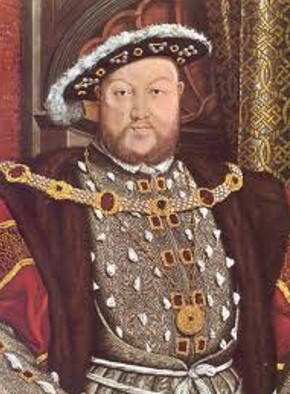
Hendrik VIII Tudor, after a portrait by Hans Holbein ca.1540. Source: Englishistory.net
However, the Irish continued to resist English domination, especially outside the area known as "The Pale"; the area around the current capital Dublin. This area was in the hands of the English king as a feudal lord. Under Elizabeth I of England, Catholics were heavily persecuted, partly because she was at odds with both the Pope and Catholic Spain under Philip II. Here, at the end of the Middle Ages, lies the basis for the conflict between Catholics and Protestants in this area that fell under the influence of the English crown. And Ireland has been predominantly Catholic since the 5th century.
In 1641, the Irish rose en masse, and about 12,000 English colonists were killed. The English revenge was not long in coming when Oliver Cromwell sent a punitive expedition to avenge the killed Protestants and confiscate the land of the Irish victims again. This continued regularly in the following centuries. Furthermore, a number of laws, such as the Test Act, ensured that Catholics could not hold public office, receive education, or own land. The Act of Union in 1800 officially incorporated Ireland into the United Kingdom.
Situation in Dublin before Easter Rising 1916. Source: National Library of Ireland. From same source below: Same place after Easter Rising 1916.
In the 19th century, the poor Irish tenant farmers lived a miserable existence. They hardly knew their landlords, but they could barely support themselves and stay alive thanks to the potatoes they could grow. When the potato harvests failed repeatedly due to a potato disease in 1845 and the following years, it meant certain death for almost a million Irish. As a result, food prices rose enormously, as the harvests elsewhere in Europe also failed. Meanwhile, the landlords continued to take good care of themselves, safely settled in England or in the big city. The Irish were left to their fate. To illustrate; in 1840, the Irish population was about 8 million people, while this number had dropped to about 3.5 million by 1900, directly or indirectly due to these crop failures. Many of them emigrated to America, hoping for a better life there. An estimated 2 million Irish sought their fortune overseas during the 19th century. The crossing was certainly a high risk. You did not board for fun if you could afford it at all. Diseases took a heavy toll once on board. Sharks were said to swim behind the ships full of emigrants because so many died on board and the bodies were thrown overboard. Most Irish found their place on the East Coast of the United States; anyone in Boston on March 17 will notice this.
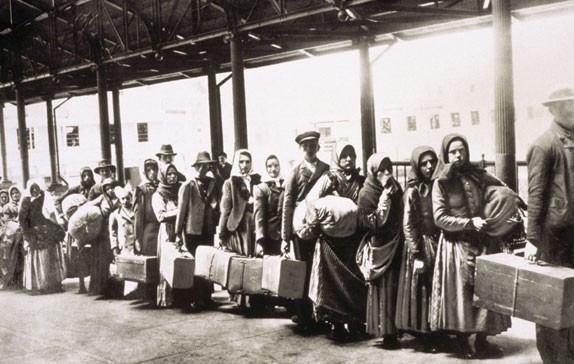
Irish refugees arriving at Ellis Island, New York (source unknown, date unknown)
The mass exodus of Irish to overseas countries had far-reaching political consequences for Ireland. Those who remained would declare independence in 1922; they had not been heard by the English government for too long. The northern part remained under British rule and did not become part of the Republic of Ireland but became Northern Ireland. At the beginning of the 20th century, nationalism grew among the Irish, who did not find the Irish political approach sufficient and felt more heard within the more radical approach of Sinn Fein; which originally advocated a dual monarchy based on the Austro-Hungarian model but was soon taken over by republican nationalists, leading to a clearer course. In 1916, a major uprising broke out during Easter week. The uprising was crushed, but the tone was set for the road to war with the English.
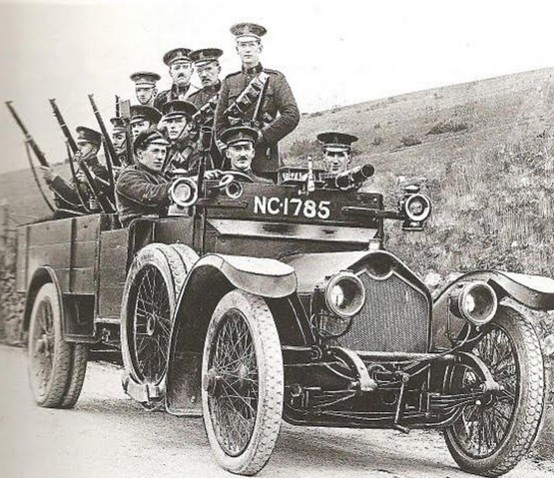
English paramilitary volunteers on patrol 1922
## Plantation: colonisation as a cheap instrument of rule
The colonisation policy the Tudors began was less a single decision than a method, repeated whenever a rebellion handed the crown land to redistribute. When the Desmond risings in Munster were broken in the 1580s, the forfeited estates went to English "undertakers" who contracted to settle English tenants on them. Under James I it went further: the departure of the Gaelic lords of Ulster in 1607 left that province open, and from 1609 it was planted with settlers from lowland Scotland as well as England, which is why the religious map of the island still runs differently in the north. The [break with Rome that Henry VIII carried through in England](https://writesidesofhistory.com/the-english-reformation-how-henry-viii-reshaped-religion-and-power-in-tudor-england/) reached Ireland as a settlement of property as much as of doctrine, much as [the dissolution of the monasteries](https://writesidesofhistory.com/the-dissolution-of-the-monasteries-henry-viiis-transformation-of-englands-sacred-landscape/) had done at home.
## Confiscation, penal law and the Protestant Ascendancy
Cromwell's expedition was followed by a settlement that made the confiscations permanent. The Act for the Settlement of Ireland of 1652 declared large numbers of Catholic proprietors forfeit and transplanted many of them west of the Shannon into Connacht, so that their estates could pay the soldiers and investors who had financed the war. Williamite victories at the Boyne in 1690 and at Limerick in 1691 closed the last opening for a Catholic recovery: Catholic ownership of Irish land, roughly three-fifths before 1641, was about a seventh by the early eighteenth century. When [the United Irishmen rose in 1798](https://writesidesofhistory.com/1798-rebellion-united-irishmen-ireland/), their defeat persuaded London that Ireland could no longer be governed through a separate parliament in Dublin, and the Act of Union followed two years later.
## Hunger, relief and the politics of memory
The blight was natural; the scale of the dying was not. Ireland went on exporting grain and livestock while its poorest people starved, because those crops were what the tenant owed as rent, and in 1847 the cost of relief was shifted onto Irish poor-law unions and the landlords who paid the rates, giving many a motive to clear their smallest tenants off the land. Irish-American money later stood behind [the Fenian rising of 1867](https://writesidesofhistory.com/fenian-rising-1867-irish-republican-brotherhood/), and the conviction that Westminster had watched a people die became one of the most durable arguments for separation.
## Chronology: from the Tudor conquest to partition
| Date | Event |
| --- | --- |
| 1169–1171 | Anglo-Norman intervention begins English lordship over Ireland. |
| 1541 | Henry VIII is declared King of Ireland; Anglican doctrine becomes the state religion. |
| 1580s | Confiscated Munster estates are planted after the Desmond risings. |
| 1607–1609 | The Gaelic lords leave Ulster; the plantation of the province begins. |
| 1641 | The Irish rise en masse; about 12,000 English colonists are killed. |
| 1649–1653 | Cromwell's punitive campaign and the Cromwellian land settlement. |
| 1690–1691 | Williamite victories at the Boyne and Limerick end Catholic hopes. |
| 1695–1728 | Penal laws bar Catholics from office, education and secure landholding. |
| 1798 | The rising of the United Irishmen is defeated. |
| 1800 | The Act of Union incorporates Ireland into the United Kingdom. |
| 1845–1849 | Repeated potato blight; roughly a million die and mass emigration begins. |
| 1916 | The Easter Rising in Dublin is crushed. |
| 1922 | The Irish Free State is founded; the northern counties stay under British rule. |
## Frequently asked questions
**Why did the Reformation take hold in England but not in Ireland?** The new doctrine was imposed from above rather than growing out of a popular movement, and it arrived attached to a colonisation policy: conformity meant submitting to the same power that was confiscating land and handing it to pro-English Protestants. Religion and property became one quarrel, which is why it outlasted the theology.
**What did the penal laws actually do to Catholic Ireland?** Measures such as the Test Act shut Catholics out of public office and education and made secure landholding effectively impossible, so that Catholic ownership of Irish land fell from roughly three-fifths before 1641 to about a seventh by the early eighteenth century. The result was a Protestant landlord class ruling a Catholic tenantry whose rent went to men they had never met.
**Was the Great Famine simply a natural catastrophe?** The potato disease that struck from 1845 was natural, and failed harvests elsewhere in Europe pushed prices up at the worst moment. But the mortality reflected a system in which the poorest depended on one crop, their landlords lived elsewhere, and food left the country as rent while people starved.
**Why did a failed rising in 1916 lead to a separate Irish state by 1922?** The Easter Rising had little popular backing and was quickly put down, but the executions that followed turned opinion sharply against British rule. Support moved to Sinn Fein, and the argument soon passed from Westminster politics to open conflict. The settlement that ended it left the northern counties under British rule, so partition became the unfinished business of independence.
## Recommended reading
- Thomas Bartlett, *Ireland: A History* (2010) - carries the whole story from the medieval lordship to partition. [View on Amazon →](https://www.amazon.com/dp/0521197201)
- Nicholas Canny, *Making Ireland British, 1580-1650* (2001) - the standard study of the plantations and their justifications. [View on Amazon →](https://www.amazon.com/dp/0199259054)
- Cecil Woodham-Smith, *The Great Hunger: Ireland 1845-1849* (1962) - the classic narrative of the famine years and the relief policy. [View on Amazon →](https://www.amazon.com/dp/014014515X)
- Kerby A. Miller, *Emigrants and Exiles: Ireland and the Irish Exodus to North America* (1985) - follows the emigrants through their own letters and memoirs. [View on Amazon →](https://www.amazon.com/dp/0195051874)
- Charles Townshend, *Easter 1916: The Irish Rebellion* (2005) - the fullest account of the rising and why its failure changed Irish politics. [View on Amazon →](https://www.amazon.com/dp/0141982470)
---
# Origin of the \"Rus\"
url: https://writesidesofhistory.com/origin-of-the-rus/
era: medieval · published: 2025-06-13 · topics: mongol-empire
The earliest history of Russia is a topic which often is being neglected. It`s not a matter of a lack of interest on the matter, but rather due to ignorance. The early inhabitants of the great Ukrainian and Southern Russian Steppes were formed by Nomadic people surrounding the Volga, Don and Dnjepr rivers. Among them the folks to become known as the Sarmatians and Scythians, had their origins in the Iranian area. For centuries their dominance in the area was unchallenged, until the Slavic (presumed to have been evolving from the Venedi-tribe as described by Tacitus)people did. After the Huns were adrift between the 4th and 6th Century A.D. the Slavs scattered across Europe in various directions. The Slavs assimilated with the people in the Ukrainian areas and in the following centuries, expanding their presence towards Belarus and Russia. They assimilated also with Baltic tribes. Around the 9th Century the Scandiavian people where expanding their presence over Europe, for a number of reasons. Danes went to the West, harassing the English and French shores, where they would become known as "Vikings". But the Swedes went Eastwards, conquering the rivers leading to the mainland of the Slavic people, setting up trades with them. The Slavs called them "Rus"-people meaning so much as "People who row". Soon the Scandinavians dominated the Slavs and Baltic People, but were then again pushed back after a massive revolt among the Slavs. The Slavic tribes however, soon began fighting eachother again. Stability in the areas was wished for finally, leading the Slavs to invite a "Rus" prince to reign them. The prince was called Rurik. He would lay the foundations for the city of Novgorod. After his Death late 9th Century, his kinsman Oleg took over, expanding his realm by conquest, and finally taking control over Kiev. And here, Kiev Rus would originate. In time, all the Slavic tribes within the realm, would become known as "Rus", living in Russia, the land of the "Rus".
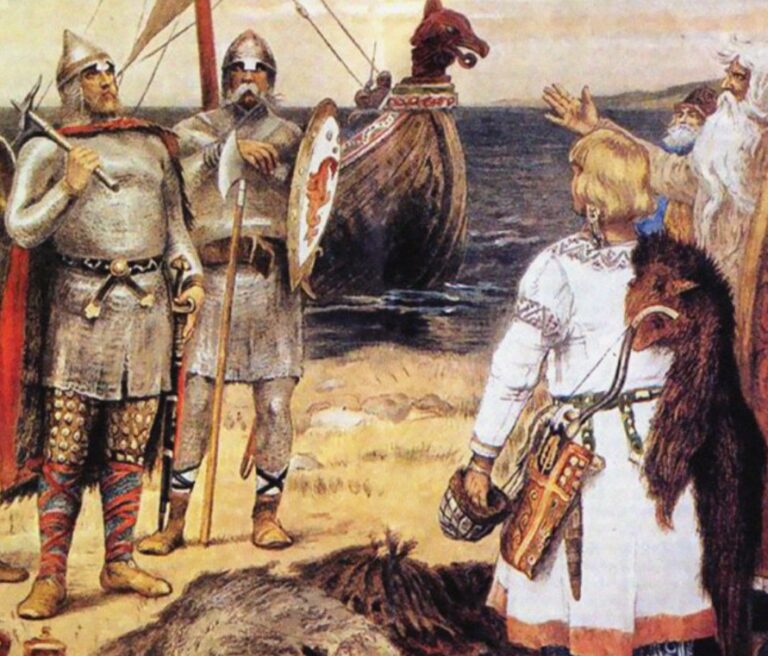
## The steppe the Slavs walked into
The lands between the Carpathians and the Volga were never empty ground waiting to be settled; they were a corridor, and for a thousand years before the Rus it belonged to mounted peoples out of the east. The wealth the Scythians and Sarmatians drew from herds and tribute survives in the [gold-heavy royal burial mounds](https://writesidesofhistory.com/scythian-royal-kurgans-gold-burial-mounds/) of the southern steppe. Their dominance was a matter of terrain rather than character: open grass rewards cavalry, and cavalry taxes whoever must cross it.
The forest belt to the north worked by other rules. There the Volga, the Don, the Dnieper and their tributaries ran roughly north to south, threading swamp and woodland into a usable network in which farming villages could survive as they never could on open steppe. That is one reason the Slavic dispersal following the Hunnic upheavals took root so widely: the peoples [Tacitus had grouped under names such as the Venedi](https://writesidesofhistory.com/tacitus-image-germanic-tribes/) were, by the eighth century, spread from the Elbe to the upper Volga, sharing much in speech and custom and almost nothing in the way of central authority. That absence is the precondition for everything after it. When the Khazar khaganate consolidated on the lower Volga and Don, several Slavic tribes of the forest-steppe fell to paying it tribute because they had no structure capable of refusing — the same weakness that soon made them attractive to armed traders arriving from the opposite direction.
## Rivers, silver and the road east
The eastward expansion was, at bottom, a hunt for silver. From roughly 800 the mints of the Abbasid caliphate were pouring dirhams into circulation, and the northern forests held what those markets wanted: furs, wax, honey, amber and slaves. Two arteries carried the exchange. The Volga route ran through the Bulgar markets to the Caspian and the caravan roads beyond; the Dnieper route ran south past the rapids to the Black Sea and Constantinople, and later generations knew it as the road from the Varangians to the Greeks. Neither was a voyage in the seagoing sense: both demanded shallow craft, long stretches of rowing against the current, and portages where boats were dragged overland between watersheds.
This is why the eastern venture took a different shape from the western one. The Danes who struck England and Francia arrived under sail, took what was portable and left, and that tradition — running from [Lindisfarne to the siege of Paris](https://writesidesofhistory.com/viking-raids-from-lindisfarne-to-the-siege-of-paris/) — eventually produced the conquest and settlement recorded in [the Danelaw](https://writesidesofhistory.com/the-danelaw-and-viking-settlement-in-england/). The rivers permitted nothing so quick. A crew that wanted silver had to move slowly through inhabited country, return the next season and hold the portages in between, which meant bases, and bases meant dealings with the Slavic and Finnic populations along the way: first as partners, then as tribute-takers. Staraya Ladoga on the Volkhov and the fortified sites later known as Rurikovo Gorodishche and Gnezdovo show the pattern in the ground, mixed settlements where Scandinavian metalwork, Slavic pottery and Islamic coin turn up together.
## The name and what it described
The etymology the article gives is the one most philologists accept. The Old Norse vocabulary of rowing passed into Finnic speech as *Ruotsi*, still the ordinary Finnish word for Sweden, and from Finnic into Slavic as *Rus*. The word began as a description of what these men did rather than of where they came from, which is exactly why it could later attach to a dynasty, then to a people who were not Scandinavian at all, and finally to a country.
Outsiders noticed them early and independently. Frankish annalists recorded in 839 that envoys of a people calling themselves Rhos had reached the emperor Louis the Pious and, on inquiry, proved to be Swedes. Arabic geographers describe Rus merchants trading and burying their dead along the Volga. A Byzantine handbook of the mid-tenth century lists the names of the Dnieper rapids twice over, once in the language of the Rus and once in Slavonic — the first set recognisably Norse, the second not. Three traditions with no interest in corroborating one another describe the same bilingual world.
## Rurik, Oleg and the making of a realm
The invitation reaches us through the Primary Chronicle, compiled in Kiev around 1113, some two and a half centuries after the events it dates to 862. Its sequence is the one the article follows: the northern tribes threw off the overseas tribute-takers, fell to fighting among themselves, and then sent for a prince who could impose order. Historians read this less as the minute of a constitutional meeting than as a foundation story shaped for a ruling house that needed its authority to look invited rather than seized. Archaeology confirms the substance without the tidiness — Scandinavians were unquestionably established and powerful in the north — but no spade has found the moment of agreement.
What followed is better attested. On the chronicle's reckoning Rurik died in 879 and his kinsman Oleg took Kiev in 882, and the choice of Kiev was decisive. The town sat on the high right bank of the Dnieper at the last defensible point before the river ran out into open steppe: far enough south to command the traffic heading for Constantinople, far enough north to be held against the nomads who controlled the grass. Taking it also meant taking over the tribute of Slavic tribes who had been paying the Khazars, converting a trading interest into a territorial one. Within a generation the Rus negotiated as a power rather than a nuisance: the treaty made with Byzantium in 911 set out how Rus merchants were to be housed, fed and policed while they did business at Constantinople.
## How the rowers became Slavs
The most striking thing about the Rus is how quickly they stopped being Scandinavian. The names tell it: Helgi becomes Oleg, Ingvar becomes Igor, Helga becomes Olga, and by the middle of the tenth century Igor and Olga's son bears the wholly Slavic name Sviatoslav. The dynasty ruled a population overwhelmingly Slavic, gathered its tribute on the annual circuit the Byzantines transcribed as *polyudie*, and came to speak and pray as its subjects did; the conversion of Vladimir in 988 completed the reorientation, binding the realm to Byzantine Christianity and Slavonic letters rather than to the north. Assimilation at that speed is what makes the article's closing point exact. The word Rus travelled from a band of rowers to a princely house, from the house to its territory, and from the territory to everyone in it — so that tribes who had once been the object of Rus tribute ended by calling themselves Rus without contradiction.
## An argument that outlived the evidence
Few questions in European history have been fought over as hotly, or for as poor a reason. In the eighteenth century scholars at the St Petersburg Academy of Sciences set out the Scandinavian reading of the chronicle; Mikhail Lomonosov attacked it as an insult to Russian origins, and the dispute hardened into the Normanist and anti-Normanist positions argued for the next two hundred years, with particular bitterness in the Soviet period, when a foreign founding looked politically intolerable. The heat came from the assumption underneath — that a state's dignity depends on the ethnicity of whoever first collected its taxes.
The evidence is less dramatic than either camp wanted. Scandinavians formed the armed and commercial elite of the early Rus; the graves, the coin hoards, the Norse names in the Byzantine treaties and the rapids in the Byzantine handbook leave little room to argue otherwise. But they were a thin layer over a Slavic society that supplied the language, the farming and the settlements, and the polity belonged to neither parent alone. Kievan Rus was a fusion, and the realm that grew from it is claimed today as ancestral by Ukraine, Belarus and Russia alike.
## Chronology of the Rus
| Date or period | Event |
|---|---|
| 1st century AD | Tacitus describes the Venedi east of the Vistula, later linked to Slavic origins |
| 4th–6th century | Hunnic upheaval unsettles the steppe; Slavic groups disperse widely across Europe |
| 7th–8th century | The Khazar khaganate dominates the lower Volga and Don; some Slavic tribes pay it tribute |
| c. 750 | Staraya Ladoga is settled on the Volkhov, the earliest of the northern river bases |
| c. 800 onward | Abbasid silver dirhams flow north along the Volga in exchange for furs, wax and slaves |
| 839 | Frankish annals record envoys of a people called Rhos, found to be Swedes |
| 860 | A Rus fleet appears before Constantinople |
| 862 (chronicle date) | Northern tribes invite Rurik to rule after expelling tribute-takers and falling into discord |
| 879 (chronicle date) | Rurik dies; his kinsman Oleg succeeds him |
| 882 (chronicle date) | Oleg takes Kiev and makes it the centre of the realm |
| 911 | A Rus treaty with Byzantium regulates the trading of Rus merchants at Constantinople |
| mid-10th century | Sviatoslav, first ruler of the line with a Slavic name, succeeds Igor and Olga |
| 988 | Vladimir's conversion binds Rus to Byzantine Christianity and Slavonic letters |
| c. 1113 | The Primary Chronicle takes shape in Kiev, fixing the story of Rurik's invitation |
## Frequently asked questions
**Why did the Swedes go east while the Danes went west?** Geography set the terms. The Danish and Norwegian coasts opened onto the North Sea and the sailing routes to England and Francia, where a fast raid could take portable wealth and leave; the Swedish coast opened onto the Baltic and the river mouths of the eastern forests. The eastern rivers could not be raided in the same way, because they had to be rowed and portaged slowly through inhabited country, so the venture there took the form of trading bases and tribute rather than coastal plunder.
**What does the word "Rus" actually mean?** It began as a term for rowing and rowing crews in Old Norse, passed into Finnic speech as *Ruotsi* — still the Finnish word for Sweden — and entered Slavic as *Rus*. It described an activity, not a homeland, which is precisely why it could later be applied to a princely dynasty, then to the territory that dynasty ruled, and finally to a Slavic population that had no Scandinavian ancestry at all.
**Did the Slavs really invite a prince to rule them?** The invitation is reported by the Primary Chronicle, written in Kiev around 1113 about events placed in 862, and it served a ruling house that benefited from appearing to have been asked rather than to have seized power. Archaeology confirms the underlying situation — Scandinavians were established and dominant in the northern river settlements — without confirming the neat moment of agreement. The likeliest reading is that a real pattern of expulsion, disorder and negotiated overlordship was later compressed into a single founding scene.
**When did the Rus stop being Scandinavian?** Remarkably fast: within about three generations. Helgi, Ingvar and Helga appear in the Slavic record as Oleg, Igor and Olga, and by the middle of the tenth century the ruling prince bears the entirely Slavic name Sviatoslav. Language, tribute-taking and, after Vladimir's conversion in 988, religion all bound the dynasty to its Slavic subjects rather than to the north.
## Recommended reading
- Simon Franklin and Jonathan Shepard, *The Emergence of Rus 750-1200* (1996) - the standard scholarly narrative of how river trade, tribute and dynasty combined into a state. [View on Amazon →](https://www.amazon.com/dp/058249091X)
- Wladyslaw Duczko, *Viking Rus: Studies on the Presence of Scandinavians in Eastern Europe* (2004) - the archaeological case, settlement by settlement and grave by grave. [View on Amazon →](https://www.amazon.com/dp/9004138749)
- Janet Martin, *Medieval Russia, 980-1584* (2007) - takes up the story where Kievan Rus is already formed and follows it to Muscovy. [View on Amazon →](https://www.amazon.com/dp/0521676363)
- Christian Raffensperger, *Reimagining Europe: Kievan Rus' in the Medieval World, 988-1146* (2012) - argues for Rus as an ordinary member of the medieval European political world rather than an eastern exception. [View on Amazon →](https://www.amazon.com/dp/0674063848)
- Neil Price, *Children of Ash and Elm: A History of the Vikings* (2020) - the best recent account of the Scandinavian world the eastward rowers came from. [View on Amazon →](https://www.amazon.com/dp/0465096980)
---
# The Raid on Dutch soil
url: https://writesidesofhistory.com/the-raid-on-dutch-soil/
era: modern · published: 2025-06-13 · topics: world-wars
Early 1940, The Netherlands was still building their defense against a possible raid from Hitlers Germany. In the middle section of the Eastern border, they build the so called Maaslinie, supported with the “Peel-raamstelling”, a defensive line containing rather small concrete fortifications called “kazematten” from which fixed machinegunfire could be launched upon the enemy approaching. The Peelraamstelling contained about 2000 of these Kazematten, intersected by approximately 300-400 meters. Next to that a anti-tank channel had been dug, which was supposed to prevent enemy tanks on their advance.
## A line built to buy time, not to win
The Peel-Raam Position was never meant to defeat a German invasion on its own. Dutch strategy rested on armed neutrality, and behind that neutrality lay a very old idea: if an invader came anyway, the field army would fall back on the Vesting Holland — Fortress Holland — the western provinces protected by rivers and by deliberately flooded ground, and hold there until the diplomatic situation changed or a great power intervened. It was the same instinct that had saved the Dutch Republic in [the disaster year of 1672](https://writesidesofhistory.com/the-disaster-year-1672-political-upheaval-and-survival-in-the-dutch-republic/), when sluices were opened and a belt of shallow water stopped the armies of Louis XIV where fortresses had failed.
That doctrine explains the shape of the eastern defences. The Maas Line was a thin outpost belt along the river, meant to watch the crossings and force an attacker to deploy. The Peel-Raam Position lay roughly nine to twenty-one kilometres behind it, running from Grave past Mill and then south along the Zuid-Willemsvaart canal towards Weert. In the northern sector the anti-tank obstacle was a purpose-dug Defensiekanaal; further south the existing canal did the same work. What the line did not do was join up with the Belgian defences beyond the border, so its southern end hung in the air — a gap neutrality had forbidden the two staffs to close.
The state of the Dutch army in comparison to the German army was an inferior one, and modernisation of the army had not been put through properly. The river “Maas” was considered a natural barrier but the eastern border held several bridges. To prevent the enemy from crossing the bridges, they were mostly prepared for demolition by the teams responsible.
## The bridges the Dutch could not afford to lose
Demolition was the hinge on which the whole eastern scheme turned: a river is only a barrier while the crossings over it are gone. On the morning of the invasion most of the Dutch firing parties did their work and the great majority of the Maas bridges went into the water. The plan failed only where it was attacked by something other than an ordinary assault.
The Germans understood the problem exactly as the Dutch did, which is why the crossings went not to the leading infantry but to a new and still experimental formation: Bau-Lehr-Bataillon z.b.V. 800, the unit that would shortly become famous as the Brandenburgers. Its speciality was the coup de main in enemy uniform — seizing a bridge in the minutes before the charges could be fired, rather than fighting across it afterwards. Of all the targets on the Dutch frontier the railway bridge at Gennep was the most valuable, because it carried the line from Goch straight across the Maas and pointed, without a turn, at the Peel-Raam Position beyond.
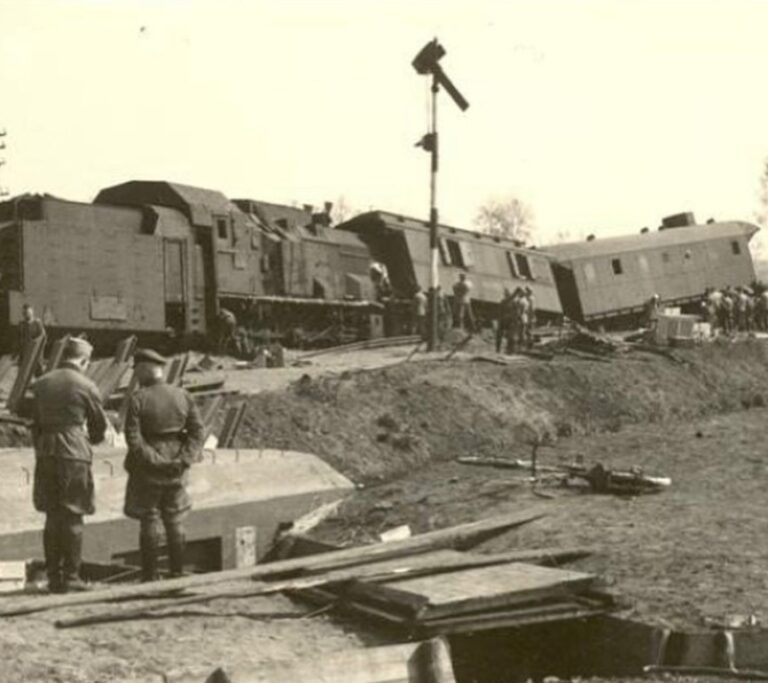
Armoured train near Mill, The Netherlands, May 1940
## A handful of men in the wrong uniforms
The party that took the Gennep bridge was small. In the early hours of 10 May 1940 a team led by Oberleutnant Wilhelm Walther, dressed as Dutch military police escorting German prisoners, worked its way onto the eastern approach and struck at around two in the morning. Two guard positions were overrun and three of the attackers were wounded before the group was pinned down; Walther, still in Dutch uniform, walked forward along the bridge, and the hesitation of defenders who could not be certain what they were looking at gave the rest of the team the seconds they needed. The guards were overcome and the detonators disabled. Walther received the Knight's Cross for the action on 4 June 1940.
But in the early morning the Germans were able to neutralize the demolitionloads from the railroad bridge at Gennep and to decept the guards. It made them possible not only to breach the Maaslinie, but also breach the Peelraamstelling using an armoured train containing troops and penetrate Dutch soil up to 15 kilometers until the train was finally put to a hold at the town of Mill. The Germans were then able to attack the Peelraamstelling from behind. Later that same day after delaying the German advance and brave defensive efforts, the Peelraamstelling was cleared as ordered by the High Command of the Dutch army. Next defensive line for the Germans to stumble upon would be the Grebbelinie, an attachment to the North of the Peelraamstelling.
## The trains at Mill
What crossed the captured bridge was not a spearhead of tanks but two trains: an armoured train followed by a troop train carrying roughly five hundred infantrymen of the 481st Infantry Regiment, part of Generalleutnant Gerhard Kauffmann's 256th Infantry Division. Because the invasion had not yet been recognised for what it was, they rolled through the Dutch positions almost unopposed, and at about half past four in the morning they halted some three and a half kilometres west of Mill, near Zeeland — behind the line, in the middle of the ground the casemates were built to cover.
The improvisation that followed decided the shape of the day. When the armoured train ran back east some three quarters of an hour later, apparently to fetch reinforcements, Dutch troops had already dragged rail obstacles — the steel "asperges" designed for exactly this purpose — onto the track and laid mines, and the train was derailed. The corridor closed behind the Germans who had already used it. What remained was a conventional battle: the Mill sector was held by roughly two thousand men in two battalions with artillery support, fighting behind the Defensiekanaal, minefields and casemates, and now also fighting the infantry deposited in their rear. Dutch counter-attacks failed to destroy the intruders, but the position was not carried cheaply, and the advance was held up for a full day.
The captured bridge also proved less useful than the Germans had hoped. It was a railway crossing, and to run lorries and guns over it timber had to be laid between and beside the rails; the train carrying that timber was routed to the wrong destination and arrived a day late. For the first crucial hours the great prize at Gennep delivered infantry on rails and very little else.
## The order that had already been written
The evacuation of the Peel-Raam Position on the evening of 10 May looks, from the outside, like a collapse forced by the breakthrough at Mill. It was in fact a decision taken six weeks earlier. General Henri Winkelman, who had taken command of the Dutch armed forces in February 1940, did not regard the position as a main line of resistance at all. On 30 March he decided in secret that at the onset of a German attack the bulk of Third Army Corps would be pulled back to the Linge to cover the southern flank of the Grebbe Line, leaving only a covering force behind. The men in the casemates were not told; they were defending a position their commander-in-chief had already decided to give up.
The withdrawal was carried out that night, a rearguard holding the crossings of the Zuid-Willemsvaart until about four in the morning on 11 May while the field units marched west. Historians have argued ever since about whether the plan was realism or defeatism. The case for Winkelman is that a long, thinly held line with an open southern flank, facing an enemy free to concentrate anywhere along it, would have cost the Dutch army its field divisions in a day. The case against is that the troops who died holding it died for a line nobody intended to keep.
## What the breakthrough cost
The consequences ran well beyond one Brabant village. The French Seventh Army, advancing north to link up with the Dutch in Brabant and Zeeland, found the Dutch field army gone from the sector it had come to support and its own position untenable within days. Inside the Netherlands the war moved quickly to the water lines: the Grebbe Line, the next obstacle facing the Germans, held for three days and fell on 13 May, Rotterdam was bombed on 14 May, and Winkelman signed the capitulation at Rijsoord on 15 May.
The raid at Gennep is remembered because it shows so cleanly how narrow the margins were. A defensive system built over years, at great cost, was unhinged in a few minutes by a handful of men in borrowed uniforms and a sentry's moment of doubt — and then held up for a day by soldiers improvising with rail obstacles and mines. Neither fact cancels the other. The same summer would show, in the skies over southern England during [the Battle of Britain](https://writesidesofhistory.com/battle-of-britain-raf-fighter-command-1940/), that a defence surviving its first day could change the course of the war; the Dutch eastern lines were never designed to be given that chance.
## Chronology of the raid and the breakthrough, 1939–1940
| Date | Event |
|---|---|
| 1939 | The Peel-Raam Position is fortified, with casemates, minefields and an anti-tank canal from Grave past Mill to the Zuid-Willemsvaart |
| February 1940 | General Henri Winkelman becomes commander-in-chief of the Dutch armed forces |
| 30 March 1940 | Winkelman secretly decides to abandon the Peel-Raam Position at the onset of an attack and withdraw Third Army Corps behind it |
| c. 02:00, 10 May 1940 | Oberleutnant Wilhelm Walther's Brandenburger team, in Dutch uniform, seizes the Gennep railway bridge and disables the demolition charges |
| c. 04:30, 10 May 1940 | An armoured train and a troop train pass through the Peel-Raam Position and halt near Zeeland, west of Mill |
| Morning, 10 May 1940 | The returning armoured train is derailed on rail obstacles and mines; the battle for Mill develops on both sides of the line |
| Evening, 10 May 1940 | The Dutch high command orders the Peel-Raam Position cleared |
| c. 04:00, 11 May 1940 | The rearguard on the Zuid-Willemsvaart breaks off; the field units are away to the west |
| 13 May 1940 | The Grebbe Line falls |
| 14 May 1940 | Rotterdam is bombed |
| 15 May 1940 | Winkelman signs the Dutch capitulation at Rijsoord |
| 4 June 1940 | Walther is awarded the Knight's Cross for the Gennep operation |
## Frequently asked questions
**Why did the Dutch not simply blow up the bridge at Gennep?** They intended to, and the charges were in place with a firing party responsible for them. The bridge was taken by a small German team in Dutch uniforms who reached the detonation point before the order could be carried out, which is precisely why the operation was given to a specialist unit rather than to ordinary assault infantry. Most of the other Maas bridges were destroyed as planned.
**How could a train breach a fortified line?** The Peel-Raam Position was designed to stop men and tanks approaching across open ground, with an anti-tank canal and interlocking machine-gun fire covering the front. A railway ran straight through it, and once the bridge behind was intact the line offered a corridor that pointed the wrong way for the defenders — troops arrived behind the casemates rather than in front of them. The Dutch answer was improvised: rail obstacles and mines that derailed the armoured train when it tried to return.
**Was the Peel-Raam Position abandoned because of the breakthrough at Mill?** Not really. Winkelman had already decided on 30 March 1940 to give up the position at the start of any attack and to withdraw the bulk of his field troops to cover the southern flank of the Grebbe Line. The fighting at Mill determined how much time that withdrawal was given, not whether it would happen.
**Did the defence achieve anything?** It bought a day. The German advance was delayed by roughly twenty-four hours and cost the attackers heavier casualties than the campaign's pace suggests, and that delay covered the retreat of Dutch field units towards Fortress Holland. Set against the five-day collapse of the Netherlands as a whole, it was a small return on an expensive line — but it was not nothing.
## Recommended reading
- Herman Amersfoort and Piet H. Kamphuis (eds.), *May 1940: The Battle for the Netherlands* (2010) - the standard scholarly account of the five-day campaign, and the best corrective to the idea that it was simply Blitzkrieg. [View on Amazon →](https://www.amazon.com/dp/9004184384)
- Karl-Heinz Frieser, *The Blitzkrieg Legend: The 1940 Campaign in the West* (2005) - the official German history of the western campaign, essential for understanding why bridges and speed mattered more than tanks. [View on Amazon →](https://www.amazon.com/dp/1591142946)
- Anthony Rogers, *Brandenburger: Wartime Photographs of Wilhelm Walther* (2022) - a photographic record assembled from the album of the officer who led the seizure of the Gennep bridge. [View on Amazon →](https://www.amazon.com/dp/1784387150)
- Julian Jackson, *The Fall of France: The Nazi Invasion of 1940* (2003) - places the Dutch collapse inside the wider Allied defeat that followed within weeks. [View on Amazon →](https://www.amazon.com/dp/0192805509)
---
# The Fall of the Roman Empire
url: https://writesidesofhistory.com/80/
era: ancient · published: 2025-06-12 · topics: roman-empire
**One of the most discussed topics regarding the dating of the end of antiquity and the beginning of the Middle Ages is the fall of the Western Roman Empire. Western Roman indeed, the great Roman Empire was divided, with the Eastern Roman Empire not ceasing to exist until its decline at the end of the Middle Ages, which is again seen as an endpoint of the Middle Ages and transition to the Renaissance. However, one event is rarely solely responsible for the end of an era. Often it involves a series of events that over a longer period lead to a shift in the existing order.**
Thus, one could not only designate the year 476 AD (Fall of the Western Roman Empire where the last emperor, Romulus Augustulus, is deposed by Odoacer, leader of Germanic mercenaries within the Roman army) as the end of antiquity and the beginning of the Middle Ages. One could just as well mention other events, such as the sackings of Rome in 410 AD and 455 AD by respectively the Visigoths and the Vandals, Germanic tribes displaced by the arrival of the Huns in Europe. The fourth century marked a Roman Empire that was forced to incorporate Germans as foederati, residents without citizenship, but forced to provide (military) assistance in exchange for protection and inclusion within the empire's borders. This further led to decline. The difficulty of letting one event be responsible for the end and beginning of a period quickly becomes clear. This also keeps the discussion alive within historiography about where to end antiquity and begin the Middle Ages. It depends on what you look at. Tradition, however, maintains 476 AD as the transition, one must give it a year somehow, which is convenient for people. However, identifying the fall of the Western Roman Empire is anything but an easy matter, as it involves various aspects that ultimately lead to its end.
**Christianity**
After the death of Jesus, his apostles set out to preach Jesus' teachings. One of the apostles who was most fanatic in this was Paul, who also went to Rome to bring Christianity there and eventually achieved martyrdom. Christianity was and is fundamentally a pacifist religion, whereas the Romans had a war god, Mars. Additionally, the Christian faith was primarily a monotheistic religion. And that was a problem in the Roman Empire, as the Roman state religion adhered to many gods. The Romans can be said to be reasonably tolerant of other religions and ideologies, unless one completely abstained from the Roman cult, which was polytheistic in nature. Christians were therefore, as the Jews had previously experienced until they were recognized by the Roman emperor(s) in the first century, seen as a danger to the unity of the state. They would be bad for trade because they drove merchants away from temples where they could. The Romans also watched the rituals of the Christians with suspicion, they were seen as cannibals because they ate the flesh and blood of Christ. As a result, they were regularly subjected to persecutions. Examples of this can be found in all three centuries; in the first century, for example, by Nero, who used Christians as torches along the road, in the second under Marcus Aurelius (177), and in the third and fourth respectively under Decius (250), Valerian (257), and Diocletian (303). The persecutions only stopped with the Edict of Milan in 313, which officially allowed the religion within the empire and granted citizens the right to freedom of religion. This allowed the following among Christians to grow strongly. More and more people within the empire became followers of the Christian faith, including soldiers. However, they came into conflict with their faith and their profession, as these two were difficult to reconcile. Historians often point out that with the advent of Christianity, the military strength was gradually undermined. Further reading on the topic can be found here in the book by Stephen Williams: *[Diocletian and the Roman Recovery](https://www.amazon.com/dp/0415918278)*.
Christians are slaughtered for entertainment in front of a frenzied audience. Source: Historia.nl
**Declining Power**
The Roman Empire reached its peak at the beginning of the third century (202 AD) under Emperor Septimius Severus, who annexed a vast territory in Mesopotamia to the already considerable empire. It is often thought that the greatest extent was reached under Trajan, but this is not true because he could not definitively establish his authority in the same area, although he made successful incursions there, as J. Lendering indicates in a book review on his weblog Mainzer Beobachter about Maarten van Rossem's book "The End of the Roman Empire". But here too: the larger an empire, the harder it is to manage. A larger empire has more border kilometers and needs more soldiers and thus more pay. That means higher taxes. Due to the call for a larger army, Roman citizens could no longer be exclusively recruited for military service. Increasingly, these were foederati or prisoners of war. Furthermore, a large part of the third century was characterized by internal chaos and civil wars within the empire. The period is known in history as the crisis of the third century and the rule of competing soldier emperors. Soldiers often appointed their commander in the hope that more pay would follow. Due to internal strife, much less loot came in than before. To make matters worse, the pressure from various tribes on the outer borders became increasingly greater. In the Parthians, the Romans found an opponent to reckon with on their eastern borders. They suffered several major defeats against the Parthians (territory largely modern-day Iran) between the mid-first century BC and the early third century AD and later at the hands of the successors of the Parthians; the Sassanid Empire. In the west, barbarian invasions became more frequent and intense. The Germans increasingly banded together in organized (tribal) alliances in the fight against the Romans. They had often fought in the ranks of the Romans and now used their acquired military knowledge against their old employer. The emperor sought refuge in strengthening the army to better face the many enemies, but more troops meant more expenses. The silver content in a coin was drastically reduced to keep everything funded. As a result of currency devaluations and people leaving both cities and border areas, the economy in the west collapsed. Only with the arrival of Emperor Diocletian did some peace return to the empire.
Roman Empire around 117 A.D.
**A divided Empire**
Both [Diocletian](https://writesidesofhistory.com/diocletians-price-edict-late-roman-economic-reform/) and [Constantine](https://writesidesofhistory.com/constantine-the-great-conversion-power-and-the-founding-of-constantinople/) implemented various reforms in their attempts to further restore the empire. Both in administrative areas (expansion of the bureaucracy), economic areas (prices for goods were controlled), and the actual division of power (Tetrarchy). As a result, Rome was no longer the seat of power. In 285 AD, the Roman Empire was administratively split in two. From then on, there would be a western part and an eastern part. This division is called the tetrarchy, in which Diocletian, emperor at the time, appointed a co-emperor and two sub-emperors. It was hoped that by dividing the empire, attacks from different sides could be better parried. Ultimately, the emperors quarreled over succession, from which Constantine the Great emerged victorious after having a vision of the Christian cross on the eve of a decisive battle against his greatest enemy, which would bring him victory. Constantine indeed won and became the first Christian emperor of the empire. Constantine moved his seat of government to the richer [Constantinople](https://writesidesofhistory.com/the-fall-of-constantinople-1453-the-end-of-byzantium-and-dawn-of-a-new-era/) (later Byzantium). After the death of Theodosius the Great (395), who had to admit the Visigoths under Alaric I within the borders of the empire, a definitive division between East and West followed. Armies of both empires no longer supported each other in military campaigns, leading to further weakening the military.
The Tetrarchy around 230 n.Chr. Source: Historiek.net
**Taxes**
Due to the many (civil) wars within the empire, residents were burdened with increasingly higher taxes. These could no longer be borne by the backbone of the economy, the free tenant farmers (coloni). Many farmers were forced to leave their lands in the hope of a better existence. This led to less agricultural production; large tracts of farmland were left uncultivated. Markets became smaller. Attempts were made to reverse the tide by making the profession hereditary and tied to the land, so that the large exodus from the countryside would be stopped. The abandoned pieces of land were often seized by large landowners who employed slaves there. The large landowners eventually became lords of both coloni (free tenant farmers) and slaves. Serfdom (bondage) thus arose. However, due to less territory being conquered, there were also fewer slaves available. This resulted in smaller pieces of land being exploited and large landowners becoming increasingly independent of Rome. The government could no longer manage the countryside. The villas in the countryside became administrative centers in a certain area.
**Migrations and Plague**
During these economic and social developments, the Roman Empire also had to deal with the outbreak of plague epidemics. This further weakened the economy. Cities shrank significantly and trade became more small-scale. The first major epidemic occurred under Marcus Aurelius (r. 161-180). It is doubted whether this was real plague, but in any case, an estimated ten percent of the empire's inhabitants died. Especially among the soldiers, the number of victims was high. Eventually, the army could not withstand Germanic invasions, forcing the emperor to lead the army himself (successfully). However, the threat of Germanic invasions remained, and increasingly the Romans were forced to incorporate Germans in large numbers into the empire. These foederati subjected themselves to Roman laws. In exchange for protection within the empire, the foederati provided auxiliary troops for the legions, which increasingly consisted of Germans.
At the end of the fourth century, however, the Huns (an Asian equestrian people from the Mongolian regions) were displaced. They drove various Germanic peoples into flight, such as the Visigoths, for example. Rome was sacked in 410 AD by these Visigoths, who became foederati after fleeing from the Huns, and again in 455 AD by the Vandals. The event caused a tremendous shock in the old world order, Rome saw foreign troops in the city for the first time since the fourth century BC. The Huns flooded European territory and even took Milan and Ravenna and also threatened Rome. The last great victory of the Romans took place on the Catalaunian Fields where the Roman general Aetius defeated the Huns under Attila. The last Roman emperor, Romulus Augustulus, was eventually deposed in 476 by Odoacer, who thus became the first barbarian king of Italy.
**Complex**
As we can deduce from the above, the fall of the Western Roman Empire is thus a complex set of factors over a longer period that lead to the end of a period of Roman rule in the west. Disease, famine, the size of the empire, migrations, the advent of Christianity and thus pacifism in the empire, the incorporation of Germans into the army and their growing importance in that army, even in high positions, the division of the empire, military defeats, good emperors, bad emperors, sky-high taxes that can no longer be borne, the lack of loot due to the absence of victories, de-urbanization, civil war, legislation, so many causes play a role in the disintegration of the empire, that when choosing a year to periodize the final fall, the year 475 AD was chosen to somewhat periodize it, and one looks mainly at a break with the past on an institutional level. However, the Latin culture further [merged with the Germanic](https://writesidesofhistory.com/clovis-and-the-rise-of-the-merovingian-franks/), a process that would take centuries and to this day you find elements of both around you. For further reading, the renowned standard work on the topic is *[Edward Gibbon's history of the empire's decline](https://www.amazon.com/dp/0140437649).*
## Chronology of the fall of the Western Roman Empire
| Date | Event |
| --- | --- |
| 64 AD | Nero persecutes Christians in Rome, the first of the persecutions that recur across three centuries |
| 117 AD | Trajan's campaigns mark the empire's widest reach on the map, though his authority in Mesopotamia is never made permanent |
| 161-180 | Reign of Marcus Aurelius; a major epidemic kills an estimated ten percent of the empire's inhabitants, hitting the army hardest |
| 177 AD | Persecution of Christians under Marcus Aurelius |
| 202 AD | Septimius Severus annexes a vast territory in Mesopotamia, the empire's true greatest extent |
| 235-284 | The crisis of the third century: civil war, competing soldier emperors, currency debasement and mounting pressure on the frontiers |
| 250 AD | Persecution under Decius |
| 257 AD | Persecution under Valerian |
| 285 AD | Diocletian divides the empire administratively into a western and an eastern part; the Tetrarchy follows |
| 303 AD | The last great persecution of Christians, under Diocletian |
| 313 AD | The Edict of Milan legalises Christianity and grants freedom of religion within the empire |
| 330 AD | Constantine the Great dedicates Constantinople as his seat of government |
| 395 AD | Death of Theodosius the Great; the division between East and West becomes definitive and the two armies stop supporting each other |
| 410 AD | The Visigoths under Alaric sack Rome, the first foreign troops in the city since the fourth century BC |
| 451 AD | Aetius defeats Attila's Huns on the Catalaunian Fields, the last great Roman victory in the west |
| 455 AD | The Vandals sack Rome |
| 476 AD | Odoacer deposes Romulus Augustulus and becomes the first barbarian king of Italy |
## Frequently asked questions
**Why do historians still mark 476 AD as the end of the Western Roman Empire if the collapse actually took centuries?** As the article explains, no single event ends an era; the deposition of Romulus Augustulus by Odoacer in 476 is a convenient institutional break rather than a true cause. Tradition needs a year to periodize the transition from antiquity to the Middle Ages, so 476 is kept as shorthand even though the real story runs from the third-century crisis through the sackings of 410 and 455.
**Did the Roman Empire disappear entirely in 476 AD?** No, only the Western Roman Empire fell that year. The Eastern Roman Empire, which had split off definitively after the death of Theodosius the Great in 395, continued for another thousand years and only declined at the end of the Middle Ages, which is itself sometimes treated as the transition point to the Renaissance.
**How did the rise of Christianity weaken Rome's military strength, according to the article?** Christianity was fundamentally a pacifist religion, in contrast to the Roman state cult and its war god Mars, and as more soldiers converted they found their faith increasingly hard to reconcile with their profession. Historians point to this tension, alongside the persecutions that preceded the Edict of Milan in 313, as a factor that gradually undermined military discipline and readiness.
**What were the foederati, and why did they matter to the empire's decline?** The foederati were Germanic groups admitted within Rome's borders without citizenship, obligated to provide military assistance in exchange for protection, a practice that expanded from the fourth century onward. As the army came to rely on them for auxiliary troops and even the legions themselves, Rome effectively armed the same peoples, such as the Visigoths who sacked Rome in 410, who would later turn against it.
## Recommended reading
- Peter Heather, *The Fall of the Roman Empire: A New History of Rome and the Barbarians* (2005), argues that centuries of contact with Rome transformed its Germanic neighbors into an enemy capable of dismantling the empire, directly expanding on the foederati and migration threads this article traces. [View on Amazon →](https://www.amazon.com/Fall-Roman-Empire-History-Barbarians/dp/0195159543)
- Bryan Ward-Perkins, *The Fall of Rome and the End of Civilization* (2005), uses archaeological evidence to argue the fall was a genuine catastrophe rather than a peaceful transformation, a useful counterweight to the article's more gradual, multi-causal account. [View on Amazon →](https://www.amazon.com/Fall-Rome-End-Civilization/dp/0192807285)
- Adrian Goldsworthy, *How Rome Fell: Death of a Superpower* (2009), traces the decline through the emperors named in this article, from Marcus Aurelius and Septimius Severus to Diocletian, and the political dysfunction that accompanied it. [View on Amazon →](https://www.amazon.com/How-Rome-Fell-Death-Superpower/dp/0300137192)
- Guy Halsall, *Barbarian Migrations and the Roman West, 376–568* (2007), gives the fullest scholarly account of the Visigothic and Vandal movements this article describes, and makes the case that Rome's fall drove the migrations rather than the reverse. [View on Amazon →](https://www.amazon.com/Barbarian-Migrations-Cambridge-Medieval-Textbooks/dp/0521434912)
---