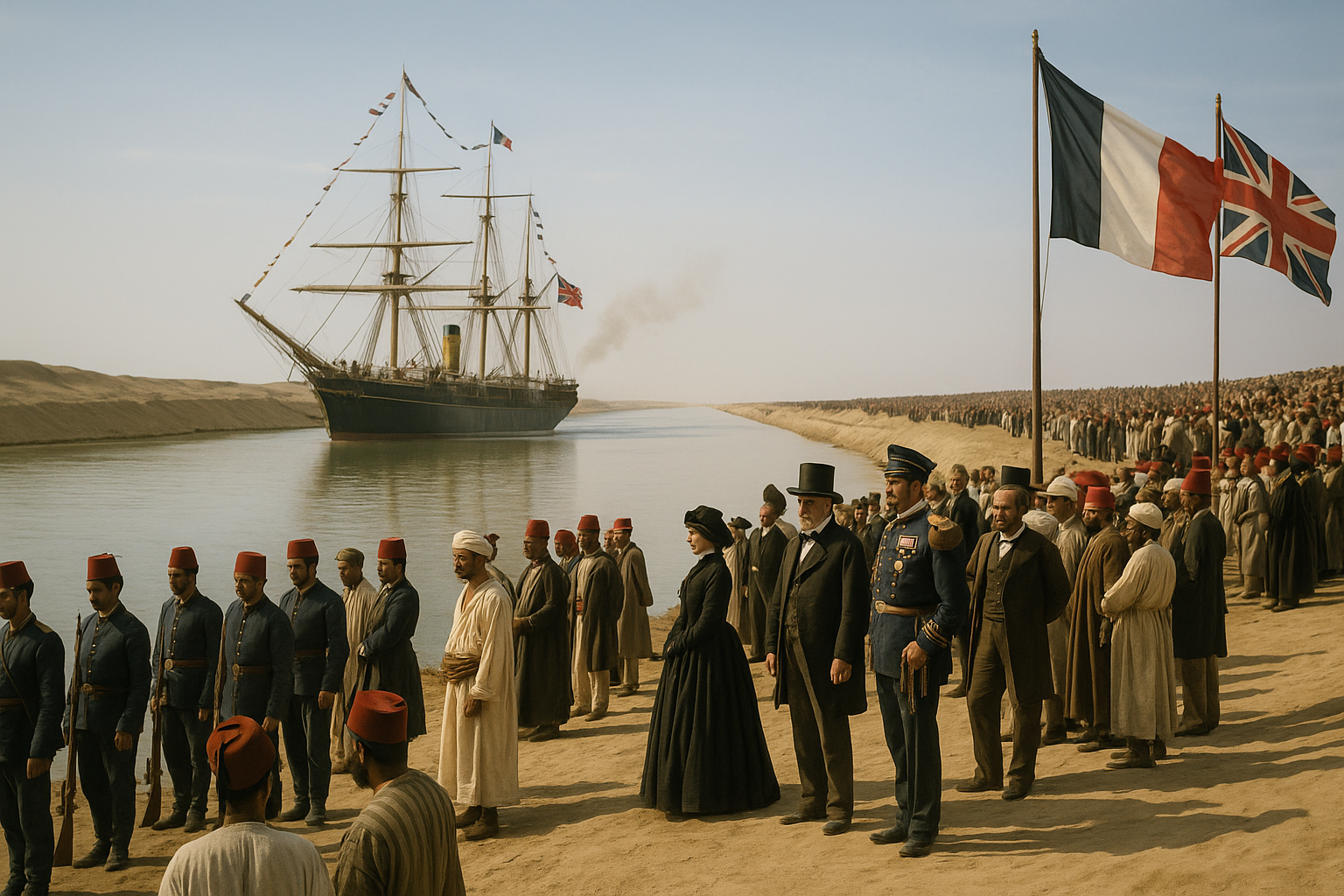
On a bright November day in 1869, the bitter Mediterranean breeze mingled with the anticipation that weighed over the canal banks at Port Said. Royal barges bobbed beside humble Egyptian fishing boats. Distant cannon salutes thundered out to sea. The opening of the Suez Canal—this slender, freshly carved waterway—would reshape not only Egypt but the world, chaining together distant empires and forever redrawing trade, diplomacy, and power across three continents. Behind this singular event pulsed decades of ambition, negotiation, and the vision of a handful of determined individuals, each with their own stake in the world’s new gateway.
Dreams on Desert Sand: The Genesis of the Canal
The notion of connecting the Mediterranean and Red Seas had haunted human imagination since antiquity—pharaohs and Roman emperors alike weighed the possibilities. But the 19th century, with its spirit of engineering and empire, turned this dream into an irresistible obsession. Into this moment stepped Ferdinand de Lesseps, a French diplomat whose charisma proved as effective as his engineering optimism. De Lesseps forged a partnership with Egypt’s reform-minded Khedive, Said Pasha, in the 1850s.
The project was as technically audacious as it was politically fraught. Suez would not wind along a river valley: it would cleave through arid plain, unstable sand, and brackish lakes. Thousands of Egyptian peasants—corvée laborers—swung pickaxes under punishing sun, digging the early stretches by hand. Later, with European machinery and investment, vast dredgers took over. Quietly, the canal zone became a microcosm of Egypt’s struggle: between innovation and exploitation, between Europe and Egyptian identity. A detailed book on de Lesseps motives and enthousiasm can be read in the book from the hand of Daryl B. Spencer: Suez Canal.
Diplomacy and Discord: Navigating International Waters
As the canal’s outline formed in the sands, so too did the shadow of international rivalry. France, buoyed by de Lesseps’s vision, supplied critical finance and technical expertise, envisioning Suez as a lever to restore its standing in the Near East. The British, ever wary, eyed the canal with suspicion. Their commercial empire pulsed through sea lanes that rounded Africa—a route soon to be threatened by this shortcut.
The Ottoman Empire, Egypt’s official overlord, oscillated between support and alarm. Even among Egyptians, the project became a symbol not just of progress, but of foreign dominance over native land. As completion neared, the British pressed Egypt to guarantee rights of passage, resulting in a series of tense diplomatic maneuvers. The eventual internationalization of canal access—enshrined in the Convention of Constantinople in 1888—would guarantee open passage, but only after decades of wrangling and, eventually, British control.
The maneuvering around Suez mirrored the complexities of the age—imperial ambition, nationalism, and the realities of an era in which technology would often sprint ahead of stable politics. The precedent of intense negotiation around a critical maritime artery foreshadowed future international flashpoints, such as those surrounding African colonial frontiers.
The Grand Opening: Ceremony and Consequence
On November 17, 1869, the canal was ready to receive its first formal procession. The Khedive, joined by European royals—most notably Empress Eugénie of France—hosted what became the social event of the century. Ornate yachts and naval vessels, festooned with flags and more than a touch of imperial posturing, traveled from Port Said to Suez. For Egypt’s elite, this was a moment of hope and pride; for de Lesseps, it was vindication, immortalized in the frenzied reporting of European newspapers.
Beneath the spectacle, the human costs of the achievement were evident, if unacknowledged. Early construction had claimed thousands of Egyptian lives. Political cost too was mounting: Egypt’s escalating debt, incurred from modernization efforts, would soon place the country’s finances—and eventually its very sovereignty—under European control.
The event’s symbolism echoed far. The Suez Canal represented an age when the globe was being inexorably bound together by engineering marvels: the canal’s completion happened only a few months after the golden spike was driven home on America’s transcontinental railroad. Both events heralded a world in which distance bowed before innovation and investors watched as the map was redrawn.
Immediate Impact: Trade, Power, and New Tensions
Even before the last celebratory cannon faded, the Suez Canal began recalibrating global trade. The journey from London to Bombay shrank by more than 4,000 miles, a transformation not only in miles but in power. British steamships quickly became the canal’s main traffic, even though Britain had been a reluctant supporter. Ships of every European nation soon threaded the new passage alongside Indian dhows and Ottoman brigs.
This shift carried enormous economic benefits but also heightened tensions. For Egypt, the canal brought prestige and revenue, but also intrusive foreign oversight. Within a decade, British troops occupied the canal zone, rationalized by the need to “safeguard” the waterway. The canal was now a bargaining chip in great power rivalry, a flashpoint as visible in the 20th century’s Suez Crisis as it was in these heady first years.
The Suez Canal also had a profound impact on regional economies, particularly those of adjacent port cities. Alexandria, once a vital commercial hub, had to adjust to new trade flows and competition from Port Said and Suez itself—much like other Mediterranean towns reeling from altered currents of commerce due to technological and political change. These shifting port dynamics can be compared with the earlier transformation seen in Hanseatic trading cities when northern Europe’s maritime landscape was similarly upended by new centers of gravity.
The Canal’s Enduring Legacy
The Suez Canal’s legacy is as deep as the channel itself. Though claimed by Egypt, it has been fated always to serve the world, at the fulcrum of East and West. Its strategic centrality sparked multiple confrontations—from colonial occupation to Cold War brinkmanship—demonstrating how infrastructure can become destiny.
On a more intimate scale, the canal altered the daily rhythms of the people along its banks: new jobs, new dangers, new encounters. Both a marvel and a cautionary tale, its opening signaled how the ambitions of engineers, diplomats, and financiers could reshape societies and spark both connection and conflict. And, as history shows, wherever ships pass in convoy, the eyes of distant chanceries and boardrooms soon follow.
Today, the Suez Canal remains one of the world’s most vital arteries, its banks lined not only with history but with the echoes of that first, jubilant passage in 1869—a rare moment when spades, strategy, and spectacle realigned the map, and the destiny of nations bent around a man-made sea.