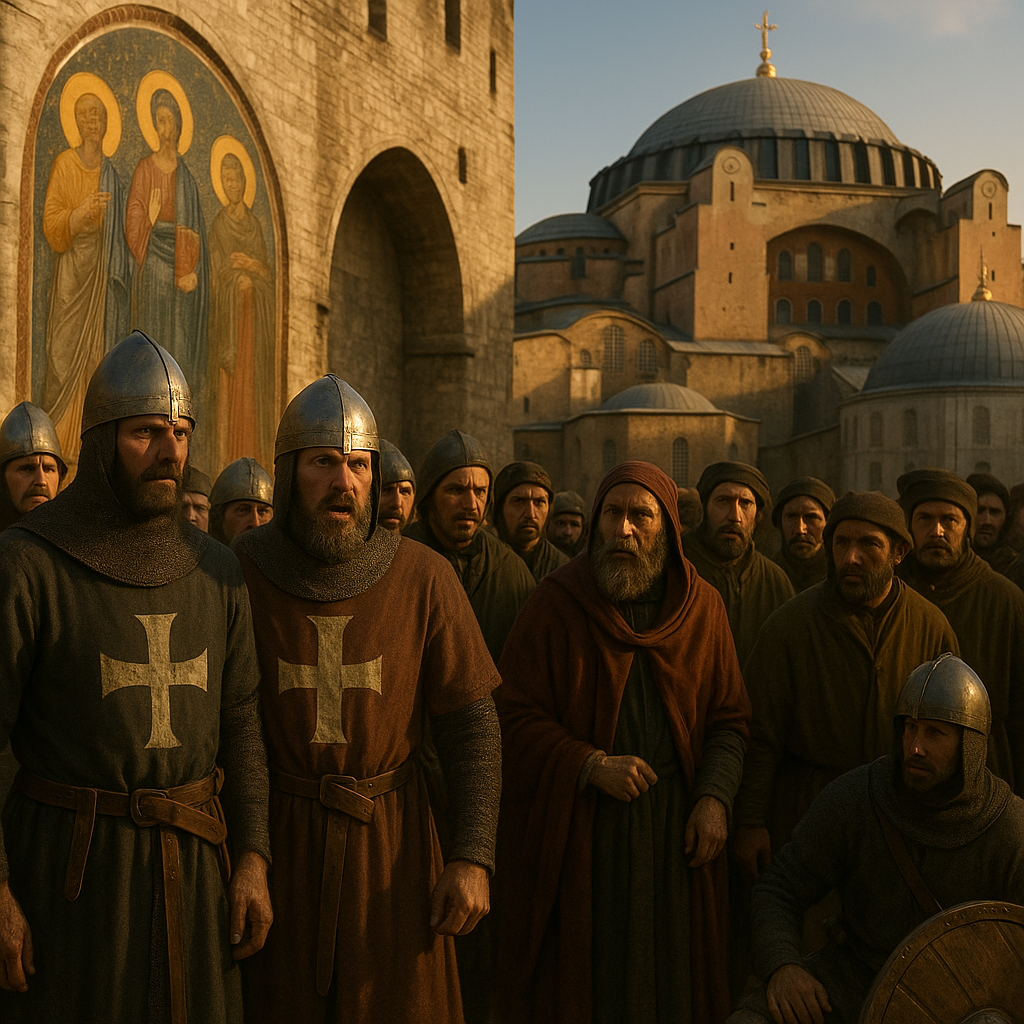
The Fourth Crusade, launched at the dawn of the 13th century, promised to reclaim the Holy Land from Muslim control. Instead, it ended in one of the most shocking and consequential episodes of medieval history: the sack of Constantinople in 1204. This crusade, initially intended as a military expedition to Jerusalem, diverted dramatically to attack and plunder the Christian capital of Byzantium, leaving a lasting scar on East-West relations and altering the course of the medieval world.
The Origins of the Fourth Crusade
By the late 12th century, the Christian hold on the Holy Land was precarious. The fall of Jerusalem in 1187 to Saladin galvanized Pope Innocent III to call for a new crusade in 1198. His vision was ambitious, urging knights of Western Europe to rally once more to the cause of reclaiming sacred lands. However, unlike previous crusades, this campaign quickly faced logistical and political hurdles.
Relying heavily on Venetian maritime power for transport, the crusaders made an initial agreement to pay Venice a significant sum for fleet provision. The lack of sufficient funds among the crusaders forced a series of debts and compromises that would have grave consequences for the campaign’s direction.
The Venetian Agenda and the Diversion to Zara
Venice, at the height of its economic power, saw the crusade as an opportunity not only to secure commercial dominance but also to settle local political scores. When the crusaders could not pay the agreed price, Venetian leaders proposed a detour to the Christian city of Zara (modern-day Zadar), which had rebelled against Venetian control.
The crusader army agreed to this assault despite the moral implications of attacking a Christian city, especially one under papal protection. The siege of Zara in 1202 was brutal, leading to its capture and intensifying tensions with the papacy, which initially excommunicated the crusaders and Venetians involved.
The Intrigue of Byzantine Politics
It was at this crossroads that Byzantine internal politics drew the crusaders further off course. Alexios IV Angelos, a son of the deposed Byzantine emperor Isaac II, sought to regain his family’s throne. In exchange for his restoration, Alexios promised the crusaders vast riches, military support, and the submission of the Eastern Orthodox Church to Rome.
This proposition was tempting for the financially strained crusaders. They agreed to divert to Constantinople and reinstate Alexios IV, hoping to solve their monetary problems and strengthen their cause. Arriving at Constantinople in 1203, they installed Alexios IV as co-emperor alongside his blinded father.
The 1204 Sack of Constantinople
Despite initial cooperation, the new emperor failed to fulfill his promises. His inability to pay the crusader debts and growing discord between the population and the Latin forces led to escalating tensions. In early 1204, Alexios IV was overthrown and executed, prompting the crusaders to take drastic measures.
The assault on Constantinople in April 1204 was catastrophic. For three days, crusaders and Venetian forces pillaged the city, looting churches, palaces, and homes. Artistic treasures, religious relics, and immense wealth were seized. The city’s population was subjected to violence, and its infrastructure devastated.
The sack marked not only the physical destruction of one of Christendom’s greatest cities but also the deepest rupture between the Eastern Orthodox and Roman Catholic worlds. The establishment of the Latin Empire in Constantinople further fragmented Byzantine power and hastened its eventual decline.
The Aftermath and Long-Term Impact
The immediate consequences were the creation of a Latin regime in Constantinople that lasted until 1261, alongside the fragmentation of the Byzantine Empire into successor states such as the Empire of Nicaea. The sack deepened cultural and religious divisions, hardening distrust between East and West that persists to this day.
Beyond the political fallout, the looting dispersed priceless works of Byzantine art and manuscripts across Western Europe, influencing Renaissance art but also representing a cultural loss for Byzantium. The weakening of Byzantine power opened the door for the eventual Ottoman conquest in the 15th century.
The Fourth Crusade’s fate serves as a cautionary tale of how financial pressures, political intrigue, and shifting allegiances can derail noble causes, turning holy wars into devastating internecine conflicts.
Conclusion: A Lost Opportunity for Christian Unity
The Fourth Crusade remains one of medieval history’s most tragic ironies. Rather than reclaiming the Holy Land, the crusaders destroyed a Christian empire, compromising the broader goals of Christendom. The sack of Constantinople not only reshaped the geopolitical map but also fractured the Christian world, influencing centuries of religious and political relations in Europe and the Near East.
This event highlights the complexities and unintended consequences of crusading zeal. Its legacy endures in how history remembers the fragile balance of power and faith in medieval Europe, underscoring a turning point where the line between crusader and conqueror irrevocably blurred.
the broader context of crusader expeditions