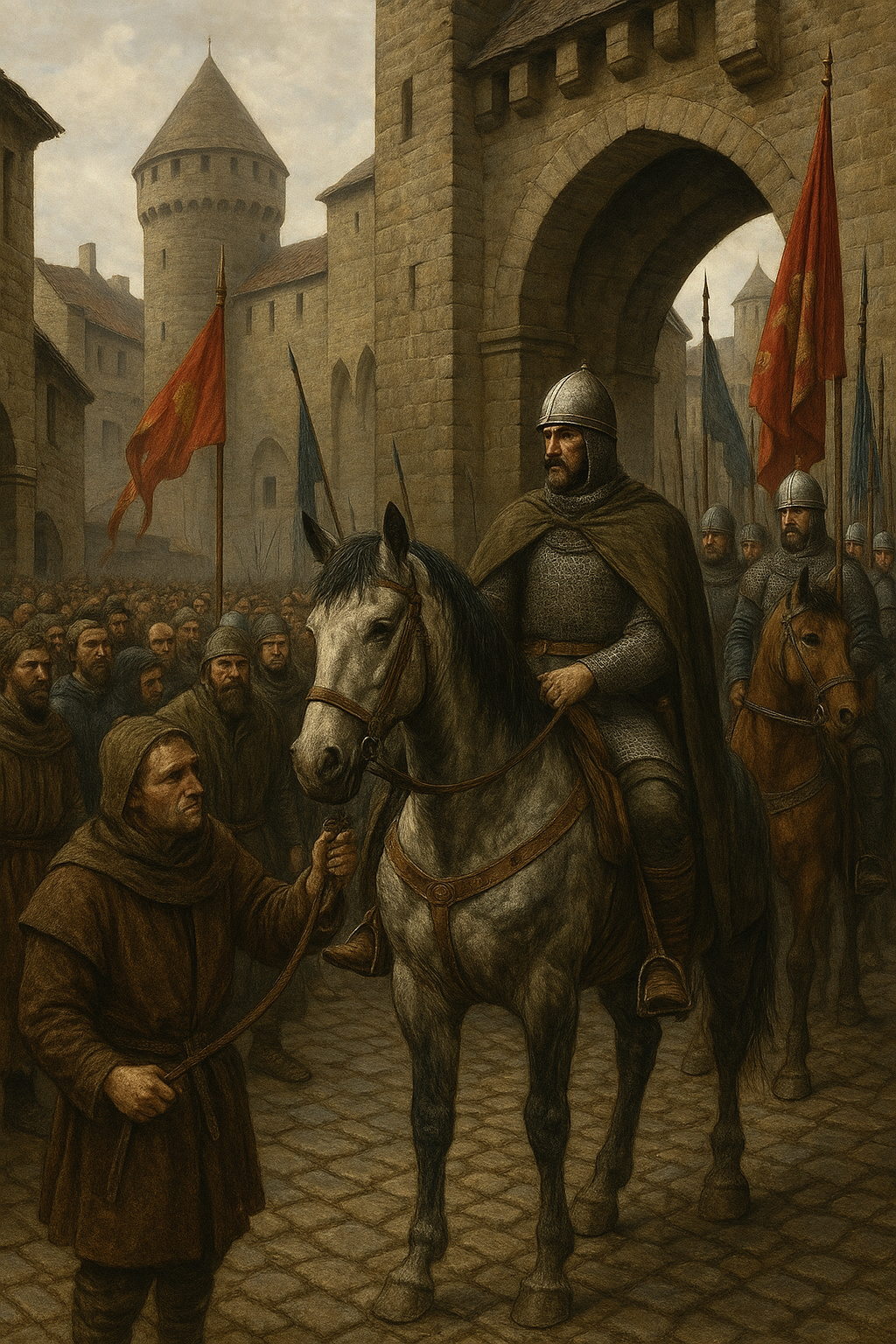
In the heart of medieval Europe, the thunder of hooves heralded not just approaching armies, but seismic shifts in social hierarchy, military strategy, and political power. Between 900 and 1300, the selective breeding and spread of powerful warhorses transformed the face of European warfare, embedding the mounted knight at the core of feudal society. Much more than mere livestock, horses—through deliberate breeding, acquisition, and cultural valorization—became both the engine and the emblem of military and political change, with consequences felt from the Scottish borders to the plains of Hungary.
The Rise of Specialized Horse Breeding
While horses had long played a role in European society, the period after 900 saw a deepening sophistication in equine breeding. Medieval lords, abbeys, and even monarchs invested in stud farms dedicated to producing powerful destriers and agile coursers, horses bred specifically for the rigors of mounted combat. This was not simply a continuation of ancient traditions, but a response to rapidly evolving military demands. The disruption wrought by Viking raids and Magyar incursions in the 9th and 10th centuries highlighted the limitations of infantry-heavy armies; mobile cavalry units, supported by robust horses, offered a dramatic tactical advantage on the battlefield.
The resulting focus on selective breeding led to the refinement of traits such as strength, endurance, and, crucially, temperament—creating animals capable of bearing armored riders into the chaos of war. Records from Carolingian and Capetian France reveal the careful management of bloodlines and investment in imported stock from Spain and beyond. By the 12th century, sophisticated trade routes were established for horses, and horses were among the costliest and most symbolically charged commodities in Europe.
Structural Change in Feudal Society
Horse breeding’s impact reached far beyond the paddock. The expense of acquiring and maintaining a trained warhorse effectively raised the barrier to entry for military service, deepening the division between mounted nobility and unmounted commoners. In this way, the social order of feudal Europe became intimately tied to the horse: only those wealthy enough to sustain such animals could claim knightly status and the associated privileges. Landholding itself was increasingly justified on the basis of “knightly service”—a military obligation that presumed equestrian readiness.
This structural shift became encapsulated in the feudal ethos, with obligations of loyalty, service, and vassalage revolving around mounted warfare. Castles and estates across Europe invested in building stables and pastures suited for breeding, reflecting a society being literally reshaped to sustain its new warrior elite. Monasteries, too, played a surprising role: many ran important breeding facilities, ensuring that even the Church was entangled in the politics of horsepower. The equestrian revolution thus shaped both military structures and the very fabric of social stratification during these centuries.
Warhorse and Innovation: Military Consequences
The development of bred warhorses coincided with, and enabled, a suite of technological innovations in European warfare. The widespread adoption of the stirrup, high-backed saddles, and reinforced horseshoes unlocked the devastating force of the “mounted charge”—a dense shock assault that could scatter infantry formations. Early medieval chroniclers narrate the psychological and physical impact of these assaults: the sight of armored cavalry, astride massive destriers, became a symbol of feudal invincibility.
Crucially, these changes were not static. As European armies encountered new enemies—especially during the Crusades—breeding priorities shifted again. Exposure to lighter, faster eastern horses led to crossbreeding and the rise of the destrier’s agile counterpart, the palfrey. This blending of bloodlines allowed for greater tactical flexibility, informing both warfare and the mythos of knightly chivalry. The technological and biological arms race on European soil spurred continuous social and military adaptation, echoing transformations seen alongside, for instance, the hydraulic and technological advancements described in The Ingenious Waterwheel: Technological Innovation and Social Change in Medieval Islamic Spain.
Political and Economic Ramifications
Beneath the clashing lances, horse breeding drove profound political and economic transformations. Monarchs’ attempts to assert control over horse breeding and distribution often mirrored their broader efforts to centralize authority. Royal stud farms became vital assets, their success—or failure—impacting the balance of power within kingdoms. The Norman Conquest of England in 1066, for example, was not solely a triumph of will or tactics, but of equestrian logistics: the carefully planned importation of horses from Normandy played a key role in enabling William the Conqueror’s decisive cavalry tactics. This episode highlights how horse breeding became entwined with long-term political ambitions, as explored in The Norman Conquest of 1066: How William the Conqueror Reshaped England.
The economic impact of the equine arms race was equally profound. Horses required vast tracts of pasture, skilled labor for training and grooming, networks of merchants and artisans to supply saddles and armor, and veterinary knowledge spread through both lay and monastic channels. The demand for quality horses spurred cross-border trade, as well as competition and collaboration between different regions and elites. In many respects, the “horse economy” became a hidden backbone of feudal prosperity and expansion.
Horse Breeding, Crusades, and Cultural Exchange
The high medieval centuries were marked by a surge in east-west contact, most dramatically through the Crusades. As knights and lords journeyed to the Holy Land, they encountered breeds, tack, and riding techniques foreign to Europe—units of lithe Turkish and Arab horses, renowned for their stamina and speed. The return of European crusaders sparked a fresh wave of crossbreeding experiments, seeking to blend eastern agility with western strength.
This movement of horses and expertise cannot be viewed in isolation. It was interconnected with other flows of technology, information, and finance, as seen with the rise of military orders and their extensive banking and logistical networks discussed in The Templars’ Banking Network: Finance, Trust, and Power in Medieval Europe. The equestrian dimension of the Crusades thus spurred not only the development of new breeds but also a broader reconfiguration of European warfare and culture—heralded in everything from Arthurian romance to illuminated manuscripts depicting legendary steeds.
Societal Impact: Myth, Status, and Mobility
Perhaps nowhere was the influence of horse breeding clearer than in the shifting landscape of status, symbolism, and mobility. The horse became an omnipresent icon in the art, literature, and self-image of medieval Europe. Possession of a destrier or palfrey was a matter of both strategic necessity and social prestige. Tournaments and pageants featuring knightly displays reinforced the association between chivalric identity and mastery of the warhorse—entrenching the equation of horsemanship with noble virtue.
However, these changes also reinforced barriers of exclusion. The cost of keeping even a single warhorse was often beyond the reach of poorer knights or lesser landholders. Across Europe, guilds, laws, and traditions evolved to demarcate who could own, breed, and display valuable horses, sometimes reflected obliquely in medieval social regulation. Horse breeding thus became a powerful agent of both social ascent and exclusion, codifying privilege while offering rare opportunities for upward mobility where a talented rider or breeder could win favor at court.
Conclusion: The Legacy of the Equestrian Revolution
The period between 900 and 1300 witnessed the weaving of the horse into the very sinews of European life. Selective breeding and escalating demand for capable warhorses transformed not only the practice of warfare but also the structures of feudal society, the alignment of political power, and the rhythms of rural economics. The legacy of this equestrian revolution would endure through the late medieval period, carrying into the ranks of the Crusaders at Acre, the knights of Agincourt, and the great orders that helped finance and administer an increasingly interconnected world.
While the rise of gunpowder and mercenary armies in later centuries would eventually eclipse the supremacy of the mounted knight, the transformation of warfare and society sparked by medieval horse breeding remains foundational to our understanding of both the violence and the vitality of the Middle Ages. The hoofbeats that once shook European fields echo still, not only in histories of battles and kingdoms, but in our very imagination of what it meant to be medieval.