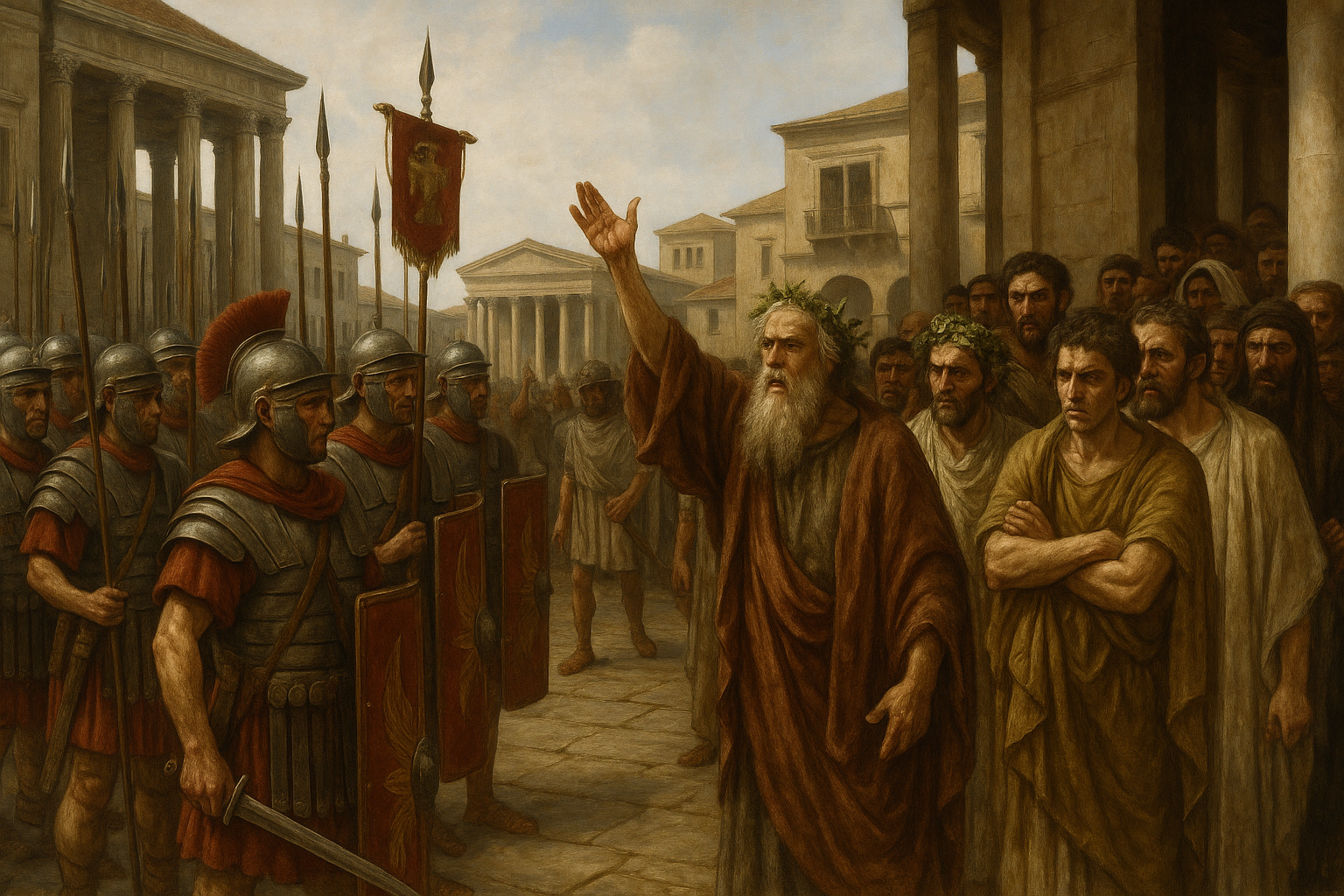
In the last centuries before the rise of the Roman Empire, Sicily was a place of competing identities, imperial ambitions, and clandestine religious struggle. The Dionysian cult, with its intoxicating blend of ecstatic rituals and secretive gatherings, did not simply cater to the spiritual yearnings of the island’s population. It also provided a powerful institutional base from which priests and local elites could challenge—sometimes violently—the order imposed by Rome. The resulting tension between cultic authority, senatorial power, and provincial governance in late Republican Sicily produced an extraordinary episode of political instability and provincial revolt, with far-reaching consequences for how authority was negotiated in the ancient Mediterranean.
This article delves into the specific ways the Dionysian cult intersected with the power structures of Sicily during the 2nd and 1st centuries BCE. It explores how the priests, far from being merely spiritual leaders, became central players in local governance, social resistance, and—ultimately—insurrection. By examining the cult’s deep roots, its explosive growth, and Rome’s often brutal response, we uncover a story of religious conflict, provincial desperation, and the challenges facing imperial control in the ancient world.
The Dionysian Cult: Structure, Priests, and Political Meaning
The Dionysian cult, originating in Greece and spreading throughout the Hellenistic world, found particularly fertile ground in Sicily. While its ecstatic processions, theatrical performances, and wine-soaked rituals were celebrated, what truly set the cult apart was its organizational sophistication. The cult was structured into tight-knit thiasoi (associations), each overseen by priests or priestesses responsible not only for spiritual rites, but also for the administration of communal funds, legal disputes among members, and the enforcement of social norms. In Sicily, where local identities were already resistant to outside dominion, these priestly leaders wielded significant influence over their followers and frequently mediated between the populace and distant Roman authorities.
The priests of Dionysus became integral to provincial society, accumulating patronage networks that included free citizens, rural laborers, and even enslaved people. Such breadth meant the cult became a counterweight to Roman attempts at direct elite rule. For the Sicilian poor, especially those disenfranchised by wealthy Roman landholders, the Dionysian associations provided solidarity and a sense of justice often missing from provincial administration. More than mere ritualists, the cult’s priests became local patrons, arbitrators, and sometimes agitators against the injustices of the Roman tax and land system.
Roman Rule and Sicilian Discontent
When Sicily became Rome’s first province in 241 BCE, it ushered in an era of new taxes, pressures on landholdings, and the influx of Roman settlers and administrators. While some urban elites adapted, much of the rural population suffered at the hands of absentee landlords and corrupt local officials, producing endemic resentment. Roman control depended on collaboration with select segments of the population, while bypassing or marginalizing the traditional power bases—such as those provided by local religious structures.
This marginalization only intensified discontent. Priests and cult associations, with their grassroots reach, became alternative nodes of social support and resistance. In times of food shortage or protest against Roman exactions, it was not uncommon for the Dionysian thiasoi to organize local assemblies, distribute relief, and even shield members from arbitrary arrest. The fact that these networks operated largely in secrecy—and invoked a higher religious law—frustrated Roman authorities who saw them as potential sources of disorder, if not outright subversion.
The Bacchanalian Crisis and Suppression
The explosive growth of Dionysian associations across Italy and Sicily alarmed Roman magistrates. In 186 BCE, the Senate issued the famous senatus consultum de Bacchanalibus, a decree that attempted, with limited success, to suppress the cult across the peninsula. The decree regulated the number of initiates, limited the gatherings of cult associations, and required that all meetings receive senatorial approval. Roman authorities in Sicily, acutely aware of the cult’s power among the disenfranchised, enforced these restrictions with special zeal.
Yet the ban also radicalized elements within the movement. The secrecy that protected cult gatherings became a channel for open dissent. Priests who once offered community counsel became clandestine organizers, providing networks for storing weapons, circulating messages, or sheltering fugitives. The tension between Rome’s fear of secret societies and the cult’s own traditions of initiation and secrecy mirrored, in many ways, what would later appear in other episodes of religious or social repression—see, for instance, the role of religious authority in Hellenistic religious politics and the state-sanctioned anti-heresy campaigns chronicled in examples of later religious trials.
Cult, Revolt, and Provincial Violence
The landscape of late Republican Sicily was increasingly volatile, marked by a series of revolts and insurrections, the most famous being the two servile wars (135–132 BCE and 104–100 BCE). While these uprisings were principally driven by the island’s vast enslaved population, the Dionysian cult—sometimes explicitly blamed by Roman chroniclers—provided the spiritual and organizational underpinnings for resistance. Cult associations, whose rites blended ecstatic liberation with visions of cosmic justice, attracted desperate followers. In these moments, priests played dual roles: invoking Dionysus’s power in secret rituals and facilitating communication and coordination among disparate rebel groups.
Though direct evidence is often tinted by the polemics of Roman historians, there is little doubt that the cult’s networks played a crucial part in challenging Roman authority. The senatorial response—often brutally suppressive—targeted not just ringleaders of open revolt, but also priests suspected of fostering unrest. As seen in other periods of provincial crisis, such as the systemic unrest described in case studies of imperial vulnerability, the inability of central authorities to control local religious institutions proved destabilizing.
Roman Strategies: Repression, Co-optation, and Institutional Change
Unable to destroy the Dionysian cult outright, Rome instead adopted a dual strategy of repression and co-optation. On the one hand, Roman magistrates and governors redoubled their surveillance, used informants, and imposed harsh penalties on unauthorized gatherings. Priests were arrested, exiled, or—in extreme cases—executed as warnings to others. On the other hand, Rome sought to bring public religious practices under the umbrella of state ritual, attempting to siphon authority away from the independent thiasoi and concentrate it in officially sanctioned temples or festivals.
This effort to politicize and regulate local religion was fraught with difficulty. Many Sicilian elites, both Roman and indigenous, maneuvered to position themselves as intermediaries, trying to benefit from both Roman patronage and the prestige of local cults. In some towns, the state attempted to incorporate Dionysian rites into official civic calendars (albeit in a tamed form), hoping ritual spectacle would replace dangerous secrecy. The underlying challenge—how to police the boundaries between loyalty and heresy, religious practice and rebellion—remained unresolved, as can be seen in numerous other historical episodes including the attempts to manage church-state relations traced in controversies over religious authority.
Conclusion: Legacy and Long-Term Consequences
The crisis of the Dionysian cult in late Republican Sicily provides a striking glimpse into the power of religious institutions to shape—and destabilize—provincial societies under imperial rule. Far from being a simple episode of superstition or moral panic, the struggle between the cult and Roman authority was deeply intertwined with questions of local citizenship, class struggle, and the limits of centralized power. The priests, as both spiritual and political actors, forged networks that transcended official boundaries and fueled resistance in times of crisis.
The legacy of these conflicts continued to echo through later Roman policy. Lessons learned in Sicily would inform the empire’s strategies for dealing with other potentially subversive religions, from Christianity to the various Eastern cults encountered in the imperial period. More broadly, the cult’s story highlights the persistent ambiguities in how ancient societies balanced religious legitimacy and political loyalty—an ongoing tension at the heart of imperial power. In Sicily, as in so many other places, the interplay between priests and power could turn the rituals of the divine into sparks of political revolt.