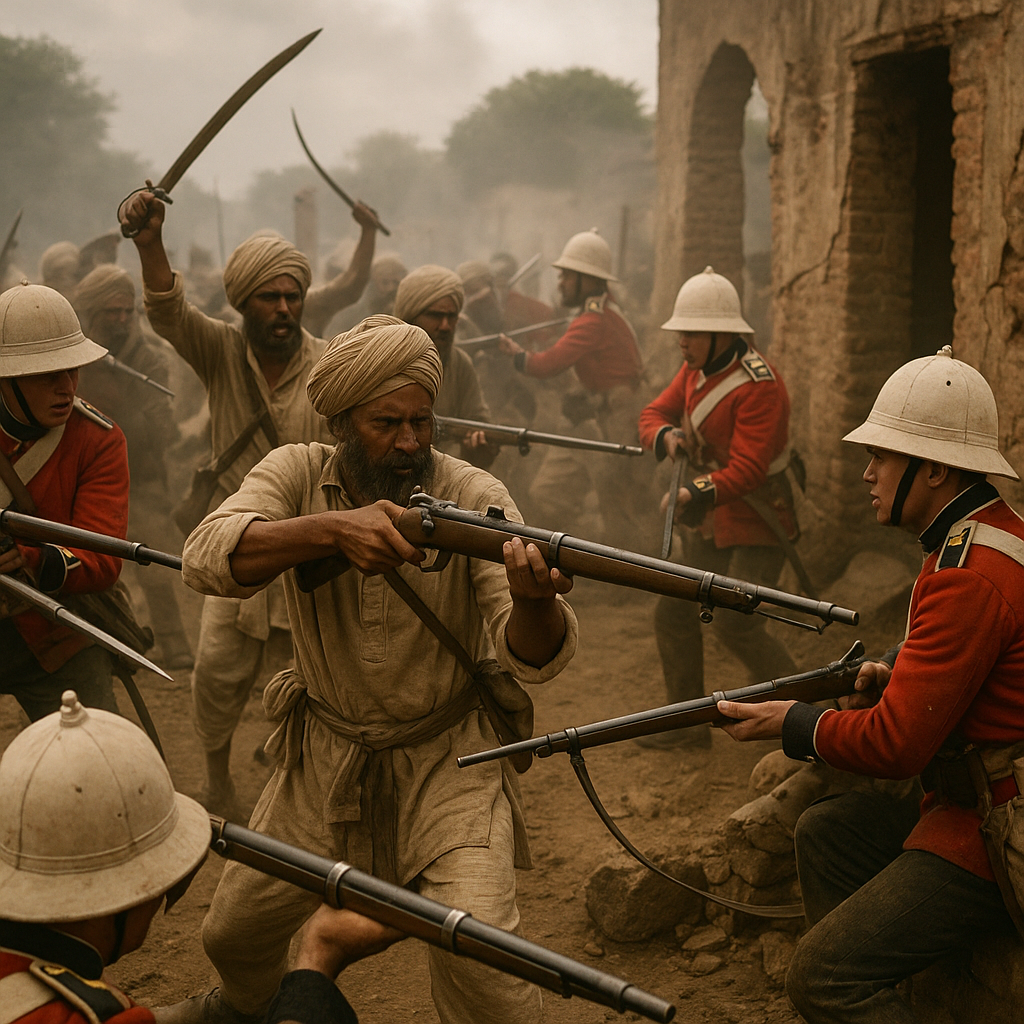
The British Raj in India rested on fragile foundations — alliances with Indian princely states, a strategic military order, and an aura of invincibility. In 1857, this intricate system fractured in Northern India. The Sepoy Mutiny, also known as the First War of Indian Independence or the Indian Rebellion of 1857, did not merely erupt as a spontaneous expression of popular anger but as a complex, cascading crisis in political and military authority. Its crackling onset in the cantonments of Meerut and its spread through Delhi, Awadh, and other centers dramatically exposed the vulnerabilities at the heart of the colonial regime.
Though ultimately suppressed, the rebellion forced British authorities to confront the limits of their control and prompted a sweeping transformation of the Indian political system. For observers at the time, and for historians ever since, the Sepoy Mutiny demonstrated not only the precarious position of imperial institutions in the face of mass unrest but also the intricate dynamics of loyalty and power that shaped the fate of empire in the modern world.
Fault Lines in Imperial Rule: Political and Institutional Tensions
The Company Raj’s authority in India was both institutional and ideological. The British East India Company wielded sovereign powers — collecting taxes, enforcing legal codes, and fielding armies — yet its dominance required the co-option of local rulers, the loyalty of sepoy regiments, and the manipulation of civil administration. Beneath this ordered surface simmered profound tensions, especially in the ethnically and religiously diverse north.
By the 1850s, years of annexations and ‘reforms’ — including the infamous Doctrine of Lapse, which allowed the Company to annex princely states lacking a direct heir — alarmed both local elites and the regular soldiery. Many sepoys were drawn from high-caste Hindu and Muslim communities of Awadh and Bihar, regions now abruptly subject to new land revenue policies, British courts, and infringements upon traditional privileges. The Company’s attempts at legal ‘rationalization’ disrupted existing patronage networks, alienating influential landholders and religious leaders alike.
Moreover, the army itself was an uneasy organism. Its European officers often misunderstood or disregarded the customs and concerns of their Indian subordinates. Pay disparities, restrictions on promotion, and a rigid disciplinary order had bred quiet discontent. But the British, confident in their technological superiority and the vaunted stability of their ‘martial’ institutions, failed to grasp the structural weaknesses beneath the routine of the parade ground.
Sparks and Spreading Flames: The Outbreak and Escalation
The immediate trigger for the crisis came in March–May 1857, when sepoys, forced to use new Enfield rifle cartridges rumored to be greased with cow and pig fat, refused the cartridges en masse. The issue, seemingly trivial to British minds, was in fact incendiary for troops whose caste and religious identities were at stake. The Company’s reaction — dismissals and public punishments — only intensified grievance. On May 10 in Meerut, sepoys mutinied, killed British officers and civilians, and marched to Delhi, where they declared allegiance to the aging Mughal emperor Bahadur Shah II.
The military sequence rapidly unraveled Company control across Northern India. The ‘Mutiny’ was never simply a soldiers’ revolt; it evolved into a broader social upheaval as disaffected landlords, dismissed princes, urban notables, and peasant insurgents joined or exploited the rebellion. The existing political order proved unable to contain cascading outbreaks from Kanpur to Lucknow, Allahabad to Jhansi. The Company’s administrative machinery, stretched thin, collapsed in key districts as magistrates and collectors fled or were killed, and communication lines severed.
British authority thus faced a stark reversal: the very Indian troops and intermediaries upon which power had depended became, in places, society’s most potent agents of destabilization. The web of trust that had bound the Raj’s military, fiscal, and judicial administration was decisively torn.
The Fragmentation of Authority: Collapsing Systems and Competing Powers
The Sepoy Mutiny exposed not just the weaknesses of the Company Raj but the layered complexities of political legitimacy in Northern India. With the British authority disintegrating in broad swathes, new centers of power emerged. Rebels often invoked symbols of past sovereignty — as in Delhi, where the Mughal emperor was anointed a figurehead, or in Awadh, where the ousted royal family regathered followers. Elsewhere, local strongmen, disbanded soldiers, and religious leaders tried to carve fiefdoms or seek redress for grievances. The administrative routines of land collection, law, and local order disintegrated, replaced by highly variable forms of self-organization or opportunism.
This fragmentation brought new dilemmas. Many cities and rural districts fell under neither firm rebel nor British control, but into chaotic contests of authority. In such liminal spaces, reprisals, plunder, and shifting alliances became the norm. British attempts to reassert power relied heavily on a patchwork of loyal regiments, Punjab infantry, Sikh and Gurkha battalions, and tenuous alliances with certain landholders and princely states who remained committed — for reasons of self-interest or mutual dislike of rebels — to the Company’s cause. These dynamics echo the fluctuating structures and loyalties seen in other moments of imperial crisis, such as the [The 1680 Pueblo Revolt in New Mexico and the Limits of Spanish Imperial Control], where central authority rapidly crumbled under pressure from within.
Simultaneously, the crisis revealed the absence of a single revolutionary program among rebels. There was no unified council, vision, or command. Despite sporadic coordination in defense and siege, most rebel leadership remained parochial, rooted in local social and political traditions. This patchwork of ambition, grievance, and improvisation — as much as British military recovery and brutal reprisals — ultimately prevented the emergence of a sustained revolutionary regime against British hegemony.
Restoration and Reinvention: The End of Company Rule
By late 1858, the British — employing a mix of military reinforcements, the exploitation of divided antagonists, and relentless punitive action — had recaptured Delhi, Lucknow, and the ‘rebel belt.’ But the shattering of authority in Northern India during 1857 was not so easily reversed. In the aftermath, the British government in London determined that the East India Company could no longer be trusted with imperial governance. The Government of India Act of 1858 abolished Company rule. The power to govern was transferred to the British Crown, with a new Secretary of State and Viceroy in India, centralizing authority in ways meant to preclude future mutiny or administrative chaos.
The mutiny and its aftermath set new patterns in political systems. The Crown sought both to solidify its direct rule and to safeguard against mass revolt by co-opting the Indian aristocracy and landed gentry, promising non-interference in religious and social customs, and reorganizing the army along ethnic lines to dilute mutinous potential. The notion of ‘martial races’ was institutionalized to favor minorities deemed loyal — Sikhs, Gurkhas, and Pathans in particular — in a calculated effort to engineer stability. In this sense, the post-1857 order foreshadowed both modern strategies of ‘divide and rule’ and the reflexive hardening of colonial administrative control in later imperial crises. A comparable pattern of institutional reengineering in response to revolt can be observed in [The Paris Commune of 1871: Revolution in the Heart of France], where nervous states confronted insurrection by reshaping political and security structures.
Legacy: Power, Memory, and the Fate of Empire
The institutional and political consequences of the 1857 Sepoy Mutiny echo far beyond the immediate military restoration of British power. The specter of rebellion haunted British imperial authorities for generations. New practices of intelligence-gathering, censorship, and authoritarian policing emerged from the trauma of 1857. At the same time, the rebellion’s memory — forcibly suppressed, yet cherished in Indian nationalist narratives — continually shaped debates over loyalty, authority, and the legitimacy of foreign rule.
In historiography, the mutiny’s enduring importance lies in how it revealed the fragility of even the most outwardly robust imperial regimes. The revolt’s anarchic violence and rapid institutional breakdown foreshadowed the lethal volatility lurking beneath supposedly stable colonial systems, offering a warning — and a lesson — that would echo throughout the modern world. The shattering of British authority in northern India marked more than a ‘mutiny’; it signaled the exposure, and ultimately the reconfiguration, of empire itself. Empires’ abilities to respond to such ruptures — as in [The Nika Riots of 532: Destruction and Renewal in Byzantine Constantinople] or [Divided Loyalties on the Steppe: The 14th-Century Golden Horde Succession Crisis and the Fragmentation of Mongol Rule] — depended on their willingness and capacity to recalibrate power structures in crisis.
Although the British Raj survived for another ninety years, the events of 1857 marked the beginning of its slow unraveling. The reengineered state that arose was in many ways more formidable, but also more brittle, haunted by memories of revolt, forced forever to reckon with the limits of imperial control. The 1857 Sepoy Mutiny thus stands as a defining episode in the history of colonial power, the dynamics of institutional fracture, and the enduring drama of authority in the modern era.