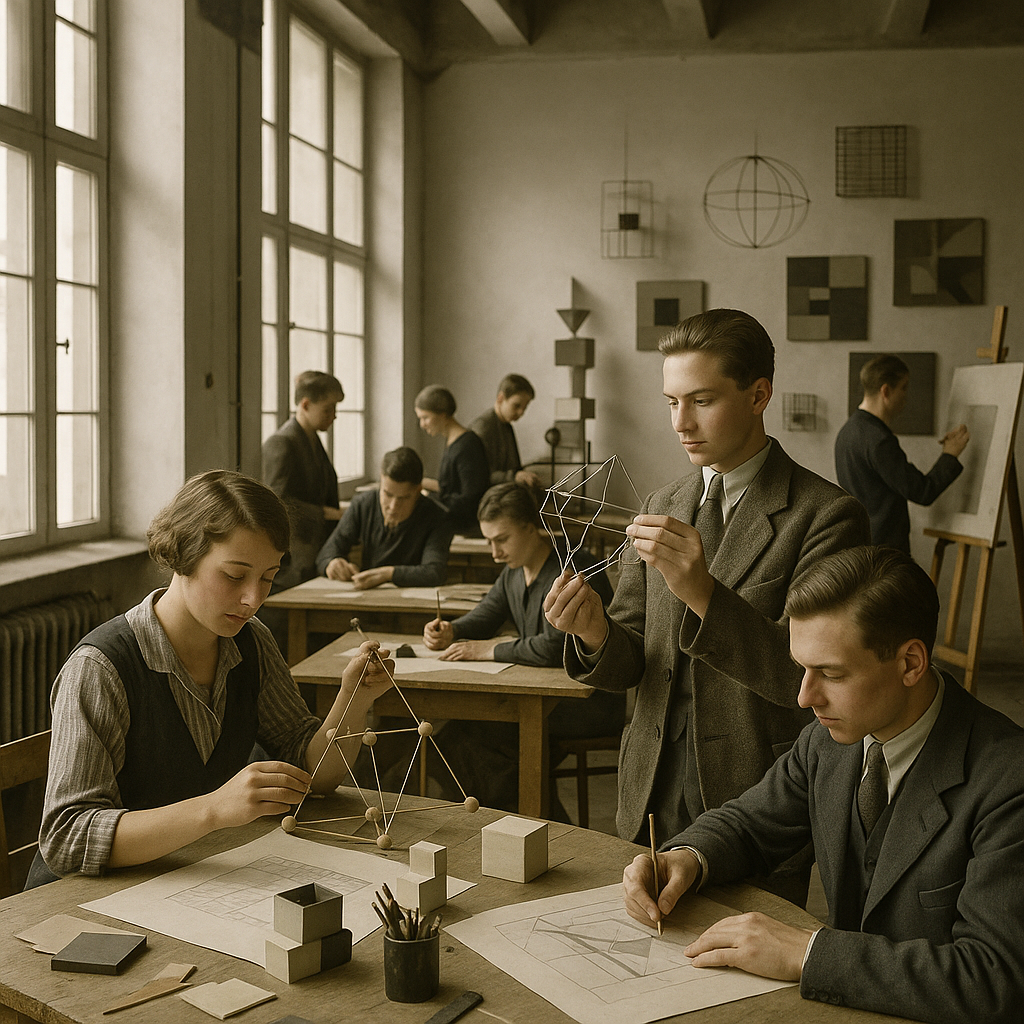
In the spring of 1919, amidst the social upheavals of postwar Germany, a daring institution opened its doors in the city of Weimar. The Staatliches Bauhaus, simply called ‘Bauhaus,’ was not merely a school, but a vision: a place where art, craftsmanship, and industry could merge to redesign how humans lived. Over a tumultuous fourteen years, Bauhaus attracted radical thinkers and architects, generated bold controversy, and deeply altered the global trajectory of design, architecture, and visual culture.
The Spirit of Bauhaus: A New Way of Seeing
Founded by architect Walter Gropius, the Bauhaus responded to the devastation of World War I by rejecting historicism and bourgeois excess. Gropius’s fundamental idea was that all arts, including architecture, sculpture, painting, and crafts, were equal—and should unite for the creation of functional, beautiful objects for everyday life. The school’s manifesto promised a radical break from old traditions; instead of ornate facades and showy flourishes, Bauhaus sought clean lines, rationality, and harmony with modern technology.
The early curriculum reflected these ideals. Students spent their first year in a Vorkurs, a foundational course led by charismatic artists Johannes Itten and later Josef Albers. Through hands-on exercises, they learned to see shapes, colors, and materials with fresh eyes, encouraged to experiment and collaborate. This approach, blending theory with tactile engagement, became the Bauhaus trademark and soon attracted avant-garde instructors such as Paul Klee and Wassily Kandinsky.
Weimar and Dessau: Creative Ferment and Political Tension
During its Weimar years, Bauhaus developed looms, stained glass, and distinctive handcrafted objects in workshops that blurred boundaries between fine and applied arts. As Germany’s political climate grew more hostile, driven by inflation and right-wing backlash, Gropius steered the school away from perceived ‘leftist’ and mystical leanings toward more standardized, industrial-friendly designs. When state funding fell under threat, Bauhaus relocated in 1925 to Dessau, finding new energy and a purpose-built campus.
The Dessau Bauhaus building, designed by Gropius, embodied the school’s credo—glass curtain walls, reinforced concrete, and open-plan spaces provided light-filled studios and communal living arrangements. In Dessau, Bauhaus forged strong ties with industry, creating modular furniture, sleek typefaces, and mass-producible lighting and textiles. Marcel Breuer’s tubular steel chairs and Wilhelm Wagenfeld’s table lamp stand as icons of the era—objects that seemed both futuristic and practical, accessible to the emerging middle class. The school also spilled into architecture, designing affordable housing blocks and urban layouts.
Faculty Mavericks and Student Life
Few institutions could boast such a roster of instructors: Gropius, Klee, Kandinsky, Lyonel Feininger, László Moholy-Nagy, and Ludwig Mies van der Rohe, to name a few. Each brought unique vision and artistry, leading workshops, giving lectures, and guiding public exhibitions. This melting pot fueled a lively campus culture. Students and teachers collaborated on designs for homes, toys, posters, ceramics, and even stage sets, breaking down class and disciplinary hierarchies. Bauhaus students wore utilitarian smocks and hosted legendary costume parties, their playful experiments influencing modern theater and photography.
While some instructors, like Klee, favored introspection and spontaneity, others, such as Moholy-Nagy, drove the embrace of machine aesthetics and mass production. Faculty debates between craft traditions and industrial modernity shaped not only Bauhaus products, but also the school’s identity as both a laboratory and a battleground for opposing ideas.
Among Bauhaus’ most famous designs were Breuer’s Wassily Chair and Marianne Brandt’s teapots—showcasing the seamless blend of function and art. These artifacts resonate with those interested in the legacy of Bauhaus architecture in modern design.
Suppression, Dissolution, and a Diaspora of Ideas
The school’s utopian ambitions made enemies. Bauhaus was entwined with both left-leaning politics and avant-garde ideals, exposing it to constant scrutiny by conservative parties and eventually the Nazi regime. In 1932, Dessau’s city council, dominated by Nazis, shut the school. Mies van der Rohe, the final director, attempted to keep the Bauhaus alive in Berlin as a privately run institution, but a year later, relentless pressure ended its operations for good.
Yet, Bauhaus did not vanish—it migrated. Many teachers and alumni fled Germany, carrying their methods and philosophy into exile. Gropius and Breuer left for the United States, Moholy-Nagy founded the New Bauhaus in Chicago, and Mies shaped the skyline of postwar America with his minimalist glass-and-steel towers. Thus, the Bauhaus generated not a single school, but a dispersed network that seeded modernism worldwide.
The spread of Bauhaus sensibility can be traced alongside developments such as the work of Le Corbusier’s urban planning approach, whose functional city layouts echoed many Bauhaus ideals on the intersection of architecture and daily life.
Legacy: The Bauhaus Aftermath and Enduring Influence
Though the original Bauhaus existed for only fourteen years, its approach to unifying art, industrial design, and technology became foundational to twentieth-century modernism. Its DNA is evident in everything from IKEA furniture and glass-walled skyscrapers to contemporary logos and city signage. Across continents and generations, form and function continue to dance the Bauhaus ballet.
Bauhaus also inspired new schools and movements, from Black Mountain College in the U.S. to the Ulm School of Design in postwar Germany. In the digital age, the Bauhaus emphasis on clarity, usability, and integration of technology remains as relevant as ever, a testament to the enduring power of visionary education and stubborn idealism.
The Bauhaus’s story—of creative risk, suppression, and global transformation—reminds us how a group of mavericks in postwar Germany radically reimagined what daily life, architecture, and even society itself could be.